RESEARCH PAPER

Mechanism of Houttuynia cordata in Preventing and Treating Enteritis Based on Network Pharmacology and Molecular Docking Technology

  • TAO Wenjing , 1 ,
  • XU Haohua 2 ,
  • FAN Qiwen 1 ,
  • ZHAO Na 1 ,
  • HUANG Jing 1 ,
  • CHEN Fang 1 ,
  • DU Encun 1 ,
  • GUO Wanzheng 1 ,
  • WEI Jintao , 1, *
Expand
  • 1 Key Laboratory of Animal Embryo Engineering and Molecular Breeding of Hubei Province, Institute of Animal Sciences and Veterinary Medicine, Hubei Academy of Agricultural Sciences, Wuhan 430064, China
  • 2 Hubei Hongshan Laboratory, College of Animal Science and Technology, Huazhong Agricultural University, Wuhan 430070, China
* associate professor, E-mail:

Received date: 2025-06-13

  Online published: 2026-01-13

Abstract

This study aimed to explore the mechanism of Houttuynia cordata in preventing and treating enteritis using network pharmacology and molecular docking technology. The active components of Houttuynia cordata were obtained through the Traditional Chinese Medicine Systems Pharmacology Database and Analysis Platform (TCMSP) and literature retrieval, the active component targets of Houttuynia cordata and enteritis targets were acquired from the Swiss Target Prediction and GeneCards databases, respectively, and the common targets were obtained. The protein-protein interaction (PPI) network analysis of the common targets was performed using the search tool for the retrieval of interacting genes/proteins (STRING) database, the gene ontology (GO) function and Kyoto encyclopedia of genes and genomes (KEGG) pathway enrichment analysis were conducted using the database for annotation, visualization and integrated discovery (DAVID). The active components of Houttuynia cordata-enteritis targets-signaling pathways network diagram was constructed using Cytoscape 3.7.1 software, and the molecular docking technology was used to verify the docking of the active components with the core targets. The results showed that Houttuynia cordata contains nine main active components, including isoramanone, kaempferol and quercetin et al, and 90 targets for preventing and treating enteritis were identified, and the core targets were interleukin 6 (IL6), serine/threonine protein kinase 1 (AKT1), tumor necrosis factor (TNF) and epidermal growth factor receptor (EGFR). The GO function enrichment analysis enriched 473 terms, including 347 biological processes, 55 cellular components and 71 molecular functions; the KEGG pathway enrichment analysis enriched 146 terms, primarily involving the phosphatidylinositol 3-kinase (PI3K)-protein kinase B (AKT) and TNF signaling pathways et al. The molecular docking results indicated that the active components of Houttuynia cordata could stably bind to the core targets, with the strongest binding ability observed between isoramanone and EGFR, kaempferol and TNF, quercetin and TNF. In conclusion, the active components of Houttuynia cordata, including isoramanone, kaempferol and quercetin can prevent and treat enteritis by targeting core targets such as IL6, AKT1, TNF and EGFR, and regulating the PI3K-AKT and TNF signaling pathways. This study provides a theoretical basis for the application of Houttuynia cordata in livestock and poultry production.

Cite this article

TAO Wenjing , XU Haohua , FAN Qiwen , ZHAO Na , HUANG Jing , CHEN Fang , DU Encun , GUO Wanzheng , WEI Jintao . Mechanism of Houttuynia cordata in Preventing and Treating Enteritis Based on Network Pharmacology and Molecular Docking Technology[J]. Chinese Journal of Animal Nutrition, 2026 , 38(1) : 693 -705 . DOI: 10.12418/CJAN2026.053

肠道不仅是营养物质消化吸收的核心场所,还是抵御有害物质和病原体入侵的关键屏障,对维持机体免疫平衡至关重要[1]。当前,畜禽集约化养殖中病原微生物[2]、饲养密度[3]、饲粮成分[4]、霉菌毒素[5]和热应激[6]等多种因素都会引发肠道炎症,降低营养物质吸收效率并诱发腹泻,导致生产性能下降,严重时甚至导致死亡,最终造成畜禽养殖效益降低。传统防治方法主要依赖抗生素和化学抗炎药,但长期使用易导致药物残留、细菌耐药性增强,并通过食物链威胁人类健康,其带来的环境污染问题亦不容忽视[7]。因此,开发绿色、安全、有效的饲料添加剂防治动物肠炎成为迫切需求。
鱼腥草(Houttuynia cordata)为三白草科、蕺菜属的多年生草本植物,主产于我国中部、东南部及西南部各省和自治区,在贵州、四川、云南、湖北、广西等地区均有分布,是一种兼具药用和食用价值的植物[8-9]。鱼腥草富含挥发油、黄酮类、生物碱和多糖类等多种活性成分,具有抗炎、抗菌、抗病毒及免疫调节等作用[9-10]。在断奶仔猪饲粮中添加鱼腥草粉能提高日增重,降低料重比和腹泻率,降低血清中促炎因子水平,改善空肠形态,增强肠道屏障功能,优化肠道菌群结构[11]。在肉兔饲粮中添加鱼腥草提取物能提高日增重,降低料重比,增长空肠和结肠长度,增加结肠重量,促进肠道有益菌生长,抑制有害菌增殖[12]。以上研究结果表明,饲粮中添加鱼腥草可提高动物生产性能,促进肠道健康。Wang等[13]研究发现,鱼腥草水煎剂能缓解肿瘤坏死因子(tumor necrosis factor,TNF)-α刺激导致的人结肠腺癌细胞系Caco-2细胞炎症反应,能缓解葡聚糖硫酸钠(dextran sulfate sodium,DSS)导致的小鼠结肠炎。最近研究发现,鱼腥草的活性成分,包括鱼腥草黄酮[14]、多酚[15]、多糖[16-17]、鱼腥草素钠[18](挥发油中鱼腥草素的衍生物)能通过减少炎性细胞浸润、降低炎症因子水平、抑制核因子-κB(nuclear factor-kappa B,NF-κB)信号通路来改善小鼠肠道炎症。但是现有报道大多是鱼腥草活性成分的复合物对肠道炎症因子的调控作用,其改善肠炎的关键活性单体成分和靶点尚需进一步研究。
网络药理学能通过构建药物成分、靶点和疾病之间的多层次网络模型,系统揭示中药多组分协同调控疾病的分子机制[19]。分子对接技术则从结构生物学角度模拟活性成分与关键靶点的结合模式,预测相互作用位点及亲和力[20]。网络药理学与分子对接技术为解析中医药复杂作用机制提供了新的研究方法。因此,本研究拟采用网络药理学与分子对接技术,系统地探究鱼腥草防治肠炎的主要活性成分、作用靶点与潜在机制,以期为鱼腥草作为饲料添加剂在畜禽生产中的开发和应用提供理论依据。

1 材料与方法

1.1 鱼腥草活性成分和靶点的筛选

在中药系统药理学数据库与分析平台(traditional Chinese medicine systems pharmacology database and analysis platform,TCMSP)(https://old.tcmsp-e.com/tcmsp.php)中检索“鱼腥草”,设置口服生物利用度(oral bioavailability,OB)≥30%和类药性(drug-likeness,DL)≥0.18[21],同时通过中国知网、PubMed查阅文献进行补充,确定鱼腥草的活性成分。通过PubChem数据库(https://pubchem.ncbi.nlm.nih.gov)查找活性成分的分子结构,导入Swiss Target Prediction数据库(http://www.swisstargetprediction.ch),预测鱼腥草活性成分的作用靶点。利用Uniprot蛋白质信息数据库(http://www.uniprot.org),将靶点名称转化为标准基因名称。

1.2 肠炎靶点和交集靶点的获取

利用GeneCards数据库(https://www.genecards.org),以“enteritis”为关键词检索,筛选相关性分数大于2倍中位数的靶点[22],得到肠炎疾病靶点。将获得的药物靶点数据与疾病靶点数据导入微生信在线生物信息学分析、可视化云平台(https://www.bioinformatics.com.cn)中绘制韦恩图,获得交集靶点作为鱼腥草防治肠炎的潜在作用靶点。

1.3 蛋白质-蛋白质相互作用(protein-protein interaction,PPI)网络的构建及核心靶点的筛选

将交集靶点数据导入基因、蛋白质相互作用关系检索工具(search tool for the retrieval of interacting genes/proteins,STRING)数据库(http://cn.string-db.org),物种选择为“Homo sapiens”,构建PPI网络,将产生的TSV格式文件导入Cytoscape 3.7.1软件进行可视化分析,构建PPI同心圆,利用“Network Analyzer”功能分析网络拓扑特征,根据度值、介数中心性和接近中心性筛选核心靶点。

1.4 富集分析

将交集靶点数据导入注释、可视化和综合发现数据库(database for annotation, visualization and integrated discovery,DAVID)(http://david.ncifcrf.gov/summary.jsp),物种选择为“Homo sapiens”,进行基因本体(gene ontology,GO)功能和京都基因与基因组百科全书(Kyoto encyclopedia of genes and genomes,KEGG)通路富集分析,并通过微生信在线生物信息学分析、可视化云平台(https://www.bioinformatics.com.cn)进行绘图。

1.5 药物活性成分-作用靶点-信号通路网络图的构建

根据鱼腥草活性成分作用靶点及信号通路预测结果,在Excel表格中建立活性成分-作用靶点、作用靶点-信号通路的相互对应关系,然后导入Cytoscape 3.7.1软件中,构建药物活性成分-作用靶点-信号通路网络图,明确鱼腥草活性成分、作用靶点与信号通路之间的关系。

1.6 活性成分和关键靶点的分子对接

在TCMSP中下载鱼腥草活性成分的结构,利用Chem3D 19.0软件进行能量最小化处理,在蛋白质结构数据库(protein data bank,PDB)(http://www.rcsb.org)下载关键靶点的蛋白质结构,以PDB格式保存,利用PyMOL 4.6软件去水、去配体,用Autodock 1.5.7软件进行加氢操作,对小分子配体和蛋白质受体进行前处理后,用Autodock Vina软件进行分子对接,最后利用PyMOL 4.6软件进行可视化处理。

2 结果

2.1 鱼腥草活性成分和靶点

通过TCMSP检索得到鱼腥草活性成分共有50种,其中符合OB≥30%和DL≥0.18条件的有7种,分别为异热马酮、山奈酚、1-甲基-2-九壬基-4-喹诺酮、黄夹次苷丙、C09747、菠菜甾醇和槲皮素。另外,通过查找文献补充了3种对肠炎有抑制作用的鱼腥草活性成分,分别为芦丁[23]、绿原酸[24]和鱼腥草素[18]。通过Swiss Target Prediction数据库预测靶点,发现C09747没有对应的靶点,故最终获得9个鱼腥草的活性成分(表1),合并去重后共获得259个靶点。
表1 鱼腥草的活性成分

Table 1 Active components of Houttuynia cordata

TCMSP编号
TCMSP No.
化合物英文名称
English name of compound
化合物中文名称
Chinese name of compound
口服生物利用度
OB/%
类药性
DL
MOL003851 Isoramanone 异热马酮 39.97 0.51
MOL000422 Kaempferol 山奈酚 41.88 0.24
MOL004345 1-methyl-2-nonacosyl-4-quinolone 1-甲基-2-九壬基-4-喹诺酮 31.54 0.50
MOL004350 Ruvoside_qt 黄夹次苷丙 36.12 0.76
MOL004355 Spinasterol 波菜甾醇 42.98 0.76
MOL000098 Quercetin 槲皮素 46.43 0.28
MOL000415 Rutin 芦丁 3.20 0.68
MOL001955 Chlorogenic acid 绿原酸 11.93 0.33
MOL004359 Houttuynin 鱼腥草素 36.04 0.04

2.2 肠炎靶点和交集靶点

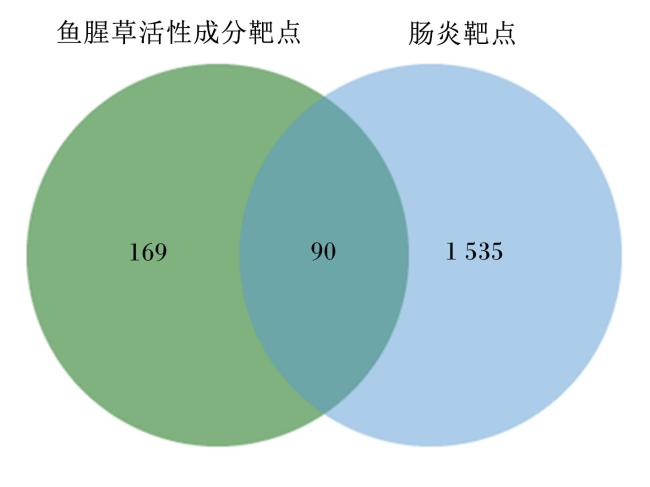
通过GeneCards数据库检索“enteritis”得到9 916个靶点,根据相关性分数筛选获得肠炎靶点1 625个。将鱼腥草的9种活性成分对应的259个靶点与肠炎的1 625个靶点导入生物信息学分析、可视化云平台微生信在线进行韦恩图绘制,共获得90个交集靶点(图1)。
图1 鱼腥草活性成分靶点与肠炎靶点韦恩图

Fig.1 Venn diagram of active component targets of Houttuynia cordata and enteritis targets

2.3 鱼腥草防治肠炎的靶点PPI网络及核心靶点

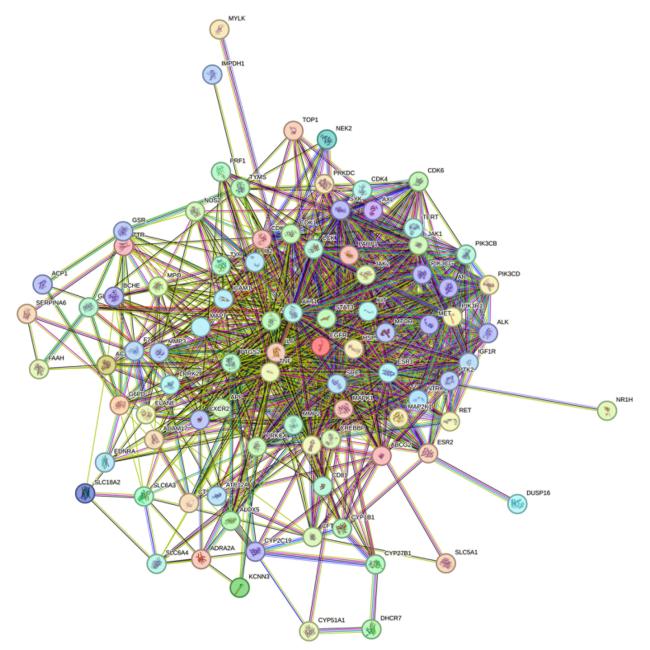
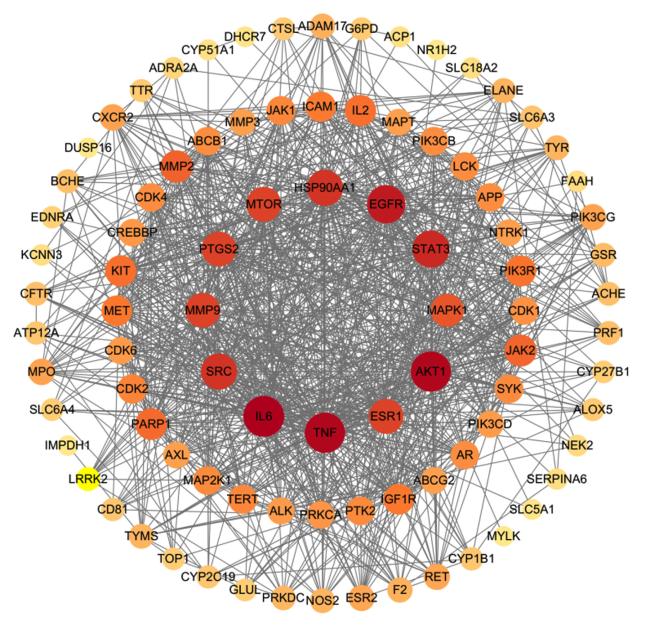
将90个交集靶点导入STRING数据库,获得鱼腥草防治肠炎的靶点PPI网络图(图2),结果显示节点数为90,边数为974,平均节点度值为21.6,平均局部聚类系数为0.603,PPI富集P值<1.0×10⁻¹⁶。利用Cytoscape 3.7.1软件绘制同心圆PPI网络图(图3),分别筛选出度值、介数中心性和接近中心性排名前5位的靶点,取交集获得核心靶点4个(表2),分别为白细胞介素(interleukin,IL)6、丝氨酸/苏氨酸蛋白激酶1(serine/threonine-protein kinase 1,AKT1)、TNF、表皮生长因子受体(epidermal growth factor receptor,EGFR)。
图2 鱼腥草活性成分防治肠炎潜在靶点的PPI网络图

仅列出度值排名前5的靶点名称 list only the top 5 target names in degree values ranking。IL6:白细胞介素6 interleukin 6;AKT1:丝氨酸/苏氨酸蛋白激酶1 serine/threonine-protein kinase 1;TNF:肿瘤坏死因子tumor necrosis factor;EGFR:表皮生长因子受体 epidermal growth factor receptor;STAT3:信号转导和转录激活因子3 signal transducer and activator of transcription 3。图3同 the same as Fig.3

Fig.2 PPI network diagram of potential targets of active component of Houttuynia cordata for preventing and treating enteritis

图3 鱼腥草活性成分-肠炎交集靶点的同心圆PPI网络图

Fig.3 Concentric PPI network diagram of common targets of active component of Houttuynia cordata and enteritis

表2 核心靶点的拓扑参数

Table 2 Topological parameters of core targets

靶点
Targets
度值
Degree value
介数中心性
Betweenness centrality
接近中心性
Closeness centrality
白细胞介素6 IL6 65 592.292 7 0.780 7
丝氨酸/苏氨酸蛋白激酶1 AKT1 63 752.266 3 0.767 2
肿瘤坏死因子TNF 63 619.484 4 0.767 2
表皮生长因子受体EGFR 57 493.513 2 0.729 5

2.4 GO功能和KEGG通路富集分析

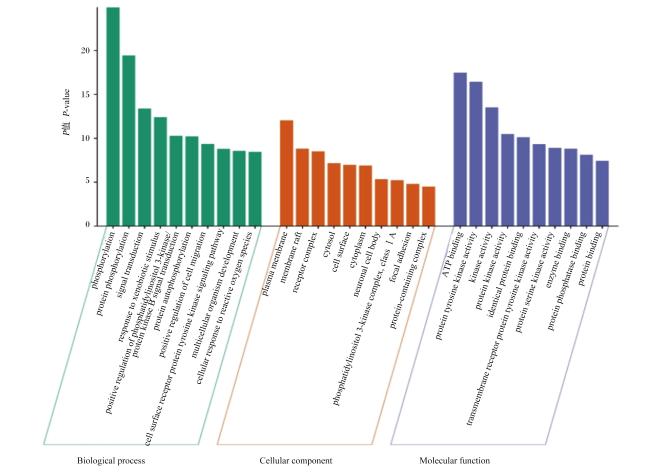
将90个交集靶点导入DAVID数据库,以P<0.05为筛选条件,分析得到GO功能富集条目473条,其中生物过程(biological processes,BP)347条,细胞组分(cellular components,CC)55条,分子功能(molecular functions,MF)71条,分别取P值从小到大的前10个条目进行可视化处理(图4),结果表明,BP主要包括磷酸化、蛋白质磷酸化、信号转导、对外源刺激的反应、磷脂酰肌醇3-激酶(phosphatidylinositol 3-kinase,PI3K)/蛋白激酶B(protein kinase B,AKT)信号转导的正调控等;CC主要包括质膜、膜筏、受体复合物、细胞溶质、细胞表面等;MF主要包括ATP结合、蛋白酪氨酸激酶活性、激酶活性、蛋白质激酶活性、同一蛋白质结合等。
图4 GO功能富集分析柱形图

Biological process:生物过程;Cellular component:细胞组分;Molecular function:分子功能;phosphorylation:磷酸化;protein phosphorylation:蛋白质磷酸化;signal transduction:信号转导;response to xenobiotic stimulus:对外源刺激的反应;positive regulation of phosphatidylinositol 3-kinase/protein kinase B signal transduction:磷脂酰肌醇3-激酶/蛋白激酶B信号转导的正调控;protein autophosphorylation:蛋白质自磷酸化;positive regulation of cell migration:细胞迁移的正调控;cell surface receptor protein tyrosine kinase signaling pathway:细胞表面受体蛋白酪氨酸激酶信号通路;multicellular organism development:多细胞生物发育;cellular response to reactive oxygen species:细胞对活性氧的正调控;plasma membrane:质膜;membrane raft:膜筏;receptor complex:受体复合物;cytosol:细胞溶质;cell surface:细胞表面;cytoplasm:细胞质;neuronal cell body:核内体;phosphatidylinositol 3-kinase complex, class ⅠA:磷脂酰肌醇3-激酶复合物ⅠA类;focal adhesion:聚焦黏附;protein-containing complex:蛋白质包涵体;ATP binding:ATP结合;protein tyrosine kinase activity:蛋白酪氨酸激酶活性;kinase activity:激酶活性;protein kinase activity:蛋白质激酶活性;identical protein binding:同一蛋白质结合;transmembrane receptor protein tyrosine kinase activity:膜受体蛋白酪氨酸激酶活性;protein serine kinase activity:蛋白丝氨酸激酶活性;enzyme binding:酶结合;protein phosphatase binding:蛋白质磷酸酶结合;protein binding:蛋白质结合。

Fig.4 GO function enrichment analysis bar chart

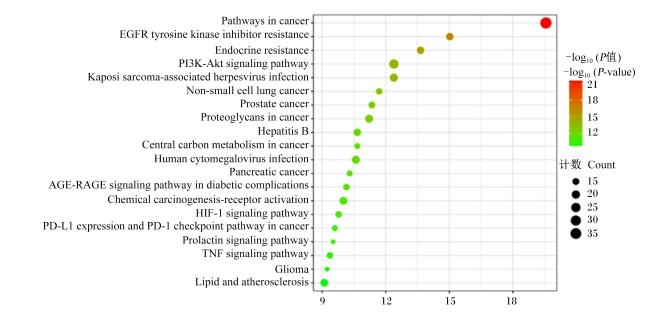
筛选得到KEGG通路条目146条(P<0.05),取P值较小的前20个条目绘制气泡图(图5),结果表明鱼腥草防治肠炎的机制主要涉及癌症通路、表皮生长因子受体酪氨酸激酶抑制性耐药、内分泌抵抗、PI3K-AKT信号通路、卡波西肉瘤相关疱疹病毒感染、非小细胞肺癌、前列腺癌、癌症蛋白质聚糖、乙型肝炎、癌症的中心碳代谢、人类巨细胞病毒感染、胰腺癌、糖尿病并发症中的糖基化终产物及其受体信号通路、化学致癌-受体激活、缺氧诱导因子1信号通路、癌症PD-L1表达及PD-1核查点通路、催乳素信号通路、TNF信号通路、胶质瘤、脂质与动脉粥样硬化等通路。
图5 KEGG通路富集分析气泡图

Pathways in cancer:癌症通路;EGFR tyrosine kinase inhibitor resistance:表皮生长因子受体酪氨酸激酶抑制性耐药;Endocrine resistance:内分泌抵抗;PI3K-Akt signaling pathway:磷脂酰肌醇3-激酶-蛋白激酶B信号通路;Kaposi sarcoma-associated herpesvirus infection:卡波西肉瘤相关疱疹病毒感染;Non-small cell lung cancer:非小细胞肺癌;Prostate cancer:前列腺癌;Proteoglycans in cancer:癌症蛋白质聚糖;Hepatitis B:乙型肝炎;Central carbon metabolism in cancer:癌症的中心碳代谢;Human cytomegalovirus infection:人类巨细胞病毒感染;Pancreatic cancer:胰腺癌;AGE-RAGE signaling pathway in diabetic complications:糖尿病并发症中的糖基化终产物及其受体信号通路;Chemical carcinogenesis-receptor activation:化学致癌-受体激活;HIF-1 signaling pathway:缺氧诱导因子1信号通路;PD-L1 expression and PD-1 checkpoint pathway in cancer:癌症PD-L1表达及PD-1核查点通路;Prolactin signaling pathway:催乳素信号通路;TNF signaling pathway:肿瘤坏死因子信号通路;Glioma:胶质瘤;Lipid and atherosclerosis:脂质与动脉粥样硬化。

Fig.5 KEGG pathway enrichment analysis bubble plot

2.5 鱼腥草活性成分-肠炎靶点-信号通路网络分析

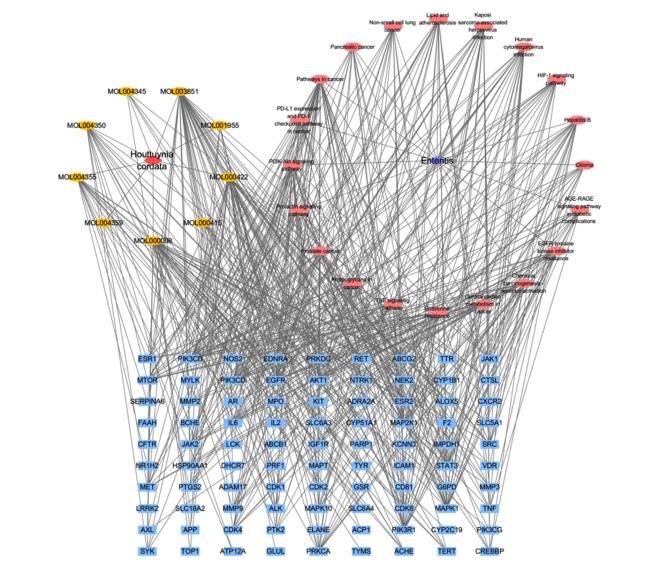
利用Cytoscape 3.7.1软件构建鱼腥草活性成分-肠炎靶点-信号通路网络图(图6)。网络中共涉及121个节点(1个中药、9个活性成分、90个靶点、20条通路和1种疾病)和532条边。由此可见,鱼腥草通过多成分、多靶点及多通路相互协调作用于肠炎疾病。分析获得鱼腥草活性成分对应的度值,排名前3位的活性成分分别是异热马酮、山奈酚和槲皮素,这些化合物可能是鱼腥草防治肠炎的主要活性成分。
图6 鱼腥草活性成分-肠炎靶点-信号通路网络图

仅注释主要靶点 only annotate the main targets。Houttuynia cordata:鱼腥草;MOL003851:异热马酮 isoramanone;MOL000422:山奈酚 kaempferol;MOL004345:1-甲基-2-九壬基-4-喹诺酮 1-methyl-2-nonacosyl-4-quinolone;MOL004350:黄夹次苷丙 ruvoside_qt;MOL004355:波菜甾醇 spinasterol;MOL000098:槲皮素 quercetin;MOL000415:芦丁 rutin;MOL001955:绿原酸 chlorogenic acid;MOL004359:鱼腥草素 houttuynin;IL6:白细胞介素6 interleukin 6;AKT1:丝氨酸/苏氨酸蛋白激酶1 serine/threonine-protein kinase 1;TNF:肿瘤坏死因子tumor necrosis factor;EGFR:表皮生长因子受体epidermal growth factor receptor;STAT3:信号转导和转录激活因子3 signal transducer and activator of transcription 3;PI3K-Akt signaling pathway:磷脂酰肌醇3-激酶-蛋白激酶B信号通路 phosphatidylinositol 3-kinase/protein kinase B signaling pathway;TNF signaling pathway:肿瘤坏死因子信号通路 tumor necrosis factor signaling pathway;Enteritis:肠炎。

Fig.6 Active components of Houttuynia cordata-enteritis targets-signaling pathways network diagram

2.6 活性成分和关键靶点的分子对接

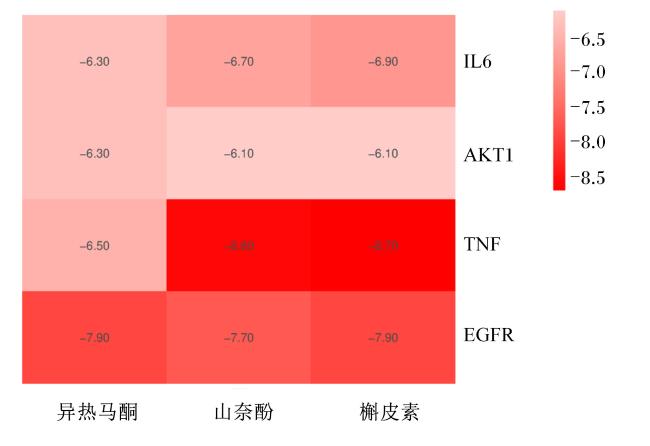
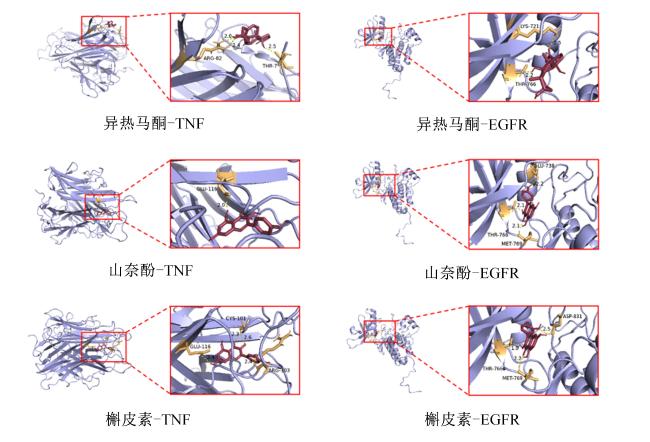
以网络分析图中度值排名前3位的鱼腥草活性成分,即异热马酮、山奈酚和槲皮素为配体,PPI网络图筛选出的4个核心靶蛋白,即IL6、AKT1、TNF和EGFR为受体,分别进行分子对接。结果发现,所有组合的分子对接结合能均小于-5 kcal/mol(图7),表明鱼腥草3种活性成分均能与4个核心靶点稳定结合。每种活性成分选取结合能最低的2组对接结果用PyMOL软件进行可视化(图8),其中,槲皮素与TNF结合能力最好,对接结果显示槲皮素与TNF蛋白活性位点的精氨酸(arginine,ARG)-103、半胱氨酸(cysteine,CYS)-101和谷氨酸(glutamic acid,GLU)-116氨基酸形成较强的相互作用。
图7 鱼腥草活性成分与核心靶点分子对接结合能热图

IL6:白细胞介素6 interleukin 6;AKT1:丝氨酸/苏氨酸蛋白激酶1 serine/threonine-protein kinase 1;TNF:肿瘤坏死因子 tumor necrosis factor;EGFR:表皮生长因子受体 epidermal growth factor receptor。

Fig.7 Heat map of molecular docking binding energy of core targets with active components of Houttuynia cordata

图8 鱼腥草活性成分与核心靶点分子对接模式图

TNF:肿瘤坏死因子 tumor necrosis factor;EGFR:表皮生长因子受体 epidermal growth factor receptor。

Fig.8 Molecular docking pattern diagram of active components of Houttuynia cordata and core targets

3 讨论

3.1 鱼腥草防治肠炎的关键活性成分分析

本研究用网络药理学方法对鱼腥草防治肠炎的主要活性成分和作用机制进行了研究,结果显示其主要活性成分包括异热马酮、山奈酚、1-甲基-2-九壬基-4-喹诺酮、黄夹次苷丙、C09747、菠菜甾醇、槲皮素、芦丁、绿原酸和鱼腥草素。根据活性成分-肠炎靶点-信号通路网络,筛选出鱼腥草防治肠炎的关键活性成分是异热马酮、山奈酚和槲皮素。异热马酮属于甾体类化合物[25],尽管目前还没有关于异热马酮改善肠炎的报道,但是异热马酮已被证实是鱼腥草缓解气道炎症的关键活性成分[26]。值得注意的是,活性成分-肠炎靶点-信号通路网络图显示与异热马酮相连的肠炎靶点较多,而且在分子对接中异热马酮与关键肠炎靶点也有较强的结合力,这些结果表明异热马酮是鱼腥草改善肠炎的关键活性成分。山奈酚和槲皮素都是黄酮类化合物,具有抗炎、抗氧化、抗菌和抗癌等作用[27-28]。研究发现,山奈酚能通过降低炎症因子水平、抑制Toll样受体4(Toll-like receptor 4,TLR4)/NF-κB信号通路、调节肠道菌群来改善DSS导致的小鼠结肠炎[29-30];还能减少高脂肪饮食导致的小鼠结肠炎性细胞浸润、下调结肠炎症相关基因表达量、抑制TLR4/NF-κB信号通路[31]。大量研究证实,槲皮素能改善各种因素,包括DSS[32]、脂多糖(lipopolysaccharides,LPS)[33]、高脂饲粮[34]和霉菌毒素[35]导致的小鼠肠道炎症。此外,在蛋鸡饲粮中添加槲皮素能逆转LPS导致的肠道IL1βTLR4基因表达水平上调,IL4基因表达水平下调[36]。在育肥猪饲粮中添加槲皮素能通过抑制肠道炎症来减轻运输导致的肠道损伤[37]。体外试验结果表明,槲皮素能抑制鼠伤寒沙门氏菌LPS[38]或产肠毒素大肠杆菌K88[39]导致的猪小肠上皮细胞炎症。在筛选到的3个关键活性成分中,山奈酚和槲皮素已被证实具有改善肠炎的作用,而异热马酮改善肠炎的作用是首次被报道,可以将其作为防治肠炎的新成分进行进一步研究。

3.2 鱼腥草防治肠炎的核心靶点分析

本研究结果表明,鱼腥草防治肠炎的核心靶点为IL6、AKT1、TNF和EGFR等。IL6和TNF-α是重要的促炎细胞因子,在肠炎发生时IL6和TNF-α表达明显增加[40]。研究发现,鱼腥草能通过下调结肠组织中的IL6和TNF-α等促炎细胞因子表达,缓解小鼠溃疡性结肠炎[41]。Wang等[13]研究发现,鱼腥草水煎剂能通过降低IL6水平来抑制TNF-α引起的Caco-2细胞炎症。AKT1是丝氨酸/苏氨酸蛋白激酶家族的重要亚型之一,广泛表达于各种组织细胞中,AKT的完全活化需要苏氨酸(Thr)308和丝氨酸(Ser)473这2个位点的磷酸化,活化的AKT可以磷酸化IκB激酶(inhibitor of κB kinase,IKK),增强IKK活性,促进NF-κB核转位,增强其转录活性,从而促进炎症因子的表达和分泌[42]。在DSS诱导的小鼠溃疡性结肠炎模型中观察到结肠的磷酸化AKT1(Thr308和Ser473)蛋白表达水平升高,而通过降低磷酸化AKT1蛋白表达水平能改善结肠炎[43]。EGFR是一种跨膜糖蛋白受体,当其与表皮生长因子(epidermal growth factor,EGF)或转化生长因子α等配体结合后,会发生二聚化,诱导受体酪氨酸激酶活化,导致受体C末端酪氨酸残基磷酸化,激活多种下游信号转导途径,从而参与调节细胞生长、增殖、分化和存活等生物过程[44]。研究发现,小鼠结肠炎模型和临床炎症性肠病(inflammatory bowel disease,IBD)患者的结肠EGFR表达下调[45];给结肠炎小鼠灌胃EGFR激动剂能减少结肠炎症细胞浸润,促进细胞增殖和迁移,改善肠道屏障功能[46]。由以上研究结果可知,4个核心靶点均可在肠炎中发挥关键作用,这也证实了本研究预测结果的准确性。

3.3 鱼腥草防治肠炎的GO功能和KEGG通路富集分析

GO功能和KEGG通路富集分析结果显示,鱼腥草的活性成分通过参与磷酸化、蛋白质磷酸化、信号转导、对外源刺激的反应、PI3K/AKT信号转导的正调控等多种生物过程防治肠炎,关键通路是PI3K-AKT信号通路、TNF信号通路等。外源刺激,如病原体、毒素和压力等是诱发或加重肠炎的关键因素,免疫细胞识别这些刺激后,释放大量促炎因子,引起局部炎症反应,导致肠道功能紊乱[47],鱼腥草的活性成分可能通过调节相关蛋白质磷酸化水平,减轻肠道对外源刺激的反应。PI3K-AKT信号通路是一种重要的细胞内信号通路,PI3K能被多种细胞外信号分子激活,使磷酸肌醇4,5-二磷酸转化为磷脂酰肌醇3,4,5-三磷酸(phosphatidylinositol 3,4,5-trisphosphate,PIP3),PIP3激活下游的AKT,AKT通过调控哺乳动物雷帕霉素靶蛋白、糖原合酶激酶3、叉头转录因子等多种下游信号分子,参与调节细胞生长、增殖、凋亡和代谢等过程[42]。PI3K-AKT信号通路在炎症疾病的发生发展中发挥着重要作用,PI3K-AKT信号通路被激活后,会激活NF-κB信号通路促进促炎细胞因子释放,还会增加肠上皮细胞凋亡,进而影响肠道炎症反应和黏膜损伤修复[48]。已有研究表明,中草药及其活性成分能通过抑制PI3K-AKT信号通路减少肠道炎症细胞浸润,降低促炎细胞因子表达,抑制肠上皮细胞凋亡,促进肠道黏膜屏障的恢复,从而缓解肠炎[43,49-50]。TNF信号通路是最重要的炎症相关通路之一,TNF能通过激活丝裂原活化蛋白激酶和NF-κB信号通路促进促炎细胞因子释放,从而直接促进炎症;还能通过增加细胞死亡,释放损伤相关分子模式来间接促进和加剧炎症反应[51]。临床上已证实抗TNF-α生物制剂,如英夫利昔单抗、阿达木单抗等对克罗恩病和溃疡性结肠炎有较好的治疗效果[52]。鱼腥草下调肠道TNF-α水平的作用已被报道,GO功能富集分析结果显示鱼腥草参与PI3K/AKT信号转导的正调控,但是其对PI3K-AKT和TNF信号通路的具体调控作用及机制还有待深入研究。
本研究虽然通过网络药理学与分子对接技术初步揭示了鱼腥草防治肠炎的活性成分及潜在作用机制,但仍存在一些不足:由于畜禽的肠炎相关靶点、PPI网络以及富集分析数据库尚不完善,故本文的核心分析主要基于人类数据库进行,值得注意的是许多肠炎通路和免疫反应机制在人类和畜禽上存在一定的保守性。为进一步验证本研究结果的可靠性和科学性,后续将在现有预测结果的基础上,开展动物试验(如建立猪或家禽的肠炎模型)和细胞试验(如采用畜禽肠源细胞构建炎症模型),从而更全面、准确地阐明鱼腥草防治畜禽肠道炎症的作用机制。

4 结论

鱼腥草含有的异热马酮、山奈酚和槲皮素等活性成分通过结合IL6、AKT1、TNF和EGFR等核心靶点,调控PI3K-AKT和TNF信号通路来防治肠炎。
[1]
GUSTAFSSON J K, JOHANSSON M E V. The role of goblet cells and mucus in intestinal homeostasis[J]. Nature Reviews Gastroenterology & Hepatology, 2022, 19(12):785-803.

[2]
KOGUT M H, GENOVESE K J, SWAGGERTY C L, et al. Inflammatory phenotypes in the intestine of poultry:not all inflammation is created equal[J]. Poultry Science, 2018, 97(7):2339-2346.

DOI

[3]
ZHANG H J, ZHANG Y, BAI D Y, et al. Effect of dietary aspirin eugenol ester on the growth performance,antioxidant capacity,intestinal inflammation,and cecal microbiota of broilers under high stocking density[J]. Poultry Science, 2024, 103(7):103825.

DOI

[4]
CARDOSO DAL PONT G, LEE A, BORTOLUZZI C, et al. Novel model for chronic intestinal inflammation in chickens:(2) immunologic mechanism behind the inflammatory response[J]. Developmental & Comparative Immunology, 2023, 138:104524.

[5]
GE L, LIU D D, MAO X R, et al. Low dose of deoxynivalenol aggravates intestinal inflammation and barrier dysfunction induced by enterotoxigenic Escherichia coli infection through activating macroautophagy/NLRP3 inflammasomes[J]. Journal of Agricultural and Food Chemistry, 2022, 70(9):3009-3022.

DOI

[6]
YU Z C, YONG Y H, LIU A A, et al. Insights and implications for transcriptomic analysis of heat stress-induced intestinal inflammation in pigs[J]. BMC Genomics, 2024, 25(1):1110.

DOI PMID

[7]
马新燕, 李大刚, 余苗, 等. 饲用抗生素替代品在畜禽生产中应用研究进展[J]. 动物营养学报, 2024, 36(12):7502-7512.

DOI

MA X Y, LI D G, YU M, et al. Research progress on application of feed antibiotic substitutes in livestock and poultry production[J]. Chinese Journal of Animal Nutrition, 2024, 36(12):7502-7512. (in Chinese)

DOI

[8]
赵丹, 杨昌贵, 康传志, 等. 经典名方中鱼腥草的本草考证[J]. 中国实验方剂学杂志, 2025, 31(8):250-259.

ZHAO D, YANG C G, KANG C Z, et al. Herbal textual research on Houttuyniae herba in famous classical formulas[J]. Chinese Journal of Experimental Traditional Medical Formulae, 2025, 31(8):250-259. (in Chinese)

[9]
王连睿, 东红阳, 苗明三. 鱼腥草的研究进展及其质量标志物的预测分析[J]. 中药新药与临床药理, 2024, 35(7):1084-1092.

WANG L R, DONG H Y, MIAO M S. Research progress on Houttuynia cordata and predictive analysis of its quality markers[J]. Traditional Chinese Drug Research and Clinical Pharmacology, 2024, 35(7):1084-1092. (in Chinese)

[10]
WEI P P, LUO Q, HOU Y, et al. Houttuynia cordata Thunb.:a comprehensive review of traditional applications,phytochemistry,pharmacology and safety[J]. Phytomedicine, 2024, 123:155195.

[11]
司雨豪. 鱼腥草对断奶清平仔猪生长性能、血液理化指标与肠道健康的影响[D]. 硕士学位论文. 武汉: 华中农业大学, 2024.

SI Y H. The effects of Houttuynia cordata on the growth performance,blood physicochemical indicators,and intestinal health of weaned Qingping piglets[D]. Master’s Thesis. Wuhan: Huazhong Agricultural University, 2024. (in Chinese)

[12]
王旭. 鱼腥草提取物对肉兔生长性能、抗氧化能力、肉品质及肠道菌群的影响[D]. 硕士学位论文. 贵阳: 贵州大学, 2024.

WANG X. Effects of Houttuynia cordata extract on growth performance,antioxidant capacity,meat quality,and intestinal microbiota of meat rabbits[D]. Master’s Thesis. Guiyang: Guizhou University, 2024. (in Chinese)

[13]
WANG J F, DEMPSEY E, CORR S C, et al. The traditional Chinese medicine Houttuynia cordata Thunb. decoction alters intestinal barrier function via an EGFR dependent MAPK (ERK1/2) signalling pathway[J]. Phytomedicine, 2022, 105:154353.

[14]
杨乐天, 杨晨, 颜晓飞, 等. 鱼腥草总黄酮对小鼠结肠炎防治作用的研究[J]. 药学研究, 2022, 41(5):287-291,315.

YANG L T, YANG C, YAN X F, et al. Effect of total flavonoids from Houttuynia cordata Thunb. on the treatment of colitis in mice[J]. Journal of Pharmaceutical Research, 2022, 41(5):287-291,315. (in Chinese)

[15]
董晶, 王帅珂, 吴苹, 等. 鱼腥草多酚对葡聚糖硫酸钠(DSS)诱导小鼠溃疡性结肠炎的改善作用[J]. 现代食品科技, 2021, 37(12):7-13,229.

DONG J, WANG S K, WU P, et al. Protective effect of polyphenol of Houttuynia cordata on ulcerative colitis induced by sodium dextran sulfate (DSS) in mice[J]. Modern Food Science and Technology, 2021, 37(12):7-13,229. (in Chinese)

[16]
CEN L F, YI T, HAO Y Z, et al. Houttuynia cordata polysaccharides alleviate ulcerative colitis by restoring intestinal homeostasis[J]. Chinese Journal of Natural Medicines, 2022, 20(12):914-924.

DOI

[17]
CHEN M Y, LI H, LU X X, et al. Houttuynia cordata polysaccharide alleviated intestinal injury and modulated intestinal microbiota in H1N1 virus infected mice[J]. Chinese Journal of Natural Medicines, 2019, 17(3):187-197.

DOI

[18]
ZHANG L, LV H, LI Y, et al. Sodium houttuyfonate enhances the intestinal barrier and attenuates inflammation induced by Salmonella typhimurium through the NF-κB pathway in mice[J]. International Immunopharmacology, 2020, 89(Pt A):107058.

[19]
ZHAO L, ZHANG H, LI N, et al. Network pharmacology,a promising approach to reveal the pharmacology mechanism of Chinese medicine formula[J]. Journal of Ethnopharmacology, 2023, 309:116306.

[20]
AGU P C, AFIUKWA C A, ORJI O U, et al. Molecular docking as a tool for the discovery of molecular targets of nutraceuticals in diseases management[J]. Scientific Reports, 2023, 13(1):13398.

DOI PMID

[21]
王胜男, 孔智谦, 周智慧, 等. 基于数据挖掘、网络药理和分子对接分析中药组方治疗梅尼埃病的作用机制[J]. 中草药, 2025, 56(6):2066-2078.

WANG S N, KONG Z Q, ZHOU Z H, et al. Analyzing mechanism of traditional Chinese medicine formulas in treatment of Meniere’s disease based on data mining,network pharmacology and molecular docking[J]. Chinese Traditional and Herbal Drugs, 2025, 56(6):2066-2078. (in Chinese)

[22]
董雯雯, 张玉霞, 袁小远, 等. 基于网络药理学与分子对接技术探究辣木叶治疗肠炎的作用机制[J]. 动物营养学报, 2023, 35(12):8053-8073.

DOI

DONG W W, ZHANG Y X, YUAN X Y, et al. Mechanism of moringa oleifera leaves in treating enteritis based on network pharmacology and molecular docking technology[J]. Chinese Journal of Animal Nutrition, 2023, 35(12):8053-8073. (in Chinese)

[23]
SHARMA A, TIRPUDE N V, KUMARI M, et al. Rutin prevents inflammation-associated colon damage via inhibiting the p38/MAPKAPK2 and PI3K/Akt/GSK3β/NF-κB signalling axes and enhancing splenic Tregs in DSS-induced murine chronic colitis[J]. Food & Function, 2021, 12(18):8492-8506.

[24]
LIU H W, MENG H L, DU M M, et al. Chlorogenic acid ameliorates intestinal inflammation by inhibiting NF-κB and endoplasmic reticulum stress in lipopolysaccharide-challenged broilers[J]. Poultry Science, 2024, 103(5):103586.

DOI

[25]
GEOFFROY P, RESSAULT B, MARCHIONI E, et al. Norrish-Prins reaction as a key step in the synthesis of 14β-hydroxy-5α (or 5β or Δ5,6)-pregnane derivatives[J]. Steroids, 2011, 76(10/11):1166-1175.

DOI

[26]
YANG Y, LAI Q Z, WANG C Y, et al. Protective effects of Herba Houttuyniae aqueous extract against OVA-induced airway hyperresponsiveness and inflammation in asthmatic mice[J]. Evidence-Based Complementary and Alternative Medicine, 2022, 2022:7609785.

[27]
BANGAR S P, CHAUDHARY V, SHARMA N, et al. Kaempferol:a flavonoid with wider biological activities and its applications[J]. Critical Reviews in Food Science and Nutrition, 2023, 63(28):9580-9604.

DOI

[28]
AGHABABAEI F, HADIDI M. Recent advances in potential health benefits of quercetin[J]. Pharmaceuticals, 2023, 16(7):1020.

DOI

[29]
YU R Y, ZHOU Q L, LIU T L, et al. Kaempferol relieves the DSS-induced chronic colitis in C57BL/6J mice,alleviates intestinal angiogenesis,and regulates colonic microflora structure[J]. Journal of Functional Foods, 2023, 107:105646.

[30]
QU Y F, LI X Y, XU F Y, et al. Kaempferol alleviates murine experimental colitis by restoring gut microbiota and inhibiting the LPS-TLR4-NF-κB axis[J]. Frontiers in Immunology, 2021, 12:679897.

[31]
BIAN Y F, LEI J Q, ZHONG J, et al. Kaempferol reduces obesity,prevents intestinal inflammation,and modulates gut microbiota in high-fat diet mice[J]. The Journal of Nutritional Biochemistry, 2022, 99:108840.

[32]
DONG Y Y, LEI J Q, ZHANG B K. Dietary quercetin alleviated DSS-induced colitis in mice through several possible pathways by transcriptome analysis[J]. Current Pharmaceutical Biotechnology, 2020, 21(15):1666-1673.

DOI

[33]
ZHANG H X, LI Y Y, LIU Z J, et al. Quercetin effectively improves LPS-induced intestinal inflammation,pyroptosis,and disruption of the barrier function through the TLR4/NF-κB/NLRP3 signaling pathway in vivo and in vitro[J]. Food & Nutrition Research, 2022, 66:8948.

[34]
LU J X, HUANG Y T, ZHANG Y J, et al. Quercetin ameliorates obesity and inflammation via microbial metabolite indole-3-propionic acid in high fat diet-induced obese mice[J]. Frontiers in Nutrition, 2025, 12:1574792.

[35]
YE Y R, JIANG M Z, HONG X Y, et al. Quercetin alleviates deoxynivalenol-induced intestinal damage by suppressing inflammation and ferroptosis in mice[J]. Journal of Agricultural and Food Chemistry, 2023, 71(28):10761-10772.

DOI PMID

[36]
FENG J, LI Z R, MA H, et al. Quercetin alleviates intestinal inflammation and improves intestinal functions via modulating gut microbiota composition in LPS-challenged laying hens[J]. Poultry Science, 2023, 102(3):102433.

DOI

[37]
ZOU Y, WEI H K, XIANG Q H, et al. Protective effect of quercetin on pig intestinal integrity after transport stress is associated with regulation oxidative status and inflammation[J]. Journal of Veterinary Medical Science, 2016, 78(9):1487-1494.

PMID

[38]
KARANCSI Z, KOVÁCS D, PALKOVICSNÉ PÉZSA N, et al. The impact of quercetin and its methylated derivatives 3-O-methylquercetin and rhamnazin in lipopolysaccharide-induced inflammation in porcine intestinal cells[J]. Antioxidants, 2022, 11(7):1265.

DOI

[39]
XIAO K, ZHOU M H, LV Q Q, et al. Protocatechuic acid and quercetin attenuate ETEC-caused IPEC-1 cell inflammation and injury associated with inhibition of necroptosis and pyroptosis signaling pathways[J]. Journal of Animal Science and Biotechnology, 2023, 14(1):5.

DOI PMID

[40]
NEURATH M F. Strategies for targeting cytokines in inflammatory bowel disease[J]. Nature Reviews Immunology, 2024, 24(8):559-576.

DOI PMID

[41]
邓代霞, 李凤兰, 李潮云, 等. 鱼腥草对葡聚糖硫酸钠诱导小鼠溃疡性结肠炎的缓解及保护作用[J]. 食品科学, 2023, 44(1):107-114.

DENG D X, LI F L, LI C Y, et al. Ameliorative and protective effects of Houttuynia cordata on dextran sulfate sodium-induced ulcerative colitis in mice[J]. Food Science, 2023, 44(1):107-114. (in Chinese)

[42]
HE X G, LI Y, DENG B, et al. The PI3K/AKT signalling pathway in inflammation,cell death and glial scar formation after traumatic spinal cord injury:mechanisms and therapeutic opportunities[J]. Cell Proliferation, 2022, 55(9):e13275.

DOI

[43]
WU X Y, DONG Q W, ZHANG Y B, et al. Cimicifuga heracleifolia Kom. attenuates ulcerative colitis through the PI3K/AKT/NF-κB signaling pathway[J]. Journal of Ethnopharmacology, 2025, 337(Pt 3):118892.

DOI

[44]
DAMARE R, ENGLE K, KUMAR G. Targeting epidermal growth factor receptor and its downstream signaling pathways by natural products:a mechanistic insight[J]. Phytotherapy Research, 2024, 38(5):2406-2447.

DOI

[45]
ZHAO J J, GUO M M, YAN Y P, et al. The miR-7/EGFR axis controls the epithelial cell immunomodulation and regeneration and orchestrates the pathology in inflammatory bowel disease[J]. Journal of Advanced Research, 2024, 57:119-134.

DOI

[46]
CONG Y L, LIU K, HUANG Z H, et al. A bivalent aptamer-based DNA agonist for EGFR signaling effectively alleviates ulcerative colitis in vivo[J]. ACS Chemical Biology, 2024, 19(6):1280-1290.

DOI

[47]
NEURATH M F, ARTIS D, BECKER C. The intestinal barrier:a pivotal role in health,inflammation,and cancer[J]. The Lancet Gastroenterology & Hepatology, 2025, 10(6):573-592.

[48]
ZHENG S H, XUE T Y, WANG B, et al. Chinese medicine in the treatment of ulcerative colitis:the mechanisms of signaling pathway regulations[J]. The American Journal of Chinese Medicine, 2022, 50(7):1781-1798.

DOI

[49]
GENG Z J, ZUO L G, LI J, et al. Ginkgetin improved experimental colitis by inhibiting intestinal epithelial cell apoptosis through EGFR/PI3K/AKT signaling[J]. The FASEB Journal, 2024, 38(14):e23817.

DOI

[50]
ZHANG X H, ZHANG F, LI Y, et al. Blockade of PI3K/AKT signaling pathway by Astragaloside Ⅳ attenuates ulcerative colitis via improving the intestinal epithelial barrier[J]. Journal of Translational Medicine, 2024, 22(1):406.

DOI

[51]
HUYGHE J, PRIEM D, BERTRAND M J M. Cell death checkpoints in the TNF pathway[J]. Trends in Immunology, 2023, 44(8):628-643.

DOI PMID

[52]
LEONE G M, MANGANO K, PETRALIA M C, et al.Past, present and (Foreseeable) future of biological anti-TNF alpha therapy[J]. Journal of Clinical Medicine, 2023, 12(4):1630.

DOI

Outlines

/