RESEARCH PAPER

Effects of Clostridium butyricum on Intestinal Morphology, Expression of nflammatory and Barrier-Related Genes, Structure and Function of Fungal Community in Mice Challenged with Enterotoxigenic Escherichia coli K88

  • SHAO Taohong , 1, 2 ,
  • WEN Yang 2 ,
  • ZHENG Wentong 2 ,
  • YU Minjie 2 ,
  • SUN Qianqian 2 ,
  • MA Lingyan 2 ,
  • XIAO Yingping , 2, *
Expand
  • 1 College of Life Science, Huzhou University, Huzhou 313000, China
  • 2 State Key Laboratory of Hazard Factors and Risk Prevention and Control of Agricultural Product Quality and Safety, Institute of Agro-Product Safety and Nutrition, Zhejiang Academy of Agricultural Sciences, Hangzhou 310021, China
* professor, E-mail:

Received date: 2025-06-06

  Online published: 2026-01-13

Abstract

This study aimed to investigate the effects of Clostridium butyricum on intestinal morphology, the expression of inflammation and barrier-related genes, as well as the structure and function of the fungal community in mice challenged with enterotoxigenic Escherichia coli K88 (ETEC K88). Twenty 4-week-old male C57BL/6J mice with similar initial body weight were selected, after one week of acclimatization, they were randomly divided into four groups (5 mice per group): the control group (CON group), the Clostridium butyricum group (CB group), the ETEC K88 group (ETEC group), and the Clostridium butyricum+ETEC K88 group (CB+ETEC group). The experimental period lasted 28 days. During this period, the CON group received a daily oral gavage of 200 μL of physiological saline throughout the entire 28 days; the CB group received a daily oral gavage of 200 μL of a Clostridium butyricum suspension (1×10⁸ CFU/mL) from days 1 to 21, followed by 200 μL of physiological saline from days 22 to 28; the ETEC group received 200 μL of physiological saline daily from days 1 to 21, and was then challenged with a daily oral gavage of 200 μL of an ETEC K88 suspension (1×10⁹ CFU/mL) from days 22 to 28; the CB+ETEC group received a daily oral gavage of 200 μL of the Clostridium butyricum suspension (1×10⁸ CFU/mL) from days 1 to 21, and was then challenged with a daily oral gavage of 200 μL of ETEC K88 suspension (1×10⁹ CFU/mL) from days 22 to 28. The results showed that in the ETEC K88-challenged mice, pretreatment with Clostridium butyricum significantly increased jejunal villus height and the villus height/crypt depth ratio (P<0.05), while significantly reduced the pathological score (P<0.05). It also significantly up-regulated the mRNA relative expression levels of barrier-related genes, including claudin-1 (Claudin-1), zonula occludens-1 (ZO-1), and occludin (Occludin) in the jejunum (P<0.05). Concurrently, it significantly down-regulated the mRNA relative expression levels of inflammation-related genes, namely interleukin-6 (IL-6), interleukin-1β (IL-1β), and tumor necrosis factor-alpha TNF-α (P<0.05). Further analysis of the fungal community diversity and structure in the jejunum and cecum revealed that, in the jejunum, compared with the ETEC group, the CB+ETEC group showed no significant changes in either the Chao1 or Shannon indices (P>0.05), and no obvious difference observed in the fungal community structure. Conversely, in the cecum, the CB+ETEC group exhibited an extremely significant decrease in the Chao1 index compared with the ETEC group (P<0.01), along with a distinct alteration in the fungal community structure. Analysis of differentially fungal genera showed a significant enrichment of potential pathogenic fungi, such as Aspergillus, in the ETEC group. In contrast, pretreatment with Clostridium butyricum reduced the relative abundance of these pathogenic fungi. Furthermore, it led to a significant enrichment of beneficial fungal genera, including Talaromyces and Trichoderma. KEGG-based functional analysis indicated that after pretreatment with Clostridium butyricum, fungal community in the jejunum likely alleviated intestinal damage by activating energy synthesis pathways such as glycolysis/gluconeogenesis and antioxidant/anti-inflammatory pathways like propanoate metabolism, whereas in the cecum, they might enhance functional pathways such as ATP-binding cassette (ABC) transporter expression and flavonoid synthesis to alleviate intestinal damage caused by ETEC K88 infection. In conclusion, Clostridium butyricum mitigates the adverse effects of ETEC K88 challenge on intestinal health in mice by inhibiting the proliferation of pathogenic fungi, promoting the enrichment of beneficial fungi, and thereby regulating specific intestinal microbiota metabolic pathways.

Cite this article

SHAO Taohong , WEN Yang , ZHENG Wentong , YU Minjie , SUN Qianqian , MA Lingyan , XIAO Yingping . Effects of Clostridium butyricum on Intestinal Morphology, Expression of nflammatory and Barrier-Related Genes, Structure and Function of Fungal Community in Mice Challenged with Enterotoxigenic Escherichia coli K88[J]. Chinese Journal of Animal Nutrition, 2026 , 38(1) : 716 -728 . DOI: 10.12418/CJAN2026.055

在动物肠道微生态研究中,产肠毒素性大肠杆菌K88(enterotoxigenic Escherichia coli K88,ETEC K88)感染已成为危害畜牧养殖健康的重要问题。该病原菌通过释放肠毒素、侵袭肠道上皮细胞、破坏肠道屏障完整性,导致仔猪腹泻、营养吸收障碍及生长性能下降[1-3]。肠道菌群紊乱是ETEC K88感染的典型特征,不仅涉及菌群组成失衡,还会显著影响在肠道微生物总量中占比不足1%的真菌群落的结构与功能[4-5]。尽管肠道真菌在微生物群中占比极低,但能通过模式识别受体介导的信号通路调节局部黏膜免疫及系统性免疫反应,在维持肠道稳态中发挥着不可替代的作用[6-7]
现有研究表明,益生菌可通过竞争生态位、分泌抗菌物质等机制抑制病原菌定植[8]。丁酸梭菌(Clostridium butyricum)作为一种重要的益生菌,已被证实能够通过分泌丁酸、抗菌肽等代谢产物调节肠道菌群,同时增强肠道屏障功能、抑制炎症反应[9-10]。然而,丁酸梭菌对动物肠道真菌的调控机制尚缺乏系统性研究,特别是在ETEC K88感染条件下,其是否通过调节真菌的结构与功能来维持肠道稳态,目前仍不明确。因此,本研究通过ETEC K88攻毒构建小鼠肠道炎症模型,在此基础上探究丁酸梭菌对小鼠肠道真菌群落结构及功能的影响,旨在为益生菌的深入应用与动物肠道健康的精准调控提供理论依据。

1 材料与方法

1.1 试验材料

本试验所用丁酸梭菌为课题组前期分离得到[7],ETEC K88(编号:CVCC224)购自中国菌种保藏中心,小鼠由上海斯莱克实验动物有限中心提供。

1.2 试验设计

本研究的动物试验由浙江省农业科学院实验动物福利伦理委员会审查批准(编号:2024ZAASLA057)。
选取20只4周龄的无特定病原体(SPF)级雄性C57BL/6J小鼠,在动物中心12 h光照和12 h黑暗的循环条件下饲养于温控室[(23±2) ℃],预饲1周后进行试验。饲养试验于浙江省农业科学院动物实验房开展,试验期为28 d,期间各组小鼠饲喂相同的小鼠专用商品饲粮(生长繁殖配合饲料,产品编号:P1101F-25,购自杭州骊滕生物科技有限公司)。将20只小鼠随机分为4组(每组5只),按照如下方案进行处理:对照组(CON组)小鼠全期灌胃200 μL/d生理盐水;丁酸梭菌组(CB组)第1~21天灌胃200 μL/d丁酸梭菌菌悬液(1×108 CFU/mL),第22~28天灌胃200 μL/d生理盐水;ETEC K88组(ETEC组)小鼠第1~21天灌胃200 μL/d生理盐水,第22~28天进行攻毒处理,灌胃200 μL/d ETEC K88菌悬液(1×10⁹ CFU/mL);丁酸梭菌+ETEC K88组(CB+ETEC组)小鼠第1~21天灌胃200 μL/d丁酸梭菌菌悬液(1×108 CFU/mL),第22~28天进行攻毒处理,灌胃200 μL/d ETEC K88菌悬液(1×10⁹ CFU/mL)。试验结束后,各组小鼠称重后处死,收集空肠和盲肠内容物样品,液氮速冻后于-80 ℃冰箱保存待检;取空肠中段组织,一部分于4%多聚甲醛固定液中固定,常温保存,另一部分放入无菌冻存管中,液氮速冻后转移至-80 ℃冰箱保存待检。

1.3 空肠组织病理学分析

取经4%多聚甲醛固定液固定后的适量空肠组织,按照常规流程制作石蜡切片,经苏木精-伊红(HE)染色后,在荧光倒置显微镜下观察小鼠空肠组织病理学变化,测量绒毛高度、隐窝深度,计算绒毛高度/隐窝深度的比值,并根据Chiu’s肠黏膜组织学损伤评分标准[11]进行病理评分。

1.4 空肠组织中炎症和屏障相关基因表达检测

取0.2 g空肠组织,加1 mL TRIzol提取组织总RNA,紫外分光光度计和电泳检测其含量、纯度及质量,然后将其逆转录为cDNA。按Power SYBR® Green Master Mix 10.0 μL,上、下游引物各0.5 μL,DEPC水8.0 μL,cDNA 1.0 μL配制20 μL的PCR体系,在QuantStudioTM Design&Analysis实时荧光定量PCR仪上进行扩增,反应条件为:95 ℃,1 min;95 ℃,15 s,63 ℃,25 s,收集荧光,40个循环;最后绘制熔解曲线。PCR引物序列见表1。内参基因为β-肌动蛋白(β-actin),目的基因白细胞介素-6(IL-6)、白细胞介素-1β(IL-1β)、肿瘤坏死因子-α(TNF-α)、闭合蛋白-1(Claudin-1)、闭锁小带蛋白-1(ZO-1)、闭锁蛋白(Occludin)的mRNA相对表达量通过2-ΔΔCt法进行计算。
表1 实时荧光定量PCR引物序列

Table 1 Primer sequences for qRT-PCR

基因Genes 引物序列Primer sequences (5'—3')
β-肌动蛋白
β-actin
F:GTGTGACGTTGACATCCGTAAAGA
R:GCCGGACTCATCGTACTCCT
白细胞介素-6
IL-6
F:GCCTTCTTGGGACTGATGCTGGT
R:CTGTTGGGAGTGGTATCCTCTGTGA
白细胞介素-1β
IL-1β
F:GGCAGGCAGTATCACTCATTGTG
R:GCTCATGTCCTCATCCTGGAAG
肿瘤坏死因子-α
TNF-α
F:GACCCTCACACTCAGATCATCTTCT
R:GCTACGACGTGGGCTACAG
闭合蛋白-1
Claudin-1
F:AAGGACAAAACCGTGTGGGA
R:CTCTCCCCACATTCGAGATGATT
闭锁小带蛋白-1
ZO-1
F:GCCATCCACTCCTGCCTAT
R:CGGGACCTGCTCATAACTTC
闭锁蛋白
Occludin
F:CAGCAGCAGTGGTAACTTGG
R:CTCTCCCCACATTCGAGATGATT

1.5 肠道内容物DNA提取及ITS扩增子高通量测序

参照试剂盒说明书,使用QIAamp DNA提取试剂盒(Qiagen)从小鼠空肠空肠、盲肠内容物中提取总DNA,并使用1%琼脂糖凝胶电泳检测其完整性。随后,使用特异性引物ITS3-2024F(5'-GCATCGATGAAGAACGCAGC-3')和ITS4-2409R(5'-TCCTCCGCTTATTGATATGC-3')对真菌rRNA基因的ITS2区域进行PCR扩增。扩增产物最终交由上海凌恩生物科技有限公司,在Illumina MiSeq平台上进行PE250双端测序[12]
测序所得原始数据经按样本拆分后,导入QIIME 2分析平台,使用默认参数的DADA2算法进行质控与去噪处理,以生成高精度的扩增子序列变体(amplicon sequence variant,ASV)。对生成的ASV进行过滤、抽平及物种注释后,使用R语言中的vegan软件包计算肠道真菌群落的α多样性指数(Shannon指数和Chao1指数),基于Bray-Curtis距离算法计算样本间的β多样性。数据分析结果通过Venn图、群落结构柱状图、物种丰度热图及主坐标分析(PCoA)图进行可视化。组间差异真菌属的鉴定则通过Kruskal-Wallis非参数检验完成。

1.6 数据统计与分析

采用SPSS 27.0软件对小鼠体重和肠道真菌Alpha多样性指数结果进行单因素方差分析(one-way ANOVA),并使用LSD法进行多重比较,数据以“平均值±标准误(mean±SE)”形式表示,P<0.05为差异显著,P<0.01为差异极显著。使用GraphPad Prism 10.0软件绘制相关的图表。

2 结果与分析

2.1 小鼠体重变化

通过分析各组小鼠体重(表2)发现,与CON组相比,ETEC组小鼠体重极显著下降(P=0.002);相较于ETEC组,CB+ETEC组小鼠体重显著上升(P=0.015);此外,与CON组相比,CB组小鼠体重没有产生显著变化(P=0.120)。
表2 丁酸梭菌对ETEC K88攻毒小鼠体重的影响

Table 2 Effects of Clostridium butyricum on body weight of ETEC K88-challenged mice g

项目
Item
组别Groups P1
P1-value
P2
P2-value
P3
P3-value
CON CB ETEC CB+ETEC
体重Body weight 23.48±0.06 22.65±0.12 21.02±0.40 23.40±0.05 0.120 0.002 0.015

P1:CB组 vs. CON组;P2:ETEC组 vs. CON组;P3值:CB+ETEC组 vs. ETEC组。

P1-value: CB group vs. CON group; P2-value: ETEC group vs. CON group; P3-value: ETEC+CB group vs. ETEC group.

2.2 小鼠空肠组织形态变化

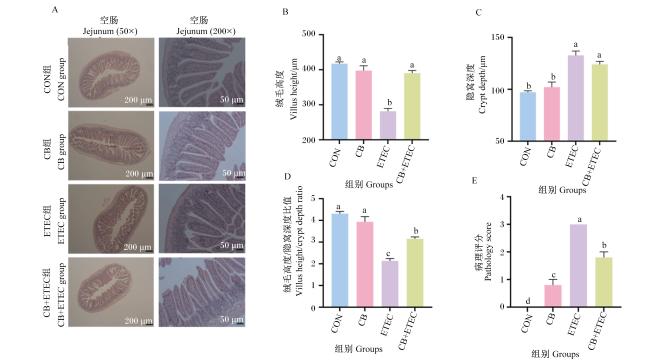
图1显示,与CON组相比,ETEC组小鼠空肠隐窝部分缺失、黏膜损伤,并有明显的炎性细胞浸润,空肠绒毛高度以及绒毛高度/隐窝深度的比值显著降低(P<0.05),隐窝深度和病理评分显著升高(P<0.05);相比ETEC组,CB+ETEC组小鼠空肠组织损伤得到缓解,空肠绒毛高度以及绒毛高度/隐窝深度的比值显著升高(P<0.05),病理评分显著降低(P<0.05)。
图1 丁酸梭菌对ETEC K88攻毒小鼠空肠组织形态的影响

数据柱标注不同小写字母表示差异显著(P<0.05),相同或无字母表示差异不显著(P>0.05)。图2同。

Fig.1 Effects of Clostridium butyricum on jejunal morphology of ETEC K88-challenged mice

Data columns with different small letters mean significant difference (P<0.05), while with the same or no letters mean no significant difference (P>0.05). The same as Fig.2.

2.3 小鼠空肠组织中炎症和屏障相关基因表达变化

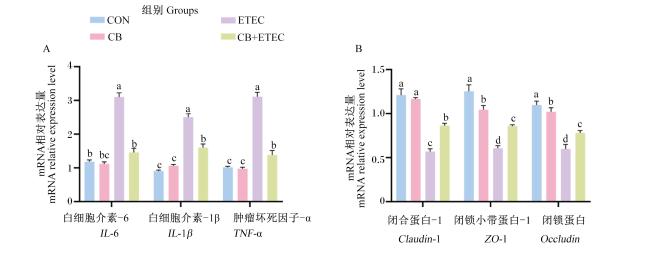
图2-A可知,相较于CON组,ETEC组空肠组织中炎症相关基因IL-6、IL-1βTNF-α的mRNA相对表达量显著升高(P<0.05);相较于ETEC组,CB+ETEC组空肠组织中IL-6、IL-1βTNF-α的mRNA相对表达量均显著降低(P<0.05);与CON组相比,CB组空肠组织中IL-6、IL-1βTNF-α的mRNA相对表达量无显著变化(P>0.05)。
图2 丁酸梭菌对ETEC K88攻毒小鼠空肠组织中炎症和屏障相关基因表达的影响

Fig.2 Effects of Clostridium butyricum on expression of inflammatory and barrier-related genes in jejunal tissues of ETEC K88-challenged mice

图2-B可知,与CON组相比,ETEC组空肠组织中屏障相关基因Claudin-1、ZO-1、Occludin的mRNA相对表达量显著降低(P<0.05);与ETEC组相比,CB+ETEC组空肠组织中Claudin-1、ZO-1、Occludin 的mRNA相对表达量显著升高(P<0.05);与CON组相比,CB组空肠组织中ZO-1、Occludin的mRNA相对表达量显著降低(P<0.05)。

2.4 小鼠空肠和盲肠真菌群落结构和功能变化

2.4.1 α多样性和β多样性

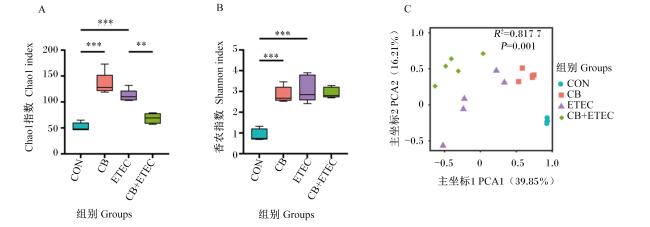
通过Chao1指数和Shannon指数反映小鼠空肠和盲肠真菌群落的丰富度和多样性。对于空肠真菌群落,CB组和ETEC组Chao1指数极显著低于CON组(P<0.001),CB+ETEC组相较ETEC组Chao1指数具有上升趋势(图3-A,P>0.05);各组间Shannon指数均无显著差异(图3-B,P>0.05)。对于盲肠真菌群落,与CON组相比,CB组和ETEC组Chao1指数和Shannon指数均极显著升高(图4-A,P<0.01);同时,CB+ETEC组Chao1指数较ETEC组极显著降低(图4-B,P<0.01)。
图3 空肠真菌群落α多样性和β多样性

*:差异显著(P<0.05);**:差异极显著(P<0.01);***:差异极显著(P<0.001)。图4同。

Fig.3 α diversity and β diversity of jejunal fungal community

*: significant difference (P<0.05); **: extremely significant difference (P<0.01); ***: extremely significant difference (P<0.001). The same as Fig.4.

图4 盲肠真菌群落α多样性和β多样性

Fig.4 α diversity and β diversity of cecal fungal community

进一步通过PCoA发现,小鼠空肠和盲肠真菌群落结构均存在明显差异。在空肠中,真菌群落结构变化主要受到ETEC K88处理的影响,而丁酸梭菌预处理对其影响较小(图3-C);在盲肠中,各组间的真菌群落结构均存在明显差异(图4-C)。

2.4.2 小鼠空肠和盲肠真菌群落组成

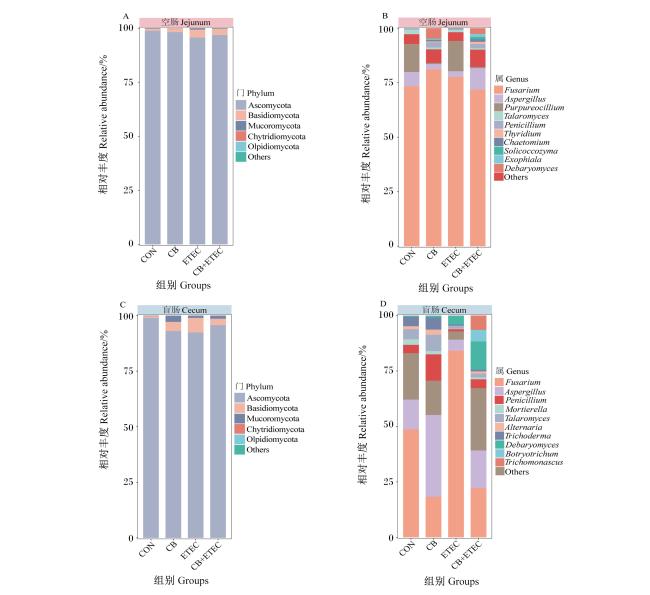
在空肠真菌群落中,优势真菌门为子囊菌门(Ascomycota)和担子菌门(Basidiomycota)(图5-A),二者相对丰度超过99.66%;优势真菌属为镰刀菌属(Fusarium)、紫孢霉属(Purpureocillium)、德巴利酵母属(Debaryomyces)、毛壳菌属(Chaetomium)、外瓶霉属(Exophiala)等(图5-B),其中CON组Purpureocillium的相对丰度高于ETEC组,ETEC组Debaryomyces的相对丰度低于CB+ETEC组。
图5 空肠和盲肠真菌群落门水平和属水平组成

Ascomycota:子囊菌门;Basidiomycota:担子菌门;Mucoromycota:毛霉门;Chytridiomycota:壶菌门;Olpidiomycota:油壶菌门;Fusarium:镰刀菌属;Purpureocillium:紫孢霉属;Aspergillus:曲霉属;Debaryomyces:德巴利酵母属;Chaetomium:毛壳菌属;Exophiala:外瓶霉属;Solicoccozyma;索利科酵母属;Filobasidium:线黑粉菌属;Preussia:光黑壳属;Malassezia:马拉色菌属;Acremonium:枝顶孢霉属;Penicillium:青霉菌属;Talaromyces:篮状菌属;Trichoderma:木霉属;Botryotrichum:毛束葡属;Mortierella:被孢霉属;Alternaria:链格孢属;Others:其他。

Fig.5 Composition of jejunal and cecal fungal communities at phylum and genus levels

在盲肠真菌群落中,优势真菌门为Ascomycota和Basidiomycota(图5-C),二者相对丰度超过98.5%;优势真菌属为Fusarium、青霉菌属(Penicillium)、Debaryomyces、篮状菌属(Talaromyces)、木霉属(Trichoderma)等(图5-D),其中CON组Fusarium的相对丰度高于ETEC组,ETEC组Penicillium的相对丰度低于CB+ETEC组。

2.4.3 差异真菌属

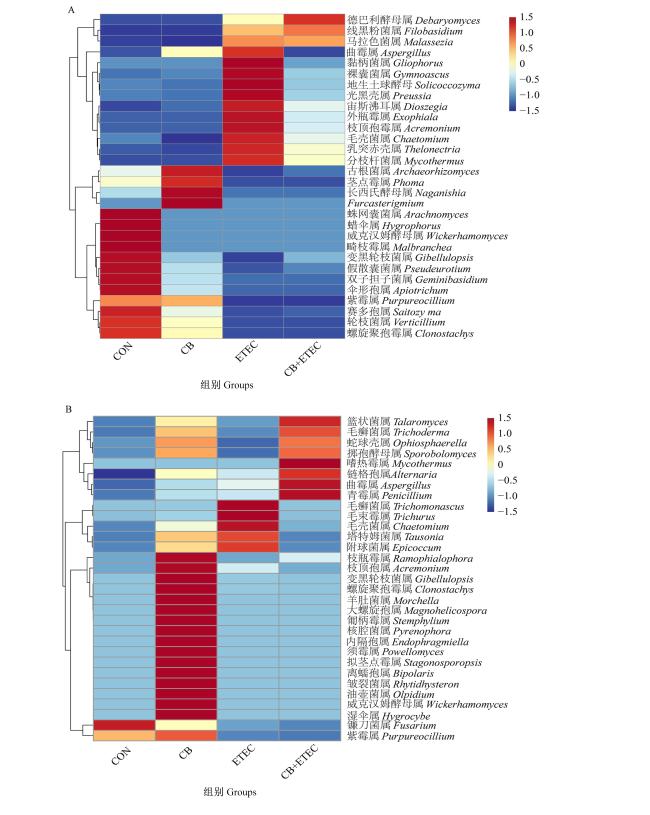
采用Kruskal-Wallis非参数检验热图识别相对丰度大于1%的差异真菌属。空肠中真菌属差异分析结果(图6-A)表明,CON组富集了包括Purpureocillium在内的12个真菌属,然而,经丁酸梭菌预处理后,显著富集的是长西氏酵母菌属(Naganishia)等4个真菌属;此外,ETEC K88攻毒后,曲霉菌属(Aspergillus)、ExophialaChaetomium等潜在病原真菌属显著富集;而经丁酸梭菌预处理后,AspergillusExophialaChaetomium等病原真菌属相对丰度明显降低,且Debaryomyces和线黑粉菌属(Filobasidium)等有益真菌属显著富集。
图6 空肠(A)、盲肠(B)真菌属Kruskal-Wallis非参数检验差异热图(Z-score标准化)

Fig.6 Differential heatmap (Z-score standardized) of fungal genera in jejunum (A) and cecum (B) based on Kruskal-Wallis nonparametric test

观察盲肠真菌属差异分析结果(图6-B)发现,丁酸梭菌对盲肠真菌群落结构组成影响显著,威克汉姆酵母属(Wickerhamomyces)和羊肚菌属(Morchella)等17个真菌属显著富集于CB组;进一步对比ETEC组和CB+ETEC组发现,TalaromycesTrichoderma等潜在有益菌显著富集,并且这个真菌属在CB组的相对丰度也较高。

2.4.4 空肠中差异真菌属与组织形态、炎症和屏障相关基因的相关性分析

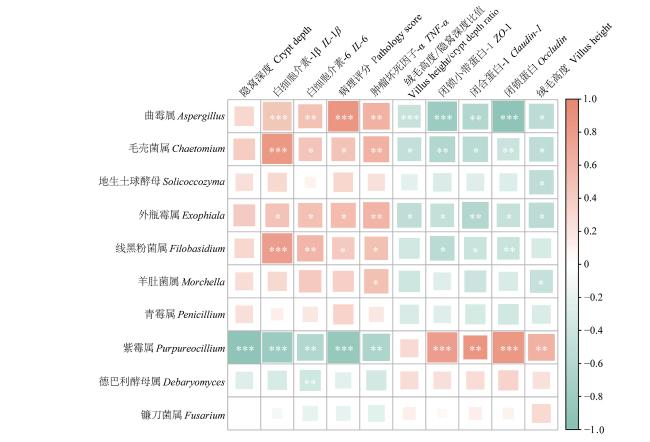
通过斯皮尔曼相关性分析进一步分析小鼠空肠中差异真菌属与组织形态、炎症及屏障相关基因之间的相关性,结果(图7)显示,大多差异真菌属的相对丰度与IL-1βIL-6和TNF-α的mRNA相对表达量呈正相关,与Claudin-1、ZO-1、Occludin的mRNA相对表达量呈负相关,其中ChaetomiumAspergillusExophiala的相对丰度与IL-1βIL-6和TNF-α的mRNA相对表达量以及病理评分呈显著或极显著正相关(P<0.05、P<0.01或P<0.001),与绒毛高度、绒毛高度/隐窝深度比值以及Claudin-1、ZO-1、Occludin的mRNA相对表达量呈显著或极显著负相关(P<0.05、P<0.01或P<0.001),与此相反的是,Purpureocillium的相对丰度与隐窝深度、病理评分以及IL-1βIL-6和TNF-α的mRNA相对表达量显著或极显著正相关(P<0.05、P<0.01或P<0.001),与绒毛高度以及Claudin-1、ZO-1、Occludin的mRNA相对表达量呈显著或极显著正相关(P<0.05、P<0.01或P<0.001)。
图7 空肠中差异真菌属与组织形态指标、炎症及屏障相关基因的相关性分析

*:显著相关(P<0.05);**:极显著相关(P<0.01);***:极显著相关(P<0.001)。

Fig.7 Correlation analysis between differentially fungal genera and morphology indices,inflammatory and barrier-related genes in jejunum

*: significant correlation (P<0.05); **: extremely significant correlation (P<0.01); ***: extremely significant correlation (P<0.001).

2.4.5 空肠和盲肠真菌群落功能预测

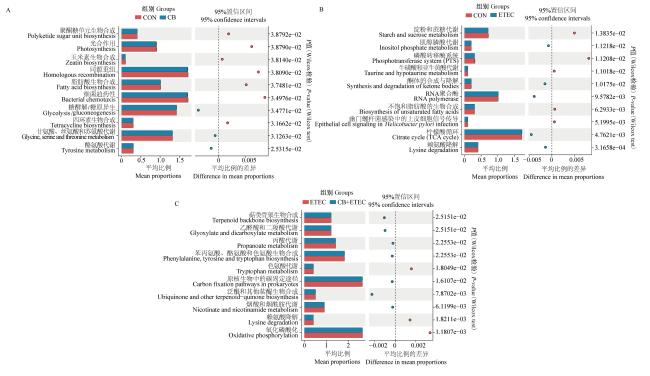
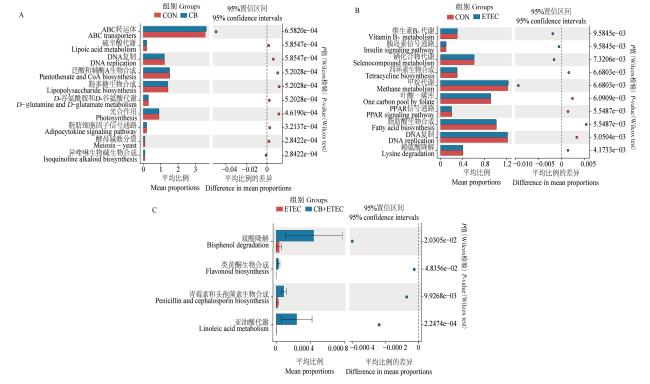
基于KEGG数据库对小鼠肠道真菌群落进行功能预测。通过分析各组小鼠空肠真菌群落功能代谢通路(图8)的变化发现,与CON组相比,丁酸梭菌预处理显著激活了糖酵解/糖异生(glycolysis/gluconeogenesis)、氨基酸代谢等能量产生和合成通路,而ETEC K88感染则主要刺激了柠檬酸(TCA)循环(TCA cycle)和赖氨酸降解(lysine degradation)等应激响应通路;值得注意的是,丁酸梭菌与ETEC K88联合处理激活了萜类合成(terpenoid backbone biosynthesis)、丙酸代谢(propanoate metabolism)等抗氧化和抗炎通路,提示丁酸梭菌可能通过调节真菌代谢来缓解ETEC K88引起的氧化损伤。通过分析各组小鼠盲肠真菌群落功能代谢通路(图9)的变化发现,丁酸梭菌预处理增强了ATP结合盒(ABC)转运体(ABC transporters)和异喹啉生物碱合成(isoquinoline alkaloid biosynthesis)等解毒功能,而ETEC K88感染干扰了维生素B6代谢(vitamin B6 metabolism)和胰岛素信号(insulin signaling pathway)通路;丁酸梭菌与ETEC K88联合处理则显著激活了黄酮类合成(flavonoid biosynthesis)、青霉素和头孢菌素生物合成(penicillin and cephalosporin biosynthesis)等抗菌通路,表明丁酸梭菌可能通过促进真菌产生抗菌化合物来抑制ETEC K88的致病作用。
图8 空肠真菌群落KEGG功能预测

Fig.8 KEGG functional prediction of jejunal fungi community

图9 盲肠真菌群落KEGG功能预测

Fig.9 KEGG functional prediction of cecal fungi community

3 讨论

人和动物肠道内栖息着丰富的细菌、真菌等微生物,它们之间通过复杂的共生和竞争关系,形成了一个相对平衡的微生态系统[13]。肠道微生物与宿主各器官之间的动态交互,在维持肠道稳态、调控炎症反应等生理过程中发挥核心作用[2,14]。本试验以ETEC K88建立小鼠肠道炎症模型,发现小鼠肠道绒毛高度降低,发育受阻,而丁酸梭菌预处理能缓解ETEC K88造成的小鼠肠道组织损伤;进一步观察发现,丁酸梭菌预处理可以缓解ETEC K88导致的与紧密连接蛋白相关的肠道屏障功能损伤和炎症相关基因表达量升高,这与Wei等[1]所得结果一致。此外,已经有研究证实丁酸梭菌在维持畜禽肠道微生态平衡方面具有重要作用,它可通过优化肠道菌群结构和调节代谢平衡维持肠道健康[15]
既往研究多聚焦于细菌对畜禽肠道健康的调节作用[16],而近年来肠道真菌的生态功能逐渐成为研究热点,越来越多的研究证明真菌在哺乳动物的肠道稳态和宿主免疫调节过程中发挥着不可或缺的作用[7,17-18]。本研究及相关报道均证实丁酸梭菌干预会影响小鼠肠道真菌群落的结构和多样性[19]。本研究结果显示,Ascomycota和Basidiomycota在肠道中占主导地位,这与彭浩等[7]的研究结论一致。值得注意的是,ETEC K88感染后,小鼠空肠与盲肠中Chaetomium的相对丰度显著增加,而Chaetomium会降低机体免疫功能,对动物具有潜在致病性[20];同样地,Aspergillus在空肠中的相对丰度亦显著增加,其产生的毒素污染和真菌感染会威胁畜禽健康,引发肠道屏障损伤及免疫紊乱[21]。本试验还发现,部分真菌在丁酸梭菌预处理后显著富集,可能在维持肠道健康中发挥积极作用,经丁酸梭菌预处理后,Debaryomyces在空肠中的相对丰度显著上升,Debaryomyces对于胃肠道有一定应激耐受能力和抗炎作用[22],其可通过调节过氧化氢酶活性、调控转录因子促进抗氧化以及免疫相关信号通路基因的表达[23]TalaromycesTrichoderma在盲肠中富集的现象同样值得关注,前者具有抗菌、抗炎活性,能够抑制促炎标志物产生,减轻肠道炎症反应[24],后者可通过调控肠道菌群发挥类抗生素效应,在保障畜禽生长性能方面具有重要产业化应用潜力[25],二者可能在丁酸梭菌预处理缓解ETEC K88感染所致肠道炎症过程中发挥协同作用。本研究还发现,丁酸梭菌预处理后,空肠盲肠真菌群落组成结构的变化可能激活了萜类生物碱、3,4-二羟基苯基丙酸、黄酮类化合物等生物活性物质的产生,这些生物活性物质分别凭借其显著的抗炎、抗氧化和抗菌特性,参与炎症调控和组织修复过程[26-28],结合前人关于益生菌调节肠道微生物组成及氨基酸代谢通路以维持代谢稳态的研究[29],该结果进一步佐证了丁酸梭菌预处理调节真菌群落结构,促进有益真菌定植,从而改善肠道健康的作用机制。
本研究证实ETEC K88感染可显著改变小鼠肠道真菌群落结构和多样性,而丁酸梭菌预处理能够通过调节肠道真菌群落结构缓解肠道屏障功能受损和炎症反应。然而,丁酸梭菌调节肠道真菌群落结构功能的具体分子机制,以及这些调节作用如何与宿主的免疫应答、代谢通路相互作用,仍需进一步深入研究来阐明,以便为动物肠道健康调控提供更坚实的理论基础和更有效的解决方案。

4 结论

① 丁酸梭菌干预显著缓解ETEC K88引起的小鼠体重降低,肠道炎症和屏障损伤。
② 丁酸梭菌干预显著缓解ETEC K88引起的小鼠空肠和盲肠真菌菌群紊乱,其分别促进空肠和盲肠中DebaryomycesTalaromyces的富集,并降低Chaetomium的相对丰度。
③ 在真菌群落功能上,丁酸梭菌预处理后,空肠真菌群落中糖酵解/糖异生和丙酸代谢等功能通路显著富集,盲肠真菌群落中ABC转运体和黄酮类合成等通路显著富集。
[1]
WEI Z, HE Z Q, WANG T Y, et al. Lactobacillus salivarius WZ1 inhibits the inflammatory injury of mouse jejunum caused by enterotoxigenic Escherichia coli K88 by regulating the TLR4/NF-κB/MYD88 inflammatory pathway and gut microbiota[J]. Microorganisms, 2023, 11(3):657.

DOI

[2]
LIU Y Y, ZHANG S D, XIAO J J, et al. Gut microbiota-involved metabolism and intestinal absorption mechanisms in decreasing bioaccessibility of triadimefon in strawberry and grape[J]. Food Chemistry, 2022, 373(Pt B):131575.

[3]
吴文文, 丁雪燕, 洪天旗, 等. 猪源产肠毒素性大肠杆菌主要毒力因子研究进展[J]. 中国兽医学报, 2019, 39(7):1403-1409.

WU WW, DING X Y, HONG T Q, et al. Research progress on the main virulence factors of enterotoxin-producing Escherichia coli from pigs[J]. Chinese Journal of Veterinary Science, 2019, 39(7):1403-1409. (in Chinese)

[4]
GARCIA-BONETE M J, RAJAN A, SURIANO F, et al. The underrated gut microbiota helminths,bacteriophages,fungi,and archaea[J]. Life, 2023, 13(8):1765.

DOI

[5]
黄双梅, 罗玉衡. 猪肠道真菌的组成及其潜在的健康和营养学意义[J]. 动物营养学报, 2025, 37(4):2134-2141.

DOI

HUANG S M, LUO Y H. Composition of intestinal fungi in swine and its potential health and nutritional significance[J]. Chinese Journal of Animal Nutrition, 2025, 37(4):2134-2141. (in Chinese)

DOI

[6]
MALAGUARNERA L. Vitamin D and microbiota:two sides of the same coin in the immunomodulatory aspects[J]. International Immunopharmacology, 2020, 79:106112.

[7]
彭浩, 任莹, 马灵燕, 等. 丁酸梭菌及其胞外囊泡对结肠炎小鼠肠道真菌菌群结构的影响[J]. 动物营养学报, 2023, 35(7):4686-4696.

DOI

PENG H, REN Y, MA L Y, et al. Effects of Clostridium butyricum and its extracellular vesicles on intestinal fungal community structure of mice with colitis[J]. Chinese Journal of Animal Nutrition, 2023, 35(7):4686-4696. (in Chinese)

DOI

[8]
LAN C, LI H, SHEN Y Q, et al. Next-generation probiotic candidates targeting intestinal health in weaned piglets:both live and heat-killed Akkermansia muciniphila prevent pathological changes induced by enterotoxigenic Escherichia coli in the gut[J]. Animal Nutrition, 2024, 17:110-122.

DOI

[9]
LIAO J Y, LIU Y L, YAO Y, et al. Clostridium butyricum strain CCFM1299 reduces obesity via increasing energy expenditure and modulating host bile acid metabolism[J]. Nutrients, 2023, 15(20):4339.

DOI

[10]
LIU X, QIU X Y, YANG Y, et al. Alteration of gut microbiome and metabolome by Clostridium butyricum can repair the intestinal dysbiosis caused by antibiotics in mice[J]. iScience, 2023, 26(3):106190.

DOI

[11]
CHIU C J, MCARDLE A H, BROWN R, et al. Intestinal mucosal lesion in low-flow states.Ⅰ.A morphological,hemodynamic,and metabolic reappraisal[J]. Archives of Surgery, 1970, 101(4):478-483.

DOI

[12]
CAPORASO J G, KUCZYNSKI J, STOMBAUGH J, et al. QIIME allows analysis of high-throughput community sequencing data[J]. Nature Methods, 2010, 7(5):335-336.

DOI PMID

[13]
LI H M, WANG K, HAO M D, et al. The role of intestinal microecology in inflammatory bowel disease and colorectal cancer:a review[J]. Medicine, 2023, 102(51):e36590.

DOI

[14]
YOO J Y, GROER M, DUTRA S V O, et al. Gut microbiota and immune system interactions[J]. Microorganisms, 2020, 8(10):1587.

DOI

[15]
MA L Y, TAO S Y, SONG T X, et al. Clostridium butyricum and carbohydrate active enzymes contribute to the reduced fat deposition in pigs[J]. iMeta, 2024, 3(1):e160.

DOI

[16]
LIAO S F, JI F, FAN P X, et al. Swine gastrointestinal microbiota and the effects of dietary amino acids on its composition and metabolism[J]. International Journal of Molecular Sciences, 2024, 25(2):1237.

DOI

[17]
WEI G Y. Insights into gut fungi in pigs:a comprehensive review[J]. Journal of Animal Physiology and Animal Nutrition, 2025, 109(1):96-112.

DOI

[18]
ZHANG Y C, LIU H, YUE Z T, et al. Wickerhamomyces anomalus relieves weaning diarrhea via improving gut microbiota and redox homeostasis using a piglet model[J]. Food & Function, 2022, 13(21):11223-11235.

[19]
YANG S, HE J, SHI J, et al. Characteristics of intestinal microbiota in preterm infants and the effects of probiotic supplementation on the microbiota[J]. Frontiers in Microbiology, 2024, 15:1339422.

[20]
REDDY M, VENUGOPAL R, PRAKASH P Y, et al. Corneal ulcer due to a rare coelomycetes fungus Chaetomium strumarium:case report and global review of Chaetomium keratomycosis[J]. Indian Journal of Ophthalmology, 2017, 65(9):871-874.

DOI

[21]
ZHANG T Y, LIU N N. Fungal influence:the role of the gut mycobiome in women’s health[J]. Cell Host & Microbe, 2025, 33(1):17-19.

[22]
OCHANGCO H S, GAMERO A, SMITH I M, et al. In vitro investigation of Debaryomyces hansenii strains for potential probiotic properties[J]. World Journal of Microbiology & Biotechnology, 2016, 32(9):141.

DOI

[23]
ANGULO M, REYES-BECERRIL M, CEPEDA-PALACIOS R, et al. Probiotic effects of marine Debaryomyces hansenii CBS 8339 on innate immune and antioxidant parameters in newborn goats[J]. Applied Microbiology and Biotechnology, 2019, 103(5):2339-2352.

DOI

[24]
TELES A M, XAVIER G S, DE FREITAS MOREIRA W F, et al. Talaromyces purpurogenus from a marine-polluted environment inhibits pro-inflammatory markers in LPS-stimulated RAW 264.7 cells and in carrageenan-induced paw edema[J]. Journal of King Saud University-Science, 2022, 34:102021.

DOI

[25]
ALYILEILI S R, BELAL I E H, HUSSEIN A S, et al. Effect of inclusion of degraded and non-degraded date pits in broilers’ diet on their intestinal microbiota and growth performance[J]. Animals, 2020, 10(11):2041.

DOI

[26]
LIU J H, WANG Y, DAI S J, et al. C17-labdane diterpenoid alkaloids bearing a rare skeleton with anti-inflammatory and anti-oxidant activities from Forsythia suspensa[J]. Fitoterapia, 2025, 180:106345.

[27]
李锐. 肠道菌群代谢物3,4-二羟基苯基丙酸通过抑制巨噬细胞促炎活性减轻小鼠肝脏缺血再灌注损伤[D]. 博士学位论文. 广州: 南方医科大学, 2022.

LI R. The gut microbial metabolite,3,4-dihydroxyphenylpropionic acid,alleviates hepatic ischemia/reperfusion injury via mitigation of macrophage proinflammatory activity in mice[D]. Ph.D.Thesis. Guangzhou: Southern Medical University, 2022. (in Chinese)

[28]
YANG J L, ZHANG L F, DING Q T, et al. Flavonoid-loaded biomaterials in bone defect repair[J]. Molecules, 2023, 28(19):6888.

DOI

[29]
WANG Q X, LIANG J R, ZOU Q H, et al. Tryptophan metabolism-regulating probiotics alleviate hyperuricemia by protecting the gut barrier integrity and enhancing colonic uric acid excretion[J]. Journal of Agricultural and Food Chemistry, 2024, 72(48):26746-26761.

DOI PMID

Outlines

/