RESEARCH PAPER

Isolation and Purification of Earthworm Antimicrobial Peptides and Preliminary Evaluation of Their Antimicrobial Stability

  • ZHOU Panhong , 1, 2 ,
  • LI Dongguang 3, * ,
  • HUANG Yifan 1, 2 ,
  • XU Tao 1, 2 ,
  • HUANG Yanhua 1, 2 ,
  • LI Xufang 1, 2 ,
  • SHI Xiaoli , 1, 2, **
Expand
  • 1 Key Laboratory of Genetic Breeding and Reproduction of Highland Mountain Animals of the Ministry of Education, Guizhou University, Guiyang 550025, China
  • 2 College of Animal Science, Guizhou University, Guiyang 550025, China
  • 3 Guizhou Animal Husbandry and Veterinary Research Institute, Guiyang 550005, China
** professor, E-mail:

* Contributed equally

Received date: 2025-07-16

  Online published: 2026-02-12

Abstract

This experiment aimed to isolate and purify earthworm antimicrobial peptides (EAMPs), and to investigate their antimicrobial effects on Gram-positive bacteria, Gram-negative bacteria and fungi, as well as the effects of heat treatment temperature and storage time on their antimicrobial activities. Crude EAMPs from earthworm homogenate were precipitated with ammonium sulfate, isolated and purified by Sephadex G-100 column chromatography and reversed-phase high-performance liquid chromatography (RP-HPLC), and molecular mass was determined by sodium dodecyl sulfate-polyacrylamide gel electrophoresis (SDS-PAGE). Moreover, the antimicrobial activities against Gram-positive bacteria, Gram-negative bacteria and fungi were detected, and the effects of heat treatment at 25, 37, 50, 80 and 100 ℃ for 20 minutes and storage for 180 days on the antimicrobial activities were observed. The results showed as follows: 1) the C component with antimicrobial activity obtained by RP-HPLC purification included two EAMPs of C1 and C2. The molecular mass of the C1 component was 11.2 ku, while the C2 component was further separated into two parts, with 11.4 and 9.3 ku, respectively. 2) The minimum inhibitory concentration (MIC) of C component against three Gram-positive bacteria, namely Staphylococcus aureus, Streptococcus pyogenes and Bacillus subtilis, were 0.14, 0.14 and 0.56 mg/L, respectively, and those for three Gram-negative bacteria, namely Escherichia coli, Salmonella Dublin and Shigella flexneri, were 0.56, 0.28 and 0.54 mg/L, respectively, while those for two fungi, namely Rhizopus oryzae and Aspergillus niger, were both 1.12 mg/L. 3) The antimicrobial activity of EAMPs was decreased with the increase of heat treatment temperature. When the temperature reached 100 ℃, their antimicrobial activity was significantly decreased (P<0.05). 4) The antimicrobial activity of EAMPs was decreased with the extension of storage time. When stored for 180 days, their antimicrobial activity was significantly decreased (P<0.05). In conclusion, the component C of EAMPs has broad-spectrum antimicrobial activity and can inhibit both Gram-positive and Gram-negative bacteria, but its antimicrobial effects on fungi are relatively weak. The antimicrobial effects of EAMPs remain stable after heat treatment at no more than 80 ℃ for 20 minutes and storage at 8 ℃ for 90 days.

Cite this article

ZHOU Panhong , LI Dongguang , HUANG Yifan , XU Tao , HUANG Yanhua , LI Xufang , SHI Xiaoli . Isolation and Purification of Earthworm Antimicrobial Peptides and Preliminary Evaluation of Their Antimicrobial Stability[J]. Chinese Journal of Animal Nutrition, 2026 , 38(2) : 1541 -1547 . DOI: 10.12418/CJAN2026.122

长期以来,传统抗生素的发现跟不上病原体抗药性快速增长的变化,造成了畜禽和人类健康的巨大危机,这凸显了替代抗生素的迫切必要性。抗菌肽(antimicrobial peptides,AMPs)是生物体为抵抗细菌、真菌和病毒等病原体入侵而合成的一类小分子多肽,有低耐药性和易降解等优点,是极具潜力的抗生素替代物[1-2]。但AMPs抑菌活性较低且稳定性差等不足限制了其的广泛应用[3]。因此,寻找活性强和稳定性好的AMPs是当前研究的重点[1]。蚯蚓为抵御土壤中大量致病性微生物和理化因素侵袭而拥有强大的免疫系统[4-5],是获取高活性AMPs的潜在来源[6],研究人员相继分离得到了近10种抑菌活性的蚯蚓抗菌肽(earthworm antimicrobial peptides,EAMPs)[6-12],但对其耐高温等抗逆性的研究较少,不利于其在饲料工业中的应用。为应对AMPs研发存在的问题,以蚯蚓的生态适应为理论基点,有望筛选出抑菌活性更强、稳定性更好的AMPs。因此,本试验采集了生猪养殖场土壤中的蚯蚓,通过分离纯化获得新种类的EAMPs,测定其抑菌活性并评估其热和贮存的稳定性,旨在为EAMPs的开发利用奠定基础。

1 材料与方法

1.1 蚯蚓和菌株

本试验所用蚯蚓为皮质远盲蚓(Amynthas corticis),取自贵阳市花溪区贵阳恒晨饲料有限公司养殖基地。
革兰氏阳性菌:金黄色葡萄球菌(Staphylococcus aureus,ACCC 01011)、化脓性链球菌(Streptococcus pyogenes,ATCC 12344)和枯草芽孢杆菌(Bacillus subtilis,ATCC 23857);革兰氏阴性菌:大肠杆菌(Escherichia coli,GDMCC 11478)、都柏林沙门氏菌(Salmonella Dublin,GDMCC 801269)、弗氏志贺氏菌(Shigella flexneri,CICC 21534);真菌:米根霉(Rhizopus oryzae,ATCC 20344)和黑曲霉(Aspergillus niger,ATCC 1015)。上述微生物由贵州大学预防兽医实验室提供。

1.2 试验方法

1.2.1 EAMPs的提取和分离

用清水反复冲洗蚯蚓以去除泥土等异物,然后用生理盐水浸泡24 h,待其吐出肠道中异物,加入2倍体积0.05 mol/L的4 ℃磷酸盐缓冲液(pH 6.8)匀浆,并于4 ℃下搅拌24 h后,2 012×g离心20 min,取上清液;加入80%饱和硫酸铵溶液,4 ℃静置4 h,再以8 944×g离心25 min,弃上清,收集沉淀,用1 ku透析袋去除硫酸铵后,真空冷冻干燥,于-80 ℃冰箱保存以待分析。
将10 mL EAMPs粗提物的重悬液加到Sephadex G-100(Merck G5050)凝胶层析柱(1.6 cm×70 cm)中,用0.05 mol/L磷酸盐洗脱液(pH 6.8)以1 mL/min流速洗脱,收集洗脱液,以UV-751紫外分光光度计[尤尼柯(上海)仪器有限公司]测定其280 nm吸光度值,以吸光度值为纵坐标,以收集管的编号为横坐标,绘制洗脱曲线。将各收集管的样品冷冻干燥,用大肠杆菌作为指示菌检测各收集管样品的抑菌活性。

1.2.2 EAMPs的纯化

采用反相高效液相色谱(RP-HPLC)柱(Beckman,美国)纯化抑菌活性强的EAMPs。EAMPs样品蛋白质浓度为7.64 mg/mL,上样量为100 μL,采用0.1%三氟乙酸(TFA)、5%~80%乙腈(ACN)线性洗脱,流速为1 mL/min,收集洗脱峰组分并冷冻干燥,以检测EAMPs浓度。

1.2.3 EAMPs浓度的测定

采用Bradford法测定蛋白质浓度,用牛血清白蛋白(BSA)作为标准对照。

1.2.4 十二烷基硫酸钠-聚丙烯酰胺凝胶电泳(SDS-PAGE)测定EAMPs分子质量

取5 μL纯化EAMPs,加入2倍磷酸盐缓冲液稀释,置于沸水浴中2 min变性,冷却,加入加样槽,于80 V/cm电压下电泳5~6 h至溴酚蓝到达分离胶底部;将凝胶放入0.062 5%的R250考马斯亮蓝染色液中染色20~30 min,再将凝胶放入脱色液中脱色,直至蛋白条带清晰为止。

1.2.5 EAMPs抑菌活性和最小抑菌浓度(MIC)的测定

金黄色葡萄球菌、化脓性链球菌、枯草芽孢杆菌、大肠杆菌、都柏林沙门氏菌和弗氏志贺氏菌均接种于牛肉膏肉汤培养基中,37.5 ℃恒温培养24~48 h,于4 ℃冰箱保存;米根霉和黑曲霉接种于马铃薯葡萄糖琼脂培养基中,37.5 ℃恒温培养24~48 h,于4 ℃冰箱保存。
采用纸片扩散法(SN/T 1944—2016)测定7.64 mg/mL EAMPs的抑菌活性,每菌设3个重复,测量抑菌圈直径(diameter of inhibition zone,DIZ),每个抑菌圈测定3次,取平均值。抑菌活性用抑菌环宽度(width of inhibition zone,WIZ)表示:
W=(D-d)/2。
式中:W为WIZ(mm);D为DIZ(mm);d为纸片直径(6 mm)。
以浓度为8 U/mL的硫酸庆大霉素(40 000 U/mL,贵州光正制药有限责任公司)抑制大肠杆菌结果为阳性对照。
参考ISO 20776-1∶2019稀释法测定EAMPs的MIC,稀释比例分别为1∶2、1∶4、1∶8、1∶16、1∶32(等比稀释)。每管加入10 μL的菌液,37.5 ℃恒温培养16~18 h后观察菌落生长情况,以完全无菌生长的最低浓度作为该菌对EAMPs和药物的MIC。

1.2.6 EAMPs的稳定性评价

热稳定性:将EAMPs分别置于25、37、50、80和100 ℃水浴锅中处理20 min后,检测其抑制大肠杆菌活性。
贮存时间对抑菌活性的影响:将EAMPs纯化分离液冷冻干燥后,置于8 ℃冰箱中分别保存90和180 d后,加入1 mL水溶解成浓度为7.64 mg/mL的EAMPs,检测其抑制大肠杆菌活性。

1.3 数据统计分析

利用SPSS 18.0软件的Shapiro-Wilk法检验数据正态性,Levene法检验数据方差齐性,再进行单因素方差分析,并用Duncan氏法进行多重比较,结果以“平均值±标准差”表示,P<0.05表示差异显著;采用线性回归分析热处理温度和贮存时间对EAMPs抑菌活性的影响。

2 结果与分析

2.1 EAMPs的分离、纯化和鉴定

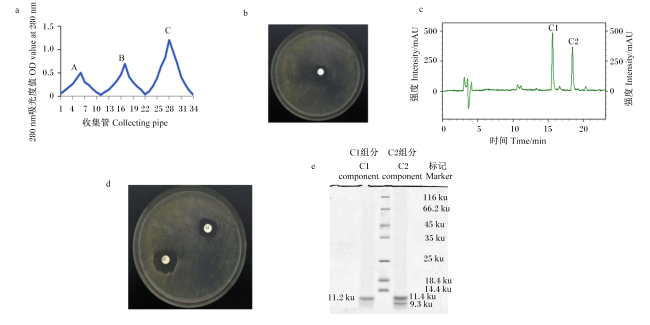
经Sephadex G-100柱层析分离蚯蚓匀浆硫酸铵沉淀,得到A、B、C 3个蛋白洗脱峰(图1-a)。对大肠杆菌抑菌试验显示:A峰无活性,B峰有弱活性,而C峰强活性,其DIZ达到9.5 mm(图1-b)。采用RP-HPLC进一步分离C峰组分,得到C1和C2 2个组分(图1-c),2个峰均有抑菌作用(图1-d),检测蛋白质浓度分别为2.82和1.43 mg/L。经SDS-PAGE测定C1组分分子质量约为11.2 ku,而C2组分则进一步分离为11.4和9.3 ku 2个条带(图1-e)。
图1 EAMPs的分离、纯化和鉴定

a:EAMPs的Sephadex G-100柱层析洗脱曲线;b:C组分对大肠杆菌的抑制作用;c:C组分的RP-HPLC纯化图;d:C1和C2组分对大肠杆菌的抑菌作用;e:C1和C2组分的SDS-PAGE图。

Fig.1 Isolation, purification and identification of EAMPs

a: chromatography elution curve of EAMPs isolated by Sephadex G-100 column; b: inhibitory effect of C component on Escherichia coli; c: purification of C component by RP-HPLC; d: inhibitory effects of C1 and C2 components on Escherichia coli; e: electrophoretogram of C1 and C2 components by SDS-PAGE.

2.2 EAMPs的抑菌活性和MIC

表1可知,EAMPs对革兰氏阳性菌、革兰氏阴性菌和真菌均有抑制作用,其抑菌活性(WIZ)从高到低的排序为:金黄色葡萄球菌、化脓性链球菌>大肠杆菌、都柏林沙门氏菌、弗氏志贺氏菌>枯草芽孢杆菌>米根霉和黑曲霉;同时,EAMPs对大肠杆菌的MIC(0.56 mg/L)与8 U/mL庆大霉素(0.80 mg/L)相当,差异不显著(P>0.05)。
表1 EAMPs对细菌和真菌的抑制作用

Table 1 Inhibitory effects of EAMPs on bacteria and fungi

项目
Items
抑菌圈直径
DIZ/mm
抑菌环宽度
WIZ/mm
最小抑菌浓度
MIC/(mg/L)
革兰氏阳性菌Gram-positive bacteria
金黄色葡萄球菌Staphylococcus aureus 10.87±0.27a 2.44±0.06a 0.14±0.01d
化脓性链球菌Streptococcus pyogenes 10.64±0.21a 2.32±0.05a 0.14±0.01d
枯草芽孢杆菌Bacillus subtilis 8.28±0.16b 1.14±0.03c 0.56±0.03b
革兰氏阴性菌Gram-negative bacteria
大肠杆菌Escherichia coli 9.53±0.18a 1.76±0.03b 0.56±0.02b
都柏林沙门氏菌Salmonella Dublin 9.46±0.35a 1.73±0.05b 0.28±0.01c
弗氏志贺氏菌Shigella flexneri 8.47±0.06b 1.23±0.03b 0.54±0.04b
真菌Fungi
米根霉Rhizopus oryzae 6.93±0.10c 0.46±0.03d 1.12±0.05a
黑曲霉Aspergillus niger 6.53±0.18c 0.26±0.01d 1.12±0.07a
庆大霉素Gentamicin 10.85±0.12a 2.43±0.02a 0.80±0.03b
磷酸盐缓冲液PBS 0.00 0.00 0.00

同列数据肩标不同字母表示差异显著(P<0.05)。下表同。

Values in the same column with different letter superscripts indicated significant differences (P<0.05). The same as below.

2.3 EAMPs的热稳定性

表2可知,分别在25、37、50和80 ℃下处理20 min后,EAMPs对大肠杆菌的抑制作用(DIZ和WIZ)均无显著变化(P>0.05),但100 ℃处理则显著降低其DIZ和WIZ(P<0.05)。对热处理温度与DIZ进行回归分析,得到线性方程:DIZ=9.843-0.009×热处理温度[P<0.001,决定系数(R2)=0.918,n=15];由方程可知,每升高1℃,DIZ降低约0.009 mm。
表2 热处理温度对EAMPs抑菌活性的影响

Table 2 Effects of heat treatment temperature on antimicrobial activities of EAMPs mm

温度
Temperature/℃
抑菌圈直径
DIZ
抑菌环宽度
WIZ
25 9.52±0.06a 1.76±0.02a
37 9.52±0.04a 1.76±0.03a
50 9.45±0.06a 1.73±0.05a
80 9.20±0.07a 1.60±0.03a
100 8.85±0.05b 1.43±0.06b

2.4 贮存时间对EAMPs抑菌活性的影响

贮存时间对EAMPs抑制大肠杆菌活性的影响见表3。与0 d相比,于8 ℃贮存90 d时,EAMPs对大肠杆菌的DIZ和WIZ无显著变化(P>0.05);贮存180 d时,其DIZ和WIZ分别显著降低8.88%和23.37%(P<0.05)。对贮存时间与DIZ进行回归分析,得到线性方程:DIZ=9.772-0.005×贮存时间(P<0.001,R2=0.918,n=9);由方程可知,在180 d贮藏期内,EAMPs的DIZ以每天约0.005 mm的速度降低。
表3 贮存时间对EAMPs抑菌活性的影响

Table 3 Effects of storage time on antimicrobial activities of EAMPs mm

时间
Time/d
抑菌圈直径
DIZ
抑菌环宽度
WIZ
0 9.68±0.10a 1.84±0.05a
90 9.53±0.06a 1.77±0.03a
180 8.82±0.03b 1.41±0.01b

3 讨论

采用硫酸铵沉积、再经柱层析和高效液相色谱分离纯化是获取AMPs的主流手段,不过受凝胶分子筛效应等因素的影响,会使许多活性成分被忽略,一次分离纯化只能获得1种或2种AMPs,而调整分离纯化条件,可能得到不同分子质量的AMPs。目前,研究人员在不同提取(60%~80%硫酸铵)和纯化(Sephadex G-50~200)条件下,从赤子爱胜蚓、威廉环毛蚓和直隶环毛蚓等体腔液或细胞、皮肤黏液等组织器官中分离得到了7 231 u的蚯蚓素(lumbricin)I[7]、6 909.07 u的蚯蚓素-PG[8]、40 000和45 000 u的Fetidins[9]、37 ku的PP-1[10]以及535.27 u的F1和519.17 u的F2等EAMPs[11],并分析了EAMPs的氨基酸序列;同时,抑菌试验均显示上述EAMPs对革兰氏阳性和/或阴性菌有较好的抑制作用,甚至对真菌亦有抑菌活性。本试验从生猪养殖场采集的蚯蚓,通过80%硫酸铵沉淀、Sephadex G-100凝胶柱层析以及RP-HPLC纯化获得了对革兰氏阳性菌和阴性菌及真菌均有抑制活性的C组分。SDS-PAGE显示,C组分由分子质量为11.2 ku的C1组分和由11.4和9.3 ku组成的C2组分3种EAMPs构成,其分子质量与已发现的EAMPs不同,是否为新EAMPs有待质谱分析结合氨基酸序列测定及数据库比对确定。研究显示,不同EAMPs的抑菌活性有较大差异。蚯蚓素I对革兰氏阳性菌、阴性菌及真菌的MIC分别为12~30 mg/L、12~16 mg/L和12~25 mg/L[7]。而Bui等[13]研究显示,3~10 ku EAMPs对大肠杆菌和枯草芽孢杆菌的MIC为1和2 mg/mL。张希春等[11]分离得到2种分子质量分别为535.27和519.27 u的EAMPs F-1和F-2,其对鹑鸡肠球菌、绿脓杆菌、鲍氏不动杆菌和土生克雷伯氏菌的MIC为11.4~22.8 mg/L,而蚯蚓素-PG对金黄色葡萄球菌和大肠杆菌的MIC则分别为5.0和20.0 mg/L[8]。本试验纯化得到的EAMPs对革兰氏阳性菌的MIC为0.14~0.56 mg/L,对革兰氏阴性菌的MIC则为0.28~0.56 mg/L,而对米根霉和黑曲霉的MIC均为1.12 mg/L。由此可见,与上述EAMPs相比,本试验从环境较差的养殖场中采集的蚯蚓中分离得到的EAMPS具有更强的抑菌活性,且具有广谱抑菌活性。
在畜禽生产中往往饲喂颗粒饲料,要在饲粮中使用EAMPs则其需能耐受约80 ℃持续18 min左右的高温,因此本试验观测了热处理对EAMPs抑菌活性的影响。结果显示,EAMPs在25~80 ℃下,加热20 min后对大肠杆菌抑菌活性无显著影响;当升高至100 ℃时,其抑菌活性才显著降低。张显忠等[14]100 ℃加热10 min EAMPs后只能保持部分活力。Bui等[13]提取的EAMPs在100 ℃加热30 min后抑菌活性也有所降低。贮存试验结果还显示,EAMPs贮存90 d后,其抑菌活性无显著降低;但当贮存180 d时,抑菌活性显著降低。由此可见,本试验提取的EAMPs可耐高温和贮存,具有较好的稳定性。研究表明,AMPs的稳定性受其氨基酸组成和一级结构的影响,由半胱氨酸残基形成的二硫键使其具有较好的稳定性[15-16]

4 结论

本试验分离纯化得到2种EAMPs C1和C2,其分子质量分别为11.2以及11.4和9.3 ku,对革兰氏阳性菌和阴性菌均有抑菌作用,对真菌的抑菌作用较弱,可耐受80 ℃以下热处理和8 ℃下贮存90 d。
[1]
WANG J K, FENG J W, KANG Y, et al. Discovery of antimicrobial peptides with notable antibacterial potency by an LLM-based foundation model[J]. Science Advances, 2025, 11(10):eads8932.

[2]
MAGANA M, PUSHPANATHAN M, SANTOS A L, et al. The value of antimicrobial peptides in the age of resistance[J]. The Lancet Infectious Diseases, 2020, 20(9):e216-e230.

[3]
MARR A K, GOODERHAM W J, HANCOCK R E. Antibacterial peptides for therapeutic use:obstacles and realistic outlook[J]. Current Opinion in Pharmacology, 2006, 6(5):468-472.

DOI

[4]
GHOSH S. Environmental pollutants,pathogens and immune system in earthworms[J]. Environmental Science and Pollution Research, 2018, 25(7):6196-6208.

DOI

[5]
SIMBANEGAVI T T, MAKUVARA Z, MARUMURE J, et al. Are earthworms the victim,facilitator or antidote of antibiotics and antibiotic resistance at the soil-animal-human interface?A one-health perspective[J]. Science of the Total Environment, 2024,945:173882.

[6]
马占飞, 李杨, 王亚博, 等. 蚯蚓抗菌肽研究进展[J]. 动物医学进展, 2022, 43(7):69-73.

MA Z F, LI Y, WANG Y B, et al. Advance in antibacterial peptides from earthworms[J]. Progress in Veterinary Medicine, 2022, 43(7):69-73. (in Chinese)

[7]
CHO J H, PARK C B, YOON Y G, et al. Lumbricin I,a novel proline-rich antimicrobial peptide from the earthworm:purification,cDNA cloning and molecular characterization[J]. Biochimica et Biophysica Acta:Molecular Basis of Disease, 1998, 1408(1):67-76.

DOI

[8]
BODÓ K, BOROS Á, RUMPLER É, et al. Identification of novel lumbricin homologues in Eisenia andrei earthworms[J]. Developmental & Comparative Immunology, 2019,90:41-46.

[9]
LI W L, LI S S, ZHONG J, et al. A novel antimicrobial peptide from skin secretions of the earthworm,Pheretima guillelmi (Michaelsen)[J]. Peptides, 2011, 32(6):1146-1150.

DOI

[10]
WANG X, WANG X X, ZHANG Y, et al. An antimicrobial peptide of the earthworm Pheretima tschiliensis:cDNA cloning,expression and immunolocalization[J]. Biotechnology Letters, 2003, 25(16):1317-1323.

DOI

[11]
张希春, 孙振钧, 禚如朋, 等. 蚯蚓两种抗菌肽的分离纯化及部分性质[J]. 生物化学与生物物理进展, 2002, 29(6):955-960.

ZHANG X C, SUN Z J, ZHUO R P, et al. Purification and characterization of two antibacterial peptides from Eisenia fetida[J]. Progress in Biochemistry and Biophysics, 2002, 29(6):955-960. (in Chinese)

[12]
WU Y Z, DENG S G, WANG X H, et al. Discovery and mechanism of action of a novel antimicrobial peptide from an earthworm[J]. Microbiology Spectrum, 2023, 11(1):e0320622.

DOI

[13]
BUI P T, HA D Q, PHAM K T, et al. Investigation into antimicrobial activity and its stability of protein hydrolysate derived from earthworms[J]. Chemical Engineering Transactions, 2023,106:883-888.

[14]
张显忠, 张欣然, 武晓雯, 等. 蚯蚓体内外分泌液的抗菌活性研究[J]. 安徽农业科学, 2018, 46(13):95-97.

ZHANG X Z, ZHANG X R, WU X W, et al. Study on the antibacterial activity of internal and external secretory fluid of earthworm[J]. Journal of Anhui Agricultural Sciences, 2018, 46(13):95-97. (in Chinese)

[15]
ZHANG S H, LUO L, SUN X Y, et al. Bioactive peptides:a promising alternative to chemical preservatives for food preservation[J]. Journal of Agricultural and Food Chemistry, 2021, 69(42):12369-12384.

DOI

[16]
AL-SAHLANY S T G, ALTEMIMI A B, AL-MANHEL A J A, et al. Purification of bioactive peptide with antimicrobial properties produced by Saccharomyces cerevisiae[J]. Foods, 2020, 9(3):324.

DOI

Outlines

/