REVIEW

Absorption, Metabolism, Biological Activity and Application in Livestock Production of Anthocyanidins

  • YAO Xiangtian , 1, 2 ,
  • ZANG Ying’an 2 ,
  • WANG Yibing , 1, * ,
  • JIANG Shouqun 1
Expand
  • 1 Guangdong Provincial Key Laboratory of Animal Breeding and Nutrition, Key Laboratory of Animal Nutrition and Feed Science in South China, Ministry of Agriculture and Rural Affairs, National Key Laboratory of Swine and Poultry Breeding Industry, Institute of Animal Science, Guangdong Academy of Agricultural Sciences, Guangzhou 510640, China
  • 2 College of Animal Science & Technology, Zhongkai University of Agriculture and Engineering, Guangzhou 510225, China
* associate professor, E-mail:

Received date: 2025-06-11

  Online published: 2026-02-12

Abstract

In the face of the global prohibition on antibiotics in feed, the pursuit of natural bioactive substances, such as plant extracts, is crucial for promoting livestock health and sustainable farming. Anthocyanidins, a class of flavonoid pigments widely found in plants, exhibit diverse biological activities, which have anti-inflammatory, antioxidant, and anti-tumor effects. This review presents a summary of the source structure, physicochemical properties, absorption and metabolism, anti-inflammatory, antioxidant, antitumor mechanisms and of anthocyanidins, as well as the current stage of the application of the study in livestock and poultry production, with the aim of promoting the development of new bioactive additives and the healthy and efficient breeding of livestock and poultry.

Cite this article

YAO Xiangtian , ZANG Ying’an , WANG Yibing , JIANG Shouqun . Absorption, Metabolism, Biological Activity and Application in Livestock Production of Anthocyanidins[J]. Chinese Journal of Animal Nutrition, 2026 , 38(2) : 914 -925 . DOI: 10.12418/CJAN2026.072

花青素(anthocyanidin)又称花色素,是一种天然的生物活性物质。花青素具有抗炎、抗氧化、抗肿瘤等生物学活性,对多种慢性炎症疾病和神经退行性疾病起到有效缓解作用。目前,花青素主要用作人体健康保健功能,应用在食品添加剂和保健品等领域,其在畜禽养殖方面的应用不够系统和深入。因此,本文就花青素的来源、结构、理化性质和吸收代谢等特性进行介绍,综述其抗炎、抗氧化和抗肿瘤等作用机制以及现阶段在畜禽生产中的应用研究,探讨其用作饲料添加剂的可行性及前景,旨在推动新型生物活性添加剂的开发及应用于畜禽健康高效养殖中。

1 花青素的来源及结构

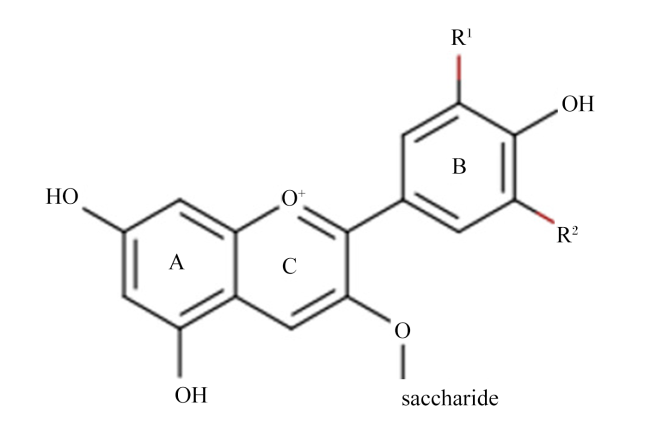
花青素是一种植物源水溶性黄酮类化合物,广泛存在于蓝色、红色、紫色的水果、花卉和蔬菜中,如蓝莓、牵牛花和紫甘蓝等。花青素最早由德国化学家Ludwig Marquart发现并命名[1],1913年,美国化学家Richard Willstätter和Arthur Stoll第1次从矢车菊中分离出蓝色花青素,并且详细描述了其化学结构[2]。花青素是2-苯并芘或黄原酸盐离子的多羟基和甲氧基衍生物,其基本结构是C6-C3-C6,即2个芳香环和1个含氧杂环,花青素的化学结构式[3]图1。C6-C3-C6上不同的取代基决定了花青素颜色变化,B环的羟基化和甲基化控制花青素的颜色和稳定性,蓝色随着羟基数量的增加而增加,而红色随着B环中甲基化的增强而增加[4]
图1 花青素的化学结构式

saccharide:糖类。

Fig.1 Chemical structure of anthocyanidins[3]

目前,自然界中存在的花青素有27种,常见的有6种,分别是矢车菊素(cyanidin)、芍药花素(peonidin)、天竺葵色素(pelargonidin)、飞燕草素(delphinidin)、锦葵素(malvidin)和矮牵牛素(petunidin)[5]。花色苷(anthocyanin)是花青素衍生物,由花青素(糖苷配基)以及不同的糖苷组成。糖苷通过1个或多个羟基形成缩醛键连接到花青素的基本机构骨架上,特别是C环的C-3'位,A环的C-5'、C-6'和C-7'位,以及B环的C-3'、C-4'和C-5'位,常见花青素的化学结构[6]表1。27种花青素结合不同的糖苷可产生超过700种不同的花色苷,在自然界中,花青素通过糖苷键结合糖类形成花色苷,以维持其稳定性[7]
表1 常见花青素的化学结构

Table 1 Chemical structures of common anthocyanidins[6]

项目Items R1 R2
天竺葵色素Pelargonidin H H
矢车菊素Cyanidin OH H
飞燕草素Delphinidin OH OH
芍药花素Peonidin OCH3 H
矮牵牛素Petunidin OCH3 H
锦葵素Malvidin OCH3 OCH3

2 花青素的理化性质

花青素可溶于水,具有良好的着色能力,作为食品或制药行业合成染料的天然替代品,具有很强的生态持续性。花青素可溶于甲醇、乙醇和丙酮等有机溶剂,在生产中常用乙醇作为浸提剂。
花青素的分子结构具有离子性质,因此花青素的颜色受到pH影响。在酸性条件下(pH<6),花青素呈现为红色,主要以黄酮阳离子的形式存在,这加强了花青素的稳定性;在中性条件下(pH=6~8),花青素呈现为紫色,形成醌式碱;在碱性条件下(pH>8),花青素呈现蓝色,形成顺式和反式查尔酮。花青素的不同形态可以共存和互相转化,在不同的pH水平上保持平衡[8]
花青素的稳定性受花青素B环结构和羟基或甲氧基的影响,B环中邻位羟基的存在使分子更容易氧化,从而降低分子的稳定性,不同种类的花青素的稳定性不同[9]。因此,矢车菊素、飞燕草素和矮牵牛素中的邻位羟基使它们比芍药花素和锦葵素更不稳定。花青素降解和代谢可能会发生在A环和B环,A环降解导致形成三羟基苯甲酸或间苯三酚醛,而丁香酸、香草酸和原儿茶酸是通过B环裂解的花青素降解的主要产物[10]
光、温度、pH以及金属离子、酶和抗氧化剂均会影响花青素的稳定性。研究表明,花青素降解程度随加热时间呈对数增长[11]。Voss等[12]发现,在90 ℃加热4.5 h后,花青素吸光度显著下降,颜色褪变明显;且不同花青素对温度的敏感性不同,其中矢车菊素-3-葡萄糖苷在高温下表现出较高的稳定性;另外,酰基化和糖基化的花青素比普通花青素具有更好的热稳定性。

3 花青素的吸收与代谢

3.1 花青素的吸收

花青素通过口腔、消化道吸收,进入血液循环,并在尿液及组织(小脑、眼睛和肝脏等)广泛分布,对机体发挥生物学作用。经口摄入后,花青素呈现快速和非线性吸收,0.75 h即可进入血液[13]。花色苷被口腔上皮细胞与细菌分泌的β-葡萄糖苷酶分解为花青素,花青素则自动降解为间苯三酚醛和原儿茶酸;抑制β-葡萄糖苷酶分泌可显著降低花青素的分解速率[14]。此外,在口腔中花青素平均每5 min即可降解超过10%[15]。在无酶的人工唾液中,固定的时间和温度条件处理下,不同花青素的苷元部分降解程度不同,飞燕草素和牵牛花素降解程度高于矢车菊素、芍药花素和锦葵素,飞燕草素降解90%以上,牵牛花素降解70%以上,芍药花素、矢车菊素和锦葵素均降解30%~40%[16]
花青素在胃中被快速吸收,摄入30 min后即可入血[17]。花色苷可以在胃中被乳糖酶和β-葡萄糖苷酶水解成花青素,然后通过被动扩散或葡萄糖转运蛋白吸收。抑制促进性葡萄糖转运蛋白转录后,花青素的转运率明显下降[18]。花青素也可以与胆汁转位酶结合并进入上皮细胞,直接吸收进入血液循环。这种吸收方式与花青素的结构有关,酰化花青素不易被吸收,而单糖苷和双糖苷花青素是更高效的胆汁转位酶配体。
小肠是花青素吸收的主要部位,花青素经转运蛋白进入肠细胞。药代动力学显示,空肠中花青素吸收最多,十二指肠吸收次之,回肠吸收可以忽略不计[19]。小肠对花青素的吸收与它们的稳定性和疏水性有关,飞燕草素有2个-OH基团,锦葵素有2个-OCH3基团,芍药花素有1个-OH基团,这使得飞燕草素比其他基团更亲水,而疏水花青素的转运速率高于亲水花青素,更易被吸收。

3.2 花青素的代谢

花青素在体内代谢较为复杂,其主要在肝脏和小肠中进行Ⅰ期和Ⅱ期代谢。在Ⅰ期代谢中,花青素受细胞色素P450酶催化,发生脱甲基化和羟基化反应,产生更多活性位点。在Ⅱ期代谢中,花青素受UDP-葡萄糖醛酸转移酶(UGTs)、儿茶酚-O-甲基转移酶(COMT)和磺基转移酶(SULTs)催化,形成葡萄糖醛酸、硫酸酯等代谢物,使水溶性提高,更易于排泄[20]。复杂糖基花青素在肠道中能够更长时间保持活性,从而提高生物利用度[21]。在一项仔猪试验中,与矢车菊素-3-葡萄糖相比,矢车菊素-3-山梨糖苷和矢车菊素-3-鼠李糖苷在肠道的降解率更低[22]
花青素在肠道中的代谢也受肠道菌群影响。部分花青素到达结肠,与微生物群相互作用并发生酶促降解。某些花青素会降解为酚酸,如原儿茶酸、没食子酸和香草酸,这些物质会在体内积累,并通过调节生物活性来促进健康[23]。花色苷糖苷首先被肠道菌群中的α-L-鼠李糖苷酶和β-D-葡萄糖苷酶去糖基化,形成花青素;而后花青素发生环裂解或水解反应生成苯甲酸、邻苯二酚等酚类化合物或酚酸和醛类化合物[24]。未被吸收的花青素进入结肠,被肠道微生物降解成小分子酚酸等代谢物,部分被吸收,部分随粪便排出。
花青素的苷元和化学结构决定了其具有复杂的吸收和代谢过程,而吸收和代谢的差异决定了其生物利用度和在靶器官的活性及含量。因此,不同类型花青素在机体的起效时间和作用机制可能存在差异。此外,与纳米技术和其他化合物的协同作用可以显著提高花青素的生物利用度。如复合纳米凝胶膜包被增加了花青素-3-O-葡萄糖苷的表观渗透系数和抗氧化活性[25];异硫氰酸烯丙酯和花青素-3-葡萄糖苷联合使用提高了在小鼠体内的生物利用度[26];多糖-马铃薯蛋白复合凝聚物增强了花青素的生物利用度和稳定性[27]

4 花青素的生物学活性及作用机理

在机体内,花青素经吸收代谢后,其原型及代谢产物分布至各靶组织,与特定细胞相互作用并触发一系列生物学效应,从而发挥各种各样的生物学活性,如抗炎、抗氧化和抗肿瘤等。

4.1 抗炎活性

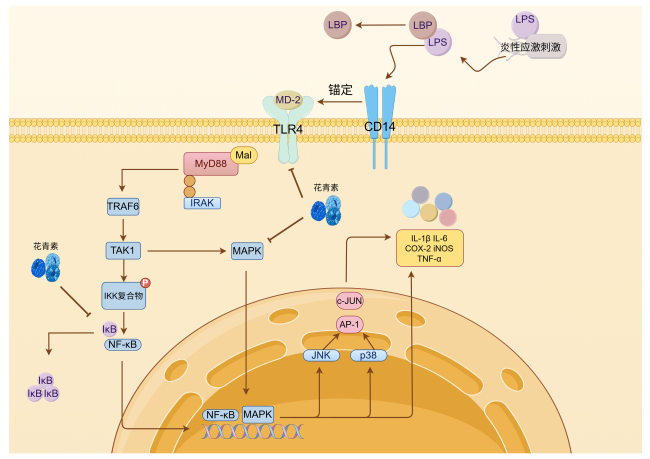
花青素作为一种天然的化合物,表现出显著的抗炎效果,在治疗炎症性疾病方面显示出潜在的应用价值。Toll样受体(Toll like receptor,TLR)能特异识别病原相关分子模式,是连接天然免疫和获得性免疫的桥梁。研究表明,花青素主要通过调节TLR,阻碍脂多糖(lipopolysaccharide,LPS)与TLR的结合,调控下游核因子-κB(nuclear factor kappa-B,NF-κB)和丝裂原活化蛋白激酶(mitogen-activated protein kinase,MAPK)信号通路,减少炎症因子的产生,从而发挥抗炎作用[28]

4.1.1 调控NF-κB信号通路

NF-κB信号通路调控多种炎症相关基因的转录,作为炎症反应的核心和放大器,在炎症反应中扮演关键角色。NF-κB在受到外界刺激后,诱导炎症基因的表达,有效激活炎症细胞因子,如肿瘤坏死因子-α(tumor necrosis factor-α,TNF-α)、白细胞介素(interleukin,IL)-1α、IL-1β、IL-8、细胞间黏附因子(intercellular adhesion molecules,ICAMs)、血管细胞黏附因子-1(vascular cell adhesion molecule-1,VCAM-1)、诱导型一氧化氮合酶(inducible nitric oxide synthase,iNOS)等,从而参与炎症的发生和发展[29]
研究表明,花青素可以通过抑制NF-κB信号通路激活来缓解多种炎症性疾病。如在急性肾炎小鼠中,花青素可下调NF-κB p65的蛋白表达、上调核因子-κB抑制蛋白α(inhibitor of NF-κB α,IκBα)的蛋白表达,降低肾脏丙二醛(malondialdehyde,MDA)含量,提高总抗氧化能力(total antioxidant capacity,T-AOC)和超氧化物歧化酶(superoxide dismutase,SOD)活性,减轻肾脏组织病理损伤[30]
花青素可通过抑制NF-κB信号通路有效改善软骨和骨关节炎症。Zeng等[31]和Duarte等[32]研究发现,天竺葵素和天竺葵素-3-O-葡萄糖苷可以显著抑制p65亚基从细胞质到细胞核的移位,从而抑制NF-κB信号通路的激活,降低软骨细胞中IL-6、TNF-α、环氧化酶(cyclooxygenase,COX)-2和iNOS的蛋白表达,抑制骨关节炎小鼠软骨基质细胞的分解,改善软骨损伤。Zhang等[33]研究表明,黑果枸杞花青素可以降低血清TNF-α、IL-1β、IL-18、前列腺素E2(prostaglandin E2,PGE2)、COX-1含量,降低小鼠爪部COX-1的mRNA表达水平,抑制痛风性关节炎。
花青素通过调节NF-κB途径抑制炎症反应,保护紧密连接蛋白,从而维持肠上皮屏障的完整性,对缓解炎症性肠炎具有积极作用。研究表明,红树莓(含丰富矢车菊素)可以减少肠道出血,增强结肠紧密连接蛋白密封蛋白(Claudin)-2、Claudin-3和黏蛋白2(mucin 2,MUC2)的mRNA表达水平,从而改善小鼠结肠炎[34];黑涩石楠和红树莓可以抑制NF-κB p65的核转位,减少血清PGE2含量,下调结肠干扰素-γ(interferon-γ,IFN-γ)、COX-2、iNOSTNF-αIL-17和IL-1β等炎症因子的mRNA表达水平,降低结肠IL-6、TNF-α和IFN-γ含量,缓解葡聚糖硫酸钠诱导的小鼠结肠炎[34-35]
在缺血再灌注损伤模型中,花青素也通过调控NF-κB信号通路发挥着抗炎作用。Chen等[36]研究发现,花色苷剂量依赖式(50、100、150 mg/kg)降低缺血再灌注大鼠脊髓组织中TLR4、COX-2和NF-κB的蛋白表达,抑制了IL-6、IL-1β和TNF-α的产生。Cui等[37]研究也表明,杨梅花青素(300 mg/kg)也可以降低小鼠脑缺血再灌注损伤中的核苷酸结合寡聚化结构域样受体蛋白(nucleotide-binding oligomerization domain-like receptor protein 3,NLRP3)、半胱氨酸蛋白酶(cysteinyl aspartate specific proteinase,Caspase)-1、TLR4、TNF-α、NF-κB和IL-18的蛋白表达,最终缓解炎症损伤。

4.1.2 调控MAPK信号通路

MAPK是细胞内重要的信号传递者,参与了多种生理过程,包括炎症过程的调节。其中与炎症有关的信号通路为p38 MAPK和c-Jun N端激酶(c-Jun N-terminal kinase,JNK),二者均可被多种应激原刺激而活化。活化后的JNK通过磷酸化激活转录因子2(activating transcription factor 2,ATF2)和磷酸化JNK,增强激活蛋白-1(activator protein-1,AP-1)的转录活性,从而促进炎症基因表达和蛋白质合成;p38 MAPK的激活可调节产生多种下游炎症介质,包括促进炎性因子、COX-2和iNOS,进而影响PGE2和一氧化氮(NO)的生成,参与炎症反应[38]。研究表明,花青素可调控MAPK信号通路发挥抗炎作用[39]
Gao等[35]研究黑果海桑花色苷对葡聚糖硫酸钠诱导的炎症性肠病(inflammatory bowel disease,IBD)小鼠模型的影响,显示其可以剂量依赖性(20~40 mg/kg)抑制MAPK信号通路的激活,降低TNF-α、IFN-γ和IL-6含量。Jiang等[40]研究发现,紫甘薯游离花青素降低细胞外信号调节蛋白激酶(extracellular signals regulate protein kinases,ERK)、p38 MAPK和JNK的磷酸化,通过抑制MAPK信号通路介导的AP-1核转位来抑制LPS诱导的巨噬细胞RAW264.7炎症。另外,花青素可降低ERK、p38 MAPK和JNK的磷酸化水平,对IL-1β[41]和糖基化终末产物[42]刺激的人软骨细胞炎症均表现出抗炎作用。Kim等[43]比较了花青素的神经保护作用,发现其在体外和体内试验中均降低磷酸化JNK表达,抑制人淀粉样蛋白1-42(amyloid β-protein 1-42,Aβ1-42)诱导的BV2小胶质细胞及小鼠脑组织中的淀粉样蛋白、iNOS、TNF-α、COX-2等的蛋白表达,在预防神经退行性疾病的防治方面起积极作用。花青素调控NF-κB和MAPK信号通路缓解炎症的分子机制如图2所示。
图2 花青素调控NF-κB和MAPK信号通路缓解炎症的分子机制(由Figdraw绘制)

LBP:脂多糖结合蛋白 lipopolysaccharide binding protein;LPS:脂多糖 lipopolysaccharide;MD-2:髓样分化蛋白-2 myeloid differentiation protein-2;TLR4:Toll样受体4 Toll like receptor 4;CD14:分化簇14 cluster of differentiation 14;Myd88:髓样分化因子88 myeloid differentiation protein 88;Mal:髓样分化因子88接头蛋白 myeloid differentiation protein 88 adapter protein;IRAK:白细胞介素-1受体相关激酶 interleukin-1 receptor-associated kinase;TRAF6:肿瘤坏死因子受体相关因子6 TNF receptor-associated factor 6;TAK1:转化生长因子-β激活激酶1 transforming growth factor-beta-activated kinase 1;MAPK:丝裂原活化蛋白激酶 mitogen-activated protein kinase;IL-6:白细胞介素-6 interleukin-6;IL-1β:白细胞介素-1β interleukin-1β;COX-2:环氧化酶-2 cyclooxygenase-2;iNOS:诱导型一氧化氮合酶 inducible nitric oxide synthase;TNF-α:肿瘤坏死因子-α tumor necrosis factor-α;IKK:核因子-κB抑制蛋白激酶 nuclear factor-κB inhibitor protein kinase;IκB:核因子-κB抑制蛋白 inhibitor of nuclear factor-κB;NF-κB:核因子-κB nuclear factor-κB;c-JUN:Jun原癌基因 Jun proto-oncogene;AP-1:激活蛋白-1 activator protein-1;JNK:c-Jun氨基端激酶 c-Jun N-terminal kinase;p38:p38有丝分裂原激活的蛋白激酶 p38 mitogen-activated protein kinase。

Fig.2 Molecular mechanism of anthocyanidins on regulation of NF-κB and MAPK signaling pathways to alleviate inflammation (drawn by Figdraw)[28-29,39]

4.2 抗氧化活性

花青素的抗氧化能力主要来自其化学结构,花青素查尔酮和醌型碱均是清除自由基的有效抗氧化剂。此外B环糖基化、邻位羟基化和甲氧基也有助于提高抗氧化活性。花青素的环结构中存在电子供体和电子受体取代基,可以向活性氧自由基传递1个电子来中和自由基,从而抑制自由基的传播和进一步形成。常见的6种花青素抗氧化作用从强到弱依次是:矢车菊色素、飞燕草素、矮牵牛素、锦葵素、芍药花素和天竺葵色素[44]
氧化损伤过程与衰老、肿瘤相关,还与多种免疫、炎症性疾病具有紧密联系。花青素因其高效的抗氧化功能,可改善多种疾病模型中的氧化损伤。花青素可以螯合生成活性氧(reactive oxygen species,ROS)所需的金属离子,或抑制生成ROS的酶,降低氧化应激水平,缓解脑缺血再灌注损伤引发的小鼠肾脏损伤[45]。花青素还可以提高谷胱甘肽过氧化物酶(glutathione peroxidase,GSH-Px)、过氧化氢酶(catalase、CAT)和SOD活性,降低MDA含量,缓解大鼠中神经系统退行性病变[46]及糖尿病等营养代谢性疾病[47]中的氧化损伤。
核因子E2相关因子2(nuclear factor E2-related factor 2,Nrf2)-抗氧化反应元件(antioxidant response element,ARE)信号通路是细胞抗氧化应激的关键机制,由这条通路调控的抗氧化酶系和Ⅱ相解毒酶能够清除ROS等有害物质,转录Nrf2通路生物标志物如依赖还原型辅酶Ⅰ(Ⅱ)醌氧化还原酶1[NAD(P)H:quinine oxidoreductase 1,NQO1]、血红素氧合酶-1(heme oxygenase-1,HO-1)和SOD等基因,进而抵抗各种刺激对机体产生的氧化应激[48]。在体内外多种试验中,花青素通过激活Nrf2-ARE信号通路,提高GSH-Px、SOD和CAT等抗氧化酶活性,减少MDA和ROS生成,缓解大鼠肾脏[49]及脑组织[48]、小鼠肝脏[50]及睾丸[51]的氧化应激损伤。

4.3 抗肿瘤

除了抗炎和抗氧化活性外,花青素还具有抗肿瘤作用。花青素及其代谢产物可以通过诱导细胞周期阻滞、促进凋亡以及抑制肿瘤转移等机制发挥抗肿瘤作用。

4.3.1 诱导细胞周期阻滞

花青素及其衍生物具有抗癌细胞增殖活性,可通过调节细胞周期相关基因,在G1/G0和G2/M阶段阻滞细胞周期[52]。此外,花青素通过抑制Wnt/β-连环蛋白信号通路调下游靶点c-Myc和细胞周期蛋白D1(cyclin D1)表达[53]与肿瘤细胞生长因子受体磷酸化,降低肿瘤细胞的增殖和迁移能力[54]。芍药花素-3-葡萄糖苷(5、10和30 μmol/L)和矢车菊素-3-葡萄糖苷(0.2、2.5、5.0和10.0 μmol/L)剂量依赖性下调人乳腺癌细胞HS578T中周期蛋白依赖性蛋白激酶(cyclin-dependent protein kinases,CDK)-1、CDK-2、细胞周期蛋白B1(cyclin B1)和cyclin D1蛋白水平[55]。此外矢车菊素-3-O-β葡萄糖苷也可降低HL-60细胞中p53蛋白水平[56]。MAPK家族可以调节癌变过程中调节细胞分化、增殖和存活,上文介绍的花青素对MAPK信号通路的阻断作用很可能是其抗癌活性的关键调控机理。

4.3.2 诱导癌细胞凋亡

花青素在多种癌症细胞模型和动物模型中表现出诱导细胞凋亡的能力。细胞凋亡是一种以细胞质凝聚、质膜起泡、核固缩和染色体DNA降解为特征的细胞程序性死亡。Caspase上游途径通过B细胞淋巴瘤-2(B-cell lymphoma-2,Bcl-2)家族蛋白释放细胞色素C释放到细胞质,进而激活Caspase下游途径,最终导致细胞凋亡。研究表明,花青素在癌细胞中可促进Caspase-3活化来增强细胞凋亡的能力[57]。黑果腺肋花楸花青素通过Wnt/β-连环蛋白信号通路诱导Caco-2细胞凋亡[58]。花青素可以通过激活线粒体依赖性的凋亡通路,如增加B细胞淋巴瘤-2相关X蛋白(B-cell lymphoma-2-associated X protein,Bax)/Bcl-2比值、激活Caspase-3和降低抗凋亡蛋白的表达来诱导直肠癌细胞凋亡[59-60]

4.3.3 抑制肿瘤转移和血管新生

癌细胞通过淋巴系统或血液移入新的组织器官并定居增殖,而花青素可以降低癌细胞与细胞外基质蛋白(如纤连蛋白)的黏附能力,从而抑制肿瘤转移。在Awad等[61]的研究中,花青素和顺铂联合处理抑制乳腺癌MCF7和肝癌HepG2细胞与纤维连接蛋白的黏附,通过抑制基质金属蛋白酶-9(matrix metallopeptidase-9,MMP-9)表达,促进组织金属蛋白酶抑制剂-1(tissue inhibitor of metalloproteinase-1,TIMP-1)的表达来发挥抗转移和抗血管生成的作用。花青素还可以调节上皮间质转化相关基因,降低纤维连接蛋白和波形蛋白等间质标志物的表达,来降低肿瘤细胞迁移[62-63]。此外,花青素还可以降低肠癌干细胞标志物CD44和CD133的表达,抑制肠癌干细胞的增殖和转移[64]
在肿瘤增殖过程中,新血管生成发挥了重要作用,其生成受到血管生成因子的调控。花色苷可以通过抑制血管生成因子的表达来减少血管新生,从而抑制肿瘤的生长和转移。Mazewski等[65]研究发现,飞燕草素-3-葡萄糖苷能够抑制人结肠癌细胞hcT-116和HT-29中细胞血管内皮生长因子表达。

5 花青素在畜禽生产中的应用

现阶段养殖生产中,畜禽长期处于高密度饲养、免疫刺激等多种应激源叠加的环境中,普遍存在氧化应激和炎症反应频发、生长发育受阻、产品品质下降等产业问题。花青素作为一种功能性生物活性物质,在调节炎症反应、抵御氧化应激等方面具有有效作用,其添加在饲料中能够有效改善畜禽抗氧化功能、免疫力和肠道健康,提升畜禽生长性能和产品质量,是养殖业中具有重要应用前景的天然物质。

5.1 在家禽生产中的应用

目前花青素对家禽的作用研究主要集中在肉鸡养殖中。研究表明,花青素可以改善肠道健康,提高肉鸡的生长性能。覃继肖等[66]研究发现,饲粮中添加240 mg/kg的紫玉米花青素可以提高赤水乌骨鸡的平均日增重。Fang等[67]研究表明,饲粮中添加紫甘薯花青素(32 mg/kg)可以缓解热应激造成的文昌鸡血浆D-乳酸含量和二胺氧化酶活性的提高,对肠道起到保护作用。作用于LPS应激[68]和沙门氏菌感染[69]肉鸡时,400 mg/kg花青素处理显著降低脾脏中IL-1β表达,提高了回肠绒毛高度、绒隐比,提高了回肠闭锁小带蛋白-1(zonula occluden-1,ZO-1)、连接附着分子2(junctional adhesion molecule 2,JAM2)、闭合蛋白(Occludin)表达和空肠ZO-1、Claudin-1、OccludinMUC2的表达,从而改善肠道健康,提高平均日增重,缓解应激或感染造成的损伤。另外,上述沙门菌感染肉鸡中,花青素可以增加有益菌如乳酸杆菌等的相对丰度,降低肉鸡肠道条件致病菌埃希氏菌和志贺氏菌的相对丰度[69],调节肠道微生物组成,抑制致病菌的生长。花青素的抗氧化作用可以有效改善肉鸡的氧化应激状态。研究表明,花青素可以提高文昌鸡[67]和赤水黑骨鸡[70]血液和肝脏中抗氧化酶(GSH-Px、SOD)活性,并降低MDA含量。Wang等[71]研究发现,饲粮中添加400 mg/kg越橘花青素增强黄羽肉鸡雏鸡血浆SOD活性与空肠黏膜中SOD1、CATGSH-Px的表达,减少MDA含量,缓解LPS诱导的氧化应激。
花青素对鸡肉品质风味也具有改善作用。Fang等[67]研究发现,紫甘薯花青素可提高文昌鸡胸肌的肌肉持水率,降低胸肌pH和降低腹脂率,改善热应激对肉质和胴体品质的不利影响。Wang等[71]研究发现,饲粮中添加400 mg/kg越橘花青素提高了黄羽肉鸡胸肌pH,并降低滴水损失和剪切力,改善肉品质。饲粮中添加紫玉米花青素(160、240 mg/kg)[70]和山竹果皮(富含花青素,含4 000和6 000 mg/kg果皮提取物)[72]可以降低肌肉失水率,上调肌肉鲜味氨基酸、必需氨基酸和不饱和脂肪酸的含量,改善赤水黑骨鸡和罗斯308肉鸡肉品质与风味。

5.2 在猪生产中的应用

花青素可有效改善猪肉品质,其作用机理与减少自由基、防止肌肉脂质氧化相关;另外,也有研究显示花青素可以通过调节肌肉纤维密度、直径和横截面来影响肉品质[73]。Liu等[74]研究发现,在断奶仔猪饲粮中添加1 000或2 000 mg/kg富含花青素的黑果腺肋花楸果渣可提高仔猪血清和肝脏中GSH-Px活性,并上调肝脏中GSH-Px1和GSH-Px4的表达,从而提高断奶仔猪的平均日采食量、平均日增重,并降低腹泻率;还减少肌肉的滴水损失、提高宰后pH,改善肉品质。
Pearce等[75]研究发现,在断奶仔猪饲粮中添加5 000 mg/kg黑果腺肋花楸果汁粉可以提高结肠中IFN-γ含量,提高回肠中Claudin-2和JAM2(调节肠道屏障功能)以及结肠抗菌肽RegⅢγ、溶质载体家族6成员19(SLC6A19)和蔗糖酶异麦芽糖酶(SI)的表达,花青素可能通过调节与屏障功能和消化吸收功能相关的基因表达,改善仔猪肠道健康。

5.3 在反刍动物生产中的应用

应用于反刍动物时,花青素同样可以发挥抗氧化作用,通过抑制脂质和蛋白质的氧化,有效维持肉类的色泽、风味和营养价值,从而提升整体肉品质。饲粮中添加6%紫玉米提取残渣[76]或6%紫色印楝叶[77]可降低公牛血浆和羔羊血浆MDA含量;添加500或1 000 mg/d紫玉米色素[78]以及50%富含花青素的黑甘蔗饲料[79]可提高山羊血浆SOD、CAT和GSH-Px等抗氧化酶活性。另外,上述紫玉米色素[78]降低了山羊背最长肌的剪切力值和饱和脂肪酸含量,增加了不饱和脂肪酸、总多不饱和脂肪酸含量;添加40 mg/kg参薯花青素提高了海南黑山羊血浆中上述抗氧化酶活性,提高肌肉宰后pH和熟肉率,降低剪切力[80]
研究表明,花青素可以改善瘤胃微生物菌群和挥发性脂肪酸构成,促进反刍动物肠道健康。Tian等[81]研究发现,饲粮中添加500 mg/d紫玉米花青素调控山羊属水平上的微生物分布,提高瘤胃乙酸含量,降低丙酸、丁酸、戊酸和异丁酸含量,从而提高山羊粗蛋白质和总能消化率。富含花青素的红玉米降低了血清葡萄糖和非酯化脂肪酸含量,同时提高了育肥羔羊[82]的血红蛋白含量及天门冬氨酸氨基转移酶(aspartate transaminase,AST)、肌酸激酶(creatine kinase,CK)活性。富含花青素的紫色印楝叶[77]提高了2和4 h瘤胃的氨态氮、尿素氮、乙酸、丙酸、丁酸和总挥发性脂肪酸含量及乙酸/丙酸比值,提高了瘤胃总细菌、丁酸弧菌、琥珀酸纤维杆菌、白色瘤胃球菌、黄色瘤胃球菌和牛链球菌的相对丰度,降低了原虫和产甲烷菌的相对丰度。

6 小结与展望

花青素具有多种生物学功能,对多种炎症性疾病及肿瘤均有抑制作用。目前花青素吸收代谢和作用机制的研究多数集中于人类和啮齿类模型,除了抗氧化、抗炎和抗肿瘤等方面外,也有改善认知功能和运动协调方面的研究。而在畜禽应用中主要集中在提高生长性能、免疫功能和产品品质等产业需求。因此,多数研究对畜禽实际应用的指导程度不够,尤其是对于不同动物的有效作用剂量仍需大量研究进行明确。
花青素及花色苷种类繁多,自然界中存在700多种变体,其活性和应用效果也存在较大差异。不同花青素在理化性质和吸收代谢能力上存在显著差异,植物提取物中普遍为混合花青素,这导致了其在畜禽运用中存在结果难以复现,机制阐述不清和应用效果不稳定等问题,限制了其在畜禽养殖应用中的优化。未来应以单体或明确花青素复合物为研究重点,使用计算模拟和高通量筛选等技术阐明不同花青素及其代谢物与生物靶点的相互作用,从而明确不同花青素的作用异同。此外,不同花青素间吸收代谢的差异决定了其生物利用度的差异,应开发基于靶向递送系统(如纳米载体)等花青素制剂,特异性提高其在目标组织的生物利用度和滞留时间,从而进一步确定畜禽饲粮中的添加种类、比例和数量。
[1]
李小东, 王钰, 效碧亮, 等. 花青素的提取方法及应用研究进展[J]. 应用化工, 2020, 49(2):449-451,457.

LI X D, WANG Y, XIAO B L, et al. Research progress on extraction methods and applications of anthocyanins[J]. Applied Chemical Industry, 2020, 49(2):449-451,457. (in Chinese)

[2]
TRAUNER D. Richard Willstätter and the 1915 Nobel prize in chemistry[J]. Angewandte Chemie International Edition, 2015, 54(41):11910-11916.

DOI

[3]
YAÑEZ A J, DOMÍNGUEZ-USCANGA A, HERRERA-GONZÁLEZ A, et al. Pharmacological activities and chemical stability of natural and enzymatically acylated anthocyanins:a comparative review[J]. Pharmaceuticals, 2023, 16(5):638.

DOI

[4]
ZHANG R J, LU Y Q. Molecular mechanisms and natural selection of flower color variation[J]. Botanical Research, 2016, 5(6):186-209.

DOI

[5]
SAIGO T, WANG T, WATANABE M, et al. Diversity of anthocyanin and proanthocyanin biosynthesis in land plants[J]. Current Opinion in Plant Biology, 2020,55:93-99.

[6]
崔海鹏, 郭健龙, 王大全, 等. 花青素加工稳定性及其研究进展[J]. 食品与发酵工业, 2024, 50(13):388-397.

DOI

CUI H P, GUO J L, WANG D Q, et al. Stability of anthocyanins during processing and research progress[J]. Food and Fermentation Industries, 2024, 50(13):388-397. (in Chinese)

DOI

[7]
SIGURDSON G T, TANG P P, GIUSTI M M. Cis-trans configuration of coumaric acid acylation affects the spectral and colorimetric properties of anthocyanins[J]. Molecules, 2018, 23(3):598.

DOI

[8]
赵娅敏, 张敏, 张沛春, 等. 基于不同提取物中的花青素智能pH复合膜的研究进展[J]. 食品与发酵工业, 2025, 51(1):373-380.

DOI

ZHAO Y M, ZHANG M, ZHANG P C, et al. Research progress of smart pH composite membrane based on anthocyanins from different extracts[J]. Food and Fermentation Industry, 2025, 51(1):373-380. (in Chinese)

[9]
HUANG J Y, CHEN Y L, LIN D Q, et al. Updated insights into steady-modified anthocyanin food packaging:novel strategies,characterization,application and future challenges[J]. Food Chemistry, 2025,483:144113.

[10]
YANG P, YUAN C L, WANG H, et al. Stability of anthocyanins and their degradation products from cabernet sauvignon red wine under gastrointestinal pH and temperature conditions[J]. Molecules, 2018, 23(2):354.

DOI

[11]
ALVAREZ-SUAREZ J M, CUADRADO C, REDONDO I B, et al. Novel approaches in anthocyanin research-plant fortification and bioavailability issues[J]. Trends in Food Science & Technology, 2021,117:92-105.

[12]
VOSS D M, MIYAGUSUKU-CRUZADO G, GIUSTI M M. Thermal stability comparison between 10-catechyl-pyranoanthocyanins and anthocyanins derived from pelargonidin,cyanidin,and malvidin[J]. Food Chemistry, 2023,403:134305.

[13]
ROSALES T K O, SILVA F F A D, RIVERA A G, et al. A study of the oral bioavailability and biodistribution increase of nanoencapsulation-driven delivering radiolabeled anthocyanins[J]. Food Research International, 2024, 197(Pt 1):115125.

DOI

[14]
MALLERY S R, BUDENDORF D E, LARSEN M P, et al. Effects of human oral mucosal tissue,saliva,and oral microflora on intraoral metabolism and bioactivation of black raspberry anthocyanins[J]. Cancer Prevention Research, 2011, 4(8):1209-1221.

DOI

[15]
GUI H L, SUN L J, LIU R H, et al. Current knowledge of anthocyanin metabolism in the digestive tract:absorption,distribution,degradation,and interconversion[J]. Critical Reviews in Food Science and Nutrition, 2023, 63(22):5953-5966.

DOI

[16]
KAMONPATANA K, GIUSTI M M, CHITCHUMROONCHOKCHAI C, et al. Susceptibility of anthocyanins to ex vivo degradation in human saliva[J]. Food Chemistry, 2012, 135(2):738-747.

DOI

[17]
TALAVÉRA S, FELGINES C, TEXIER O, et al. Anthocyanins are efficiently absorbed from the stomach in anesthetized rats[J]. The Journal of Nutrition, 2003, 133(12):4178-4182.

DOI

[18]
HAN F L, OLIVEIRA H, BRÁS N F, et al. In vitro gastrointestinal absorption of red wine anthocyanins-impact of structural complexity and phase Ⅱ metabolization[J]. Food Chemistry, 2020,317:126398.

[19]
LILA M A, BURTON-FREEMAN B, GRACE M, et al. Unraveling anthocyanin bioavailability for human health[J]. Annual Review of Food Science and Technology, 2016,7:375-393.

[20]
AMARARATHNA M, HOSKIN D W, GORALSKI K B, et al. Suppression of NNK metabolism by anthocyanin-rich haskap berry supplementation through modulation of P450 enzymes[J]. Pharmaceuticals, 2024, 17(12):1615.

DOI

[21]
HE J R, YE S X, CORREIA P, et al. Dietary polyglycosylated anthocyanins, the smart option?A comprehensive review on their health benefits and technological applications[J]. Comprehensive Reviews in Food Science and Food Safety, 2022, 21(4):3096-3128.

DOI

[22]
WU X L, PITTMAN H E 3rd,PRIOR R L. Fate of anthocyanins and antioxidant capacity in contents of the gastrointestinal tract of weanling pigs following black raspberry consumption[J]. Journal of Agricultural and Food Chemistry, 2006, 54(2):583-589.

PMID

[23]
LIANG A Q, LEONARD W, BEASLEY J T, et al. Anthocyanins-gut microbiota-health axis:a review[J]. Critical Reviews in Food Science and Nutrition, 2024, 64(21):7563-7588.

DOI

[24]
TIAN L M, TAN Y S, CHEN G W, et al. Metabolism of anthocyanins and consequent effects on the gut microbiota[J]. Critical Reviews in Food Science and Nutrition, 2019, 59(6):982-991.

DOI PMID

[25]
FENG J, WU Y H, ZHANG L X, et al. Enhanced chemical stability,intestinal absorption,and intracellular antioxidant activity of cyanidin-3-O-glucoside by composite nanogel encapsulation[J]. Journal of Agricultural and Food Chemistry, 2019, 67(37):10432-10447.

DOI

[26]
OHARA K, SHIBATA Y, MATSUMOTO K, et al. Bioavailability of anthocyanin cyanidin-3-glucoside from black rice (Oryza sativa L.) extract after co-administration with allyl isothiocyanate in rats[J]. Journal of Nutritional Science and Vitaminology, 2024, 70(6):514-520.

DOI

[27]
AKTAŞ H, CUSTODIO-MENDOZA J, SZPICER A, et al. Polysaccharide-potato protein coacervates for enhanced anthocyanin bioavailability and stability[J]. International Journal of Biological Macromolecules, 2024, 282(Part 2):136829.

DOI

[28]
GAO Q C, MA R, SHI L, et al. Anti-glycation and anti-inflammatory activities of anthocyanins from purple vegetables[J]. Food & Function, 2023, 14(4):2034-2044.

[29]
CAPECE D, VERZELLA D, FLATI I, et al. NF-κB:blending metabolism,immunity,and inflammation[J]. Trends in Immunology, 2022, 43(9):757-775.

DOI

[30]
闫永林. 花青素对急性肾损伤小鼠氧化应激保护作用及NF-κB通路的影响[D]. 硕士学位论文. 合肥: 安徽医科大学, 2021.

YAN Y L. Protective of anthocyanins on oxidative stress and effect of NF-κB pathway in mice with acute kidney injury[D]. Master’s Thesis. Hefei: Anhui Medical University, 2021. (in Chinese)

[31]
ZENG Z, LI H, LUO C, et al. Pelargonidin ameliorates inflammatory response and cartilage degeneration in osteoarthritis via suppressing the NF-κB pathway[J]. Archives of Biochemistry and Biophysics, 2023,743:109668.

[32]
DUARTE L J, CHAVES V C, NASCIMENTO M V P D S, et al. Molecular mechanism of action of pelargonidin-3-O-glucoside,the main anthocyanin responsible for the anti-inflammatory effect of strawberry fruits[J]. Food Chemistry, 2018,247:56-65.

[33]
ZHANG G, CHEN S S, ZHOU W, et al. Anthocyanin composition of fruit extracts from Lycium ruthenicum and their protective effect for gouty arthritis[J]. Industrial Crops and Products, 2019,129:414-423.

[34]
BIBI S, KANG Y F, DU M, et al. Dietary red raspberries attenuate dextran sulfate sodium-induced acute colitis[J]. The Journal of Nutritional Biochemistry, 2018,51:40-46.

[35]
GAO J, YU W C, ZHANG C J, et al. The protective effect and mechanism of Aornia melanocarpa Elliot anthocyanins on IBD model mice[J]. Food Bioscience, 2021,41:101075.

[36]
CHEN X Q, ZHU J K, ZHANG H J, et al. Impacts of anthocyanin on apoptosis and toll-like receptor 4/cyclooxygenase 2/nuclear factor-kappa B signaling pathway in rats with spinal cord ischemia-reperfusion injury[J]. Indian Journal of Pharmaceutical Sciences, 2023, 85(4):936-943.

[37]
CUI H X, CHEN J H, LI J W, et al. Protection of anthocyanin from Myrica rubra against cerebral ischemia-reperfusion injury via modulation of the TLR4/NF-κB and NLRP3 pathways[J]. Molecules, 2018, 23(7):1788.

DOI

[38]
陈建勇, 王聪, 王娟, 等. MAPK信号通路研究进展[J]. 中国医药科学, 2011, 1(8):32-34.

CHEN J Y, WANG C, WANG J, et al. Research progress on MAPK signaling pathway[J]. China Medicine and Pharmacy, 2011, 1(8):32-34. (in Chinese)

[39]
SHEN X, LI G, DENG X M, et al. Cyanidin 3-O-glucoside chloride attenuates Streptococcus suis-induced inflammation by inhibiting MAPK and NF-κB signaling pathways in murine macrophage J774 cells[J]. Journal of Microbiology and Biotechnology, 2019, 19(1):4036.

[40]
JIANG T, ZHOU J, LIU W, et al. The anti-inflammatory potential of protein-bound anthocyanin compounds from purple sweet potato in LPS-induced RAW264.7 macrophages[J]. Food Research International, 2020,137:109647.

[41]
WONGWICHAI T, TEEYAKASEM P, PRUKSAKORN D, et al. Anthocyanins and metabolites from purple rice inhibit IL-1β-induced matrix metalloproteinases expression in human articular chondrocytes through the NF-κB and ERK/MAPK pathway[J]. Biomedicine & Pharmacotherapy, 2019,112:108610.

[42]
CHUNTAKARUK H, KONGTAWELERT P, POTHACHAROEN P. Chondroprotective effects of purple corn anthocyanins on advanced glycation end products induction through suppression of NF-κB and MAPK signaling[J]. Scientific Reports, 2021, 11(1):1895.

DOI PMID

[43]
KIM M J, REHMAN S U, AMIN F U, et al. Enhanced neuroprotection of anthocyanin-loaded PEG-gold nanoparticles against Aβ1-42-induced neuroinflammation and neurodegeneration via the NF-KB /JNK/GSK3β signaling pathway[J]. Nanomedicine:Nanotechnology, Biology,and Medicine, 2017, 13(8):2533-2544.

[44]
KOSS-MIKOŁAJCZYK I, BARTOSZEK A. Relationship between chemical structure and biological activity evaluated in vitro for six anthocyanidins most commonly occurring in edible plants[J]. Molecules, 2023, 28(16):6156.

DOI

[45]
LI L, LI J, XU H, et al. The protective effect of anthocyanins extracted from Aronia melanocarpa berry in renal ischemia-reperfusion injury in mice[J]. Mediators of Inflammation, 2021,2021:7372893.

[46]
MA X B, LIU Y, DING B, et al. Anthocyanins from blueberry ameliorated arsenic-induced memory impairment,oxidative stress,and mitochondrial-biosynthesis imbalance in rat hippocampal neurons[J]. Cellular Signalling, 2024,119:111177.

[47]
LIU Y, WANG Q W, WU K Z, et al. Anthocyanins’ effects on diabetes mellitus and islet transplantation[J]. Critical Reviews in Food Science and Nutrition, 2023, 63(33):12102-12125.

DOI

[48]
LIU S N, PI J B, ZHANG Q. Signal amplification in the KEAP1-NRF2-ARE antioxidant response pathway[J]. Redox Biology, 2022,54:102389.

[49]
LI Q, ZHENG Y B, ZHAO J Y, et al. Radish red attenuates chronic kidney disease in obese mice through repressing oxidative stress and ferroptosis via Nrf2 signaling improvement[J]. International Immunopharmacology, 2024,143:113385.

[50]
WEI J, ZHANG C J, TANG X, et al. Synergistic protection of combined Aronia melanocarpa Elliot anthocyanins with aloe polysaccharides inhibits alcoholic liver injury in mice[J]. Food Bioscience, 2023,55:102938.

[51]
JIANG X W, ZHU C J, LI X S, et al. Cyanidin-3-O-glucoside at low doses protected against 3-chloro-1,2-propanediol induced testis injury and improved spermatogenesis in male rats[J]. Journal of Agricultural and Food Chemistry, 2018, 66(48):12675-12684.

DOI

[52]
DE ARRUDA NASCIMENTO E, DE LIMA COUTINHO L,DA SILVA C J, et al. In vitro anticancer properties of anthocyanins:a systematic review[J]. Biochimica et Biophysica Acta:Reviews on Cancer, 2022, 1877(4):188748.

DOI

[53]
CHAREPALLI V, REDDIVARI L, RADHAKRISHNAN S, et al. Anthocyanin-containing purple-fleshed potatoes suppress colon tumorigenesis via elimination of colon cancer stem cells[J]. The Journal of Nutritional Biochemistry, 2015, 26(12):1641-1649.

DOI

[54]
LEE M G, HONG H J, NAM K S. Anthocyanin oligomers induce apoptosis and autophagy by inhibiting the mTOR signaling pathway in human breast cancer cells[J]. Pharmaceuticals, 2023, 17(1):24.

DOI

[55]
CHEN P N, CHU S C, CHIOU H L, et al. Cyanidin 3-glucoside and peonidin 3-glucoside inhibit tumor cell growth and induce apoptosis in vitro and suppress tumor growth in vivo[J]. Nutrition and Cancer, 2005, 53(2):232-243.

DOI

[56]
FIMOGNARI C, BERTI F, NÜSSE M, et al. In vitro anticancer activity of cyanidin-3-O-β-glucopyranoside:effects on transformed and non-transformed T lymphocytes[J]. Anticancer Research, 2005, 25(4):2837-2840.

[57]
CHO E, CHUNG E Y, JANG H Y, et al. Anti-cancer effect of cyanidin-3-glucoside from mulberry via caspase-3 cleavage and DNA fragmentation in vitro and in vivo[J]. Anti-Cancer Agents in Medicinal Chemistry, 2017, 17(11):1519-1525.

[58]
WEI J, YU W C, HAO R B, et al. Anthocyanins from Aronia melanocarpa induce apoptosis in Caco-2 cells through Wnt/β-catenin signaling pathway[J]. Chemistry & Biodiversity, 2020, 17(11):e2000654.

DOI

[59]
SHI N, CHEN X, CHEN T. Anthocyanins in colorectal cancer prevention review[J]. Antioxidants, 2021, 10(10):1600.

DOI

[60]
MAZEWSKI C, LIANG K T, GONZALEZ DE MEJIA E. Comparison of the effect of chemical composition of anthocyanin-rich plant extracts on colon cancer cell proliferation and their potential mechanism of action using in vitro,in silico,and biochemical assays[J]. Food Chemistry, 2018,242:378-388.

[61]
AWAD M G, HANAFY N A N, ALI R A, et al. Exploring the therapeutic applications of nano-therapy of encapsulated cisplatin and anthocyanin-loaded multiwalled carbon nanotubes coated with chitosan-conjugated folic acid in targeting breast and liver cancers[J]. International Journal of Biological Macromolecules, 2024, 280(Pt 2):135854.

DOI

[62]
LIANG L W, LIU X P, HE J Y, et al. Cyanidin-3-glucoside induces mesenchymal to epithelial transition via activating SIRT1 expression in triple negative breast cancer cells[J]. Biochimie, 2019,162:107-115.

[63]
KANG H M, PARK B S, KANG H K, et al. Delphinidin induces apoptosis and inhibits epithelial-to-mesenchymal transition via the ERK/p38 MAPK-signaling pathway in human osteosarcoma cell lines[J]. Environmental Toxicology, 2018, 33(6):640-649.

DOI

[64]
CHAREPALLI V, REDDIVARI L, VADDE R, et al. Eugenia jambolana (Java plum) fruit extract exhibits anti-cancer activity against early stage human HCT-116 colon cancer cells and colon cancer stem cells[J]. Cancers, 2016, 8(3):29.

DOI

[65]
MAZEWSKI C, KIM M S, GONZALEZ DE MEJIA E. Anthocyanins,delphinidin-3-O-glucoside and cyanidin-3-O-glucoside,inhibit immune checkpoints in human colorectal cancer cells in vitro and in silico[J]. Scientific Reports, 2019, 9(1):11560.

DOI

[66]
覃继肖, 周迪, 李辉, 等. 紫玉米花青素对产蛋后期淘汰赤水乌骨鸡生长性能、血浆生化指标和肉品质的影响[J]. 动物营养学报, 2024, 36(3):1652-1664.

DOI

QIN J X, ZHOU D, LI H, et al. Effects of purple corn anthocyanin on growth performance,plasma biochemical indexes and meat quality of eliminated Chishui black-bone chickens during late laying period[J]. Chinese Journal of Animal Nutrition, 2024, 36(3):1652-1664. (in Chinese)

[67]
FANG X, NONG K Y, QIN X Y, et al. Effect of purple sweet potato-derived anthocyanins on heat stress response in Wenchang chickens and preliminary mechanism study[J]. Poultry Science, 2023, 102(9):102861.

DOI

[68]
WANG Y B, YE J L, ZHANG S, et al. Dietary supplementation with anthocyanin attenuates lipopolysaccharide-induced intestinal damage through antioxidant effects in yellow-feathered broiler chicks[J]. Poultry Science, 2023, 102(2):102325.

DOI

[69]
ZHANG S, WANG Y B, YE J L, et al. Dietary supplementation of bilberry anthocyanin on growth performance,intestinal mucosal barrier and cecal microbes of chickens challenged with Salmonella typhimurium[J]. Journal of Animal Science and Biotechnology, 2023, 14(1):15.

DOI

[70]
LUO Q Y, LI J X, LI H, et al. The effects of purple corn pigment on growth performance,blood biochemical indices,meat quality,muscle amino acids,and fatty acids of growing chickens[J]. Foods, 2022, 11(13):1870.

DOI

[71]
WANG Y B, MA X Y, YE J L, et al. Effects of dietary supplementation with bilberry extract on growth performance,immune function,antioxidant capacity,and meat quality of yellow-feathered chickens[J]. Animals, 2021, 11(7):1989.

DOI

[72]
PASTSART U, PIMPA O. Growth performance,meat quality,meat oxidation and intestinal bacterial contents of broilers fed with Garcinia mangostana peel extract[J]. Indian Journal of Animal Research, 2022, 56(8):966-971.

[73]
ZHOU Y, RUAN Z, LI X L, et al. Eucommia ulmoides Oliver leaf polyphenol supplementation improves meat quality and regulates myofiber type in finishing pigs[J]. Journal of Animal Science, 2016, 94(S3):164-168.

[74]
LIU X Z, JU Y, BAO N, et al. Effects of polyphenol-rich Aronia melanocarpa pomace feeding on growth performance,biochemical profile,and meat quality in pigs at weaned and finishing stages[J]. Livestock Science, 2021,252:104674.

[75]
PEARCE S C, ANDERSON C L, KERR B J. Effects of Aronia melanocarpa juice-powder on hindgut function and performance in post-weaned pigs[J]. Journal of Functional Foods, 2024,116:106196.

[76]
PROMMACHART R, URIYAPONGSON J, CHERDTHONG A, et al. Feed intake,nutrient digestibility,antioxidant activity in plasma,and growth performance of male dairy cattle fed black rice and purple corn extracted residue[J]. Tropical Animal Science Journal, 2021, 44(3):307-315.

DOI

[77]
TAETHAISONG N, PAENGKOUM S, NAKHARUTHAI C, et al. Consumption of purple neem foliage rich in anthocyanins improves rumen fermentation,growth performance and plasma antioxidant activity in growing goats[J]. Fermentation, 2022, 8(8):373.

DOI

[78]
TIAN X Z, LI J X, LUO Q Y, et al. Effects of purple corn anthocyanin on growth performance,meat quality,muscle antioxidant status,and fatty acid profiles in goats[J]. Foods, 2022, 11(9):1255.

DOI

[79]
PURBA R A P, SUONG N T M, PAENGKOUM S, et al. Iron sulfate and molasses treated anthocyanin-rich black cane silage improves growth performance,rumen fermentation,antioxidant status,and meat tenderness in goats[J]. Animal Bioscience, 2023, 36(2):218.

DOI

[80]
FENG H B, SHI H Y, YANG F Y, et al. Impact of anthocyanins derived from Dioscorea Alata L. on growth performance,carcass characteristics, antioxidant capacity,and immune function of Hainan black goats[J]. Frontiers in Veterinary Science, 2023,10:1283947.

[81]
TIAN X Z, LI J X, LUO Q Y, et al. Effects of purple corn anthocyanin on blood biochemical indexes,ruminal fluid fermentation,and rumen microbiota in goats[J]. Frontiers in Veterinary Science, 2021,8:715710.

[82]
ANTUNOVIĆ Z, NOVOSELEC J, ŠALAVARDIĆ Ž K, et al. Influence of red corn rich in anthocyanins on productive traits,blood metabolic profile,and antioxidative status of fattening lambs[J]. Animals, 2022, 12(5):612.

DOI

Outlines

/