REVIEW

Research Progress on Synthesis and Catabolism Mechanism of Conjugated Linoleic Acid in Ruminants and Its Nutritional Regulation Strategies

  • LYU Hechao , 1, 2 ,
  • ZHOU Chuanshe 2 ,
  • LI Maochun 3 ,
  • XIAO Dingfu , 1, *
Expand
  • 1 College of Animal Science and Technology, Hunan Agricultural University, Changsha 410125, China
  • 2 State Key Laboratory of Efficient Design and Utilization of Forage Germplasm, Institute of Subtropical Agriculture, Chinese Academy of Sciences, Changsha 410125, China
  • 3 Institute of Animal Husbandry and Veterinary Medicine, Yueyang Academy of Agricultural Sciences, Yueyang 414000, China
*professor, E-mail:

Received date: 2025-08-20

  Online published: 2026-03-16

Abstract

Conjugated linoleic acid (CLA), the signature bioactive lipid of ruminant-derived foods, exerts hypolipemic, anti-inflammatory, anti-carcinogenic and immunomodulatory bioactivities, and has consequently become a central theme in contemporary ruminant nutrition and functional-food research. This review dissects the two dominant CLA biogenetic routes in ruminants-ruminal microbial biohydrogenation of linoleic acid and endogenous Δ9-desaturase-catalyzed desaturation of trans-vaccenic acid-and delineates the complementary catabolic fluxes governed by incomplete ruminal hydrogenation and hepatic β-oxidation. From a nutritional-modulation perspective, we critically evaluate evidence-based strategies-dietary formulation refinement, functional additive deployment and targeted rumen microbiome intervention-that suppress CLA catabolism while channeling metabolic flux toward its efficient enrichment in milk and muscle. The mechanistic insights and translational outcomes synthesized herein provide an integrated theoretical framework and practical roadmap for enhancing the functional value of ruminant edible products via precision nutrition.

Cite this article

LYU Hechao , ZHOU Chuanshe , LI Maochun , XIAO Dingfu . Research Progress on Synthesis and Catabolism Mechanism of Conjugated Linoleic Acid in Ruminants and Its Nutritional Regulation Strategies[J]. Chinese Journal of Animal Nutrition, 2026 , 38(3) : 1644 -1654 . DOI: 10.12418/CJAN2026.132

共轭亚油酸(CLA)是一类具有共轭双键结构的十八碳二烯酸异构体,主要存在于反刍动物乳肉产品中。其代表性异构体顺-9,反-11-共轭亚油酸(c9,t11-CLA)与反-10,顺-12-共轭亚油酸(t10,c12-CLA)已被证实具有抗氧化、抗炎[1]、调节体脂及改善心血管健康[2]、抗癌[3]等多种生物活性,因而在营养与医学领域受到广泛关注。目前,CLA的生物合成机制、关键代谢途径及调控手段[4]已形成基本框架,但微生物-宿主互作、异构体特异性功能及系统级营养干预策略等方面仍存在大量未知。本文不仅梳理了已有研究共识,也指出当前机制认知的不足,并提出未来应在“微生物-饲粮-宿主-环境”系统框架下推动CLA从基础研究走向生产实践,为开发CLA富集型功能性畜产品提供理论与技术支撑。

1 CLA合成与分解

1.1 CLA的合成代谢途径

1.1.1 瘤胃微生物合成

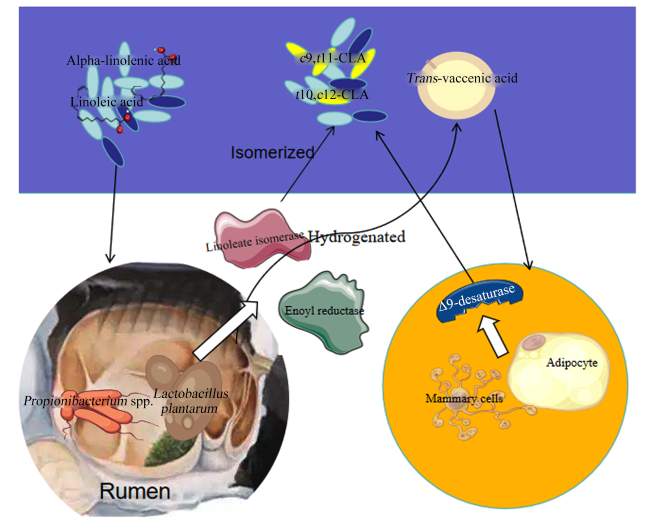
目前,CLA的合成主要依赖于反刍动物瘤胃微生物的生物转化过程。主要是由不饱和脂肪酸[如亚油酸(LA)、亚麻酸(ALA)]在瘤胃内通过微生物分泌的异构酶[亚油酸异构酶(LAI)]及氢化酶(烯酰还原酶)经转化形成,其中LA是CLA的核心前体,贡献了超70%的合成底物[5]。LA经瘤胃微生物[如丙酸杆菌属(Propionibacterium)、植物乳杆菌(Lactobacillus plantarum)、双歧杆菌属(Bifidobacterium)等]的异构化作用及不完全氢化作用,主要生成c9,t11-CLA和t10,c12-CLA 2种异构体[6],而70%~85%则被氢化为反-11-十八碳烯酸(TVA)[7]

1.1.2 CLA合成的核心瘤胃微生物

参与CLA合成的核心瘤胃微生物及其代谢特性见表1,其中溶纤维丁酸弧菌(Butyrivibrio fibrisolvens)是关键的c9,t11-CLA生产菌,而丙酸杆菌属则能生成多种异构体。
表1 参与CLA合成的核心瘤胃微生物及其代谢特性

Table 1 Core rumen microorganisms involved in CLA synthesis and their metabolic characteristics

微生物种类
Microbial species
作用
Functions
代谢特性
Metabolic characteristics
文献
Reference
溶纤维丁酸弧菌
Butyrivibrio fibrisolvens
通过亚油酸异构酶将LA
转化为c9,t11-CLA
厌氧,依赖LA作为底物,优先进行异构化
而非完全氢化;产物以c9,t11-CLA为主
[8-9]
白色瘤胃球菌
Ruminococcus albus
间接影响CLA合成:分解纤维素
释放植物细胞壁中的多不饱和
脂肪酸(如LA)
厌氧,以纤维降解为主;通过释放
LA为其他CLA合成菌提供底物
[10]
丙酸杆菌属
Propionibacterium
生成多种CLA异构体,如c9,
t11-CLA和t10,c12-CLA
耐酸性强;通过亚油酸异构酶和氢化酶
双重途径代谢LA,尤其在低pH
条件下活性高
[11]
乳杆菌属
Lactobacillus
部分菌株可将LA转化为c9,
t11-CLA,具有益生功能
兼性厌氧;代谢依赖乳酸生成,可能
通过降低pH抑制CLA进一步氢化
[12]
植物乳杆菌
Lactobacillus plantarum
潜在CLA生产者,但活性较弱;可能
通过代谢调控间接促进CLA积累
耐酸、耐胆盐;在体外试验中
可转化少量LA为CLA
[13-14]

CLA:共轭亚油酸 conjugated linoleic acid;LA:亚油酸 linoleic acid;c9,t11-CLA:顺-9,反-11-共轭亚油酸 cis-9, trans-11-conjugated linoleic acid;t10,c12-CLA:反-10,顺-12-共轭亚油酸 cis-9, trans-11-conjugated linoleic acid。

1.1.3 动物自身组织的酶促转化

反刍动物自身组织存在CLA的内源性合成途径。该途径依赖于组织细胞(如脂肪细胞、乳腺上皮细胞)中的Δ9-去饱和酶,将瘤胃氢化产生的TVA或组织内源TVA转化为c9,t11-CLA[15]。该转化过程主要依赖于Δ9-去饱和酶的活性中心,通过诱导契合机制与TVA结合[16],催化改变脂肪酸的双键构型。具体来说,它利用还原型烟酰胺腺嘌呤二核苷酸磷酸(NADPH)作为电子供体,在C9~C10碳原子之间引入1个双键[17],从而生成c9,t11-CLA。CLA的合成途径见图1[18]
图1 CLA的合成途径图(参考文献[18]并修改)

Linoleic acid:亚油酸;Alpha-linolenic acid:α-亚麻酸;Propionibacterium:丙酸杆菌属;Lactobacillus plantarum:植物乳杆菌;Rumen:瘤胃;Linoleate isomerase:亚油酸异构酶;Enoyl reductase:烯酰还原酶;Isomerized:异构化;Hydrogenated:氢化;Trans-vaccenic acid:反-11-十八碳烯酸;Δ9-desaturase:Δ9-去饱和酶;Mammary cells:乳腺细胞;Adipocyte:脂肪细胞;c9,t11-CLA:顺-9,反-11-共轭亚油酸 cis-9, trans-11-conjugated linoleic acid;t10,c12-CLA:反-10,顺-12-共轭亚油酸 cis-9, trans-11-conjugated linoleic acid。

Fig.1 Diagram of CLA synthesis pathway (referred reference [18] and modified)

1.1.4 CLA合成的关键酶及其作用

CLA合成与代谢涉及多种关键功能酶,其作用机制与靶点总结见表2。其中,LAI和Δ9-去饱和酶是合成途径的核心,而β-氧化酶系则主导其分解代谢。
表2 参与CLA合成的核心功能酶

Table 2 Key functional enzymes involved in CLA synthesis

酶名称
Enzyme names
类型
Types
功能
Functions
作用分子机制
Molecular mechanism
of action
作用靶点
Target sites
文献
Reference
亚油酸异构酶
Linoleic acid isomerase
合成酶 催化LA转化为CLA,
生成c9,t11-CLA等异构体
通过异构化反应调整
LA的共轭双键位置
LA的共轭双键 [19]
Δ9-去饱和酶
Δ9-desaturase
合成酶 在乳腺中催化TVA
转化为c9,t11-CLA
通过去饱和作用引入双键,
依赖前体反式-11-油酸
TVA [20-21]
硫酯酶
Thioesterase
合成
辅助酶
水解酰基-辅酶A为
游离脂肪酸,增加LA的可
利用性以促进CLA合成
催化酰基-辅酶A硫酯
键断裂,释放游离态LA
作为PAI底物
酰基-辅
酶A(如亚
油酰-辅酶A)
[22]
Δ12-去饱和酶
Δ12-desaturase
合成前体酶 催化油酸转化为LA,
为CLA合成提供前体
通过去饱和作用在油酸中
引入双键,生成LA
油酸(C18∶1) [23-24]
烯酰-ACP还原酶
Enoyl-ACP reductase
还原酶 在生物氢化过程中还原
LA的双键,生成TVA
等中间体
催化双键的氢化反应,
将多不饱和脂肪酸转
化为单不饱和脂肪酸
LA或共轭中间体 [25]
双键特异性还原酶
Double bond-
specific reductase
还原酶 在特定微生物中直接
还原CLA前体的双键,
调控氢化路径
选择性还原特定位置的
双键,生成特定构型的
CLA前体
CLA中间体 [26]
β-氧化酶系
β-oxidation enzyme
system
分解酶 降解CLA为
短链脂肪酸
通过酰基-辅酶A脱氢酶、
水合酶等将CLA-辅酶A逐
步分解为乙酰-辅酶A
CLA-
辅酶A
[27]
脂肪酸延长酶
Fatty acid elongase
合成
前体酶
催化脂肪酸链延长,将
C16∶0延长为C18∶0,
为后续去饱和生成
LA提供前体
通过缩合反应将丙二酰-
辅酶A的乙酰基添加至
酰基链末端,生成更长
链的脂肪酸
棕榈酰-
辅酶A
(C16∶0-
辅酶A)
[28-29]

CLA:共轭亚油酸 conjugated linoleic acid;LA:亚油酸 linoleic acid;c9,t11-CLA:顺-9,反-11-共轭亚油酸 cis-9, trans-11-conjugated linoleic acid;TVA:反-11-十八碳烯酸 trans-11-vaccenic acid;C16∶0:棕榈酸 hexadecanoic acid;C18∶0:硬脂酸 octadecanoic acid;PAI:多不饱和脂肪酸异构酶 propionibacterium acnes isomerase;C18∶1:油酸 oleic acid。

1.2 CLA的分解代谢途径

1.2.1 瘤胃分解代谢

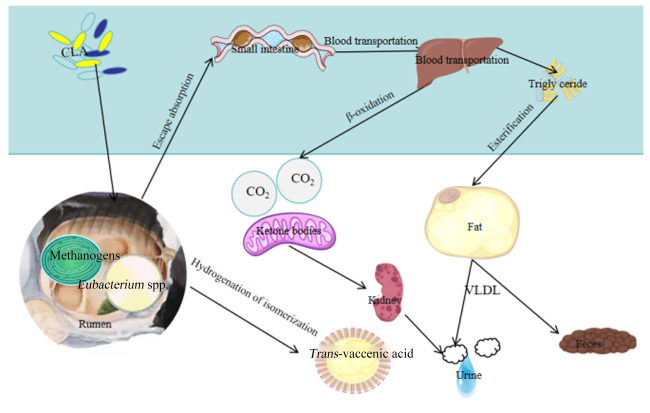
在瘤胃中,由功能菌群[如溶纤维丁酸弧菌[30]、丙酸杆菌属[31]、乳杆菌属(Lactobacillus)[32]等]经LAI催化合成的CLA,可进一步被产甲烷菌(methanogens)[33]、真杆菌属(Eubacterium)[10]等微生物氢化或异构化为TVA、硬脂酸(C18∶0)及反-10-十八碳烯酸等产物;而另一部分未被完全代谢的CLA可逃逸瘤胃代谢。研究表明,瘤胃内合成的CLA有5%~15%能避开瘤胃微生物的降解[34],随食糜进入小肠后被吸收入血[35],进而转运至脂肪、肌肉等组织并发挥生理功能。

1.2.2 肝脏分解代谢

肝脏是CLA的核心代谢场所,经β-氧化生成乙酰辅酶A[36],进入三羧酸循环(TCA)循环或生酮;部分被酯化为甘油三酯(TG)/磷脂[37],以极低密度脂蛋白(VLDL)形式外运。其终产物有2条去路:脂溶性衍生物随胆汁入肠-粪便排出[38];水溶性酮体[39]及氧化产物经肾小球滤过由尿排泄(图2)。
图2 CLA的分解途径图(参考文献[8]并修改)

CLA:共轭亚油酸 conjugated linoleic acid; Methanogens:产甲烷菌;Eubacterium:真杆菌属;Hydrogenation of isomerization:异构化氢化;trans-vaccenic acid:反-11-十八碳烯酸;Small intestine:小肠;Triglyceride:甘油三酯;Fat:脂肪;Ketone bodies:酮体;VLDL:极低密度脂蛋白 very low density lipoprotein;Escape absorption:逃逸吸收;CO2:二氧化碳;Urine:尿液;Esterification:酯化;Kidney:肾脏;Rumen:瘤胃;Feces:粪便;Blood transportation:血液运输;β-oxidation:β-氧化。

Fig.2 Diagram of CLA decomposition pathway (referred reference [8] and modified)

2 促进反刍动物肉奶中CLA沉积的营养调控策略

基于上述CLA合成与代谢机制,CLA的沉积可通过从饲粮组成、添加剂和微生物等方面的干预进行调控,以下将系统总结其营养策略。

2.1 饲粮直接补充

最直接的策略是在饲粮中直接添加CLA补充剂。例如市售产品中的以软胶囊、片剂、粉末为主的CLA添加剂。研究发现,在肉牛饲粮中添加1.5%CLA添加剂可提升肌内脂肪含量,改善肉色并富集CLA[40]。然而,当添加量过高(超过3%~4.5%)[41]时,可能因t10,c12-CLA的富集而引起动物代谢紊乱等副作用,其具体安全剂量阈值需进一步评估。相比之下,肉奶产品中的CLA被视为高效、安全的可被人体健康利用的CLA,为功能性的肉奶食品开发指明方向。

2.2 饲粮间接补充

在动物饲粮中添加富含LA和ALA的植物油,可以促进瘤胃微生物合成CLA。

2.2.1 饲粮中添加藻类对CLA的影响

研究表明,藻类作为饲料添加剂,能通过提供CLA合成前体及调控代谢途径,提升反刍动物体内CLA含量。Orzuna-Orzuna等[42]发现,低剂量微藻裂殖体可增加奶牛乳汁中c9,t11-CLA比例和血液牛痘酸水平。藻类富含LA、α-亚麻酸等前体物质,经生物氢化作用转化为CLA。其活性成分还能激活Δ9-去饱和酶等关键酶活性,促进前体向CLA高效转化[43]。例如,微藻裂殖体既提供CLA前体,又优化乳脂组成,增加C18∶2n-6顺式含量,间接强化CLA合成环境。这为天然藻类作为饲料添加剂,安全、可持续地提高乳制品CLA含量提供了理论和实践依据。

2.2.2 饲粮的精粗比对CLA的影响

研究表明,饲粮精粗比对CLA沉积有显著影响,这种影响主要通过调控动物的整体营养代谢和瘤胃微环境来实现。适量增加精料比例(如60∶40)能促进脂肪合成及CLA富集,但精料比例超过70%时易引发消化紊乱等,反而不利于CLA积累[44]。粗饲料中的纤维可刺激肠道蠕动、维持瘤胃正常pH及微生物活性,为CLA合成创造稳定环境,同时粗饲料占比提升可优化瘤胃菌群结构、增强前体生物氢化效率[45-46]。精饲料营养成分与粗饲料纤维组分协同作用,既能激活脂肪合成代谢通路,又能避免瘤胃酸中毒。因此,需根据动物生理阶段及营养需求调整精粗比,实现CLA合成与机体代谢的最佳平衡。

2.2.3 饲粮金属离子对CLA的影响

金属离子(如铁、锰、铜等)会影响瘤胃微生物的氢化作用及CLA沉积。铁和锰浓度增加会促进油酸氢化[47],而铜则会降低CLA含量,其机制可能与铜离子催化CLA氧化降解有关[48]。金属离子通过络合和氧化还原反应,直接或间接调控CLA合成。其作用效果受浓度、种类和饲粮组成等因素影响[49],高精料饲粮可能加剧CLA的氧化损伤。为了优化CLA沉积,需要平衡饲粮中金属离子含量,添加抗氧化剂(如维生素E),并结合动物种类、生理状态等因素综合设计营养策略。

2.2.4 植物源活性物质对CLA的影响

粗饲料的营养组成会显著影响反刍动物体内CLA的沉积效率。例如,菊苣等特定饲草能通过优化瘤胃环境来促进CLA的合成。研究发现,用菊苣替代25%的黑麦草饲粮,可以使乳脂中c9,t11-CLA的含量从约0.4%提升至0.6%以上[50]。此外,草饲牛肉相比谷饲牛肉含有更高比例的CLA及多不饱和脂肪酸[51],更符合健康膳食标准。合理搭配粗饲料(如高纤维饲草与菊苣等CLA促进型植物)可以协同调控瘤胃微生物代谢,从而定向提升CLA在乳脂或肌肉组织中的生物积累,为开发功能性畜产品提供了科学依据。

2.2.5 鱼油和亚麻籽对CLA的影响

在反刍动物饲粮中添加鱼油或亚麻籽,可显著提高乳肉制品中CLA含量,二者协同作用效果更优。鱼油富含ω-3脂肪酸,通过调节瘤胃氢化过程促进CLA合成;亚麻籽提供关键前体α-亚麻酸(ALA)[52],直接参与CLA生成。此外,鱼油和亚麻籽联合补充可激活代谢通路,乳脂中c9,t11-CLA含量可提升198%~440%,总饱和脂肪酸含量降低约12%[53],然而,这一效果受多种因素影响,例如鱼油对瘤胃原虫的毒性可能抑制纤维降解,因此在实际应用中需综合评估,有时更倾向于单独使用亚麻籽。鱼油虽能丰富乳脂与肉质的脂肪酸组成、改善其功能营养特性,进而提升产品市场竞争力,但其对瘤胃原虫具有毒性,并会抑制纤维降解等,存在负面影响。因此,在生产实践中,人们更倾向于选用亚麻籽来实现相关目标。

2.2.6 莫能菌素对CLA的影响

莫能菌素(由链霉菌分泌的饲料添加剂)通过调控瘤胃微环境间接影响CLA的合成与保留。其作用机制包括:降低瘤胃液pH、提高氨态氮(NH3-N)及总挥发性脂肪酸(TVFA)含量(尤其是丙酸等短链脂肪酸),这些变化可选择性促进特定微生物代谢活性,从而改变脂肪酸合成路径[54-55]。研究显示,莫能菌素虽不直接参与CLA及其前体t-11C18∶1的合成,但能抑制瘤胃微生物对CLA的氢化反应,使CLA氢化率显著降低20%~40%[56],从而减少其进一步氢化,进而减少饱和脂肪酸的生成比例,最终提高瘤胃液及乳脂中CLA的保留量[57]。这种通过调节瘤胃发酵参数与微生物代谢平衡的双重作用,使莫能菌素成为优化反刍动物CLA产生的潜在调控手段。

2.3 瘤胃内菌群的影响

特定益生菌如短双歧杆菌、植物乳杆菌与丙酸杆菌等,具有高效转化LA为CLA的能力,其关键酶基因(如LAI)已被克隆并实现异源表达。通过益生菌接种或后生元制剂调控瘤胃菌群结构,已成为提升CLA合成效率的前沿方向。

2.3.1 双歧杆菌

双歧杆菌是重要的CLA生产菌属,不同菌种的CLA合成能力差异较大。动物双歧杆菌和乳双歧杆菌虽能转化CLA,但转化效率低、异构体比例不理想[58]。而短双歧杆菌的CLA合成表现更优,其产生的CLA中c9,t11-CLA异构体占比较多。研究发现,LAI和亚油酸水合酶(LAH)功能基因是CLA生物合成的核心[59],还发现短双歧杆菌应对LA胁迫时存在特定基因表达调控网络[60]。又有研究表明,短双歧杆菌与瘤胃主要CLA产生菌溶纤维丁酸弧菌共培养时,在模拟瘤胃条件下的CLA转化率是后者的2倍,显示其作为反刍动物功能性益生菌的潜在应用[61]。这些发现为解析短双歧杆菌CLA合成代谢途径及菌株改良提供了理论依据,也体现了它在功能性CLA生产中的巨大应用潜力。

2.3.2 植物乳杆菌

植物乳杆菌通过多酶协同作用从LA生物合成CLA,涉及水合、脱水和异构化三类酶促反。植物乳杆菌WCFS1在含0.5 mg/mL LA的培养基中CLA产量达110 μg/mL,转化率达22%[62]。其中,CLA水合酶、CLA短链脱氢酶和CLA乙酰乙酸脱羧酶分别催化不同反应步骤[63]。植物乳杆菌CFQ-100的α-烯醇化酶在糖酵解和LA生物氢化中都发挥作用,能驱动c9,t11-CLA的形成,菌株的LAI基因表达水平与CLA产量呈正相关[64]。在体外山羊瘤胃发酵试验中,植物乳杆菌RG14的后生物制剂显著改善了瘤胃发酵特性,具体表现为:有机物消化率和TVFA含量随添加水平(0.3%~1.2%)增加而线性增加,纤维分解细菌数量显著提升,同时促进了CLA的生成[65],这些发现提示其在反刍动物饲粮中的应用价值,也为高产菌株的定向改造提供了理论依据。

2.3.3 丙酸杆菌

丙酸杆菌不仅能够抑制甲烷生成,还可通过调控多不饱和脂肪酸的生物氢化过程促进有益脂肪酸CLA的合成[66]。研究表明,丙酸杆菌来源的多不饱和脂肪酸异构酶(PAI)在毕赤酵母中成功实现异源表达,通过优化诱导表达条件显著提升PAI蛋白表达水平,并进一步利用重组毕赤酵母制备静息细胞催化剂,高效催化LA生成t10,c12-CLA异构体[67]。研究中发现,费氏丙酸杆菌舍氏亚种可耐受1 000 μg/mL LA,以57%~87%的转化率高效生成CLA,其中c9,t11及t9,c11异构体占产物的85%~90%[68]。目前该菌已从健康奶牛瘤胃中成功分离,表明其在反刍动物瘤胃中提升CLA水平的潜力。

2.3.4 瘤胃细菌

瘤胃细菌是反刍动物体内CLA生物合成的核心微生物类群,其中纤维芽孢杆菌作为模式菌种具有关键作用[69]。研究表明,纤维芽孢杆菌A38可通过生物氢化途径生成0.08 g/L CLA,其中95%为天然活性形式c9,t11-CLA,5%为t10,c12-CLA异构体[70]。通过定向调控瘤胃菌群的酶活性(如抑制CLA还原酶),可优化CLA的内源性合成效率,使用苹婆酸抑制CLA还原酶会使乳脂或肉脂中c9,t11-CLA的含量下降约45%。这一结果揭示了CLA还原酶在维持CLA水平中的关键作用,同时也表明,若能通过其他手段有效抑制该酶活性,则存在大幅提升CLA在反刍动物产品中富集水平的潜力[71],从而提升其在反刍动物乳脂或肉脂中的富集水平,为精准调控功能性畜产品中CLA含量提供微生物学基础。

3 小结与展望

尽管当前研究已初步构建了CLA在反刍动物体内的合成与分解框架,但仍面临异构体功能与代谢机制不明确、微生物-宿主互作关系模糊以及营养干预策略粗放化等核心问题,未来研究应从关注总量转向解析异构体特异性代谢网络,从描述互作升级为构建微生物-宿主跨界对话模型,并最终通过精准营养与微生物工程的协同设计,实现CLA在保障动物健康与环境可持续前提下的高效富集,从而推动其从基础研究走向系统化的生产实践。
[1]
ZHANG H, DAN N, WANG Y Q, et al. Protection effect of cis 9,trans 11-conjugated linoleic acid on oxidative stress and inflammatory damage in bovine mammary epithelial cells[J]. Scientific Reports, 2024, 14(1):26295.

DOI

[2]
ESMAEILNEJAD M, RASAEI N, GOUDARZI K, et al. The effects of conjugated linoleic acid supplementation on cardiovascular risk factors in patients at risk of cardiovascular disease:a GRADE-assessed systematic review and dose-response Meta-analysis[J]. British Journal of Nutrition, 2024, 132(7):919-934.

DOI

[3]
PRATES J A M. The role of meat lipids in nutrition and health:balancing benefits and risks[J]. Nutrients, 2025, 17(2):350.

DOI

[4]
谷树乾, 朱雪峰. 饲料中添加油脂对育肥山羊生长性能和养分消化率的影响[J]. 中国饲料, 2022(10):72-75.

GU S Q, ZHU X F. Effects of dietary oil on growth performance and nutrient digestibility of fattening goats[J]. China Feed, 2022(10):72-75. (in Chinese)

[5]
LOOR J J, FERLAY A, OLLIER A, et al. High-concentrate diets and polyunsaturated oils alter trans and conjugated isomers in bovine rumen,blood,and milk[J]. Journal of Dairy Science, 2005, 88(11):3986-3999.

DOI

[6]
MA Z Y, MENG Y R, LI F, et al. Effects of an essential oil blend rich in cinnamaldehyde and carvacrol on rumen biohydrogenation and fatty acid profile in the longissimus lumborum of growing lambs[J]. Journal of the Science of Food and Agriculture, 2024, 104(15):9581-9591.

DOI

[7]
LOURENÇO M, RAMOS-MORALES E, WALLACE R J. The role of microbes in rumen lipolysis and biohydrogenation and their manipulation[J]. Animal, 2010, 4(7):1008-1023.

DOI PMID

[8]
AMIN A B, MAO S Y. Influence of yeast on rumen fermentation,growth performance and quality of products in ruminants:a review[J]. Animal Nutrition, 2021, 7(1):31-41.

DOI

[9]
SHIVANI S, SRIVASTAVA A, SHANDILYA U K, et al. Dietary supplementation of Butyrivibrio fibrisolvens alters fatty acids of milk and rumen fluid in lactating goats[J]. Journal of the Science of Food and Agriculture, 2016, 96(5):1716-1722.

DOI

[10]
KEMP P, WHITE R W, LANDER D J. The hydrogenation of unsaturated fatty acids by five bacterial isolates from the sheep rumen,including a new species[J]. Journal of General Microbiology, 1975, 90(1):100-114.

DOI

[11]
ZHANG B X, NI L J, TANG X S, et al. Engineering the β-oxidation pathway in Yarrowia lipolytica for the production of trans-10,cis-12-conjugated linoleic acid[J]. Journal of Agricultural and Food Chemistry, 2022, 70(27):8377-8384.

DOI

[12]
SU X M, YANG Y Z, GAO Y H, et al. Gut microbiota CLA and IL-35 induction in macrophages through Gαq/11-mediated STAT1/4 pathway:an animal-based study[J]. Gut Microbes, 2024, 16(1):2437253.

DOI

[13]
LIU X X, LIU L, SONG X, et al. The arginine repressor ArgR2 controls conjugated linoleic acid biosynthesis by activating the CLA operon in Lactiplantibacillus plantarum[J]. Microbiology Spectrum, 2022, 10(3):e0261921.

DOI

[14]
LIU X X, LIU L, SONG X, et al. Determination of the regulatory network and function of the lysR-type transcriptional regulator of Lactiplantibacillus plantarum,LpLttR[J]. Microbial Cell Factories, 2022, 21(1):65.

DOI

[15]
LIU J Y, SHEN J L, ZONG J X, et al. Lithium chloride promotes endogenous synthesis of CLA in bovine mammary epithelial cells[J]. Biological Trace Element Research, 2024, 202(2):513-526.

DOI

[16]
PENG L Y, BAI G, WANG C Z, et al. Proteomics insights into the gene network of cis 9,trans 11-conjugated linoleic acid biosynthesis in bovine mammary gland epithelial cells[J]. Animals, 2022, 12(13):1718.

DOI

[17]
LI S H, XU L W, QING J J, et al. Multiple biological activities and biosynthesis mechanisms of specific conjugated linoleic acid isomers and analytical methods for prospective application[J]. Food Chemistry, 2023, 409:135257.

DOI

[18]
侯爱菊, 王荣春, 代翠红, 等. 反刍动物体内共轭亚油酸生物合成途径研究进展[J]. 生物信息学, 2012, 10(4):285-292.

HOU A J, WANG R C, DAI C H, et al. Progresses in the biosynthesis pathways of conjugated linoleic acids in ruminants[J]. China Journal of Bioinformatics, 2012, 10(4):285-292. (in Chinese)

[19]
ELNAR A G, JANG Y J, KIM G B. Heterologous expression and polyphasic analysis of CLA-converting linoleic acid isomerase from Bifidobacterium breve JKL2022[J]. Journal of Agricultural and Food Chemistry, 2025, 73(2):1425-1440.

DOI

[20]
侯俊财, 刘艳平, 霍贵成, 等. 奶牛胎次对乳中CLA含量和△9-去饱和酶指数的影响[J]. 畜牧兽医学报, 2008, 39(3):320-326.

HOU J C, LIU Y P, HUO G C, et al. The effect of parity on conjugated linoleic acid (CLA) content in milk fat and CLA-desaturase index from Holstein dairy cows[J]. Acta Veterinaria et Zootechnica Sinica, 2008, 39(3):320-326. (in Chinese)

[21]
侯俊财, 刘艳平, 霍贵成, 等. 产奶量对乳中c9,t11 CLA含量和乳腺△9-去饱和酶指数的影响[J]. 中国乳品工业, 2008, 36(5):19-22,26.

HOU J C, LIU Y P, HUO G C, et al. Effect of milk yield on c9,t11 conjugated linoleic acid content in milk fat and △9-desaturase index of mammary gland from Holstein dairy cows[J]. China Dairy Industry, 2008, 36(5):19-22,26. (in Chinese)

[22]
SCHMIDT M, PROCTOR T, DIAO R C, et al. Escherichia coli YigI is a conserved gammaproteobacterial acyl-CoA thioesterase permitting metabolism of unusual fatty acid substrates[J]. Journal of Bacteriology, 2022, 204(8):e0001422.

DOI

[23]
WU C, CHEN H Q, MEI Y C, et al. Advances in research on microbial conjugated linoleic acid bioconversion[J]. Progress in Lipid Research, 2024, 93:101257.

DOI

[24]
WU C C, OHASHI T, KAJIURA H, et al. Functional characterization and overexpression of Δ12-desaturase in the oleaginous yeast Rhodotorula toruloides for production of linoleic acid-rich lipids[J]. Journal of Bioscience and Bioengineering, 2021, 131(6):631-639.

DOI

[25]
VOLKOV A, KHOSHNEVIS S, NEUMANN P, et al. Crystal structure analysis of a fatty acid double-bond hydratase from Lactobacillus acidophilus[J]. Acta Crystallographica Section D: Biological Crystallography, 2013, 69(Pt 4):648-657.

DOI

[26]
ZHOU P N, SHAO Y F, JIANG Z, et al. The revealing of a novel double bond reductase related to perilla ketone biosynthesis in Perilla frutescens[J]. BMC Plant Biology, 2023, 23(1):345.

DOI

[27]
DING L G, SUN W F, BALAZ M, et al. Peroxisomal β-oxidation acts as a sensor for intracellular fatty acids and regulates lipolysis[J]. Nature Metabolism, 2021, 3(12):1648-1661.

DOI PMID

[28]
JAKOBSSON A, WESTERBERG R, JACOBSSON A. Fatty acid elongases in mammals:their regulation and roles in metabolism[J]. Progress in Lipid Research, 2006, 45(3):237-249.

DOI

[29]
LEAVER M J, TOCHER D R, OBACH A, et al. Effect of dietary conjugated linoleic acid (CLA) on lipid composition,metabolism and gene expression in Atlantic salmon (Salmo salar) tissues[J]. Comparative Biochemistry and Physiology Part A:Molecular & Integrative Physiology, 2006, 145(2):258-267.

[30]
OR M M, 姜雅慧. 瘤胃细菌、原虫及混合微生物参与亚油酸代谢的对比研究[J]. 中国畜牧兽医, 2011, 38(3):149.

OR M M, JIANG Y H. A comparative study on the involvement of rumen bacteria, protozoa, and mixed microorganisms in linoleic acid metabolism[J]. China Animal Husbandry & Veterinary Medicine, 2011, 38(3):149. (in Chinese)

[31]
李秀清, 陈海琴, 唐鑫, 等. 痤疮丙酸杆菌亚油酸异构酶在毕赤酵母中的异源表达及其静息细胞催化合成共轭亚油酸[J]. 中国油脂, 2021, 46(9):87-91.

LI X Q, CHEN H Q, TANG X, et al. Heterologous expression of linoleate isomerase from Propionibacterium acnes in Pichia pastoris and its catalytic synthesis of conjugated linoleic acid by resting cells[J]. China Oils and Fats, 2021, 46(9):87-91. (in Chinese)

[32]
陈海琴, 杨波, 许庆炎, 等. 植物乳杆菌ZS2058生物转化共轭亚油酸反应条件的优化研究[J]. 食品工业科技, 2012, 33(22):192-197.

CHEN H Q, YANG B, XU Q Y, et al. Study on condition optimization of conjugated linoleic acid bioconversion by Lactobacillus plantarum ZS2058[J]. Science and Technology of Food Industry, 2012, 33(22):192-197. (in Chinese)

[33]
YANZA Y R, SZUMACHER-STRABEL M, BRYSZAK M, et al. Coleus amboinicus (Lour.) leaves as a modulator of ruminal methanogenesis and biohydrogenation in vitro[J]. Journal of Animal Science, 2018, 96(11):4868-4881.

[34]
BALDIN M, GAMA M A S, DRESCH R, et al. A rumen unprotected conjugated linoleic acid supplement inhibits milk fat synthesis and improves energy balance in lactating goats[J]. Journal of Animal Science, 2013, 91(7):3305-3314.

DOI PMID

[35]
曹秀青, 刘立成, 刘大森. 提高日粮中CLA含量对反刍动物瘤胃发酵及其产品品质的影响[J]. 中国饲料, 2008(11):24-27.

CAO X Q, LIU L C, LIU D S. Effects of improving CLA contents on ruminal fermentation and products quality in ruminant[J]. China Feed, 2008(11):24-27. (in Chinese)

[36]
OCZKOWICZ J, PIASNA-SŁUPECKA E, DROZDOWSKA M, et al. The combination of resveratrol and conjugated linoleic acid dienes enhances the individual effects of these molecules on de novo fatty acid biosynthesis in 3T3-L1 adipocytes[J]. International Journal of Molecular Sciences, 2024, 25(24):13429.

DOI

[37]
CHARDIGNY J M, MASSON E, SERGIEL J P, et al. The position of rumenic acid on triacylglycerols alters its bioavailability in rats[J]. Journal of Nutrition, 2003, 133(12):4212-4214.

PMID

[38]
高畅鸿, 王爽, 田艳, 等. HMGCR对脂肪肝奶牛肝脏胆汁酸及脂质代谢机制[J]. 中国兽医学报, 2024, 44(11):2452-2457.

GAO C H, WANG S, TIAN Y, et al. Mechanism of HMGCR on liver bile acid and lipid metabolism in dairy cow with fatty liver[J]. Chinese Journal of Veterinary Science, 2024, 44(11):2452-2457. (in Chinese)

[39]
TALLEY J T, MOHIUDDIN S S. Biochemistry,fatty acid oxidation[M/OL]//StatPearls [Internet]. Treasure Island (FL): StatPearls Publishing LLC. 2023:NBK556002.

[40]
万荣, 农斯伟, 周振明, 等. 共轭亚油酸对肉牛肌内前脂肪细胞增殖与分化的影响[J]. 农业生物技术学报, 2024, 32(3):559-567.

WAN R, NONG S W, ZHOU Z M, et al. Effects of conjugated linoleic acid on proliferation and differentiation of bovine (Bos taurus) intramuscular preadipocyte[J]. Journal of Agricultural Biotechnology, 2024, 32(3):559-567. (in Chinese)

[41]
BEZAN P N, HOLLAND H, DE CASTRO G S, et al. High dose of a conjugated linoleic acid mixture increases insulin resistance in rats fed either a low fat or a high fat diet[J]. Experimental and Clinical Endocrinology & Diabetes, 2018, 126(6):379-386.

[42]
ORZUNA-ORZUNA J F, GODINA-RODRÍGUEZ J E, GARAY-MARTÍNEZ J R, et al. Milk yield,composition,and fatty acid profile in milk of dairy cows supplemented with microalgae Schizochytrium sp.:a Meta-analysis[J]. Agriculture, 2024, 14(7):1119.

DOI

[43]
FRANKLIN S T, MARTIN K R, BAER R J, et al. Dietary marine algae (Schizochytrium sp.) increases concentrations of conjugated linoleic,docosahexaenoic and transvaccenic acids in milk of dairy cows[J]. The Journal of Nutrition, 1999, 129(11):2048-2054.

DOI

[44]
MAVROMMATIS A, SOTIRAKOGLOU K, KAMILARIS C, et al. Effects of inclusion of Schizochytrium spp. and forage-to-concentrate ratios on goats’ milk quality and oxidative status[J]. Foods, 2021, 10(6):1322.

DOI

[45]
王思飞, 周玉香, 张艳梅, 等. 日粮精粗比与共轭亚油酸对家畜生产性能的影响研究概况[J]. 畜牧与饲料, 2017, 38(11):35-37.

WANG S F, ZHOU Y X, ZHANG Y M, et al. Research progress on effects of dietary forage to concentrate ratio and conjugated linoleic acid content on production performance of livestock[J]. Animal Husbandry and Feed Science, 2017, 38(11):35-37. (in Chinese)

[46]
田希雅, 孙阳, 钮慧晶, 等. 不同精粗比饲粮对绵羊瘤胃体外发酵和共轭亚油酸产量的影响[J]. 中国畜牧兽医, 2022, 49(5):1707-1714.

DOI

TIAN X Y, SUN Y, NIU H J, et al. Effects of dietary with different concentrate to forage ratio on ruminal fermentation and conjugated linoleic acid production of sheep in vitro[J]. China Animal Husbandry & Veterinary Medicine, 2022, 49(5):1707-1714. (in Chinese)

[47]
ALZAHAL O, OR-RASHID M M, GREENWOOD S L, et al. The effect of dietary fiber level on milk fat concentration and fatty acid profile of cows fed diets containing low levels of polyunsaturated fatty acids[J]. Journal of Dairy Science, 2009, 92(3):1108-1116.

DOI PMID

[48]
DENG S L, LI J, LUO T, et al. Correction to “flaxseed cyclic peptide [1-9-NαC]-linusorb B3 (CLA) improves oxidative stability of flaxseed oil by chelating metal ions and intermediate oxidative products”[J]. Journal of Agricultural and Food Chemistry, 2024, 72(1):946.

DOI

[49]
SHILU D, JING L, TING L, et al. Flaxseed cyclic peptide[1-9-NαC]-linusorb B3(CLA)improves oxidative stability of flaxseed oil by chelating metal ions and intermediate oxidative products[J]. Food Chemistry, 2022, 465:142011.

DOI

[50]
MANGWE M C, BRYANT R H, OLSZEWSKI A, et al. Can the inclusion of forage chicory in the diet of lactating dairy cattle alter milk production and milk fatty acid composition?Findings of a multilevel Meta-analysis[J]. Animals, 2024, 14(7):1002.

DOI

[51]
KRUSINSKI L, MACIEL I C F, SERGIN S, et al. Fatty acid and micronutrient profile of longissimus lumborum from red angus and red Angus×Akaushi cattle finished on grass or grain[J]. Foods, 2022, 11(21):3451.

DOI

[52]
MAZAREEI S, AGHJEHGHESHLAGH F M, FATHI-ACHACHLOUEI B, et al. Effects of extruded flaxseed and conjugated linoleic acid (CLA) on productive and reproductive performance of lactating qezel ewes[J]. Small Ruminant Research, 2024, 231:107180.

DOI

[53]
THANH L P, LOOR J J, MAI D T T, et al. Effect of fish oil and linseed oil on intake,milk yield and milk fatty acid profile in goats[J]. Animals, 2023, 13(13):2174.

DOI

[54]
VIEIRA ROMERO J, DE MARCHI F E, ALCALDE C R, et al. Pelleting and sodium monensin increase milk CLA concentration from dairy cows fed flaxseed[J]. Revista Colombiana de Ciencias Pecuarias, 2018, 31(2):110-119.

DOI

[55]
HE M L, JIA J J, YANG W Z. Comparison on the fatty acid profiles of liver,subcutaneous fat and muscle from feedlot steers finished on diets supplemented with or without cinnamaldehyde or monensin[J]. Journal of the Science of Food and Agriculture, 2015, 95(3):576-582.

DOI

[56]
OGUNADE I, SCHWEICKART H, ANDRIES K, et al. Monensin alters the functional and metabolomic profile of rumen microbiota in beef cattle[J]. Animals, 2018, 8(11):211.

DOI

[57]
贾淑庚, 黄仁录. 反刍动物CLA的合成及其营养调控措施[J]. 畜牧产业, 2014(11):23-27.

JIA S G, HUANG R L. Synthesis of conjugated linoleic acid (CLA) in ruminants and its nutritional regulation strategies[J]. Animal Agriculture, 2014(11):23-27. (in Chinese)

[58]
SALSINHA A S, PIMENTEL L L, FONTES A L, et al. Microbial production of conjugated linoleic acid and conjugated linolenic acid relies on a multienzymatic system[J]. Microbiology and Molecular Biology Reviews, 2018, 82(4):e00019-18.

[59]
ELNAR A G, EUM B, KIM G B. Genomic characterization and probiotic assessment of Bifidobacterium breve JKL2022 with strain-specific CLA-converting properties[J]. Scientific Reports, 2025, 15(1):15419.

DOI

[60]
MEI Y C, CHEN H Q, YANG B, et al. Computational analysis and heterologous expression of BBI-like proteins from food-grade Bifidobacterium species reveal possibly a key factor in conjugated linoleic acid bioconversion[J]. Journal of Agricultural and Food Chemistry, 2023, 71(21):8093-8103.

DOI

[61]
PARK H G, HEO W, KIM S B, et al. Production of conjugated linoleic acid (CLA) by Bifidobacterium breve LMC520 and its compatibility with CLA-producing rumen bacteria[J]. Journal of Agricultural and Food Chemistry, 2011, 59(3):984-988.

DOI

[62]
ELNAR A G, KIM G B. Growth-independent CLA production by Bifidobacterium breve JKL2022 and the potential transcriptional regulatory role of TetR in linoleic acid isomerase expression[J]. Microbial Cell Factories, 2025, 24(1):140.

DOI

[63]
IORIZZO M, DI MARTINO C, LETIZIA F, et al. Production of conjugated linoleic acid (CLA) by Lactiplantibacillus plantarum:a review with emphasis on fermented foods[J]. Foods, 2024, 13(7):975.

DOI

[64]
YU X M, WEI M, YANG D, et al. Lactiplantibacillus plantarum strain FLPL05 promotes longevity in mice by improving intestinal barrier[J]. Probiotics and Antimicrobial Proteins, 2023, 15(5):1193-1205.

DOI

[65]
IZUDDIN W I, LOH T C, SAMSUDIN A A, et al. In vitro study of postbiotics from Lactobacillus plantarum RG14 on rumen fermentation and microbial population[J]. Revista Brasileira de Zootecnia, 2018, 47:e20170255.

[66]
ZHANG B X, ZHU T, HUANG X T. Enhanced soluble expression of linoleic acid isomerase by coordinated regulation of promoter and fusion tag in Escherichia coli[J]. Foods, 2022, 11(10):1515.

DOI

[67]
ZHANG Y, GU H X, SHI H, et al. Green synthesis of conjugated linoleic acids from plant oils using a novel synergistic catalytic system[J]. Journal of Agricultural and Food Chemistry, 2017, 65(26):5322-5329.

DOI PMID

[68]
RAINIO A, VAHVASELKÄ M, SUOMALAINEN T, et al. Reduction of linoleic acid inhibition in production of conjugated linoleic acid by Propionibacterium freudenreichii ssp. shermanii[J]. Canadian Journal of Microbiology, 2001, 47(8):735-740.

DOI

[69]
JENKINS T C, WALLACE R J, MOATE P J, et al. Board-invited review:recent advances in biohydrogenation of unsaturated fatty acids within the rumen microbial ecosystem[J]. Journal of Animal Science, 2008, 86(2):397-412.

DOI

[70]
HUNTER W J, BAKER F C, ROSENFELD I S, et al. Biohydrogenation of unsaturated fatty acids.Hydrogenation by cell-free preparations of Butyrivibrio fibrisolvens[J]. Journal of Biological Chemistry, 1976, 251(8):2241-2247.

DOI

[71]
GRIINARI J M, CORL B A, LACY S H, et al. Conjugated linoleic acid is synthesized endogenously in lactating dairy cows by delta(9)-desaturase[J]. The Journal of Nutrition, 2000, 130(9):2285-2291.

DOI

Outlines

/