REVIEW

Cultivation and Harvesting of Scenedesmus sp. and Its Application in Livestock Production

  • LIU Huan , 1 ,
  • LI Zhen 1 ,
  • WU Shusong , 1, 2, *
Expand
  • 1 College of Animal Science and Technology, Hunan Agricultural University, Changsha 410128, China
  • 2 Yuelushan Laboratory, Changsha 410128, China
*professor, E-mail:

Received date: 2025-09-09

  Online published: 2026-03-16

Abstract

Scenedesmus sp., a photosynthetic microalgae with heterotrophic potentiality, exhibits a rapid growth rate, high nutritional value, and strong stress tolerance. It shows great promise for applications in livestock wastewater treatment and as a novel feed resource. However, its complex cultivation modes and high harvesting costs hinder widespread adoption in livestock production. This paper systematically reviews the different cultivation strategies for Scenedesmus sp., outlines the main limiting factors for growth, and provides a comparative analysis of mainstream harvesting methods. Furthermore, it summarizes the latest research progress in utilizing Scenedesmus sp. for wastewater treatment and feed resource development. The aim is to provide theoretical and technical insights to support the scaling up of Scenedesmus sp. production and its scientific utilization in the livestock industry.

Cite this article

LIU Huan , LI Zhen , WU Shusong . Cultivation and Harvesting of Scenedesmus sp. and Its Application in Livestock Production[J]. Chinese Journal of Animal Nutrition, 2026 , 38(3) : 1666 -1677 . DOI: 10.12418/CJAN2026.134

微藻是一类分布广泛、光合效率高的单细胞或多细胞水生微生物,其环境适应性强,可以合成多种高价值代谢产物,在环境修复及高值化产品开发等领域展现出巨大的应用潜力。其中,栅藻(Scenedesmus sp.)因其丰富的营养成分、卓越的环境耐受性和高效的污染物降解能力受到广泛关注。栅藻是绿藻门(Chlorophyta)、绿球藻目(Chlorococcales)、栅藻科(Scenedesmaceae)的淡水浮游藻类,其细胞呈圆柱形或椭球形,通常通过纤细细胞质桥连接,形成群体或丝状聚集体,外围包裹着纤维素细胞壁[1-2]。作为一种混合营养型微藻,栅藻兼具光自养与异养代谢能力,可在光照或有机碳源条件下生长,对温度波动、营养盐浓度变化及光照强度差异等多种环境胁迫具有耐受性[3-6]。此外,栅藻可降解并吸附污水中的毒素和污染物,将其中的氮、磷等营养元素转换为生物质,在废水处理领域具有巨大潜力[7]。栅藻营养价值高,蛋白质含量丰富,氨基酸组成全面,具备替代豆粕、鱼粉等蛋白质饲料原料的潜力[8]。此外,其脂质含量为干重的13%~58%,富含不饱和脂肪酸,对畜禽生长和健康有益[9-11]。基于国内外研究进展,本文系统对比了栅藻3种培养模式的生长状况与经济效益,综合分析了光照、碳源和氮源这些关键培养条件对其生长速率与生物质积累的影响,总结了离心法和絮凝法等采收方法的原理与回收效率,重点评估了栅藻对养殖废水中氮、磷的回收效率及其对抗生素与重金属离子的吸附/降解原理与去除率,并进一步综述了栅藻在动物饲粮中的应用效果,以期为栅藻规模化生产及其在畜牧业中的高价值利用提供参考。

1 培养模式

栅藻的培养模式根据其利用光照和碳源的方式可分为自养、异养和混养3种(图1)。
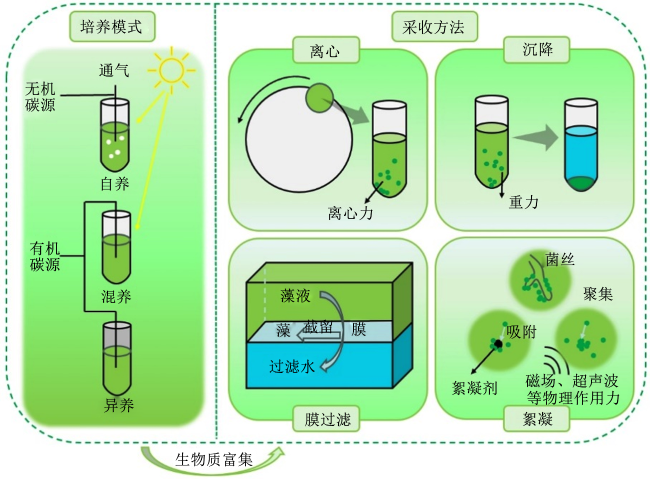
图1 栅藻的培养和采收

Fig.1 Cultivation and harvesting for Scenedesmus sp.

1.1 自养

自养培养是栅藻最常见的培养模式。栅藻的光合作用包含光反应与暗反应2个阶段,在光反应中,其光合色素系统捕获光能,转化为三磷酸腺苷(ATP)和还原型烟酰胺腺嘌呤二核苷酸磷酸(NADPH)中的化学能,并在随后的暗反应中还原二氧化碳(CO2),最终合成碳水化合物[12]。目前,栅藻光合自养的培养系统主要分为露天池塘、薄层培养系统和光生物反应器。其中,露天池塘凭借较低的建造成本、简易的操作流程及良好的耐用性,是目前栅藻规模化培养的主流系统,但其开放式结构易导致原生动物、细菌或杂藻污染,且较高的培养水位会抑制藻体光合效率与生长速率,进而影响栅藻生产的经济效益[13]。薄层培养系统可视为露天池塘的进化版本,其凭借极短的光程(<10 mm),显著提升光能利用率,可实现高生物量积累[14-15];其通过高密度培养形成生态竞争优势,有效抑制杂菌污染,显著提升生物防控能力[15]。相比之下,光生物反应器作为封闭系统,其污染风险更低,并可根据藻类特性优化相应的培养条件,但其高昂的维护成本使其难以大规模应用于实际生产。综上所述,露天池塘凭借其较低的投资与运行成本,在短期、低成本的规模化生产中具有显著经济优势;薄层培养系统生产速率高,但前期建设成本高,适应长期、高值化栅藻生产;而光生物反应器通常用于实验室研究。

1.2 异养

异养培养模式通过提供有机碳源来满足栅藻的能量需求。栅藻可直接利用葡萄糖等有机物,无需通过光合作用固定CO2,代谢路径更短,可实现短时间的高生物量积累[16]。研究表明,斜生栅藻(Tetradesmus obliquus)在异养条件下生物量(3.30 g/L)达到了自养条件下(0.91 g/L)的3.6倍[3]。异养培养模式下使用化学发酵罐可形成高密度养殖,在实现规模化生产的同时大幅降低栅藻培养的水资源消耗。尖状栅藻(Scenedesmus acuminatus)在发酵罐中超高密度异养培养,生物量可以达到286 g/L[17]。然而,异养培养需要消耗氧气,水中溶解氧含量的降低会限制栅藻生长,且有机碳源的引入容易引发杂菌污染,因此需严格无菌操作。综上所述,异养培养优势在于可短时间内快速积累高生物量,扩大生产规模需考虑成本效益。

1.3 混养

混养培养作为异养培养的一种代谢加强模式,其特点是可同时利用光照和有机碳源作为能量来源,并行有氧呼吸与光合作用,从而显著提升生长速率[18]。但其代谢机制并非简单的自养[卡尔文(Calvin)循环]与异养[三羧酸(TCA)循环]叠加。研究表明,Calvin循环与TCA循环的碳流交互作用会激活旁路代谢,提升能量利用效率[19]。与异养培养相似,混养培养有效突破了传统光生物反应器因依赖光能而导致的低细胞密度瓶颈,光能不再成为栅藻生物量增长的限制因素[20]。研究表明,斜生栅藻在含有4 g/L木糖的BG-11培养基条件下混养培养,细胞密度是光自养条件下的2.9倍;在7 g/L葡萄糖条件下混养培养,其产脂能力达到了27 mg/(L·d),相当于自养条件下的50倍[21-22]。同样,双对栅藻(Scenedesmus bijuga)在10 g/L葡萄糖的条件下混养培养,生物量较自养条件下提高了约6倍,较异养培养提高了约4.5倍[23]。光源的引入能够有效降低有机碳源引发的污染风险,平衡呼吸代谢所消耗的氧气,提高栅藻能量利用效率。

2 培养条件

2.1 光照

光照作为栅藻自养条件下光合过程中驱动藻细胞生长繁殖的重要因素,其强度直接影响栅藻的生长速率。随光照强度的增加,栅藻的生长速率持续提升,并于光饱和点达到峰值[24]。然而,在高密度藻液中,藻细胞间的相互遮蔽会影响光的利用效率,限制其生物量的积累。增加光照强度可一定程度上缓解这种遮蔽效应,但过度光照会导致光能在光系统积累从而引发叶绿素光氧化损伤,光利用效率反而下降[25-26]。随藻细胞密度的增加,需适度提升光照强度以保障光合效率并规避光损伤风险。研究表明,当光照强度超过丰富栅藻(Scenedesmus abundans)阈值时,其生物量与脂肪产量显著下降[24]。此外,栅藻中的脂质、碳水化合物和蛋白质的含量也会受到光照强度的影响。研究表明,高光照强度会促进栅藻碳水化合物的合成,低光照强度则有利于栅藻脂质积累[27]。除光照强度外,光质(光谱组成)与光周期对栅藻生理代谢同样具有调控作用。研究表明,斜生栅藻在红光下生长速率最高,其次为白光、蓝光和绿光[28]。斜生栅藻在12 h光照/12 h黑暗循环周期下脂质与叶绿素合成效率更高,而在连续光照(24 h/d光照)下,生物量与蛋白质产量则显著提升[29]。因此,在自养或混养模式下,针对不同藻种的生理特性,精准设计光照参数组合(强度、光谱和周期)是提高栅藻生长速率、优化目标产物(油脂和蛋白质等)产量以及降低培养成本的核心策略。

2.2 碳源

碳源是调控栅藻生长代谢的核心要素,选择合适的碳源需兼顾藻种的生理特性与生产目标双重需求。在自养条件下,CO2一般为主要碳源,其通过扩散作用参与Calvin循环,但受限于气液传质效率,单一CO2供应难以满足高密度培养需求[30]。培养过程中往往需要提供大量的CO2,但仅有小部分能够被栅藻利用,大部分则因其在培养基中的溶解度有限而损失。除直接从水中吸收利用CO2外,栅藻还可通过碳浓缩机制从环境中吸收碳酸氢根离子(HCO3-)等无机碳源并转换为CO2[30]。这一特性为自养条件下栅藻高密度培养时CO2供应不足的问题提供了一种有效的解决方案。在真核细胞中,有机碳源的代谢吸收是一个复杂的过程,涉及到糖异生、TCA循环、乙醛酸循环等多种代谢途径,其中葡萄糖凭借其代谢路径短、同化效率高的优势成为最优碳源[31]。研究表明,在混养模式下,斜生栅藻的生物量以葡萄糖(1.99 g/L)作为碳源时最高,其余依次为以蔗糖(1.41 g/L)、乙酸钠(1.25 g/L)和甘油(1.24 g/L)[32]作为碳源时。但是,高纯度葡萄糖的经济成本较高,限制了异养培养规模化生产。为提高经济效益,有必要开展低廉碳源(果糖、甘油、糖蜜等)高效利用的相关研究。

2.3 氮源

氮代谢是调控栅藻细胞增殖与代谢产物合成的核心枢纽。氨、硝酸盐、亚硝酸盐和尿素是栅藻培养中常用的氮源。研究表明,栅藻氮吸收速率通常遵循氨>尿素>硝酸盐的顺序[33-34]。在氮代谢路径中,氨通过谷氨酰胺合成酶-谷氨酸合酶途径直接参与氨基酸的生物合成,而硝酸盐需经硝酸还原酶和亚硝酸还原酶这2步还原生成铵根离子(NH4+)[35]。尽管硝酸盐代谢过程中存在额外能量消耗,但实际培养条件下的栅藻生物量积累效率常优于氨;研究表明,同等氮源浓度下,以硝酸盐作为氮源时斜生栅藻的生物量(1.048 g/L)高于以氨(0.075 g/L)作为氮源时[36],这种现象与高浓度氨对栅藻的毒性及引发的环境pH改变密切相关[19]。此外,氮源浓度是调控栅藻代谢情况的关键因素,直接决定外源碳源在合成脂质或蛋白质之间的分配。氮饥饿是提高栅藻脂质含量的有效措施[19],研究表明,四尾栅藻(Scenedesmus quadricauda)CASA CC202在缺氮条件下脂质积累量达到富氮条件下的2.27倍[37]。然而,氮饥饿会造成栅藻的生长速度下降和光合色素含量降低等负面影响,斜生栅藻在氮饥饿(0.315 g/L)条件下的生物量约为富氮(0.64 g/L)条件下的1/2,且叶绿素含量及光合活性均所降低[38]。因此,在栅藻实际生产中需分为2个阶段,首先提供充足的氮源保证栅藻生物量的积累,其次再通过氮饥饿来诱导栅藻脂质合成。

3 采收方法

微藻采收是生产过程中分离生物质与水相培养液的关键环节,占生物量生产总成本的20%~30%[39]。选择采收方法需关注如何提高生物量回收率、降低操作和维护费用,以及减轻对环境的影响[40]。离心法、絮凝法、沉降法和膜过滤法是栅藻采收中常用的分离方法[41](图1表1)。
表1 不同采收方法对栅藻的回收效率的影响

Table 1 Effects of different harvesting methods on recovery efficiency of Scenedesmus sp.

藻种
Microalgae
species
采收方法
Harvesting
methods
采收助剂
Harvesting
aids
添加量
Dosage/
(mg/L)
分离驱动力
Separation driving
forces
回收率
Recovery
rate/%
参考文献
Reference
斜生栅藻
Tetradesmus obliquus
离心法 离心力
3 000×g
99.3 [45]
化学絮凝法 硫酸铁
[Fe2(SO4)3]
150 96.2 [45]
栅藻GTAF01 IU
Scenedesmu sp. GTAF01 IU
生物絮凝法 黄曲霉
F_GTAF1 IU
93.6 [55]
栅藻
Scenedesmus sp.
化学絮凝法 环氧氯丙胺-二甲
胺-N,N-二异丙胺
共聚物
8 90 [56]
二形栅藻
Scenedesmus dimorphus
物理/化学
絮凝法
聚乙烯亚胺
包裹的磁性
纳米粒子
磁场强度0.175 T,
超声强度500 W
92.6 [57]
栅藻 QUCCCM63
Scenedesmus sp.
QUCCCM63 (GenBank:
KM985413)
化学絮凝法 氯化铁(FeCl3) 72 97.2 [58]
尖细栅藻
Scenedesmus
acuminatus
错流膜过滤法 聚氯乙烯膜 渗透通量
53.6 L/(m2·h)
93 [59]

3.1 离心法

离心法是一种快速、高效的微藻分离方法,其原理是利用离心力加速细胞悬浮液的沉降和浓缩,核心优势在于能够快速浓缩藻液,通过优化转速和离心时间可使栅藻回收率达到90%~95%[42]。凭借高回收率与生物质纯度,离心法在微藻生物燃料生产及高值蛋白质提取等领域应用广泛。然而,较高的初始设备投资、运行成本及能耗,加之潜在的剪切应力导致细胞损伤风险,限制了该技术的大规模工业应用[43]。因此,尽管离心法在采收方面效果显著,但仍存在成本、能耗及规模化瓶颈,未来需要通过与新兴技术协同应用来优化工艺,进而降低成本。

3.2 絮凝法

絮凝法包括物理絮凝、化学絮凝和生物絮凝3类。物理絮凝通过电场、磁场、超声波等物理作用实现栅藻的絮凝和回收,在环境友好性和保护细胞完整性上优势突出,但其较高的能耗和设备成本以及适用性局限制约了其工业化推广。化学絮凝主要作用机制涉及电荷中和、吸附架桥和网捕作用,大多数化学絮凝剂具有絮凝效果好、絮凝速度快、投入时间短的特点,但存在金属盐污染的风险[44];Wang等[45]研究表明,使用硫酸铁絮凝法回收斜生栅藻生物质时,其效率与离心法相当,并可以提高生物柴油产量;Oliveira等[11]对比阳离子聚丙烯酰胺絮凝法与离心法,发现二者生物柴油生产效率相近。生物絮凝则是通过自絮凝藻类、细菌、真菌及酵母等微生物或其分泌的胞外聚合物(EPS)来诱导藻细胞聚集,从而达到栅藻絮凝的目的[46]。相较于化学絮凝,生物絮凝具有低能耗、环境友好的优势,但栅藻与其他微生物的分离需要额外消耗能量。

3.3 沉降法

沉降法指在不添加絮凝剂的情况下,通过长时间静置使藻类悬浮液自然沉降的过程。栅藻的沉降能力受到表面电荷、大小、形状和细胞外有机物等因素的影响[47-48]。沉降法的优势在于无需化学试剂或机械干预、能耗低、操作简单、无细胞剪切力损伤且成本低,然而该过程十分缓慢,单纯依赖自然沉降的采收效率过低,无法满足商业化藻类生产需求。实际操作时,为了提高效率,沉降法通常与絮凝法协同使用[49-50]。絮凝后,悬浮藻液可实现高效重力沉降,分离出来的藻细胞可直接保留在反应器中,既维持高生物质回收率又确保出水水质[44]

3.4 膜过滤法

膜过滤法是一种结合微藻生物特性与膜分离技术的处理方法,通过膜反应器截留微藻生物质并促进营养物质富集。膜的分类基于孔径和操作构型。膜的孔径是衡量膜性能的关键指标,根据孔径大小,膜过滤可分为粗滤(MaF)、微滤(MF)、超滤(UF)、纳滤(NF)和反渗透(RO)[51];根据操作构型,膜过滤则可分为死端过滤、错流过滤、浸没式过滤(微滤/超滤)和正向渗透过滤[52]。死端过滤模式下,藻液垂直流向膜表面,在压力驱动下培养液透过膜,藻细胞被截留并堆积在膜表面;错流过滤模式下,藻液平行于膜表面流动,部分培养液垂直透过膜成为滤液;浸没式过滤是将微滤或超滤膜浸入藻液中,通过负压驱动过滤,结合曝气冲刷控制膜污染;正向渗透过滤则依靠膜两侧渗透压差驱动藻液水分子自发扩散至高渗透压溶液。膜过滤的优势在于可高效回收大量微藻且能耗较低,但在实际应用中面临着膜污染的挑战[53]。污染问题主要是由微藻细胞及其分泌的EPS引起的,具体表现为孔隙堵塞-中间过滤-滤饼层形成的3阶段动态过程[54]

4 栅藻在畜牧生产中的应用

4.1 栅藻在粪污处理中的应用

养殖废水是养殖生产的主要废弃物之一,残留大量营养物质(以氮、磷及有机物为主)、抗生素和重金属,存在巨大污染风险[60]。其中,抗生素滥用导致的残留问题易引发次生环境污染。不同养殖系统中废水抗生素污染呈现显著差异,部分猪场抗生素含量甚至高达3 630 μg/L[61]。此外,由于畜禽对微量元素的吸收能力有限,饲粮中过量的铜(Cu)、锌(Zn)、铁(Fe)等微量元素不能被机体有效吸收,最终随粪便和尿液排出[62]。栅藻在废水处理中展现出多重潜力,包括高效同化氮、磷营养盐,降解特定抗生素类污染物,以及通过生物吸附作用去除重金属离子。

4.1.1 栅藻对氮、磷的去除效果

大量研究表明,栅藻在废水营养物质回收方面展现出应用潜力(表2)。Oliveira等[63]使用斜生栅藻处理家禽废水,NH4+和磷酸盐离子的去除率超过了97%,化学需氧量(chemical oxygen demand,COD)去除率超过了95%;Tan等[64]在厌氧消化处理后的猪养殖废水中培养斜生栅藻,有机物、氨和磷的去除率分别达到了83.2%、91.7%、59.7%;Zhao等[65]在稀释猪养殖废水中培养栅藻LX1,COD、总氮、氨态氮和总磷的去除率分别达到了86.92%、60.75%、71.81%和96.13%。此外,光的波长也会对栅藻氮和磷去除效果产生影响,Kim等[66]发现,红蓝复合光可提升栅藻除氮效率,而单一蓝光对磷具有特异性去除作用。
表2 栅藻对各类废水的处理效率

Table 2 Treatment efficiency of different types of wastewater by Scenedesmus sp.

藻种
Microalgae
species
废水类型
Wastewater
type
化学需氧量
COD
总氮
TN
总磷
TP
参考文献
Reference
初浓度
Initial
concentration/
(mg/L)
去除率
Removal
efficiency/%
初浓度
Initial
concentration/
(mg/L)
去除率
Removal
efficiency/%
初浓度
Initial
concentration/
(mg/L)
去除率
Removal
efficiency/%
斜生栅藻
Tetradesmus
obliquus
家禽养殖
废水
3 694.7 97 122.9 97.1 27.9 99.3 [63]
水产养殖废水 33 88.9 32 94.4 1.85 90.2 [67]
城市废水 141.25 63.35 95 81 [68]
二形栅藻
Scenedesmus
dimorphus
猪养殖
废水
1 000 48 140.5 46 10.6 99.7 [69]
栅藻LX1
Scenedesmus
sp. LX1
猪养殖废水
(稀释)
600 86.92 85 60.75 2 96.13 [65]
四尾栅藻
Scenedesmus
quadricauda
污水处理
厂废水
51 99 4.0 90 [10]

4.1.2 栅藻对抗生素的去除效果

栅藻对抗生素具有很好的去除效果(表3)。栅藻可通过生物吸附、生物富集和生物降解从水生介质中有效去除抗生素[70-71]。生物吸附与表面结合是栅藻去除水中抗生素的核心机制之一,栅藻细胞表面通过静电作用、氢键及疏水相互作用与溶解态或悬浮态的抗生素结合[72]。这一过程受到抗生素的理化性质、藻细胞表面特性及环境条件的影响,藻类分泌的EPS可以通过提供额外结合位点增强吸附效率[73-75]。生物富集是栅藻细胞通过主动运输将抗生素摄入胞内的动态过程,该过程的效率取决于抗生素浓度、暴露时间及环境条件[76]。除物理吸附外,栅藻还可通过酶促途径与代谢转化降解抗生素污染物,从而降低抗生素对水生生物及环境的毒性[77]
表3 栅藻对不同抗生素的去除效果

Table 3 Removal efficiency of different antibiotics by Scenedesmus sp.

藻种
Microalgae species
抗生素
Antibiotic
初浓度
Initial
concentration
时间
Time
去除率
Removal
efficiency/%
参考文献
Reference
斜生栅藻
Tetradesmus obliquus
四环素 Tetracycline 50 mg/L 96 h 99 [78]
左氧氟沙星 Levofloxacin 1 mg/L 96 h 93 [79]
环丙沙星 Ciprofloxacin 6.5 mg/L 7 d 84.6 [71]
诺氟沙星 Norfloxacin 0.5 mg/L 7 d 84.8 [71]
四尾栅藻
Scenedesmus quadricauda
磺胺甲恶唑 Sulfamethoxazole 100 μg/L 74 [80]

4.1.3 栅藻对重金属的去除效果

栅藻是重金属去除的理想选择,其机制与去除抗生素相似,主要包括生物吸附和生物富集[81]。Liu等[82]用栅藻处理猪养殖废水,铜的去除率达到了88.35%;Roy等[83]用斜生栅藻处理废水,重金属铁、锌、镍(Ni)、铜和砷(As)含量分别降低了69.43%、72.94%、72.99%、90.49%和91.5%。栅藻对重金属的去除率受到栅藻种类、重金属浓度、pH等因素的影响,研究表明,斜生栅藻对0.5、1.0、2.0、3.0和4.0 mg/L浓度下的铬(Cr)去除率分别为100.0%、90.9%、58.5%、53.8%和43.0%[84];酸性条件下(pH<3)下,氢离子(H+)会中和带负电的生物吸附剂表面,减少金属离子的吸附[85];在实际应用中应调控废水浓度和pH,优化栅藻对重金属的生物修复效果。

4.2 栅藻在动物饲粮中的应用

栅藻富含蛋白质、脂质及多种功能性成分,可有效改善动物健康状态并提升畜产品品质。在实际生产中,栅藻既可直接用作饲料原料,亦可作为功能性添加剂使用。栅藻的蛋白质富含多种必需氨基酸,接近动物蛋白质标准,是一种优质蛋白质来源,可作为鱼粉替代品。斜生栅藻粗蛋白质含量可达54%,包含除色氨酸外的所有必需氨基酸[86];栅藻B38的粗蛋白质含量可达49%,包含所有必需氨基酸,尤其谷氨酸、天冬氨酸含量丰富,必需氨基酸指数达85.42%[8];研究表明,栅藻部分或全部替代鱼粉对南美白对虾幼虾的存活率、周生长率、产量均无显著影响[87]。此外,栅藻含有多酚、多糖、脂质、多肽、蛋白质和色素等多种活性分子[88],这些分子在抗氧化、抗菌、抗炎及代谢调控等方面展现出显著潜力,并在畜牧养殖中逐步成为提升动物健康与生产性能的关键功能性添加剂[89];Xu等[90]在异育银鲫饲料中添加4%椭圆栅藻(Scenedesmus ovalternus),异育银鲫的免疫功能和抗病力均有所提升;Abdel-Tawwab等[91]研究发现,饲粮中添加15 g/kg四尾栅藻可显著提高尼罗罗非鱼的生长性能、消化酶活性和抗氧化能力。栅藻的不饱和脂肪酸含量丰富,以n-3多不饱和脂肪酸为主,富含α-亚麻酸;栅藻IBRC-M50098、斜生栅藻和Scenedesmus bijugusi中n-3脂肪酸含量分别为总脂肪酸的39.52%、39.83%和28.39%,其中α-亚麻酸在n-3类脂肪酸中占比为65.31%、57.12%和47.89%[92];在动物体内,α-亚麻酸可通过去饱和酶和碳链延长酶的催化作用,逐步转化为具有重要生理功能的长链n-3脂肪酸,如二十碳五烯酸(EPA)和二十二碳六烯酸(DHA)[92]。然而,目前栅藻作为饲料成分在畜禽中的应用研究较少,有必要开展相关研究确定其具体的营养方案。

5 小结

栅藻具有较强的环境适应性与抗逆性能,能够高效处理养殖废水并实现营养物质的循环利用,兼具环境污染治理与资源化利用的双重优势。此外,其生物活性物质具有抗氧化、抗菌、抗炎等多种生物学功能,其蛋白质富含多种必需氨基酸,脂质不饱和脂肪酸含量丰富,具备作为优质饲料资源的潜力。然而,不同培养工艺下,栅藻的营养成分(如蛋白质、不饱和脂肪酸)存在较大波动且培养及采收成本高昂,严重制约了其在畜牧生产中规模化应用。未来需开发低成本培养基质(如污水、低价有机碳源)并优化培养和采收工艺以降低生产成本,并深化栅藻在畜禽营养调控与健康中的应用价值研究,甚至探索污水处理、资源回收与高值化应用相结合的循环农业的可能性。
[1]
QUEIROZ M I, VIEIRA J G, MARONEZE M M. Morphophysiological,structural,and metabolic aspects of microalgae[M]//JACOB-LOPES E,MARONEZE M M,QUEIROZ M I,et al.Handbook of microalgae-based processes and products. New York: Academic Press, 2020:25-48.

[2]
XIA Y L, LIU D D, DONG Y, et al. Effect of ionic liquids with different cations and anions on photosystem and cell structure of Scenedesmus obliquus[J]. Chemosphere, 2018, 195:437-447.

DOI

[3]
李淑媛, 赵丹, 王灿梅, 等. 混养模式和营养条件优化对斜生四链藻生物量积累和脂质含量的影响[J]. 能源环境保护, 2024, 38(6):168-178.

LI S Y, ZHAO D, WANG C M, et al. Effects of mixed cultivation mode and nutrient condition optimization on biomass accumulation and lipid content of Tetradesmus obliquus[J]. Energy Environmental Protection, 2024, 38(6):168-178. (in Chinese)

[4]
YANG J W, TANG H X, ZHANG X X, et al. High temperature and pH favor Microcystis aeruginosa to outcompete Scenedesmus obliquus[J]. Environmental Science and Pollution Research, 2018, 25(5):4794-4802.

DOI

[5]
FERREIRA A, RIBEIRO B, FERREIRA A F, et al. Scenedesmus obliquus microalga-based biorefinery-from brewery effluent to bioactive compounds,biofuels and biofertilizers-aiming at a circular bioeconomy[J]. Biofuels,Bioproducts and Biorefining, 2019, 13(5):1169-1186.

DOI

[6]
FARUQUE M O, HOSSAIN M M, RAZZAK S A. Photoautotrophic cultivation,lipid enhancement,and dry biomass characterization of microalgae Scenedesmus dimorphus for bioenergy application[J]. Arabian Journal for Science and Engineering, 2023, 48(12):16263-16280.

DOI

[7]
CONDORI M A M, CONDORI M M, GUTIERREZ M E V, et al. Bioremediation potential of the Chlorella and Scenedesmus microalgae in explosives production effluents[J]. Science of the Total Environment, 2024, 920:171004.

DOI

[8]
曹猛, 王盛林, 刘平怀, 等. 栅藻B38营养成分分析及蛋白质营养价值评价[J]. 水产科学, 2020, 39(1):103-110.

CAO M, WANG S L, LIU P H, et al. Nutritional composition and evaluation of protein in green alga Scenedesmus (Desmodesmus) armatus B38[J]. Fisheries Science, 2020, 39(1):103-110. (in Chinese)

[9]
ABOU-SHANAB R A I, HWANG J H, CHO Y C, et al. Characterization of microalgal species isolated from fresh water bodies as a potential source for biodiesel production[J]. Applied Energy, 2011, 88(10):3300-3306.

DOI

[10]
WONG Y K, YUNG K K L, TSANG Y F, et al. Scenedesmus quadricauda for nutrient removal and lipid production in wastewater[J]. Water Environment Research, 2015, 87(12):2037-2044.

DOI PMID

[11]
OLIVEIRA C Y B D, VIEGAS T L, LOPES R G, et al. A comparison of harvesting and drying methodologies on fatty acids composition of the green microalga Scenedesmus obliquus[J]. Biomass and Bioenergy, 2020, 132:105437.

DOI

[12]
MARKOU G, GEORGAKAKIS D. Cultivation of filamentous cyanobacteria (blue-green algae) in agro-industrial wastes and wastewaters:a review[J]. Applied Energy, 2011, 88(10):3389-3401.

DOI

[13]
SAFI C, ZEBIB B, MERAH O, et al. Morphology,composition,production,processing and applications of Chlorella vulgaris:a review[J]. Renewable and Sustainable Energy Reviews, 2014, 35:265-278.

DOI

[14]
TRAMONTIN D P, GRESSLER P D, RÖRIG L R, et al. Growth modeling of the green microalga Scenedesmus obliquus in a hybrid photobioreactor as a practical tool to understand both physical and biochemical phenomena in play during algae cultivation[J]. Biotechnology and Bioengineering, 2018, 115(4):965-977.

DOI

[15]
MASOJÍDEK J, KOPECKÝ J, GIANNELLI L, et al. Productivity correlated to photobiochemical performance of Chlorella mass cultures grown outdoors in thin-layer cascades[J]. Journal of Industrial Microbiology & Biotechnology, 2011, 38(2):307-317.

[16]
MAO B D, VADIVELOO A, QIU J, et al. Artificial photosynthesis:promising approach for the efficient production of high-value bioproducts by microalgae[J]. Bioresource Technology, 2024, 401:130718.

DOI

[17]
JIN H, ZHANG H, ZHOU Z W, et al. Ultrahigh-cell-density heterotrophic cultivation of the unicellular green microalga Scenedesmus acuminatus and application of the cells to photoautotrophic culture enhance biomass and lipid production[J]. Biotechnology and Bioengineering, 2020, 117(1):96-108.

DOI

[18]
WANG J H, YANG H Z, WANG F. Mixotrophic cultivation of microalgae for biodiesel production:status and prospects[J]. Applied Biochemistry and Biotechnology, 2014, 172(7):3307-3329.

DOI

[19]
SHEN X F, HU H, MA L L, et al. FAMEs production from:Scenedesmus obliquus in autotrophic,heterotrophic and mixotrophic cultures under different nitrogen conditions[J]. Environmental Science:Water Research and Technology, 2018, 4(3):461-468.

DOI

[20]
李淑媛. 两阶段培养下营养条件优化对斜生四链藻生物量积累和脂质含量的影响[D].硕士学位论文. 南宁: 广西大学, 2024.

LI S Y. Effects of optimization of nutrient conditions on biomass accumulation and lipid content of Tetradesmus obliquus under two-stage cultivation[D].Master’s Thesis. Nanning: Guangxi University, 2024. (in Chinese)

[21]
YANG S L, LIU G J, MENG Y T, et al. Utilization of xylose as a carbon source for mixotrophic growth of Scenedesmus obliquus[J]. Bioresource Technology, 2014, 172:180-185.

DOI

[22]
MANDAL S, MALLICK N. Microalga Scenedesmus obliquus as a potential source for biodiesel production[J]. Applied Microbiology and Biotechnology, 2009, 84(2):281-291.

DOI

[23]
BHATNAGAR A, CHINNASAMY S, SINGH M, et al. Renewable biomass production by mixotrophic algae in the presence of various carbon sources and wastewaters[J]. Applied Energy, 2011, 88(10):3425-3431.

DOI

[24]
RAI M P, GUPTA S. Effect of media composition and light supply on biomass,lipid content and FAME profile for quality biofuel production from Scenedesmus abundans[J]. Energy Conversion and Management, 2017, 141:85-92.

DOI

[25]
LI Y C, ZHOU W G, HU B, et al. Effect of light intensity on algal biomass accumulation and biodiesel production for mixotrophic strains Chlorella kessleri and Chlorella protothecoide cultivated in highly concentrated municipal wastewater[J]. Biotechnology and Bioengineering, 2012, 109(9):2222-2229.

DOI

[26]
DENG X Y, CHEN B, XUE C Y, et al. Biomass production and biochemical profiles of a freshwater microalga Chlorella kessleri in mixotrophic culture:effects of light intensity and photoperiodicity[J]. Bioresource Technology, 2019, 273:358-367.

DOI

[27]
UGUZ S, SOZCU A, SIMSEK E, et al. Nutritional and amino acid composition of Scenedesmus sp. cultivated under various light intensities[J]. Current Microbiology, 2025, 82(6):274.

DOI

[28]
CEPÁK V, PÝIBYL P, VÍTOVÁ M. The effect of light color on the nucleocytoplasmic and chloroplast cycle of the green chlorococcal alga Scenedesmus obliquus[J]. Folia Microbiologica, 2006, 51(4):342-348.

DOI

[29]
VENDRUSCOLO R G, FAGUNDES M B, MARONEZE M M, et al. Scenedesmus obliquus metabolomics:effect of photoperiods and cell growth phases[J]. Bioprocess and Biosystems Engineering, 2019, 42(5):727-739.

DOI

[30]
LATAGAN M J D, NAGARAJAN D, HUANG W M, et al. Bicarbonate-based microalgal cultivation technologies:mechanisms,critical strategies,and future perspectives[J]. Chemical Engineering Journal, 2024, 502:157998.

DOI

[31]
TOCCA G P, AGOSTINO V, MENIN B, et al. Mixotrophic and heterotrophic growth of microalgae using acetate from different production processes[J]. Reviews in Environmental Science and Bio/Technology, 2024, 23(1):93-132.

DOI

[32]
弥雨薇. 碳源诱导下斜生四链藻脂质积累的实验研究[D].硕士学位论文. 南宁: 广西大学, 2022.

MI Y W. Study of lipid accumulation in Tetradesmus obliquus induced by carbon source[D].Master’s Thesis. Nanning: Guangxi University, 2022. (in Chinese)

[33]
GLIBERT P M, WILKERSON F P, DUGDALE R C, et al. Phytoplankton communities from San Francisco Bay Delta respond differently to oxidized and reduced nitrogen substrates-even under conditions that would otherwise suggest nitrogen sufficiency[J]. Frontiers in Marine Science, 2014, 1:17.

[34]
CEJUDO E, TAYLOR W, SCHIFF S. Epilithic algae from an urban river preferentially use ammonium over nitrate[J]. International Aquatic Research, 2020, 12(1):30-39.

[35]
SU Y Y. Revisiting carbon,nitrogen,and phosphorus metabolisms in microalgae for wastewater treatment[J]. Science of the Total Environment, 2021, 762:144590.

DOI

[36]
张生盛. 氮源对斜生栅藻生长及脂质积累影响[D].硕士学位论文. 南宁: 广西大学, 2021.

ZHANG S S. Effects of nitrogen sources on growth and lipid accumulation of Scenedesmus obliquus[D].Master’s Thesis. Nanning: Guangxi University, 2021. (in Chinese)

[37]
SULOCHANA S B, ARUMUGAM M. Targeted metabolomic and biochemical changes during nitrogen stress mediated lipid accumulation in Scenedesmus quadricauda CASA CC202[J]. Frontiers in Bioengineering and Biotechnology, 2020, 8:585632.

DOI

[38]
ABRHA G T, MAKARANGA A, JUTUR P P. Enhanced lipid accumulation in microalgae Scenedesmus sp.under nitrogen limitation[J]. Enzyme and Microbial Technology, 2025, 182:110546.

DOI

[39]
GEJJI V, FERNANDO S D. Harvesting microalgae using ionic polyelectrolytes in an aqueous-organic two-phase system:screening of separation parameters using model algal particles[J]. Process Biochemistry, 2018, 72:188-197.

DOI

[40]
FAHRINA A, FAHRURROZI F, MUNANDAR H, et al. Harvesting marine microalgae Tetraselmis sp.using cellulose acetate membrane[J]. Bioresource Technology, 2024, 399:130622.

DOI

[41]
DE MORAIS E G, SAMPAIO I C F, GONZALEZ-FLO E, et al. Microalgae harvesting for wastewater treatment and resources recovery:a review[J]. New Biotechnology, 2023, 78:84-94.

DOI

[42]
ZHU J Y, WAKISAKA M, OMURA T, et al. Advances in industrial harvesting techniques for edible microalgae:recent insights into sustainable,efficient methods and future directions[J]. Journal of Cleaner Production, 2024, 436:140626.

DOI

[43]
MATHIMANI T, MALLICK N. A comprehensive review on harvesting of microalgae for biodiesel-key challenges and future directions[J]. Renewable and Sustainable Energy Reviews, 2018, 91:1103-1120.

DOI

[44]
LI S X, HU T Y, XU Y Z, et al. A review on flocculation as an efficient method to harvest energy microalgae:mechanisms,performances,influencing factors and perspectives[J]. Renewable and Sustainable Energy Reviews, 2020, 131:110005.

DOI

[45]
WANG S, YERKEBULAN M, ABOMOHRA A E F, et al. Microalgae harvest influences the energy recovery:a case study on chemical flocculation of Scenedesmus obliquus for biodiesel and crude bio-oil production[J]. Bioresource Technology, 2019, 286:121371.

DOI

[46]
ALAM M A, VANDAMME D, CHUN W, et al. Bioflocculation as an innovative harvesting strategy for microalgae[J]. Reviews in Environmental Science and Bio/Technology, 2016, 15(4):573-583.

DOI

[47]
HENDERSON R, PARSONS S A, JEFFERSON B. The impact of algal properties and pre-oxidation on solid-liquid separation of algae[J]. Water Research, 2008, 42(8/9):1827-1845.

DOI

[48]
和文洁. 产油微藻油脂生产中下游工艺研究进展[J]. 中国石油和化工标准与质量, 2020, 40(11):27-28.

HE W J. Advances in downstream processing for lipid production from oleaginous microalgae[J]. China Petroleum and Chemical Standard and Quality, 2020, 40(11):27-28. (in Chinese)

[49]
ORTIZ A, GARCÍA-GALÁN M J, GARCÍA J, et al. Optimization and operation of a demonstrative full scale microalgae harvesting unit based on coagulation,flocculation and sedimentation[J]. Separation and Purification Technology, 2021, 259:118171.

DOI

[50]
SUN J J, JIANG S H, YANG L B, et al. Microalgal wastewater recycling:suitability of harvesting methods and influence on growth mechanisms[J]. Science of the Total Environment, 2023, 859(Pt 2):160237.

DOI

[51]
DREXLER I L C, YEH D H. Membrane applications for microalgae cultivation and harvesting:a review[J]. Reviews in Environmental Science and Bio/Technology, 2014, 13(4):487-504.

DOI

[52]
VATANPOUR V, KHALIGH S S, SERTGUMEC S, et al. A review on algal biomass dewatering and recovery of microalgal-based valuable products with different membrane technologies[J]. Journal of Environmental Management, 2024, 371:123182.

DOI

[53]
ENNACERI H, FISCHER K, SCHULZE A, et al. Membrane fouling control for sustainable microalgal biodiesel production:a review[J]. Renewable and Sustainable Energy Reviews, 2022, 161:112335.

DOI

[54]
YANG K X, WANG J W, ZHENG J, et al. Microalgae-based wastewater treatment:advances and challenges in membrane harvesting technologies[J]. Separation and Purification Technology, 2025, 360(Pt 1):130805.

DOI

[55]
TRIPATHI G, PANDEY V K, AHMAD S, et al. Utilizing novel Aspergillus species for bio-flocculation:a cost-effective approach to harvest Scenedesmus microalgae for biofuel production[J]. Current Research in Microbial Sciences, 2024, 7:100272.

DOI

[56]
GUPTA S K, KUMAR M, GULDHE A, et al. Design and development of polyamine polymer for harvesting microalgae for biofuels production[J]. Energy Conversion and Management, 2014, 85:537-544.

DOI

[57]
GE S J, AGBAKPE M, ZHANG W, et al. Heteroaggregation between PEI-coated magnetic nanoparticles and algae:effect of particle size on algal harvesting efficiency[J]. ACS Applied Materials & Interfaces, 2015, 7(11):6102-6108.

[58]
DAS P, THAHER M I, ABDUL HAKIM M A Q M, et al. Microalgae harvesting by pH adjusted coagulation-flocculation,recycling of the coagulant and the growth media[J]. Bioresource Technology, 2016, 216:824-829.

DOI

[59]
WANG L, PAN B, GAO Y X, et al. Efficient membrane microalgal harvesting:pilot-scale performance and techno-economic analysis[J]. Journal of Cleaner Production, 2019, 218:83-95.

DOI

[60]
YE Z L, GHYSELBRECHT K, MONBALLIU A, et al. Fractionating various nutrient ions for resource recovery from swine wastewater using simultaneous anionic and cationic selective-electrodialysis[J]. Water Research, 2019, 160:424-434.

DOI

[61]
ZHANG M, LIU Y S, ZHAO J L, et al. Occurrence,fate and mass loadings of antibiotics in two swine wastewater treatment systems[J]. Science of the Total Environment, 2018, 639:1421-1431.

DOI

[62]
ZENG Z, ZHENG P, KANG D, et al. The removal of copper and zinc from swine wastewater by anaerobic biological-chemical process:performance and mechanism[J]. Journal of Hazardous Materials, 2021, 401:123767.

DOI

[63]
OLIVEIRA A C, BARATA A, BATISTA A P, et al. Scenedesmus obliquus in poultry wastewater bioremediation[J]. Environmental Technology, 2019, 40(28):3735-3744.

DOI

[64]
TAN X B, ZHAO Z Y, GONG H, et al. Growth of Scenedesmus obliquus in anaerobically digested swine wastewater from different cleaning processes for pollutants removal and biomass production[J]. Chemosphere, 2024, 352:141515.

DOI

[65]
ZHAO G P, WANG X Y, HONG Y, et al. Attached cultivation of microalgae on rational carriers for swine wastewater treatment and biomass harvesting[J]. Bioresource Technology, 2022, 351:127014.

DOI

[66]
KIM T H, LEE Y H, HAN S H, et al. The effects of wavelength and wavelength mixing ratios on microalgae growth and nitrogen,phosphorus removal using Scenedesmus sp. for wastewater treatment[J]. Bioresource Technology, 2013, 130:75-80.

DOI

[67]
LIU Y, LV J P, FENG J, et al. Treatment of real aquaculture wastewater from a fishery utilizing phytoremediation with microalgae[J]. Journal of Chemical Technology & Biotechnology, 2019, 94(3):900-910.

DOI

[68]
HAN S F, JIN W B, ABOMOHRA A E F, et al. Municipal wastewater enriched with trace metals for enhanced lipid production of the biodiesel-promising microalga Scenedesmus obliquus[J]. Bioenergy Research, 2019, 12(4):1127-1133.

DOI

[69]
ZHAO Y J, GUO G Y, SUN S Q, et al. Co-pelletization of microalgae and fungi for efficient nutrient purification and biogas upgrading[J]. Bioresource Technology, 2019, 289:121656.

DOI

[70]
PRADHAN N, KUMAR S, SELVASEMBIAN R, et al. Emerging trends in the pretreatment of microalgal biomass and recovery of value-added products:a review[J]. Bioresource Technology, 2023, 369:128395.

DOI

[71]
RICKY R, SHANTHAKUMAR S. A pilot-scale study on the removal of binary mixture (ciprofloxacin and norfloxacin) by Scenedesmus obliquus:optimization,biotransformation,and biofuel profile[J]. Journal of Environmental Management, 2023, 344:118388.

DOI

[72]
ZAMBRANO J, GARCÍA-ENCINA P A, HERNÁNDEZ F, et al. Removal of a mixture of veterinary medicinal products by adsorption onto a Scenedesmus almeriensis microalgae-bacteria consortium[J]. Journal of Water Process Engineering, 2021, 43:102226.

DOI

[73]
LENG L J, WEI L, XIONG Q, et al. Use of microalgae based technology for the removal of antibiotics from wastewater:a review[J]. Chemosphere, 2020, 238:124680.

DOI

[74]
LE V V, TRAN Q G, KO S R, et al. How do freshwater microalgae and cyanobacteria respond to antibiotics?[J]. Critical Reviews in Biotechnology, 2023, 43(2):191-211.

DOI

[75]
XU P P, TU X J, AN Z D, et al. Cadmium-induced physiological responses,biosorption and bioaccumulation in Scenedesmus obliquus[J]. Toxics, 2024, 12(4):262.

DOI

[76]
HENA S, GUTIERREZ L, CROUÉ J P. Removal of pharmaceutical and personal care products (PPCPs) from wastewater using microalgae:a review[J]. Journal of Hazardous Materials, 2021, 403:124041.

DOI

[77]
SUTHERLAND D L, RALPH P J. Microalgal bioremediation of emerging contaminants-opportunities and challenges[J]. Water Research, 2019, 164:114921.

DOI

[78]
CHEN Z H, OU D, GU G, et al. Removal of tetracycline from water by catalytic photodegradation combined with the microalga Scenedesmus obliquus and the responses of algal photosynthesis and transcription[J]. Journal of Environmental Management, 2023, 326(Pt A):116693.

[79]
XIONG J Q, KURADE M B, PATIL D V, et al. Biodegradation and metabolic fate of levofloxacin via a freshwater green alga,Scenedesmus obliquus in synthetic saline wastewater[J]. Algal Research, 2017, 25:54-61.

DOI

[80]
KIKI C, RASHID A, WANG Y W, et al. Dissipation of antibiotics by microalgae:kinetics,identification of transformation products and pathways[J]. Journal of Hazardous Materials, 2020, 387:121985.

DOI

[81]
AGOUN N A, AVCI F G. Phycoremediation:a path towards heavy metal bioremediation from wastewater[J]. Journal of Chemical Technology & Biotechnology, 2025, 100(1):13-23.

DOI

[82]
LIU L H, LIN X A, LUO L Z, et al. Biosorption of copper ions through microalgae from piggery digestate:optimization,kinetic,isotherm and mechanism[J]. Journal of Cleaner Production, 2021, 319:128724.

DOI

[83]
ROY H P, ELDIEHY K S H, DEKA D. Phycoremediation of rice bran oil processing wastewater and biodiesel production using green microalgae,Scenedesmus obliquus:a green approach to environmental protection and remediation[J]. Environmental Science and Pollution Research, 2024, 31(57):65288-65301.

DOI

[84]
张晶. 混合营养模式下利用斜生栅藻同步去除养分和重金属[D].硕士学位论文. 太原: 太原理工大学, 2022.

ZHANG J. Synchronous removal of nutrients and heavy metals by Scenedesmus obliquus under mixotrophic mode[D].Master’s Thesis. Taiyuan: Taiyuan University of Technology, 2022. (in Chinese)

[85]
KUMAR R, BISHNOI N R, GARIMA, et al. Biosorption of chromium (VI) from aqueous solution and electroplating wastewater using fungal biomass[J]. Chemical Engineering Journal, 2008, 135(3):202-208.

DOI

[86]
LIU X, WANG K J, ZHANG J, et al. Ammonium removal potential and its conversion pathways by free and immobilized Scenedesmus obliquus from wastewater[J]. Bioresource Technology, 2019, 283:184-190.

DOI

[87]
NUNES A J P, FAÇANHA F N, LEITE J S, et al. Potential of Scenedesmus sp. and Aurantiochytrium spp. as protein and n-3 fatty acid sources in practical diets for juvenile Penaeus vannamei[J]. Aquaculture International, 2024, 33(1):18.

DOI

[88]
MICHALAK I, CHOJNACKA K. Algae as production systems of bioactive compounds[J]. Engineering in Life Sciences, 2015, 15(2):160-176.

DOI

[89]
PARK J K. Algal polysaccharides:properties and applications[J]. Biochemistry & Analytical Biochemistry, 2015, 4(2):1000176.

[90]
XU W J, LI H Y, WU L Y, et al. Dietary Scenedesmus ovalternus improves disease resistance of overwintering gibel carp (Carassius gibelio) by alleviating toll-like receptor signaling activation[J]. Fish & Shellfish Immunology, 2020, 97:351-358.

[91]
ABDEL-TAWWAB M, GEWIDA A G A, ABDELGHANY M F, et al. The green microalga Scenedesmus quadricauda modulates the performance,immune indices,and disease resistance of Nile tilapia fingerlings[J]. Aquaculture, 2022, 560:738550.

DOI

[92]
KHODADADIANZAGHMARI F, JAHADI M, GOLI M. Biochemical profile of Scenedesmus isolates,with a main focus on the fatty acid profile[J]. Food Science & Nutrition, 2024, 12(8):5922-5931.

DOI

Outlines

/