RESEARCH PAPER

Effects of Feeding Low Protein Diet to Sows during Gestation on Growth Performance, Immune Function and Antioxidant Capacity of Their Offspring

  • LIU Zhongyu , 1, 2 ,
  • ZHANG Qipeng 1 ,
  • KONG Bolei 1 ,
  • FANG Zhengfeng 1 ,
  • CHE Lianqiang 1 ,
  • LIN Yan 1 ,
  • XU Shengyu 1 ,
  • ZHUO Yong 1 ,
  • LI Jian 1 ,
  • JIANG Xuemei 1 ,
  • HUA Lun 1 ,
  • LIU Guangmang 1 ,
  • ZHANG Ruinan 1 ,
  • WU De 1 ,
  • FENG Bin , 1, 2, *
Expand
  • 1 Institute of Animal Nutrition, Sichuan Agricultural University, Chengdu 611130, China
  • 2 Key Laboratory of Animal Disease-Resistant Nutrition of Ministry of Education, Key Laboratory of Animal Disease-Resistant Nutrition and Feed of Ministry of Agriculture and Rural Affairs, Key Laboratory of Animal Disease-Resistant Nutrition of Sichuan Province, Chengdu 611130, China
*professor, E-mail:

Received date: 2025-08-28

  Online published: 2026-03-16

Abstract

This experiment was conducted to explore the effects of feeding low protein diet to sows during gestation on growth performance, immune function and antioxidant capacity of their offspring. Twenty-four “Landrace×Yorkshire” crossbred sows with similar body condition and parity (3 to 5 parities) were selected. After artificial insemination, they were randomly divided into 2 groups (12 sows in each group) at 30 days of gestation. During gestation, they were fed a normal protein diet (NP group, with crude protein content of 13.65%) and a low protein diet (LP group, with crude protein content of 11.30%), respectively. Sows were fed the same lactation diet during the lactation period. Piglets were weaned at 21 days of age, and two male castrated piglets with a body weight close to the average body weight of the litter were selected from each litter (a total of 48 piglets), with 8 replicates in each group and 3 piglets in each replicate. The offspring were fed the same diet during the nursery period and the growth period. The piglets were slaughtered and sampled 90 days after weaning. The results showed as follows: 1) compared with NP group, there was no significant difference in the growth performance of offspring in LP group (P>0.05). 2) Compared with NP group, the jejunal secretory immunoglobulin A (sIgA) content of offspring in LP group was significantly increased 90 days after weaning (P<0.05). 3) Compared with NP group, the valeric acid content in feces during the growth period in LP group was significantly decreased (P<0.05). 4) Compared with NP group, the mRNA relative expression levels of thymic interleukin-1β (IL-1β) and nuclear factor-κB (NF-κB) during the growth period in LP group were significantly increased (P<0.05); there was no significant difference in the weight of spleen (P>0.05), while the mRNA relative expression levels of interleukin-6 (IL-6) and interleukin-10 (IL-10) in spleen were significantly increased (P<0.05). 5) Compared with NP group, the mRNA relative expression levels and enzyme activities of catalase (CAT) and superoxide dismutase (SOD) in spleen and thymus during the growth period in LP group were significantly increased (P<0.05), the mRNA relative expression levels of endoplasmic reticulum stress marker genes glucose-regulated protein 78 (GRP78) and C/EBP homologous protein (CHOP) in spleen were significantly decreased (P<0.05), and the malondialdehyde content in spleen was significantly decreased (P<0.05). In conclusion, appropriately reducing the dietary protein level of sows during gestation has no significant effect on the growth performance of offspring, but it can increase the jejunal sIgA content of offspring during the growth period, enhance the antioxidant capacity and immune function of thymus and spleen.

Cite this article

LIU Zhongyu , ZHANG Qipeng , KONG Bolei , FANG Zhengfeng , CHE Lianqiang , LIN Yan , XU Shengyu , ZHUO Yong , LI Jian , JIANG Xuemei , HUA Lun , LIU Guangmang , ZHANG Ruinan , WU De , FENG Bin . Effects of Feeding Low Protein Diet to Sows during Gestation on Growth Performance, Immune Function and Antioxidant Capacity of Their Offspring[J]. Chinese Journal of Animal Nutrition, 2026 , 38(3) : 1778 -1791 . DOI: 10.12418/CJAN2026.144

母体妊娠期营养可影响胎儿生长发育[1]、免疫系统建立[2]、代谢[3]和疾病易感性[4]等,这些因素都会影响子代生长过程中的整体健康水平。随着饲料行业的改革和蛋白质饲料原料的短缺,我国养猪业饲养模式和饲粮配比模式发生变化[5-6],向寻求节能减排的环境资源友好型养猪业方向发展[7-8]。低蛋白质饲粮基于氨基酸平衡理论,通过添加必需氨基酸降低饲粮蛋白质水平,达到提高蛋白质利用率和动物健康水平,同时减少氮排放的目的[9-12]。研究表明,降低母猪妊娠期饲粮蛋白质水平1~2个百分点,可以降低粪氮和尿氮排放,减少猪舍内氨气浓度,从而减少猪呼吸道疾病和腹泻的发生[13-14]。但母猪妊娠期低蛋白质饲粮对子代免疫的影响尚不明确。据报道,低蛋白质饲粮可能会削弱动物免疫能力[15],但通过适当的营养补充,可缓解低蛋白质饲粮的这种负面效应[16]。本研究旨在探究母猪妊娠期饲喂低蛋白质饲粮对子代生长性能、免疫功能和抗氧化能力的影响,为“母子一体化”低蛋白质饲粮饲喂策略的制定提供依据。

1 材料与方法

1.1 试验动物和饲粮

本研究动物试验方案经四川农业大学动物保护和使用委员会批准(批准号:20220132)。试验动物为体况和胎次(3~5胎)相近的24头“大白×长白”二元母猪。正常蛋白质饲粮(粗蛋白质含量设计值为14%,实测值为13.65%)根据NRC(2012)[17]推荐的妊娠母猪营养需求配制;低蛋白质饲粮(粗蛋白质含量设计值为11%,实测值为11.30%)除蛋白质水平外,其他营养水平均满足NRC(2012)推荐的妊娠母猪营养需求,并补充必需氨基酸以满足妊娠母猪需要量。母猪妊娠期饲粮组成及营养水平见表1
表1 母猪妊娠期饲粮组成及营养水平(饲喂基础)

Table 1 Composition and nutrient levels of diets for sows during gestation (as-fed basis)

项目
Items
正常蛋
白质饲粮
Normal
protein
diet
低蛋白
质饲粮
Low
protein
diet
原料 Ingredients
玉米 Corn 64.66 73.19
豆粕 Soybean meal 14.00 7.00
小麦麸 Wheat bran 18.00 16.00
L-赖氨酸盐酸盐
L-lysine·HCl (98%)
0.05 0.26
DL-蛋氨酸
DL-methionine (99%)
0.02 0.05
L-色氨酸
L-tryptophan (98%)
0.02 0.05
L-苏氨酸
L-threonine (98.5%)
0.05 0.15
石粉 Limestone 1.00 1.00
磷酸氢钙 CaHPO4 1.30 1.40
氯化钠 NaCl 0.40 0.40
氯化胆碱 Choline chloride (50%) 0.15 0.15
预混料 Premix1) 0.35 0.35
合计 Total 100.00 100.00
营养水平 Nutrient levels2)
代谢能 ME/(MJ/kg) 13.10 13.05
粗蛋白质 CP 13.65 11.30
粗纤维 CF 3.78 3.48
钙 Ca 0.76 0.76
标准全肠道可消化磷 STTD P 0.41 0.40
标准回肠可消化赖氨酸 SID Lys 0.57 0.56
标准回肠可消化蛋氨酸 SID Met 0.24 0.24
标准回肠可消化苏氨酸 SID Thr 0.45 0.45
标准回肠可消化色氨酸 SID Trp 0.13 0.13

1)预混料为每千克饲粮提供 The premix provided the following per kg of diets:VA 12 000 IU,VD3 2 400 IU,VE 100 IU,VK3 4.8 mg,VB1 2 mg,VB2 7.2 mg,VB6 3.6 mg,VB12 0.025 mg,烟酸 nicotinic acid 40 mg,叶酸 folic acid 4 mg,Fe (as ferrous sulfate) 120 mg,Cu (as copper sulfate) 20 mg,Zn (as zinc sulfate) 120 mg,Mn (as manganese sulfate) 30 mg,I (as potassium iodide) 0.3 mg,Se (as sodium selenite) 0.45 mg,载体为统糠 the carrier was bran。

2)营养水平中代谢能和粗蛋白质(GB/T 6432—2018)为实测值,其余均为参考NRC(2012)所得计算值。代谢能通过代谢笼进行消化代谢试验实测,根据代谢能=总能-粪能-尿能进行计算,能量采用弹式热量计(6400,Parr Instrument Company,美国)进行测定。ME and CP in nutrient levels were measured values, while the others were calculated values according to NRC (2012). ME was measured through digestion and metabolism experiment using metabolic cage. According to the measurement formula of ME=gross energy-fecal energy-urinary energy, it was measured using a bomb calorimeter (6400, Parr Instrument Company, USA).

1.2 试验设计和饲养管理

24头母猪经人工授精(同一来源的杜洛克公猪精液)后,于妊娠30 d时随机分为2组(每组12头),并于妊娠期分别饲喂正常蛋白质饲粮(NP组)和低蛋白质饲粮(LP组)。母猪哺乳期饲喂相同的哺乳期饲粮,每天饲喂4~6次,分娩第1天饲喂1 kg,随后每天增加1 kg直至泌乳第6天开始自由采食。母猪哺乳期饲粮组成及营养水平见表2。仔猪哺乳期乳汁为唯一食物来源。仔猪21日龄断奶,并从每窝选取2头接近窝平均体重的雄性去势仔猪(共48头),每组随机分到8个圈舍(重复),每个圈舍3头仔猪。子代保育期和生长期饲喂相同饲粮,其组成及营养水平见表3。仔猪断奶后90 d进行屠宰采样。
表2 母猪哺乳期饲粮组成及营养水平(饲喂基础)

Table 2 Composition and nutrient levels of diets for sows during lactation (as-fed basis)

项目 Items 含量 Content
原料 Ingredients
玉米 Corn 63.38
豆粕 Soybean meal 22.20
小麦麸 Wheat bran 6.00
鱼粉 Fish meal 2.60
大豆油 Soybean oil 2.00
L-赖氨酸盐酸盐 L-lysine·HCl (98%) 0.27
DL-蛋氨酸 DL-methionine (99%) 0.13
L-色氨酸 L-tryptophan (98%) 0.05
石粉 Limestone 0.98
磷酸氢钙 CaHPO4 1.50
氯化钠 NaCl 0.40
氯化胆碱 Choline chloride (50%) 0.15
预混料 Premix1) 0.34
合计 Total 100.00
营养水平 Nutrient levels2)
代谢能 ME/(MJ/kg) 14.10
粗蛋白质 CP 17.87
粗纤维 CF 3.24
钙 Ca 0.93
标准全肠道可消化磷 STTD P 0.46
标准回肠可消化赖氨酸 SID Lys 1.04
标准回肠可消化蛋氨酸 SID Met 0.41
标准回肠可消化苏氨酸 SID Thr 0.56
标准回肠可消化色氨酸 SID Trp 0.20

1)预混料为每千克饲粮提供 The premix provided the following per kg of diets:VA 9 600 IU,VD3 1 920 IU,VE 80 IU,VK3 3.8 mg,VB1 1.6 mg,VB2 5.8 mg,VB6 2.9 mg,VB12 0.02 mg,烟酸 nicotinic acid 32 mg,叶酸 folic acid 3.2 mg,Fe (as ferrous sulfate) 120 mg,Cu (as copper sulfate) 20 mg,Zn (as zinc sulfate) 120 mg,Mn (as manganese sulfate) 30 mg,I (as potassium iodide) 0.3 mg,Se (as sodium selenite) 0.45 mg,载体为统糠 the carrier was bran。

2)营养水平均为参考NRC(2012)所得计算值。The nutrient levels were all calculated values according to NRC (2012).

表3 仔猪保育期和生长期饲粮组成及营养水平(饲喂基础)

Table 3 Composition and nutrient levels of diets for piglets during nursery and growth periods (as-fed basis)

项目
Items
含量 Content
7~25 kg 25~50 kg 50~75 kg
原料 Ingredients
玉米 Corn 24.90 67.94 70.82
豆粕 Soybean meal 16.00 23.00 22.00
膨化大豆 Extruded soybean 14.00
膨化玉米 Extruded corn 5.00
小麦麸 Wheat bran 10.00 4.00 3.00
大豆油 Soybean oil 2.00 1.00 1.00
鱼粉 Fish meal 3.00 1.00
乳清粉 Whey powder 20.00
蔗糖 Sucrose 2.00
氯化钠 NaCl 0.60 0.30 0.30
磷酸氢钙 CaHPO4 1.20 1.20 1.40
碳酸钙 CaCO3 0.60 0.70 0.70
L-赖氨酸盐酸盐 L-lysine·HCl (98%) 0.10 0.30 0.25
DL-蛋氨酸 DL-methionine (99%) 0.07 0.03 0.01
L-苏氨酸 L-threonine (98.5%) 0.30 0.10 0.10
L-色氨酸 L-tryptophan (98%) 0.06 0.03 0.03
氯化胆碱 Choline chloride 0.10 0.15 0.15
矿物质预混料 Mineral premix1) 0.02 0.05 0.04
维生素预混料 Vitamin premix2) 0.05 0.20 0.20
合计 Total 100.00 100.00 100.00
营养水平 Nutrient levels3)
代谢能 ME/(MJ/kg) 14.64 14.06 14.06
粗蛋白质 CP 21.26 17.20 16.10
粗纤维 CF 2.64 3.25 3.19
钙 Ca 0.78 0.70 0.70
标准全肠道可消化磷 STTD P 0.39 0.37 0.37
标准回肠可消化赖氨酸 SID Lys 1.32 1.01 0.90
标准回肠可消化蛋氨酸 SID Met 0.39 0.29 0.25
标准回肠可消化苏氨酸 SID Thr 0.78 0.63 0.60
标准回肠可消化色氨酸 SID Trp 0.22 0.18 0.16

1)矿物质预混料为7~25 kg阶段每千克饲粮提供 The mineral premix provided the following per kg of diets for 7 to 25 kg stage:Fe (as ferrous sulfate) 100 mg,Cu (as copper sulfate) 6 mg,Zn (as zinc sulfate) 100 mg,Mn (as manganese sulfate) 4 mg,I (as potassium iodide) 0.15 mg,Se (as sodium selenite) 0.3 mg;矿物质预混料为25~50 kg阶段每千克饲粮提供 The mineral premix provided the following per kg of diets for 25 to 50 kg stage:Fe (as ferrous sulfate) 60 mg,Cu (as copper sulfate) 4 mg,Zn (as zinc sulfate) 60 mg,Mn (as manganese sulfate) 2 mg,I (as potassium iodide) 0.14 mg,Se (as sodium selenite) 0.2 mg;矿物质预混料为50~75 kg阶段每千克饲粮提供 The mineral premix provided the following per kg of diets for 50 to 75 kg stage:Fe (as ferrous sulfate) 50 mg,Cu (as copper sulfate) 3.5 mg,Zn (as zinc sulfate) 50 mg,Mn (as manganese sulfate) 2 mg,I (as potassium iodide) 0.14 mg,Se (as sodium selenite) 0.15 mg。

2)维生素预混料为每千克饲粮提供 The vitamin premix provided the following per kg of diets:VA 1 300 IU,VD3 150 IU,VE 11 IU,VK3 0.5 mg,VB1 1.0 mg,VB2 3.0 mg,VB6 1.0 mg,VB12 10 μg,烟酸 nicotinic acid 30 mg,D-泛酸 D-pantothenic acid 8 mg,叶酸 folic acid 0.3 mg,生物素 biotin 50 μg。载体为统糠(在25~50 kg和50~75 kg阶段添加量为0.15%),维生素预混料添加量均为0.05%。The carrier was bran with addition amount for 0.15% in 25 to 50 kg and 50 to 75 kg stages, and the addition amount of vitamin premix was 0.05% for all.

3)营养水平均为参考NRC(2012)所得计算值。The nutrient levels were all calculated values according to NRC (2012).

试验在四川农业大学动物营养研究所科研基地进行,日常管理参照动物营养研究所的动物饲养管理操作规范进行。子代保育期和生长期每天饲喂3次(08:30、15:00、20:00各1次),每次均保证略有余料,并自由饮水。每天观察记录温度、环境状态和试验猪的健康状况,其他消毒及管理程序按照常规进行。

1.3 样品采集

仔猪于断奶当天清晨进食前,每组随机选取6窝仔猪,并从每窝中随机选取1头体重接近窝平均体重的仔猪,采集空肠组织冻存备测。分别在子代断奶后60和90 d早晨,每重复选取1头体重接近该重复平均体重的猪,从前腔静脉采集空腹血20 mL,室温下静置30 min后,于4 ℃、3 500×g条件下离心15 min,收集上层血清保存于-20 ℃冰箱备测。同时,通过直肠取样法,分别采集仔猪30和90日龄粪便样品于冻存管中于-20 ℃冰箱保存备测。
在子代断奶后90 d早晨,每重复选取1头接近该重复平均体重的猪进行屠宰,采集脾脏、胸腺和空肠组织样品,用预冷的生理盐清洗后用吸水纸吸干,装入冻存管中于液氮中速冻,然后转入-80 ℃超低温冰箱保存备测。

1.4 测定指标及方法

1.4.1 生长性能

分别于仔猪断奶及断奶后60和90 d进行称重,计算平均日增重;试验期间记录仔猪采食量和腹泻情况,计算平均日采食量和保育期腹泻率,并计算料重比。

1.4.2 血清免疫指标

血清总蛋白(TP)、白蛋白(ALB)、免疫球蛋白M(IgM)和免疫球蛋白G(IgG)含量采用全自动生化分析仪(LA8080,日立,日本)测定,相应试剂购自迈克生物股份有限公司。

1.4.3 脾脏、胸腺和空肠组织RNA提取及实时荧光定量PCR(RT-qPCR)

采用TRIzol试剂(Sigma)提取脾脏、胸腺和空肠组织总RNA,并采用Prime ScriptTM RT试剂盒(TaKaRa)合成cDNA。采用SYBR Green RT-PCR试剂(TaKaRa)在PCR仪(ABI 7900HT,Applied Biosystems,美国)上检测各基因表达水平。PCR程序为95 ℃ 30 s,1个循环;95 ℃ 15 s,然后60 ℃ 1 min,40个循环。目的基因mRNA相对表达量采用2-ΔΔCt法进行计算,以甘油醛-3-磷酸脱氢酶(GAPDH)为参考基因。基因引物序列见表4
表4 引物序列

Table 4 Primer sequences

基因
Genes
引物序列
Primer sequences (5'—3')
产物长度
Product length/bp
登录号
Accession No.
甘油醛-3-磷酸脱氢酶
GAPDH
F:ACACTGAGGACCAGGTTGTG
R:GACGAAGTGGTCGTTGAGGG
98 NM_001206359
白细胞介素-1β
IL-1β
F:TCTGCCCTGTACCCCAACTG
R:CCAGGAAGACGGGCTTTTG
64 XM_021085847.1
白细胞介素-6
IL-6
F:TGGATAAGCTGCAGTCACAG
R:ATTATCCGAATGGCC CTCAG
109 NM_001252429.1
白细胞介素-10
IL-10
F:GCCTTCGGCCCAGTGAA
R:AGAGACCCGGTCAGCAACAA
71 NM_214041.1
核因子-κB
NF-κB
F:CATCTTTGACAACCGTGCCC
R:CAGGAAGATCTCATCGCCCC
97 NM_001114281.1
肿瘤坏死因子-α
TNF-α
F:TCTATTTTGGGATCATTGCCC
R:CCAGCCCCTCATTCTCTTTCT
127 NM_214022.1
C/EBP同源蛋白
CHOP
F:GCTGGAAAGCAACGCATGAA
R:ACCATCCGGTCAATCAGAGC
149 NM_00114484
葡萄糖调节蛋白78
GRP78
F:GGTAAGTGGGGTTGGTGGAA
R:CACGGCCATTCTTGAACACC
112 XM_02106883
超氧化物歧化酶
SOD
F:GAGCTGAAGGGAGAGAAGACAGT
R:GCACTGGTACAGCCTTGTGTAT
116 NM_001190422.1
过氧化氢酶
CAT
F:CGAAGGCGAAGGTGTTTG
R:AGTGTGCGATCCATATCC
374 NM_214301.2
谷胱甘肽过氧化物酶1
GSH-Px1
F:GATGCCACTGCCCTCATGA
R:TCGAAGTTCCATGCGATGTC
80 AF532927
谷胱甘肽过氧化物酶2
GSH-Px2
F:AGAATGTGGCCTCGCTCTGA
R:GGCATTGCAGCTCGTTGAG
66 DQ898282
谷胱甘肽过氧化物酶3
GSH-Px3
F:TGCACTGCAGGAAGAGTTTGAA
R:CCGGTTCCTGTTTTCCAAATT
80 AY368622
谷胱甘肽过氧化物酶4
GSH-Px4
F:TGAGGCAAGACGGAGGTAAACT
R:TCCGTAAACCACACTCAGCATATC
73 NM_214407
白细胞介素-7受体
IL-7R
F:CCGTGAGGGAGCAAATGACT
R:GACAAGTTCACGTGCATCCAA
135 NM_001146128.2
肿瘤坏死因子-α诱导蛋白3
TNFAIP3
F:GAGCTTCTGGAAGAGTCCCA
R:CTGCCTCCTTTCCTGTGAGC
145 XM_021076534.1
B细胞淋巴瘤-2
BCL-2
F:GAGGATTGTGGCCTTCTTTGAGT
R:CATCCCAGCCTCCGTTATCC
155 XM_021099593.1

1.4.4 胸腺和脾脏抗氧化指标

在液氮中研磨胸腺和脾脏组织,取100 mg左右研磨组织样品,按1∶9(质量体积比)比例加入生理盐水,用匀浆器充分匀浆,于4 ℃、12 000×g条件下离心10 min,取上清液用于丙二醛(MDA)含量以及过氧化氢酶(CAT)、超氧化物歧化酶(SOD)和谷胱甘肽过氧化物酶(GSH-Px)活性,相应检测试剂盒均购自南京建成生物工程研究所。蛋白质含量采用二喹啉甲酸(BCA)试剂盒(Thermo Scientific,美国)进行测定。

1.4.5 空肠免疫指标测定

在液氮中研磨空肠组织,取100 mg左右研磨组织样品,按1∶9(质量体积比)比例加入生理盐水,用匀浆器充分匀浆,于4 ℃、12 000×g条件下离心10 min,取上清液采用酶联免疫吸附试验(ELISA)法测定分泌型免疫球蛋白A(sIgA)含量,试剂盒购自泉州市睿信生物科技有限公司。

1.4.6 粪便短链脂肪酸(SCFA)含量

取约0.7 g粪便样品(湿重)于2 mL离心管中,加入1.5 mL超纯水,涡旋混匀后于冰上静置30 min,于4 ℃、10 000×g条件下离心 15 min;取1 mL上清液加入 0.2 mL 25%(质量体积分数)的偏磷酸溶液和23.3 μL 210 mmol/L的巴豆酸溶液,混匀后于4 ℃孵育30 min,于4 ℃、8 000×g条件下离心10 min;取0.3 mL上清液加入0.9 mL色谱级甲醇,涡旋混匀后于4 ℃、8 000×g条件下离心5 min;取上清液用0.22 μm有机针式过滤器过滤,然后采用气相色谱仪(8890,Agilent,美国)测定乙酸、丙酸、异丁酸、丁酸、异戊酸和戊酸含量。

1.5 数据统计分析

所有试验数据采用Excel 2019进行初步整理,然后采用SPSS 21.0软件进行t检验,结果数据采用“平均值±标准误(SE)”形式表示,P<0.05表示差异显著,0.05≤P<0.10表示差异有显著趋势;采用Prism 9.5.1软件作图。

2 结果

2.1 母猪妊娠期饲喂低蛋白质饲粮对子代生长性能的影响

表5可知,与饲喂正常蛋白质饲粮(NP组)相比,母猪妊娠期饲喂低蛋白质饲粮(LP组)对子代保育期和生长期平均日采食量、平均日增重和料重比均无显著影响(P>0.05)。
表5 母猪妊娠期饲喂低蛋白质饲粮对子代生长性能的影响

Table 5 Effects of feeding low protein diet to sows during gestation on growth performance of their offspring (n=8)

项目 Items NP组 NP group LP组 LP group PP-value
断奶重 Weaning weight/kg 6.26±0.41 6.38±0.35 0.825
保育期 Nursery period
平均日采食量 ADFI/(kg/d) 0.93±0.04 0.88±0.04 0.452
平均日增重 ADG/(kg/d) 0.48±0.02 0.47±0.02 0.574
末重 FBW/kg 35.13±1.34 34.31±1.58 0.698
料重比 F/G 1.93±0.02 1.90±0.02 0.376
生长期 Growing period
平均日采食量 ADFI/(kg/d) 2.30±0.08 2.44±0.07 0.227
平均日增重 ADG/(kg/d) 1.01±0.03 1.05±0.06 0.604
末重 FBW/kg 65.41±1.89 65.68±2.59 0.933
料重比 F/G 2.29±0.08 2.36±0.07 0.526

2.2 母猪妊娠期饲喂低蛋白质饲粮对子代血清免疫指标的影响

表6可知,与饲喂正常蛋白质饲粮相比,母猪妊娠期饲喂低蛋白质饲粮对子代血清TP、ALB、IgG和IgM含量均无显著影响(P>0.05)。
表6 母猪妊娠期饲喂低蛋白质饲粮对子代血清免疫指标的影响

Table 6 Effects of feeding low protein diet to sows during gestation on serum immune indices of their offspring (n=8)

项目 Items NP组 NP group LP组 LP group PP-value
断奶后60 d 60 d after weaning
总蛋白 TP 51.77±1.90 52.35±1.14 0.798
白蛋白 ALB 25.40±1.86 24.12±1.08 0.561
免疫球蛋白M IgM 0.40±0.03 0.42±0.03 0.614
免疫球蛋白G IgG 2.58±0.18 2.69±0.10 0.584
断奶后90 d 90 d after weaning
总蛋白 TP 66.07±2.13 64.69±1.20 0.579
白蛋白 ALB 33.81±0.67 32.91±0.89 0.434
免疫球蛋白M IgM 0.69±0.06 0.60±0.05 0.277
免疫球蛋白G IgG 3.52±0.25 3.31±0.16 0.486

2.3 母猪妊娠期饲喂低蛋白质饲粮对子代空肠免疫指标的影响

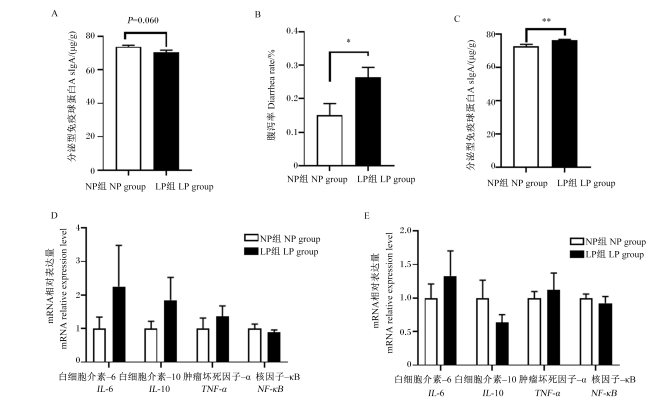
图1所示,与NP组相比,LP组仔猪21日龄断奶时空肠sIgA含量有降低趋势(P=0.060),断奶后90 d空肠sIgA含量显著提高(P<0.05)。同时,与NP组相比,LP组仔猪保育期腹泻率显著提高(P<0.05)。此外,无论是断奶时还是断奶后90 d,子代空肠炎症因子mRNA相对表达量在2组间均无显著差异(P>0.05)。
图1 母猪妊娠期饲喂低蛋白质饲粮对子代空肠免疫指标的影响

A:仔猪21日龄断奶时空肠sIgA含量 sIgA content in jejunum of piglets at weaning on 21 days of age (n=6);B:仔猪保育期腹泻率 diarrhea rate of piglets during nursery period (n=24);C:仔猪断奶后90 d空肠sIgA含量 sIgA content in jejunum of piglets on day 90 after weaning (n=8);D:仔猪21日龄断奶时空肠炎症因子mRNA相对表达量 mRNA relative expression levels of inflammatory factors in jejunum of piglets at weaning on 21 days of age (n=6);E:仔猪断奶后90 d空肠炎症因子mRNA相对表达量 mRNA relative expression levels of inflammatory factors in jejunum of piglets on day 90 after weaning (n=8)。

*表示P<0.05,**表示P<0.01。下图同。* mean P<0.05, and ** mean P<0.01. The same as below.

Fig.1 Effects of feeding low protein diet to sows during gestation on jejunal immune indices of their offspring

2.4 母猪妊娠期饲喂低蛋白质饲粮对子代粪便SCFA含量的影响

表7可知,与NP组相比,LP组子代保育期(30日龄)粪便各SCFA含量无显著差异(P>0.05);但生长期(90日龄)粪便戊酸含量显著降低(P<0.05),且粪便异丁酸含量有降低趋势(P=0.079);同时,生长期粪便乙酸、丙酸、丁酸和异戊酸含量在2组间无显著差异(P>0.05)。
表7 母猪妊娠期饲喂低蛋白质饲粮对子代粪便SCFA含量的影响

Table 7 Effects of feeding low protein diet to sows during gestation on fecal SCFA contents of their offspring (n=7)

项目 Items NP组 NP group LP组 LP group PP-value
30日龄 30 days of age
乙酸 Acetic acid 3.66±0.22 3.80±0.25 0.663
丙酸 Propionic acid 1.85±0.16 1.96±0.19 0.687
异丁酸 Isobutyric acid 0.26±0.02 0.31±0.02 0.144
丁酸 Butyric acid 1.19±0.13 1.30±0.14 0.570
异戊酸 Isovaleric acid 0.51±0.04 0.55±0.05 0.495
戊酸 Valeric acid 0.80±0.10 0.76±0.11 0.770
90日龄 90 days of age
乙酸 Acetic acid 3.67±0.24 3.29±0.19 0.238
丙酸 Propionic acid 1.90±0.12 1.55±0.17 0.126
异丁酸 Isobutyric acid 0.31±0.01 0.25±0.03 0.079
丁酸 Butyric acid 1.15±0.09 0.99±0.12 0.308
异戊酸 Isovaleric acid 0.54±0.04 0.46±0.06 0.298
戊酸 Valeric acid 0.76±0.07 0.51±0.06 0.020

2.5 母猪妊娠期饲喂低蛋白质饲粮对子代免疫器官炎症因子表达的影响

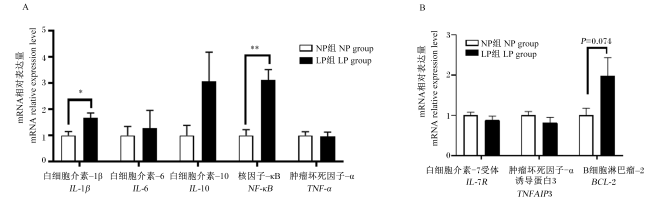
图2所示,与NP组相比,LP组子代生长期胸腺白细胞介素-1β(IL-1β)和核因子-κB(NF-κB)mRNA相对表达量显著提高(P<0.05),胸腺B细胞淋巴瘤-2(BCL-2)mRNA相对表达量有升高趋势(P=0.074),而胸腺白细胞介素-6(IL-6)和白细胞介素-10(IL-10)等炎症因子mRNA相对表达量无显著差异(P>0.05)。
图2 母猪妊娠期饲喂低蛋白质饲粮对子代胸腺炎症因子和T细胞分化相关基因表达的影响

A:胸腺炎症因子mRNA相对表达量 mRNA relative expression levels of thymic inflammatory factors;B:胸腺中T细胞标记基因表达 expression of T-cell marker genes in thymus。

Fig.2 Effects of feeding low protein diet to sows during gestation on expression of inflammatory factors and genes related to T cell differentiation of their offspring (n=8)

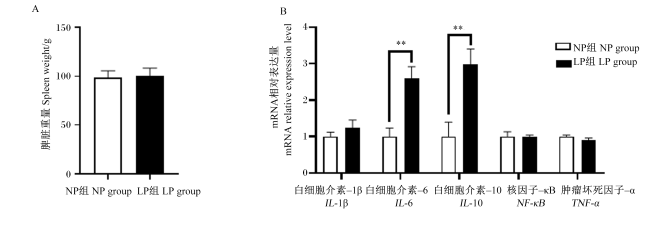
图3所示,与NP组相比,LP组子代生长期脾脏重量无显著差异(P>0.05),但脾脏IL-6和IL-10 mRNA相对表达量显著提高(P<0.05),而脾脏IL-1βNF-κB等炎症因子mRNA相对表达量无显著差异(P>0.05)。
图3 母猪妊娠期饲喂低蛋白质饲粮对子代脾脏重量和炎症因子表达的影响

Fig.3 Effects of feeding low protein diet to sows during gestation on spleen weight and expression of inflammatory factors of their offspring (n=8)

2.6 母猪妊娠期饲喂低蛋白质饲粮对子代免疫器官抗氧化指标的影响

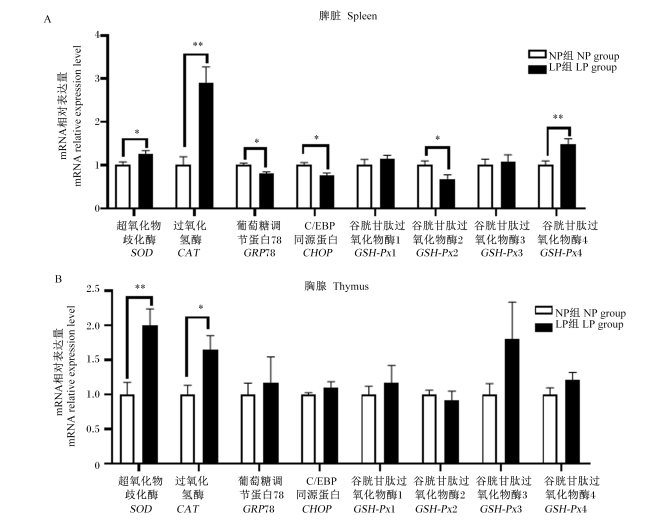
图4所示,与NP组相比,LP组子代生长期脾脏和胸腺SODCAT mRNA相对表达量显著提高(P<0.05);LP组脾脏GSH-Px4 mRNA相对表达量显著提高(P<0.05),脾脏内质网应激标志基因葡萄糖调节蛋白78(GRP78)和C/EBP同源蛋白(CHOP)mRNA相对表达量显著降低(P<0.05),脾脏GSH-Px2 mRNA相对表达量显著降低(P<0.05);LP组胸腺GRP78、CHOPGSH-Px1、GSH-Px2、GSH-Px3和GSH-Px4 mRNA相对表达量无显著差异(P>0.05)。
图4 母猪妊娠期饲喂低蛋白质饲粮对子代脾脏和胸腺抗氧化和内质网应激相关基因表达的影响

Fig.4 Effects of feeding low protein diet to sows during gestation on expression of genes related to antioxidant and endoplasmic reticulum stress in spleen and thymus of their offspring (n=8)

表8可知,与NP组相比,LP组子代生长期脾脏MDA含量显著降低(P<0.05),脾脏和胸腺SOD和CAT活性显著提高(P<0.05),脾脏和胸腺GSH-Px活性无显著差异(P>0.05)。
表8 母猪妊娠期饲喂低蛋白质饲粮对子代胸腺和脾脏抗氧化指标的影响

Table 8 Effects of feeding low protein diet to sows during gestation on antioxidant indices in spleen and thymus of their offspring (n=6)

项目 Items NP组 NP group LP组 LP group PP-value
胸腺 Thymus
丙二醛 MDA/(nmol/mg prot) 2.26±0.53 1.73±0.27 0.388
超氧化物歧化酶 SOD/(U/mg prot) 16.58±0.79 18.45±0.42 0.045
过氧化氢酶 CAT/(U/mg prot) 45.56±5.34 61.68±3.87 0.034
谷胱甘肽过氧化物酶 GSH-Px/(U/mg prot) 123.91±6.99 102.17±9.00 0.130
脾脏 Spleen
丙二醛 MDA/(nmol/mg prot) 4.98±0.26 3.88±0.15 0.016
超氧化物歧化酶 SOD/(U/mg prot) 8.41±0.26 9.80±0.39 0.014
过氧化氢酶 CAT/(U/mg prot) 40.51±0.61 43.95±1.35 0.042
谷胱甘肽过氧化物酶 GSH-Px/(U/mg prot) 88.61±3.47 88.85±3.65 0.971

3 讨论

低蛋白质饲粮作为一种功能性饲粮策略,具有降低饲料成本、减少氮排放等优点,但在生猪生产实践中仍存在诸多争议。仔猪在胎儿期和哺乳期的营养主要来自母体,妊娠期母体营养的供给对胎儿的生长发育及免疫系统的建立极为重要[18-19]。在母猪妊娠期降低饲粮蛋白质水平并补充必需氨基酸,能够兼顾母猪和胎儿的营养需要,同时通过科学的饲养管理,以促进子代的健康生长[20-22],从而为后续的生长育肥提供优势的基础。

3.1 母猪妊娠期饲喂低蛋白质饲粮对子代生长性能的影响

母体妊娠期的蛋白质营养水平对子代的生长性能极为重要[23]。生长性能是综合评价仔猪生长和健康的关键指标,本研究中,与饲喂正常蛋白质饲粮相比,母猪妊娠期饲喂低蛋白质(11.30% vs 13.65%粗蛋白质)饲粮对子代保育期和生长期末重、平均日采食量、平均日增重和料重比均无显著影响。Sciascia等[24]研究表明,母猪饲粮蛋白质水平(6.5% vs 12.1% vs 30.0%粗蛋白质)对子代断奶后体重无显著影响,与本研究结果相似。同时,Eskildsen等[25]研究表明,妊娠母猪饲粮粗蛋白质含量降低12%,同时提升15%的供能对子代生长性能无显著影响。因此,母猪妊娠期适当降低饲粮蛋白质水平(11.30% vs 13.65%粗蛋白质)不会影响子代的生长性能。

3.2 母猪妊娠期饲喂低蛋白质饲粮对子代血清免疫指标的影响

动物免疫系统中的炎症因子和免疫球蛋白对于机体免疫极为重要,其中IgG和IgM是B细胞在不同阶段分化产生的体液免疫的关键分子,其在血清中的含量可反映动物抗病力的强弱[26]。本研究中,与NP组相比,LP组子代血清TP、ALB、IgG和IgM含量在保育期和生长期均无显著差异。Eskildsen等[25]研究表明,母体妊娠期饲粮粗蛋白质含量降低至81 g/kg,后代血清TP含量与对照组相比无显著差异,这与本试验结果一致。此外,在Tuchscherer等[27]的研究中,母猪妊娠期饲粮不同蛋白质水平(6.5% vs 12.1% vs 30.0%粗蛋白质)对子代保育期和生长期血清IgG和IgM含量无显著影响。然而,在Atinmo等[28]的研究中,妊娠母猪饲喂低蛋白质(5%粗蛋白质)饲粮导致其胎儿血清TP和ALB含量降低。这与本研究结果不一致,可能原因是该研究饲粮蛋白质过度缺乏。因此,母猪妊娠期适当降低饲粮蛋白质水平(不低于6.5%粗蛋白质)可能对子代血清免疫球蛋白和TP含量不产生影响。

3.3 母猪妊娠期饲喂低蛋白质饲粮对子代肠道健康的影响

母猪妊娠期的营养水平对子代的生长发育和肠道免疫功能具有重要影响。本研究中,与NP组相比,LP组子代空肠sIgA含量在断奶时有降低趋势,且在生长期显著提高;但LP组子代在保育期腹泻率显著高于NP组;而子代空肠炎症因子mRNA相对表达量在2组间无显著差异。在Sciascia等[24]的研究中,当母猪妊娠期饲粮粗蛋白质含量降低至6.5%时,仔猪表现出较高的腹泻率,这与本研究结果相似。此外,Cao等[29]研究表明,母体营养水平降低会损害胎儿肠道发育,但在新生儿期生长中可以得到部分补偿。这可能是LP组子代在后期生长过程中空肠sIgA含量出现显著升高的原因。在生长期中,与NP组相比,LP组子代粪便戊酸含量显著降低,粪便异丁酸也有降低趋势。在Chen等[30]的研究中,母猪妊娠期饲粮粗蛋白质含量降低至7.3%时,其子代仔猪肠道中SCFA含量出现降低趋势,这与本研究结果相似。因此,母猪妊娠期适当降低饲粮蛋白质水平会改变子代肠道适应和分泌能力。

3.4 母猪妊娠期饲喂低蛋白质饲粮对子代免疫器官功能的影响

在动物机体免疫系统中,胸腺和脾脏作为核心组成部分,主要负责T细胞、B细胞的产生和成熟[31]。随着年龄增长,先天性和适应性免疫系统均会发生演变,其特征为慢性炎症状态与免疫衰老,共同影响机体健康[32]。胸腺作为中枢免疫器官,通过分化、发育和成熟T细胞来维持正常免疫功能,但会随着年龄的增长逐渐缩小,其功能也会逐渐退化,出现免疫衰老的趋势[33]。本试验中,与NP组相比,LP组子代胸腺中部分炎症因子mRNA相对表达量发生显著改变,其中IL-1βNF-κB显著上调,同时抗凋亡基因BCL2也呈上调趋势。在脾脏中,与NP组相比,LP组子代脾脏重量无显著差异,但脾脏IL-6和IL-10 mRNA相对表达量显著提高。Tuchscherer等[27]研究表明,母猪妊娠期饲喂低蛋白质饲粮(6.5%粗蛋白质)会使子代47日龄血浆IL-6和IL-10含量显著提高,虽然未直接测定胸腺或脾脏组织,但外周炎症因子含量升高与胸腺-脾脏轴活化一致。Zheng等[34]研究表明,大鼠妊娠期饲喂低蛋白质饲粮(9.6% vs 23.5%粗蛋白质)使得子代断奶后血清和肝脏中IL-6等促炎因子表达显著上调。同样,Altinpinar等[35]研究表明,母鼠妊娠期饲喂低蛋白质饲粮(8% vs 20%粗蛋白质),21日龄后代肌肉中免疫反应相关基因表达上调,同时富集了适应性免疫途径,这与本研究结果相似。在Calder等[36]的研究中,大鼠妊娠期饲喂低蛋白质饲粮(9% vs 18%粗蛋白质)后,新生儿胸腺T细胞数量与对照组相比显著增加,而脾脏淋巴细胞数量与对照组相比无显著差异。这一结果解释了本研究中LP组子代胸腺中NF-κB mRNA相对表达量的显著提高,可能正是因为胸腺细胞在发育过程中,其T细胞抗原受体(TCR)与自身主要组织相容性复合体(MHC)分子结合,激活了NF-κB信号通路以支持T细胞的存活和阳性选择[37];而脾脏则可能不在此信号通路的调控之下。这也就意味着母体妊娠期饲粮低蛋白质水平可能会使子代胸腺和脾脏中的免疫机制反应更加迅捷[38],有助于机体迅速启动炎症反应来招募T细胞、B细胞,进而去清除病原体并恢复免疫稳态[39]。因此,母猪妊娠期适当降低饲粮蛋白质水平或能有助于子代的免疫潜力提升。

3.5 母猪妊娠期饲喂低蛋白质饲粮对子代免疫器官抗氧化能力指标的影响

动物饲养过程中易受饮食、高温、惊吓和环境等条件刺激,导致机体出现急性或长期慢性应激[40-42]。本研究中,与NP组相比,LP组子代脾脏和胸腺SODCAT mRNA相对表达量和组织酶活性在生长期一致显著提高;MDA含量在脾脏中显著降低,在胸腺中无显著差异;GSH-Px活性在脾脏和胸腺中均无显著差异。Li等[43]研究表明,母猪妊娠期饲喂低蛋白质饲粮(粗蛋白质含量为12.13%),子代免疫器官SODCAT mRNA相对表达量和酶活性显著提高,MDA含量显著降低,这与本试验结果相似。Theys等[44]研究表明,母鼠妊娠期饲喂低蛋白质饲粮(8% vs 20%粗蛋白质),子代胰腺和免疫器官SOD活性显著提高,进一步支持了本试验结果。此外,He等[45]研究表明,母羊妊娠期饲喂低蛋白质饲粮(7.5% vs 12.5%粗蛋白质)会降低新生儿器官抗氧化能力,但营养恢复6周后,胸腺和脾脏SOD活性高于对照组,长期趋势与本研究结果有相似之处,但其短期效应的差异可能源于反刍动物与单胃动物在代谢上的根本不同。鉴于抗氧化酶是机体应对氧化应激、实现自我调节和稳态恢复的关键物质[46]。因此,母猪妊娠期适当降低饲粮蛋白质水平可以诱导子代免疫器官代偿性抗氧化能力的增强。

4 结论

母猪妊娠期适当降低饲粮蛋白质水平(11.30% vs 13.65%粗蛋白质)对子代生长性能无显著影响,但可提高子代生长期空肠sIgA含量,增强胸腺和脾脏抗氧化能力和免疫功能。
[1]
NA X X, MACKEAN P P, CAPE G A, et al. Maternal nutrition during pregnancy and offspring brain development:insights from neuroimaging[J]. Nutrients, 2024, 16(19):3337.

DOI

[2]
SHANG Q H, LIU S J, LIU H S, et al. Maternal supplementation with a combination of wheat bran and sugar beet pulp during late gestation and lactation improves growth and intestinal functions in piglets[J]. Food & Function, 2021, 12(16):7329-7342.

[3]
CHENG R Y, ZHANG Y J, YANG Y, et al. Maternal gestational Bifidobacterium bifidum TMC3115 treatment shapes construction of offspring gut microbiota and development of immune system and induces immune tolerance to food allergen[J]. Frontiers in Cellular and Infection Microbiology, 2022, 12:1045109.

DOI

[4]
DING D J, MOU D L, ZHAO L P, et al. Maternal organic selenium supplementation alleviates LPS induced inflammation,autophagy and ER stress in the thymus and spleen of offspring piglets by improving the expression of selenoproteins[J]. Food & Function, 2021, 12(22):11214-11228.

[5]
MA L, MA W Q, VELTHOF G L, et al. Modeling nutrient flows in the food chain of China[J]. Journal of Environment Quality, 2010, 39(4):1279-1289.

DOI

[6]
BAI Z H, MA L, QIN W, et al. Changes in pig production in China and their effects on nitrogen and phosphorus use and losses[J]. Environmental Science & Technology, 2014, 48(21):12742-12749.

DOI

[7]
尹杰, 刘红南, 李铁军, 等. 我国蛋白质饲料资源短缺现状与解决方案[J]. 中国科学院院刊, 2019, 34(1):89-93.

YIN J, LIU H N, LI T J, et al. Current situation and developmental suggestions on shortage of feeding protein resources in Chinese pig industry[J]. Bulletin of the Chinese Academy of Sciences, 2019, 34(1):89-93. (in Chinese)

[8]
宋维平, 沈红霞, 赵莉莉, 等. 大北农蛋白饲料生物制造创新联合体:推动解决大豆进口依赖[J]. 中国农村科技, 2023(7):34-37.

SONG W P, SHEN H X, ZHAO L L, et al. Da Bei Nong protein feed bio manufacturing innovation alliance:promoting the solution to soybean import dependence[J]. China Rural Science & Technology, 2023(7):34-37. (in Chinese)

[9]
陈青云, 涂佳钰, 曾祥芳, 等. 低蛋白质饲粮中非常规饲料原料不同程度替代玉米和豆粕对生长猪生长性能、氮利用率和营养物质吸收转运的影响[J]. 动物营养学报, 2025, 37(3):1614-1631.

DOI

CHEN Q Y, TU J Y, ZENG X F, et al. Effects of different substitution levels of unconventional feed materials for corn and soybean meal in low-protein diet on growth performance,nitrogen utilization and nutrient absorption and transport of growing pigs[J]. Chinese Journal of Animal Nutrition, 2025, 37(3):1614-1631. (in Chinese)

[10]
韩萌萌, 龚渝, 廉潇, 等. 泌乳母猪低蛋白质饲粮必需氨基酸限制性顺序研究[J]. 动物营养学报, 2025, 37(3):1597-1613.

DOI

HAN M M, GONG Y, LIAN X, et al. Study on restrictive order of essential amino acids in low-protein diet for lactating sows[J]. Chinese Journal of Animal Nutrition, 2025, 37(3):1597-1613. (in Chinese)

DOI

[11]
张歌, 张泽宇, 赵金标, 等. 饲粮粗蛋白质水平和热灭活乳酸菌对断奶仔猪生长性能、营养物质表观全肠道消化率、抗氧化能力、免疫功能和粪便微生物组成的影响[J]. 动物营养学报, 2025, 37(3):1585-1596.

DOI

ZHANG G, ZHANG Z Y, ZHAO J B, et al. Effects of dietary crude protein level and heat-inactivated lactic acid bacteria on growth performance,nutrient apparent total tract digestibility,antioxidant ability,immune function and fecal microbial composition of weaned piglets[J]. Chinese Journal of Animal Nutrition, 2025, 37(3):1585-1596. (in Chinese)

DOI

[12]
远德龙, 宋春阳. 低蛋白氨基酸平衡日粮在养猪生产中的应用[J]. 猪业科学, 2014, 31(7):88-90.

YUAN D L, SONG C Y. Application of low-protein amino acid balanced diets in pig production[J]. Swine Industry Science, 2014, 31(7):88-90. (in Chinese)

[13]
MILLET S, ALUWÉ M, DE BOEVER J, et al. The effect of crude protein reduction on performance and nitrogen metabolism in piglets (four to nine weeks of age) fed two dietary lysine levels[J]. Journal of Animal Science, 2018, 96(9):3824-3836.

DOI

[14]
HEO J M, KIM J C, HANSEN C F, et al. Effects of feeding low protein diets to piglets on plasma urea nitrogen,faecal ammonia nitrogen,the incidence of diarrhoea and performance after weaning[J]. Archives of Animal Nutrition, 2008, 62(5):343-358.

DOI

[15]
CARRILLO E, JIMENEZ M A, SANCHEZ C, et al. Protein malnutrition impairs the immune response and influences the severity of infection in a hamster model of chronic visceral leishmaniasis[J]. PLoS One, 2014, 9(2):e89412.

DOI

[16]
LAWAL A S, OGUNRIBIDO T Z, FU Y C, et al. Responses in weanling pigs fed low protein diets supplemented with dietary nucleotides[J]. Translational Animal Science, 2024,8:txae142.

[17]
National Research Council,Division on Earth,Committee on Nutrient Requirements of Swine Nutrient requirements of swine[S].11th Rev. ed. Washington,D.C.: The National Academies Press, 2012.

[18]
LI Q H, YANG S W, ZHANG X L, et al. Maternal nutrition during late gestation and lactation:association with immunity and the inflammatory response in the offspring[J]. Frontiers in Immunology, 2021, 12:758525.

DOI

[19]
ŚWIATKIEWICZ M, HANCZAKOWSKA E, OKOÑ K, et al. Effect of maternal diet and medium chain fatty acids supplementation for piglets on their digestive tract development,structure,and chyme acidity as well as performance and health status[J]. Animals, 2020, 10(5):834.

DOI

[20]
LE BOURGOT C, FERRET-BERNARD S, LE NORMAND L, et al. Maternal short-chain fructooligosaccharide supplementation influences intestinal immune system maturation in piglets[J]. PLoS One, 2014, 9(9):e107508.

DOI

[21]
BINTER C, KHOL-PARISINI A, GERNER W, et al. Effect of maternally supplied n-3 and n-6 oils on the fatty acid composition and mononuclear immune cell distribution of lymphatic tissue from the gastrointestinal tract of suckling piglets[J]. Archives of Animal Nutrition, 2011, 65(5):341-353.

PMID

[22]
GU F, HOU L, GAO K G, et al. Effects of dietary net energy concentration on reproductive performance,immune function,milk composition,and gut microbiota in primiparous lactating sows[J]. Animals, 2024, 14(20):3044.

DOI

[23]
SWITKOWSKI K M, JACQUES P F, MUST A, et al. Maternal protein intake during pregnancy and linear growth in the offspring[J]. The American Journal of Clinical Nutrition, 2016, 104(4):1128-1136.

DOI

[24]
SCIASCIA Q L, PREHN C, ADAMSKI J, et al. The effect of dietary protein imbalance during pregnancy on the growth,metabolism and circulatory metabolome of neonatal and weaned juvenile porcine offspring[J]. Nutrients, 2021, 13(9):3286.

DOI

[25]
ESKILDSEN M, KROGH U, SØRENSEN M T, et al. Effect of reduced dietary protein level on energy metabolism,sow body composition and metabolites in plasma,milk and urine from gestating and lactating organic sows during temperate winter conditions[J]. Livestock Science, 2020, 240:104088.

DOI

[26]
SALMON H, BERRI M, GERDTS V, et al. Humoral and cellular factors of maternal immunity in swine[J]. Developmental & Comparative Immunology, 2009, 33(3):384-393.

[27]
TUCHSCHERER M, OTTEN W, KANITZ E, et al. Effects of inadequate maternal dietary protein:carbohydrate ratios during pregnancy on offspring immunity in pigs[J]. BMC Veterinary Research, 2012, 8(1):232.

DOI

[28]
ATINMO T, BALDIJAO C, POND W G, et al. Prenatal and postnatal protein malnutrition in pigs:effects on growth rate,serum protein and albumin[J]. Journal of Animal Science, 1976, 43(3):606-612.

DOI

[29]
CAO M, CHE L Q, WANG J, et al. Effects of maternal over- and undernutrition on intestinal morphology,enzyme activity,and gene expression of nutrient transporters in newborn and weaned pigs[J]. Nutrition, 2014, 30(11/12):1442-1447.

DOI

[30]
CHEN Y L, MOU D L, HU L, et al. Effects of maternal low-energy diet during gestation on intestinal morphology,disaccharidase activity,and immune response to lipopolysaccharide challenge in pig offspring[J]. Nutrients, 2017, 9(10):1115.

DOI

[31]
ROMAGNANI S. Regulation of the T cell response[J]. Clinical & Experimental Allergy, 2006, 36(11):1357-1366.

[32]
QUIROS-ROLDAN E, SOTTINI A, NATALI P G, et al. The impact of immune system aging on infectious diseases[J]. Microorganisms, 2024, 12(4):775.

DOI

[33]
GULLA S, REDDY M C, REDDY V C, et al. Role of thymus in health and disease[J]. International Reviews of Immunology, 2023, 42(5):347-363.

DOI

[34]
ZHENG J, XIAO X H, ZHANG Q, et al. Maternal low-protein diet modulates glucose metabolism and hepatic microRNAs expression in the early life of offspring[J]. Nutrients, 2017, 9(3):205.

DOI

[35]
ALTINPINAR A E, ALAMEDDINE M, ERSOY U, et al. Gestational low-protein diet impairs mitochondrial function and skeletal muscle development by inducing immune responses in male offspring[J]. Redox Biology, 2025, 87:103890.

DOI

[36]
CALDER P C, YAQOOB P. The level of protein and type of fat in the diet of pregnant rats both affect lymphocyte function in the offspring[J]. Nutrition Research, 2000, 20(7):995-1005.

DOI

[37]
HÖVELMEYER N, SCHMIDT-SUPPRIAN M, OHNMACHT C. NF-κB in control of regulatory T cell development,identity,and function[J]. Journal of Molecular Medicine, 2022, 100(7):985-995.

DOI

[38]
NELSON B N, FRIEDMAN J E. Developmental programming of the fetal immune system by maternal western-style diet:mechanisms and implications for disease pathways in the offspring[J]. International Journal of Molecular Sciences, 2024, 25(11):5951.

DOI

[39]
WEISBERG S P, URAL B B, FARBER D L. Tissue-specific immunity for a changing world[J]. Cell, 2021, 184(6):1517-1529.

DOI PMID

[40]
LYKKESFELDT J, SVENDSEN O. Oxidants and antioxidants in disease:oxidative stress in farm animals[J]. The Veterinary Journal, 2007, 173(3):502-511.

DOI

[41]
AKBARIAN A, MICHIELS J, DEGROOTE J, et al. Association between heat stress and oxidative stress in poultry;mitochondrial dysfunction and dietary interventions with phytochemicals[J]. Journal of Animal Science and Biotechnology, 2016, 7(1):37.

DOI

[42]
HE Y, SANG Z, ZHUO Y, et al. Transport stress induces pig jejunum tissue oxidative damage and results in autophagy/mitophagy activation[J]. Journal of Animal Physiology and Animal Nutrition, 2019, 103(5):1521-1529.

DOI PMID

[43]
LI Y, LIU H Y, ZHANG L J, et al. Maternal dietary fiber composition during gestation induces changes in offspring antioxidative capacity,inflammatory response,and gut microbiota in a sow model[J]. International Journal of Molecular Sciences, 2019, 21(1):31.

DOI

[44]
THEYS N, CLIPPE A, BOUCKENOOGHE T, et al. Early low protein diet aggravates unbalance between antioxidant enzymes leading to islet dysfunction[J]. PLoS One, 2009, 4(7):e6110.

DOI

[45]
HE Z X, SUN Z H, TAN Z L, et al. Effects of maternal protein or energy restriction during late gestation on antioxidant status of plasma and immune tissues in postnatal goats[J]. Journal of Animal Science, 2012, 90(12):4319-4326.

DOI PMID

[46]
HAWKRIDGE J M, PIPE R K, BROWN B E. Localisation of antioxidant enzymes in the cnidarians Anemonia viridis and Goniopora stokesi[J]. Marine Biology, 2000, 137(1):1-9.

DOI

Outlines

/