RESEARCH PAPER

Effects of Clostridium Butyricum on Semen Quality and Fecal Microbial Composition of Duroc Boars

  • GE Zihao , 1 ,
  • DU Zhaohui 1 ,
  • YOU Junyi 1 ,
  • LIANG Guodong 2 ,
  • MA Yunhui 2 ,
  • HU Jianhong , 1, * ,
  • LI Xiao , 1, *
Expand
  • 1 College of Animal Sciences and Technologies, Northwest A&F University, Yangling 712100, China
  • 2 Dali Zhongkang livestock breeding Co., Ltd., Dali 715100, China
*HU Jianhong, professor, E-mail: ;
LI Xiao, associate professor, E-mail:

Received date: 2025-08-14

  Online published: 2026-03-16

Abstract

This experiment was conducted to investigate the effects of dietary supplementation with Clostridium butyricum on semen quality and fecal microbial composition of Duroc boars. Twenty adult Duroc boars with similar body weights [(133.53±5.00) kg] and good body condition were randomly divided into 4 groups with 5 boars per group, and reared individually in stalls. The control group was fed a basal diet, while the experimental groups were fed the basal diets supplemented with 50, 100 and 200 mg/kg of Clostridium butyricum (freeze-dried powder, viable count≥1.0×10⁹ CFU/g), respectively. The pre-experiment period lasted for 7 days, and the formal experiment period lasted for 60 days. The results showed as follows: 1) compared with the control group, dietary supplementation with 200 mg/kg Clostridium butyricum significantly increased the ejaculatory duration time, sperm motility, sperm linear motion ability, and Grade A+B sperm proportion of Duroc boars by 63%, 14%, 29% and 33%, respectively (P<0.05), and significantly decreased the ejaculatory response time by 57% (P<0.05); the sperm plasma membrane integrity rate was significantly increased by 12% (P<0.05), and the sperm mitochondrial membrane potential was significantly increased by 9% (P<0.05); the activities of glutathione peroxidase (GSH-Px), superoxide dismutase (SOD) and lactate dehydrogenase (LDH) in seminal plasma were significantly increased by 33%, 20% and 56%, respectively (P<0.05), and the contents of fructose and adenosine triphosphate (ATP) were significantly increased by 6% and 46%, respectively (P<0.05). 2) Fecal microbial analysis results showed that compared with the control group, dietary supplementation with 200 mg/kg Clostridium butyricum significantly increased the relative abundances of Spirochaetota, Oscillospiraceae, Lachnospiraceae and UCG-002 in feces (P<0.05), and significantly decreased the relative abundances of Desulfobacterota, Streptococcaceae, Peptostreptococcaceae, and Clostridium_sensu_stricto_1 in feces (P<0.05). 3) Metabolomics results showed that compared with the control group, dietary supplementation with 200 mg/kg Clostridium butyricum significantly increased the contents of isocitric acid and β-D-fucose in seminal plasma (P<0.05), and significantly increased the content of tartaric acid (P<0.05) and significantly decreased the content of hyocholic acid (P<0.05) in feces. In conclusion, dietary supplementation with 200 mg/kg Clostridium butyricum can alter the intestinal flora structure and regulate seminal plasma metabolites of Duroc boars, thereby improving their semen quality.

Cite this article

GE Zihao , DU Zhaohui , YOU Junyi , LIANG Guodong , MA Yunhui , HU Jianhong , LI Xiao . Effects of Clostridium Butyricum on Semen Quality and Fecal Microbial Composition of Duroc Boars[J]. Chinese Journal of Animal Nutrition, 2026 , 38(3) : 1805 -1821 . DOI: 10.12418/CJAN2026.146

精液品质是影响公猪与母猪繁殖性能的关键因素,优质精液可显著提升母猪受胎率及产仔数,进而提高整体繁殖效率[1]。保障公猪精液品质优良,是提升猪群繁殖效率和遗传进展的关键环节[2-3]。因此,提升公猪精液品质具有重要意义。研究证实,高脂饮食诱导的肠道菌群失调会引发内毒素血症和附睾炎症,进而干扰睾丸基因表达,导致精子发生障碍和活力下降[4]。与之相反,口服乳酸杆菌和双歧杆菌能够提高人类弱精症患者的精子活力,减少精子的DNA损伤[5]。同样,在小鼠[6]和肉鸡[7]模型中,饲粮中添加益生菌可显著提升精子活力及精液品质,这为通过调节肠道菌群来改善公猪精液品质提供了一种新的策略。
丁酸梭菌(Clostridium butyricum)是一种广泛存在于健康动物、人类肠道及自然环境中的益生菌[8],具有耐热、耐胃酸、耐胆盐的抗逆性[9]。该菌可代谢产生丁酸、丙酸、丁醇、乙醇、丁二醇等多种短链脂肪酸和醇类物质[10],在维持肠道微生态平衡、促进动物生长及增强机体免疫力方面具有显著功效[11]。因此,丁酸梭菌作为饲料添加剂已在生产实践中得到广泛应用[12]。已有研究表明,丁酸梭菌可提高肉鸡生长性能、增强免疫力并改善肠道健康[13];丁酸梭菌能够促进断奶仔猪生长、修复肠道屏障损伤并缓解腹泻症状[14]。此外,丁酸作为其主要代谢产物,有助于维持结肠健康并减少炎症反应[8]。本课题组前期研究发现,给小鼠灌胃丁酸梭菌可显著提高其血清中睾酮含量,增强睾丸组织抗氧化能力,改善精液品质,进而修复肥胖导致的小鼠生殖能力损伤[15]。然而,丁酸梭菌对公猪精液品质的影响尚不明确。因此,本试验旨在探究饲粮中添加丁酸梭菌对杜洛克公猪精液品质及粪便微生物组成的影响,以明确丁酸梭菌对公猪生殖能力的改善效果并寻求适宜的添加剂量,以期为丁酸梭菌在畜牧领域中新的应用前景提供试验基础,以及为改善公猪精液品质提供理论依据。

1 材料与方法

1.1 试验设计与饲粮

本试验于陕西大荔众康家畜良种繁育有限公司开展,试验方案及动物使用方案均经西北农林科技大学实验动物管理及伦理委员会审批批准(批准号:NWAFU-DK2024052)。
选择20头体重[(133.53±5.00) kg]相近、体况良好的成年杜洛克种公猪,随机分为4组,每组5头。对照组饲喂基础饲粮,试验组在基础饲粮中分别添加50、100和200 mg/kg丁酸梭菌(冻干粉,有效活菌数≥1.0×109 CFU/g)。所有公猪均在室温20 ℃的环境下单栏饲养,每天08:00和16:00各饲喂1次,日总采食量为2.5 kg。结合公猪精子发生周期与精子运输时间的生理特点,试验设置7 d适应期,正试期为60 d。
基础饲粮组成及营养水平见表1。饲粮中粗蛋白质(GB/T 6432—2018)、粗脂肪(GB/T 6433—2006)、粗灰分(GB/T 6438—2007)、粗纤维(GB/T 6434—2022)、钙(GB/T 6436—2018)、总磷(GB/T 6437—2018)、水分(GB/T 6435—2014)和氨基酸(GB/T 18246—2019)含量参照相应的国标方法进行测定,总能采用氧弹测热法(GB/T 45104—2024)进行测定,有效磷含量参照《中国饲料成分及营养价值表(2024年第35版)》进行计算。
表1 基础饲粮组成及营养水平(饲喂基础)

Table 1 Composition and nutrient levels of the basal diet (as-fed basis)

项目 Items 含量 Content
原料 Ingredients
玉米 Corn 60.00
豆粕 Soybean meal 17.37
麸皮 Bran 12.00
草粉 Grass meal 2.00
氯化钠 NaCl 0.59
预混料 Premix1) 8.04
合计 Total 100.00
营养水平 Nutrient levels2)
总能 GE/(MJ/kg) 15.24
粗蛋白质 CP 16.93
粗脂肪 EE 3.00
粗灰分 Ash 5.29
粗纤维 CF 3.77
钙 Ca 0.69
总磷 TP 0.60
有效磷 AP 0.32
水分 Moisture 10.66
赖氨酸 Lys 0.96
蛋氨酸+半胱氨酸 Met+Cys 0.58
苏氨酸 Thr 0.65
色氨酸 Trp 0.18

1)预混料为每千克饲粮提供 The premix provided the following per kg of the diet:VA 11 900 IU,VB1 2.1 mg,VB2 6.3 mg,VB6 3.5 mg,VB12 0.03 mg,VC 291 mg,VD3 2 100 IU,VE 142.5 IU,VK3 4.6 mg,D-生物素 D-biotin 0.7 mg,D-泛酸 D-pantothenic acid 22.05 mg,烟酰胺 nicotinamide 35.0 mg,氯化胆碱 choline chloride 600 mg,L-肉碱 L-carnitine 92.0 mg,Cu 15.0 mg,Fe 120.0 mg,Zn 75.0 mg,Mn 60.01 mg,L-赖氨酸盐酸盐 L-Lys·HCl 936 mg,苯甲酸 benzoic acid 199.8 mg。

2)有效磷为计算值,其余营养水平为实测值。AP was a calculated value, while the other nutrient levels were measured values.

1.2 样本采集

在正试期第60天,采用手握法收集20头公猪的精液。使用带有3层无菌纱布的一次性精液收集袋收集精液,丢弃含胶状物和透明旁腺液的第1段精液,将富含精子的中段精液收集至预热并灭菌的37 ℃保温杯中,送至实验室进行常规精液分析。每份精液样本取15 mL,在室温下以1 500×g离心15 min,分离得到精浆,分装后置于-80 ℃冰箱保存待测。
在正试期第60天,采集公猪新鲜粪便样本。采样前,使用无菌纱布依次蘸取生理盐水和75%乙醇清洗肛周及肛门。佩戴无菌橡胶手套,将食指与中指用无菌磷酸盐缓冲液(PBS)润湿后,缓慢插入肛门,收集粪便至无菌50 mL离心管中。随后取少量粪便样本置于2 mL无菌冻存管中,立即投入液氮进行速冻,之后转运至-80 ℃冰箱保存待测。

1.3 指标测定及方法

1.3.1 公猪性欲

依据Kondracki等[16]的研究,选择射精量、射精反应时间及射精持续时间作为公猪性欲的评估指标。采用电子天平称量盛有精液的采精杯总重量,减去空杯重,再除以精液的比重(猪精液比重约等于1),即可得到射精量[17]。射精反应时间是指从公猪进入采精室至其爬跨假台猪后开始射精所用的时间[18]。射精持续时间是指公猪从开始射精到射精结束所用的时间[19]

1.3.2 精子活力和运动性能参数

采用计算机辅助精子分析(CASA)系统(Hamilton公司,美国)自动检测精子活力。精子活力检测前,从每头公猪的精液样本中各取1 mL置于1.5 mL离心管内,放入37 ℃水浴锅中预热10 min。检测时,吸取10 μL精液样品滴于载玻片上,将载玻片放置于显微镜物镜下的恒温载物台上预热30 s,恒温载物台温度设置为37 ℃,随后用CASA系统进行检测计算,每份精液样本至少记录1 000个精子的运动轨迹。精子运动性能参数包括直线速度(straight-line velocity,VSL)、曲线速度(curvilinear velocity,VCL)、平均路径速度(velocity of average path,VAP)、直线性(linearity coefficient,LIN)、摆动性(wobble coefficient,WOB)、向前性(straightness coefficient,STR)、侧摆幅值(amplitude of lateral head displacement,ALH)和鞭打频率(beat cross frequency,BCF)。VCL>10 μm/s的精子占总精子数的百分比被定义为精子活力;VSL>25 μm/s且STR≥75%的精子占总精子数的百分比被定义为精子直线运动能力;可向前移动的精子占总精子数的百分比被定义为A+B级精子比例。

1.3.3 精子顶体完整率

采用精子顶体形态花生凝集素荧光标记(PNA-FITC)染色试剂盒(Genmed公司,美国)测定精子顶体完整率。取30 μL精液样本均匀涂布于载玻片上,用甲醇固定,并在37 ℃下自然干燥10 min。随后,依次滴加30 μL 4',6-二脒基-2-苯基吲哚(DAPI,10 μL/mL)和异硫氰酸荧光素-花生凝集素(FITC-PNA,100 μL/mL)工作液,于37 ℃避光孵育30 min。孵育结束后,用PBS洗涤样本3次,并自然风干。最后,通过Eclipse E600荧光显微镜(Nikon公司,日本)在200倍放大倍数下测定精子顶体完整率。随机选取3个清晰视野,每个视野评估至少200个精子。

1.3.4 精子质膜完整率

采用精子质膜完整性双重荧光(SYBR-14/PI)检测试剂盒(Genmed公司,美国)测定精子质膜完整率。将1 mL稀释后的精液样本与1 μL SYBR-14原液和5 μL 碘化丙啶(PI)溶液混合,共同孵育10 min。随后,取10 μL孵育后的样本于载玻片上,通过Eclipse E600荧光显微镜(Nikon公司,日本)在50倍放大倍数下测定精子质膜完整率。随机选取3个清晰视野,每个视野评估至少200个精子。

1.3.5 精子线粒体膜电位

采用JC-1试剂盒(M8650,北京索莱宝科技有限公司)测定精子线粒体膜电位。将精子细胞重悬于0.5 mL细胞培养基中,加入0.5 mL的JC-1染色工作液,37 ℃孵育20 min。孵育期间,按1 mL JC-1染色缓冲液(5×)加4 mL蒸馏水的比例配制适量的JC-1染色缓冲液(1×)备用。孵育结束后,将样本在4 ℃下以600×g离心3 min,沉淀细胞。用JC-1染色缓冲液(1×)洗涤并重悬细胞后,采用荧光显微镜观察并记录荧光信号。JC-1单体的激发光波长为490 nm,发射光波长为530 nm;JC-1聚合物的激发光波长为525 nm,发射光波长为590 nm。

1.3.6 精浆抗氧化指标

使用武汉赛维尔生物科技有限公司提供的试剂盒测定精浆丙二醛(MDA,货号:G4300)含量,使用南京建成生物生物工程研究所提供的试剂盒测定精浆超氧化物歧化酶(SOD,货号:A001-1-2)、谷胱甘肽过氧化物酶(GSH-Px,货号:A005-1-2)和过氧化氢酶(CAT,货号:A007-1-1)活性。

1.3.7 精浆能量代谢指标

使用南京建成生物工程研究所提供的试剂盒测定精浆果糖(货号:A085-1-1)含量和乳酸脱氢酶(LDH,货号:A020-2-1)活性,使用上海恒远生物科技有限公司提供的试剂盒测定精浆三磷酸腺苷(ATP)含量。

1.3.8 粪便微生物分析

取对照组和200 mg/kg丁酸梭菌组的粪便样品进行微生物测序分析。采用粪便DNA提取试剂盒[天根生化科技(北京)有限公司]提取样本基因组DNA,通过1%琼脂糖凝胶电泳测定所提取DNA的纯度与浓度。利用针对16S rRNA基因V4区域的引物(515F:5'-GTGCCAGCMGCCGCGGTAA-3',806R:5'-GGACTACHVGGGTWTCTAAT-3')进行扩增,所有聚合酶链式反应(PCR)均使用15 μL Phusion® High-Fidelity PCR Master Mix(New England Biolabs公司,美国)体系完成。采用NEB Next® UltraTM Ⅱ FS DNA PCR-free Library Prep Kit文库制备试剂盒(New England Biolabs公司,美国)构建测序文库,构建好的文库经过Qubit定量和实时荧光定量PCR(qPCR)验证合格后,使用NovaSeq 6000平台进行PE250双末端测序。下机数据根据Barcode和引物序列进行样本拆分,截去Barcode和引物序列后使用FLASH(v1.2.7)进行拼接。参照QIIME(v1.9.1)进行质控,得到高质量序列,通过vsearch软件与Silva 138.1数据库比对以去除嵌合体序列,得到1 153 440条有效序列,平均每个样本的有效序列数量为(115 344±15 892)条。随后采用QIIME2(v2022.02)中的DADA2插件对有效序列进行降噪处理,以识别扩增子序列变体(ASVs),并基于Silva 138.1数据库进行物种注释。将所有样本的序列数通过重抽样均一化至74 978条序列,并基于此均一化后的特征表进行后续分析。
使用QIIME2(v2022.02)计算α多样性指数,以评估样本内微生物群落的复杂性。应用线性判别分析效应大小(LEfSe)分析鉴定组间具有显著差异的生物标志物,线性判别分析(LDA)得分的阈值设置为4.0。

1.3.9 液相色谱-质谱联用(LC-MS)测定粪便和精浆代谢物

取对照组和200 mg/kg丁酸梭菌组的粪便及精浆样本进行LC-MS分析。首先,将精浆与粪便样品在冰浴中解冻,以防止代谢物降解。随后,使用Acquity UPLC超高效液相色谱仪(Waters公司,美国)和AB Sciex Triple TOF 5600(LC/MS)串联质谱系统(SCIEX公司,美国)对样品进行分析,具体步骤参照文献[20]所述。

1.4 数据统计分析

通过SPSS 21.0软件对多组数据进行单因素方差分析(one-way ANOVA),并通过Duncan氏法进行多重比较,代谢组相关数据采用独立样本t检验进行分析,结果以平均值±标准误(mean±SE)表示,P<0.05为差异显著。使用GraphPad Prism 8.0软件作图。粪便微生物α多样性指数数据以平均值±标准差(mean±SD)表示,并通过t检验进行分析。使用NovoMagic(https://magic.novogene.com/website)云平台绘制精液品质与粪便微生物的相关性图。

2 结果与分析

2.1 丁酸梭菌对杜洛克公猪性欲和精子品质的影响

表2可知,与对照组相比,100和200 mg/kg丁酸梭菌组公猪的射精反应时间分别显著降低了49%和57%(P<0.05),200 mg/kg丁酸梭菌组公猪的射精持续时间显著提高了63%(P<0.05),各组间射精量无显著差异(P>0.05)。此外,与对照组相比,200 mg/kg丁酸梭菌组精子活力、精子直线运动能力和A+B级精子比例分别显著提高了14%、29%和33%(P<0.05)。由表3可知,各组之间精子运动的VSL、LIN、WOB、ALH均无显著差异(P>0.05)。与对照组相比,200 mg/kg丁酸梭菌组精子运动的VCL、VAP、STR和BCF显著提高(P<0.05)。以上结果表明,饲粮中添加200 mg/kg丁酸梭菌能有效提高杜洛克公猪的精子活力,并改善了精子的运动性能。
表2 丁酸梭菌对杜洛克公猪性欲和精子活力的影响

Table 2 Effects of Clostridium butyricum on libido and sperm motility of Duroc boars (n=5)

项目
Items
丁酸梭菌添加量
Clostridium butyricum supplemental levels/(mg/kg)
P
P-value
0(对照 Control) 50 100 200
射精反应时间
Ejaculatory response time/min
5.55±1.00a 3.92±0.68ab 2.80±0.09b 2.39±0.34b 0.014 1
射精持续时间
Ejaculatory duration time/min
5.64±0.57b 5.76±0.49b 6.33±0.71ab 9.18±1.38a 0.027 3
射精量 Ejaculatory volume/mL 144.20±18.73 133.60±16.99 164.00±38.00 197.80±34.65 0.316 5
精子活力 Sperm motility/% 75.80±1.64b 80.89±1.69b 80.70±1.27b 86.35±1.70a 0.002 5
精子直线运动能力
Sperm linear motion ability/%
35.55±1.66b 37.80±0.79b 37.99±2.43b 45.82±1.31a 0.002 6
A+B级精子比例
Grade A+B sperm proportion/%
46.09±1.51c 52.20±2.17bc 56.22±1.49ab 61.26±1.82a 0.002 0

同行数据肩标无字母或相同小写字母表示差异不显著(P>0.05),不同小写字母表示差异显著(P<0.05)。下表同。

In the same row, values with no letter or the same small letter superscripts mean no significant difference (P>0.05), while with different small letter superscripts mean significant difference (P<0.05). The same as below.

表3 丁酸梭菌对杜洛克公猪精子运动性能参数的影响

Table 3 Effects of Clostridium butyricum on sperm motility parameters of Duroc boars (n=5)

项目
Items
丁酸梭菌添加量
Clostridium butyricum supplemental levels/(mg/kg)
P
P-value
0(对照 Control) 50 100 200
直线速度 VSL/(μm/s) 13.65±0.99 14.72±0.28 17.04±1.75 15.00±0.25 0.139 1
曲线速度 VCL/(μm/s) 41.89±1.07b 41.63±1.20b 40.77±1.98b 52.45±0.97a <0.000 1
平均路径速度 VAP/(μm/s) 17.15±0.97b 18.54±0.66ab 19.48±1.27ab 20.71±0.20a 0.044 9
直线性 LIN/% 19.87±1.67 20.44±0.59 22.02±1.60 21.05±0.44 0.615 8
摆动性 WOB/% 26.64±1.63 26.54±0.67 27.39±1.65 28.81±0.62 0.456 7
向前性 STR/% 39.37±1.83b 38.22±0.67b 38.60±1.38b 48.00±0.97a <0.000 1
鞭打频率 BCF/% 4.88±0.14b 5.09±0.15ab 4.75±0.17b 5.61±0.10a 0.003 1
侧摆幅值 ALH/μm 0.37±0.02 0.37±0.01 0.36±0.02 0.41±0.01 0.203 9
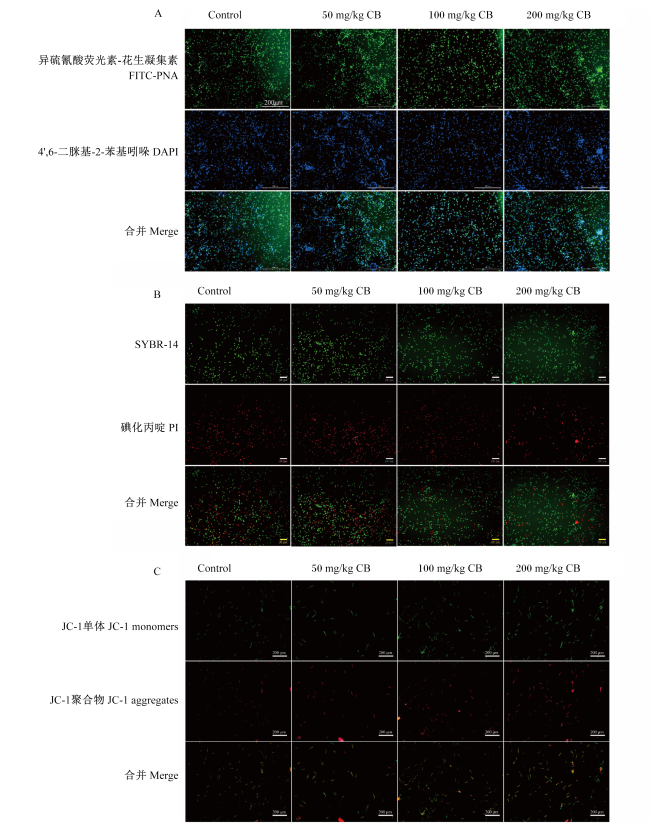
图1表4可知,饲粮中添加丁酸梭菌对精子顶体完整率无显著影响(P>0.05)。与对照组相比,200 mg/kg丁酸梭菌组精子质膜完整率显著提高了12%(P<0.05),50和200 mg/kg丁酸梭菌组精子线粒体膜电位分别显著提高了11%和9%(P<0.05)。
图1 精子顶体完整率、质膜完整率和线粒体膜电位的显微图像分析

A:采用FITC-PNA和DAPI联合染色检测精子顶体完整率;绿色(FITC-PNA):完整顶体,蓝色(DAPI):细胞核。比例尺=200 μ

Control:对照组 control group;50 mg/kg CB:50 mg/kg丁酸梭菌组 50 mg/kg Clostridium butyricum group;100 mg/kg CB:100 mg/kg丁酸梭菌组 100 mg/kg Clostridium butyricum group;200 mg/kg CB:200 mg/kg丁酸梭菌组 200 mg/kg Clostridium butyricum group。下图同 the same as below。

m。B:采用SYBR-14和PI联合染色检测精子质膜完整率;绿色(SYBR-14):活精子,红色(PI):死精子。比例尺=50 μm。C:采用JC-1染色检测精子线粒体膜电位;红色:高膜电位,绿色:低膜电位。比例尺=200 μm。

Fig.1 Microscopic imaging analysis of sperm acrosome integrity rate, plasma membrane integrity rate and mitochondrial membrane potential (n=5)

A: sperm acrosome integrity rate was detected by FITC-PNA and DAPI double staining; green (FITC-PNA): intact acrosome, blue (DAPI): nucleus. Scale bar=200 μm. B: sperm plasma membrane integrity rate was detected by SYBR and PI double staining; green (SYBR-14): live sperm, red (PI): dead sperm. Scale bar=50 μm. C: JC-1 detection of sperm mitochondrial membrane potential; red: high potential, green: low potential. Scale bar=200 μm.

表4 精子顶体完整率、质膜完整率和线粒体膜电位的定量分析

Table 4 Quantitative analysis of sperm acrosome integrity rate, plasma membrane integrity rate and mitochondrial membrane potential (n=5)

项目
Items
丁酸梭菌添加量
Clostridium butyricum supplemental levels/(mg/kg)
P
P-value
0(对照 Control) 50 100 200
精子顶体完整率
Sperm acrosome integrity rate/%
76.93±1.42 77.60±0.87 80.30±1.27 77.60±1.66 0.356 3
精子质膜完整率
Sperm plasma membrane integrity rate/%
72.40±1.64b 77.23±1.31ab 76.77±1.53ab 81.37±1.17a 0.014 6
精子线粒体膜电位/(红/绿荧光比值)
Sperm mitochondrial membrane potential
statistics/(red/green fluorescence ratio)
2.49±0.12b 2.90±0.05a 2.77±0.09ab 2.86±0.05a 0.023 8

2.2 丁酸梭菌对杜洛克公猪精浆抗氧化和能量代谢指标的影响

表5可知,与对照组相比,50和200 mg/kg丁酸梭菌组精浆SOD活性分别显著提高了18%和20%(P<0.05),200 mg/kg丁酸梭菌组精浆GSH-Px活性显著提高了33%(P<0.05);饲粮中添加丁酸梭菌对精浆MDA含量和CAT活性无显著影响(P>0.05)。
表5 丁酸梭菌对杜洛克公猪精浆抗氧化指标的影响

Table 5 Effects of Clostridium butyricum on seminal plasma antioxidant indexes of Duroc boars (n=5)

项目
Items
丁酸梭菌添加量
Clostridium butyricum supplemental levels/(mg/kg)
P
P-value
0(对照 Control) 50 100 200
超氧化物歧化酶 SOD/(U/mL) 245.23±3.86b 289.17±11.14a 267.29±9.87ab 295.18±16.18a 0.014 4
谷胱甘肽过氧化物酶 GSH-Px/(U/mL) 3.14±0.11b 3.80±0.13ab 3.41±0.39ab 4.17±0.12a 0.010 6
丙二醛 MDA/(μmol/L) 0.47±0.02 0.43±0.01 0.44±0.02 0.46±0.03 0.565 9
过氧化氢酶 CAT/(U/mL) 0.12±0.03 0.13±0.01 0.16±0.04 0.19±0.03 0.216 4
表6可知,与对照组相比,200 mg/kg丁酸梭菌组精浆LDH活性显著提高了56%(P<0.05),50、100和200 mg/kg丁酸梭菌组精浆果糖含量分别显著提高了4%、5%和6%(P<0.05),100和200 mg/kg丁酸梭菌组精浆ATP含量分别显著提高了37%和46%(P<0.05)。
表6 丁酸梭菌对杜洛克公猪精浆能量代谢指标的影响

Table 6 Effects of Clostridium butyricum on seminal plasma energy metabolism indexes of Duroc boars (n=5)

项目
Items
丁酸梭菌添加量
Clostridium butyricum supplemental levels/(mg/kg)
P
P-value
0(对照 Control) 50 100 200
乳酸脱氢酶 LDH/(U/L) 1 839.00±114.40b 1 947.00±20.08ab 2 652.00±248.70ab 2 879.00±446.90a 0.012 9
果糖 Fructose/(mg/mL) 4.90±0.04b 5.10±0.05a 5.14±0.04a 5.18±0.04a 0.001 4
三磷酸腺苷
ATP/(μmol/mL)
4.45±0.33c 4.78±0.33bc 6.09±0.47ab 6.50±0.45a 0.007 0

2.3 丁酸梭菌对杜洛克公猪粪便微生物组成的影响

2.1和2.2中结果表明,饲粮中丁酸梭菌添加量为200 mg/kg时杜洛克公猪的精液品质最佳,因此进一步采集对照组与200 mg/kg丁酸梭菌组的粪便样本,开展16S rRNA基因测序。由表7可知,与对照组相比,200 mg/kg丁酸梭菌组公猪粪便微生物的Chao1、Dominance、Observed features、Pielou、Shannon和Simpson指数均无显著差异(P>0.05)。
表7 丁酸梭菌对杜洛克公猪粪便微生物α多样性的影响

Table 7 Effects of Clostridium butyricum on fecal microbiota α diversity of Duroc boars (n=5)

项目
Items
丁酸梭菌添加量
Clostridium butyricum supplemental levels/(mg/kg)
P
P-value
0(对照 Control) 200
Chao1指数 Chao1 index 770.10±161.20 890.10±180.60 0.299 9
Dominance指数 Dominance index 0.08±0.06 0.05±0.04 0.391 1
Observed features指数 Observed features index 764.60±156.50 880.60±189.90 0.322 6
Pielou指数 Pielou index 0.66±0.08 0.70±0.05 0.348 7
Shannon指数 Shannon index 6.29±0.97 6.86±0.71 0.331 0
Simpson指数 Simpson index 0.92±0.06 0.95±0.04 0.391 1
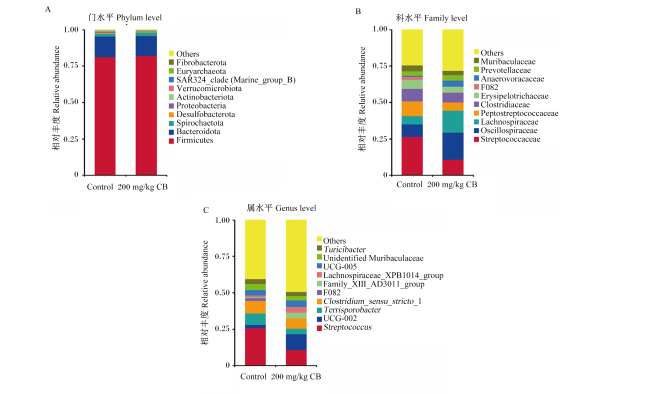
图2表8可知,在门水平上,2组粪便微生物中均检测到3个优势菌门,分别是厚壁菌门(Firmicutes)、拟杆菌门(Bacteroidota)和螺旋体门(Spirochaetota)。与对照组相比,200 mg/kg丁酸梭菌组拟杆菌门的相对丰度升高,但差异不显著(P>0.05),有益菌螺旋体门的相对丰度显著升高(P<0.05),而有害菌脱硫杆菌门(Desulfobacterota)的相对丰度显著降低(P<0.05)。在科水平上,2组粪便微生物中均检测到4个优势菌科,分别是链球菌科(Streptococcaceae)、颤螺菌科(Oscillospiraceae)、毛螺菌科(Lachnospiraceae)和消化链球菌科(Peptostreptococcaceae)。与对照组相比,200 mg/kg丁酸梭菌组链球菌科和消化链球菌科的相对丰度显著降低(P<0.05),而颤螺菌科和毛螺菌科的相对丰度显著升高(P<0.05)。在属水平上,对照组粪便微生物中优势菌属为链球菌属(Streptococcus)、土孢杆菌属(Terrisporobacter)和狭义梭菌属1(Clostridium_sensu_stricto_1),200 mg/kg丁酸梭菌组粪便微生物中优势菌属为链球菌属、UCG-002和狭义梭菌属1。与对照组相比,200 mg/kg丁酸梭菌组链球菌属和狭义梭菌属1的相对丰度显著降低(P<0.05),UCG-002的相对丰度显著升高(P<0.05),土孢杆菌属的相对丰度降低,但差异不显著(P>0.05)。
图2 门、科、属水平上粪便微生物组成

Firmicutes:厚壁菌门;Bacteroidota:拟杆菌门;Spirochaetota:螺旋体门;Desulfobacterota:脱硫杆菌门;Proteobacteria:变形菌门;Actinobacteriota:放线菌门;Verrucomicrobiota:疣微菌门;SAR324_clade (Marine_group_B):SAR324分支(海洋群B);Euryarchaeota:广古菌门;Fibrobacterota:纤维杆菌门;Streptococcaceae:链球菌科;Oscillospiraceae:颤螺菌科;Lachnospiraceae:毛螺菌科;Peptostreptococcaceae:消化链球菌科;Clostridiaceae:梭菌科;Erysipelotrichaceae:丹毒丝菌科;Anaerovoracaceae:厌氧弧菌科;Prevotellaceae:普雷沃氏菌科;Muribaculaceae:鼠杆菌科;Streptococcus:链球菌属;Terrisporobacter:土孢杆菌属;Clostridium_sensu_stricto_1:狭义梭菌属1;Family_ΧⅢ_AD3011_group:Family ΧⅢ AD3011群;Lachnospiraceae_XPB1014_group:毛螺菌科XPB1014群;Unidentified Muribaculaceae:鼠杆菌科未鉴定属;Turicibacter:苏黎世杆菌属;Others:其他。

Fig.2 Composition of fecal microbiota at phylum, family and genus levels (n=5)

表8 门、科、属水平上粪便微生物优势菌群的相对丰度差异

Table 8 Relative abundance differences of dominant fecal microbial community at phylum, family and genus levels (n=5)

项目
Items
丁酸梭菌添加量
Clostridium butyricum supplemental levels/(mg/kg)
P
P-value
0(对照 Control) 200
厚壁菌门 Firmicutes 81.32±5.36 82.19±5.57 0.913 8
拟杆菌门 Bacteroidota 14.60±3.33 20.12±4.51 0.357 9
螺旋体门 Spirochaetota 1.19±0.43b 4.01±0.92a 0.027 8
脱硫杆菌门 Desulfobacterota 0.02±0.00a 0.00±0.00b 0.032 0
链球菌科 Streptococcaceae 25.57±5.03a 4.53±0.63b 0.004 4
颤螺菌科 Oscillospiraceae 8.53±1.45b 20.93±4.67a 0.026 2
毛螺菌科 Lachnospiraceae 4.18±0.76b 7.70±1.02a 0.035 9
消化链球菌科 Peptostreptococcaceae 10.09±1.86a 3.90±0.64b 0.025 4
链球菌属 Streptococcus 24.87±4.84a 4.34±0.52b 0.004 1
UCG-002 2.01±0.70b 17.39±5.92a 0.013 2
土孢杆菌属 Terrisporobacter 6.29±0.93 3.92±1.27 0.194 4
狭义梭菌属1 Clostridium_sensu_stricto_1 7.30±0.89a 2.78±0.89b 0.017 1
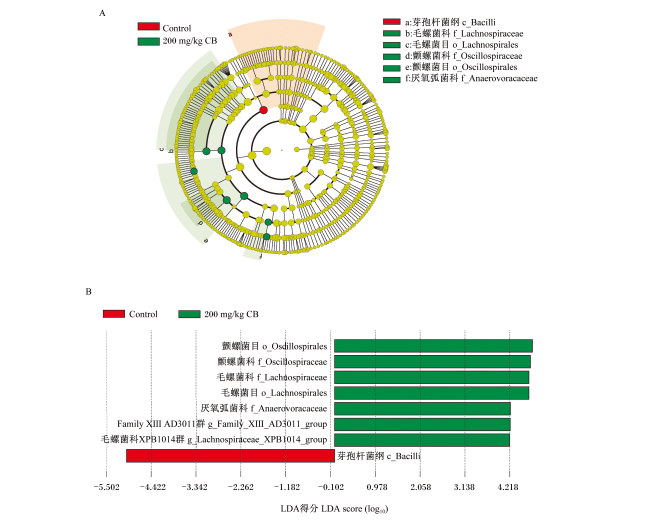
采用LEfSe分析比较对照组与200 mg/kg丁酸梭菌组粪便微生物群落的物种组成差异。进化分支图(图3-A)展示了2组样本在门、纲、目、科、属分类水平上最丰富的微生物群落。LDA(图3-B)共筛选出8个差异菌群,其中对照组富集芽孢杆菌纲(Bacilli),而200 mg/kg丁酸梭菌组则富集包括颤螺菌目(Oscillospirales)、毛螺菌科等在内的7个细菌类群。
图3 粪便微生物LEfSe进化分支图(A)和LDA得分分布柱状图(B)

Fig.3 LEfSe cladogram (A) and LDA score distribution histogram (B) of fecal microbiota

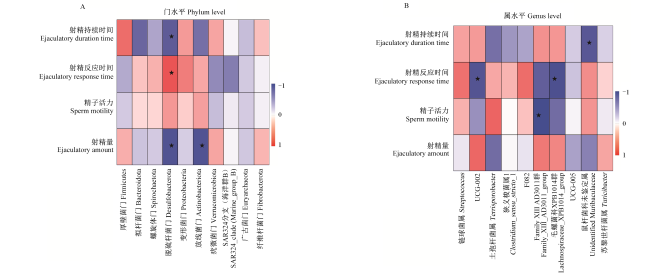
Spearman相关性分析(图4-A)显示,脱硫杆菌门的相对丰度与射精量、射精持续时间呈显著负相关(P<0.05),与射精反应时间呈显著正相关(P<0.05);放线菌门的相对丰度与射精量呈显著负相关(P<0.05)。在属水平上(图4-B),UCG-002和毛螺菌科XPB1014群(Lachnospiraceae_XPB1014_group)的相对丰度与射精反应时间呈显著负相关(P<0.05),鼠杆菌科未鉴定属(unidentified Muribaculaceae)的相对丰度与射精持续时间呈显著负相关(P<0.05)。
图4 门水平(A)和属水平(B)粪便微生物与精液品质的Spearman相关性分析

*表示相关性显著(P<0.05)。

Fig.4 Spearman correlation analysis between fecal microbiota at phylum (A) and genus (B) levels and semen quality

* indicated significant correlation (P<0.05).

2.4 丁酸梭菌对杜洛克公猪粪便代谢组的影响

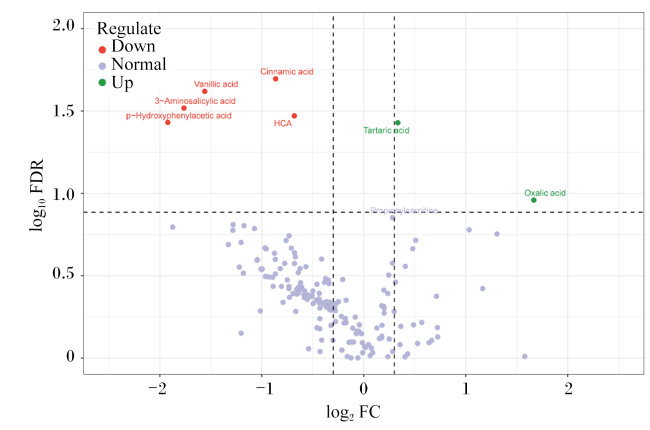
图5可知,与对照组相比,200 mg/kg丁酸梭菌组粪便中有2种上调差异代谢物,5种下调差异代谢物。由表9可知,与对照组相比,200 mg/kg丁酸梭菌组粪便代谢物酒石酸(tartaric acid)含量显著升高(P<0.05),草酸(oxalic acid)含量呈升高趋势(P=0.091 6)。此外,饲粮中添加200 mg/kg丁酸梭菌显著降低了粪便代谢物猪胆酸(hyocholic acid)、肉桂酸(cinnamic acid)和香草酸(vanillic acid)含量(P<0.05),同时还有降低3-氨基水杨酸(3-aminosalicylic acid,P=0.066 8)和对羟基苯基乙酸(p-hydroxyphenylacetic acid,P=0.080 7)含量的趋势。
图5 粪便差异代谢物火山图

Regulate:调控;Down:下调;Up:上调;Normal:不显著;FDR:错误发现率 false discovery rate;FC:差异倍数 fold change。图6同 the same as Fig.6

Tartaric acid:酒石酸;Oxalic acid:草酸;HCA:猪胆酸 hyocholic acid;Cinnamic acid:肉桂酸;Vanillic acid:香草酸;3-Aminosalicylic acid:3-氨基水杨酸;p-Hydroxyphenylacetic acid:对羟基苯乙酸。

Fig.5 Differential fecal metabolites volcano plot

表9 丁酸梭菌对杜洛克公猪粪便代谢物的影响

Table 9 Effects of Clostridium butyricum on fecal metabolites of Duroc boars

项目
Items
丁酸梭菌添加量
Clostridium butyricum supplemental levels/(mg/kg)
P
P-value
0(对照 Control) 200
酒石酸 Tartaric acid 0.56±0.01b 0.71±0.04a 0.020 4
草酸 Oxalic acid 111.00±1.46 352.60±109.30 0.091 6
猪胆酸 Hyocholic acid 21.73±2.59a 13.55±1.11b 0.043 7
肉桂酸 Cinnamic acid 0.81±0.09a 0.44±0.05b 0.022 3
香草酸 Vanillic acid 3.17±0.60a 1.07±0.26b 0.032 6
3-氨基水杨酸 3-aminosalicylic acid 104.90±28.33 30.91±8.63 0.066 8
对羟基苯乙酸 p-hydroxyphenylacetic acid 99.89±30.11 26.36±9.71 0.080 7

2.5 丁酸梭菌对杜洛克公猪精浆代谢组的影响

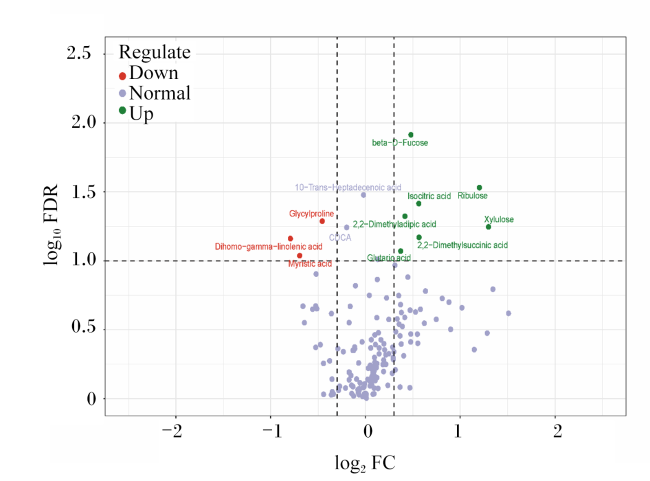
图6可知,与对照组相比,200 mg/kg丁酸梭菌组精浆中有7种上调差异代谢物,3种下调差异代谢物。由表10可知,与对照组相比,200 mg/kg丁酸梭菌组异柠檬酸(isocitric acid)和戊二酸(glutaric acid)含量显著升高(P<0.05)。此外,与对照组相比,200 mg/kg丁酸梭菌组碳水化合物的含量显著升高,如β-D-岩藻糖(β-D-fucose)、核酮糖(ribulose)和木酮糖(xylulose)等(P<0.05);同时,200 mg/kg丁酸梭菌组中2,2-二甲基己二酸(2,2-dimethyladipic acid)和2,2-二甲基琥珀酸(2,2-dimethylsuccinic acid)等脂肪酸的含量也显著升高(P<0.05)。
图6 精浆差异代谢物火山图

beta-D-Fucose:β-D-岩藻糖;Isocitric acid:异柠檬酸;Ribulose:核酮糖;Xylulose:木酮糖;2,2-Dimethyladipic acid:2,2-二甲基己二酸;2,2-Dimethylsuccinic acid:2,2-二甲基琥珀酸;Glutaric acid:戊二酸;Glycylproline:甘氨酰脯氨酸;Dihomo-gamma-linolenic acid:二高-γ-亚麻酸;Myristic acid:肉豆蔻酸;10-Trans-Heptadecenoic acid:10-反式-十七碳烯酸;CDCA:鹅脱氧胆酸 Chenodeoxycholic acid。

Fig.6 Differential seminal plasma metabolites volcano plot

表10 丁酸梭菌对杜洛克公猪精浆代谢物的影响

Table 10 Effects of Clostridium butyricum on seminal plasma metabolites of Duroc boars

项目
Items
丁酸梭菌添加量
Clostridium butyricum supplemental levels/(mg/kg)
P
P-value
0(对照 Control) 200
异柠檬酸 Isocitric acid 302.70±21.59b 364.30±6.99a 0.034 9
戊二酸 Glutaric acid 0.08±0.01b 0.25±0.04a 0.009 6
β-D-岩藻糖 β-D-fucose 0.20±0.02b 0.28±0.02a 0.011 5
核酮糖 Ribulose 1.17±0.21b 2.73±0.40a 0.013 3
木酮糖 Xylulose 0.38±0.08b 1.26±0.17a 0.003 3
2,2-二甲基己二酸 2,2-dimethyladipic acid 0.12±0.01b 0.15±0.01a 0.035 8
2,2-二甲基琥珀酸 2,2-dimethylsuccinic acid 0.03±0.00b 0.04±0.00a 0.039 2

3 讨论

精液品质受多种因素影响,包括生活方式、饮食习惯、生存环境、遗传背景及健康状况等[21]。近年来研究发现,肠道微生物对动物精液品质具有不可忽视的调节作用[22]。例如,肠道微生物可通过调控短链脂肪酸、氨基酸及维生素等代谢物的合成与代谢,进而影响精液品质[23-24];同时,肠道微生物还能参与雄性激素的分泌与代谢调节[25-26],在睾酮的代谢中发挥重要作用[27-28];肠道微生物代谢产物还可通过血睾屏障,直接作用于生殖系统以调节精液品质[29-30]。已有研究证实,饲粮中添加益生菌[如罗氏乳杆菌(Lactobacillus reuteri)[28]、植物乳杆菌(Lactobacillus plantarum)TW1-1[31]和双歧杆菌(Bifidobacterium)[5]]可有效促进精子发生,提升雄性动物的生殖能力。
丁酸梭菌因具备促生长、稳菌群、强免疫及抗肿瘤[8,32]等多重生物学功能而备受关注。在无菌小鼠模型中,补充酪酸梭菌(与丁酸梭菌同属产丁酸菌)后可观察到血睾屏障功能改善、睾酮水平提升及精子发生恢复的现象[33]。因此,通过补充丁酸梭菌来调节肠道菌群结构,是增强雄性动物生殖能力的一种潜在方法。
公猪的性欲水平直接关系到配种效率与生产性能,其高低不仅影响采精频率和精液品质,更是维系种猪群健康稳定发展的关键因素。射精反应时间和射精持续时间通常被视作衡量性欲和性能力最灵敏的指标[34]。Estienne等[19]报道,饲粮中添加n-3多不饱和脂肪酸可以显著提高公猪的性欲并延长射精持续时间。本研究也发现,饲粮中添加200 mg/kg丁酸梭菌能显著缩短射精反应时间、延长射精持续时间,有效提升其性欲水平。
公猪精液品质直接影响母猪受胎率及后代生长性能,进而影响养猪场的经济效益和生产竞争力[35-37]。小鼠试验已证实,丁酸梭菌可显著提升精液品质[15]。本研究发现,饲粮中添加丁酸梭菌同样能显著提高公猪精子活力、直线运动能力及A+B级精子比例,且这3项指标均与母猪受胎率密切相关[38-39]。此外,JC-1线粒体膜电位检测显示,饲粮中添加50和200 mg/kg丁酸梭菌能够显著提高精子线粒体膜电位,这对于ATP的生成至关重要[40]。同时,饲粮中添加200 mg/kg丁酸梭菌可显著提高精浆SOD和GSH-Px活性,这2种核心抗氧化酶可有效缓解氧化应激对精子的损伤,维持精子正常生理功能[41-42]。本研究中,丁酸梭菌的添加还显著提高了精子能量代谢关键参数(如ATP和果糖含量),而二者正是精子运动的重要能量来源[43-44]。综上所述,饲粮中添加丁酸梭菌能够显著提升公猪的性欲与精液品质。
基于上述研究结果,推测丁酸梭菌对公猪精液品质的改善作用,可能是通过重塑肠道菌群结构来实现的。肠道微生态失衡不仅会通过多种途径影响宿主精液品质,甚至还会波及后代健康[35]。已有研究表明,丁酸梭菌能够改善肠道微生态失衡,强化肠道屏障功能,并提升肠道微生物多样性[45]。本研究结果表明,饲粮中添加200 mg/kg丁酸梭菌显著提高了杜洛克公猪粪便中螺旋体门、颤螺菌科、毛螺菌科和UCG-002等有益菌的相对丰度,显著降低了脱硫杆菌门、链球菌、消化链球菌和狭义梭菌属1等有害菌的相对丰度。已有研究证实,毛螺菌能产生大量乳酸,维持雌性动物阴道酸性微环境,对生殖健康具有积极意义[46];而链球菌和消化链球菌等病原菌的感染会导致精子活力和浓度下降,进而降低受孕概率[47]。因此,通过饲粮添加丁酸梭菌促进有益菌增殖、抑制有害菌繁殖,不仅有利于提升公猪精液品质,还对母猪受孕具有积极影响。
粪便代谢物是肠道内细胞和微生物代谢的最终产物[48],可间接反映肠道微生物群的代谢状态[22,49]。本研究分析了丁酸梭菌对粪便代谢物的影响,发现饲粮中添加200 mg/kg丁酸梭菌后杜洛克公猪粪便代谢物酒石酸含量显著升高,而猪胆酸、肉桂酸及香草酸含量显著降低。酒石酸含量的升高可能与精液品质存在关联,作为一种重要的有机酸,其参与人体免疫应答、代谢应激调控及信号转导等生理过程,对维持前列腺正常功能具有重要作用[50-51]。值得注意的是,猪胆酸在猪总胆汁酸中的占比高达75%[52],其含量变化可在很大程度上作为猪总胆汁酸含量变化的表征。胆汁酸可通过激活精子中表达的法尼醇X受体(FXR)和G蛋白偶联胆汁酸受体5(TGR5),对精子发生、获能及顶体反应等多个生理过程产生负面影响[53-54]。以上结果提示,丁酸梭菌可能通过调控肠道微生物代谢活动,经肠道-睾丸轴影响公猪精液品质。
已有研究表明,肠道微生物代谢产物可调控精浆的组成成分,进而影响精子发生过程及精子活力[20,55]。本研究发现,饲粮中添加200 mg/kg丁酸梭菌显著提高了精浆中β-D-岩藻糖、木酮糖、核酮糖、异柠檬酸和脂肪酸的含量。其中,β-D-岩藻糖可能在精子与卵子的相互识别过程中发挥核心作用,可触发精子顶体反应[56];异柠檬酸作为三羧酸循环的中间产物,参与细胞能量供应及碳代谢调控,其可能对精子成熟及能量代谢过程具有正向调节作用[57]。此外,多项研究指出,多不饱和脂肪酸,尤其是ω-3多不饱和脂肪酸(如亚麻酸、二十碳五烯酸),有助于提升精子活力,同时其免疫调节功能也可能影响精子的受精能力[58]。综上所述,丁酸梭菌可通过改变精浆代谢物谱,进而改善杜洛克公猪的精子活力及整体精液品质。
值得注意的是,本研究中饲粮添加丁酸梭菌并未导致粪便和精浆中短链脂肪酸(如丁酸)含量显著升高。已有研究报道,丁酸梭菌可通过重塑肠道菌群及调控色氨酸、嘌呤等代谢产物来缓解肥胖,其抗肥胖效应并不依赖于丁酸等短链脂肪酸[59];在幼龄反刍动物模型中,丁酸梭菌未改变瘤胃丁酸含量,而是通过调整菌群结构和相关代谢通路发挥益处[60]。据此推测,丁酸梭菌改善公猪精液品质的作用机制可能不依赖于短链脂肪酸含量的提升,而是通过重塑肠道微生物群落结构(如16S rRNA测序结果所示)、产生其他功能性代谢物(如代谢组学检测结果所示)或在肠道局部发挥免疫或屏障调节作用等更为复杂的途径实现[61-63]。因此,未来研究需进一步探究丁酸梭菌调控公猪精液品质的具体机制。
本研究存在一定局限性,具体如下:首先,受杜洛克种公猪养殖规模的限制,本研究样本量相对较小(每组5头),这可能会降低统计检验的效力,进而影响研究结果的普适性,未来需在更大规模的群体中开展试验以验证本研究结论。其次,本研究未能采集试验起始阶段(第0天)的精液及粪便样本,因而难以完全排除组间初始差异对结果的潜在影响。尽管研究过程中已通过严格的随机分组和标准化管理以平衡组间差异,但这一局限仍要求对因果关系的推断保持审慎。未来研究若能在扩大样本量的基础上,纳入试验前的基线数据,将能更有力地支撑研究结论。此外,本研究仅在试验第60天评估精液品质,未能对处理效应进行动态监测,未来研究可通过增加采样频率以揭示其动态变化规律。

4 结论

饲粮中添加200 mg/kg丁酸梭菌可通过重塑肠道菌群结构及调节精浆代谢物,显著改善杜洛克公猪精液品质并增强其性欲。
[1]
MASIDE C, RECUERO S, SALAS-HUETOS A, et al. Animal board invited review:an update on the methods for semen quality evaluation in swine-from farm to the lab[J]. Animal, 2023, 17(3):100720.

DOI

[2]
SINGH M, TALIMOA MOLLIER R, SHARMA P R, et al. Dietary flaxseed oil improve boar semen quality,antioxidant status and in-vivo fertility in humid sub-tropical region of North East India[J]. Theriogenology, 2021, 159:123-131.

DOI

[3]
TSAKMAKIDIS I A, LYMBEROPOULOS A G, KHALIFA T A. Relationship between sperm quality traits and field-fertility of porcine semen[J]. Journal of Veterinary Science, 2010, 11(2):151-154.

PMID

[4]
DING N, ZHANG X, ZHANG X D, et al. Impairment of spermatogenesis and sperm motility by the high-fat diet-induced dysbiosis of gut microbes[J]. Gut, 2020, 69(9):1608-1619.

DOI PMID

[5]
VALCARCE D G, GENOVÉS S, RIESCO M F, et al. Probiotic administration improves sperm quality in asthenozoospermic human donors[J]. Beneficial Microbes, 2017, 8(2):193-206.

DOI PMID

[6]
DARDMEH F, ALIPOUR H, GAZERANI P, et al. Lactobacillus rhamnosus PB01 (DSM 14870) supplementation affects markers of sperm kinematic parameters in a diet-induced obesity mice model[J]. PLoS One, 2017, 12(10):e0185964.

DOI

[7]
INATOMI T, OTOMARU K. Effect of dietary probiotics on the semen traits and antioxidative activity of male broiler breeders[J]. Scientific Reports, 2018, 8(1):5874.

DOI PMID

[8]
STOEVA M K, GARCIA-SO J, JUSTICE N, et al. Butyrate-producing human gut symbiont,Clostridium butyricum,and its role in health and disease[J]. Gut Microbes, 2021, 13(1):1-28.

[9]
WANG K L, CAO G T, ZHANG H R, et al. Effects of Clostridium butyricum and Enterococcus faecalis on growth performance,immune function,intestinal morphology,volatile fatty acids,and intestinal flora in a piglet model[J]. Food & Function, 2019, 10(12):7844-7854.

[10]
HUANG J, CAI J, WANG J, et al. Efficient production of butyric acid from Jerusalem artichoke by immobilized Clostridium tyrobutyricum in a fibrous-bed bioreactor[J]. Bioresource Technology, 2011, 102(4):3923-3926.

DOI PMID

[11]
ARIYOSHI T, HAGIHARA M, TAKAHASHI M, et al. Effect of Clostridium butyricum on gastrointestinal infections[J]. Biomedicines, 2022, 10(2):483.

DOI

[12]
OKA K, MCCARTNEY E, ARIYOSHI T, et al. In vivo safety evaluation of the Clostridium butyricum MIYAIRI 588 strain in broilers,piglets,and turkeys[J]. Toxicology Research and Application, 2019, 3:2397847319826955.

DOI

[13]
YANG C M, CAO G T, FERKET P R, et al. Effects of probiotic,Clostridium butyricum,on growth performance,immune function,and cecal microflora in broiler chickens[J]. Poultry Science, 2012, 91(9):2121-2129.

DOI

[14]
ZONG X, WANG T H, LU Z Q, et al. Effects of Clostridium butyricum or in combination with Bacillus licheniformis on the growth performance,blood indexes,and intestinal barrier function of weanling piglets[J]. Livestock Science, 2019, 220:137-142.

DOI

[15]
杜朝晖, 葛梓豪, 游君怡, 等. 丁酸梭菌和丁酸钠对高脂饮食诱导雄性小鼠生殖损伤的影响[J]. 中国畜牧兽医, 2023, 50(4):1603-1616.

DOI

DU Z H, GE Z H, YOU J Y, et al. Effects of Clostridium butyricum and sodium butyricum on reproductive system injury induced by high fat diet in male mice[J]. China Animal Husbandry & Veterinary Medicine, 2023, 50(4):1603-1616. (in Chinese)

[16]
KONDRACKI S, IWANINA M, WYSOKIŃSKA A, et al. The usefulness of sexual behaviour assessment at the beginning of service to predict the suitability of boars for artificial insemination[J]. Animals, 2021, 11(12):3341.

DOI

[17]
WANG C, LI J L, WEI H K, et al. Effects of feeding regimen on weight gain,semen characteristics,libido,and lameness in 170- to 250-kilogram Duroc boars[J]. Journal of Animal Science, 2016, 94(11):4666-4676.

DOI

[18]
LOUIS G F, LEWIS A J, WELDON W C, et al. The effect of energy and protein intakes on boar libido,semen characteristics,and plasma hormone concentrations[J]. Journal of Animal Science, 1994, 72(8):2051-2060.

DOI

[19]
ESTIENNE M J, HARPER A F, CRAWFORD R J. Dietary supplementation with a source of omega-3 fatty acids increases sperm number and the duration of ejaculation in boars[J]. Theriogenology, 2008, 70(1):70-76.

DOI PMID

[20]
YAN X W, FENG Y N, HAO Y N, et al. Gut-testis axis:microbiota prime metabolome to increase sperm quality in young type 2 diabetes[J]. Microbiology Spectrum, 2022, 10(5):e0142322.

DOI

[21]
LEVINE H, JØRGENSEN N, MARTINO-ANDRADE A, et al. Temporal trends in sperm count:a systematic review and meta-regression analysis of samples collected globally in the 20th and 21st centuries[J]. Human Reproduction Update, 2023, 29(2):157-176.

DOI

[22]
ZHANG P, FENG Y, LI L, et al. Improvement in sperm quality and spermatogenesis following faecal microbiota transplantation from alginate oligosaccharide dosed mice[J]. Gut, 2021, 70(1):222-225.

DOI PMID

[23]
MARKOWIAK-KOPEĆ P, ŚLIŻEWSKA K. The effect of probiotics on the production of short-chain fatty acids by human intestinal microbiome[J]. Nutrients, 2020, 12(4):1107.

DOI

[24]
TREMELLEN K, MCPHEE N, PEARCE K, et al. Endotoxin-initiated inflammation reduces testosterone production in men of reproductive age[J]. American Journal of Physiology-Endocrinology and Metabolism, 2018, 314(3):E206-E213.

[25]
QIN J J, LI R Q, RAES J, et al. A human gut microbial gene catalogue established by metagenomic sequencing[J]. Nature, 2010, 464(7285):59-65.

DOI

[26]
RIDLON J M, IKEGAWA S, ALVES J M P, et al. Clostridium scindens:a human gut microbe with a high potential to convert glucocorticoids into androgens[J]. Journal of Lipid Research, 2013, 54(9):2437-2449.

DOI

[27]
LI D, LIU R, WANG M, et al. 3β-hydroxysteroid dehydrogenase expressed by gut microbes degrades testosterone and is linked to depression in males[J]. Cell Host & Microbe, 2022, 30(3):329-339.e5.

[28]
POUTAHIDIS T, SPRINGER A, LEVKOVICH T, et al. Probiotic microbes sustain youthful serum testosterone levels and testicular size in aging mice[J]. PLoS One, 2014, 9(1):e84877.

DOI

[29]
HUSSAIN T, MURTAZA G, KALHORO D H, et al. Relationship between gut microbiota and host-metabolism:emphasis on hormones related to reproductive function[J]. Animal Nutrition, 2021, 7(1):1-10.

DOI

[30]
LI X P, CHENG W, SHANG H T, et al. The interplay between androgen and gut microbiota:is there a microbiota-gut-testis axis[J]. Reproductive Sciences, 2022, 29(6):1674-1684.

DOI

[31]
TIAN X Z, YU Z S, FENG P Y, et al. Lactobacillus plantarum TW1-1 alleviates diethylhexylphthalate-induced testicular damage in mice by modulating gut microbiota and decreasing inflammation[J]. Frontiers in Cellular and Infection Microbiology, 2019, 9:221.

DOI

[32]
ZHANG X S, SONG M Z, LV P H, et al. Effects of Clostridium butyricum on intestinal environment and gut microbiome under Salmonella infection[J]. Poultry Science, 2022, 101(11):102077.

DOI

[33]
AL-ASMAKH M, STUKENBORG J B, REDA A, et al. The gut microbiota and developmental programming of the testis in mice[J]. PLoS One, 2014, 9(8):e103809.

DOI

[34]
SEREFOGLU E C, MCMAHON C G, WALDINGER M D, et al. An evidence-based unified definition of lifelong and acquired premature ejaculation:report of the second international society for sexual medicine ad hoc committee for the definition of premature ejaculation[J]. Sexual Medicine, 2014, 2(2):41-59.

DOI

[35]
ARGAW-DENBOBA A, SCHMIDT T S B, DI GIACOMO M, et al. Paternal microbiome perturbations impact offspring fitness[J]. Nature, 2024, 629(8012):652-659.

DOI

[36]
ZAK L J, GAUSTAD A H, BOLARIN A, et al. Genetic control of complex traits,with a focus on reproduction in pigs[J]. Molecular Reproduction and Development, 2017, 84(9):1004-1011.

DOI

[37]
MANJARÍN R, KIRKWOOD R N, NGULA J, et al. Effect of oxytocin,cloprostenol or buserelin in semen doses on sow fertility[J]. Animals, 2019, 9(10):746.

DOI

[38]
FERNÁNDEZ-LÓPEZ P, GARRIGA J, CASAS I, et al. Predicting fertility from sperm motility landscapes[J]. Communications Biology, 2022, 5(1):1027.

DOI

[39]
GADADHAR S, ALVAREZ VIAR G, HANSEN J N, et al. Tubulin glycylation controls axonemal dynein activity,flagellar beat,and male fertility[J]. Science, 2021, 371(6525):eabd4914.

[40]
AGNIHOTRI S K, AGRAWAL A K, HAKIM B A, et al. Mitochondrial membrane potential (MMP) regulates sperm motility[J]. In Vitro Cellular & Developmental Biology:Animal, 2016, 52(9):953-960.

DOI

[41]
KOWALOWKA M, WYSOCKI P, FRASER L, et al. Extracellular superoxide dismutase of boar seminal plasma[J]. Reproduction in Domestic Animals, 2008, 43(4):490-496.

DOI PMID

[42]
KOZIOROWKA-GILUN M, KOZIOROWSKI M, STRZEZEK J, et al. Seasonal changes in antioxidant defence systems in seminal plasma and fluids of the boar reproductive tract[J]. Reproductive Biology, 2011, 11(1):37-47.

DOI

[43]
BISWAS S, FERGUSON K M, STEDRONSKA J, et al. Fructose and hormone levels in semen:their correlations with sperm counts and motility[J]. Fertility and Sterility, 1978, 30(2):200-204.

DOI

[44]
ORLANDO C, KRAUSZ C, FORTI G, et al. Simultaneous measurement of sperm LDH,LDH-X,CPK activities and ATP content in normospermic and oligozoospermic men[J]. International Journal of Andrology, 1994, 17(1):13-18.

DOI

[45]
XU L P, SUN X L, WAN X H, et al. Dietary supplementation with Clostridium butyricum improves growth performance of broilers by regulating intestinal microbiota and mucosal epithelial cells[J]. Animal Nutrition, 2021, 7(4):1105-1114.

DOI

[46]
MITCHELL C M, HAICK A, NKWOPARA E, et al. Colonization of the upper genital tract by vaginal bacterial species in nonpregnant women[J]. American Journal of Obstetrics and Gynecology, 2015, 212(5):611.e1-611.e9.

[47]
KOEDOODER R, MACKENS S, BUDDING A, et al. Identification and evaluation of the microbiome in the female and male reproductive tracts[J]. Human Reproduction Update, 2019, 25(3):298-325.

DOI PMID

[48]
JAIN A, LI X H, CHEN W N. An untargeted fecal and urine metabolomics analysis of the interplay between the gut microbiome,diet and human metabolism in Indian and Chinese adults[J]. Scientific Reports, 2019, 9(1):9191.

DOI

[49]
KARU N, DENG L, SLAE M, et al. A review on human fecal metabolomics:methods,applications and the human fecal metabolome database[J]. Analytica Chimica Acta, 2018, 1030:1-24.

DOI

[50]
PETI-PETERDI J, GEVORGYAN H, LAM L, et al. Metabolic control of renin secretion[J]. Pflügers Archiv-European Journal of Physiology, 2013, 465(1):53-58.

DOI

[51]
DUNZENDORFER U, KRUSCHWITZ K, FELLER H, et al. Na-tartrate in the treatment of chronic nonbacterial prostatitis[J]. Andrologia, 1983, 15(2):135-140.

PMID

[52]
ZHENG X J, CHEN T L, ZHAO A H, et al. Hyocholic acid species as novel biomarkers for metabolic disorders[J]. Nature Communications, 2021, 12(1):1487.

DOI PMID

[53]
BAPTISSART M, VEGA A, MARTINOT E, et al. Bile acids alter male fertility through G-protein-coupled bile acid receptor 1 signaling pathways in mice[J]. Hepatology, 2014, 60(3):1054-1065.

DOI PMID

[54]
MALIVINDI R, SANTORO M, DE ROSE D, et al. Activated-farnesoid X receptor (FXR) expressed in human sperm alters its fertilising ability[J]. Reproduction, 2018, 156(3):249-259.

DOI

[55]
ZHANG T, SUN P, GENG Q, et al. Disrupted spermatogenesis in a metabolic syndrome model:the role of vitamin A metabolism in the gut-testis axis[J]. Gut, 2022, 71(1):78-87.

DOI

[56]
WU L H, SAMPSON N S. Fucose,mannose,and β-N-acetylglucosamine glycopolymers initiate the mouse sperm acrosome reaction through convergent signaling pathways[J]. ACS Chemical Biology, 2014, 9(2):468-475.

DOI

[57]
HAGRAS A M, TORAIH E A, FAWZY M S. Mobile phones electromagnetic radiation and NAD+-dependent isocitrate dehydrogenase as a mitochondrial marker in asthenozoospermia[J]. Biochimie Open, 2016, 3:19-25.

DOI

[58]
RODAK K, KRATZ E M. PUFAs and their derivatives as emerging players in diagnostics and treatment of male fertility disorders[J]. Pharmaceuticals, 2023, 16(5):723.

DOI

[59]
LIAO J Y, LIU Y L, PEI Z M, et al. Clostridium butyricum reduces obesity in a butyrate-independent way[J]. Microorganisms, 2023, 11(5):1292.

DOI

[60]
ZHU Y K, LI Z M, YANG Y, et al. Early-life Clostridium butyricum supplementation improved rumen development and immune by promoting the maturation of intestinal microbiota[J]. Journal of Agriculture and Food Research, 2024, 18:101517.

DOI

[61]
PENG L Y, LI Z R, GREEN R S, et al. Butyrate enhances the intestinal barrier by facilitating tight junction assembly via activation of AMP-activated protein kinase in Caco-2 cell monolayers[J]. The Journal of Nutrition, 2009, 139(9):1619-1625.

DOI

[62]
WANG H B, WANG P Y, WANG X, et al. Butyrate enhances intestinal epithelial barrier function via up-regulation of tight junction protein claudin-1 transcription[J]. Digestive Diseases and Sciences, 2012, 57(12):3126-3135.

DOI

[63]
PARADA VENEGAS D, DE LA FUENTE M K, LANDSKRON G, et al. Short chain fatty acids (SCFAs)-mediated gut epithelial and immune regulation and its relevance for inflammatory bowel diseases[J]. Frontiers in Immunology, 2019, 10:277.

DOI PMID

Outlines

/