

心脏组织中的主要效应细胞群体是心肌成纤维细胞,它们是心脏间质的关键功能单元,这些细胞在维持心脏组织的功能稳态和结构完整性中发挥着至关重要的作用。在感知并转导病理性刺激后,心肌成纤维细胞的活化和增殖是驱动心脏重塑与心肌纤维化的核心环节之一。因此,成功分离并培养马的心肌成纤维细胞,为马属动物心脏功能相关变化的发生机制提供试验材料和细胞模型,具有重要意义。
心肌细胞、内皮细胞、血管平滑肌细胞和心肌成纤维细胞是构成心脏的主要细胞类型。在一项关于鼠心脏发育过程细胞类型和数量的研究结果表明,成年鼠心脏中心肌细胞、心肌成纤维细胞、内皮细胞和血管平滑肌细胞的占比分别为56%、27%、7%和10%[1]。心肌成纤维细胞主要负责细胞外基质的合成与维持,生成胶原蛋白、纤维连接蛋白等成分,为心脏提供结构支持[2]。心肌成纤维细胞还能通过旁分泌多种生长因子如转化生长因子-β(TGF-β)、成纤维细胞生长因子(FGF)和白细胞介素-6(IL-6)等,调控心肌微环境[3],调节心肌细胞功能并影响炎症反应[4]。此外,通过细胞间的接触,它们还影响心肌细胞的电生理特性,这可能助长心律失常的发生[5]。心肌损伤后,心肌成纤维细胞被激活并转化为肌成纤维细胞,有助于形成瘢痕组织并维持心脏结构完整性[6]。但在病理状态下,心肌成纤维细胞过度激活会导致细胞外基质过度沉积,引发心肌纤维化并损害心脏功能。因此,心肌成纤维细胞在心脏的生理与病理过程中具有多重功能,其功能失调与多种心脏疾病密切相关。
1 材料与方法
1.1 试验材料
1.1.1 主要试剂
胎牛血清(FBS),杭州四季青生物工程材料有限公司;DMEM/F12培养基(Gibco),美国Thermo Fisher Scientific公司;0.25%胰蛋白酶、磷酸盐缓冲液(PBS)、Ⅱ型胶原酶、青链霉素混合液,北京索莱宝科技有限公司;无血清细胞冻存液(CELLSAVINGTM),新赛美生物科技有限公司;山羊血清封闭液、兔抗波形蛋白(vimentin)抗体,中杉金桥(北京)生物技术有限公司;Alexa Fluor® 488标记的山羊抗兔免疫球蛋白G(IgG)(H+L)二抗,英国Abcam公司;CCK-8试剂盒,北京酷来搏科技有限公司;Annexin V-PE/7-AAD细胞凋亡检测试剂盒,杭州联科生物技术股份有限公司。
1.1.2 主要仪器
超净工作台(SW-CJ-2FD,苏州安泰空气技术有限公司)、离心机(TDZ5-WS,湖南湘仪实验室仪器开发有限公司)、二氧化碳培养箱(Thermo,美国)、倒置荧光显微镜(Nikon,日本)、流式细胞仪(Beckman,美国)、酶标仪(FlexA-200HT,中国)、高压蒸汽灭菌锅(LHS-24B,合肥华泰医疗设备有限公司)、-20 ℃冰箱(海尔生物医疗股份有限公司)、-80 ℃冰箱(海尔生物医疗股份有限公司)、恒温水浴系统(Grant,英国)。
1.2 试验方法
1.2.1 样品采集
胎马心脏样品的采集已经新疆农业大学实验动物福利伦理委员会批准(批准编号:2023037)。将胎马从母马体内连带子宫剖出后在4 h内带回实验室,划开子宫露出胎马,对其胸腔部位用75%乙醇反复擦拭消毒,随后用含1%青链霉素混合液的PBS冲洗3次;用高压灭菌不锈钢剪刀剪开肋骨下部分找到心脏快速剪下,用预冷的含1%青链霉素混合液的PBS冲洗干净至无血液流出,再放到含1%青链霉素混合液的PBS中带入细胞间。
1.2.2 马原代心肌成纤维细胞的体外分离与培养
在超净工作台内,用高压灭菌眼科剪剪下心脏心尖2/3处,置于盛有PBS(含1%青链霉素混合液)的培养皿中,清除残留的血液,用高压灭菌眼科剪和眼科镊剔除脂肪、血管及结缔组织后,将剩余组织用高压灭菌眼科剪分割成大约1 mm3的组织块;所有心脏组织块经PBS冲洗3次后,与0.25%胰蛋白酶按1∶3(心脏组织∶胰蛋白酶)的体积比置于15 mL离心管中;将该离心管置于37 ℃恒温振荡水浴器(振幅120 r/min)中消化10 min,将消化好的组织液以300×g的离心力离心10 min,在无菌条件下移除上清液后,加入0.15%Ⅱ型胶原酶溶液(组织块与酶液的体积比为1∶8),于37 ℃恒温振荡水浴器(振幅120 r/min)中酶解30 min;终止消化后,将细胞悬液以300×g的离心力离心10 min,弃去上清,收集细胞沉淀;用含15% FBS和1%青链霉素混合液的DMEM/F12培养基重悬细胞,轻柔吹打形成单细胞悬液后接种至培养瓶,培养环境温度设定为37 ℃,二氧化碳(CO2)浓度保持在5%,相对湿度则保持在95%[11]。
1.2.3 马原代心肌成纤维细胞的纯化与传代
纯化:根据成纤维细胞贴附能力强且增殖速率快的特点,本试验采用差速贴壁法对其进行纯化[12],具体步骤如下:将制备好的细胞悬液接种至培养瓶,置于CO2恒温培养箱中静置培养40 min后,于显微镜下可观察到部分细胞已贴壁,且经轻微晃动后仍保持贴壁状态;收集未贴壁的细胞悬液转移至另一新培养瓶中,继续于培养箱中静置培养40 min,并重复上述操作。最终,首次及第2次转移所获贴壁细胞主要为成纤维细胞。
传代:待细胞传代至第3代后,使用倒置显微镜观察细胞群体形态变化,当贴壁区域覆盖面积达到约85%时,吸除旧培养液;采用预冷PBS进行3次清洗,移除残留液体;添加0.25%胰蛋白酶消化5 min,当细胞间连接解离达90%时立即加入含10% FBS的DMEM/F12培养基终止消化;以300×g的离心力离心10 min后,移除上清液,保留细胞沉淀;随后加入含20% FBS的DMEM/F12培养基将细胞重悬,按比例接种于培养瓶中,置于环境温度37 ℃、5% CO2和相对湿度95%的条件下进行培养。
1.2.4 马心肌成纤维细胞的冻存和复苏
冻存:当细胞群体达到90%融合度时,吸去原有培养基,加入3 mL的0.25%胰蛋白酶消化5 min;待细胞大部分脱落后,加入等量体积的含10% FBS的DMEM/F12培养基终止消化反应,通过离心(300×g)获取细胞沉淀;随后依据细胞冻存液冷冻程序操作加入1 mL细胞冻存液于离心管中,轻柔的混匀制成细胞混合液;将细胞混合液转移至2 mL细胞冻存管后,放入-80 ℃冰箱过夜,第2天转移至液氮中长期保存。
复苏:从液氮中取出细胞冻存管,立即转移至恒温水浴系统[(37.0±0.5) ℃],轻柔振荡解冻至残留微量冰晶;将其转移至15 mL离心管并加入5 mL含有10% FBS的预冷DMEM/F12培养基,离心(300×g)弃上清液,轻轻吹打重悬于含10% FBS的DMEM/F12培养基中;接种于培养瓶中,于37 ℃、5% CO2培养箱中继续培养,24 h后及时更换培养基。
1.2.5 细胞冻存复苏活力检测
筛选生长状态良好的细胞代次(第3代和第16代),将冻存细胞从液氮中取出复苏24 h后进行细胞计数,按下列公式计算复苏后的存活率:
细胞冻存复苏后的存活率(%)=(复苏24 h后贴壁细胞数量/冻存前细胞数量)×100[13]。
1.2.6 细胞形态学观察
使用光学显微镜对第16代马心肌成纤维细胞进行形态学观察,记录其细胞形态特征与生长状况。
1.2.7 细胞免疫荧光鉴定
成纤维细胞的鉴定需综合其形态学特征与特异性分子标记物的检测。本试验通过免疫荧光法,利用Alexa Fluor® 488标记的山羊抗兔IgG (H+L)二抗对分离的第3代马心肌成纤维细胞进行鉴定,并采用荧光显微镜对结果进行分析。具体操作如下:用PBS清洗细胞3次,加入0.25%胰蛋白酶[含乙二胺四乙酸(EDTA)]进行消化处理;消化完成后,以300×g的离心力离心5 min,收集细胞沉淀;将细胞沉淀用含有10% FBS的DMEM/F12培养基重悬后,接种于铺有盖玻片的培养皿内;待细胞密度达到60%左右时,参照付晶等[14]的方法依次进行孵育一抗、二抗及细胞核染色,最后在荧光显微镜下观察波形蛋白的表达情况并采集图像。
1.2.8 细胞生长曲线绘制
选取处于指数增殖期的第16代马心肌成纤维细胞,采用酶解方案结合条件培养基制备单细胞悬液,进行细胞计数。参照CCK-8试剂盒检测流程,在96孔板中接种细胞悬液100 μL(约2 500个细胞),设置6个时间点(1、2、3、5、7、9 d),每个时间点设6个重复孔,分别向各孔添加10 μL CCK-8检测试剂,细胞在37 ℃、5% CO2条件下恒温孵育3 h;待测体系显色反应达稳态后,于450(检测波长)和650 nm(参比波长)下同步检测吸光度,依据标准曲线计算细胞浓度并绘制细胞生长曲线。
1.2.9 细胞凋亡检测
使用Annexin V-PE/7-AAD细胞凋亡检测试剂盒检测细胞凋亡情况。
仪器参数调节:取生长状态良好的第16代马心肌成纤维细胞,用0.25%胰蛋白酶(不含EDTA)消化后收集细胞;用预冷PBS洗涤2次后离心(300×g,5 min),弃上清液;使用500 μL凋亡阳性质控液(apoptosis positive control solution)重悬细胞,冰上孵育30 min;用预冷PBS洗涤后离心(300×g,5 min),弃上清液;加入500 μL预冷1×结合缓冲液(binding buffer)重悬细胞,并加入等量的处于正常生长状态的同代次未经处理的活细胞与之混合;补充预冷1×结合缓冲液至1.5 mL,平均分装至3个流式管中,其中空白对照管仅含500 μL细胞悬液,单染管1在500 μL细胞悬液中添加5 μL Annexin V-PE,单染管2在500 μL细胞悬液中添加10 μL 7-AAD,各管在室温下避光孵育5 min。上机前对流式细胞仪进行校准,首先使用空白对照管调节前向散射与侧向散射电压,并设定荧光通道的基线;随后使用2个单染管分别校准FL2(Annexin V-PE)与FL3(7-AAD)通道的荧光补偿。
样本管制备与检测:取生长状态良好的第16代马心肌成纤维细胞,用预冷PBS洗涤后离心,加入3 mL的0.25%胰蛋白酶消化5 min;待细胞大部分脱落后,加入等体积的含10% FBS的DMEM/F12培养基终止消化反应,通过离心(300×g)获取细胞沉淀;取500 μL 1×结合缓冲液重悬细胞,细胞浓度在1×10⁵~5×10⁵个/mL,加入5 μL Annexin V-PE和10 μL 7-AAD,涡旋混匀后室温下避光孵育5 min后立即上机检测,激发波长为488(Annexin V-PE)和535 nm(7-AAD)。
1.2.10 细胞染色体核型分析
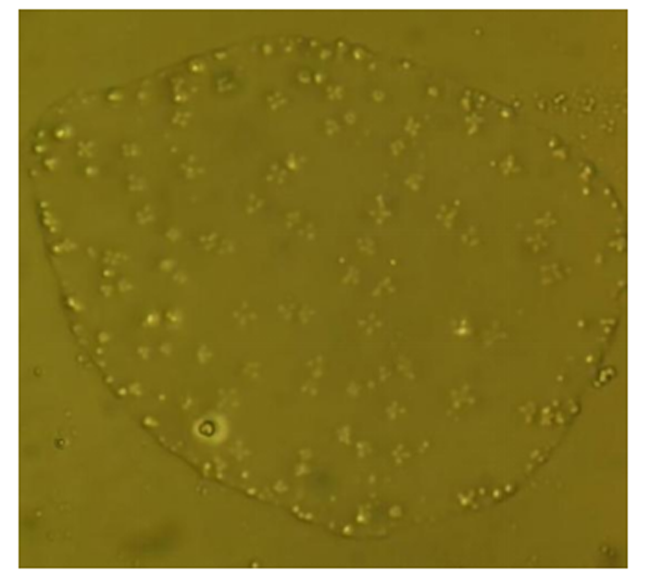
取生长状态良好的第16代马心肌成纤维细胞,由DMEM/F12培养基重悬细胞制备细胞悬液,浓度在5×105~1×106个/mL,在细胞悬液中添加秋水仙素至终浓度为0.067 μg/mL,置于37 ℃、5%CO2培养箱中孵育3 h。参照孙培皓等[15]的方法对细胞进行固定和染色后观察染色体形态。
1.3 数据统计与分析
试验数据使用Excel 2021进行整理后,由GraphPad Prism 9.0软件绘图。
2 结果与分析
2.1 马心肌成纤维细胞的形态
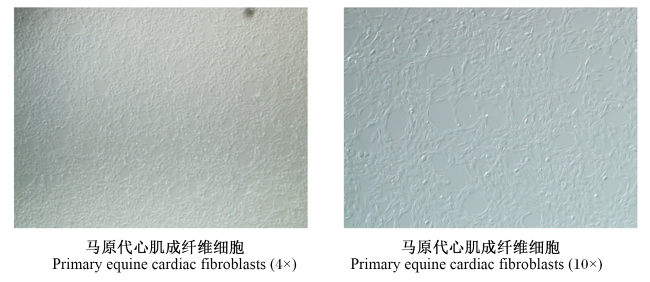
马心肌成纤维细胞的形态结构如图1所示。通过光学显微镜观察到培养的细胞群体具有显著的形态学异质性,典型表现为纺锤状胞体伴随分支状伪足延伸,或呈现多角形拓扑结构,其胞膜边界呈现近似椭球面几何特征;细胞形态比较均一,细胞分布比较均匀,没有明显的聚集或大片空白区域,表明细胞在培养环境中生长状态相对稳定,没有大量杂质或其他不明物质干扰观察。在10×细胞图像中可以观察到细胞生长状态良好。
2.2 马心肌成纤维细胞的冻存复苏活力
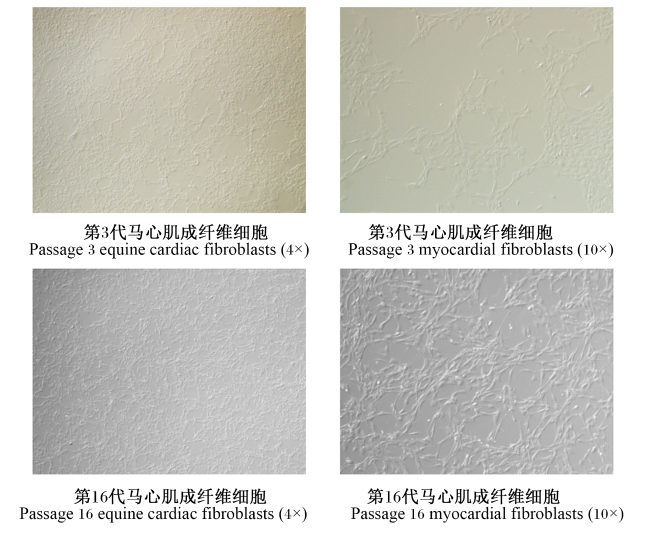
对第3代和第16代马心肌成纤维细胞的冷冻与复苏细胞进行比较,结果显示:第3代细胞冻存复苏后的存活率为96.3%,第16代为90.6%,2代次细胞的冻存复苏活力均维持在90%以上,表明经多次传代培养和冷冻保存的细胞仍具有良好的细胞活力。图2显示了第3代与第16代复苏细胞在不同放大倍数下的形态。
2.3 马心肌成纤维细胞的免疫荧光鉴定结果
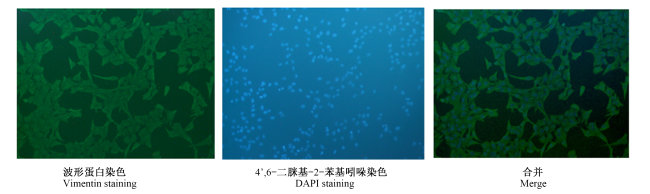
免疫荧光结果(图3)显示,细胞呈典型的梭形或不规则的三角形,且波形蛋白在细胞中呈阳性表达,符合成纤维细胞的形态学与分子标志特征,从而确认所获细胞为马心肌成纤维细胞。
2.4 马心肌成纤维细胞的生长曲线
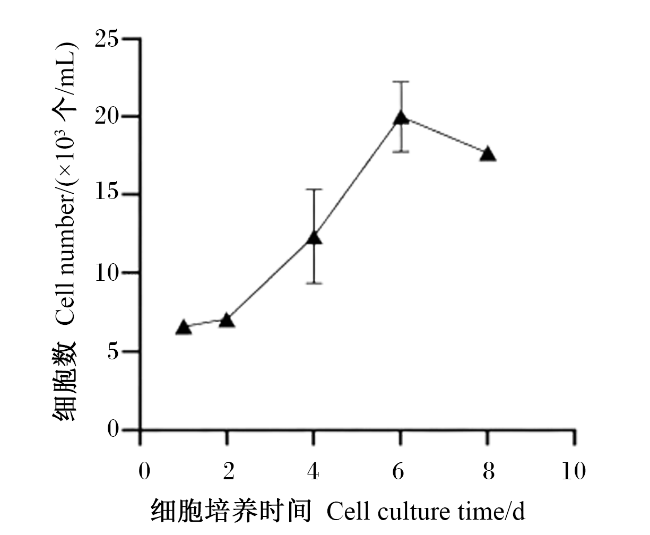
马心肌成纤维细胞的生长曲线如图4所示。在前2 d,细胞数量增长缓慢;在第2~6天,细胞进入代谢活性高度活跃的对数增殖阶段,此时细胞代谢活跃,分裂旺盛;在第6~8天,细胞数量达到峰值后开始下降,表明细胞增殖速度减缓。
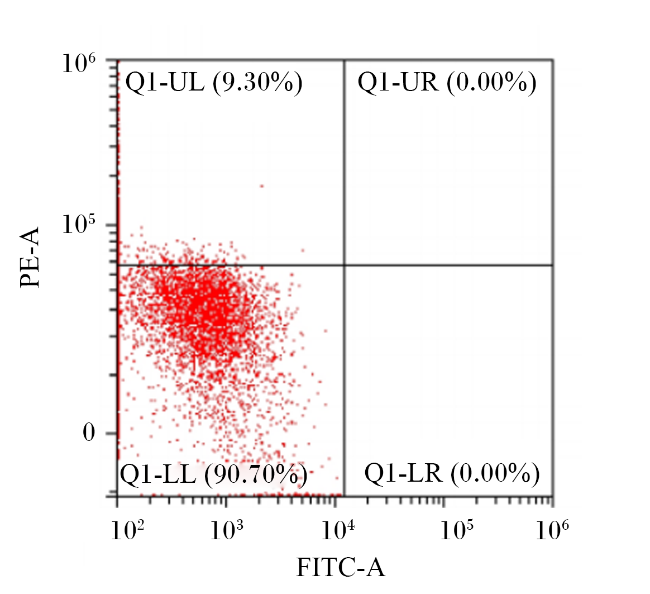
2.5 马心肌成纤维细胞的凋亡情况
使用流式细胞仪对马心肌成纤维细胞进行凋亡检测,第16代马心肌成纤维细胞凋亡检测结果如图5所示。在第16代细胞中发现机械损伤细胞占9.30%,这可能与试验操作过程中的机械作用有关;在样本中没有检测到任何早期或晚期阶段的凋亡细胞,处于凋亡早期的细胞比例显示为0.00%状态,晚期凋亡的细胞亦呈现0.00%的数值化表征;具有生命活性的细胞群体占比达到90.70%,细胞生长状态比较稳定。
2.6 马心肌成纤维细胞染色体核型分析


3 讨论
心脏细胞中约2/3为心肌成纤维细胞,这是心脏中最常见的非心肌细胞类型,目前众多研究人员正通过多种动物模型对其展开深入研究。马属动物作为大型哺乳动物,其心脏在运动过程中需适应高强度工作需求。有研究证实,高强度训练可诱导竞技马出现心肌细胞肥大与心肌纤维化等心脏结构性重塑[16]。小鼠谱系示踪研究进一步证实,心肌成纤维细胞可通过TGF-β/Smad3与丝裂原活化蛋白激酶(MAPK)信号通路主动参与运动诱导的心脏重塑[17]。也有研究通过多组学整合分析,揭示了训练诱导的伊犁马心脏适应性重塑与潜在的纤维化调控通路之间存在密切联系。转录组分析发现,差异表达基因在TGF-β、Janus激酶-信号转导及转录激活因子(JAK-STAT)及肿瘤坏死因子(TNF)信号通路中显著富集。其中,TGF-β信号通路作为心脏纤维化的核心驱动力,其活性受到特定miRNA的精细调控[18]。据此推测,在运动诱导的马属动物心脏适应性重塑过程中,心肌成纤维细胞通过激活特定的信号通路并释放旁分泌因子,对这一过程起到关键的调控作用。然而,目前针对马属动物心肌成纤维细胞的相关研究相对匮乏,因此本研究聚焦于马心肌成纤维细胞的分离培养与鉴定,建立其稳定的分离、培养与鉴定体系,以期为相关领域的研究提供参考。
在马心肌成纤维细胞分离与培养方法上,与大鼠、小鼠等常见实验动物的心肌成纤维细胞研究相比,存在一定的异同点。心肌成纤维细胞的原代培养方法主要包括组织块贴壁法和酶消化法[19]。采用酶消化法分离心脏成纤维细胞时,其成功与否主要取决于3个关键因素:消化酶的选择、消化时间的精确控制,以及重复消化的频率。胶原酶和胰蛋白酶是常用的酶类代表。胰蛋白酶可分解组织基质的蛋白质成分,但其强效作用可能损伤细胞膜,导致心肌成纤维细胞更难附着于表面,因此使用时必须严格调控酶浓度与消化时间。胶原酶能特异性分解细胞外基质中的胶原纤维,从而释放出细胞。该方法有助于维持较高的细胞存活率,且对心肌细胞损伤小,但其消化作用较为温和,往往需要较长时间,且容易导致消化不完全[20]。EDTA作为一种钙离子螯合剂[21],能破坏细胞间连接,属于非酶消化剂。将其加入消化液中可增强酶消化效率并减轻细胞损伤。在培养原代大鼠心肌细胞时,程阔菊等[22]采用1∶1配比的胰蛋白酶与胶原酶(0.125%∶0.125%),培养后细胞的纯度高于95%。本试验采用0.25%胰蛋白酶-0.15%Ⅱ型胶原酶复合物作为酶消化体系。根据马属动物与大鼠心脏组织结构成分差异及马驹心脏体积较大、质地较硬的特点,对酶用量和消化时间进行了合理调整。
在心肌成纤维细胞的原代培养中,供体动物的年龄选择是一个关键因素。大量研究证实,心肌成纤维细胞的增殖能力随个体发育成熟而显著减弱,并在成年后趋于稳定。例如,Wu等[23]通过EdU与Ki67检测发现,小鼠出生第1天有超过50%的心肌成纤维细胞处于活跃增殖状态,此比例在4周龄时降至10%,至14周龄后则稳定在2%~5%;且成年(14周龄)与老年(1.5岁)小鼠的心脏中,心肌成纤维细胞的绝对数量无显著差异,这进一步印证了其增殖潜力随发育进程下降的规律。另一项关于年龄相关性心脏纤维化的研究也指出,胎儿或新生儿来源的心肌成纤维细胞,其迁移能力显著优于成年个体来源的心肌成纤维细胞[24]。基于上述研究证据,为获取增殖活性较高的细胞,本研究选择以3~6月龄的胎马心脏组织作为试验材料,以保证心肌成纤维细胞的成功分离。
本研究成功分离并鉴定了马心肌成纤维细胞。免疫荧光染色结果显示,细胞特异性表达波形蛋白,且形态呈现典型的成纤维细胞形态学特征,如纺锤形胞体伴随分支状伪足,呈典型的梭形或不规则的多角形,从而证实了其马心肌成纤维细胞身份。在生长特性方面,相较于已报道的小鼠心脏成纤维细胞[25],马心脏成纤维细胞的体外增殖速度较缓,其对数生长期为接种后第2~6天。CCK-8检测结果进一步揭示,该细胞在体外培养过程中呈现典型的“S”形生长动力学特征。此外,细胞冻存复苏试验结果显示,第3代与第16代细胞冻存复苏后的存活率均保持在90%以上,提示本培养体系能在一定传代范围内维持细胞良好的活性,且该细胞可在液氮中稳定储存,可为后续功能研究提供可靠的材料基础。
4 结论
本试验采用胰蛋白酶和Ⅱ型胶原酶联合消化法成功分离出马心肌成纤维细胞,所获细胞生长状态良好,并实现了该细胞的稳定储存。