RESEARCH PAPER

Effects of Microdiets Supplemented with Five New Materials on Physical Properties of Diets, and Growth Performance, Body Composition, Liver and Intestinal Health, Antioxidant and Anti-Stress Capacities of Largemouth Bass (Micropterus salmoides) Larvae and Juveniles

  • LI Yuwan , 1, 2 ,
  • LIANG Guanyu 1 ,
  • XIONG Pan 1 ,
  • HU Junru 1 ,
  • ZHU Xifeng 1 ,
  • WANG Guoxia , 1, *
Expand
  • 1 Guangdong Provincial Key Laboratory of Animal Breeding and Nutrition, Key Laboratory of Animal Nutrition and Feed Science in South China for Ministry of Agriculture and Rural Affairs, Institute of Animal Science, Guangdong Academy of Agricultural Sciences, Guangzhou 510640, China
  • 2 College of Fisheries, Huazhong Agricultural University, Wuhan 430070, China
*professor, E-mail:

Received date: 2025-08-06

  Online published: 2026-04-14

Abstract

The purpose of this experiment was to study the effects of five new materials added to microdiets on the physical properties of diets, as well as the growth performance, body composition, digestive enzyme activities, hepatic and intestinal structure, and antioxidant and anti-stress capacities of largemouth bass (Micropterus salmoides) larvae and juveniles. A total of 2 880 healthy largemouth bass with an initial body weight of (0.07±0.01) g were randomly assigned to six groups, with four replicates per group and 120 fish per replicate. Based on the protein and lipid levels of an imported commercial feed (MI group, as the positive control), five isonitrogenous and isolipidic diets were formulated by supplementing with 4% Spirulina platensis powder (SP group), fermented earthworm paste (FEP group), Soycomil (SO group), Pichia pastoris (PP group), and black soldier fly enzyme (BSFE group), respectively. These diets were processed into microdiets. The feeding trial lasted for 33 days. Upon completion of sampling in the feeding trial, the remaining fish from each group were reorganized into three replicates of 40 fish each for an out-of-water stress challenge test. The results showed as follows: 1) compared with the MI group, the dissolution rate of diet in the SP, FEP and PP groups was significantly increased (P<0.05); the bulk density of diet in the MI and FEP groups was significantly lower than that in the other groups (P<0.05). 2) Compared with the MI group, the BSFE group showed an increasing trend in final body length, final body weight, and weight gain rate (P>0.05), while the weight gain rate and specific growth rate in the SP and SO groups were significantly decreased (P<0.05); the viscerosomatic index and hepatosomatic index in the MI, PP and BSFE groups were significantly lower than those in the SP, FEP and SO groups (P<0.05). 3) The crude protein content of whole fish in the MI, PP and BSFE groups was significantly higher than that in the SP, FEP and SO groups (P<0.05); the crude lipid content of whole fish in the MI, FEP and BSFE groups was significantly higher than that in the SP, SO and PP groups (P<0.05). 4) The alkaline phosphatase activity in the intestine of the FEP and SO groups was significantly increased compared with the MI and BSFE groups (P<0.05). 5) The glucose content in the liver of the MI and BSFE groups was significantly lower than that of the SP, FEP, SO and PP groups (P<0.05). 6) The liver cells in the MI, FEP, PP and BSFE groups were arranged neatly, and the intestinal tissue structure was clear and complete. The intestinal villus width in the MI group was significantly higher than that in the other groups (P<0.05). 7) Before stress, compared with the MI group, the activity of liver alkaline phosphatase was significantly increased in the SO group (P<0.05), and the total antioxidant capacity in the liver was significantly increased in the SP and FEP groups (P<0.05). After stress, the survival rate in the SO group was significantly lower than that in the other groups (P<0.05), and the liver total antioxidant capacity in the PP group was significantly higher than that in the other groups (P<0.05). Compared with before stress, the complement 3 content and total antioxidant capacity in the liver were significantly increased in the MI, SP, PP and BSFE groups (P<0.05), the alkaline phosphatase and lysozyme activities, and complement 3 content in the liver were significantly increased in the FEP group (P<0.05), and the lysozyme activity and total antioxidant capacity were significantly increased in the SO group after stress (P<0.05). Based on the comprehensive results of various indexes, black soldier fly enzyme, fermented earthworm paste, and Pichia pastoris are suitable for developing microdiet for largemouth bass larvae and juveniles. And under the experimental conditions, black soldier fly enzyme has the best effect.

Cite this article

LI Yuwan , LIANG Guanyu , XIONG Pan , HU Junru , ZHU Xifeng , WANG Guoxia . Effects of Microdiets Supplemented with Five New Materials on Physical Properties of Diets, and Growth Performance, Body Composition, Liver and Intestinal Health, Antioxidant and Anti-Stress Capacities of Largemouth Bass (Micropterus salmoides) Larvae and Juveniles[J]. Chinese Journal of Animal Nutrition, 2026 , 38(4) : 2849 -2865 . DOI: 10.12418/CJAN2026.230

大口黑鲈(Micropterus salmoides)具有生长快、味道鲜美、市场广阔等特点,深受消费者喜爱,2024年其总产量已超过90万t[1]。规模化育苗为大口黑鲈产业的快速发展奠定了基础,然而其仔稚鱼阶段存活率偏低的问题仍然突出。目前,大口黑鲈养殖普遍采用生物饵料(如丰年虫、轮虫、桡足类等)进行开口投喂,但这类饵料存在来源不稳定、易携带病原菌、容易污染水质等问题[2-3]。尽管市场上已有人工饲料供应,但国产饲料效果参差不齐,进口饲料则价格高昂,难以大规模推广应用。因此,研制营养全面、效果好且成本适宜的专用微颗粒饲料,已成为提高大口黑鲈仔稚鱼成活率的重要途径。
在微颗粒饲料研发中应用新型原料,是推动水产饲料产业向绿色环保转型、实现可持续发展的重要途径。然而,目前针对大口黑鲈仔稚鱼微颗粒饲料的原料研究仍较为有限。已有报道主要集中于在饲料中添加10%以下的大豆酶解蛋白[4]、5%蝇蛆粉或8%蛋黄粉[5]等,这些添加被证实有助于改善仔稚鱼的生长性能、免疫及抗氧化能力。在上述研究和产业现状基础上,为优化大口黑鲈仔稚鱼的微颗粒饲料配方,本团队前期已开展系列研究:首先确定了其关键营养素需求(蛋白质50.89%、蛋氨酸2.19%、赖氨酸2.67%,维生素B1 19.27~40.38 mg/kg,维生素B6 5.34~9.89 mg/kg)[6-7];随后通过5日龄仔鱼的开口原料筛选试验,遴选出钝顶螺旋藻粉、发酵蚯蚓膏、豆奶宝、毕赤酵母和黑水虻酵素等5种代表性原料,用于后续微颗粒饲料的配制[8]。钝顶螺旋藻粉具有蛋白质含量高、营养丰富、维生素与微量元素种类齐全等特点[9],饲料中适量添加可促进虹鳟(Oncorhynchus mykiss)[10]、吉富罗非鱼(Oreochromis niloticus)[11]及大棘鳅(Mastacembelus armatus)[12]等幼鱼的生长性能,并提高其免疫和抗应激能力。发酵蚯蚓膏是蚯蚓经特定发酵工艺制成的产物,豆奶宝则是大豆经特殊工艺提取的豆类制品,目前尚未有研究系统评估这2种新型原料在水产饲料中对鱼类的综合影响。毕赤酵母作为一种单细胞蛋白质源,具有蛋白质含量高、生长快、可利用非食物类废弃物转化为优质饲料等特点,适量投喂可改善乔氏四须魮(Barbodes gonionotus)[13]幼鱼的生长、营养组成及肝脏和肠道组织结构。黑水虻酵素是以新鲜黑水虻(Hermetia illucens)幼虫为原料,经酶解与发酵工艺制成,其必需氨基酸组成与鱼粉相近,适合作为水产饲料原料[14],能提升吉富罗非鱼[15]仔鱼、杂交鳢(Channa maculata ♀×Channa argus ♂)[16]幼鱼及斑点叉尾鮰(Ictalurus punctatus)[17]幼鱼的生长表现与肠道健康。
目前有关上述饲料原料的研究多集中于幼鱼阶段,在仔稚鱼方面的应用仍较为有限。因此,本研究在检测添加上述5种新型原料的微颗粒饲料的物理性质基础上,以进口商业饲料作为正对照,系统评价其对大口黑鲈仔稚鱼生长性能、体成分、消化酶活性、肝脏生化指标、肝脏免疫与抗氧化指标、肝脏和肠道组织结构的影响,并结合离水胁迫试验评估其抗应激能力,旨在筛选适宜的大口黑鲈仔稚鱼配合饲料配方。

1 材料与方法

1.1 伦理声明

本研究获得了广东省农业科学院动物科学研究所(水产研究所)实验动物福利伦理委员会批准,批准编号:GAAS20220602。

1.2 试验设计

1.2.1 微颗粒饲料配制

商业饲料(粒径为300~600 μm和580~800 μm)由日本日清丸红饲料科技有限公司提供,其余饲料原料均采购自国内市场。以进口商业饲料(MI组,作为正对照)的蛋白质和脂肪水平为参照,分别配制添加4%钝顶螺旋藻粉(SP组)、发酵蚯蚓膏(FEP组)、豆奶宝(SO组)、毕赤酵母(PP组)和黑水虻酵素(BSFE组)的5种等氮等脂饲料,并加工成微颗粒饲料。上述5种添加新型原料的微颗粒饲料采取相同的加工工艺制备,具体方法如下:将除变量的饲料原料进行超微粉碎,经150 μm尼龙网筛出细粉;将得到的细粉逐级进行混匀,加入大豆卵磷脂和复合油(鱼油∶豆油=1∶1)混匀,再加入对应的饲料原料(钝顶螺旋藻粉、发酵蚯蚓膏、豆奶宝、毕赤酵母和黑水虻酵素)进行混合、挤压等得到初步的微颗粒饲料;使用烘箱对微颗粒饲料进行60 ℃、24 h的恒温干燥,烘干后将饲料过筛、分级,得到粒径为300~425 μm和425~850 μm的微颗粒饲料,并分别装于带有组别名称的密封饲料袋中,储存于-20 ℃冰箱中备用。试验饲料组成及营养水平见表1,氨基酸和脂肪酸组成分别见表2表3
表1 试验饲料组成及营养水平(风干基础)

Table 1 Composition and nutritional level of experimental diets (air-dry basis) %

项目
Items
组别Groups
MI SP FEP SO PP BSFE
原料Ingredients
秘鲁鱼粉(超级) Preu fish meal (super prime) 40.00 40.00 40.00 40.00 40.00
酶解鸡肉Fermented chicken meal 8.00 8.00 8.00 8.00 8.00
南极磷虾粉Antarctic krill meal 8.00 8.00 8.00 8.00 8.00
大豆浓缩蛋白Soy protein concentrate 10.00 10.00 10.00 10.00 10.00
血球蛋白粉Blood protein powder 2.00 2.00 2.00 2.00 2.00
钝顶螺旋藻粉Spirulina platensis powder 4.00
发酵蚯蚓膏Fermented earthworm paste 4.00
豆奶宝Soycomil 4.00
毕赤酵母Pichia pastoris 4.00
黑水虻酵素Black soldier fly enzyme 4.00
面粉Wheat flour 11.25 11.25 11.25 11.25 11.25
三藻胶Alginates 3.00 3.00 3.00 3.00 3.00
复合油(一级鱼油∶豆油=1∶1)
Compound oil (first grade fish oil∶soybean oil=1∶1)
4.00 4.00 4.00 4.00 4.00
大豆卵磷脂Soybean lecithin 6.00 6.00 6.00 6.00 6.00
其他原料Other ingredients1) 3.75 3.75 3.75 3.75 3.75
合计Total 100.00 100.00 100.00 100.00 100.00
营养水平Nutrient levels2)
水分Moisture 10.09 10.15 11.09 10.34 10.65 11.22
粗蛋白质Crude protein 52.41 52.69 52.14 52.45 52.02 52.34
粗脂肪Crude lipid 14.80 14.03 14.25 14.04 14.58 14.74
粗灰分Crude ash 14.21 11.82 11.83 12.15 12.84 12.05

1)其他原料包括 Other ingredients included:2%的磷酸二氢钙 2% Ca(H2PO4)2,0.25%的氯化胆碱(50%)0.25% choline chloride (50%),0.3%的维生素C磷酸酯 0.3% vitamin C phosphate,0.2%的维生素预混料0.2% vitamin premix,1%的矿物质预混料 1% mineral premix。维生素预混料和矿物质预混料为每千克饲料提供 Vitamin premix and mineral premix provide per kg of diets:VA 8 000 IU,VB1 4 mg,VB2 3.6 mg,VB5 40 mg,VB6 4 mg,VB12 0.02 mg,VD3 3 000 IU,VE 20 IU,VK3 2 mg,烟酸 niacin 0.01 g,D-泛酸 D-pantothenic acid 0.011 g,叶酸 folic acid 1.0 mg,生物素 biotin 0.15 mg,抗氧化剂 antioxidant 0.1 g,Zn 75 mg,I 0.40 mg,Cu 10 mg,Mn 80 mg,Se 0.30 mg,Fe 80 mg。
2)营养水平均为实测值。Nutrient levels were all measured values.

表2 试验饲料的氨基酸组成(风干基础)

Table 2 Amino acid composition of experimental diets (air-dry basis) %

项目
Items
组别Groups
MI SP FEP SO PP BSFE
赖氨酸Lys 3.68 3.60 3.31 3.58 3.03 3.51
苏氨酸Thr 2.23 2.16 1.98 2.12 1.92 2.10
缬氨酸Val 2.35 2.54 2.35 2.48 2.18 2.46
蛋氨酸Met 1.42 1.14 1.05 1.11 1.01 1.10
苯丙氨酸Phe 2.29 2.37 2.18 2.36 2.13 2.31
异亮氨酸Ile 2.37 2.27 2.07 2.20 2.10 2.18
亮氨酸Leu 3.90 3.84 3.46 3.77 3.30 3.70
组氨酸His 1.06 1.31 1.20 1.29 1.01 1.27
精氨酸Arg 3.31 3.30 3.08 3.28 2.87 3.22
天冬氨酸Asp 4.96 4.92 4.50 4.87 4.52 4.77
丝氨酸Ser 2.16 2.11 1.94 2.10 1.88 2.07
甘氨酸Gly 2.75 3.47 3.22 3.48 2.63 3.39
丙氨酸Ala 3.26 3.66 3.34 3.36 3.06 4.06
谷氨酸Glu 7.77 7.99 7.39 7.94 7.38 7.83
酪氨酸Tyr 1.72 1.42 1.37 1.42 1.45 1.44
∑EAA 22.61 22.53 20.68 22.19 19.55 21.85
∑NEAA 22.62 23.57 21.76 23.17 20.92 23.56
∑TAA 45.23 46.10 42.44 45.36 40.47 45.41

EAA:必需氨基酸 essential amino acids;NEAA:非必需氨基酸 non-essential amino acids;TAA:总氨基酸 total amino acids。

表3 试验饲料脂肪酸组成(占总脂肪酸的比例)

Table 3 Fatty acid composition of experimental diets (percentage of total fatty acids) %

项目
Items
组别Groups
MI SP FEP SO PP BSFE
C14∶0 9.87 4.51 3.30 6.83 3.10 3.31
C16∶0 29.78 22.76 17.99 23.32 19.46 18.06
C18∶0 0.40 6.61 5.98 6.60 6.22 5.36
C20∶0 0.50 0.55 0.61 0.44 0.49 0.46
C22∶0 1.85 0.50 0.45 0.40 0.42 0.43
C16∶1n-9 9.61 4.03 3.01 1.89 3.59 3.13
C18∶1n-9 16.01 30.42 29.38 32.47 22.63 26.93
C20∶1n-9 0.88 1.08 0.88 0.33 0.96 0.73
C18∶2n-6 5.38 21.21 23.75 24.01 24.27 25.10
C18∶3n-3 0.79 2.12 3.76 0.44 3.36 3.72
C20∶4n-6 0.57 ND ND 0.70 ND ND
C20∶5n-3 (EPA) 8.26 1.86 3.03 1.11 5.39 5.01
C22∶6n-3 (DHA) 8.55 ND 3.34 1.11 6.68 3.96
∑SFA 42.40 34.93 28.34 37.59 29.27 27.62
∑MUFA 26.49 35.53 33.26 34.69 27.18 30.78
∑PUFA 23.56 25.18 33.88 27.37 39.71 37.79
n-3 17.60 3.98 10.13 2.66 15.43 12.69
n-6 5.95 21.21 23.75 24.71 24.27 25.10
n-3/n-6 2.96 0.19 0.43 0.11 0.64 0.51

EPA:二十碳五烯酸 eicosapentaenoic acid;DHA:二十二碳六烯酸 docosahexaenoic acid;SFA:饱和脂肪酸 saturated fatty acids;MUFA:单不饱和脂肪酸 monounsaturated fatty acids;PUFA:多不饱和脂肪酸 polyunsaturated fatty acid;n-3:n-3多不饱和脂肪酸 n-3 polyunsaturated fatty acid;n-6:n-6多不饱和脂肪酸 n-6 polyunsaturated fatty acid。ND代表未检测出。ND standed for fatty acid content that cannot be measured.

1.2.2 动物试验

试验用大口黑鲈仔稚鱼购自广东清远英德瑞晟渔业科技公司,正式试验前禁食24 h。
养殖试验:选取2 880尾初始体重为(0.07±0.01) g的活力好、健康的大口黑鲈仔稚鱼,随机分为6组,每组设4个重复,每个重复120尾鱼,以重复为单位饲养于24个仔稚网箱养殖系统(0.5 m×0.3 m×0.5 m)中,试验期为33 d。每日于08:00、11:00、14:00和17:00进行饱食投喂,并每日定时吸污与换水,日换水量约为总水体的1/5。试验期间持续监测水质参数,使其维持以下范围:温度22~26 ℃、pH 6.1~7.2、溶解氧浓度5~6 mg/L、氨氮浓度<0.10 mg/L、亚硝酸盐浓度<0.05 mg/L。
离水胁迫试验:养殖试验取样结束后,将同一组剩余的试验鱼重新分为3个重复,每个重复40尾鱼。将养殖网箱完全提出水面暴露于空气中并开始计时,10 min后将网箱放回水中,1 h后统计各网箱中试验鱼的存活数。

1.3 样品采集

大口黑鲈仔稚鱼养殖试验结束后,其禁食24 h,然后记录每个网箱的存活数与总重。从每个网箱中随机选取6尾鱼测量体长,称量体重、内脏重和肝脏重;每个网箱随机选取20尾鱼,在冰面上解剖后收集肝脏、肠道组织,经液氮中快速冷冻后置于-80 ℃保存,后续消化酶活性(肝脏、肠道)以及生化、免疫与抗氧化指标(肝脏)检测;每个网箱随机选取2尾鱼,解剖取其肝脏、肠道,保存于4%固定液中,常温保存,用于后续的肝脏和肠道组织切片制作;每个网箱随机选取30尾鱼,于65 ℃烘干,用于全鱼常规营养成分分析。
离水胁迫试验结束后,统计每个网箱中的试验鱼的存活数,计算存活率(survival rate,SR);每个网箱选取20尾鱼对其肝脏进行采样(方法同上),用于后续免疫与抗氧化指标的检测。

1.4 指标测定与方法

1.4.1 微颗粒饲料的物理性质检测

参照刘峰[18]的方法测定微颗粒饲料的溶失率,具体方法如下:每种饲料先各取1份(5 g)105 ℃烘至恒重作为对照样,再分别取2份(每份5 g)不做任何处理,将每份样品单独放入已备好的双层医用纱布中,包扎成药包,6种微颗粒饲料共得18个药包。将18个药包置于内盛6 cm深水的大烧杯容器中,浸泡1 h后把药包从底部至水面提动,上下各3次,然后取出将其置于105 ℃烘箱中烘至恒重,测定其溶失率。
溶失率(%)=100×(对照样烘干后质量-浸泡料烘干后质量)/对照样烘干后质量。
将待测饲料均匀放入1 000 mL量筒中,用直尺调整使体积刚好达到1 000 mL,将样品从量筒中倒出并称量重量,记为容重。每种饲料重复测定3次。

1.4.2 生长性能和形体指标分析

每天观察大口黑鲈仔稚鱼的摄食与游动情况,33 d的养殖试验结束后按照如下公式计算生长性能和形体指标:
SR(%)=100×终末尾数/初始尾数;
增重率(weight gain rate,WGR,%)=100×(终末体重-初始体重)/初始体重;
特定生长率(specific gain rate,SGR,%/d)=100×(ln终末体重-ln初始体重)/养殖天数;
饲料系数(feed conversion ratio,FCR)=摄食重/(终末体重-初始体重);
肥满度(condition factor,CF,g/cm3)=100×体重/体长3;
脏体指数(viscerosomatic index,VSI,%)=100×内脏重/体重;
肝体指数(hepatosomatic index,HSI,%)=100×肝脏重/体重。

1.4.3 营养成分检测

试验饲料和全鱼水分、粗蛋白质、粗脂肪和粗灰分含量均采用AOAC(2023)[19]中方法检测。试验饲料氨基酸组成参照GB/T 18246—2019中方法检测,脂肪酸组成参照GB/T 9695.2—2008中方法检测。

1.4.4 肝脏和肠道消化酶和免疫酶活性测定

采用南京建成生物工程研究所生产的试剂盒测定肝脏和肠道中脂肪酶、胰蛋白酶和α-淀粉酶以及肠道碱性磷酸酶(alkaline phosphatase,AKP)、Na+/K+-ATP酶(Na+/K+-ATPase)活性,具体操作等严格按照试剂盒说明书进行。

1.4.5 肝脏生化指标测定

采用南京建成生物工程研究所生产的试剂盒测定肝脏中谷草转氨酶(aspartate aminotransferase,AST)、谷丙转氨酶(alanine aminotransferase,ALT)活性及葡萄糖(glucose,GLU)、甘油三酯(triglycerides,TG)和总胆固醇(total cholesterol,T-CHO)含量。

1.4.6 肝脏免疫与抗氧化指标测定

采用南京建成生物工程研究所生产的试剂盒测定离水应激前后肝脏中溶菌酶(lysozyme,LZM)、AKP、过氧化氢酶(catalase,CAT)活性,总抗氧化能力(total antioxidant capacity,T-AOC)以及补体3(complement 3,C3)、丙二醛(malondialdehyde,MDA)和蛋白质羰基(protein carbonyl,PCO)含量。

1.4.7 肝脏和肠道组织结构观察

大口黑鲈仔稚鱼肝脏和肠道组织石蜡切片交给武汉塞维尔生物科技有限公司制作完成。肝脏和肠道组织切片通过脱水、包埋、切片、染色、封片后使用CaseViewer分析软件观察病理变化情况,同时,每张肠道组织切片测量5处绒毛高度、绒毛宽度和肌层厚度,并计算出平均值。

1.5 数据统计与分析

所有数据经Excel 2016软件进行整理后,均以平均值±标准误(mean±SE)表示,并采用SPSS 22.0软件进行统计分析。其中,离水应激前后肝脏免疫与抗氧化抗指标数据采用独立样本t检验进行分析,P<0.05表示显著差异;其余数据采用单因素方差分析(one-way ANOVA),符合方差齐性检验显著性时用Duncan氏法进行组间多重比较,不符合的数据用Dunnetts’s T3法进行组间多重比较,显著性为P<0.05。

2 结果与分析

2.1 不同微颗粒饲料的物理性质

表4可知,与MI组相比,SO和BSFE组的溶失率无显著变化(P>0.05),SP、FEP和PP组的溶失率显著升高(P<0.05);此外,MI和FEP组的容重显著低于其他组(P<0.05)。
表4 不同微颗粒饲料的物理性质

Table 4 Physical properties of different microdiets (n=3)

项目
Items
组别Groups
MI SP FEP SO PP BSFE
溶失率Leaching rate/% 5.80±0.17a 8.49±0.35b 8.44±0.85b 6.70±0.69ab 18.17±0.28c 5.32±0.47a
容重
Volume weight/(g/L)
426.00±5.03a 484.67±1.86bc 434.67±2.33a 491.67±2.03c 487.67±6.36bc 475.00±4.04b

同行数据肩标不同小写字母表示差异显著(P<0.05)。表5表8同。

In the same row, values with different lowercase letter superscripts mean significant difference (P<0.05). The same as Table 5 to Table 8.

2.2 微颗粒饲料添加5种新型原料大口黑鲈仔稚鱼生长性能和形体指标的影响

表5可知,MI组的SR显著高于PP组(P<0.05);与MI组相比,BSFE组的终末体长、终末体重、WGR、SGR、FCR均无显著变化(P>0.05);与MI组相比,SP、FEP、SO和PP组的终末体长和SGR显著降低(P<0.05),FCR显著升高(P<0.05);MI组的CF显著低于PP、SO和FEP组(P<0.05);MI、PP和BSFE组的HSI、VSI显著低于SP、FEP和SO组(P<0.05)。
表5 微颗粒饲料添加5种新型原料对大口黑鲈仔稚鱼生长性能和形体指标的影响

Table 5 Effects of microdiets supplemented with five new materials on growth performance (n=4) and body indexes (n=24) of largemouth bass larvae and juveniles

项目
Items
组别Groups
MI SP FEP SO PP BSFE
存活率SR/% 95.00±2.91b 86.88±5.90ab 74.59±10.74ab 87.09±8.54ab 66.67±12.20a 87.09±7.15ab
终末体长FBL/cm 4.68±0.14c 3.61±0.08a 4.13±0.10b 3.56±0.07a 4.17±0.08b 4.80±0.15c
终末体重FBW/g 1.71±0.10b 0.96±0.08a 1.55±0.15b 1.00±0.05a 1.55±0.18b 1.88±0.16b
增重率WGR/% 2 347.58±140.04b 1 265.82±97.56a 2 112.28±208.93b 1 338.88±70.83a 2 111.09±254.82b 2 576.80±180.86b
特定生长率
SGR/(%/d)
9.52±0.16c 7.45±0.20a 8.35±0.38b 7.60±0.24ab 7.93±0.36ab 9.49±0.10c
饲料系数FCR 0.66±0.04a 1.73±0.11d 1.18±0.12bc 1.45±0.15cd 1.35±0.11c 0.92±0.07ab
肥满度
CF/(g/cm3)
1.77±0.08a 1.95±0.06abc 2.10±0.06cd 2.20±0.78d 2.06±0.05bcd 1.84±0.10ab
脏体指数VSI/% 6.77±0.88a 10.19±0.46b 9.46±0.33b 9.74±0.31b 7.36±0.24a 7.51±0.28a
肝体指数HSI/% 1.11±0.10a 1.70±0.69b 1.56±0.09b 1.73±0.41b 1.19±0.06a 1.31±0.09a

2.3 微颗粒饲料添加5种新型原料对大口黑鲈仔稚鱼体成分的影响

表6可知,与MI组相比,BSFE组全鱼水分含量无显著差异(P>0.05),其他组则显著升高(P<0.05);SP、FEP和SO组全鱼粗蛋白质显著低于MI组(P<0.05);MI、FEP和BSFE组的全鱼粗脂肪含量显著高于SP、SO和PP组(P<0.05);MI组全鱼粗灰分含量显著高于其他组(P<0.05)。
表6 微颗粒饲料添加5种新型原料对大口黑鲈仔稚鱼体成分的影响(湿重基础)

Table 6 Effects of microdiets supplemented with five new materials on body composition of largemouth bass larvae and juveniles (wet weight basis, n=4) %

项目
Items
组别Groups
MI SP FEP SO PP BSFE
水分Moisture 78.54±0.37a 82.46±0.70c 80.41±0.34b 81.52±0.18bc 80.90±0.20b 79.33±0.37a
粗蛋白质Crude protein 13.53±0.29c 12.04±0.54ab 11.94±0.26a 12.14±0.07ab 12.93±0.13bc 12.96±0.24bc
粗脂肪Crude lipid 3.84±0.21d 1.60±0.10a 3.80±0.09d 2.87±0.10c 2.50±0.07b 4.08±0.10d
粗灰分Crude ash 2.89±0.05c 2.43±0.14a 2.35±0.05a 2.34±0.03a 2.64±0.03b 2.63±0.02b

2.4 微颗粒饲料添加5种新型原料对大口黑鲈仔稚鱼肝脏和肠道消化酶和免疫酶活性的影响

表7可知,各组肝脏中脂肪酶、淀粉酶活性和肠道中脂肪酶、淀粉酶和Na+/K+-ATP酶活性无显著差异(P>0.05);与MI和BSFE组相比,SP和SO组肝脏和肠道中胰蛋白酶活性显著降低(P<0.05),FEP和SO组肠道中AKP活性显著升高(P<0.05)。
表7 微颗粒饲料添加5种新型原料对大口黑鲈仔稚鱼肝脏和肠道消化酶和免疫酶活性的影响

Table 7 Effects of microdiets supplemented with five new materials on digestive enzyme and immune enzyme activities in liver and intestine of largemouth bass larvae and juveniles (n=4) U/mg prot

项目
Items
组别Groups
MI SP FEP SO PP BSFE
肝脏Liver
脂肪酶
Lipase
11.84
±0.74
10.68
±0.89
12.31
±0.92
12.81
±0.60
12.42
±1.13
12.62
±0.66
淀粉酶
Amylase
1.19
±0.17
1.26
±0.18
0.96
±0.10
1.39
±0.23
1.31
±0.21
0.90
±0.17
胰蛋白酶
Trypsin
7 553.86
±707.67b
3 164.97
±137.56a
3 923.83
±52.29a
3 285.89
±598.17a
4 054.43
±454.213a
6 942.89
±138.88b
肠道Intestine
脂肪酶
Lipase
16.16
±1.66
14.06
±1.01
17.25
±1.63
17.14
±1.51
18.86
±2.13
17.19
±1.35
淀粉酶
Amylase
0.71
±0.03
0.84
±0.18
0.52
±0.08
0.84
±0.13
0.73
±0.09
0.55
±0.10
Na+/K+-ATP酶
Na+/K+-ATPase
0.55
±0.08
0.48
±0.06
0.64
±0.14
0.53
±0.07
0.63
±0.07
0.53
±0.03
胰蛋白酶
Trypsin
7 865.71
±849.50b
4 456.51
±111.27a
5 840.02
±295.84ab
5 034.41
±1 085.47a
6 876.71
±1 330.18ab
8 342.39
±513.46b
碱性磷酸酶
AKP
2.85
±0.37a
3.92
±0.29bc
4.66
±0.34c
4.38
±0.22c
3.97
±0.41bc
3.14
±0.34ab

2.5 微颗粒饲料添加5种新型原料对大口黑鲈仔稚鱼肝脏生化指标的影响

表8可知,各组之间肝脏中T-CHO含量无显著差异(P>0.05);与MI相比,PP和BSFE组肝脏中ALT和AST活性无显著变化(P>0.05),SP和SO组肝脏中ALT和AST活性及FEP组肝脏中ALT活性则显著升高(P<0.05);MI和BSFE组肝脏中GLU含量显著低于SP、FEP、SO和PP组(P<0.05);MI组的肝脏中TG含量显著高于FEP、PP和BSFE组(P<0.05)。
表8 微颗粒饲料添加5种新型原料对大口黑鲈仔稚鱼肝脏生化指标的影响

Table 8 Effects of microdiets supplemented with five new materials on hepatic biochemical indexes of largemouth bass larvae and juveniles (n=4)

项目
Items
组别Groups
MI SP FEP SO PP BSFE
总胆固醇T-CHO/(mmol/g prot) 1.47±0.29 1.22±0.23 1.52±0.16 1.17±0.32 1.26±0.47 1.82±0.12
谷丙转氨酶ALT/(U/g prot) 19.10±1.70a 41.56±3.07c 31.48±3.80b 39.38±3.29c 13.65±0.83a 18.15±0.83a
谷草转氨酶AST/(U/g prot) 4.37±0.46a 7.28±0.53bc 4.60±0.43ab 8.64±1.57c 4.91±0.94ab 5.03±0.66ab
葡萄糖GLU/(mmol/g prot) 4.69±0.73a 9.15±0.21d 6.80±0.69bc 8.50±0.88cd 6.59±0.50b 3.06±0.11a
甘油三酯TG/(mmol/g prot) 1.93±0.14b 1.57±0.17ab 1.45±0.15a 1.67±0.09ab 1.54±0.07a 1.52±0.06a

2.6 微颗粒饲料添加5种新型原料对大口黑鲈仔稚鱼肝脏和肠道组织结构的影响

图1所示,MI、FEP、PP和BSFE组肝脏细胞排列整齐,细胞核位于中央,未见明显的炎性细胞浸润;而SP组肝脏细胞出现明显的空泡变性(蓝色箭头),SP和SO组出现炎性细胞浸润(黑色箭头)。
图1 微颗粒饲料添加5种新型原料对大口黑鲈仔稚鱼肝脏组织结构的影响

MI:MI组;SP:SP组;FEP:FEP组;SO:SO组;PP:PP组;BSFE:BSFE组。下图同。

Fig.1 Effects of microdiets supplemented with five new materials on hepatic structure of largemouth bass larvae and juveniles

MI: MI group; SP: SP group; FEP: FEP group; SO: SO group; PP: PP group; BSFE: BSFE group. The same as below.

图2-A所示,MI、FEP、PP和BSFE组大口黑鲈肠道组织结构清晰完整,排列整齐;SP组肠道出现淋巴组织小灶性浸润(黑色箭头),部分肠绒毛萎缩、粘连;SO组肠道结构紊乱,部分肌层和浆膜层出现断裂(黑色箭头)。进一步分析可知,MI和BSFE组的绒毛高度显著高于SP、FEP、SO和PP组(P<0.05),MI的绒毛宽度显著高于其他各组(P<0.05),SP组的肌层厚度显著低于BSFE组(P<0.05,图2-B)。
图2 微颗粒饲料添加5种新型原料对大口黑鲈仔稚鱼肠道组织结构的影响

VH:绒毛高度;VW:绒毛宽度;MT:肌层厚度。数据柱标注不同小写字母表示差异显著(P<0.05)。下图同。

Fig.2 Effects of microdiets supplemented with five new materials on intestinal structure of largemouth bass larvae and juveniles

VH: villus height; VW: villus width; MT: muscularis thickness. Data columns with different small letter superscripts mean significant difference (P<0.05). The same as below.

2.7 微颗粒饲料添加5种新型原料对大口黑鲈仔稚鱼抗应激能力的影响

表9可知,应激前,各组之间肝脏中LZM活性、C3和PCO含量没有显著差异(P>0.05);MI和BSFE组肝脏中AKP活性显著低于SO组(P<0.05),肝脏中MDA含量显著低于SP和PP组(P<0.05),肝脏中T-AOC显著低于SP和FEP组(P<0.05),肝脏中CAT活性显著高于SP和SO组(P<0.05)。应激后,各组之间肝脏中LZM、CAT、AKP活性与C3、PCO含量均没有显著差异(P>0.05);BSFE组肝脏中MDA含量显著低于SP组(P<0.05);PP组肝脏中T-AOC显著高于其他组(P<0.05)。与应激前相比,应激后,各组肝脏中CAT活性、MDA和PCO含量无显著变化(P>0.05);MI组肝脏中AKP活性、C3含量和T-AOC显著升高(P<0.05);SP组肝脏中LZM活性、C3含量和T-AOC显著升高(P<0.05);FEP组肝脏中LZM和AKP活性、C3含量显著升高(P<0.05);SO组肝脏中LZM和AKP活性、T-AOC显著升高(P<0.05);PP和BSFE组肝脏中AKP与LZM活性、C3含量、T-AOC显著升高(P<0.05)。
表9 微颗粒饲料添加5种新型原料对大口黑鲈仔稚鱼离水应激前后肝脏免疫与抗氧化指标的影响

Table 9 Effects of microdiets supplemented with five new materials on hepatic immune and antioxidant indexes of largemouth bass larvae and juveniles before and after air-exposure stress

项目
Items
组别Groups
MI SP FEP SO PP BSFE
应激前Before stress (n=4)
溶菌酶LZM/(U/mg prot) 61.11±6.33 46.97±0.77A 55.39±4.82A 52.18±2.05A 50.53±3.36A 50.85±2.78A
补体3 C3/(μg/mg prot) 2.65±0.01A 2.67±0.02A 2.68±0.02A 2.68±0.01 2.65±0.02A 2.62±0.03A
蛋白质羰基
PCO/(nmol/mg prot)
9.06±1.00 5.88±0.61 6.77±0.76 6.34±0.87 5.36±0.96 6.02±1.04
碱性磷酸酶
AKP/(U/mg prot)
3.08±0.20Aa 4.27±0.30ab 4.33±0.60Aab 4.94±0.54Ab 3.54±0.49Aab 3.08±0.37Aa
丙二醛
MDA/(nmol/mg prot)
6.63±1.18ab 13.13±1.25c 10.93±1.92bc 9.39±2.03abc 11.95±2.36c 4.91±0.51a
总抗氧化能力
T-AOC/(U/mg prot)
1.70±0.28Aa 4.59±0.32Ac 3.44±0.75bc 2.50±0.39Aab 2.75±0.42Aab 1.85±0.12Aa
过氧化氢酶
CAT/(U/mg prot)
108.21±11.70c 56.85±5.59a 67.54±11.08ab 57.09±7.48a 63.94±9.85ab 87.92±6.70bc
应激后After stress (n=3)
溶菌酶LZM/(U/mg prot) 64.21±4.34 87.56±18.34B 81.07±3.51B 90.41±5.71B 63.11±1.61B 59.68±1.03B
补体3 C3/(μg/mg prot) 2.93±0.06B 3.07±0.06B 2.96±0.04B 3.00±0.09 2.95±0.05B 2.87±0.05B
蛋白质羰基
PCO/(nmol/mg prot)
7.66±1.12 6.47±1.39 5.37±0.88 5.49±1.04 5.87±0.86 6.70±2.03
碱性磷酸酶
AKP/(U/mg prot)
4.72±0.47B 7.36±1.66 7.10±0.37B 6.47±0.54B 6.36±0.64B 5.60±0.42B
丙二醛
MDA/(nmol/mg prot)
10.17±2.46ab 19.06±4.35b 15.73±0.74ab 17.87±0.60ab 18.80±9.62ab 9.38±2.41a
总抗氧化能力
T-AOC/(U/mg prot)
4.61±0.10Ba 7.74±0.11Bb 5.01±0.90a 7.39±0.05Bb 8.61±0.54Bc 5.30±0.08Ba
过氧化氢酶
CAT/(U/mg prot)
68.14±13.11 54.24±11.87 52.97±1.96 47.03±10.08 54.48±10.18 58.22±11.36

同列相同指标数据肩标不同大写字母表示应激前后组内差异显著(P<0.05)。同行数据肩标不同小写字母表示组间差异显著(P<0.05)。

In the same column, values for the same index with different uppercase letter superscripts indicated significant difference before and after stress within a group (P<0.05). In the same row, values with different lowercase letter superscripts indicated significant difference among groups (P<0.05).

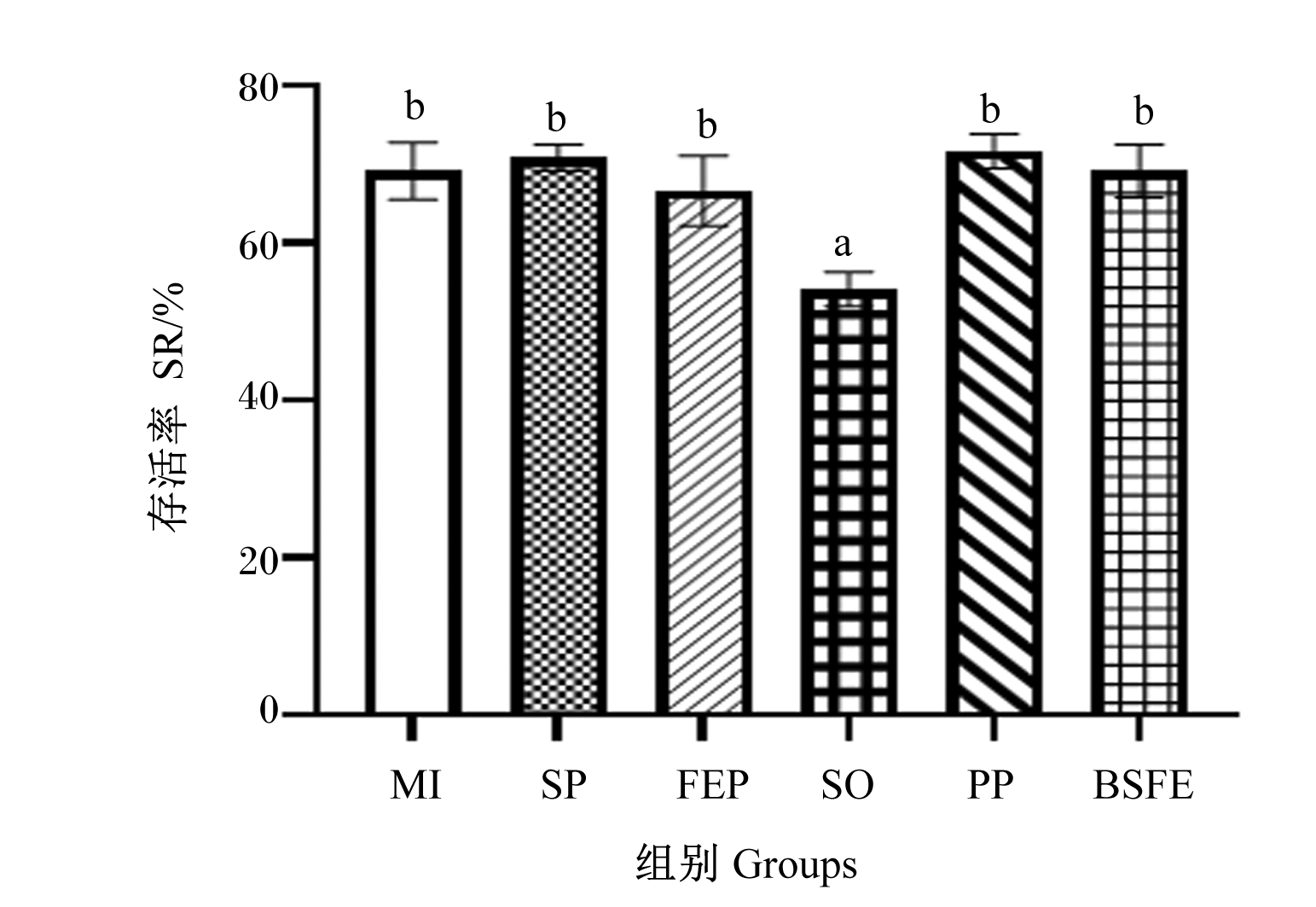
图3可知,离水应激后,SO组SR显著低于其他组(P<0.05)。
图3 微颗粒饲料添加5种新型原料对大口黑鲈仔稚鱼离水应激后存活率的影响

Fig.3 Effects of microdiets supplemented with five new materials on SR of largemouth bass larvae and juveniles after air-exposure stress (n=3)

3 讨论

3.1 不同微颗粒饲料的物理性质

水中溶失率是评价水产饲料品质的重要指标,较低的溶失率有助于减少饲料营养成分在水中的流失,从而提高摄食效率[20]。本研究中,MI和BSFE组的溶失率显著低于SP、FEP和PP组,这可能与所用原料特性及加工工艺的差异有关。其中,PP组的溶失率最高,表明该饲料在水中稳定性较差,易造成水质浑浊及饲料浪费,这也可能是导致该组大口黑鲈仔稚鱼SR偏低的原因之一。容重是衡量水产饲料物理质量的关键参数,通常与膨化率呈负相关关系[21]。本试验中,MI组的容重低于其余各组,说明自制饲料在膨化工艺方面仍不及商业饲料,这可能影响大口黑鲈仔稚鱼的摄食行为,进而导致自制饲料组的FCR偏高。后续可通过对5种微颗粒饲料进行壳聚糖涂层微胶囊化处理[2],缩小与进口商业饲料物理性质的差异。

3.2 微颗粒饲料添加5种新型原料对大口黑鲈仔稚鱼生长性能和体成分的影响

生长性能是评价水产饲料配方优劣的关键指标之一。在本研究中,与MI组相比,BSFE组的终末体长、终末体重、WGR有升高趋势,初步表明添加黑水虻酵素的饲料具有替代进口商业饲料的潜力,不会对大口黑鲈仔稚鱼生长造成负面影响。本研究结果与Xu等[22]在大口黑鲈幼鱼[初始体重:(6.03±0.01) g]上的研究结果类似。同时,进一步研究发现,虽然发酵蚯蚓膏和黑水虻酵素均为动物性蛋白质原料,但BSFE组大口黑鲈仔稚鱼的终末体长和SGR显著高于FEP组,猜测原因:一是添加黑水虻酵素饲料的总氨基酸和n-3多不饱和脂肪酸(PUFA)含量优于添加发酵蚯蚓膏饲料,更有利于大口黑鲈仔稚鱼生长;二是发酵蚯蚓膏和黑水虻酵素原料都能够产生诱食性香味[23-24],但大口黑鲈仔稚鱼可能更偏好黑水虻酵素原料,从而提高其摄食量,促进生长。PP组的终末体长、终末体重和WGR与FEP组接近,优于SP和SO组,表明富含β-葡聚糖、核苷酸和有机微量元素等的酵母[25]促进了鱼类的摄食和机体健康,具有替代动、植物性蛋白质原料的潜能,这也反映在PP组的VSI和HSI上。SP和SO组的终末体长、终末体重和WGR均出现低于其他组的现象,原因可能是钝顶螺旋藻粉和豆奶宝均属于植物性蛋白质原料,其中所含的较高纤维素、异味物质以及抗营养因子或毒素,抑制了大口黑鲈仔稚鱼的摄食[26-27],进而降低其消化吸收效率,最终影响生长。综上可知,在微颗粒饲料中添加黑水虻酵素、发酵蚯蚓膏或毕赤酵母,均能有效促进大口黑鲈仔稚鱼的生长。
鱼类体成分的变化是营养物质经消化吸收后在体内代谢与转化沉积的结果,能够反映鱼体的生长发育及代谢状况[28]。本研究发现,MI和BSFE组的全鱼粗蛋白质含量均高于其余各组,这可能与其饲料中氨基酸组成较为丰富有关,从而促进了大口黑鲈仔稚鱼体内蛋白质的合成。

3.3 微颗粒饲料添加5种新型原料对大口黑鲈仔稚鱼肝脏健康的影响

除生长性能外,消化系统的形态结构与生化状态变化亦是重要的研究参数。肝脏作为主要的营养贮存器官,在蛋白质、脂质及糖类的分解与合成代谢中发挥着关键作用。已有研究指出,饲料中较高的n-6 PUFA含量可诱导鱼类肝脏发生病理性改变[29]。本研究中,与进口商业饲料中相比,添加黑水虻酵素饲料中n-6 PUFA含量虽较高,但其对应的BSFE组中大口黑鲈仔稚鱼的肝脏中表现出更高的胰蛋白酶与脂肪酶活性,且血清ALT、AST活性较低,肝细胞排列整齐,这表明在微颗粒饲料中添加黑水虻酵素并未对大口黑鲈仔稚鱼肝脏造成不良影响,验证了该原料的安全性,该结果与吉富罗非鱼仔鱼上的相关报道[15]一致。添加发酵蚯蚓膏饲料中n-6 PUFA含量也较高,其对应的FEP组中大口黑鲈仔稚鱼肝脏中脂肪酶活性较强、AST活性较低、GLU含量较高,且肝脏切片形态正常。这可能与蚯蚓中含有的具有降脂功能的特殊酶类(如蚓激酶、纤维蛋白原酶等)有关[30],这些酶能够促进仔稚鱼的脂质代谢,从而改善肝脏健康状态。添加毕赤酵母饲料中n-6 PUFA含量也较高,但其对应的PP组中大口黑鲈仔稚鱼肝脏中ALT活性在各组中是最低的,肝脏切片未见病变,推测原因在于毕赤酵母细胞壁成分(如β-葡聚糖与甘露糖蛋白)能够激活机体免疫系统[31],帮助仔稚鱼动态调节脂质代谢平衡,从而维持肝脏健康。添加发酵蚯蚓膏饲料中n-6 PUFA含量较高,但其肝脏脂肪酶、AST活性低和GLU含量较高,肝脏切片正常,可能是蚯蚓中具有降脂功能的特殊酶(蚓激酶和纤维蛋白原酶)[30],可促进仔稚鱼的脂质代谢,从而改善肝脏健康。添加毕赤酵母饲料中n-6 PUFA含量也较高,但其ALT活性最低,肝脏切片无病变,推测原因是由于毕赤酵母的细胞壁成分(β-葡聚糖和甘露糖蛋白)可以激活免疫系统[31],使大口黑鲈仔稚鱼可以动态调节脂质代谢平衡,不会损伤肝脏健康。SP与SO组大口黑鲈仔稚鱼肝脏中胰蛋白酶、脂肪酶活性较低,GLU含量较高,且肝脏切片均观察到炎性细胞浸润,推测这可能与添加钝顶螺旋藻粉或豆奶宝的饲料中含有过量抗营养因子或不可消化物质有关。此外,这2种饲料的n-3 PUFA含量较低,可能导致脂肪在肝脏内蓄积而难以被利用或转运至肝外组织储存,从而引起HSI升高[32],造成肝脏损伤,使鱼体长期处于代谢失调的亚健康状态,后续研究可进一步优化饲料中钝顶螺旋藻粉与豆奶宝的添加比例。

3.4 微颗粒饲料添加5种新型原料对大口黑鲈仔稚鱼肠道健康的影响

鱼类肠道消化酶活性、绒毛厚度及肌层厚度等指标常用于评估其肠道发育与健康状态[33]。本研究中,与MI组相比,BSFE组大口黑鲈仔稚鱼肠道中胰蛋白酶活性更高,绒毛厚度与肌层厚度最优,肠道形态结构完整,表明黑水虻酵素中不含过敏原或其他损伤肠上皮细胞的物质,能够改善肠道结构,从而促进营养物质的吸收。然而,SP组大口黑鲈仔稚鱼肠道出现淋巴组织小灶性浸润,部分肠绒毛萎缩、粘连,说明大口黑鲈仔稚鱼对钝顶螺旋藻粉存在不适应现象。此结果与先前在大口黑鲈幼鱼(初始体重13 g)中的研究结论[34]不一致,推测原因在于仔稚鱼消化系统及肠道发育尚不完善,对饲料原料的耐受性与幼鱼存在差异。后续研究可尝试对钝顶螺旋藻粉进行去细胞壁处理,再应用于微颗粒饲料的配方优化中。SO组大口黑鲈仔稚鱼肠道结构紊乱,部分肌层与浆膜层出现断裂,该现象与多种水产动物的相关研究结果[35-36]一致。其原因可能在于豆粕类原料中存在大量抗营养因子(如大豆抗原蛋白、水苏糖、植物凝集素等),其中凝集素可与肠道上皮细胞表面的多糖结合,破坏微绒毛结构,进而影响水产动物肠道健康。具体作用机制未来可结合肠道菌群、代谢组学等手段开展进一步研究。

3.5 微颗粒饲料添加5种新型原料对大口黑鲈仔稚鱼抗氧化与抗应激能力的影响

抗氧化酶活性与鱼类健康状态密切相关,当活性氧(ROS)生成与抗氧化防御之间的动态平衡被打破时,抗氧化酶活性可作为反映氧化应激程度的关键指标[37]。本研究发现,在离水应激前,MI、FEP与BSFE组大口黑鲈仔稚鱼肝脏中LZM、CAT活性及T-AOC均维持在较高水平,该结果与在黄河鲤(Cyprinus carpio L.)[38]、大鳞副泥鳅(Paramisgurnus dabryanus)[39]及非洲鲶鱼(Clarias gariepinus)[40]中的相关报道一致。其原因可能在于:发酵蚯蚓膏与黑水虻酵素均经过发酵处理,此过程中微生物代谢可将大分子蛋白质降解为具有较强抗氧化活性的多肽类物质,同时有助于减少几丁质的沉积[41];此外,添加这2种新型原料的饲料中较高的n-3 PUFA含量也可能通过激活核因子E2相关因子2(Nrf2)通路抑制细胞内过氧化氢(H2O2)的产生[42],从而在一定程度上增强机体的抗氧化能力。以上结果表明,发酵蚯蚓膏与黑水虻酵素在淡水肉食性仔稚鱼的商品化饲料配方中具有一定的应用潜力。
本研究对大口黑鲈仔稚鱼进行了10 min的离水应激处理,结果显示,相较于添加其他新鲜饲料,添加黑水虻酵素的饲料能够提升大口黑鲈仔稚鱼的抗应激能力,并抑制肝脏中MDA含量的升高。推测这可能与其饲料中富含的抗菌肽和月桂酸有关[17],这些成分有助于鱼类在应激状态下启动保护性免疫机制,减轻脂质过氧化损伤。应激后,PP组大口黑鲈仔稚鱼肝脏中免疫与抗氧化指标与MI组较为接近,表明毕赤酵母通过表达抗菌肽[43-44],有效增强了仔稚鱼的应激耐受性。相比之下,SO组大口黑鲈仔稚鱼的SR最低,肝脏中LZM活性和T-AOC则在应激后急剧上升,反映出其处于高度应激状态并伴随大量死亡。值得注意的是,在应激后SP组大口黑鲈仔稚鱼的SR显著高于SO组,这可能得益于钝顶螺旋藻粉中含有的β-胡萝卜素、藻蓝蛋白等活性物质[45],能够在一定程度上缓解氧化应激。此外,比较离水应激前后的整体数据发现,各组大口黑鲈仔稚鱼肝脏中免疫指标的变化较抗氧化指标更为显著。推测是因为应激初期,机体优先将能量用于修复物理损伤和启动免疫防御;而抗氧化系统的激活通常需要细胞内ROS累积至一定阈值,因此响应相对滞后[46]

4 结论

在本试验设定的4%添加水平下,微颗粒饲料中添加发酵蚯蚓膏、毕赤酵母或黑水虻酵素均能通过提高消化酶活性、改善肝脏与肠道健康以及增强抗应激能力,促进大口黑鲈仔稚鱼的生长,其中以黑水虻酵素的效果最佳;相比之下,钝顶螺旋藻粉与豆奶宝的适用性较差,不仅抑制大口黑鲈仔稚鱼生长,还会对其肝脏和肠道组织造成损伤。
[1]
中华人民共和国农业农村部渔政管理局,全国水产技术推广总站,中国水产学会. 2025中国渔业统计年鉴[M]. 北京: 中国农业出版社, 2025.

Fisheries Administration Bureau,Ministry of Agriculture and Rural Affairs,the People’s Republic of China,National Aquaculture Technology Promotion Station,China Society of Fisheries. 2025 China fishery statistical yearbook[M]. Beijing: China Agricultural Press,2025.

[2]
LIU J H, XU W X, LIU Y T, et al. Effects of chitosan-coated microdiet on dietary physical properties,growth performance,digestive enzyme activities,antioxidant capacity,and inflammation response of large yellow croaker (Larimichthys crocea) larvae[J]. Aquaculture Nutrition, 2022, 2022(1):4355182.

[3]
OLIVEIRA L C C DE, COSTA L G B, EIRAS B J C F, et al. Feeding strategy induces compensatory growth in Heros severus fingerlings,an Amazonian ornamental fish[J]. Aquaculture Reports, 2020, 18:100436.

DOI

[4]
王振杰. 大豆酶解蛋白在大口黑鲈仔稚鱼及幼鱼饲料中的应用[D]. 硕士学位论文. 上海: 上海海洋大学, 2023.

WANG Z J. Application of soybean enzymatic hydrolysis protein in feeding for largemouth bass larvae and juveniles[D]. Master’s Thesis. Shanghai: Shanghai Ocean University, 2023. (in Chinese)

[5]
任兰兰. 饲料不同蝇蛆粉和蛋黄粉水平对大口黑鲈仔稚鱼生长性能、氨基酸、抗氧化及免疫性能的影响[D]. 硕士学位论文. 武汉: 华中农业大学, 2023.

REN L L. Effects of different levels of fly maggot powder and egg yolk powder in feed on the growth,amino acid,antioxidant and immune performance of larve largemouth bass[D]. Master’s Thesis. Wuhan: Huazhong Agricultural University, 2023. (in Chinese)

[6]
李诗洋. 蛋白质及蛋氨酸、赖氨酸水平对大口黑鲈稚鱼生长和免疫的影响研究[D]. 硕士学位论文. 广州: 仲恺农业工程学院, 2023.

LI S Y. Effects of protein,methionine and lysine levels on growth and immunity of juvenile largemouth bass (Micropterus salmoides)[D]. Master’s Thesis. Guangzhou: Zhongkai University of Agriculture and Engineering, 2023. (in Chinese)

[7]
梁浩辉. 大口黑鲈稚鱼对饲料中维生素B1、B6、C需求量的研究[D]. 硕士学位论文. 湛江: 广东海洋大学, 2024.

LIANG H H. Vitamin B1,B6,C requirements of largemouth bass (Micropterus salmoides) in diets for larvers[D]. Master’s Thesis. Zhanjiang: Guangdong Ocean University, 2024. (in Chinese)

[8]
李瑜琬, 梁浩辉, 覃瑶, 等. 大口黑鲈仔稚鱼早期发育及对不同饲料原料的选择性试验[J]. 广东农业科学, 2025, 52(3):100-112.

LI Y W, LIANG H H, QIN Y, et al. Early development of larvae and juvenile of largemouth bass (Micropterus salmoides) and selective experiment on different feed ingredient[J]. Guangdong Agricultural Sciences, 2025, 52(3):100-112. (in Chinese)

[9]
ALAGAWANY M, TAHA A E, NORELDIN A, et al. Nutritional applications of species of Spirulina and Chlorella in farmed fish:a review[J]. Aquaculture, 2021, 542:736841.

DOI

[10]
TEIMOURI M, AMIRKOLAIE K A, YEGANEH S. The effects of Spirulina platensis meal as a feed supplement on growth performance and pigmentation of rainbow trout (Oncorhynchus mykiss)[J]. Aquaculture, 2013, 396/399:14-19.

DOI

[11]
AWAD L Z, EL-MAHALLAWY H S, ABDELNAEIM N S, et al. Role of dietary Spirulina platensis and betaine supplementation on growth,hematological,serum biochemical parameters,antioxidant status,immune responses,and disease resistance in Nile tilapia[J]. Fish & Shellfish Immunology, 2022, 126:122-130.

[12]
SUN D, HOU D Q, ZHENG Y S, et al. Multi-omics reveals the effects of Spirulina platensis powder replacement of fish meal on intestinal metabolism and stress in zig-zag eel (Mastacembelus armatus)[J]. Antioxidants, 2024, 13(7):851.

DOI

[13]
ISLAM F, SALAM M A, RAHMAN M A, et al. Plant endophytic yeasts Pichia fermentans and Meyerozyma caribbica improve growth,biochemical composition,haematological parameters and morphology of internal organs of premature Barbonymus gonionotus[J]. Aquaculture Reports, 2021, 19:100575.

DOI

[14]
黄文庆, 李瑜琬, 黄燕华, 等. 饲料中添加黑水虻酵素对杂交鳢生长性能、体组成、血清生化和肝脏抗氧化指标的影响[J]. 广东畜牧兽医科技, 2024, 49(4):49-53,90.

DOI

HUANG W Q, LI W Y, HUANG Y H, et al. Effects of dietary supplementation of black soldier fly enzyme on growth performance,body composition,serum biochemistry,and liver antioxidant indicators of hybrid snakehead[J]. Guangdong Journal of Animal and Veterinary Science, 2024, 49(4):49-53,90. (in Chinese)

[15]
PERERA G S C, ATHUKORALA D A, NETHMI ASHINSANI M G, et al. Substituting the fishmeal with solid-state-fermented black soldier fly (Hermetia Illucens) larvae meal in GIFT tilapia (Oreochromis niloticus) fry diet:effects for growth performance,carcass composition and liver histology[J]. Annals of Animal Science, 2025, 25(3):1129-1139.

DOI

[16]
朱喜锋, 黄文庆, 李国立, 等. 发酵黑水虻对杂交鳢生长性能、体成分及抗氧化和免疫能力的影响[J]. 中国畜牧兽医, 2024, 51(9):3807-3816.

DOI

ZHU X F, HUANG W Q, LI G L, et al. Effects of fermented black solider fly (Hermetia illucens L.) on growth performance,body composition,antioxidant and immune ability of hybrid snakehead[J]. China Animal Husbandry & Veterinary Medicine, 2024, 51(9):3807-3816. (in Chinese)

[17]
郑雨顺, 陈桂琼, 黄文庆, 等. 发酵黑水虻对斑点叉尾鮰生长、肝脏生化指标、消化吸收和免疫力的影响[J]. 动物营养学报, 2025, 37(3):1940-1953.

DOI

ZHENG Y S, CHEN G Q, HUANG W Q, et al. Effects of fermented black soldier fly on growth,liver biochemical indices,digestion and absorption and immunity of channel catfish (Ictalurus punctatus)[J]. Chinese Journal of Animal Nutrition, 2025, 37(3):1940-1953. (in Chinese)

[18]
刘峰. 大黄鱼和半滑舌鳎仔稚鱼人工微颗粒饲料蛋白源选择及其加工工艺相关研究[D]. 博士学位论文. 青岛: 中国海洋大学, 2007.

LIU F. A study on protein soucres screen and processing-related technics in artificial microdiet for larvae of large yellow croaker (Pseudosciaena crocea) and tongue sole (Cynoglossus semilaevis)[D]. Ph.D.Thesis. Qingdao: Ocean University of China, 2007. (in Chinese)

[19]
AOAC. Official methods of analysis of AOAC International[S]. New York: Oxford University Press, 2023.

[20]
刘荣达, 王昊, 邢淑娟, 等. 原料及关键工艺参数对水产膨化饲料物理质量影响研究进展[J]. 饲料工业, 2023, 44(12):16-24.

LIU R D, WANG H, XING S J, et al. Effects of ingredients and processing parameters on the physical qualities of extruded aquatic feed[J]. Feed Industry, 2023, 44(12):16-24. (in Chinese)

[21]
AYADI F Y, FALLAHI P, ROSENTRATER K A, et al. Modeling single-screw extrusion processing parameters and resulting extrudate properties of DDGS-based Nile tilapia (Oreochromis niloticus) feeds[J]. Journal of Food Research, 2013, 2(2):11-28.

[22]
XU F M, HOU S W, WANG G X, et al. Effects of zymolytic black soldier fly (Hermetia illucens) pulp as dietary supplementation in largemouth bass (Micropterus salmoides)[J]. Aquaculture Reports, 2021, 21:100823.

DOI

[23]
王晗雅, 王世迪, 刘烊廷, 等. 蚯蚓在水产养殖中的研究应用[J]. 饲料研究, 2024, 47(13):147-151.

WANG H Y, WANG S D, LIU Y T, et al. Research and application of earthworms in aquaculture[J]. Feed Research, 2024, 47(13):147-151. (in Chinese)

[24]
王国霞, 莫文艳, 范怡杰, 等. 黑水虻对杂交鳢生长、肌肉组成和血清指标的影响[J]. 水产科学, 2019, 38(5):603-609.

WANG G X, MO W Y, FAN Y J, et al. Effect of black soldier fly larvae on growth performance,muscular composition and serum indices of hybrid snakehead Channa argus×C.maculata[J]. Fisheries Science, 2019, 38(5):603-609. (in Chinese)

[25]
NAVARRETE P, TOVAR-RAMÍREZ D. Use of yeasts as probiotics in fish aquaculture[M]// HERNANDEZ-VERGARAM P, PEREZ-ROSTROC I. Sustainableaquaculture techniques. London:IntechOpen, 2014.

[26]
邹圆. 大口黑鲈(Micropterus salmoides)对17种饲料原料的表观消化率研究[D].硕士学位论文. 舟山: 浙江海洋大学, 2021.

ZOU Y. Apparent digestibility of 17 raw materials by largemouth bass (Micropterus salmoides)[D]. Master’s Thesis. Zhoushan: Zhejiang Ocean University, 2021. (in Chinese)

[27]
FRANCIS G, MAKKAR H P S, BECKER K. Antinutritional factors present in plant-derived alternate fish feed ingredients and their effects in fish[J]. Aquaculture, 2001, 199(3/4):197-227.

DOI

[28]
费树站, 康茄敏, 张军豪, 等. 低蛋白质饲料中补充必需氨基酸对斑鳢幼鱼生长性能、肌肉氨基酸组成、血浆生化指标及肝脏氨基酸代谢相关基因表达的影响[J]. 动物营养学报, 2024, 36(12):7930-7942.

DOI

FEI S Z, KANG J M, ZHANG J H, et al. Influences of low protein diet supplemented with essential amino acids on growth performance,muscle amino acid composition,plasma biochemical indexes and expression of amino acid metabolism-related genes in liver of juvenile blotched snakehead (Channa maculate)[J]. Chinese Journal of Animal Nutrition, 2024, 36(12):7930-7942. (in Chinese)

[29]
MONTERO D, MATHLOUTHI F, TORT L, et al. Replacement of dietary fish oil by vegetable oils affects humoral immunity and expression of pro-inflammatory cytokines genes in gilthead sea bream Sparus aurata[J]. Fish & Shellfish Immunology, 2010, 29(6):1073-1081.

[30]
WANG X M, FAN S C, CHEN Y, et al. Earthworm protease in anti-thrombosis and anti-fibrosis[J]. Biochimica et Biophysica Acta:General Subjects, 2019, 1863(2):379-383.

DOI

[31]
ABDEL-TAWWAB M, ABDEL-RAHMAN A M, ISMAEL N E M. Evaluation of commercial live bakers’ yeast,Saccharomyces cerevisiae as a growth and immunity promoter for fry Nile tilapia,Oreochromis niloticus (L.) challenged in situ with Aeromonas hydrophila[J]. Aquaculture, 2008, 280(1/4):185-189.

DOI

[32]
LI Y, ZHAO Y T, ZHANG Y K, et al. Growth performance,fatty acid composition,peroxisome proliferator-activated receptors gene expressions,and antioxidant abilities of blunt snout bream,Megalobrama amblycephala,fingerlings fed different dietary oil sources[J]. Journal of the World Aquaculture Society, 2015, 46(4):395-408.

DOI

[33]
徐茜, 杨正, 朱文娟, 等. 发酵豆粕替代鱼粉对鲫鱼生长、 血清生化指标及肠道结构的影响[J]. 饲料工业, 2021, 42(10):31-37.

XU Q, YANG Z, ZHU W J, et al. Effects of fermented soybean meal instead of fish meal on growth,serum biochemical indexes and intestinal structure of Carassius auratus[J]. Feed Industry, 2021, 42(10):31-37. (in Chinese)

[34]
ZHANG W Q, DENG Y Y, YANG Z X, et al. Effects of partial replacement of fishmeal with Spirulina platensis powder and addition of Spirulina platensis polysaccharide on growth,nutrition,antioxidant capacity and gut microbiota of Micropterus salmoides[J]. Aquaculture, 2024, 586:740802.

DOI

[35]
BUTTLE L G, BURRELLS A C, GOOD J E, et al. The binding of soybean agglutinin (SBA) to the intestinal epithelium of Atlantic salmon,Salmo salar and rainbow trout,Oncorhynchus mykiss,fed high levels of soybean meal[J]. Veterinary Immunology and Immunopathology, 2001, 80(3/4):237-244.

DOI

[36]
HU Y J, ZHANG J Z, XUE J J, et al. Effects of dietary soy isoflavone and soy saponin on growth performance,intestinal structure,intestinal immunity and gut microbiota community on rice field eel (Monopterus albus)[J]. Aquaculture, 2021, 537:736506.

DOI

[37]
HOSEINIFAR S H, YOUSEFI S, VAN DOAN H, et al. Oxidative stress and antioxidant defense in fish:the implications of probiotic,prebiotic,and synbiotics[J]. Reviews in Fisheries Science & Aquaculture, 2021, 29(2):198-217.

[38]
MI J L, LU R H, YAN X, et al. Evaluating the mixture of earthworm meal and wormcast as a protein source for common carp (Cyprinus carpio L.) based on growth performance,antioxidant,immune capacity,lipid metabolism and intestinal health[J]. Aquaculture Reports, 2022, 24:101118.

DOI

[39]
范涛, 刘毅, 明伟, 等. 蚯蚓粉替代鱼粉对大鳞副泥鳅生长、肌肉成分、血清生化指标及免疫性能的影响[J]. 中国水产科学, 2016, 23(6):1320-1331.

FAN T, LIU Y, MING W, et al. Effects of substituting fishmeal with earthworm (Eisenia foetida) meal on growth,muscle composition,serum biochemistry index and immunity performance in the loach Paramisgurnus dabryanus[J]. Journal of Fishery Sciences of China, 2016, 23(6):1320-1331. (in Chinese)

[40]
FAWOLE F J, ADEOYE A A, TIAMIYU L O, et al. Substituting fishmeal with Hermetia illucens in the diets of African catfish (Clarias gariepinus):effects on growth,nutrient utilization,haemato-physiological response,and oxidative stress biomarker[J]. Aquaculture, 2020, 518:734849.

DOI

[41]
GHAMRY M, ZHAO W, LI L. Impact of Lactobacillus apis on the antioxidant activity,phytic acid degradation,nutraceutical value and flavor properties of fermented wheat bran,compared to Saccharomyces cerevisiae and Lactobacillus plantarum[J]. Food Research International, 2023, 163:112142.

DOI

[42]
KUSUNOKI C, YANG L, YOSHIZAKI T, et al. Omega-3 polyunsaturated fatty acid has an anti-oxidant effect via the Nrf-2/HO-1 pathway in 3T3-L1 adipocytes[J]. Biochemical and Biophysical Research Communications, 2013, 430(1):225-230.

DOI PMID

[43]
HUO X C, WANG P X, ZHAO F X, et al. High-efficiency expression of a novel antimicrobial peptide I20 with superior bactericidal ability and biocompatibility in Pichia pastoris and its efficiency enhancement to aquaculture[J]. Aquaculture, 2024, 579:740149.

DOI

[44]
WANG P X, ZHAO F X, HUO X C, et al. Oral recombinant Pichia pastoris P-I20H combined with immunopotentiator curcumin remarkably inhibits and clears LMBV in largemouth bass (Micropterus salmoides)[J]. Aquaculture, 2024, 593:741361.

DOI

[45]
TEIMOURI M, YEGANEH S, MIANJI G R, et al. The effect of Spirulina platensis meal on antioxidant gene expression,total antioxidant capacity,and lipid peroxidation of rainbow trout (Oncorhynchus mykiss)[J]. Fish Physiology and Biochemistry, 2019, 45(3):977-986.

DOI

[46]
刘奇奇, 温久福, 区又君, 等. 急性离水操作胁迫对四指马鲅(Eleutheronema tetradactylum)幼鱼组织结构和氧化应激的影响[J]. 渔业科学进展, 2017, 38(6):48-55.

LIU Q Q, WEN J F, OU Y J, et al. The effects of acute off-water handling stress on the tissue structure and oxidative stress of juvenile Eleutheronema tetradactylum[J]. Progress in Fishery Sciences, 2017, 38(6):48-55. (in Chinese)

Outlines

/