

1 材料与方法
1.1 ZEA毒性预测
1.2 ZEA毒性靶点的获取
1.3 肝毒性相关靶点的获取
1.4 ZEA致肝毒性潜在靶点的获取
1.5 ZEA-肝毒性蛋白质-蛋白质相互作用(PPI)网络的构建和核心靶点筛选
1.6 GO功能与KEGG通路富集分析
1.7 ZEA与肝毒性靶点蛋白的分子对接
2 结果与分析
2.1 ZEA毒性预测
表1 ZEA毒性预测Table 1 Prediction of toxicity of ZEA |
| 属性 Proerties | 数据库 Database | 预测概率 Predicted probability |
|---|---|---|
| 肝毒性Hepatotoxicity | ProTox 3.0 | ++ |
| 肝毒性Hepatotoxicity | ADMETlab 2.0 | +++ |
图中预测概率以符号表示:“-”表示[0.3,0.5),“+”表示[0.5,0.7),“++”表示[0.7,0.9),“+++”表示[0.9,1.0]。这些概率值可作为评估潜在毒性风险的参考指标,概率越高,毒性风险越大。 | |
In the figure, predicted probabilities are denoted by symbols: “-” represents [0.3, 0.5), “+” represents [0.5, 0.7), “++” represents [0.7, 0.9), and “+++” represents [0.9,1.0]. These probability values can serve as reference indicators for assessing potential toxicity risks, with higher probabilities suggesting a greater risk of toxicity. |
表2 ZEA代谢靶点预测Table 2 Prediction of metabolism targets of ZEA |
| 代谢酶靶点 Metabolic Enzyme targets | 预测结果 Prediction result | 相互作用类型 Interaction type | 可能性 Probability |
|---|---|---|---|
| 细胞色素P450 1A2 CYP1A2 | 不代谢 | 代谢 | 0.83 |
| 细胞色素P450 2C19 CYP2C19 | 不代谢 | 代谢 | 0.81 |
| 细胞色素P450 2C9 CYP2C9 | 不代谢 | 代谢 | 0.58 |
| 细胞色素P450 2D6 CYP2D6 | 不代谢 | 代谢 | 0.81 |
| 细胞色素P450 3A4 CYP3A4 | 代谢 | 代谢 | 0.89 |
| 细胞色素P45 03A4 CYP3A4 | 不代谢 | 代谢 | 0.99 |
2.2 ZEA毒性靶点的获取
2.3 肝毒性相关靶点的获取
2.4 ZEA致肝毒性潜在靶点的获取
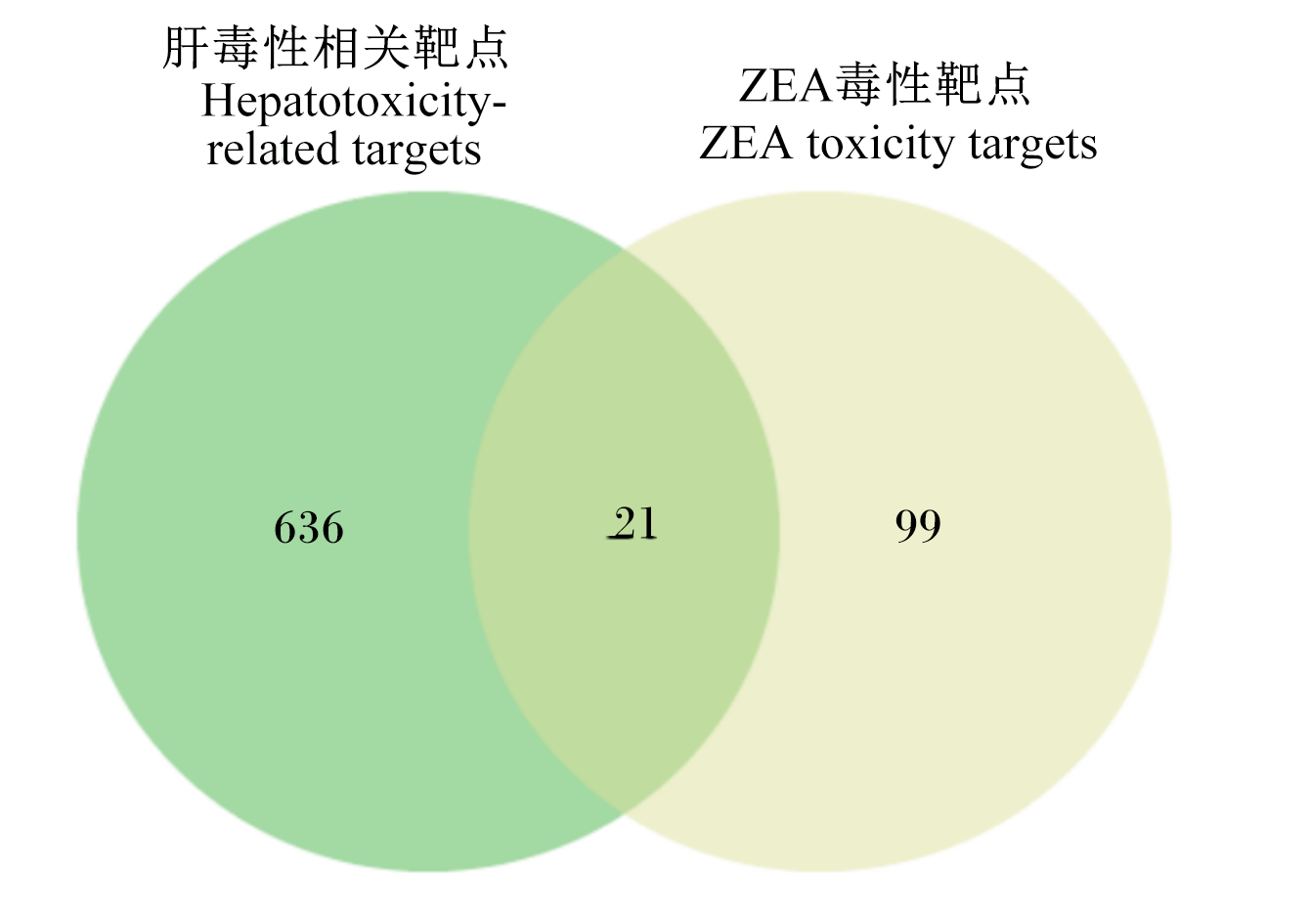
2.5 ZEA-肝毒性PPI网络的构建

图2 化合物-靶点-疾病网络图(A)、PPI网络图(B)与核心靶点筛选网络图(C)限于篇幅,仅对度值排名前8的靶点的英文简写进行注释 due to space limitations, only the abbreviations of the top 8 targets by degree value are annotated。STAT3:信号转导与转录激活因子3 signal transducer and activator of transcription 3;HSP90AA1:热休克蛋白90αA1 heat shock protein 90 alpha family class a member 1;MMP9:基质金属蛋白酶9 matrix metallopeptidase 9;ESR1:雌激素受体1 estrogen receptor 1;MAPK1:丝裂原活化蛋白激酶1 mitogen-activated protein kinase 1;MAPK3:丝裂原活化蛋白激酶3 mitogen-activated protein kinase 3;MMP2:基质金属蛋白酶2 matrix metallopeptidase 2;MTOR:哺乳动物雷帕霉素靶蛋白 mechanistic target of rapamycin。图5和图6同 the same as Fig.5 and Fig.6。 Fig.2 Compound-target-disease network diagram (A), PPI network diagram (B) and core target screening network diagram (C) |
表3 度值排前8位的核心靶点的信息Table 3 Information on top 8 core targets by degrees |
| 靶点名称Target names | 介度Betweenness | 紧密度Closeness | 度值Degree |
|---|---|---|---|
| 信号转导与转录激活因子3 STAT3 | 30.890 476 190 476 190 | 0.950 000 000 000 000 0 | 18 |
| 热休克蛋白90αA1 HSP90AA1 | 23.990 476 190 476 187 | 0.904 761 904 761 904 8 | 17 |
| 基质金属蛋白酶9 MMP9 | 27.923 809 523 809 524 | 0.904 761 904 761 904 8 | 17 |
| 雌激素受体1 ESR1 | 13.523 809 523 809 526 | 0.826 086 956 521 739 1 | 15 |
| 丝裂原活化蛋白激酶1 MAPK1 | 14.404 761 904 761 903 | 0.826 086 956 521 739 1 | 15 |
| 丝裂原活化蛋白激酶3 MAPK3 | 12.018 253 968 253 969 | 0.791 666 666 666 666 6 | 14 |
| 基质金属蛋白酶2 MMP2 | 12.278 571 428 571 427 | 0.791 666 666 666 666 6 | 14 |
| 哺乳动物雷帕霉素靶蛋白MTOR | 5.799 999 999 999 999 | 0.791 666 666 666 666 6 | 14 |
2.6 GO功能和KEGG通路富集分析
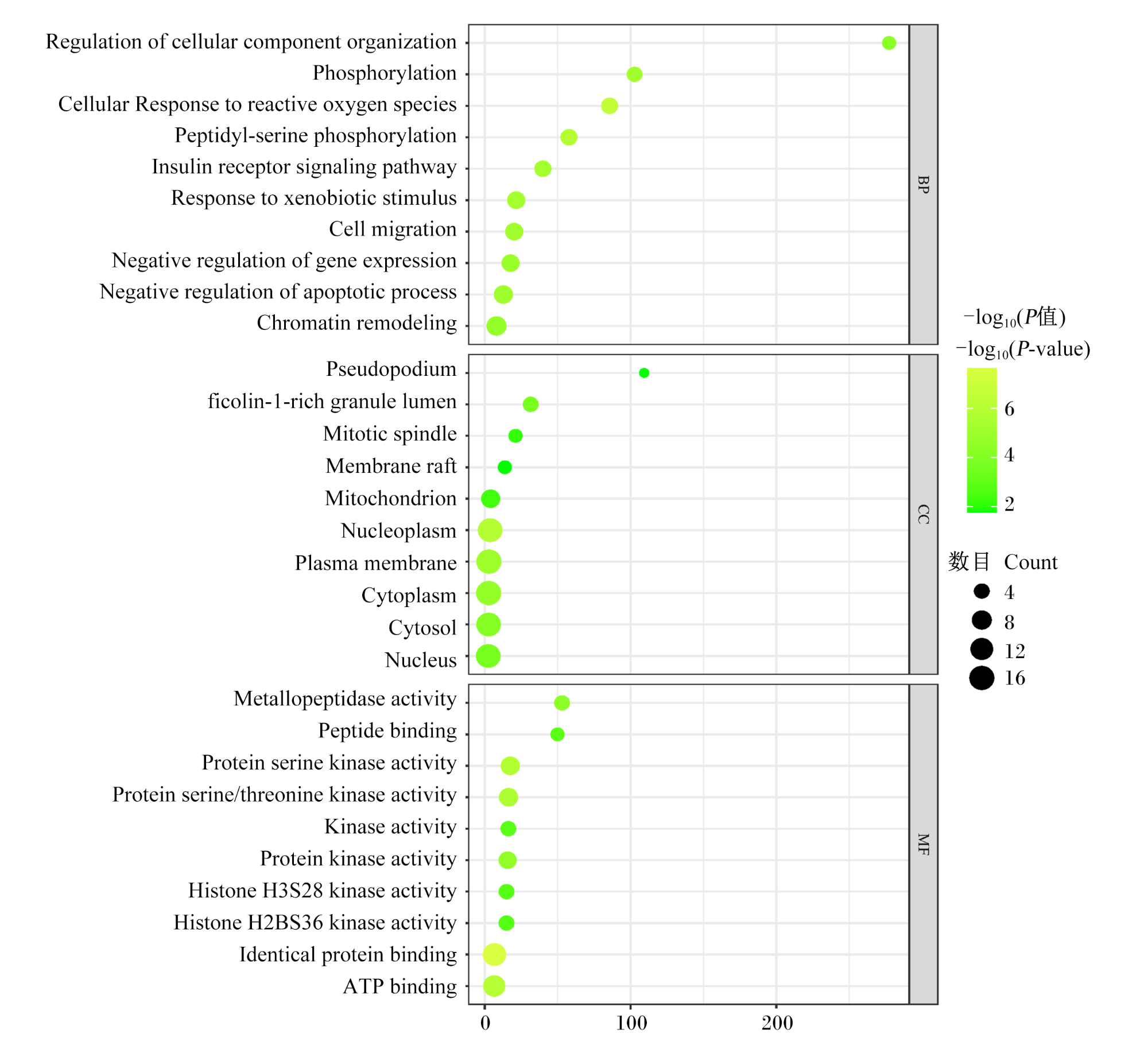
图3 GO功能富集分析结果BP:生物过程 biological process;CC:细胞组分 cellular component;MF:分子功能molecular function;Regulation of cellular component organization:细胞组分组织的调控;Phosphorylation:磷酸化;Cellular Response to reactive oxygen species:细胞对活性氧物种的反应;Peptidyl-serine phosphorylation:肽基-丝氨酸磷酸化;Insulin receptor signaling pathway:胰岛素受体信号通路;Response to xenobiotic stimulus:对外源性刺激的反应;Cell migration:细胞迁移;Negative regulation of gene expression:基因表达的负向调控;Negative regulation of apoptotic process:细胞凋亡过程的负向调控;Chromatin remodeling:染色质重构;Pseudopodium:伪足;ficolin-1-rich granule lumen:富集ficolin-1的颗粒腔;Mitotic spindle:有丝分裂纺锤体;Membrane raft:膜筏;Mitochondrion:线粒体;Nucleoplasm:核质;Plasma membrane:质膜;Cytoplasm:细胞质;Cytosol:细胞溶质;Nucleus:细胞核;Metallopeptidase activity:金属肽酶活性;Peptide binding:肽结合;Protein serine kinase activity:蛋白质丝氨酸激酶活性;Protein serine/threonine kinase activity:蛋白质丝氨酸/苏氨酸激酶活性;Kinase activity:激酶活性;Protein kinase activity:蛋白激酶活性;Histone H3S28 kinase activity:组蛋白H3S28激酶活性;Histone H2BS36 kinase activity:组蛋白H2BS36激酶活性;Identical protein binding:同源蛋白结合;ATP binding:ATP结合。 Fig.3 Results of GO function enrichment analysis |
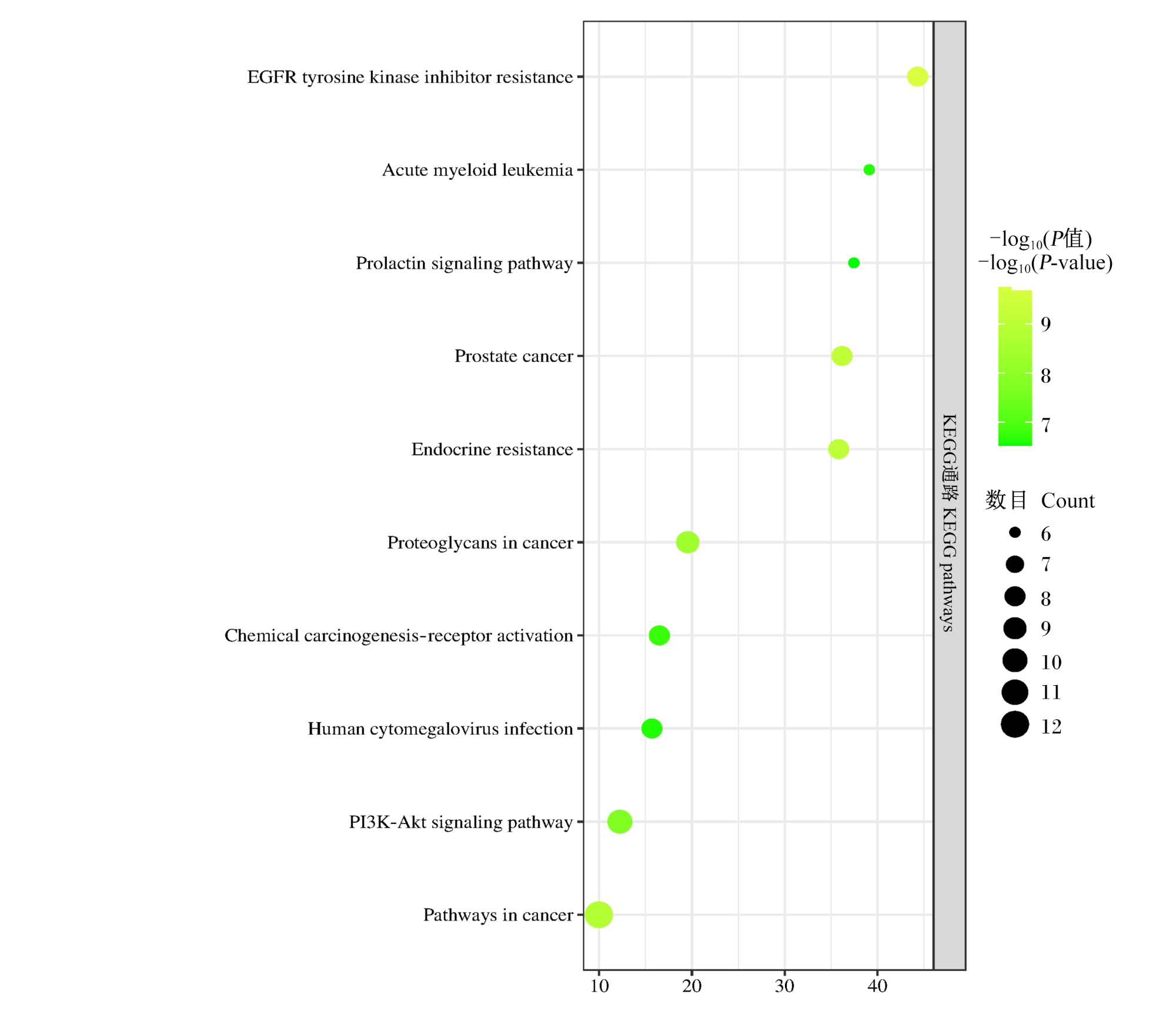
图4 KEGG通路富集分析结果EGFR tyrosine kinase inhibitor resistance:EGFR酪氨酸激酶抑制剂耐药性;Acute myeloid leukemia:急性髓系白血病;Prolactin signaling pathway:催乳素信号通路;Prostate cancer:前列腺癌;Endocrine resistance:内分泌耐药;Proteoglycans in cancer:癌症中的蛋白聚糖;Chemical carcinogenesis-receptor activation:化学致癌作用-受体激活;Human cytomegalovirus infection:人巨细胞病毒感染;PI3K-Akt signaling pathway:PI3K-Akt信号通路;Pathways in cancer:癌症通路。 Fig.4 Results of KEGG pathway enrichment analysis |

图5 核心靶点的通路富集分析Acute myeloid leukemia:急性髓系白血病;Lipid and atherosclerosis:脂质与动脉粥样硬化;Bladder cancer:膀胱癌;Th17 cell differentiation:Th17细胞分化;Prostate cancer:前列腺癌;Chemical carcinogenesis-receptor activation:化学致癌作用-受体激活;Estrogen signaling pathway:雌激素信号通路;Endocrine resistance:内分泌耐药;Pathways in cancer:癌症通路。 Fig.5 Pathway enrichment analysis of core targets |
2.7 ZEA致肝毒性核心靶点的分子对接


图6 分子对接可视化分析A:ZEA与ESR1的对接 docking of ZEA with ESR1;B:ZEA与HSP90的对接 docking of ZEA and HSP90;C:ZEA与MAPK1的对接 docking of ZEA and MAPK1;D:ZEA与MAPK3的对接 docking of ZEA and MAPK3;E:ZEA与MMP2的对接 docking of ZEA与MMP2;F:ZEA与MMP9的对接 docking of ZEA and MMP9;G:ZEA与MTOR的对接 docking of ZEA and MTOR;H:ZEA与STAT3的对接 docking of ZEA and STAT3;I:分子对接结合能示意图 schematic diagram of molecular docking binding free energy。 Fig.6 Molecular docking visualization analysis |