REVIEW

Research Progress on Relationship between Tryptophan and Metabolic Adaptation in Periparturient Dairy Cows

  • LUO Zhengzhong , 1, 2 ,
  • HUANG Yixin 3 ,
  • CAO Suizhong 3 ,
  • LI Jianxi , 1, 2, *
Expand
  • 1 Lanzhou Institute of Husbandry and Pharmaceutical Science, Chinese Academy of Agricultural Sciences, Lanzhou 730050, China
  • 2 Engineering & Technology Research Center of Traditional Chinese Veterinary Medicine of Gansu Province, Lanzhou 730050, China
  • 3 College of Veterinary Medicine, Sichuan Agricultural University, Chengdu 611130, China
*professor, E-mail:

Received date: 2025-09-16

  Online published: 2026-04-14

Abstract

The periparturient period in dairy cows, characterized by the transition from pregnancy to lactation, involves profound metabolic changes. Under healthy conditions, dairy cows undergo a series of metabolic adjustments around calving to meet the energy demands of lactation initiation. However, nearly all periparturient dairy cows experience varying degrees of negative energy balance and stress responses after calving. Excessive lipid mobilization and inflammatory responses can trigger postpartum metabolic disorders. Previous studies have shown that the concentrations of tryptophan and its metabolites have changed significantly in diseased dairy cows. Nevertheless, tryptophan metabolism encompasses multiple pathways, and its regulatory role and mechanisms in the progression of disease remains unclear. Therefore, this study aims to explore the association between tryptophan and metabolic adaptation in periparturient dairy cows, with the goal of elucidating tryptophan metabolic transitions under varying physiological and health conditions, and to provide insights into nutritional strategies that may improve metabolic adaptation and reduce the risk of postpartum diseases.

Cite this article

LUO Zhengzhong , HUANG Yixin , CAO Suizhong , LI Jianxi . Research Progress on Relationship between Tryptophan and Metabolic Adaptation in Periparturient Dairy Cows[J]. Chinese Journal of Animal Nutrition, 2026 , 38(4) : 2393 -2400 . DOI: 10.12418/CJAN2026.191

近20多年来奶牛围产期疾病的发病率一直居高不下,因病淘汰率也逐年增加,在奶牛整个生产周期中超过1/2的疾病发生在围产后期(产后21 d内),包括酮病、脂肪肝、皱胃移位、胎衣不下、低血钙症和子宫炎[1-2]。受生理、营养和环境等因素的影响,几乎所有的奶牛由妊娠经分娩过渡至泌乳时都表现出不同程度的能量负平衡(negative energy balance,NEB)、胰岛素敏感性降低和全身性炎症反应[3]。随着奶牛在适应泌乳启动时能量需求的增加,机体代谢会发生一系列的动态反应;而奶牛能否顺利过渡至泌乳期取决于机体的代谢适应能力,若代谢适应不良将出现过度的脂质动员、炎症失调和免疫抑制,最终导致围产后期代谢性或感染性疾病的发生[4]。从宏观角度看,奶牛的健康问题从分娩后开始“分流”;而从微观层面观察则可发现,奶牛在分娩前已表现出不同程度的代谢异常,分娩只是将产前已有的代谢问题进一步“放大”[5]
随着系统生物学研究手段的广泛应用,奶牛在不同生理和健康状态下的新兴生物标志物被不断发现。研究表明,奶牛由妊娠后期过渡至泌乳初期时血液中色氨酸浓度呈现显著动态变化,其代谢物犬尿氨酸被视为NEB的潜在标志物[6]。此外,奶牛在罹患酮病后色氨酸及其代谢物浓度发生显著变化,且血液中犬尿氨酸与色氨酸的比值随着非酯化脂肪酸(non-esterified fatty acids,NEFA)浓度升高而增加,提示色氨酸可能参与调控围产期代谢紊乱的发展进程[7]。目前的研究指出,色氨酸代谢物参与调控机体的葡萄糖代谢稳态、炎症反应、氧化应激等过程[8-9],而色氨酸代谢物在奶牛围产期的代谢适应进程中的作用尚不清楚。由此,通过了解色氨酸代谢与围产期奶牛不同生理和健康状态的关联性及色氨酸对糖与脂代谢稳态的调控路径,可为早期干预或纠正围产期代谢问题提供新的思路,为科学管理牛群提供新的策略。

1 围产期奶牛代谢适应与代谢挑战

1.1 适应性代谢反应

代谢适应是指机体在处于能量失衡状态下,体重减轻过程中伴随着新陈代谢改变的一种“生理学反击”[10]。目前,普遍认为奶牛由妊娠经分娩进入泌乳期时,摄入的能量无法满足泌乳所需的能量,奶牛将持续较长时间的NEB。为了适应NEB,脂肪组织对胰岛素的敏感性降低并增强脂解作用,此时脂肪细胞中甘油三酯(triglyceride,TG)水解生成NEFA,NEFA会被肝脏利用后重新组装成TG,NEFA也可经肉碱棕榈酰转移酶Ⅰ活化后进入线粒体氧化生成β-羟丁酸(β-hydroxybutyric acid,BHBA),最终TG、NEFA和BHBA可被乳腺利用生成乳汁[11]。与此同时,肝脏的糖异生作用会增强,以平衡机体对葡萄糖的需求。围产期奶牛的代谢适应进程如图1所示。
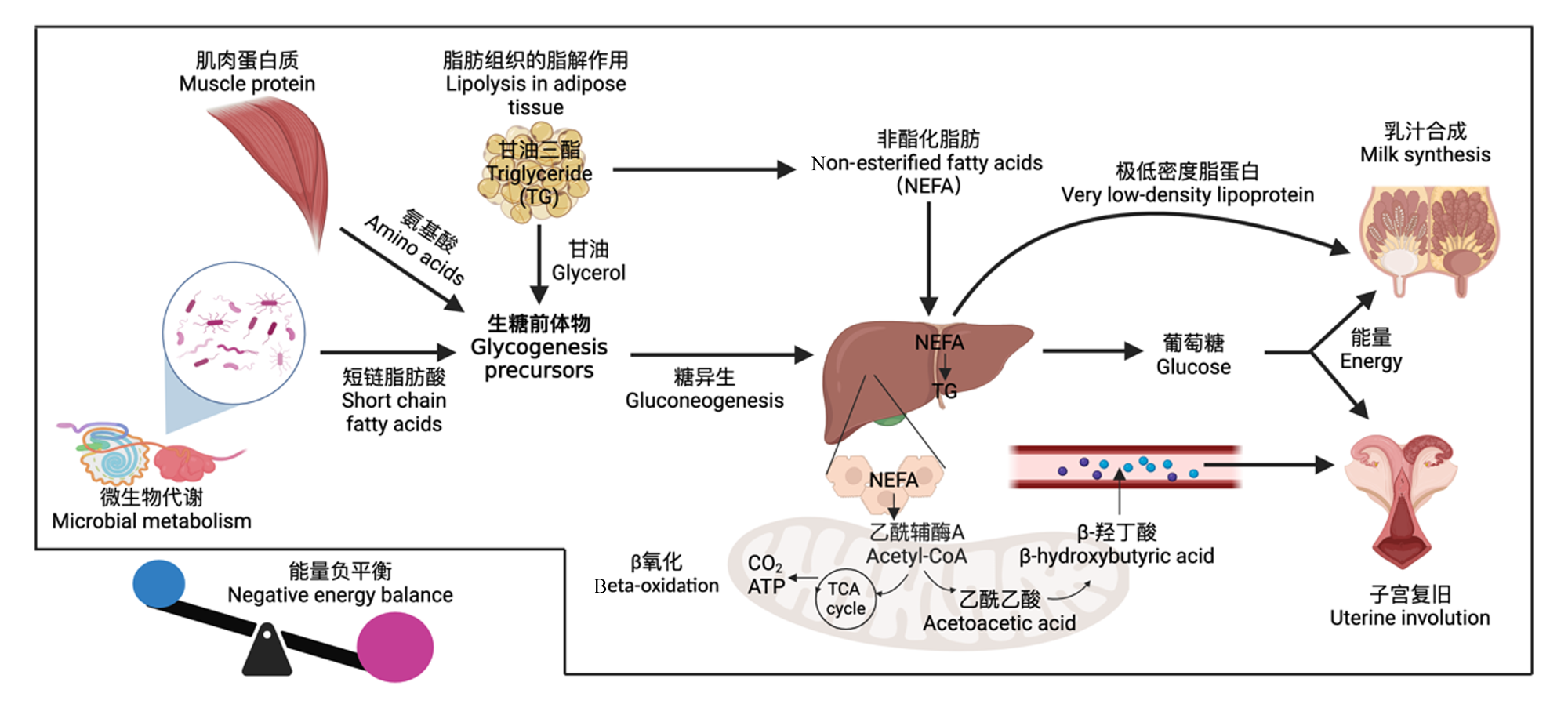
图1 奶牛由妊娠后期至泌乳初期过渡期间的代谢适应进程

TG:甘油三酯 triglyceride;TCA cycle:三羧酸循环 tricarboxylic acid cycle。

Fig.1 Progression of metabolic adaptation of dairy cows during transition from later gestation to early lactation[3]

1.2 代谢挑战

围产期奶牛在健康状态下,血液中NEFA和BHBA呈低浓度的动态变化;血液中NEFA(产前>0.3 mmol/L,产后>0.7 mmol/L)和BHBA(产前>0.7 mmol/L,产后>1.2 mmol/L)浓度呈现升高趋势,通常是发生代谢性疾病的诱因[5,12]。目前,血液中NEFA和BHBA的浓度被作为评价围产期奶牛NEB和脂质动员程度的重要指标。奶牛在围产期遭受的NEB和脂质动员在程度上存在差异,这种差异也将影响奶牛的代谢适应能力[13]。Ghaffari等[14]通过调研发现,肥胖奶牛和经产奶牛在产后罹患代谢性疾病的风险较高,其中重要的因素是这些奶牛在分娩时经历了更为严重的NEB和体重损失。奶牛在进入泌乳期后,血液中高浓度的NEFA会超出肝脏输出TG的能力,引起TG的大量积累,导致脂肪酸氧化水平的降低,进而减弱肝细胞的糖异生作用。当奶牛长时间处于高浓度NEFA、BHBA和低浓度葡萄糖状态时,机体将出现健康问题。“如何缓解围产期奶牛脂质动员和维持葡萄糖代谢稳态”一直是动物营养学者、临床兽医学工作者和牧场管理者共同关注的话题。

2 应用系统生物学方法探究奶牛在不同生理和健康状态下的色氨酸代谢差异

近年来,为解开“代谢性疾病是一种代谢物或多个代谢过程的内部稳态紊乱”和“一种代谢物、一种疾病的概念”的误解,研究学者将奶牛看作一个整体,把疾病看作是基因型、表现型和环境之间复杂的相互作用,逐渐形成“系统兽医学”方法论,并用于围产期奶牛疾病诊断、发病机制解析和预防策略的研究[15]。组学的方法已逐渐成为研究围产期奶牛疾病的重要手段,其中代谢组学可用于挖掘机体“已经发生的事”[16]。为阐明奶牛不同生理状态下的代谢水平,研究者们基于纵向的代谢组学研究发现,奶牛由妊娠后期经分娩过渡至泌乳初期时粪便和肝脏组织的氨基酸谱出现显著性差异[17-18]。在诸多氨基酸中,芳香族氨基酸的浓度在奶牛分娩时急剧降低,而在产后快速升高,并于泌乳初期时逐渐趋于稳定[19]
通过回顾和分析多个组学研究发现,芳香烃氨基酸中的色氨酸及其代谢物的浓度与血液中NEFA、BHBA、TG和葡萄糖的浓度相关。奶牛在罹患代谢性疾病时色氨酸代谢表现出不同程度的差异,如罹患酮病或皱胃左方变位奶牛血清中色氨酸和犬尿氨酸浓度降低,但色胺和吲哚乙酸浓度升高[20-21]。围产期奶牛疾病预警研究还发现,酮病奶牛的色氨酸代谢在表现临床特征前已发生显著改变[22]。围产后期罹患乳房炎的奶牛血清中色氨酸、犬尿氨酸和犬尿喹啉酸浓度均明显降低[23-24]。罹患子宫炎的奶牛血清中犬尿氨酸浓度显著升高,色氨酸浓度显著降低[25]。此外,饲粮中添加色氨酸[100 g/(d·头)]和过瘤胃色氨酸[220 g/(d·头)]已被证实能够显著提高奶牛在泌乳期的产奶量和抗氧化能力[26]。这些研究结果表明,色氨酸是奶牛代谢转变和疾病发生的特征性营养素。

3 色氨酸参与调控围产期奶牛代谢适应进程

3.1 色氨酸代谢路径

色氨酸代谢主要发生于肝脏、胃肠道和神经组织,由3条代谢途径组成,参与炎症调控、免疫反应、葡萄糖稳态、神经传递和维持上皮细胞功能等生物学进程(图2)。犬尿氨酸途径为色氨酸的主要代谢路径,且主要发生于肝脏,在限速酶色氨酸2,3-双加氧酶或肠道中吲哚胺2,3-双加氧酶的作用下生成犬尿氨酸,并进一步代谢生成犬尿酸或黄尿酸[27]。此外,犬尿氨酸经酶促作用生成喹啉酸并在磷酸核糖转移酶和烟酰胺腺嘌呤二核苷酸(nicotinamide adenine dinucleotide,NAD)合成酶调控下转化为氧化态烟酰胺腺嘌呤二核苷酸(oxidized form of nicotinamide adenine dinucleotide,NAD+),进而参与调控能量代谢[28-29]。研究指出NAD与烟酰胺腺嘌呤二核苷酸磷酸盐(NADP)比值与奶牛血液中NEFA、BHBA、葡萄糖浓度和胰岛素敏感性指数呈强相关性,可作为提示机体烟酸状态的临床指标[30]。相比之下,5-羟色胺(又称血清素)途径主要发生于肠细胞中,色氨酸在嗜铬细胞中色氨酸羟化酶的作用下生成5-羟色胺,在乙酰基转移酶作用下生成N-乙酰血清素,并进一步生成褪黑素;5-羟色胺还可降解生成5-羟基吲哚乙酸,经尿液排出[31]。5-羟色胺和褪黑素作为重要的神经系统调控小分子,与机体生理性功能(如胃肠蠕动、情绪和睡眠等)有关,饲粮中添加120 mg/d褪黑素在奶牛生产中发挥着正向调控作用[32]。另外,犬尿氨酸可透过血脑屏障,在星形胶质细胞中犬尿氨酸氨基转移酶的作用下转化成犬尿酸,通过阻断离子型谷氨酸受体起到神经保护作用[33]
图2 色氨酸的3条代谢途径

TDO:色氨酸2,3-双加氧酶 tryptophan 2,3-dioxygenase;IDO1:吲哚胺2,3-双加氧酶1 indoleamine 2,3-dioxygenase 1;KYN:犬尿氨酸 kynurenine;KYNA:犬尿酸 kynurenic acid;3-H-KYN:3-羟基犬尿氨酸 3-hydroxykynurenine;XA:黄尿酸 xanthuric acid;3-HAA:3-羟基邻氨基苯甲酸 3-hydroxyanthranilic acid;QA:喹啉酸 quinolinic acid;NAD+:氧化态烟酰胺腺嘌呤二核苷酸 oxidized form of nicotinamide adenine dinucleotide;TpH1:色氨酸羟化酶1 tryptophan hydroxylase 1;5-HT:5-羟色胺 5-hydroxytryptophan;5-HIAA:5-羟基吲哚乙酸 5-hydroxyindoleacetic acid;NAS:N-乙酰血清素 N-acetylserotonin;IA:吲哚丙烯酸 indole-acrylic acid;IPA:吲哚丙酸 indole-3-propionic acid;AhR:芳香烃受体 aromatic hydrocarbon receptor;GLP-1:胰高血糖素样肽-1 glucagon-like peptide-1;Melatonin:褪黑激素。

Fig.2 Three metabolic pathways of tryptophan[44-45]

胃肠道菌群区系与宿主的健康密切相关,其中菌群代谢色氨酸生成的产物可调控机体的代谢与免疫稳态。微生物分解代谢色氨酸生成吲哚类物质(如吲哚、吲哚乙酸、吲哚乳酸、色氨、吲哚丙烯酸等),这一路径被称为吲哚途径[34]。吲哚类代谢物作为肠-靶器官轴重要调控小分子,其可直接作用肠上皮细胞孕烷X受体以影响肠黏膜完整性,也可刺激分泌胰高血糖素样肽-1参与调控机体的胰岛素分泌[35-36]。吲哚类分子物质(如吲哚-3-乙酸)还可诱导肝细胞中芳香烃受体活化,进而减轻肝脏的脂质合成和炎症反应[37]。此外,吲哚类物质还可激活芳香烃受体或直接作用于免疫细胞,参与调控肺泡上皮细胞功能和肺脏菌群稳态[38-39]。不同于单胃动物,在反刍动物中,色氨酸微生物代谢途径还可发生于瘤胃。研究指出,瘤胃微生物代谢生成的吲哚甲醛可增强“饲料-微生物-宿主”互作关系以促进瘤胃早期发育[40]

3.2 色氨酸调控围产期奶牛代谢稳态的潜在机制

3.2.1 5-羟色胺途径与奶牛血钙的关系

目前,色氨酸代谢与奶牛健康的关联性研究集中于5-羟色胺。5-羟色胺可诱导奶牛乳腺甲状旁腺素相关蛋白的表达,并释放进入循环系统刺激骨钙的动员,从而增加血钙的浓度和维持机体的钙稳态;5-羟色胺还通过上调肝脏糖异生酶和乳腺葡萄糖转运蛋白的表达,进而调控泌乳期时葡萄糖的代谢[41]。研究表明,循环5-羟色胺浓度的降低与围产期代谢紊乱有关,如低血钙症和酮病[42]。然而,直接静脉输注5-羟色胺前体物(1 L注射液中含有1.5 mg/kg的5-羟基色氨酸)仅可上调泌乳牛全血中5-羟色胺受体的表达水平,但对促炎因子的表达水平无显著影响[43]。尽管5-羟色胺逐渐受到关注,但是目前对5-羟色胺如何调控围产期奶牛代谢稳态的相关机制仍需进一步深究。

3.2.2 犬尿氨酸途径参与奶牛炎症反应进程

对于奶牛而言,肥胖问题常表现于围产期,而产前过于肥胖的奶牛在进入泌乳期后,脂肪组织的脂解作用会更为剧烈。代谢紊乱时,脂肪组织中固有M2型巨噬细胞则向M1型巨噬细胞转变,导致促炎细胞因子生成的增加,引起全身性的炎症反应,并且脂肪组织的脂解作用和炎性反应将诱导机体的胰岛素抵抗[14]。代谢紊乱的围产期奶牛通常在产后表现出更为严重的胰岛素抵抗和全身性炎症反应[46]。相比于正常体况评分,高体况评分围产期奶牛除了血液中NEFA、BHBA和促炎因子浓度增加外,色氨酸浓度也发生明显改变[47-48]。本团队前期研究发现,犬尿氨酸与色氨酸比值与酮病产后奶牛血液中NEFA、BHBA浓度和血清中淀粉样蛋白A浓度呈强正相关性[7]。基于围产期多个时间的动态研究还发现,犬尿氨酸与色氨酸比值在分娩时处于最高值,且与奶牛血液NEFA浓度呈显著正相关,指示犬尿氨酸代谢增强可能是奶牛在应对代谢紊乱时作出的适应性反应[19,49]。在犬尿氨酸途径中,NAD+可参与调控能量内稳态、氧化应激,其中5-磷酸吡哆醛是犬尿氨酸-NAD代谢通路中的关键物质;5-磷酸吡哆醛的缺乏将减少NAD+的生成,进而转向生成大量的黄尿烯酸[50]。有研究指出,黄尿烯酸通过与胰岛素螯合后降低其活性,从而增加机体的胰岛素抵抗[51]。5-磷酸吡哆醛由维生素B6与磷酸结合形成,是维生素B6的一种生物活性存在形式,且B族维生素对奶牛健康和生产性能的正向调控作用已被证实[52-53]。维生素B6可在肝脏分解代谢生成4-吡哆酸,其浓度的改变与代谢紊乱奶牛的肠道菌群失调有关,可作为围产后期奶牛脂质过度动员和炎症反应的潜在标志物[54]。因此,未来研究可关注靶向调控犬尿氨酸代谢对围产期奶牛糖与脂代谢稳态的影响。

3.2.3 吲哚途径与奶牛健康的关系

胃肠菌群区系改变与围产期奶牛代谢紊乱有关,其中菌群代谢产物在疾病发展过程起到至关重要的作用[55-56]。从瘤胃到后肠道的微生物组研究中,短链脂肪酸和胆汁酸是目前关注较多的菌群代谢产物,它们与围产期奶牛的脂质过度动员、氧化应激和高酮血症存在密切的关联[55,57]。相比之下,色氨酸-吲哚途径与奶牛糖与脂代谢紊乱之间的关联性报道较少。值得注意的是,奶牛在泌乳初期血液中吲哚类代谢物与色氨酸比值随着泌乳天数的变化发生显著改变,且吲哚相关的调控因子胰高血糖素样肽-1浓度在分娩时明显升高,这提示胃肠道菌群介导的色氨酸代谢可能参与奶牛在过渡期的代谢适应过程[58]。尽管基于小鼠模型的研究发现,吲哚类物质可介导芳香烃受体活化以缓解子宫内膜炎和乳房炎[59-60],但是吲哚类物质对奶牛炎症反应的调控路径仍需深究。

4 小结

色氨酸作为围产期奶牛代谢适应过程中的关键营养素,其自身及其代谢物浓度的变化在疾病发生过程中尤为显著。不同的色氨酸代谢途径参与了围产期脂质过度动员、炎症反应和氧化应激等不良反应的调控,但其具体作用机制尚需深入探究。未来研究应重点关注“胃肠道菌群-色氨酸代谢-靶器官代谢重塑”这一核心链条,全面解析色氨酸代谢图谱,揭示其在围产期奶牛代谢适应中的关联机制,并探讨靶向干预色氨酸代谢对围产期奶牛糖与脂代谢稳态的调控效果。
[1]
TUFARELLI V, PUVAČA N, GLAMOČIĆ D, et al. The most important metabolic diseases in dairy cattle during the transition period[J]. Animals, 2024, 14(5):816.

DOI

[2]
BRUNNER N, GROEGER S, CANELAS RAPOSO J, et al. Prevalence of subclinical ketosis and production diseases in dairy cows in central and South America,Africa,Asia,Australia,New Zealand,and Eastern Europe[J]. Translational Animal Science, 2019, 3(1):84-92.

DOI

[3]
LOPREIATO V, MEZZETTI M, CATTANEO L, et al. Role of nutraceuticals during the transition period of dairy cows:a review[J]. Journal of Animal Science and Biotechnology, 2020, 11(1):96.

DOI

[4]
HORST E A, KVIDERA S K, BAUMGARD L H. Invited review:the influence of immune activation on transition cow health and performance—a critical evaluation of traditional dogmas[J]. Journal of Dairy Science, 2021, 104(8):8380-8410.

DOI

[5]
NICOLA I, CHUPIN H, ROY J P, et al. Association between prepartum nonesterified fatty acid serum concentrations and postpartum diseases in dairy cows[J]. Journal of Dairy Science, 2022, 105(11):9098-9106.

DOI

[6]
XU W, VERVOORT J, SACCENTI E, et al. Relationship between energy balance and metabolic profiles in plasma and milk of dairy cows in early lactation[J]. Journal of Dairy Science, 2020, 103(5):4795-4805.

DOI PMID

[7]
LUO Z Z, YONG K, DU Z L, et al. Association between tryptophan metabolism and inflammatory biomarkers in dairy cows with ketosis[J]. Metabolites, 2023, 13(3):333.

DOI

[8]
EHRLICH A M, PACHECO A R, HENRICK B M, et al. Indole-3-lactic acid associated with Bifidobacterium-dominated microbiota significantly decreases inflammation in intestinal epithelial cells[J]. BMC Microbiology, 2020, 20(1):357.

DOI

[9]
MINHAS P S, LIU L, MOON P K, et al. Macrophage de novo NAD+ synthesis specifies immune function in aging and inflammation[J]. Nature Immunology, 2019, 20(1):50-63.

DOI

[10]
MARTINS C, GOWER B A, HUNTER G R. Metabolic adaptation delays time to reach weight loss goals[J]. Obesity, 2022, 30(2):400-406.

DOI PMID

[11]
DRACKLEY J K. Biology of dairy cows during the transition period:the final frontier?[J]. Journal of Dairy Science, 1999, 82(11):2259-2273.

DOI

[12]
VAN SAUN R J. Indicators of dairy cow transition risks:metabolic profiling revisited[J]. Tierarztliche Praxis Ausgabe G:Grosstiere-Nutztiere, 2016, 44(2):118-126.

[13]
PIRAS C, MORITTU V M, SPINA A A, et al. Unraveling the adipose tissue proteome of transition cows through severe negative energy balance[J]. Animals, 2019, 9(12):1013.

DOI

[14]
GHAFFARI M H, SADRI H, SCHUH K, et al. Alterations of the acylcarnitine profiles in blood serum and in muscle from periparturient cows with normal or elevated body condition[J]. Journal of Dairy Science, 2020, 103(5):4777-4794.

DOI PMID

[15]
布里姆·N. 阿米塔吉. 奶牛围产期疾病的系统生物学研究[M]. 雍康, 曹随忠, 张传师,译. 北京: 中国农业科学技术出版社, 2021.

AMETAJ B N. Periparturient diseases of dairy cows:a systems biology approach[M]. YONGK, CAOS Z, ZHANGC S,translated. Beijing: China Agricultural Science and Technology Press, 2021. (in Chinese)

[16]
KELL D B. Metabolomics and systems biology:making sense of the soup[J]. Current Opinion in Microbiology, 2004, 7(3):296-307.

DOI

[17]
GHAFFARI M H, SAUERWEIN H, SADRI H, et al. Longitudinal characterization of the metabolome of dairy cows transitioning from one lactation to the next:investigations in fecal samples[J]. Journal of Dairy Science, 2025, 108(5):5405-5419.

DOI

[18]
GHAFFARI M H, SANZ-FERNANDEZ M V, SADRI H, et al. Longitudinal characterization of the metabolome of dairy cows transitioning from one lactation to the next:investigations in the liver[J]. Journal of Dairy Science, 2024, 107(6):4000-4016.

DOI

[19]
LUO Z Z, HUANG Y X, MA L, et al. Untargeted metabolomics reveals metabolic stress alleviation by prepartum exercise in transition dairy cows[J]. Metabolites, 2022, 12(4):309.

DOI

[20]
GUO Y S, TAO J Z, XU L H, et al. Identification of disordered metabolic networks in postpartum dairy cows with left displacement of the abomasum through integrated metabolomics and pathway analyses[J]. Journal of Veterinary Medical Science, 2020, 82(2):115-124.

DOI PMID

[21]
HUANG Y, ZHANG B H, MAUCK J, et al. Plasma and milk metabolomics profiles in dairy cows with subclinical and clinical ketosis[J]. Journal of Dairy Science, 2024, 107(8):6340-6357.

DOI PMID

[22]
LUO Z Z, DU Z L, HUANG Y X, et al. Alterations in the gut microbiota and its metabolites contribute to metabolic maladaptation in dairy cows during the development of hyperketonemia[J]. mSystems, 2024, 9(4):e0002324.

DOI

[23]
BOCHNIARZ M, DABROWSKI R, KOCKI T, et al. Content of tryptophan and kynurenines in serum and milk of dairy cows with mastitis caused by Streptococcus spp.[J]. Reproduction in Domestic Animals, 2022, 57(3):277-283.

DOI

[24]
沈留红. 白头翁皂苷对奶牛临床型乳房炎的疗效作用机理研究[D]. 博士学位论文. 雅安: 四川农业大学, 2019.

SHEN L H. The Treatment mechanism of Pulsatilla saponins on clinical mastitis in dairy cows[D]. Ph.D.Thesis. Ya’an: Sichuan Agricultural University, 2019. (in Chinese)

[25]
ZHANG G S, DENG Q L, MANDAL R, et al. DI/LC-MS/MS-based metabolic profiling for identification of early predictive serum biomarkers of metritis in transition dairy cows[J]. Journal of Agricultural and Food Chemistry, 2017, 65(38):8510-8521.

DOI PMID

[26]
陈俊宏. 添喂色氨酸、过瘤胃色氨酸对奶牛泌乳性能、血浆及乳中褪黑素含量的影响[D]. 硕士学位论文. 乌鲁木齐: 新疆农业大学, 2017.

CHEN J H. Effects of tryptophan and rumen-protected tryptophan supplementations on lactation performance,plasma and milk melatonin content of dairy cows[D]. Master’s Thesis. Urumqi: Xinjiang Agricultural University, 2017. (in Chinese)

[27]
LÖB S, KÖNIGSRAINER A, RAMMENSEE H G, et al. Inhibitors of indoleamine-2,3-dioxygenase for cancer therapy:can we see the wood for the trees?[J]. Nature Reviews Cancer, 2009, 9(6):445-452.

DOI

[28]
YOUN H S, KIM T G, KIM M K, et al. Structural insights into the quaternary catalytic mechanism of hexameric human quinolinate phosphoribosyltransferase,a key enzyme in de novo NAD biosynthesis[J]. Scientific Reports, 2016, 6(1):19681.

DOI

[29]
MUNK S H N, MERCHUT-MAYA J M, ADELANTADO RUBIO A, et al. NAD+ regulates nucleotide metabolism and genomic DNA replication[J]. Nature Cell Biology, 2023, 25(12):1774-1786.

DOI

[30]
PETROVIĆ K, DJOKOVIĆ R, CINCOVIĆ M, et al. Niacin status indicators and their relationship with metabolic parameters in dairy cows during early lactation[J]. Animals, 2022, 12(12):1524.

DOI

[31]
SHEN Y, LUO X, GUAN Q, et al. Development,validation and standardization of urinary 5-hydroxyindoleacetic acid determination by LC-MS/MS for implementation in quality-controlled environments[J]. Journal of Chromatography B, 2022, 1203:123315.

DOI

[32]
LI Y M, CHENG Z Q, MA W T, et al. Effect of exogenous melatonin on performance and mastitis in dairy cows[J]. Veterinary Science, 2024, 11(9):431.

DOI

[33]
ALKONDON M, PEREIRA E F R, EISENBERG H M, et al. Age dependency of inhibition of α7 nicotinic receptors and tonically active N-methyl-D-aspartate receptors by endogenously produced kynurenic acid in the brain[J]. The Journal of Pharmacology and Experimental Therapeutics, 2011, 337(3):572-582.

DOI

[34]
ROAGER H M, LICHT T R. Microbial tryptophan catabolites in health and disease[J]. Nature Communications, 2018, 9(1):3294.

DOI PMID

[35]
CHIMEREL C, EMERY E, SUMMERS D K, et al. Bacterial metabolite indole modulates incretin secretion from intestinal enteroendocrine L cells[J]. Cell Reports, 2014, 9(4):1202-1208.

DOI PMID

[36]
FLANNIGAN K L, NIEVES K M, SZCZEPANSKI H E, et al. The pregnane X receptor and indole-3-propionic acid shape the intestinal mesenchyme to restrain inflammation and fibrosis[J]. Cellular and Molecular Gastroenterology and Hepatology, 2023, 15(3):765-795.

DOI

[37]
KRISHNAN S, DING Y F, SAEDI N, et al. Gut microbiota-derived tryptophan metabolites modulate inflammatory response in hepatocytes and macrophages[J]. Cell Reports, 2018, 23(4):1099-1111.

DOI PMID

[38]
ZHUO J Z, LIU D Y, YU Q, et al. Indole-3-acetic acid attenuates pulmonary fibrosis by modulating lung microbiota,inhibiting fibroblast activation,and alleviating alveolar epithelial cell senescence[J]. Life Sciences, 2024, 359:123191.

DOI

[39]
HOLLOMAN B L, WILSON K, CANNON A, et al. Indole-3-carbinol attenuates lipopolysaccharide-induced acute respiratory distress syndrome through activation of AhR:role of CCR2+ monocyte activation and recruitment in the regulation of CXCR2+ neutrophils in the lungs[J]. Frontiers in Immunology, 2024, 15:1330373.

DOI

[40]
SUN D M, BIAN G R, ZHANG K, et al. Early-life ruminal microbiome-derived indole-3-carboxaldehyde and prostaglandin D2 are effective promoters of rumen development[J]. Genome Biology, 2024, 25(1):64.

DOI PMID

[41]
LAPORTA J, MOORE S A E, PETERS M W, et al. Short communication:circulating serotonin (5-HT) concentrations on day 1 of lactation as a potential predictor of transition-related disorders[J]. Journal of Dairy Science, 2013, 96(8):5146-5150.

DOI

[42]
LAPORTA J, HERNANDEZ L L. Serotonin receptor expression is dynamic in the liver during the transition period in Holstein dairy cows[J]. Domestic Animal Endocrinology, 2015, 51:65-73.

DOI PMID

[43]
CONNELLY M K, HERNANDEZ L L. Elevated serotonin alters whole-blood expression of serotonin receptor and metabolism genes in the lactating dairy cow[J]. JDS Communications, 2021, 2(5):289-294.

DOI PMID

[44]
AGUS A, CLÉMENT K, SOKOL H. Gut microbiota-derived metabolites as central regulators in metabolic disorders[J]. Gut, 2021, 70(6):1174-1182.

DOI PMID

[45]
XUE C, LI G L, ZHENG Q X, et al. Tryptophan metabolism in health and disease[J]. Cell Metabolism, 2023, 35(8):1304-1326.

DOI

[46]
YONG K, LUO Z Z, LUO Q, et al. Plasma metabolome alteration in dairy cows with left displaced abomasum before and after surgical correction[J]. Journal of Dairy Science, 2021, 104(7):8177-8187.

DOI PMID

[47]
AKBAR H, GRALA T M, VAILATI RIBONI M, et al. Body condition score at calving affects systemic and hepatic transcriptome indicators of inflammation and nutrient metabolism in grazing dairy cows[J]. Journal of Dairy Science, 2015, 98(2):1019-1032.

DOI PMID

[48]
GHAFFARI M H, JAHANBEKAM A, SADRI H, et al. Metabolomics meets machine learning:longitudinal metabolite profiling in serum of normal versus overconditioned cows and pathway analysis[J]. Journal of Dairy Science, 2019, 102(12):11561-11585.

DOI

[49]
YANG Z, LUO F, LIU G L, et al. Plasma metabolomic analysis reveals the relationship between immune function and metabolic changes in Holstein peripartum dairy cows[J]. Metabolites, 2022, 12(10):953.

DOI

[50]
AWAKAWA T, MORI T, BARRA L, et al. The structural basis of pyridoxal-5’-phosphate-dependent β-NAD-alkylating enzymes[J]. Nature Catalysis, 2024, 7(10):1099-1108.

DOI

[51]
REGINALDO C, JACQUES P, SCOTT T, et al. Xanthurenic acid is associated with higher insulin resistance and higher odds of diabetes[J]. The FASEB Journal, 2015, 29(S1):919.20.

[52]
GIRARD C L, GRAULET B. Methods and approaches to estimate B vitamin status in dairy cows:knowledge,gaps and advances[J]. Methods, 2021, 186:52-58.

DOI

[53]
MORRISON E I, REINHARDT H, LECLERC H, et al. Effect of rumen-protected B vitamins and choline supplementation on health,production,and reproduction in transition dairy cows[J]. Journal of Dairy Science, 2018, 101(10):9016-9027.

DOI

[54]
LUO Z Z, YONG K, LUO Q, et al. Altered fecal microbiome and correlations of the metabolome with plasma metabolites in dairy cows with left displaced abomasum[J]. Microbiology Spectrum, 2022, 10(6):e0197222.

DOI

[55]
KONG F L, WANG S, ZHANG Y J, et al. Rumen microbiome associates with postpartum ketosis development in dairy cows:a prospective nested case-control study[J]. Microbiome, 2025, 13(1):69.

DOI

[56]
GU F F, ZHU S L, TANG Y F, et al. Gut microbiome is linked to functions of peripheral immune cells in transition cows during excessive lipolysis[J]. Microbiome, 2023, 11(1):40.

DOI PMID

[57]
ZHANG J, ZHANG X, LIU H F, et al. Altered bile acid and correlations with gut microbiome in transition dairy cows with different glucose and lipid metabolism status[J]. Journal of Dairy Science, 2024, 107(11):9915-9933.

DOI

[58]
RELLING A E, REYNOLDS C K. Plasma concentrations of gut peptides in dairy cattle increase after calving[J]. Journal of Dairy Science, 2007, 90(1):325-330.

PMID

[59]
ZHAO C J, BAO L J, QIU M, et al. Dietary tryptophan-mediated aryl hydrocarbon receptor activation by the gut microbiota alleviates Escherichia coli-induced endometritis in mice[J]. Microbiology Spectrum, 2022, 10(4):e0081122.

DOI

[60]
HE Y H, ZHAO C J, SU N R, et al. Disturbances of the gut microbiota-derived tryptophan metabolites as key actors in vagotomy-induced mastitis in mice[J]. Cell Reports, 2024, 43(8):114585.

DOI

Outlines

/