RESEARCH PAPER

Effects of Fucoidan on Growth Performance, Diarrhea, Intestinal Permeability and Antioxidant Capacity of Weaned Piglets with Allergic Diarrhea

  • XU Yuanqing , 1 ,
  • HAN Fengwei 1 ,
  • ZHAO Shuzhen 1 ,
  • GAO Bo 2 ,
  • ZHANG Qingyue 1 ,
  • SHI Binlin 1
Expand
  • 1 College of Animal Science, Inner Mongolia Agricultural University, Hohhot 010018, China
  • 2 Inner Mongolia Autonomous Region Agricultural and Animal Husbandry Technology Extension Center, Hohhot 010010, China

Author, XU Yuanqing, associate professor, E-mail:

Received date: 2025-10-10

  Online published: 2026-04-14

Abstract

In this experiment, a model of allergic diarrhea in weaned piglets was established by soy antigen protein (SAP) and feeding fucoidan to investigate the alleviating effect of fucoidan on allergic diarrhea in weaned piglets. A total of 40 weaned piglets were randomly assigned to 5 groups with 8 piglets per group (n=8). The piglets in the 5 groups were fed different diets: basal diet (CT group), basal diet+2% SAP (SAP group), basal diet+2% SAP+100 mg/kg fucoidan (SAP+LF group), basal diet+2% SAP+200 mg/kg fucoidan (SAP+MF group), basal diet+2% SAP+300 mg/kg fucoidan (SAP+HF group). The feeding trial was lasted for 6 days. The results showed as follows: 1) compared with the CT group, dietary supplementation with SAP significantly reduced the average fecal score throughout the experimental period (P<0.05), and significantly increased the severe diarrhea days of weaned piglets (P<0.05). Compared with the SAP group, dietary supplementation with 200 mg/kg fucoidan significantly increased the average fecal score (P<0.05), and supplementation with 100, 200 and 300 mg/kg fucoidan significantly reduced the diarrhea rate (P<0.05). 2) Compared with the CT group, dietary supplementation with SAP significantly increased the contents of serum immunoglobulin E (IgE) and D-lactic acid (D-LA) as well as jejunal chymotrypsin activity (P<0.05). Compared with the SAP group, dietary supplementation with 100, 200 and 300 mg/kg fucoidan significantly reduced the serum IgE content (P<0.05). 3) Compared with the CT group, dietary supplementation with SAP significantly decreased the villus height and the villus height to crypt depth ratio in the jejunum and ileum (P<0.05), and significantly increased the crypt depth in the jejunum (P<0.05). Compared with the SAP group, dietary supplementation with 300 mg/kg fucoidan significantly increased the villus height in the jejunum and ileum (P<0.05), dietary supplementation with 200 mg/kg fucoidan significantly decreased the crypt depth in the jejunum (P<0.05), and dietary supplementation with 200 and 300 mg/kg fucoidan also significantly increased the villus height to crypt depth ratio in the jejunum (P<0.05). 4) Compared with the SAP group, dietary supplementation with 300 mg/kg fucoidan significantly upregulated the mRNA relative expression levels of zonula occludens-1 (ZO-1), Claudin-1 and Occludin in the jejunum (P<0.05). 5) Compared with the CT group, dietary supplementation with SAP significantly reduced the activities of catalase (CAT) and glutathione peroxidase (GSH-Px) in serum (P<0.05), and also significantly reduced CAT activity in the jejunum (P<0.05). Compared with the SAP group, dietary supplementation with 200 and 300 mg/kg fucoidan significantly increased serum CAT and GSH-Px activities (P<0.05), and dietary supplementation with 200 mg/kg fucoidan also significantly increased CAT activity in the jejunum (P<0.05). Furthermore, soybean antigen protein significantly downregulated the expression of manganese superoxide dismutase (Mn-SOD) in the jejunum (P<0.05), whereas 200 mg/kg fucoidan significantly upregulated the expression of CAT, copper-zinc superoxide dismutase (CuZn-SOD), Mn-SOD, glutathione peroxidase 1 (GPx1) and glutathione peroxidase 4 (GPx4) in the jejunum (P<0.05). In conclusion, dietary supplementation with fucoidan can alleviate jejunal and ileal mucosal damage induced by SAP, inhibit the increase in intestinal permeability, upregulate the expression of tight junction protein and antioxidant enzyme genes, attenuate the decline in antioxidant capacity introduced by allergic reactions, and mitigate allergic diarrhea in weaned piglets.

Cite this article

XU Yuanqing , HAN Fengwei , ZHAO Shuzhen , GAO Bo , ZHANG Qingyue , SHI Binlin . Effects of Fucoidan on Growth Performance, Diarrhea, Intestinal Permeability and Antioxidant Capacity of Weaned Piglets with Allergic Diarrhea[J]. Chinese Journal of Animal Nutrition, 2026 , 38(4) : 2534 -2546 . DOI: 10.12418/CJAN2026.204

仔猪断奶是生猪养殖过程中的关键环节。由于过早与母猪分离、生活环境骤变以及饲粮从母乳转变为固体饲料等多重应激,断奶仔猪常出现营养消化不良、免疫功能下降、腹泻、生长迟缓,甚至死亡等问题。断奶后,仔猪饲粮以大豆制品为主要蛋白质来源,其中大部分大豆蛋白可被胃肠道正常消化为肽和氨基酸等小分子物质供机体吸收利用,但仍有少量大豆抗原蛋白未被完全降解,进而诱发断奶仔猪的过敏反应。大豆抗原蛋白是引起仔猪过敏反应的主要过敏原,可诱导淋巴细胞介导的迟发型过敏反应及特异性抗原抗体反应,导致肠道组织结构异常,主要表现为肠绒毛萎缩、隐窝加深。此外,大豆抗原蛋白还可刺激肠道肥大细胞释放组胺,增加肠道通透性,进而引发腹泻[1]。尽管此类过敏反应具有一定的自限性,随时间推移可逐渐缓解,但其引发的过敏性腹泻仍会严重影响仔猪的生长性能和健康状况。
营养调控是缓解仔猪过敏性腹泻的重要策略之一。近年来,海洋源多糖等天然活性物质在缓解仔猪断奶应激方面展现出良好应用前景。其中,岩藻多糖作为一种富含硫酸基团的大分子多糖,广泛存在于褐藻及部分海洋无脊椎动物的细胞壁中,因其具有多种生物学活性而备受关注。研究表明,岩藻多糖具有抗病毒、抗氧化及抗肿瘤等多种生物活性[2-3]。在肠道健康调控方面,岩藻多糖可通过增强肠道黏膜屏障功能,提高肠道免疫力,并有效缓解肠道炎症反应;同时,它还能通过调节肠道菌群结构,维持肠道微生态平衡,从而促进肠道健康[4-5]。进一步研究发现,在断奶仔猪饲粮中添加岩藻多糖,可在不影响平均日采食量(ADFI)的前提下,显著提高仔猪的平均日增重(ADG),并降低死亡率[6]。组织学与分子生物学研究显示,岩藻多糖能够增加仔猪小肠绒毛高度及绒毛高度与隐窝深度比值[6-7],同时上调小肠紧密连接蛋白[如闭锁小带蛋白-1(ZO-1)、密封蛋白-1(Claudin-1)和闭合蛋白(Occludin)]的表达[6],从而增强肠黏膜物理屏障功能。上述结果表明,岩藻多糖可通过改善肠道结构与功能,维护肠道健康,进而促进断奶仔猪的生长性能。此外,研究表明岩藻多糖在缓解机体过敏反应方面同样具有积极作用。体外试验发现,岩藻多糖具有较强的透明质酸酶抑制活性,能够通过降低肿瘤坏死因子-α(TNF-α)和一氧化氮(NO)的分泌,减轻RAW 264.7巨噬细胞的过敏反应;同时,还可有效抑制RBL-2H3肥大细胞的脱颗粒程度及组胺释放[8]。在动物模型中,口服或灌胃岩藻多糖亦能显著缓解过敏反应。例如,口服岩藻多糖水溶液可改善食物过敏小鼠的过敏症状、减轻腹泻程度及空肠组织损伤,并显著降低血清中卵清蛋白(OVA)特异性免疫球蛋白E(IgE)和TNF-α含量[9]。灌胃岩藻多糖还能够减弱环境颗粒物诱导的脂质过氧化和炎症细胞浸润,降低因颗粒物暴露加剧的OVA特异性白细胞介素-4(IL-4)含量,抑制肥大细胞活化、脱颗粒及IgE合成,从而有效缓解环境颗粒物加重的过敏性症状[10]。进一步研究发现,灌胃岩藻多糖可通过调节Th1/Th2细胞因子平衡及T细胞亚群分化,显著降低小鼠脾淋巴细胞对IL-4的分泌,增加白细胞介素-10(IL-10)和干扰素-γ(IFN-γ)的分泌,同时减少血清中IgE和免疫球蛋白G1(IgG1)含量,促进免疫球蛋白G2a(IgG2a)分泌,进而有效抑制虾原肌球蛋白诱导的过敏反应[8]
基于上述研究背景,可以合理推测岩藻多糖对断奶仔猪过敏性腹泻同样具有缓解作用。因此,本研究以断奶仔猪为试验对象,通过在饲粮中添加大豆抗原蛋白诱导仔猪发生过敏性腹泻,并在此基础上添加不同剂量的岩藻多糖,系统考察岩藻多糖对断奶仔猪生长性能、肠道形态结构、肠道通透性及抗氧化能力的影响,旨在探究其对断奶仔猪过敏性腹泻的缓解作用,为岩藻多糖在断奶仔猪饲粮中的应用提供理论依据。

1 材料与方法

1.1 试验材料

岩藻多糖:纯度达95.2%,其中L-岩藻糖含量为22.1%,有机硫酸基团含量为30.2%。
大豆抗原蛋白:为β-伴大豆球蛋白(7S)湿基,由中国农业大学提供,使用前将其解冻,加入适量去离子水低速搅拌,并用6 mol/L氢氧化钠溶液调节pH至7.2,持续搅拌至溶液中无明显颗粒后,经冷冻干燥制成干粉备用。

1.2 试验设计

本试验由内蒙古农业大学实验动物福利与伦理委员会审查批准,批准号为NND2021038。选取40头健康状态良好、体重为(5.48±1.52) kg的杜×长×大三元杂交断奶仔猪,随机分为5个组,每组8头仔猪,分别进行如下处理:对照组(CT组),饲喂基础饲粮;过敏性腹泻组(SAP组),在基础饲粮中添加2%大豆抗原蛋白(添加剂量依据冷兆泽[11]的研究结果确定);低、中、高剂量岩藻多糖组(SAP+LF、SAP+MF、SAP+HF组),在基础饲粮中添加2%大豆抗原蛋白的基础上,分别补充100、200、300 mg/kg的岩藻多糖。基础饲粮参照NRC(2012)断奶仔猪的营养需要配制并配合成粉状全价料,基础饲粮组成及营养水平见表1。所有仔猪自7日龄开始饲喂代乳料,代乳料主要由全脂奶粉、脱脂奶粉、乳清粉、食盐和预混料组成。正式试验开始前进行为期3 d的适应期,然后进行为期6 d的饲养试验。试验期间试验仔猪自由采食和饮水,各组猪舍环境条件及饲养管理均保持一致。
表1 基础饲粮组成及营养水平(风干基础)

Table 1 Composition and nutrient levels of the basal diet (air-dry basis) %

项目Items 含量Content
原料Ingredients
膨化玉米Expanded corn 68.69
膨化全脂豆粕
Expanded full-fat soybean meal
20.30
发酵豆粕Fermented soybean meal 6.30
血浆蛋白Plasma protein 0.50
磷酸氢钙CaHPO4 0.86
石粉Limestone 1.07
食盐NaCl 0.45
L-赖氨酸盐酸盐L-Lys·HCl 0.55
DL-蛋氨酸DL-Met 0.16
L-苏氨酸L-Thr 0.12
预混料Premix1) 1.00
合计Total 100.00
营养水平Nutrient levels2)
消化能DE/(MJ/kg) 14.02
粗蛋白质CP 18.01
钙Ca 0.82
总磷TP 0.66
赖氨酸Lys 1.44
蛋氨酸Met 0.44
苏氨酸Thr 0.87
色氨酸Trp 0.22

1)预混料为每千克饲粮提供 Premix provided the following per kg of the diet:VA 2 300 IU,VD3 230 IU,VE 20 IU,VK3 0.60 mg,VB1 1.80 mg,VB2 4.25 mg,VB12 0.02 mg,泛酸 pantothenic acid 13.00 mg,尼克酸 nicotinic acid 20.00 mg,吡哆醇 pyridoxine 2.00 mg,生物素 biotin 0.09 mg,叶酸 folic acid 0.45 mg,Mn 4.00 mg,Fe 90 mg,Zn 90 mg,Cu 6.00 mg,I 0.14 mg,Se 0.30 mg。
2)消化能为参考《中国饲料饲料成分及营养价值表(2023年第34版》和《猪营养需要量》(GB/T 39235—2020)所得计算值,粗蛋白质(GB/T 6432—2018)、钙(GB/T 6436—2018)、总磷(GB/T 6437—2018)和氨基酸(GB/T 18246—2019)为参照相应国标方法所得实测值。DE was calculated according to Tables of Feed Composition and Nutritive Values in China (34th edition,2023) and Nutrient Requirements of Swine (GB/T 39235—2020), while CP (GB/T 6432—2018), Ca (GB/T 6436—2018), TP (GB/T 6437—2018) and amino acids (GB/T 18246—2019) were measured by the corresponding national standard methods.

1.3 样品采集和指标测定

1.3.1 生长性能和腹泻状况统计

分别于试验开始和结束时对各组断奶仔猪进行空腹称重,分别记录为初始体重和终末体重,统计试验期内的采食量,并计算ADFI、ADG和增重耗料比(G∶F);每天进行粪便主观视觉评分,粪便评分参照Hu等[12]的5分制评分标准,并稍做修改,粪便评分标准见表2
表2 粪便评分标准

Table 2 Standard of fecal score

评分
Scores
评定
Evaluation
评分依据(粪便外观)
Based on score (fecal appearance)
1 重度腹泻 液态,不成形,粪水分离
2 中度腹泻 半液体粪便,粪水无分离现象
3 轻度腹泻 粪便松软,部分成形
4 无腹泻 粪便微硬,或松软成形
5 便秘(不常见) 干燥、坚硬,或呈颗粒状

1.3.2 血清中肠道通透性与抗氧化指标测定

饲养试验结束后,使用真空采血管对仔猪进行前腔静脉采血。血样室温静置30 min后,于1 500×g离心15 min,分离血清,-20 ℃冻存备用。血清IgE、D-乳酸(D-LA)含量及二胺氧化酶(DAO)活性均采用武汉基因美科技有限公司生产的试剂盒进行测定,具体操作按试剂盒说明书执行。血清丙二醛(MDA)含量、总抗氧化能力(T-AOC)以及过氧化氢酶(CAT)、超氧化物歧化酶(SOD)、谷胱甘肽过氧化物酶(GSH-Px)活性采用南京建成生物工程研究所生产的试剂盒进行测定,具体操作按相应试剂盒说明书执行。

1.3.3 肠道黏膜形态观察

采血后将仔猪处死,迅速剖开腹腔,剪取2~3 cm长的小肠(十二指肠、空肠、回肠)组织,立即置于4%多聚甲醛溶液中固定。经石蜡包埋、切片后,采用苏木精-伊红(HE)染色法进行染色,并使用Nikon E200MV显微镜观察肠道黏膜形态并测量绒毛高度、隐窝深度,计算绒毛高度与隐窝深度比值。

1.3.4 空肠中肠道通透性与抗氧化指标测定

取5~6 cm空肠组织,刮取约0.5 g空肠黏膜,加入预冷生理盐水(组织与生理盐水质量比为1∶9)进行匀浆,制备匀浆液。采用武汉基因美科技有限公司生产的试剂盒测定匀浆液中IgE、组胺(HIS)、五羟色胺(5-HT)、胰蛋白酶及糜蛋白酶含量或活性,具体操作按试剂盒说明书执行。采用南京建成生物工程研究所生产的试剂盒测定匀浆液中MDA含量、T-AOC及CAT、SOD、GSH-Px活性,具体操作按试剂盒说明书执行。

1.3.5 空肠中紧密连接蛋白和抗氧化酶基因表达检测

取2~3 cm长的空肠组织置于冻存管中,经液氮速冻后于-80 ℃保存备用。按照RNA提取试剂盒说明书提取空肠组织总RNA。使用Evo M-MLV反转录预混型试剂盒(含gDNA Eraser)在LifeECO基因扩增仪上将总RNA反转录为cDNA。反应条件为:37 ℃孵育15 min,85 ℃孵育5 s。采用Roche Light Cycler® 96实时荧光定量PCR仪及SYBR Green Pro Taq HS预混型qPCR试剂盒对目的基因进行PCR检测。引物序列见表3。反应体系为20 μL,包含:2×SYBR Green Pro Tap HS Premix 10 μL,上、下游引物(终浓度均为0.4 μmol/L)各0.4 μL,cDNA模板2 μL,无菌无酶水7.2 μL。反应程序如下:95 ℃,30 s(预变性阶段);95 ℃变性5 s,60 ℃退火30 s,72 ℃延伸20 s,循环45次(PCR扩增阶段);95 ℃孵育15 s,60 ℃孵育1 min,95 ℃孵育15 s(熔解曲线阶段)。每个样本重复测定2次,通过熔解曲线分析验证扩增产物的特异性。以β-肌动蛋白(β-actin)作为内参基因,对各目的基因的表达进行归一化处理。采用2-ΔΔCt法计算各组目的基因的mRNA相对表达量(以CT组为基准)。
表3 引物序列

Table 3 Primer sequences

基因
Genes
引物序列
Primer sequence (5'—3')
产物大小
Product size/bp
闭锁小带蛋白-1
ZO-1
F:GGGCTCTTGGCTTGCTATTC
R:AAGGCCTCGGAATCTCCAAA
94
密封蛋白-1
Claudin-1
F:GGCAGATCCAGTGCAAAGTC
R:CCCAGCAGGATGCCAATTAC
168
闭合蛋白
Occludin
F:CATTATGCACCCAGCAACGA
R:GCACATCACGATAACGAGCA
72
过氧化氢酶
CAT
F:ACTTCTGGAGCCTACGTCCT
R:ATCCGTTCATGTGCCTGTGT
93
铜锌超氧化物歧化酶
CuZn-SOD
F:GAGACCTGGGCAATGTGACT
R:CTGCCCAAGTCATCTGGTTT
139
锰超氧化物歧化酶
Mn-SOD
F:TGGAGGCCACATCAATCATA
R:AGCGGTCAACTTCTCCTTGA
136
谷胱甘肽过氧化物酶1
GPx1
F:GCTCGGTGTATGCCTTCTCT
R:AGCGACGCTACGTTCTCAAT
103
谷胱甘肽过氧化物酶4
GPx4
F:GATTCTGGCCTTCCCTTGC
R:TCCCCTTGGGCTGGACTTT
172
β-肌动蛋白
β-actin
F:CTGCGGCATCCACGAAACT
R:AGGGCCGTGATCTCCTTCTG
147

1.4 数据统计分析

试验数据以重复样本(n=8)为试验单元,结果以“平均值±标准差”形式表示。采用SAS 9.2统计软件对试验数据进行单因素方差分析(one-way ANOVA),并利用Duncan氏法进行多重比较,以P<0.05表示差异显著。

2 结果与分析

2.1 岩藻多糖对断奶仔猪过敏性腹泻的影响

岩藻多糖对断奶仔猪腹泻状况的影响如图1所示。图1-A中,颜色越深代表粪便评分越低,表明仔猪腹泻状况越严重,在整个试验期内,SAP组的粪便评分均低于CT组,SAP+MF组的粪便评分均高于SAP组(P<0.05)。结合图1-B图1-E可知,试验期内SAP组平均粪便评分显著低于CT组(P<0.05),严重腹泻(评分=1)天数显著多于对照组(P<0.05),表明过敏性腹泻模型建立成功。与SAP组相比,SAP+MF组平均粪便评分显著升高(P<0.05),严重腹泻天数显著降低(P<0.05),表明中剂量岩藻多糖能够缓解仔猪过敏性腹泻。统计仔猪腹泻率发现,大豆抗原蛋白诱导仔猪腹泻率显著升高(P<0.05),低、中和高剂量的岩藻多糖均可缓解仔猪过敏性腹泻,使腹泻率显著降低(P<0.05)(图1-C)。此外,中剂量岩藻多糖也有降低仔猪腹泻天数(图1-D,P=0.079)和最长连续严重腹泻天数的趋势(图1-G,P=0.077)。由图1-F可知,与SAP组相比,SAP+MF组的最长连续腹泻天数显著减少(P<0.05)。总体而言,大豆抗原蛋白能够诱导断奶仔猪发生过敏性腹泻,饲粮中添加岩藻多糖能够缓解断奶仔猪的过敏性腹泻。
图1 岩藻多糖对断奶仔猪腹泻状况的影响

*表示P<0.05,**表示P<0.01,***表示P<0.001。

Fig.1 Effects of fucoidan on diarrhea status of weaned piglets

* indicated P<0.05, ** indicated P<0.01, and *** indicated P<0.001.

2.2 岩藻多糖对过敏性腹泻断奶仔猪生长性能的影响

表4可知,在整个试验期内,饲粮中不同水平添加岩藻多糖对过敏性腹泻断奶仔猪的生长性能均无显著影响(P>0.05)。
表4 岩藻多糖对过敏性腹泻断奶仔猪生长性能的影响

Table 4 Effects of fucoidan on growth performance of weaned piglets with allergic diarrhea

项目
Items
组别Groups P
P-value
CT SAP SAP+LF SAP+MF SAP+HF
初始体重IBW/kg 5.40±2.17 5.68±1.59 5.56±1.58 5.60±1.09 5.51±1.15 0.940
终末体重FBW/kg 5.83±2.22 5.97±1.76 5.73±1.49 6.01±1.33 5.62±1.06 0.989
平均日增重ADG/(g/d) 71.67±99.57 27.62±58.37 28.83±66.76 68.54±73.97 18.54±62.13 0.098
平均日采食量ADFI/(g/d) 236.8±50.8 199.9±47.0 234.1±37.6 221.9±56.8 214.4±10.5 0.482
增重耗料比G∶F 0.31±0.38 0.11±0.26 0.13±0.29 0.25±0.30 0.09±0.29 0.086

同行数据肩标无字母或相同字母表示差异不显著(P>0.05),不同字母表示差异显著(P<0.05)。下表同。

In the same row, data shoulders without letter or with the same letter indicated no significant difference (P>0.05), while with different letters indicated significant difference (P<0.05). The same as below.

2.3 岩藻多糖对过敏性腹泻断奶仔猪肠道通透性的影响

表5可知,与CT组相比,饲粮中添加大豆抗原蛋白显著升高了空肠中糜蛋白酶活性(P<0.05),显著升高血清中IgE和D-LA含量(P<0.05);与SAP组相比,在添加不同剂量岩藻多糖后,血清中IgE含量显著降低(P<0.05)。
表5 岩藻多糖对过敏性腹泻断奶仔猪血清和空肠中肠道通透性指标的影响

Table 5 Effects of fucoidan on intestinal permeability indicators in serum and jejunum of weaned piglets with allergic diarrhea

项目
Items
组别Groups P
P-value
CT SAP SAP+LF SAP+MF SAP+HF
血清Serum
免疫球蛋白E
IgE/(pg/mL)
1 903.18±65.54c 2 182.13±79.87a 2 038.69±66.47b 2 020.98±87.27b 2 047.53±118.53b 0.003
D-乳酸
D-LA/(ng/mL)
52.96±4.58b 60.29±4.20a 57.78±4.92ab 56.22±3.93ab 55.73±4.93ab 0.043
二胺氧化酶
DAO/(ng/mL)
43.65±5.90 47.27±3.94 45.90±3.78 46.50±3.38 46.81±3.95 0.487
空肠Jejunum
免疫球蛋白E
IgE/(pg/mg prot)
390.58±50.52 421.02±84.49 398.84±27.64 387.84±52.21 370.08±38.03 0.584
组胺
HIS/(ng/mg prot)
10.04±1.14 11.55±1.62 11.04±0.89 10.43±1.35 10.98±0.86 0.143
五羟色胺
5-HT/(ng/mg prot)
7.19±0.72 7.53±0.57 7.23±0.48 7.05±0.40 6.75±0.68 0.209
胰蛋白酶
Trypsin/
(ng/mg prot)
18.46±0.64 19.58±0.78 18.84±1.09 19.57±1.04 19.09±0.25 0.114
糜蛋白酶
Chymotrypsin/
(pg/mg prot)
413.38±15.59b 444.31±32.62a 448.98±22.76a 456.44±23.87a 449.99±25.73a 0.027

2.4 岩藻多糖对过敏性腹泻断奶仔猪肠道黏膜形态的影响

表6可知,与CT组相比,饲粮中添加大豆抗原蛋白引起的过敏反应显著降低了空肠和回肠的绒毛高度和绒毛高度与隐窝深度比值(P<0.05),显著增加了空肠的隐窝深度(P<0.05)。相较于SAP组,饲粮中添加不同剂量岩藻多糖后,SAP+HF组空肠和回肠的绒毛高度显著升高(P<0.05),SAP+MF组空肠的隐窝深度显著下降(P<0.05),SAP+MF和SAP+HF组空肠的绒毛高度与隐窝深度比值显著升高(P<0.05)。
表6 岩藻多糖对过敏性腹泻断奶仔猪肠道黏膜形态的影响

Table 6 Effects of fucoidan on intestinal mucosal morphology of weaned piglets with allergic diarrhea

项目
Items
组别Groups P
P-value
CT SAP SAP+LF SAP+MF SAP+HF
十二指肠Duodenum
绒毛高度VH/μm 465.59±40.79 441.14±25.46 441.69±25.80 452.70±32.84 440.69±29.65 0.496
隐窝深度CD/μm 194.98±29.68 200.77±16.21 195.84±20.41 185.32±7.85 191.65±16.76 0.621
绒毛高度与隐窝
深度比值
VH/CD ratio
2.44±0.47 2.21±0.19 2.27±0.25 2.45±0.26 2.31±0.19 0.424
空肠Jejunum
绒毛高度VH/μm 474.86±37.51a 413.88±15.97c 432.81±17.24bc 435.50±20.86bc 451.18±16.89ab 0.007
隐窝深度CD/μm 171.72±5.60b 184.35±9.50a 179.68±6.94a 170.90±7.81b 177.34±5.03ab 0.006
绒毛高度与隐窝
深度比值
VH/CD ratio
2.77±0.22a 2.25±0.08c 2.41±0.16bc 2.55±0.19b 2.55±0.14b <0.001
回肠Ileum
绒毛高度VH/μm 412.30±10.79a 323.84±26.89c 362.14±50.44bc 354.04±43.58bc 375.94±37.28b 0.003
隐窝深度CD/μm 172.71±16.61 180.57±12.95 175.87±18.63 177.20±10.63 177.01±11.16 0.894
绒毛高度与隐窝
深度比值
VH/CD ratio
2.45±0.22a 1.81±0.25b 2.08±0.39b 2.00±0.24b 2.14±0.30b <0.001

2.5 岩藻多糖对过敏性腹泻断奶仔猪肠道物理屏障功能的影响

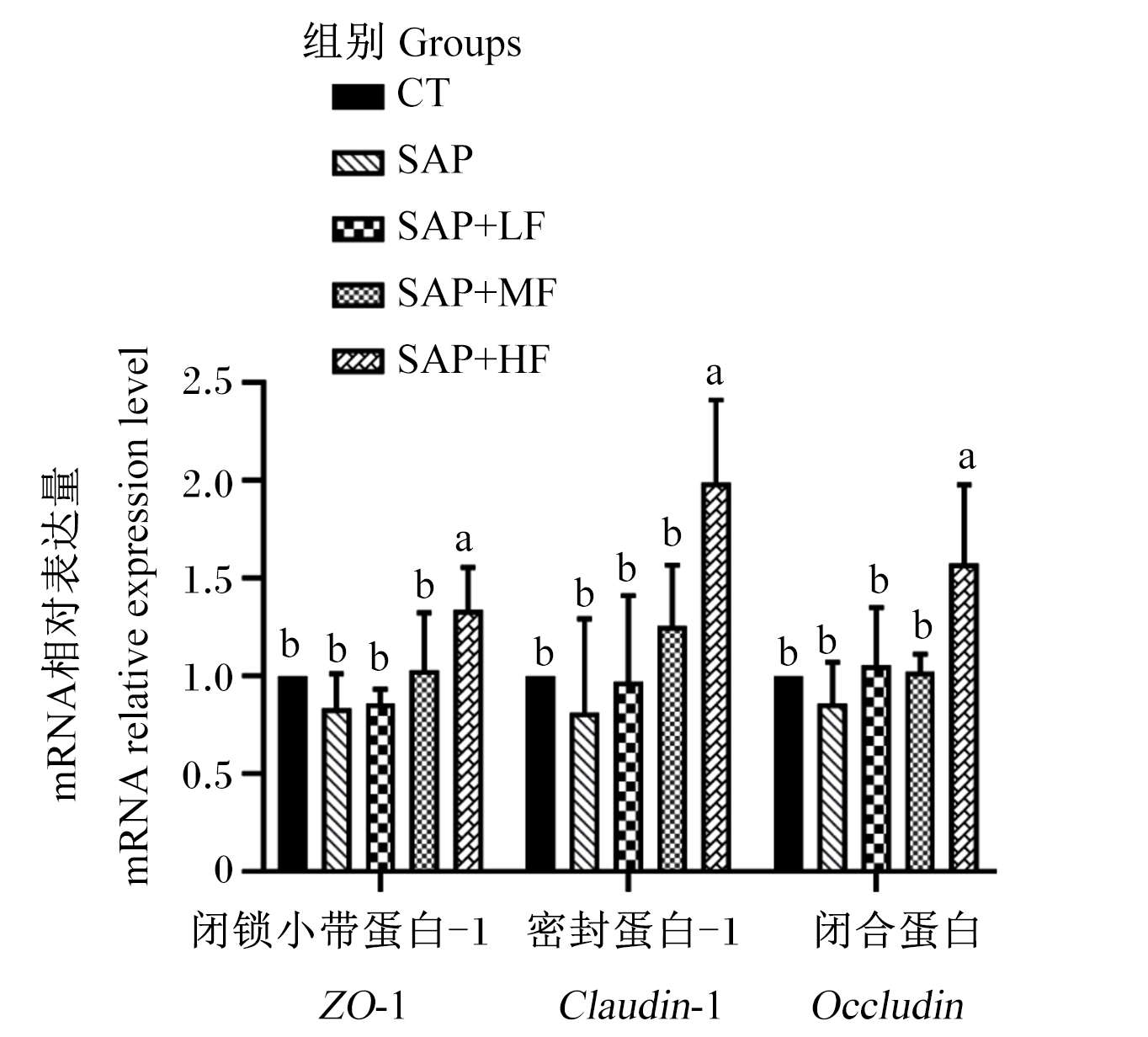
图2可知,与SAP组相比,SAP+HF组空肠中ZO-1、Claudin-1和Occludin的mRNA相对表达量显著升高(P<0.05)。
图2 岩藻多糖对过敏性腹泻断奶仔猪空肠中紧密连接蛋白基因表达的影响

数据柱标注相同字母表示差异不显著(P>0.05),不同字母表示差异显著(P<0.05)。下图同。

Fig.2 Effects of fucoidan on expression of tight junction protein genes in jejunum of weaned piglets with allergic diarrhea

Data columns with the same letter indicated no significant difference (P>0.05), while with different letters indicated significant difference (P<0.05). The same as below.

2.6 岩藻多糖对过敏性腹泻断奶仔猪抗氧化能力的影响

表7可知,与CT组相比,饲粮中添加大豆抗原蛋白显著降低了血清中CAT和GSH-Px活性(P<0.05),而在饲粮中添加200和300 mg/kg岩藻多糖可以显著缓解由大豆抗原蛋白引起的血清中CAT和GSH-Px活性下降(P<0.05);与CT组相比,饲粮中添加大豆抗原蛋白还显著降低了空肠中CAT活性(P<0.05),而在饲粮中添加200 mg/kg岩藻多糖可以显著提高过敏性腹泻断奶仔猪空肠中CAT活性(P<0.05)。
表7 岩藻多糖对过敏性腹泻断奶仔猪血清和空肠中抗氧化指标的影响

Table 7 Effects of fucoidan on antioxidant indicators in serum and jejunum of weaned piglets with allergic diarrhea

项目
Items
组别Groups P
P-value
CT SAP SAP+LF SAP+MF SAP+HF
血清Serum
丙二醛MDA/(nmol/mL) 3.22±0.49 3.73±0.85 3.56±0.72 2.98±0.45 3.24±0.49 0.213
总抗氧化能力
T-AOC/(mmol/L)
0.71±0.07 0.74±0.06 0.70±0.19 0.77±0.05 0.77±0.06 0.776
过氧化氢酶CAT/(U/mL) 5.81±0.66a 1.47±0.78d 3.52±0.71b 2.59±0.44c 3.07±0.46bc <0.001
超氧化物歧化酶
SOD/(U/mL)
12.79±1.36 11.32±1.87 12.79±1.47 13.19±1.20 12.01±1.20 0.112
谷胱甘肽过氧化物酶
GSH-Px/(U/mL)
405.71±21.71b 345.82±22.56c 390.88±6.31bc 397.99±30.57b 497.72±67.93a <0.001
空肠Jejunum
丙二醛MDA/(nmol/mg prot) 0.34±0.06 0.35±0.02 0.35±0.09 0.35±0.06 0.30±0.07 0.597
总抗氧化能力
T-AOC/(mmol/g prot)
0.54±0.02 0.55±0.05 0.57±0.04 0.57±0.02 0.57±0.05 0.557
过氧化氢酶
CAT/(U/mg prot)
169.62±16.55a 155.68±10.84b 160.81±9.22ab 173.53±7.16a 160.20±11.15ab 0.035
超氧化物歧化酶
SOD/(U/mg prot)
20.67±1.89 19.23±0.72 20.03±0.89 20.71±0.85 21.37±1.02 0.063
谷胱甘肽过氧化物酶
GSH-Px/(U/mg prot)
6.64±5.13 3.21±1.74 4.80±2.59 6.69±2.80 6.03±2.39 0.162
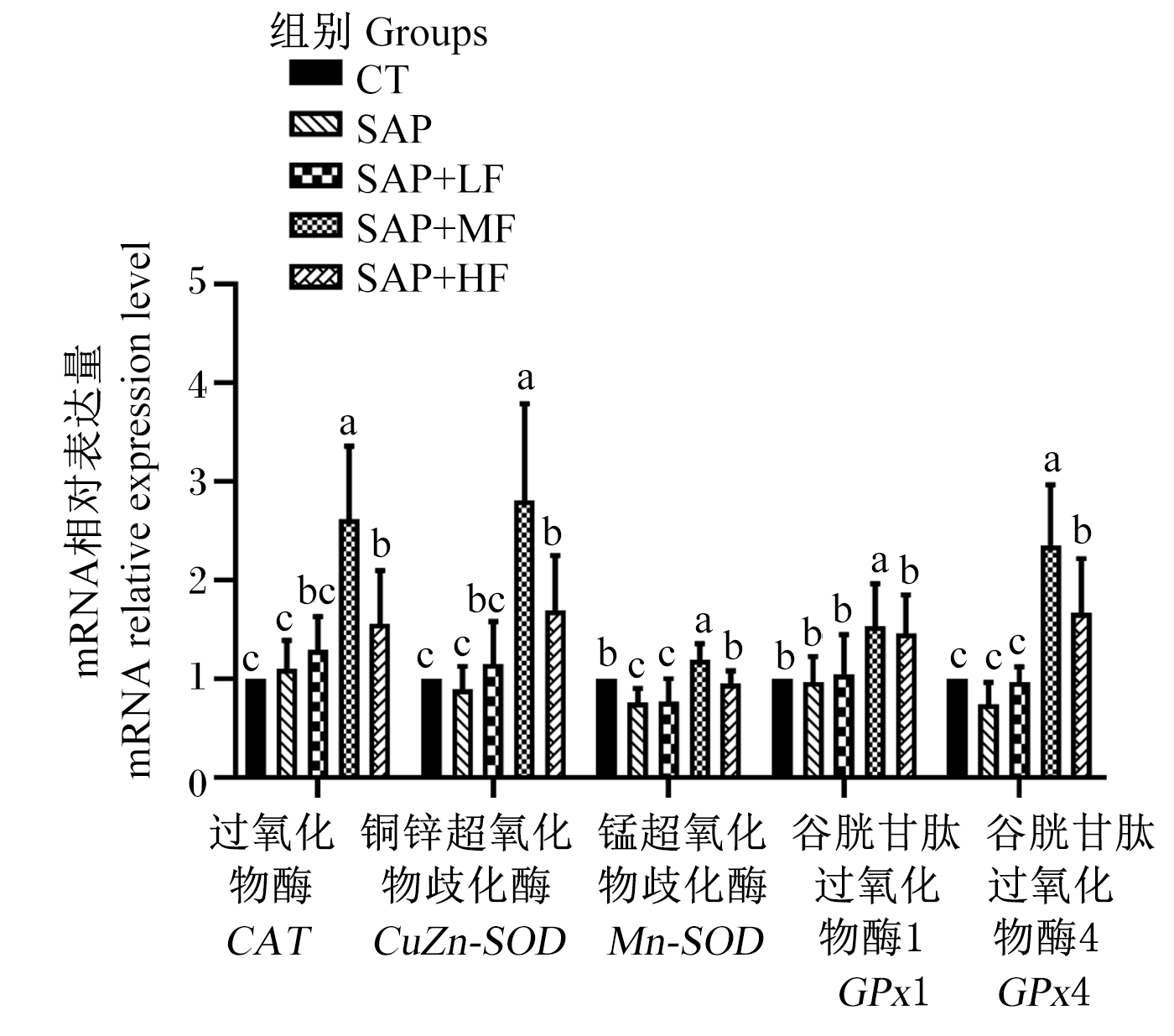
图3可知,与CT组相比,SAP组空肠中锰超氧化物歧化酶(Mn-SOD)的mRNA相对表达量显著下降(P<0.05);与SAP组相比,SAP+MF组空肠中CAT、铜锌超氧化物歧化酶(CuZn-SOD)、Mn-SOD、谷胱甘肽过氧化物酶1(GPx1)和谷胱甘肽过氧化物酶4(GPx4)的mRNA相对表达量显著提高(P<0.05),SAP+HF组空肠中CATCuZn-SODMn-SODGPx4的mRNA相对表达量显著提高(P<0.05)。
图3 岩藻多糖对过敏性腹泻断奶仔猪空肠中抗氧化酶基因表达的影响

Fig.3 Effects of fucoidan on expression of antioxidant enzyme genes in jejunum of weaned piglets with allergic diarrhea

3 讨论

断奶期是仔猪整个生产周期中最重要的时期之一,在此期间,生活环境、管理模式及饲粮组成的剧变极易引发断奶应激综合征,导致仔猪腹泻、生长迟缓甚至死亡。早期断奶时,饲粮由液态母乳骤然转变为固体饲料,其中所含的大豆抗原蛋白可对仔猪的消化系统、免疫系统及肠道屏障功能造成不良影响,诱发过敏性腹泻。同时,环境变化与混群带来的应激进一步加剧了这一过程。本研究在断奶仔猪饲粮中添加大豆抗原蛋白(β-伴大豆球蛋白),结果显示,该处理显著降低了仔猪粪便评分,提高了腹泻率及严重腹泻天数,表明大豆抗原蛋白成功诱导仔猪发生腹泻。作为I型过敏反应的主要标志物,IgE在过敏性腹泻的发生中发挥关键作用。仔猪采食大豆抗原蛋白后,大豆抗原蛋白通过肠道黏膜进入血液循环,刺激机体产生特异性IgE抗体。该抗体迅速与肥大细胞表面受体结合,使机体处于致敏状态;当大豆抗原蛋白再次进入体内时,与肥大细胞表面IgE交联,触发肥大细胞脱颗粒反应,导致肠道通透性增加、屏障功能受损,最终诱发过敏性腹泻。本研究中,饲粮中添加大豆抗原蛋白显著提高了断奶仔猪血清中IgE含量,结合腹泻相关指标的显著变化,证实成功建立了断奶仔猪过敏性腹泻模型。
本试验研究发现,饲粮中添加岩藻多糖显著改善了断奶仔猪的过敏性腹泻状况。在断奶羔羊上的研究也发现,代乳粉中添加0.3%~0.6%的岩藻多糖能够有效降低早期羔羊腹泻发生率[13]。在过敏模型研究中,Huang等[9]通过OVA诱导小鼠过敏反应,发现模型小鼠血清中IgE含量显著升高,而饲粮中添加岩藻多糖后显著降低了血清中IgE含量。本研究结果与此一致,饲喂岩藻多糖同样显著降低了过敏性腹泻断奶仔猪血清中IgE含量,提示岩藻多糖可能通过调控IgE的生成来缓解仔猪的过敏反应。D-LA是细菌代谢产物及细菌裂解的重要指示物,DAO则是一种高活性的细胞内酶。在健康肠道中,血清中D-LA含量与DAO活性维持相对稳定;当发生过敏反应导致肠道通透性增加时,两者可通过受损的肠黏膜进入血液循环,导致血清中D-乳酸含量和DAO活性升高,从而间接反映肠道通透性的变化。Yang等[14]报道,在断奶羔羊饲粮中添加岩藻多糖可显著降低血清中D-LA含量和DAO活性。Xue等[15]研究也表明,岩藻多糖能够降低大鼠血清中D-LA含量和DAO活性,缓解由7,12-二甲基苯并蒽诱导的乳腺癌所伴随的肠道屏障损伤。本研究中,断奶仔猪饲粮中添加大豆抗原蛋白后,血清中D-LA含量显著升高,表明过敏反应导致肠道通透性增加;然而,饲喂岩藻多糖并未显著影响断奶仔猪血清中D-LA含量和DAO活性。这一结果可能与岩藻多糖的理化性质(如分子质量、硫酸基团含量)及在饲粮中的添加剂量有关,具体作用机制有待进一步深入研究。
早期断奶仔猪的胃肠道尚未发育完全,断奶应激易导致肠道形态改变,进而损伤肠道结构与屏障功能,而饲粮中的抗原蛋白可诱发仔猪过敏反应,进一步加剧肠道损伤[16]。已有研究表明,岩藻多糖对改善仔猪肠道黏膜形态具有积极作用。例如,Leonard等[17]研究发现,饲粮中添加岩藻多糖可显著提高断奶仔猪空肠的绒毛高度及绒毛高度与隐窝深度比值;Walsh等[7]的研究也表明,不同剂量的岩藻多糖均能提高断奶仔猪十二指肠的绒毛高度及绒毛高度与隐窝深度比值。与上述研究结果一致,本试验发现,在断奶仔猪饲粮中添加大豆抗原蛋白显著降低了空肠和回肠的绒毛高度,加深了空肠的隐窝深度,并降低了空肠和回肠的绒毛高度与隐窝深度比值。而饲粮中补充岩藻多糖后,上述由大豆抗原蛋白诱导的肠道黏膜形态学改变得到一定缓解,表现为空肠和回肠绒毛高度的降低趋势被抑制,空肠隐窝深度的增加得到改善,空肠绒毛高度与隐窝深度比值有所回升。综上所述,岩藻多糖能够有效缓解由大豆抗原蛋白致敏所引发的肠道绒毛萎缩与隐窝加深等不良形态变化,对维护断奶仔猪肠道黏膜结构完整性具有积极作用。
肠黏膜是机体抵御病原入侵的重要屏障,维持肠道上皮结构的完整性是其屏障功能正常发挥的前提。肠上皮细胞间的紧密连接结构不仅介导肠道选择性物质运输,还能有效阻止肠腔内细菌、抗原等有害物质进入肠黏膜固有层,从而避免过度激活局部免疫细胞[18-19]。紧密连接蛋白是构成肠道物理屏障的核心分子基础,主要包括密封蛋白(Claudin)、Occludin和闭锁小带蛋白(ZO)家族蛋白,它们与细胞骨架共同形成完整的屏障结构[20]。研究表明,岩藻多糖可通过改善肠道黏膜形态和调控紧密连接蛋白表达来增强肠道屏障功能[21-22]。在细胞水平上,岩藻多糖能够提高经大肠杆菌感染的猪小肠上皮细胞(IPEC-J2)中紧密连接蛋白的表达,从而保护细胞屏障的完整性[23]。在动物模型中,断奶应激常导致仔猪肠道屏障功能受损,紧密连接蛋白基因表达下降[24]。而饲粮中添加岩藻多糖则可显著上调断奶仔猪小肠组织中ZO-1、OccludinClaudin-1的表达[25]。类似结果也在小鼠和大鼠研究中得到证实:灌服岩藻多糖能够上调小肠和结肠组织中ZOClaudinOccludin的基因表达,增强结肠物理屏障功能[22,26-27]。此外,在断奶羔羊和断奶仔猪上的研究均表明,岩藻多糖可通过上调小肠紧密连接蛋白OccludinClaudinZO的表达,有效维持肠黏膜物理屏障功能[6,14,21,25,28]。综上所述,岩藻多糖能够通过上调肠黏膜紧密连接蛋白的表达,降低肠道通透性,从而改善肠道物理屏障功能。本研究结果与此一致,发现饲喂岩藻多糖可显著上调过敏性腹泻断奶仔猪空肠中ZO-1、Claudin-1和Occludin的表达,进一步验证了岩藻多糖在维护肠道屏障完整性方面的积极作用。
正常情况下,机体产生的活性氧可被自身的抗氧化系统有效清除。然而,当机体受到外界应激源刺激时,体内自由基过量积累,可引发抗氧化功能紊乱,进而导致氧化损伤。已有研究表明,断奶应激是诱导仔猪发生氧化应激的重要因素之一[29-30]。多项研究证实,岩藻多糖能够提高机体抗氧化酶活性,增强抗氧化能力。杨成君等[31]研究发现,在饲粮中添加岩藻多糖可显著提高小鼠血清中谷胱甘肽还原酶(GR)和GSH-Px活性,增强机体抗氧化能力,并降低脂质过氧化反应。崔君等[32]在仔猪饲粮中添加岩藻多糖,同样发现其可提高血清中T-AOC和GSH-Px活性,并降低MDA含量。本研究结果显示,大豆抗原蛋白显著降低了断奶仔猪血清中CAT和GSH-Px活性,同时降低了空肠中CAT活性及Mn-SOD的mRNA相对表达量,表明大豆抗原蛋白诱导的过敏反应削弱了断奶仔猪的抗氧化能力;而在饲粮中添加岩藻多糖后,断奶仔猪血清中CAT和GSH-Px活性显著回升,空肠中CATCuZn-SODMn-SODGPx1及GPx4的mRNA相对表达量也显著上调。综上所述,岩藻多糖能够有效提高仔猪机体抗氧化酶活性,增强抗氧化能力,从而缓解由大豆抗原蛋白诱发的过敏反应所导致的氧化损伤。

4 结论

本试验初步得出,饲粮中添加岩藻多糖能够改善大豆抗原蛋白引起的空肠和回肠黏膜形态损伤,抑制肠道通透性升高,上调紧密连接蛋白和抗氧化酶基因表达,从而缓解过敏反应诱导的断奶仔猪抗氧化能力下降和过敏性腹泻。
[1]
刘明美, 赵国琦. 早期断奶仔猪“过敏性腹泻”原因分析及控制措施[J]. 养猪, 2010(6):76-77.

LIU M M, ZHAO G Q. Causes analysis and control measures of “allergic diarrhea” in early weaned piglets[J]. Swine Production, 2010(6):76-77. (in Chinese)

[2]
SONG S, PENG H R, WANG Q L, et al. Inhibitory activities of marine sulfated polysaccharides against SARS-CoV-2[J]. Food & Function, 2020, 11(9):7415-7420.

[3]
SUN T, XUE M L, YANG J, et al. Metabolic regulation mechanism of fucoidan via intestinal microecology in diseases[J]. Journal of the Science of Food and Agriculture, 2021, 101(11):4456-4463.

DOI

[4]
YANG W G, CHEN J Y, GUO G Z, et al. The effects of fucoidan dietary supplementation on growth performance,serum antioxidant capacity,immune function indices and intestinal morphology in weaned kids[J]. Animals, 2022, 12(5):574.

DOI

[5]
LIM J M, YOO H J, LEE K W. High molecular weight fucoidan restores intestinal integrity by regulating inflammation and tight junction loss induced by methylglyoxal-derived hydroimidazolone-1[J]. Marine Drugs, 2022, 20(9):580.

DOI

[6]
ZOU T D, YANG J, GUO X B, et al. Dietary seaweed-derived polysaccharides improve growth performance of weaned pigs through maintaining intestinal barrier function and modulating gut microbial populations[J]. Journal of Animal Science and Biotechnology, 2021, 12(1):28.

DOI PMID

[7]
WALSH A M, SWEENEY T, O’SHEA C J, et al. Effects of supplementing dietary laminarin and fucoidan on intestinal morphology and the immune gene expression in the weaned pig[J]. Journal of Animal Science, 2012, 90(S4):284-286.

DOI

[8]
ZHANG Z Y, LI X M, GUO Y T, et al. Insight into the anti-allergic impacts of fucoidan from Gracilaria lemaneiformis in mitigating allergic reactions induced by shrimp tropomyosin via regulating Th1/Th2 cytokines and T cell subsets[J]. International Journal of Biological Macromolecules, 2025, 299:140228.

DOI

[9]
HUANG L, ZENG Q H, ZHANG Y D, et al. Effects of fucoidans and alginates from Sargassum graminifolium on allergic symptoms and intestinal microbiota in mice with OVA-induced food allergy[J]. Food & Function, 2022, 13(12):6702-6715.

[10]
HERATH K H I N M, KIM H J, KIM A, et al. The role of fucoidans isolated from the sporophylls of Undaria pinnatifida against particulate-matter-induced allergic airway inflammation:evidence of the attenuation of oxidative stress and inflammatory responses[J]. Molecules, 2020, 25(12):2869.

DOI

[11]
冷兆泽. β-伴大豆球蛋白对仔猪抗营养阈值的研究[D]. 硕士学位论文. 长春: 吉林农业大学, 2019.

LENG Z Z. Study on the anti-nutritional threshold of β-conglycinin in piglets[D]. Master’s Thesis. Changchun: Jilin Agricultural University, 2019. (in Chinese)

[12]
HU C H, SONG J, YOU Z T, et al. Zinc oxide-montmorillonite hybrid influences diarrhea,intestinal mucosal integrity,and digestive enzyme activity in weaned pigs[J]. Biological Trace Element Research, 2012, 149(2):190-196.

DOI

[13]
郭广振. 岩藻多糖对断奶羔羊生长性能、血清生理生化指标和肠道屏障功能影响的研究[D]. 硕士学位论文. 广州: 广东海洋大学, 2022.

GUO G Z. Effects of fucoidan on growth performance,organ indices and serum biochemical,antioxidant and immune indices of weaned lambs[D]. Master’s Thesis. Guangzhou: Guangdong Ocean University, 2022. (in Chinese)

[14]
YANG W G, GUO G Z, CHEN J Y, et al. Effects of dietary fucoidan supplementation on serum biochemical parameters,small intestinal barrier function,and cecal microbiota of weaned goat kids[J]. Animals, 2022, 12(12):1591.

DOI

[15]
XUE M L, JI X Q, LIANG H, et al. The effect of fucoidan on intestinal flora and intestinal barrier function in rats with breast cancer[J]. Food & Function, 2018, 9(2):1214-1223.

[16]
GRAHAM F, CAUBET J C, RAMADAN S, et al. Specific IgE decision point cutoffs in children with IgE-mediated wheat allergy and a review of the literature[J]. International Archives of Allergy and Immunology, 2020, 181(4):296-300.

DOI PMID

[17]
LEONARD S G, SWEENEY T, BAHAR B, et al. Effects of dietary seaweed extract supplementation in sows and post-weaned pigs on performance,intestinal morphology,intestinal microflora and immune status[J]. British Journal of Nutrition, 2011, 106(5):688-699.

DOI

[18]
HARHAJ N S, ANTONETTI D A. Regulation of tight junctions and loss of barrier function in pathophysiology[J]. International Journal of Biochemistry and Cell Biology, 2004, 36(7):1206-1237.

DOI

[19]
SHEN L, SU L P, TURNER J R. Mechanisms and functional implications of intestinal barrier defects[J]. Digestive Diseases, 2009, 27(4):443-449.

DOI

[20]
HOROWITZ A, CHANEZ-PAREDES S D, HAEST X, et al. Paracellular permeability and tight junction regulation in gut health and disease[J]. Nature Reviews Gastroenterology & Hepatology, 2023, 20(7):417-432.

[21]
RATTIGAN R, SWEENEY T, VIGORS S, et al. The effect of increasing inclusion levels of a fucoidan-rich extract derived from Ascophyllum nodosum on growth performance and aspects of intestinal health of pigs post-weaning[J]. Marine Drugs, 2019, 17(12):680.

DOI

[22]
LIU X X, ZHANG Y H, LI W H, et al. Fucoidan ameliorated dextran sulfate sodium-induced ulcerative colitis by modulating gut microbiota and bile acid metabolism[J]. Journal of Agricultural and Food Chemistry, 2022, 70(47):14864-14876.

DOI PMID

[23]
郭晓波. 海藻多糖对仔猪小肠上皮细胞屏障功能的调控作用[D]. 硕士学位论文. 南昌: 江西农业大学, 2019.

GUO X B. Regulation of seaweed polysaccharide on the barrier function of intestinal porcine epithelial cells[D]. Master’s Thesis. Nanchang: Jiangxi Agricultural University, 2019. (in Chinese)

[24]
HU C H, XIAO K, SONG J, et al. Effects of zinc oxide supported on zeolite on growth performance,intestinal microflora and permeability,and cytokines expression of weaned pigs[J]. Animal Feed Science and Technology, 2013, 181(1/2/3/4):65-71.

DOI

[25]
杨晋. 海藻多糖替代抗生素对断奶仔猪生长性能和肠道屏障功能的影响[D]. 硕士学位论文. 南昌: 江西农业大学, 2019.

YANG J. Effects of seaweed polysaccharide substitute for antibiotics on growth performance and intestinal barrier function of weaned piglets[D]. Master’s Thesis. Nanchang: Jiangxi Agricultural University, 2019. (in Chinese)

[26]
XUE M L, LIANG H, JI X Q, et al. Effects of fucoidan on gut flora and tumor prevention in 1,2-dimethylhydrazine-induced colorectal carcinogenesis[J]. The Journal of Nutritional Biochemistry, 2020, 82:108396.

DOI

[27]
SHI H J, CHANG Y G, GAO Y, et al. Dietary fucoidan of Acaudina molpadioides alters gut microbiota and mitigates intestinal mucosal injury induced by cyclophosphamide[J]. Food & Function, 2017, 8(9):3383-3393.

[28]
ZHENG W Y, JIA J H, ZHANG C X, et al. Undaria pinnatifida fucoidan ameliorates dietary fiber deficiency-induced inflammation and lipid abnormality by modulating mucosal microbiota and protecting intestinal barrier integrity[J]. International Journal of Biological Macromolecules, 2023, 247:125724.

DOI

[29]
KAZEMI S, HAJIMOHAMMADI A, MIRZAEI A, et al. Effects of probiotic and yeast extract supplementation on oxidative stress,inflammatory response,and growth in weaning Saanen kids[J]. Tropical Animal Health and Production, 2023, 55(4):282.

DOI

[30]
YIN J, WU M M, XIAO H, et al. Development of an antioxidant system after early weaning in piglets[J]. Journal of Animal Science, 2014, 92(2):612-619.

DOI PMID

[31]
杨成君, 李俐, 李晓林, 等. 褐藻多糖硫酸酯对老龄小鼠GSH和GR含量的影响[J]. 中国实验诊断学, 2010, 14(10):1549-1550.

YANG C J, LI L, LI X L, et al. Effect of algal polysaccharide sulfate on the GSH and GR content of aging mouse[J]. Chinese Journal of Laboratory Diagnosis, 2010, 14(10):1549-1550. (in Chinese)

[32]
崔君, 傅春妮, 李留安, 等. 褐藻多糖对仔猪抗氧化能力、肠道菌群和细胞因子的影响[J]. 畜牧与兽医, 2019, 51(12):66-69.

CUI J, FU C N, LI L A, et al. Effects of brown algae polysaccharide on growth,antioxidantcapacity,intestinal flora and cytokines in piglets[J]. Animal Husbandry & Veterinary Medicine, 2019, 51(12):66-69. (in Chinese)

Outlines

/