RESEARCH PAPER

Effects of Unconventional Diet and Its Low-Protein Level for Gestating Sows on Intestinal Health of Offspring Newborn Piglets

  • LI Yuanyuan , 1 ,
  • WEI Wenyan 1 ,
  • MAO Xiangyu 1 ,
  • LI Wenyuan 1 ,
  • CHE Lianqiang 1 ,
  • LIN Yan 1 ,
  • ZHUO Yong 1 ,
  • LIU Guangmang 1 ,
  • JIN Chao 1 ,
  • WANG Chun 2 ,
  • WU De 1 ,
  • XU Shengyu , 1, *
Expand
  • 1 Key Laboratory of Animal Disease-Resistant Nutrition, Sichuan Province, Key Laboratory of Animal Disease-Resistant Nutrition and Feed, Ministry of Agriculture and Rural Affairs, Key Laboratory of Animal Disease-Resistant Nutrition, Ministry of Education, Institute of Animal Nutrition, Sichuan Agricultural University, Chengdu 611130, China
  • 2 Kunming Saturn Biological Technology (Group) Co., Ltd., Kunming 650200, China
*associate professor, E-mail:

Received date: 2025-09-29

  Online published: 2026-04-14

Abstract

This experiment was conducted to investigate the effects of unconventional diet and its low-protein level for gestating sows on intestinal health of offspring newborn piglets. Twenty-one “Landrace×Yorkshire” sows with similar parity (6 to 7 parities) and backfat thickness were selected and randomly divided into 3 groups, with 7 replicates in each group and 1 sow in each replicate. The control group (CON group) was fed a corn-soybean meal type basal diet, while the other two groups were fed an unconventional diet (UG group) and an unconventional low-protein diet (LUG group), respectively. Among them, the unconventional diet was prepared with unconventional feed raw materials such as wheat, broken rice, rice bran meal and rapeseed meal to replace corn and soybean meal, and the dietary crude protein content in LUG group was decreased by 2 percentage points compared with the other two groups. The experiment started from the first day after mating and ended at the end of delivery. The results showed as follows: 1) compared with CON group, the jejunal villus height of newborn piglets in UG group tended to be increased (P=0.056), and the ileal crypt depth was significantly increased (P<0.05); meanwhile, the activities of duodenal trypsin and jejunal and ileal lipase in UG group were significantly increased (P<0.05), and the jejunal trypsin activity showed an increasing trend (P=0.051). 2) Compared with CON group, the serum malondialdehyde content in UG group showed an increasing trend (P=0.053), and the relative expression levels of jejunal tumor necrosis factor-α (TNF-α) and interleukin-10 (IL-10) were significantly increased (P<0.05). 3) Compared with UG group, the contents of propionic acid (P=0.096) and butyric acid (P=0.078) in colon in LUG group showed an increasing trend, and the Shannon index of colonic microbiota was significantly increased (P<0.05). At the phylum level, compared with UG group, the Proteobacteria relative abundance in colon in LUG group was significantly decreased (P<0.05), and the Patescibacteria relative abundance in colon was significantly increased (P<0.05). At the genus level, compared with CON group, the relative abundances of Clostridium_sensu_stricto_1 (P=0.099) and Corynebacterium (P=0.090) in colon in UG group showed a decreasing trend; compared with UG group, the Acinetobacter relative abundance in colon in LUG group was significantly decreased (P<0.05), and the Bacillus relative abundance in colon was significantly increased (P<0.05). In conclusion, feeding unconventional diet to sows during gestation can improve the intestinal morphology of newborn piglets to a certain extent and enhance the activities of intestinal digestive enzymes. Further reducing protein level can optimize the intestinal microbiota structure and promote the production of short-chain fatty acids.

Cite this article

LI Yuanyuan , WEI Wenyan , MAO Xiangyu , LI Wenyuan , CHE Lianqiang , LIN Yan , ZHUO Yong , LIU Guangmang , JIN Chao , WANG Chun , WU De , XU Shengyu . Effects of Unconventional Diet and Its Low-Protein Level for Gestating Sows on Intestinal Health of Offspring Newborn Piglets[J]. Chinese Journal of Animal Nutrition, 2026 , 38(4) : 2547 -2562 . DOI: 10.12418/CJAN2026.205

妊娠期母体的营养状况对于后代的肠道健康发育有着决定性的作用[1-2]。妊娠后期胎儿肠道进入快速生长阶段,为应对出生后的环境挑战进行功能储备,此阶段的发育不仅影响营养物质的消化吸收,还涉及肠道屏障功能的完善以及免疫稳态调节机制的构建[3]。研究表明,母体营养会通过表观遗传修饰(如DNA甲基化[4]、组蛋白修饰)和“微生物-肠-脑”轴等途径,直接对胎儿肠道形态、屏障功能以及微生物定植进行编程。母猪妊娠期补充甲基供体可通过提高后代空肠肽转运载体1(Pept1)启动子甲基化水平,上调Pept1/葡萄糖转运载体1(Sglt1)表达,增强肽/葡萄糖转运能力以及消化酶活性,促进肠道形态发育[5]。妊娠期母体营养可借助改变母体微生物群落,影响胎儿微生物组定植及其代谢物,以表观遗传等方式调控胎儿发育以及后代长期健康[6]
当下玉米-豆粕型饲粮面临资源短缺和环境压力的双重挑战,大豆进口依存度过高以及豆粕碳足迹问题,促使行业积极探寻替代方案。2021年我国农业农村部发布了《饲料中玉米豆粕减量替代工作方案》,在蛋白质替代方面,为减少豆粕依赖,养殖业正广泛探索棉籽粕[7]、菜籽粕[8-9]等杂粕的应用。本课题组前期研究发现,用小麦、碎米、米糠粕和菜籽粕等非常规饲料原料替代玉米和豆粕,对母猪的繁殖性能无不良影响,并显示出提高断奶仔猪窝增重[(87.05±6.43) kg vs. (77.64±3.52) kg]和增加每窝断奶仔猪头数[(12.22±0.46)头 vs. (10.88±0.55)头]的潜力;此外,进一步降低非常规饲粮蛋白质水平还可通过提高粪便短链脂肪酸(SCFA)含量和促进有益菌增殖来增强母猪的肠道健康[10]。然而,母体非常规饲粮及非常规低蛋白质饲粮饲喂是否影响新生仔猪肠道健康及微生物群落并不清楚。因此,本研究旨在探究母猪妊娠期饲喂非常规饲粮及非常规低蛋白质饲粮对新生仔猪肠道形态、消化酶活性、屏障功能、抗氧化能力、SCFA含量和微生物群落等的影响。

1 材料与方法

1.1 试验设计

本试验在四川农业大学动物营养研究所教学科研基地进行,经四川农业大学动物管理与使用委员会批准(伦理批准编号:SICAU2022214007)。选取21头胎次(6~7胎)和背膘厚度相似的“长白×大白”母猪,随机分为3组,每组7个重复,每个重复1头。3组分别饲喂玉米-豆粕型基础饲粮(对照组,CON组)、非常规饲粮(UG组)和非常规低蛋白质饲粮(LUG组),其中LUG组饲粮粗蛋白质含量与其他2组相比降低2个百分点。饲粮配方满足或超过NRC(2012)推荐的妊娠母猪营养需求。各组饲粮组成及营养水平见表1。试验期从配种后第1天开始,到分娩结束。
表1 饲粮组成及营养水平(风干基础)

Table 1 Composition and nutrient levels of diets (air-dry basis) %

项目
Items
组别Groups
CON UG LUG
原料Ingredients
玉米Corn 66.00 33.50 33.50
豆粕Soybean meal 15.00 3.80
小麦麸Wheat bran 14.23 11.10 11.10
小麦Wheat 17.43 18.13
碎米Broken rice 15.50 17.48
菜籽粕Rapeseed meal 6.33 2.02
米糠粕Rice bran meal 3.30 8.38
发酵酒糟Fermented distiller grains 4.00 4.00
大豆油Soybean oil 1.80 2.10 2.10
L-赖氨酸盐酸盐L-Lys·HCl (98%) 0.19 0.33
DL-蛋氨酸DL-Met (98.5%) 0.03
L-苏氨酸L-Thr (98.5%) 0.04 0.13
L-色氨酸L-Trp (98%) 0.02
石粉Limestone 0.81 0.80 0.87
磷酸氢钙CaHPO4 1.35 1.10 1.10
氯化钠NaCl 0.40 0.40 0.40
氯化胆碱Choline chloride (50%) 0.15 0.15 0.15
维生素预混料Vitamin premix1) 0.04 0.04 0.04
矿物质预混料Mineral premix2) 0.20 0.20 0.20
酶制剂Enzyme preparation3) 0.02 0.02 0.02
合计Total 100.00 100.00 100.00
营养水平Nutrient levels4)
总能GE/(MJ/kg) 16.26 16.25 16.20
代谢能ME/(MJ/kg) 13.04 13.02 13.07
粗蛋白质CP 12.84 12.65 10.81
粗纤维CF 3.21 4.43 4.24
可溶性纤维Soluble fiber 1.92 2.19 2.01
不可溶性纤维Insoluble fiber 14.35 14.03 14.99
总膳食纤维Total dietary fiber 14.77 15.85 17.00
钙Ca 0.74 0.74 0.74
有效磷AP 0.35 0.35 0.35
标准回肠可消化赖氨酸SID Lys 0.57 0.57 0.57
标准回肠可消化蛋氨酸SID Met 0.20 0.20 0.21
标准回肠可消化苏氨酸SID Thr 0.43 0.42 0.42
标准回肠可消化色氨酸SID Trp 0.13 0.14 0.13

1)维生素预混料为每千克饲粮提供 Vitamin premix provided the following per kilogram of diets:VA 9 600 IU,VD3 1 920 IU,VE 80 IU,VK3 3.84 mg,VB1 1.6 mg,VB2 5.76 mg,VB6 2.88 mg,VB12 0.02 mg,泛酸 pantothenic acid 20 mg,生物素 biotin 0.384 mg,叶酸 folic acid 3.2 mg,烟酸 nicotinic acid 32 mg。

2)矿物质预混料为每千克饲粮提供 Mineral premix provided the following per kilogram of diets:Cu (as copper sulfate) 12 mg,Fe (as ferrous sulfate) 100 mg,Mn (as manganese sulfate) 28 mg,Zn (as zinc sulfate) 120 mg,I (as potassium iodide) 0.20 mg,Se (as sodium selenite) 0.20 mg。

3)酶制剂组成及活性:木聚糖酶 25 000 U/g,葡聚糖酶 1 800 U/g,甘露聚糖酶 800 U/g,纤维素酶 600 U/g,酸性蛋白酶 4 000 U/g,淀粉酶 400 U/g,果胶酶 500 U/g。Enzyme preparation composition and activity: xylanase 25 000 U/g, glucanase 1 800 U/g, mannanase 800 U/g, cellulase 600 U/g, acid protease 4 000 U/g, amylase 400 U/g, pectinase 500 U/g.

4)总能、粗蛋白质和粗纤维为实测值;其余为计算值,根据《中国饲料成分及营养价值表》(2022年第33版)和NRC(2012)计算。GE, CP and CF were measured values, while the others were calculated values based on Tables of Feed Composition and Nutritive Values in China (33rd edition, 2022) and NRC (2012).

1.2 饲养管理

所有母猪均使用同期发情药物诱导发情,然后使用“杜洛克”公猪精液进行人工授精。所有母猪配种前均饲喂玉米-豆粕型基础饲粮,试验期间统一投喂粉状饲粮。妊娠期实行每日2次(08:00和15:00各1次)定时饲喂,并保证充足饮水;每头母猪单独饲养在妊娠栏(2.2 m×0.6 m)中;饲养环境温度为18~22 ℃,相对湿度控制在(60±5)%,同时定期清理粪便、记录采食量和健康状况。饲喂量分阶段进行调整:妊娠1~90 d为2.2 kg/d,妊娠91 d至分娩为2.6 kg/d。母猪分娩前4 d转入分娩舍,分娩当天禁食;新生仔猪进行统一处理(剪脐带、称重、干燥后记录出生体重)。

1.3 样品采集和指标测定

1.3.1 饲粮样品采集及分析

在饲粮配制出料时,分别从出料口的前、中、后段等量接取2 kg饲粮,充分混匀后于-20 ℃冰箱保存待测。
饲粮粗蛋白质和粗纤维含量分别按照国家标准测定:粗蛋白质含量依据GB/T 6432—2018采用Kjeltec 8400分析仪(瑞典)进行测定;粗纤维含量依据GB/T 6434—2006采用ANKOM a2000i分析仪(美国)进行测定。饲粮总能使用Parr 6400氧弹热量仪(美国)进行测定。

1.3.2 血液样品采集及分析

仔猪出生当天未吃初乳前,每组每窝随机选取1头接近平均体重的仔猪(每组共7头,公母比例基本一致),前腔静脉采集血液5 mL,室温下静置30 min后,1 300×g、4 ℃离心15 min,收集血清,于-20 ℃冰箱保存待测。按照试剂盒(苏州格锐思生物科技有限公司)说明书测定血清超氧化物歧化酶(SOD,G0101W)、谷胱甘肽过氧化物酶(GSH-Px,G0206W)活性以及丙二醛(MDA,G0109W)含量和总抗氧化能力(T-AOC,G0142W)。

1.3.3 小肠样品采集及分析

仔猪采血后屠宰,迅速打开腹腔,完整地分离出小肠部分(从幽门至回盲瓣)。将取出的小肠轻柔放置在预冷的生理盐水中,去除表面的血液和肠道内容物后,按照解剖学标志将小肠分为十二指肠、空肠和回肠3段,随后使用精确度为0.01 g的电子分析天平进行称重。称重后取十二指肠、空肠和回肠各5 cm左右样本各3份,1份置于4%多聚甲醛液中固定;另外2份用生理盐水洗去内容物并擦干后放入冻存管中,并迅速放入液氮中,之后保存于-80 ℃冰箱中,用于后续消化道酶活性和基因的检测。
小肠样品切片:将固定后的肠道组织样品进行石蜡包埋,并切成3 μm厚的切片;对切片进行苏木精-伊红(HE)染色,同时对空肠和回肠切片进行过碘酸-雪夫(PAS)染色。染色后的切片使用Olympus CX-31显微镜(日本)进行镜检,并联合Hamamatsu C13220-01成像系统采集图像,并采用NDP.view 2软件进行观察和分析。对于HE染色切片,在每个切片(代表1个肠段)中随机选取5个视野进行形态计量学观测,并选取7~8根结构完整的绒毛,测量其绒毛高度(VH)和隐窝深度(CD),并计算绒毛高度/隐窝深度(V/C)。杯状细胞数目测定方法如下:通过人工计数空肠和回肠每张PAS染色切片7~8根完整绒毛上的杯状细胞数目,再取其平均值。
肠道消化酶活性测定:各取适量十二指肠、空肠和回肠组织样品,采用液氮磨样,称量0.1 g左右研磨样至1.5 mL离心管,之后添加900 μL预冷的生理盐水,使用匀浆器制成10%的样品匀浆,随后4 ℃、14 400×g离心10 min,取上清测定胰蛋白酶、脂肪酶、淀粉酶、乳糖酶、蔗糖酶和麦芽糖酶活性,具体的测定步骤参考酶联免疫吸附测定(ELISA)试剂盒(泉州市睿信生物科技有限公司)说明书进行。
肠道RNA提取和实时荧光定量PCR:将空肠组织于液氮中研磨后,取约0.1 g研磨样使用RNA提取试剂盒(南京诺唯赞生物科技股份有限公司)提取总RNA;RNA浓度及纯度(A260/A280)采用NanoDrop ND-2000分光光度计(Thermo Fisher Scientific,美国)测定;以1 μg总RNA为模板,采用HiScript Ⅲ RT SuperMix反转录试剂盒(R323-01,南京诺唯赞生物科技股份有限公司)按照说明书合成cDNA。在ABI 7900HT Fast实时荧光定量PCR系统(Applied Biosystems,美国)上,采用ChamQ Universal SYBR qPCR预混液(Q711-02,南京诺唯赞生物科技股份有限公司)进行定量PCR分析。反应程序为:95 ℃ 30 s;95 ℃ 10 s→ 60 ℃ 30 s,40个循环;最后进行熔解曲线分析。以β-肌动蛋白(β-actin)为内参基因,采用2-ΔΔCt法计算靶基因相对表达量。PCR引物序列见表2
表2 PCR引物序列

Table 2 Primer sequences for PCR

基因
Genes
引物序列
Primer sequences (5'—3')
产物长度
Product length/bp
登录号
Accession No.
闭锁小带蛋白-1 ZO-1 F:ATGATGAAGATGAGGATGGTCACA
R:CCGCCGTTGCTGTTAAACA
67 XM_021098856.1
黏蛋白2 MUC2 F:GCCTTCGGCCCAGTGAA
R:GCTCCACAGACAAGCAGACC
84 XM_021082584.1
闭合蛋白OCLN F:ACGGGCTCCCGCAAAG
R:TGTCTCGTAATGGTCTTGCTCTGA
64 NM_001163647.2
血红素氧合酶-1 HO-1 F:GGTCCTCAAGAAGATTGCTCAGAAG
R:GTGGCGTTGGCGACATTGG
93 NM_001004027.1
超氧化物歧化酶1 SOD1 F:CAATGCTCCTGAGGCGATCA
R:TCCAACGGAAAAGGAGCCAA
92 NM_001190422.1
核因子E2相关因子2 Nrf2 F:TGTCCAAGGAGCAATTCAATGAGG
R:TTGAGCAGCCACTTTATTCTTACCC
81 XM_013984303.2
肿瘤坏死因子-α TNF-α F:CCTGCCCGACTATCTGGACTT
R:ACAGGGCAATGATCCCAAAAT
62 NM_214022.1
白细胞介素-6 IL-6 F:CGCAGCCTTGAGGATTTCC
R:CAGGTGCCCCAGCTACATTATC
66 NM_214399.1
白细胞介素-10 IL-10 F:TCTTTCAAACGAAGGACCAGATG
R:CCCTTAAAGTCCTCCAGCAGAGA
67 NM_214041.1
β-肌动蛋白β-actin F:GACCCTCAAGTACCCCATCGA
R:TTGTAGAAGGTGTGGTGCCAGAT
81 XM_021086047.1

1.3.4 结肠内容物样品采集及分析

仔猪采血后屠宰分离结肠,采集内容物装入无菌冻存管中,迅速置于液氮速冻,后转入-80 ℃保存,用于分析微生物群落以及SCFA含量。
SCFA含量测定:准确称取约1 g样品(记录精确质量)置于5 mL离心管中,加入2 mL超纯水混匀,室温静置30 min后,3 600×g离心10 min;取1 mL上清液,加入0.2 mL 25% (w/v)偏磷酸溶液和23.3 μL 210 mmol/L巴豆酸溶液,混匀并于室温孵育30 min,随后14 400×g离心10 min;取0.3 mL上清液,加入0.9 mL甲醇混匀(1∶3稀释),14 400×g离心10 min;取上清液经0.22 μm滤膜过滤,所得滤液于-20 ℃保存备用。采用Agilent 8890气相色谱仪(美国)测定滤液中乙酸、丙酸和丁酸等SCFA含量。
结肠内容物微生物群落通过16S rRNA基因(V3~V4区)扩增子测序进行分析。首先运用十六烷基三甲基溴化铵(CTAB)法提取DNA,借助特异性引物开展PCR扩增,随后构建文库并于Illumina MiSeq平台上实施测序。然后将测序下机后的数据,经过拼接、质控、操作分类单元(OTU)聚类以及物种注释等处理后,继续如下分析:计算Shannon指数,以此来评估α多样性;基于加权UniFrac距离进行主坐标分析(PCoA),结合Wilcoxon检验来评估β多样性;通过展示相对丰度前10的菌门和前30的菌属来分析物种组成。

1.4 数据统计分析

试验数据采用Excel 2021进行初步整理,然后采用SPSS 27.0软件进行Shapiro-Wilk正态性检验和Levene’s方差齐性检验,对符合正态分布的数据进行独立样本t检验;结果数据以“平均值±标准误”形式表示,P<0.05视为差异显著,0.05≤P<0.10视为差异有显著趋势。

2 结果与分析

2.1 母猪妊娠期饲喂非常规饲粮及其低蛋白质水平对新生仔猪肠道重量、肠道形态和杯状细胞数目的影响

表3可知,母猪妊娠期饲喂非常规饲粮及其低蛋白质水平对新生仔猪肠道重量无显著影响(P>0.05)。由表4图1可知,与CON组相比,UG组空肠绒毛高度有升高趋势(P=0.056),回肠隐窝深度显著提高(P<0.05),空肠和回肠杯状细胞数目无显著差异(P>0.05);与UG组相比,LUG组肠道形态和杯状细胞数目无显著差异(P>0.05)。
表3 母猪妊娠期饲喂非常规饲粮及其低蛋白质水平对新生仔猪肠道重量的影响

Table 3 Effects of unconventional diet and its low-protein level for gestating sows on intestinal weight of newborn piglets g

项目
Items
组别Groups P1 P2
CON UG LUG
十二指肠Duodenum 1.19±0.22 0.78±0.12 0.80±0.07 0.133 0.872
空肠Jejunum 49.22±3.43 48.39±2.54 53.61±4.78 0.848 0.354
回肠Ileum 0.69±0.05 0.75±0.14 0.58±0.08 0.707 0.335

P1表示CON组与UG组之间P值,P2表示UG组与LUG组之间P值。下表同。

P1 represented P-value between CON group and UG group, and P2 represented P-value between UG group and LUG group. The same as below.

表4 母猪妊娠期饲喂非常规饲粮及其低蛋白质水平对新生仔猪肠道形态和杯状细胞数目的影响

Table 4 Effects of unconventional diet and its low-protein level for gestating sows on intestinal morphology and goblet cell number of newborn piglets

项目
Items
组别Groups P1 P2
CON UG LUG
十二指肠Duodenum
绒毛高度Villus height/μm 543.71±30.65 594.95±51.56 627.09±55.81 0.410 0.680
隐窝深度Crypt depth/μm 113.74±4.06 111.57±4.62 118.06±4.18 0.729 0.318
绒毛高度/隐窝深度V/C 4.85±0.39 5.33±0.38 5.32±0.42 0.394 0.981
空肠Jejunum
绒毛高度Villus height/μm 714.59±22.84 822.63±45.78 948.00±60.43 0.056 0.124
隐窝深度Crypt depth/μm 89.58±2.64 95.07±2.75 95.27±4.29 0.175 0.969
绒毛高度/隐窝深度V/C 7.99±0.23 8.71±0.58 9.95±0.42 0.267 0.110
杯状细胞数目Goblet cell number/个 17.91±0.82 20.03±1.18 20.56±1.12 0.167 0.750
回肠Ileum
绒毛高度Villus height/μm 727.24±31.31 710.49±68.42 694.73±47.34 0.828 0.858
隐窝深度Crypt depth/μm 95.27±3.46 110.96±3.97 103.35±1.78 0.011 0.128
绒毛高度/隐窝深度V/C 7.71±0.47 6.49±0.70 6.72±0.42 0.175 0.796
杯状细胞数目Goblet cell number/个 19.32±1.67 20.75±1.05 21.25±1.59 0.479 0.800
图1 母猪妊娠期饲喂非常规饲粮及其低蛋白质水平对新生仔猪肠道形态的影响

A:苏木精-伊红染色组织切片显微照片 HE stained tissue section micrographs;B:过碘酸-雪夫染色组织切片显微照片 PAS stained tissue section micrographs。

Fig.1 Effects of unconventional diet and its low-protein level for gestating sows on intestinal morphology of newborn piglets

2.2 母猪妊娠期饲喂非常规饲粮及其低蛋白质水平对新生仔猪肠道消化酶活性的影响

表5可知,与CON组相比,UG组新生仔猪十二指肠胰蛋白酶活性显著提高(P<0.05),空肠胰蛋白酶活性有升高趋势(P=0.051),空肠和回肠脂肪酶活性显著提高(P<0.05);与UG组相比,LUG组十二指肠、空肠和回肠消化酶活性无显著差异(P>0.05)。
表5 母猪妊娠期饲喂非常规饲粮及其低蛋白质水平对新生仔猪肠道消化酶活性的影响

Table 5 Effects of unconventional diet and its low-protein level for gestating sows on intestinal digestive enzyme activities of newborn piglets

项目
Items
组别Groups P1 P2
CON UG LUG
十二指肠Duodenum
胰蛋白酶Trypsin/(U/mL) 172.37±13.83 216.59±13.37 194.80±16.01 0.040 0.317
脂肪酶Lipase/(U/L) 708.39±79.61 884.01±71.02 754.88±65.76 0.126 0.207
淀粉酶Amylase/(U/mL) 341.73±39.43 421.32±36.66 389.68±38.24 0.165 0.561
乳糖酶Lactase/(U/mL) 11.37±1.45 12.69±1.27 12.94±1.57 0.507 0.903
蔗糖酶Sucrase/(U/mL) 43.16±8.20 56.60±5.68 58.08±8.17 0.203 0.884
麦芽糖酶Maltase/(U/mL) 16.99±1.73 19.41±1.40 18.40±1.62 0.298 0.644
空肠Jejunum
胰蛋白酶Trypsin/(U/mL) 145.36±16.41 196.38±16.81 174.83±17.28 0.051 0.389
脂肪酶Lipase/(U/L) 548.34±57.92 761.91±62.25 656.91±76.39 0.027 0.308
淀粉酶Amylase/(U/mL) 296.52±35.36 382.43±35.88 323.73±34.68 0.114 0.262
乳糖酶Lactase/(U/mL) 13.54±1.61 15.04±0.92 14.39±1.56 0.434 0.724
蔗糖酶Sucrase/(U/mL) 61.02±7.12 70.33±6.17 66.58±9.18 0.342 0.740
麦芽糖酶Maltase/(U/mL) 19.55±2.07 21.30±1.50 21.15±1.67 0.508 0.950
回肠Ileum
胰蛋白酶Trypsin/(U/mL) 117.49±17.25 159.74±18.11 166.87±10.75 0.120 0.733
脂肪酶Lipase/(U/L) 361.46±50.77 660.82±91.85 655.86±49.40 0.017 0.961
淀粉酶Amylase/(U/mL) 217.00±35.76 291.06±41.40 304.68±24.22 0.201 0.781
乳糖酶Lactase/(U/mL) 8.19±1.37 10.56±1.50 12.00±0.93 0.264 0.431
蔗糖酶Sucrase/(U/mL) 29.21±6.64 48.32±8.91 51.89±5.70 0.111 0.742
麦芽糖酶Maltase/(U/mL) 13.28±1.66 15.97±1.83 17.59±1.04 0.299 0.457

2.3 母猪妊娠期饲喂非常规饲粮及其低蛋白质水平对新生仔猪血清抗氧化指标的影响

表6可知,与CON组相比,UG组新生仔猪血清MDA含量有升高趋势(P=0.053);与UG组相比,LUG组血清抗氧化指标无显著差异(P>0.05)。
表6 母猪妊娠期饲喂非常规饲粮及其低蛋白质水平对新生仔猪血清抗氧化指标的影响

Table 6 Effects of unconventional diet and its low-protein level for gestating sows on serum antioxidant indices of newborn piglets

项目
Items
组别Groups P1 P2
CON UG LUG
丙二醛MDA/(nmol/mL) 18.65±2.43 30.64±5.02 30.60±2.92 0.053 0.994
谷胱甘肽过氧化物酶GSH-Px/(U/mL) 161.16±11.17 165.66±31.78 160.83±18.23 0.896 0.897
总抗氧化能力T-AOC/(μmol/mL) 0.16±0.01 0.17±0.01 0.16±0.00 0.463 0.180
超氧化物歧化酶SOD/(U/mL) 7.24±2.51 2.89±0.63 5.23±1.18 0.118 0.105

2.4 母猪妊娠期饲喂非常规饲粮及其低蛋白质水平对新生仔猪肠道屏障、炎症和抗氧化相关基因表达的影响
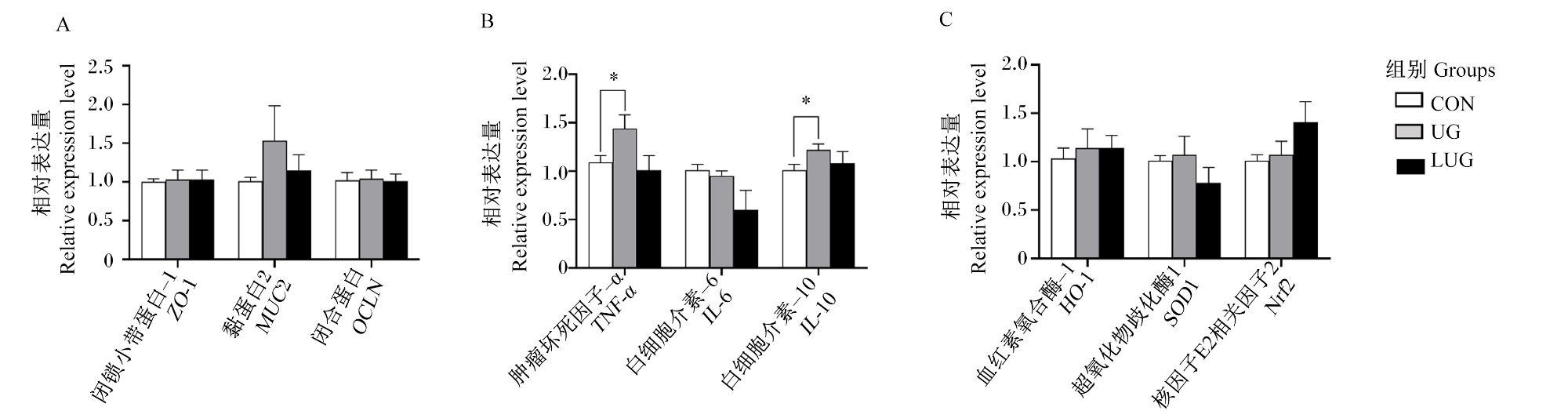
图2所示,与CON组相比,UG组新生仔猪空肠肿瘤坏死因子-α(TNF-α)和白细胞介素-10(IL-10)相对表达量显著提高(P<0.05);与UG组相比,LUG组空肠屏障、炎症和抗氧化相关基因相对表达量无显著差异(P>0.05)。
图2 母猪妊娠期饲喂非常规饲粮及其低蛋白质水平对新生仔猪肠道屏障、炎症和抗氧化相关基因表达的影响

A:肠道屏障相关基因 intestinal barrier-related genes;B:炎症相关基因 inflammation-related genes;C:抗氧化相关基因 antioxidant-related genes。

*表示差异显著(P<0.05)。下图同。* indicated significant difference (P<0.05). The same as below.

Fig.2 Effects of unconventional diet and its low-protein level for gestating sows on expression of genes related to intestinal barrier, inflammation and antioxidant of newborn piglets

2.5 母猪妊娠期饲喂非常规饲粮及其低蛋白质水平对新生仔猪结肠SCFA含量的影响

表7可知,与CON组相比,UG组新生仔猪结肠SCFA含量无显著差异(P>0.05);与UG组相比,LUG组结肠丙酸(P=0.096)和丁酸(P=0.078)含量有升高趋势。
表7 母猪妊娠期饲喂非常规饲粮及其低蛋白质水平对新生仔猪结肠SCFA含量的影响

Table 7 Effects of unconventional diet and its low-protein level for gestating sows on SCFA content of newborn piglets μg/g

项目
Items
组别Groups P1 P2
CON UG LUG
乙酸Acetic acid 7.58±0.77 7.42±0.36 7.09±0.67 0.848 0.673
丙酸Propionic acid 2.10±0.10 1.90±0.08 2.11±0.08 0.142 0.096
丁酸Butyric acid 0.90±0.03 0.83±0.04 0.92±0.03 0.201 0.078
总短链脂肪酸Total SCFA 10.85±0.84 10.68±0.37 10.50±0.72 0.846 0.832

2.6 母猪妊娠期饲喂非常规饲粮及其低蛋白质水平对新生仔猪结肠微生物群落的影响

2.6.1 母猪妊娠期饲喂非常规饲粮及其低蛋白质水平对新生仔猪结肠微生物群落多样性的影响
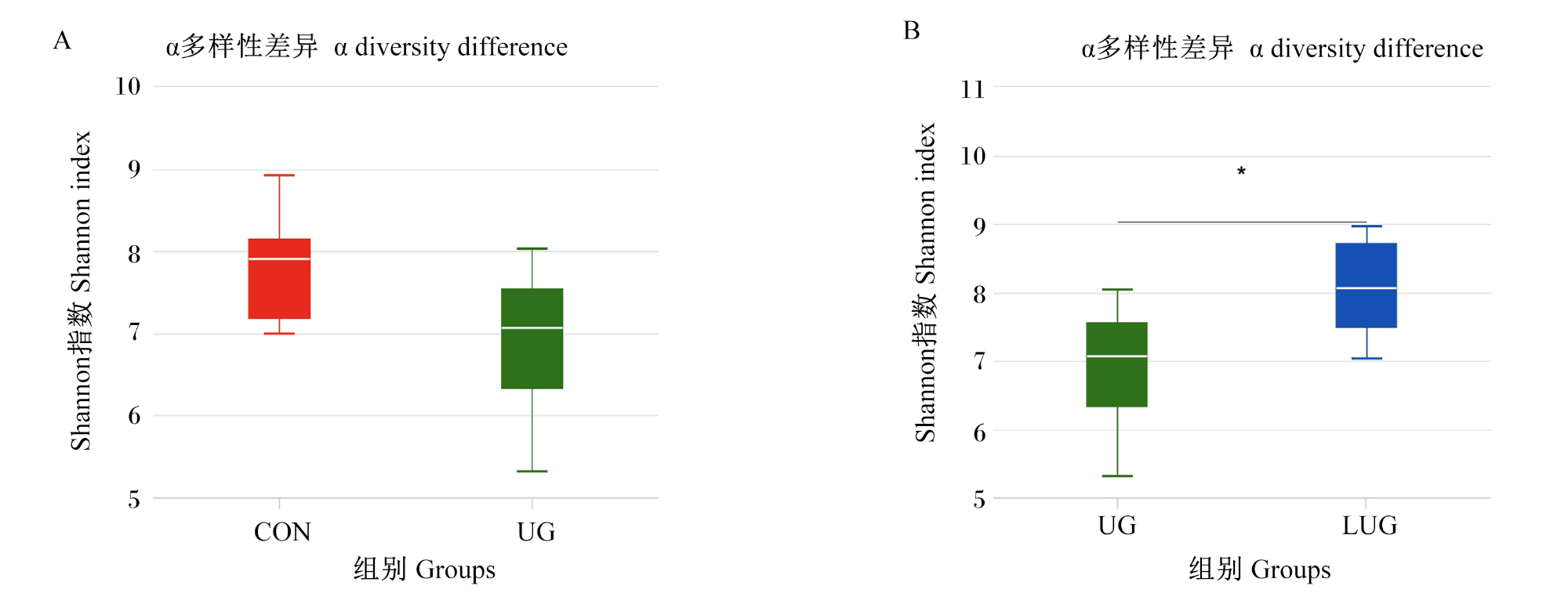
图3所示,与CON组相比,UG组新生仔猪结肠微生物群落Shannon指数无显著差异(P>0.05);与UG组相比,LUG组结肠微生物群落Shannon指数显著提高(P<0.05)。
图3 母猪妊娠期饲喂非常规饲粮及其低蛋白质水平对新生仔猪结肠微生物群落α多样性的影响

Fig.3 Effects of unconventional diet and its low-protein level for gestating sows on α diversity of colonic microbiota of newborn piglets

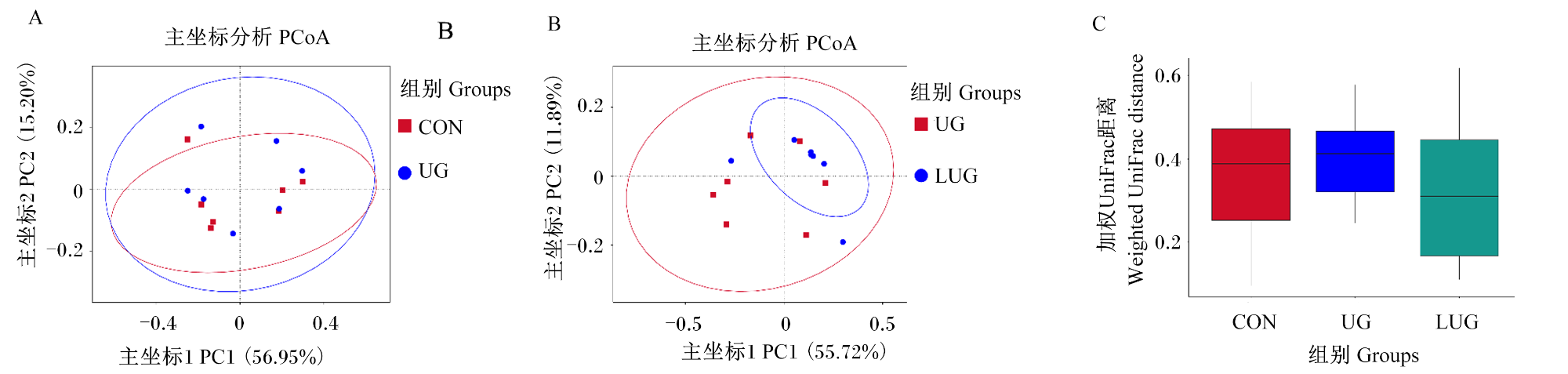
图4所示,母猪妊娠期饲喂非常规饲粮及其低蛋白质水平对新生仔猪结肠微生物群落β多样性无显著影响(P>0.05)。
图4 母猪妊娠期饲喂非常规饲粮及其低蛋白质水平对新生仔猪结肠微生物群落β多样性的影响

Fig.4 Effects of unconventional diet and its low-protein level for gestating sows on β diversity of colonic microbiota of newborn piglets

2.6.2 母猪妊娠期饲喂非常规饲粮及其低蛋白质水平对新生仔猪结肠微生物群落组成的影响
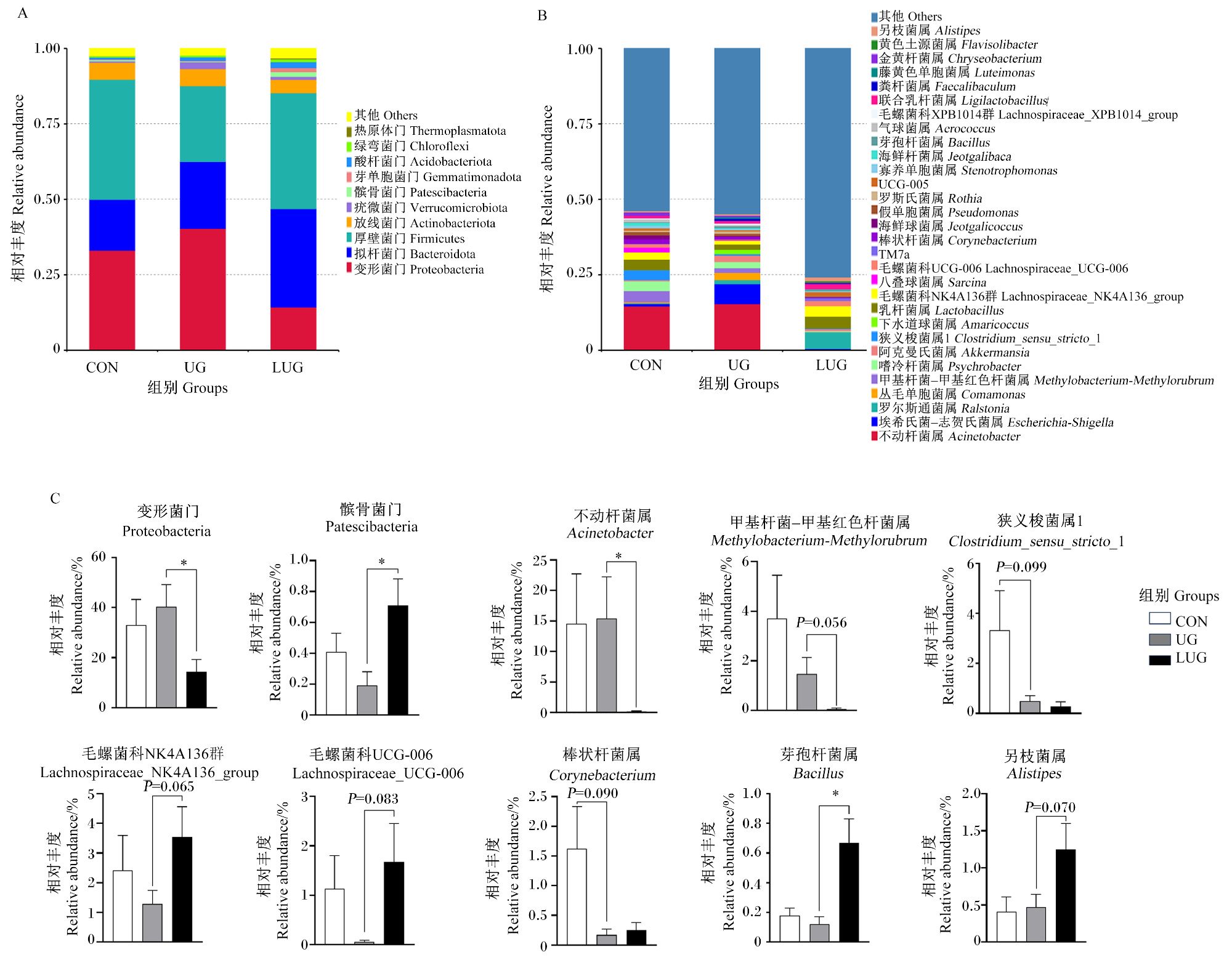
图5所示,在门水平上,与CON组相比,UG组新生仔猪结肠微生物相对丰度无显著差异(P>0.05);与UG组相比,LUG组结肠变形菌门(Proteobacteria)相对丰度显著降低(P<0.05),结肠髌骨菌门(Patescibacteria)相对丰度显著提高(P<0.05)。在属水平上,与CON组相比,UG组结肠狭义梭菌属1(Clostridium_sensu_stricto_1,P=0.099)和棒状杆菌属(Corynebacterium,P=0.090)相对丰度有降低趋势;与UG组相比,LUG组结肠不动杆菌属(Acinetobacter)相对丰度显著降低(P<0.05),结肠甲基杆菌-甲基红色杆菌属(Methylobacterium-Methylorubrum)相对丰度有降低趋势(P=0.056),结肠芽孢杆菌属(Bacillus)相对丰度显著提高(P<0.05),同时结肠毛螺菌科NK4A136群(Lachnospiraceae_NK4A136_group,P=0.065)、毛螺菌科UCG-006(Lachnospiraceae_UCG-006,P=0.083)和另枝菌属(Alistipes,P=0.070)相对丰度有升高趋势。
图5 母猪妊娠期饲喂非常规饲粮及其低蛋白质水平对新生仔猪结肠微生物群落组成的影响

A:微生物群落在门水平上组成(相对丰度前10) microbiota composition at phylum level (top 10 in relative abundance);B:微生物群落在属水平上组成(相对丰度前30) microbiota composition at genus level (top 30 in relative abundance);C:差异物种分析 analysis of differential species。

Fig.5 Effects of unconventional diet and its low-protein level for gestating sows on colonic microbiota composition of newborn piglets

3 讨论

3.1 母猪妊娠期饲喂非常规饲粮及其低蛋白质水平对新生仔猪肠道形态和消化酶活性的影响

妊娠期母体的营养状况会对后代肠道发育和功能产生影响[1]。研究表明,妊娠期母体营养可借助如DNA甲基化等表观遗传修饰方式,以及改变母体微生物群落及其代谢物等途径,对胎儿肠道形态、屏障功能、营养转运以及微生物定植进行编程,从而对后代肠道的健康发育以及长期健康状况产生深远影响[4-5]。本课题组前期研究发现,母猪饲喂非常规饲粮有提高断奶仔猪窝重的趋势,饲喂非常规低蛋白质饲粮倾向于增加断奶仔猪的数量[10]。鉴于仔猪肠道健康的建立是其后续消化吸收效率和生长性能的长期基础[11],由此推测,断奶窝重和数量的增加,可能源于非常规饲粮及其低蛋白质水平对母猪-仔猪肠道健康轴潜在的优化作用。
本研究发现,母猪妊娠期饲喂非常规饲粮能够一定程度上改善新生仔猪肠道形态,提高消化酶活性,并且未损伤黏膜屏障。越来越多的研究证实,妊娠期母体膳食模式可调控后代肠道发育轨迹以及引起微生物群落结构的长期变化[12]。仔猪肠道发育健康是其具备良好消化吸收功能的前提条件。肠道绒毛高度、隐窝深度及其比值,可在一定程度上反映肠道功能和吸收状态[13]。其中,绒毛高度体现了营养吸收表面积的大小,而隐窝深度则指示肠上皮细胞的增殖水平,上皮细胞更新率加快一般会致使隐窝加深[14]。妊娠后期是胎儿肠道快速发育期[15-16]。在猪胎儿模型里,妊娠后期胎儿肠道隐窝深度明显大于妊娠早期,隐窝深度与肠道成熟度呈正相关[17]。研究发现,母猪在妊娠期摄入高纤维饲粮使新生仔猪回肠隐窝深度增加,高纤维摄入或许可促进肠道成熟[18],其中可溶性纤维β-葡聚糖可借助激活Rho依赖性途径加速肠上皮细胞增殖和迁移[19]。本研究中,UG组新生仔猪肠道形态发生了改变,空肠和回肠作为消化吸收的主要部位,空肠绒毛高度提高且回肠隐窝深度显著提高,这可能与非常规饲粮原料中的可溶性纤维促进肠上皮细胞增殖有关。有研究证实,肠道形态与消化酶活性之间存在关联[20],肠道消化酶对猪的营养物质消化与吸收非常关键,仔猪肠道消化酶活性提高,不仅能有效改善饲粮消化率及利用率,还能调节后续的营养代谢[21]。淀粉酶、脂肪酶和胰蛋白酶由胰腺分泌,可分别分解淀粉、脂肪和蛋白质,在消化过程中起关键作用[22]。小肠刷状缘膜上的糖苷水解酶负责碳水化合物的分解和吸收[23]。同样,Shuai等[9]研究发现,在生长猪饲粮中添加12.24%发酵菜籽粕显著提高胰腺胰蛋白酶、脂肪酶和淀粉酶活性。这与本研究观察到的小肠胰蛋白酶和脂肪酶活性升高的结果一致。

3.2 母猪妊娠期饲喂非常规饲粮及其低蛋白质水平对新生仔猪空肠屏障相关基因表达的影响

肠道的生理状态反映肠道屏障功能,而这一功能依靠3个紧密关联的核心要素:肠上皮结构、黏膜完整性以及肠道微生物群落组成[24]。肠道黏膜构成了关键的先天屏障,包含物理、化学、微生物和免疫屏障,它们共同作用来维持肠道内环境的稳态,阻止致病菌以及毒素的侵袭。其中,物理屏障是保证肠上皮屏障功能和选择通透性的结构基础,而紧密连接蛋白则是影响肠上皮细胞通透性大小的关键因素[25]。作为紧密连接的关键组成部分,闭锁小带蛋白-1(ZO-1)和闭合蛋白(occludin,OCLN)在维持肠道内环境稳定和保障屏障完整性方面发挥核心作用[26]。肠道受到上皮覆盖的黏液保护,黏液主要由黏蛋白(MUC)组成,并且黏液不断地由杯状细胞进行更新[27]。杯状细胞属于特化的上皮细胞,对于肠道黏膜屏障的形成起关键性作用[28]。本研究中,新生仔猪空肠OCLNZO-1的表达水平维持着稳定状态,尽管UG组空肠MUC2相对表达量与其他2组相比未达到统计学显著水平,但其数值比其他2组要高,而且还伴有杯状细胞数目的增加,这种现象可能对于维持肠道黏膜屏障有一定的积极作用。

3.3 母猪妊娠期饲喂非常规饲粮及其低蛋白质水平对新生仔猪血清抗氧化指标和空肠抗氧化相关基因表达的影响

胎儿在发育和生长过程容易受到氧化应激的影响,这种负面影响可能会延伸到生命的后期[29]。研究报道,菜籽粕会提高肝脏和血清中多种氧化代谢产物和醛类含量,同时降低抗坏血酸和含二十二碳六烯酸的脂质含量,说明菜籽粕会破坏仔猪的氧化还原平衡[30]。研究普遍认为,血清MDA含量反映动物体内脂质过氧化的水平[31]。研究发现,在断奶仔猪饲粮中添加8%发酵菜籽粕显著提高血清MDA含量[32]。这与本研究结果一致,UG组新生仔猪血清MDA含量有高于CON组的趋势,但血清其他抗氧化指标及空肠组织中抗氧化相关基因相对表达量均未见显著变化。由此推测,非常规饲粮可能通过提高氧化代谢产物负荷,而非调控抗氧化基因表达,导致血清MDA积累。

3.4 母猪妊娠期饲喂非常规饲粮及其低蛋白质水平对新生仔猪结肠SCFA含量的影响

SCFA在维持肠道稳态中发挥重要作用[33]。在近端结肠中,膳食纤维的降解是SCFA的主要生成途径,蛋白质降解也是其生成途径之一[25,34]。研究发现,在生长猪饲粮中同时添加多菌种益生菌并降低粗蛋白质含量,能有效提升肠道SCFA含量,并恢复其生成[35]。本试验中,饲喂非常规饲粮并未显著提高新生仔猪结肠SCFA含量,且饲粮蛋白质水平降低后,SCFA的生成恢复,由此推测非常规饲粮与低蛋白质的共同作用可恢复SCFA生成。SCFA可以通过刺激宿主免疫细胞中细胞因子的产生来增强免疫反应[36-37]。本课题组前期研究发现,母猪饲喂非常规饲粮后粪便丁酸含量显著提高[10],推测母体SCFA生成能够激活仔猪调节性T细胞,促进IL-10表达量升高[38],从而适度刺激免疫训练,提高TNF-α相对表达量,这可能有助于肠道免疫屏障的建立与增强。

3.5 母猪妊娠期饲喂非常规饲粮及其低蛋白质水平对新生仔猪结肠微生物群落的影响

近年来,新的证据不断挑战无菌宫内环境的传统观念,研究证实母胎微生物传播发生于妊娠期间[2,39]。母猪妊娠期营养干预策略包括调整饲粮[40]、添加功能性添加剂[41]等,营养干预可显著影响母猪自身及其后代仔猪的肠道菌群。早期微生物定植是塑造肠道和免疫发育的最重要时期,母体肠道微生物群落组成与功能的优化能够促进新生儿肠道的发育和成熟[42]。其机制在于,母体来源的有益微生物可直接定植于新生儿肠道,或通过间接调控新生儿肠道内固有细菌的生态演替过程,从而发挥积极作用[6,43]。后肠微生物群落的结构和组成特征与肠道健康密切相关。α多样性作为肠道微生物群落功能恢复力的关键表征指标,其变化直接反映生态系统的抗干扰能力与稳态维持潜力[44]。本团队前期研究发现,非常规饲粮提高了母猪粪便菌群α多样性指数[10],但本试验中UG组新生仔猪结肠菌群α多样性并未发生显著变化,说明母体菌群结构变化并非简单垂直传递。研究发现,母猪饲喂低蛋白质饲粮显著提高后代仔猪空肠菌群α多样性[45]。同样的,本研究中LUG组新生仔猪结肠菌群α多样性的Shannon指数与UG组相比也显著升高。非常规低蛋白质饲粮通过降低饲粮蛋白质水平,可能优化了母体代谢产物谱,从而为后代创造了更有利的微生物定植环境。
变形菌门含有多种条件致病菌,其相对丰度降低有利于维持肠道微生物群落的稳态,对维持肠道健康具有重要意义[46]。研究指出,母猪饲喂低蛋白质饲粮会使后代肠道变形菌门相对丰度升高[45]。本课题组前期研究也发现,母猪饲喂非常规低蛋白质饲粮会使粪便变形菌门相对丰度升高[10]。而后代肠道变形菌门相对丰度降低,或许是因为SCFA的作用[47]。与UG组相比,LUG组新生仔猪结肠髌骨菌门相对丰度提高,说明低蛋白质饲粮可能更适合寡营养型菌群的定植。梭菌是肠道内常见的共生菌群,其维持肠道稳态的有益作用主要源自细胞成分和代谢产物,这些物质通过为肠上皮细胞提供能量、强化肠道屏障完整性以及介导免疫调节来实现益生功能[48]。本研究发现,UG组结肠狭义梭菌属1相对丰度有低于CON组的趋势,同时结肠丁酸含量也有所降低,但该变化未观察到对肠道造成明显危害。在属水平上,LUG组结肠不动杆菌属和甲基杆菌-甲基红色杆菌属相对丰度低于UG组,以上2种菌属均属于变形菌门,说明母猪饲喂低蛋白质饲粮致使其后代肠道病原菌减少,其相对丰度下降可能可以改善肠道免疫稳态。芽孢杆菌属以产酶、产抗菌肽及孢子的抗逆性而闻名,其定植可能提高仔猪肠道屏障功能。芽孢杆菌改善动物生长性能的作用机制主要在于其产生的胞外酶、维生素和肽类物质,这些物质能提高营养物质的消化利用率,间接促进生长,并调节肠道内益生菌及其他有益菌群的相对丰度[49]。研究显示,芽孢杆菌能改善肠道形态,提高十二指肠、空肠和回肠绒毛高度,并提高空肠OCLN蛋白表达[50]。在本试验条件下,母猪饲喂非常规低蛋白质饲粮显著提高新生仔猪结肠芽孢杆菌属相对丰度,可能是上述促进肠道形态改善的原因之一。同时,与UG组相比,LUG组结肠毛螺菌科相关属和另枝菌属相对丰度的升高可能表示该组新生仔猪SCFA生成潜能提高,其中毛螺菌科UCG-006与盲肠SCFA生成呈正相关[51]。由此可知,母猪妊娠期饲喂非常规低蛋白质饲粮依靠双重机制优化后代肠道菌群,抑制潜在病原菌并提升菌群多样性。
综上所述,本试验结果表明,母猪妊娠期采用“非常规原料结合适度低蛋白质”饲粮,可通过调节“母体-后代微生物-肠道”轴来改善新生仔猪肠道健康。未来研究可以对母子微生物传递机制展开详细剖析,评估其对后代仔猪长期生长性能所产生的影响,为母仔猪一体化精准营养提供数据支撑。

4 结论

在本试验条件下,母猪妊娠期饲喂非常规饲粮能够一定程度上改善新生仔猪肠道形态,提高肠道消化酶活性;饲喂非常规低蛋白质饲粮能够提高结肠菌群α多样性,降低有害菌相对丰度,并提高结肠SCFA含量,优化仔猪肠道微生物群落结构。
[1]
HU L, WU F L, CHE L Q. Programming effects of maternal nutrition on intestinal development and microorganisms of offspring:a review on pigs[J]. Microorganisms, 2025, 13(5):1151.

DOI

[2]
CHU D M, MEYER K M, PRINCE A L, et al. Impact of maternal nutrition in pregnancy and lactation on offspring gut microbial composition and function[J]. Gut Microbes, 2016, 7(6):459-470.

PMID

[3]
AZAD M A K, BIN P, LIU G, et al. Effects of different methionine levels on offspring piglets during late gestation and lactation[J]. Food & Function, 2018, 9(11):5843-5854.

[4]
JIN C, ZHUO Y, WANG J, et al. Methyl donors dietary supplementation to gestating sows diet improves the growth rate of offspring and is associating with changes in expression and DNA methylation of insulin-like growth factor-1 gene[J]. Journal of Animal Physiology and Animal Nutrition, 2018, 102(5):1340-1350.

DOI PMID

[5]
LIU H, WANG J, MOU D L, et al. Maternal methyl donor supplementation during gestation counteracts the bisphenol A-induced impairment of intestinal morphology,disaccharidase activity,and nutrient transporters gene expression in newborn and weaning pigs[J]. Nutrients, 2017, 9(5):423.

DOI

[6]
SOCHA-BANASIAK A, PAWŁOWSKA M, CZKWIANIANC E, et al. From intrauterine to extrauterine life-the role of endogenous and exogenous factors in the regulation of the intestinal microbiota community and gut maturation in early life[J]. Frontiers in Nutrition, 2021, 8:696966.

DOI

[7]
TAO A, WANG J H, LUO B, et al. Research progress on cottonseed meal as a protein source in pig nutrition:an updated review[J]. Animal Nutrition, 2024, 18:220-233.

DOI

[8]
CZECH A, GRELA E R, KIESZ M. Dietary fermented rapeseed or/and soybean meal additives on performance and intestinal health of piglets[J]. Scientific Reports, 2021, 11(1):16952.

DOI PMID

[9]
SHUAI C Y, CHEN D W, YU B, et al. Effect of fermented rapeseed meal on growth performance,nutrient digestibility,and intestinal health in growing pigs[J]. Animal Nutrition, 2023, 15:420-429.

DOI

[10]
WEI W Y, GAO J J, QIN F, et al. Effects of unconventional diets and unconventional low-protein diets on reproductive performance,placental nutrient transport,and fecal microorganisms of multiparous sows during gestation[J]. Journal of Animal Science, 2025, 103:skaf095.

DOI

[11]
ZHAO B C, WANG T H, CHEN J, et al. Effects of dietary supplementation with a carvacrol-cinnamaldehyde-thymol blend on growth performance and intestinal health of nursery pigs[J]. Porcine Health Management, 2023, 9(1):24.

DOI

[12]
CHENG C S, WEI H K, XU C H, et al. Maternal soluble fiber diet during pregnancy changes the intestinal microbiota,improves growth performance,and reduces intestinal permeability in piglets[J]. Applied and Environmental Microbiology, 2018, 84(17):e01047-18.

[13]
TANG X P, XIONG K N. Intrauterine growth retardation affects intestinal health of suckling piglets via altering intestinal antioxidant capacity,glucose uptake,tight junction,and immune responses[J]. Oxidative Medicine and Cellular Longevity, 2022, 2022(1):2644205.

DOI

[14]
DING X Q, LI H Y, WEN Z W, et al. Effects of fermented tea residue on fattening performance,meat quality,digestive performance,serum antioxidant capacity,and intestinal morphology in fatteners[J]. Animals, 2020, 10(2):185.

DOI

[15]
MEYER A M, CATON J S. Role of the small intestine in developmental programming:impact of maternal nutrition on the dam and offspring[J]. Advances in Nutrition, 2016, 7(1):169-178.

DOI

[16]
CHE L Q, HU L, LIU Y, et al. Dietary nucleotides supplementation improves the intestinal development and immune function of neonates with intra-uterine growth restriction in a pig model[J]. PLoS One, 2016, 11(6):e0157314.

DOI

[17]
YAO Y, VOILLET V, JEGOU M, et al. Comparing the intestinal transcriptome of Meishan and large white piglets during late fetal development reveals genes involved in glucose and lipid metabolism and immunity as valuable clues of intestinal maturity[J]. BMC Genomics, 2017, 18(1):647.

DOI

[18]
HE Y, PENG X, LIU Y, et al. Effects of maternal fiber intake on intestinal morphology,bacterial profile and proteome of newborns using pig as model[J]. Nutrients, 2020, 13(1):42.

DOI

[19]
VEERAPERUMAL S, QIU H M, TAN C S, et al. Restitution of epithelial cells during intestinal mucosal wound healing:the effect of a polysaccharide from the sclerotium of Lignosus rhinocerotis (Cooke) Ryvarden[J]. Journal of Ethnopharmacology, 2021, 274:114024.

DOI

[20]
WANG L X, YAN S L, LI J Z, et al. Rapid communication:the relationship of enterocyte proliferation with intestinal morphology and nutrient digestibility in weaning piglets[J]. Journal of Animal Science, 2019, 97(1):353-358.

[21]
LIU X T, LYU W T, LIU L, et al. Comparison of digestive enzyme activities and expression of small intestinal transporter genes in Jinhua and Landrace pigs[J]. Frontiers in Physiology, 2021, 12:669238.

DOI

[22]
OWSLEY W F, ORR D E Jr, TRIBBLE L F. Effects of age and diet on the development of the pancreas and the synthesis and secretion of pancreatic enzymes in the young pig[J]. Journal of Animal Science, 1986, 63(2):497-504.

PMID

[23]
NICHOLS B L, AVERY S, SEN P, et al. The maltase-glucoamylase gene:common ancestry to sucrase-isomaltase with complementary starch digestion activities[J]. Proceedings of the National Academy of Sciences of the United States of America, 2003, 100(3):1432-1437.

[24]
PAONE P, SURIANO F, JIAN C, et al. Prebiotic oligofructose protects against high-fat diet-induced obesity by changing the gut microbiota,intestinal mucus production,glycosylation and secretion[J]. Gut Microbes, 2022, 14(1):2152307.

DOI

[25]
DAVILA A M, BLACHIER F, GOTTELAND M, et al. Intestinal luminal nitrogen metabolism:role of the gut microbiota and consequences for the host[J]. Pharmacological Research, 2013, 68(1):95-107.

DOI

[26]
MA Y, XIE H, XU N, et al. Large yellow tea polysaccharide alleviates HFD-induced intestinal homeostasis dysbiosis via modulating gut barrier integrity,immune responses,and the gut microbiome[J]. Journal of Agricultural and Food Chemistry, 2024, 72(13):7230-7243.

DOI

[27]
JOHANSSON M E, HANSSON G C. Goblet cells need some stress[J]. The Journal of Clinical Investigation, 2022, 132(17):e162030.

DOI

[28]
CORTEZ V, SCHULTZ-CHERRY S. The role of goblet cells in viral pathogenesis[J]. The FEBS Journal, 2021, 288(24):7060-7072.

DOI

[29]
LIN Y, YAN H, CAO L, et al. Maternal organic selenium supplementation during gestation enhances muscle fiber area and muscle fiber maturation of offspring in porcine model[J]. Journal of Animal Science and Biotechnology, 2022, 13(1):121.

DOI PMID

[30]
CHEN C, PÉREZ DE NANCLARES M, KURTZ J F, et al. Identification of redox imbalance as a prominent metabolic response elicited by rapeseed feeding in swine metabolome[J]. Journal of Animal Science, 2018, 96(5):1757-1768.

DOI PMID

[31]
XI Q Y, JIANG Y, ZHAO S, et al. Effect of ginseng polysaccharides on the immunity and growth of piglets by dietary supplementation during late pregnancy and lactating sows[J]. Animal Science Journal, 2017, 88(6):863-872.

DOI

[32]
CZECH A, NOWAKOWICZ-DEBEK B, ŁUKASZEWICZ M, et al. Effect of fermented rapeseed meal in the mixture for growing pigs on the gastrointestinal tract,antioxidant status,and immune response[J]. Scientific Reports, 2022, 12(1):15764.

DOI

[33]
SAM Q H, LING H, YEW W S, et al. The divergent immunomodulatory effects of short chain fatty acids and medium chain fatty acids[J]. International Journal of Molecular Sciences, 2021, 22(12):6453.

DOI

[34]
LOUIS P, FLINT H J. Formation of propionate and butyrate by the human colonic microbiota[J]. Environmental Microbiology, 2017, 19(1):29-41.

DOI PMID

[35]
VASQUEZ R, KIM S H, OH J K, et al. Multispecies probiotic supplementation in diet with reduced crude protein levels altered the composition and function of gut microbiome and restored microbiome-derived metabolites in growing pigs[J]. Frontiers in Microbiology, 2023, 14:1192249.

DOI

[36]
LIU L X, LI Q Q, YANG Y J, et al. Biological function of short-chain fatty acids and its regulation on intestinal health of poultry[J]. Frontiers in Veterinary Science, 2021, 8:736739.

DOI

[37]
ZHANG Y M, DUAN X Y, WASSIE T, et al. Enteromorpha prolifera polysaccharide-zinc complex modulates the immune response and alleviates LPS-induced intestinal inflammation via inhibiting the TLR4/NF-κB signaling pathway[J]. Food & Function, 2022, 13(1):52-63.

[38]
SINGH N, GURAV A, SIVAPRAKASAM S, et al. Activation of Gpr109a,receptor for niacin and the commensal metabolite butyrate,suppresses colonic inflammation and carcinogenesis[J]. Immunity, 2014, 40(1):128-139.

DOI

[39]
VANDENPLAS Y, CARNIELLI V P, KSIAZYK J, et al. Factors affecting early-life intestinal microbiota development[J]. Nutrition, 2020, 78:110812.

DOI

[40]
WANG C, WEI S Y, LIU B J, et al. Maternal consumption of a fermented diet protects offspring against intestinal inflammation by regulating the gut microbiota[J]. Gut Microbes, 2022, 14(1):2057779.

DOI

[41]
XU S Y, WANG C Q, ZHOU Q, et al. Effects of 25-hydroxycholecalciferol supplementation during gestation on sow performance,offspring development,and intestinal microbiota in sows and piglets[J]. Journal of Animal Science, 2025, 103:skaf228.

DOI

[42]
NOWLAND T L, KIRKWOOD R N, PLUSKE J R. Review:can early-life establishment of the piglet intestinal microbiota influence production outcomes?[J]. Animal, 2022, 16(S2):100368.

DOI

[43]
THUM C, COOKSON A L, OTTER D E, et al. Can nutritional modulation of maternal intestinal microbiota influence the development of the infant gastrointestinal tract?[J]. The Journal of Nutrition, 2012, 142(11):1921-1928.

DOI

[44]
ZHANG L H, PIAO X S. Different dietary protein sources influence growth performance,antioxidant capacity,immunity,fecal microbiota and metabolites in weaned piglets[J]. Animal Nutrition, 2022, 8(1):71-81.

DOI

[45]
JIN J P, ZHANG L P, JIA J L, et al. Effects of maternal low-protein diet on microbiota structure and function in the jejunum of Huzhu Bamei suckling piglets[J]. Animals, 2019, 9(10):713.

DOI

[46]
SHIN N R, WHON T W, BAE J W. Proteobacteria:microbial signature of dysbiosis in gut microbiota[J]. Trends in Biotechnology, 2015, 33(9):496-503.

DOI

[47]
SONG Y Y, CHEN K, LV L, et al. Uncovering the biogeography of the microbial community and its association with nutrient metabolism in the intestinal tract using a pig model[J]. Frontiers in Nutrition, 2022, 9:1003763.

DOI

[48]
GUO P T, ZHANG K, MA X, et al. Clostridium species as probiotics:potentials and challenges[J]. Journal of Animal Science and Biotechnology, 2020, 11(1):24.

DOI

[49]
LUISE D, BOSI P, RAFF L, et al. Bacillus spp. probiotic strains as a potential tool for limiting the use of antibiotics,and improving the growth and health of pigs and chickens[J]. Frontiers in Microbiology, 2022, 13:801827.

DOI

[50]
PAN L, ZHAO P F, MA X K, et al. Probiotic supplementation protects weaned pigs against enterotoxigenic Escherichia coli K88 challenge and improves performance similar to antibiotics[J]. Journal of Animal Science, 2017, 95(6):2627-2639.

[51]
GUO W L, XIANG Q R, MAO B Y, et al. Protective effects of microbiome-derived inosine on lipopolysaccharide-induced acute liver damage and inflammation in mice via mediating the TLR4/NF-κB pathway[J]. Journal of Agricultural and Food Chemistry, 2021, 69(27):7619-7628.

DOI

Outlines

/