RESEARCH PAPER

Effects of Compound Acidifiers on Growth Performance, Serum Inflammatory Indices, and Intestinal Digestive Enzyme Activities and Microbiota of Weaned Piglets

  • CHEN Haoyang , 1 ,
  • LIAO Jialong 1 ,
  • LI Yunzheng 2 ,
  • GUO Naiwei 2 ,
  • DUAN Xiaoyu 2 ,
  • YIN Jingdong 1 ,
  • ZHANG Xin , 1, *
Expand
  • 1 State Key Laboratory of Animal Nutrition and Feeding, College of Animal Science and Technology, China Agricultural University, Beijing 100193, China
  • 2 Anhui Sealong Biotechnology Co., Ltd., Bengbu 233316, China
*associate professor, E-mail:

Received date: 2025-10-30

  Online published: 2026-05-14

Abstract

This experiment was conducted to investigate the effects of compound acidifiers on the growth performance, serum inflammatory indices, and intestinal digestive enzyme activities and microbiota of weaned piglets. In experiment 1, a total of 192 Duroc×Landrace×Yorkshire weaned piglets of 28-day-old were selected and randomly divided into 4 groups, with 6 replicates in each group and 8 pigs in each replicate (half male and half female). The control group was fed a corn-soybean meal type basal diet, while the experimental groups were fed the basal diets supplemented with 0.1%, 0.3% and 0.5% compound acidifiers (malic acid, fumaric acid and aspartic acid), respectively. The experiment lasted for 28 days. In experiment 2, a total of 450 Duroc×Landrace×Yorkshire weaned piglets of 43-day-old were selected and randomly divided into a control group and an experimental group, with 5 replicates in each group and 45 pigs in each replicate. In the control group, the diet No.1 was supplemented with 0.5% benzoic acid and 0.3% formic acid, and the diet No.2 was supplemented with 0.3% benzoic acid; in the experimental group, the acidifiers in the control group were removed, the diet No.1 was supplemented with 0.3% compound acidifiers, and the diet No.2 was supplemented with 0.2% compound acidifiers. The experiment lasted for 31 days, including 14 days of feeding diet No.1 and 17 days of feeding diet No.2. The results showed as follows: 1) in experiment 1, dietary supplementation with compound acidifiers had no significant effect on the growth performance of weaned piglets (P>0.05). Compared with the control group, the serum contents of tumor necrosis factor-α, interleukin-1β, interleukin-6, monocyte chemoattractant protein 1 and lipopolysaccharide (LPS) in 0.3% and 0.5% compound acidifier groups were significantly decreased (P<0.05), and the above indices were decreased linearly with the increase of the dietary supplementation level of compound acidifiers (P<0.05); the chymotrypsin activity in jejunum in 0.1% compound acidifier group was significantly increased (P<0.05), and there was a significant difference trend in the β diversity of colonic microbiota (P=0.072); meanwhile, in 0.1% compound acidifier group, the Pseudomonadota relative abundance in colon showed a significantly increasing trend (P=0.067), the Streptococcus relative abundance in colon was significantly increased (P<0.05), and the Christensenellaceae_R-7_group relative abundance in colon showed a significantly decreasing trend (P=0.074). 2) In Experiment 2, the replacement of benzoic acid and formic acid with the compound acidifiers had no significant effects on the growth performance, diarrhea rate, and serum inflammation and intestinal permeability indices of weaned piglets (P>0.05). In conclusion, an appropriate dietary supplementation level of compound acidifiers can enhance the anti-inflammatory ability of weaned piglets, reduce the serum LPS content, and improve intestinal health by increasing the chymotrypsin activity in jejunum and regulating the colonic microbiota. Meanwhile, the application effects of the compound acidifiers with a lower supplementation level are comparable to those of benzoic acid and formic acid.

Cite this article

CHEN Haoyang , LIAO Jialong , LI Yunzheng , GUO Naiwei , DUAN Xiaoyu , YIN Jingdong , ZHANG Xin . Effects of Compound Acidifiers on Growth Performance, Serum Inflammatory Indices, and Intestinal Digestive Enzyme Activities and Microbiota of Weaned Piglets[J]. Chinese Journal of Animal Nutrition, 2026 , 38(5) : 3349 -3361 . DOI: 10.12418/CJAN2026.268

对于仔猪而言,断奶是重要的生理和环境过渡期,环境、饲粮等多方面的应激刺激使断奶仔猪免疫功能紊乱,肠道内环境遭到破坏,导致腹泻、生长停滞等问题,严重时还会导致死亡率提高[1-2]。抗生素曾被广泛用来减轻仔猪的断奶应激,但长期使用会破坏胃肠道菌群平衡、损伤免疫系统、提高仔猪耐药性,仔猪体内的药物残留还会对人类健康和生态环境构成威胁。在“禁抗令”实施之后,寻求绿色的饲料添加剂成为行业热点。酸化剂作为一种绿色安全的饲料添加剂,通过提高饲粮的适口性或者降低胃肠道pH等作用在断奶仔猪生产中得到了广泛的应用。例如,苯甲酸是最简单的芳香族羧酸,Halas等[3]研究表明在饲粮中添加0.5%苯甲酸可以改善断奶仔猪平均日增重(ADG)、平均日采食量(ADFI)和胃肠道发育,提高盲肠微生物群落的多样性;Chen等[4]研究表明,在断奶仔猪饲粮中添加0.2%苯甲酸可以提高回肠内容物中乳杆菌属(Lactobacillus)和双歧杆菌属(Bifidobacterium)相对丰度,显著降低血浆二胺氧化酶(DAO)活性和D-乳酸含量。甲酸是结构最简单的饱和一元有机酸,具有酸性强、挥发性高、抑菌谱广的特点。Bolduan等[5]研究了在仔猪饲粮中添加0.35%或1.20%甲酸的效果,结果发现添加0.35%甲酸降低胃中pH,而对肠道短链脂肪酸含量没有影响。不过,单一酸化剂的作用是有限的,通过不同有机酸化剂之间的合理配比能够改善断奶仔猪生长发育和肠道健康[6]
L-苹果酸是一种天然的有机酸,具有酸性强、适口性好的特点,单独应用于断奶仔猪时,Zhang等[7]发现饲粮添加L-苹果酸可使断奶仔猪氧化型肌纤维的比例提高约8%,并提高机体抗氧化能力。富马酸作为一种稳定性较强的有机酸,主要通过抗应激来提高动物生长性能。刘禹彤等[8]研究表明,在断奶仔猪饲粮中添加600 mg/kg富马酸使仔猪试验末重和ADG分别提高了10.99%和18.78%。天冬氨酸是一种动物体内的非必需氨基酸,但是仔猪在断奶应激后会导致天冬氨酸合成不足,需要额外补充。Jin等[9]研究发现,在D-半乳糖胺构建的断奶仔猪氧化应激模型中,饲粮添加0.5%天冬氨酸可以通过调节受体相互作用蛋白3(RIP3)-混合谱系激酶结构域样蛋白(MLKL)和受体相互作用蛋白1(RIP1)-核因子E2相关因子2(Nrf2)-核因子-κB(NF-κB)信号通路清除过多的氧自由基,维持线粒体功能,从而缓解仔猪的氧化应激,提高ADG和ADFI。尽管苹果酸、富马酸、天冬氨酸的单独应用均展现出有益效果,但是这3种物质按特定比例组成的复合酸化剂在断奶仔猪上的应用并未探讨。因此,本试验在小群试验条件下,旨在研究苹果酸、富马酸和天冬氨酸组成的新型复合酸化剂对断奶仔猪生长性能、血清炎症指标以及肠道消化酶活性和微生物群落的影响;并在此基础上,在大群规模养殖条件下对比该复合酸化剂与断奶仔猪饲粮中传统酸化剂苯甲酸/甲酸的应用效果,为养猪生产中开发新型复合酸化剂提供科学依据和应用指导。

1 材料与方法

1.1 试验材料

复合酸化剂由含苹果酸、富马酸、天冬氨酸和缓冲体系组成;其中,苹果酸含量≥15%,富马酸含量≥25%,天冬氨酸含量≥15%。

1.2 试验设计和饲养管理

本试验经中国农业大学实验动物福利与动物实验伦理审查委员会批准(批准编号:AW01202313-1)。试验1在国家饲料工程技术研究中心/农业农村部饲料工业中心动物试验基地(河北丰宁)进行,选用192头28日龄三元(杜×长×大)杂交断奶仔猪(具有相似的遗传背景),采用完全随机区组试验设计分为4组,每组6个重复,每个重复8头猪(公母各占1/2)。对照组饲喂玉米-豆粕型基础饲粮,3个试验组分别在饲喂基础饲粮的基础上添加0.1%、0.3%和0.5%复合酸化剂。试验期28 d,分为前期(第1~14天)和后期(第15~28天)2个阶段。饲粮营养水平满足《猪营养需要量》(GB/T 39235—2020)仔猪营养需要标准,基础饲粮组成及营养水平见表1。试验期间,仔猪自由采食和饮水,饲养管理按照本试验所在试验基地常规管理和免疫程序进行。
表1 试验1基础饲粮组成及营养水平(饲喂基础)

Table 1 Composition and nutrient levels of the basal diet in experiment 1 (as-fed basis)%

项目 Items 含量 Content
原料 Ingredients
玉米 Corn 62.62
豆粕 Soybean meal 10.00
膨化全脂大豆 Extruded full-fat soybean 10.00
鱼粉 Fish meal 4.00
乳清粉 Whey powder 6.00
大豆浓缩蛋白 Soy protein concentration 2.00
大豆油 Soybean oil 1.75
磷酸氢钙 CaHPO4 0.65
石粉 Limestone 1.09
氯化钠 NaCl 0.30
L-赖氨酸盐酸盐 L-lysine·HCl 0.60
DL-蛋氨酸 DL-methionine 0.20
L-苏氨酸 L-threonine 0.23
L-色氨酸 L-tryptophan 0.05
植酸酶 Phytase 0.01
预混料 Premix1) 0.50
合计 Total 100.00
营养水平 Nutrient levels2)
消化能 DE/(MJ/kg) 14.82
粗蛋白质 Crude protein 18.10
钙 Calcium 0.82
可消化磷 Digestible phosphorus 0.34
标准回肠可消化赖氨酸 SID lysine 1.33
标准回肠可消化蛋氨酸 SID methionine 0.48
标准回肠可消化苏氨酸 SID threonine 0.80
标准回肠可消化色氨酸 SID tryptophan 0.22

1)预混料为每千克饲粮提供 The premix provided the following per kg of the diet:VA 10 000 IU,VD3 1 500 IU,VE 30 IU,VK3 2.5 mg,VB1 1.5 mg,VB2 10 mg,VB6 10 mg,VB12 0.05 mg,叶酸 folic acid 1 mg,生物素 biotin 0.5 mg,烟酸 niacin 30 mg,泛酸 pantothenic acid 20 mg,Cu 20 mg,Fe 100 mg,Zn 110 mg,Mn 40 mg,Se 0.3 mg,I 0.54 mg。

2)粗蛋白质为参考GB/T 6432—2018中方法实测值,其余营养水平为参考《中国饲料成分及营养价值表(2024年第35版)》所得计算值。CP was a measured value in accordance with GB/T 6432—2018, while the other nutrient levels were calculated values derived from referencing Tables of Feed Composition and Nutritive Values in China (35th edition, 2024).

试验2在某国家重点龙头企业进行,选用450头约11 kg(43日龄)的三元(杜×长×大)杂交断奶仔猪(具有相似的遗传背景),根据体重分为对照组和试验组,每组5个重复,每个重复45头猪。对照组饲粮为企业内部自用饲料,其中1号料添加0.5%苯甲酸和0.3%甲酸,2号料添加0.3%苯甲酸;试验组去除对照组的酸化剂,并在1号料中添加0.3%复合酸化剂,2号料添加0.2%复合酸化剂。试验期31 d,包含2个阶段,即1号料饲喂14 d,2号料饲喂17 d。试验期间,仔猪自由采食和饮水,饲养管理按照本试验所在试验基地常规管理和免疫程序进行。

1.3 样品采集

试验1结束后,每个重复选取1头接近该重复平均体重的健康阉公猪(n=6),共计24头,前腔静脉采血。血液静置30 min后,于4 ℃、2 800×g条件下离心15 min,吸取上层血清于-80 ℃保存,用于血清指标分析。鉴于0.1%复合酸化剂组仔猪ADG高于0.3%和0.5%复合酸化剂组,从对照组和0.1%复合酸化剂组每个重复选择1头接近该重复平均体重的阉公猪屠宰和取样(n=6)。屠宰后采集空肠黏膜,保存于-80 ℃冰箱,用于消化酶活性的分析;采集结肠内容物,保存于-80 ℃冰箱,用于微生物群落的分析。
试验2结束后,每个重复选取2头接近该重复平均体重的健康阉公猪前腔静脉采血(n=5),离心获得血清并于-80 ℃冰箱保存,用于血清指标分析。

1.4 测定指标及方法

1.4.1 生长性能和腹泻率

分别于试验1第1、14和28天称量仔猪体重,仔猪称重前12 h停止投喂饲粮。根据初始体重及各阶段结束时体重的变化,计算每头仔猪的ADG;试验期间统计各重复饲粮消耗量以计算ADFI和料重比(F/G)。
分别于试验2第1、14和31天,仔猪以重复为单位称重并记录数据,称重前12 h停止喂料。根据初始体重及各阶段结束时体重的变化,计算ADG;试验期间统计各重复饲粮消耗量以计算ADFI和F/G。试验期间每天09:00逐头检查仔猪,观察猪栏内有无稀粪以及仔猪肛门是否出现红肿。粪便黏稠度评分等级为:0分,正常条状或粒状;1分,软粪,能成型;2分,中度稠状,不成型,粪水无分离现象;3分,严重液状,不成型,粪水有分离现象。粪便评级为2或3分则被定义为腹泻。腹泻率计算公式如下:

腹泻率(%)=100×仔猪腹泻头次总和/(仔猪头数×试验天数)。

1.4.2 血清炎症和肠道通透性指标

采用试剂盒(南京建成生物工程研究所)测定血清肿瘤坏死因子-α(TNF-α)、白细胞介素-1β(IL-1β)、白细胞介素-6(IL-6)、单核细胞趋化蛋白1(MCP1)和脂多糖(LPS)含量以及DAO活性,操作步骤按照试剂盒说明书进行。

1.4.3 空肠消化酶活性

采用试剂盒(南京建成生物工程研究所)测定试验1仔猪空肠黏膜样品中淀粉酶、脂肪酶、胰蛋白酶和糜蛋白酶活性,操作步骤按照试剂盒说明书进行。

1.4.4 结肠微生物群落

根据E.Z.N.A.® Soil DNA Kit(Omega Bio-Tek,美国)说明书抽提试验1仔猪结肠内容物微生物群落基因组总DNA。DNA经质量、浓度和纯度检测后,以其为模板,采用携带barcode序列的上游引物338F(5'-ACTCCTACGGGAGGCAGCAG-3')和下游引物806R(5'-GGACTACHVGGGTWTCTAAT-3')对16S rRNA基因V3~V4可变区进行PCR扩增,送至上海美吉生物医药科技有限公司进行16S rRNA基因测序。采用NEXTFLEX Rapid DNA-Seq Kit对纯化后的PCR产物进行建库。采用fastp软件(https://github.com/OpenGene/fastp,version0.19.6)对双端原始测序序列进行质控,采用FLASH软件(http://www.cbcb.umd.edu/software/flash,version1.2.11)进行拼接。采用UPARSE软件(http://drive5.com/uparse/,version7.1),根据97%的相似度对质控拼接后的序列进行操作分类单元(operational taxonomic unit,OTU)聚类并剔除嵌合体。计算α多样性指数(Shannon、Simpson、Chao、Ace和Coverage指数);采用基于Bray-Curtis距离算法的主坐标分析(PCoA)检验样本间微生物群落结构的相似性,结合置换多元方差分析(PERMANOVA)非参数检验分析组间样本微生物群落结构差异是否显著;采用线性判别分析(LDA)效应大小(LEfSe)分析(LDA得分>3,P<0.05)确定不同组间从门到属水平上相对丰度差异显著的微生物类群。

1.5 数据统计分析

采用Excel 2013对原始数据进行整理,对于试验1中4组间的比较,采用SAS 9.2软件进行单因素方差分析(one-way ANOVA),并采用Duncan氏法进行多重比较;对于试验1和试验2中2组间的比较,采用SAS 9.2软件进行Student’s t检验。同时,利用线性和二次分析评估复合酸化剂发挥作用的剂量效应。结果数据采用平均值和均值标准误(SEM)表示,P<0.05表示差异显著,0.05<P<0.10表示差异有显著趋势。

2 结果与分析

2.1 复合酸化剂对断奶仔猪生长性能的影响

表2可知,在试验1中,与0.5%复合酸化剂组相比,0.1%复合酸化剂组断奶仔猪第1~14天ADG显著提高(P<0.05);与对照组相比,试验组第1~14天、第15~28天以及第1~28天ADG、ADFI和F/G均无显著差异(P>0.05)。结果表明,饲粮添加复合酸化剂对断奶仔猪生长性能无显著影响。
表2 复合酸化剂对断奶仔猪生长性能的影响

Table 2 Effects of compound acidifiers on growth performance of weaned piglets (n=6)

项目
Items
对照组
Control
group
复合酸化剂添加量
Compound acidifier supplemental
level/%
均值
标准误
SEM
PP-value
方差分析
ANOVA
线性
Linear
二次
Quadratic
0.1 0.3 0.5
体重 BW/kg
第1天 Day 1 6.49 6.51 6.52 6.50 0.302 1.000 0.988 0.937
第14天 Day 14 9.97 10.66 10.03 10.03 0.412 0.607 0.917 0.206
第28天 Day 28 13.35 14.29 13.21 13.45 0.615 0.611 0.673 0.847
第1~14天 Days 1 to 14
平均日增重 ADG/(g/d) 250ab 298a 253ab 242b 14.456 0.035 0.090 0.214
平均日采食量 ADFI/(g/d) 410 441 401 384 25.999 0.392 0.190 0.500
料重比 F/G 1.64 1.49 1.61 1.56 0.079 0.553 0.962 0.768
第15~28天 Days 15 to 28
平均日增重 ADG/(g/d) 258 273 242 243 15.302 0.372 0.406 0.886
平均日采食量 ADFI/(g/d) 469 513 454 450 26.223 0.198 0.192 0.697
料重比 F/G 1.92 1.85 1.92 1.85 0.093 0.894 0.701 0.905
第1~28天 Days 1 to 28
平均日增重 ADG/(g/d) 263 268 259 263 15.021 0.891 0.605 0.720
平均日采食量 ADFI/(g/d) 533 572 504 506 21.621 0.240 0.173 0.961
料重比 F/G 2.04 2.22 2.08 2.00 0.067 0.445 0.357 0.315

同行数据肩标无字母或相同字母表示差异不显著(P>0.05),不同字母表示差异显著(P<0.05)。下表同。

In the same row, values with no letter or the same letter superscripts mean no significant difference (P>0.05), while with different superscripts mean significant difference (P<0.05). The same as below.

2.2 复合酸化剂对断奶仔猪血清炎症和肠道通透性指标的影响

表3可知,与对照组相比,0.3%和0.5%复合酸化剂组断奶仔猪血清TNF-α、IL-1β、IL-6、MCP1和LPS含量均显著降低(P<0.05)。同时,随着复合酸化剂添加量的提高,血清TNF-α、IL-1β、IL-6、MCP1和LPS含量呈线性降低(P<0.05)。结果表明,饲粮添加复合酸化剂能够降低断奶仔猪炎症反应,并改善肠道通透性,且效果存在剂量效应。
表3 复合酸化剂对断奶仔猪血清炎症和肠道通透性指标的影响

Table 3 Effects of compound acidifiers on serum inflammatory and intestinal permeability indices of weaned piglets (n=6)

项目
Items
对照组
Control
group
复合酸化剂添加量
Compound acidifier supplemental
level/%
均值
标准误
SEM
PP-value
方差分析
ANOVA
线性
Linear
二次
Quadratic
0.1 0.3 0.5
肿瘤坏死因子-α
TNF-α/(pg/mL)
56.43a 53.27a 41.59b 36.54b 1.762 <0.001 <0.001 0.334
白细胞介素-1β
IL-1β/(pg/mL)
25.06a 23.31a 19.01b 16.84c 0.542 <0.001 <0.001 0.162
白细胞介素-6
IL-6/(pg/mL)
142.49a 136.68a 125.73b 115.70c 1.891 <0.001 <0.001 0.757
单核细胞趋化蛋白1
MCP1/(pg/mL)
82.71a 78.71ab 72.03bc 64.40c 2.027 <0.001 <0.001 0.957
脂多糖 LPS/(EU/mL) 0.40a 0.33a 0.25b 0.22b 0.019 <0.001 <0.001 0.076

2.3 复合酸化剂对断奶仔猪空肠消化酶活性的影响

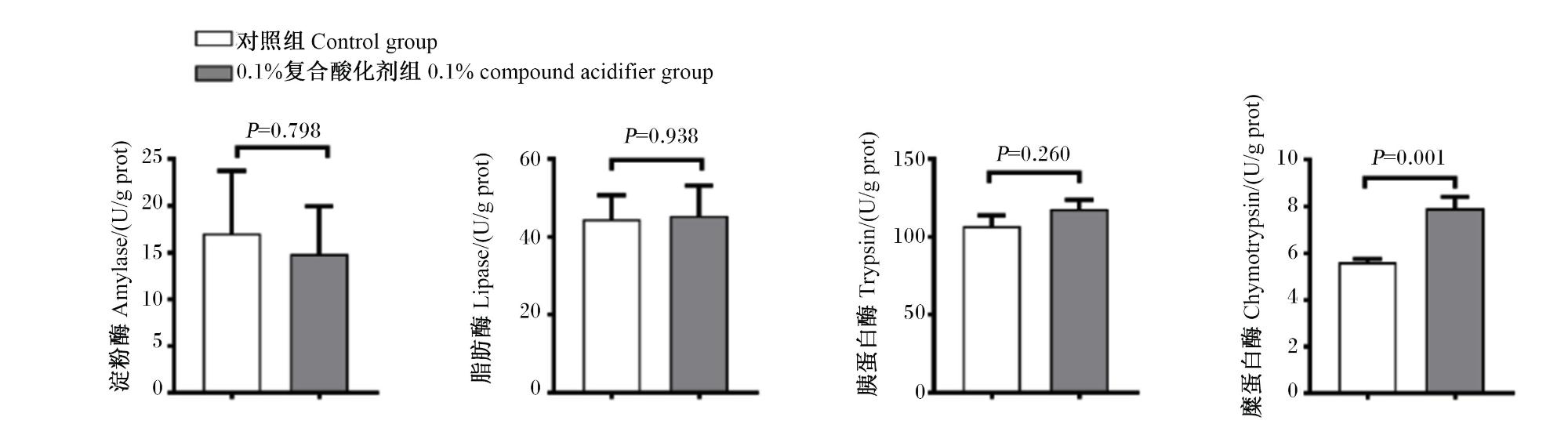
根据生长性能结果,选择对照组和0.1%复合酸化剂组进行空肠消化酶活性比较。如图1所示,与对照组相比,0.1%复合酸化剂组空肠糜蛋白酶活性显著提高(P<0.05),空肠淀粉酶、脂肪酶和胰蛋白酶活性无显著差异(P>0.05)。
图1 复合酸化剂对断奶仔猪空肠消化酶活性的影响

Fig.1 Effects of compound acidifiers on jejunal digestive enzyme activities of weaned piglets (n=6)

2.4 复合酸化剂对断奶仔猪结肠微生物群落的影响

2.4.1 α和β多样性分析

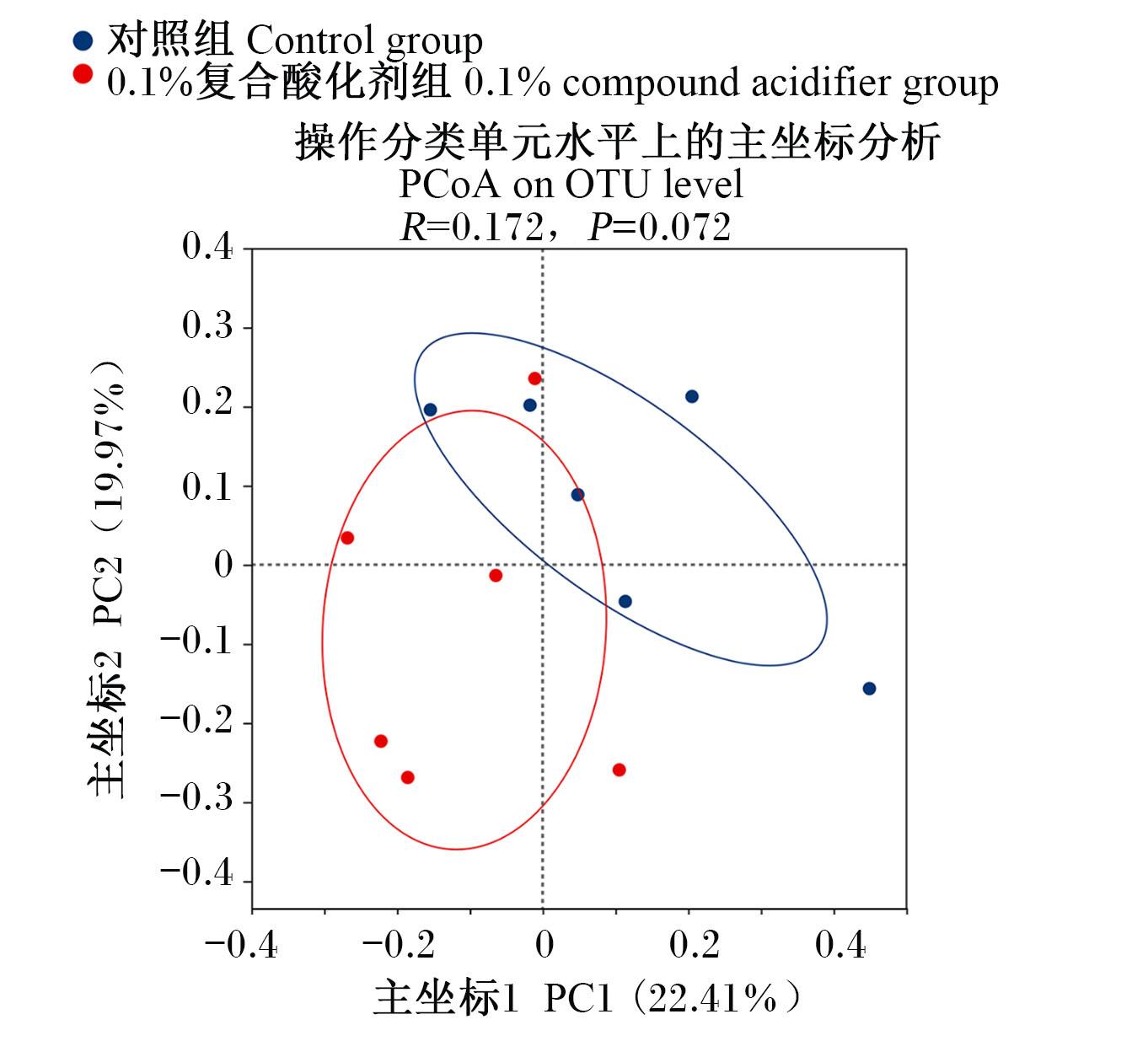
表4可知,与对照组相比,饲粮添加0.1%复合酸化剂对断奶仔猪结肠微生物群落Shannon、Simpson、Chao和Ace指数均无显著影响(P>0.05)。2组Coverage指数均大于99%,说明测序数据量足够大,可以反映样品中绝大多数的微生物信息。如图2所示,基于OTU的PCoA结果表明,2组间结肠微生物群落β多样性存在显著差异趋势(P=0.072)。
表4 复合酸化剂对断奶仔猪结肠微生物群落α多样性的影响

Table 4 Effects of compound acidifiers on α diversity of colonic microbiota of weaned piglets (n=6)

项目
Items
对照组
Control group
0.1%复合酸化剂组
0.1% compound
acidifier group
均值标准误
SEM
P
P-value
Shannon指数 Shannon index 4.40 4.16 0.147 0.440
Simpson指数 Simpson index 0.06 0.05 0.013 0.694
Chao指数 Chao index 745.52 930.69 35.375 0.285
Ace指数 Ace index 899.10 819.00 36.110 0.288
Coverage指数 Coverage index 1.00 1.00 <0.001 0.477
图2 复合酸化剂对断奶仔猪结肠微生物群落β多样性的影响

Fig.2 Effects of compound acidifiers on β diversity of colonic microbiota of weaned piglets

2.4.2 差异微生物分析

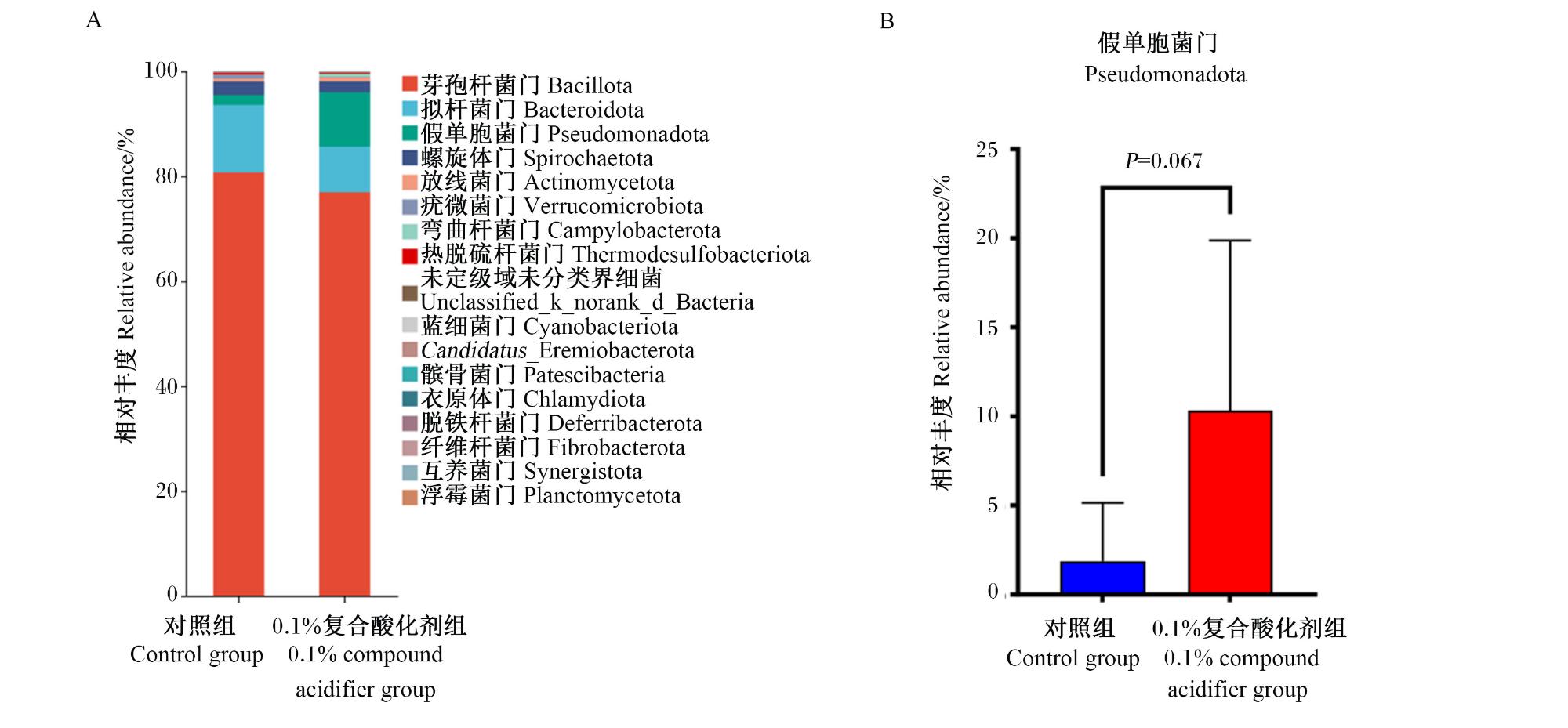
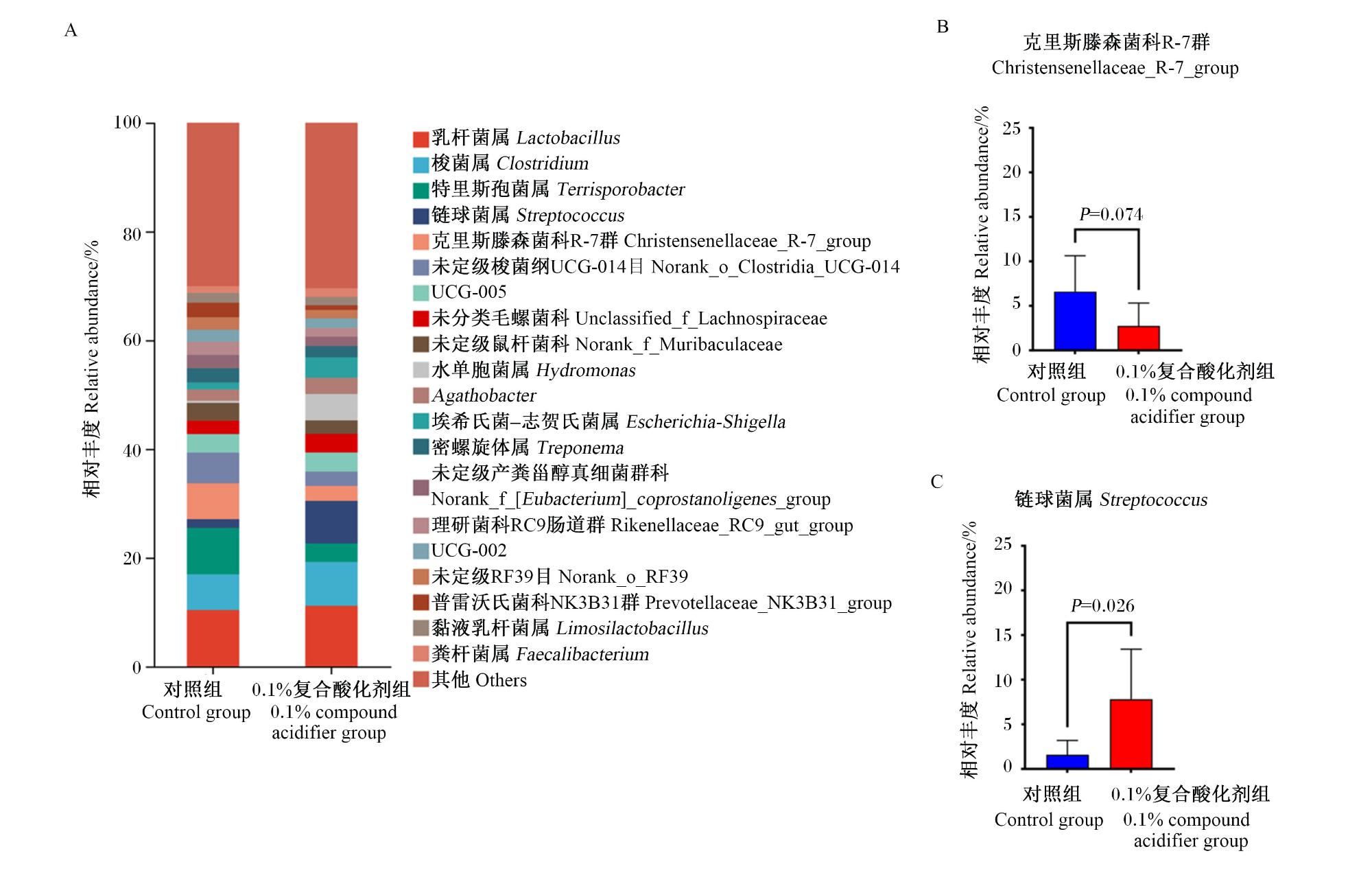
图3所示,在门水平上,芽孢杆菌门(Bacillota)、拟杆菌门(Bacteroidota)和假单胞菌门(Pseudomonadota)是断奶仔猪结肠微生物群落中的优势菌门,且0.1%复合酸化剂组结肠假单胞菌门相对丰度有显著高于对照组的趋势(P=0.067)。如图4所示,在属水平上,乳杆菌属、梭菌属(Clostridium)和特里斯孢菌属(Terrisporobacter)占据优势地位;同时,与对照组相比,0.1%复合酸化剂组结肠链球菌属相对丰度显著提高(P<0.05),结肠克里斯滕森菌科R-7群(Christensenellaceae_R-7_group)相对丰度有显著降低趋势(P=0.074)。
图3 断奶仔猪结肠微生物群落在门水平上的组成

Fig.3 Composition of colonic microbiota of weaned piglets at phylum level

图4 断奶仔猪结肠微生物群落在属水平上的组成

Fig.4 Composition of colonic microbiota of weaned piglets at genus level

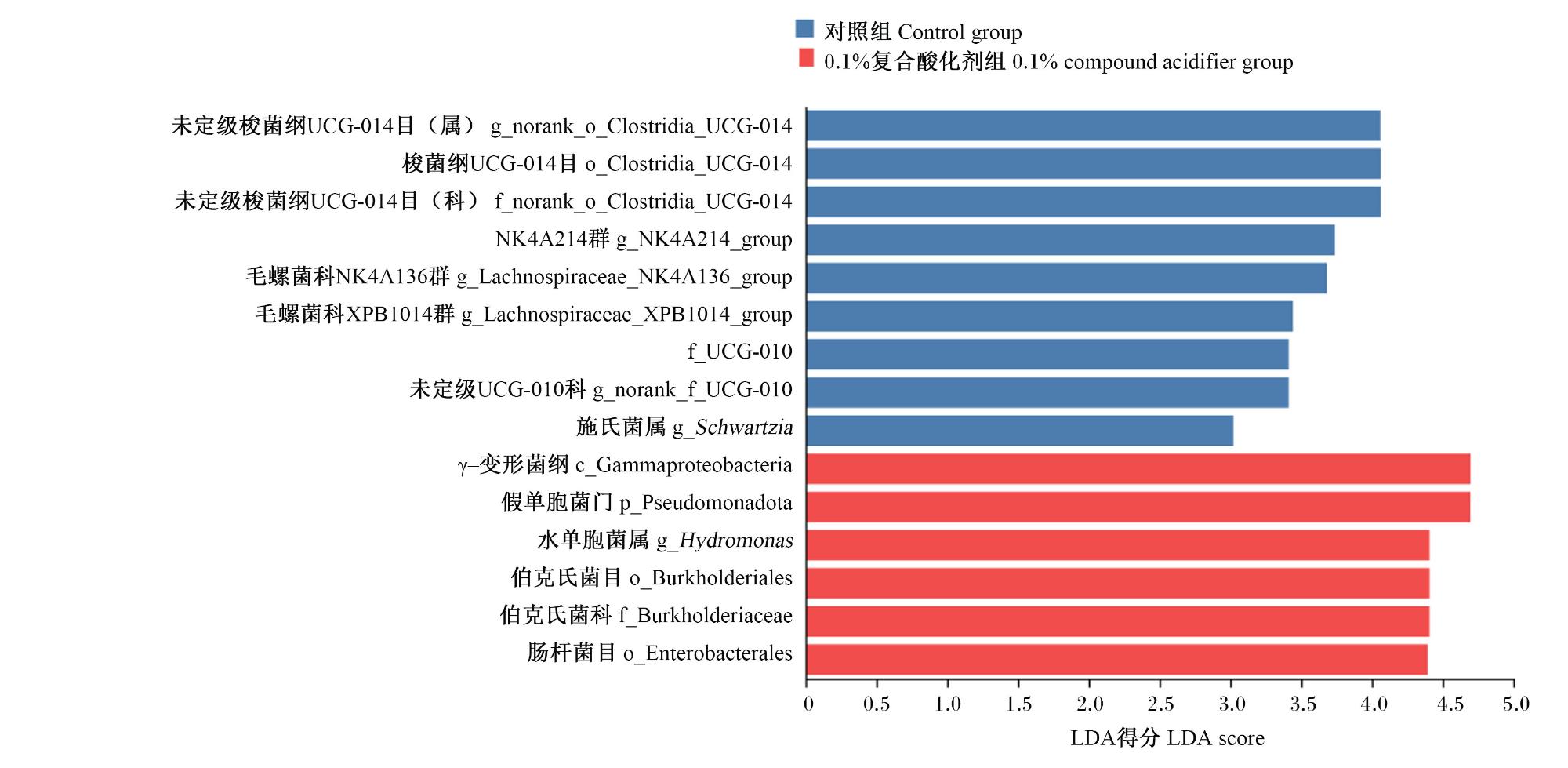
图5所示,LEfSe分析结果表明,对照组结肠微生物群落标记类群为梭菌纲UCG-014目(o_Clostridia_UCG-014)及其未定级科属、毛螺菌科NK4A136群(Lachnospiraceae_NK4A136_group)、毛螺菌科XPB1014群(Lachnospiraceae_XPB1014_group)及施氏菌属(Schwartzia)等;0.1%复合酸化剂组标记类群为假单胞菌门和水单胞菌属(Hydromonas)等。
图5 断奶仔猪结肠微生物群落LEfSe分析

Fig.5 LEfSe analysis of colonic microbiota of weaned piglets

2.5 复合酸化剂替代苯甲酸和甲酸对断奶仔猪生长性能、腹泻率以及血清炎症和肠道通透性指标的影响

试验2评估了在断奶仔猪饲粮中采用复合酸化剂替代苯甲酸和甲酸的潜力。鉴于试验1中复合酸化剂对断奶仔猪血清炎症因子和LPS含量的降低作用呈剂量效应,同时与对照组相比,饲粮添加0.3%复合酸化剂显著降低血清TNF-α、IL-1β、IL-6、MCP1和LPS含量(P<0.05),而饲粮添加0.1%复合酸化剂对上述指标无显著影响(P>0.05),因此在试验2第1~14天试验组采用0.3%复合酸化剂替代对照组的0.5%苯甲酸和0.3%甲酸;随着断奶仔猪体重的增加,健康状况会逐渐改善,为了降低饲料成本,将试验2第15~31天试验组复合酸化剂添加量降到0.2%,以替代对照组的0.3%苯甲酸。由表5可知,采用复合酸化剂替代苯甲酸/甲酸对试验2第1~14天(1号料阶段)、第15~31天(2号料阶段)以及第1~31天(试验全期)断奶仔猪ADG、ADFI、F/G和腹泻率均无显著影响(P>0.05)。
表5 复合酸化剂替代苯甲酸和甲酸对断奶仔猪生长性能和腹泻率的影响

Table 5 Effects of compound acidifiers replacing benzoic acid and formic acid on growth performance and diarrhea rate of weaned piglets (n=5)

项目
Items
对照组
Control group
试验组
Experimental group
均值标准误
SEM
P
P-value
体重 BW/kg
第1天 Day 1 11.18 11.22 0.323 0.929
第14天 Day 14 18.78 18.91 0.363 0.810
第31天 Day 31 31.25 31.32 0.376 0.899
第1~14天 Days 1 to 14
平均日增重 ADG/(g/d) 543 549 5.552 0.461
平均日采食量 ADFI/(g/d) 725 732 3.541 0.207
料重比 F/G 1.34 1.33 0.013 0.916
腹泻率 Diarrhea rate/% 3.71 3.67 0.482 0.951
第15~31天 Days 15 to 31
平均日增重 ADG/(g/d) 734 730 6.986 0.739
平均日采食量 ADFI/(g/d) 1 336 1 347 12.576 0.551
料重比 F/G 1.82 1.84 0.021 0.443
腹泻率 Diarrhea rate/% 4.32 4.70 0.578 0.660
第1~31天 Days 1 to 31
平均日增重 ADG/(g/d) 648 649 4.467 0.890
平均日采食量 ADFI/(g/d) 1 051 1 060 7.884 0.434
料重比 F/G 1.62 1.63 0.011 0.455
腹泻率 Diarrhea rate/% 4.03 4.20 0.419 0.780
本试验进一步评估了复合酸化剂替代苯甲酸/甲酸对断奶仔猪血清炎症和肠道通透性指标的影响。由表6可知,与对照组相比,试验组血清IL-1β含量有显著升高趋势(P=0.094),血清TNF-α、IL-6和LPS含量以及DAO活性无显著差异(P>0.05)。
表6 复合酸化剂替代苯甲酸和甲酸对断奶仔猪血清炎症和肠道通透性指标的影响

Table 6 Effects of compound acidifiers replacing benzoic acid and formic acid on serum inflammatory and intestinal permeability indices of weaned piglets (n=5)

项目
Items
对照组
Control group
试验组
Experimental group
均值标准误
SEM
P
P-value
肿瘤坏死因子-α TNF-α/(pg/mL) 48.78 53.17 2.209 0.177
白细胞介素-1β IL-1β/(pg/mL) 24.77 28.99 1.689 0.094
白细胞介素-6 IL-6/(pg/mL) 120.47 131.07 4.681 0.127
脂多糖 LPS/(EU/mL) 0.56 0.62 0.037 0.238
二胺氧化酶 DAO/(U/L) 1.75 1.87 0.062 0.215

3 讨论

3.1 复合酸化剂对断奶仔猪生长性能和腹泻率的影响

生长性能和腹泻率是反映仔猪生长和健康的重要指标。酸化剂可通过降低胃肠道pH提高蛋白酶活性,帮助仔猪更高效地吸收饲粮营养,从而提升其生长性能[10]。不过,在试验1中,各组仔猪均未出现腹泻情况,这可能是饲粮添加0.1%~0.5%复合酸化剂不影响仔猪生长性能的一个原因。值得注意的是,饲料原料的酸结合能力显著影响酸化剂效果。酸结合能力较高的饲料原料,如豆粕、鱼粉等会中和胃酸,导致胃内pH升高,蛋白质消化率降低并促进病原菌增殖,从而削弱酸化剂作用。钙盐、磷酸盐等高酸结合能力的成分也会中和酸化剂,降低其有效性[11-12]。因此,在后续的研究中可以结合饲料原料组成进一步分析复合酸化剂对断奶仔猪生长性能的影响。
苯甲酸和甲酸是断奶仔猪饲粮中常用的传统酸化剂。在全球市场中,中国是甲酸和苯甲酸的重要生产者,我国甲酸的市场份额占世界的45%,苯甲酸在中国的消费需求占全球的42%。研究表明,饲粮添加0.5%苯甲酸能够降低仔猪回肠和结肠pH,显著减少大肠杆菌数量,并增加乳酸杆菌数量[13-14]。Luise等[15]研究表明,在仔猪饲粮中添加1.4和6.4 g/kg甲酸,在断奶后前3周显著提高ADG,其中1.4 g/kg组ADG最高(286.0 g/d),但是延长使用时间对生长性能的有益作用消失。Ren等[16]研究发现,甲酸可以调控NF-κB/丝裂原活化蛋白激酶(MAPK)信号通路,减少促炎因子释放,缓解肠道炎症,甲酸组(添加0.6%甲酸)回肠厚壁菌门相对丰度从对照组的48.09%提升至57.60%。本研究发现,在商业化养殖条件下,饲粮采用0.3%复合酸化剂替代0.5%苯甲酸和0.3%甲酸,以及采用0.2%复合酸化剂替代0.3%苯甲酸对断奶仔猪生长性能和腹泻率均无显著影响,这意味着在断奶仔猪饲粮中使用复合酸化剂的效果与苯甲酸/甲酸相当,且添加量更低,具有较好的应用前景。

3.2 复合酸化剂对断奶仔猪血清炎症指标的影响

TNF-α和IL-1β是两大核心促炎因子,能引起发热、食欲减退等全身反应[17]。IL-6参与急性期炎症反应[18]。MCP1可以引导免疫细胞(如单核细胞、巨噬细胞)到炎症部位[19]。促炎细胞因子与病原菌诱导的紧密连接蛋白的表达改变相关,过量表达会损伤肠道屏障功能,导致仔猪腹泻[20]。试验1发现,饲粮添加0.3%和0.5%复合酸化剂显著降低断奶仔猪血清TNF-α、IL-1β、IL-6和MCP1含量,且存在剂量效应,说明复合酸化剂显著提高了断奶仔猪的免疫功能。在动物机体炎症调控与抗氧化防御体系中,苹果酸、富马酸及天冬氨酸均有关键的调节作用。其中,L-苹果酸对炎症反应有显著的剂量依赖性抑制效果,在母猪妊娠后期饲粮添加L-苹果酸可有效降低血清TNF-α、干扰素-γ(IFN-γ)和IL-6等促炎因子含量,显著提升总抗氧化能力以及超氧化物歧化酶、谷胱甘肽过氧化物酶和过氧化氢酶活性,降低丙二醛含量,通过强化抗氧化系统的功能减少氧化应激对机体的损伤[21]。在低蛋白质饲粮中补充天冬氨酸,可有效缓解过氧化氢攻击导致的断奶仔猪肠道损伤,缓解肠黏膜的破坏,间接抑制肠道炎症的发生[22]。富马酸作为三羧酸循环的关键中间产物,一方面可通过参与能量代谢为机体提供充足ATP,为免疫细胞发挥抗炎功能奠定物质基础;另一方面,其代谢过程可以调节细胞内的氧化还原平衡,减少活性氧堆积,进而抑制炎症因子的激活与释放[23]。因此,在本研究中,苹果酸、富马酸和天冬氨酸三者可能共同发挥作用,改善了断奶仔猪的炎症反应。

3.3 复合酸化剂对断奶仔猪肠道通透性和消化酶活性的影响

仔猪断奶时消化器官发育不充分,一方面胃肠道系统不完善导致胃酸分泌不足,胃内酸度较低,难以维持适宜pH和足够的酶活性[24];另一方面蛋白质消化吸收能力受限,未消化的蛋白质在后肠发酵易产生有毒物质,导致仔猪腹泻[25]。胰蛋白酶的作用是将蛋白质分解为小分子肽和氨基酸,激活后的胰蛋白酶进一步激活糜蛋白酶原。糜蛋白酶的核心作用是进一步分解蛋白质和多肽,生成更小分子的肽和氨基酸。尹苗等[26]研究发现,适当调节畜禽胃肠道pH可以提高蛋白酶等消化酶活性,促进畜禽对饲粮营养物质的吸收利用。苹果酸、富马酸、天冬氨酸对肠道消化酶活性均有调控作用,其中随饲料L-苹果酸添加量的提高,吉富罗非鱼肠道淀粉酶和脂肪酶活性先升高后下降,蛋白酶活性逐渐升高[27];饲粮添加0.42%富马酸能显著提高肉鸡胰蛋白酶活性[28];饲粮添加0.5%和1.0%天冬氨酸则可显著缓解LPS刺激导致的空肠蔗糖酶和回肠麦芽糖酶活性的降低,并显著提高空肠乳糖酶以及回肠乳糖酶和蔗糖酶活性[29]。与前人报道一致,本研究试验1中饲粮添加0.1%复合酸化剂显著提高断奶仔猪空肠糜蛋白酶活性,空肠胰蛋白酶活性也提高了10.32%,对空肠淀粉酶和脂肪酶活性无显著影响。同时,试验1还发现,复合酸化剂线性降低了血清LPS含量。LPS导致结肠黏膜结构紊乱、隐窝萎缩、杯状细胞减少,并降低紧密连接蛋白闭合蛋白(occludin)和闭锁小带蛋白-1(ZO-1)表达,增加肠道通透性[30]。因此,饲粮添加复合酸化剂可以通过提高肠道蛋白酶活性以及减少LPS的产生,改善断奶仔猪的肠道健康。考虑到复合酸化剂降低断奶仔猪血清炎症因子和LPS含量的效果呈现剂量依赖效应,在后续的研究中可以进一步分析复合酸化剂添加量对空肠消化酶活性的影响。值得注意的是,LPS刺激可以通过激活Toll样受体4(TLR4)引起大量促炎细胞因子的产生,导致系统性炎症[31]。因此,减少LPS的产生可能是复合酸化剂改善断奶仔猪免疫功能的重要原因。

3.4 复合酸化剂对断奶仔猪肠道微生物群落的影响

调节肠道微生物群落结构,提高梭菌属、乳杆菌属、普雷沃氏菌属、双歧杆菌属等有益菌的相对丰度,以及抑制沙门氏菌和大肠杆菌等有害菌的生长,是二甲酸钾、乳酸、柠檬酸、乙酸等酸化剂改善断奶仔猪抗炎能力和肠道健康的重要途径[32-34]。本研究发现,饲粮添加复合酸化剂提高了断奶仔猪结肠假单胞菌门和链球菌属相对丰度。链球菌在仔猪肠道中的有益作用主要体现在稳定乳酸菌,以及抑制沙门氏菌等有害微生物定植;链球菌还可以缓解抗生素对肠道菌群的破坏,抑制潜在致病菌的异常增殖,降低肠道感染风险[35]。Peng等[36]研究也发现,嗜热链球菌可以通过合成胞外多糖降低肠道通透性,减少有害物质进入血液循环,并促进乳糖分解以及钙、磷等矿物质吸收。同时本研究还发现,饲粮添加0.1%复合酸化剂组有降低结肠克里斯滕森菌科R-7群相对丰度的趋势。Khalid等[37]研究表明,热应激显著降低肉兔空肠克里斯滕森菌科R-7群相对丰度,而补充辣木叶粉可恢复其相对丰度,同时伴随丁酸盐含量升高。Waters等[38]报道,克里斯滕森菌科与炎症性肠病、脂肪沉积异常等代谢疾病呈负相关。在未来的工作中,还需要借助粪菌移植技术和模式动物等进一步揭示肠道微生物在复合酸化剂发挥有益效果中的作用。

4 结论

综上所述,饲粮添加适宜剂量复合酸化剂能够提高断奶仔猪抗炎能力,降低血清LPS含量,并通过提高空肠糜蛋白酶活性和调节结肠微生物群落改善肠道健康。在商业化养殖条件下,复合酸化剂的使用效果与传统酸化剂苯甲酸和甲酸相当,且添加量更低,显示出了较好的应用前景。
[1]
CAMPBELL J M, CRENSHAW J D, POLO J. The biological stress of early weaned piglets[J]. Journal of Animal Science and Biotechnology, 2013, 4(1):19.

DOI PMID

[2]
HEO J M, OPAPEJU F O, PLUSKE J R, et al. Gastrointestinal health and function in weaned pigs:a review of feeding strategies to control post-weaning diarrhea without using in-feed antimicrobial compounds[J]. Journal of Animal Physiology and Animal Nutrition, 2013, 97(2):207-237.

DOI

[3]
HALAS D, HANSEN C F, HAMPSON D J, et al. Dietary supplementation with benzoic acid improves apparent ileal digestibility of total nitrogen and increases villous height and caecal microbial diversity in weaner pigs[J]. Animal Feed Science and Technology, 2010, 160(3/4):137-147.

DOI

[4]
CHEN J L, ZHENG P, ZHANG C, et al. Benzoic acid beneficially affects growth performance of weaned pigs which was associated with changes in gut bacterial populations,morphology indices and growth factor gene expression[J]. Journal of Animal Physiology and Animal Nutrition, 2017, 101(6):1137-1146.

DOI

[5]
BOLDUAN G, JUNG H, SCHNEIDER R, et al. Influence of fumaric acid and propanediol formate on piglets[J]. Journal of Animal Physiology and Animal Nutrition, 1988, 59(3):143-149.

DOI

[6]
张旭晖, 王恬, 冀凤杰, 等. 有机酸化剂对断奶仔猪生长性能和肠道健康的影响[J]. 动物营养学报, 2012, 24(3):507-514.

DOI

ZHANG X H, WANG T, JI F J, et al. Effects of dietary organic acids on growth performance and gut health of weaner piglets[J]. Chinese Journal of Animal Nutrition, 2012, 24(3):507-514. (in Chinese)

[7]
ZHANG X, CHEN M X, YAN E F, et al. Dietary malic acid supplementation induces skeletal muscle fiber-type transition of weaned piglets and further improves meat quality of finishing pigs[J]. Frontiers in Nutrition, 2022, 8:825495.

DOI

[8]
刘禹彤, 杨冠华, 王璐瑶, 等. 富马酸和肉桂醛及其联合添加对断奶仔猪生长性能、血清生化和抗氧化指标以及肠道炎症反应的影响[J]. 动物营养学报, 2025, 37(3):1575-1584.

DOI

LIU Y T, YANG G H, WANG L Y, et al. Effects of fumaric acid and cinnamic aldehyde and their combination on growth performance,serum biochemical and antioxidant indices and intestinal inflammatory response of weaned piglets[J]. Chinese Journal of Animal Nutrition, 2025, 37(3):1575-1584. (in Chinese)

[9]
JIN S S, WU J, WANG C Y, et al. Aspartate metabolism-driven gut microbiota dynamics and RIP-dependent mitochondrial function counteract oxidative stress[J]. Advanced Science, 2025, 12(11):e2404697.

[10]
奚玉莲, 黄金华, 宁国信, 等. 酸化剂在生猪养殖中的应用[J]. 中国饲料, 2020(17):10-14.

XI Y L, HUANG J H, NING G X, et al. Application of acidifier in pig breeding[J]. China Feed, 2020(17):10-14. (in Chinese)

[11]
STAS E B, TOKACH M D, WOODWORTH J C, et al. Effects of dietary acidifiers and other low acid-binding capacity formulation strategies on weanling pig growth performance and fecal dry matter[J]. Translational Animal Science, 2025,9:txaf104.

[12]
STAS E B, TOKACH M D, DEROUCHEY J M, et al. Evaluation of the acid-binding capacity of ingredients and complete diets commonly used for weanling pigs[J]. Translational Animal Science, 2022, 6(3):txac104.

[13]
TORRALLARDONA D, BADIOLA I, BROZ J. Effects of benzoic acid on performance and ecology of gastrointestinal microbiota in weanling piglets[J]. Livestock Science, 2007, 108(1/2/3):210-213.

DOI

[14]
DIAO H, ZHENG P, YU B, et al. Effects of dietary supplementation with benzoic acid on intestinal morphological structure and microflora in weaned piglets[J]. Livestock Science, 2014, 167:249-256.

DOI

[15]
LUISE D, MOTTA V, SALVARANI C, et al. Long-term administration of formic acid to weaners:influence on intestinal microbiota,immunity parameters and growth performance[J]. Animal Feed Science and Technology, 2017, 232:160-168.

DOI

[16]
REN C X, WANG Y J, LIN X F, et al. A combination of formic acid and monolaurin attenuates enterotoxigenic Escherichia coli induced intestinal inflammation in piglets by inhibiting the NF-κB/MAPK pathways with modulation of gut microbiota[J]. Journal of Agricultural and Food Chemistry, 2020, 68(14):4155-4165.

DOI

[17]
RAMILO O, SÁEZ-LLORENS X, MERTSOLA J, et al. Tumor necrosis factor alpha/cachectin and interleukin 1 beta initiate meningeal inflammation[J]. Journal of Experimental Medicine, 1990, 172(2):497-507.

DOI PMID

[18]
FIELDING C A, MCLOUGHLIN R M, MCLEOD L, et al. IL-6 regulates neutrophil trafficking during acute inflammation via STAT3[J]. Journal of Immunology, 2008, 181(3):2189-2195.

DOI PMID

[19]
MIYAZAKI S, MATSUKAWA A, OHKAWARA S, et al. Neutrophil infiltration as a crucial step for monocyte chemoattractant protein (MCP)-1 to attract monocytes in lipopolysaccharide-induced arthritis in rabbits[J]. Inflammation Research, 2000, 49(12):673-678.

PMID

[20]
YU X R, CUI Z C, QIN S K, et al. Effects of Bacillus licheniformis on growth performance,diarrhea incidence,antioxidant capacity,immune function,and fecal microflora in weaned piglets[J]. Animals, 2022, 12(13):1609.

DOI

[21]
ZHANG P G, JIANG G Y, WANG Y B, et al. Maternal consumption of L-malic acid enriched diets improves antioxidant capacity and glucose metabolism in offspring by regulating the gut microbiota[J]. Redox Biology, 2023, 67:102889.

DOI

[22]
CHEN S, WU X, DUAN J L, et al. Low-protein diets supplemented with glutamic acid or aspartic acid ameliorate intestinal damage in weaned piglets challenged with hydrogen peroxide[J]. Animal Nutrition, 2021, 7(2):356-364.

DOI PMID

[23]
XAVIERA A, SALEEM A, AKHTAR M F, et al. Fumaric acid per se and in combination with methotrexate arrests inflammation via moderating inflammatory and oxidative stress biomarkers in arthritic rats[J]. Immunopharmacology and Immunotoxicology, 2024, 46(6):793-804.

DOI

[24]
徐海岩, 王超, 徐鲁善. 日粮系酸力在断奶仔猪上的应用研究进展[J]. 猪业科学, 2021, 38(5):90-94.

XU H Y, WANG C, XU L S. Research progress on application of dietary acid-binding capacity in weaned piglets[J]. Swine Industry Science, 2021, 38(5):90-94. (in Chinese)

[25]
XIA J Y, FAN H Y, YANG J, et al. Research progress on diarrhoea and its mechanism in weaned piglets fed a high-protein diet[J]. Journal of Animal Physiology and Animal Nutrition, 2022, 106(6):1277-1287.

DOI

[26]
尹苗, 陈希文, 王聪, 等. 酸化剂的作用机制及在畜禽健康养殖中的应用[J]. 黑龙江畜牧兽医, 2022(20):31-35.

YIN M, CHEN X W, WANG C, et al. Action mechanism of acidifier and its application in healthy livestock and poultry breeding[J]. Heilongjiang Animal Science and Veterinary Medicine, 2022(20):31-35. (in Chinese)

[27]
李赞, 罗莉, 陈任孝, 等. L-苹果酸对吉富罗非鱼肠道结构功能及肝脏TCA循环效率的影响[J]. 水产学报, 2014, 38(1):119-126.

LI Z, LUO L, CHEN R X, et al. Effects of L-malic acid on intestinal histology and function,and TCA cycle efficiency of the liver of gift tilapia (Oreochromis niloticus)[J]. Journal of Fisheries of China, 2014, 38(1):119-126. (in Chinese)

[28]
赵旭, 沈一茹, 陈杰, 等. 不同种类酸化剂对肉鸡肠道发育、消化酶活性以及微生物数量的影响[J]. 动物营养学报, 2015, 27(11):3509-3515.

DOI

ZHAO X, SHEN Y R, CHEN J, et al. Effects of different kinds of acidifier on intestinal development,digestive enzyme activities and microbiota number of broiler chickens[J]. Chinese Journal of Animal Nutrition, 2015, 27(11):3509-3515. (in Chinese)

[29]
石海峰. 天冬氨酸对脂多糖刺激断奶仔猪肠道损伤的调控作用[D]. 硕士学位论文. 武汉: 武汉轻工大学, 2013.

SHI H F. Regulatory effect of aspartic acid on intestinal injury in piglets after lipopolysaccharide challenge[D]. Master’s Thesis. Wuhan: Wuhan Polytechnic University, 2013. (in Chinese)

[30]
CHEN L, ZHONG X L, CAO W Y, et al. JQ1 as a BRD4 inhibitor blocks inflammatory pyroptosis-related acute colon injury induced by LPS[J]. Frontiers in Immunology, 2021, 12:609319.

DOI

[31]
MOHAMMAD S, THIEMERMANN C. Role of metabolic endotoxemia in systemic inflammation and potential interventions[J]. Frontiers in Immunology, 2020, 11:594150.

DOI

[32]
淡江华, 李国柱, 冯燕平, 等. 不同饲料添加剂对断奶仔猪生长性能、免疫性能、肠道健康及粪便微生物的影响[J]. 动物营养学报, 2024, 36(9):5581-5593.

DOI

DAN J H, LI G Z, FENG Y P, et al. Effects of different feed additives on growth performance,immune performance,intestinal health and fecal microorganisms of weaned piglets[J]. Chinese Journal of Animal Nutrition, 2024, 36(9):5581-5593. (in Chinese)

[33]
王丽娜, 高飞, 朱晓彤, 等. 不同有机酸对断奶仔猪肠道厌氧培养微生物菌群的影响[J]. 华南农业大学学报, 2015, 36(6):9-14.

WANG L N, GAO F, ZHU X T, et al. Effects of different organic acids on anaerobically cultured intestinal microflora in weaned piglets[J]. Journal of South China Agricultural University, 2015, 36(6):9-14. (in Chinese)

[34]
朱爱民, 孙强东. 不同酸化剂对断奶仔猪生长、免疫性能和微生物菌群的影响[J]. 中国饲料, 2021(4):36-39.

ZHU A M, SUN Q D. Effects of different acidifier agents on growth,immune performance and microflora of weaned piglets[J]. China Feed, 2021(4):36-39. (in Chinese)

[35]
OZAWA K, YABU-UCHI K, YAMANAKA K, et al. Effect of Streptococcus faecalis BIO-4R on intestinal flora of weanling piglets and calves[J]. Applied and Environmental Microbiology, 1983, 45(5):1513-1518.

DOI

[36]
PENG Q T, HU H M, DAI A, et al. Mechanisms of exopolysaccharide synthesis by Streptococcus thermophilus IMAU20246 determined by the carbon source[J]. Food Chemistry, 2025, 481:144069.

DOI

[37]
KHALID A R, YASOOB T B, ZHANG Z, et al. Dietary Moringa oleifera leaf powder improves jejunal permeability and digestive function by modulating the microbiota composition and mucosal immunity in heat stressed rabbits[J]. Environmental Science and Pollution Research International, 2022, 29(53):80952-80967.

DOI

[38]
WATERS J L, LEY R E. The human gut bacteria Christensenellaceae are widespread,heritable,and associated with health[J]. BMC Biology, 2019, 17(1):83.

DOI

Outlines

/