RESEARCH PAPER

Dietary Oils Affects Egg Quality of Laying Hens via Fibroblast Growth Factor 23-Klotho-Vitamin D Axis

  • LI Xiaoyao ,
  • XIE Yuesheng ,
  • LIU Fu ,
  • YUAN Shunhua ,
  • ZHAO Yurong ,
  • CAO Manhu , *
Expand
  • College of Animal Science and Technology, Hunan Agricultural University, Changsha 410128, China
*professor, E-mail:

Received date: 2025-10-14

  Online published: 2026-05-14

Abstract

This study aimed to investigate the effects of dietary oil supplementation on egg quality of laying hens and to elucidate the underlying mechanism from the perspective of oil-mediated regulation of vitamin D metabolism and the fibroblast growth factor 23 (FGF23)-Klotho axis. A total of 144 Roman pink laying hens aged 65 weeks, with no significant difference in laying rate among groups (P>0.05), were randomly divided into 4 groups, each consisting of 6 replicates with 6 hens per replicate. Group A (control group) was fed a basal diet without oil supplementation, while the other three groups (experimental groups) were fed experimental diets supplemented with 2.0% soybean oil (group B), 1.4% soybean oil+0.6% lard (group C) or 2.0% composite oil (0.5% soybean oil+0.5% corn oil+0.5% palm oil+0.5% coconut oil) (group D). The pre-feeding period lasted for 7 days, followed by a formal experimental period of 45 days. The results showed as follows: 1) there were no significant differences among groups in average daily feed intake, average daily egg mass, feed-to-egg ratio, laying rate, soft-shell egg rate and breaking egg rate (P>0.05). Compared with the control group, albumen height and Haugh unit were significantly increased in the three experimental groups (P<0.05), while eggshell strength showed a numerical increase (P>0.05). 2) Compared with the control group, the contents of linoleic acid (C18∶2n-6), α-linolenic acid (C18∶3n-3), arachidonic acid (C20∶4), docosahexaenoic acid (C22∶6n-3, DHA), n-6 polyunsaturated fatty acids (PUFA), n-3 PUFA and PUFA in egg yolk in the three experimental groups were significantly increased (P<0.05), whereas the contents of palmitoleic acid (C16∶1), trans-oleic acid (C18∶1 trans), cis-oleic acid (C18∶1 cis) and monounsaturated fatty acids (MUFA) were significantly decreased (P<0.05). The n-6/n-3 PUFA ratio in the control group was 20.0, and compared with the control group, this ratio was significantly reduced by 4.7, 4.6 and 1.7 in groups B, C and D, respectively (P<0.05). Meanwhile, compared with the control group, saturated fatty acid (SFA) content in egg yolk was decreased by 1.20% in group B (P>0.05), 1.98% in group C (P<0.05), and 1.21% in group D (P>0.05), whereas unsaturated fatty acid (UFA) content was increased by 1.38% in group B (P>0.05), 1.89% in group C (P<0.05), and 1.10% in group D (P>0.05). 3) Compared with the control group, serum contents of 1,25-dihydroxyvitamin D3 [1,25-(OH)2D3], FGF23, Klotho and calcium were significantly increased in the three experimental groups (P<0.05); in addition, serum phosphorus content was significantly increased in group C (P<0.05). 4) The relative mRNA expression levels of cytochrome P450 family 27 subfamily B member 1 (CYP27B1) in the kidney, as well as membrane vitamin D receptor (mVDR), nuclear vitamin D receptor (nVDR) and solute carrier family 34 member 2 (SLC34A2) in the duodenum, were significantly higher in the three experimental groups than in the control group (P<0.05). In conclusion, dietary supplementation with different oils (2.0% soybean oil, 1.4% soybean oil+0.6% lard, or 2.0% composite oil) in laying hen diets can improve calcium and phosphorus metabolism and the activation of vitamin D by upregulating the expression of CYP27B1 in the kidney and mVDR, nVDR and SLC34A2 in the duodenum, thereby enhancing egg quality. Additionally, oil supplementation increases egg yolk PUFA content while decreasing SFA content, thereby optimizing egg yolk fatty acid composition and the n-6/n-3 PUFA ratio.

Cite this article

LI Xiaoyao , XIE Yuesheng , LIU Fu , YUAN Shunhua , ZHAO Yurong , CAO Manhu . Dietary Oils Affects Egg Quality of Laying Hens via Fibroblast Growth Factor 23-Klotho-Vitamin D Axis[J]. Chinese Journal of Animal Nutrition, 2026 , 38(5) : 3403 -3416 . DOI: 10.12418/CJAN2026.272

产蛋后期由于蛋鸡身体机能下降,蛋品质随之显著降低,尤其是蛋壳质量问题更为突出。生产数据显示,该阶段破蛋、软壳蛋和薄壳蛋的比例都会增加,严重影响生产效益[1-2]。因此,探索改善产蛋后期蛋壳质量的措施及其作用机理,是该阶段重要的研究方向。油脂作为蛋鸡重要的能量饲料,不仅提供能量和脂肪酸,还是脂溶性维生素的溶剂,能够显著促进脂溶性维生素的吸收[3-4]。维生素D是蛋鸡必需的重要维生素,对钙、磷的吸收及蛋壳质量具有关键调控作用[5-6]。然而,油脂是如何影响维生素D代谢进而调控钙、磷吸收的,目前尚缺乏深入研究。近年来,成纤维细胞生长因子23(FGF23)-Klotho轴被证实是调控磷稳态及维生素D向活性形式1,25-二羟基维生素D3[1,25-(OH)2D3]转化的重要通路[7-8]。该信号轴通过FGF23抑制肾脏1α-羟化酶并激活24-羟化酶,从而精确调控1,25-(OH)2D3的合成与降解。然而,该信号轴是否受油脂调控,以及饲粮中添加油脂对其产生何种影响,目前均未见报道。为此,本研究聚焦产蛋后期蛋品质改善的营养措施,围绕“油脂添加→维生素D代谢→FGF23-Klotho轴→钙磷稳态→蛋品质”这一调控路径,系统探究油脂对维生素D向活性形式1,25-(OH)2D3转化过程的影响,并基于FGF23-Klotho轴相关指标的变化揭示其作用机制,以期为提升蛋鸡产蛋后期蛋品质提供营养干预策略,并为相关研究奠定理论基础。

1 材料与方法

1.1 试验材料

试验油脂分别为豆油、猪油、玉米油、棕榈油粉和椰子油粉,各油脂的脂肪酸组成见表1
表1 试验所用各油脂原料的脂肪酸组成

Table 1 Fatty acid composition of each oil raw material used in this experiment%

项目
Items
含量 Content
豆油
Soybean oil
猪油
Lard
玉米油
Corn oil
椰子油
Coconut oil
棕榈油
Palm oil
棕榈酸 C16∶0 10.3 25.5 10.4 8.0 40.7
硬脂酸 C18∶0 3.5 10.5 2.5 2.5 4.2
油酸 C18∶1 23.5 40.2 25.6 5.1 37.0
亚油酸 C18∶2n-6 50.5 5.0 50.1 1.3 10.4
α-亚麻酸 C18∶3n-3 8.2 - 1.6 - 0.5
肉豆蔻酸 C14∶0 - 1.5 - 15.4 -
月桂酸 C12∶0 - - - 45.2 -
葵酸 C17∶0 - - - 5.3 -
辛酸 C18∶0 - - - 5.6 -

“-”代表该脂肪酸含量极低,可忽略不计。

“-” indicates that the content of this fatty acid is extremely low and negligible.

1.2 试验设计

本试验所有动物操作均符合《实验动物 福利伦理审查指南》(GB/T 35892—2018)的要求,并经湖南农业大学生物医学研究伦理委员会批准,批准编号为2025190。
试验选取144只65周龄罗曼粉蛋鸡,随机分为4个组,每个组设6个重复,每个重复6只鸡。在正式试验开始前,记录各个重复的产蛋数,并根据统计结果进行适当调整,使得各组的产蛋率差异不显著(P>0.05)。基础饲粮不添加油脂,参照《罗曼粉商品蛋鸡饲养管理手册》营养标准配制;试验饲粮在基础饲粮配方基础上进行调整,添加2.0%的单一或复合油脂。A组(作为对照组)饲喂基础饲粮,3个试验组分别饲喂添加2.0%豆油(B组)、1.4%豆油+0.6%猪油(C组)和2.0%复合油(0.5%豆油+0.5%玉米油+0.5%棕榈油+0.5%椰子油,D组)的试验饲粮,预试期为7 d,正试期为45 d。各组饲粮组成及营养水平见表2
表2 各组饲粮组成及营养水平(风干基础)

Table 2 Composition and nutrient levels of diets for each group (air-dry basis)%

项目
Items
组别 Groups
A(对照 Control) B C D
原料 Ingredients
玉米 Corn 65.00 59.16 59.01 59.29
豆粕 Soybean meal 23.70 24.65 24.67 24.61
豆油 Soybean oil 2.00 1.40 0.50
猪油 Lard 0.60
玉米油 Corn oil 0.50
椰子油 Coconut oil 0.50
棕榈油 Palm oil 0.50
DL-蛋氨酸 DL-Met 0.14 0.14 0.14 0.14
磷酸氢钙 CaHPO4 1.84 1.84 1.84 1.84
石粉 Limestone 8.62 8.62 8.62 8.62
沸石粉 Zeolite powder 2.89 3.02 2.80
氯化钠 NaCl 0.30 0.30 0.30 0.30
氯化胆碱 Choline chloride 0.20 0.20 0.20 0.20
矿物质预混料 Mineral premix1) 0.16 0.16 0.16 0.16
维生素预混料 Vitamin premix2) 0.04 0.04 0.04 0.04
合计 Total 100.00 100.00 100.00 100.00
营养水平 Nutrient levels3)
代谢能 ME/(MJ/kg) 11.21 11.21 11.21 11.21
粗蛋白质 CP 16.00 15.92 15.92 15.92
赖氨酸 Lys 0.87 0.87 0.87 0.87
蛋氨酸 Met 0.37 0.37 0.37 0.37
蛋氨酸+胱氨酸 Met+Cys 0.65 0.64 0.64 0.64
钙 Ca 3.64 3.69 3.79 3.66
有效磷 AP 0.42 0.42 0.42 0.42
总磷 TP 0.61 0.58 0.62 0.60

1)矿物质预混料为每千克饲粮提供 Mineral premix provides the following per kg of diets: Fe 110 mg,Cu 10 mg,Mn 120 mg,Zn 85 mg,Se 0.3 mg,I 0.7 mg,Co 0.2 mg。

2)维生素预混料为每千克饲粮提供 Vitamin premix provides the following per kg of diets: VA 10 000 IU,VD3 2 500 IU,VE 20 IU,VK 3 mg,VB1 1 mg,VB2 4 mg,VB6 3 mg,VB12 15 mg,D-泛酸 D-pantothenic acid 11 mg,叶酸 folic acid 0.5 mg,烟酸 nicotinic acid 30 mg,生物素 biotin 25 mg。

3)营养水平中的粗蛋白质、钙和总磷为实测值,分别参考GB/T 6432—2018、GB/T 6436—2018和GB/T 6437—2018测定,其余指标参考《中国饲料成分及营养价值表(2019年第30版)》计算得出。CP, Ca and TP are measured values, which are determined according to GB/T 6432—2018, GB/T 6436—2018 and GB/T 6437—2018, respectively, while the other indexes are calculated based on Tables of Feed Composition and Nutritive Values in China (30th edition, 2019).

1.3 饲养管理

饲养试验在湖南农业大学实训楼进行。试验开始前,对鸡舍及笼具进行清洗,并使用专用消毒剂消毒,鸡舍通风5 d后开始试验。试验鸡采用笼养方式,室内温度控制在24 ℃左右,相对湿度控制在60%~70%,自由饮水。每天于10:00和18:00各饲喂1次,并于17:00记录蛋鸡产蛋情况,同时记录采食量、产蛋率等数据。

1.4 测定指标及方法

1.4.1 生产性能的测定

正试期内,每天以每只为单位记录耗料量,以每重复为单位记录产蛋数、蛋重、破蛋数和软壳蛋数。蛋鸡的平均日采食量、平均日产蛋重、料蛋比、产蛋率、破蛋率和软壳蛋率均为采样次数所测数据的平均值,相关计算公式如下:

平均日采食量(g)=耗料量/试验天数;

平均日产蛋重(g)=总蛋重/

(鸡只数×试验天数);

料蛋比=平均日采食量/平均日产蛋重;

产蛋率(%)=[总产蛋数/

(鸡只数×试验天数)]×100;

破蛋率(%)=(日产破蛋数/日产蛋总数)×100;

软壳蛋率(%)=(日产软壳蛋数/

日产蛋总数)×100。

1.4.2 蛋品质和蛋黄脂肪酸组成的测定

分别在正试期第25、35、43天采集蛋样,每次采样每个重复2枚,每组12枚,共48枚,采集后待测蛋品质;在正试期第45天每个重复采集2枚蛋样,每组12枚,共48枚,用冻干机做成冻干样品,贴好标签,4 ℃保存,待测蛋黄脂肪酸组成。
蛋壳强度用蛋壳强度测定仪(EF0-495,Orka公司,以色列)测定;蛋壳厚度用蛋壳厚度测定仪(NFN380,FHK,日本)测定;用游标卡尺测鸡蛋长径与短径,并计算蛋形指数(蛋形指数=长径/短径)[9];用塑料蛋白蛋黄分离器将蛋白、蛋黄分离,之后用电子分析天平称量蛋黄重量,用游标卡尺测蛋黄高度;蛋黄颜色、蛋白高度与哈氏单位用蛋品质测定仪(EA-01,Orka公司,以色列)测定;蛋黄脂肪酸组成采用高效液相色谱法测定。

1.4.3 血清生化指标的测定

试验结束后,每个重复随机选取的2只蛋鸡,采集颈静脉血于5 mL真空采血管中,室温静置1 h后以1 000×g的离心力离心10 min,将血清分装至1.5 mL的EP管中,置于-80 ℃保存待测。
血清1,25-(OH)2D3、FGF23以及Klotho含量均采用上海酶联生物科技有限公司生产的酶联免疫吸附检测(ELISA)试剂盒进行测定;血清钙含量采用邻甲酚酞络合铜比色法测定,血清磷含量采用磷钼酸法测定,二者所用试剂盒也为上海酶联生物科技有限公司生产。

1.4.4 肾脏中维生素D羟化和FGF23-Klotho轴相关基因及十二指肠中钙磷代谢相关基因表达的测定

将采血后的蛋鸡解剖,取肾脏,液氮中速冻后,转移至-80 ℃保存待测;取十二指肠,用生理盐水清洗干净,去除肠道中食糜后,用载玻片刮取黏膜样品,液氮中速冻后,转移至-80 ℃保存待测。
使用RNA提取试剂盒提取肾脏和十二指肠黏膜中的总RNA,将提取的RNA使用反转录试剂盒反转录为cDNA后,使用荧光定量PCR(qPCR)试剂盒在PCR仪(GM-05型,杭州晶格科学仪器有限公司)上进行扩增,具体操作步骤见试剂盒说明书。所用RNA提取试剂盒(货号:AG21017)、反转录试剂盒(货号:AG11706)以及qPCR试剂盒(货号:AG11701)均购自湖南艾科瑞生物工程有限公司。以β-肌动蛋白(β-actin)为内参基因,采用2-△△Ct法计算目的基因的mRNA相对表达量,肾脏中的目的基因为细胞色素P450家族27亚家族B成员1(CYP27B1)、FGF23、Klotho,十二指肠中的目的基因为膜维生素D受体(mVD)、核维生素D受体(nVDR)和溶质载体家族34成员2(SLC34A2)。引物序列见表3
表3 引物序列

Table 3 Primer sequences

基因
Genes
引物序列
Primer sequences
(5'—3')
扩增长度
Amplicon
length/bp
GenBank登录号
GenBank
accession No.
成纤维细胞生长因子23
FGF23
F:CAGCCAAGAGGACTGTGTGT
R:ACTGGGAGTATGGTGGTGGA
146 XM_425663.6
Klotho F:TCACACTGGATAAAACCTCAACA
R:TACTTCTTGTCTTCTTCGCTGA
179 XM_003641245.6
膜维生素D受体
mVDR
F:TCCCCACCATCTATTTCGCTC
R:CCTCCTTTGCCTTCTTCTTGG
168 NM_204110.4
核维生素D受体
nVDR
F:GGAGCAGCAGAAAGTCATCG
R:GCATCGGAGCCAAAGACATC
192 NM_205098.2
细胞色素P450家族27亚家族B成员1
CYP27B1
F:GCTGTCACTGGGATTCTTTGC
R:CCAACCGAAAGGCACAAGTC
160 AF470455
溶质载体家族34成员2
SLC34A2
F:CTTGGCTGGCTGGATACCTG
R:GGGTGAGGGGATAAGAACGC
141 NM_204474.3
β-肌动蛋白
β-actin
F:TGCGTGACATCAAGGAGAAG
R:TGCCAGGGTACATTGTGGTA
300 NM_205518.2

1.5 数据统计与分析

试验数据使用SPSS 29.0软件进行统计分析,结果以平均值和均值标准误(SEM)的形式呈现。采用ANOVA程序进行单因素方差分析,并采用Duncan氏法进行多重比较,以P<0.05为差异显著标准。结果的图示部分使用GraphPad Prism 10.0软件绘制。

2 结果与分析

2.1 不同油脂对蛋鸡生产性能的影响

表4可知,与对照组相比,3个试验组的平均日采食量、平均日产蛋重、料蛋比、产蛋率、软壳蛋率、破蛋率均没有显著差异(P>0.05),但软壳蛋率、破蛋率在数值上均有所降低。
表4 不同油脂对蛋鸡生产性能的影响

Table 4 Effects of different oils on performance of laying hens

项目
Items
组别 Groups 均值标准误
SEM
P
P-value
A(对照 Control) B C D
平均日采食量 ADFI/g 112.44 114.47 116.73 114.31 2.151 0.287
平均日产蛋重 AEW/g 58.67 58.23 58.75 59.43 0.573 0.180
料蛋比 F/E 1.92 1.97 1.98 1.92 0.045 0.253
产蛋率 Laying rate/% 79.04 81.11 82.04 83.41 0.022 0.223
破蛋率 Breaking egg rate/% 6.34 4.90 5.09 5.46 0.016 0.418
软壳蛋率 Soft shell egg rate/% 4.54 3.99 3.78 3.62 0.011 0.787

同行数据肩标无字母或相同字母表示差异不显著(P>0.05),不同字母表示差异显著(P<0.05)。下表同。

In the same row, values with no letter or the same letter superscripts mean no significant difference (P>0.05), while with different letter superscripts mean significant difference (P<0.05). The same as below.

2.2 不同油脂对蛋鸡蛋品质的影响

表5可知,与对照组相比,3个试验组的蛋壳强度、蛋壳厚度、蛋黄颜色、蛋形指数、蛋黄高度、蛋黄重量均无显著差异(P>0.05),但蛋壳强度在数值上均有所增加;与对照组相比,3个试验组的蛋白高度以及B组和C组的哈氏单位均显著提高(P<0.05)。
表5 不同油脂对蛋鸡蛋品质的影响

Table 5 Effects of different oils on egg quality of laying hens

项目
Items
组别 Groups 均值标准误
SEM
P
P-value
A(对照 Control) B C D
蛋壳强度 Eggshell strength/kgf 4.01 4.14 4.60 4.28 0.271 0.184
蛋壳厚度 Eggshell thickness/mm 0.38 0.38 0.37 0.38 0.013 0.432
蛋白高度 Albumen height/mm 10.37b 12.34a 11.36a 12.33a 0.361 <0.001
蛋黄颜色 Egg yolk color 8.86 8.92 8.64 8.75 0.345 0.848
蛋形指数 Egg shape index 1.33 1.31 1.35 1.33 0.016 0.095
蛋黄高度 Egg yolk height/mm 14.64 14.48 14.48 14.73 0.231 0.640
蛋黄重量 Egg yolk weight/g 17.51 18.02 17.51 17.43 0.336 0.287
哈氏单位 Haugh unit 80.71b 84.52a 82.31b 84.80a 0.896 <0.001

2.3 不同油脂对蛋鸡蛋黄脂肪酸组成的影响

表6可知,与对照组相比,3个试验组的棕榈酸(C16∶0)、十七烷酸(C17∶0)、亚油酸(C18∶2n-6)、α-亚麻酸(C18∶3n-3)、花生四烯酸(C20∶4n-6)、二十二碳六烯酸(C22∶6n-3,DHA)、n-6多不饱和脂肪酸(PUFA)、n-3 PUFA及PUFA含量显著升高(P<0.05),棕榈油酸(C16∶1)、反式油酸(C18∶1 trans)、顺式油酸(C18∶1 cis)、单不饱和脂肪酸(MUFA)含量及n-6/n-3 PUFA比值显著降低(P<0.05),硬脂酸(C18∶0)、γ-亚麻酸(C18∶3n-6)、二十碳烯酸(C20∶1)和二十碳三烯酸(C20∶3n-6)含量无显著变化(P>0.05);同时,B组、C组和D组饱和脂肪酸(SFA)含量相较于对照组分别下降了1.20%(P>0.05)、1.98%(P<0.05)和1.21%(P>0.05),不饱和脂肪酸(UFA)含量相较于对照组分别增加了1.38%(P>0.05)、1.89%(P<0.05)和1.10%(P>0.05);此外,D组C18∶3n-3含量显著低于C组(P<0.05),DHA含量显著低于B组和C组(P<0.05),肉豆蔻酸(C14∶0)含量显著高于B组和C组(P<0.05)。
表6 不同油脂对蛋鸡蛋黄脂肪酸组成的影响

Table 6 Effects of different oils on egg yolk fatty acid composition of laying hens

项目
Items
组别 Groups 均值标准误
SEM
P
P-value
A(对照 Control) B C D
肉豆蔻酸 C14∶0 0.31b 0.32b 0.32b 0.42a 0.022 <0.001
棕榈酸 C16∶0 27.30a 25.90b 25.40b 26.00b 0.464 0.030
棕榈油酸 C16∶1 3.43a 2.48b 2.35b 2.61b 0.266 0.020
十七烷酸 C17∶0 0.13c 0.16ab 0.17a 0.15b 0.015 <0.001
硬脂酸 C18∶0 9.34 9.57 9.29 9.35 0.333 0.835
反式油酸 C18∶1 trans 0.15a 0.12b 0.12b 0.13b 0.010 <0.001
顺式油酸 C18∶1 cis 43.50a 40.50b 40.50b 40.90b 1.022 0.023
亚油酸 C18∶2n-6 12.10b 16.80a 17.40a 16.20a 0.747 <0.001
γ-亚麻酸 C18∶3n-6 0.13ab 0.15a 0.13ab 0.12b 0.015 0.005
二十碳烯酸 C20∶1 0.24 0.23 0.23 0.25 0.010 0.220
α-亚麻酸 C18∶3n-3 0.22c 0.43a 0.47a 0.36b 0.031 <0.001
二十碳二烯酸 C20∶2n-6 0.14b 0.17a 0.15ab 0.16a 0.011 0.022
二十碳三烯酸 C20∶3n-6 0.18 0.18 0.18 0.18 0.012 0.987
花生四烯酸 C20∶4n-6 2.24b 2.37a 2.34a 2.37a 0.044 0.013
二十二碳六烯酸 C22∶6n-3(DHA) 0.51c 0.83a 0.82a 0.66b 0.031 <0.001
饱和脂肪酸 SFA 37.15a 35.95ab 35.17b 35.94ab 0.493 0.006
不饱和脂肪酸 UFA 62.93b 64.31ab 64.82a 64.03ab 0..552 0.017
单不饱和脂肪酸 MUFA 47.12a 43.11b 43.07b 43.69b 0.928 <0.001
多不饱和脂肪酸 PUFA 15.25b 20.63a 19.75a 21.24a 0.783 <0.001
n-6多不饱和脂肪酸 n-6 PUFA 14.50b 19.30a 19.90a 16.70a 0.741 <0.001
n-3多不饱和脂肪酸 n-3 PUFA 0.73c 1.27a 1.29a 1.02b 0.055 <0.001
n-6/n-3多不饱和脂肪酸比值
n-6/n-3 PUFA ratio
20.00a 15.40c 15.30c 18.30b 0.477 <0.001

表中数据除n-6/n-3多不饱和脂肪酸比值(无量纲)外,均以百分比(%)表示。

Data in the table are presented as percentages (%), except for the n-6/n-3 PUFA ratio, which is dimensionless.

2.4 不同油脂对蛋鸡血清生化指标的影响

表7可知,与对照组相比,3个试验组血清中1,25-(OH)2D3、FGF23、Klotho和钙含量均显著提升(P<0.05);此外,C组血清中磷含量也较对照组显著升高(P<0.05)。
表7 不同油脂对蛋鸡血清生化指标的影响

Table 7 Effects of different oils on serum biochemical indexes of laying hens

项目
Items
组别 Groups 均值标准误
SEM
P
P-value
A(对照 Control) B C D
1,25-二羟基维生素D3
1,25-(OH)2D3/(ng/mL)
19.83b 27.04a 28.85a 27.34a 2.997 0.021
成纤维细胞生长因子23 FGF23/(pg/mL) 205.57c 278.93a 239.80b 250.47ab 15.942 0.002
Klotho/(pg/mL) 597.23b 626.43a 627.54a 639.71a 9.694 0.002
磷 P/(mmol/L) 1.49b 1.75ab 1.96a 1.63b 0.133 0.014
钙 Ca/(mmol/L) 1.65c 1.89ab 2.06a 1.83b 0.088 <0.001

2.5 不同油脂对蛋鸡肾脏中维生素D羟化和FGF23-Klotho轴相关基因表达的影响
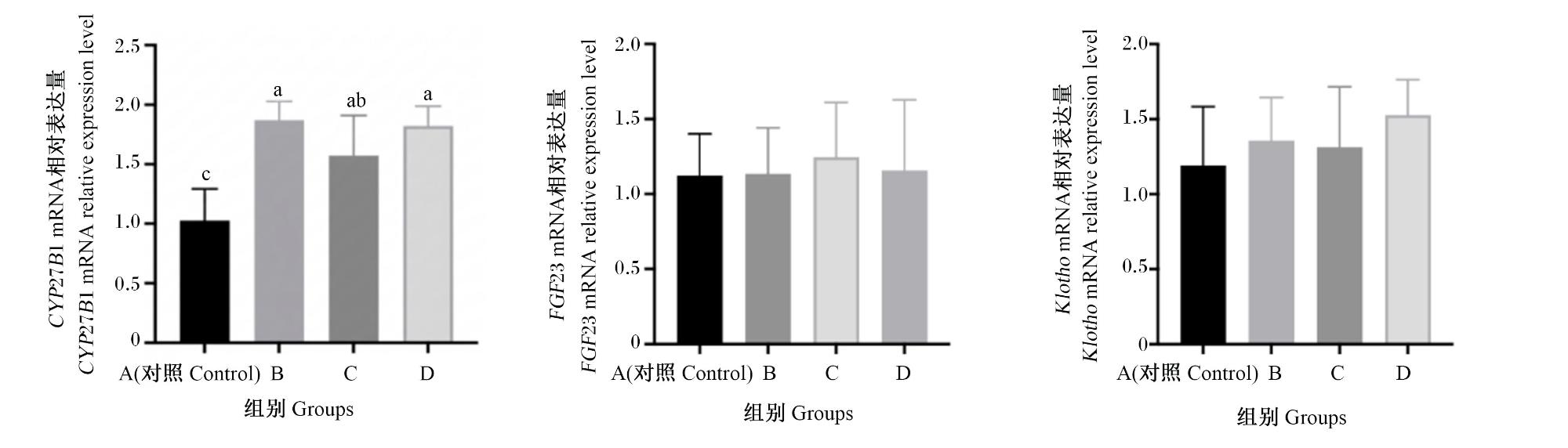
图1所示,在肾脏中,3个试验组CYP27B1的mRNA相对表达量均显著高于对照组(P<0.05),而FGF23和Klotho的mRNA相对表达量虽与对照组无显著差异(P>0.05),但均有不同程度的升高;此外,3个试验组CYP27B1、FGF23和Klotho的mRNA相对表达量均无显著差异(P>0.05)。
图1 不同油脂对蛋鸡肾脏中CYP27B1、FGF23和Klotho表达的影响

数据柱标注相同字母或无字母表示差异不显著(P>0.05),不同字母表示差异显著(P<0.05)。下图同。

Fig.1 Effects of different oils on expression of CYP27B1, FGF23 and Klotho in kidney of laying hens

Value columns with the same letter or no letter superscripts mean no significant difference (P>0.05), while with different letter superscripts mean significant difference (P<0.05). The same as below.

2.6 不同油脂对蛋鸡十二指肠中钙磷代谢相关基因表达的影响

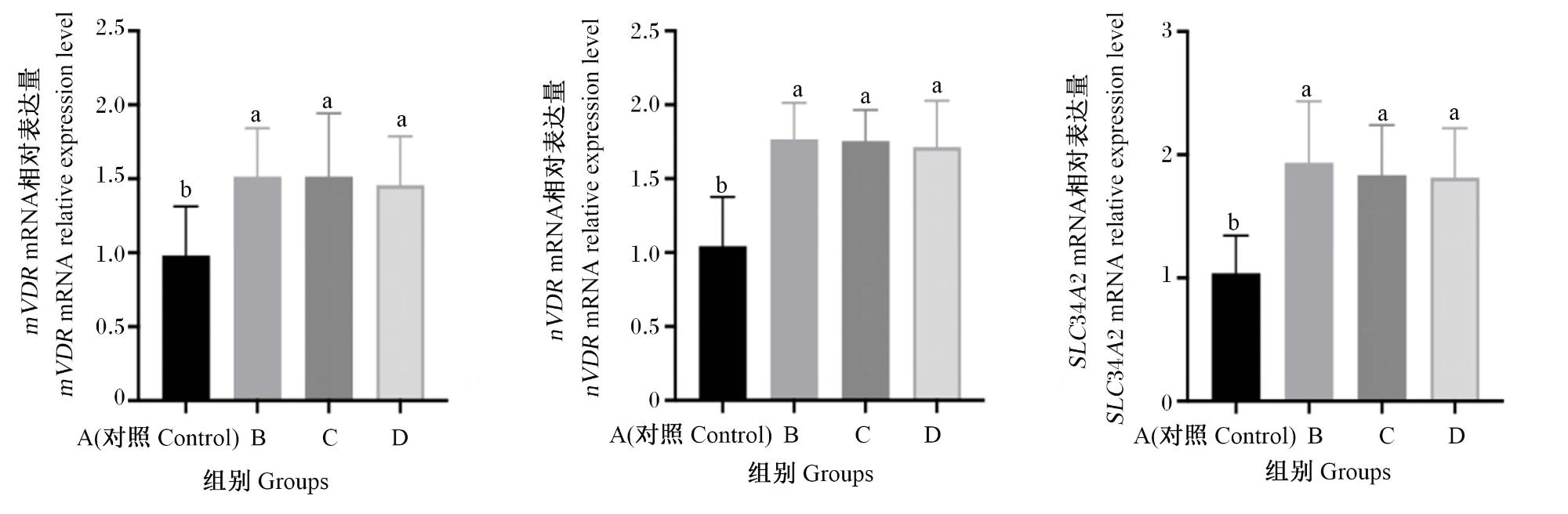
图2所示,在十二指肠中,3个试验组mVDRnVDRSLC34A2的mRNA相对表达量均显著高于对照组(P<0.05),且3个试验组之间无显著差异(P>0.05)。
图2 不同油脂对蛋鸡十二指肠中mVDRnVDRSLC34A2表达影响

Fig.2 Effects of different oils on expression mVDR, nVDR and SLC34A2 in duodenum of laying hens

3 讨论

3.1 不同油脂对蛋鸡生产性能和蛋品质的影响

油脂作为一种能量饲料和能量来源,在蛋鸡养殖中具有独特作用。研究表明,添加油脂不仅能提高饲粮的能量密度,还可能对产蛋率、蛋重和饲料转化率等关键生产指标产生影响。然而,其效果并非一成不变,不同研究之间存在显著差异甚至相互矛盾的结论。例如,刘伟等[10]研究发现,饲喂含2%猪油、棕榈油或大豆油的饲粮后,蛋鸡的采食量、产蛋率及蛋形指数均无显著变化,各项蛋品质指标也无显著变化,但大豆油组蛋壳强度和蛋壳厚度相对较好,猪油组蛋黄颜色、哈氏单位和蛋白高度相对较优;Kim等[11]指出,高浓度油脂显著降低蛋鸡的蛋壳厚度和蛋黄颜色,其中4%豆油组最低;Dagaas等[12]研究表明,饲粮中组合添加1%椰子油与1%大豆卵磷脂油可显著提高蛋鸡的饲料转化率;Fakhraei等[13]则发现,添加1%和3%的大豆脂肪酸(SFA)同样能显著改善蛋鸡的产蛋率和饲料转化率。本试验结果显示,饲粮中添加不同油脂后,各试验组在平均日采食量、平均日产蛋重、料蛋比、产蛋率等生产性能指标以及蛋黄重量、蛋白高度、蛋黄颜色、蛋形指数、蛋壳厚度等蛋品质指标方面与对照组均无显著差异,与上述部分研究结果一致。此外,本试验还观察到3个试验组的蛋白高度以及B组和C组的哈氏单位均显著提高,这与刘卫军等[14]的研究结果相似,该研究认为饲粮中添加适量不饱和脂肪酸可改善蛋鸡体内代谢环境,促进蛋白质合成与分泌,从而提高蛋白高度和哈氏单位。然而,Gao等[15]的研究发现,添加3%高浓度豆油会降低鸡蛋的哈氏单位,同时猪油混合添加可能破坏蛋黄球结构,导致蛋黄质量下降,这与本试验结果相反。造成这种差异的原因可能与油脂添加比例、种类及是否为复合油脂等因素有关。

3.2 不同油脂对蛋鸡蛋黄脂肪酸组成的影响

不同种类油脂可显著改变蛋黄中脂肪酸的组成,包括SFA与UFA,尤其是n-3 PUFA的含量,而n-6/n-3 PUFA比值对蛋黄品质至关重要。Grobas等[16]研究指出,豆油可通过增加C18∶3n-3的代谢间接促进二十碳五烯酸(C20∶5n-3,EPA)和DHA的合成,但效果较弱。也有研究表明,猪油可显著提升鸡蛋蛋黄中油酸(C18∶1)和C18∶2的含量,同时降低C16∶0的含量[17],棕榈油则显著提高鸡蛋蛋黄中C14∶0、C18∶0和C18∶1的含量,同时减少C18∶2和C18∶3的含量,并促进C18∶1的积累,但对n-3 PUFA含量的影响较小[18-19]。Kanbur等[20]研究发现,玉米油与大豆油、葵花油类似,能够提高蛋黄中PUFA含量,但不能富集蛋黄中的n-3脂肪酸;Kang等[21]研究表明,棕榈油可显著提高鸡蛋蛋黄中SFA的含量,同时降低n-6和n-3 PUFA(如DHA和EPA)的含量。与上述单一油脂研究相比,本试验中“豆油-猪油协同”及“四油复配”处理所呈现的蛋黄脂肪酸组成存在明显差异。Hirata等[22]报道,添加2%纯豆油即可显著提高鸡蛋蛋黄中C18∶2与C20∶4的含量,同时降低SFA与MUFA含量,本研究中添加2.0%豆油的B组所得结果与此一致。然而,当1.4%豆油与0.6%猪油联用(C组)时,C18∶3n-3的含量增幅反而高于添加纯豆油的B组,DHA含量亦有额外提升。其机制可能与Δ-6去饱和酶有关,该酶是C18∶3n-3向DHA转化的限速酶[23],而豆油中高含量的C18∶2n-6会与C18∶3n-3竞争该共同酶系统。B组(纯豆油)n-6 PUFA含量为19.30%,n-6/n-3 PUFA比值为15.40;C组(豆油+猪油)n-6 PUFA含量为19.90%,n-6/n-3 PUFA比值为15.30,相对更低,尽管绝对差异不大,但变化趋势明确。更重要的是,猪油的加入稀释了饲粮中n-6 PUFA的比例,减少了与n-3 PUFA的竞争,从而使更多Δ-6去饱和酶可用于催化C18∶3n-3向EPA、DHA等下游产物的转化。类似地,D组虽包含棕榈油与椰子油2种高SFA油脂,理论上应如Kang等[21]所述可提升SFA含量并降低n-3 PUFA含量,但经多油复配后,玉米油与豆油提供的大量C18∶2和C18∶3稀释了C16∶0和C18∶0;同时,椰子油中的月桂酸(C12∶0)与C14∶0等短链脂肪酸优先氧化供能,减少了长链SFA的沉积,使得该组PUFA含量的增幅最大。此外,各试验组MUFA含量均较对照组显著下降,与Saleh[24]的报道一致,进一步佐证了“植物油替代效应”而非氢化过程。
本研究还发现,3个试验组鸡蛋蛋黄中C18∶1 含量均较对照组显著降低了,这与Oliveira等[25]的研究结果一致,该研究表明,添加大豆油、向日葵油或亚麻籽油组,其蛋黄中反式脂肪酸含量均显著低于无油脂组。尽管该研究仅添加单一油脂,未涉及不同油脂的混合添加,但根据其结果可推测,大豆油、向日葵油及亚麻籽油同样具有降低蛋黄中反式脂肪酸含量的作用。此外,3个试验组鸡蛋蛋黄中SFA含量相较于无油脂添加的对照组分别下降1.20%、1.98%、1.21%,UFA含量则分别增加了1.38%、1.89%、1.10%,各试验组SFA与UFA含量的增降趋势基本一致。蛋黄中脂肪酸总量并非固定不变,但在正常饲养条件下相对稳定,约占蛋黄重量的30%。根据最新食品成分数据库,普通鸡蛋蛋黄中脂肪酸含量约为29.7 g/100 g蛋黄,每个蛋黄约含4.8 g总脂肪[26]。另一项试验测得的蛋黄总脂肪含量为4.77 g/个[27],与上述数据相近,表明常规商品蛋的蛋黄中总脂肪含量变化较小。因此,当饲粮中UFA供给增加时,其可能“挤占”内源性合成SFA所占的“份额”,但脂肪酸总量变化不大。
此外,饲粮中能量来源的多样性亦会影响蛋品质,通过优化能量物质组合,可提高鸡蛋营养价值并改善蛋壳质量。齐明星等[28]研究发现,饲粮不同代谢能和粗蛋白质水平对新杨绿壳蛋鸡产蛋后期的哈氏单位、蛋黄颜色及蛋壳强度有显著影响。刘静波等[29]指出,用动物脂肪和植物淀粉替代玉米后可改善鸡蛋品质。Nys[30]也指出,优化能量摄入可改善鸡蛋大小与蛋重,并发现不同能量浓度对蛋品质具有调节作用。然而,仅提高饲粮代谢能水平(如增加玉米粉、麦麸等的用量)而不改变脂肪来源时,蛋黄的脂肪酸组成变化不显著,主要影响产蛋量和饲料转化率[31]。与上述结果不同的是,本试验在添加油脂的同时,通过调整玉米-豆粕基础饲粮中玉米和豆粕的用量,使各组代谢能水平保持一致,结果显示,添加油脂的各试验组的产蛋性能无显著差异,但与未添加油脂的对照组相比,蛋黄脂肪酸组成均得到显著改善。这与前人研究结果存在相似之处,即在代谢能水平一致的前提下,可根据试验目的相应调整能量饲料的配比。

3.3 油脂对FGF23-Klotho轴和维生素D羟化的调节

油脂作为脂溶性维生素D的载体,可与胆汁酸乳化形成微粒,增大脂质与肠道的接触面积,从而促进维生素D的吸收[32-33]。吸收后的维生素D需经肝脏25-羟化酶(由CYP2R1编码)催化生成25-羟基维生素D3[25-(OH)D3],再在肾脏1α-羟化酶(由CYP27B1编码)的作用下转化为活性形式1,25-(OH)2D3[34]。1,25-(OH)2D3通过mVDR和nVDR调节SLC34A2[编码钠依赖性磷酸转运蛋白2B(NaPi-Ⅱb)]表达,促进小肠钙、磷吸收,进而改善蛋品质[35-36]。此外,由成骨细胞分泌的FGF23与Klotho结合后可抑制1α-羟化酶的活性,形成负反馈调节[37]
本研究结果显示,3个试验组蛋鸡血清中1,25-(OH)2D3、FGF23、钙含量及肾脏中CYP27B1的mRNA相对表达量均显著高于对照组,C组血清中磷含量也显著高于对照组。这表明,油脂的添加有效促进了维生素D的吸收与活化。其可能的调控机制如下:油脂的摄入首先提升了肠道对维生素D的吸收效率,使循环中1,25-(OH)2D3含量升高;升高的1,25-(OH)2D3进一步上调肾脏中CYP27B1的表达,增强1α-羟化酶活性,催化生成更多活性维生素D。1,25-(OH)2D3含量的提升,一方面直接促进肠道对钙、磷的吸收,导致血清中钙、磷含量升高,这可能是本试验中各试验组蛋壳强度均升高的直接原因;另一方面,1,25-(OH)2D3含量的升高也触发了机体的负反馈调节机制,刺激骨细胞分泌更多FGF23,进而抑制1α-羟化酶的活性并加速维生素D的降解,从而维持其在体内的稳态。本研究观察到的血清中FGF23含量同步显著升高,正符合这一生理调节规律。此外,也不能排除添加的油脂本身作为信号分子,直接上调CYP27B1表达的可能性。
然而,一个值得深入探讨的发现是,尽管添加不同油脂的试验组在血清生化指标上表现出显著效应,但在十二指肠中mVDRnVDRSLC34A2的mRNA相对表达量均未呈现出显著差异。这或许表明,维生素D在肠道的吸收及其受体在基因转录层面的早期应答对脂肪酸类型的特异性并不敏感。这一发现与部分人体研究结论存在不一致。Park等[8]在对小鼠的研究中发现,高脂饮食诱导的肥胖并未显著影响肝脏中CYP2R1的mRNA表达,但导致大量维生素D3蓄积于肝脏和脂肪组织,从而使血清中25-(OH)D3含量降低。秦锐等[38]的研究指出,高脂饮食诱导的肥胖大鼠,其血清中25-(OH)D3含量显著降低,同时白色脂肪组织(WAT)中维生素D受体(VDR)的mRNA相对表达量下降。Elkhwanky等[39]也报道,肥胖会抑制肝脏中CYP2R1的表达,减少25-(OH)D3的合成。这种物种间的差异,可能源于维生素D代谢调控通路的根本不同。蛋鸡因持续的蛋壳形成过程,对血钙具有极高的持续性需求[31],这可能使其肾脏中CYP27B1的基础表达水平高于哺乳动物,同时对FGF23等负反馈信号的敏感性相对降低。更为关键的是,鸡的维生素D活化系统并非完全集中于肾脏,其肝脏及负责蛋壳钙化的蛋壳腺也表达CYP27B1,能够通过局部合成1,25-(OH)2D3精准调控钙转运。此外,有研究表明,饲粮中的油脂可能通过激活过氧化物酶体增殖物激活受体α/γ(PPARα/γ)等核受体通路,直接上调鸡肾脏中CYP27B1的表达(因其基因启动子区域含有PPRE应答元件)[40],而人类的同源基因则缺乏该调控机制[41-42]。上述机制共同解释了为何在本研究中油脂添加展现出促进维生素D代谢的积极效果,而未出现哺乳动物研究中常见的抑制现象。本试验中,虽然3个试验组肾脏中FGF23和Klotho的mRNA相对表达量与对照组未达到统计学上的显著差异,但均显示出升高趋势,这提示FGF23-Klotho轴可能被轻度激活。综上所述,油脂的添加无疑对蛋鸡的维生素D代谢和钙磷稳态产生了积极影响,但其具体作用机制,尤其是油脂的不同脂肪酸组成、添加比例及复配策略对肠道受体表达影响的细微之处,仍有待通过更深入的研究来阐明。

4 结论

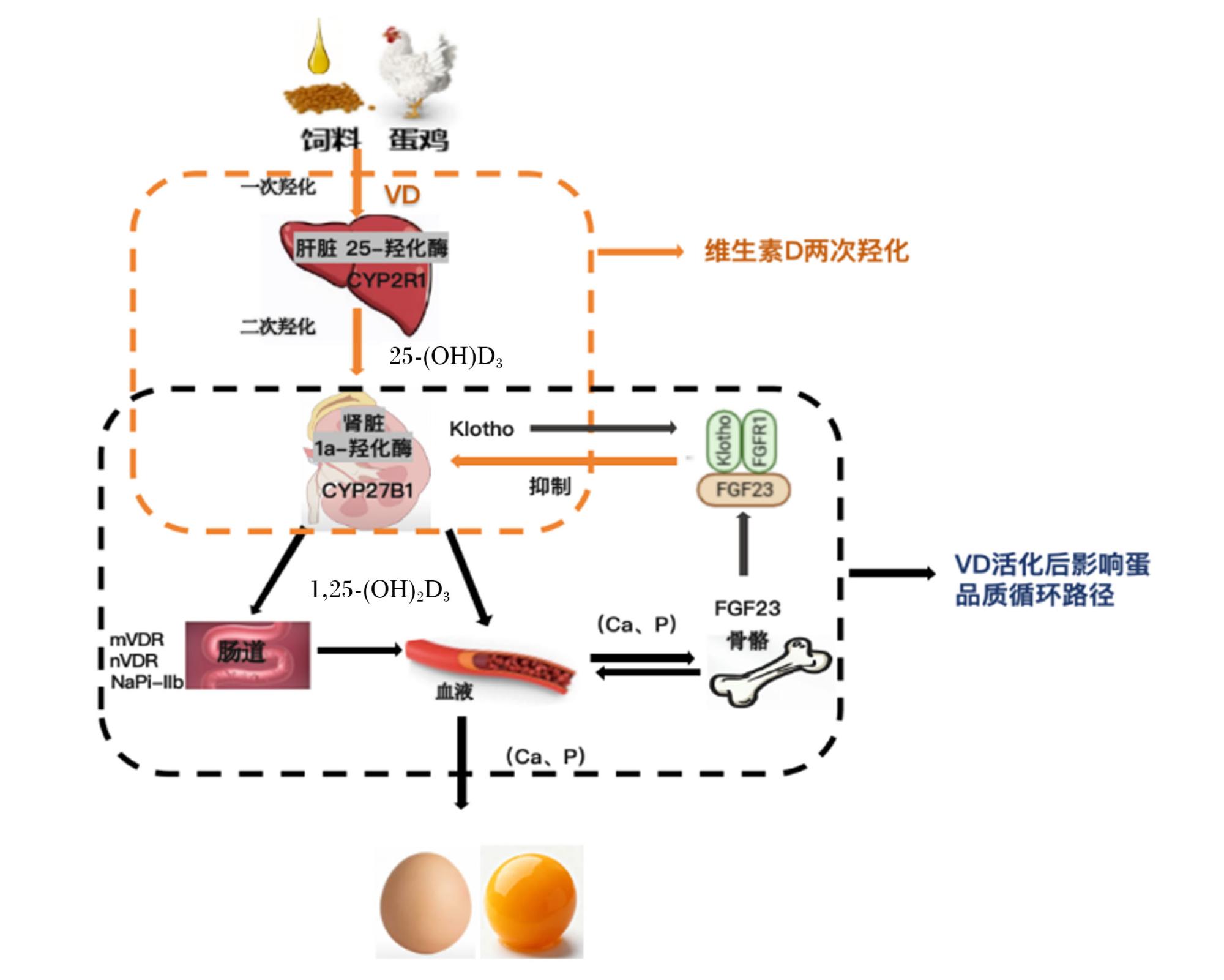
综上所述,在蛋鸡饲粮中添加2.0%豆油、1.4%豆油+0.6%猪油或2.0%复合油(0.5%豆油+0.5%玉米油+0.5%棕榈油+0.5%椰子油)均可提高鸡蛋的蛋白高度、哈氏单位和蛋壳厚度,改善蛋黄脂肪酸组成。其作用机制在于:油脂通过促进维生素D的羟化与活化,上调CYP27B1的表达,增强活性形式1,25-(OH)2D3的生成,进而上调钙磷代谢相关基因(nVDRmVDRSLC34A2)的表达,影响钙磷代谢,最终改善蛋品质(图3)。
图3 油脂通过FGF23-Klotho-维生素D轴影响蛋品质

VD:维生素D vitamin D;CYP2R1:细胞色素P450家族2亚家族R成员1 cytochrome P450 family 2 subfamily R member 1;25-(OH)D3:25-羟基维生素D3 25-hydroxyvitamin D3;CYP27B1:细胞色素P450家族27亚家族B成员1 cytochrome P450 family 27 subfamily B member 1;1,25-(OH)2D3:1,25-二羟基维生素D3 1,25-dihydroxyvitamin D3;mVDR:膜维生素D受体 membrane vitamin D receptor;nVDR:核维生素D受体 nuclear vitamin D receptor;NaPi-Ⅱb:钠依赖性磷酸转运蛋白2B;Ca:钙 calcium;P:磷 phosphorus;FGF23:成纤维细胞生长因子23 fibroblast growth factor 23;FGFR1:成纤维细胞生长因子受体1 fibroblast growth factor receptor 1。

Fig.3 Oil affects egg quality through FGF23-Klotho-VD axis

[1]
HANLON C, TAKESHIMA K, KIARIE E G, et al. Bone and eggshell quality throughout an extended laying cycle in three strains of layers spanning 50 years of selection[J]. Poultry Science, 2022, 101(3):101672.

DOI

[2]
马艳粉, 陈琦, 钱忠立, 等. 产蛋后期蛋鸡蛋壳质量变化及影响因素的探究[J]. 畜牧兽医学报2025, 56(5):2148-2156.

MA Y F, CHEN Q, QIAN Z L, et al. Exploration of the changes in the quality of eggshells in the later stage of egg production and the influencing factors[J]. Journal of Animal Husbandry and Veterinary Medicine, 2025, 56(5):2148-2156. (in Chinese)

[3]
HAETINGER V S, DALMORO Y K, GODOY G L, et al. Optimizing cost,growth performance,and nutrient absorption with a bio-emulsifier based on lysophospholipids for broiler chickens[J]. Poultry Science, 2021, 100(4):101025.

DOI

[4]
LAIKA M, JAHANIAN R. Dietary supplementation of organic selenium could improve performance,antibody response,and yolk oxidative stability in laying hens fed on diets containing oxidized fat[J]. Biological Trace Element Research, 2015, 165(2):195-205.

DOI

[5]
TURGUT L, HAYIRLI A, ÇELEBĪ Ş, et al. The effects of vitamin D supplementation to peak-producing hens fed diets differing in fat source and level on laying performance,metabolic profile,and egg quality[J]. Asian-Australasian Journal of Animal Sciences, 2006, 19(8):1179-1189.

DOI

[6]
ZHAO P Y, YAN L, ZHANG T, et al. Effect of 25-hydroxyvitamin D and essential oil complex on productive performance,egg quality,and uterus antioxidant capacity of laying hens[J]. Poultry Science, 2021, 100(11):101410.

DOI

[7]
PRIÉ D. Vitamin D and FGF23 in chronic kidney disease[M]// UREÑA TORRES P A,COZZOLINO M,VERVLOET M G.Vitamin D in chronic kidney disease.Cham:Springer, 2016:195-206.

[8]
PARK C Y, SHIN Y, KIM J H, et al. Effects of high fat diet-induced obesity on vitamin D metabolism and tissue distribution in vitamin D deficient or supplemented mice[J]. Nutrition & Metabolism, 2020, 17(1):44.

[9]
林雪. 钙和锌日动态饲喂对蛋鸡钙、磷和锌昼夜变化的影响及其调控研究[D]. 博士学位论文. 长沙: 湖南农业大学学, 2020.

LIN X. A study on the effects of daily dynamic calcium and zinc feeding regime on the diurnal variation of calcium,phosphorus and zinc in laying hens and its regulation[D]. Ph.D.Thesis. Changsha: Hunan Agricultural University, 2020. (in Chinese)

[10]
刘伟. 饲用不同种类油脂对蛋鸡生产性能、蛋品质及脂质代谢的影响[D]. 硕士学位论文. 杭州: 浙江大学, 2020.

LIU W. Effects of different oils on production performance,egg quality and lipid metabolism of laying hens[D]. Master’s Thesis. Hangzhou: Zhejiang University, 2020. (in Chinese)

[11]
KIM J H, LEE H K, YANG T S, et al. Effect of different sources and inclusion levels of dietary fat on productive performance and egg quality in laying hens raised under hot environmental conditions[J]. Asian-Australasian Journal of Animal Sciences, 2019, 32(9):1407-1413.

DOI PMID

[12]
DAGAAS C T, BAUTISTA H N F, LUIS E S. Performance and egg quality of Babcock layer chicken fed coconut oil and soya lecithin oil in the ration[J]. Philippine Journal of Veterinary & Animal Sciences, 2015, 41(1):31.

[13]
FAKHRAEI J, KHAGHANI S, ABBASI S, et al. Productive performance,blood biochemical variables and immune responses of laying hens fed diets containing various fat sources[J]. South African Journal of Animal Science, 2019, 49(4):675-683.

DOI

[14]
刘卫军, 郭永丰, 靳小惠, 等. 热应激条件下补充不同油脂对蛋鸡生产性能、蛋品质及血清生化指标的影响[J]. 中国饲料, 2021(16):26-29.

LIU W J, GUO Y F, JIN X H, et al. Effects of different oil source on performance,egg quality and serum biochemical indices of laying hens under heat stress[J]. China Feed, 2021(16):26-29. (in Chinese)

[15]
GAO Z Y, DUAN Z Y, ZHANG J N, et al. Effects of oil types and fat concentrations on production performance,egg quality,and antioxidant capacity of laying hens[J]. Animals, 2022, 12(3):315.

DOI

[16]
GROBAS S, MÉNDEZ J, LÁZARO R, et al. Influence of source and percentage of fat added to diet on performance and fatty acid composition of egg yolks of two strains of laying hens[J]. Poultry Science, 2001, 80(8):1171-1179.

PMID

[17]
OHTAKE Y, HOSHINO Y. Influences of dietary fat and oil on the fatty acid distribution in egg yolk lipids of laying hens[J]. Nihon Chikusan Gakkaiho, 1976, 47(7):430-440.

DOI

[18]
HOSSEINI-VASHAN S J, AFZALI N, GOLIAN A, et al. Comparison of yolk fatty acid content,blood and egg cholesterol of hens fed diets containing palm olein oil and kilka fish oil[J]. African Journal of Biotechnology, 2011, 10(51):10484-10490.

[19]
OHTAKE Y, NAGASHIMA Y. Influences of the egg yolk lipids on the fatty acid distribution in the hatched chick lipids[J]. Japanese Journal of Zootechnical Science, 1982, 53(11):753-760.

[20]
KANBUR G, GÖÇMEN R, CUFADAR Y. A comparative study on the effects of hemp seed oil versus four different UFA-rich seed oils’ dietary supplementation on egg production performance,egg quality,and yolk fatty acids in laying hens[J]. Tropical Animal Health and Production, 2023, 55(1):6.

DOI

[21]
KANG K R, CHERIAN G, SIM J S. Dietary palm oil alters the lipid stability of polyunsaturated fatty acid-modified poultry products[J]. Poultry Science, 2001, 80(2):228-234.

PMID

[22]
HIRATA A, NISHINO M, KIMURA T, et al. Effects of dietary fats for laying hens on the fatty acid compositions and cholesterol contents of liver,abdominal adipose tissue,plasma and egg yolk lipids[J]. Journal of Food Science and Technology, 1986, 33(9):631-639.

[23]
GANZAROLI J F, VENTURA G, POLIDORO B R, et al. Different n6:n3 ratios on performance,egg quality,and health of 81-week-old laying hens[J]. Brazilian Journal of Poultry Science, 2022, 24(1):eRBCA-2019-1237.

[24]
SALEH A A. Effects of fish oil on the production performances,polyunsaturated fatty acids and cholesterol levels of yolk in hens[J]. Emirates Journal of Food and Agriculture, 2013, 25(8):605-612.

DOI

[25]
OLIVEIRA D D, BAIÃO N C, CANÇADO S V, et al. Effects of lipid sources in the diet of laying hens on the fatty acid profiles of egg yolks[J]. Poultry Science, 2010, 89(11):2484-2490.

DOI PMID

[26]
TOMASZEWSKA E, MUSZYŃSKI S, ARCZEWSKA-WŁOSEK A, et al. Cholesterol content,fatty acid profile and health lipid indices in the egg yolk of eggs from hens at the end of the laying cycle,following alpha-ketoglutarate supplementation[J]. Foods, 2021, 10(3):596.

DOI

[27]
PALOMAR M, GARCÉS-NARRO C, PIQUER O, et al. Influence of free fatty acid content and degree of fat saturation on production performance,nutrient digestibility,and intestinal morphology of laying hens[J]. Animal Nutrition, 2023, 13:313-323.

DOI

[28]
齐明星, 丁科, 李兰兰, 等. 饲粮不同代谢能、粗蛋白质水平对新杨绿壳蛋鸡产蛋后期生产性能、蛋品质及血清生化指标的影响[J]. 动物营养学报, 2017, 29(4):1159-1166.

QI M X, DING K, LI L L, et al. Effects of different dietary energy and crude protein levels on performance,egg quality and serum biochemical indices of Xinyang green shell laying hens during late stage of egg production[J]. Chinese Journal of Animal Nutrition, 2017, 29(4):1159-1166. (in Chinese)

[29]
刘静波, 张金伟, 陈代文, 等. 不同能量水平和来源对鸡蛋品质的影响[J]. 中国家禽, 2008, 30(14):19-22.

LIU J B, ZHANG J W, CHEN D W, et al. Effects of different energy levels and energy sources on egg quality[J]. China Poultry, 2008, 30(14):19-22. (in Chinese)

[30]
NYS Y. Laying hen nutrition:optimizing energy intake,egg size and weight[J]. Achieving Sustainable Production of Eggs, 2017, 2:3-28.

[31]
GARCIA-MEJIA R A, SINCLAIR-BLACK M, BLAIR L R, et al. Physiological changes in the regulation of calcium and phosphorus utilization that occur after the onset of egg production in commercial laying hens[J]. Frontiers in physiology, 2024, 15:1465817.

DOI

[32]
HUANG C X, GUO Y M, YUAN J M. Dietary taurine impairs intestinal growth and mucosal structure of broiler chickens by increasing toxic bile acid concentrations in the intestine[J]. Poultry Science, 2014, 93(6):1475-1483.

DOI PMID

[33]
ROHR M W, NARASIMHULU C A, RUDESKI-ROHR T A, et al. Negative effects of a high-fat diet on intestinal permeability:a review[J]. Advances in Nutrition, 2020, 11(1):77-91.

DOI

[34]
HEWISON M. Vitamin D and the intracrinology of innate immunity[J]. Molecular and Cellular Endocrinology, 2010, 321(2):103-111.

DOI PMID

[35]
ORFANIDOU T, MALIZOS K N, VARITIMIDIS S, et al. 1,25-dihydroxyvitamin D3 and extracellular inorganic phosphate activate mitogen-activated protein kinase pathway through fibroblast growth factor 23 contributing to hypertrophy and mineralization in osteoarthritic chondrocytes[J]. Experimental Biology and Medicine, 2012, 237(3):241-253.

DOI

[36]
PALMA-LARA I, PÉREZ-RAMÍREZ M, GARCÍA ALONSO-THEMANN P, et al. FAM20C overview:classic and novel targets,pathogenic variants and raine syndrome phenotypes[J]. International Journal of Molecular Sciences, 2021, 22(15):8039.

DOI

[37]
CARBONE F, MACH F, VUILLEUMIER N, et al. Potential pathophysiological role for the vitamin D deficiency in essential hypertension[J]. World Journal of Cardiology, 2014, 6(5):260-276.

DOI PMID

[38]
秦锐, 曾凡勇, 郭锡熔. 高脂饮食诱导肥胖大鼠的钙代谢研究[C]// 第二届国际妇幼保健学术会议暨2006全国妇幼保健学术大会论文集. 北京: 中华预防医学会, 2006:231.

QIN R, ZENG F Y, GUO X R. Study on calcium metabolism induced by high-fat diet in obese rats[C]// Proceedings of the Second International Maternal and Child Health Care Academic Conference and the 2006 National Maternal and Child Health Care Academic Conference. Beijing: Chinese Preventive Medicine Association, 2006:231. (in Chinese)

[39]
ELKHWANKY M S, KUMMU O, PILTONEN T T, et al. Obesity represses CYP2R1,the vitamin D 25-hydroxylase,in the liver and extrahepatic tissues[J]. JBMR Plus, 2020, 4(11):e10397.

DOI

[40]
CUI T T, XING T Y, HUANG J X, et al. Nuclear respiratory factor 1 negatively regulates the P1 promoter of the peroxisome proliferator-activated receptor-γ gene and inhibits chicken adipogenesis[J]. Frontiers in Physiology, 2018, 9:1823.

DOI PMID

[41]
MEYER M B, BENKUSKY N A, KAUFMANN M, et al. A kidney-specific genetic control module in mice governs endocrine regulation of the cytochrome P450 gene Cyp27b1 essential for vitamin D3 activation[J]. Journal of Biological Chemistry, 2017, 292(42):17541-17558.

DOI

[42]
DAL BOSCO A, CAVALLO M, MENCHETTI L, et al. The healthy fatty index allows for deeper insights into the lipid composition of foods of animal origin when compared with the atherogenic and thrombogenicity indexes[J]. Foods, 2024, 13(10):1568.

DOI

Outlines

/