RESEARCH PAPER

Potential Targets and Pathways of Main Active Components from Eucommia ulmoides Leaves in Alleviating Cow Mastitis Based on Network Pharmacology Analysis

  • ZHAO Fenghui ,
  • CHANG Yueqiang ,
  • PAN Lijuan ,
  • JIA Qiqi ,
  • GAO Tengyun ,
  • WANG Linfeng ,
  • LIU Kaizhen , *
Expand
  • International Joint Laboratory of Livestock Nutritional Regulation and Ecological Breeding, College of Animal Science and Technology, Henan Agricultural University, Zhengzhou 450046, China
*lecturer, E-mail:

Received date: 2025-10-14

  Online published: 2026-05-14

Abstract

This study aimed to explore the potential targets and pathways of the main active components from Eucommia ulmoides leaves (EUL) in alleviating cow mastitis via network pharmacology. The pharmacokinetic parameters of the main active components of EUL, chlorogenic acid (CGA), aucubin (AU), rutin (RU) and pinoresinol diglucoside (PDG), were obtained from the Traditional Chinese Medicine Systems Pharmacology Database and Analysis Platform (TCMSP). The potential targets of these active components were predicted by integrating TCMSP, Swiss Target Prediction and SuperPred databases, while the disease-related targets of cow mastitis were retrieved from GeneCards and OMIM databases. The intersection targets between EUL active components and cow mastitis were then screened out. Gene Ontology (GO) functional and Kyoto Encyclopedia of Genes and Genomes (KEGG) pathway enrichment analysis of the intersection targets were performed using the Bioinformatics platform. The intersection targets were imported into the STRING online database to obtain protein-protein interaction data, and the EUL active components-cow mastitis targets-pathways network diagram was constructed via Cytoscape software. Finally, molecular docking technology was used to verify the binding affinity between EUL active components and core targets. The results showed as follows: 1) the numbers of intersection targets of CGA, AU, RU and PDG with cow mastitis were 9, 11, 16 and 8, respectively. 2) GO functional enrichment analysis indicated that the potential targets of the four active components for alleviating cow mastitis were all enriched in 10 entries in both the molecular function and biological process categories; in the cellular component category, the targets were enriched in 10, 5, 9 and 2 entries for CGA, AU, RU and PDG, respectively. 3) KEGG pathway enrichment analysis revealed that the targets of the four active components acting on cow mastitis were mainly enriched in nuclear factor-κB (NF-κB), hypoxia-inducible factor-1 (HIF-1), cyclic guanosine monophosphate-protein kinase G (cGMP-PKG), cyclic adenosine monophosphate (cAMP), lipid and atherosclerosis signaling pathways and other related pathways. 4) Molecular docking results demonstrated that the binding energies between core target Toll-like receptor 4 (TLR4) and the four active components were all no more than -6.8 kJ/mol, indicating that CGA, AU, RU and PDG could bind to TLR4 spontaneously and stably. In conclusion, CGA, AU, RU and PDG can synergistically alleviate cow mastitis by acting on TLR4 and other core targets, as well as regulating NF-κB, HIF-1, cGMP-PKG, cAMP and other key signaling pathways. This study provides a theoretical basis for the development of therapeutic strategies for cow mastitis.

Cite this article

ZHAO Fenghui , CHANG Yueqiang , PAN Lijuan , JIA Qiqi , GAO Tengyun , WANG Linfeng , LIU Kaizhen . Potential Targets and Pathways of Main Active Components from Eucommia ulmoides Leaves in Alleviating Cow Mastitis Based on Network Pharmacology Analysis[J]. Chinese Journal of Animal Nutrition, 2026 , 38(5) : 3747 -3762 . DOI: 10.12418/CJAN2026.300

乳腺炎是高产奶牛的常见疾病,主要由病原微生物感染乳腺组织引发的炎症反应所致,可分为临床型乳腺炎和隐性乳腺炎[1]。牛舍环境卫生条件差、饲养管理不当、营养不均衡以及挤奶操作不规范等因素,均会增加奶牛乳腺炎的发生风险[2]。乳腺炎直接导致奶牛生产性能下降,对养殖户造成严重的经济损失,因此对奶牛乳腺炎的诊断和治疗尤为重要。目前,治疗奶牛乳腺炎多采用抗生素类药物,但过量使用抗生素会造成药物残留、耐药性等问题,对人类健康和安全构成严重威胁[3]。近年来,中草药和植物提取物用于预防奶牛乳腺炎的相关研究引起广泛关注[4]。中草药治疗可做到标本兼治、疗效确切,提高产奶量和免疫力,并增强机体代谢,可作为替代合成药物的新型手段用于乳腺炎的防控[5]。杜仲叶(Eucommia ulmoides leaves,EUL)为我国古老树种杜仲的干燥叶,其味微辛、性温,归肝、肾经,有补肝肾、强筋骨、降血压之功效[6]。EUL化学成分种类丰富,包括酚酸类、环烯醚萜类、黄酮类、木脂素类和萜及甾体类化合物[7]。研究发现,饲粮中添加EUL可提高奶牛的产奶量、采食量及牛奶品质[8];使用EUL提取物饲喂畜禽,可增强青山羊的血清抗氧化和抗炎能力[9],改善育肥猪肉品质[10],提高黄羽肉雏鸡免疫器官指数[11]。网络药理学作为一种新兴的研究方法,通过整合信息生物学、系统生物学和药理学等多学科理论构建药物-靶点-疾病网络,揭示其相互关系,进而为兽医临床诊疗提供理论依据与数据支持,推动中医药现代化和畜牧业发展[12-14]。目前,已有大量研究基于网络药理学和分子对接技术预测靶点蛋白,以探究药物的作用机制[15-17]。EUL中的绿原酸(chlorogenic acid,CGA)[18]、桃叶珊瑚苷(aucubin,AU)[19]、芦丁(rutin,RU)[20]和松脂醇二葡萄糖苷(pinoresinol diglucoside,PDG)[21]等主要活性成分已被证实具有抗炎功效,但其作用于奶牛乳腺炎的具体机制尚不明确。因此,本研究利用网络药理学方法探究EUL的主要活性成分在缓解奶牛乳腺炎中的作用机制,旨在为EUL在奶牛养殖生产中的应用提供理论依据。

1 材料与方法

1.1 EUL主要活性成分的药物动力学参数及靶点预测

在中药系统药理学数据库与分析平台(TCMSP, https://old.tcmsp-e.com/tcmsp.php)检索CGA、AU、RU和PDG的化学文摘社(Chemical Abstracts Service,CAS)登记号,获取其药物动力学参数。通过TCMSP、Swiss Target Prediction数据库(https://www.swisstargetprediction.ch)和SuperPred数据库(https://prediction.charite.de/subpages/target-prediction.php),预测各活性成分对应的靶点蛋白及其规范名称。

1.2 奶牛乳腺炎关联靶点预测

以“cow mastitis”为关键词,通过GeneCards数据库(https://www.genecards.org)和OMIM疾病数据库(https://www.omim.org)检索奶牛乳腺炎关联靶点。

1.3 EUL主要活性成分作用靶点与奶牛乳腺炎关联靶点的交集分析

利用微生信平台(https://www.bioinformatics.com.cn)对筛选出的CGA、AU、RU和PDG作用靶点与奶牛乳腺炎关联靶点进行交集分析,得到EUL主要活性成分作用于奶牛乳腺炎的潜在靶点。

1.4 基因本体(GO)功能与京都基因与基因组百科全书(KEGG)通路富集分析

利用微生信平台(https://www.bioinformatics.com.cn)对CGA、AU、RU和PDG作用于奶牛乳腺炎的潜在靶点进行GO功能和KEGG通路富集分析,将分析结果分别以条形图和气泡图的形式进行可视化呈现。

1.5 潜在靶点蛋白质-蛋白质互作网络分析及核心靶点筛选

将CGA、AU、RU和PDG作用于奶牛乳腺炎的潜在靶点导入STRING在线数据库(https://cn.string-db.org),选择物种为“Bos taurus”,获取靶点蛋白质-蛋白质互作数据,并采用Cytoscape 3.8.0软件筛选核心靶点。

1.6 EUL主要活性成分-奶牛乳腺炎靶点-通路网络构建

将KEGG通路富集分析结果与EUL主要活性成分作用于奶牛乳腺炎的靶点进行一一对应,整理为以“type”和“work”命名的Excel文件,并导入到Cytoscape 3.8.0软件中,绘制EUL主要活性成分-奶牛乳腺炎靶点-通路网络图。

1.7 分子对接验证

对上述筛选得到的EUL主要活性成分缓解奶牛乳腺炎的核心靶点进行分子对接验证。通过TCMSP数据库获取CGA、AU、RU和PDG的分子结构,在PDB数据库中下载核心靶点蛋白的三维(3D)结构。将药物分子结构式和靶点蛋白3D结构导入CB-DOCK2在线软件(https://cadd.labshare.cn/cb-dock2)进行分子对接,并将对接结果转化为可视化图像。

2 结果与分析

2.1 EUL主要活性成分的药物动力学参数及作用靶点

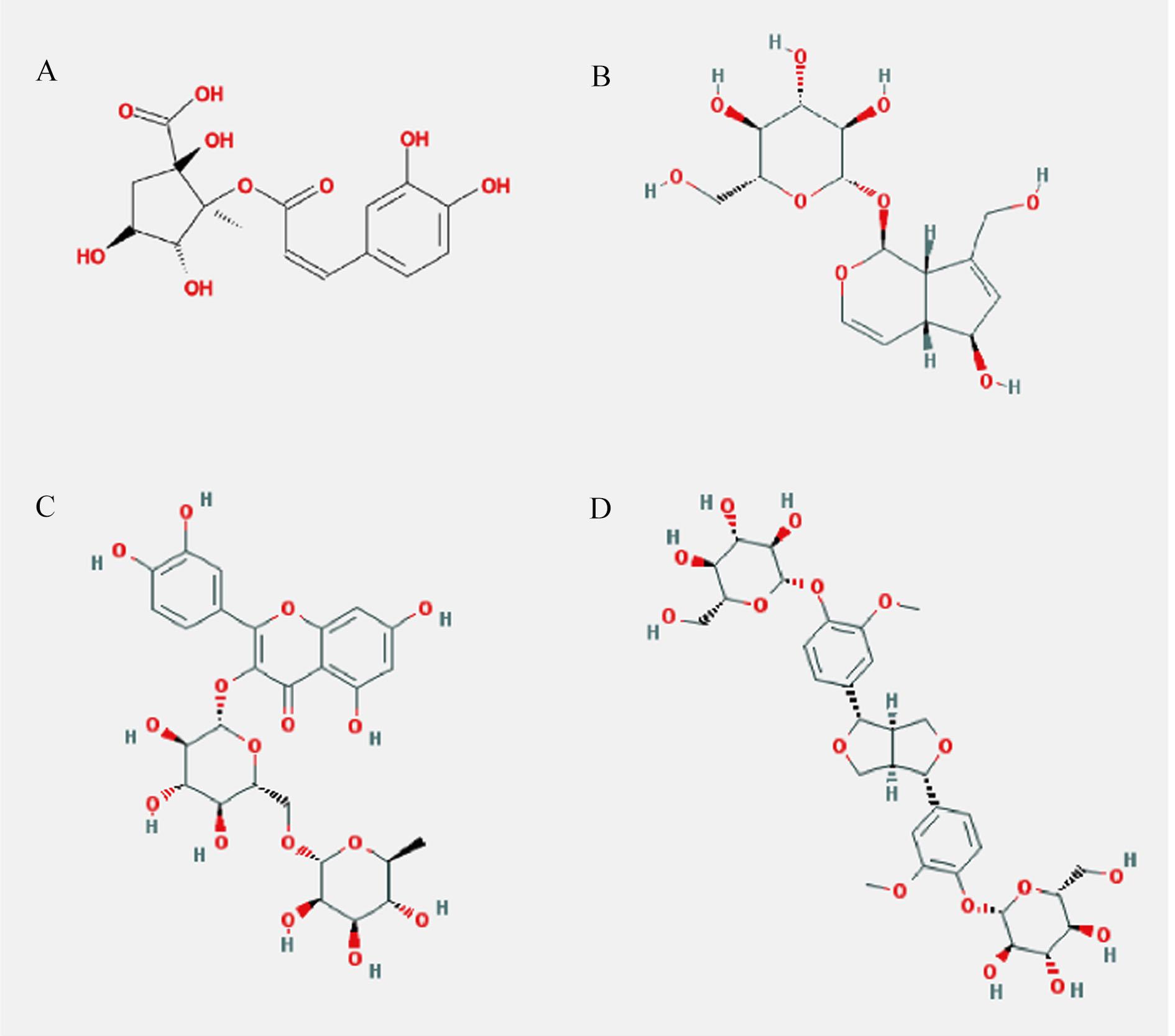
在TCMSP数据库中输入CGA(CAS:327-97-9)、AU(CAS:479-98-1)、RU(CAS:153-18-4)和PDG(CAS:63902-38-5)的CAS登记号进行检索,获得各成分的药物动力学参数(https://www.tcmsp-e.com/molecule.php?qn=3871/2813/415/11468)如下:CGA的口服生物利用度(oral bioavailability,OB)为13.6%,类药性(drug-likeness,DL)为0.31,Caco-2细胞渗透性为-1.32 cm/s;AU的OB为4.16%,DL为0.33,Caco-2细胞渗透性为-1.83 cm/s;RU的OB为3.2%,DL为0.68,Caco-2细胞渗透性为-1.92 cm/s;PDG的OB为14.92%,DL为0.33,Caco-2细胞渗透性为-2.33 cm/s。同时获得CGA、AU、RU和PDG的化学结构式(图1)。
图1 CGA(A)、AU(B)、RU(C)和PDG(D)的化学结构式

Fig.1 Chemical structural formula of CGA (A), AU (B), RU (C) and PDG (D)

CGA通过TCMSP、Swiss Target Prediction和SuperPred数据库分别预测到1、200(概率≥0)和98(概率≥50)个靶点,整合去重后共得到198个潜在作用靶点;AU通过TCMSP、Swiss Target Prediction和SuperPred数据库分别预测到10、200(概率≥0)和95(概率≥50)个靶点,整合去重后共得到207个潜在作用靶点;RU通过TCMSP、Swiss Target Prediction 和SuperPred数据库分别预测到10、200(概率≥0)和98(概率≥50)个靶点,整合去重后共得到196个潜在作用靶点;PDG经TCMSP、Swiss Target Prediction和SuperPred数据库分别预测到0、200(概率≥0)和81(概率≥50)个靶点,整合去重后共得到181个潜在作用靶点。

2.2 EUL主要活性成分与奶牛乳腺炎的交集靶点

基于GeneCards和OMIM疾病数据库检索奶牛乳腺炎关联靶点,其中从GeneCards数据库检索出168个关联靶点,从OMIM疾病数据库检索出140个关联靶点,经整合去重后,共得到305个奶牛乳腺炎关联靶点。
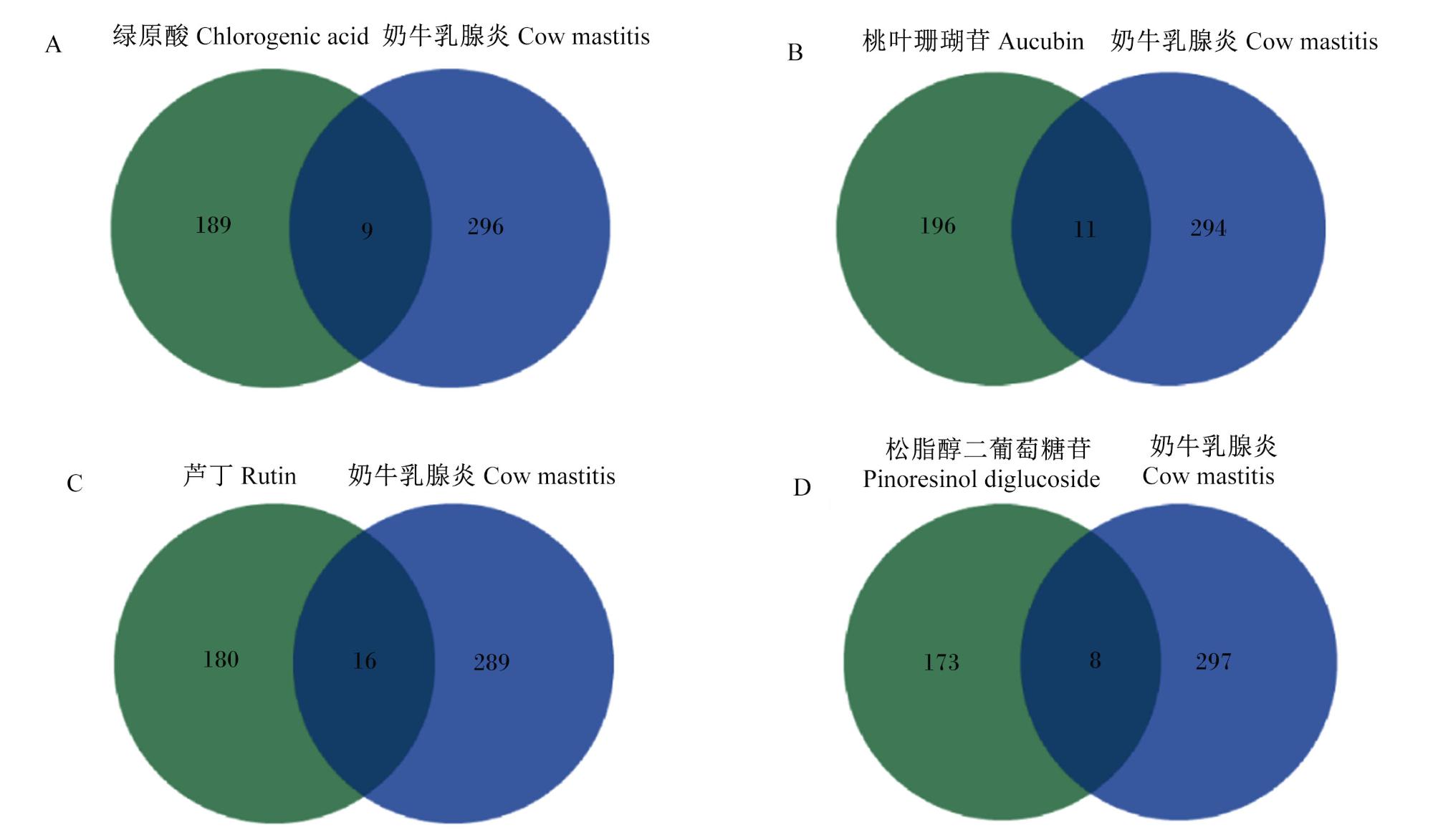
图2所示,CGA作用靶点与奶牛乳腺炎关联靶点取交集得到9个交集靶点,分别为整合素β2(integrin beta 2,ITGB2)、细胞间黏附分子1(intercellular adhesion molecule 1,ICAM1)、雌激素受体1(estrogen receptor 1,ESR1)、囊性纤维化跨膜传导调节因子(cystic fibrosis transmembrane conductance regulator,CFTR)、白细胞选择素(leukocyte selectin,SELL)、Toll样受体4(Toll-like receptor 4,TLR4)、C5a过敏毒素趋化因子受体1(C5a anaphylatoxin chemotactic receptor 1,C5AR1)、血管内皮生长因子受体1(vascular endothelial growth factor receptor 1,FLT1)和谷胱甘肽还原酶(glutathione reductase,GSR);AU作用靶点与奶牛乳腺炎关联靶点取交集得到11个交集靶点,分别为肿瘤坏死因子(tumor necrosis factor,TNF)、白细胞介素6(interleukin 6,IL6)、腺苷A1受体(adenosine A1 receptor,ADORA1)、BCL2样蛋白1(BCL2-like protein 1,BCL2L1)、白细胞介素2(interleukin 2,IL2)、ICAM1、ITGB2、信号转导与转录激活因子3(signal transduction and transcriptional activator 3,STAT3)、C5AR1、TLR4和CFTR;RU作用靶点与奶牛乳腺炎关联靶点取交集得到16个交集靶点,分别为TNF、IL6、白细胞介素1β(interleukin 1 beta,IL1β)、超氧化物歧化酶1(superoxide dismutase 1,SOD1)、ITGB2、IL2、ADORA1、纤溶酶原(plasminogen,PLG)、ATP结合盒亚家族G成员2(ATP-binding cassette subfamily G member 2,ABCG2)、ESR1、表皮生长因子受体(epidermal growth factor receptor,EGFR)、细胞色素P450家族19亚家族A成员1(cytochrome P450 family 19 subfamily A member 1,CYP19A1)、髓过氧化物酶(myeloperoxidase,MPO)、CFTR、TLR4和C5AR1;PDG作用靶点与奶牛乳腺炎关联靶点取交集得到8个交集靶点,分别为ADORA1、类固醇5α还原酶1(steroid 5α-reductase 1,SRD5A1)、ESR1、CYP19A1、二氢叶酸还原酶(dihydrofolate reductase,DHFR)、内皮素受体A(endothelin receptor type A,EDNRA)、C5AR1和TLR4。
图2 CGA、AU、RU和PDG作用靶点与奶牛乳腺炎关联靶点交集

Fig.2 Intersection of CGA, AU, RU and PDG action targets with cow mastitis-associated targets

2.3 EUL主要活性成分作用于奶牛乳腺炎潜在靶点的GO功能与KEGG通路富集分析
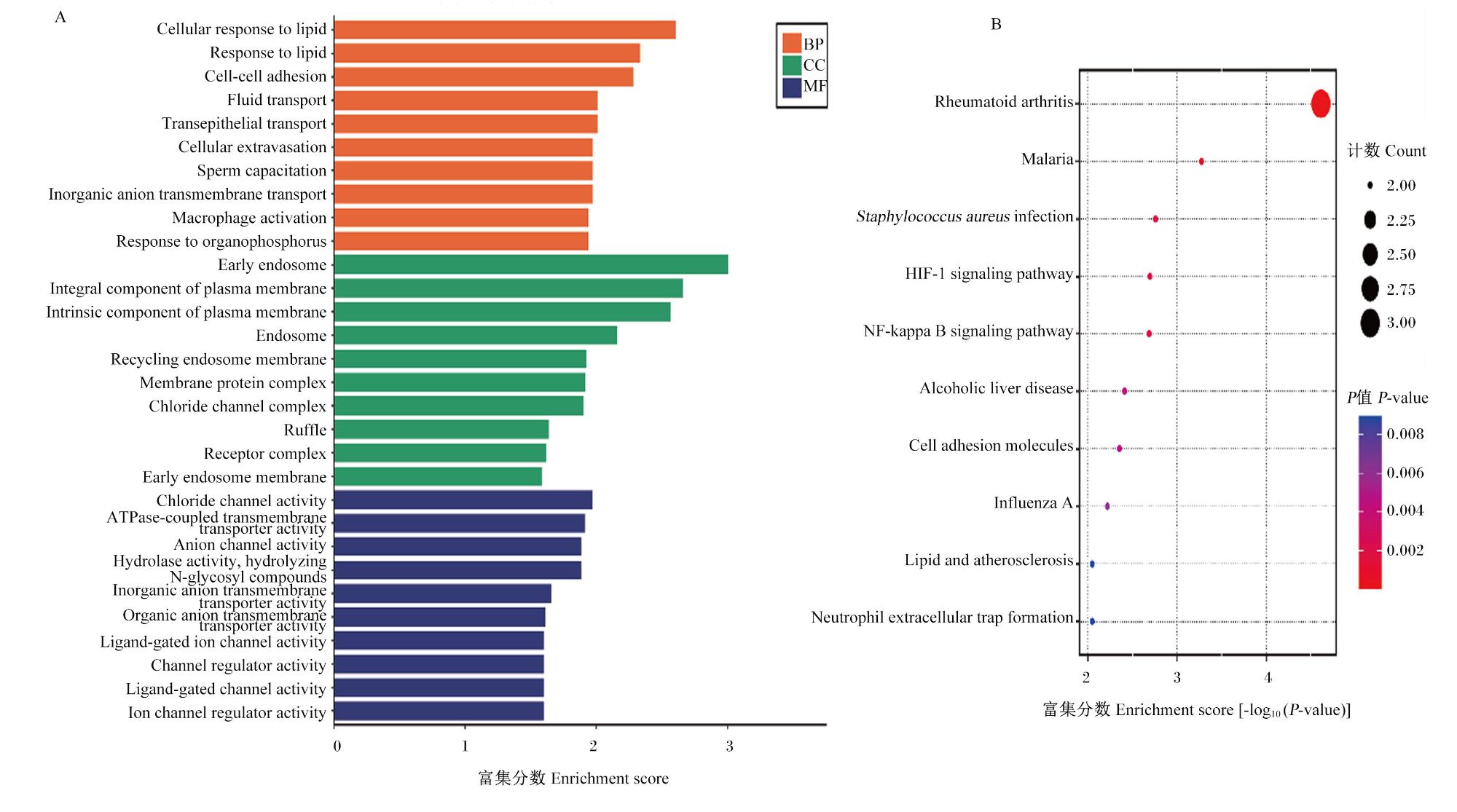
基于微生信在线分析平台,选择物种为牛,分别对CGA、AU、RU及PDG作用于奶牛乳腺炎的潜在靶点进行GO功能和KEGG通路富集分析。
GO功能富集分析结果(图3-A)显示,CGA作用于奶牛乳腺炎的潜在靶点主要参与细胞对脂质的反应、细胞间黏附、跨上皮转运、巨噬细胞活化、对有机磷的反应等生物过程;定位于内体、质膜的固有成分、质膜的内在成分、膜蛋白复合物、氯离子通道复合物和受体复合物等细胞组分;具有氯离子通道活性、ATP酶偶联跨膜转运蛋白活性、阴离子通道活性、水解N-糖基化合物的水解酶活性、无机和有机阴离子跨膜转运蛋白活性、配体门控离子通道活性、通道调节活性、配体门控通道活性和离子通道调节活性等分子功能。KEGG通路富集分析结果(图3-B)显示,CGA作用于奶牛乳腺炎的潜在靶点主要与缺氧诱导因子-1(HIF-1)信号通路、核因子-κB(NF-κB)信号通路、酒精性肝病、细胞黏附分子和脂质与动脉粥样硬化等相关。
图3 CGA作用于奶牛乳腺炎潜在靶点的GO功能(A)和KEGG通路(B)富集分析

BP:生物过程 biological process;CC:细胞组分 cellular component;MF:分子功能 molecular function;Cellular response to lipid:细胞对脂质的反应;Response to lipid:对脂质的反应;Cell-cell adhesion:细胞间黏附;Fluid transport:液体转运;Transepithelial transport:跨上皮转运;Cellular extravasation:细胞渗出;Sperm capacitation:精子获能;Inorganic anion transmembrane transport:无机阴离子跨膜运输;Macrophage activation:巨噬细胞活化;Response to organophosphorus:对有机磷的反应;Early endosome:早期内体;Integral component of plasma membrane:质膜的固有成分;Intrinsic component of plasma membrane:质膜的内在成分;Endosome:内体;Recycling endosome membrane:循环内体膜;Membrane protein complex:膜蛋白复合物;Chloride channel complex:氯离子通道复合物;Ruffle:褶皱;Receptor complex:受体复合物;Early endosome membrane:早期内体膜;Chloride channel activity:氯离子通道活性;ATPase-coupled transmembrane transporter activity:ATP酶偶联跨膜转运蛋白活性;Anion channel activity:阴离子通道活性;Hydrolase activity, hydrolyzing N-glycosyl compounds:水解N-糖基化合物的水解酶活性;Inorganic anion transmembrane transporter activity:无机阴离子跨膜转运蛋白活性;Organic anion transmembrane transporter activity:有机阴离子跨膜转运蛋白活性;Ligand-gated ion channel activity:配体门控离子通道活性;Channel regulator activity:通道调节活性;Ligand-gated channel activity:配体门控通道活性;Ion channel regulator activity:离子通道调节活性;Rheumatoid arthritis:类风湿关节炎;Malaria:疟疾;Staphylococcus aureus infection:金黄色葡萄球菌感染;HIF-1 signaling pathway:缺氧诱导因子-1信号通路;NF-kappa B signaling pathway:核因子-κB信号通路;Alcoholic liver disease:酒精性肝病;Cell adhesion molecules:细胞黏附分子;Influenza A:甲型流感;Lipid and atherosclerosis:脂质与动脉粥样硬化;Neutrophil extracellular trap formation:中性粒细胞胞外陷阱形成。下图同 the same as below。

Fig.3 GO functional (A) and KEGG pathway (B) enrichment analyses of potential targets of CGA acting on cow mastitis

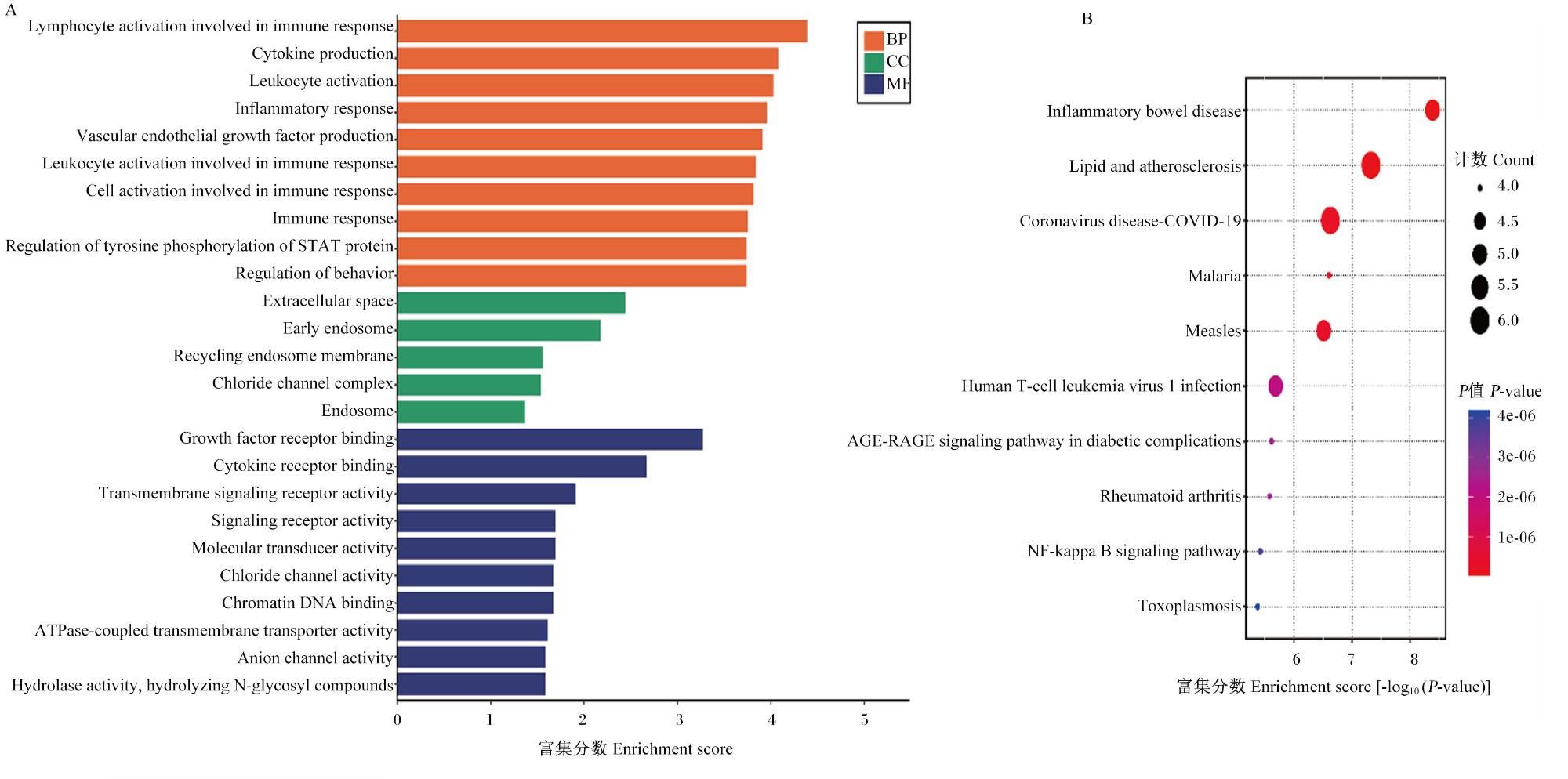
GO功能富集分析结果(图4-A)显示,AU作用于奶牛乳腺炎的潜在靶点主要参与免疫应答中涉及的淋巴细胞活化、细胞因子产生、白细胞活化、炎症反应、血管内皮生长因子产生、免疫应答和STAT蛋白酪氨酸磷酸化的调控等生物过程;定位于氯离子通道复合物、早期内体和循环内体膜等细胞组分;具有生长因子受体结合、染色质DNA结合、跨膜信号转导受体活性、分子转导器活性、氯离子通道活性、ATP酶偶联跨膜转运蛋白活性、阴离子通道活性和水解N-糖基化合物的水解酶活性等分子功能。KEGG通路富集分析结果(图4-B)显示,AU作用于奶牛乳腺炎的潜在靶点主要与炎症性肠病、脂质与动脉粥样硬化、NF-κB信号通路和糖尿病并发症中的晚期糖基化终末产物-晚期糖基化终末产物受体(AGE-RAGE)信号通路等相关。
图4 AU作用于奶牛乳腺炎潜在靶点的GO功能(A)和KEGG通路(B)富集分析

Lymphocyte activation involved in immune response:免疫应答中涉及的淋巴细胞活化;Cytokine production:细胞因子产生;Leukocyte activation:白细胞活化;Inflammatory response:炎症反应;Vascular endothelial growth factor production:血管内皮生长因子产生;Leukocyte activation involved in immune response:免疫应答中涉及的白细胞活化;Cell activation involved in immune response:免疫应答中涉及的细胞活化;Immune response:免疫应答;Regulation of tyrosine phosphorylation of STAT protein:STAT蛋白酪氨酸磷酸化的调控;Regulation of behavior:行为调控;Extracellular space:细胞外间隙;Growth factor receptor binding:生长因子受体结合;Cytokine receptor binding:细胞因子受体结合;Transmembrane signaling receptor activity:跨膜信号转导受体活性;Signaling receptor activity:信号转导受体活性;Molecular transducer activity:分子转导器活性;Chromatin DNA binding:染色质DNA结合;Inflammatory bowel disease:炎症性肠病;Coronavirus disease-COVID-19:新冠肺炎;Measles:麻疹;Human T-cell leukemia virus 1 infection:人类T淋巴细胞白血病病毒1型感染;AGE-RAGE signaling pathway in diabetic complications:糖尿病并发症中的晚期糖基化终末产物-晚期糖基化终末产物受体信号通路;Toxoplasmosis:弓形虫病。下图同 the same as below。

Fig.4 GO functional (A) and KEGG pathway (B) enrichment analyses of potential targets of AU acting on cow mastitis

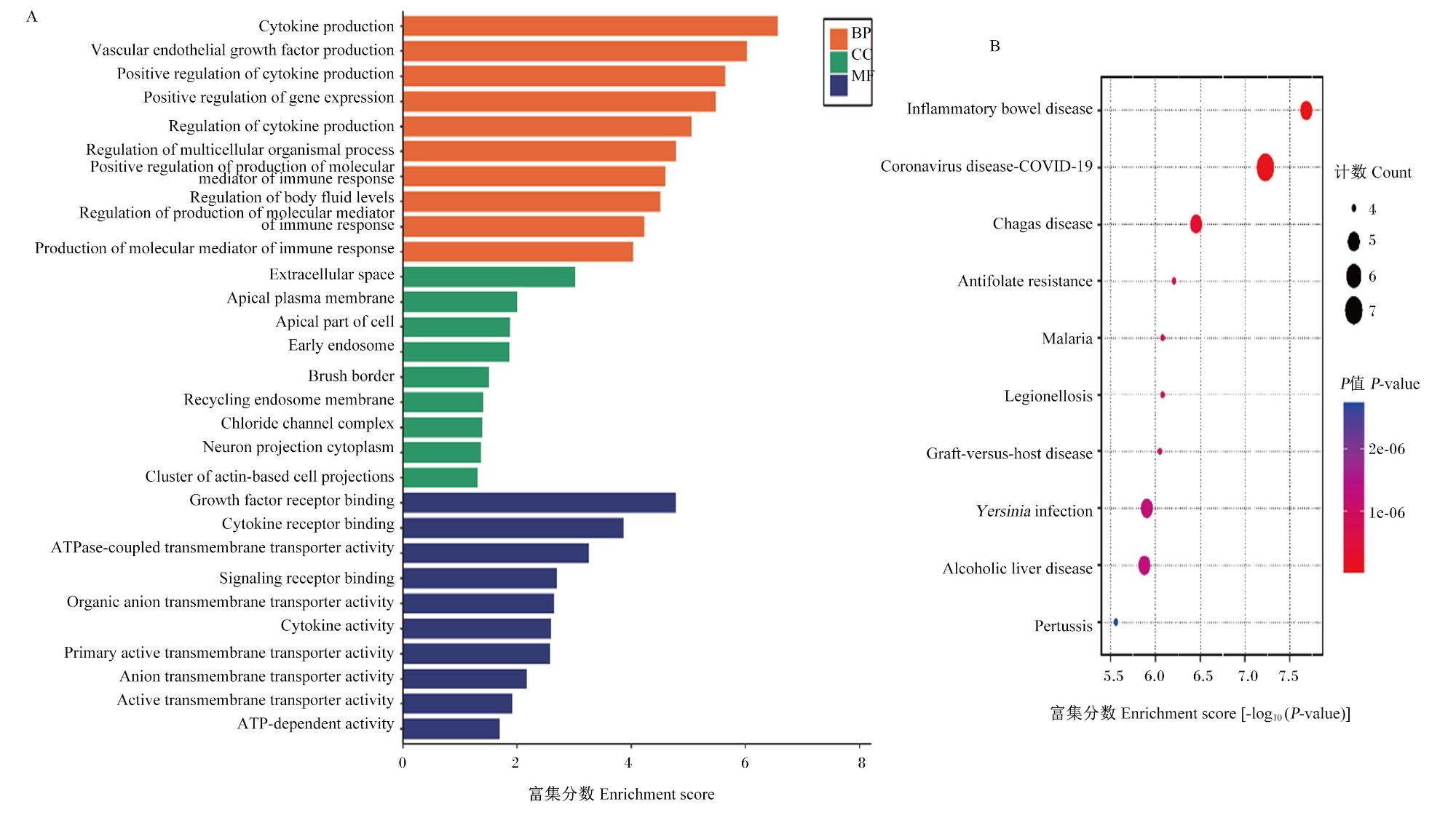
GO功能富集分析结果(图5-A)显示,RU作用于奶牛乳腺炎的潜在靶点主要参与细胞因子产生、血管内皮生长因子产生、细胞因子产生的正向调控、基因表达的正向调控、多细胞生物体过程的调控和免疫反应分子介导物的产生等生物过程;定位于细胞顶端部分、早期内体、氯离子通道复合物、神经元突起细胞质和基于肌动蛋白基的细胞突起簇等细胞组分;具有细胞因子受体结合、ATP酶偶联跨膜转运蛋白活性、有机阴离子跨膜转运蛋白活性、细胞因子活性、原发性主动跨膜转运蛋白活性、主动跨膜转运蛋白活性和依赖ATP的活性等分子功能。KEGG通路富集分析结果(图5-B)显示,RU作用于奶牛乳腺炎的潜在靶点主要与炎症性肠炎、抗叶酸耐药性、酒精性肝病和疟疾等相关。
图5 RU作用于奶牛乳腺炎潜在靶点的GO功能(A)和KEGG通路(B)富集分析

Positive regulation of cytokine production:细胞因子产生的正向调控;Positive regulation of gene expression:基因表达的正向调控;Regulation of cytokine production:细胞因子产生的调控;Regulation of multicellular organismal process:多细胞生物体过程的调控;Positive regulation of production of molecular mediator of immune response:免疫反应分子介导物产生的正向调控;Regulation of body fluid levels:体液水平的调控;Regulation of production of molecular mediator of immune response:免疫反应分子介导物产生的调控;Production of molecular mediator of immune response:免疫反应分子介导物的产生;Apical plasma membrane:顶端质膜;Apical part of cell:细胞顶端部分;Brush border:刷状缘;Neuron projection cytoplasm:神经元突起细胞质;Cluster of actin-based cell projections:基于肌动蛋白的细胞突起簇;Signaling receptor binding:信号转导受体结合;Cytokine activity:细胞因子活性;Primary active transmembrane transporter activity:原发性主动跨膜转运蛋白活性;Anion transmembrane transporter activity:阴离子跨膜转运蛋白活性;Active transmembrane transporter activity:主动跨膜转运蛋白活性;ATP-dependent activity:依赖ATP的活性;Chagas disease:恰加斯病;Antifolate resistance:抗叶酸耐药性;Legionellosis:军团菌病;Graft-versus-host disease:移植物抗宿主病;Yersinia infection:耶尔森菌感染;Pertussis:百日咳。下图同 the same as below。

Fig.5 GO functional (A) and KEGG pathway (B) enrichment analyses of potential targets of RU acting on cow mastitis

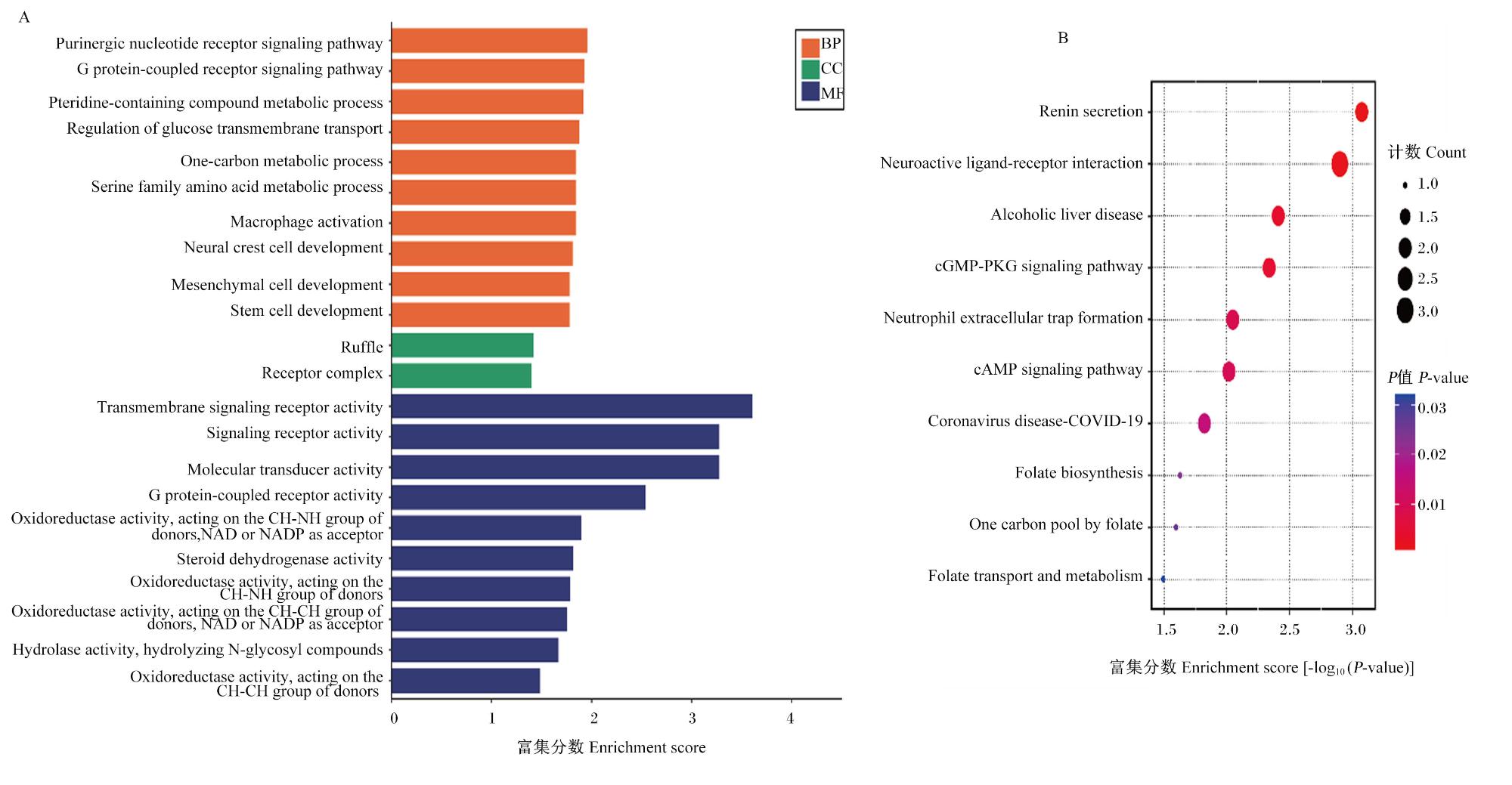
GO功能富集分析结果(图6-A)显示,PDG作用于奶牛乳腺炎的潜在靶点主要参与嘌呤能核苷酸受体信号通路、G蛋白偶联受体信号通路、葡萄糖跨膜转运的调控、一碳代谢过程、丝氨酸家族氨基酸代谢过程和巨噬细胞活化等生物过程;定位于褶皱和受体复合物细胞组分;具有跨膜信号转导受体活性、分子转导器活性、G蛋白偶联受体活性、类固醇脱氢酶活性、作用于供体CH-NH和CH-CH基团的氧化还原酶活性和水解N-糖苷键化合物的水解酶活性等分子功能。KEGG通路富集分析结果(图6-B)显示,PDG作用于奶牛乳腺炎的潜在靶点主要与酒精性肝病、环磷酸鸟苷-蛋白激酶G(cGMP-PKG)信号通路、环磷酸腺苷(cAMP)信号通路、叶酸生物合成及叶酸转运与代谢等相关。
图6 PDG作用于奶牛乳腺炎潜在靶点的GO功能(A)和KEGG通路(B)富集分析

Purinergic nucleotide receptor signaling pathway:嘌呤能核苷酸受体信号通路;G protein-coupled receptor signaling pathway:G蛋白偶联受体信号通路;Pteridine-containing compound metabolic process:含蝶啶化合物代谢过程;Regulation of glucose transmembrane transport:葡萄糖跨膜转运的调控;One-carbon metabolic process:一碳代谢过程;Serine family amino acid metabolic process:丝氨酸家族氨基酸代谢过程;Neural crest cell development:神经嵴细胞发育;Mesenchymal cell development:间充质细胞发育;Stem cell development:干细胞发育;G protein-coupled receptor activity:G蛋白偶联受体活性;Oxidoreductase activity, acting on the CH-NH group of donors, NAD or NADP as acceptor:作用于供体CH-NH基团、以NAD或NADP为受体的氧化还原酶活性;Steroid dehydrogenase activity:类固醇脱氢酶活性;Oxidoreductase activity, acting on the CH-NH group of donors:作用于供体CH-NH基团的氧化还原酶活性;Oxidoreductase activity,acting on the CH-CH group of donors, NAD or NADP as acceptor:作用于供体CH-CH基团、以NAD或NADP为受体的氧化还原酶活性;Hydrolase activity, hydrolyzing N-glycosyl compounds:水解N-糖苷键化合物的水解酶活性;Oxidoreductase activity, acting on the CH-CH group of donors:作用于供体CH-CH基团的氧化还原酶活性;Renin secretion:肾素分泌;Neuroactive ligand-receptor interaction:神经活性配体-受体相互作用;cGMP-PKG signaling pathway:环磷酸鸟苷-蛋白激酶G信号通路;cAMP signaling pathway:环磷酸腺苷信号通路;Folate biosynthesis:叶酸生物合成;One carbon pool by folate:叶酸介导的一碳代谢;Folate transport and metabolism:叶酸转运与代谢。下图同 the same as below。

Fig.6 GO functional (A) and KEGG pathway (B) enrichment analyses of potential targets of PDG acting on cow mastitis

2.4 EUL主要活性成分作用于奶牛乳腺炎的核心靶点筛选与分析

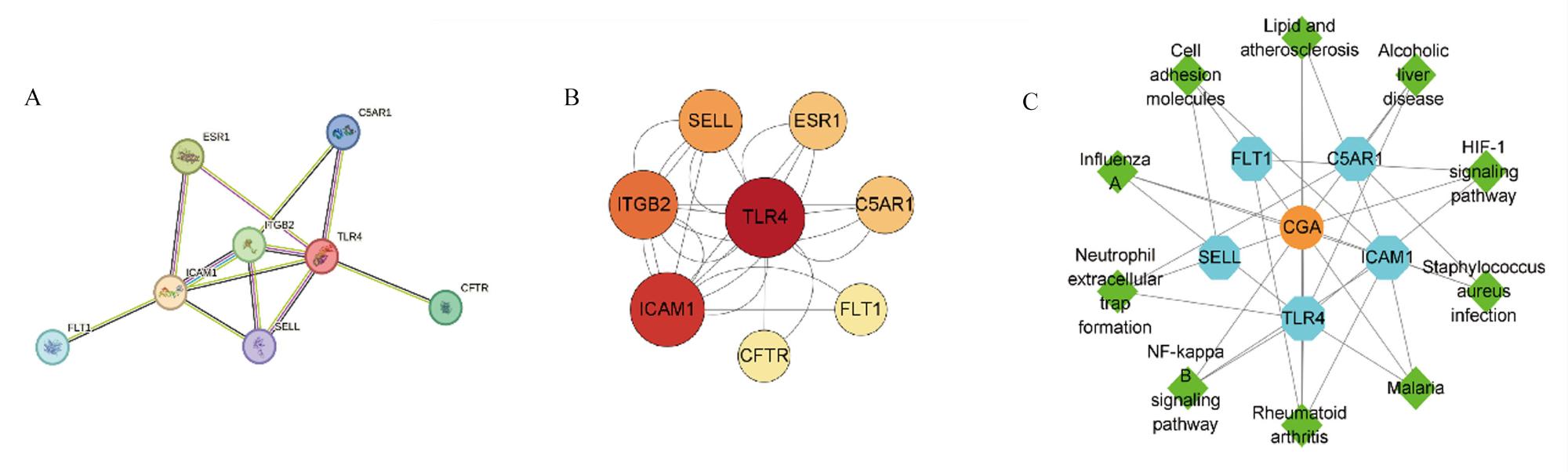
图7所示,将CGA作用于奶牛乳腺炎的潜在靶点导入STRING在线数据库,设置置信度为0.4,构建蛋白质-蛋白质互作网络,获得8个蛋白节点及24条连线。利用MCODE筛选子网络(评分4.0,6个节点,12条边),筛选出连接度较高的6个靶点:TLR4、ICAM1、ITGB2、SELL、ESR1和C5AR1。CGA-靶点-通路网络分析显示,CGA与各靶点及通路的连接度分布较为均匀。综合分析表明,CGA缓解奶牛乳腺炎的作用可能与TLR4、ICAM1、SELL和C5AR1核心靶点以及HIF-1信号通路、NF-κB信号通路、酒精性肝病、细胞黏附分子及脂质与动脉粥样硬化等关键通路有关。
图7 CGA作用于奶牛乳腺炎的核心靶点筛选与分析

A:CGA作用于奶牛乳腺炎潜在靶点的蛋白质-蛋白质互作网络;B:CGA作用于奶牛乳腺炎核心靶点筛选;C:CGA-靶点-通路网络图。A: protein-protein interaction network of potential targets for CGA acting on cow mastitis; B: screening of core targets for CGA acting on cow mastitis; C: CGA-target-pathway network diagram.

TLR4:Toll样受体4 Toll-like receptor 4;ICAM1:细胞间黏附分子1 intercellular adhesion molecule 1;ITGB2:整合素β2 integrin beta 2;SELL:白细胞选择素 leukocyte selectin;ESR1:雌激素受体1 estrogen receptor 1;C5AR1:C5a过敏毒素趋化因子受体1 C5a anaphylatoxin chemotactic receptor 1;FLT1:血管内皮生长因子受体1 vascular endothelial growth factor receptor 1;CFTR:囊性纤维化跨膜传导调节因子 cystic fibrosis transmembrane conductance regulator;CGA:绿原酸 chlorogenic acid。下图同 the same as below。

Fig.7 Screening and analysis of core targets for CGA acting on cow mastitis

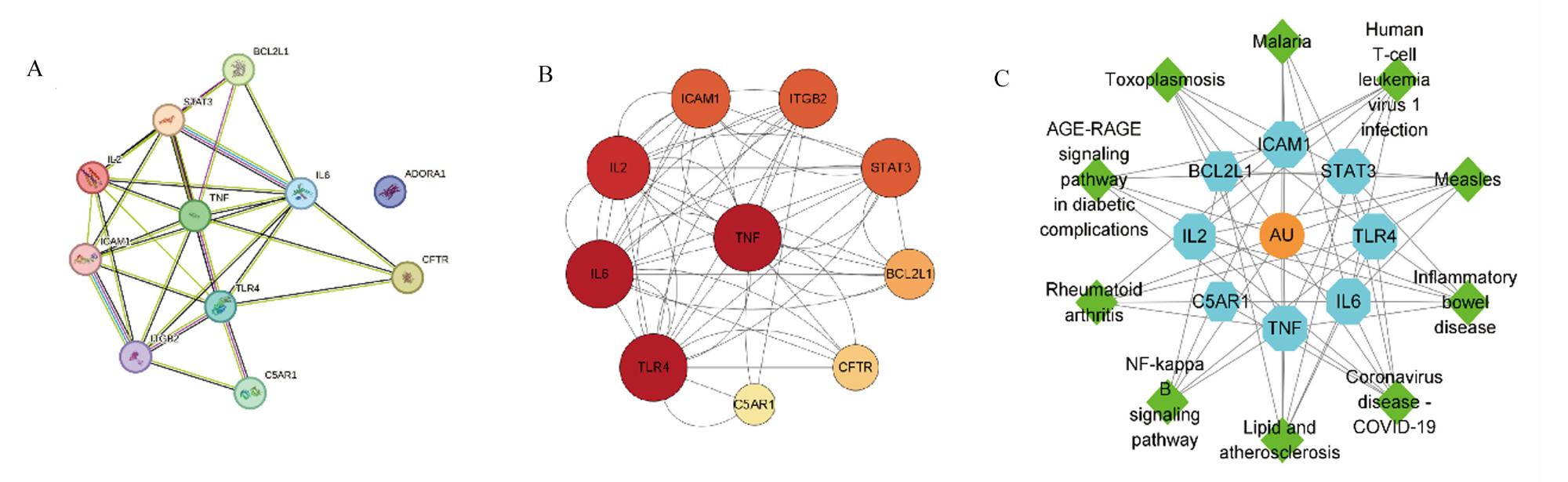
图8所示,将AU作用于奶牛乳腺炎的潜在靶点导入STRING在线数据库,设置置信度为0.4,构建蛋白质-蛋白质互作网络,获得10个蛋白节点及58条连线。利用MCODE筛选子网络(评分6.857,8个节点,48条边),筛选出连接度较高的8个靶点:TNF、TLR4、IL6、IL2、ICAM1、ITGB2、STAT3和BCL2L1。AU-靶点-通路网络分析显示,AU与各靶点及通路的连接度分布较为均匀。综合分析表明,AU缓解奶牛乳腺炎的作用可能与TNF、TLR4、IL6、IL2、ICAM1、STAT3和BCL2L1核心靶点以及炎症性肠病、脂质与动脉粥样硬化、NF-κB信号通路和糖尿病并发症中的AGE-RAGE信号通路等关键通路有关。
图8 AU作用于奶牛乳腺炎的核心靶点筛选与分析

A:AU作用于奶牛乳腺炎潜在靶点的蛋白质-蛋白质互作网络;B:AU作用于奶牛乳腺炎核心靶点筛选;C:AU-靶点-通路网络图。A: protein-protein interaction network of potential targets for AU acting on cow mastitis; B: screening of core targets for AU acting on cow mastitis; C: AU-target-pathway network diagram.

TNF:肿瘤坏死因子 tumor necrosis factor;IL6:白细胞介素6 interleukin 6;IL2:白细胞介素2 interleukin 2;STAT3:信号转导与转录激活因子3 signal transduction and transcriptional activator 3;BCL2L1:BCL2样蛋白1 BCL2-like protein 1;ADORA1:腺苷A1受体 adenosine A1 receptor;AU:桃叶珊瑚苷 aucubin。下图同 the same as below。

Fig.8 Screening and analysis of core targets for AU acting on cow mastitis

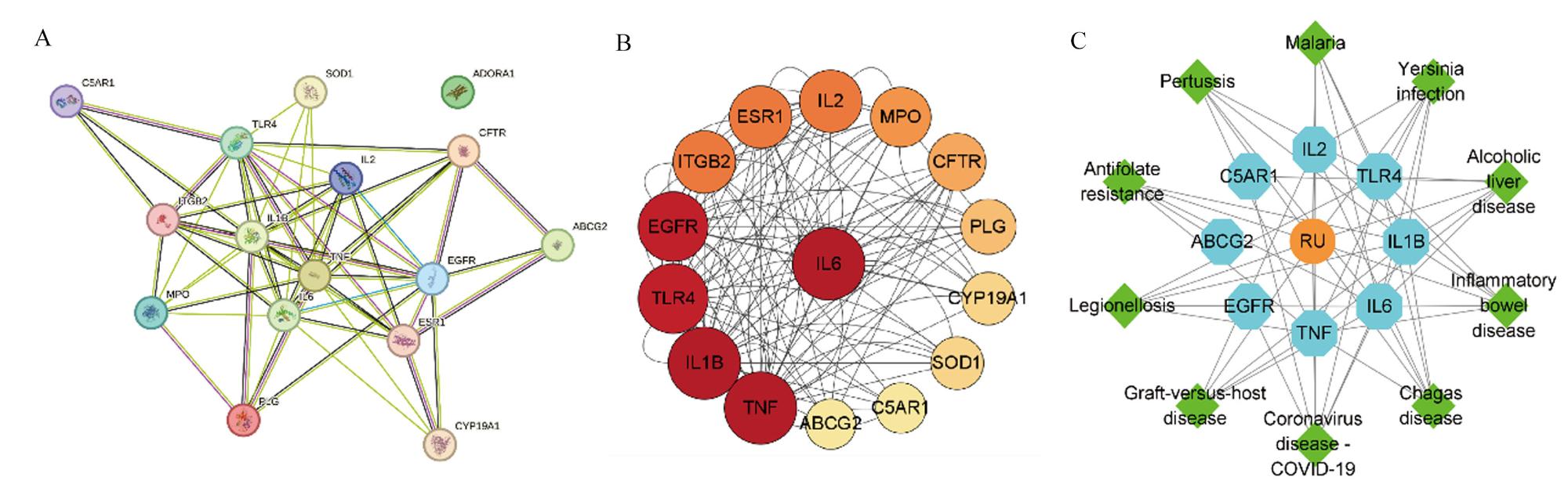
图9所示,将RU作用于奶牛乳腺炎的潜在靶点导入STRING在线数据库,设置置信度为0.4,构建蛋白质-蛋白质互作网络,获得10个蛋白节点及76条连线。利用MCODE筛选子网络(评分8.444,10个节点,76条边),筛选出连接度较高的10个靶点:TNF、IL6、TLR4、IL2、IL1β、MPO、ITGB2、EGFR、ESR1和CFTR。RU-靶点-通路网络分析显示,RU与各靶点及通路的连接度分布较为均匀。综合分析表明,RU缓解奶牛乳腺炎的作用可能与TNF、TLR4、IL6、IL2、IL1β和EGFR核心靶点以及炎症性肠炎和酒精性肝损伤等关键通路有关。
图9 RU作用于奶牛乳腺炎的核心靶点筛选与分析

A:RU作用于奶牛乳腺炎潜在靶点的蛋白质-蛋白质互作网络;B:RU作用于奶牛乳腺炎核心靶点筛选;C:RU-靶点-通路网络图。A: protein-protein interaction network of potential targets for RU acting on cow mastitis; B: screening of core targets for RU acting on cow mastitis; C: RU-target-pathway network diagram.

IL1β:白细胞介素1β interleukin 1 beta;EGFR:表皮生长因子受体 epidermal growth factor receptor;SOD1:超氧化物歧化酶1 superoxide dismutase 1;PLG:纤溶酶原 plasminogen;ABCG2:ATP结合盒亚家族G成员2 ATP-binding cassette subfamily G member 2;CYP19A1:细胞色素P450家族19亚家族A成员1 cytochrome P450 family 19 subfamily A member 1;MPO:髓过氧化物酶 myeloperoxidase;RU:芦丁 rutin。下图同 the same as below。

Fig.9 Screening and analysis of core targets for RU acting on cow mastitis

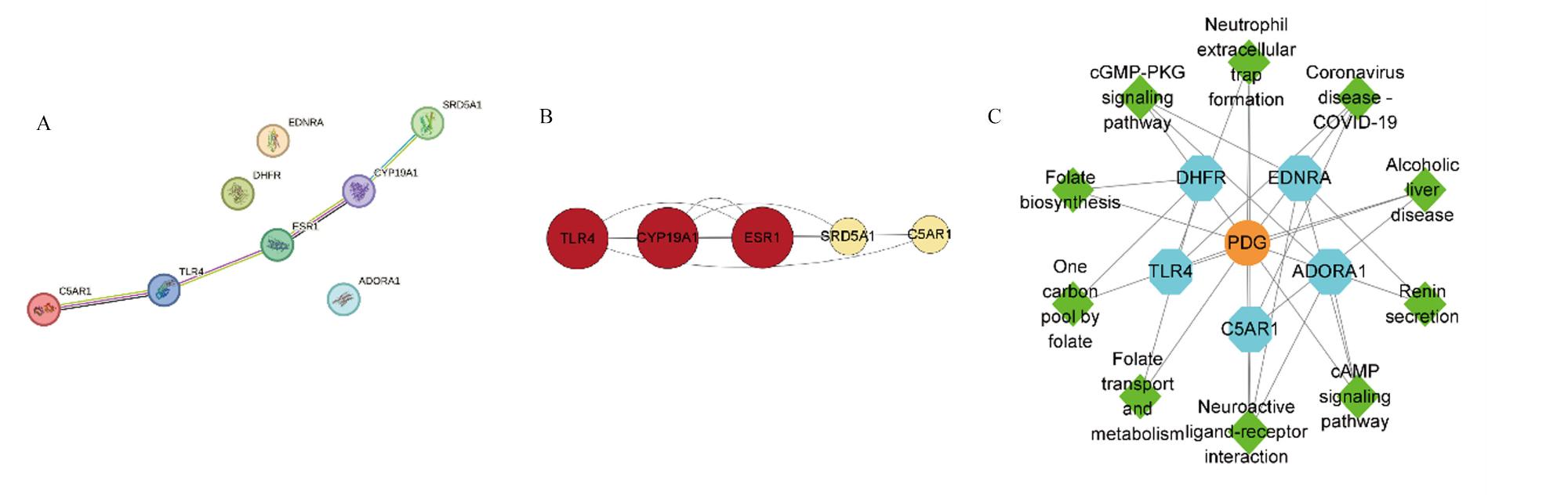
图10所示,将PDG作用于奶牛乳腺炎的潜在靶点导入STRING在线数据库,设置置信度为0.4,构建蛋白质-蛋白质互作网络,获得5个蛋白节点及8条连线。通过CytoNCA筛选出连接度较高的5个靶点:TLR4、CYP19A1、ESR1、SRD5A1和C5AR1。PDG-靶点-通路网络分析显示,PDG与各靶点及通路的连接度分布较为均匀。综合分析表明,PDG缓解奶牛乳腺炎的作用可能与TLR4和C5AR1核心靶点以及酒精性肝病、cGMP-PKG信号通路、cAMP信号通路、叶酸生物合成及叶酸转运与代谢等关键通路有关。
图10 PDG作用于奶牛乳腺炎的核心靶点筛选与分析

A:PDG作用于奶牛乳腺炎潜在靶点的蛋白质-蛋白质互作网络;B:PDG作用于奶牛乳腺炎核心靶点筛选;C:PDG-靶点-通路网络图。A: protein-protein interaction network of potential targets for PDG acting on cow mastitis; B: screening of core targets for PDG acting on cow mastitis; C: PDG-target-pathway network diagram.

SRD5A1:类固醇5α还原酶1 steroid 5α-reductase 1;DHFR:二氢叶酸还原酶 dihydrofolate reductase;EDNRA:内皮素受体A endothelin receptor type A;PDG:松脂醇二葡萄糖苷 pinoresinol diglucoside。

Fig.10 Screening and analysis of core targets for PDG acting on cow mastitis

CGA、AU、RU和PDG作用于奶牛乳腺炎的核心靶点信息见表1。将CGA、AU、RU和PDG通过靶点蛋白质-蛋白质互作网络筛选出的核心靶点取交集,筛选出1个共同核心靶点TLR4。
表1 CGA、AU、RU和PDG作用于奶牛乳腺炎的核心靶点信息

Table 1 Core targets of CGA, AU, RU and PDG acting on cow mastitis

活性成分
Active ingredients
序号
No.
基因名称
Gene name
通用蛋白编号
UniProt ID
蛋白质名称
Protein name


绿原酸 CGA
1 TLR4 Q9GL65 Toll样受体4
2 ICAM1 Q95132 细胞间黏附分子1
3 C5AR1 Q673L2 C5a过敏毒素趋化因子受体1
4 SELL P98131 白细胞选择素


桃叶珊瑚苷 AU
1 TNF Q06599 肿瘤坏死因子
2 TLR4 Q9GL65 Toll样受体4
3 IL6 P26892 白细胞介素6
4 IL2 P60568 白细胞介素2
5 ICAM1 Q95132 细胞间黏附分子1
6 STAT3 P61635 信号转导与转录激活因子3
7 BCL2L1 Q05KJ0 BCL2样蛋白1


芦丁 RU
1 TNF Q06599 肿瘤坏死因子
2 IL6 P26892 白细胞介素6
3 TLR4 Q9GL65 Toll样受体4
4 IL2 P60568 白细胞介素2
5 IL1β P09428 白细胞介素1β
6 EGFR A0A3Q1MHB0 表皮生长因子受体

松脂醇二葡萄糖苷 PDG
1 TLR4 Q9GL65 Toll样受体4
2 C5AR1 Q673L2 C5a过敏毒素趋化因子受体1

2.5 分子对接验证

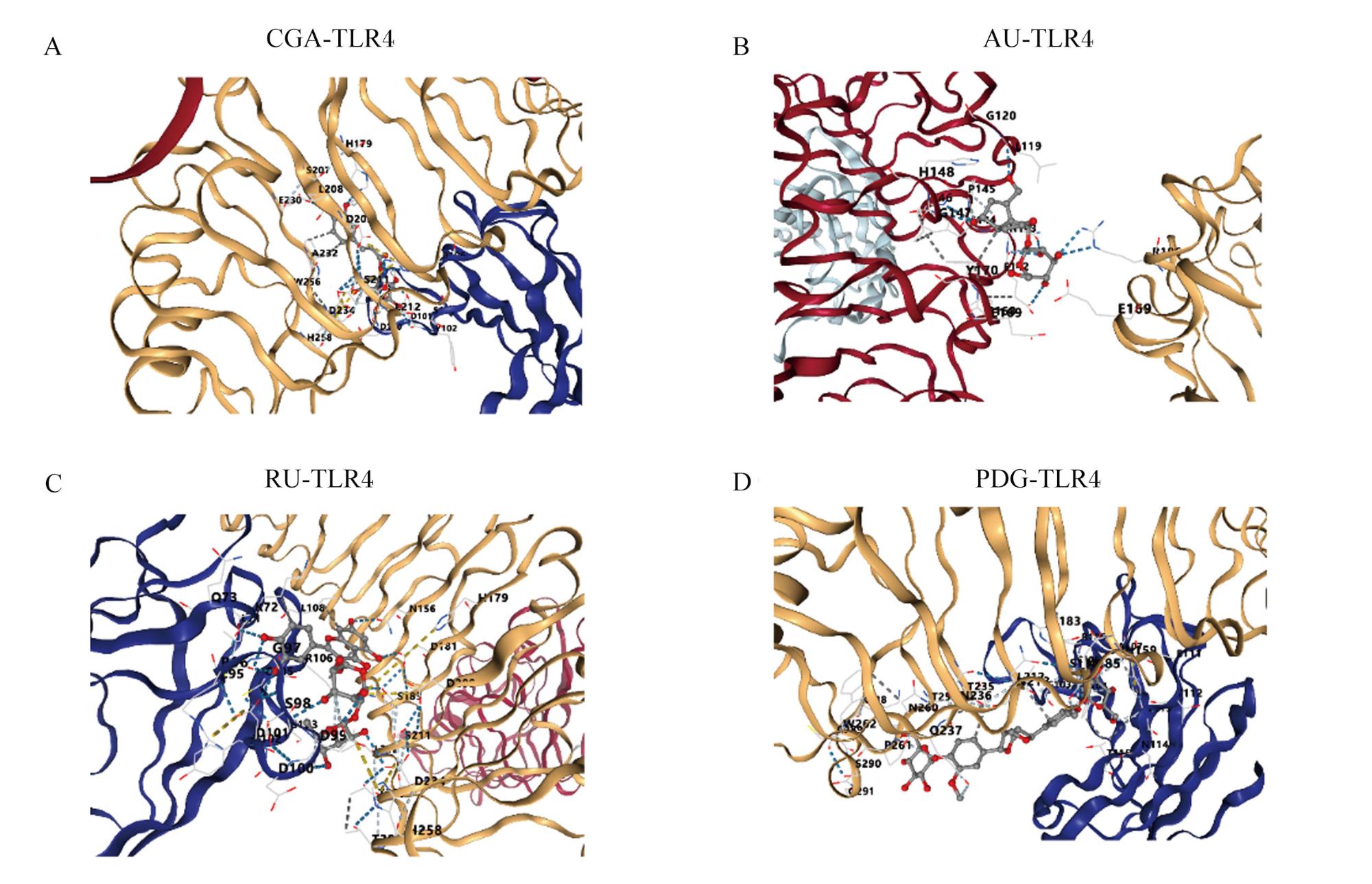
将CGA、AU、RU和PDG的分子结构式与TLR4(PDB ID:2z65)的三维结构导入CB-DOCK2在线软件进行分子对接分析,其可视化结果如图11所示。分析结果显示,CGA-TLR4、AU-TLR4、RU-TLR4、PDG-TLR4的结合能分别为-7.1、-6.8、-9.4、-8.7 kJ/mol,表明4种活性成分均能与TLR4发生稳定结合。该结果证实,CGA、AU、RU和PDG缓解奶牛乳腺炎的作用机制与靶向调控TLR4密切相关。
图11 EUL主要活性成分作用于奶牛乳腺炎的核心靶点分子对接可视化结果

Fig.11 Molecular docking visualization of core targets for main active components of EUL acting on cow mastitis

3 讨论

CGA是EUL中主要的酚酸类物质,是一种有机酸,具有抗炎、抗菌、抗癌变和免疫调节作用[22]。研究表明,CGA能够通过提高抗氧化能力和减少炎症反应来改善D-半乳糖诱导的大鼠学习记忆障碍,并作用于磷脂酰肌醇3(phosphatidylinositol 3-kinase,PI3K)/蛋白激酶B(protein kinase B,AKT)/NF-κB信号通路,缓解盐酸/乙醇诱导的大鼠胃溃疡[23-24]。此外,CGA可通过调节TLR4/NF-κB信号通路改善对肾纤维化的炎症反应和氧化应激[25]。本研究发现,NF-κB信号通路是CGA作用于奶牛乳腺炎的主要富集通路之一,其中潜在靶点TLR4和ICAM1均位于该通路。TLR4在激活先天性免疫反应、引发炎症过程中起核心作用,ICAM1的表达则受TLR4信号通路激活。另有研究表明,给小鼠饲喂高剂量CGA可抑制核苷酸结合寡聚化结构域样受体蛋白3(nucleotide-binding oligomerization domain-like receptor protein 3,NLRP3)信号通路,并减少IL1β、IL6、白细胞介素18(interleukin 18,IL18)及TNF-α的分泌,改善顺铂所致的肠黏膜屏障的破坏和动脉粥样硬化[26-27]。动脉粥样硬化属于脂质驱动的慢性炎症性疾病,TLR4和ICAM1同样参与脂质与动脉粥样硬化通路调控。Park等[28]研究发现,CGA可显著降低A549肺癌细胞中缺氧诱导的HIF-1α
蛋白表达水平,并抑制HIF-1α/AKT信号通路,发挥抑制血管生成的作用。在酒精性肝损伤方面,桑叶提取物主要成分CGA可缓解酒精诱发的肝细胞疾病,抑制酒精诱导的促凋亡信号,抑制EGFR/STAT3/诱导型一氧化氮合酶(inducible nitric oxide synthase,iNOS)信号通路,从而降低肝损伤标志物和脂质积累[29]。上述研究均表明,TLR4、ICAM1靶点以及HIF-1信号通路、NF-κB信号通路、酒精性肝损伤、细胞黏附和脂质与动脉粥样硬化等信号通路在炎症缓解过程中发挥重要作用,与本研究结果相一致。而SELL和C5AR1对奶牛乳腺炎的缓解作用及具体机制,仍有待进一步试验验证。
AU为EUL中的环烯醚萜类成分,其抗炎、保肝等生物活性已被广泛研究。AU通过激活蛋白激酶R样内质网激酶(protein kinase R-like endoplasmic reticulum kinase,PERK)/核因子E2相关因子2(nuclear factor erythroid 2-related factor 2,Nrf2)/血红素氧合酶-1(heme oxygenase-1,HO-1)信号通路,促进神经胶质瘤细胞发生铁死亡,抑制细胞增殖活性[30]。本研究中,AU作用于奶牛乳腺炎的潜在靶点TLR4、TNF、IL6、BCL2L1、ICAM1和STAT3等均为脂质与动脉粥样硬化通路中的重要调控因子。AU可通过抑制氧化应激和炎症反应来减轻椎间盘退变大鼠椎间盘髓核细胞凋亡和细胞外基质降解,其机制可能与调节Nrf2/NF-κB信号通路有关[31]。另有研究表明,AU抗炎作用的发挥与抑制TLR4/NF-κB信号通路激活有关[32]。本研究表明,NF-κB信号通路为AU缓解奶牛乳腺炎的关键通路之一,与王帅[31]等和杨雷等[32]的研究结果相符。Shi等[33]通过网络药理学分析发现,杜仲与急性肝损伤的核心靶点包括TNF,关键通路涉及AGE-RAGE信号通路。本研究预测,AU可通过糖尿病并发症中的AGE-RAGE信号通路缓解奶牛乳腺炎,与上述研究结果相符。研究表明,AU作为EUL中的活性成分,可提高小鼠体重,修复结肠组织形态,降低炎症因子IL1βTNF-αIL18、髓样分化因子88(myeloid differentiation factor 88,MyD88)和NF-κB的mRNA相对表达量,这为炎症性肠病的防治提供了理论支撑[34]。此外,本研究通过网络药理学分析还预测,AU可通过ICAM1、STAT3、BCL2L1等关键靶点发挥缓解炎症作用。
RU为EUL中的黄酮单体化合物,具有较好的抗炎效果。RU可能通过激活腺苷酸活化蛋白激酶(adenosine monophosphate-activated protein kinase,AMPK)/固醇调节元件结合蛋白1(sterol regulatory element-binding protein 1,SREBP1)通路,改善糖尿病合并非酒精性脂肪肝病症[35]。同时,RU可抑制NLRP3炎症小体和NF-κB信号通路来改善各部位炎症[36-38]。本研究预测的RU作用于奶牛乳腺炎的核心靶点及通路结果显示,TLR4在NOD样受体信号通路、酒精性肝病和炎症性肠病等通路中起着关键作用,与前人研究结果一致。另有研究表明,RU可激活一氧化氮(NO)-cGMP-PKG-KATP通道、Nrf2/HO-1信号通路以及抑制NF-κB信号通路来发挥镇痛作用[39]。RU可减轻咪喹莫特诱导的小鼠银屑病样皮肤炎症,而AGE-RAGE信号通路的调控可能是其潜在的抗炎机制之一[40]。此外,RU可通过抑制Src激酶降低EGFR的磷酸化水平,减轻糖尿病肾病中的足细胞损伤[41]。本研究同样预测RU与EGFR、TLR4和TNF以及酒精性肝病、炎症性肠炎和NF-κB信号通路密切相关。
PDG属于木脂素类化合物,其在EUL中的含量高于杜仲茎和杜仲皮。PDG具有抗炎效果,但目前对其缓解炎症的相关研究较少。NO-cGMP-PKG信号通路在血小板抑制和骨骼稳态中发挥关键作用[42-43]。多数药物如Isthmin-1可通过cGMP-PKG信号通路缓解心脏缺血再灌注损伤[44]。在抗炎方面,本研究发现,PDG可通过调控cGMP-PKG信号通路缓解奶牛乳腺炎,其潜在靶点ADORA1是该通路中的重要蛋白载体,推测PDG可通过激活cGMP-PKG信号通路减少炎症发生。cAMP作为一种极其重要的第二信使,可传递细胞外信号,触发细胞特异性应答,维持细胞正常生理功能。本研究表明,cAMP信号通路为PDG作用于奶牛乳腺炎的主要富集通路之一,其潜在靶点EDNRA为cAMP/PKA信号通路中的一种G蛋白偶联受体,EDNRA的激活可促进TNF-α、IL6、IL8等炎性细胞因子的合成与释放。由此可见,cGMP-PKG和cAMP信号通路在PDG缓解奶牛乳腺炎的过程中具有重要调控作用。另有研究表明,抑制C5AR1表达可激活脑细胞间的细胞生长与修复相关信号通路,同时抑制炎症通路活化[45]。本研究预测,PDG与C5AR1密切相关,提示PDG缓解奶牛乳腺炎的机制可能与抑制C5AR1表达有关。
目前,关于EUL单体提取化合物预防和治疗奶牛乳腺炎的研究较少,现有炎症缓解相关研究多集中于小鼠和家禽。网络药理学分析借助大量最新研究以及相关信息数据库来探究药物作用机制,为奶牛乳腺炎的缓解与预防提供了理论方向,但EUL活性成分作用于奶牛乳腺炎的具体靶点和通路,仍需后续试验进一步验证。

4 结论

网络药理学与分子对接研究结果表明,CGA、AU、RU和PDG缓解奶牛乳腺炎的作用与TLR4靶点以及NF-κB、HIF-1、cGMP-PKG、cAMP、脂质与动脉粥样硬化等相关信号通路密切相关。本研究为阐明EUL活性成分缓解奶牛乳腺炎的作用机制奠定了理论基础,也为后续开展体内、体外试验验证其具体作用机制明确了研究方向。
[1]
SHARUN K, DHAMA K, TIWARI R, et al. Advances in therapeutic and managemental approaches of bovine mastitis:a comprehensive review[J]. The Veterinary Quarterly, 2021, 41(1):107-136.

DOI

[2]
HALASA T, HUIJPS K, ØSTERÅS O, et al. Economic effects of bovine mastitis and mastitis management:a review[J]. The Veterinary Quarterly, 2007, 29(1):18-31.

DOI

[3]
THOMPSON-CRISPI K, ATALLA H, MIGLIOR F, et al. Bovine mastitis:frontiers in immunogenetics[J]. Frontiers in Immunology, 2014, 5:493.

[4]
范素菊, 孙灵灵, 王慧琴, 等. 中草药提取物治疗奶牛乳腺炎的研究进展[J]. 中国草食动物科学, 2024, 45(6):83-88.

FAN S J, SUN L L, WANG H Q, et al. Research progress of Chinese herbal extracts for the treatment of dairy cow mastitis[J]. China Herbivore Science, 2024, 45(6):83-88. (in Chinese)

[5]
杨丽云. 中草药对奶牛乳腺炎的利弊[J]. 中国动物保健, 2025, 27(2):165-166.

YANG L Y. The advantages and disadvantages of Chinese herbal medicine for mastitis in dairy cows[J]. China Animal Health, 2025, 27(2):165-166. (in Chinese)

[6]
WANG C Y, TANG L, HE J W, et al. Ethnobotany,phytochemistry and pharmacological properties of Eucommia ulmoides:a review[J]. The American Journal of Chinese Medicine, 2019, 47(2):259-300.

DOI

[7]
HE X R, WANG J H, LI M X, et al. Eucommia ulmoides Oliv.:ethnopharmacology,phytochemistry and pharmacology of an important traditional Chinese medicine[J]. Journal of Ethnopharmacology, 2014, 151(1):78-92.

DOI

[8]
高素敏. 杜仲叶对奶牛生产性能影响的研究[J]. 中国乳业, 2018(6):40-41.

GAO S M. Research on the effect of Eucommia ulmoides leaves on the production performance of dairy cows[J]. China Dairy, 2018(6):40-41. (in Chinese)

[9]
侍世梅, 王芳. 杜仲叶提取物对湖羊生长性能、血清生化及抗氧化指标的影响[J]. 中国饲料, 2024(12):17-20.

SHI S M, WANG F. Effects of Eucommia ulmoides leaves extract on growth performance,serum biochemical and antioxidant indexes of Hu sheep[J]. China Feed, 2024(12):17-20. (in Chinese)

[10]
YANG Y H, LI F N, GUO Q P, et al. Effects of different supplemental levels of Eucommia ulmoides leaf extract in the diet on carcass traits and lipid metabolism in growing-finishing pigs[J]. Frontiers in Veterinary Science, 2022, 8:828165.

DOI

[11]
PENG M J, HUANG T, YANG Q L, et al. Dietary supplementation Eucommia ulmoides extract at high content served as a feed additive in the hens industry[J]. Poultry Science, 2022, 101(3):101650.

DOI

[12]
于苗苗, 张艳, 徐婷婷, 等. 网络药理学在兽医学领域的应用研究进展[J]. 动物医学进展, 2025, 46(8):102-107.

YU M M, ZHANG Y, XU T T, et al. Progress on the application of network pharmacology in veterinary medicine[J]. Progress in Veterinary Medicine, 2025, 46(8):102-107. (in Chinese)

[13]
张代峰, 胡晨骏, 胡孔法. 网络药理学在中药领域的应用和展望[J]. 医学信息学杂志, 2024, 45(6):30-36,56.

ZHANG D F, HU C J, HU K F. Application and prospect of network pharmacology in the field of traditional Chinese medicine[J]. Journal of Medical Informatics, 2024, 45(6):30-36,56. (in Chinese)

[14]
ZHAO W B, WANG B Y, LI S. Network pharmacology for traditional Chinese medicine in era of artificial intelligence[J]. Chinese Herbal Medicines, 2024, 16(4):558-560.

DOI PMID

[15]
LI C Y, GENG C, WANG J M, et al. Investigating the inflammatory mechanism of notoginsenoside R1 in diabetic nephropathy via ITGB8 based on network pharmacology and experimental validation[J]. Molecular Medicine, 2024, 30(1):277.

DOI PMID

[16]
WANG Z Z, CHENG L L, SHANG Z G, et al. Network pharmacology for analyzing the key targets and potential mechanism of wogonin in gliomas[J]. Frontiers in Pharmacology, 2021, 12:646187.

DOI

[17]
LI R, LOU Q, ZHU Y, et al. Mechanism of huoshan large-leaf yellow tea in treatment of diabetic cognitive dysfunction based on bioinformatics and network pharmacology[J]. Phytomedicine, 2025, 144:156923.

DOI

[18]
FENG S Y, ZHANG Y H, FU S D, et al. Application of chlorogenic acid as a substitute for antibiotics in multidrug-resistant Escherichia coli-induced mastitis[J]. International Immunopharmacology, 2023, 114:109536.

DOI

[19]
YANG T A, LANG W Y, ZHAO Y, et al. Aucubin alleviates methotrexate-induced enteritis in rats by inducing autophagy[J]. Clinical and Experimental Pharmacology & Physiology, 2023, 50(11):855-866.

[20]
SU S Y, LI X Y, LI S T, et al. Rutin protects against lipopolysaccharide-induced mastitis by inhibiting the activation of the NF-κB signaling pathway and attenuating endoplasmic reticulum stress[J]. Inflammopharmacology, 2019, 27(1):77-88.

DOI PMID

[21]
ZHANG Y, LEI Y B, YAO X X, et al. Pinoresinol diglucoside alleviates ischemia/reperfusion-induced brain injury by modulating neuroinflammation and oxidative stress[J]. Chemical Biology & Drug Design, 2021, 98(6):986-996.

[22]
MIAO M S, XIANG L L. Pharmacological action and potential targets of chlorogenic acid[J]. Advances in Pharmacology, 2020, 87:71-88.

[23]
余丽, 曾玉萍, 汪莉, 等. 绿原酸对D-半乳糖诱导的大鼠认知功能障碍的保护作用及机制研究[J]. 中国食品添加剂, 2025, 36(5):26-32.

YU L, ZENG Y P, WANG L, et al. Study on the protective effect and mechanisms of chlorogenic acid against D-galactose-induced cognitive dysfunction in rats[J]. China Food Additives, 2025, 36(5):26-32. (in Chinese)

[24]
GONG M, LI Q F, GUO H, et al. Protective effect of active components of Eucommia ulmoides leaves on gastric ulcers in rats:involvement of the PI3K/Akt/NF-κB pathway[J]. Journal of Food Science, 2022, 87(7):3207-3222.

DOI

[25]
JIAO H, ZHANG M J, XU W Q, et al. Chlorogenic acid alleviate kidney fibrosis through regulating TLR4/NF-κB mediated oxidative stress and inflammation[J]. Journal of Ethnopharmacology, 2024, 335:118693.

DOI

[26]
杨韵琪, 王艳, 余丹凤, 等. 绿原酸调控NLRP3炎症小体改善动脉粥样硬化的机制研究[J]. 中医药信息, 2024, 41(12):1-5.

YANG Y Q, WANG Y, YU D F, et al. Study on the mechanism of chlorogenic acid regulating NLRP3 inflammasome to improve atherosclerosis[J]. Information on Traditional Chinese Medicine, 2024, 41(12):1-5. (in Chinese)

[27]
王诗琪, 熊志翔, 许杨鼎, 等. 基于转录组学和蛋白质组学研究绿原酸对须癣毛癣菌的抑菌机制[J]. 中国医院药学杂志, 2025, 45(10):1134-1139,1176.

DOI

WANG S Q, XIONG Z X, XU Y D, et al. Inhibitory mechanism of chlorogenic acid against Trichophyton mentagrophytes based on transcriptomics and proteomics[J]. Chinese Journal of Hospital Pharmacy, 2025, 45(10):1134-1139,1176. (in Chinese)

[28]
PARK J J, HWANG S J, PARK J H, et al. Chlorogenic acid inhibits hypoxia-induced angiogenesis via down-regulation of the HIF-1α/AKT pathway[J]. Cellular Oncology, 2015, 38(2):111-118.

DOI PMID

[29]
LEE Y J, HSU J D, LIN W L, et al. Upregulation of caveolin-1 by mulberry leaf extract and its major components,chlorogenic acid derivatives,attenuates alcoholic steatohepatitis via inhibition of oxidative stress[J]. Food & Function, 2017, 8(1):397-405.

[30]
牛国栋, 宋志远, 任洪波, 等. 桃叶珊瑚苷对神经胶质瘤细胞铁死亡的影响[J]. 中国临床神经外科杂志, 2025, 30(2):95-100.

NIU G D, SONG Z Y, REN H B, et al. Effect of aucubin on ferroptosis in glioma cells[J]. Chinese Journal of Clinical Neurosurgery, 2025, 30(2):95-100. (in Chinese)

[31]
王帅, 贾欢欢, 韦林, 等. 桃叶珊瑚苷通过调控Nrf2/NF-κB信号通路改善穿刺诱导的大鼠椎间盘退变[J]. 广州中医药大学学报, 2024, 41(12):3273-3282.

WANG S, JIA H H, WEI L, et al. Aucubin ameliorates puncture-induced intervertebral disc degeneration in rats by modulating the Nrf2/NF-κB signaling pathway[J]. Journal of Guangzhou University of Traditional Chinese Medicine, 2024, 41(12):3273-3282. (in Chinese)

[32]
杨雷, 李兆勇, 马露, 等. 基于TLR4/NF-κB通路研究桃叶珊瑚苷联合ADSCs-exos对TBHP诱导的髓核细胞保护作用[J]. 中国中药杂志, 2023, 48(19):5294-5303.

YANG L, LI Z Y, MA L, et al. Aucubin combined with ADSCs-exos protects TBHP-induced nucleus pulposus cells via TLR4/NF-κB pathway[J]. China Journal of Chinese Materia Medica, 2023, 48(19):5294-5303. (in Chinese)

[33]
SHI P Y, ZHANG M, QIAN C X, et al. Effects of sweating and drying processes on chemical components,antioxidant activity,and anti-acute liver injury mechanisms of Eucommia ulmoides based on the spectrum-effect relationship[J]. International Journal of Molecular Sciences, 2025, 26(17):8686.

DOI

[34]
ZHANG Y, QIAO H, CAO Y X, et al. Protective effects of aucubin in DSS-induced colitis:modulation of inflammatory pathways,intestinal barrier integrity,and gut microbiota[J]. Foods, 2025, 14(21):3648.

DOI

[35]
LIU Y D, SUN Z Y, DONG R X, et al. Rutin ameliorated lipid metabolism dysfunction of diabetic NAFLD via AMPK/SREBP1 pathway[J]. Phytomedicine, 2024, 126:155437.

DOI

[36]
WANG Y N, WANG Q Q, WANG G G, et al. Rutin,a natural flavonoid glycoside,ameliorates zearalenone induced liver inflammation via inhibiting lipopolysaccharide gut leakage and NF-κB signaling pathway in mice[J]. Food and Chemical Toxicology, 2024, 191:114887.

DOI

[37]
ZHAO X D, CHEN X C, YUE C C. Rutin ameliorates inflammation and oxidative stress in ulcerative colitis by inhibiting NLRP3 inflammasome signaling pathway[J]. Cell Biochemistry and Biophysics, 2024, 82(4):3715-3726.

DOI

[38]
KANDEMIR F M, OZKARACA M, YILDIRIM B A, et al. Rutin attenuates gentamicin-induced renal damage by reducing oxidative stress,inflammation,apoptosis,and autophagy in rats[J]. Renal Failure, 2015, 37(3):518-525.

DOI

[39]
CARVALHO T T, MIZOKAMI S S, FERRAZ C R, et al. The granulopoietic cytokine granulocyte colony-stimulating factor (G-CSF) induces pain:analgesia by rutin[J]. Inflammopharmacology, 2019, 27(6):1285-1296.

DOI

[40]
WANG M X, MA X X, GAO C J, et al. Rutin attenuates inflammation by downregulating AGE-RAGE signaling pathway in psoriasis:network pharmacology analysis and experimental evidence[J]. International Immunopharmacology, 2023, 125(Pt A):111033.

[41]
WU L, LI L Q, WANG X, et al. The inhibition of rutin on src kinase blocks high glucose-induced EGFR/ERK transactivation in diabetic nephropathy by integrative approach of network pharmacology and experimental verification[J]. Phytomedicine, 2024, 135:156220.

DOI

[42]
GAMBARYAN S. The role of NO/sGC/cGMP/PKG signaling pathway in regulation of platelet function[J]. Cells, 2022, 11(22):3704.

DOI

[43]
KIM S M, YUEN T, IQBAL J, et al. The NO-cGMP-PKG pathway in skeletal remodeling[J]. Annals of the New York Academy of Sciences, 2021, 1487(1):21-30.

DOI

[44]
HU M, ZHANG X, HU C, et al. Isthmin-1 alleviates cardiac ischaemia/reperfusion injury through cGMP-PKG signalling pathway[J]. Cardiovascular Research, 2024, 120(9):1051-1064.

DOI

[45]
SCHARTZ N D, LIANG H Y, CARVALHO K, et al. C5aR1 antagonism suppresses inflammatory glial responses and alters cellular signaling in an Alzheimer’s disease mouse model[J]. Nature Communications, 2024, 15(1):7028.

DOI

Outlines

/