RESEARCH PAPER

Evaluation of Rumen Degradation Characteristics and Digestibility of Eleven Kinds of Oilseed Meal and Cake Feeds in Xinjiang by a Multi-Method Approach

  • ZHANG Yanlong , 1 ,
  • HUANG Dan 1 ,
  • YUAN Weiwei 1 ,
  • LIU Lili 1 ,
  • BAI Tiantian 2 ,
  • ZHOU Xiaoling 1, 3 ,
  • WANG Mengzhi 4 ,
  • GUO Xuefeng , 1, 3, *
Expand
  • 1 College of Animal Science and Technology, Tarim University, Alaer 843300, China
  • 2 College of Life Science and Technology, Tarim University, Alaer 843300, China
  • 3 Key Laboratory of Livestock and Grassland Resources Utilization Around Tarim, Ministry of Agriculture and Rural Affairs, Key Laboratory of Tarim Animal Husbandry Science and Technology of Xinjiang Production and Construction Corps, Alaer 843300, China
  • 4 College of Animal Science and Technology, Yangzhou University, Yangzhou 225000, China
*professor, E-mail:

Received date: 2025-10-30

  Online published: 2026-05-14

Abstract

This study was conducted to evaluate the rumen degradation characteristics and digestibility of 11 kinds of oilseed meal and cake feeds in Xinjiang, so as to provide a scientific basis for the development and utilization of unconventional protein feeds. Six Karakul sheep with body weight of (40.00±3.40) kg fitted with permanent rumen fistulas were selected as rumen fluid donors. The 72 h cumulative gas production and gas production parameters of the 11 oilseed meal and cake feeds were determined by the in vitro gas production method. The rumen degradation rates and effective degradation rates of dry matter (DM), crude protein (CP), neutral detergent fiber (NDF) and acid detergent fiber (ADF) of the 11 oilseed meal and cake feeds at different time points (6, 12, 24, 36, 48 and 72 h) were measured by the nylon bag method. The in vitro rumen degradation rates, small intestinal digestibility and total tract digestibility of DM and organic matter (OM) of the 11 oilseed meal and cake feeds were systematically evaluated by the in vitro three-step method. Finally, the prediction equations of rumen effective degradation rate and total tract digestibility of nutrients based on gas production were established by correlation analysis and regression analysis. The results showed as follows: 1) linseed meal had the highest 72 h cumulative gas production and potential gas production, while chrysanthemum meal had the fastest gas production rate. 2) The rumen DM degradation rate of cottonseed meal (50%) was the highest at 6, 36, 48 and 72 h, which was significantly higher than that of other oilseed meal and cake feeds except cottonseed protein (P<0.05). The CP rumen degradation rate of sunflower meal (Cocodala) at 72 h was significantly higher than that of other oilseed meal and cake feeds (P<0.05), and the CP effective degradation rate of sunflower meal (2nd Div.) was significantly higher than that of other oilseed meal and cake feeds (P<0.05). The NDF and ADF rumen degradation rates of pepper meal at 72 h were significantly higher than those of other oilseed meal and cake feeds (P<0.05), while the NDF and ADF effective degradation rates of cottonseed meal (46%) were the highest and significantly higher than those of other oilseed meal and cake feeds (P<0.05). The rumen degradation rates and effective degradation rates of DM and NDF of chrysanthemum meal at all time points were the lowest. 3) Cottonseed protein had the highest in vitro small intestinal digestibilities of DM and OM and in vitro total tract digestibility of OM. Its in vitro small intestinal digestibility of DM was significantly higher than that of other oilseed meal and cake feeds except pepper meal (P<0.05), and the in vitro small intestinal digestibility and total tract digestibility of OM were significantly higher than those of the other 10 oilseed meal and cake feeds (P<0.05). 4) When 72 h gas production was used as the predictor of DM total tract digestibility, the obtained prediction equation had the highest coefficient of determination (R2), which was DM total tract digestibility=2.459+0.953×72 h gas production (R2=0.612, P=0.004). In conclusion, among the 11 oilseed meal and cake feeds in Xinjiang, both cottonseed meal (50%) and cottonseed protein show excellent rumen degradation characteristics, and cottonseed protein has the best total tract digestibility, while chrysanthemum meal has relatively low feeding value.

Cite this article

ZHANG Yanlong , HUANG Dan , YUAN Weiwei , LIU Lili , BAI Tiantian , ZHOU Xiaoling , WANG Mengzhi , GUO Xuefeng . Evaluation of Rumen Degradation Characteristics and Digestibility of Eleven Kinds of Oilseed Meal and Cake Feeds in Xinjiang by a Multi-Method Approach[J]. Chinese Journal of Animal Nutrition, 2026 , 38(5) : 3868 -3882 . DOI: 10.12418/CJAN2026.308

新疆地区是我国重要的特色经济作物(如棉花、辣椒、向日葵、菜籽等)产区,其农产品加工业每年产生大量饼粕类副产物,包括棉籽粕、葵花粕、辣椒粕、菜籽粕等。近年来,随着我国畜牧业的快速发展,蛋白质饲料资源供需矛盾日益突出。据统计,我国每年进口大豆约9 000万t,蛋白质饲料对外依存度超过80%[1]。在此背景下,充分挖掘和利用本土非常规蛋白质饲料资源,对于缓解蛋白质饲料短缺、降低养殖成本、促进畜牧业可持续发展具有重要的战略意义。杨建军等[2]研究发现,使用棉籽粕替代25%的豆粕对湖羊生长性能和屠宰性能无负面影响;杨荣等[3]研究指出,葵花籽粕中含有较高的含硫氨基酸,可部分替代饲粮中的豆粕,从而降低饲料成本;赵芸君等[4]研究表明,饲粮添加5%的辣椒粕可显著提高育肥肉牛采食量、生产性能及瘦肉率;武晓东等[5]研究指出,用亚麻籽饼替代2/3的豆粕,可提高绵羊的日增重、胴体重及屠宰率。由此可见,饼粕资源具有开发为优质反刍动物植物性蛋白质饲料的良好应用前景,但目前针对新疆地区多种特色饼粕资源的系统性比较与综合评价研究仍相对缺乏。
因此,本试验选取新疆地区11种饼粕饲料为研究对象,运用体外产气技术、尼龙袋法与体外三步法,测定其产气参数、营养物质瘤胃降解特性及小肠消化率,旨在阐明这些饼粕饲料在反刍动物体内的消化规律,科学评定其营养价值,为新疆地区非常规蛋白质饲料资源的开发利用提供数据支撑和理论参考。

1 材料与方法

1.1 试验材料

选用菊花粕、葵花粕(二师)、辣椒粕、辣椒籽粕、棉籽蛋白、棉籽粕(46%)、棉籽粕(50%)、葵花饼、芝麻粕、亚麻籽粕、葵花粕(可克达拉市)共11种饼粕饲料为试验样品。所有样品于2023年11月至2024年3月采集自新疆维吾尔自治区图木舒克市、二师22团、四师78团、伊宁市开发区、可克达拉市及新疆泰昆集团有限责任公司,其中棉籽粕(46%)与棉籽粕(50%)为新疆泰昆集团有限责任公司生产的不同蛋白质水平产品,均经过脱毒处理。每份样品采集量均为500 g,经密封处理后于-20 ℃冷冻保存,运输全程以冷藏箱维持低温环境。样品经自然风干后,采用粉碎机粉碎并过40目筛,置于干燥器中备用。

1.2 试验动物与饲粮

本试验已获得塔里木大学科技伦理委员会的批准,批准号为PB20250618001。选用6只体重(40.00±3.40) kg且安装永久瘤胃瘘管的卡拉库尔羊为瘤胃液供体动物,每日09:30和20:00进行定量饲喂,羊只自由饮水。基础饲粮参照《肉羊营养需要量》(NY/T 816—2021)配制,其组成及营养水平见表1
表1 基础饲粮组成及营养水平(风干基础)

Table 1 Composition and nutrient levels of the basal diet (air-dry basis)%

项目 Items 含量 Content
原料 Ingredients
棉籽壳 Cottonseed hull 36.50
苜蓿干草 Alfalfa hay 23.50
玉米 Com 16.70
麸皮 Wheat bran 12.67
棉籽粕 Cottonseed meal 5.25
食盐 NaCl 0.73
碳酸钙 CaCO3 0.75
磷酸氢钙 CaHPO4 0.90
预混料 Premix1) 3.00
合计 Total 100.00
营养水平 Nutrient levels2)
干物质 DM 84.25
代谢能 ME/(MJ/kg) 8.32
粗蛋白质 CP 12.01
粗灰分 Ash 5.69
酸性洗涤纤维 ADF 30.58
中性洗涤纤维 NDF 51.99
钙 Ca 0.85
磷 P 0.48

1)每千克预混料含有 One kilogram of the premix contained the following:VA 55 000 IU,VD3 13 000 IU,VE 500 mg,Fe 1 300 mg,Se 10.8 mg,Mn 1 100 mg,Zn 1 500 mg,Cu 200 mg。

2)代谢能为计算值,根据《肉羊营养需要量》(NY/T 816—2021)计算,其余为实测值。ME was a calculated value based on Nutrient Requirements of Meat-Type Sheep and Goat (NY/T 816—2021), while the others were measured values.

1.3 饼粕饲料及饲粮常规养分测定

干物质(DM)含量参照GB/T 6435—2014的方法测定,粗蛋白质(CP)含量参照GB/T 6432—2018的方法测定,粗脂肪(EE)含量参照GB/T 6433—2025的方法测定;粗灰分(Ash)含量参照GB/T 6438—2007的方法测定,中性洗涤纤维(NDF)和酸性洗涤纤维(ADF)含量参照Van Soest等[6]的方法测定,钙(Ca)含量参照GB/T 6436—2018的方法测定,磷(P)含量参照GB/T 6437—2018的方法测定。

1.4 体外产气试验

1.4.1 试验方法

精确称取0.200 0 g待测样品于玻璃注射器内,每个样品设置3个重复。参照Menke等[7]的方法制备体外发酵培养液;瘤胃液于晨饲前2 h采集,经4层纱布过滤后,与人工唾液按1∶2的体积比进行混合,混合过程中持续通入二氧化碳并进行搅拌。向每个注射器中加入30 mL上述培养液,排尽注射器内残留空气后记录初始刻度,并设置3个空白对照。将注射器迅速移入39 ℃恒温摇床培养箱中进行体外发酵,分别于发酵6、12、24、36、48和72 h时读取并记录注射器刻度。

1.4.2 指标计算方法

产气量及产气参数计算公式如下:

产气量(mL)=某时间点玻璃注射器

产气量(mL)-对应时间点空白玻璃注射器

平均产气量(mL);

GPt=a+b(1-e-ct)。

式中:t为发酵时间(h);GPtt时刻的产气量(mL);a为快速产气部分(mL);b为慢速产气部分(mL);c为产气速率(%/h);a+b为潜在产气量(mL)。

1.5 尼龙袋试验

1.5.1 试验方法

以6只安装永久性瘤胃瘘管的卡拉库尔羊为试验动物。选用孔径300目、尺寸8 cm×12 cm的尼龙袋,编号后置于清水中浸泡5 min,随后在65 ℃条件下烘至恒重,称重记录。准确称取5.0 g(精确至0.000 1 g)饲料样品装入尼龙袋,扎紧袋口,将其固定在尼龙绳上并穿过塑料软管。本试验共涉及11种饲料样品,分2批开展尼龙袋试验:第1批投放6种饲料的尼龙袋,第2批投放5种饲料的尼龙袋,每个时间点设置3个重复。于晨饲前1 h,经瘤胃瘘管将尼龙袋投入瘤胃中,按照预设时间(6、12、24、36、48、72 h)依次取出。取出后的尼龙袋迅速放入冰水中终止发酵,随后转移至实验室用冷水冲洗干净,65 ℃烘至恒重,称重记录。将降解残渣粉碎后过40目筛,密封保存,用于测定DM、CP、NDF、ADF瘤胃降解率。

1.5.2 指标计算方法

参照刘祥圣等[8]的方法计算营养物质瘤胃降解率,计算公式如下:

营养物质某个时间点的瘤胃降解率=100×

(降解前该营养物质含量-降解后该营养物质

含量)/降解前该营养物质含量。

参照Ørskov等[9]提出的模型计算动态降解模型参数和有效降解率:

P=a+b(1-e-ct);

ED=a+bc/(k+c)。

式中:P为饲料某营养物质在瘤胃t时刻的瘤胃降解率(%),t为饲料在瘤胃内的停留时长(h);ED为某营养物质在瘤胃中的有效降解率(%);a为快速降解部分(%);b为慢速降解部分(%);c为慢速降解部分的降解速率(%/h);k为瘤胃外流速率(%/h),参照Ørskov等[9]的研究取0.031%/h。

1.6 体外三步法

1.6.1 试验方法

采集瘤胃液后,配制Kansas缓冲液[7],采用Daisy Ⅱ型体外模拟培养系统(Ankom公司,美国)进行培养。准确称取2.0 g(精确至0.000 1 g)饲料样品,装入预先处理好的尼龙袋(孔径300目、尺寸8 cm×12 cm)中,用尼龙线扎紧袋口防止样品泄露。每罐放置6个样品袋及1个空白对照袋。
模拟瘤胃发酵阶段:每罐依次加入266 mL缓冲溶液B和1 330 mL缓冲溶液A(缓冲液A为微量矿物质溶液,缓冲液B为碳酸氢钠缓冲液,具体组成参照Menke等[7]),调节pH至6.8,将发酵罐置于39 ℃培养箱中平衡20~30 min。随后每罐加入400 mL新鲜瘤胃液,并持续通入二氧化碳维持厌氧环境,加盖密封后,在(39.0±0.5) ℃条件下培养48 h。培养结束后,立即采用冰浴终止发酵。取出尼龙袋,用冰水充分洗涤至滤出液澄清。随后将样品袋置于65 ℃烘箱中烘至恒重,测定DM和Ash含量,计算DM和有机物(OM)体外瘤胃降解率。
胃蛋白酶消化阶段:将经瘤胃发酵并烘干后的残渣袋转移至含有2 L胃蛋白酶消化液的发酵罐中。该消化液由2 g/L胃蛋白酶(CP8291L,北京酷来搏科技有限公司)溶解于pH 1.9的盐酸溶液中配制而成。在39 ℃条件下以旋转方式培养1 h,结束后再次用蒸馏水彻底冲洗样品袋。
胰酶小肠消化阶段:将经过胃蛋白酶处理的样品转入含有2 L小肠培养液的发酵罐中。小肠培养液成分包括3 g/L胰酶(CT11501,北京酷来搏科技有限公司)、1 mL/L 0.5%氯霉素以及pH 7.75的磷酸盐缓冲液。在39 ℃条件下以旋转方式培养24 h。反应结束后同样进行冲洗和烘干操作,测定DM和Ash含量,计算DM和OM体外小肠消化率和全消化道消化率。

1.6.2 指标计算方法

参照赵浩翔等[10]的方法计算体外瘤胃降解率、小肠消化率及全消化道消化率,计算公式如下:

某营养物质体外瘤胃降解率=100×(降解前

该营养物质含量-经过瘤胃降解后剩余饲料

残渣中该营养物质含量)/降解前

该营养物质含量;

某营养物质体外小肠消化率=100×(经瘤胃

降解后剩余饲料残渣中该营养物质含量-

经胃和小肠降解后该营养物质含量)/经瘤胃

降解后剩余饲料残渣中该营养物质含量;

某营养物质体外全消化道消化率=100×(降解前

饲料该营养物质含量-经瘤胃、胃和小肠消化后的

饲料残渣中该营养物质含量)/

降解前饲料中该营养物质含量。

1.7 数据统计与分析

试验数据经Excel 2019整理后,利用SPSS 27.0软件进行单因素方差分析,采用Duncan氏法进行多重比较,结果以平均值和均值标准误(SEM)表示,P<0.05表示差异显著;利用SPSS 27.0软件进行Pearson相关性分析与线性回归分析。

2 结果与分析

2.1 不同饼粕饲料的常规养分含量

表2可知,DM含量以芝麻粕最高,为98.20%;CP含量以棉籽粕(50%)最高,为57.28%;菊花粕的NDF和ADF含量均为最高,分别为56.18%和40.18%;EE含量以葵花饼和芝麻粕较高,分别为13.42%和13.11%;Ash含量以辣椒粕和辣椒籽粕较高,分别为13.57%和13.35%。
表2 不同饼粕饲料的常规养分含量(风干基础)

Table 2 Conventional nutrient contents of different oilseed meal and cake feeds (air-dry basis)%

项目
Items
干物质
DM
粗蛋白质
CP
中性洗涤纤维
NDF
酸性洗涤纤维
ADF
粗脂肪
EE
粗灰分
Ash
菊花粕 Chrysanthemum meal 94.20c 10.09i 56.18a 40.18a 4.35cd 9.10c
葵花粕(二师) Sunflower meal (2nd Div.) 90.91f 27.35g 48.54b 28.89d 6.54c 5.75f
辣椒粕 Pepper meal 90.06g 16.74h 40.12c 31.91c 4.24cd 13.57a
辣椒籽粕 Pepper seed meal 87.50j 17.49h 38.00c 31.67c 3.63d 13.35a
棉籽蛋白 Cottonseed protein 88.86i 47.18c 42.46c 14.57e 5.06cd 7.93cd
棉籽粕 Cottonseed meal (46%) 89.22h 48.32b 39.99c 12.86e 3.20d 6.17def
棉籽粕 Cottonseed meal (50%) 93.53d 57.28a 17.44e 7.16f 6.14c 7.85cde
葵花饼 Sunflower cake 96.51b 26.71g 48.33b 35.41b 13.42a 8.39c
芝麻粕 Sesame meal 98.20a 45.98d 24.09d 5.87f 13.11a 11.19b
亚麻籽粕 Linseed meal 92.35e 37.34e 38.24c 7.71f 10.31b 5.90ef
葵花粕(可克达拉市)Sunflower meal (Cocodala) 90.91f 30.04f 53.02ab 28.54d 6.26c 5.24f
均值标准误 SEM 0.560 2.570 2.003 2.153 0.647 0.525
PP-value <0.001 <0.001 <0.001 <0.001 <0.001 <0.001

同列数据肩标无字母或相同小写字母表示差异不显著(P>0.05),不同小写字母表示差异显著(P<0.05)。下表同。

In the same column, values with no letter or the same small letter superscripts mean no significant difference (P>0.05), while with different small letter superscripts mean significant difference (P<0.05). The same as below.

2.2 不同饼粕饲料的产气量及产气参数

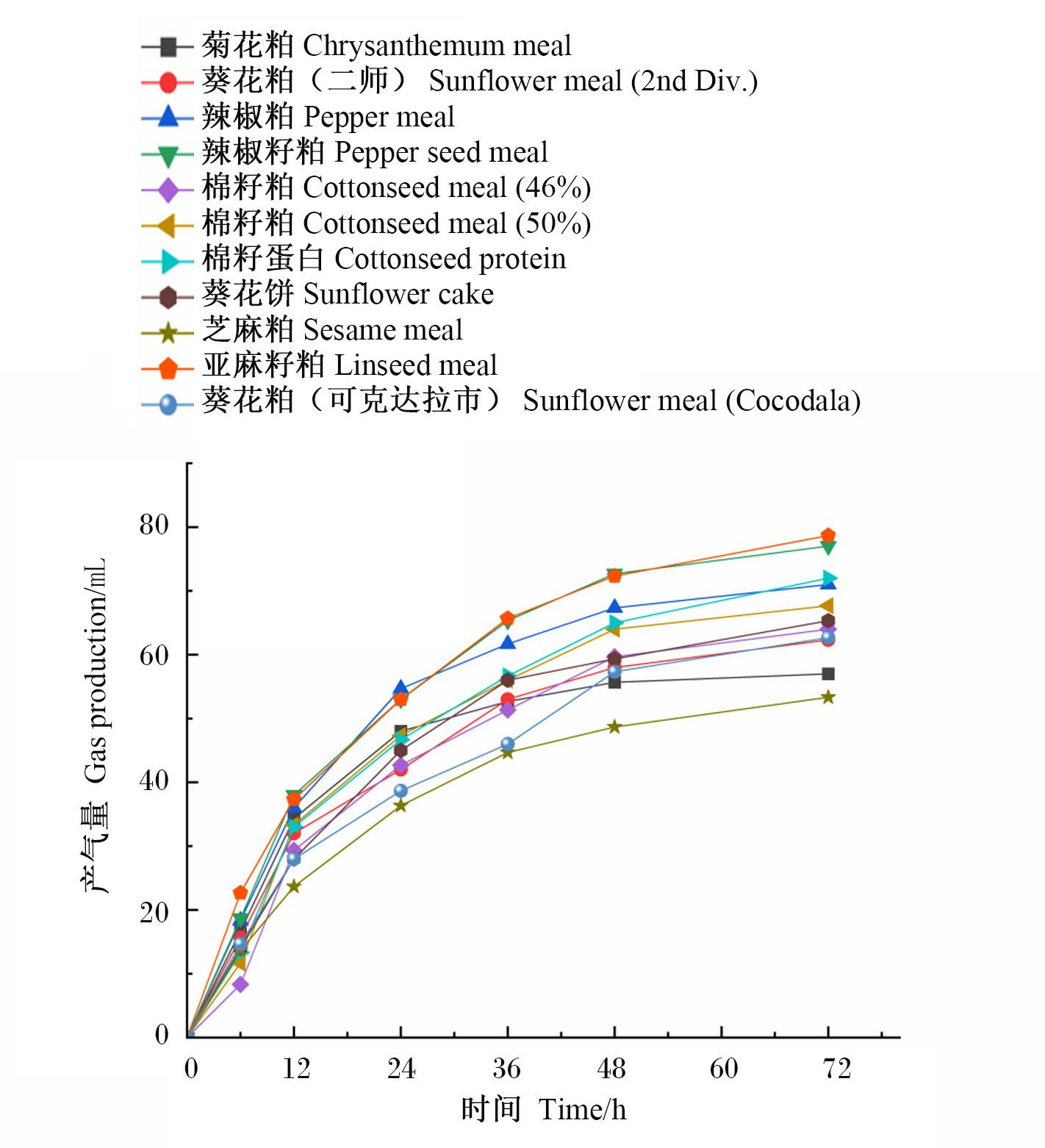
图1可知,所有饼粕饲料的累积产气量均随体外培养时间的延长呈持续上升趋势,其产气过程可划分为2个阶段:0~24 h为快速产气阶段,此阶段产气速率提升较快;24~72 h为慢速产气阶段,产气曲线增速趋缓。亚麻籽粕的72 h累积产气量最高。
图1 不同饼粕饲料的产气量变化折线图

Fig.1 Line chart of gas production of different oilseed meal and cake feeds

表3可知,亚麻籽粕和辣椒籽粕的72 h累积产气量显著高于其他饼粕饲料(P<0.05);亚麻籽粕的快速产气部分和潜在产气量也为最高;辣椒籽粕的慢速产气部分最高,且显著高于芝麻粕及2种葵花粕(P<0.05);菊花粕的产气速率最快,且显著高于其他饼粕饲料(P<0.05)。
表3 不同饼粕饲料的72 h累积产气量及产气参数

Table 3 72 h cumulative gas production and gas production parameters of different oilseed meal and cake feeds

项目
Items
72 h累积产气量
72 h cumulative
gas production/
mL
产气参数 Gas production parameters
快速产气部分
a/mL
慢速产气部分
b/mL
产气速率
c/(%/h)
潜在产气量
a+b/mL
菊花粕 Chrysanthemum meal 57.00f -11.06e 67.47abc 0.091a 56.41e
葵花粕(二师) Sunflower meal (2nd Div.) 62.33e 1.49abc 62.91cd 0.048cde 64.41d
辣椒粕 Pepper meal 71.00bc -5.61cde 76.72ab 0.064b 71.10cd
辣椒籽粕 Pepper seed meal 77.00a -0.43abcd 79.73a 0.049cde 79.30ab
棉籽粕 Cottonseed meal (46%) 64.00de -10.24de 75.00abc 0.054bcd 64.76d
棉籽粕 Cottonseed meal (50%) 67.00cd -9.43de 77.68a 0.058bc 68.25cd
棉籽蛋白 Cottonseed protein 72.00b -1.99abcde 76.60ab 0.043de 74.61bc
葵花饼 Sunflower cake 65.33de -4.34bcde 71.31abc 0.050cde 66.96d
芝麻粕 Sesame meal 53.33f 1.05abc 54.55d 0.045de 55.61e
亚麻籽粕 Linseed meal 78.67a 6.42a 76.70ab 0.042ef 83.12a
葵花粕(可克达拉市)
Sunflower meal (Cocodala)
62.67e 5.23ab 64.76bcd 0.031f 69.99cd
均值标准误 SEM 1.340 1.157 1.479 0.002 0 1.482
PP-value 0.007 <0.001 <0.001 <0.001 <0.001

2.3 不同饼粕饲料的瘤胃降解率及降解参数

2.3.1 DM瘤胃降解率及降解参数

表4可知,所有饼粕饲料的DM瘤胃降解率均随培养时间延长而升高。在6、36、48和72 h时,棉籽粕(50%)的DM瘤胃降解率最高,其DM快速降解部分及DM有效降解率同样表现为最高;菊花粕在各时间点的DM瘤胃降解率均显著低于其他饼粕饲料(P<0.05)。亚麻籽粕的DM慢速降解部分显著高于除芝麻粕和辣椒粕外的其他饼粕饲料(P<0.05);葵花粕(可克达拉市)DM慢速降解部分的降解速率最高,且显著高于其他饼粕饲料(P<0.05)。
表4 不同饼粕饲料的DM瘤胃降解率及降解参数

Table 4 DM rumen degradation rate and degradation parameters of different oilseed meal and cake feeds

项目
Items
瘤胃降解率
Rumen degradation rate/%
瘤胃降解参数
Rumen degradation parameters
6 h 12 h 24 h 36 h 48 h 72 h a/% b/% c/(%/h) ED/%
菊花粕
Chrysanthemum meal
8.91h 15.96g 20.39f 28.13g 32.94g 37.28h 3.83ef 41.03f 0.023e 24.13i
葵花粕(二师)
Sunflower meal (2nd Div.)
12.42g 24.28f 35.59e 42.92f 46.38f 50.72g -0.47fg 52.10de 0.050bc 34.32h
辣椒粕
Pepper meal
26.79c 40.75c 53.25b 65.65a 72.01b 76.35b 12.22d 68.16ab 0.043bcd 54.66c
辣椒籽粕
Pepper seed meal
31.06b 46.75a 54.16b 62.06b 66.03c 70.37c 18.63bc 52.00de 0.050bc 53.86c
棉籽粕
Cottonseed meal (46%)
21.03e 36.94d 45.59cd 52.64de 60.58d 64.92d 9.99d 57.34cd 0.047bcd 46.18e
棉籽粕
Cottonseed meal (50%)
35.40a 43.76b 56.74ab 66.76a 75.28a 79.62a 23.93a 62.89bc 0.030de 59.19a
棉籽蛋白
Cottonseed protein
34.83a 47.93a 59.28a 62.48b 68.17c 72.51c 22.33ab 50.02e 0.057b 56.42b
葵花饼
Sunflower cake
23.83d 32.59e 42.14d 50.76de 57.28e 61.62e 14.71cd 52.44de 0.033cde 44.29f
芝麻粕
Sesame meal
24.21d 33.32e 46.72c 53.06d 66.84c 71.18c 14.21cd 67.70ab 0.030de 49.36d
亚麻籽粕
Linseed meal
18.33f 33.01e 43.54cd 58.04c 67.01c 71.35c 5.33e 73.05a 0.037cde 48.00d
葵花粕(可克达拉市)
Sunflower meal (Cocodala)
16.76f 36.26d 44.22cd 49.76e 54.91e 58.20f -1.82g 58.44cd 0.073a 41.59g
均值标准误 SEM 1.467 1.614 1.856 1.910 2.087 2.096 1.497 1.641 0.003 0 1.745
PP-value <0.001 <0.001 <0.001 <0.001 <0.001 <0.001 <0.001 <0.001 <0.001 <0.001

a为快速降解部分,b为慢速降解部分,c为慢速降解部分的降解速率,ED为有效降解率。下表同。

a was fast degrading part, b was slow degrading part, c was degradation rate of slow degrading part, ED was effective degradability. The same as below.

2.3.2 CP瘤胃降解率及降解参数

表5可知,不同饼粕饲料的CP瘤胃降解率存在显著差异(P<0.05)。6 h时,辣椒粕的CP瘤胃降解率显著高于其他饼粕饲料(P<0.05);12 h时,辣椒粕和葵花粕(可克达拉市)的CP瘤胃降解率显著高于其他饼粕饲料(P<0.05);36 h时,棉籽蛋白和葵花粕(可克达拉市)的CP瘤胃降解率显著高于其他饼粕饲料(P<0.05);葵花粕(可克达拉市)在48及72 h时仍保持最高CP瘤胃降解率。在瘤胃降解参数方面,辣椒粕的CP快速降解部分与慢速降解部分均显著高于其他饼粕饲料(P<0.05);CP慢速降解部分的降解速率以棉籽粕(46%)、棉籽粕(50%)和棉籽蛋白较高;CP有效降解率则以葵花粕(二师)最高,且显著高于其他饼粕饲料(P<0.05)。
表5 不同饼粕饲料的CP瘤胃降解率及降解参数

Table 5 CP rumen degradation rate and degradation parameters of different oilseed meal and cake feeds

项目
Items
瘤胃降解率
Rumen degradation rate/%
瘤胃降解参数
Rumen degradation parameters
6 h 12 h 24 h 36 h 48 h 72 h a/% b/% c/(%/h) ED/%
菊花粕
Chrysanthemum meal
26.21e 32.73e 34.36g 37.79f 43.31h 48.17h 24.83d 45.99g 0.013e 24.24h
葵花粕(二师)
Sunflower meal (2nd Div.)
40.43c 43.30d 49.55d 57.43d 61.58f 66.44f 34.93b 42.01g 0.020d 62.27a
辣椒粕 Pepper meal 51.55a 56.42a 58.77c 67.35c 79.45b 84.31b 47.07a 94.57a 0.010e 36.30g
辣椒籽粕 Pepper seed meal 41.72bc 53.53b 62.48b 66.37c 73.48d 78.34d 33.72b 46.92g 0.040b 51.56c
棉籽粕
Cottonseed meal (46%)
19.88f 33.29e 47.64d 57.46d 62.60f 67.46f 4.43g 65.25de 0.047a 46.96d
棉籽粕
Cottonseed meal (50%)
30.29d 43.80d 59.29c 73.60b 75.85c 78.46d 10.52f 70.51cd 0.050a 58.62b
棉籽蛋白
Cottonseed protein
30.62d 50.81c 60.77bc 75.53a 80.39ab 82.09c 11.44ef 72.82c 0.047a 58.59b
葵花饼 Sunflower cake 18.23f 32.13ef 39.75f 50.34e 66.64e 71.50e 9.88f 79.01b 0.020d 50.75c
芝麻粕 Sesame meal 24.56e 32.78e 43.83e 57.72d 62.85f 67.71f 12.89e 61.70ef 0.030c 45.32de
亚麻籽粕 Linseed meal 14.38g 30.73f 39.62f 49.58e 56.61g 61.47g 2.82g 61.56ef 0.040b 42.95f
葵花粕(可克达拉市)
Sunflower meal (Cocodala)
42.89b 55.43a 66.66a 75.59a 81.51a 86.37a 31.06c 58.28f 0.040b 44.53ef
均值标准误 SEM 1.997 1.754 1.854 2.049 1.998 1.922 2.471 2.670 0.002 0 1.847
PP-value <0.001 <0.001 <0.001 <0.001 <0.001 <0.001 <0.001 <0.001 <0.001 <0.001

2.3.3 NDF瘤胃降解率及降解参数

表6可知,6 h时,葵花粕(可克达拉市)的NDF瘤胃降解率显著高于其他饼粕饲料(P<0.05);12、36、48及72 h时,辣椒粕的NDF瘤胃降解率显著高于其他饼粕饲料(P<0.05);菊花粕在各时间点的NDF瘤胃降解率均显著低于其他饼粕饲料(P<0.05)。NDF快速降解部分及慢速降解部分的降解速率以葵花粕(可克达拉市)最高;辣椒粕与辣椒籽粕的NDF慢速降解部分显著高于其他饼粕饲料(P<0.05);棉籽粕(46%)的NDF有效降解率最高,且显著高于其他饼粕饲料(P<0.05)。
表6 不同饼粕饲料的NDF瘤胃降解率及降解参数

Table 6 NDF rumen degradation rate and degradation parameters of different oilseed meal and cake feeds

项目
Items
瘤胃降解率
Rumen degradation rate/%
瘤胃降解参数
Rumen degradation parameters
6 h 12 h 24 h 36 h 48 h 72 h a/% b/% c/(%/h) ED/%
菊花粕
Chrysanthemum meal
4.41f 11.41g 18.31g 22.49g 27.35h 35.01g 0.49d 46.52cde 0.023d 27.21e
葵花粕(二师)
Sunflower meal (2nd Div.)
8.33e 19.39de 27.26de 35.70e 40.28f 45.14e -0.44d 48.64cd 0.040b 33.07c
辣椒粕 Pepper meal 19.83b 35.16a 44.19ab 56.87a 62.29a 67.15a 7.48ab 63.11a 0.040b 18.10h
辣椒籽粕 Pepper seed meal 18.65b 30.43b 42.84b 54.60b 58.98b 63.84b 4.88bc 62.85a 0.040b 26.13f
棉籽粕
Cottonseed meal (46%)
11.51d 20.67cd 28.67cd 35.20e 42.48de 47.34d 4.42bc 49.64c 0.030cd 43.42a
棉籽粕
Cottonseed meal (50%)
14.22c 21.79c 29.98c 35.46e 41.98de 46.31de 7.55ab 44.11cde 0.030cd 40.54b
棉籽蛋白
Cottonseed protein
9.23e 18.23e 26.40ef 35.27e 41.35ef 44.24e 0.23d 48.45cd 0.037bc 28.24d
葵花饼 Sunflower cake 13.71c 21.27cd 28.50cd 37.69d 41.52ef 46.38de 6.23ab 45.37cde 0.033bc 29.09d
芝麻粕 Sesame meal 11.05d 15.82f 28.29d 32.93f 36.55g 41.41f 1.95d 42.08e 0.040b 26.12f
亚麻籽粕 Linseed meal 11.50d 19.40de 25.17f 38.52d 43.38d 44.72e 7.13abc 57.44b 0.010e 28.83d
葵花粕(可克达拉市)
Sunflower meal (Cocodala)
23.31a 32.18b 44.40a 47.26c 49.99c 52.52c 9.44a 43.00de 0.067a 24.92g
均值标准误 SEM 0.939 1.234 1.458 1.686 1.657 1.595 0.634 1.355 0.002 0 1.206
PP-value <0.001 <0.001 <0.001 <0.001 <0.001 <0.001 <0.001 <0.001 <0.001 <0.001

2.3.4 ADF瘤胃降解率及降解参数

表7可知,在整个培养期内,辣椒粕ADF瘤胃降解率均显著高于其他饼粕饲料(P<0.05),且其ADF快速降解部分也显著高于其他饼粕饲料(P<0.05)。ADF慢速降解部分以葵花饼最高,ADF有效降解率以棉籽粕(46%)最高,二者均显著高于其他饼粕饲料(P<0.05)。
表7 不同饼粕饲料的ADF瘤胃降解率及降解参数

Table 7 ADF rumen degradation rate and degradation parameters of different oilseed meal and cake feeds

项目
Items
瘤胃降解率
Rumen degradation rate/%
瘤胃降解参数
Rumen degradation parameters
6 h 12 h 24 h 36 h 48 h 72 h a/% b/% c/(%/h) ED/%
菊花粕
Chrysanthemum meal
7.81de 12.78e 20.17c 23.52f 28.34e 31.50fg 2.20de 32.96e 0.033bcd 15.18e
葵花粕(二师)
Sunflower meal (2nd Div.)
5.93f 16.38d 20.04c 24.44ef 28.70e 33.53ef 1.74de 34.21de 0.033bcd 28.71b
辣椒粕 Pepper meal 29.32a 38.06a 42.92a 47.95a 52.62a 56.12a 23.71a 35.57de 0.037abc 18.75d
辣椒籽粕 Pepper seed meal 13.92c 31.38b 34.57b 42.85b 48.01b 52.84b 5.84c 48.05b 0.043a 19.44d
棉籽粕
Cottonseed meal (46%)
4.99g 13.61e 12.57e 19.40h 23.45f 28.28h 3.69d 37.78cd 0.017e 42.30a
棉籽粕
Cottonseed meal (50%)
7.26e 16.33d 21.67c 25.53de 28.98e 33.47ef 1.73de 33.02e 0.040ab 20.08cd
棉籽蛋白
Cottonseed protein
8.22d 17.00d 22.08c 26.40d 29.40e 34.23e 3.14d 32.66e 0.040ab 15.73e
葵花饼 Sunflower cake 8.25d 11.00f 16.26d 22.12g 29.21e 34.04e 3.94cd 51.96a 0.010e 20.84c
芝麻粕 Sesame meal 6.90e 15.59d 21.82c 26.07d 32.60d 37.43d 1.96de 41.07c 0.027d 20.84c
亚麻籽粕 Linseed meal 5.13fg 10.89f 15.89d 22.10g 25.10f 29.93f 0.60e 34.53de 0.030cd 18.73d
葵花粕(可克达拉市)
Sunflower meal (Cocodala)
17.75b 25.92c 32.91b 36.98c 40.64c 44.49c 11.04b 34.77de 0.040ab 21.20c
均值标准误 SEM 1.240 1.565 1.562 1.585 1.612 1.575 1.131 1.140 0.001 0 1.628
PP-value <0.001 <0.001 <0.001 <0.001 <0.001 <0.001 <0.001 <0.001 <0.001 <0.001

2.4 体外三步法试验结果

表8可知,菊花粕和辣椒籽粕的DM体外瘤胃降解率显著高于除亚麻籽粕外的其他饼粕饲料(P<0.05)。OM体外瘤胃降解率则以菊花粕和亚麻籽粕最高,显著高于除辣椒籽粕外的其他饼粕饲料(P<0.05)。棉籽蛋白的DM与OM体外小肠消化率最高,其DM体外小肠消化率显著高于除辣椒粕外的其他饼粕饲料(P<0.05),OM体外小肠消化率显著高于其余10种饼粕饲料(P<0.05)。辣椒粕、辣椒籽粕和棉籽蛋白的DM体外全消化道消化率显著高于其他饼粕饲料(P<0.05),且棉籽蛋白的OM体外全消化道消化率显著高于其他饼粕饲料(P<0.05)。
表8 不同饼粕饲料的体外瘤胃降解率、小肠消化率及全消化道消化率

Table 8 In vitro rumen degradation rate, intestinal digestibility and total tract digestibility of different oilseed meal and cake feeds%

项目
Items
体外瘤胃降解率
In vitro rumen degradation rate
体外小肠消化率
In vitro intestinal digestibility
体外全消化道消化率
In vitro total tract digestibility
干物质 DM 有机物 OM 干物质 DM 有机物 OM 干物质 DM 有机物 OM
菊花粕
Chrysanthemum meal
31.40a 26.72a 19.15h 16.29f 50.55d 43.02f
葵花粕(二师)
Sunflower meal (2nd Div.)
24.60c 20.95c 32.49g 27.66e 57.10c 48.61e
辣椒粕 Pepper meal 25.75bc 19.73c 52.35ab 39.96b 78.10a 59.69b
辣椒籽粕
Pepper seed meal
34.35a 25.49ab 43.48cd 32.23cd 77.83a 57.72bc
棉籽粕
Cottonseed meal (46%)
23.05c 18.65c 43.68cd 35.35c 66.73b 54.01cd
棉籽粕
Cottonseed meal (50%)
21.87c 18.19c 47.62bc 39.55b 69.50b 57.74bc
棉籽蛋白
Cottonseed protein
23.38c 20.05c 54.83a 46.96a 78.21a 67.01a
葵花饼 Sunflower cake 20.99c 18.50c 37.71ef 33.24c 58.70c 51.73de
芝麻粕 Sesame meal 24.79c 21.57bc 33.36fg 29.02de 58.15c 50.60de
亚麻籽粕 Linseed meal 30.07ab 25.99a 37.67ef 32.57cd 67.74b 58.56b
葵花粕(可克达拉市)
Sunflower meal (Cocodala)
20.86c 17.88c 40.01de 34.28c 60.88c 52.16de
均值标准误 SEM 0.849 0.656 1.735 1.357 1.652 1.135
PP-value <0.001 <0.001 <0.001 <0.001 <0.001 <0.001

2.5 基于产气量的不同饼粕饲料瘤胃有效降解率及全消化道消化率预测方程

本研究对11种饼粕饲料体外产气量与营养物质降解率及消化率进行Pearson相关性分析,筛选出相关性显著且决定系数(R2)较高的产气参数作为预测因子,建立了基于体外产气量预测饼粕饲料NDF有效降解率及DM、OM全消化道消化率的回归方程。各指标对应的预测方程及决定系数见表9。其中,选取6 h产气量作为NDF有效降解率的预测因子;选取48和72 h产气量作为DM全消化道消化率的预测因子;选取72 h产气量作为OM全消化道消化率的预测因子。
表9 基于产气量的不同饼粕饲料瘤胃有效降解率及全消化道消化率预测方程

Table 9 Prediction equations for rumen effective degradability and total tract digestibility of different oilseed meal and cake feeds based on gas production

序号 No. 预测方程 Prediction equations 决定系数 R2 PP-value
1 NDF有效降解率=48.066-1.211×6 h产气量 0.424 0.030
2 DM全消化道消化率=3.734+1.004×48 h产气量 0.586 0.006
3 DM全消化道消化率=2.459+0.953×72 h产气量 0.612 0.004
4 OM全消化道消化率=13.721+0.615×72 h产气量 0.559 0.008

NDF:中性洗涤纤维 neutral detergent fiber;DM:干物质 dry matter;OM:有机物 organic matter。

3 讨论

3.1 不同饼粕饲料的营养成分分析

常规营养成分是评估饲料营养价值的基础[11]。本研究中,棉籽粕与芝麻粕均表现出较高的CP含量,与邵鹏程等[12]测得的豆粕CP含量(48.79%)相近,表明二者在蛋白质水平上具备替代豆粕的营养基础。吴陆处等[13]研究表明,棉籽粕替代50%豆粕可以提高牦牛的生长性能;徐泽君等[14]研究发现,芝麻粕替代豆粕能够显著提升肉羊的生长性能,这进一步支持二者作为优质植物蛋白质源的可行性。值得注意的是,不同来源棉籽粕的CP含量存在波动,这主要源于加工工艺的差异[15-17],提示在实际应用中需加强原料质量控制。相比之下,菊花粕呈现典型的“低蛋白质、高纤维”的特征。陈颜旭[18]研究发现,万寿菊粕添加量为15%时效果最好,能够提高绵羊生长性能,而添加35%的万寿菊粕不利于绵羊生长性能的发挥。因此,菊花粕在实际应用中需严格把控添加比例,以平衡其纤维效应与饲用价值。

3.2 不同饼粕饲料的产气量及产气参数

累积产气量是反映瘤胃微生物对饲料营养物质降解程度的关键参数,饲料可降解性越强,瘤胃微生物活性越高,累积产气量就越高[19]。本试验中,各饼粕饲料的累积产气量随培养时间延长呈持续上升趋势,可分为快速产气(0~24 h)和慢速产气(24~72 h)2个阶段,该产气规律与Menke等[7]提出的产气模型相符。一般而言,体外产气量与饲料可消化OM含量呈显著正相关[20];本试验中,亚麻籽粕与辣椒籽粕的72 h累积产气量均处于较高水平,表明二者含有较高的可消化OM,提示其具备作为反刍动物饲料的潜在营养价值。饲料中NDF与ADF含量较高时,会导致其在瘤胃内的发酵程度降低,进而抑制发酵效率、减少累积产气量[21],这也解释了菊花粕累积产气量较低的原因。体外发酵参数是反映瘤胃微生物对饲料降解程度的重要指标。本试验中部分原料的快速产气部分为负值,这在体外发酵研究中较为常见,代表饲料存在产气滞后期[22];而慢速产气部分数值较高的饲料,能够为瘤胃微生物持续性提供发酵底物,进而提升纤维物质的消化率[23]。这提示本试验中辣椒籽粕、棉籽粕(50%)等饲料可以提供持续稳定的瘤胃能氮供应,具备成为优质蛋白质饲料的潜力。

3.3 不同饼粕饲料的DM瘤胃降解率及降解参数

DM瘤胃降解率是评估反刍动物饲料营养价值的关键指标,直接影响饲料在瘤胃内的发酵效率及后续营养物质的利用效率。本试验结果表明,随着培养时间延长,各饼粕饲料的DM瘤胃降解率均呈逐步上升趋势,后期趋于平缓,与Mehrez等[24]的研究结果一致。本试验中,亚麻籽粕的DM慢速降解部分最高,这可能与其较低的ADF含量有关,较低的纤维含量预示着较高的潜在消化率与能量可利用性,彰显其作为优质反刍动物饲料原料的开发潜力。棉籽粕(50%)的DM快速降解部分较高,高于前人研究结果[25],推测与棉籽粕产地和加工工艺不同有关。本试验中,DM有效降解率以棉籽粕(50%)最高,且显著高于棉籽粕(46%),说明不同蛋白质水平棉籽粕在瘤胃中的降解特性存在差异。田晓雨等[26]报道,在不同类型蛋白质原料替代滩羊饲粮中的豆粕时,棉籽粕组具有较高的消化率,且与豆粕组较为接近。本试验结果提示,选用50%蛋白质水平的棉籽粕可能获得优于常规棉籽粕的替代效果,但其在绵羊实际生产中的应用效果有待进一步验证。

3.4 不同饼粕饲料的CP瘤胃降解率及降解参数

瘤胃微生物维持正常生长与繁殖所需的菌体蛋白,其首要来源为饲粮中CP降解所产生的氮源。饲粮中可溶性蛋白与不可溶性蛋白的降解程度,主要受其在瘤胃内滞留时间及自身蛋白质含量的双重影响[27]。不同饲料CP有效降解率之间的差异主要取决于饲料发酵特性及瘤胃滞留时间,若在瘤胃中降解时间延长,有效降解率随之升高,反之则降低[28]。本试验结果表明,葵花粕(二师)、棉籽粕(50%)和棉籽蛋白的CP有效降解率较高,与李德鹏等[25]研究结果相似,表明葵花粕(二师)与经过加工的棉籽蛋白属于优质蛋白质饲料原料,其高CP有效降解率意味着能为瘤胃微生物提供高效氮源。此外,李敏等[29]指出,在反刍动物饲养中,棉籽蛋白能够完全替代豆粕,而且经过发酵处理的棉籽蛋白可显著提升生产效益,有效节约蛋白质资源,并降低养殖成本。

3.5 不同饼粕饲料的NDF、ADF瘤胃降解率及降解参数

饲料NDF、ADF瘤胃降解率是评价饲料营养价值及可利用性的关键指标,直接影响反刍动物的DM采食量和整体生产性能[30]。本试验结果表明,辣椒粕的NDF、ADF瘤胃降解率在多个时间点均为最高,但其NDF有效降解率较低,这提示辣椒粕纤维结构中可溶性组分占比更高,可促进微生物早期附着与降解;同时其富含多酚、辣椒素类活性物质[31],可能调节瘤胃微生物群并在一定剂量下抑制部分纤维分解菌活性,进而导致NDF降解速率提升受限。菊花粕的NDF有效降解率同样较低,可能源于其较高的木质素和多酚含量,导致不可降解NDF比例偏高并抑制纤维分解菌活性。已有研究表明,菊科植物含有较高含量的木质素及多酚类化合物,其中多酚类物质对瘤胃纤维降解具有抑制作用[32]。本研究所测棉籽粕(46%)的NDF、ADF有效降解率高于现有文献报道结果[33],且在所有试验原料中处于最高水平,这表明该棉籽粕作为反刍动物蛋白质饲料原料具有较高的瘤胃利用效率。

3.6 不同饼粕饲料的体外瘤胃降解率、小肠消化率及全消化道消化率

饲料经瘤胃降解后的残渣进入胃和小肠后,其消化过程主要由酶催化完成。进入该消化阶段的营养物质主要包括过瘤胃非降解组分(如过瘤胃蛋白、过瘤胃淀粉)以及微生物蛋白等[10]。本试验中11种饼粕饲料的DM体外小肠消化率为19.15%~54.83%,OM体外小肠消化率为16.29%~46.96%,总体呈现较大变异幅度。于浩等[34]在研究绒山羊常用精饲料原料的胃-小肠营养物质体外消化率时,测得的DM与OM消化率均高于本试验结果,这一差异可能与饲料的加工处理方式及营养成分含量不同相关[35]。本试验中,菊花粕的DM和OM体外小肠消化率均低于其瘤胃降解率,原因在于小肠对营养物质的消化主要依赖于胰蛋白酶的酶解作用,由于缺乏纤维降解酶系,粗饲料中的纤维组分在小肠难以被有效降解,导致其在此消化阶段的降解比例降低。棉籽蛋白的DM与OM体外全消化道消化率均为最高,表明其具备更高的整体消化潜力,可作为优质蛋白质原料应用于反刍动物饲粮中,以提升饲粮的整体消化利用率。Dolatkhah等[36]研究发现,饲粮中添加2%水解棉籽蛋白可以增强犊牛抗氧化能力,且对其生长性能和代谢状态无负面影响,这一研究也证实了棉籽蛋白在反刍动物饲粮中具有较高的应用价值。

3.7 基于产气量的不同饼粕饲料瘤胃有效降解率及全消化道消化率预测方程

本研究选取6 h产气量为预测因子,建立了NDF有效降解率的预测方程:NDF有效降解率=48.066-1.211×6 h产气量,该方程可更精准地评估NDF有效降解率。针对DM、OM全消化道消化率的预测,本研究选用相关性最强的48和72 h产气量作为预测因子,构建线性方程如下:DM全消化道消化率=3.734+1.004×48 h产气量,DM全消化道消化率=2.459+0.953×72 h产气量,OM全消化道消化率=13.721+0.615×72 h产气量。由此可知,后期产气量可有效预测DM、OM全消化道消化率。需注意的是,本研究基于新疆地区11种饼粕饲料所建立的预测方程仍有优化空间,未来需进一步扩大样本量,以提升预测模型的普适性与稳定性。

4 结论

新疆地区11种饼粕饲料中,棉籽粕(50%)与棉籽蛋白均表现出优良的瘤胃降解特性,且棉籽蛋白的全消化道消化率最佳,可作为反刍动物优质蛋白质饲料予以优先开发;菊花粕则因纤维含量高、木质化程度深,各项降解指标均表现较差,饲用价值有限,需经加工处理后才可使用。此外,本研究通过相关性分析构建了相应预测方程,为快速评估饼粕饲料的营养价值提供了简便有效的技术手段。
[1]
中华人民共和国国家统计局. 2023年中国统计年鉴[M]. 北京: 中国统计出版社, 2023.

National Bureau of Statistics of the People’s Republic of China. China statistical yearbook 2023[M]. Beijing: China Statistics Press, 2023. (in Chinese)

[2]
杨建军, 程俐芬, 程彩虹, 等. 棉粕替代豆粕对湖羊生长性能、表观消化率及屠宰性能的影响[J]. 中国饲料, 2024(10):88-91.

YANG J J, CHENG L F, CHENG C H, et al. The effect of replacing soybean meal with cotton meal on the growth performance,apparent digestibility,and slaughter performance of Hu sheep[J]. China Feed, 2024(10):88-91. (in Chinese)

[3]
杨荣, 王华朗, 宋增廷. 葵花籽粕的营养价值及其综合利用[J]. 广东饲料, 2020, 29(9):37-40.

YANG R, WANG H L, SONG Z T. The nutritional value and comprehensive benefits of sunflower seed meal[J]. Guangdong Feed, 2020, 29(9):37-40. (in Chinese)

[4]
赵芸君, 苏玲玲, 张志军, 等. 新疆4种辣椒粕营养成分的比较研究[J]. 草食家畜, 2017(2):32-35.

ZHAO Y J, SU L L, ZHANG Z J, et al. Study on nutrition components four kinds of capsicum residues in Xinjiang[J]. Grass-Feeding Livestock, 2017(2):32-35. (in Chinese)

[5]
武晓东, 赵俊星, 刘文忠, 等. 日粮中胡麻饼代替豆粕对绵羊生产性能、肉品质、脂肪酸含量及血液生化指标的影响[J]. 畜牧兽医学报, 2017, 48(7):1260-1270.

WU X D, ZHAO J X, LIU W Z, et al. Effect of replacement of soybean meal by oil cake of flax seed in diet on growth performance,meat quality,fatty acid content and blood biochemical indicators of sheep[J]. Acta Veterinaria et Zootechnica Sinica, 2017, 48(7):1260-1270. (in Chinese)

[6]
VAN SOEST P J, ROBERTSON J B, LEWIS B A. Methods for dietary fiber,neutral detergent fiber,and nonstarch polysaccharides in relation to animal nutrition[J]. Journal of Dairy Science, 1991, 74(10):3583-3597.

DOI

[7]
MENKE K H, RAAB L, SALEWSKI A, et al. The estimation of the digestibility and metabolizable energy content of ruminant feedingstuffs from the gas production when they are incubated with rumen liquor in vitro[J]. The Journal of Agricultural Science, 1979, 93(1):217-222.

DOI

[8]
刘祥圣, 邓波波, 王阔鹏, 等. 常规与非常规粗饲料在奶牛瘤胃中的降解特性研究[J]. 草业学报, 2020, 29(11):190-197.

DOI

LIU X S, DENG B B, WANG K P, et al. Degradation characteristics of conventional and unconventional roughage in the rumen of dairy cows[J]. Acta Prataculturae Sinica, 2020, 29(11):190-197. (in Chinese)

[9]
ØRSKOV E R, MCDONALD I. The estimation of protein degradability in the rumen from incubation measurements weighted according to rate of passage[J]. The Journal of Agricultural Science, 1979, 92(2):499-503.

DOI

[10]
赵浩翔, 杜霞, 闫素梅, 等. 利用体外三步法研究绒山羊常用粗饲料原料的营养物质降解率[J]. 饲料研究, 2023, 46(9):5-9.

ZHAO H X, DU X, YAN S M, et al. Study on nutrient degradation rate of common roughage raw materials for cashmere goat by in vitro three-step method[J]. Feed Research, 2023, 46(9):5-9. (in Chinese)

[11]
MOHAMED R, CHAUDHRY A S. Methods to study degradation of ruminant feeds[J]. Nutrition Research Reviews, 2008, 21(1):68-81.

DOI PMID

[12]
邵鹏程, 唐庆凤, 覃林杰, 等. 6种水牛饲料原料的营养价值评定及瘤胃降解特性研究[J]. 动物营养学报, 2024, 36(12):7819-7828.

DOI

SHAO P C, TANG Q F, QIN L J, et al. Evaluation of nutritional value and rumen degradation characteristics of six water buffalo feedstuffs[J]. Chinese Journal of Animal Nutrition, 2024, 36(12):7819-7828. (in Chinese)

DOI

[13]
吴陆处, 吴建平, 黄燕玲, 等. 牦牛日粮中棉籽粕替代50%豆粕和添加复合营养添加剂的应用效果研究[J]. 中国饲料, 2025(7):151-157.

WU L C, WU J P, HUANG Y L, et al. Study on the application effect of replacing 50% soybean with cotton meal and adding compound nutrition additive in yak diet[J]. China Feed, 2025(7):151-157. (in Chinese)

[14]
徐泽君, 王献伟, 牛岩, 等. 基于Meta分析的芝麻粕替代豆粕饲粮对肉羊生长性能及肉品质的影响[J]. 饲料工业, 2024, 45(11):91-98.

XU Z J, WANG X W, NIU Y, et al. Effects of sesame meal replacing soybean meal diet on growth performance and meat quality of mutton sheep based on Meta-analysis[J]. Feed Industry, 2024, 45(11):91-98. (in Chinese)

[15]
刘少娟, 陈家顺, 姚康, 等. 棉粕的营养组成及其在畜禽生产中的应用[J]. 畜牧与饲料科学, 2016, 37(9):45-49.

LIU S J, CHEN J S, YAO K, et al. Nutritional composition of cottonseed meal and its application in poultry and animal production[J]. Animal Husbandry and Feed Science, 2016, 37(9):45-49. (in Chinese)

[16]
杨宽, 吕刚, 陈宁, 等. 应用CNCPS比较新疆地区几种棉源饲料的营养价值[J/OL]. 饲料工业, 2025:1-9(2025-09-28)[2025-10-27]. https://link.cnki.net/urlid/21.1169.S.20250928.1404.002.html.

YANG K, LV G, CHEN N, et al. Comparative nutritional evaluation of several cotton-derived feeds in Xinjiang region using CNCPS[J/OL]. Feed Industry, 2025:1-9(2025-09-28)[2025-10-27]. https://link.cnki.net/urlid/21.1169.S.20250928.1404.002.html. in Chinese)

[17]
杨青苗, 刘畅, 赵艳丽, 等. 利用体外三步法研究驴主要精饲料原料的体外营养物质降解率[J]. 饲料研究, 2023, 46(16):102-108.

YANG Q M, LIU C, ZHAO Y L, et al. Study on nutrient degradation rate of donkey main concentrate feed by three steps in vitro[J]. Feed Research, 2023, 46(16):102-108. (in Chinese)

[18]
陈颜旭. 饲粮添加万寿菊粕对绵羊生产性能、血清指标、瘤胃发酵和微生物区系的影响[D]. 硕士学位论文. 阿拉尔: 塔里木大学, 2023.

CHEN Y X. Effects of dietary marigold meal on growth performance,rumen fermentation parameters and serum biochemical indices of sheep[D]. Master’s Thesis. Alaer: Tarim University, 2023. (in Chinese)

[19]
GETACHEW G, ROBINSON P H, DEPETERS E J, et al. Relationships between chemical composition,dry matter degradation and in vitro gas production of several ruminant feeds[J]. Animal Feed Science And Technology, 2004, 111(1-4):57-71.

DOI

[20]
LEI Y G, LI X Y, WANG Y Y, et al. Determination of ruminal dry matter and crude protein degradability and degradation kinetics of several concentrate feed ingredients in cashmere goat[J]. Journal of Applied Animal Research, 2018, 46(1):134-140.

DOI

[21]
崔洪哲, 杨坤, 赵海霞, 等. 体外产气法评价8种新型非常规饲料的营养价值[J]. 饲料研究, 2025, 48(4):98-102.

CUI H Z, YANG K, ZHAO H X, et al. Evaluation of nutritional value of eight novel unconventional feeds using in vitro gas production technique[J]. Feed Research, 2025, 48(4):98-102. (in Chinese)

[22]
李陇平, 吴仪, 王旭辉, 等. 陕北白绒山羊几种非常规饲料营养成分、体外发酵参数和酶活性研究[J]. 动物营养学报, 2025, 37(1):603-616.

DOI

LI L P, WU Y, WANG X H, et al. Study on nutritional composition,in vitro fermentation parameters and enzyme activity of several unconventional feeds for Shaanbei white cashmere goats[J]. Chinese Journal of Animal Nutrition, 2025, 37(1):603-616. (in Chinese)

[23]
张凯. 四种豆科植物青贮营养价值评价[D]. 硕士学位论文. 阿拉尔: 塔里木大学, 2022.

ZHANG K. Evaluation of nutritional value of silage of four leguminous plants[D]. Master’s Thesis. Alaer: Tarim University, 2022. (in Chinese)

[24]
MEHREZ A Z, ØRSKOV E R. A study of artificial fibre bag technique for determining the digestibility of feeds in the rumen[J]. The Journal of Agricultural Science, 1977, 88(3):645-650.

DOI

[25]
李德鹏, 宫晨, 姜富贵, 等. 不同来源蛋白质饲料瘤胃降解特性研究[J]. 中国饲料, 2022(16):15-22.

LI D P, GONG C, JIANG F G, et al. Ruminal degradation characteristics of protein feeds from different sources[J]. Chinese Feed, 2022(16):15-22. (in Chinese)

[26]
田晓雨, 马小俊, 李雪梅, 等. 体外产气法研究棉籽粕替代豆粕对滩羊瘤胃体外发酵参数和营养物质消化率的影响[J]. 饲料工业, 2025, 46(13):43-47.

TIAN X Y, MA X J, LI X M, et al. Effects of replacing soybean meal with cottonseed meal on in vitro rumen fermentation parameters and nutrient digestibility of Tan sheep by gas production method[J]. Feed Industry, 2025, 46(13):43-47. (in Chinese)

[27]
王敬林, 魏元浩, 赵国琦. 奶牛对不同糟渣类饲料营养成分的瘤胃降解率和小肠消化率对比研究[J]. 动物营养学报, 2022, 34(3):1592-1603.

DOI

WANG J L, WEI Y H, ZHAO G Q. Comparative study on rumen degradation rates and small intestinal digestibilities of nutrients of different residue feeds of dairy cows[J]. Chinese Journal of Animal Nutrition, 2022, 34(3):1592-1603. (in Chinese)

[28]
成锦霞, 于胜晨, 张暄梓, 等. 3种非常规饲料营养的价值及瘤胃降解特性研究[J]. 中国畜禽种业, 2019, 15(10):102-106.

CHENG J X, YU S C, ZHANG X Z, et al. A study on the nutritional value and rumen degradation characteristics of three unconventional feedstuffs[J]. China Livestock and Poultry Breeding Industry, 2019, 15(10):102-106. (in Chinese)

[29]
李敏, 吕旦, 陈冰, 等. 棉籽蛋白的营养价值及其在动物饲料中的应用研究进展[J]. 中国畜牧兽医, 2024, 51(9):3867-3877.

DOI

LI M, LV D, CHEN B, et al. Research progress on the nutritional value of cottonseed protein and its application in animal feed[J]. China Animal Husbandry and Veterinary Medicine, 2024, 51(9):3867-3877. (in Chinese)

[30]
GOULART R S, VIEIRA R A M, DANIEL J L P, et al. Effects of source and concentration of neutral detergent fiber from roughage in beef cattle diets on feed intake,ingestive behavior,and ruminal kinetics[J]. Journal of Animal Science, 2020, 98(5):skaa107.

[31]
CVETKOVIĆ T, RANILOVIĆ J, JOKIĆ S. Quality of pepper seed by-products:a review[J]. Foods, 2022, 11(5):748.

DOI

[32]
VASTA V, DAGHIO M, CAPPUCCI A, et al. Invited review:plant polyphenols and rumen microbiota responsible for fatty acid biohydrogenation,fiber digestion,and methane emission:experimental evidence and methodological approaches[J]. Journal of Dairy Science, 2019, 102(5):3781-3804.

DOI

[33]
胡丽红, 马银, 杨石红, 等. 6种蛋白质饲料和4种能量饲料主要营养物质瘤胃降解规律及相关性研究[J]. 动物营养学报, 2025, 37(6):4158-4175.

DOI

HU L H, MA Y, YANG S H, et al. Study on ruminal degradation characteristics and correlations of main nutrients of six protein feeds and four energy feeds[J]. Chinese Journal of Animal Nutrition, 2025, 37(6):4158-4175. (in Chinese)

DOI

[34]
于浩, 杜霞, 郭咏梅, 等. 利用体外三步法研究绒山羊常用精饲料原料的营养物质降解率[J]. 饲料研究, 2023, 46(11):1-6.

YU H, DU X, GUO Y M, et al. Study on nutrient degradation rate of concentrated feed materials of cashmere goats by an in vitro three-step method[J]. Feed Research, 2023, 46(11):1-6. (in Chinese)

[35]
林聪. 辣木与其他粗饲料营养价值比较及替代苜蓿对奶牛生产性能的影响[D]. 硕士学位论文. 哈尔滨: 东北农业大学, 2017.

LIN C. Compared nutritional value of Moringa oleifera with other roughage and effects of its replaced alfalfa on performance in dairy cows[D]. Master’s Thesis. Harbin: Northeast Agricultural University, 2017. (in Chinese)

[36]
DOLATKHAH B, GHORBANI G R, ALIKHANI M, et al. Effects of hydrolyzed cottonseed protein supplementation on performance,blood metabolites,gastrointestinal development,and intestinal microbial colonization in neonatal calves[J]. Journal of Dairy Science, 2020, 103(6):5102-5117.

DOI

Outlines

/