RESEARCH PAPER

Isolation, Identification and Safety Evaluation of a Sheep-Derived Bacillus amyloliquefaciens Strain

  • MAI Duo , 1, 2 ,
  • XIAO Ying 1, 2 ,
  • LYU Ruixue 1, 2 ,
  • PAN Yuhan 1, 2 ,
  • PAN Juan 1, 2 ,
  • TAN Jiacheng 1, 2 ,
  • PENG Qimin 1, 2 ,
  • BAO Yingying 1, 2 ,
  • LU Yabin 1, 2 ,
  • WANG Jinquan , 1, 2, 3, **
Expand
  • 1 College of Animal Medicine, Xinjiang Agricultural University, Urumqi 830052, China
  • 2 Xinjiang Key Laboratory of New Drug Research and Development for Herbivores, Urumqi 830052, China
  • 3 Xinjiang Key Laboratory of Animal Infectious Diseases, Urumqi 830052, China
**professor, E-mail:

*Contributed equally

Received date: 2025-10-24

  Online published: 2026-05-14

Abstract

The aim of this study was to isolate and screen a sheep-derived Bacillus amyloliquefaciens strain with probiotic potential, and to evaluate its probiotic properties and safety. First, fecal samples were collected from healthy lambs, and the strain isolation and species identification were conducted through methods including colony morphology observation, biochemical identification and 16S rRNA gene sequencing. Subsequently, the in vitro probiotic properties were evaluated by assessing growth characteristics, hemolytic activity, acid and bile salt tolerance, antimicrobial activity, antibiotic susceptibility and antioxidant capacity. Finally, the in vivo safety was assessed through acute and subacute toxicity tests in mice. The results showed that: 1) a Bacillus strain was isolated and screened from the feces of healthy lambs. It was identified as Bacillus amyloliquefaciens through biochemical characterization and molecular biological identification, and was designated as Bacillus amyloliquefaciens D3-4. 2) The strain entered the stationary phase after 10 h of culture at 37 ℃ and entered the decline phase after 30 h. It exhibited no hemolytic activity. The relative survival rates were 49.43% at pH 3.0 and 43.80% after treatment with 0.30% bile salt for 4 h. The strain showed inhibitory effects against Escherichia coli, Staphylococcus aureus, and Salmonella Typhimurium. It was susceptible to 12 out of 17 common antibiotics tested. Furthermore, its scavenging rates for 1,1-diphenyl-2-picrylhydrazyl (DPPH) and hydroxyl radicals were 66.38% and 72.36%, respectively. 3) In the acute toxicity test, the mice showed normal physical signs and no obvious pathological changes in organs. In the subacute toxicity test, compared with the control group, the final body weight, average daily gain and average daily feed intake in the high-dose group were significantly decreased (P<0.05), and the liver index was also significantly reduced (P<0.05); the red blood cell count in the low-dose group was significantly decreased (P<0.05). However, all these indexes remained within the normal physiological ranges. In conclusion, Bacillus amyloliquefaciens D3-4 isolated from the feces of healthy lambs exhibits significant in vitro probiotic potential and a favorable in vivo safety profile. Therefore, it can be considered as a candidate strain for the subsequent development of probiotic preparations for sheep.

Cite this article

MAI Duo , XIAO Ying , LYU Ruixue , PAN Yuhan , PAN Juan , TAN Jiacheng , PENG Qimin , BAO Yingying , LU Yabin , WANG Jinquan . Isolation, Identification and Safety Evaluation of a Sheep-Derived Bacillus amyloliquefaciens Strain[J]. Chinese Journal of Animal Nutrition, 2026 , 38(5) : 3937 -3950 . DOI: 10.12418/CJAN2026.313

我国自2020年实施饲料端全面禁抗政策以来,已构建起涵盖疫苗制剂[1]、微生态制剂[2]、酶制剂[3]及中兽药[4]等多元化技术路径的抗生素替代体系[5]。新疆作为我国五大传统牧区之一,羊产业是区域农业经济的支柱产业,其中细菌性腹泻是制约羔羊成活率的主要疾病,可引发营养不良、体重下降、脱水甚至死亡[6-7],年死亡率高达20%,不仅造成严重的经济损失,亦成为制约当地养羊业提质增效的关键瓶颈[8]。研究发现,解淀粉芽孢杆菌作为饲料添加剂不仅可以防控饲料中黄曲霉污染[9],且已证实其无菌发酵上清液对黄曲霉有较强的抑制作用;此外,解淀粉芽孢杆菌还能够改善山羊的生长性能、屠宰性能、免疫指标和健康状况[10]。益生菌作为重要的抗生素替代品,具有调节肠道微生态平衡[3]、增强免疫力[14]、防治疾病[11]及促进生长[12-13]等多种生物学功能。然而,目前市售的微生态制剂多源自猪[15]、鸡[16]等单胃动物肠道。由于宿主特异性的存在,这类制剂在反刍动物中的应用效果往往受限。相比之下,专门针对羊研发的羊源益生菌产品则相对匮乏[17]。此外,商用益生菌以乳酸菌[2]、芽孢杆菌[16]及酵母菌[18]为主,其中芽孢杆菌因其抗逆性强、定植能力突出等优势逐渐受到关注,但针对反刍动物肠道的益生性芽孢杆菌研究仍较薄弱。因此,本试验拟从新疆阿勒泰羔羊粪便中分离并筛选具有耐酸、耐胆盐特性及体外抑菌活性的益生菌菌株,并评估其抗生素敏感性,旨在为开发羔羊腹泻防控益生菌制剂提供理论依据与菌种资源。

1 材料与方法

1.1 粪便来源与试验动物

于2023年12月至2024年2月,在新疆阿勒泰地区采集50份健康羔羊的粪便拭子作为粪便样本。体内安全性试验选用无特定病原体(SPF)级昆明小鼠为试验动物,体重(20±2) g,购自新疆医科大学实验动物中心。

1.2 主要试剂与菌种

主要试剂:LB肉汤、LB营养琼脂培养基、Mueller-Hinton琼脂、哥伦比亚血琼脂基础及HBI芽孢杆菌生化鉴定条均购自青岛海博生物技术有限公司;革兰氏染色液购自塞维尔生物科技有限公司;脱纤维绵羊血和牛胆盐购自北京索莱宝科技有限公司;细菌药敏片(批号:20240402)为杭州滨和微生物试剂有限公司产品;中性树胶及4%多聚甲醛购自白鲨生物;石蜡购自上海标本模型厂。
质控菌株:大肠杆菌ATCC 25922、金黄色葡萄球菌ATCC 29213、鼠伤寒沙门氏菌ATCC 14028菌株购自青岛海博生物技术有限公司。

1.3 试验方法

1.3.1 芽孢杆菌的分离

参考孟维珊等[19]方法,将采集的粪便样本使用无菌磷酸盐缓冲液(PBS)进行均质化处理,随后在80 ℃的水浴中进行20 min的热处理。处理后让样本静置分层,取100 μL上清液涂布于LB琼脂培养基上,并在37 ℃的恒温条件下培养36 h。挑选均一菌落进行LB平板纯化,经3次纯化后转接至LB肉汤增菌,最后进行革兰染色、显微观察和镜检分析。

1.3.2 分离菌株的鉴定

用HBI芽孢杆菌鉴定条鉴定分离菌株,结果参照《伯杰氏古菌和细菌系统学手册》归类判定。

1.3.3 分离菌株的16S rRNA序列分析

运用水煮法,从分离得到的菌株中提取细菌DNA,将其作为PCR扩增的模板。随后,把PCR扩增产物送往新疆有康生物科技有限公司开展测序分析。将测序结果上传至NCBI数据库进行序列比对,从而确定菌株的种属分类。

1.3.4 分离菌株的益生潜力评估

1.3.4.1 生长曲线

取分离菌株的新鲜菌液以2%(v/v)的接种量接种于LB肉汤中,置于MCG-300微生物生长曲线分析仪中,于37 ℃、170 r/min条件下振荡培养。培养期间,以2 h为时间间隔,测定培养物在600 nm波长处的吸光度值,每个时间点重复测定3次取平均值,每个时间点重复测定3次取平均值,并根据所得数据绘制菌株的生长曲线。

1.3.4.2 溶血活性

将无菌脱纤维绵羊血以5%(v/v)的比例加入到哥伦比亚血琼脂基础中,混匀后制备血平板备用。取分离菌株制备菌悬液,于血平板上划线接种,置37 ℃恒温培养箱中培养过夜,观察菌落周围有无溶血环形成。

1.3.4.3 耐酸和耐胆盐能力

分离菌株的耐酸和耐胆盐能力测定参照贾盛等[20]的方法。将分离菌株分别接种于pH 3.0、4.0、5.0、6.0、7.0及含0.05%、0.15%、0.30%(v/v)胆盐的LB肉汤中,以正常菌液为对照。所有处理于37 ℃培养4 h后,经梯度稀释,取100 μL涂布于LB营养琼脂平板,37 ℃培养24 h后进行菌落计数,通过计算相对存活率评估分离菌株的耐酸与耐胆盐能力。每种处理设3个重复。

相对存活率(%)=(试验组芽孢杆菌数量/

对照组芽孢杆菌数量)×100。

1.3.4.4 抑菌活性

参照王琦等[21]的方法,用无菌棉签将病原菌[大肠杆菌ATCC 25922(4×10⁸ CFU/mL)、金黄色葡萄球菌ATCC 29213(3×10⁸ CFU/mL)和鼠伤寒沙门氏菌ATCC 14028(3×10⁸ CFU/mL)]均匀涂布于LB营养琼脂平板表面,用打孔器于LB营养琼脂平板上均匀打孔,在孔中加入100 μL的分离菌株菌悬液(1×10⁷ CFU/mL),于37 ℃恒温培养箱中培养24 h,采用游标卡尺测定抑菌圈直径。每种处理设3个重复。

1.3.4.5 抗生素敏感性

采用纸片扩散法(Kirby-Bauer法)测定分离菌株对17种抗菌药物(包括β-内酰胺类、氨基糖苷类、大环内酯类等代表性药物)的敏感性。将100 μL的分离菌株菌悬液均匀接种于Mueller-Hinton琼脂平板表面,放置17种抗菌药物纸片,于37 ℃恒温培养箱中培养24 h,使用游标卡尺测量抑菌圈直径,并参照临床实验室标准协会(CLSI)指南M100-2024标准判断敏感性:抑菌圈直径≥特定阈值记为敏感,≤阈值记为耐药,中间值记为中介。

1.3.4.6 抗氧化能力

参照李奥运[22]所提供的方法开展分离菌株的抗氧化能力试验,测定1,1-二苯基-2-三硝基苯肼(DPPH)自由基清除率和羟自由基清除率。
取2 mL待测菌悬液,加入2 mL用无水乙醇配制的浓度为0.4 mmol/L的DPPH溶液,充分混合均匀后,将其置于室温且避光的环境中反应30 min;反应液以8 000×g离心(4 ℃)10 min,取上清液,以乙醇-生理盐水混合液(1∶1)为空白调零,测定其在517 nm处的吸光度(记为Ds);同时,以生理盐水替代菌悬液作为对照,同法操作测定吸光度(记为Dc)。待测菌悬液设置3个平行样,按以下公式计算DPPH自由基清除率:
DPPH清除率(%)=(1-Ds/Dc)×100。
依次加入2.0 mL亚硫酸铁(FeSO4)溶液(0.5 mmol/L)、1.0 mL亮绿溶液(0.5 mmol/L)、1.5 mL过氧化氢(H2O2)溶液(3.0%,w/v)和1.0 mL待测菌悬液,混匀后室温避光孵育30 min;反应液于4 ℃、8 000×g离心10 min,取上清液,以超纯水调零,测定其在510 nm处的吸光度(记为A1);同时以超纯水代替菌悬液作为对照,同法操作测定吸光度(记为A0)。待测菌悬液设置3个平行样,按以下公式计算羟自由基清除率:
羟自由基清除率(%)=(1-A1/A0)×100。

1.3.5 分离菌株的安全性评估

1.3.5.1 急性毒性试验

参照农业农村部《直接饲喂微生物和发酵制品生产菌株鉴定及其安全性评价指南》对分离菌株进行安全性评估,动物试验方案经新疆农业大学动物伦理委员会批准,批准号为2017013。
28 只SPF级昆明小鼠适应性饲养7 d后,随机分为2组,每组14只(n=14,公母各占1/2)。对照组腹腔注射无菌生理盐水(0.2 mL/只),试验组腹腔注射1×109 CFU/mL的分离菌株菌悬液(0.2 mL/只),于试验第1天单次腹腔注射。饲养期间小鼠自由采食和饮水,每日观察毛色、精神状态及分泌物、排泄物状况,连续观察7 d,计算平均日增重、平均日采食量。7 d后安乐死所有小鼠,解剖观察心脏、肝脏、脾脏、肺脏、肾脏及胸腺等主要脏器的病理变化,计算脏器指数。

脏器指数(%)=[脏器重(g)/小鼠

处死前体重(g)]×100。

1.3.5.2 亚急性毒性试验

48 只SPF级昆明小鼠适应性饲养7 d后,随机分为4组,每组12只(n=12,公母各占1/2)。对照组灌胃无菌生理盐水(0.2 mL/只),高、中、低剂量组分别灌胃1×109 CFU/mL、1×108 CFU/mL、1×107 CFU/mL的分离菌株菌悬液(0.2 mL/只),每日灌胃1次,连续灌胃28 d。每日灌胃前称量并记录小鼠体重,同时每日观察并记录小鼠精神状态、饮食饮水及排泄物情况,计算平均日增重、平均日采食量。试验结束后,摘眼球法采集小鼠血液,采用全自动血细胞分析仪进行血细胞常规分析;解剖小鼠,摘取心脏、肝脏、脾脏、肺脏、肾脏及胸腺,用预冷的无尘滤纸吸干表面水分后,使用电子天平精确称重,计算脏器指数,计算公式同1.3.5.1。

1.4 数据处理与分析

试验数据采用SPSS 30.0软件进行统计分析,使用GraphPad Prism 8软件作图。结果数据以平均值±标准差(mean±SD)表示。两组间比较采用t检验;多组间比较先进行单因素方差分析,若差异有统计学意义,再采用 LSD 法进行事后检验,以P<0.05为差异具有统计学意义。

2 结果与分析

2.1 分离菌株鉴定结果

2.1.1 形态学鉴定

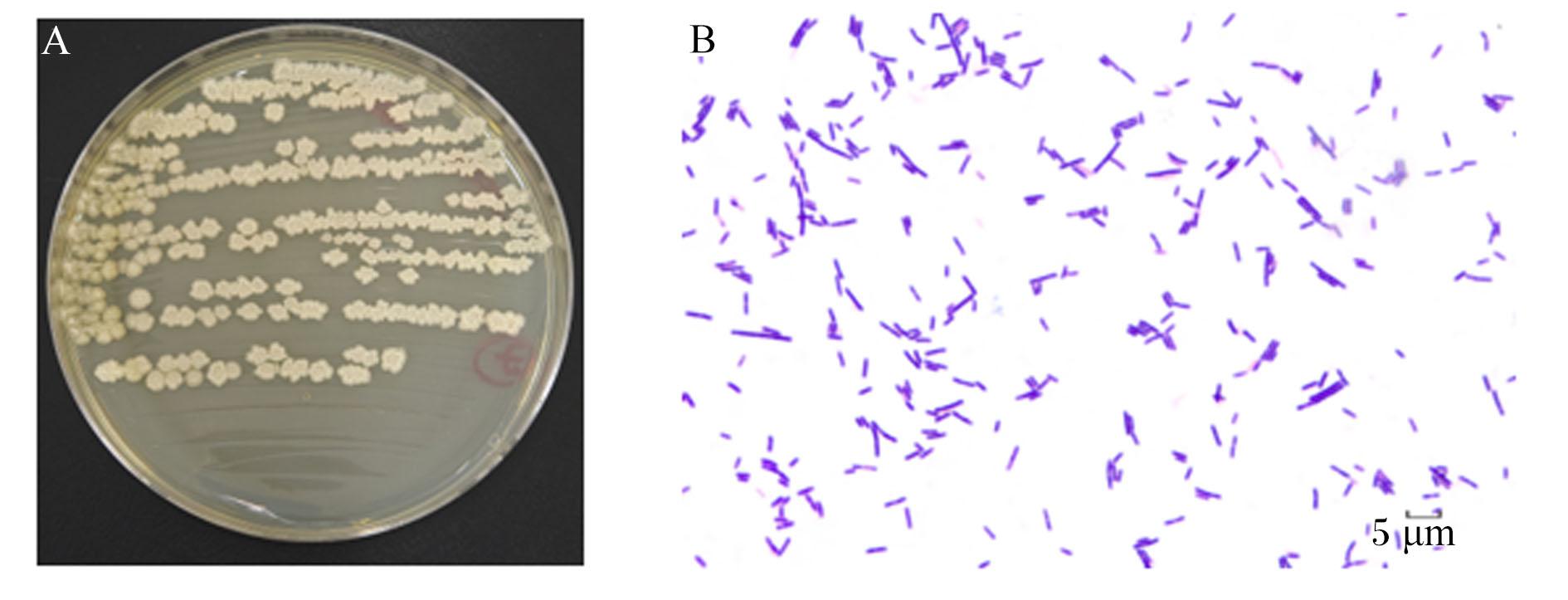
分离菌株D3-4在LB营养琼脂培养基上培养后,单菌落呈现乳白色且形态不规则(图1-A);革兰氏染色结果显示,该菌株属于革兰氏阳性杆状细菌(图1-B)。
图1 分离菌株D3-4的形态特征

A:菌落形态 colony morphology;B:革兰氏染色结果 Gram staining result (100×)。

Fig.1 Morphological characteristics of isolated strain D3-4

2.1.2 生化鉴定

分离菌株的生化鉴定结果见表1,参照《伯杰氏古菌和细菌系统学手册》,初步鉴定分离菌株D3-4符合芽孢杆菌的生化鉴定。
表1 分离菌株D3-4的生化鉴定结果

Table 1 Biochemical identification results of isolated strain D3-4

项目
Items
鉴定结果
Identification results
项目
Items
鉴定结果
Identification results
V-P试验 V-P test - 明胶液化 Gelatin liquefaction +
柠檬酸盐 Citrate + 7%氯化钠 7% NaCl -
丙酸盐 Propionate - pH 5.7生长 pH 5.7 growth -
D-木糖 D-xylose - 硝酸盐还原 Nitrate reduction +
L-阿拉伯糖 L-arabinose - 淀粉水解 Starch hydrolysis +
D-甘露醇 D-mannitol - 厌氧生长 Anaerobic growth -

“+”表示阳性反应;“-”表示阴性反应;

“+” means positive reaction; “-” means negative reaction.

2.1.3 生物学鉴定

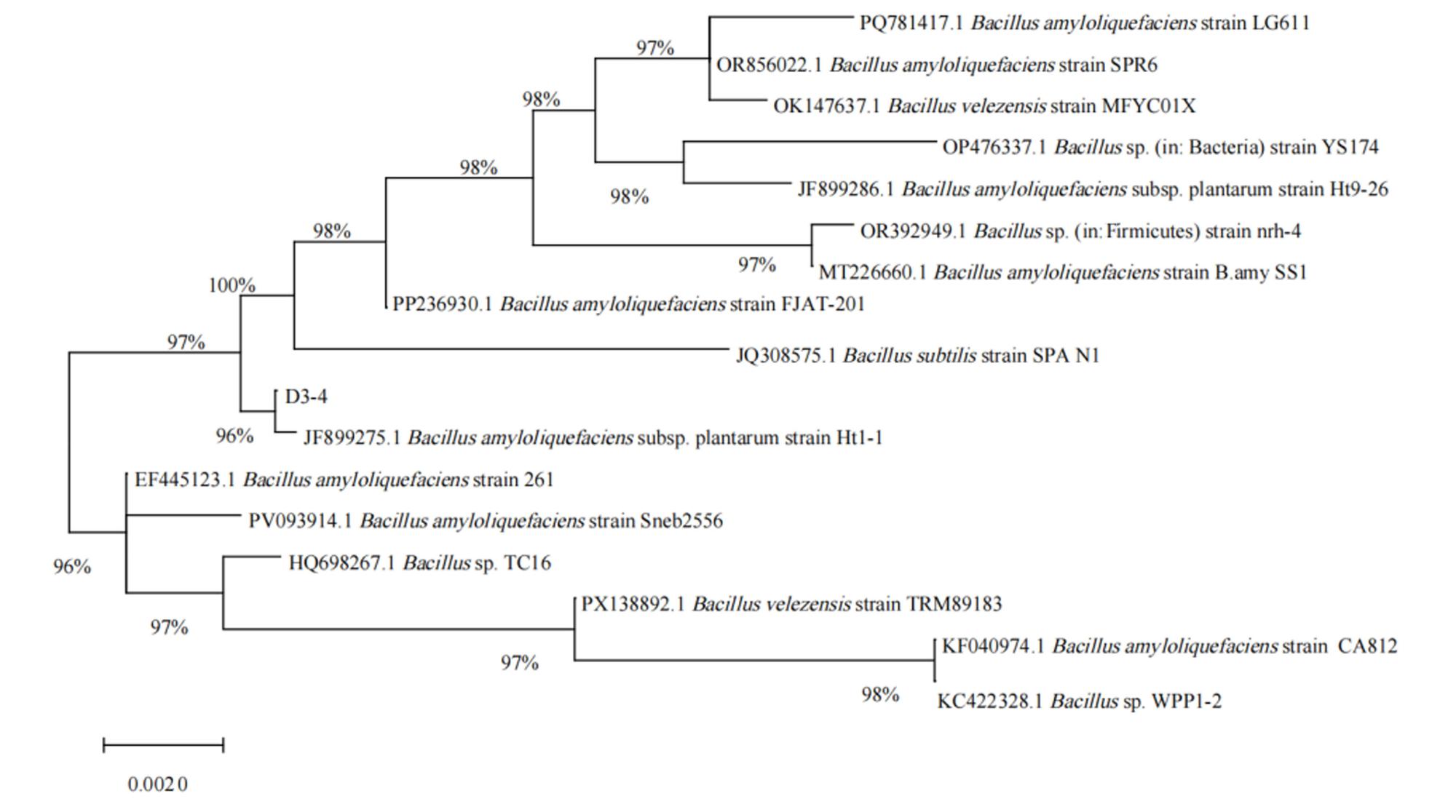
基于MEGA 7.0.14软件进行的16S rRNA基因序列分析表明,分离菌株D3-4与解淀粉芽孢杆菌植物亚种Ht1-1具有较高的同源性,并据此构建了系统发育进化树(图2)。综合该菌株的菌落形态特征、革兰氏染色反应、生理生化特性及分子生物学鉴定结果,判定其为解淀粉芽孢杆菌,命名为解淀粉芽孢杆菌D3-4。
图2 基于16S rRNA基因序列构建的分离菌株D3-4系统发育树

Bacteria:细菌;Firmicutes:厚壁菌门;Bacillus sp.:芽孢杆菌属未确定种;Bacillus amyloliquefaciens:解淀粉芽孢杆菌;Bacillus velezensis:贝莱斯芽孢杆菌;Bacillus subtilis:枯草芽孢杆菌;Bacillus amyloliquefacien subsp. plantarum:枯草芽孢杆菌植物亚种;strain:菌株。

Fig.2 Phylogenetic tree of isolated strain D3-4 based on 16S rRNA gene sequences

2.2 解淀粉芽孢杆菌D3-4的体外益生特性评价结果

2.2.1 生长曲线

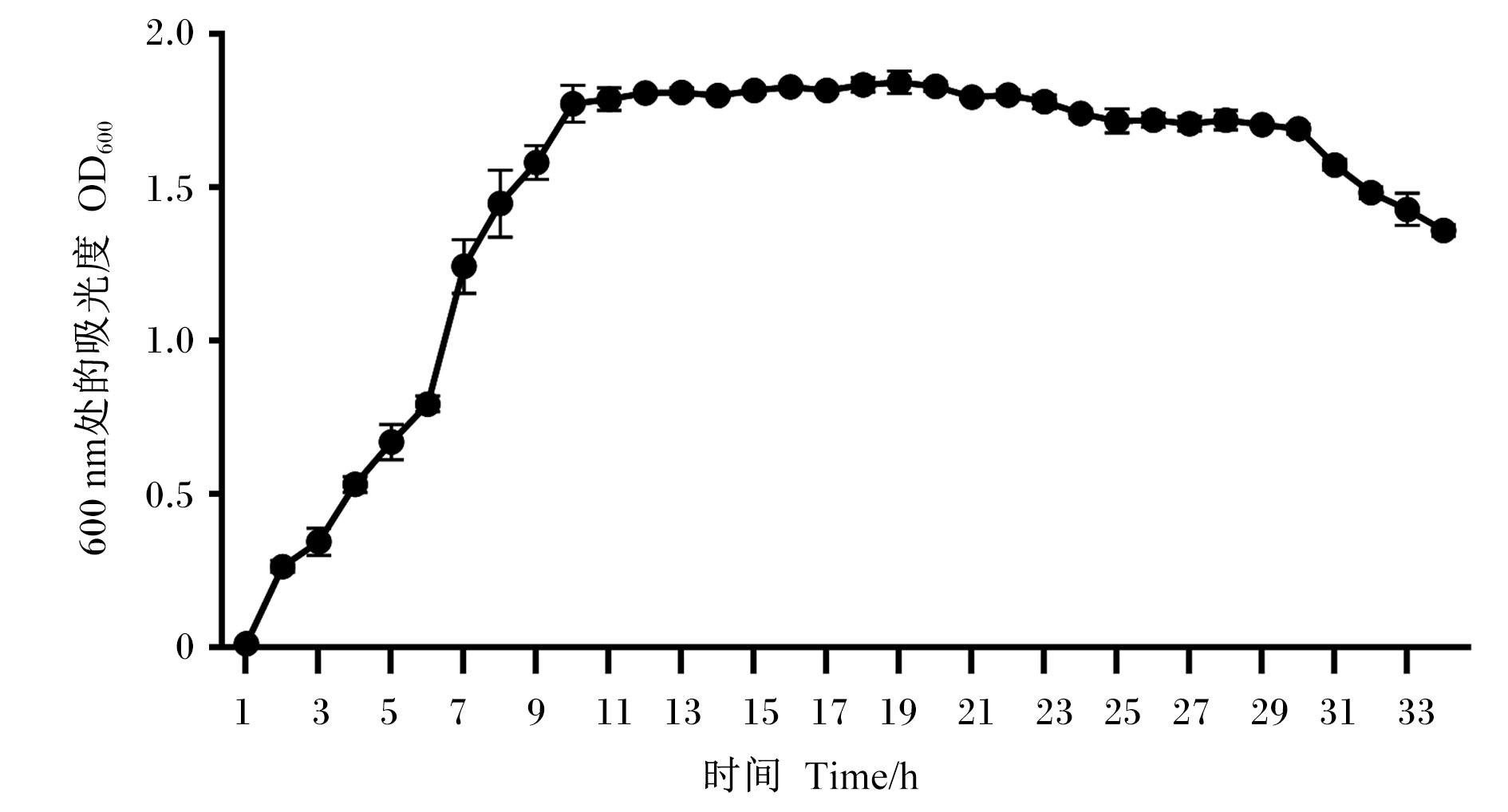
解淀粉芽孢杆菌D3-4的生长曲线如图3所示,该菌株在1~10 h为对数生长期,10 h后进入平缓期,在30 h后进入衰退期。
图3 解淀粉芽孢杆菌D3-4的生长曲线

Fig.3 Growth curve of Bacillus amyloliquefaciens D3-4

2.2.2 溶血活性

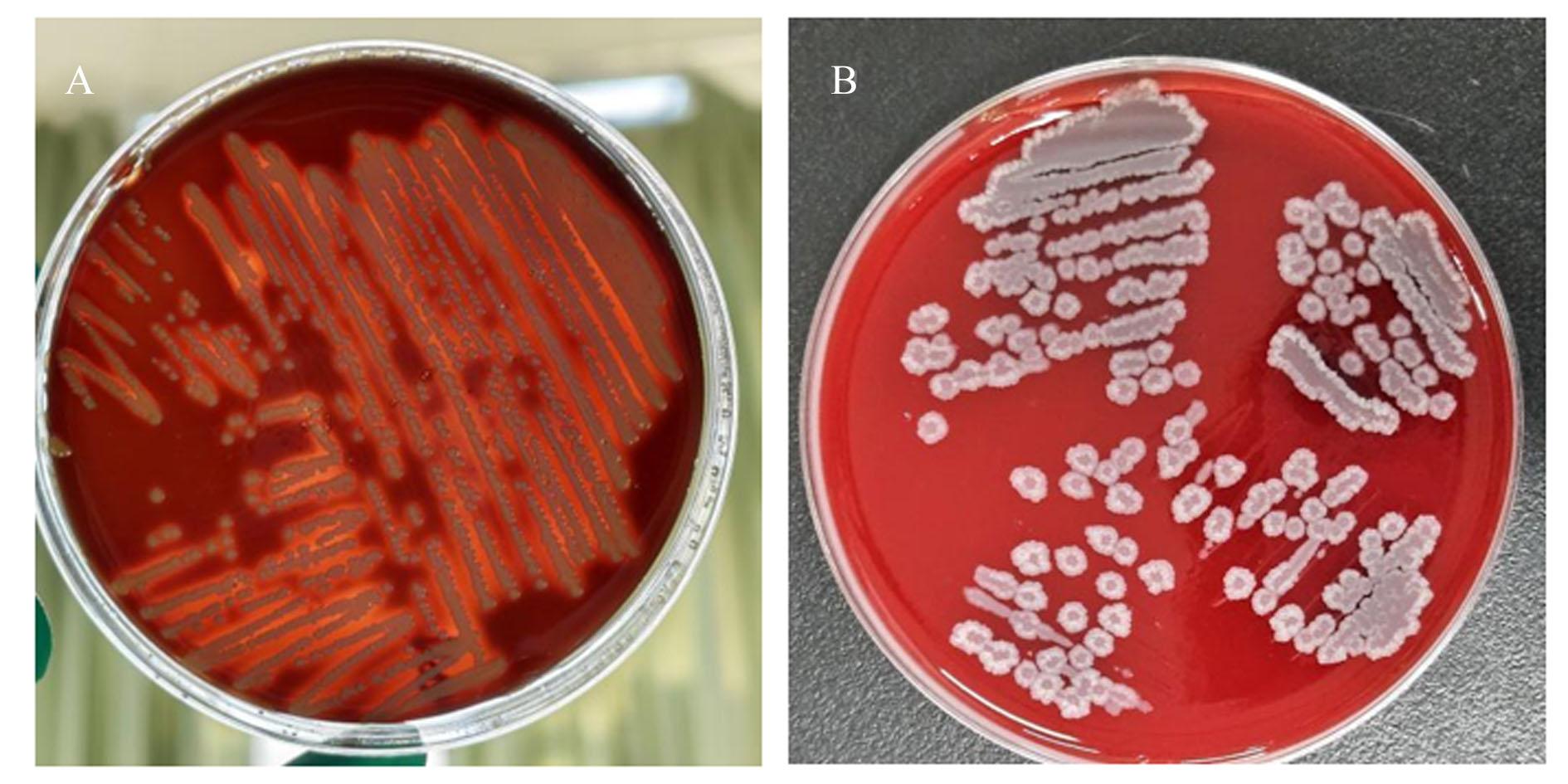
图4所示,解淀粉芽孢杆菌D3-4在绵羊血平板上生长良好,菌落周围无溶血环,表明其无溶血活性。
图4 解淀粉芽孢杆菌D3-4的溶血试验结果

A:金黄色葡萄球菌(阳性对照) Staphylococcus aureus (positive control);B:解淀粉芽孢杆菌D3-4(分离菌株) Bacillus amyloliquefaciens D3-4 (isolated strain)。

Fig.4 Hemolysis test results of Bacillus amyloliquefaciens D3-4

2.2.3 耐酸能力

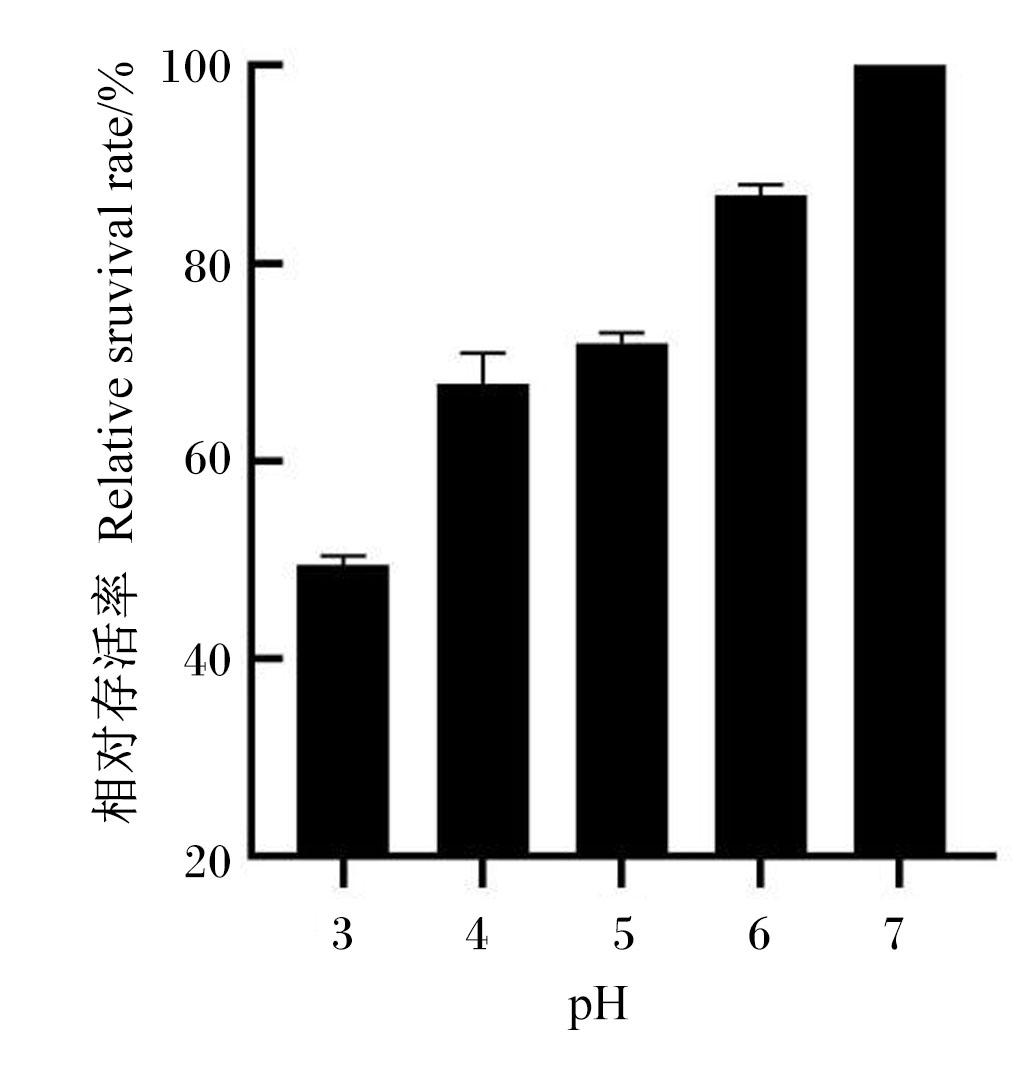
图5可知,在pH 3.0、4.0、5.0、6.0、7.0条件下,解淀粉芽孢杆菌D3-4的相对存活率分别为49.43%、67.75%、71.95%、86.84%、100.00%,表明该菌株在体外不同pH环境中均具有一定的存活能力。
图5 解淀粉芽孢杆菌D3-4在不同pH条件下的相对存活率

Fig.5 Relative survival rate of Bacillus amyloliquefaciens D3-4 at different pH conditions

2.2.4 耐胆盐能力

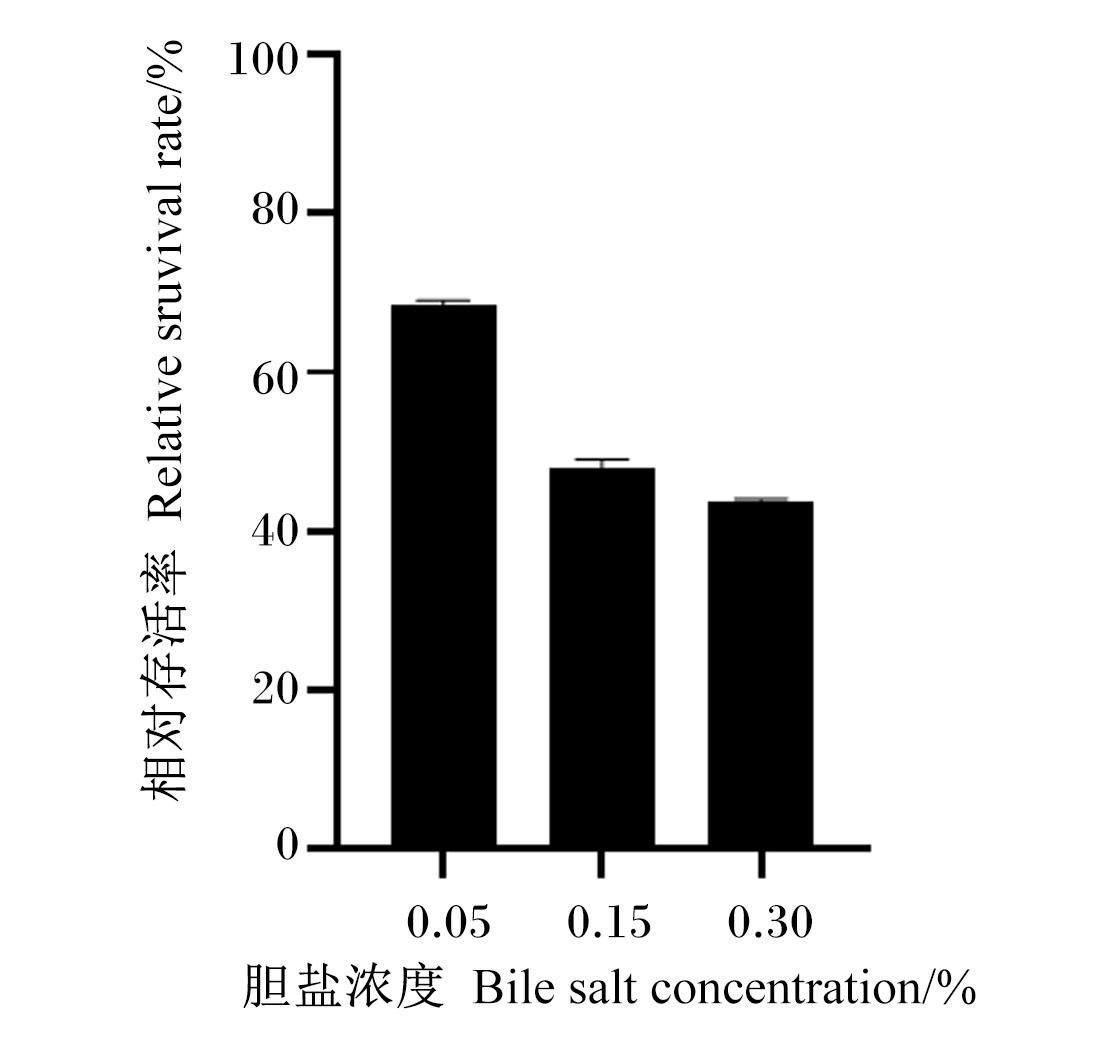
图6可知,在0.05%、0.15%、0.30%胆盐条件下,解淀粉芽孢杆菌D3-4的相对存活率分别为68.43%、47.96%、43.80%,说明该菌株在体外不同浓度胆盐环境中均具有一定的存活能力。
图6 解淀粉芽孢杆菌D3-4在不同浓度胆盐条件下的相对存活率

Fig.6 Relative survival rate of Bacillus amyloliquefaciens D3-4 under different concentrations of bile salt

2.2.5 抑菌活性

表2可知,解淀粉芽孢杆菌D3-4对金黄色葡萄球菌ATCC 29213、鼠伤寒沙门氏菌ATCC 14028以及大肠杆菌ATCC 25922均有抑制效果,但抑制效果存在差异,其中对金黄色葡萄球菌ATCC 29213的抑制效果最好。
表2 解淀粉芽孢杆菌D3-4的抑菌试验结果

Table 2 Results of bacterial inhibition test of Bacillus amyloliquefaciens D3-4mm

供试菌
Tested bacteria
抑菌圈直径
Antibacterial ring diameter
金黄色葡萄球菌ATCC 29213 Staphylococcus aureus ATCC 29213 21.40±1.84
鼠伤寒沙门氏菌ATCC 14028 Salmonella Typhimurium ATCC 14028 12.70±0.96
大肠杆菌ATCC 14028 Escherichia coli ATCC 14028 12.81±0.75

2.2.6 抗生素敏感性

在17种抗菌药物中,解淀粉芽孢杆菌D3-4对12种表现出敏感,对多黏菌素B和羧苄西林表现出耐药(表3)。
表3 解淀粉芽孢杆菌D3-4的药敏试验结果

Table 3 Antimicrobial susceptibility test results of Bacillus amyloliquefaciens D3-4

抗生素名称
Antibiotics names
每片含量
Content per
piece
判定标准:抑菌圈直径
Judgment standard: antibacterial ring diameter/mm
敏感性
Susceptibility
耐药
Resistance (R)
中介
Intermediate (I)
敏感
Sensitive (S)
四环素 Tetracycline 30 μg/片 ≤14 15~18 ≥19 S
米诺环素 Minocycline 30 μg/片 ≤8 9~15 ≥16 S
克林霉素 Clindamycin 2 μg/片 ≤13 14~17 ≥18 S
多黏菌素B Polymyxin B 300 IU/片 ≤8 9~11 ≥12 R
卡那霉素 Kanamycin 30 μg/片 ≤13 14~17 ≥18 S
庆大霉素 Gentamycin 10 μg/片 ≤12 13~14 ≥15 S
阿米卡星 Amikacin 30 μg/片 ≤15 16~18 ≥19 S
新霉素 Neomycin 30 μg/片 ≤15 16~19 ≥20 S
氨苄西林 Ampicillin 10 μg/片 ≤13 14~16 ≥17 S
苯唑西林 Oxacillin 1 μg/片 ≤18 19~22 ≥23 I
青霉素G Penicillin G 10 U/片 ≤10 - ≥29 I
诺氟沙星 Norfloxacin 10 μg/片 ≤12 13~16 ≥17 S
左氧氟沙星 Levofloxacin 5 μg/片 ≤16 17~22 ≥23 S
环丙沙星 Ciprofloxacin 5 μg/片 ≤15 16~20 ≥21 S
羧苄西林 Carbenicillin 100 μg/片 ≤16 17~20 ≥21 R
呋喃唑酮 Furazolidone 300 μg/片 ≤10 11~15 ≥16 I
复方新诺明
Compound sul-famethoxazole
25 μg/片 ≤14 15~18 ≥19 S

“-”表示抑菌圈直径大于10 mm,但边缘模糊,无法准确测量。

“-” indicates that the diameter of the inhibition zone is greater than 10 mm, but the edge is blurred, making accurate measurement impossible.

2.2.7 抗氧化能力

表4可知,解淀粉芽孢杆菌D3-4的DPPH自由基清除率为66.38%,羟基自由基清除率为72.36%。
表4 解淀粉芽孢杆菌D3-4的抗氧化能力试验结果

Table 4 Results of antioxidant capacity test of Bacillus amyloliquefaciens D3-4%

菌株
Strain
DPPH自由基清除率 DPPH free
radical scavenging rate
羟自由基清除率 Hydroxyl free
radical scavenging rate
解淀粉芽孢杆菌D3-4
Bacillus amyloliquefaciens D3-4
66.38±10.22 72.36±3.40

2.3 解淀粉芽孢杆菌D3-4的安全性评估

2.3.1 急性毒性试验结果

2.3.1.1 体征观察及剖检结果
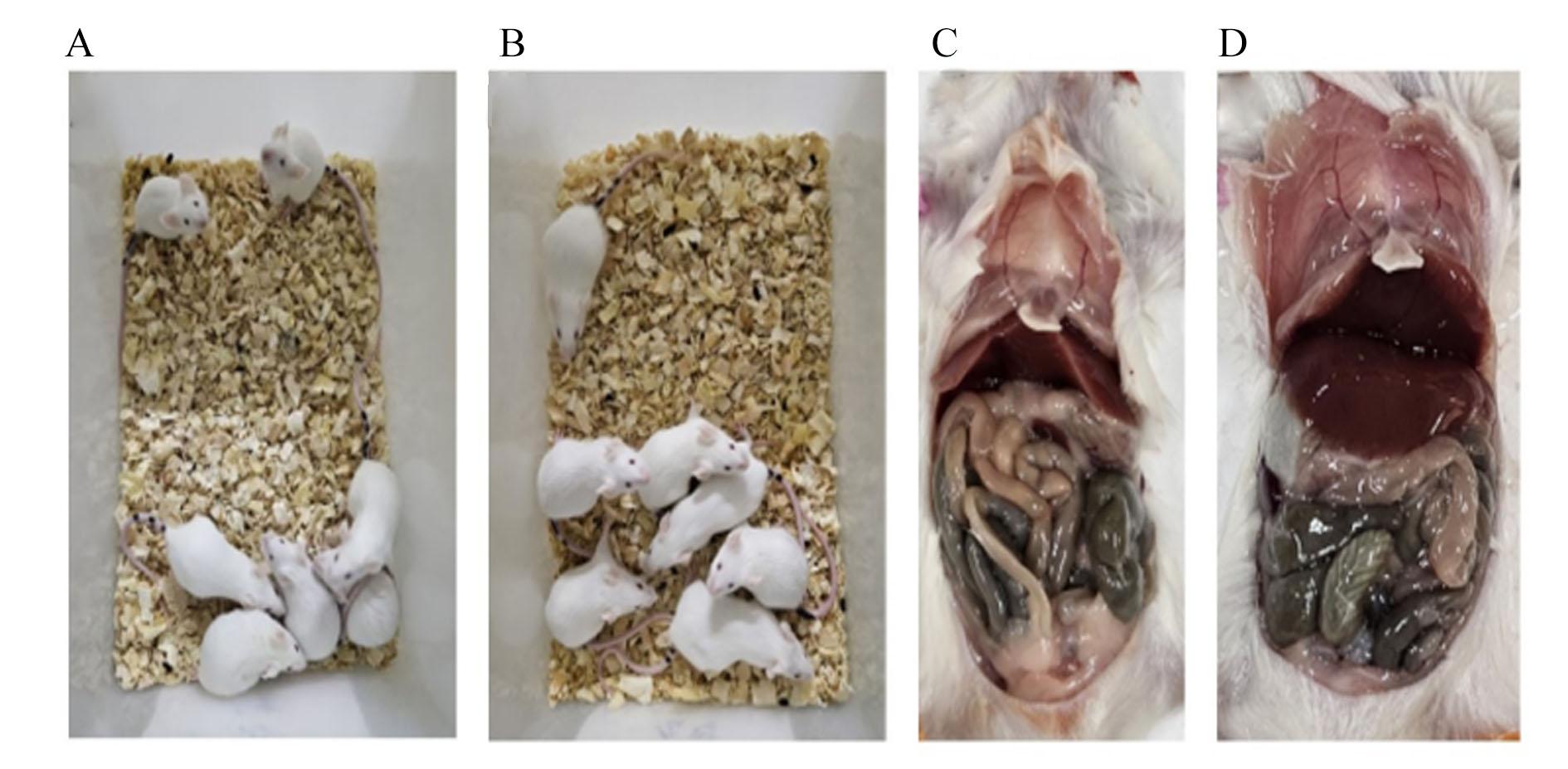
在动物安全性试验期间,2组小鼠均未出现异常状况,且无死亡现象;其毛色、精神状态和粪便均保持正常,口、鼻、耳及肛门处未见异常分泌物(图7-A图7-B)。剖检观察结果显示,试验组与对照组小鼠腹腔内主要器官均无明显出血,肉眼观察未见异常(图7-C图7-D)。
图7 腹腔注射解淀粉芽孢杆菌D3-4小鼠的体征及剖检观察

A:对照组体征观察 physical sign observation of the control group;B:试验组体征观察 physical sign observation of the test group;C:对照组剖检观察 necropsy observation of the control group;D:试验组剖检观察 necropsy observation of the test group。

Fig.7 Physical sign observation and necropsy observation of mice injected intraperitoneally with Bacillus amyloliformis D3-4

2.3.1.2 生长性能

表5可知,试验期间2组小鼠体重无显著差异(P>0.05)。
表5 解淀粉芽孢杆菌D3-4对小鼠生长性能的影响

Table 5 Effects of Bacillus amyloliquefaciens D3-4 on growth performance of miceg

项目 Items 对照组 Control group 试验组 Test group PP-value
初始体重 IBW 20.05±1.77 20.42±1.31 0.539
终末体重 FBW 31.84±1.64 31.82±2.42 0.981
平均日增重 ADG 1.68±0.29 1.62±0.43 0.320
平均日采食量 ADFI 6.29±0.69 5.99±0.88 0.336

2.3.1.3 脏器指数

表6可知,与对照组相比,试验组的心脏、肝脏、脾脏、肺脏及肾脏指数均未呈现出显著变化(P>0.05)。
表6 解淀粉芽孢杆菌D3-4对小鼠脏器指数的影响

Table 6 Effects of Bacillus amyloliquefaciens D3-4 on organ indexes of mice%

项目 Items 对照组 Control group 试验组 Test group PP-value
心脏指数 Heart index 0.53±0.07 0.54±0.06 0.603
肝脏指数 Liver index 6.58±0.57 6.59±0.53 0.965
脾脏指数 Spleen index 0.43±0.16 0.52±0.08 0.107
肺脏指数 Lung index 0.71±0.08 0.77±0.09 0.147
肾脏指数 Kidney index 1.42±0.17 1.38±0.10 0.462

2.3.1.4 组织病理学观察

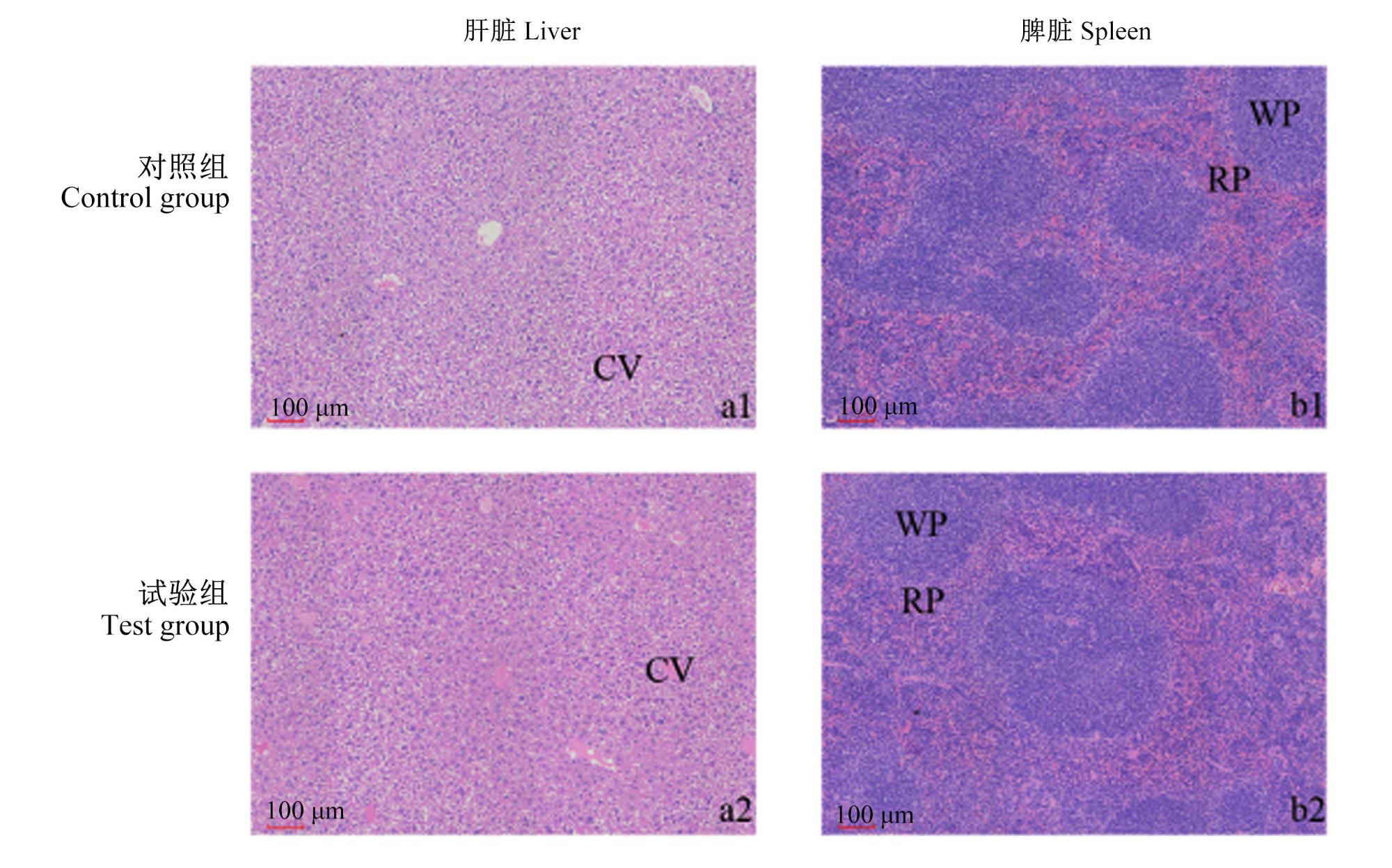
组织病理学观察结果显示,对照组和试验组小鼠肝脏和脾脏结构均正常,未见任何病变(图8)。
图8 解淀粉芽孢杆菌D3-4对小鼠脏器的影响

肝脏与脾脏组织切片(苏木精-伊红染色,10×)。CV:中央静脉;WP:白髓;RP:红髓。

Fig.8 Effects of Bacillus amyloliquefaciens D3-4 on organs of mice

Histological sections of liver and spleen (HE staining, 10×). CV: central vein; WP: white pulp; RP: red pulp.

2.3.2 亚急性毒性试验结果

2.3.2.1 生长性能

表7可以看出,与对照组相比,高剂量组终末体重、平均日增重及平均日采食量显著降低(P<0.05),而中、低剂量组则无显著变化(P>0.05)。
表7 灌胃解淀粉芽孢杆菌D3-4对小鼠生长性能的影响

Table 7 Effects of Bacillus amyloliquefaciens D3-4 via gavage on growth performance of miceg

项目
Items
对照组
Control group
高剂量组
High-dose group
中剂量组
Middle-dose group
低剂量组
Low-dose group
初始体重 IBW 23.53±2.54 25.10±1.31 22.61±1.53 23.96±2.65
终末体重 FBW 40.94±4.56 38.87±2.56* 40.68±3.40 40.08±2.07
平均日增重 ADG 0.62±0.20 0.35±0.24* 0.64±0.11 0.57±0.06
平均日采食量 ADFI 40.23±8.15 37.80±1.82* 39.60±3.56 39.39±0.31

不同剂量组数据标注*表示与对照组存在显著差异(P<0.05)。下表同。

Data from different dose groups marked with * indicated a significant difference compared with the control group (P<0.05). The same as below.

2.3.2.2 脏器指数

表8可以看出,与对照组相比,高剂量组小鼠的肝脏指数显著降低(P<0.05);然而,灌胃不同剂量解淀粉芽孢杆菌D3-4对小鼠的心脏、肝脏、脾脏、肺脏和肾脏指数均未产生显著影响(P>0.05)。
表8 灌胃解淀粉芽孢杆菌D3-4对小鼠脏器指数的影响

Table 8 Effects of Bacillus amyloliquefaciens D3-4 via gavage on organ indexes of mice%

项目
Items
对照组
Control group
高剂量组
High-dose group
中剂量组
Middle-dose group
低剂量组
Low-dose group
心脏指数 Heart index 0.19±0.03 0.19±0.03 0.19±0.03 0.18±0.02
肝脏指数 Liver index 1.61±0.22 1.34±0.19* 1.46±0.13 1.53±0.17
脾脏指数 Spleen index 0.11±0.02 0.11±0.01 0.13±0.06 0.12±0.05
肺脏指数 Lung index 0.25±0.05 0.23±0.02 0.24±0.03 0.24±0.04
肾脏指数 Kidney index 0.53±0.12 0.49±0.11 0.52±0.10 0.50±0.09

2.3.2.3 血常规指标

表9可以看出,灌胃解淀粉芽孢杆菌D3-4后,仅低剂量组小鼠红细胞数目与对照组存在显著差异(P<0.05),中剂量组和高剂量组小鼠血常规指标与对照组均无显著差异(P>0.05)。
表9 灌胃解淀粉芽孢杆菌D3-4对小鼠血常规指标的影响

Table 9 Effects of Bacillus amyloliquefaciens D3-4 via gavage on hematological indexes of mice

项目
Items
对照组
Control group
高剂量组
High-dose group
中剂量组
Middle-dose group
低剂量组
Low-dose group
红细胞 RBC/(×1012个/L) 9.26±0.69 9.56±1.00 9.04±1.20 8.31±1.13*
平均红细胞体积 MCV/fL 57.11±1.43 56.45±1.78 54.30±5.79 59.37±4.24
红细胞压积 HCT/% 52.77±4.40 53.86±5.20 48.83±6.61 48.98±4.83
白细胞 WBC/(×109个/L) 7.95±2.09 8.57±2.32 7.70±1.97 6.86±2.60
淋巴细胞 LYM/(×109个/L) 5.36±1.77 5.70±1.83 5.01±1.40 4.73±2.06
单核细胞 MON/(×109个/L) 1.18±0.56 1.53±0.83 1.26±1.03 0.99±0.34
粒细胞 GRA/(×109个/L) 1.43±0.46 1.33±0.34 1.41±0.30 1.13±0.40
血红蛋白 HGB/(g/L) 158.55±18.48 169.16±17.45 158.55±18.48 150.95±17.69

2.3.2.4 组织病理学观察

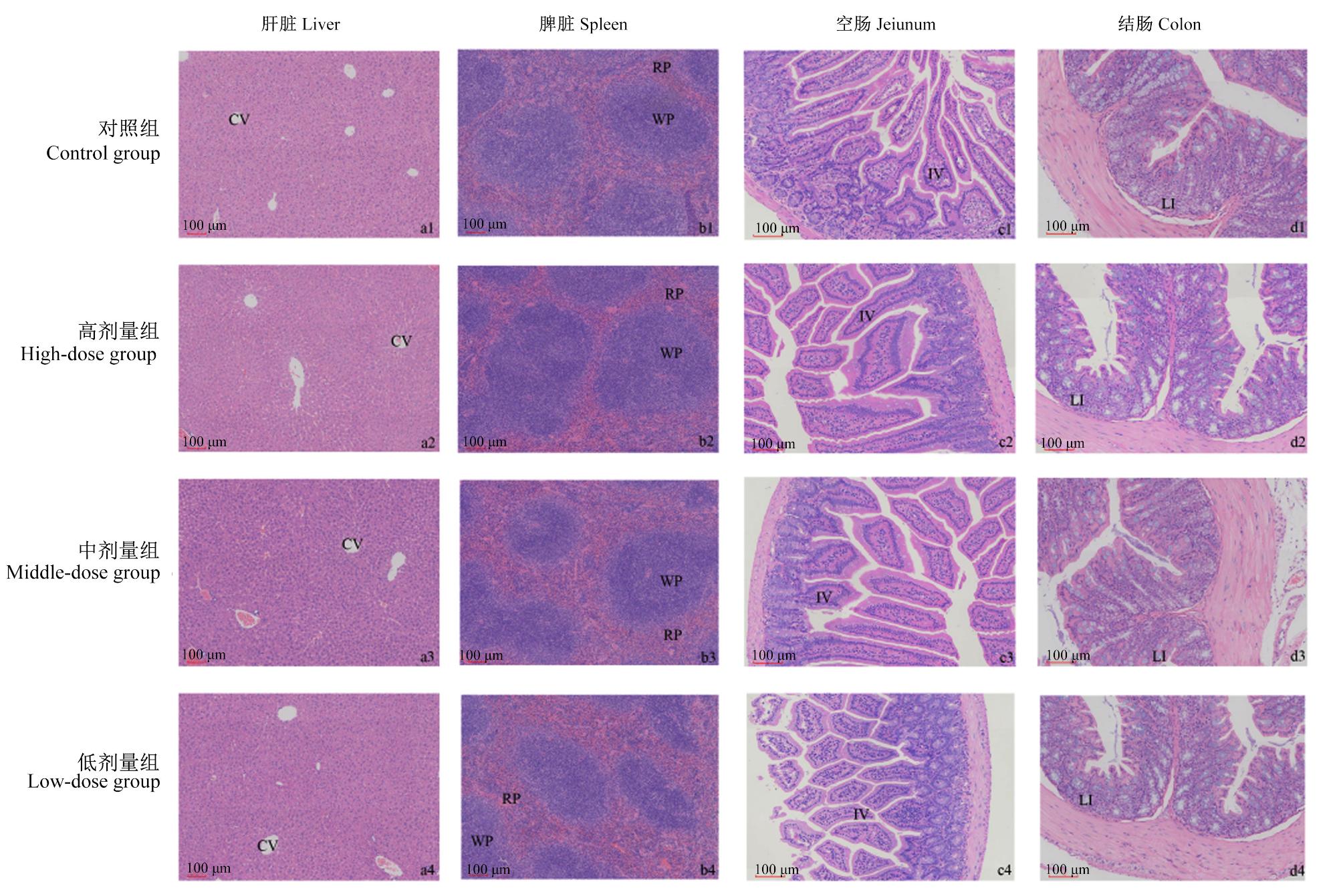
组织病理学观察结果显示,4组小鼠肝脏、脾脏、空肠和结肠结构均正常,未见任何病变(图9)。
图9 灌胃解淀粉芽孢杆菌D3-4对小鼠脏器的影响

肝脏、脾脏、空肠与结肠组织切片(苏木精-伊红染色,10×)。CV:中央静脉;WP:白髓;RP:红髓;IV:肠绒毛;LI:隐窝。

Fig.9 Effects of Bacillus amyloliquefaciens D3-4 via gavage on organs of mice

Histological sections of liver, spleen, jejunum, and colon (HE staining, 10×). CV: central vein; WP: white pulp; RP: red pulp; IV: intestinal villi; LI: crypt.

3 讨论

3.1 羊源解淀粉芽孢杆菌D3-4的体外益生特性

动物肠道健康是保障养殖效益的关键环节[23]。益生菌作为绿色安全的微生态制剂,能够通过调节肠道菌群平衡、增强肠道屏障功能[24]及调控免疫应答[25]等多途径维护肠道健康。基于此,本试验从新疆阿勒泰地区健康羔羊粪便中分离获得1株细菌,综合菌落形态观察、生理生化鉴定及16S rRNA序列分析,将其鉴定为解淀粉芽孢杆菌,并命名为解淀粉芽孢杆菌D3-4。体外益生特性评价结果显示,该菌株具有良好的耐酸、耐胆盐能力,并对特定病原菌具有抑制作用,表明其作为动物益生菌候选菌株具有潜在应用价值。
益生特性筛选是益生菌评估的核心环节[26]。潜在益生菌需满足耐酸性、胆盐耐受性、无获得性耐药、对致病菌的抑菌活性、抗氧化能力及无溶血活性等基本要求[27]。具有胃酸与胆盐耐受性是益生菌定植肠道并发挥生物学功能的前提[28]。动物胃液pH通常为3.0左右,羊肠道胆汁浓度范围为0.03%~0.30%[29-30]。本研究中,羊源解淀粉芽孢杆菌D3-4在pH 3.0~7.0及胆盐0.05%~0.30%条件下均可生长,pH 3.0时相对存活率为49.43%,0.30%胆盐处理后相对存活率为43.80%,表明其具有良好的肠道环境适应性。抑菌活性是益生菌维护肠道健康的重要功能。已有研究证实,芽孢杆菌可通过分泌细菌素[31]、磷脂类[32]及抗菌肽[33]等物质破坏病原菌结构并抑制其生长。例如,巨大芽孢杆菌JX-1对大肠杆菌、金黄色葡萄球菌具有显著抑制作用[34],解淀粉芽孢杆菌Y02亦对大肠埃希氏菌、金黄色葡萄球菌及表皮葡萄球菌表现出抑菌活性[35]。本试验究分离的羊源解淀粉芽孢杆菌D3-4对3种常见致病菌均呈现显著的抑菌活性,该特性与解淀粉芽孢杆菌在生物防治领域的广泛应用相符。
安全性是益生菌应用的前提。溶血活性检测可评估菌株对宿主细胞的潜在毒性,而抗生素耐药性则关系到益生菌在临床使用的安全性及有效性[3]。本研究结果显示,羊源解淀粉芽孢杆菌D3-4无溶血活性,且对12种常用抗生素(包括环丙沙星、诺氟沙星等)表现敏感,其药敏谱特征与解淀粉芽孢杆菌Y02[35]一致。鉴于益生菌可能通过水平基因转移将抗生素抗性基因传递给病原菌[36-37],候选菌株在应用前需严格评估其耐药性。羊源解淀粉芽孢杆菌D3-4表现出的抗生素敏感性及无溶血活性,表明其具有良好的安全性,不会对宿主健康构成潜在威胁。
抗氧化能力是益生菌的重要功能特性之一,DPPH自由基与羟自由基清除能力是评价抗氧化能力的常用指标[34]。已有研究表明,部分乳酸菌如粪肠球菌ZJUIDS-D016和融合魏斯氏菌ZJUIDS-D034具有较高的自由基清除能力[38]。本研究中,羊源解淀粉芽孢杆菌D3-4的DPPH自由基清除率达66.38%,羟自由基清除率为72.36%,表现出良好的抗氧化潜力。推测该菌株可能通过产生抗氧化酶或其他活性物质,帮助机体抵御氧化损伤,从而维持肠道内的氧化还原平衡。

3.2 羊源解淀粉芽孢杆菌D3-4的体内安全性

益生菌在进入临床应用前,需通过动物毒性试验评估潜在风险并确定安全剂量[39]。小鼠模型是益生菌体内安全性研究的常用工具,例如,白海等[40]通过小鼠试验证实了枯草芽孢杆菌的安全性,Abid等[41]亦通过21 d连续灌胃小鼠证实牛奶源发酵乳杆菌无毒性。
本试验采用经口灌胃和腹腔注射2种途径评估了羊源解淀粉芽孢杆菌D3-4的体内安全性。其中,经口灌胃试验模拟了益生菌作为饲料添加剂的自然暴露途径,结果明确显示其在预期使用剂量下对小鼠无毒性作用,为其应用安全性提供了最直接的证据。腹腔注射则作为一种非自然的极端暴露方式,旨在进行更严苛的全身毒性挑战。该途径下亦未观察到明显毒性反应,进一步证实了该菌株即使在极端条件下仍具有良好的生物相容性,这为其整体安全性提供了补充和支持。综上可知,本试验分离的羊源解淀粉芽孢杆菌D3-4对小鼠无毒性作用,具备作为益生菌应用的安全性基础。

4 结论

本试验从健康羔羊粪便中分离得到的解淀粉芽孢杆菌D3-4生长速率较快且无溶血活性,展现出良好的耐酸及耐胆盐能力,对大肠杆菌、金黄色葡萄球菌、鼠伤寒沙门氏菌均有抑制作用,对多数抗生素敏感,抗氧化能力良好,体外益生潜能突出。经小鼠安全性试验证实,其安全性良好,可作为后续研制羊源益生菌制剂的候选菌株。
[1]
肖玉花. “One Health”视角下国内外兽用抗菌药耐药性管控策略比对分析[D]. 硕士学位论文. 武汉: 华中农业大学, 2024.

XIAO Y H. Management on antimicrobial resistance in veterinary medicine from the perspective of “One Health”[D]. Master’s Thesis. Wuhan: Huazhong Agricultural University, 2024. (in Chinese)

[2]
荆学毅, 禹爱兵, 程雨菲, 等. 乳酸菌与益生元组合的筛选并利用IPEC-J2细胞模型验证其对肠道屏障的作用[J]. 动物营养学报, 2024, 36(7):4693-4705.

DOI

JING X Y, YU A B, CHENG Y F, et al. Screening combination of Lactobacillus spp. and prebiotics and evaluating their impact on intestinal barrier utilizing IPEC-J2 cell model[J]. Chinese Journal of Animal Nutrition, 2024, 36(7):4693-4705. (in Chinese)

[3]
PHAN A, THAPA K, HASHMI M A, et al. Prophylactic efficacy of probiotics and their metabolites against Staphylococcus epidermidis[J]. BMC Microbiology, 2025, 25(1):621.

DOI

[4]
郁胜男, 尹福泉. 人参多糖的理化性质、生物学作用及其在动物生产中的应用[J]. 动物营养学报, 2024, 36(12):7626-7634.

DOI

YU S N, YIN F Q. Physicochemical properties and biological effects of ginseng polysaccharide and its application in animal production[J]. Chinese Journal of Animal Nutrition, 2024, 36(12):7626-7634. (in Chinese)

DOI

[5]
张丹, 吴荣富, 梁忠, 等. 我国畜禽细菌耐药性控制一直在路上——饲料“禁抗”面面观[J]. 中国禽业导刊, 2021, 38(10):2-16.

ZHANG D, WU R F, LIANG Z, et al. Control of bacterial resistance is always on road from viewpoints of antibiotics-ban in feed materials[J]. Guide to Chinese Poultry, 2021, 38(10):2-16. (in Chinese)

[6]
李树春. 羊腹泻病因分析与防治措施[J]. 农业工程技术, 2024, 44(15):122-123.

LI S C. Analysis of causes and control measures for sheep diarrhea[J]. Agricultural Engineering Technology, 2024, 44(15):122-123. (in Chinese)

[7]
KONG L C, WANG B, WANG Y M, et al. Characterization of bacterial community changes and antibiotic resistance genes in lamb manure of different incidence[J]. Scientific Reports, 2019, 9(1):10101.

DOI

[8]
LIU M J, LIU W J, ZHANG W J, et al. Effect of marine red yeast rhodosporidium paludigenum on diarrhea rate,serum antioxidant competence,intestinal immune capacity,and microflora structure in early-weaned lambs[J]. BioMed Research International, 2022, 2022(1):2228632.

DOI

[9]
李天溪. 解淀粉芽孢杆菌B10抑制黄曲霉生长生物活性物质的分离鉴定及作用效果研究[D]. 硕士学位论文. 沈阳: 沈阳农业大学, 2023.

LI T X. Study on the isolation,identification and effect of bioactive substances from Bacillus amylolyticus B10 that can inhibit the growth of Aspergillus flavus[D]. Master’s Thesis. Shenyang: Shenyang Agricultural University, 2023. (in Chinese)

[10]
张楠驰, 李娟, 王利, 等. 羊源解淀粉芽孢杆菌对断奶金堂黑山羊生长性能、屠宰性能、血清生化和免疫指标以及肌肉发育相关基因表达的影响[J]. 动物营养学报, 2022, 34(3):1743-1753.

DOI

ZHANG N C, LI J, WANG L, et al. Effects of Bacillus amyloliquefaciens isolated from goats on growth performance,slaughter performance,serum biochemical and immune indexes,and muscle development-related gene expression of weanling Jintang black goat[J]. Chinese Journal of Animal Nutrition, 2022, 34(3):1743-1753. (in Chinese)

[11]
王玺年, 安小娅, 魏占虎, 等. 补饲益生菌对湖羊羔羊生长性能、免疫功能及血液生化指标的影响[J]. 畜牧兽医杂志, 2025, 44(1):17-20.

WANG X N, AN X Y, WEI Z H, et al. Effects of probiotics supplementation on growth performance,immune function and blood biochemical indexes of Hu-sheep lambs[J]. Journal of Animal Science and Veterinary Medicine, 2025, 44(1):17-20. (in Chinese)

[12]
CORDEIRO M A, MIRANDA V C, BARROS K O, et al. Limosilactobacillus reuteri UN41 improves the survival rate and exhibits hepatoprotective effects in a murine model of Salmonella infection[J]. Brazilian Journal of Microbiology, 2025, 56(4):3019-3027.

DOI

[13]
潘伊微, 李文, 周斐然, 等. 添加复合益生菌对不同品种育肥牛生长性能、肠道菌群及血清生化指标影响[J]. 中国牛业科学, 2024, 50(6):59-65.

PAN Y W, LI W, ZHOU F R, et al. The effect of adding composite probiotics on the growth performance,gut microbiota,and serum biochemical indicators of different breeds of fattening cattle[J]. China Cattle Science, 2024, 50(6):59-65. (in Chinese)

[14]
魏立民, 孙瑞萍, 刘海隆, 等. 枯草芽孢杆菌对断奶仔猪生长性能和血清生化指标的影响[J]. 中国畜牧兽医, 2017, 44(6):1720-1725.

DOI

WEI L M, SUN R P, LIU H L, et al. Effect of Bacillus subtilis on growth performance and serum biochemical parameters of weaned piglets[J]. China Animal Husbandry & Veterinary Medicine, 2017, 44(6):1720-1725. (in Chinese)

[15]
庞敏. 益生菌制剂对断奶仔猪肠道黏膜屏障功能的影响及其机理的研究[D]. 硕士学位论文. 北京: 中国农业科学院, 2016.

PANG M. Effects and its mechanism of probiotics on intestinal mucosal barrier function in weaning piglets[D]. Master’s Thesis. Beijing: Chinese Academy of Agricultural Sciences, 2016. (in Chinese)

[16]
陈坤, 李健, 罗正. 枯草芽孢杆菌PB6对肉鸡生长性能、消化酶活性、肠道形态及盲肠微生物区系的影响[J]. 现代畜牧科技, 2025, 53(9):56-60.

CHEN K, LI J, LUO Z. Growth performance promotion of Bacillus subtilis in broilers relies on improving digestive enzyme activity,intestinal morphology and modulating cecum microorganism[J]. Modern Animal Husbandry Science & Technology, 2025, 53(9):56-60. (in Chinese)

[17]
PAIVA N M L, RIBEIRO S C, BORBA A E S, et al. Current status and future challenges in the use of bacteriocins to modulate ruminant gut microbiota[J/OL]. Probiotics and Antimicrobial Proteins, 2025. https://link.springer.com/article/10.1007/s12602-025-10792-z. DOI:10.1007/s12602-025-10792-z.

[18]
李建梅, 沈海玉, 许明, 等. 饲粮中添加枯草芽孢杆菌、屎肠球菌、酵母菌及其复合菌对柔嫩艾美耳球虫感染肉鸡生长性能、炎症反应及肠道屏障功能的影响[J]. 动物营养学报, 2025, 37(7):4384-4396.

DOI

LI J M, SHEN H Y, XU M, et al. Effects of dietary supplementation of Bacillus subtilis,Enterococcus faecium,yeast and their complex bacteria on growth performance,inflammatory response and intestinal barrier function of broilers infected with Eimeria tenella[J]. Chinese Journal of Animal Nutrition, 2025, 37(7):4384-4396. (in Chinese)

[19]
孟维珊, 崔毅, 白长胜. 枯草芽孢杆菌的分离及富硒试验[J]. 现代畜牧科技, 2020(12):11-12,16.

MENG W S, CUI Y, BAI C S. Isolation and selenium-enrichment experiment of Bacillus subtilis[J]. Modern Animal Husbandry Science & Technology, 2020(12):11-12,16. (in Chinese)

[20]
贾盛, 候萌, 陈伟丽, 等. 一株羊源巨大芽孢杆菌BM24的分离鉴定及安全性评价[J]. 动物营养学报, 2024, 36(9):6083-6094.

DOI

JIA S, HOU M, CHEN W L, et al. Isolation,identification and safety evaluation of a sheep-derived Bacillus megaterium BM24[J]. Chinese Journal of Animal Nutrition, 2024, 36(9):6083-6094. (in Chinese)

[21]
王琦, 谢晓佩, 吴庆侠, 等. 牦牛源枯草芽孢杆菌的益生作用研究[J]. 江苏农业科学, 2020, 48(11):157-165.

WANG Q, XIE X P, WU Q X, et al. Study on probiotic effect of Bacillus subtilis from yak[J]. Jiangsu Agricultural Sciences, 2020, 48(11):157-165. (in Chinese)

[22]
李奥运. 牦牛源枯草芽孢杆菌的筛选及对犊牦牛肠道菌群和代谢的影响[D]. 博士学位论文. 武汉: 华中农业大学, 2023.

LI A Y. Screening of yak-derived Bacillus subtilis and its effects on intestinal microbiota andmetabolism of calving yaks[D]. Ph.D.Thesis. Wuhan: Huazhong Agricultural University, 2023. (in Chinese)

[23]
韩丹. 益生菌在动物肠道健康维护中的应用研究进展[J]. 广东饲料, 2025, 34(7):15-18.

HAN D. Research progress on the application of probiotics in animal intestinal health maintenance[J]. Guangdong Feed, 2025, 34(7):15-18. (in Chinese)

[24]
LIU A L, LV H, WANG H Y, et al. Probiotics reduce the severity of DSS-induced colitis in aged mice by enhancing intestinal barrier function and modulating gut microbiota[J/OL]. GeroScience, 2025.https://pubmed.ncbi.nlm.nih.gov/41082099. DOI:10.1007/s11357-025-01900-6.

[25]
ALMANSOUR N, AL-RASHED F, CHOUDHRY K, et al. Gut microbiota:a promising new target in immune tolerance[J]. Frontiers in Immunology, 2025, 16:1607388.

DOI

[26]
徐雅芫. 猪源益生菌筛选及其益生作用机理的研究[D]. 博士学位论文. 合肥: 安徽农业大学, 2017.

XU Y Y. Research on screening and functional mechanism of the porcine probiotic[D]. Ph.D.Thesis. Hefei: Anhui Agricultural University, 2017. (in Chinese)

[27]
PENG Y D, SHEN X Y. Supplementation of a dietary probiotics blend can enhance growth performance in guiqian semi-fine wool sheep by modulating rumen microbiota and immune function[J/OL]. Probiotics and Antimicrobial Proteins, 2025.https://link.springer.com/article/10.1007/s12602-025-10757-2. DOI:10.1007/s12602-025-10757-2.

[28]
郭云霞, 郝庆红, 朱宝成. 羊源芽孢益生菌的筛选与Y5-39菌株的鉴定及其耐受性试验[J]. 华北农学报, 2010, 25(5):206-210.

DOI

GUO Y X, HAO Q H, ZHU B C. Screening and identification of the probiotics strain Y5-39 showing antidysenteriae effects from sheep[J]. Acta Agriculturae Boreali-Sinica, 2010, 25(5):206-210. (in Chinese)

DOI

[29]
王婷, 安明轩, 李正浩, 等. 牛源产酸芽孢杆菌的分离筛选及益生特性研究[J]. 动物医学进展, 2023, 44(10):12-18.

WANG T, AN M X, LI Z H, et al. Isolation and screening of acid-producing Bacillus from cattle and study on its prebiotics[J]. Progress in Veterinary Medicine, 2023, 44(10):12-18. (in Chinese)

[30]
MALOGAN J, HALLOWELL H A, FRANCIS B, et al. Supplementation and elimination of microbiome-produced metabolites in the treatment of human disease[J]. Annals of the New York Academy of Sciences, 2025, 1553(1):50-68.

DOI

[31]
胡振华, 杨永平, 杨宇, 等. 畜禽源益生菌的筛选及安全性研究[J]. 饲料工业, 2018, 39(14):61-64.

HU Z H, YANG Y P, YANG Y, et al. Safety research and selection of probiotics origin from livestock and poultry[J]. Feed Industry, 2018, 39(14):61-64. (in Chinese)

[32]
于佳民, 赵倩, 张志焱, 等. 多黏类芽孢杆菌抗菌肽的分离纯化及特性研究[J]. 中国畜牧兽医, 2021, 48(8):2830-2837.

DOI

YU J M, ZHAO Q, ZHANG Z Y, et al. Separation,purification and characteristics analysis of antibacterial peptidesfrom Paenibacillus polymyxa[J]. China Animal Husbandry & Veterinary Medicine, 2021, 48(8):2830-2837. (in Chinese)

[33]
TONG N N, CHEN Y F, LIU H N, et al. Evaluation of medicinal quality of tree peony byproducts and the effects of dietary byproducts supplementation on production performance,egg quality,serum antioxidant levels,and gut microbiota in late-phase laying hens[J]. Poultry Science, 2025, 104(12):105925.

DOI

[34]
钟罗华, 邓舜洲, 张文波, 等. 6株猪源芽孢杆菌的分离鉴定及其益生性研究[J]. 中国畜牧兽医, 2017, 44(2):521-529.

DOI

ZHONG L H, DENG S Z, ZHANG W B, et al. Isolation and identification of six strains of swine Bacillus and their probiotic research[J]. China Animal Husbandry & Veterinary Medicine, 2017, 44(2):521-529. (in Chinese)

[35]
郝静雪, 张彤, 唐溯, 等. 鸡源解淀粉芽孢杆菌Y02的分离鉴定及其益生特性研究[J]. 动物医学进展, 2025, 46(10):13-20.

HAO J X, ZHANG T, TANG S, et al. Study on identification and probiotic properties of Bacillus amyloliquefaciens Y02 isolated from broilers[J]. Progress in Veterinary Medicine, 2025, 46(10):13-20. (in Chinese)

[36]
刘勇, 张勇, 张和平. 世界益生菌安全性评价方法[J]. 中国食品学报, 2011, 11(6):141-151.

LIU Y, ZHANG Y, ZHANG H P. Evaluating methods of probiotic’s safety in the world[J]. Journal of Chinese Institute of Food Science and Technology, 2011, 11(6):141-151. (in Chinese)

[37]
RAJPUT K, DUBEY R C, KUMAR A. Probiotic potential and immunomodulatory properties in Enterococcus faecium GMB24 and Enterococcus hirae SMB16 isolated from goat and sheep milk[J]. Archives of Microbiology, 2022, 204(10):619.

DOI

[38]
陈楠, 余泽旭, 季暄, 等. 犬源抗氧化益生菌的筛选及功效评定[J]. 动物营养学报, 2024, 36(2):1303-1314.

DOI

CHEN N, YU Z X, JI X, et al. Screening and efficacy evaluation of antioxidant probiotics derived from canine[J]. Chinese Journal of Animal Nutrition, 2024, 36(2):1303-1314. (in Chinese)

DOI

[39]
HARANAHALLI NATARAJ B, BEHARE P V, YADAV H, et al. Emerging pre-clinical safety assessments for potential probiotic strains:a review[J]. Critical Reviews in Food Science and Nutrition, 2024, 64(23):8155-8183.

DOI

[40]
白海, 刘丽敏, 安志鹏, 等. 一株羊源性枯草芽孢杆菌的筛选鉴定及安全性评价[J]. 中国兽药杂志, 2020, 54(9):10-14.

BAI H, LIU L M, AN Z P, et al. Screening and identification of a sheep-derived Bacillus subtilis and assessment of its safety in mice[J]. Chinese Journal of Veterinary Drug, 2020, 54(9):10-14. (in Chinese)

[41]
ABID S, FARID A, ABID R, et al. Identification,biochemical characterization,and safety attributes of locally isolated Lactobacillus fermentum from Bubalus bubalis (buffalo) milk as a probiotic[J]. Microorganisms, 2022, 10(5):954.

DOI

Outlines

/