RESEARCH PAPER

Effects of Corn Stover Fermented by Lactic Acid Bacteria on Growth Performance, Nutrient Apparent Digestibility, and Rumen Fermentation Parameters and Microbiota of Beef Cattle

  • SU Xiaolong ,
  • SHA Zhihang ,
  • HONG Haiyang ,
  • ZHANG Lili ,
  • XU Xiaofeng ,
  • MA Yulin , *
Expand
  • School of Animal Science and Technology, Ningxia University, Yinchuan 750021, China
* associate professor, E-mail:

Received date: 2025-11-25

  Online published: 2026-06-13

Abstract

This experiment was conducted to explore the effects of corn stover fermented by lactic acid bacteria on growth performance, nutrient apparent digestibility, and rumen fermentation parameters and microbiota of beef cattle. Forty healthy Simmental cattle aged 16 months were selected and randomly divided into the control group (CON group) and the lactic acid bacteria group (LAB group), with 20 replicates in each group and 1 cattle in each replicate. The CON group was fed a basal diet mainly composed of corn stover as roughage, while the LAB group replaced the corn stover in the basal diet with the lactic acid bacteria-fermented corn stover in equal amounts. The pre-experiment was 15 days and the formal experiment was 75 days. The results showed as follows: 1) compared with the CON group, the final body weight, average daily gain and dry matter intake in the LAB group were significantly increased (P<0.05). 2) Compared with the CON group, the apparent digestibility of dry matter and crude protein in the LAB group was significantly increased (P<0.05). 3) Compared with the CON group, the contents of rumen ammonia nitrogen, microbial protein, propionic acid, butyric acid and total volatile fatty acids in the LAB group were significantly increased (P<0.05), while the rumen acetic acid content was significantly decreased (P<0.05). 4) Compared with the CON group, the Shannon index of the rumen microbiota in the LAB group was significantly decreased (P<0.05), and the Simpson index was significantly increased (P<0.05). The relative abundances of Streptococcus, Succiniclasticum, Prevotellaceae_UCG-003 and Acetobacter in the LAB group were significantly increased (P<0.05). In conclusion, the corn stover fermented by lactic acid bacteria can enhance the growth performance of beef cattle by optimizing the rumen microbiota structure, improving the rumen fermentation, and increasing the nutrient apparent digestibility.

Cite this article

SU Xiaolong , SHA Zhihang , HONG Haiyang , ZHANG Lili , XU Xiaofeng , MA Yulin . Effects of Corn Stover Fermented by Lactic Acid Bacteria on Growth Performance, Nutrient Apparent Digestibility, and Rumen Fermentation Parameters and Microbiota of Beef Cattle[J]. Chinese Journal of Animal Nutrition, 2026 , 38(6) : 4291 -4301 . DOI: 10.12418/CJAN2026.344

肉牛产业作为节粮型畜牧产业的重要组成部分,在优化我国节粮型畜种结构、提升人民生活品质方面发挥着关键作用。在肉牛养殖成本中,饲料成本占比超过70%[1]。随着我国经济社会的持续发展,市场对牛肉的需求逐年升高,由此推动肉牛养殖规模不断扩大,也使得对优质粗饲料的需求量日益增加[2]
玉米秸秆是玉米生产的主要副产物,我国年产量高达2.1亿t[3-4],这一庞大的资源为其饲料化利用提供了充足的原料基础。然而,玉米秸秆具有粗纤维含量高、适口性差以及能量水平低等固有缺陷,导致其目前的饲料化利用率仍旧较低[5]。适当的预处理能改善玉米秸秆的营养价值,在众多方法中微生物处理是近年来较受欢迎的绿色处理方式,不仅能改善玉米秸秆的适口性[6],还能提高动物采食量[7]。乳酸菌作为传统青贮添加剂,可优化微生物群落结构,有效抑制有害菌生长,进而提升青贮饲料的营养价值和安全性[8]。然而,关于乳酸菌发酵玉米秸秆对肉牛生长性能和瘤胃微生物区系影响的研究有限。因此,本试验旨在利用乳酸菌发酵的方式处理玉米秸秆,评估乳酸菌发酵玉米秸秆对肉牛生长性能、养分表观消化率以及瘤胃发酵参数和微生物区系的影响,以期为乳酸菌发酵玉米秸秆在肉牛养殖中的科学应用提供依据。

1 材料与方法

1.1 伦理声明

本试验经宁夏大学实验动物伦理委员会批准(批准编号:NXU-A-2025-0274)。

1.2 试验材料

乳酸菌发酵玉米秸秆由黑龙江省牡丹江市林口县绿之源牧业有限公司提供,其营养成分含量见表1。发酵玉米秸秆使用的乳酸菌剂由内蒙古和美科盛生物技术有限公司提供,其主要由植物乳杆菌(1×10¹¹ CFU/g)、布氏乳杆菌(5×1010 CFU/g)、纤维素酶和木聚糖酶组成,每1 000 kg发酵饲料添加1 g乳酸菌剂。
表1 乳酸菌发酵玉米秸秆营养成分含量(干物质基础)

Table 1 Nutrient contents of corn stover fermented by lactic acid bacteria (DM basis) %

项目
Items
玉米秸秆
Corn stover
乳酸菌发酵玉米秸秆
Corn stover fermented by lactic acid bacteria
粗蛋白质 CP 3.18 5.99
中性洗涤纤维 NDF 44.23 43.19
酸性洗涤纤维 ADF 25.16 24.32
粗灰分 Ash 8.14 6.65

营养成分含量均为实测值,测定方法见1.4.1。

Nutrient contents were all measured values, and the determination methods were detailed in 1.4.1.

1.3 试验设计和饲养管理

本试验采用单因素试验设计,选取40头16月龄健康的西门塔尔牛,随机分为对照组(CON组)和乳酸菌组(LAB组),每组20个重复,每个重复1头牛。CON组饲喂粗饲料以玉米秸秆为主的基础饲粮,LAB组将基础饲粮中的玉米秸秆等量替换为乳酸菌发酵玉米秸秆。试验期90 d,其中预试期15 d,正试期75 d。饲粮参照《肉牛饲养标准》(NY/T 815—2004)配制,其组成及营养水平见表2。试验期间,每天饲喂2次(08:00和18:00各1次),试验牛自由采食和饮水,每日剩料量保持在3%~5%;圈舍定期打扫卫生,保持通风。
表2 饲粮组成及营养水平(干物质基础)

Table 2 Composition and nutrient levels of diets (DM basis) %

项目
Items
组别 Groups
CON LAB
原料 Ingredients
玉米秸秆 Corn stover 30.50
乳酸菌发酵玉米秸秆
Corn stover fermented by
lactic acid bacteria
30.50
玉米面 Corn meal 40.50 38.00
豆粕 Soybean meal 15.30 15.90
棉籽粕 Cottonseed meal 11.50 13.22
预混料 Premix1) 0.52 0.51
碳酸氢钠 NaHCO3 1.10 1.30
氯化钠 NaCl 0.58 0.57
合计 Total 100.00 100.00
营养水平 Nutrient levels2)
综合净能 NEmf/(MJ/kg) 5.90 5.90
粗蛋白质 CP 13.00 13.00
中性洗涤纤维 NDF 34.00 34.50
酸性洗涤纤维 ADF 20.00 20.02
钙 Ca 0.70 0.70
磷 P 0.35 0.35

1)每千克预混料含有 One kg of the premix contained the following:VA 200 000 IU,VD3 25 000 IU,VE 4 000 IU,Fe 3 500 mg,Mn 2 000 mg,Zn 1 500 mg,Cu 550 mg,I 30 mg,Se 15 mg,Co 15 mg,Ca 150 g,P 60 g。
2)综合净能根据《肉牛饲养标准》(NY/T 815—2004)计算得出,其余为实测值。NEmf was calculated according to Feeding Standard of Beef Cattle (NY/T 815—2004), while the others were measured values.

1.4 指标测定及方法

1.4.1 营养成分含量测定

干物质(DM)含量参照GB/T 6435—2014中方法测定,粗蛋白质(CP)含量参照GB/T 6432—2018中方法测定,中性洗涤纤维(NDF)含量参照GB/T 20806—2022中方法测定,酸性洗涤纤维(ADF)含量参照NY/T 1459—2022中方法测定,粗灰分(Ash)含量参照GB/T 6438—2007中方法测定,钙含量参照GB/T 6436—2018中方法测定,磷含量参照GB/T 6437—2018中方法测定。

1.4.2 生长性能测定

所有试验牛分别于正试期第1天和第75天进行空腹称重并记录体重数据,计算每头牛的平均日增重(ADG);正试期间,每天记录每头牛的喂料量及剩料量,并测定饲喂料和剩余料的DM含量,计算干物质采食量(DMI),并计算料重比(F/G)。生长性能指标计算公式如下:
ADG(kg/d)=[终末体重(kg)-初始体重(kg)]/试验天数(d);
DMI(kg/d)=平均喂料量(kg/d)×DM含量(%)-平均剩料量(kg/d)×DM含量(%);
F/G=DMI(kg/d)/ADG(kg/d)。

1.4.3 养分表观消化率测定

于正试期第73~75天,连续3 d采用全收粪法收集试验牛粪便样品,将每头试验牛3 d的粪样等比例混匀,留取鲜重10%的粪样加入酒石酸固氮装盒并标记,放入-20 ℃冰箱冷冻保存。试验结束后,将冷冻粪便样品置于60~75 ℃烘箱烘干至恒重后室温回潮24 h,然后将样品称重、粉碎至粉末状且通过40目筛后用于后续养分表观消化率的测定。选择盐酸不溶灰分(AIA)作为测定各养分表观消化率的指示剂,粪便DM、CP、NDF和ADF含量的测定方法同1.4.1,AIA含量参照GB/T 23742—2009中方法测定,并采用内源性指示剂法计算养分表观消化率,计算公式如下:
某养分表观消化率(%)=100-100×(饲粮AIA含量/粪便AIA含量)×(粪便该养分含量/饲粮该养分含量)。

1.4.4 瘤胃液采集及瘤胃发酵参数测定

于正试期第75天晨饲前,对每头试验牛采用胃管式瘤胃液采集器经口腔采集瘤胃液200 mL。为减少唾液污染,弃去前50 mL瘤胃液,随后继续采集200 mL瘤胃液。采集后立即采用PHB-5型笔式便携pH计现场测定瘤胃液pH。剩余瘤胃液经4层纱布过滤后,分装于5 mL无菌冻存管中,并于-20 ℃冰箱冷冻保存,用于后续挥发性脂肪酸(VFA)、氨态氮(NH3-N)和微生物蛋白(MCP)含量的测定。瘤胃液NH3-N含量参照冯宗慈等[9]的比色法进行测定,MCP含量采用考马斯亮蓝法[10]进行测定,VFA含量采用GC-2014C气相色谱仪(岛津,日本)进行测定[11]

1.4.5 瘤胃微生物区系测定

于正试期第75天每组采集5头牛的瘤胃液,立即经4层纱布过滤后,分装于-80 ℃超低温冰箱中保存。所有样品委托上海美吉生物医药科技有限公司进行后续分析。采用引物338F(5'-ACTCCTACGGGAGGCAGCAG-3')和806R(5'-GGACTACHVGGGTWTCTAAT-3')对16S rRNA基因的V3~V4区进行扩增,并在Illumina MiSeq PE300平台上进行测序,获得的测序数据用于后续的可视化分析。

1.5 数据统计和分析

试验数据通过Excel 2021整理后,采用SPSS 26.0软件进行独立样本t检验,结果数据以平均值和均值标准误(SEM)表示,P<0.05为差异显著。微生物测序数据在美吉云平台采用mothur软件计算alpha多样性指数,并采用Wilcoxon秩和检验进行alpha多样性的组间差异比较分析;采用基于Bray-Curtis距离算法的主坐标分析(PCoA)检验组间样本微生物群落结构的相似性,并结合置换多元方差分析(PERMANOVA)非参数检验分析组间样本微生物群落结构差异是否显著;采用线性判别分析(LDA)效应大小(LEfSe)分析(LDA>3,P<0.05)确定不同组间从门到属水平相对丰度差异显著的细菌类群。

2 结果与分析

2.1 乳酸菌发酵玉米秸秆对肉牛生长性能的影响

表3可知,LAB组肉牛终末体重、ADG和DMI均显著高于CON组(P<0.05),2组间F/G无显著差异(P>0.05)。
表3 乳酸菌发酵玉米秸秆对肉牛生长性能的影响

Table 3 Effects of corn stover fermented by lactic acid bacteria on growth performance of beef cattle

项目
Items
组别 Groups 均值标准误
SEM
P
P-value
CON LAB
初始体重 IBW/kg 503.73 504.50 0.921 0.263
终末体重 FBW/kg 579.73 584.65 0.912 0.004
平均日增重 ADG/(kg/d) 0.84 0.89 0.042 0.011
干物质采食量 DMI/(kg/d) 13.95 14.95 0.248 <0.001
料重比 F/G 16.51 16.89 1.279 0.432

2.2 乳酸菌发酵玉米秸秆对肉牛养分表观消化率的影响

表4可知,LAB组肉牛DM和CP表观消化率显著高于CON组(P<0.05),2组间NDF和ADF表观消化率无显著差异(P>0.05)。
表4 乳酸菌发酵玉米秸秆对肉牛养分表观消化率的影响

Table 4 Effects of corn stover fermented by lactic acid bacteria on nutrient apparent digestibility of beef cattle %

项目
Items
组别 Groups 均值标准误
SEM
P
P-value
CON LAB
干物质 DM 63.30 66.19 0.298 0.002
粗蛋白质 CP 60.17 68.28 1.124 0.018
中性洗涤纤维 NDF 61.29 62.35 2.786 0.759
酸性洗涤纤维 ADF 36.38 39.47 0.842 0.140

2.3 乳酸菌发酵玉米秸秆对肉牛瘤胃发酵参数的影响

表5可知,CON组和LAB组间肉牛瘤胃pH无显著差异(P>0.05);LAB组瘤胃NH3-N、MCP、丙酸(PA)、丁酸(BA)和总挥发性脂肪酸(TVFA)含量均显著高于CON组(P<0.05),瘤胃乙酸(AA)含量显著低于CON组(P<0.05)。
表5 乳酸菌发酵玉米秸秆对肉牛瘤胃发酵参数的影响

Table 5 Effects of corn stover fermented by lactic acid bacteria on rumen fermentation parameters of beef cattle

项目
Items
组别 Groups 均值标准误
SEM
P
P-value
CON LAB
pH 6.32 6.45 0.154 0.492
氨态氮 NH3-N/(mg/dL) 12.48 17.84 1.629 0.032
微生物蛋白 MCP/(mg/mL) 0.61 0.77 0.012 0.026
乙酸 AA/(mmol/L) 36.85 34.09 0.789 0.032
丙酸 PA/(mmol/L) 9.85 10.59 0.213 0.011
丁酸 BA/(mmol/L) 5.33 5.81 0.047 0.017
总挥发性脂肪酸 TVFA/(mmol/L) 49.27 53.25 0.623 0.006

2.4 乳酸菌发酵玉米秸秆对肉牛瘤胃微生物区系的影响

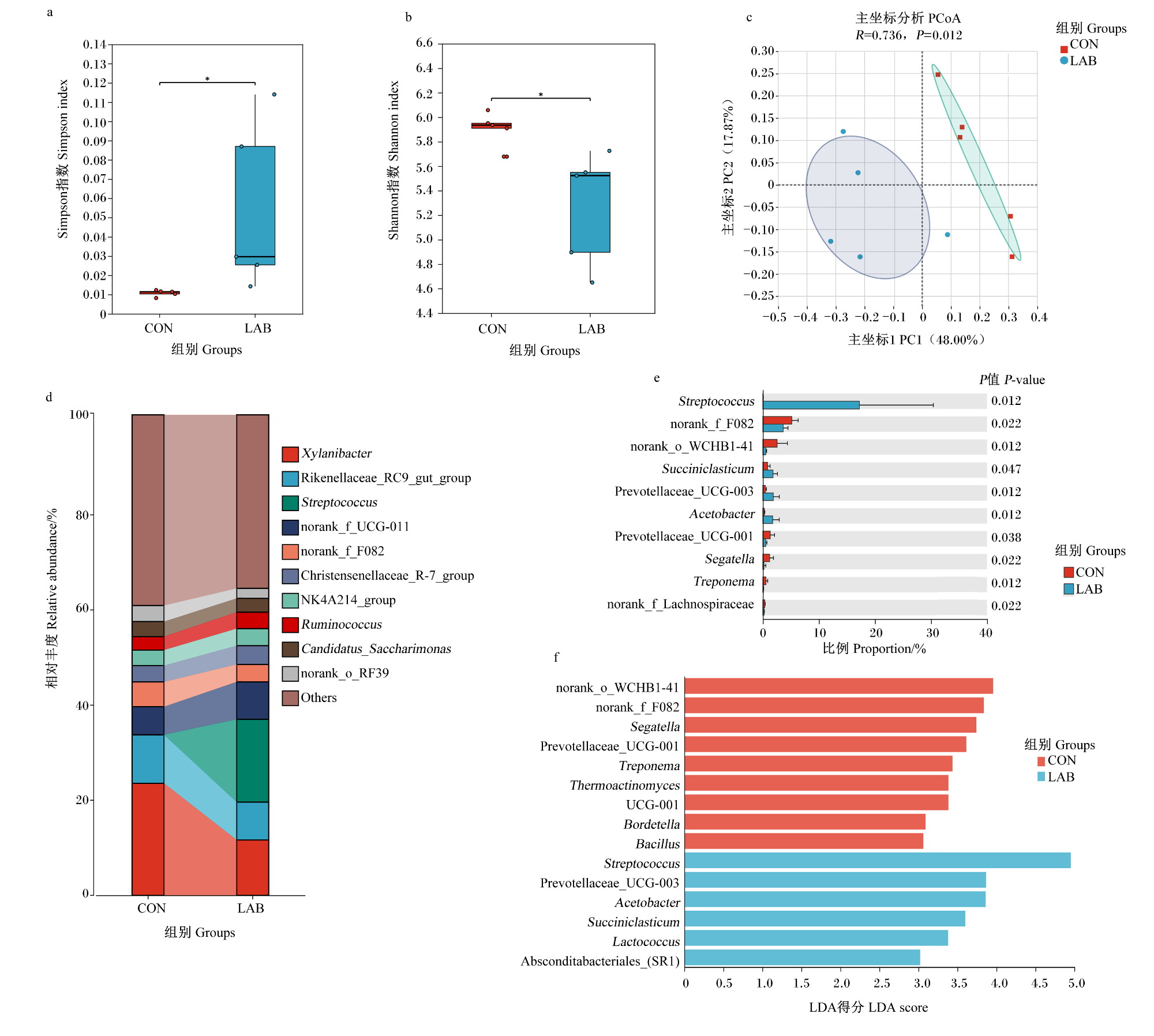
图1-a图1-b所示,基于操作分类单元(OTU)的alpha多样性分析结果表明,与CON组相比,LAB组肉牛瘤胃微生物群落Shannon指数显著降低(P<0.05),而Simpson指数显著提高(P<0.05)。如图1-c所示,PCoA结果进一步表明,CON组和LAB组间瘤胃微生物群落结构存在显著分离(P<0.05)。如图1-d所示,LAB组瘤胃链球菌属(Streptococcus)相对丰度高于CON组,瘤胃理研菌科RC9肠道群(Rikenellaceae_RC9_gut_group)相对丰度低于CON组。如图1-e所示,Metastat检验结果表明,LAB组瘤胃链球菌属、解琥珀酸菌属(Succiniclasticum)、普雷沃氏菌科UCG-003(Prevotellaceae_UCG-003)和醋酸杆菌属(Acetobacter)相对丰度显著高于CON组(P<0.05),而瘤胃普雷沃氏菌科UCG-001(Prevotellaceae_UCG-001)等相对丰度显著低于CON组(P<0.05)。如图1-f所示,进一步通过LEfSe分析识别组间瘤胃微生物差异标志类群发现,LAB组瘤胃微生物标志类群包括链球菌属、普雷沃氏菌科UCG-003、醋酸杆菌属、解琥珀酸菌属和乳球菌属(Lactococcus)等,CON组瘤胃微生物标志类群则主要包括塞加特菌属(Segatella)、普雷沃氏菌科UCG-001、密螺旋体属(Treponema)和高温放线菌属(Thermoactinomyces)等。
图1 乳酸菌发酵玉米秸秆对肉牛瘤胃微生物区系的影响

Xylanibacter:木聚糖杆菌属;Rikenellaceae_RC9_gut_group:理研菌科RC9肠道群;Streptococcus:链球菌属;norank_f_UCG-011:未定级UCG-011科;norank_f_F082:未定级F082科;Christensenellaceae_R-7_group:克里斯滕森菌科R-7群;NK4A214_group:NK4A214群;Ruminococcus:瘤胃球菌属;norank_o_RF39:未定级RF39目;norank_o_WCHB1-41:未定级WCHB1-41目;Succiniclasticum:解琥珀酸菌属;Prevotellaceae_UCG-003:普雷沃氏菌科UCG-003;Acetobacter:醋酸杆菌属;Prevotellaceae_UCG-001:普雷沃氏菌科UCG-001;Segatella:塞加特菌属;Treponema:密螺旋体属;norank_f_Lachnospiraceae:未定级毛螺菌科;Thermoactinomyces:高温放线菌属;Bordetella:鲍特氏菌属;Bacillus:芽孢杆菌属;Lactococcus:乳球菌属;Others:其他。图2同 the same as Fig.2

*表示差异显著(P<0.05)。* indicated significant difference (P<0.05).

Fig.1 Effects of corn stover fermented by lactic acid bacteria on rumen microbiota of beef cattle

2.5 肉牛生长性能、养分表观消化率和瘤胃发酵参数与瘤胃微生物相关性分析

图2-a所示,肉牛瘤胃普雷沃氏菌科UCG-003相对丰度与DM表观消化率呈显著正相关(P<0.05);瘤胃醋酸杆菌属相对丰度与DM表观消化率、ADG以及瘤胃NH3-N、乙酸和TVFA含量呈显著或极显著正相关(P<0.05或P<0.01);瘤胃链球菌属相对丰度与瘤胃丙酸含量和CP表观消化率呈显著正相关(P<0.05),而瘤胃塞加特菌属相对丰度与瘤胃丙酸含量和CP表观消化率呈极显著负相关(P<0.01);瘤胃解琥珀酸菌属相对丰度与CP表观消化率呈显著正相关(P<0.05);瘤胃芽孢杆菌科(Bacillaceae)相对丰度与瘤胃NH3-N含量呈显著负相关(P<0.05)。
图2 肉牛生长性能、养分表观消化率和瘤胃发酵参数与瘤胃微生物相关性分析

Bacillaceae:芽孢杆菌科;Acetobacteraceae:醋酸杆菌科;Streptococcaceae:链球菌科;Acidaminococcaceae:氨基酸球菌科。

Fig.2 Correlation analysis of growth performance, nutrient apparent digestibility and rumen fermentation parameters with rumen microbiota of beef cattle

*表示显著相关(P<0.05),**(P<0.01)和***(P<0.001)表示极显著相关。* indicated significant correlation (P<0.05), and ** (P<0.01) and *** (P<0.001) indicated extremely significant correlation.

图2-b所示,肉牛DM表观消化率与瘤胃乙酸、丙酸、TVFA含量及CP表观消化率均呈显著正相关(P<0.05);ADG与瘤胃乙酸、TVFA、NH3-N含量及CP表观消化率均呈显著正相关(P<0.05)。

3 讨论

3.1 乳酸菌发酵玉米秸秆对肉牛生长性能的影响

在肉牛养殖中,玉米秸秆对促进肉牛增重和瘤胃发育具有重要作用[12]。本试验结果表明,LAB组肉牛终末体重、ADG和DMI均显著高于CON组,这可能是由于发酵玉米秸秆中添加了纤维素酶,破坏了纤维素与木质素的交联结构,从而改善了瘤胃微生物对秸秆中营养物质的利用率[13-14];同时,发酵玉米秸秆中的乳酸菌还可抑制大肠杆菌、沙门氏菌等有害菌在瘤胃内的定植[15-16],优化肠道菌群结构,从而增强对营养物质的消化吸收[17]。叶娟等[18]在肉牛饲养试验中发现,发酵玉米秸秆饲粮组肉牛ADG显著提高,与本试验结果一致。此外,王维中等[19]的发酵玉米秸秆梯度添加试验进一步证明,乳酸菌发酵玉米秸秆对肉牛生长发育具有积极的作用。不过,本试验虽然发现LAB组肉牛生长性能更优,但F/G并无显著变化,这说明乳酸菌发酵玉米秸秆主要是通过刺激肉牛采食,增加营养物质摄入量来提高ADG。

3.2 乳酸菌发酵玉米秸秆对肉牛养分表观消化率的影响

养分表观消化率是评价动物营养物质消化吸收的重要指标,受饲粮组成、原料加工方式等多种因素的影响[20]。本试验结果发现,饲喂乳酸菌发酵玉米秸秆饲粮显著提高肉牛DM和CP表观消化率,这可能是由于乳酸菌发酵产生的多重效应所致:一方面,乳酸菌剂中添加的纤维素酶有助于降解饲料中的纤维类物质[21];另一方面,乳酸菌通过刺激肉牛肠道中原有微生物的活性,促进机体对饲粮中非纤维组分的降解和利用[22]。刘学贤等[23]研究也表明,乳酸菌发酵玉米秸秆能显著提高肉牛DM表观消化率。

3.3 乳酸菌发酵玉米秸秆对肉牛瘤胃发酵参数的影响

VFA是反刍动物最主要的能量来源[24],其中乙酸是体内脂肪酸合成的重要前体[25],丙酸是合成葡萄糖和储存能量的关键前体[26]。本试验中,LAB组肉牛瘤胃乙酸含量显著低于CON组,而瘤胃丙酸含量显著高于CON组,这与屈雷宇等[27]的研究结果一致,该研究发现乳酸菌发酵玉米秸秆能够降低瘤胃乙酸含量,提高瘤胃丙酸含量。此外,本试验用来发酵玉米秸秆添加的纤维素酶,能将粗纤维降解为低聚糖等更易消化的小分子碳水化合物[17]。这些小分子更易被瘤胃微生物利用,并使丙酸成为其主要代谢产物,最终导致瘤胃发酵模式的改变。同时,本试验中LAB组瘤胃TVFA含量显著高于CON组,这与瘤胃中丙酸含量的大幅度提高有关。然而,本研究发现瘤胃pH无显著变化,这可能是由于采食量的提升促进了肉牛的咀嚼和反刍,刺激唾液大量分泌[28-29],中和了瘤胃中的酸性物质,从而在更高的营养摄入水平上维持了瘤胃的酸碱动态平衡。

3.4 乳酸菌发酵玉米秸秆对肉牛瘤胃微生物区系的影响

瘤胃微生物群落在调控反刍动物营养代谢、消化吸收及维持机体健康中具有核心作用[30]。饲粮组成是影响瘤胃微生物群落结构和功能的关键因素之一[31]。本试验结果发现,乳酸菌发酵玉米秸秆改变了肉牛瘤胃群落结构,具体表现为Shannon指数和链球菌属等厚壁菌门微生物相对丰度的显著提升。该结果与孙瑜良[32]采用甘草茎叶与全株玉米混合青贮饲喂西门塔尔肉牛的研究结果相似,该研究发现混合青贮可改变肉牛瘤胃微生物多样性,显著提高瘤胃厚壁菌门相对丰度。其可能原因是发酵玉米秸秆通过为特定瘤胃微生物提供适宜的生态位和营养底物,从而促进其定植和增殖,最终改变微生物群落结构。
本试验发现,与CON组相比,LAB组瘤胃链球菌属相对丰度显著提高,这可能与玉米秸秆中的木质纤维素降解后引起葡萄糖含量升高有关[33]。已有研究指出,链球菌属能够利用乳酸并将其转化为丙酸,这与本试验中LAB组瘤胃丙酸含量升高的结果一致。普雷沃氏菌属是反刍动物瘤胃中参与碳水化合物和氢代谢的核心微生物[34]。本试验中,普雷沃氏菌科UCG-003在LAB组瘤胃中显著富集,该菌属基因组中含有多糖利用位点,可编码一系列降解复杂碳水化合物的酶[35],这可能也是本试验中LAB组DM表观消化率显著升高的原因之一。此外,普雷沃氏菌属具备丙酸合成能力[36-37],所生成的丙酸有助于促进葡萄糖转化和能量供应[38],这与本试验发现LAB组肉牛生长性能改善的结果相吻合。Cui等[39]研究也证实,饲喂全株玉米青贮可提高肉牛瘤胃普雷沃氏菌科UCG-003相对丰度。
本试验还发现,肉牛生长性能和养分表观消化率与瘤胃微生物存在显著相关性。醋酸杆菌属是LAB组瘤胃微生物的标志类群,其相对丰度与DM表观消化率、ADG以及瘤胃NH3-N、乙酸和TVFA含量均呈显著正相关,这与Accetto等[40]的研究结果相似,说明醋酸杆菌属可能通过促进VFA生成和增强纤维类物质降解,对肉牛生长性能产生积极影响[41]。此外,塞加特菌属和芽孢杆菌科是CON组瘤胃微生物的标志类群。同时,塞加特菌属相对丰度与瘤胃丙酸含量和CP表观消化率均呈极显著负相关,表明其可能抑制瘤胃发酵功能;芽孢杆菌科相对丰度与瘤胃NH3-N含量呈显著负相关,推测该菌群可能会减少蛋白质降解过程中氨的释放,从而促进氮存留[42]

4 结论

本试验结果表明,乳酸菌发酵玉米秸秆可以通过优化肉牛瘤胃菌群结构,改善瘤胃发酵,提高养分表观消化率,从而提高其生长性能。
[1]
郭美玲, 郭泰, 王志新, 等. 玉米秸秆利用的主要途径与方法综述[J]. 现代化农业, 2023(10):2-8.

GUO M L, GUO T, WANG Z X, et al. Review on main pathways and methods of corn stover utilization[J]. Modernizing Agriculture, 2023(10):2-8. (in Chinese)

[2]
李胜开. 南方农副产品混合青贮饲料的营养价值评定及对肉牛生长性能和血液生化指标的影响[D].硕士学位论文. 南宁: 广西大学, 2017.

LI S K. Nutritive value evaluation of the southern agricultural mixed silage products and its influence on growth performance and blood biochemical indices in beef cattle[D].Master’s Thesis. Nanning: Guangxi University, 2017. (in Chinese)

[3]
张成武. 低共熔溶剂预处理木质纤维素的研究[D].硕士学位论文. 天津: 天津大学, 2016.

ZHANG C W. Study on the pretreatment of lignocellulose by deep eutectic solvents[D].Master’s Thesis. Tianjin: Tianjin University, 2016. (in Chinese)

[4]
柳静. 氯化胆碱低共熔溶剂预处理玉米秸秆及其促进酶解的研究[D].博士学位论文. 昆明: 云南师范大学, 2024.

LIU J. Study on corn straw pretreatment and enzymatic hydrolysis enhanced by choline chloride-based deep eutectic solvents[D].Ph.D. Thesis. Kunming: Yunnan Normal University, 2024. (in Chinese)

[5]
HASSANAT F, GERVAIS R, JULIEN C, et al. Replacing alfalfa silage with corn silage in dairy cow diets:effects on enteric methane production,ruminal fermentation,digestion,N balance,and milk production[J]. Journal of Dairy Science, 2013, 96(7):4553-4567.

DOI

[6]
YU Z J, XIE C Y, ZHANG Z Y, et al. Microbial fermentation and black soldier fly feeding to enhance maize straw degradation[J]. Chemosphere, 2024, 353:141498.

DOI

[7]
JIA X Y, DUN Y H, XIANG G Q, et al. The effects of pretreated and fermented corn stalks on growth performance,nutrient digestion,intestinal structure and function,and immune function in New Zealand rabbits[J]. Animals, 2025, 15(12):1737.

DOI

[8]
李彦飞, 段佳鑫, 初晓辉, 等. 优质本土乳酸菌对紫花苜蓿青贮饲料微生物数量及发酵品质的影响[J]. 饲料研究, 2023, 46(1):116-119.

LI Y F, DUAN J X, CHU X H, et al. Effect of high quality native lactic acid bacteria on microbial quantity and fermentation quality of alfalfa silage[J]. Feed Research, 2023, 46(1):116-119. (in Chinese)

[9]
冯宗慈, 高民. 通过比色测定瘤胃液氨氮含量方法的改进[J]. 畜牧与饲料科学, 2010, 31(6/7):37.

FENG Z C, GAO M. Improvement of method for determining ammonia nitrogen concentration in rumen fluid by colorimetry[J]. Animal Husbandry and Feed Science, 2010, 31(6/7):37. (in Chinese)

[10]
MAKKAR H P, SHARMA O P, DAWRA R K, et al. Simple determination of microbial protein in rumen liquor[J]. Journal of Dairy Science, 1982, 65(11):2170-2173.

PMID

[11]
胡伟莲, 王佳堃, 吕建敏, 等. 瘤胃体外发酵产物中的甲烷和有机酸含量的快速测定[J]. 浙江大学学报(农业与生命科学版), 2006, 32(2):217-221.

HU W L, WANG J K, LV J M, et al. Rapid gas chromatogram determination of methane,organic acid in in vitro ruminal fermentation products[J]. Journal of Zhejiang University (Agriculture & Life Sciences), 2006, 32(2):217-221. (in Chinese)

[12]
CARVALHO P H V, METEER W T, SCHROEDER A R, et al. 338 Enhancing the feeding value of corn residues to improve beef cattle production[J]. Journal of Animal Science, 2016, 94(S2):159.

[13]
SALVETTI E, FONDI M, FANI R, et al. Evolution of lactic acid bacteria in the order lactobacillales as depicted by analysis of glycolysis and pentose phosphate pathways[J]. Systematic and Applied Microbiology, 2013, 36(5):291-305.

DOI PMID

[14]
WANG X, LIU H, WANG Y, et al. Effects of lactic acid bacteria and cellulase additives on the fermentation quality,antioxidant activity,and metabolic profile of oat silage[J]. Bioresources and Bioprocessing, 2024, 11(1):92.

DOI

[15]
ZHONG Y F, FU D Y, DENG Z X, et al. Lactic acid bacteria mixture isolated from wild pig alleviated the gut inflammation of mice challenged by Escherichia coli[J]. Frontiers in Immunology, 2022, 13:822754.

DOI

[16]
KOWALSKA B, SZCZECH M, LISEK A, et al. Inhibition of Botrytis cinerea and Escherichia coli by lactic acid bacteria on leafy vegetables[J]. Agriculture, 2024, 14(8):1228.

DOI

[17]
AIT SEDDIK H, BENDALI F, CUDENNEC B, et al. Anti-pathogenic and probiotic attributes of Lactobacillus salivarius and Lactobacillus plantarum strains isolated from feces of Algerian infants and adults[J]. Research in Microbiology, 2017, 168(3):244-254.

DOI

[18]
叶娟, 郑鸿云. 日粮添加发酵玉米秸秆对肉牛生长性能、养分表观消化率和经济效益的影响[J]. 中国饲料, 2023(16):73-76.

YE J, ZHENG H Y. The effect of adding fermented corn straw to the diet on the growth performance,nutrient apparent digestibility,and economic benefits of beef cattle[J]. China Feed, 2023(16):73-76. (in Chinese)

[19]
王维中, 周泉佚. 日粮添加不同水平玉米发酵物对肉牛生长性能、养分消化及屠宰性能的影响[J]. 中国饲料, 2022(14):53-56.

WANG W Z, ZHOU Q Y. Effects of different levels of corn ferment on growth performance,nutrient digestion and slaughter performance of beef cattle[J]. China Feed, 2022(14):53-56. (in Chinese)

[20]
JUNG H G, ALLEN M S. Characteristics of plant cell walls affecting intake and digestibility of forages by ruminants[J]. Journal of Animal Science, 1995, 73(9):2774-2790.

DOI PMID

[21]
万江春, 于辉, 张延辉, 等. 纤维素酶及乳酸菌对棉花秸秆青贮饲料发酵品质及体外消化率的影响[J]. 中国畜牧杂志, 2019, 55(4):101-106.

WAN J C, YU H, ZHANG Y H, et al. Effects of cellulase and lactic acid bacteria on fermentation quality and in vitro digestibility of cotton stalk silage[J]. Chinese Journal of Animal Science, 2019, 55(4):101-106. (in Chinese)

[22]
CASTRILLO C, VICENTE F, GUADA J A. The effect of crude fibre on apparent digestibility and digestible energy content of extruded dog foods[J]. Journal of Animal Physiology and Animal Nutrition, 2001, 85(7/8):231-236.

DOI

[23]
刘学贤, 王锴, 郭春燕, 等. 乳酸菌发酵和蒸汽爆破玉米秸秆对育肥牛生长性能、养分消化率和瘤胃发酵参数的影响[J]. 中国畜牧杂志, 2025, 61(10):348-353.

LIU X X, WANG K, GUO C Y, et al. Effects of lactic acid bacteria fermentation and steam explosion of corn stover on growth performance, nutrient digestibility and rumen fermentation parameters of fattening cattle[J]. Chinese Journal of Animal Science, 2025, 61(10):348-353. (in Chinese)

[24]
李岚捷, 成述儒, 刁其玉, 等. 不同NFC/NDF水平饲粮对犊牛瘤胃发酵参数和微生物区系多样性的影响[J]. 畜牧兽医学报, 2017, 48(12):2347-2357.

LI L J, CHENG S R, DIAO Q Y, et al. Effects of diets with different NFC/NDF levels on the rumen fermentation parameters and bacterial community in male calves[J]. Acta Veterinaria et Zootechnica Sinica, 2017, 48(12):2347-2357. (in Chinese)

DOI

[25]
ØRSKOV E R, GRUBB D A, SMITH J S, et al. Efficiency of utilization of volatile fatty acids for maintenance and energy retention by sheep[J]. British Journal of Nutrition, 1979, 41(3):541-551.

PMID

[26]
WILKE P I, VAN DER MERWE F J. Net utilization of roughage and concentrate diets by sheep[J]. British Journal of Nutrition, 1976, 35(2):201-209.

PMID

[27]
屈雷宇, 金楚砚, 李可人, 等. 富硒乳酸菌发酵秸秆对延边黄牛瘤胃发酵的影响[J]. 饲料工业, 2022, 43(23):44-50.

QU L Y, JIN C Y, LI K R, et al. Effect of selenium-enriched lactobacillus fermenting straw on rumen fermentation of Yanbian yellow cattle[J]. Feed Industry, 2022, 43(23):44-50. (in Chinese)

[28]
ZHANG H R, XUE X, SONG M M, et al. Comparison of feeding value,ruminal fermentation and bacterial community of a diet comprised of various corn silages or combination with wheat straw in finishing beef cattle[J]. Livestock Science, 2022, 258:104876.

DOI

[29]
PITTROFF W, KOTHMANN M M. Review:keystone issues in ruminant science Ⅰ.Feed intake control in ruminants[J]. Animal, 2025, 19(S4):101553.

DOI

[30]
TENG Z W, LIU S, ZHANG L J, et al. Tea polyphenols inhibit methanogenesis and improve rumen epithelial transport in dairy cows[J]. Animals, 2024, 14(17):2569.

DOI

[31]
HE Y, YU Z T, QIU Q H, et al. Effects of dietary protein levels and calcium salts of long-chain fatty acids on nitrogen mobilization,rumen microbiota and plasma fatty acid composition in Holstein bulls[J]. Animal Feed Science and Technology, 2018, 246:1-10.

DOI

[32]
孙瑜良. 甘草茎叶与全株玉米混合青贮对西门塔尔牛生长性能、血液生化指标及胃肠道微生物的影响[D].硕士学位论文. 阿拉尔: 塔里木大学, 2025.

SUN Y L. The effects of licorice stem and leaf mixed with corn silage on the production performance,blood biochemical indicators,and gastrointestinal microbiota of Simmental cattle[D].Master’s Thesis. Alaer: Tarim University, 2025. (in Chinese)

[33]
ZHAO X B, SONG Y Q, LIU D H. Enzymatic hydrolysis and simultaneous saccharification and fermentation of alkali/peracetic acid-pretreated sugarcane bagasse for ethanol and 2,3-butanediol production[J]. Enzyme and Microbial Technology, 2011, 49(4):413-419.

DOI PMID

[34]
KABEL M A, YEOMAN C J, HAN Y J, et al. Biochemical characterization and relative expression levels of multiple carbohydrate esterases of the xylanolytic rumen bacterium Prevotella ruminicola 23 grown on an ester-enriched substrate[J]. Applied and Environmental Microbiology, 2011, 77(16):5671-5681.

DOI

[35]
GÁLVEZ E J C, ILJAZOVIC A, AMEND L, et al. Distinct polysaccharide utilization determines interspecies competition between intestinal Prevotella spp.[J]. Cell Host & Microbe, 2020, 28(6):838-852.e6.

[36]
PORTINCASA P, BONFRATE L, VACCA M, et al. Gut microbiota and short chain fatty acids:implications in glucose homeostasis[J]. International Journal of Molecular Sciences, 2022, 23(3):1105.

DOI

[37]
WU Q C, WANG W K, ZHANG F, et al. Dietary cysteamine supplementation remarkably increased feed efficiency and shifted rumen fermentation toward glucogenic propionate production via enrichment of Prevotella in feedlot lambs[J]. Microorganisms, 2022, 10(6):1105.

DOI

[38]
PURUSHE J, FOUTS D E, MORRISON M, et al. Comparative genome analysis of Prevotella ruminicola and Prevotella bryantii:insights into their environmental niche[J]. Microbial Ecology, 2010, 60(4):721-729.

DOI

[39]
CUI Y L, LIU H, GAO Z M, et al. Whole-plant corn silage improves rumen fermentation and growth performance of beef cattle by altering rumen microbiota[J]. Applied Microbiology and Biotechnology, 2022, 106(11):4187-4198.

DOI

[40]
ACCETTO T, AVGUŠTIN G. Non-oral Prevotella stepping into the spotlight[J]. Anaerobe, 2021, 68:102321.

DOI

[41]
ATASOY M, CETECIOGLU Z. Bioaugmented mixed culture by Clostridium aceticum to manipulate volatile fatty acids composition from the fermentation of cheese production wastewater[J]. Frontiers in Microbiology, 2021, 12:658494.

DOI

[42]
CAO Y, JIN Y, LU Y, et al. Characteristics and nitrogen removal performance optimization of aerobic denitrifying bacteria Bacillus cereus J1 under ammonium and nitrate-nitrogen conditions[J]. Water, 2024, 16(16):2231.

DOI

Outlines

/