

粗饲料作为反刍动物饲粮中不可或缺的部分,对维持反刍动物瘤胃微生物生态平衡具有重要作用[1]。尽管我国农林业副产物资源总量丰富,但因适口性差、利用率低等问题,常被焚烧或丢弃,造成巨大资源浪费,未能有效助力反刍动物产业发展[2]。我国作为全球辣椒主产国之一,辣椒秸秆副产物年产量达6.9×10⁷ t[3],但其在反刍动物中的饲料化利用尚处于起步阶段。李进龙等[4]研究发现,饲喂添加10%辣椒秸秆的饲粮能提高杜湖杂交羔羊的生长性能和养分表观消化率,改善血清指标。反刍动物瘤胃微生物虽可分解秸秆中的木质纤维素,但目前秸秆类资源的饲料化利用效率整体偏低[5]。酶制剂能有效降解饲粮中的抗营养因子,提升纤维物质的利用效率[6]。研究表明,纤维素酶可发挥生物催化剂作用,将纤维素降解为还原糖[7];添加纤维素酶能够降低木质素结构的稳定性,进而增加瘤胃消化液与底物的接触面积,提高粗饲料消化率,从而改善反刍动物生产性能[8-10]。祝欣悦等[11]研究表明,在全混合日粮中添加1.2 g/kg含纤维素酶的复合菌酶制剂能提高肉牛的产气量、营养物质降解率及纤维素降解酶活性,提升琥珀酸弧菌属(Succinivibrio)相对丰度,降低解琥珀酸菌属(Succiniclasticum)相对丰度。Lu等[12]研究表明,在饲粮中添加复合益生菌制剂和含有纤维素酶的多酶菌复合物,可有效调节断奶山羊的生长性能、免疫力、饲料消化率和瘤胃微生物区系。然而,目前关于纤维素酶在辣椒秸秆饲料化利用中的应用效果及其适宜添加水平尚不明确。因此,本研究通过体外模拟瘤胃发酵法,探究不同纤维素酶添加水平对辣椒秸秆体外营养物质降解率、瘤胃发酵特性及微生物区系的影响,旨在为提高辣椒秸秆饲料化利用效率提供数据支撑和理论依据。
1 材料与方法
1.1 伦理声明
试验于2025年5月在广东省湛江市中国热带农业科学院湛江实验站开展。动物试验程序经西南科技大学生物与健康伦理委员会批准,批准编号为SM20250077。
1.2 试验材料
试验所用纤维素酶为市购产品,酶活性为20 000 U/g;辣椒秸秆采自四川省达州市,品种为朝天椒“福建辣椒王”。将辣椒秸秆样品于65 ℃烘72 h,回潮24 h制成风干样,粉碎后过1 mm筛,密封保存备用。辣椒秸秆营养成分见表1。样品中干物质(DM)、粗蛋白质(CP)、粗脂肪(EE)、中性洗涤纤维(NDF)和酸性洗涤纤维(ADF)含量分别参照GB/T 6435—2014、GB/T 6432—2018、GB/T 6433—2025、GB/T 20806—2022和NY/T 1459—2022的方法进行测定。
表1 辣椒秸秆营养成分(风干基础)Table 1 Nutrient contents of pepper straw (air-dry basis) % |
| 项目 Items | 含量 Content |
|---|---|
| 干物质 DM | 97.98 |
| 粗蛋白质 CP | 7.74 |
| 粗灰分 Ash | 6.84 |
| 粗脂肪 EE | 3.02 |
| 中性洗涤纤维 NDF | 61.75 |
| 酸性洗涤纤维 ADF | 41.17 |
1.3 体外发酵试验设计
采用单因素完全随机试验设计,共设4个组,以辣椒秸秆为发酵底物,分别添加0(对照组)、10 000、20 000和30 000 U/kg纤维素酶。称取0.4 g各组发酵底物,与8 g玻璃珠一同装入已恒重的4.5 cm×5 cm尼龙袋(孔隙度38~40 μm)中,采用无纺布封口机封口后称量总重。将装有发酵底物的尼龙袋放入64根100 mL产气培养管(Fortuna,Haberle Labortechnik,德国)中,于39 ℃条件下进行48 h体外发酵试验。分别于发酵3、6、9、12、24、48 h测定产气量,于6、12、24、48 h取样,每个时间点设4个重复,试验进行2个批次重复。
1.4 瘤胃体外发酵
1.4.1 瘤胃液采集
选择6只体重[(11.30±0.02) kg]相近、6月龄左右的去势雷州山羊作为瘤胃液供体动物。羊只饲养在16 m2的畜栏中,畜栏配备料槽,饲喂王草鲜青草,自由饮水。于晨饲前采用瘤胃液采样器(长度1 200 mm,直径8 mm)经口腔采集瘤胃液,每只羊采集200 mL。采集的瘤胃液经多层纱布过滤后,迅速装入瓶中并盖严瓶口,置于39 ℃水浴锅中保温,待6只供体羊的瘤胃液全部采集完毕后,立即带回实验室用于体外发酵试验。
1.4.2 体外发酵培养
将装有4组发酵底物的尼龙袋放入64根100 mL的产气培养管中,在39 ℃恒温水浴温床中进行预热处理。提前按照Menke等[13]的方法配制人工瘤胃缓冲液,其组成如下:0.12 mL微量元素溶液A(含钙、锰、钴、铁)、237 mL缓冲液B(碳酸氢钠、碳酸氢铵溶液)、237 mL磷酸盐缓冲液C(磷酸氢钠、磷酸氢钾溶液)、1.22 mL刃天青(0.1%,w/v)指示剂及50 mL还原剂(含九水合硫化钠),用蒸馏水定容至1 000 mL。将人工瘤胃缓冲液与瘤胃液按2∶1的体积比充分混匀,制成人工瘤胃液,混合过程中持续通入二氧化碳以维持厌氧环境。随后,使用移液器(普兰德-450,德国)取40 mL人工瘤胃液[14],注入每根产气培养管中进行底物发酵,全程通入二氧化碳以保持厌氧环境,于39 ℃水浴摇床中发酵。
分别于发酵3、6、9、12、24、48 h读取产气培养管上的产气量(gas production,GP)数值并记录,减去对应时间点空白发酵管的产气量,即为底物发酵产气量。各组在培养6、12、24、48 h时,分别取出4个产气培养管,使用pH计(pH-10,上海仪电科学仪器股份有限公司)测定pH,将尼龙袋放入冰水浴盆中终止发酵,发酵液分别移入1.5与5 mL离心管中,用于分析瘤胃发酵参数及微生物区系。同时,将发酵后的尼龙袋冲洗至水无色,于55 ℃烘箱(上海一恒科学仪器有限公司)中烘至恒重,测定DM、NDF和ADF含量,用于计算营养物质降解率。
1.5 测定指标及其方法
1.5.1 体外产气量
体外产气量计算公式如下:
产气量(mL)=该时间段内培养管产气管的刻度读数(mL)-开始发酵时产气管的刻度读数(mL)。
1.5.2 体外降解率
发酵后辣椒秸秆残渣DM、NDF和ADF含量测定方法同1.2。根据以下公式计算DM降解率(DMD)、NDF降解率(NDFD)和ADF降解率(ADFD):
某营养物质降解率(%)=[(发酵前样品质量×发酵前样品该营养物质含量-发酵后样品质量×发酵后该营养物质含量)/(发酵前样品质量×发酵前样品该营养物质含量)]×100。
1.5.3 体外瘤胃发酵参数
将1.5 mL发酵液在离心机中以3 200×g离心15 min,将上清液转移至离心管中,加入0.2 mL 25%的偏磷酸溶液。向每个样品瓶中加入0.1 mL 100 mmol/L的2-乙基丁酸作为内标物。参照Erwin等[15]描述的方法,使用配备火焰离子化检测器(7683 B)和25 m长熔融石英毛细管柱(内径320 μm,J&W 19091 F-112,Agilent,美国)的Agilent 7890气相色谱仪测定挥发性脂肪酸(VFA)浓度。氨态氮(NH3-N)浓度参照Bolsen等[16]报道的方法进行测定,微生物蛋白(MCP)浓度参照Makkar等[17]的方法,使用二喹啉甲酸(BCA)蛋白定量试剂盒(湖南比克曼控股有限责任公司)进行测定。
1.5.4 微生物区系
取2个批次发酵48 h的瘤胃发酵液样本(共计32个),采用16S rRNA基因测序技术进行微生物群落分析,委托上海美吉生物医药科技有限公司完成检测。具体步骤为:1)DNA抽提,采用基因组DNA提取法从瘤胃液样本中提取DNA,使用1%琼脂糖凝胶电泳对提取的DNA进行质量验证;2)PCR扩增,针对目标基因片段设计特异性引物并进行PCR扩增,扩增产物经均质化处理后,采用2%琼脂糖凝胶电泳分离检测,利用AXYGEN公司生产的凝胶回收试剂盒对所得DNA条带进行纯化回收;3)文库构建与测序分析,纯化后的PCR产物用于高通量测序文库构建并完成测序,数据在美吉生物云平台进行分析。数据分析流程为:对原始数据进行质控、去噪及拼接,获得有效序列;将相似度≥97%的有效序列聚类为操作分类单元(OTU);基于OTU结果开展后续分析,其中α多样性分析(Shannon、Ace、Chao1、Coverage、Sobs、Simpson指数)采用单因素方差分析(one-way ANOVA)结合错误发现率(FDR)多重检验校正,群落结构分析(属水平)采用Kruskal-Wallis秩和检验结合FDR多重检验校正;通过线性判别分析效应大小(LEfSe)分析筛选组间差异显著菌群[P<0.05,线性判别分析(LDA)值>2]。
1.6 数据统计与分析
试验数据采用Excel 2019进行初步整理,然后采用SPSS 22.0软件进行单因素方差分析,采用Duncan氏法进行组间多重比较,并进行线性和二次回归分析。结果用平均值和均值标准误(SEM)表示,P<0.05表示差异显著。
2 结果与分析
2.1 纤维素酶添加水平对辣椒秸秆体外产气量的影响
由表2可知,随着纤维素酶添加水平的提高,发酵3、6、9、24和48 h时,体外产气量呈线性增加(P<0.05)。与对照组相比,发酵6、24和48 h时,10 000和30 000 U/kg组体外产气量显著提高(P<0.05);发酵9 h时,30 000 U/kg组体外产气量显著提高(P<0.05)。
表2 纤维素酶添加水平对辣椒秸秆体外产气量的影响Table 2 Effects of cellulase addition levels on in vitro gas production of pepper strawmL |
| 时间 Time/h | 纤维素酶添加水平 Cellulase addition levels/(U/kg) | SEM | P值 P-value | |||||
|---|---|---|---|---|---|---|---|---|
| 0(对照 Control) | 10 000 | 20 000 | 30 000 | 方差分析 ANOVA | 线性 Linear | 二次 Quadratic | ||
| 3 | 51.17 | 51.56 | 51.95 | 53.83 | 0.406 | 0.062 | 0.018 | 0.336 |
| 6 | 81.88c | 84.46ab | 82.65bc | 85.46a | 0.415 | 0.002 | 0.004 | 0.861 |
| 9 | 105.96b | 109.03ab | 107.30ab | 109.81a | 0.545 | 0.021 | 0.030 | 0.782 |
| 12 | 107.36 | 127.50 | 127.10 | 129.06 | 0.716 | 0.315 | 0.093 | 0.921 |
| 24 | 176.46b | 181.09a | 179.38ab | 182.57a | 0.790 | 0.025 | 0.012 | 0.614 |
| 48 | 214.92b | 220.72a | 219.17ab | 222.55a | 0.921 | 0.003 | 0.004 | 0.457 |
同行数据肩标无字母或相同字母表示差异不显著(P>0.05),不同小写字母表示差异显著(P<0.05)。下表同。 | |
In the same row, values with no letter or the same letter superscripts mean no significant difference (P>0.05), while with different small letter superscripts mean significant difference (P<0.05). The same as below. |
2.2 纤维素酶添加水平对辣椒秸秆体外营养物质降解率的影响
由表3可知,随着纤维素酶添加水平的提高,发酵6 h时,DMD呈线性和二次变化(P<0.05);发酵24 h时,DMD和NDFD呈线性和二次变化(P<0.05),ADFD呈线性增加(P<0.05);发酵48 h时,NDFD和ADFD呈线性增加(P<0.05)。与对照组相比,发酵6 h时,20 000 U/kg组DMD显著提高(P<0.05);发酵24 h时,各试验组DMD、NDFD和ADFD均显著提高(P<0.05);发酵48 h时,30 000 U/kg组DMD显著提高(P<0.05),各试验组NDFD和ADFD均显著提高(P<0.05)。
表3 纤维素酶添加水平对辣椒秸秆体外营养物质降解率的影响Table 3 Effects of cellulase addition levels on in vitro nutrient degradation rates of pepper straw % |
| 项目 Items | 时间 Time/h | 纤维素酶添加水平 Cellulase addition levels/(U/kg) | SEM | P值 P-value | |||||
|---|---|---|---|---|---|---|---|---|---|
| 0(对照 Control) | 10 000 | 20 000 | 30 000 | 方差分析 ANOVA | 线性 Linear | 二次 Quadratic | |||
干物质降解率 DMD | 6 | 30.5bc | 30.1c | 32.1a | 31.3ab | 0.22 | <0.001 | 0.002 | 0.001 |
| 12 | 38.8 | 41.2 | 41.6 | 41.4 | 0.45 | 0.325 | 0.347 | 0.859 | |
| 24 | 41.3d | 45.5b | 44.0c | 47.4a | 0.52 | <0.001 | <0.001 | <0.001 | |
| 48 | 50.5b | 50.7b | 51.7ab | 52.4a | 0.29 | 0.033 | 0.425 | 0.897 | |
中性洗涤纤维 降解率 NDFD | 6 | 12.0 | 12.1 | 12.6 | 12.2 | 0.18 | 0.909 | 0.368 | 0.672 |
| 12 | 17.7 | 23.7 | 22.9 | 21.9 | 1.05 | 0.121 | 0.080 | 0.167 | |
| 24 | 20.6b | 27.3a | 26.9a | 27.6a | 0.92 | 0.002 | 0.001 | 0.004 | |
| 48 | 24.6b | 29.0a | 30.1a | 30.7a | 0.79 | 0.002 | 0.001 | 0.149 | |
酸性洗涤纤维 降解率 ADFD | 6 | 8.5 | 9.1 | 9.1 | 9.2 | 0.24 | 0.122 | 0.928 | 0.667 |
| 12 | 15.5 | 18.5 | 18.7 | 18.8 | 0.53 | 0.250 | 0.184 | 0.269 | |
| 24 | 18.6b | 22.3a | 23.1a | 22.9a | 0.58 | <0.001 | <0.001 | 0.302 | |
| 48 | 21.9b | 26.1a | 27.0a | 26.3a | 0.60 | <0.001 | <0.001 | 0.102 | |
2.3 纤维素酶添加水平对辣椒秸秆体外瘤胃发酵参数的影响
由表4可知,随着纤维素酶添加水平的提高,发酵6和12 h时,pH呈线性降低(P<0.05),NH3-N和MCP浓度呈线性增加(P<0.05);发酵24 h时,NH3-N浓度呈线性增加(P<0.05);发酵48 h时,NH3-N浓度呈线性和二次变化(P<0.05),MCP浓度呈线性增加(P<0.05)。与对照组相比,发酵6 h时,各试验组pH显著降低(P<0.05),30 000 U/kg组NH3-N浓度显著提高(P<0.05),20 000和30 000 U/kg组MCP浓度显著提高(P<0.05);发酵12 h时,20 000和30 000 U/kg组pH显著降低(P<0.05),各试验组NH3-N浓度显著提高(P<0.05),30 000 U/kg组MCP浓度显著提高(P<0.05);发酵24 h时,20 000和30 000 U/kg组NH3-N和MCP浓度显著提高(P<0.05);发酵48 h时,各试验组pH显著降低(P<0.05),NH3-N浓度显著提高(P<0.05),20 000和30 000 U/kg组MCP浓度显著提高(P<0.05)。随着纤维素酶添加水平的提高,发酵6 h时,总挥发性脂肪酸(TVFA)和乙酸浓度呈线性和二次变化(P<0.05),丙酸和丁酸浓度呈线性增加(P<0.05);发酵12 h时,TVFA、乙酸和丙酸浓度呈线性增加(P<0.05),丁酸浓度呈线性和二次变化(P<0.05)。与对照组相比,发酵6 h时,各试验组TVFA、乙酸、丙酸和丁酸浓度均显著提高(P<0.05);发酵12 h时,10 000和20 000 U/kg组TVFA、乙酸、丙酸和丁酸浓度显著提高(P<0.05);发酵24和48 h时,30 000 U/kg组TVFA、乙酸和丙酸浓度显著提高(P<0.05)。
表4 纤维素酶添加水平对辣椒秸秆体外瘤胃发酵参数的影响Table 4 Effect of cellulase addition levels on in vitro rumen fermentation parameters of pepper straw |
| 项目 Items | 时间 Time/h | 纤维素酶添加水平 Cellulase addition levels/(U/kg) | SEM | P值 P-value | ||||||
|---|---|---|---|---|---|---|---|---|---|---|
| 0(对照 Control) | 10 000 | 20 000 | 30 000 | 方差分析 ANOVA | 线性 Linear | 二次 Quadratic | ||||
pH | 6 | 6.83a | 6.73b | 6.72b | 6.71b | 0.163 | 0.018 | 0.009 | 0.108 | |
| 12 | 6.77a | 6.71ab | 6.70b | 6.68b | 0.118 | 0.045 | 0.010 | 0.310 | ||
| 24 | 6.75 | 6.69 | 6.68 | 6.66 | 0.120 | 0.050 | 0.009 | 0.303 | ||
| 48 | 6.69a | 6.63b | 6.60b | 6.58b | 0.107 | <0.001 | 0.325 | 0.699 | ||
氨态氮 NH3-N/ (mg/dL) | 6 | 5.43b | 5.82ab | 5.91ab | 6.57a | 0.150 | 0.039 | 0.007 | 0.582 | |
| 12 | 6.91c | 8.26b | 9.28a | 9.54a | 0.300 | <0.001 | <0.001 | 0.095 | ||
| 24 | 13.41b | 14.90ab | 16.34a | 16.86a | 0.510 | 0.049 | 0.008 | 0.566 | ||
| 48 | 17.95b | 20.92a | 22.00a | 21.58a | 0.520 | 0.008 | 0.003 | 0.039 | ||
微生物蛋白 MCP/(mg/dL) | 6 | 2.10b | 2.34ab | 2.43a | 2.51a | 0.470 | 0.010 | 0.001 | 0.367 | |
| 12 | 2.20b | 2.35ab | 2.53ab | 2.71a | 0.140 | 0.039 | 0.004 | 0.884 | ||
| 24 | 2.33b | 2.41b | 2.67a | 2.74a | 0.090 | 0.001 | 0.606 | 0.322 | ||
| 48 | 2.51b | 2.86ab | 2.91a | 3.06a | 0.070 | 0.041 | 0.006 | 0.458 | ||
总挥发性 脂肪酸 TVFA/ (mmoL/L) | 6 | 19.79b | 23.65a | 23.55a | 24.13a | 0.439 | 0.002 | <0.001 | 0.017 | |
| 12 | 24.31b | 29.37a | 29.77a | 26.85ab | 0.728 | 0.014 | 0.004 | 0.112 | ||
| 24 | 33.07b | 35.04b | 36.31ab | 40.21a | 0.908 | 0.013 | 0.174 | 0.844 | ||
| 48 | 35.84b | 37.06b | 40.80ab | 46.45a | 1.354 | 0.008 | 0.157 | 0.785 | ||
乙酸 Acetic acid/ (mmol/L) | 6 | 10.58b | 12.90a | 12.58a | 13.26a | 0.272 | <0.001 | <0.001 | 0.011 | |
| 12 | 12.62b | 15.45a | 15.98a | 13.61ab | 0.462 | 0.019 | 0.005 | 0.203 | ||
| 24 | 16.84b | 18.09b | 18.86ab | 20.97a | 0.541 | 0.021 | 0.172 | 0.881 | ||
| 48 | 18.80b | 19.67b | 21.50ab | 25.06a | 0.813 | 0.012 | 0.224 | 0.884 | ||
丙酸 Propionic acid/ (mmol/L) | 6 | 3.75b | 4.55a | 4.75a | 4.70a | 0.129 | 0.008 | 0.003 | 0.245 | |
| 12 | 5.03b | 6.23a | 6.13a | 5.71ab | 0.183 | 0.043 | 0.018 | 0.087 | ||
| 24 | 7.16b | 7.18b | 7.61ab | 8.38a | 0.192 | 0.041 | 0.408 | 0.620 | ||
| 48 | 7.50b | 7.55b | 8.71ab | 9.87a | 0.308 | 0.005 | 0.105 | 0.426 | ||
丁酸 Butyric acid/ (mmol/L) | 6 | 2.81b | 3.38a | 3.41a | 3.36a | 0.069 | 0.003 | 0.001 | 0.067 | |
| 12 | 3.57b | 4.27a | 4.26a | 4.21a | 0.086 | 0.002 | 0.001 | 0.024 | ||
| 24 | 4.89b | 5.35ab | 5.41ab | 6.11a | 0.154 | 0.004 | 0.122 | 0.829 | ||
| 48 | 5.04 | 5.24 | 5.72 | 6.31 | 0.192 | 0.058 | 0.207 | 0.814 | ||
异丁酸 Isobutyric acid/ (mmol/L) | 6 | 0.85 | 0.90 | 0.90 | 0.90 | 0.010 | 0.085 | 0.041 | 0.183 | |
| 12 | 0.95 | 1.03 | 1.03 | 1.00 | 0.020 | 0.453 | 0.162 | 0.460 | ||
| 24 | 1.19 | 1.23 | 1.26 | 1.31 | 1.677 | 0.451 | 0.538 | 0.975 | ||
| 48 | 1.27 | 1.28 | 1.35 | 1.44 | 0.043 | 0.150 | 0.345 | 0.850 | ||
戊酸 Valeric acid/ (mmol/L) | 6 | 0.83 | 0.87 | 0.87 | 0.87 | 0.013 | 0.267 | 0.099 | 0.302 | |
| 12 | 0.94 | 1.02 | 1.02 | 1.01 | 0.021 | 0.484 | 0.178 | 0.497 | ||
| 24 | 1.20 | 1.28 | 1.27 | 1.38 | 0.041 | 0.339 | 0.860 | 0.702 | ||
| 48 | 1.26 | 1.31 | 1.37 | 1.46 | 0.030 | 0.085 | 0.201 | 0.911 | ||
异戊酸 Isovaleric acid/ (mmoL/L) | 6 | 0.96 | 1.05 | 1.04 | 1.04 | 0.018 | 0.157 | 0.085 | 0.189 | |
| 12 | 1.21 | 1.36 | 1.36 | 1.31 | 0.038 | 0.429 | 0.173 | 0.362 | ||
| 24 | 1.77b | 1.90ab | 1.90ab | 2.05a | 0.045 | 0.019 | 0.195 | 0.376 | ||
| 48 | 1.97 | 2.01 | 2.15 | 2.30 | 0.087 | 0.236 | 0.363 | 0.902 | ||
乙酸/丙酸 Acetic acid/ propionic acid | 6 | 2.88 | 2.86 | 2.67 | 2.87 | 0.070 | 0.652 | 0.278 | 0.609 | |
| 12 | 2.52 | 2.50 | 2.64 | 2.39 | 0.061 | 0.480 | 0.358 | 0.534 | ||
| 24 | 2.35 | 2.52 | 2.48 | 2.51 | 0.035 | 0.298 | 0.211 | 0.315 | ||
| 48 | 2.51 | 2.59 | 2.47 | 2.54 | 0.034 | 0.694 | 0.755 | 0.266 | ||
2.4 纤维素酶添加水平对辣椒秸秆体外发酵瘤胃微生物区系的影响
2.4.1 韦恩图分析
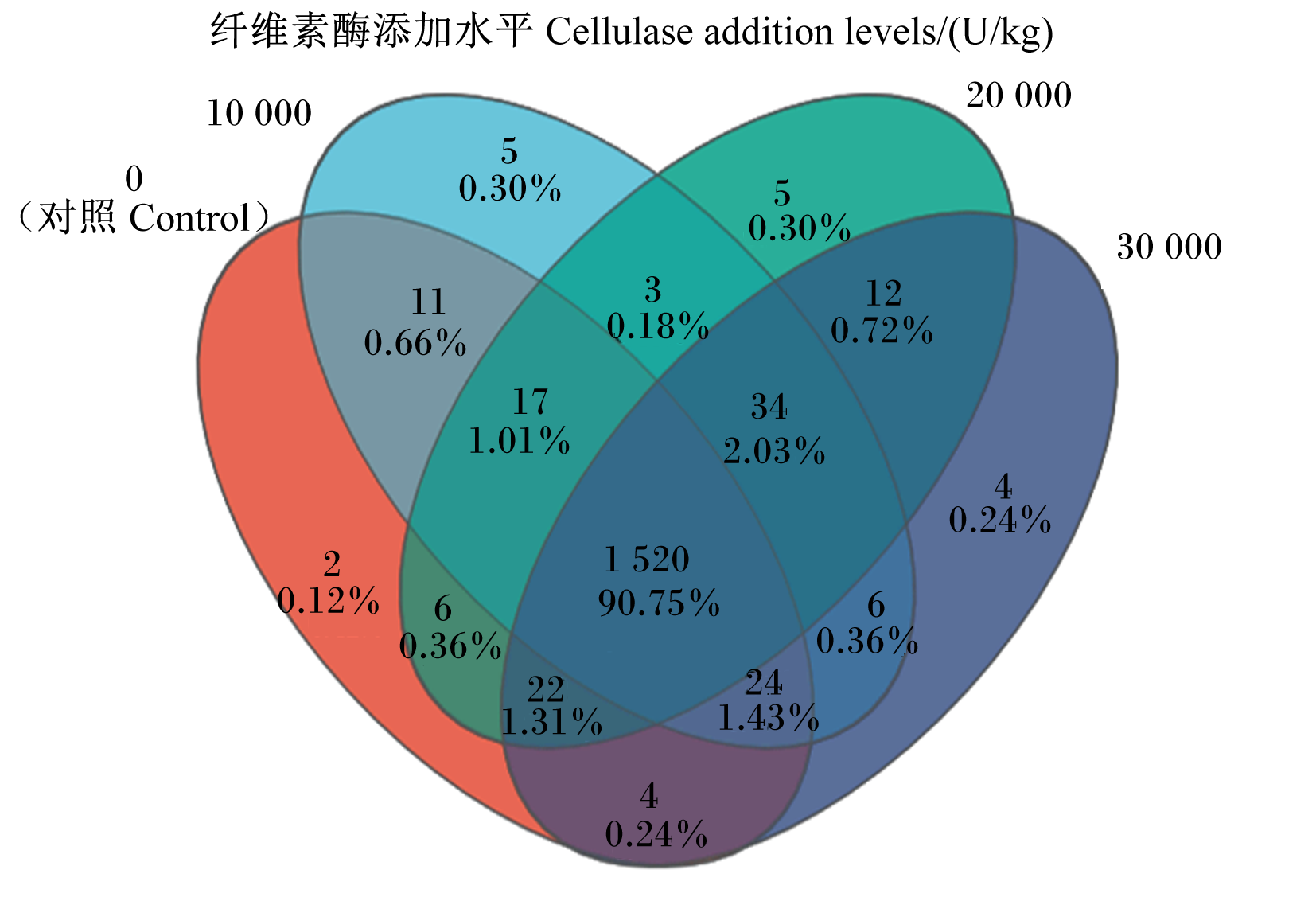
韦恩图(图1)分析结果显示,所有样本共检测到1 675个OTU,4组共有OTU数为1 520个,占总OTU数的90.75%;对照组特有2个OTU,占总OTU数的0.12%,10 000和20 000 U/kg组均特有5个OTU,各占总OTU数的0.30%,30 000 U/kg组特有4个OTU,占总OTU数的0.24%。
2.4.2 α多样性分析
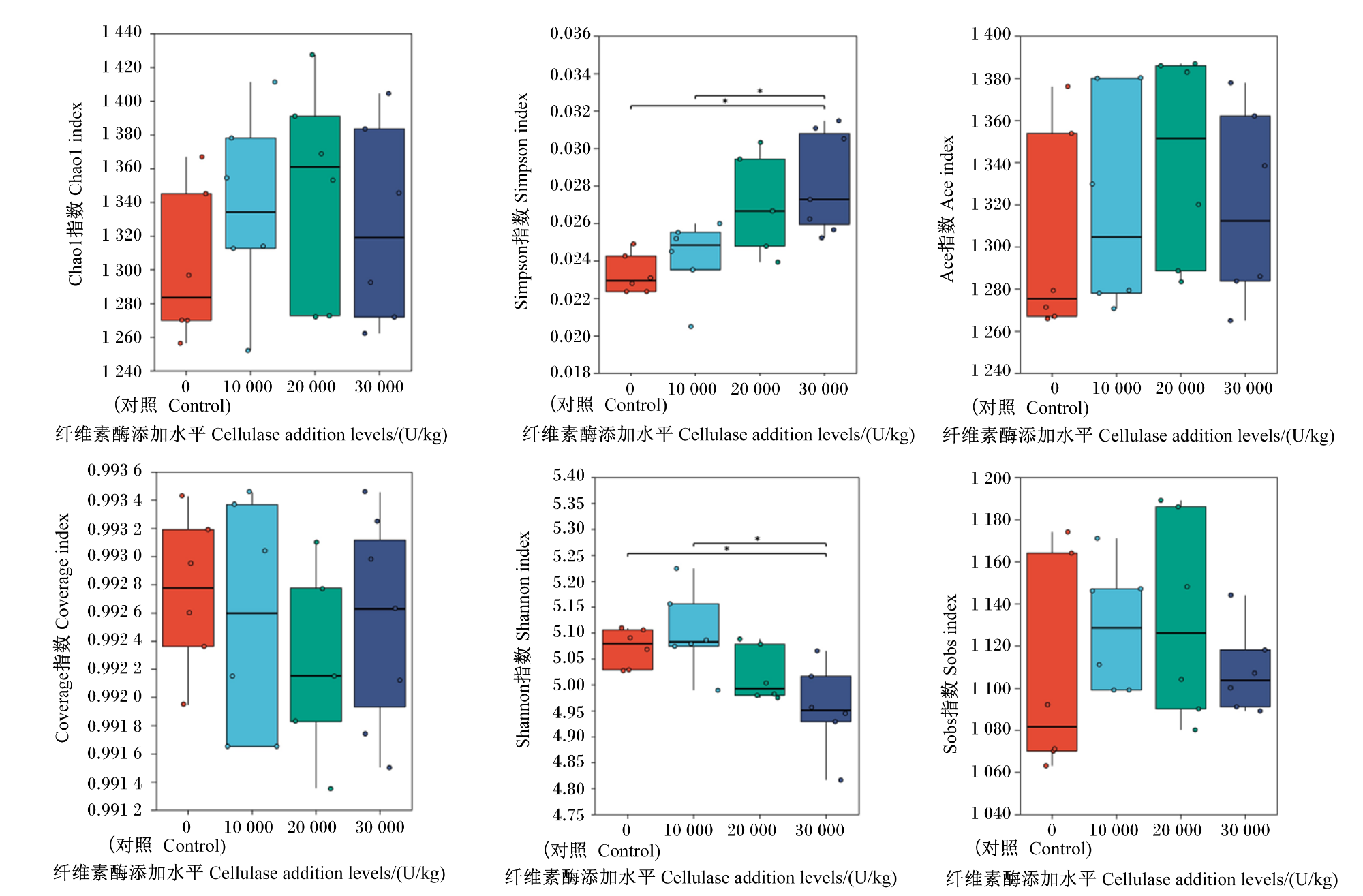
由图2可知,与对照组相比,30 000 U/kg组Simpson指数显著提高(P<0.05),Shannon指数显著降低(P<0.05),Chao1、Ace、Coverage和Sobs指数均无显著变化(P>0.05)。
2.4.3 微生物群落组成及差异物种分析
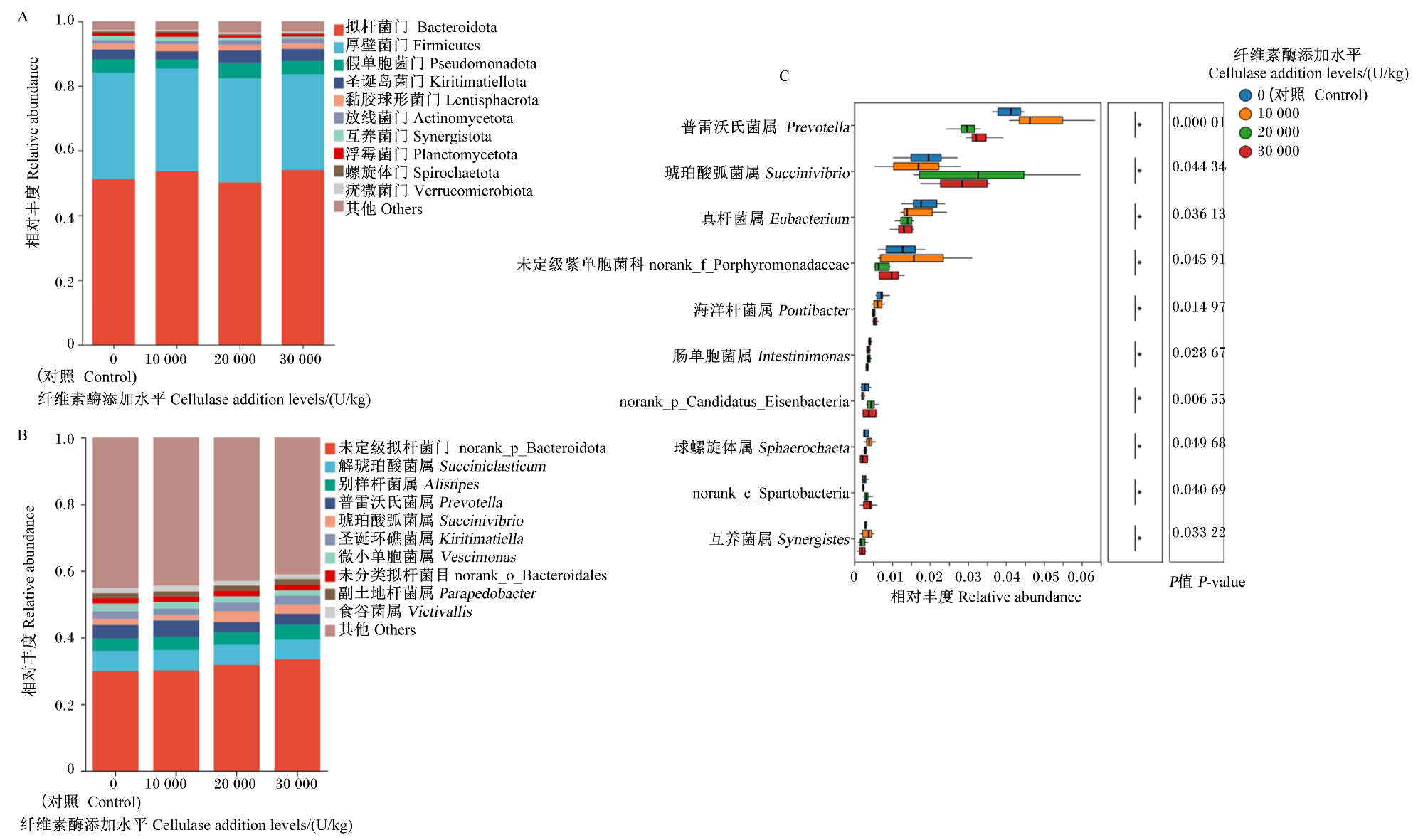
由图3-A可知,体外瘤胃发酵菌群的优势菌门为拟杆菌门(Bacteroidota)和厚壁菌门(Firmicutes)。与对照组相比,10 000和30 000 U/kg组拟杆菌门相对丰度提高,20 000和30 000 U/kg组厚壁菌门相对丰度降低。由图3-B可知,体外瘤胃发酵菌群相对丰度较高的菌属包括未定级拟杆菌门(norank_p_Bacteroidota)、解琥珀酸菌属、别样杆菌属(Alistipes)、普雷沃氏菌属(Prevotella)和琥珀酸弧菌属等,其中30 000 U/kg组解琥珀酸菌属相对丰度较对照组降低。由图3-C可知,与对照组相比,10 000 U/kg组普雷沃氏菌属相对丰度显著提高(P<0.05);20 000和30 000 U/kg组普雷沃氏菌属相对丰度显著降低(P<0.05),琥珀酸弧菌属相对丰度显著提高(P<0.05)。
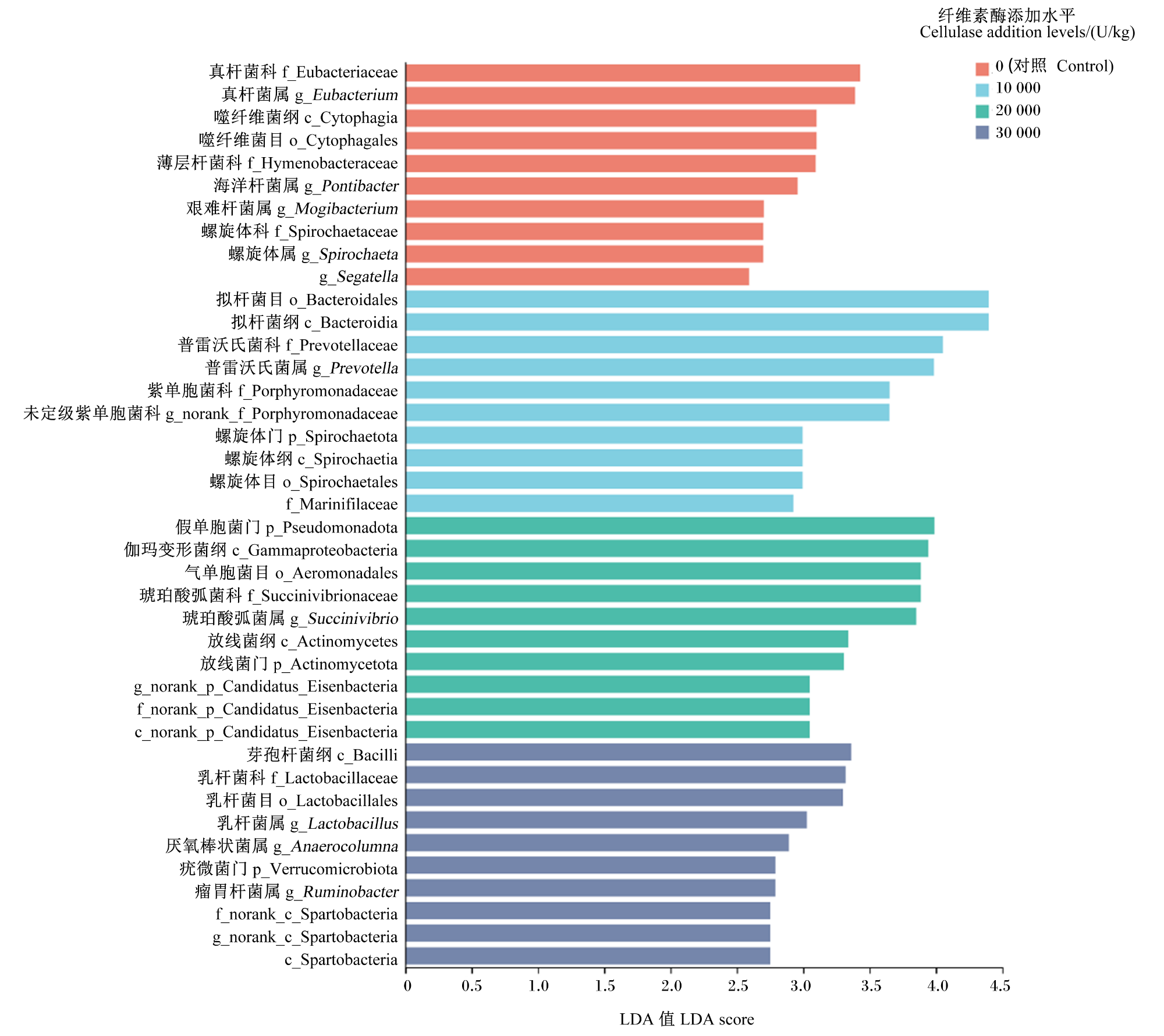
由LEfSe分析LDA值分布柱状图(图4)可知,对照组显著富集真杆菌科(Eubacteriaceae)、真杆菌属(Eubacterium)、噬纤维菌纲(Cytophaga)、噬纤维菌目(Cytophagales)和薄层杆菌科(Hymenobacteraceae)等菌群(P<0.05);10 000 U/kg组显著富集拟杆菌目(Bacteroidales)、拟杆菌纲(Bacteroidia)、普雷沃氏菌科(Prevotellaceae)和普雷沃氏菌属等菌群(P<0.05);20 000 U/kg组显著富集假单胞菌门(Pseudomonadota)、琥珀酸弧菌科(Succinivibrionaceae)和琥珀酸弧菌属等菌群(P<0.05);30 000 U/kg组显著富集芽孢杆菌纲(Bacilli)、乳杆菌科(Lactobacillaceae)、乳杆菌属(Lactobacillus)、疣微菌门(Verrucomicrobiota)和瘤胃杆菌属(Ruminobacter)等菌群(P<0.05)。


3 讨论
3.1 纤维素酶添加水平对辣椒秸秆体外瘤胃发酵产气量和营养物质降解率的影响
营养物质降解率通常用来评判饲粮营养价值和瘤胃微生物状态,而瘤胃微生物状态又反映了瘤胃内微生物对饲粮中营养物质的降解和利用能力[21]。Arif等[22]研究发现,在饲喂前使用纤维素酶对燕麦进行预处理,可显著提高泌乳牛的干物质表观消化率,本试验结果与之相符,在添加纤维素酶后,发酵24和48 h DMD均较对照组有所提高。Yang等[23]在外源纤维素酶处理蚕豆对瘤胃发酵特性的影响研究中也观察到了相似结果。NDFD与ADFD是评价饲粮消化率的重要指标,与纤维素和半纤维素的消化程度密切相关[24]。本试验中,发酵6和12 h时,试验组NDFD和ADFD与对照组无显著差异;而发酵24和48 h时,试验组NDFD和ADFD均显著高于对照组。这一结果可能是由于饲料底物与酶需要一定时间反应,以增加植物细胞壁的孔隙,从而促进微生物与细胞壁的附着,Kong等[25]的研究也支持这一观点。
3.2 纤维素酶添加水平对辣椒秸秆体外瘤胃发酵参数的影响
发酵液pH反映发酵体系酸碱度,其水平主要受VFA和NH3-N浓度调控,并影响瘤胃微生物的活性与组成[26]。体外瘤胃发酵正常pH为6.0~7.0,当pH低于6.0时,会抑制瘤胃微生物的活性。Depeters等[27]研究得到的体外瘤胃发酵pH为6.50~6.96,与本试验结果相近。本试验结果表明,发酵6、12、24和48 h时,各试验组发酵液pH均低于对照组,原因可能是纤维素酶的添加加速了辣椒秸秆细胞壁的分解,导致发酵体系中VFA不断累积,进而引起pH降低。NH3-N是瘤胃微生物合成菌体蛋白的重要氮源[28]。本试验发现,与对照组相比,添加20 000和30 000 U/kg纤维素酶可显著提高发酵24和48 h时的NH3-N和MCP浓度。MCP的合成需消耗NH3-N,但本试验中NH3-N浓度未随MCP合成量增加而降低,原因可能是纤维素酶的添加促进了瘤胃微生物的增殖,同时提升了辣椒秸秆的降解率,进而使NH3-N浓度升高[23]。瘤胃VFA为反刍动物提供了超过70%的能量,是评价瘤胃发酵的重要指标之一[29]。本试验结果表明,发酵6 h时,各试验组TVFA浓度较对照组均显著提高;而在24和48 h时,仅纤维素酶添加水平30 000 U/kg组表现出显著提高。这一结果与Lamid等[30]的研究一致,其发现采用纤维素酶预处理稻草饲喂泌乳牛,可显著提高瘤胃内TVFA浓度,原因可能是pH降低所形成的瘤胃酸性条件促进了微生物对底物的发酵,进而增加了VFA的生成。进一步分析各VFA组分可知,与对照组相比,发酵6 h时,各试验组的乙酸、丙酸和丁酸浓度均显著提高;发酵12 h时,10 000和20 000 U/kg组的乙酸、丙酸和丁酸浓度显著提高;发酵24和48 h时,30 000 U/kg组的乙酸和丙酸浓度显著提高。该结果与祝欣悦等[11]的研究结果相符,其潜在机制可能在于,纤维素酶的添加强化了其与瘤胃微生物的协同效应,使纤维类底物的分解效率提升,进而促进了乙酸、丙酸、丁酸等VFA的合成与积累。
3.3 纤维素酶添加水平对辣椒秸秆体外发酵瘤胃微生物区系的影响
反刍动物的消化能力主要依赖于瘤胃内的微生物菌群,维持瘤胃菌群稳态对其健康生长具有重要意义。为提升反刍动物对营养物质的消化吸收效率,深入了解瘤胃微生物在粗饲料利用中的作用至关重要[31]。本试验结果表明,30 000 U/kg组Simpson指数显著高于对照组,该指数升高表明微生物菌群的物种均匀度提升。而30 000 U/kg组Shannon指数较对照组显著降低,这可能是由于添加纤维素酶使得发酵体系pH降低,抑制了部分微生物的生长,强化了优势菌群的主导地位,进而降低了物种多样性。在门水平上,本试验中各组优势菌门均为拟杆菌门和厚壁菌门。其中,拟杆菌门菌群主要参与蛋白质与碳水化合物的降解[32],厚壁菌门则包含大量纤维分解菌[33]。解琥珀酸菌属是厚壁菌门的主要优势菌属之一[34],该菌属可通过代谢生成琥珀酸,进而促进瘤胃内丙酸的合成[35]。在属水平上,本试验中相对丰度较高的菌属包括普雷沃氏菌属、解琥珀酸菌属和琥珀酸弧菌属等。与对照组相比,20 000和30 000 U/kg组的解琥珀酸菌属相对丰度降低,琥珀酸弧菌属相对丰度升高,原因可能是解琥珀酸菌属参与琥珀酸向丙酸的转化过程,其代谢活动导致自身丰度降低,而琥珀酸弧菌属的相对丰度与底物利用率呈正相关[36-37]。普雷沃氏菌属可与纤维素分解菌协同作用,促进植物细胞壁降解[38],但本试验中20 000和30 000 U/kg组该菌属相对丰度显著低于对照组,推测原因是普雷沃菌属代谢产生的琥珀酸,可被Dialister和/或考拉杆菌属(Phascolarctobacterium)利用,通过交叉喂养机制转化为丙酸;而丙酸的大量积累反向抑制了普雷沃氏菌属的生长繁殖[39]。
4 结论
添加纤维素酶可提高辣椒秸秆的体外产气量、营养物质降解率及NH3-N和TVFA浓度,改善体外瘤胃发酵效果。在本试验条件下,纤维素酶处理辣椒秸秆的适宜添加水平为30 000 U/kg。