RESEARCH PAPER

Effects of Soil Selenium Application in Simulated Potting on Quality of Alfalfa

  • QI Fangcun , 1 ,
  • QIE Xiaoxu 1 ,
  • ZHANG Shengping 1 ,
  • MA Wanhao 2 ,
  • ZHAO Guojun 3 ,
  • MA Chenglin 4 ,
  • ZHANG Qunying 1 ,
  • ZHANG Jianbo 1 ,
  • YANG Yingkui 1 ,
  • HAO Lizhuang , 1, * ,
  • BAI Binqiang , 1, *
Expand
  • 1 Key Laboratory of Plateau Grazing Animal Nutrition and Feed Science of Qinghai Province, Qinghai University, Xining 810016, China
  • 2 Yak Breeding and Extension Service Center of Qinghai Province, Datong 810100, China
  • 3 Haibei Prefecture Agricultural and Livestock Product Quality Safety Inspection and Testing Center, Haibei 812200, China
  • 4 Datong County Animal Husbandry and Veterinary Station, Datong 810100, China
* HAO Lizhuang, professor, E-mail: ;
BAI Binqiang, associate professor, E-mail:

Received date: 2025-11-28

  Online published: 2026-06-13

Abstract

This experiment was conducted to investigate the effects of different soil selenium application concentrations on conventional nutrients, biomass, selenium contents, selenium accumulation characteristics and in vitro fermentation gas production, gas production parameters, fermentation parameters of alfalfa under simulated potting conditions. A completely randomized design was employed, divided into 3 groups with 10 replicates in each group, 30 pots. The soil selenium application concentrations in 3 groups were 0 control (control group), 0.4 (low selenium application group) and 4.0 mg/kg (high selenium application group), respectively. The results showed as follows: 1) the fresh weight and dry weight in alfalfa of low selenium application group and high selenium application group were significantly higher than those of the control group (P<0.05). 2) With the soil selenium concentration increased, the alfalfa crude ash content was significantly increased (P<0.05), and the acid detergent fiber (ADF) content showed a decreasing trend (P=0.063); no significant differences were observed in contents of dry matter (DM), ether extract (EE), neutral detergent fiber (NDF), crude protein (CP), calcium (Ca) and phosphorus (P) in alfalfa among all groups (P>0.05). 3) With the soil selenium concentration increased, the contents of total selenium, inorganic selenium and organic selenium in alfalfa was significantly increased (P<0.05); the selenium transport coefficient of low selenium application group and high selenium application group was significantly higher than that of the control group (P<0.05). 4) The slow gas production, gas production rate and theoretical gas production of high selenium application group were significantly higher than those of the control group (P<0.05), and the slow gas production and theoretical gas production of low selenium application group were significantly higher than those of the control group (P<0.05). 5) No significant differences were observed in alfalfa in vitro fermentation parameters among all groups (P>0.05). In summary, the soil selenium application can enhance the biomass and selenium accumulation of alfalfa, improve the quality and in vitro rumen gas production parameters of alfalfa, and the optimal soil selenium concentration is 4.0 mg/kg.

Cite this article

QI Fangcun , QIE Xiaoxu , ZHANG Shengping , MA Wanhao , ZHAO Guojun , MA Chenglin , ZHANG Qunying , ZHANG Jianbo , YANG Yingkui , HAO Lizhuang , BAI Binqiang . Effects of Soil Selenium Application in Simulated Potting on Quality of Alfalfa[J]. Chinese Journal of Animal Nutrition, 2026 , 38(6) : 4704 -4715 . DOI: 10.12418/CJAN2026.376

硒(Se)是第4周期ⅥA族的非金属元素,是人和动物所必需的微量元素之一,参与人和动物机体抗氧化防御、甲状腺激素代谢和免疫调节等多种生理功能[1]。动物缺硒会导致机体代谢紊乱、生理功能受损等,可以通过在饲粮中添加硒或采食富硒牧草等方式来补充。硒是否为植物所必需的元素目前尚不清楚,但是关于硒对植物的相关研究较多。前人研究表明,在植物生长发育阶段,通过土壤中施用或叶面喷洒硒肥的方式能有效提高不同植物的营养水平,改善植株品质[2-3];廖青等[4]研究发现,土壤施硒可显著提高甘薯块硒含量及富硒能力;陈钟佃等[5]研究发现,土壤施硒可有效促进杂交狼尾草生长,提高其富硒能力。土壤施硒能显著提高黄瓜的抗氧化能力,增强抗逆性[6];相关研究还证实,与禾本科植物相比,豆科植物的富硒能力更强[7]
紫花苜蓿(Medicago sativa L.)是豆科、苜蓿属多年生草本植物,是一种典型的豆科牧草,兼具饲料作物与生态改良功能,具有蛋白质含量高、适应性强、易于家畜消化等特点,被誉为“牧草之王”,如今已成为我国畜牧业重要的饲草资源。孙鹏波等[8]研究发现,土壤中喷施纳米硒可有效提高紫花苜蓿产量、营养品质和富硒能力;Bai等[9]研究表明,土壤中适量施硒能显著提高紫花苜蓿叶片中抗氧化酶活性;与叶面施硒相比,土壤施硒能更持久地为植物生长提供硒源,减少叶面施硒时的挥发损失,植株能够通过根系吸收促进硒的转化与累积,土壤施硒更适合规模化富硒牧草生产[10]。但是目前关于土壤施硒对紫花苜蓿品质的研究鲜有报道,因此进行相关研究很有必要。
本试验选用中苜一号紫花苜蓿,该品种具有耐寒、耐旱、适应性强的特点,在青海高原地区推广应用广泛,其蛋白质含量高、抗逆性强,适合作为富硒牧草栽培的供试品种,通过研究盆栽模拟土壤施硒对紫花苜蓿品质的影响,旨在合理使用硒资源,为富硒紫花苜蓿生产提供理论支撑与技术指导,同时提升紫花苜蓿品质,助力富硒牧草产业标准化发展。

1 材料与方法

1.1 试验材料

硒源采用无水亚硒酸钠(Na2SeO3,上海中泰化学试剂有限公司),生长基质由土壤与蛭石按体积比3∶1混合制成。

1.2 试验设计

试验采用完全随机设计,分为3个组,每组10个重复,共30盆。各组土壤施硒浓度分别为0(对照组)、0.4(低施硒组)和4.0 mg/kg(高施硒组)。紫花苜蓿种植于聚乙烯盆(直径23 cm×高度21 cm)中,每盆填充5 kg土壤与蛭石混合生长基质。土壤理化性质见表1
表1 土壤理化性质

Table 1 Physicochemical properties of soil

项目
Items
组别 Groups
对照
Control
低施硒
Low selenium application
高施硒
High selenium application
总硒 Total selenium/(mg/kg) 0.38 1.22 4.75
总氮 Total nitrogen/(g/kg) 3.17 3.65 3.94
总磷 Total phosphorus/(g/kg) 2.63 2.53 2.70
总钾 Total potassium/(g/kg) 24.70 23.76 24.72
有机物 Organic matter/(g/kg) 62.20 66.40 70.50

表中为施硒后10 d的土壤理化性质。

The table shows the physicochemical properties of soil after 10 days of selenium application.

1.3 日常管理

试验于2023年6月在青海大学农牧实验楼102实验室进行。硒溶液按指定浓度均匀喷洒于土壤表面,播种前静置10 d。播种前,苜蓿种子在5%次氯酸钠溶液中进行表面消毒8 min,随后用去离子水彻底冲洗。每盆播种30~40粒种子,播种深度1.5 cm,出苗7 d后每盆间苗至20株。各组均放置于恒温光照培养箱中进行培育,各试验组植株均放置于恒温光照培养箱中进行培育,控制条件如下:昼夜温度分别调节为24~26 ℃和16~18 ℃,相对湿度为80%~85%,光周期为14 h光照、10 h黑暗,光照强度10 000 lx。

1.4 样品采集与生物量测定

经过2个月的生长周期,收割整株苜蓿植株,根系经去离子水冲洗后,立即浸入预冷0.5 mmol/L氯化钙(CaCl2)溶液中30 min,以溶解附着的硒及其他干扰元素。浸泡后植株用去离子水彻底冲洗,吸干表面水分,随后分离根茎。刈割后测定鲜草产量,然后根据水分含量计算鲜干比,得出干草产量。各组分别置于透气纸袋中,于105 ℃进行30 min脱酶处理,再于65 ℃干燥至恒重,使用便携式粉碎机粉碎过1 mm网筛后,放入自封袋中保存。

1.5 常规营养成分测定

干物质(DM)含量测定方法参照GB/T 6435—2014[11],粗蛋白质(CP)含量测定方法参照GB/T 6432—1994[12],粗脂肪(EE)含量测定方法参照GB/T 6433—2006[13],中性洗涤纤维(NDF)含量测定方法参照GB/T 20806—2022[14],酸性洗涤纤维(ADF)含量测定方法参照NY/T 1459—2007[15];粗灰分(Ash)含量测定方法参照GB/T 6438—2007[16],钙(Ca)和磷(P)含量测定方法参照GB/T 13885—2017[17]

1.6 总硒含量及硒形态的测定

参照GB/T 13883—2023[18]的方法测定紫花苜蓿中总硒含量,参照DB36/T 1243—2020[19]的方法测定紫花苜蓿中无机硒含量。有机硒含量计算公式如下:
有机硒含量=总硒含量-无机硒含量。

1.7 体外模拟紫花苜蓿的牦牛瘤胃液发酵品质测定

1.7.1 试验动物与瘤胃液采集

试验在青海大学畜牧兽医科学院青海省高原放牧家畜动物营养与饲料科学重点实验室开展。试验选取3头2~3岁、体重(150±5) kg、体况相似的健康公牦牛作为瘤胃液供体动物。试验牛采用拴系式饲养,每日07:00和18:00各饲喂1次,保证自由饮水。饲粮组成及营养水平见表2,预饲15 d后,次日清晨空腹采集瘤胃液后混合均匀。于晨饲前通过牦牛口腔吸取瘤胃液,瘤胃液保存至保温壶中(保证保温瓶内温度保持在39 ℃左右),带回实验室用4层纱布过滤,通入二氧化碳(CO2)排出空气。
表2 饲粮组成及营养水平(风干基础)

Table 2 Composition and nutritional levels of the diet (air-dry basis) %

原料
Ingredients
含量
Content
营养水平
Nutrient levels2)
含量
Content
燕麦青干草 Oat green hay 40.00 代谢能 ME/(MJ/kg) 9.93
玉米 Corn 32.00 粗蛋白质 CP 11.69
小麦麸 Wheat bran 9.00 中性洗涤纤维 NDF 33.06
豆粕 Soybean meal 14.00 酸性洗涤纤维 ADF 16.29
食盐 NaCl 1.00 钙 Ca 0.77
预混料 Premix1) 4.00 磷 P 0.36
合计 Total 100.00

1)每千克预混料包含 One kilogram of the premix contained the following: VA 250 000 IU,VD 60 000 IU,VE 1 000 IU,Fe 5 000 mg,Cu 300 mg,Zn 750 mg,Mn 1 250 mg。
2)代谢能为计算值,其他营养水平为实测值,测定方法同1.5。ME was a calculated value, while the other nutrient levels were measured values, and the measurement methods were the same as 1.5.

1.7.2 体外发酵培养

参照Menke等[20]方法配制人工瘤胃缓冲液,将瘤胃液与缓冲液按照1∶2的体积比混合,然后水浴加热至39 ℃,期间持续充入CO2形成厌氧环境,制成人工瘤胃发酵液。精确称取0.2 g牧草样品,置于100 mL培养管中,添加30 mL人工瘤胃发酵液,每种样品设置3个平行,并设置3个空白对照,进行体外产气试验,在恒温水浴摇床中培养72 h后终止发酵。

1.7.3 pH及体外产气量测定

分别读取发酵0、2、4、6、8、12、16、24、36、48、54、60、66、72 h的产气量。在恒温水浴中培养72 h后终止发酵,使用便携式pH计测定发酵液的pH。产气量计算公式如下:
产气量(mL)=各时间段内培养管产气量-对应时间段内空白管平均产气量。

1.7.4 产气参数预测

基于Ørskov等[21]提出的产气模型,将各时间点(2、4、6、8、12、16、24、36、48、54、60、66、72 h)的产气量代入模型,计算出产气参数。产气模型计算公式如下:
GP(mL)=a+b(1-e-ct)。
式中:GPt时刻的累计产气量(mL);a为快速产气量(mL);b为慢速产气量(mL);c为产气速率(%/h);t为发酵时间(h);a+b为理论产气量(mL)。

1.7.5 挥发性脂肪酸(VFA)、氨态氮(NH3-N)及微生物蛋白(MCP)含量的测定

参照冯宗慈等[22]的比色法测定NH3-N含量,参考Makkar[23]的考马斯亮蓝法测定MCP含量,使用气相色谱仪(GC-2014,日本岛津公司)按照使用说明书测定VFA含量。

1.8 数据分析

使用SPSS 26.0软件中的ANOVA程序进行单因素方差分析,结果以“平均值±标准差”表示,采用Duncan氏法进行多重比较,P<0.05表示差异显著,0.05≤P<0.10表示差异有显著的趋势。产气动力学参数利用SAS 9.4软件分析,折线图使用Excel 2019制作。

2 结果与分析

2.1 土壤施硒对紫花苜蓿生物量的影响

表3可知,低施硒组和高施硒组紫花苜蓿的鲜重和干重均显著高于对照组(P<0.05),且低施硒组和高施硒组之间差异不显著(P>0.05)。与对照组相比,低施硒组紫花苜蓿的鲜重和干重分别增加了57.80%和68.27%,高施硒组分别增加了53.99%和72.08%。
表3 土壤施硒对紫花苜蓿生物量的影响

Table 3 Effects of soil selenium application on biomass of alfalfag/盆

项目
Items
组别 Groups P
P-value
对照
Control
低施硒
Low selenium application
高施硒
High selenium application
鲜重 Fresh weight 25.19±4.31b 39.75±7.35a 38.79±4.31a 0.001
干重 Dry weight 3.94±0.53b 6.63±0.52a 6.78±1.29a <0.001

同行数据肩标不同小写字母表示差异显著(P<0.05),相同或无字母表示差异不显著(P>0.05)。下表同。

In the same row, values with different small letter superscripts mean significant difference (P<0.05), while with the same or no letter superscripts mean no significant difference (P>0.05). The same as below.

2.2 土壤施硒对紫花苜蓿常规营养成分的影响

表4可知,随着土壤施硒浓度的升高,紫花苜蓿的Ash含量显著增加(P<0.05),ADF含量呈下降趋势(P=0.063)。各组之间紫花苜蓿的DM、EE、CP、NDF、Ca和P含量差异均不显著(P>0.05)。
表4 土壤施硒对紫花苜蓿常规营养成分的影响(风干基础)

Table 4 Effects of soil selenium application on conventional nutrients of alfalfa (air-dry basis) %

项目
Items
组别 Groups P
P-value
对照
Control
低施硒
Low selenium application
高施硒
High selenium application
干物质 DM 16.08±3.66 17.06±2.87 17.69±4.11 0.740
粗灰分 Ash 16.13±0.10c 16.73±0.08b 16.95±0.11a <0.001
粗脂肪 EE 7.39±1.39 8.32±0.30 7.48±0.16 0.601
粗蛋白质 CP 22.11±0.19 22.15±0.20 22.17±0.59 0.965
中性洗涤纤维 NDF 32.42±4.28 30.36±0.74 28.07±2.58 0.265
酸性洗涤纤维 ADF 27.18±2.07 26.80±0.96 22.97±1.32 0.063
钙 Ca 1.33±0.43 1.18±0.24 1.17±0.10 0.747
磷 P 0.29±0.04 0.29±0.04 0.26±0.01 0.596

2.3 土壤施硒对紫花苜蓿硒含量的影响

表5可知,随着土壤施硒浓度的升高,紫花苜蓿的地上和地下硒含量均显著升高(P<0.05)。低施硒组地上和地下硒含量分别是对照组的2.11倍和1.26倍,高施硒组分别是对照组的23.62倍和125.73倍。
表5 土壤施硒对紫花苜蓿硒含量的影响(风干基础)

Table 5 Effects of soil selenium application on selenium content of alfalfa (air-dry basis)μg/kg

项目
Items
组别 Groups P
P-value
对照
Control
低施硒
Low selenium application
高施硒
High selenium application
地上 Above ground 29.40±0.10c 62.15±7.50b 694.40±15.51a <0.001
地下 Under ground 148.23±4.53c 186.78±9.73b 1 785.38±25.85a <0.001

2.4 土壤施硒对紫花苜蓿硒累积特征的影响

表6可知,随着土壤施硒浓度的升高,紫花苜蓿的总硒、无机硒、有机硒含量均显著升高(P<0.05);低施硒组和高施硒组紫花苜蓿的硒转运系数显著高于对照组(P<0.05),且低施硒组和高施硒组之间差异不显著(P>0.05)。高施硒组的总硒、无机硒、有机硒含量和硒转运系数分别是对照组的23.67倍、4.63倍、23.85倍和1.95倍,低施硒组分别是对照组的2.12倍、2.31倍、2.11倍和1.65倍。
表6 土壤施硒对紫花苜蓿硒累积特征的影响(风干基础)

Table 6 Effects of soil selenium application on selenium accumulation characteristics of alfalfa (air-dry basis)

项目
Items
组别 Groups P
P-value
对照
Control
低施硒
Low selenium application
高施硒
High selenium application
总硒 Total selenium/(μg/kg) 14.67±0.06c 31.07±3.76b 347.17±7.75a <0.001
无机硒 Inorganic selenium/(μg/kg) 0.16±0.01c 0.37±0.04b 0.74±0.02a <0.001
有机硒 Organic selenium/(μg/kg) 14.53±0.06c 30.70±3.82b 346.47±7.75a <0.001
硒转运系数
Selenium transport coefficient
0.20±0.01b 0.33±0.06a 0.39±0.01a <0.001

2.5 土壤施硒对紫花苜蓿体外发酵特性的影响

2.5.1 土壤施硒对紫花苜蓿体外发酵产气量的影响
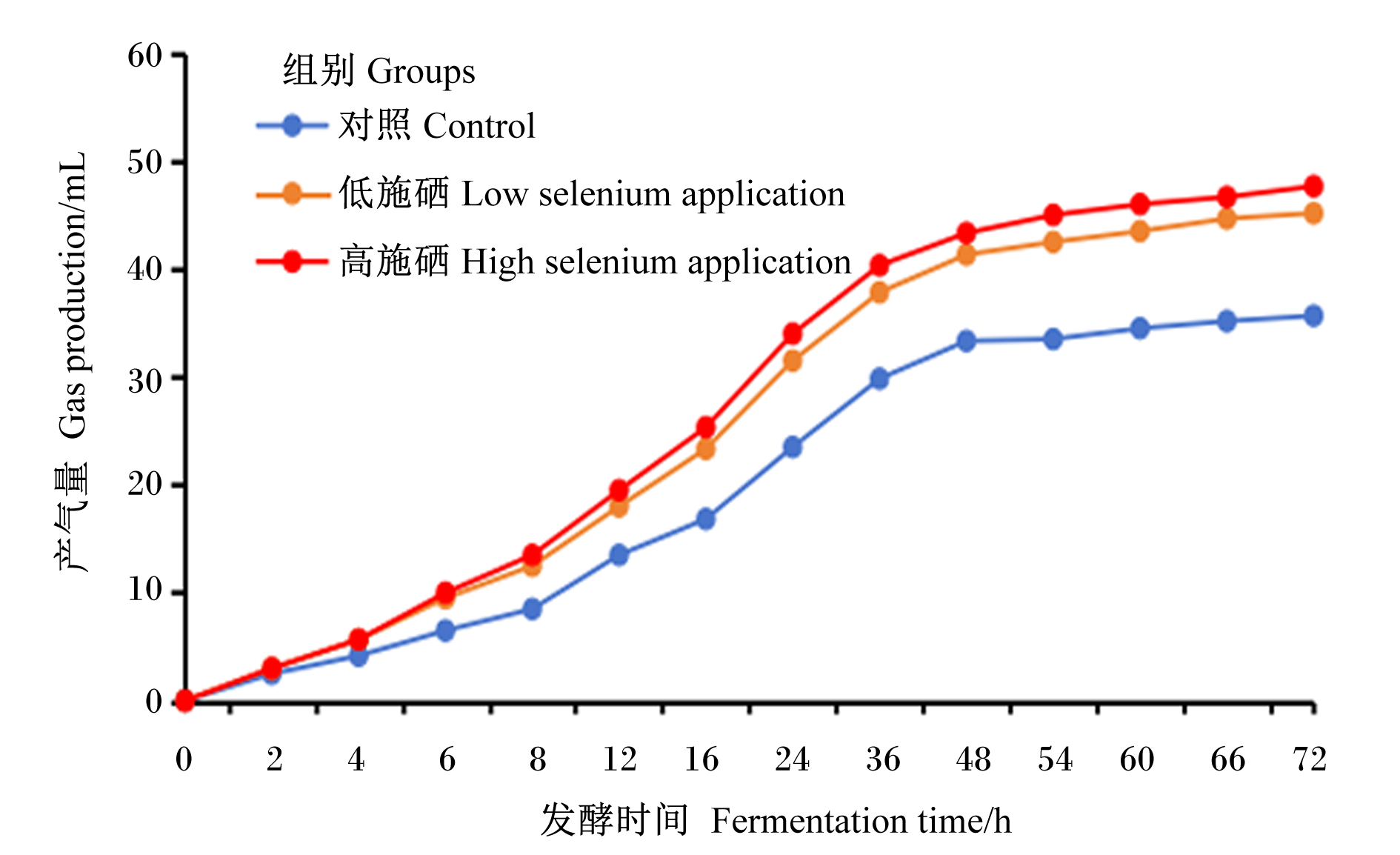
图1可知,随着发酵时间的增加,各组的紫花苜蓿产气量均不同程度的增加。高施硒组的紫花苜蓿在各发酵时间的产气量均为最高,而低施硒组的产气量次之,对照组的产气量最低。各组紫花苜蓿的产气量均呈增长态势,0~48 h的产气量增长速度较快,48 h后增长速度放缓,72 h时发酵结束。
图1 紫花苜蓿体外发酵产气量的变化曲线

Fig.1 Variation curve of gas production during in vitro fermentation of alfalfa

2.5.2 土壤施硒对紫花苜蓿产气参数的影响

表7可知,产气参数中各组快速产气量均为负值。高施硒组中慢速产气量、产气速率和理论产气量显著高于对照组(P<0.05),分别高出29.66%、25.00%、28.27%;低施硒组中慢速产气量和理论产气量显著高于对照组(P<0.05),分别高出22.90%、23.23%。
表7 土壤施硒对紫花苜蓿产气参数的影响

Table 7 Effects of soil selenium application on gas production parameters of alfalfa

项目
Items
组别 Groups P
P-value
对照
Control
低施硒
Low selenium application
高施硒
High selenium application
快速产气量 a/mL -1.82±0.59 -2.11±0.44 -2.87±0.77 0.342
慢速产气量 b/mL 39.92±0.65b 49.06±0.31a 51.76±1.90a 0.004
产气速率 c/(%/h) 0.04±0.00b 0.05±0.00ab 0.05±0.00a 0.040
理论产气量 a+b/mL 38.10±1.24b 46.95±0.75a 48.87±1.11a 0.004

2.5.3 土壤施硒对紫花苜蓿体外发酵参数的影响

表8可知,各组之间紫花苜蓿的pH及NH3-N、MCP、乙酸、丙酸、异丁酸、丁酸、异戊酸、戊酸、总挥发性脂肪酸(TVFA)含量差异均不显著(P>0.05)。高施硒组的pH及NH3-N、MCP、乙酸、丙酸、异丁酸、丁酸、异戊酸、戊酸、T-VFA的含量均高于对照组;低施硒组pH及NH3-N、MCP、丙酸、异丁酸、丁酸含量略低于对照组,乙酸、丙酸含量高于对照组,异丁酸含量无变化。
表8 土壤施硒对紫花苜蓿体外发酵参数的影响

Table 8 Effects of soil selenium application on in vitro fermentation parameters of alfalfa

项目
Items
组别 Groups P
P-value
对照
Control
低施硒
Low selenium application
高施硒
High selenium application
pH 7.13±0.03 7.11±0.01 7.14±0.01 0.203
氨态氮 NH3-N/(mg/dL) 46.33±1.99 44.90±1.73 47.89±2.09 0.417
微生物蛋白 MCP/(g/L) 1.01±3.41 1.00±5.61 1.02±3.93 0.904
乙酸 AA/(mmol/L) 39.32±0.64 40.49±2.76 42.89±1.43 0.179
丙酸 PA/(mmol/L) 11.88±0.11 11.80±0.86 12.55±0.50 0.348
异丁酸 IBA/(mmol/L) 1.12±0.11 1.07±0.04 1.13±0.11 0.790
丁酸 BA/(mmol/L) 4.86±0.78 4.82±0.41 5.36±0.36 0.470
异戊酸 IVA/(mmol/L) 2.24±0.34 2.24±0.04 2.32±0.27 0.928
戊酸 VA/(mmol/L) 0.96±0.01 1.06±0.08 1.14±0.08 0.126
乙酸/丙酸 AA/PA 3.33±0.07 3.44±0.01 3.42±0.03 0.119
总挥发性脂肪酸 TVFA/(mmol/L) 58.93±0.54 61.46±4.13 65.39±2.72 0.143

3 讨论

3.1 土壤施硒对紫花苜蓿生物量的影响

植物生物量是反映其DM积累、养分分配及环境适应性的重要指标,地上和地下生物量分配反映了植物适应环境变化的策略[24-25]。本试验条件下,低施硒组和高施硒紫花苜蓿的鲜重和干重均显著高于对照组。胡华锋等[10]研究发现,低浓度硒可以提高紫花苜蓿的产量;Sun等[26]研究指出,硒处理可以提高紫花苜蓿产量;石彦召等[27]研究表明,通过叶片喷施硒肥可以提高花生产量,以上研究结果与本研究结果一致。因此,在紫花苜蓿生产中适量添加硒,有助于生物量的提高。

3.2 土壤施硒对紫花苜蓿常规营养成分的影响

常规营养成分作为评价牧草营养价值的基础,其含量的高低直接反映牧草品质的优劣[28]。Ash主要反映植物体中矿物质含量的变化,是评估植物营养状况和土壤肥力的重要指标。生长2个月的紫花苜蓿处于从幼苗期向生长旺盛期过渡的阶段,本试验中紫花苜蓿DM含量为16%~18%,即含水量为82%~84%,符合紫花苜蓿营养生长期规律,处于正常范围内。随着土壤施硒浓度的升高,紫花苜蓿的Ash含量显著增加,这可能是因为紫花苜蓿通过吸收土壤中的硒,改变了自身营养的积累和分配方式,促进吸收了更多的矿物质元素,而Ash是牧草矿物质营养的重要组成部分,硒可能抑制了其他元素的吸收,导致Ash含量上升[29]。CP是评价牧草营养品质的关键指标,含量越高代表营养品质越好[30]。Sun等[31]研究发现,纳米硒能够调控氮代谢过程,促进植物对氮的积累,提高CP含量。孙鹏波等[8]研究发现,添加不同硒源及其不同浓度可以提高紫花苜蓿CP含量,以添加100 mg/L纳米硒的效果最佳;杨文秀等[32]研究发现,喷施低浓度亚硒酸钠可提高油菜CP含量,降低游离氨基酸含量,与Matich等[33]研究结果一致。本研究表明,紫花苜蓿CP含量随着土壤施硒浓度的升高无显著变化,这与以上研究结果并不相同,造成的原因可能是本试验是盆栽试验,其存在土壤容量小、根系发育不完全、微生物活性低等情况,硒无法被充分吸收利用形成蛋白质,导致并未表现出显著差异。NDF和ADF含量对牧草的适口性有直接影响,其含量越低,表示牧草适口性越好,营养品质越佳[34]。本试验结果显示,紫花苜蓿中NDF和ADF含量随着土壤施硒浓度的升高而降低。孙鹏波等[8]研究表明,在紫花苜蓿生长前期一次性施用高浓度或多次施用低浓度的纳米硒,可以降低ADF和NDF含量,与本试验结果一致,这说明在土壤施硒会影响纤维的合成,进而提高紫花苜蓿的品质。EE富含热能,是提供能量的重要物质。本研究中,土壤施硒并没有对紫花苜蓿EE含量造成显著影响,但是在土壤施硒浓度为0.4 mg/kg条件下的紫花苜蓿EE含量高于其他组,可能是0.4 mg/kg的施硒浓度更能促进紫花苜蓿的合成及积累。牧草中Ca、P含量对反刍动物的生长发育和机体代谢具有重要意义。在本研究结果中,土壤施硒后紫花苜蓿的Ca与P含量随施硒浓度的升高而降低。Arinzechi等[35]研究表明,硒和Ca之间存在较强的负相关关系,而Ca与P之间存在一定程度的拮抗与协同作用,硒的增加会影响植物对Ca、P的吸收,这与本研究中得到的结果相似。

3.3 土壤施硒对紫花苜蓿总硒含量及硒累积特征的影响

植物在生长期间会从土壤中吸收无机硒并转化为有机硒,是人和动物摄入硒的直接来源。直接对土壤施硒是一个高效的补硒方式,能够有效提高植物硒含量[36]。张霞[37]研究发现,随着施硒水平的升高,小麦硒含量也随着增加;张瑞标[38]研究表明,龙须菜的硒含量随施硒水平升高而增加;陈火云等[39]研究结果得出同样的结论,喷施硒肥后油菜籽粒硒含量显著增加,以上研究结果与本试验结果一致。本研究发现,土壤施硒能够显著提高紫花苜蓿总硒、无机硒和有机硒含量,同时硒在土壤-植物间的硒转运系数随土壤施硒浓度的升高而增加,这说明紫花苜蓿对硒具有较强的吸收和富集能力。同时与白三叶、红三叶豆科牧草相比,紫花苜蓿的硒富集能力更强,这说明其富硒能力在豆科牧草中处于较高水平[40]。本试验通过盆栽模拟土壤施硒的方式提高了硒含量,但施硒的效果可能因浓度不同而存在显著差异。

3.4 土壤施硒对紫花苜蓿的牦牛瘤胃液体外模拟发酵品质的影响

3.4.1 土壤施硒对紫花苜蓿体外发酵产气量及产气参数的影响

产气量是评价饲料营养价值的一项重要指标,直接关系饲料的营养价值,产气量越高,饲料中能够利用的营养成分越多,其微生物活性就越高[41]。本试验中,高施硒组的各发酵时间的产气量均高于对照组,其原因可能是与紫花苜蓿的发酵程度及瘤胃微生物活性高有关;产气量土壤施硒浓度的增加而增加,可能是土壤施硒对紫花苜蓿部分营养成分的累积产生了影响,从而改变了微生物活动,提高了产气量。
体外产气参数是反映瘤胃微生物对饲料不同成分降解效果的重要指标[42]。本研究中,3个组的快速产气量均为负值,表明存在发酵滞后现象,这可能与植物体富含纤维类物质,导致其需要更长的微生物适应时间有关;慢速产气量是衡量微生物降解纤维素能力的指标,慢速产气量越高,为瘤胃微生物所提供的发酵底物越持久,纤维物质的消化率越高[43]。本研究中,高施硒组具有较高的慢速产气量和理论产气量值,表明4.0 mg/kg施硒浓度可以较好地提升紫花苜蓿中纤维组分在牦牛中的降解效率。

3.4.2 土壤施硒对紫花苜蓿体外发酵参数的影响

体外发酵参数直接关系到饲料营养价值的高低[41]。瘤胃液pH是直观地反映瘤胃发酵状态的重要指标,pH过高或过低都会直接影响瘤胃微生物活性导致发酵异常。研究发现,瘤胃pH在5.5~7.7之间波动[44]。本试验中,紫花苜蓿的体外发酵pH为7.11~7.14,均处于适宜pH范围,这说明没有对反刍动物造成不良影响。NH3-N是衡量瘤胃氮代谢效率的重要指标,反映瘤胃MCP降解与合成之间的平衡情况[45]。本试验条件下,土壤施硒并未对体外发酵中NH3-N含量产生显著影响,这表明土壤施硒对牦牛瘤胃氮代谢无明显影响;各组之间MCP含量差异均不显著,其结果与CP含量结果一致,但低施硒组的NH3-N含量较对照组略低,可能是低浓度硒未显著影响微生物的生长增殖,瘤胃微生物吸收的NH3-N未用于蛋白质合成或积累,而是通过氮素储存或形态转化等途径进行了消耗,因此MCP和CP总量保持稳定。VFA是反刍动物的主要能量来源,其含量及组成是衡量反刍动物瘤胃发酵能力的关键指标[46]。本试验中,紫花苜蓿的乙酸、丙酸、异丁酸、丁酸、异戊酸、戊酸及TVFA含量分别为39.32~42.89 mmol/L、11.80~12.55 mmol/L、1.07~1.13 mmol/L、4.82~5.36 mmol/L、2.24~2.32 mmol/L、0.96~1.14 mmol/L及58.93~65.39 mmol/L,其中高施硒组紫花苜蓿的各VFA含量均为最高;随着土壤施硒浓度的增加,各组紫花苜蓿的TVFA含量虽差异不显著,但明显升高,这说明土壤施硒可以提高紫花苜蓿的能量利用效率,能够为反刍动物提供更多的能量,有利于反刍动物的生长。

4 结论

本试验条件下,盆栽模拟土壤施硒能促进紫花苜蓿生长,降低粗纤维含量,提高生物量和硒累积量,改善紫花苜蓿品质和体外瘤胃产气参数,其中土壤施硒4.0 mg/kg为紫花苜蓿富硒栽培的适宜浓度。
[1]
吴小丽, 张慧娜. 不同类型硒肥对甜瓜光合作用、果实品质及硒含量的影响[J]. 热带农业科学, 2025, 45(4):30-34.

WU X L, ZHANG H N. Effects of different selenium fertilizer sources on photosynthesis,fruit quality,and selenium content in muskmelon[J]. Chinese Journal of Tropical Agriculture, 2025, 45(4):30-34. (in Chinese)

[2]
ALSAMADANY H, ALHARBY H F, AL-ZAHRANI H S, et al. Selenium fortification stimulates antioxidant- and enzyme gene expression-related defense mechanisms in response to saline stress in Cucurbita pepo[J]. Scientia Horticulturae, 2023, 312:111886.

DOI

[3]
孙小川, 丁竞, 王纪忠, 等. 外源硒对萝卜芽苗菜生长特性及营养品质的影响[J]. 黑龙江农业科学, 2023(8):66-71.

SUN X C, DING J, WANG J Z, et al. Effects of exogenous selenium on growth characteristics and nutritional quality of radish sprouts[J]. Heilongjiang Agricultural Sciences, 2023(8):66-71. (in Chinese)

[4]
廖青, 邢颖, 梁潘霞, 等. 甘薯自然富硒能力测定及施硒方式对甘薯硒含量的影响[J]. 西南农业学报, 2017, 30(8):1838-1842.

LIAO Q, XING Y, LIANG P X, et al. Natural selenium-enriched ability of sweet potatoes and effect of ways of applying selenium on selenium content of sweet potato[J]. Southwest China Journal of Agricultural Sciences, 2017, 30(8):1838-1842. (in Chinese)

[5]
陈钟佃, 邱水玲, 冯德庆, 等. 土壤施硒量对杂交狼尾草生长和硒积累的影响[J]. 草地学报, 2024, 32(3):838-847.

DOI

CHEN Z D, QIU S L, FENG D Q, et al. Effects of selenium application on the production and selenium accumulation of hybrid Pennisetum[J]. Acta Agrestia Sinica, 2024, 32(3):838-847. (in Chinese)

[6]
何璇, 张平安, 丁光武, 等. 外源硒对黄瓜富硒及抗氧化反应和营养品质的影响研究[J]. 核农学报, 2024, 38(8):1568-1574.

DOI

HE X, ZHANG P A, DING G W, et al. A study on the effects of exogenous selenium on selenium enrichment,antioxidant response and nutritional quality of cucumber[J]. Journal of Nuclear Agricultural Sciences, 2024, 38(8):1568-1574. (in Chinese)

[7]
彭琴, 李哲, 梁东丽, 等. 不同作物对外源硒动态吸收、转运的差异及其机制[J]. 环境科学, 2017, 38(4):1667-1674.

PENG Q, LI Z, LIANG D L, et al. Dynamic differences of uptake and translocation of exogenous selenium by different crops and its mechanism[J]. Environmental Science, 2017, 38(4):1667-1674. (in Chinese)

DOI

[8]
孙鹏波, 王志军, 格根图, 等. 喷施纳米硒对紫花苜蓿产量、营养品质和硒含量的影响[J]. 中国草地学报, 2023, 45(8):79-87.

SUN P B, WANG Z J, GE G T, et al. Effects of nano-selenium spraying on yield,nutritional quality,and selenium content of alfalfa[J]. Chinese Journal of Grassland, 2023, 45(8):79-87. (in Chinese)

[9]
BAI B Q, WANG Z, GAO L M, et al. Effects of selenite on the growth of alfalfa (Medicago sativa L. cv. Sadie 7) and related physiological mechanisms[J]. Acta Physiologiae Plantarum, 2019, 41(6):78.

DOI

[10]
胡华锋, 王彦华, 李明, 等. 叶面施硒对紫花苜蓿产草量及吸硒特性的影响[J]. 草地学报, 2015, 23(6):1347-1350.

DOI

HU H F, WANG Y H, LI M, et al. Effects of foliar selenium on the forage yield of alfalfa and selenium absorption characteristics[J]. Acta Agrestia Sinica, 2015, 23(6):1347-1350. (in Chinese)

[11]
中华人民共和国国家质量监督检验检疫总局, 中国国家标准化管理委员会. 饲料中水分的测定:GB/T6435—2014[S]. 北京: 中国标准出版社, 2014.

General Administration of Quality Supervision, Inspection and Quarantine of the People’s Republic of China, China National Standardization Administration. Determination of moisture in feedstuffs: GB/T 6435—2014[S]. Beijing: Standards Press of China, 2014. (in Chinese)

[12]
中国国家标准化管理委员会. 饲料中粗蛋白测定方法:GB/T6432—1994[S]. 北京: 中国标准出版社, 1994.

National Standardization Administration. Method for the determination of crude protein in feedstuffs:GB/T 6432—1994[S]. Beijing: Standards Press of China, 1994. (in Chinese)

[13]
中华人民共和国国家质量监督检验检疫总局, 中国国家标准化管理委员会. 饲料中粗脂肪的测定:GB/T6433—2006[S]. 北京: 中国标准出版社, 2006.

General Administration of Quality Supervision,Inspection and Quarantine of the People’s Republic of China,National Standardization Administration. Determinaiion of crude fat in feeds:GB/T 6433—2006[S]. Beijing: Standards Press of China, 2006. (in Chinese)

[14]
中华人民共和国国家质量监督检验检疫总局, 中国国家标准化管理委员会. 饲料中中性洗涤纤维(NDF)的测定:GB/T20806—2006[S]. 北京: 中国标准出版社, 2006.

General Administration of Quality Supervision,Inspection and Quarantine of the People’s Republic of China,National Standardization Administration. Determination of neutral detergent fiber (NDF) in feedstuffs:GB/T 20806—2006[S]. Beijing: Standards Press of China, 2006. (in Chinese)

[15]
中华人民共和国农业部. 饲料中酸性洗涤纤维的测定:NY/T1459—2007[S]. 北京: 中国农业出版社, 2007.

Ministry of Agriculture of the People’s Republic of China. Determination of acid detergent fiber in feedstuff:NY/T 1459—2007[S]. Beijing: China Agricultural Press, 2007. (in Chinese)

[16]
中华人民共和国国家质量监督检验检疫总局, 中国国家标准化管理委员会. 饲料中粗灰分的测定:GB/T6438—2007[S]. 北京: 中国标准出版社, 2007.

General Administration of Quality Supervision,Inspection and Quarantine of the People’s Republic of China,National Standardization Administration. Animal feeding stuffs—determination of crude ash:GB/T 6438—2007[S]. Beijing: Standards Press of China, 2007. (in Chinese)

[17]
中华人民共和国国家质量监督检验检疫总局, 中国国家标准化管理委员会. 饲料中钙、铜、铁、镁、锰、钾、钠和锌含量的测定原子吸收光谱法:GB/T13885—2017[S]. 北京: 中国标准出版社, 2017.

General Administration of Quality Supervision,Inspection and Quarantine of the People’s Republic of China,National Standardization Administration. Determination of the contents of calcium,copper,iron,magnesium,manganese,potassium,sodium and zinc in feeds—method using atomic absorption spectrometry:GB/T 13885—2017[S]. Beijing: Standards Press of China, 2017. (in Chinese)

[18]
中华人民共和国国家市场监督检验检疫总局, 中国国家标准化管理委员会. 饲料中硒的测定:GB/T13883—2023[S]. 北京: 中国标准出版社, 2023.

State Administration for Market Regulation, National Standardization Administration. Determination of selenium in feeds:GB/T 13883—2023[S]. Beijing: Standards Press of China, 2023. (in Chinese)

[19]
江西省市场监督管理局. 稻米中有机硒和无机硒含量的测定氢化物原子荧光光谱法:DB36/T 1243—2020[S]. [s.l.]:[s.n.], 2020.

Jiangxi Market Supervision and Administration Bureau. Determination of organic selenium and inorganic selenium contents in rice hydride generation-atomic fluorescence spectrometry:DB36/T 1243—2020[S]. [s.l.]:[s.n.], 2020.

[20]
MENKE K H, STEINGASS H. Estimation of the energetic feed value obtained from chemical analysis and in vitro gas production using rumen flued[J]. Animal Research and Development, 1988, 28:7-55.

[21]
ØRSKOV E R, MCDONALD I. The estimation of protein degradability in the rumen from incubation measurements weighted according to rate of passage[J]. The Journal of Agricultural Science, 1979, 92(2):499-503.

DOI

[22]
冯宗慈, 高民. 通过比色测定瘤胃液氨氮含量方法的改进[J]. 畜牧与饲料科学, 2010, 31(6/7):37.

FENG Z C, GAO M. Improvements to the method for determining ammonia nitrogen content in rumen fluid by colorimetric analysis[J]. Animal Husbandry and Feed Science, 2010, 31(6/7):37. (in Chinese)

[23]
MAKKAR H P S. In vitro gas methods for evaluation of feeds containing phytochemicals[J]. Animal Feed Science and Technology, 2005, 123-124(Pt 1):291-302.

DOI

[24]
王家妍, 蒋丰璟, 李青春, 等. 人工林种植模式对天门冬生物量、养分含量及品质的影响[J]. 经济林研究, 2024, 42(4):145-154.

WANG J Y, JIANG F J, LI Q C, et al. Effects of understory intercropping on biomass and nutrient stoichiometry of Asparagus cochinchinensis[J]. Non-wood Forest Research, 2024, 42(4):145-154. (in Chinese)

[25]
王娇, 关欣, 张伟东, 等. 杉木幼苗生物量分配格局对氮添加的响应[J]. 植物生态学报, 2021, 45(11):1231-1240.

DOI

WANG J, GUAN X, ZHANG W D, et al. Responses of biomass allocation patterns to nitrogen addition of Cunninghamia lanceolata seedlings[J]. Chinese Journal of Plant Ecology, 2021, 45(11):1231-1240. (in Chinese)

DOI

[26]
SUN M F, WANG J J, LIU W, et al. Effect and mechanism of exogenous selenium on selenium content and quality of fresh tea leaves[J]. Notulae Botanicae Horti Agrobotanici Cluj-Napoca, 2022, 50(3):12814.

DOI

[27]
石彦召, 和爱玲, 朱桢桢, 等. 叶面喷施硒肥对花生光合特性、经济性状、籽仁硒含量及产量的影响[J]. 陕西农业科学, 2024, 70(11):74-80,97.

SHI Y Z, HE A L, ZHU Z Z, et al. Effects of foliar application of selenium fertilizer on photosynthetic characteristics,economic traits,selenium content in seed kernels and yield of peanut[J]. Shaanxi Journal of Agricultural Sciences, 2024, 70(11):74-80,97. (in Chinese)

[28]
李文娟, 王世琴, 姜成钢, 等. 体外法评定南方4种经济作物副产品及3种暖季型牧草的营养价值研究[J]. 畜牧与兽医, 2017, 49(4):33-39.

LI W J, WANG S Q, JIANG C G, et al. Nutritional value of 4 economic crop byproducts and 3 warm-season forage in the southern region of China using in vitro gas production method[J]. Animal Husbandry & Veterinary Medicine, 2017, 49(4):33-39. (in Chinese)

[29]
王莹, 马彦斌, 王泽晶. 基于有效硒的富硒土壤阈值及有效硒的影响因素[J]. 环境科学, 2023, 44(1):395-404.

WANG Y, MA Y B, WANG Z J. Threshold of Se-rich soil based on available-Se and influencing factors of available-Se[J]. Environmental Science, 2023, 44(1):395-404. (in Chinese)

[30]
YANG Z F, NIE G, PAN L, et al. Development and validation of near-infrared spectroscopy for the prediction of forage quality parameters in Lolium multiflorum[J]. PeerJ, 2017, 5:e3867.

DOI

[31]
SUN P B, GE G T, SUN L, et al. Metabolomics combined with physiology and transcriptomics reveal the regulation of key nitrogen metabolic pathways in alfalfa by foliar spraying with nano-selenium[J]. Journal of Nanobiotechnology, 2025, 23(1):7.

DOI PMID

[32]
杨文秀, 王萍, 杨晓宇, 等. 叶面施硒对油菜产量及品质的影响[J]. 内蒙古农业大学学报, 2010, 31(3):88-90.

YANG W X, WANG P, YANG X Y, et al. Effect of foliar application selenium on the yield and quality of pakchoi (Brassica campestris L. ssp. chinensis var. communis)[J]. Journal of Inner Mongolia Agricultural University, 2010, 31(3):88-90. (in Chinese)

[33]
MATICH A J, MCKENZIE M J, LILL R E, et al. Distribution of selenoglucosinolates and their metabolites in Brassica treated with sodium selenate[J]. Journal of Agricultural and Food Chemistry, 2015, 63(7):1896-1905.

DOI

[34]
李陇平, 吴仪, 王旭辉, 等. 陕北白绒山羊几种非常规饲料营养成分、体外发酵参数和酶活性研究[J]. 动物营养学报, 2025, 37(1):603-616.

DOI

LI L P, WU Y, WANG X H, et al. Study on nutritional composition,in vitro fermentation parameters and enzyme activity of several unconventional feeds for Shaanbei white cashmere goats[J]. Chinese Journal of Animal Nutrition, 2025, 37(1):603-616. (in Chinese)

[35]
ARINZECHI C, DONG C H, HUANG P C, et al. Correction:synergistic mitigation of cadmium stress in rice (Oryza sativa L.) through combined selenium,calcium,and magnesium supplementation[J]. Environmental Geochemistry and Health, 2024, 46(11):480.

DOI

[36]
周玲玲, 刘书华, 余翔, 等. 不同施硒量对黄花菜花蕾硒含量、品质和产量的影响[J]. 北方农业学报, 2024, 52(3):114-120.

DOI

ZHOU L L, LIU S H, YU X, et al. Effects of different selenium application amount on selenium content,quality and yield of flower buds of Hemerocallis citrina baroni[J]. Journal of Northern Agriculture, 2024, 52(3):114-120. (in Chinese)

[37]
张霞. 硒肥施用量及施用方式对小麦硒累积运转及土壤肥力的影响[D].硕士学位论文. 晋中: 山西农业大学, 2019.

ZHANG X. Effects of different selenium fertilizer amounts and application method on selenium accumulation transportation and soil fertility in wheat[D].Master’s Thesis. Jinzhong: Shanxi Agricultural University, 2019. (in Chinese)

[38]
张瑞标. 硒肥类型、水平和施肥方式对龙须菜生长、硒含量及营养品质的影响[J]. 饲料研究, 2025, 48(16):121-126.

ZHANG R B. Effects of selenium fertilizer types,levels and fertilization methods on growth,selenium content,and nutritional quality of Gracilariopsis lemaneiformis[J]. Feed Research, 2025, 48(16):121-126. (in Chinese)

[39]
陈火云, 谢义梅, 周灵, 等. 施硒方式对油菜生长和籽粒硒、镉、铅含量的影响[J]. 河南农业科学, 2019, 48(3):49-54.

CHEN H Y, XIE Y M, ZHOU L, et al. Effects of selenium application methods on the growth and the seed selenium,cadmium and lead contents in rape[J]. Journal of Henan Agricultural Sciences, 2019, 48(3):49-54. (in Chinese)

[40]
吴倩倩, 苏娅, 曾祥明, 等. 紫花苜蓿、白三叶硒蛋白的提取方法筛选及工艺优化[J]. 草地学报, 2024, 32(2):654-660.

DOI

WU Q Q, SU Y, ZENG X M, et al. Extraction method screening and process optimization of alfalfa and white clover selenoprotein[J]. Acta Agrestia Sinica, 2024, 32(2):654-660. (in Chinese)

[41]
SUN G Q, LV Y Y, ZHANG J J. A study on the associative effect of whole corn silage-peanut vine and Leymus chinensis by rumen fermentation in vitro[J]. Acta Prataculturae Sinica, 2014, 23(3):224-231.

[42]
代秦丹, 王之盛, 胡瑞, 等. 不同类型酒糟瘤胃发酵特性和甲烷产量的比较[J]. 动物营养学报, 2021, 33(6):3497-3506.

DOI

DAI Q D, WANG Z S, HU R, et al. Comparison of rumen fermentation characteristics and methane production of different distillers grains[J]. Chinese Journal of Animal Nutrition, 2021, 33(6):3497-3506. (in Chinese)

[43]
安靖, 杨艺, 吴文旋, 等. 体外产气法评价缓释尿素替代山羊饲粮中苜蓿蛋白的可行性[J]. 动物营养学报, 2023, 35(10):6516-6525.

DOI

AN J, YANG Y, WU W X, et al. Feasibility evaluation on replacing dietary alfalfa protein with slow-release urea using in vitro gas production technique for goats[J]. Chinese Journal of Animal Nutrition, 2023, 35(10):6516-6525. (in Chinese)

[44]
LLONCH L, CASTILLEJOS L, FERRET A. Increasing the content of physically effective fiber in high-concentrate diets fed to beef heifers affects intake,sorting behavior,time spent ruminating, and rumen pH[J]. Journal of Animal Science, 2020, 98(6):skaa192.

DOI

[45]
盛子阳, 王定发, 吕仁龙, 等. 假蒟提取物对海南黑山羊体外瘤胃发酵参数和干物质消化率的影响[J]. 中国畜牧杂志, 2024, 60(5):233-238.

SHENG Z Y, WANG D F, LV R L, et al. Effects of pseudoginger extract on in vitro rumen fermentation parameters and dry matter digestibility in Hainan black goats[J]. Chinese Journal of Animal Science, 2024, 60(5):233-238. (in Chinese)

[46]
WANG L J, ZHANG G N, LI Y, et al. Effects of high forage/concentrate diet on volatile fatty acid production and the microorganisms involved in VFA production in cow rumen[J]. Animals, 2020, 10(2):223.

DOI

Outlines

/