REVIEW

Regulatory Effects of Dietary Fiber-Derived Short-Chain Fatty Acids on Gut Health of Monogastric Animals

  • ZHANG Jiarui ,
  • XU Xiaofeng ,
  • ZHANG Lili , *
Expand
  • College of Animal Science and Technology, Ningxia University, Yinchuan 750021, China
* associate professor, E-mail:

Received date: 2025-12-29

  Online published: 2026-07-14

Abstract

Dietary fiber is a core natural source of short-chain fatty acids (SCFAs) in monogastric animal production that can be precisely regulated through diet formulation. SCFAs produced via intestinal microbial fermentation of dietary fiber serve as key metabolites regulating animal gut health and play an irreplaceable role in maintaining gut health of monogastric animals. As important energy substrates for intestinal epithelial cells, SCFAs also exert critical functions in sustaining intestinal barrier integrity, modulating intestinal immunity, and stabilizing intestinal microecological balance. This paper reviewed the classification and fermentation characteristics of dietary fiber, as well as the regulatory effects of its fermentation products on gut health of monogastric animals, with emphasis on the physiological functions of SCFAs and their mechanisms of action in intestinal mechanical barrier, immune response, and microbial homeostasis. It aims to provide references for nutritional regulation research and healthy breeding practices in monogastric animals.

Cite this article

ZHANG Jiarui , XU Xiaofeng , ZHANG Lili . Regulatory Effects of Dietary Fiber-Derived Short-Chain Fatty Acids on Gut Health of Monogastric Animals[J]. Chinese Journal of Animal Nutrition, 2026 , 38(7) : 4816 -4826 . DOI: 10.12418/CJAN2026.386

饲粮纤维是单胃动物饲粮中不可或缺的重要组分,在维持单胃动物肠道健康和功能稳定方面发挥着关键调控作用[1]。单胃动物缺乏可分解饲粮纤维的自身消化酶,其生理功能的实现主要依赖盲肠和结肠的肠道微生物发酵过程;作为单胃动物肠道短链脂肪酸(short-chain fatty acids,SCFAs)的天然核心生成底物,饲粮纤维进入单胃动物后肠后,可作为微生物的重要代谢底物,在特定菌群的作用下发酵转化为以乙酸、丙酸和丁酸为主的SCFAs[2]。这类纤维源SCFAs的生成及其在肠道的分布,均受纤维化学结构、生理特性及单胃动物肠道微生物群落组成和多样性的显著调控[3-4]。作为饲粮纤维代谢的核心产物,纤维源SCFAs不仅是单胃动物肠道上皮细胞的重要能量来源,还能调节肠道pH、改善肠黏膜屏障功能、参与肠道局部免疫调节,并通过营养供给与信号传导作用促进有益菌群定植和代谢,进而在单胃动物肠道生理稳态中发挥核心调控作用,深刻塑造其肠道微生态环境[5-6]

1 饲粮纤维的分类

饲粮纤维早期被定义为基于强酸强碱处理的“粗纤维”,但由于大部分半纤维素和部分木质素会因溶解而损失,因此此定义存在明显局限性[7]。饲粮纤维现代定义的奠基性转折源于Trowell等[8]提出的生理学定义,即饲粮纤维为“不被动物体消化酶水解的植物细胞壁成分”,该定义首次将关注点从化学组成转向了生理归宿,并隐含了纤维与后肠道微生物发酵的关键联系。此后,国际食品法典委员会将其定义为由3个及以上单体单元构成、且不在小肠消化的碳水化合物聚合物,并包括了木质素[9]。这一定义兼具精确性与包容性,涵盖了天然存在及经加工获得的具有生理益处的相关聚合物,也揭示了饲粮纤维并非是单一物质,而是一种异质性很强的混合物,因此其存在多种分类方式,可根据其来源、化学结构、溶解性以及发酵特性进行分类。从组成上看,饲粮纤维主要包括纤维素、半纤维素、果胶以及少量β-葡聚糖和木聚糖等,且不同类型纤维在结构和理化性质上的差异,决定了其在肠道中的发酵速度和发酵部位[10]。饲粮纤维的分类见表1[11-23]
表1 饲粮纤维的分类

Table 1 Classification of dietary fiber

分类依据
Classification basis
主要类别
Main categories
主要成分和来源
Main ingredients and sources
参考文献
References


来源
Source
谷物类纤维 成分:纤维素、木质素、β-葡聚糖、阿拉伯木聚糖;
来源:小麦麸、黑麦、玉米皮
[11-12]
豆类和油料籽实纤维 成分:纤维素、果胶多糖、木质素和木聚糖;
来源:大豆皮、豆粕、菜籽粕
[13-14]
水果蔬菜加工副产物 成分:纤维素、半纤维素、木质素、果胶;
来源:苹果渣、柑橘渣
[15-16]
特种功能性纤维 成分:菊粉、低聚果糖;来源:菊苣、菊芋 [17]


化学结构
Chemical structure
非淀粉多糖 成分:纤维素、半纤维素、果胶;
来源:麸皮、豆类


[18-20]
抗性低聚糖 成分:低聚果糖、低聚半乳糖;
来源:菊苣根、菊芋
抗性淀粉 来源:土豆、玉米
木质素 来源:小麦秸秆、玉米芯


溶解性
Solubility
可溶性纤维 成分:果胶、β-葡聚糖、部分半纤维素;
来源:燕麦、大麦、豆类


[21-22]
不可溶性纤维 成分:纤维素、大部分半纤维素、木质素;
来源:麦麸、米糠、大豆皮

发酵特性
Fermentation property
可发酵纤维 成分:果胶、β-葡聚糖、菊粉;
来源:甜菜粕、燕麦、大麦、菊芋


[23]
不可发酵纤维 成分:木质素、部分半纤维素;来源:木质化秸秆

2 饲粮纤维在单胃动物体内的发酵特性

2.1 发酵部位

饲粮纤维是单胃动物饲粮中的重要组成部分,其营养价值的实现主要依赖于后肠道微生物的发酵作用[24]。与反刍动物依赖瘤胃进行大规模前置发酵的模式不同,单胃动物缺乏功能性前肠发酵室,其对纤维的消化吸收主要发生在盲肠和结肠[25-26],且不同结构特性的纤维组分在消化道中的发酵部位存在规律性差异,其中可溶性纤维通常在小肠末端和盲肠快速发酵;而不溶性纤维和结构复杂的纤维基质则主要在结肠,特别是远端结肠缓慢分解,这一基本规律因纤维的精细结构而呈现多样化表现。研究表明,存在于谷物基质中的β-葡聚糖主要在肠道远端发酵,而纯化形式的则可能在小肠被利用;果聚糖的发酵位点在盲肠;阿拉伯木聚糖的发酵部位则严格取决于其聚合度和溶解性,小片段在近端结肠快速发酵,大片段在远端结肠缓慢分解[27]。单胃动物后肠道纤维发酵的规律及产物见表2[27-37]
表2 单胃动物后肠道纤维发酵的规律及产物

Table 2 Patterns and products of fiber fermentation in hindgut of monogastric animals

发酵部位
Fermentation
sites
物种
Species
纤维组分
Fiber components
发酵特征
Fermentation
characteristics
主要SCFAs产物
Main SCFAs
products
参考文献
References


盲肠
Cecum
猪、家禽 可溶性纤维(果胶、
β-葡聚糖、部分半纤维素)
发酵速度快,微生物活性高,
是后肠发酵核心区域
乙酸、丙酸、丁酸
(乙酸主导)
[28-30]
猪、家禽 不溶性纤维(纤维素、
木质素结合纤维)
发酵程度有限,主要促进肠道
蠕动和内容物通过
少量乙酸 [31-32]
结肠近端
Proximal colon
半纤维素、抗性淀粉、
可溶性阿拉伯木聚糖
发酵强度高,短链脂肪酸
(SCFAs)生成最为集中
乙酸、丁酸 [27,33]
结肠中段
Middle colon
纤维素、半纤维素、
抗性淀粉
发酵速率中等,
SCFAs持续释放
乙酸、丙酸 [34-35]
结肠远端
Distal colon
难发酵纤维残余
(纤维素、木质素)
可利用底物减少,微生物发酵
活性明显下降
以乙酸为主 [36-37]

2.2 主要发酵产物及其生理功能

饲粮纤维作为复杂多糖,进入单胃动物后肠后,首先被微生物分泌的碳水化合物活性酶水解为单糖。这些单糖经由糖酵解途径生成丙酮酸,并进一步被不同类群的微生物通过特定的发酵途径转化,最终生成以乙酸、丙酸和丁酸为主的SCFAs,同时伴随二氧化碳(CO2)、甲烷(CH4)等气体及少量支链脂肪酸、醇类等代谢产物。作为上述发酵过程的核心产物,SCFAs占纤维发酵产物的90%以上,其不仅是饲粮纤维调控单胃动物肠道健康的关键介导因子,更是饲粮纤维发挥生理功能最为重要的组分[38]。乙酸、丙酸和丁酸这3种主要SCFAs的合成由不同的微生物类群主导,并遵循着各自独特的生化途径。其中,乙酸的生成主要依赖于拟杆菌属(Bacteroidetes)、瘤胃球菌属(Ruminococcus)、真杆菌属(Eubacterium)和链球菌属(Streptococcus)等细菌,这些微生物能够通过糖酵解途径利用果胶、木聚糖和阿拉伯半乳聚糖等底物[38];其途径的关键步骤在于将丙酮酸氧化为乙酰辅酶A,随后乙酰辅酶A在磷酸乙酰转移酶和乙酸激酶的连续催化下生成乙酸[39]。丙酸的合成则主要由拟杆菌属通过琥珀酸途径完成,该途径利用阿拉伯半乳聚糖等底物,首先将琥珀酸转化为甲基丙二酰辅酶A,这一关键步骤需要维生素B12作为必需的辅助因子,最终甲基丙二酰辅酶A被还原为丙酸[40-41]。丁酸主要由厚壁菌门(Firmicutes)中的梭菌属(Clostridium)、真杆菌属和梭杆菌属(Fusobacterium)等发酵抗性淀粉产生[42]。这些细菌将丙酮酸转化为乙酰辅酶A后,经多步反应生成关键的代谢中间体——丁酰辅酶A,丁酰辅酶A主要通过丁酰辅酶A转移酶途径与乙酸结合直接生成丁酸,此途径不消耗ATP且能调控乙酸浓度,是肠道产丁酸菌的主导代谢途径[43]。此外,丁酰辅酶A也可经丁酸激酶和磷酸丁酰转移酶的催化生成丁酸并产能,但这主要存在于梭菌属的少数物种中[44]。值得注意的是,纤维发酵的空间梯度分布直接导致了不同肠道节段中SCFAs产量和比例的差异,通常后肠道的前段快速发酵以产生丁酸为主,对结肠上皮细胞的营养和健康至关重要;而后段的缓慢发酵则以产生乙酸为主,对维持肠道内环境稳态具有重要作用[45-46]
SCFAs作为肠道微生物发酵的重要产物,其生理功能贯穿于宿主消化代谢、肠道健康及免疫调控等多个关键环节[45,47-48]。在能量供给层面,SCFAs可被宿主肠道上皮细胞及外周组织高效吸收利用,尤其是在单胃动物中,后肠道发酵产生的SCFAs能补充部分能量需求,降低宿主对饲粮中碳水化合物的依赖[49];在肠道微生态调控方面,SCFAs可通过调节肠道内pH,抑制有害菌的生长繁殖,同时为有益菌的增殖提供适宜环境,进而优化肠道菌群结构[50]。在营养物质代谢调节上,SCFAs能参与宿主脂质合成、葡萄糖稳态调控等过程,乙酸可作为合成脂肪的前体物质,丙酸则能抑制肝脏糖异生,有助于维持机体能量代谢平衡[51-52]。此外,SCFAs还可通过激活宿主肠道相关信号通路调控基因表达,进一步强化肠黏膜屏障功能,减少肠道损伤,并参与全身免疫反应的调控,提升宿主抗病能力[53-54]。当然,其益处存在剂量依赖性,过量的纤维摄入可能导致后肠过度发酵和腹泻[55-56]。综上所述,SCFAs不仅是宿主重要的能量补充来源,更是维系肠道健康、调控机体代谢平衡及免疫功能的关键信号分子,其生理功能的正常发挥对保障宿主整体健康具有不可或缺的意义。SCFAs产生途径及主要生理功能见表3[41,57-64]
表3 SCFAs产生途径及主要生理功能

Table 3 Production pathways and main physiological functions of SCFAs

SCFAs类型
Types of SCFAs
主要产生途径
Main production
pathways
关键微生物群
Key microbiota
主要生理功能
Main physiological
functions
参考文献
References
乙酸
Acetic acid
多种碳水化合物经糖
酵解途径生成乙酰辅酶A,
随后转化为乙酸
拟杆菌属、普雷沃氏
菌属、双歧杆菌属
为外周组织提供能量底物;
降低肠道pH,抑制病原菌;
参与脂质代谢调控
[57-58]
丙酸
Propionic acid
琥珀酸途径(主要)和
丙二醇途径,由己糖和
脱氧糖发酵生成
拟杆菌门、韦荣氏球菌属、
普雷沃氏菌属
进入肝脏参与糖异生;
调节葡萄糖稳态;
调节肠道免疫
[41,59-60]
丁酸
Butyric acid
2分子乙酰辅酶A缩合,
经丁酰辅酶A途径
生成丁酸
粪杆菌属、罗氏菌属、
梭菌属Ⅳ和ⅩⅣa类群
结肠上皮细胞主要能量来源;
增强肠道屏障功能;
抗炎和免疫调节
[61-62]
异丁酸、异戊酸
Isobutyric acid,
isovaleric acid
支链氨基酸(缬氨酸、
亮氨酸、异亮氨酸)
发酵产生
普雷沃氏菌科、毛螺菌科 反映蛋白质发酵水平 [63-64]

2.3 SCFAs的吸收和转运

饲粮纤维经肠道微生物发酵产生的SCFAs,主要在盲肠和结肠被迅速吸收,吸收率超过95%[45],且吸收机制取决于其存在形式,其中一小部分以非解离的分子形式存在,可通过被动扩散直接进入上皮细胞;而绝大部分在肠道近中性环境下以解离的阴离子形式存在,需依赖特异性转运蛋白[65]。目前,已知单羧酸转运蛋白1(MCT1)和钠偶联单羧酸转运蛋白1(SMCT1)这2种关键转运蛋白介导了该过程;其中,丁酸对SMCT1的亲和力最高,而乙酸最低[66-67]。这2种转运蛋白在胃肠道上皮细胞中广泛表达,此外MCT1在淋巴细胞、SMCT1在肾脏均呈高表达,这暗示了SCFAs可能具有全身性生理作用[68-70]。被吸收的SCFAs首要满足肠上皮细胞自身的能量需求,进入门静脉循环的部分被运送至肝脏;在肝细胞内,丙酸主要作为糖异生前体转化为葡萄糖,而乙酸则可经β-氧化进入三羧酸循环氧化供能,最终未被吸收的极少部分SCFAs随粪便排出体外[71]

3 SCFAs对单胃动物肠道健康的调控

3.1 SCFAs强化机械屏障和化学屏障

SCFAs是肠道微生物发酵饲粮纤维产生的一类关键代谢产物,其不仅是结肠上皮细胞的主要能量来源,更是调节肠道稳态的核心信号分子[54]。研究表明,SCFAs通过多途径协同作用,显著强化肠道的机械屏障和化学屏障,构成抵御病原体入侵的第一道防线[72-74]
在机械屏障方面,SCFAs的核心作用是增强肠上皮紧密连接的结构和功能,并且上调紧密连接蛋白相关基因的表达。紧密连接是由闭合蛋白(Occludin)、密封蛋白(Claudin)和闭锁小带蛋白(ZO)家族等构成的动态蛋白复合体,其完整性直接决定肠道通透性,对维持肠道机械屏障和抑制病原物入侵机体具有重要作用[75]。SCFAs(尤其是丁酸)可通过2种主要机制发挥调控作用:一方面可作为组蛋白去乙酰化酶(HDAC)的抑制剂,通过表观遗传修饰直接上调紧密连接蛋白的基因表达;另一方面可通过激活肠上皮细胞表面的G蛋白偶联受体(GPR),触发细胞内信号级联反应,促进紧密连接的组装与稳定[76-77]。刘畅等[78]研究发现,提高猪饲粮纤维水平后,肠道紧密连接蛋白的表达显著上调,这证实了通过提高饲粮纤维水平能够促进SCFAs生成,从而能够有效降低肠道通透性、促进黏膜修复。
在化学屏障方面,SCFAs主要作用于刺激黏液层的合成和分泌。覆盖于肠上皮的黏液层,其主要成分是杯状细胞分泌的黏蛋白2(MUC2),该蛋白是形成凝胶网络的核心,能够有效阻止有害物质接触上皮[79]。SCFAs可特异性上调MUC2等黏蛋白基因的转录和表达,促进黏液分泌,从而加固黏液屏障[80-81]。此外,由MUC2构成的结肠黏液呈现独特的双层结构,内层致密以隔离细菌,外层疏松以供共生菌定植,SCFAs不仅通过促进MUC2分泌维持这一结构,还能提高SCFA产生菌相对丰度,为肠道菌群提供适宜的生态位[79,82]

3.2 SCFAs调节免疫屏障

SCFAs对单胃动物肠道免疫屏障的调节作用,是其作为微生物与宿主间核心介质的关键体现。SCFAs通过受体依赖信号转导和表观遗传调控2条核心途径,系统性调节肠道免疫微环境,从而构建并维持一道平衡而有效的免疫防线。一方面,SCFAs作为GPR41、GPR43和GPR109A的内源性配体,通过激活这些受体调控免疫细胞功能[83]。SCFAs通过GPR43信号能特异性促进结肠调节性T细胞(Tregs)的扩增和功能增强,显著上调其抗炎因子白细胞介素-10(IL-10)的表达,从而维持肠道免疫耐受,在结肠炎模型中发挥保护作用[84]。同时,该通路也抑制辅助性T细胞17(Th17)的分化,从而减少促炎因子白细胞介素-17(IL-17)的产生[85]。在固有免疫方面,SCFAs(特别是丁酸)可通过GPR109A赋予巨噬细胞抗炎特性,促进其表达抗炎因子IL-10和乙醛脱氢酶1家族成员A1(ALDH1A1),并抑制促炎因子白细胞介素-6(IL-6)的产生[86]。另一方面,SCFAs(尤其是丁酸)作为HDAC的有效抑制剂,可通过表观遗传机制直接调控免疫相关基因的转录[54]。这种对HDAC的抑制不仅能稳定Tregs的关键转录因子叉头框蛋白P3(FoxP3)的表达,从而增强Tregs的抑制功能[87];还能促进3型固有淋巴细胞(ILC3)分泌保护性细胞因子白细胞介素-22(IL-22),IL-22是连接免疫系统与上皮屏障的关键信使,它直接刺激肠上皮细胞分泌再生相关蛋白和抗菌肽,从而增强黏膜固有的防御能力[88]。综上所述,SCFAs通过这些相互关联的分子机制,协同促进抗炎环境、增强免疫耐受并强化上皮固有防御,从而全方位巩固单胃动物的肠道免疫屏障功能。

3.3 SCFAs稳定微生物屏障

由复杂微生物群落构成的微生物屏障,其稳定与平衡是肠道屏障功能的基础,而SCFAs对肠道生物屏障的调控,是其塑造健康肠道微生态的核心机制之一。SCFAs通过直接调节肠道环境和选择性影响菌群组成,在此过程中发挥决定性作用。一方面,SCFAs在结肠低pH环境下以未解离形式穿透细菌细胞膜,在胞内解离释放氢离子(H+),导致细菌胞内酸化,从而选择性地抑制包括大肠杆菌(Escherichia coli)、沙门氏菌(Salmonella)等在内的多种致病菌和条件致病菌的生长、毒力表达及定植[89-91];同时,为乳杆菌属(Lactobacillus)等有益菌的生长繁殖提供竞争优势和适宜生态位[92]。另一方面,SCFAs本身作为信号分子或代谢底物,能够更精细地调控菌群互作,如丁酸可作为结肠上皮细胞的优先能量物质,通过维持上皮完整性来间接支持专性厌氧菌的生存,从而进一步巩固以厚壁菌门、拟杆菌属中有益菌为主导的微生物群落结构[54]。这种通过维持肠道上皮低氧环境及免疫调节实现的菌群优化,本质上是SCFAs介导的微生物选择性压力,最终结果是抑制病原体过度增殖,增强有益菌群的定植抗力,从而从生态层面构筑并强化一道稳定、抗扰动的肠道生物屏障[93-94]
综上所述,SCFAs可通过调节机械、化学、免疫和微生物屏障从而促进单胃动物肠道健康,但不同SCFAs的生理作用存在差异,丁酸在提供能量和抗炎方面作用突出,是强化机械屏障的主力;乙酸和丙酸则在全身代谢和免疫调节中扮演更重要的角色,并能协同影响屏障功能。饲粮纤维源短链脂肪酸对单胃动物肠道健康的调控作用如图1所示。
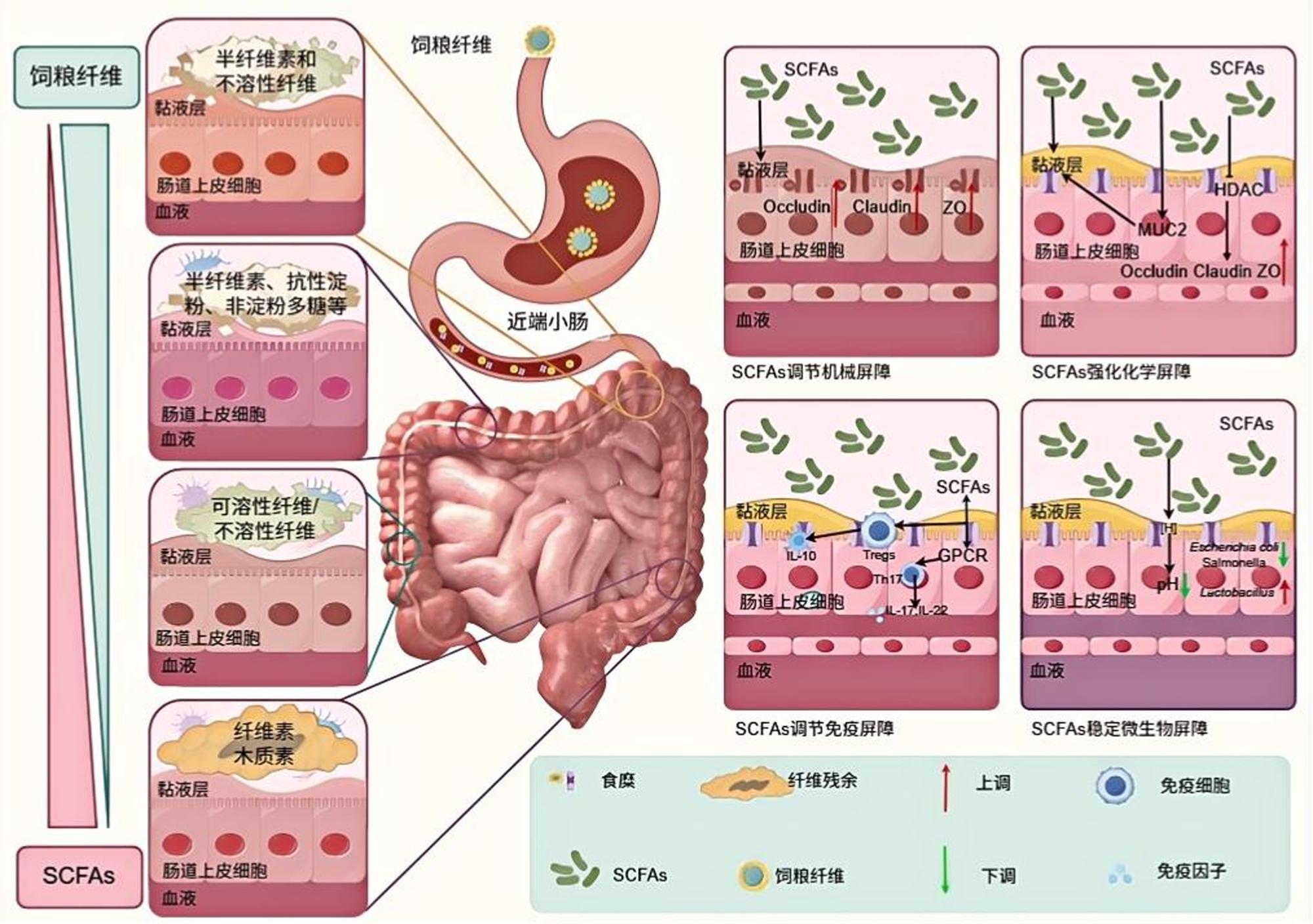
图1 饲粮纤维源短链脂肪酸对单胃动物肠道健康的调控作用

SCFAs:短链脂肪酸 short-chain fatty acids;Occludin:闭合蛋白;Claudin:密封蛋白;ZO:闭锁小带蛋白 zonula occludens;HDAC:组蛋白去乙酰化酶 histone deacetylase;MUC2:黏蛋白2 mucin 2;IL-10:白细胞介素-10 interleukin-10;IL-17:白细胞介素-17 interleukin-17;IL-22:白细胞介素-22 interleukin-22;Tregs:调节性T细胞 regulatory T cells;Th17:辅助性T细胞17 T helper cell 17;GRCR:G蛋白偶联受体 G protein-coupled receptor;Escherichia coli:大肠杆菌;Salmonella:沙门氏菌;Lactobacillus:乳杆菌属。

Fig.1 Regulatory effects of dietary fiber-derived short-chain fatty acids on gut health of monogastric animals

4 小结

饲粮纤维是调控单胃动物肠道健康的关键组分,其经后肠微生物发酵产生的SCFAs是介导纤维功能的核心产物。SCFAs通过增强肠道屏障、调节局部免疫和稳定菌群结构,协同维持肠道稳态,其生成量和分布特征直接影响纤维的健康效应,是连接饲粮纤维、微生物和宿主的重要桥梁。
当前研究虽已明确SCFAs的核心调控作用,但仍存在诸多挑战:微生物定向发酵与SCFAs靶向递送技术尚未成熟,纤维高效利用与健康效益的平衡缺乏系统方案,不同纤维源的精准适配机制尚未形成统一结论。未来应聚焦养殖实践需求,深入解析纤维结构与SCFAs的生成规律,开发发酵增效技术和高效产SCFAs菌群,阐明SCFAs与“肠道-免疫-代谢”轴的互作机制,同时加快靶向制剂和功能性纤维饲料研发,推动饲粮纤维在单胃动物健康养殖中的精准化应用,为动物营养调控和效益提升提供理论支撑。
[1]
JHA R, FOUHSE J M, TIWARI U P, et al. Dietary fiber and intestinal health of monogastric animals[J]. Frontiers in Veterinary Science, 2019,6:48.

[2]
ALI Q, MA S, LA S K, et al. Microbial short-chain fatty acids:a bridge between dietary fibers and poultry gut health-a review[J]. Animal Bioscience, 2022, 35(10):1461-1478.

DOI

[3]
李学冯, 胡希怡, 张宁波, 等. 不同体重琅琊鸡盲肠菌群多样性、短链脂肪酸含量以及微生物差异功能预测分析[J]. 动物营养学报, 2025, 37(3):1794-1809.

DOI

LI X F, HU X Y, ZHANG N B, et al. Prediction and analysis of cecal microflora diversity,short chain fatty acids contents and microbial differential function of Langya chickens with different body weights[J]. Chinese Journal of Animal Nutrition, 2025, 37(3):1794-1809. (in Chinese)

[4]
刘旭乐, 胡明扬, 荆鹍鹏, 等. 饲粮中添加油莎豆或油莎豆粕对妊娠后期母猪繁殖性能、血清免疫指标和粪便微生物组成的影响[J]. 动物营养学报, 2024, 36(8):4896-4909.

DOI

LIU X L, HU M Y, JING K P, et al. Effects of dietary addition of tiger nut or tiger nut meal on reproductive performance,serum immune indexes and fecal microbial composition of sows in late pregnancy[J]. Chinese Journal of Animal Nutrition, 2024, 36(8):4896-4909. (in Chinese)

[5]
DO PRADO S B R, MINGUZZI B T, HOFFMANN C, et al. Modulation of human gut microbiota by dietary fibers from unripe and ripe papayas:distinct polysaccharide degradation using a colonic in vitro fermentation model[J]. Food Chemistry, 2021,348:129071.

[6]
李敬, 高歌, 李平, 等. 饲粮纤维结构及其发酵产物对单胃动物肠道健康的调控机制和应用现状[J]. 动物营养学报, 2024, 36(4):2057-2066.

DOI

LI J, GAO G, LI P, et al. Regulation mechanism and application of dietary fiber structure and fermentation products on intestinal health of monogastric animals[J]. Chinese Journal of Animal Nutrition, 2024, 36(4):2057-2066. (in Chinese)

DOI

[7]
VAN SOEST P J, ROBERTSON J B, LEWIS B A. Methods for dietary fiber,neutral detergent fiber,and nonstarch polysaccharides in relation to animal nutrition[J]. Journal of Dairy Science, 1991, 74(10):3583-3597.

DOI

[8]
TROWELL H, SOUTHGATE D A, WOLEVER T M, et al. Letter:dietary fibre redefined[J]. Lancet, 1976, 1(7966):967.

[9]
JONES J M. CODEX-aligned dietary fiber definitions help to bridge the ‘fiber gap’[J]. Nutrition Journal, 2014,13:34.

[10]
YONG F, LIU B, LI H J, et al. Relationship between dietary fiber physicochemical properties and feedstuff fermentation characteristics and their effects on nutrient utilization,energy metabolism,and gut microbiota in growing pigs[J]. Journal of Animal Science and Biotechnology, 2025, 16(1):1.

DOI

[11]
KNUDSEN K E B. Fiber and nonstarch polysaccharide content and variation in common crops used in broiler diets[J]. Poultry Science, 2014, 93(9):2380-2393.

DOI PMID

[12]
ROSENFELDER-KUON P, STRANG E J P, SPINDLER H K, et al. Ileal starch digestibility of different cereal grains fed to growing pigs[J]. Journal of Animal Science, 2017, 95(6):2711-2717.

[13]
YANG J C, GUEVARA-OQUENDO V H, CHRISTENSEN D, et al. Utilization of exogenous fibrolytic enzymes in fiber fermentation,degradation,and digestions and characteristics of whole legume faba bean and its plant silage[J]. Critical Reviews in Food Science and Nutrition, 2023, 63(23):6114-6125.

DOI

[14]
ZHU X F, WANG L Y, ZHANG Z, et al. Combination of fiber-degrading enzymatic hydrolysis and Lactobacilli fermentation enhances utilization of fiber and protein in rapeseed meal as revealed in simulated pig digestion and fermentation in vitro[J]. Animal Feed Science and Technology, 2021,278:115001.

[15]
VANDOROU M, PLAKIDIS C, TSOMPANIDOU I M, et al. A review on apple pomace bioactives for natural functional food and cosmetic products with therapeutic health-promoting properties[J]. International Journal of Molecular Sciences, 2024, 25(19):10856.

DOI

[16]
FIERASCU R C, SIENIAWSKA E, ORTAN A, et al. Fruits by-products-a source of valuable active principles.A short review[J]. Frontiers in Bioengineering and Biotechnology, 2020,8:319.

[17]
HOLSCHER H D. Dietary fiber and prebiotics and the gastrointestinal microbiota[J]. Gut Microbes, 2017, 8(2):172-184.

DOI PMID

[18]
JAN B, BASIST P, MOHAPATRA S, et al. Dietary fiber: a comprehensive review of its sources, health benefits,and mechanisms driving nutraceutical effects[J/OL]. Recent Advances in Food,Nutrition & Agriculture, 2025(2025-08-18)[2025-10-15].http://dx.doi.org/10.2174/012772574X378014250727175222.

[19]
ADEBOWALE T O, YAO K, OSO A O. Major cereal carbohydrates in relation to intestinal health of monogastric animals:a review[J]. Animal Nutrition, 2019, 5(4):331-339.

DOI

[20]
TRACHSEL J M, BEARSON B L, KERR B J, et al. Short chain fatty acids and bacterial taxa associated with reduced Salmonella enterica serovar I 4,[5],12:i:-shedding in swine fed a diet supplemented with resistant potato starch[J]. Microbiology Spectrum, 2022, 10(3):e0220221.

DOI

[21]
EASTWOOD M A. The physiological effect of dietary fiber:an update[J]. Annual Review of Nutrition, 1992,12:19-35.

[22]
DHINGRA D, MICHAEL M, RAJPUT H, et al. Dietary fibre in foods:a review[J]. Journal of Food Science and Technology, 2012, 49(3):255-266.

DOI

[23]
黎宇, 杨琳, 朱勇文, 等. 日粮纤维对畜禽肠道健康的调控作用研究进展[J]. 黑龙江畜牧兽医, 2021(15):29-35.

LI Y, YANG L, ZHU Y W, et al. Research progress of dietary fiber regulation on intestinal health of livestock and poultry[J]. Heilongjiang Animal Science and Veterinary Medicine, 2021(15):29-35. (in Chinese)

[24]
FERREIRA DE BRITO MANDU D, SOBRAL V S, RIBAS J C R, et al. Sperm quality and welfare of sexually mature boars supplemented with partially fermentable insoluble fiber[J]. Life, 2025, 15(10):1597.

DOI

[25]
BERGMAN E N. Energy contributions of volatile fatty acids from the gastrointestinal tract in various species[J]. Physiological Reviews, 1990, 70(2):567-590.

DOI PMID

[26]
任敏敏, 杨华, 项云, 等. 饲粮纤维水平对金华猪生长性能、盲肠菌群结构和短链脂肪酸含量的影响[J]. 动物营养学报, 2020, 32(6):2575-2585.

DOI

REN M M, YANG H, XIANG Y, et al. Effects of dietary fiber levels on growth performance,microbial community structure and short-chain fatty acid content in cecum of Jinhua pigs[J]. Chinese Journal of Animal Nutrition, 2020, 32(6):2575-2585. (in Chinese)

[27]
JAWORSKI N W, STEIN H H. Disappearance of nutrients and energy in the stomach and small intestine,cecum,and colon of pigs fed corn-soybean meal diets containing distillers dried grains with solubles,wheat middlings,or soybean hulls[J]. Journal of Animal Science, 2017, 95(2):727-739.

DOI

[28]
MONTOYA C A, BLATCHFORD P, MOUGHAN P J. In vitro ileal and caecal fermentation of fibre substrates in the growing pig given a human-type diet[J]. The British Journal of Nutrition, 2021, 125(9):998-1006.

DOI

[29]
GAO Q T, LIU Z Q, LI K, et al. Time-course effects of different fiber-rich ingredients on energy values,microbiota composition and SCFA profile in growing pigs[J]. Animal Nutrition, 2023,12:263-275.

[30]
JÓZEFIAK D, RUTKOWSKI A, MARTIN S A. Carbohydrate fermentation in the avian ceca:a review[J]. Animal Feed Science and Technology, 2004, 113(1/2/3/4):1-15.

DOI

[31]
BEDFORD M R, SVIHUS B, COWIESON A J. Dietary fibre effects and the interplay with exogenous carbohydrases in poultry nutrition[J]. Animal Nutrition, 2024,16:231-240.

[32]
NDOU S P, KIARIE E, NYACHOTI C M. Flaxseed meal and oat hulls supplementation:impact on predicted production and absorption of volatile fatty acids and energy from hindgut fermentation in growing pigs[J]. Journal of Animal Science, 2019, 97(1):302-314.

[33]
TIWARI U P, SINGH A K, JHA R. Fermentation characteristics of resistant starch,arabinoxylan,and β-glucan and their effects on the gut microbial ecology of pigs:a review[J]. Animal Nutrition, 2019, 5(3):217-226.

DOI

[34]
NEWMAN M A, PETRI R M, GRÜLL D, et al. Transglycosylated starch modulates the gut microbiome and expression of genes related to lipid synthesis in liver and adipose tissue of pigs[J]. Frontiers in Microbiology, 2018,9:224.

[35]
VAN HEES H M J, DAVIDS M, MAES D, et al. Dietary fibre enrichment of supplemental feed modulates the development of the intestinal tract in suckling piglets[J]. Journal of Animal Science and Biotechnology, 2019, 10(1):83.

DOI

[36]
FLEMING S E, FITCH M D, DE VRIES S. The influence of dietary fiber on proliferation of intestinal mucosal cells in miniature swine may not be mediated primarily by fermentation[J]. The Journal of Nutrition, 1992, 122(4):906-916.

DOI

[37]
VON ENGELHARDT W, BURMESTER M, HANSEN K, et al. Unidirectional fluxes of short-chain fatty acids across segments of the large intestine in pig,sheep and pony compared with guinea pig[J]. Journal of Comparative Physiology B, 1995, 165(1):29-36.

DOI

[38]
程雅婷, 孔祥峰. 短链脂肪酸的生理作用及其在母猪生产中的应用[J]. 动物营养学报, 2021, 33(10):5435-5440.

DOI

CHENG Y T, KONG X F. Physiological functions of short-chain fatty acids and their application in sow production[J]. Chinese Journal of Animal Nutrition, 2021, 33(10):5435-5440. (in Chinese)

[39]
YASSIN A F, LANGENBERG S, HUNTEMANN M, et al. Draft genome sequence of Actinotignum schaalii DSM 15541T:genetic insights into the lifestyle,cell fitness and virulence[J]. PLoS One, 2017, 12(12):e0188914.

DOI

[40]
MACY J M, LJUNGDAHL L G, GOTTSCHALK G. Pathway of succinate and propionate formation in Bacteroides fragilis[J]. Journal of Bacteriology, 1978, 134(1):84-91.

DOI

[41]
REICHARDT N, DUNCAN S H, YOUNG P, et al. Phylogenetic distribution of three pathways for propionate production within the human gut microbiota[J]. The ISME Journal, 2014, 8(6):1323-1335.

DOI

[42]
梁胜男, 柯楚新, 黄鹤, 等. 肠道内产丁酸细菌及其产物丁酸生理功能的研究进展[J]. 微生物学通报, 2021, 48(3):948-959.

LIANG S N, KE C X, HUANG H, et al. Butyrate-producing bacteria in the intestinal tract and the physiological function of their metabolite butyrate:a review[J]. Microbiology China, 2021, 48(3):948-959. (in Chinese)

[43]
DUNCAN S H, BARCENILLA A, STEWART C S, et al. Acetate utilization and butyryl coenzyme A (CoA):acetate-CoA transferase in butyrate-producing bacteria from the human large intestine[J]. Applied and Environmental Microbiology, 2002, 68(10):5186-5190.

DOI PMID

[44]
LOUIS P, DUNCAN S H, MCCRAE S I, et al. Restricted distribution of the butyrate kinase pathway among butyrate-producing bacteria from the human colon[J]. Journal of Bacteriology, 2004, 186(7):2099-2106.

DOI PMID

[45]
TOPPING D L, CLIFTON P M. Short-chain fatty acids and human colonic function:roles of resistant starch and nonstarch polysaccharides[J]. Physiological Reviews, 2001, 81(3):1031-1064.

DOI

[46]
WONG J M W, DE SOUZA R, KENDALL C W C, et al. Colonic health:fermentation and short chain fatty acids[J]. Journal of Clinical Gastroenterology, 2006, 40(3):235-243.

DOI

[47]
PATEL P, JIN C S, NOOKAEW I, et al. Oat bran fiber protects against radiation-induced disruption of gut barrier dynamics and mucosal damage[J]. NPJ Biofilms and Microbiomes, 2025, 11(1):128.

DOI PMID

[48]
LI J H, LI S, CHENG L Y, et al. Digestive and fermentative properties of hawthorn pectic polysaccharides and immunostimulatory effects of fermentation products[J]. Food Chemistry:X, 2025,31:103098.

[49]
KOH A, DE VADDER F, KOVATCHEVA-DATCHARY P, et al. From dietary fiber to host physiology:short-chain fatty acids as key bacterial metabolites[J]. Cell, 2016, 165(6):1332-1345.

DOI

[50]
RICKE S C. Perspectives on the use of organic acids and short chain fatty acids as antimicrobials[J]. Poultry Science, 2003, 82(4):632-639.

DOI PMID

[51]
YOSHIDA H, ISHII M, AKAGAWA M. Propionate suppresses hepatic gluconeogenesis via GPR43/AMPK signaling pathway[J]. Archives of Biochemistry and Biophysics, 2019,672:108057.

[52]
BOSE S, RAMESH V, LOCASALE J W. Acetate metabolism in physiology,cancer,and beyond[J]. Trends in Cell Biology, 2019, 29(9):695-703.

DOI

[53]
LUCAS S, OMATA Y, HOFMANN J, et al. Short-chain fatty acids regulate systemic bone mass and protect from pathological bone loss[J]. Nature Communications, 2018, 9(1):55.

DOI PMID

[54]
PARADA VENEGAS D, et al.DE LA FUENTE M K,LANDSKRON G, Short chain fatty acids (SCFAs)-mediated gut epithelial and immune regulation and its relevance for inflammatory bowel diseases[J]. Frontiers in Immunology, 2019,10:277.

[55]
PLUSKE J R, TURPIN D L, KIM J C. Gastrointestinal tract (gut) health in the young pig[J]. Animal Nutrition, 2018, 4(2):187-196.

DOI PMID

[56]
HUANG J Y, SUN Z Q, ZHU Q, et al. Effects of dietary fiber fermentation and protein digestion properties on growth performance and microbial metabolites in weaned pigs[J]. Animals, 2025, 15(11):1669.

DOI

[57]
TUGNOLI B, GIOVAGNONI G, PIVA A, et al. From acidifiers to intestinal health enhancers:how organic acids can improve growth efficiency of pigs[J]. Animals, 2020, 10(1):134.

DOI

[58]
SUIRYANRAYNA M V A N, RAMANA J V. A review of the effects of dietary organic acids fed to swine[J]. Journal of Animal Science and Biotechnology, 2015, 6(1):45.

DOI

[59]
XU N Y, CHEN T, YIN J. The role of lipids in fermentative propionate production from the co-fermentation of lipid and food waste[J]. Frontiers of Environmental Science & Engineering, 2023, 17(7):86.

[60]
陈慧子, 张亚南, 余凯凡, 等. 盲肠灌注丙酸对生长猪结肠黏膜基因表达的影响[J]. 动物营养学报, 2018, 30(8):3134-3141.

CHEN H Z, ZHANG Y N, YU K F, et al. Effects of cecal infusion of propionate on gene expression in colon mucosa of growing pigs[J]. Chinese Journal of Animal Nutrition, 2018, 30(8):3134-3141. (in Chinese)

[61]
许旖旎, 樊倩, 杨彩梅, 等. 番鸭盲肠不同肠型特征及其与盲肠短链脂肪酸含量、屠宰性能的相关性研究[J]. 动物营养学报, 2024, 36(6):3680-3692.

DOI

XU Y N, FAN Q, YANG C M, et al. Study on different characteristics of cecal enterotypes and their association with cecal short-chain fatty acid contents and slaughter performance of Muscovy ducks[J]. Chinese Journal of Animal Nutrition, 2024, 36(6):3680-3692. (in Chinese)

DOI

[62]
于卓腾, 杭苏琴, 姚文, 等. 肠道产丁酸细菌及其丁酸产生机制的研究进展[J]. 世界华人消化杂志, 2006, 14(25):2531-2534.

YU Z T, HANG S Q, YAO W, et al. Intestinal butyrate-producing bacterium and its mechanisms[J]. World Chinese Journal of Digestology, 2006, 14(25):2531-2534. (in Chinese)

DOI

[63]
WANG B J, HOU J J, CAO Y D, et al. Dietary isobutyric acid supplementation improves intestinal mucosal barrier function and meat quality by regulating cecal microbiota and serum metabolites in weaned piglets[J]. Frontiers in Veterinary Science, 2025,12:1565216.

[64]
WANG H Y, XU R Y, LI Q K, et al. Daily fluctuation of colonic microbiome in response to nutrient substrates in a pig model[J]. NPJ Biofilms and Microbiomes, 2023, 9(1):85.

DOI PMID

[65]
RITZHAUPT A, WOOD I S, ELLIS A, et al. Identification and characterization of a monocarboxylate transporter (MCT1) in pig and human colon:its potential to transport L-lactate as well as butyrate[J]. The Journal of Physiology, 1998, 513(Pt 3):719-732.

DOI

[66]
CUFF M, DYER J, JONES M, et al. The human colonic monocarboxylate transporter isoform 1:its potential importance to colonic tissue homeostasis[J]. Gastroenterology, 2005, 128(3):676-686.

DOI

[67]
GURAV A, SIVAPRAKASAM S, BHUTIA Y D, et al. Slc5a8,a Na+-coupled high-affinity transporter for short-chain fatty acids,is a conditional tumour suppressor in colon that protects against colitis and colon cancer under low-fibre dietary conditions[J]. Biochemical Journal, 2015, 469(2):267-278.

DOI

[68]
IWANAGA T, TAKEBE K, KATO I, et al. Cellular expression of monocarboxylate transporters (MCT) in the digestive tract of the mouse,rat,and humans,with special reference to slc5a8[J]. Biomedical Research, 2006, 27(5):243-254.

DOI

[69]
GANAPATHY V, GOPAL E, MIYAUCHI S, et al. Biological functions of SLC5A8,a candidate tumour suppressor[J]. Biochemical Society Transactions, 2005, 33(Pt 1):237-240.

DOI

[70]
WELTER H, CLAUS R. Expression of the monocarboxylate transporter 1 (MCT1) in cells of the porcine intestine[J]. Cell Biology International, 2008, 32(6):638-645.

DOI PMID

[71]
DEN BESTEN G, VAN EUNEN K, GROEN A K, et al. The role of short-chain fatty acids in the interplay between diet,gut microbiota,and host energy metabolism[J]. Journal of Lipid Research, 2013, 54(9):2325-2340.

DOI

[72]
PENG L Y, LI Z R, GREEN R S, et al. Butyrate enhances the intestinal barrier by facilitating tight junction assembly via activation of AMP-activated protein kinase in Caco-2 cell monolayers[J]. The Journal of Nutrition, 2009, 139(9):1619-1625.

DOI

[73]
FANG X Y, LIU H Y, LIU J L, et al. Isobutyrate confers resistance to inflammatory bowel disease through host-microbiota interactions in pigs[J]. Research, 2025,8:0673.

[74]
ZENG X F, SUNKARA L T, JIANG W Y, et al. Induction of porcine host defense peptide gene expression by short-chain fatty acids and their analogs[J]. PLoS One, 2013, 8(8):e72922.

DOI

[75]
FENG Y H, WANG Y, WANG P, et al. Short-chain fatty acids manifest stimulative and protective effects on intestinal barrier function through the inhibition of NLRP3 inflammasome and autophagy[J]. Cellular Physiology and Biochemistry, 2018, 49(1):190-205.

DOI PMID

[76]
GASALY N, HERMOSO M A, GOTTELAND M. Butyrate and the fine-tuning of colonic homeostasis:implication for inflammatory bowel diseases[J]. International Journal of Molecular Sciences, 2021, 22(6):3061.

DOI

[77]
CHEN G X, RAN X, LI B, et al. Sodium butyrate inhibits inflammation and maintains epithelium barrier integrity in a TNBS-induced inflammatory bowel disease mice model[J]. eBioMedicine, 2018,30:317-325.

[78]
刘畅, 崔子旭, 左周, 等. 饲粮纤维水平对猪肠道屏障功能、结肠微生物及代谢产物的影响[J]. 中国农业科学, 2023, 56(22):4532-4551.

DOI

LIU C, CUI Z X, ZUO Z, et al. Effects of dietary fiber level on intestinal barrier function,colonic microbiota and metabolites in pigs[J]. Scientia Agricultura Sinica, 2023, 56(22):4532-4551. (in Chinese)

[79]
JOHANSSON M E V, PHILLIPSON M, PETERSSON J, et al. The inner of the two Muc2 mucin-dependent mucus layers in colon is devoid of bacteria[J]. Proceedings of the National Academy of Sciences, 2008, 105(39):15064-15069.

DOI

[80]
WILLEMSEN L E M, KOETSIER M A, et al.VAN DEVENTER S J H, Short chain fatty acids stimulate epithelial mucin 2 expression through differential effects on prostaglandin E1 and E2 production by intestinal myofibroblasts[J]. Gut, 2003, 52(10):1442-1447.

DOI

[81]
HAN X B, HU X D, JIN W, et al. Dietary nutrition,intestinal microbiota dysbiosis and post-weaning diarrhea in piglets[J]. Animal Nutrition, 2024,17:188-207.

[82]
YE Z H, TAN Q H, WOLTEMATE S, et al. Escherichia coli Nissle improves short-chain fatty acid absorption and barrier function in a mouse model for chronic inflammatory diarrhea[J]. Inflammatory Bowel Diseases, 2025, 31(4):1109-1120.

DOI

[83]
NOGAL A, VALDES A M, MENNI C. The role of short-chain fatty acids in the interplay between gut microbiota and diet in cardio-metabolic health[J]. Gut Microbes, 2021, 13(1):1-24.

[84]
SMITH P M, HOWITT M R, PANIKOV N, et al. The microbial metabolites,short-chain fatty acids,regulate colonic Treg cell homeostasis[J]. Science, 2013, 341(6145):569-573.

DOI

[85]
LUU M, PAUTZ S, KOHL V, et al. The short-chain fatty acid pentanoate suppresses autoimmunity by modulating the metabolic-epigenetic crosstalk in lymphocytes[J]. Nature Communications, 2019, 10(1):760.

DOI PMID

[86]
SINGH N, GURAV A, SIVAPRAKASAM S, et al. Activation of Gpr109a,receptor for niacin and the commensal metabolite butyrate,suppresses colonic inflammation and carcinogenesis[J]. Immunity, 2014, 40(1):128-139.

DOI

[87]
ARPAIA N, CAMPBELL C, FAN X Y, et al. Metabolites produced by commensal bacteria promote peripheral regulatory T-cell generation[J]. Nature, 2013, 504(7480):451-455.

DOI

[88]
YANG W J, YU T M, HUANG X S, et al. Intestinal microbiota-derived short-chain fatty acids regulation of immune cell IL-22 production and gut immunity[J]. Nature Communications, 2020, 11(1):4457.

DOI PMID

[89]
HOCKENBERRY A M, MICALI G, TAKÁCS G, et al. Microbiota-derived metabolites inhibit Salmonella virulent subpopulation development by acting on single-cell behaviors[J]. Proceedings of the National Academy of Sciences, 2021, 118(31):e2103027118.

DOI

[90]
LING C, REN L L, SONG Y R, et al. Intestinal short-chain fatty acids spatially regulate the antibiotic tolerance and virulence of avian pathogenic Escherichia coli[J]. Poultry Science, 2025, 104(4):104917.

DOI

[91]
CHANG K C, NAGARAJAN N, GAN Y H. Short-chain fatty acids of various lengths differentially inhibit Klebsiella pneumoniae and Enterobacteriaceae species[J]. mSphere, 2024, 9(2):e0078123.

DOI

[92]
何荣香, 唐红艳, 杨玲, 等. 短链脂肪酸在单胃动物肠道中的生理功能及其作用机制的研究进展[J]. 中国畜牧杂志, 2020, 56(4):1-5.

HE R X, TANG H Y, YANG L, et al. Advances in physiological function and mechanism of short chain fatty acids in intestine of monogastric animals[J]. Chinese Journal of Animal Science, 2020, 56(4):1-5. (in Chinese)

[93]
RIVERA-CHÁVEZ F, ZHANG L F, FABER F, et al. Depletion of butyrate-producing Clostridia from the gut microbiota drives an aerobic luminal expansion of Salmonella[J]. Cell Host & Microbe, 2016, 19(4):443-454.

[94]
HE J, ZHANG P W, SHEN L Y, et al. Short-chain fatty acids and their association with signalling pathways in inflammation,glucose and lipid metabolism[J]. International Journal of Molecular Sciences, 2020, 21(17):6356.

DOI

Outlines

/