REVIEW

Progress in Modification Methods of High-Yield Cellulase Strains and Their Applications in Animal Nutrition

  • HE Tingting , 1 ,
  • LIU Zhen 1 ,
  • ZHANG Dongyan 2 ,
  • LIU Ming , 1, *
Expand
  • 1 Animal Science and Technology College, Beijing University of Agriculture, Beijing 102206, China
  • 2 Institute of Animal Husbandry and Veterinary Medicine, Beijing Academy of Agriculture and Forestry Sciences, Beijing 100097, China
* professor, E-mail:

Received date: 2025-11-25

  Online published: 2026-07-13

Abstract

Cellulase is a type of complex enzyme system that can efficiently degrade cellulose, consisting of multiple components such as endoglucanase, cellobiohydrolase and β-glucosidase. When applied in feed, cellulase can specifically hydrolyze cellulose and hemicellulose into small carbohydrate molecules absorbable by animals, thereby improving feed digestibility and utilization efficiency. Therefore, it has attracted extensive attention in the field of efficient and healthy livestock and poultry breeding. This paper reviews the microbial sources of cellulase, modification methods of high-yield cellulase strains and their applications in animal nutrition, aiming to provide references for improving the cellulase production efficiency of microbial strains and promoting the efficient application of cellulase in animal production.

Cite this article

HE Tingting , LIU Zhen , ZHANG Dongyan , LIU Ming . Progress in Modification Methods of High-Yield Cellulase Strains and Their Applications in Animal Nutrition[J]. Chinese Journal of Animal Nutrition, 2026 , 38(7) : 4867 -4878 . DOI: 10.12418/CJAN2026.390

在饲料粮安全与节粮减损的重大需求背景下,人们日益重视工农业副产物的资源化开发。其中,纤维素的高效转化与利用是提高饲料品质和促进畜牧业可持续发展的重要技术瓶颈,已成为当前研究热点。纤维素酶可通过酶解纤维原料产生葡萄糖[1],在提高肉羊[2]与猪[3]的采食量和日增重、提升奶牛泌乳量[4],以及调节动物肠道菌群结构等方面具有显著应用潜力[5]。随着基因组学及高通量筛选技术的发展,改善纤维素酶的热稳定性、pH耐受性等关键性能,对实现其高效利用具有重要意义。本文综述了纤维素酶的微生物来源,从物理诱变、化学诱变和基因工程改造等方面总结了纤维素酶高产菌株的改造方法及其在动物营养中的应用,以期为进一步提高微生物菌株产纤维素酶效率、推进其在动物生产中的高效利用提供参考。

1 纤维素酶的微生物来源及其作用机制

纤维素是一种由β-1,4-糖苷键连接葡萄糖单元形成的线性聚合物[6],其结构中包含结晶区和无定形区[7],单一酶组分难以将其彻底分解,必须依赖多组分酶系的协同作用。纤维素酶属于糖苷水解酶(glycoside hydrolases,GH)家族,根据碳水化合物活性酶(carbohydrate-active enzymes,CAZy)数据库的分类和作用方式,分为内切葡聚糖酶(endoglucanase,EG)、外切葡聚糖酶[又称纤维二糖水解酶(cellobiohydrolase,CBH)]与β-葡萄糖苷酶(β-glucosidase,β-Gase)[8],微生物纤维素酶并非单一酶,是由多种酶组成的复合酶系,可通过协同作用将不溶性的纤维素大分子降解为可发酵的单糖,高效催化纤维素的降解[1]。微生物因生长周期短、易于培养和遗传改造、酶产量高等优点,成为了商业化纤维素酶的最主要来源[9]

1.1 纤维素酶的微生物来源

1.1.1 真菌

在真菌来源中,丝状真菌是传统且高效的产酶菌株,此类真菌可分泌大量胞外酶系,进而组装形成结构完整的酶复合体,高效降解结构复杂的木质纤维素[10]。真菌来源的纤维素酶种类齐全,且通常以游离酶形式协同作用,其核心优势在于天然分泌的酶系高度完整且各组分间协同作用显著。丝状真菌产酶水平普遍较高,在产酶效率方面优势突出[11],已成为工业规模化生产纤维素酶的核心菌株。里氏木霉(Trichoderma reesei)在工业中研究广泛,其分泌的酶系完整,包括多种EG与CBH,能够高效协同降解结晶纤维素[12]。黑曲霉(Aspergillus niger)通常可分泌高活性的β-Gase,性能稳定、适配性强,应用较为广泛[13]。从腐烂大丽花中分离可利用椰油饼为唯一碳源分泌纤维素酶的酵母菌,经筛选获得的季也蒙毕赤酵母(Meyerozyma guillermondii)MH10的EG活性可达102.96 U/mL[14]。此外,白腐真菌中的黄孢原毛平革菌(Phanerochaete chrysosporium)的最大EG活性可达166.32 U/mL[15]。Moharram等[16]以羧甲基纤维素(carboxymethyl cellulose,CMC)为底物,采用液态发酵方式进行产酶研究,结果表明,真菌葡萄穗霉属(Stachybotrys)菌株AUMC14705的产酶量最高,可达7.9 IU/mL,比活性为14.59 IU/mg prot,纤维素酶相对活性为1.7 IU/(mL·min),具备高效降解纤维素的潜力。

1.1.2 细菌

细菌来源的纤维素酶同样具有重要价值,尤其是来源于高温、高盐、强酸、强碱等极端环境的细菌菌株,其产生的纤维素酶具有生产周期短、遗传操作方便和环境耐受性更强等优势。细菌降解结晶纤维素的机制常与丝状真菌不同,真菌中高效的过程性CBH在细菌中相对少见,而细菌可通过多纤维素酶体(cellulosome)协同作用完成CBH功能的发挥[17]。常见的产酶细菌有芽孢杆菌属(Bacillus)、梭菌属(Clostridium)、放线菌门(Actinobacteria)及纤维素单胞菌属(Cellulomonas)等[18]。芽孢杆菌属因其强大的分泌能力和对环境的适应性,是高效的EG生产者[19]。不同芽孢杆菌属菌株的最适产酶条件存在差异,适宜pH与温度范围各不相同,表明针对不同应用场景筛选特定性质的菌株至关重要[20]。其中,地衣芽孢杆菌(Bacillus licheniformis)能够产生多种纤维素酶,包括EG、CBH及β-Gase[21]。梭菌属、瘤胃球菌属(Ruminococcus)等在能源开发与环保领域应用广泛,这类细菌可通过黏附于纤维素底物并分泌纤维素酶实现纤维素的高效降解[22]。热纤梭菌(Clostridium thermocellum)可分泌CBH类功能酶,但不具备β-Gase分泌能力[21]。与土壤来源菌株相比,从蚁巢及蚁体分离得到的放线菌表现出更高的纤维素降解潜力,且从木蚁中分离的链霉菌还具有潜在抗菌活性[23]

1.2 纤维素酶的作用机制

纤维素酶可通过多组分协同作用将纤维素分子逐步降解为葡萄糖[24]。EG主要作用于纤维素分子链内部的无定形区,随机切断β-1,4-糖苷键[6],生成不同长度的纤维寡糖,同时将长链纤维素切成较短的片段,从而产生更多的链末端[25]。CBH以与底物持续结合并连续催化的方式,作用于纤维素链的还原性或非还原性末端,甚至可作用于结晶区的表面,进而持续水解糖苷键,主要释放产物为纤维二糖[7]。β-Gase则通过特异性水解纤维二糖的β-1,4-糖苷键,将其分解为2个葡萄糖分子[26]。纤维素的完全降解依赖于上述3种酶的高度协同作用(表1):首先由EG在纤维素表面制造缺口,暴露出更多的链端;CBH则从这些新产生的链端开始,过程性地切割纤维素链,释放纤维二糖[27-28];最后由β-Gase将纤维二糖水解为葡萄糖,解除产物抑制,推动整个反应正向进行[29-30]
表1 纤维素酶的类型及其特性

Table 1 Types and characteristics of cellulases

类型
Types
作用位点
Binding site
水解产物
Hydrolysis
product
最适pH
Optimum pH
热稳定性
Thermal
stability/℃
参考文献
References
内切葡聚糖酶EG 纤维素无定形区 纤维寡糖 5.0~8.0 ≤70 [24,30-31]
外切葡聚糖酶CBH 纤维素链末端 纤维二糖 4.0~6.5 ≤65 [26,32-33]
β-葡萄糖苷酶β-Gase 纤维二糖 葡萄糖 4.8~5.5 ≤60 [32-34]

2 纤维素酶高产菌株的改造方法

2.1 物理诱变

在分子生物学技术普及之前,获得纤维素酶高产菌株的主要途径为物理诱变结合功能筛选,即通过紫外线、γ射线等物理方法诱变获得突变体后,从数以万计的突变体中筛选出优良的菌株。研究证实,在γ射线诱变基础上,当温度控制在30 ℃、水分含量为74%、培养4 d时,里氏木霉的滤纸酶(FPase)活性达到峰值,为1.317 U/g[35]。王传旭等[36]对嗜盐菌株Y3进行紫外线照射处理,选取照射60 s以上的存活菌株检测酶活性,最终筛选获得活性最高的突变株Y3M,该突变株的纤维素酶在pH 7.0~10.0及高盐环境中活性显著提升。将黑曲霉的紫外突变基因在大肠杆菌BL21中进行异源表达后,所得重组菌株的纤维素酶活性较野生型黑曲霉菌株提升4.6倍[37]。另有研究采用紫外线与硫酸二乙酯对解淀粉芽孢杆菌(Bacillus amyloliquefaciens)BA-2进行复合诱变,所得的突变株的纤维素酶产量较原始菌株提升24.5%,且热稳定性增强[38]。刘浩等[39]采用12C6+重离子对黑曲霉进行多剂量辐照,经培养筛选获得遗传稳定的突变株CJH-JWSFZh-W122,其FPase和EG活性分别达223.5和440.8 U/mL,较原始菌株分别显著提高6.07%和8.01%。
常压室温等离子体(atmospheric and room temperature plasma,ARTP)是一种新型、高效的物理诱变技术,其包含大量高能量的活性粒子[40],这些活性粒子能直接作用于微生物细胞表面,破坏细胞膜的完整性并进入细胞内部,与DNA、蛋白质等生物大分子发生剧烈反应[41-42]。不同于紫外诱变仅造成的单一DNA损伤,ARTP诱变会引发碱基氧化、DNA单链断裂(single-strand break,SSB)和双链断裂(double-strand breaks,DSB)等多重DNA损伤[43-44]。这种复杂和高强度的DNA损伤导致了更高的突变率和更宽的突变谱[45-46],从而提高获得目标优良性状突变体的可能。Zou等[45]采用ARTP诱变里氏木霉RUT-C30,获得高产突变株JNDY-13,其纤维素酶活性最高可达4.35 U/mL,FPase活性为2.21 U/mL。李豪等[46]通过紫外线与等离子体复合诱变技术获得的菌株AY-42 FPase活性提高97%,且遗传稳定性良好,表明迭代ARTP诱变结合高通量筛选,可持续提升菌株产酶性能。

2.2 化学诱变

化学诱变通过对微生物进行化学物质处理,诱导其遗传物质发生随机且可遗传的改变,从而创造出丰富的突变体库[47],该技术凭借操作简便、成本低廉以及能够引发全基因组范围内广泛突变等优势,得到广泛应用。化学诱变中甲基磺酸乙酯(ethyl methanesulfonate,EMS)和甲基-N'-硝基-N-亚硝基胍(N-methyl-N'-nitro-N-nitrosoguanidine,NTG)是使用频率最高、效果较为显著的2种诱变剂。其中,EMS主要通过在DNA复制过程中诱导GC碱基对与AT碱基对互变,从而产生点突变[48]。Narasimha等[49]使用EMS对野生型黑曲霉进行诱变处理,结果显示,突变株的FPase、EG和β-Gase活性分别提升204%、502%和236%。NTG能够引起DNA的多种损伤,包括碱基的烷基化、交联以及断裂,从而导致高频率的突变。Cellulomonas菌株TSU-03经NTG处理后得到突变株M23,其表现出的最高纤维素酶活性为2 008 U/mg prot,较野生型提升1.30倍且具有稳定遗传性[50]。Singh等[51]分别使用NTG与EMS对黑曲霉进行诱变,结果显示,NTG处理得到的突变株EG和FPase活性分别为30.36和9.52 U/mL,EMS处理得到的突变株EG和FPase活性分别为23.58和12.00 U/mL。上述结果表明,经NTG和EMS诱变后的菌株,其纤维素酶活性与木霉属(Trichoderma)菌株相当,具有较高的工业应用潜力。
然而,化学诱变的最大缺陷在于其引发的突变具有随机性和盲目性,绝大多数突变是无效甚至有害的,有益突变的概率极低,这极大地增加了后续的筛选工作量。因此,化学诱变应与高通量筛选技术相结合,例如利用微流控技术可实现突变体的快速培养与酶活检测,荧光激活细胞分选技术则能根据酶活相关的荧光信号,快速分选高产细胞,从而有效弥补化学诱变随机性强的不足[52-53]

2.3 基因工程改造

近年来,随着分子生物学与合成生物学的快速发展,研究重心逐步转向对纤维素酶的基因工程改造。通过提取环境样品中的总DNA构建宏基因文库,基于功能驱动(function-driven)或序列驱动(sequence-driven)筛选阳性克隆,研究人员得以发掘源于微生物的新型纤维素酶基因[54-55]。有研究对菌株进行基因定点突变,通过引入多个有益突变,显著提升了酶的热稳定性和催化活性,为基于蛋白质三维结构分析的EG热稳定机制提供了试验证据,也证明了工程纤维素酶在工业应用中的可行性[54]。合成生物学则通过过表达碳代谢通路中的限速酶来提升代谢通量,从而为纤维素酶的大量合成提供充足的能量及原料[55]。随着转录因子工程与CRISPR/Cas9等基因编辑工具的应用,现已能够实现对关键调控元件的定向优化与多基因并行改造。

2.3.1 转录调控网络的重构

纤维素酶基因的表达受一套复杂且精密的转录调控网络控制,转录因子为该网络中的关键功能节点,因此对转录因子进行定向改造成为提高纤维素酶产量的核心策略。在里氏木霉中,木聚糖酶调控因子1(xylanase regulator 1,XYR1)是调控几乎所有纤维素酶与半纤维素酶基因表达的核心正调控因子,而调控XYR1表达的转录因子1(RXE1)可调控XYR1及纤维素酶基因的表达,且RXE1敲低菌株中组成型表达XYR1可恢复纤维素酶产量,这表明RXE1通过调控XYR1的表达间接影响纤维素酶的合成[56]
葡萄糖等易利用碳源会抑制纤维素酶基因的表达,这一调控现象被称为碳源代谢物阻遏(carbon catabolite repression,CCR),其核心调控过程主要由转录抑制因子碳代谢阻遏调控因子1(carbon catabolite repression regulator 1,CRE1)及激活因子XYR1等调控,并会显著下调里氏木霉中纤维素分解酶的转录水平。CRE1属于半胱氨酸2-组氨酸2(C2H2)型锌指蛋白转录因子,能结合到纤维二糖水解酶1(cellobiohydrolase 1,cel7a)等靶基因启动子上,从而抑制其编码的纤维素酶基因转录[57]CRE1在真菌碳代谢调控中起到重要作用,但其具体作用表现出显著的菌株特异性和物种依赖性[58],这种功能差异可能源于蛋白质序列的微小变异[57]。早期研究发现,对里氏木霉CRE1蛋白进行磷酸化修饰后,其丧失了对葡萄糖的抑制作用,成功打破了纤维素酶生产长期依赖诱导物的传统模式[59]
构建人工转录因子是提升纤维素酶产量的革命性策略,其核心机制在于通过设计非天然人工转录因子,使其直接靶向并特异性激活纤维素酶基因的启动子。近期研究在里氏木霉Rut C-30基础上构建了菌株U5,该菌株在乳糖碳源培养基中的FPase活性达0.83 U/mL,为Rut C-30菌株的4.15倍。U5菌株部分解除了CCR,即使在葡萄糖存在下,其产酶能力仍远高于Rut C-30菌株[60]

2.3.2 CRISPR/Cas9基因编辑技术

CRISPR/Cas9基因编辑技术具有高效、精准、便捷等特点,可轻松实现多基因同时改造[61],改变了工业微生物育种基因工程1次仅能操作1~2个基因、耗时耗力的传统模式。研究表明,通过优化CRISPR/Cas9系统,可在乳酸杆菌中实现90%以上的基因编辑效率,同时还能完成多基因同步编辑、无痕基因删除等复杂操作[62]。纤维素酶激活因子1(activator of cellulases 1,ACE1)已被证实是纤维素酶基因表达的一个关键负调控元件。Singh等[30]通过构建CRISPR/Cas9质粒并采用原生质体转化法,对嗜热真菌埃默森罗萨氏菌(Rasamsonia emersonii)的转录因子ACE1进行了基因编辑,量化结果显示,ACE1敲除株的纤维素酶生产能力显著增强,与野生型菌株相比,突变株的EG、CBH和β-Gase活性分别提升了21.97%、20.70%和24.63%。Chen等[32]研究发现,里氏木霉纤维素酶合成相关转录抑制因子1(Trichoderma reesei cellulase transcription factor 1,TRCTF1)在纤维素酶的诱导合成中起着负调控作用,利用CRISPR/Cas9技术对TRCTF1基因进行敲除后,菌株在乳糖诱导条件下的纤维素酶合成能力显著增强。Fonseca等[63]利用CRISPR/Cas9技术对里氏木霉RUT-C30菌株开展6处同步基因改造,获得的工程菌株不仅蛋白分泌速率大幅提升、产酶谱系更合理,还能利用非诱导性廉价碳源,最终以甘蔗糖蜜为碳源实现了80.6 g/L的蛋白产量。Ji等[27]通过CRISPR/Cas9技术将黑曲霉葡萄糖氧化酶基因(Aspergillus niger glucose oxidase,AnGOx)精准插入里氏木霉纤维素酶3c(cellulase 3c,cel3c)位点,实现了该异源酶的高效表达,其酶活性达309 U/mL。

3 纤维素酶在动物生产中的应用

3.1 提升营养物质利用率

在玉米、豆粕、麸皮、秸秆等植物性饲料中,淀粉、蛋白质等营养成分被纤维素、半纤维素及果胶构成的细胞壁包裹,该物理屏障限制了动物内源性消化酶对营养物质的接触与作用,最终形成细胞壁介导的营养笼蔽效应;且单胃动物消化道几乎不含内源性纤维素酶,无法有效利用纤维素[31]。Javed等[64]研究发现,纤维素酶通过破坏植物细胞壁结构,使家禽消化酶能有效利用细胞壁中包裹的淀粉、蛋白质及脂肪等营养物质,进而提高饲料表观代谢能。李秀丽等[2]研究表明,添加0.01%纤维素酶与酿酒酵母菌混合物可显著提高肉羊终末体重、平均日增重,且显著降低料重比。青贮饲料经低蛋白质处理后,接种由黑曲霉、绿色木霉(Trichoderma viride)、枯草芽孢杆菌(Bacillus subtilis)按2∶1∶1质量比组成的纤维素分解菌,可显著降低饲料中中性洗涤纤维与酸性洗涤纤维含量,该处理下纤维有效降解率达69.80%,高于对照组的59.44%;此外,纤维素酶还可通过分解纤维素底物,间接提高瘤胃微生物对养分的利用效率[65]。Novakovska等[66]研究显示,添加纤维素酶复合制剂的猪只平均日增重达902 g,较对照组提高了19.7%,其每千克增重的饲粮消耗量降低10%,表明纤维素酶可通过提高碳水化合物消化率优化饲料利用效率。

3.2 维护肠道微生物稳态
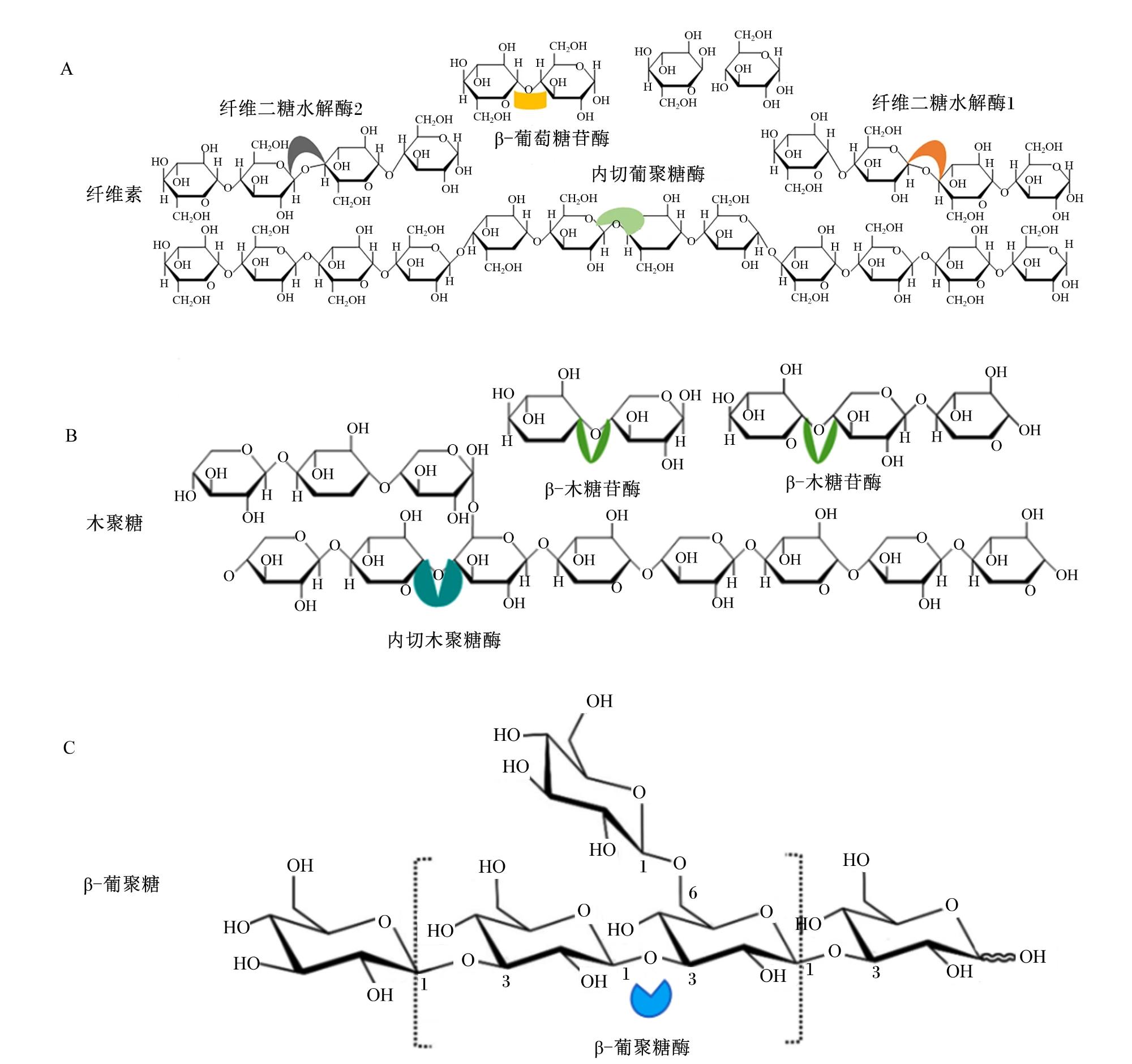
小麦、大麦等饲料原料中富含纤维素、β-葡聚糖和木聚糖等非淀粉多糖(NSP)[28],其可溶性部分会在动物肠道中吸收水分,形成高黏度凝胶状物质,不仅阻碍营养物质在肠道上皮的吸收,还可能改变肠道微生态环境,导致有害菌过度增殖,损害肠道黏膜的形态与功能[67-68]。外源NSP酶可靶向分解上述抗营养物质,各类酶的作用位点如图 1 所示。其中EG、CBH可破坏细胞壁中的纤维素结构,并降低细胞壁中NSP含量[24];β-葡聚糖酶则作用于β-葡聚糖,快速降低其高分子黏度[67];而木聚糖酶可降解木聚糖生成寡糖[68]
图1 纤维素酶、木聚糖酶和β-葡聚糖酶的作用位点

Fig.1 Action sites of cellulase, xylanase and β-glucanase[67-69]

因此,在饲粮中添加纤维素酶,并与β-葡聚糖酶、木聚糖酶等NSP酶协同使用,能将NSP降解为聚合度低的寡糖片段,进而有效降低肠道食糜的黏度。Chen等[70]研究表明,在低代谢能家禽饲粮中添加200 mg/kg复合NSP酶(含β-甘露聚糖酶5 000 U/g、β-葡聚糖酶2 000 U/g、木聚糖酶10 000 U/g、纤维素酶500 U/g),可使饲粮中粗蛋白质和粗纤维的表观利用率分别提高7.24%和15.63%,表明即使饲喂低成本饲粮,家禽仍能在纤维素酶制剂的作用下维持正常生长性能。纤维素酶在仔猪饲养中同样发挥重要作用,仔猪断奶后,饮食从高消化率的母乳转变为复杂的固态植物性饲粮,而仔猪等单胃动物无法合成水解NSP所需的内源性酶类,NSP会对仔猪消化功能产生负面影响,加剧断奶后腹泻[71]。郑凯天等[3]研究发现,在仔猪饲粮中添加纤维素酶微生态制剂,可显著提高其平均日增重和体液免疫水平,同时有效降低腹泻率。

3.3 协同瘤胃微生物降解纤维原料

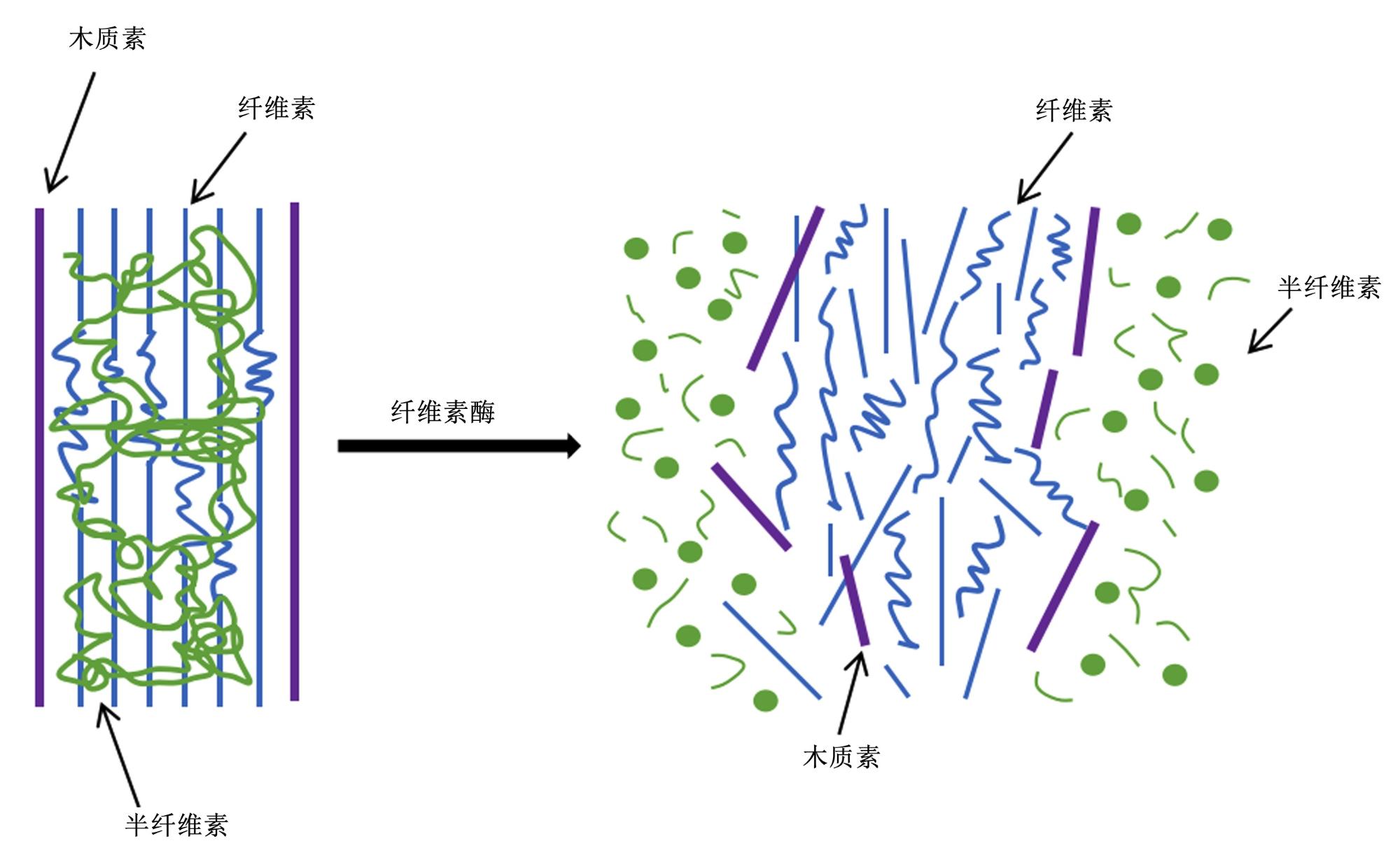
反刍动物通过瘤胃内的细菌、真菌、原生动物等微生物自主合成复杂的纤维降解酶系统,分泌内源性纤维素酶催化纤维物质的降解。添加外源纤维素酶既可补充瘤胃内源酶的不足,又可与内源酶产生协同效应,尤其是在降解结构稳定的纤维素结晶区时,这种协同作用可增强纤维降解效率[72]。纤维素酶处理前后细胞壁的结构变化[73]图2所示。外源纤维素酶通过水解植物细胞壁的木质纤维素结构,使其暴露更多结合位点,从而破坏细胞壁结构完整性,导致细胞壁变薄、细胞腔扩大且孔隙度增大[74],促进瘤胃微生物的定植及生物膜的形成[75]。研究表明,纤维素酶与瘤胃微生物分泌的内源酶协同作用,可提高纤维的降解速率和降解程度,最终提升反刍动物对饲料干物质及纤维的消化率[76]。在青贮过程中添加纤维素酶,可将部分纤维素分解为简单碳水化合物,这类物质既可被动物胃肠道直接吸收利用,又能为瘤胃微生物提供能量,间接增强内源酶活性[77];同时还能驱动瘤胃微生物的代谢过程,改变发酵产物构成,显著提升反刍动物的纤维消化率[78]。Abd-Elkerem等[79]研究证实,当纤维素酶添加剂量为24 mg/g DM时,对屠宰后奶牛瘤胃液的分析结果显示,纤维素酶能改善纤维素和蛋白质的降解效率,显著提升饲粮干物质和粗蛋白质的降解率,同时增加代谢能预测值,这归因于酶解作用促进了纤维素的分解,释放可溶性糖,进而提高发酵效率。Refat等[4]研究发现,在奶牛基础饲粮中添加0.75 mL/kg DM来源于里氏木霉的木聚糖酶和纤维素酶混合物,可显著提高饲粮干物质和中性洗涤纤维消化率及4%乳脂校正乳(fat corrected milk,FCM)产量,且乳脂率提升至3.28%。另有研究表明,当饲粮中纤维素酶添加量为15 g/kg DM时,肉牛对干物质和有机物的摄入量显著提高[80]
图2 纤维素酶处理前后细胞壁的结构变化

Fig.2 Structural changes of cell wall before and after cellulase treatment[73]

4 小结与展望

微生物源纤维素酶作为多功能酶系,可高效降解植物细胞壁中的纤维素,提升底物利用率与营养释放效率。在动物生产中,纤维素酶通过提高饲料纤维素消化率、优化肠道微生态以及与瘤胃微生物发挥协同作用等途径,显著提升生物质转化效率,促进动物生长。然而,目前微生物源纤维素酶的应用仍受限于稳定性不足、成本偏高以及应用精准度欠缺等问题,具体表现为在动物肠道中酶活性易衰减、生产成本居高不下,以及缺乏针对性的添加剂量等关键应用参数。近年来,随着生物技术的发展,该领域的研究已从基础应用阶段逐步突破传统微生物发酵的单一技术框架,向复合诱变、基因工程等新阶段演进。未来研究重点将逐步从传统发酵技术转向多方向创新:通过蛋白质理性设计定向改造纤维素酶催化活性与稳定性;通过合成生物学重构高效微生物,实现纤维素酶的可控化高效合成;专注于智能递送系统,研发信号递送载体以提升纤维素酶的靶向释放与利用率;依托多组学技术整合基因组、转录组等数据,系统解析并优化纤维素酶的生产与应用调控机制。在此基础上,后续研究将通过增强纤维素酶的环境适应性、优化从基因到产品的全链条生产体系并构建精准应用模型等方式,系统提升纤维素酶的应用效能,为动物养殖的可持续发展提供关键技术支撑。
[1]
WANG B T, HU S, YU X Y, et al. Studies of cellulose and starch utilization and the regulatory mechanisms of related enzymes in fungi[J]. Polymers, 2020, 12(3):530.

DOI

[2]
李秀丽, 石英, 庞纪彩, 等. 胍基乙酸和酿酒酵母菌与纤维素酶复合物对肉羊生长性能、消化代谢、屠宰性能及肉品质的影响[J]. 动物营养学报, 2024, 36(7):4428-4446.

DOI

LI X L, SHI Y, PANG J C, et al. Effects of guanidine acetic acid,Saccharomyces cerevisiae and cellulase complex on growth performance,digestion and metabolism,slaughter performance and meat quality of mutton sheep[J]. Chinese Journal of Animal Nutrition, 2024, 36(7):4428-4446. (in Chinese)

[3]
郑凯天, 许英蕾, 熊约飞, 等. 1株产纤维素酶猪源性枯草芽孢杆菌的筛选鉴定及其对仔猪生长性能、体液免疫的影响[J]. 中国畜牧杂志, 2024, 60(4):214-219.

ZHENG K T, XU Y L, XIONG Y F, et al. Screening and identification of a porcine-derived Bacillus subtilis strain capable of producing cellulase,and its effects on the growth performance and humoral immunity of piglets[J]. Chinese Journal of Animal Science, 2024, 60(4):214-219. (in Chinese)

[4]
REFAT B, CHRISTENSEN D A, MCKINNON J J, et al. Effect of fibrolytic enzymes on lactational performance,feeding behavior,and digestibility in high-producing dairy cows fed a barley silage-based diet[J]. Journal of Dairy Science, 2018, 101(9):7971-7979.

DOI

[5]
LIU Y, FAN J T, HUANG H J, et al. High dietary non-starch polysaccharides detrimental to nutrient digestibility,digestive enzyme activity,growth performance,and intestinal morphology in largemouth bass,Micropterus salmoides[J]. Frontiers in Nutrition, 2022, 9:1015371.

DOI

[6]
MONDAL S, HALDER S K, MONDAL K C. Tailoring in fungi for next generation cellulase production with special reference to CRISPR/CAS system[J]. Systems Microbiology and Biomanufacturing, 2022, 2(1):113-129.

DOI

[7]
WANG J L, CHEN J, LV K M, et al. Structure-guided engineering unveils deeper substrate channel in processive endoglucanase EG5C-1 contributing to enhanced catalytic efficiency and processivity[J]. ACS Synthetic Biology, 2024, 13(12):4131-4142.

DOI PMID

[8]
王霆辉. 饲料脂肪水平对繁殖期克氏原螯虾糖脂代谢、抗氧化及非特异性免疫力的影响[D]. 硕士学位论文. 湖州: 湖州师范学院, 2023.

WANG T H. Effects of dietary lipid levels on glycolipid metabolism,antioxidant and nonspecific immunity of Procambarus clarkii during breeding period[D]. Master’s Thesis. Huzhou: Huzhou University, 2023. (in Chinese)

[9]
SUTAONEY P, RAI S N, SINHA S, et al. Current perspective in research and industrial applications of microbial cellulases[J]. International Journal of Biological Macromolecules, 2024, 264(Pt 1):130639.

DOI

[10]
MENG Q S, ZHANG F, WANG W, et al. Engineering the effector domain of the artificial transcription factor to improve cellulase production by Trichoderma reesei[J]. Frontiers in Bioengineering and Biotechnology, 2020, 8:675.

DOI

[11]
ILIĆ N, MILIĆ M, BELUHAN S, et al. Cellulases:from lignocellulosic biomass to improved production[J]. Energies, 2023, 16(8):3598.

DOI

[12]
ZHANG Z, XING J, LI X Z, et al. Review of research progress on the production of cellulase from filamentous fungi[J]. International Journal of Biological Macromolecules, 2024, 277(Pt 4):134539.

DOI

[13]
HAO S, LIU Y P, QIN Y, et al. Expression of a highly active β-glucosidase from Aspergillus niger AS3.4523 in Escherichia coli and its application in gardenia blue preparation[J]. Annals of Microbiology, 2020, 70(1):32.

DOI

[14]
FU Z H, LIU J, ZHONG L B, et al. Screening of cellulose-degrading yeast and evaluation of its potential for degradation of coconut oil cake[J]. Frontiers in Microbiology, 2022, 13:996930.

DOI

[15]
KSHIRSAGAR S, WAGHMARE P, SARATALE G, et al. Composition of synthesized cellulolytic enzymes varied with the usage of agricultural substrates and microorganisms[J]. Applied Biochemistry and Biotechnology, 2020, 191(4):1695-1710.

DOI PMID

[16]
MOHARRAM A M, ZOHRI A N A, HUSSEIN D A. Cellulase and xylanase production by sugarcane bagasse mycobiota[J]. Egyptian Sugar Journal, 2021, 16:41-76.

DOI

[17]
LIU L R, HUANG W C, LIU Y, et al. Diversity of cellulolytic microorganisms and microbial cellulases[J]. International Biodeterioration & Biodegradation, 2021, 163:105277.

[18]
JUTURU V, WU J C. Microbial cellulases:engineering,production and applications[J]. Renewable and Sustainable Energy Reviews, 2014, 33:188-203.

[19]
IBRAHIM A M, HAMOUDA R A, EL-NAGGAR N E A, et al. Bioprocess development for enhanced endoglucanase production by newly isolated bacteria,purification,characterization and in-vitro efficacy as anti-biofilm of Pseudomonas aeruginosa[J]. Scientific Reports, 2021, 11(1):9754.

DOI

[20]
FOUDA A, ALSHALLASH K S, ATTA H M, et al. A thermo-tolerant cellulase enzyme produced by Bacillus amyloliquefaciens M7,an insight into synthesis,optimization,characterization,and bio-polishing activity[J]. Green Processing and Synthesis, 2023, 12(1):20230127.

DOI

[21]
KONAR A, AICH S, KATAKOJWALA R, et al. A processive GH9 family endoglucanase of Bacillus licheniformis and the role of its carbohydrate-binding domain[J]. Applied Microbiology and Biotechnology, 2022, 106(18):6059-6075.

DOI

[22]
ABIDI W, DECOSSAS M, TORRES-SÁNCHEZ L, et al. Bacterial crystalline cellulose secretion via a supramolecular BcsHD scaffold[J]. Science Advances, 2022, 8(50):eadd1170.

[23]
ZAKALYUKINA Y V, ZAYTSEV A R, BIRYUKOV M V. Study of cellulose-destroying activity of actinobacteria associated with ants[J]. Moscow University Biological Sciences Bulletin, 2021, 76(1):20-27.

DOI

[24]
WAN X R, SUNKANG Y J, CHEN Y J, et al. Co-expression of endoglucanase and cellobiohydrolase from yak rumen in lactic acid bacteria and its preliminary application in whole-plant corn silage fermentation[J]. Frontiers in Microbiology, 2024, 15:1442797.

DOI

[25]
ESSGHAIER B, OUMAYA S, SADFI-ZOUAOUI N. First report of endoglucanase from Planococcus rifitoensis strain M2-26[J]. Acta Scientific Microbiology, 2018, 1(1):25-28.

DOI

[26]
DE P S, THEILMANN J, RAGUIN A. A detailed sensitivity analysis identifies the key factors influencing the enzymatic saccharification of lignocellulosic biomass[J]. Computational and Structural Biotechnology Journal, 2024, 23:1005-1015.

DOI PMID

[27]
JI W L, WANG X L, LIU X Q, et al. Combining manipulation of integration loci and secretory pathway on expression of an Aspergillus niger glucose oxidase gene in Trichoderma reesei[J]. Microbial Cell Factories, 2023, 22(1):38.

DOI

[28]
FAN M Z, CHENG L, WANG M, et al. Monomodular and multifunctional processive endocellulases:implications for swine nutrition and gut microbiome[J]. Animal Microbiome, 2024, 6(1):4.

DOI

[29]
FUJIMORI S. Humans have intestinal bacteria that degrade the plant cell walls in herbivores[J]. World Journal of Gastroenterology, 2021, 27(45):7784-7791.

DOI PMID

[30]
SINGH V, RAHEJA Y, BASOTRA N, et al. CRISPR/Cas 9 mediated gene editing of transcription factor ACE1 for enhanced cellulase production in thermophilic fungus Rasamsonia emersonii[J]. Fungal Biology and Biotechnology, 2023, 10(1):18.

DOI

[31]
TEDESCHI L O, ADAMS J M, VIEIRA R A M. Forages and pastures symposium:revisiting mechanisms,methods,and models for altering forage cell wall utilization for ruminants[J]. Journal of Animal Science, 2023,101:skad009.

[32]
CHEN Y D, GAO Y S, WANG Z C, et al. The influence of Trctf1 gene knockout by CRISPR-Cas9 on cellulase synthesis by Trichoderma reesei with various soluble inducers[J]. Fermentation, 2023, 9(8):746.

DOI

[33]
WU S S, WU S F. Processivity and the mechanisms of processive endoglucanases[J]. Applied Biochemistry and Biotechnology, 2020, 190(2):448-463.

DOI PMID

[34]
BROWN J, LINDSTROM J K, GHOSH A, et al. Production of sugars from lignocellulosic biomass via biochemical and thermochemical routes[J]. Frontiers in Energy Research, 2024, 12:1347373.

DOI

[35]
DARABZADEH N, HAMIDI-ESFAHANI Z, HEJAZI P. Optimization of cellulase production under solid-state fermentation by a new mutant strain of Trichoderma reesei[J]. Food Science & Nutrition, 2019, 7(2):572-578.

DOI

[36]
王传旭, 于慧瑛, 李云杰, 等. 紫外诱变高产纤维素酶嗜盐菌株[J]. 云南大学学报(自然科学版), 2025, 47(1):175-186.

WANG C X, YU H Y, LI Y J, et al. Ultraviolet mutagenesis of high yield cellulase producing halophilic strain[J]. Journal of Yunnan University (Natural Sciences Edition), 2025, 47(1):175-186. (in Chinese)

[37]
DAUD Q, HAMID Z, SADIQ T, et al. Enhanced production of cellulase by Escherichia coli engineered with UV-mutated cellulase gene from Aspergillus niger UVMT-I[J]. BioResources, 2019, 14(4):9054-9063.

DOI

[38]
温冬灼, 张智, 张晓彤. 解淀粉芽孢杆菌BA-2原生质体的制备及纤维素酶高产突变菌株筛选[J]. 食品安全质量检测学报, 2024, 15(14):139-147.

WEN D Z, ZHANG Z, ZHANG X T. Protoplast mutagenesis was used to select and breed mutant strains with high yield of cellulase[J]. Journal of Food Safety & Quality, 2024, 15(14):139-147. (in Chinese)

[39]
刘浩, 陈皓, 周翔, 等. 重离子辐照结合α-纤维素适应性进化提高黑曲霉真菌纤维素酶活性研究[J]. 原子核物理评论, 2022, 39(3):382-390.

LIU H, CHEN H, ZHOU X, et al. Heavy ion irradiation combined with alpha-cellulose adaptive evolution to improve cellulase activity of Aspergillus niger[J]. Nuclear Physics Review, 2022, 39(3):382-390. (in Chinese)

[40]
LI H P, WANG Z B, GE N, et al. Studies on the physical characteristics of the radio-frequency atmospheric-pressure glow discharge plasmas for the genome mutation of methylosinus trichosporium[J]. IEEE Transactions on Plasma Science, 2012, 40(11):2853-2860.

DOI

[41]
SONGNAKA N, LERTCANAWANICHAKUL M, HUTAPEA A M, et al. Atmospheric and room temperature plasma (ARTP) mutagenesis improved the anti-MRSA activity of Brevibacillus sp. SPR20[J]. International Journal of Molecular Sciences, 2023, 24(15):12016.

DOI

[42]
WU L L, GAO L J, CAO Y H, et al. Analysis of the protective mechanism of liraglutide on retinopathy based on diabetic mouse model[J]. Saudi Journal of Biological Sciences, 2019, 26(8):2096-2101.

DOI PMID

[43]
HUANG Y T, WANG L Y, ZHANG X, et al. Quantitative evaluation of DNA damage caused by atmospheric and room-temperature plasma (ARTP) and other mutagenesis methods using a rapid umu-microplate test protocol for microbial mutation breeding[J]. Chinese Journal of Chemical Engineering, 2021, 39:205-210.

DOI

[44]
ZHANG Z C, SHAH A M, MOHAMED H, et al. Improved laccase production in Pleurotus djamor RP by atmospheric and room temperature plasma (ARTP) mutagenesis[J]. Electronic Journal of Biotechnology, 2022, 58:1-9.

DOI

[45]
ZOU Z S, ZHAO Y Y, ZHANG T Z, et al. Efficient isolation and characterization of a cellulase hyperproducing mutant strain of Trichoderma reesei[J]. Journal of Microbiology and Biotechnology, 2018, 28(9):1473-1481.

DOI

[46]
李豪, 白光剑, 吴静, 等. 紫外-常压室温等离子体复合诱变高产纤维素酶真菌[J]. 食品与发酵工业, 2019, 45(15):81-86.

DOI

LI H, BAI G J, WU J, et al. High cellulase-producing fungi by UV and ARTP mutagenesis[J]. Food and Fermentation Industries, 2019, 45(15):81-86. (in Chinese)

DOI

[47]
KORSA G, KONWARH R, MASI C, et al. Microbial cellulase production and its potential application for textile industries[J]. Annals of Microbiology, 2023, 73(1):13.

DOI

[48]
SHREYA S, SHARMA A K, ARORA R, et al. Enhancement of lipase production by ethyl methane sulfonate mutagenesis of soil fungal isolate[J]. Plant Science Today, 2019, 6(sp1):600-606.

DOI

[49]
NARASIMHA G, REDDI PRADEEP M, SRIDEVI A. Chemical pretreatment of agricultural feedstock for enhanced production of cellulase by mutant fungus,Aspergillus niger[J]. Journal of Applied Biotechnology&Bioengineering, 2016, 1(1):22-26.

[50]
SANGKHARAK K, VANGSIRIKUL P, JANTHACHAT S. Strain improvement and optimization for enhanced production of cellulase in Cellulomonas sp. TSU-03[J]. African Journal of Microbiology Research, 2012, 6(5):1079-1084.

[51]
SINGH H, JANIYANI K, GANGAWANE A. Mutational enhancement of Aspergillus niger tiegh. for higher cellulase production comparable to Trichoderma species in solid-state fermentation[J]. Journal of Applied Biology & Biotechnology, 2025, 13(3):194-207.

[52]
HU X P. Identification and characterisation of novel cellulolytic genes using metagenomics[D]. Master’s Thesis. Bellville: University of the Western Cape, 2010.

[53]
ALI S M, SOLIMAN N A, ABDAL-AZIZ S A A, et al. Cloning of cellulase gene using metagenomic approach of soils collected from Wadi El natrun, an extremophilic desert valley in Egypt[J]. Journal of Genetic Engineering and Biotechnology, 2022, 20(1):20.

DOI

[54]
ZHANG J F, SHI H, XU L Y, et al. Site-directed mutagenesis of a hyperthermophilic endoglucanase Cel12B from thermotoga maritima based on rational design[J]. PLoS One, 2015, 10(7):e0133824.

DOI

[55]
LI J H, MENG H L, WANG Y. Synbiological systems for complex natural products biosynthesis[J]. Synthetic and Systems Biotechnology, 2016, 1(4):221-229.

DOI PMID

[56]
WANG L, LV X X, CAO Y L, et al. A novel transcriptional regulator RXE1 modulates the essential transactivator XYR1 and cellulase gene expression in Trichoderma reesei[J]. Applied Microbiology and Biotechnology, 2019, 103(11):4511-4523.

DOI

[57]
HAN L J, LIU K M, MA W, et al. Redesigning transcription factor Cre1 for alleviating carbon catabolite repression in Trichoderma reesei[J]. Synthetic and Systems Biotechnology, 2020, 5(3):230-235.

DOI

[58]
BENOCCI T, AGUILAR-PONTES M V, ZHOU M M, et al. Regulators of plant biomass degradation in ascomycetous fungi[J]. Biotechnology for Biofuels, 2017, 10(1):152.

DOI

[59]
CZIFERSZKY A, MACH R L, KUBICEK C P. Phosphorylation positively regulates DNA binding of the carbon catabolite repressor Cre1 of Hypocrea jecorina (Trichoderma reesei)[J]. Journal of Biological Chemistry, 2002, 277(17):14688-14694.

DOI

[60]
ZHANG F, LI J X, CHAMPREDA V, et al. Global reprogramming of gene transcription in Trichoderma reesei by overexpressing an artificial transcription factor for improved cellulase production and identification of Ypr1 as an associated regulator[J]. Frontiers in Bioengineering and Biotechnology, 2020, 8:649.

DOI

[61]
TSAI S Q, JOUNG J K. Defining and improving the genome-wide specificities of CRISPR-Cas9 nucleases[J]. Nature Reviews Genetics, 2016, 17(5):300-312.

DOI PMID

[62]
MU Y L, ZHANG C X, LI T H, et al. Development and applications of CRISPR/Cas9-based genome editing in Lactobacillus[J]. International Journal of Molecular Sciences, 2022, 23(21):12852.

DOI

[63]
FONSECA L M, PARREIRAS L S, MURAKAMI M T. Rational engineering of the Trichoderma reesei RUT-C30 strain into an industrially relevant platform for cellulase production[J]. Biotechnology for Biofuels, 2020, 13(1):93.

DOI

[64]
JAVED K, SALMAN M, SHARIF M, et al. Effect of enzymes by substitution of corn with wheat on growth performance and digestibility of broilers[J]. Brazilian Journal of Science, 2022, 1(5):76-86.

[65]
李双明, 张力, 闫云峰, 等. 纤维素分解菌与同质型乳酸菌联合接种对青贮玉米发酵品质、有氧稳定性、酶活性和瘤胃降解率的影响[J]. 动物营养学报, 2024, 36(11):7185-7195.

DOI

LI S M, ZHANG L, YAN Y F, et al. Effects of Co-inoculation of cellulose decomposition bacteria and homogenous lactic acid bacteria on fermentation quality,aerobic stability,enzyme activity and ruminal degradability of silage maize[J]. Chinese Journal of Animal Nutrition, 2024, 36(11):7185-7195. (in Chinese)

[66]
NOVAKOVSKA V Y. Productivity of pigs when feeding celluloseamylolytic additive[J]. Scientific Messenger of LNU of Veterinary Medicine and Biotechnologies, 2020, 22(92):76-80.

DOI

[67]
PERROT T, PAULY M, RAMÍREZ V. Emerging roles of β-glucanases in plant development and adaptative responses[J]. Plants, 2022, 11(9):1119.

DOI

[68]
NING Y N, TIAN D, ZHAO S, et al. Regulation of genes encoding polysaccharide-degrading enzymes in Penicillium[J]. Applied Microbiology and Biotechnology, 2024, 108(1):16.

DOI

[69]
HAN C, YANG R R, SUN Y X, et al. Identification and characterization of a novel hyperthermostable bifunctional cellobiohydrolase-xylanase enzyme for synergistic effect with commercial cellulase on pretreated wheat straw degradation[J]. Frontiers in Bioengineering and Biotechnology, 2020, 8:296.

DOI

[70]
CHEN X, ZHANG G M, WANG W W, et al. Compound non-starch polysaccharide enzymes improve growth performance,slaughter performance,immune function,and apparent utilization rate of nutrients in broiler chickens fed a low-metabolizable energy diet[J]. Frontiers in Veterinary Science, 2023, 10:1162811.

DOI

[71]
BAKER J T, DENG Z X, GORMLEY A R, et al. Impacts of non-starch polysaccharide sources with enzymes influencing intestinal mucosa-associated microbiota and mucosal immunity of nursery pigs on growth and carcass traits at market weight[J]. Journal of Animal Science and Biotechnology, 2025, 16(1):47.

DOI PMID

[72]
曹静, 曹华. 纤维素酶青贮玉米秸秆对肉牛生长性能、养分表观消化率及屠宰性能的影响[J]. 中国饲料, 2025(4):137-140.

CAO J, CAO H. Effects of adding cellulase to corn stover silage on growth performance,apparent nutrient digestibility,and slaughter performance in beef cattle[J]. China Feed, 2025(4):137-140. (in Chinese)

[73]
BRANDT A, GRÄSVIK J, HALLETT J P, et al. Deconstruction of lignocellulosic biomass with ionic liquids[J]. Green Chemistry, 2013, 15(3):550-583.

DOI

[74]
XIE Z Y, TIAN Z J, LIU S, et al. Effects of different amounts of cellulase on the microstructure and soluble substances of cotton stalk bark[J]. Advanced Composites and Hybrid Materials, 2022, 5(2):1294-1306.

DOI

[75]
LI X Q, XIA J L, ZHU X Y, et al. Construction and characterization of bifunctional cellulases:Caldicellulosiruptor-sourced endoglucanase,CBM,and exoglucanase for efficient degradation of lignocellulose[J]. Biochemical Engineering Journal, 2019, 151:107363.

DOI

[76]
KHADEMI A R, HASHEMZADEH F, KHORVASH M, et al. Use of exogenous fibrolytic enzymes and probiotic in finely ground starters to improve calf performance[J]. Scientific Reports, 2022, 12(1):11942.

DOI PMID

[77]
车雷杰, 郝王宝. 纤维素酶青贮玉米秸秆的品质及其对肉牛生长性能的影响[J]. 饲料研究, 2022, 45(16):18-22.

CHE L J, HAO W B. Quality of cellulase silage corn stover and its effect on growth performance of beef cattle[J]. Feed Research, 2022, 45(16):18-22. (in Chinese)

[78]
SURYANARAYANA M V A N. A review on newer trends in the use of exogenous fibrolytic enzymes use in the ruminants[J]. International Journal of Current Microbiology and Applied Sciences, 2020, 9(10):2242-2249.

DOI

[79]
ABD-ELKEREM M M A, BASSIONY S M, SHEHATA S A, et al. Influence of exogenous fibrolytic enzymes on ruminal fermentation characteristics and nutrients degradability of date seeds using in vitro gas production technique[J]. Zagazig Journal of Agricultural Research, 2020, 47(6):1499-1508.

DOI

[80]
SOBANG Y U L, PAULUS C A, PAU S P N, et al. Exogenous cellulase enzyme supplementation in complete feed based on fermentation of banana stems for nutritional consumption of beef cattle[J]. International Journal of Current Science Research and Review, 2024, 7(9):7376-7381.

Outlines

/