RESEARCH PAPER

Effects of Biological Protein API on Growth Performance, Nutrient Apparent Digestibility and Fecal Microbiota of Weaned Piglets

  • ZHU Haibin , 1 ,
  • YANG Linxu 1, * ,
  • MENG Jiageng 1 ,
  • YIN Shenggang 1 ,
  • JIANG Yilong 2 ,
  • JING Jinzhong 1 ,
  • CHEN Xiaoling 1 ,
  • FENG Bin 1 ,
  • CHE Lianqiang 1 ,
  • CHEN Xianxin , 1, 2, ** ,
  • ZHAO Hua , 1, **
Expand
  • 1 Key Laboratory of Animal Disease-Resistant Nutrition, Sichuan Province, Key Laboratory of Animal Disease-Resistant Nutrition and Feed, Ministry of Agriculture and Rural Affairs, Key Laboratory of Animal Disease-Resistant Nutrition, Ministry of Education, Institute of Animal Nutrition, Sichuan Agricultural University, Chengdu 611130, China
  • 2 Leshan Academy of Agriculture Sciences, Leshan 614000, China
** CHEN Xianxin, senior husbandry specialist, E-mail: ;
ZHAO Hua, professor, E-mail:

* Contributed equally

Received date: 2025-12-25

  Online published: 2026-07-14

Abstract

This experiment was conducted to explore the effects of dietary supplementation with biological protein API (an artificially designed recombinant biological protein containing the functional fragment of catfish antimicrobial peptide parasin I) on the growth performance, nutrient apparent digestibility and fecal microbiota of weaned piglets. Fifty-four 28-day-old Duroc×Landrace×Yorkshire weaned and castrated piglets with a body weight of (8.45±0.41) kg were selected and randomly divided into 3 groups, with 6 replicates in each group and 3 piglets in each replicate. The control group (CON group) was fed a basal diet, the KBX group was fed the basal diet+2 000 mg/kg KBX (commercial compound antibiotic alternative product), and the API group was fed the basal diet+1 000 mg/kg API product. The experimental period was 42 days, divided into three stages: days 1 to 14, days 15 to 28, and days 29 to 42. The results showed as follows: 1) compared with the CON group, the body weight of weaned piglets in the API group was significantly increased on days 28 and 42 of the experiment (P<0.05), and the average daily gain from days 29 to 42 of the experiment and throughout the entire period (days 1 to 42 of the experiment) was significantly increased (P<0.05). 2) Compared with the CON group, the crude protein apparent digestibility in the API group was significantly increased (P<0.05); compared with the CON group and the KBX group, the gross energy apparent digestibility in the API group was significantly increased (P<0.05). 3) Compared with the CON group, the contents of fecal acetic acid, isobutyric acid and total short-chain fatty acids in the API group were significantly increased (P<0.05). 4) Compared with the CON group, the relative abundances of Proteobacteria and Streptococcus in feces in the API group were significantly decreased (P<0.05), while the Prevotellaceae_NK3B31_group relative abundance in feces was significantly increased (P<0.05). In conclusion, dietary supplementation with biological protein API can enhance the growth performance and apparent nutrient digestibility of weaned piglets, improve the structure of fecal microbiota, and increase the contents of short-chain fatty acids in feces. Moreover, the effect is superior to that of the compound antibiotic alternative product KBX.

Cite this article

ZHU Haibin , YANG Linxu , MENG Jiageng , YIN Shenggang , JIANG Yilong , JING Jinzhong , CHEN Xiaoling , FENG Bin , CHE Lianqiang , CHEN Xianxin , ZHAO Hua . Effects of Biological Protein API on Growth Performance, Nutrient Apparent Digestibility and Fecal Microbiota of Weaned Piglets[J]. Chinese Journal of Animal Nutrition, 2026 , 38(7) : 4955 -4966 . DOI: 10.12418/CJAN2026.397

断奶期是仔猪生命周期中最为关键的阶段,在这一时期,仔猪因消化吸收能力低下、免疫系统发育不完善,并且面临环境、饮食和种群重建等变化[1],容易出现断奶应激,导致仔猪腹泻和生长迟缓,影响生产性能。生产中,常通过添加抗生素来缓解仔猪因断奶引起的腹泻和生长缓慢问题[2],但长期使用或滥用抗生素易产生耐药菌株、污染环境及危害人类健康。抗菌肽是一类小分子活性肽,具有抗有害微生物和免疫调节等生物学功能[3],在动物生产中具有提高动物生长性能、调节免疫和改善肠道菌群的作用[4]。其中,鲶鱼抗菌肽parasin I(PI)是从受伤鲶鱼皮肤表面提取的一种含有19个氨基酸残基的抗菌肽,对革兰氏阴性菌、革兰氏阳性菌和真菌都有一定的抗菌活性[5]。生物蛋白API(含PI功能片段的人工设计重组生物蛋白)是本实验室通过基因工程技术人工设计的一种融合蛋白,具有替抗和促生长效应[6]。本实验室在肉鸡和兔上的试验证实,生物蛋白API具有促生长、提高免疫能力和改善肠道健康的功能[7-8],但其是否可以通过饲粮添加改善断奶仔猪生长性能和肠道健康等还有待研究。为此,本试验以断奶仔猪为研究对象,通过探究饲粮添加生物蛋白API对断奶仔猪生长性能、养分表观消化率和粪便微生物群落的影响,并与商业复合替抗产品KBX进行比较,综合评价生物蛋白API在仔猪生产中的应用效果,为其在断奶仔猪中的应用提供参考。

1 材料与方法

1.1 动物伦理说明

本动物试验已获得四川农业大学动物伦理委员会的审查批准(批准号:SCAUAC202104-1),并严格遵守机构动物福利指南进行。

1.2 试验材料

复合替抗产品KBX含10%中草药植物、0.5%~1.0%抗菌肽、5%小分子蛋白质、2%维生素、枯草芽孢杆菌等复合益生菌(5×10⁹~10×109CFU/g)及发酵基质(玉米粉和麦麸等),由长沙某生物科技有限公司提供。生物蛋白API是本实验室通过50 L发酵罐高密度发酵后的发酵液经吸附剂吸附干燥后的产物,1 L发酵液经载体吸附干燥后,制成1 kg API产物(每千克产物含生物蛋白API含量约8 g)。断奶仔猪由四川遂宁市船山区强春华养殖农民专业合作社提供。

1.3 试验设计和饲粮

采用单因素随机试验设计,选择54头体重为(8.45±0.41) kg的28日龄“杜×长×大”断奶去势仔猪,随机分为3组,每组6个重复,每个重复3头猪。对照组(CON组)饲喂基础饲粮,KBX组饲喂基础饲粮+2 000 mg/kg KBX(厂商推荐剂量),API组饲喂基础饲粮+1 000 mg/kg API产物。试验期42 d,分为第1~14天、第15~28天和第29~42天3个阶段。基础饲粮根据NRC(2012)猪营养需要量标准并结合生产实践按体重阶段进行配制,为不含抗生素的玉米-豆粕型饲粮,其组成及营养水平见表1。饲养试验于遂宁市船山区强春华养殖农民专业合作社进行,试验开始前对猪舍及用具进行全面消毒,试验期间仔猪自由采食和饮水。
表1 基础饲粮组成及营养水平(干物质基础)

Table 1 Composition and nutrient levels of the basal diet (DM basis) %

项目
Items
第1~14天
Days 1 to 14
第15~28天
Days 15 to 28
第29~42天
Days 29 to 42
原料Ingredients
玉米Corn (7.8% CP) 26.13 64.74 75.86
大豆油Soybean oil 2.50 1.80 2.30
去皮豆粕Peeling soybean meal (44.2% CP) 8.00 12.00 14.00
大豆浓缩蛋白Soy protein concentrate (65.2% CP) 5.00 7.00 2.00
鱼粉Fish meal (62.5% CP) 4.00 4.00 2.00
低蛋白质乳清粉Low protein whey powder (3% CP) 12.00 7.00
膨化玉米Extruded corn (8.7% CP) 25.00
全脂膨化大豆Extruded full-fat soybean (35.5% CP) 5.00
乳清浓缩蛋白Whey protein concentrate (34.19% CP) 5.00
全脂奶粉Whole milk powder (34.45% CP) 4.00
L-赖氨酸盐酸盐L-lysine·HCl (98.5%) 0.45 0.48 0.45
DL-蛋氨酸DL-methionine (99%) 0.15 0.19 0.15
L-苏氨酸L-threonine (99%) 0.11 0.17 0.15
L-色氨酸L-tryptophan 0.01 0.02 0.05
氯化胆碱Choline chloride (50%) 0.15 0.10 0.10
碳酸钙CaCO3 1.00 0.85 0.94
磷酸氢钙CaHPO4 0.20 0.35 0.70
食盐NaCl 0.30 0.30 0.30
预混料1 Premix 11) 1.00
预混料2 Premix 22) 1.00 1.00
合计Total 100.00 100.00 100.00
营养水平Nutrient levels3)
消化能Digestible energy/(MJ/kg) 14.43 14.31 14.18
粗蛋白质Crude protein 19.33 18.33 15.32
钙Calcium 0.84 0.70 0.66
总磷Total phosphorus 0.57 0.54 0.49
标准回肠可消化赖氨酸SID Lys 1.35 1.23 0.98
标准回肠可消化蛋氨酸SID Met 0.47 0.46 0.37
标准回肠可消化苏氨酸SID Thr 0.79 0.73 0.59
标准回肠可消化色氨酸SID Trp 0.25 0.20 0.18

1)预混料1为每千克饲粮提供 The premix 1 provided the following per kilogram of the diet:VA 16 350 IU,VD34 900 IU,VE 35.25 IU,VK3 4.9 mg,VB1 5.7 mg,VB2 11.25 mg,VB6 7.35 mg,VB12 0.047 mg,叶酸 folic acid 2.15 mg,D-泛酸 D-pantothenic acid 22.5 mg,烟酸 niacin 52 mg,生物素 biotin 0.29 mg,氯化胆碱 choline chloride 500 mg,Cu (as copper sulfate) 7 mg,Fe (as ferrous sulfate) 100 mg,Mn (as manganese sulfate) 3.8 mg,Zn (as zinc sulfate) 100 mg,I (as potassium iodide) 0.17 mg,Se (as sodium selenite) 0.35 mg。

2)预混料2为每千克饲粮提供 The premix 2 provided the following per kilogram of diets:VA 10 500 IU,VD3 3 200 IU,VE 22.5 IU,VK3 3.5 mg,VB1 3 mg,VB2 8.5 mg,VB12 0.04 mg,VB6 5.5 mg,叶酸 folic acid 1.2 mg,D-泛酸 D-pantothenic acid 17 mg,烟酸 niacin 30 mg,生物素 biotin 0.15 mg,氯化胆碱 choline chloride 400 mg,Cu (as copper sulfate) 6 mg,Fe (as ferrous sulfate) 100 mg,Mn (as manganese sulfate) 3.3 mg,Zn (as zinc sulfate) 80 mg,I (as potassium iodide) 0.15 mg,Se (as sodium selenite) 0.3 mg。

3)消化能和标准回肠可消化氨基酸为计算值,其余为实测值。DE and SID amino acids were calculated values, while the others were measured values.

1.4 样品采集及指标测定

1.4.1 饲粮营养水平

饲粮消化能和标准回肠可消化氨基酸含量根据NRC(2012)计算;饲粮干物质(DM)、粗蛋白质(CP)、钙和总磷含量分别参照GB/T 6435—2014、GB/T 6432—2018、GB/T 6436—2018和GB/T 6437—2018中方法进行测定。

1.4.2 生长性能和腹泻指数

试验期间,每周对仔猪进行空腹称重并记录饲粮消耗情况,以此计算各阶段平均日增重(ADG)、平均日采食量(ADFI)和料重比(F/G)。每天08:30、16:30逐只观察试验猪腹泻情况并评分,评分标准为:评分0,粪便正常,呈圆柱形;评分1,粪便稀软但有形;评分2,中度腹泻,粪便黏稠,不成形,水分含量高;评分3,严重腹泻,粪便不成形,呈水样稀粪。计算腹泻指数,计算公式为:
腹泻指数=粪便评分之和/(试验猪头数×评分次数)。

1.4.3 样品采集

于试验第38~42天,以盐酸不溶灰分(AIA)为内源指示剂进行消化试验,以重复为单位每天收集200 g左右新鲜粪便,固氮后于-20 ℃保存。试验结束后,将每个重复的粪样充分混匀后放入烘箱烘干直至样品恒重(相邻2次重量相差≤0.5 g),称重后将样品封装置于-20 ℃保存备用。
于试验第42天,每个重复选取2头仔猪收集约5 g新鲜粪便,置于冻存管中于-80 ℃保存。

1.4.4 养分表观消化率

以AIA为内源指示剂测定仔猪养分表观消化率。饲粮和粪便样品中CP、粗灰分(Ash)和粗脂肪(EE)含量分别参照GB/T 6432—2018、GB/T 6438—2007和GB/T 6433—2006中方法进行测定;总能(GE)参照ISO 9831:1998方法采用绝热式热量计(Parr 6400)进行测定。

1.4.5 粪便短链脂肪酸(SCFAs)含量

粪便样品室温解冻后称取0.7 g,加入1.5 mL超纯水,涡旋混匀,静置30 min后21 130×g离心15 min;取1 mL上清,加入0.2 mL的25%(质量体积分数)偏磷酸及23.3 μL的210 mmol/L巴豆酸溶液,混匀后4 ℃静置30 min,6 010×g离心10 min;取0.3 mL上清,加入0.9 mL甲醇混匀,9 391×g离心5 min;上清经0.22 μm滤膜过滤,滤液置于4 ℃保存。采用气相色谱仪(CP-3800,VARIAN,美国)对粪便中乙酸、丙酸、丁酸、戊酸、异丁酸和异戊酸含量进行测定,并计算总短链脂肪酸含量。

1.4.6 粪便微生物群落

首先采用粪便基因组DNA提取试剂盒(D4015-01,Omega Bio-Tek,美国)提取粪便样品的基因组DNA,检测DNA的浓度和纯度。基因测序由北京诺禾致源科技股份有限公司完成。原始数据采用Flash软件进行去杂和拼接,获得有效数据。在97%序列相似度水平上,采用uParse软件对所有序列进行操作分类单元(operational taxonomic unit,OTU)聚类分析;采用UCHIME软件检测并去除PCR扩增过程产生的嵌合体,并用usearch_global方法分析各OTU相对丰度。基于OTU,采用mothur软件分析样品α多样性;计算UniFrac距离,以此分析β多样性。

1.5 数据统计分析

试验数据采用Excel 2019进行初步整理,然后采用SPSS 26.0软件进行统计分析。预先对所有数据进行正态性检验,符合正态分布的数据进行单因素方差分析(one-way ANOVA),并采用Duncan氏法进行多重比较;不符合正态分布的数据采用Kruskal-Wallis非参数检验进行分析。结果数据采用“平均值±标准误”形式表示,以P<0.05为差异显著,0.05≤P<0.10为差异有显著趋势。

2 结果与分析

2.1 生物蛋白API对断奶仔猪生长性能和腹泻指数的影响

表2可知,与CON组相比,API组断奶仔猪试验第28天和第42天体重显著提高(P<0.05),试验第29~42天和全期(试验第1~42天)ADG显著提高(P<0.05),试验第15~28天ADG(P=0.077)以及试验第29~42天(P=0.084)和全期ADFI(P=0.092)有提高趋势。各组间各阶段F/G和腹泻指数无显著差异(P>0.05)。
表2 生物蛋白API对断奶仔猪生长性能和腹泻指数的影响

Table 2 Effects of biological protein API on growth performance and diarrhea index of weaned piglets

项目
Items
组别Groups P
P-value
CON KBX API
体重BW/kg
第1天Day 1 8.44±0.23 8.47±0.16 8.46±0.13 0.992
第14天Day 14 12.30±0.21 12.07±0.25 12.49±0.29 0.515
第28天Day 28 20.38±0.19a 21.13±0.38ab 21.53±0.24b 0.034
第42天Day 42 29.83±0.39a 30.65±0.67ab 32.04±0.27b 0.016
平均日增重ADG/(g/d)
第1~14天Days 1 to 14 275.50±16.61 257.34±14.07 287.30±16.20 0.417
第15~28天Days 15 to 28 577.38±15.19 646.93±32.67 645.63±16.10 0.077
第29~42天Days 29 to 42 675.00±16.30a 679.86±26.81a 751.19±9.00b 0.020
第1~42天Days 1 to 42 509.29±12.09a 528.04±17.86ab 561.38±6.22b 0.037
平均日采食量ADFI/(g/d)
第1~14天Days 1 to 14 427.49±18.56 386.96±26.45 439.73±35.72 0.396
第15~28天Days 15 to 28 962.19±33.03 1 033.31±50.39 1 075.36±26.19 0.137
第29~42天Days 29 to 42 1 367.44±40.71 1 411.31±59.15 1 513.46±23.93 0.084
第1~42天Days 1 to 42 919.04±25.99 943.86±34.70 1 009.52±21.19 0.092
料重比F/G
第1~14天Days 1 to 14 1.66±0.06 1.71±0.22 1.56±0.08 0.480
第15~28天Days 15 to 28 1.67±0.04 1.60±0.05 1.67±0.02 0.479
第29~42天Days 29 to 42 2.03±0.05 2.10±0.07 2.02±0.03 0.815
第1~42天Days 1 to 42 1.78±0.02 1.80±0.10 1.75±0.03 0.829
腹泻指数Diarrhea index
第1~14天Days 1 to 14 0.57±0.03 0.60±0.10 0.51±0.10 0.741
第15~28天Days 15 to 28 0.23±0.03 0.15±0.03 0.20±0.04 0.257
第29~42天Days 29 to 42 0.27±0.05 0.20±0.06 0.16±0.03 0.273
第1~42天Days 1 to 42 0.36±0.02 0.32±0.04 0.29±0.05 0.404

同行数据肩标不同字母表示差异显著(P<0.05),相同字母或无字母表示差异不显著(P>0.05)。表3表4表6表7表8同。

In the same row, values with different letter superscripts indicated significant difference (P<0.05), while with the same letter or no letter superscripts indicated no significant difference (P>0.05). The same as Table 3, Table 4, Table 6, Table 7 and Table 8.

2.2 生物蛋白API对断奶仔猪养分表观消化率的影响

表3可知,与CON组相比,API组断奶仔猪CP表观消化率显著提高(P<0.05);与CON组和KBX组相比,API组GE表观消化率显著提高(P<0.05)。各组间EE和Ash表观消化率无显著差异(P>0.05)。
表3 生物蛋白API对断奶仔猪养分表观消化率的影响

Table 3 Effects of biological protein API on nutrient apparent digestibility of weaned piglets %

项目
Items
组别Groups P
P-value
CON KBX API
粗蛋白质CP 70.25±1.83a 73.81±1.58ab 77.70±1.52b 0.022
总能GE 81.03±0.92a 82.35±0.81a 86.21±0.88b 0.002
粗脂肪EE 75.36±2.26 74.93±2.56 80.27±0.93 0.191
粗灰分Ash 50.88±1.99 55.57±3.52 59.30±1.92 0.127

2.3 生物蛋白API对断奶仔猪粪便SCFAs含量的影响

表4可知,与CON组相比,KBX组和API组断奶仔猪粪便乙酸和异丁酸含量显著提高(P<0.05),API组粪便总短链脂肪酸含量显著提高(P<0.05)。各组间粪便丙酸、丁酸、戊酸和异戊酸含量无显著差异(P>0.05)。
表4 生物蛋白API对断奶仔猪粪便SCFAs含量的影响

Table 4 Effects of biological protein API on contents of SCFAs of weaned piglets mg/g

项目
Items
组别Groups P
P-value
CON KBX API
乙酸Acetic acid 3.24±0.10a 3.80±0.21b 3.98±0.13b 0.009
丙酸Propionic acid 2.21±0.15 2.42±0.14 2.53±0.14 0.304
丁酸Butyric acid 1.45±0.11 1.59±0.14 1.74±0.10 0.231
戊酸Valeric acid 0.45±0.05 0.51±0.04 0.59±0.07 0.250
异丁酸Isobutyric acid 0.19±0.03a 0.30±0.03b 0.29±0.03b 0.047
异戊酸Isovaleric acid 0.29±0.05 0.43±0.05 0.40±0.03 0.102
总短链脂肪酸Total SCFAs 7.84±0.21a 9.05±0.55ab 9.54±0.29b 0.047

2.4 生物蛋白API对断奶仔猪粪便微生物群落的影响

2.4.1 生物蛋白API对断奶仔猪粪便微生物群落序列及OTU数量的影响

表5可知,18个样品共产生1 155 406条有效序列,每个样品平均产生64 189条有效序列;采用uParse软件对有效序列进行OTU聚类,并用UCHIME软件检查并剔除嵌合体之后,18个样品共获得1 105 714条序列,每个样品平均含有61 428条经过质控的序列;经分析得到14 895个OTU,平均每个样品OTU数量为827个。
表5 生物蛋白API对断奶仔猪粪便微生物群落序列及OTU数量的影响

Table 5 Effects of biological protein API on fecal microbiota sequence and OTU numbers of weaned piglets 个

项目
Items
组别Groups
CON KBX API
总tags Total tags 386 975 370 892 397 539
分类tags Taxon tags 370 351 353 369 381 994
OTU数量OTU number 5 120 5 101 4 674

2.4.2 生物蛋白API对断奶仔猪粪便微生物群落OTU聚类及稀释曲线的影响
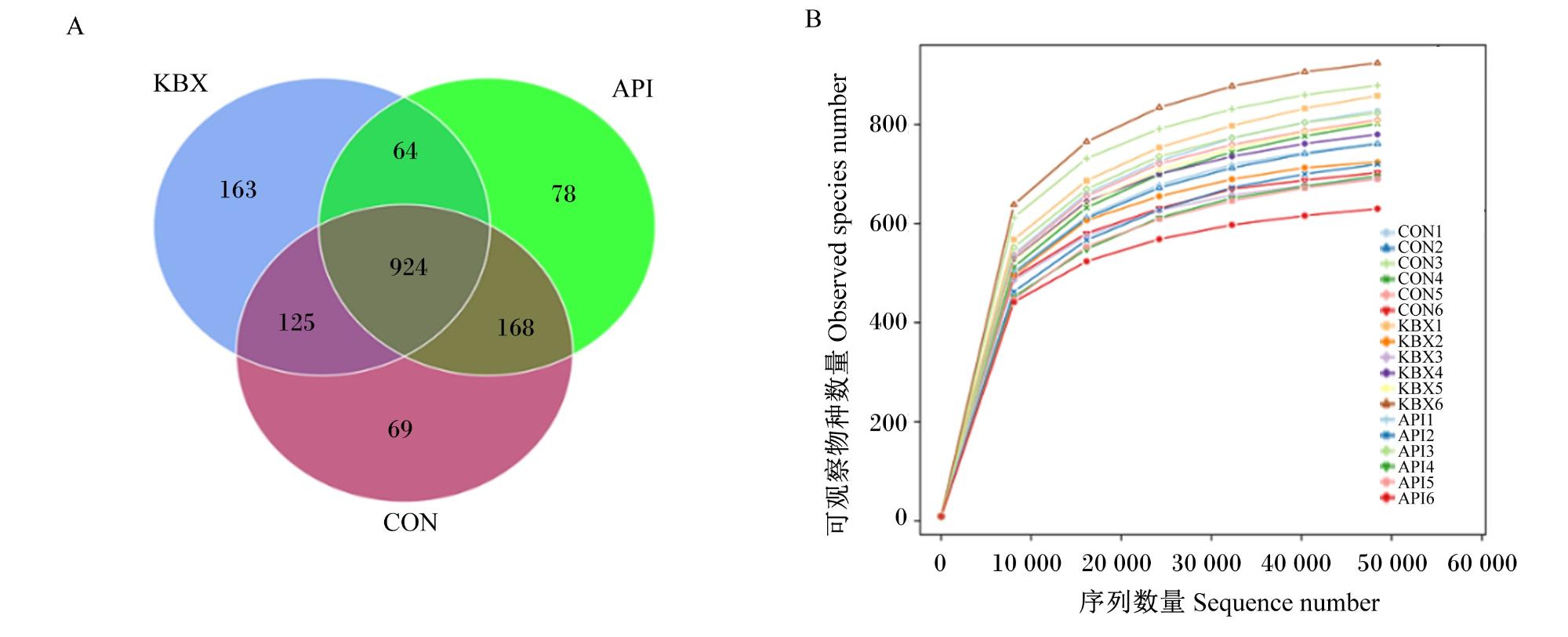
对所有样品的全部clean reads进行聚类分析,结果如图1-A所示,共得到1 591个具有97%序列相似性的OTU;3组断奶仔猪粪便样品共有的OTU数量为924个,CON组、KBX组和API组特有的OTU数量分别为69、163和78个,其中API组和KBX组OTU数量均大于CON组,表明KBX和API的添加改变了断奶仔猪粪便微生物群落结构。
图1 生物蛋白API对断奶仔猪粪便微生物群落OTU聚类(A)及稀释曲线(B)的影响

CON、KBX和API分别表示CON组、KBX组和API组。图2同。

Fig.1 Effects of biological protein API on fecal microbiota OTU clustering (A) and rarefaction curves (B) of weaned piglets

CON, KBX and API represented CON group, KBX group and API group, respectively. The same as Fig.2.

稀释曲线是描述组内样品多样性的常用曲线,可直接反映测序数据量的合理性,并间接反映样品中物种的丰富程度。如图1-B所示,本试验中各组样本稀释曲线趋向平坦,说明测序数据量渐进合理,更多的数据量只会产生少量新的物种。

2.4.3 生物蛋白API对断奶仔猪粪便微生物群落α多样性的影响

表6可知,各组间断奶仔猪粪便微生物群落α多样性各指数均无显著差异(P>0.05)。
表6 生物蛋白API对断奶仔猪粪便微生物群落α多样性的影响

Table 6 Effects of biological protein API on α diversity of fecal microbiota of weaned piglets

项目
Items
组别Groups P
P-value
CON KBX API
可观察物种数量Observed species number 794.17±22.91 797.00±34.36 727.67±26.52 0.181
Shannon指数Shannon index 6.70±0.16 7.01±0.07 6.61±0.17 0.131
Simpson指数Simpson index 0.97±0.01 0.98±0.01 0.97±0.01 0.166
Chao1指数Chao1 index 840.44±23.21 836.08±39.51 776.34±24.23 0.270
ACE指数ACE index 848.77±23.82 846.33±41.12 786.54±26.06 0.310
PD whole tree指数PD whole tree index 62.58±3.82 59.23±8.15 56.71±2.86 0.750

2.4.4 生物蛋白API对断奶仔猪粪便微生物群落β多样性的影响

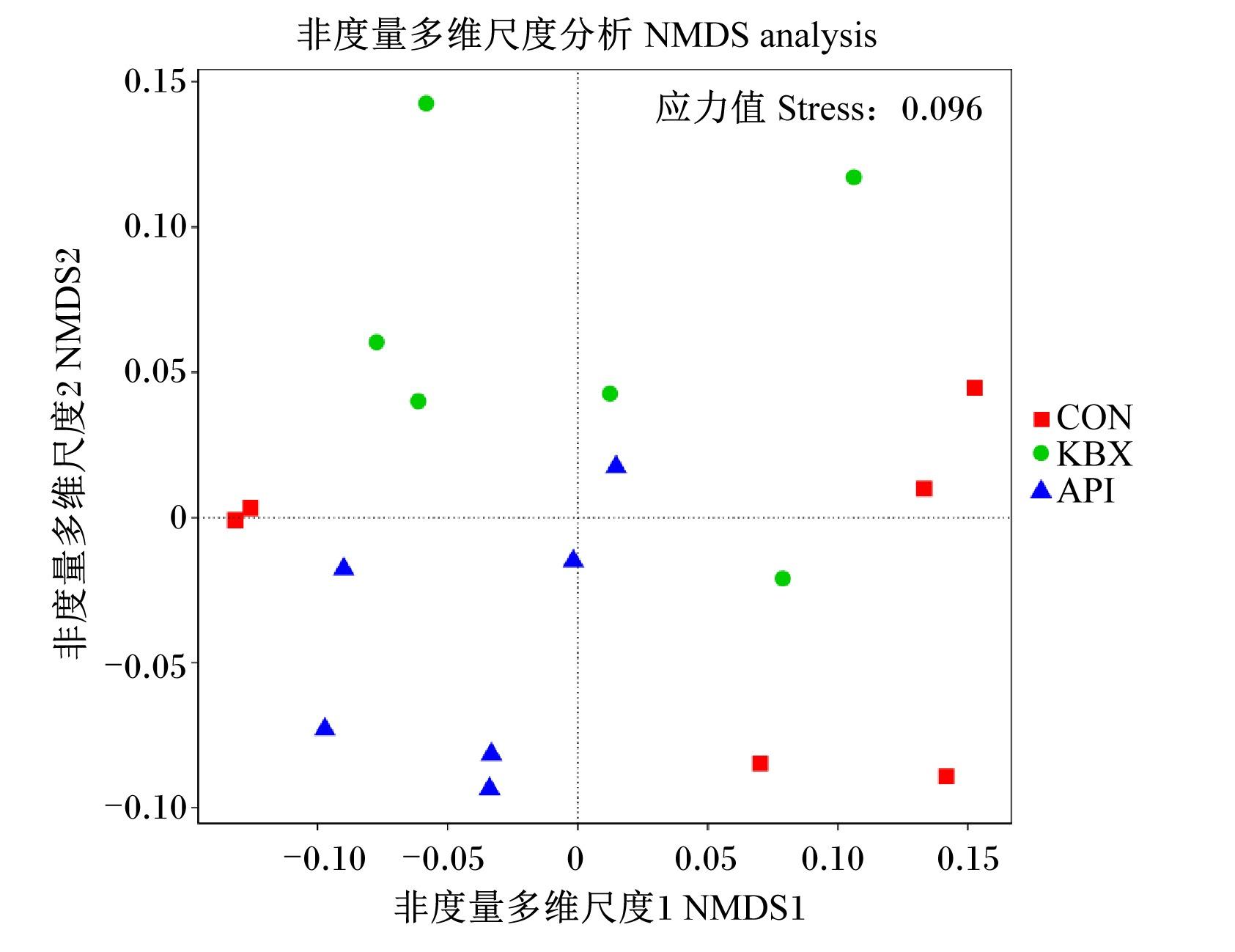
图2所示,各组样本较为聚集,且组间彼此分离,表明各组间断奶仔猪粪便微生物群落组成差异较大;同时,组内样本离散程度依次为CON组>KBX组>API组,表明API组粪便微生物群落结构更加稳定。
图2 生物蛋白API对断奶仔猪粪便微生物群落β多样性的影响

Fig.2 Effects of biological protein API on β diversity of fecal microbiota of weaned piglets

2.4.5 生物蛋白API对断奶仔猪粪便微生物群落组成的影响

根据物种注释结果,在门水平上,相对丰度>0.10%的菌门有9个,并在此基础上进行分析。由表7可知,断奶仔猪粪便微生物群落中以厚壁菌门(Firmicutes)和拟杆菌门(Bacteroidota)为优势菌门。与CON组相比,KBX组和API组粪便未鉴别细菌(unidentified_Bacteria)相对丰度显著提高(P<0.05),API组粪便变形菌门(Proteobacteria)相对丰度显著降低(P<0.05),KBX组粪便螺旋菌门(Spirochaetota)(P=0.085)和蓝细菌门(Cyanobacteria)相对丰度(P=0.058)有提高趋势。
表7 生物蛋白API对断奶仔猪粪便微生物群落在门水平上组成的影响

Table 7 Effects of biological protein API on fecal microbiota composition at phylum level of weaned piglets %

项目
Items
组别Groups P
P-value
CON KBX API
厚壁菌门Firmicutes 58.63±4.75 51.09±2.73 56.28±2.50 0.320
拟杆菌门Bacteroidota 30.59±3.25 34.33±2.07 29.83±1.53 0.388
未鉴别细菌Unidentified_Bacteria 2.71±0.19a 4.52±0.36b 4.83±0.23b 0.001
变形菌门Proteobacteria 2.00±0.39b 1.22±0.24ab 0.98±0.13a 0.048
螺旋体门Spirochaetota 0.23±0.09 0.80±0.27 0.31±0.05 0.085
广古菌门Euryarchaeota 0.01±0.01 0.41±0.28 0.09±0.07 0.350
放线菌门Actinobacteriota 0.60±0.12 0.45±0.08 0.46±0.02 0.379
脱硫杆菌Desulfobacterota 0.34±0.08 0.44±0.12 0.25±0.07 0.401
蓝细菌门Cyanobacteria 0.14±0.01 0.30±0.12 0.24±0.02 0.058
弯曲杆菌门Campilobacterota 0.22±0.10 0.27±0.12 0.21±0.11 0.918
在属水平上,相对丰度>1.0%的菌属有17个,并在此基础上进行分析。由表8可知,与CON组相比,KBX组和API组断奶仔猪粪便链球菌属(Streptococcus)相对丰度显著降低(P<0.05),粪便普雷沃氏菌科NK3B31群(Prevotellaceae_NK3B31_group)相对丰度显著提高(P<0.05)。与CON组相比,KBX组粪便拟杆菌属(Bacteroides)、UCG-002、理研菌科RC9肠道群(Rikenellaceae_RC9_gut_group)相对丰度显著提高(P<0.05),粪便厌氧弧菌属(Anaerovibrio)相对丰度显著降低(P<0.05)。与KBX组相比,API组粪便拟杆菌属、UCG-002和理研菌科RC9肠道群相对丰度显著降低(P<0.05),粪便厌氧弧菌属相对丰度显著提高(P<0.05),粪便巨球型菌属(Megasphaera)相对丰度有提高趋势(P=0.091)。
表8 生物蛋白API对断奶仔猪粪便微生物群落在属水平上组成的影响

Table 8 Effects of biological protein API on fecal microbiota composition at genus level of weaned piglets %

项目
Items
组别Groups P
P-value
CON KBX API
普雷沃氏菌属Prevotella 11.02±3.14 8.53±1.43 12.44±0.77 0.220
乳杆菌属Lactobacillus 4.09±1.06 9.46±2.74 7.32±1.62 0.177
巨球型菌属Megasphaera 4.01±1.68 3.63±0.55 9.24±2.60 0.091
链球菌属Streptococcus 9.87±2.50b 3.58±1.33a 4.52±0.71a 0.049
阿加索杆菌属Agathobacter 5.05±1.66 2.79±0.84 3.76±0.47 0.271
普雷沃氏菌科NK3B31群
Prevotellaceae_NK3B31_group
2.35±0.32a 4.63±0.93b 4.56±0.24b 0.018
戴阿利斯特杆菌属Dialister 2.46±0.77 1.34±0.33 2.68±0.86 0.366
拟普雷沃氏菌属Alloprevotella 2.64±0.20 3.59±0.59 3.30±0.35 0.283
UCG-005 1.67±0.64 1.20±0.18 0.83±0.15 0.182
拟杆菌属Bacteroides 0.30±0.06a 1.77±0.54b 0.16±0.04a 0.016
厌氧弧菌属Anaerovibrio 2.23±0.53b 0.72±0.15a 1.68±0.18b 0.014
UCG-002 0.63±0.12a 1.52±0.42b 0.55±0.06a 0.031
普雷沃氏菌科UCG-003
Prevotellaceae_UCG-003
1.94±0.47 2.23±0.34 1.75±0.26 0.655
瘤胃球菌属Ruminococcus 1.30±0.38 0.95±0.06 1.60±0.23 0.242
粪杆菌属Faecalibacterium 1.81±0.24 1.68±0.26 1.71±0.14 0.905
狭义梭菌属1 Clostridium_sensu_stricto_1 0.64±0.19 1.04±0.42 0.92±0.13 0.372
理研菌科RC9肠道群
Rikenellaceae_RC9_gut_group
0.80±0.10a 1.62±0.23b 0.98±0.10a 0.005
罗斯氏菌属Roseburia 1.33±0.30 0.77±0.11 0.78±0.12 0.100
毛螺菌科NK4A136群
Lachnospiraceae_NK4A136_group
1.29±0.23 1.41±0.33 0.80±0.15 0.215

3 讨论

3.1 生物蛋白API对断奶仔猪生长性能的影响

抗菌肽能够改善畜禽生产性能并缓解应激。Wan等[9]研究发现,饲粮添加重组抗菌肽Ple可降低仔猪腹泻率,提高ADFI和ADG。Yi等[10]研究发现,抗菌肽C-BF可提高仔猪ADFI和ADG,并降低腹泻指数。本实验室在肉鸡上的研究发现,饲粮添加API提高了肉鸡末重和ADG[11];同时,在产肠毒素大肠杆菌(ETEC)攻毒断奶仔猪上的试验表明,饲粮添加API缓解了攻毒引起的ADG下降,并改善了F/G[12]。本试验中,饲粮添加源于抗菌肽PI研发的生物蛋白API提高了断奶仔猪生长性能,且效果优于KBX。

3.2 生物蛋白API对断奶仔猪养分表观消化率的影响

养分表观消化率反映动物对营养物质的消化吸收能力。Yoon等[13]研究发现,饲粮添加复合抗菌肽可提高断奶仔猪DM、CP和Ash表观消化率。Jin等[14]在断奶仔猪上的研究发现,饲粮添加马铃薯蛋白抗菌肽可提高CP和DM表观消化率,从而提高仔猪生长性能。本试验中,饲粮添加生物蛋白API和KBX均提高了断奶仔猪CP和GE表观消化率,且API组GE表观消化率显著优于KBX组,表明生物蛋白API可提高断奶仔猪养分表观消化率,且效果优于KBX。

3.3 生物蛋白API对断奶仔猪粪便SCFAs含量的影响

SCFAs是链长不超过6个碳原子的有机单羧酸[15],包括乙酸、丙酸、丁酸、戊酸、异丁酸和异戊酸。这些有机酸主要由单胃动物体内的膳食纤维、抗性淀粉和低聚糖等不易消化的糖类在结肠中被乳酸菌、双歧杆菌等有益菌群酵解而产生[16]。乙酸作为含量最高的SCFAs,是肝脏从头合成脂肪和胆固醇的底物,也是宿主重要的能量来源;丙酸是肝脏糖异生的底物;丁酸是动物机体结肠上皮细胞的主要能量来源。大部分的SCFAs被结肠细胞吸收,有5%分泌在粪便中,通常用粪便中的SCFAs含量来反映肠道中SCFAs的产生及利用情况。易宏波[17]研究发现,在仔猪饲粮中添加抗菌肽CWA显著提高了仔猪粪便乙酸、丙酸和丁酸含量。Yu等[4]研究发现,饲粮添加抗菌肽J25显著提高仔猪粪便乙酸和丙酸含量。本试验中,饲粮添加生物蛋白API显著提高断奶仔猪粪便乙酸、异丁酸和总短链脂肪酸含量,可能原因是API可抑制肠道中的有害菌属,促进肠道中有益菌的定植,提高仔猪肠道微生物的代谢能力,从而促进SCFAs的产生,进而为机体提供更多的能量。SCFAs含量的提高表明API改善了仔猪肠道微生物群落结构和功能,进而优化了肠道发酵过程。

3.4 生物蛋白API对断奶仔猪粪便微生物群落的影响

α多样性可以反映样品内的微生物群落的丰富度和多样性。仔猪断奶后肠道微生物群落的α多样性一般先下降后上升,从断奶到成年总体呈上升趋势[18]。本试验结果显示,饲粮添加生物蛋白API对断奶仔猪粪便微生物群落α多样性无显著影响。β多样性主要用于比较不同处理间微生物群落的差异,本试验结果显示3个组间粪便微生物群落差异较大,表明KBX和API的添加改变了断奶仔猪肠道微生物群落,这与冀凤杰[19]的研究结果相似,且API组离散程度较小,表明API组仔猪粪便微生物群落更加稳定,API对仔猪微生物群落的干预更加有效。
本试验结果发现,在门水平上,断奶仔猪粪便微生物群落的优势菌门为厚壁菌门和拟杆菌门,这与前人研究结果[20]相似。张小平等[21]研究发现,复合微生态制剂可提高草鱼肠道中厚壁菌门和拟杆菌门相对丰度,降低变形菌门相对丰度。变形菌门包括多种病原体如大肠杆菌、沙门氏菌和螺杆菌等,可诱发炎症[22]。本试验中,饲粮添加生物蛋白API显著降低断奶仔猪粪便变形菌门相对丰度,表明API可减少有害菌对宿主的侵袭,保护仔猪肠道健康。在属水平上,本实验室在肉鸡上的研究表明,饲粮添加生物蛋白API提高了肉鸡盲肠乳酸杆菌数量并降低了大肠杆菌数量,进而改善了肉鸡的肠道微生物群落[11]。本试验发现,断奶仔猪粪便微生物群落的优势菌属为普雷沃氏菌属(Prevotella)和乳杆菌属(Lactobacillus)。研究表明,断奶后仔猪肠道的优势菌属从拟杆菌属转换为普雷沃氏菌属[23-24],普雷沃氏菌属可降解膳食纤维从而产生SCFAs[25]。肠道中普雷沃氏菌属相对丰度提高,表明仔猪对饲粮的接受度提高[19];而乳杆菌属相对丰度的提高可降低仔猪肠道内pH,促进肠道有益菌的增殖。以上结果表明,饲粮添加生物蛋白API促进了断奶仔猪肠道有益微生物的定植并抑制了有害微生物的生长,从而改善了仔猪肠道菌群结构。综上推测,生物蛋白API可能通过调节微生物菌群结构,增加特定菌属如普雷沃氏菌属参与膳食纤维、淀粉等的消化和代谢过程,促进SCFAs的产生,同时抑制有害菌如变形菌门的产生和定植,从而营造良好的肠道内环境,影响仔猪机体的营养和能量代谢网络,最终提高仔猪生长性能。

4 结论

饲粮添加生物蛋白API能够提高断奶仔猪生长性能和养分表观消化率,同时改善粪便菌群结构,并提高粪便SCFAs含量,且效果优于复合替抗产品KBX。
[1]
CAMPBELL J M, CRENSHAW J D, POLO J. The biological stress of early weaned piglets[J]. Journal of Animal Science and Biotechnology, 2013, 4(1):19.

DOI PMID

[2]
徐丽萍, 李国江, 肖振铎. 抗生素的现状及其主要代用产品的研究和应用进展[J]. 吉林畜牧兽医, 2002(2):9-11.

XU L P, LI G J, XIAO Z D. Current status of antibiotics and research and application progress of their main substitute products[J]. Jilin Animal Husbandry and Veterinary Medicine, 2002(2):9-11. (in Chinese)

[3]
KUMAR P, KIZHAKKEDATHU J N, STRAUS S K. Antimicrobial peptides:diversity,mechanism of action and strategies to improve the activity and biocompatibility in vivo[J]. Biomolecules, 2018, 8(1):4.

DOI

[4]
YU H T, DING X L, LI N, et al. Dietary supplemented antimicrobial peptide microcin J25 improves the growth performance,apparent total tract digestibility,fecal microbiota,and intestinal barrier function of weaned pigs[J]. Journal of Animal Science, 2017, 95(11):5064-5076.

DOI

[5]
PARK I Y, PARK C B, KIM M S, et al. Parasin I,an antimicrobial peptide derived from histone H2A in the catfish,Parasilurus asotus[J]. FEBS Letters, 1998, 437(3):258-262.

DOI

[6]
ZHAO H, TANG J Y, CAO L, et al. Characterization of bioactive recombinant antimicrobial peptide parasin I fused with human lysozyme expressed in the yeast Pichia pastoris system[J]. Enzyme and Microbial Technology, 2015,77:61-67.

[7]
TANG Y T, YIN S G, PENG C F, et al. Compound bioengineering protein supplementation improves intestinal health and growth performance of broilers[J]. Poultry Science, 2023, 102(11):103037.

DOI

[8]
赵婉馨. 饲粮生物蛋白API和APL添加对肉兔生长性能和肠道健康的影响[D]. 硕士学位论文. 雅安: 四川农业大学, 2023.

ZHAO W X. Effects of bioengineering protein API and APL Supplementation on growth performance and intestinal health of rabbits[D]. Master’s Thesis. Ya’an: Sichuan Agricultural University, 2023. (in Chinese)

[9]
WAN J, LI Y, CHEN D W, et al. Recombinant plectasin elicits similar improvements in the performance and intestinal mucosa growth and activity in weaned pigs as an antibiotic[J]. Animal Feed Science and Technology, 2016,211:216-226.

[10]
YI H B, YU C H, ZHANG H W, et al. Cathelicidin-BF suppresses intestinal inflammation by inhibiting the nuclear factor-κB signaling pathway and enhancing the phagocytosis of immune cells via STAT-1 in weanling piglets[J]. International Immunopharmacology, 2015, 28(1):61-69.

DOI PMID

[11]
彭春芳, 赵华, 唐昱婷, 等. 生物蛋白API对肉鸡生长性能和肠道健康的影响[J]. 四川农业大学学报, 2022, 40(5):676-682,689.

PENG C F, ZHAO H, TANG Y T, et al. Effects of bioengineering protein API on growth performance and gut health of broilers[J]. Journal of Sichuan Agricultural University, 2022, 40(5):676-682,689. (in Chinese)

[12]
ZOU C Z, ZHAO W X, YIN S G, et al. Artificial parasin I protein (API) supplementation improves growth performance and intestinal health in weaned piglets challenged with enterotoxigenic Escherichia coli[J]. Animal Nutrition, 2024,18:154-165.

[13]
YOON J H, INGALE S L, KIM J S, et al. Effects of dietary supplementation with antimicrobial peptide-P5 on growth performance,apparent total tract digestibility,faecal and intestinal microflora and intestinal morphology of weanling pigs[J]. Journal of the Science of Food and Agriculture, 2013, 93(3):587-592.

DOI

[14]
JIN Z, YANG Y X, CHOI J Y, et al. Potato (Solanum tuberosum L. cv. Gogu valley) protein as a novel antimicrobial agent in weanling pigs[J]. Journal of Animal Science, 2008, 86(7):1562-1572.

DOI

[15]
SILVA Y P, BERNARDI A, FROZZA R L. The role of short-chain fatty acids from gut microbiota in gut-brain communication[J]. Frontiers in Endocrinology, 2020,11:25.

[16]
陈福, 何邵平, 田科雄, 等. 短链脂肪酸的生理功能及其在畜禽生产中的应用[J]. 动物营养学报, 2019, 31(7):3039-3048.

CHEN F, HE S P, TIAN K X, et al. Physiological function of short-chain fatty acids and their application in livestock and poultry production[J]. Chinese Journal of Animal Nutrition, 2019, 31(7):3039-3048. (in Chinese)

[17]
易宏波. 抗菌肽CWA对断奶仔猪肠道炎症和肠道屏障功能的作用及其机制[D]. 博士学位论文. 杭州: 浙江大学, 2016.

YI H B. Effects and mechanisms of antimicrobial peptide CWA on intestinal inflammation and intestinal barrier functions in weaned piglets[D]. Ph.D. Thesis. Hangzhou: Zhejiang University, 2016. (in Chinese)

[18]
HU J, NIE Y F, CHEN J W, et al. Gradual changes of gut microbiota in weaned miniature piglets[J]. Frontiers in Microbiology, 2016,7:1727.

[19]
冀凤杰. 抗菌肽对断奶仔猪肠道功能的调控作用及机制研究[D]. 博士学位论文. 长沙: 湖南师范大学, 2021.

JI F J. Regulation and mechanism of antimicrobial peptides on intestinal function of weaned piglets[D]. Ph.D.Thesis. Changsha: Hunan Normal University, 2021. (in Chinese)

[20]
CHEN L M, XU Y S, CHEN X Y, et al. The maturing development of gut microbiota in commercial piglets during the weaning transition[J]. Frontiers in Microbiology, 2017,8:1688.

[21]
张小平, 傅罗琴, 王一冰, 等. 养殖水体中添加复合微生态制剂对草鱼免疫和肠道菌群的影响[C]// 第九届世界华人鱼虾营养学术研讨会论文摘要集. 厦门:中国水产学会动物营养与饲料专业委员会, 473. ZHANG X P, FUL Q, WANGY B, et al.Effects of adding compound probiotics to aquaculture water on immunity and intestinal microbiota of grass carp[C]// Abstracts of the 9th World Chinese Symposium on Fish and Shrimp Nutrition. Xiamen: Animal Nutrition and Feed Professional Committee of the Chinese Fisheries Society,2013:473.

[22]
WANG H H, SHOU Y K, ZHU X, et al. Stability of vitamin B12 with the protection of whey proteins and their effects on the gut microbiome[J]. Food Chemistry, 2019,276:298-306.

[23]
ZHAO W J, WANG Y P, LIU S Y, et al. The dynamic distribution of porcine microbiota across different ages and gastrointestinal tract segments[J]. PLoS One, 2015, 10(2):e0117441.

DOI

[24]
GUEVARRA R B, HONG S H, CHO J H, et al. The dynamics of the piglet gut microbiome during the weaning transition in association with health and nutrition[J]. Journal of Animal Science and Biotechnology, 2018, 9(1):54.

DOI

[25]
IVARSSON E, ROOS S, LIU H Y, et al. Fermentable non-starch polysaccharides increases the abundance of Bacteroides-Prevotella-Porphyromonas in ileal microbial community of growing pigs[J]. Animal, 2014, 8(11):1777-1787.

DOI

Outlines

/