RESEARCH PAPER

Effects of Dietary Methionine Supplementation of Meat-Type Breeder Ducks on Growth Performance and Intestinal Health of Their Offspring Meat Ducks

  • ZHANG Shanshan , 1, 2 ,
  • JIN Yongyan 1 ,
  • ZHANG Mengwen 1, 3 ,
  • ZHUANG Lei 1 ,
  • ZHOU Wei 1 ,
  • WU Qingyi 1 ,
  • WANG Shuaiqin 1 ,
  • XIE Ming 1 ,
  • ZHANG Kai 2 ,
  • TANG Jing , 1, *
Expand
  • 1 National Key Laboratory of Animal Nutrition and Feeding, Beijing Institute of Animal Science and Veterinary Medicine, Chinese Academy of Agricultural Sciences, Beijing 100193, China
  • 2 College of Animal Science and Technology, Qingdao Agricultural University, Qingdao 266000, China
  • 3 College of Animal Science, Shanxi Agricultural University, Taigu 030800, China
* professor, E-mail:

Received date: 2025-12-02

  Online published: 2026-07-13

Abstract

This study investigated the effects of dietary methionine supplementation of meat-type breeder ducks on growth performance and intestinal health of their offspring meat ducks. Forty-eight Beijing breeder ducks (50 weeks of age) with similar egg production rate and body weight were assigned to 2 groups in a completely randomized design with 6 replicates per group and 4 birds per replicate. Breeder ducks in the control group were fed a corn-soybean meal basal diet containing 0.265% methionine, whereas those in the methionine-supplemented group were fed the basal diet supplemented with 0.18% DL-methionine (to reach a dietary methionine content of 0.445%). The trial lasted for 20 weeks, hatching eggs from weeks 18 to 20 were collected for incubation. From each group, 80 healthy ducklings with similar hatch weight were selected (10 replicates with 8 birds per replicate), fed the same methionine-adequate diet, and reared for 49 days. Growth performance, intestinal development, mRNA relative expression levels of jejunal barrier-related genes, and cecal microbial diversity were determined. The results showed as follows: 1) compared with the control group, offspring meat ducks from methionine-supplemented group had a significantly higher body weight at 1 day of age (P<0.05), and had a significantly lower feed-to-gain ratio (P<0.05). 2) Ileal length and ileal weight of offspring meat ducks from methionine-supplemented group were significantly increased (P<0.05), villus height in the duodenum and jejunum was significantly increased (P<0.05), and mRNA relative expression level of zonula occludens-1 (ZO-1) in the jejunum was significantly upregulated (P<0.05). 3) Cecal microbiota β-diversity significantly differed between the 2 groups (P<0.05). At phylum level, the relative abundance of Bacillota was significantly increased and that of Bacteroidota was significantly decreased in the methionine-supplemented group compared with control group (P<0.05). At genus level, the relative abundances of Faecalibacterium, Mediterribacter and Negativibacillus were significantly increased in the methionine-supplemented group compared with control group (P<0.05). In conclusion, dietary methionine supplementation of meat-type breeder ducks can improve growth performance, promote intestinal development, enhance intestinal barrier function, and modulates cecal microbiota composition of their offspring meat ducks.

Cite this article

ZHANG Shanshan , JIN Yongyan , ZHANG Mengwen , ZHUANG Lei , ZHOU Wei , WU Qingyi , WANG Shuaiqin , XIE Ming , ZHANG Kai , TANG Jing . Effects of Dietary Methionine Supplementation of Meat-Type Breeder Ducks on Growth Performance and Intestinal Health of Their Offspring Meat Ducks[J]. Chinese Journal of Animal Nutrition, 2026 , 38(7) : 5106 -5118 . DOI: 10.12418/CJAN2026.409

肠道不仅承担营养物质消化吸收的基本生理功能,还通过物理屏障和黏膜免疫等机制参与机体防御调控,其结构和功能的完好性与畜禽健康状况及生产效率密切相关[1]。当肠道稳态被打破时,常伴随营养利用率降低、上皮通透性升高、氧化应激水平上升以及菌群失衡等一系列改变,进而限制畜禽生长发育并降低养殖效益[2-3]。饲粮组成和营养供给水平是影响肠道结构与功能的重要因素,通过优化饲粮组成、精细调节关键营养素供给,可以维持肠道微生态平衡并提升机体整体健康水平。
蛋氨酸(methionine,Met)是动物必需含硫氨基酸,机体无法自身合成,需依赖饲粮供给以满足正常生长繁殖需求。除作为蛋白质合成的关键前体外,蛋氨酸还通过提供甲基参与一碳代谢和DNA甲基化修饰,在脂肪代谢、核酸合成和基因表达调控等过程中发挥重要作用[4-5]。其含硫侧链是肌酸、磷脂酰胆碱等多种生物活性分子的合成基础[6],并可通过调节氧化还原状态和抗氧化体系活性影响机体免疫功能与肠道屏障稳定性[7-8]。研究表明,饲粮蛋氨酸供应不足或过量均会扰乱机体代谢稳态,导致生长迟缓、脂质沉积异常和氧化损伤加重[9-11],而适宜水平的蛋氨酸供应有助于改善肠道黏膜形态、增强紧密连接蛋白表达、提高抗氧化能力并缓解肠道炎症反应[12-13]
母源营养对子代发育具有深远影响:母猪饲粮中添加蛋氨酸羟基类似物可通过优化乳汁营养组成,改善仔猪肠道上皮完整性[14];肉牛和奶牛妊娠期补饲蛋氨酸有助于重塑子代肠道微生物群,提高肠道抗菌能力[15];绵羊妊娠后期补饲蛋氨酸可上调子代十二指肠氨基酸转运蛋白基因表达,促进营养吸收[16]。肉种鸭处于肉鸭产业链的源头,其母源营养不仅影响肉种鸭自身的生产性能和繁殖水平,也关系到其子代肉鸭的生长潜力和肠道健康。然而,现有研究多集中于蛋氨酸对育成家禽生产性能和抗氧化能力的影响,关于肉种鸭饲粮蛋氨酸水平对子代生长表现、肠道结构与屏障功能以及盲肠微生态影响的相关研究仍较为欠缺。基于此,本研究通过在肉种鸭饲粮中添加蛋氨酸,系统评估其对子代肉鸭生长性能、肠道形态发育、空肠屏障相关基因表达及盲肠菌群结构的影响,为蛋氨酸在肉种鸭生产中的合理应用提供理论依据。

1 材料与方法

1.1 试验设计

本试验采用单因子完全随机设计,选用体重和产蛋率相近的50周龄北京鸭种母鸭48只,随机分为对照组和蛋氨酸补充组,每组6个重复,每个重复4只。对照组饲喂玉米-豆粕型基础饲粮;蛋氨酸补充组饲喂在基础饲粮中额外添加0.18% DL-蛋氨酸的试验饲粮。种鸭饲养试验持续20周,期间按公母比1∶4进行自然交配。收集试验第18~20周所产出的合格种蛋进行孵化,出雏后,每组选择健康且初生重相近的雏鸭80只作为子代试验动物(10个重复,每个重复8只)。子代雏鸭为混合性别;为保证各重复间公母比例一致,采用随机分配并进行必要的性别比例调整。子代雏鸭饲养期为49 d,期间所有子代雏鸭均饲喂相同的蛋氨酸充足的玉米-豆粕型基础饲粮。

1.2 试验饲粮与饲养管理

肉种鸭及子代雏鸭基础饲粮的配制依据《肉鸭营养需要量》(GB/T 45103—2024)中相应阶段的营养推荐水平,蛋氨酸添加量亦参考该标准确定。肉种鸭和雏鸭基础饲粮组成及营养水平见表1。采用高效液相色谱法测定肉种鸭基础饲粮中蛋氨酸含量为0.265%(蛋氨酸缺乏),在此基础上添加0.18% DL-蛋氨酸(纯度98.5%,北京嘉康源科技发展有限公司),配制成蛋氨酸含量为0.445%的试验饲粮。
表1 肉种鸭和雏鸭基础饲粮组成及营养水平(风干基础)

Table 1 Composition and nutrient levels of basal diets for meat-type breeder ducks and ducklings (air-dry basis) %

项目
Items
肉种鸭基础饲粮
Basal diets for meat-
type breeder ducks
雏鸭基础饲粮Basal diets for ducklings
1~21日龄
1 to 21 days of age
22~49日龄
22 to 49 days of age
原料Ingredients
玉米Corn 62.00 62.92 68.10
豆粕Soybean meal 17.80 33.30 25.60
花生粕Peanut meal 10.00
磷酸氢钙CaHPO4 1.50 1.50 1.75
石粉Limestone 7.20 0.80 1.25
预混料Premix1) 1.00 1.00 1.00
食盐NaCl 0.30 0.30 0.30
赖氨酸Lys 0.20 0.10
大豆油Soybean oil 1.80
DL-蛋氨酸DL-Met 0.18 0.10
合计Total 100.00 100.00 100.00
营养水平Nutrient levels2)
代谢能ME/(MJ/kg) 11.67 12.13 12.68
粗蛋白质CP 18.56 20.13 17.19
钙Ca 2.89 0.94 1.13
非植酸磷NPP 0.41 0.41 0.44
赖氨酸Lys 0.96 1.04 0.94
蛋氨酸Met 0.27 0.45 0.38
蛋氨酸+胱氨酸Met+Cys 0.55 0.67 0.69
苏氨酸Thr 0.65 0.83 0.69
色氨酸Trp 0.20 0.25 0.21
精氨酸Arg 1.30 1.31 1.08

1)肉种鸭预混料为每千克饲粮提供 The premix for meat-type breeder ducks provided the following per kg of the diet:Cu 8 mg,Fe 60 mg, Zn 60 mg,Mn 100 mg,Se 0.3 mg,I 0.4 mg,硫胺素 thiamine 2 mg,胆碱 choline 1 500 mg,核黄素 riboflavin 15 mg,烟酸 nicotinic acid 50 mg,泛酸 pantothenic acid 20 mg,VA 8 000 IU,VD3 3 000 IU,VE 30 IU,VK3 2 mg,VB6 4 mg,VB12 0.02 mg,叶酸 folic acid 1 mg,生物素 biotin 0.2 mg。

2)粗蛋白质、钙及氨基酸分别按照GB/T 6432—2018、GB/T 6436—2018 和 GB/T 18246—2019实测,其余营养成分根据《中国饲料成分及营养价值表(2023年第34版)》计算。CP, Ca and amino acids were measured according to GB/T 6432—2018, GB/T 6436—2018 and GB/T 18246—2019, respectively, and other nutrients were calculated from the Tables of Feed Composition and Nutritive Values in China (34th edition, 2023).

1~21日龄雏鸭预混料为每千克饲粮提供 The premix for 1- to 21-day-old ducklings provided the following per kg of the diet:Cu 10 mg,Fe 60 mg,Zn 60 mg,Mn 80 mg,Se 0.3 mg,I 0.2 mg,胆碱 choline 1 000 mg,VA 10 000 IU,硫胺素 thiamine 2 mg,核黄素 riboflavin 10 mg,烟酸 nicotinic acid 50 mg,泛酸 pantothenic acid 20 mg,VD3 3 000 IU,VE 30 IU,VK3 2 mg,VB6 4 mg,VB12 0.02 mg,叶酸 folic acid 1 mg,生物素 biotin 0.2 mg。

22~49日龄雏鸭预混料为每千克饲粮提供The premix for 22- to 49-day-old ducklings provided the following per kg of the diet:Cu 8 mg,Fe 60 mg,Zn 60 mg,Mn 100 mg,Se 0.3 mg,I 0.4 mg,胆碱 choline 1 000 mg,硫胺素 thiamine 2 mg,核黄素 riboflavin 10 mg,烟酸 nicotinic acid 50 mg,泛酸 pantothenic acid 20 mg,VA 8 000 IU,VD3 2 000 IU,VE 20 IU,VK3 2 mg,VB6 4 mg,VB12 0.02 mg,叶酸 folic acid 1 mg,生物素 biotin 0.2 mg。

动物试验在中国农业科学院北京畜牧兽医研究所昌平试验基地开展,试验方案经该所动物实验福利伦理委员会批准(审查受理号:IAS2024-27)。肉种鸭采用单笼饲养,笼具规格为40 cm×60 cm×50 cm,鸭舍24 h光照,自由采食和饮水。子代肉鸭采用网上平养方式,饲养密度按照肉鸭生产常规控制,饲喂过程中自由采食和饮水,舍内温度由33 ℃逐步降至约22 ℃,光照制度与肉种鸭基本一致,其余管理措施参照常规生产标准执行。

1.3 样品采集

在子代试验第49天,每个重复选取2只体重接近该重复平均值的子代肉鸭,停饲8 h(仍供给饮水)后屠宰,迅速剖检,分别剪取十二指肠、空肠和回肠中段约2 cm肠段,用生理盐水轻柔冲洗黏附内容物后置于4%多聚甲醛固定,用于组织学观察;同时采集空肠中段组织及盲肠内容物,置于无菌1.5 mL离心管中,经液氮速冻后转入-80 ℃冰箱保存。

1.4 检测指标

1.4.1 生长性能

称量并记录子代肉鸭1和49日龄体重,以重复为单位统计全期采食量,计算平均日采食量、平均日增重和料重比,计算公式如下:
平均日采食量(g)=总采食量/试验天数;
平均日增重(g)=总增重/试验天数;
料重比=平均日采食量/平均日增重。

1.4.2 肠道发育指标

子代肉鸭屠宰后沿系膜缘仔细分离小肠各段,使用精度为0.1 cm的卷尺测量十二指肠、空肠和回肠的实际长度;将相应肠段内容物挤净,用精度为0.1 g的电子天平称量其湿重,记录各肠段的长度和重量。

1.4.3 肠道形态

将经4%多聚甲醛固定24 h的肠段样品按常规组织学步骤脱水、浸蜡并石蜡包埋,切制厚度约5 μm的连续切片,苏木精-伊红染色后封片,进行形态学测量。使用光学显微镜(Canon EOS750D,日本)捕获染色样品的图像后,通过Image-Pro Plus 6.0软件测量绒毛高度、隐窝深度和肌层厚度,计算绒隐比(绒毛高度/隐窝深度)。

1.4.4 空肠屏障基因表达

采用Trizol试剂提取空肠组织总RNA,用HiScript Ⅲ RT SuperMix for qPCR试剂盒(南京诺唯赞生物科技股份有限公司)反转录合成cDNA。使用NanoDrop One超微量紫外分光光度计(Thermo Fisher Scientific,美国)检测cDNA浓度和纯度(在260和280 nm下的吸光度比值在1.8~2.0),-20 ℃保存备用。根据GenBank中鸭相关基因序列,通过NCBI Primer Blast设计闭锁小带蛋白-1(ZO-1)、闭合蛋白(Occludin)的特异性引物(表2),引物由北京擎科生物科技股份有限公司合成。以cDNA为模板,使用SYBR Green PCR Master Mix进行实时荧光定量PCR,总反应体系为10 μL:2×SYBR Green PCR Master Mix 5 μL,上、下游引物各0.2 μL,ddH2O 3.6 μL,cDNA 1 μL。反应程序:95 ℃预变性30 s;95 ℃ 10 s,60 ℃ 30 s,40个循环。每个样品设3个重复,以β-肌动蛋白(β-actin)为内参基因,采用2-ΔΔCt法计算各目标基因的mRNA相对表达量。
表2 引物序列

Table 2 Primer sequences

基因Genes 引物序列Primer sequences (5'—3')
β-肌动蛋白β-actin F:GCTATGTCGCCCTGGATTT
R:GGATGCCACAGGACTCCATAC
闭锁小带蛋白-1 ZO-1 F:TCGAGCAGATTTCTGGAGGT
R:AGCTAGTTTCTCCCGTGCAA
闭合蛋白Occludin F:AAGGAGCTCGACAGCATCTC
R:CACCTTGTCGTAGTCGCTCA

1.4.5 盲肠菌群

采用16S rRNA基因测序技术检测盲肠菌群组成,测序工作委托上海美吉生物医药科技有限公司完成。使用QIAamp DNA试剂盒提取盲肠内容物总DNA,1%琼脂糖凝胶电泳评估完整性,并利用NanoDrop One测定其浓度和纯度。以质量合格的DNA为模板,使用引物338F(5'-ACTCCTACGGGAGGCAGCAG-3')和806R(5'-GGACTACHVGGGTWTCTAAT-3')扩增16S rRNA V3~V4区。PCR产物经2%琼脂糖凝胶纯化并回收,用Qubit 4.0核酸定量仪测定DNA含量。采用NEXTFLEX Rapid DNA-Seq Kit构建文库,在Illumina Nextseq2000平台进行双端测序。原始数据在美吉生物云平台(https://cloud.majorbio.com)进行质控和序列聚类,计算Chao1、Ace、Shannon、Simpson指数等α多样性指数,基于Bray-Curtis距离的主坐标分析(PCoA)评估β多样性,并通过LEfSe分析比较组间的优势菌群差异。

1.5 数据统计分析

试验数据以“平均值±标准差”表示,采用SAS 9.4统计软件进行独立样本t检验,P<0.05视为差异显著。

2 结果

2.1 肉种鸭饲粮中添加蛋氨酸对其子代肉鸭生长性能的影响

表3可知,与对照组相比,蛋氨酸补充组子代肉鸭1日龄体重显著提高(P<0.05),49日龄体重呈增加趋势(P=0.056),料重比显著降低(P<0.05),而平均日增重和平均日采食量均无显著差异(P>0.05)。
表3 肉种鸭饲粮中添加蛋氨酸对其子代肉鸭生长性能的影响

Table 3 Effects of dietary Met supplementation of meat-type breeder ducks on growth performance of their offspring meat ducks

项目
Items
对照组
Control group
蛋氨酸补充组
Met-supplemented group
P
P-value
1日龄体重BW at 1 day of age/g 48.29±1.40b 51.64±2.28a 0.001
49日龄体重BW at 49 days of age/g 2 555.78±312.34 2 664.78±306.81 0.056
平均日增重ADG/g 51.17±4.33 53.30±2.71 0.218
平均日采食量ADFI/g 187.46±20.07 172.03±26.01 0.155
料重比F/G 2.95±0.07a 2.64±0.37b 0.018

同行数据肩标不同字母表示差异显著(P<0.05),无字母表示差异不显著(P>0.05)。下表同。

In the same row, values with different superscript letters were significantly different (P<0.05), whereas values with no superscript letters were not significantly different (P>0.05). The same as below.

2.2 肉种鸭饲粮中添加蛋氨酸对其子代肉鸭肠道重量、长度的影响

表4可知,与对照组相比,蛋氨酸补充组子代肉鸭回肠长度和重量显著增加(P<0.05),而回肠单位长度重量无显著变化(P>0.05);十二指肠和空肠长度、重量及单位长度重量在2组之间均无显著差异(P>0.05)。
表4 肉种鸭饲粮中添加蛋氨酸对其子代肉鸭肠道重量、长度的影响

Table 4 Effects of dietary Met supplementation of meat-type breeder ducks on intestinal weight and length of their offspring meat ducks

项目
Items
对照组
Control group
蛋氨酸补充组
Met-supplemented group
P
P-value
十二指肠长度Duodenal length/cm 3.47±0.32 3.49±0.33 0.911
十二指肠重量Duodenal weight/g 9.05±1.16 9.05±1.16 0.830
十二指肠单位长度重量
Duodenal weight per unit length/(g/cm)
2.60±0.23 2.61±0.28 0.907
空肠长度Jejunal length/cm 7.77±0.94 7.83±1.16 0.874
空肠重量Jejunal weight/g 20.37±4.60 20.39±4.34 0.994
空肠单位长度重量Jejunal weight per unit length/(g/cm) 2.60±0.33 2.59±0.35 0.928
回肠长度Ileal length/cm 7.37±0.35b 7.82±0.64a 0.035
回肠重量Ileal weight/g 16.35±2.46b 18.89±3.44a 0.028
回肠单位长度重量Ileal weight per unit length/(g/cm) 2.24±0.33 2.42±0.42 0.226

2.3 肉种鸭饲粮中添加蛋氨酸对其子代肉鸭肠道形态的影响

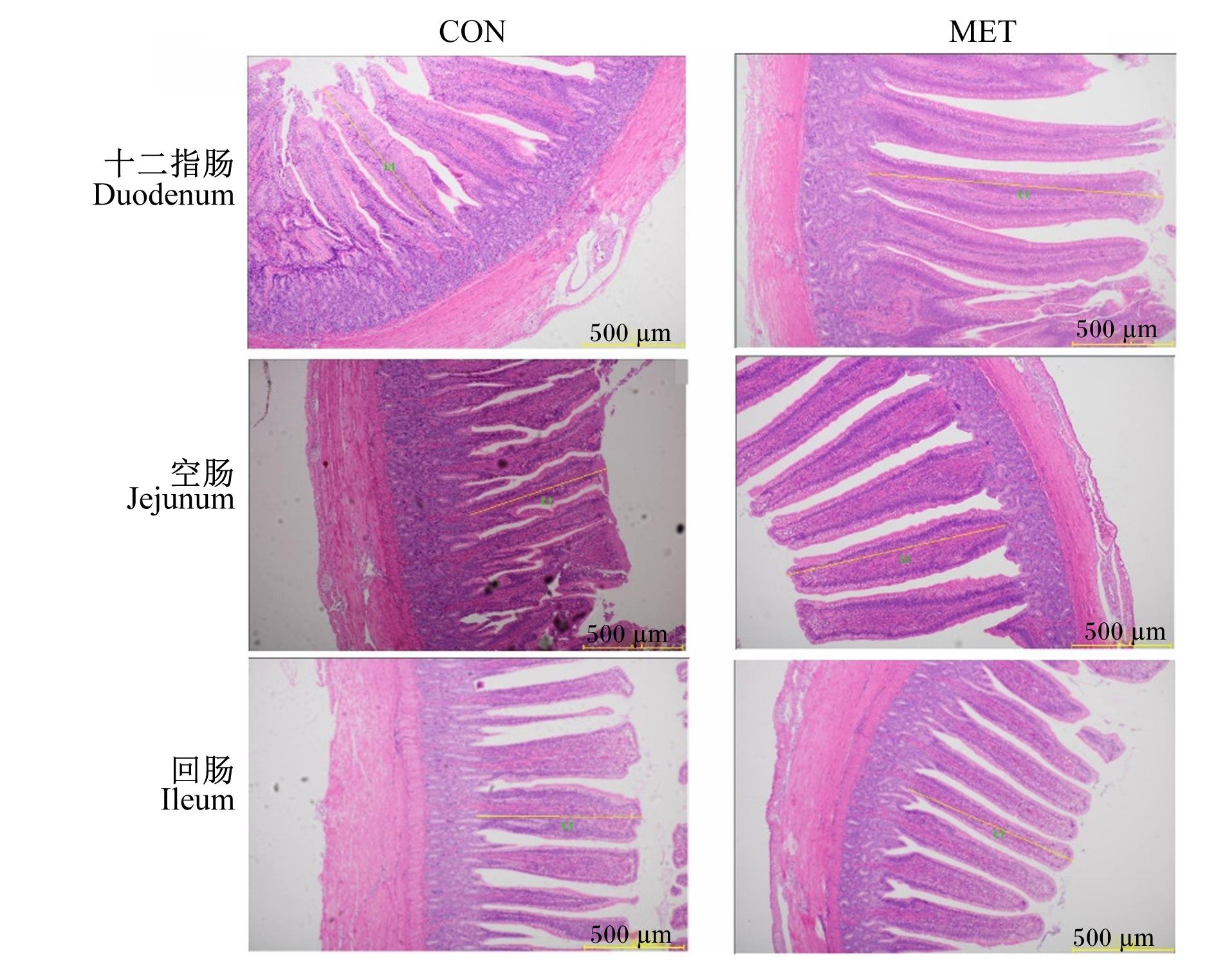
对照组和蛋氨酸补充组子代肉鸭不同肠段绒毛形态如图1所示。由表5可知,蛋氨酸补充组子代肉鸭十二指肠和空肠绒毛高度显著高于对照组(P<0.05);各肠段隐窝深度、绒隐比及肌层厚度在2组之间均无显著差异(P>0.05)。
图1 子代肉鸭不同肠段绒毛形态

CON:对照组 control group;MET:蛋氨酸补充组 Met-supplemented group。下图同 the same as below。

Fig.1 Villus morphology in different gut segments of offspring meat ducks

表5 肉种鸭饲粮中添加蛋氨酸对其子代肉鸭肠道形态的影响

Table 5 Effects of dietary Met supplementation of meat-type breeder ducks on intestinal morphology of their offspring meat ducks

项目
Items
对照组
Control group
蛋氨酸补充组
Met-supplemented group
P
P-value
十二指肠Duodenum
绒毛高度Villus height/μm 969.36±122.72b 1 183.99±177.60a 0.024
隐窝深度Crypt depth/μm 389.39±83.46 382.19±47.07 0.832
绒隐比Villus height to crypt depth ratio 2.78±0.83 3.24±0.71 0.270
肌层厚度Muscle layer thickness/μm 294.37±32.78 301.03±52.92 0.789
空肠Jejunum
绒毛高度Villus height/μm 913.24±130.77b 1 058.56±167.29a 0.034
隐窝深度Crypt depth/μm 302.65±63.40 307.37±72.60 0.873
绒隐比Villus height to crypt depth ratio 3.25±0.87 3.67±0.87 0.274
肌层厚度Muscle layer thickness/μm 304.08±48.13 262.50±50.55 0.062
回肠Ileum
绒毛高度Villus height/μm 722.82±86.70 762.27±95.69 0.298
隐窝深度Crypt depth/μm 220.12±71.15 215.66±28.19 0.831
绒隐比Villus height to crypt depth ratio 3.72±1.11 3.71±0.43 0.971
肌层厚度Muscle layer thickness/μm 329.22±49.16 352.26±45.13 0.235

2.4 肉种鸭饲粮中添加蛋氨酸对其子代肉鸭空肠屏障基因表达的影响

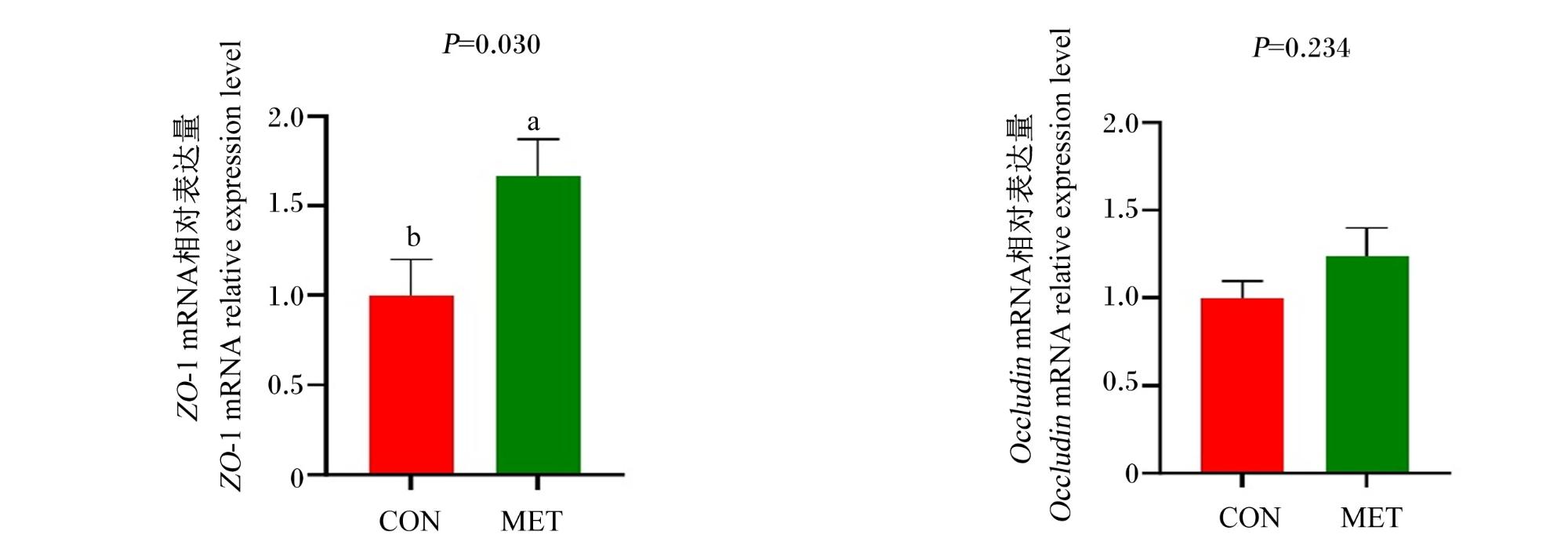
图2所示,与对照组相比,蛋氨酸补充组子代肉鸭49日龄空肠中ZO-1 mRNA相对表达量显著增加(P<0.05),Occludin mRNA相对表达量无显著变化(P>0.05)。
图2 肉种鸭饲粮中添加蛋氨酸对其子代肉鸭空肠屏障基因表达的影响

数据柱标注不同字母表示差异显著(P<0.05),无字母表示差异不显著(P>0.05)。

Fig.2 Effects of dietary Met supplementation of meat-type breeder ducks on jejunal barrier-related gene expression of their offspring meat ducks

Bars with different letters indicated significant difference (P<0.05), while without letter indicated no significant difference (P>0.05).

2.5 肉种鸭饲粮中添加蛋氨酸对其子代肉鸭盲肠菌群的影响

2.5.1 子代肉鸭盲肠菌群操作分类单元(OTU)组成特征
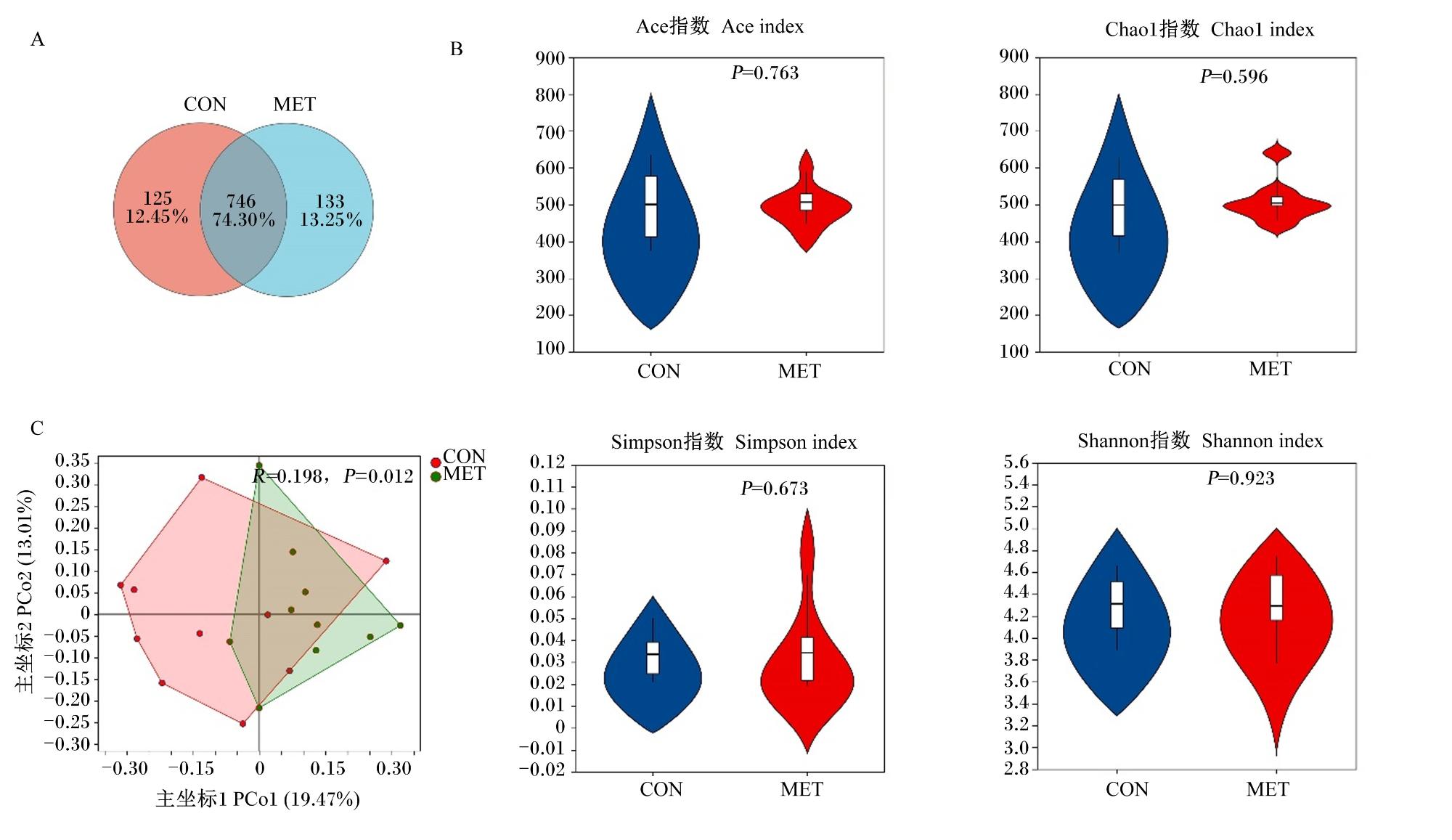
基于OTU聚类结果构建的Venn图(图3-A)显示,蛋氨酸补充组与对照组子代肉鸭盲肠菌群的共有OTU数目为739,蛋氨酸补充组特有OTU数目为133,对照组特有OTU数目为125。
图3 肉种鸭饲粮中添加蛋氨酸对其子代肉鸭盲肠菌群OTU组成及多样性的影响

A:基于OTU水平的Venn图;B:α多样性(Chao1、Ace、Shannon、Simpson指数);C:β多样性(PCoA)。

Fig.3 Effects of dietary Met supplementation of meat-type breeder ducks on cecal microbiota OTU composition and diversity of their offspring meat ducks

A: the Venn diagram based on OTU level; B: α diversity (Chao1, Ace, Shannon and Simpson indexes); C: β diversity (PCoA).

2.5.2 子代肉鸭盲肠菌群α多样性

图3-B可知,2组子代肉鸭盲肠菌群的Chao1、Shannon、Simpson和Ace指数均无显著差异(P>0.05)。

2.5.3 子代肉鸭盲肠菌群β多样性

基于Bray-Curtis距离矩阵的PCoA(图3-C)显示,蛋氨酸补充组与对照组子代肉鸭盲肠菌群组成存在显著差异(R=0.198,P=0.012),即2组盲肠菌群β多样性存在显著差异。

2.5.4 子代肉鸭盲肠菌群物种组成

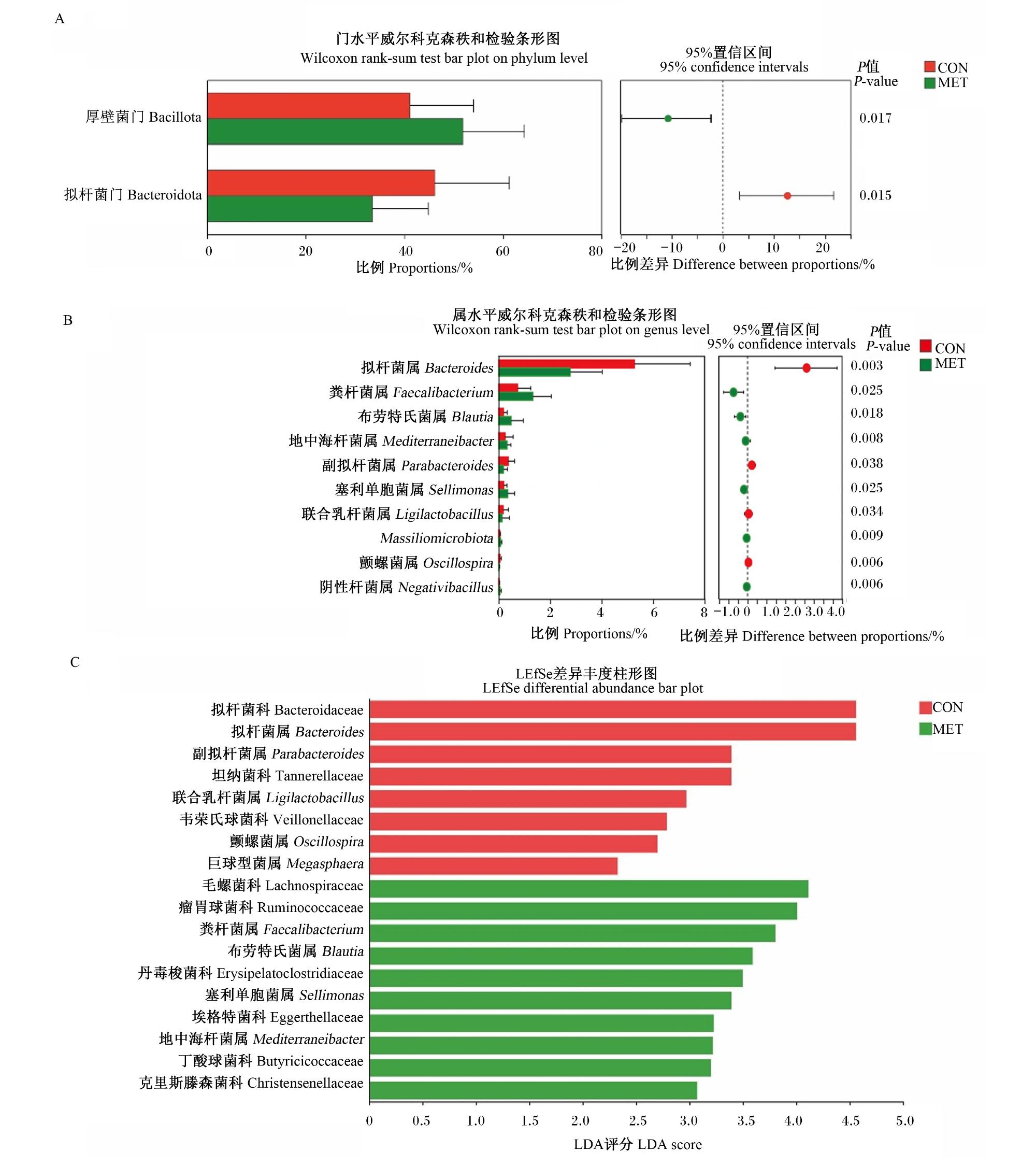
门水平上(图4-A),与对照组相比,蛋氨酸补充组子代肉鸭盲肠菌群中厚壁菌门(Bacillota,曾用名Firmicutes)的相对丰度显著升高(P<0.05),而拟杆菌门(Bacteroidota)的相对丰度显著降低(P<0.05)。
图4 肉种鸭饲粮中添加蛋氨酸对其子代肉鸭盲肠菌群物种组成的影响

A:门水平物种相对丰度;B:属水平物种相对丰度(仅显示前10个优势属);C:LEfSe分析揭示的差异微生物类群(LDA评分>2,P<0.05)。

Fig.4 Effects of dietary Met supplementation of meat-type breeder ducks on species composition of cecal microbiota of their offspring meat ducks

A: the relative abundance of bacteria at phylum level; B: the relative abundance of bacteria at genus level (only the top 10 dominant genera were shown); C: differential bacterial taxa identified by LEfSe analysis (LDA score>2, P<0.05).

属水平上(图4-B),蛋氨酸补充组子代肉鸭盲肠菌群中粪杆菌属(Faecalibacterium)、布劳特氏菌属(Blautia)、地中海杆菌属(Mediterraneibacter)、赛利单胞菌属(Sellimonas)、Massiliomicrobiota 和阴性杆菌属(Negativibacillus)的相对丰度显著高于对照组(P<0.05),拟杆菌属(Bacteroides)、副拟杆菌属(Parabacteroides)、联合乳杆菌属( Ligilactobacillus)和颤螺菌属(Oscillospira)的相对丰度显著低于对照组(P<0.05)。
LEfSe分析结果(图4-C)显示,对照组子代肉鸭盲肠菌群中拟杆菌科(Bacteroidaceae)、拟杆菌属、副拟杆菌属、坦纳菌科(Tannerellaceae)为显著富集的微生物类群[线性判别分析(LDA)评分>2,P<0.05];而蛋氨酸补充组中,粪杆菌属、毛螺菌科(Lachnospiraceae)、瘤胃球菌科(Ruminococcaceae)和丁酸球菌科(Butyricicoccaceae)等产丁酸相关菌为显著富集类群(LDA评分>2,P<0.05)。

3 讨论

3.1 肉种鸭饲粮中添加蛋氨酸对其子代肉鸭生长性能的影响

蛋氨酸是畜禽饲粮中重要的功能性氨基酸,其供应水平直接影响机体蛋白质合成与生长发育[17]。大量研究表明,饲粮中添加适量的蛋氨酸可显著改善畜禽生产性能。例如,绵羊妊娠后期饲粮添加0.25%过瘤胃蛋氨酸可提高羔羊初生重和断奶期平均日增重[18];肉种鸡饲粮中添加0.10%包被蛋氨酸能够增加子代出栏体重和胴体重[19];在肉鸭方面,李帅[20]发现,饲粮中添加蛋氨酸或蛋氨酸羟基类似物可显著提高14和42日龄体重并降低料重比;吴永保等[17]报道,在低能量低蛋白质饲粮中添加蛋氨酸可显著增加北京鸭各阶段平均体重、平均日增重和平均日采食量。本试验结果显示,肉种鸭饲粮中添加蛋氨酸后,其子代雏鸭1日龄体重显著提高,49日龄体重呈增加趋势,料重比显著降低,与上述研究结果一致,表明在母源营养层面提高蛋氨酸水平同样有利于子代生长发育。已有研究发现,蛋氨酸作为甲基供体,可参与DNA甲基化及组蛋白修饰等表观遗传调控过程,调控肌肉生长和营养代谢相关基因的转录[21];此外,蛋氨酸对肠道消化吸收功能和营养利用效率的改善,也可能是本试验中子代肉鸭料重比降低的原因之一。

3.2 肉种鸭饲粮中添加蛋氨酸对其子代肉鸭肠道发育的影响

小肠绒毛和隐窝的形态特征能够反映黏膜上皮更新与营养吸收能力,是评价肠道发育状况的关键指标。绒毛高度增加可扩大黏膜有效吸收面积,而隐窝过深往往提示上皮细胞更新加快、损伤修复负担加重,二者共同决定肠道对营养物质的吸收效率[22]。蛋氨酸作为多胺类化合物(如精胺、亚精胺)合成的重要前体,可参与调控肠上皮细胞的增殖、分化及绒毛结构的形成[23-24]。已有研究表明,蛋氨酸对肠道形态发育具有显著的调控作用:在鹅胚胎期注射蛋氨酸可显著提高出雏后十二指肠和空肠绒毛高度[25]。肉鸡饲粮中添加蛋氨酸能够改善回肠黏膜结构,增强肠道形态完整性[26]。Lugata等[27]研究也证实,不同来源蛋氨酸均可促进雏鸡胚胎期肠道发育,提高空肠绒毛高度。妊娠母猪饲粮蛋氨酸水平提高至0.48%时,可显著增加子代表观肠绒毛高度并降低隐窝深度[28]。本试验中,与对照组相比,蛋氨酸补充组子代肉鸭十二指肠和空肠绒毛高度显著增加,回肠长度和重量也显著提高,与上述研究结果一致,表明母体补充蛋氨酸可促进子代肠道形态发育。其机制可能与蛋氨酸参与多胺合成有关,多胺可促进肠上皮细胞增殖与分化,有利于绒毛结构形成[29-30];同时,肠道形态发育的改善及营养吸收面积的扩大,为子代料重比降低提供了形态学依据。

3.3 肉种鸭饲粮中添加蛋氨酸对其子代肉鸭肠道屏障基因表达的影响

肠道上皮紧密连接是由ZO-1、Occludin、密封蛋白(Claudin)等紧密连接蛋白构成的选择性屏障结构,其完整性直接决定肠道通透性,对维持肠道屏障功能、阻止有害物质(如内毒素)进入血液循环起到关键作用[31-32],紧密连接蛋白的表达和分布易受营养、炎症因子及氧化应激等多种因素影响,其中蛋氨酸作为功能性氨基酸之一,在维持肠道屏障完整性方面发挥着重要调控作用[33-34]。研究显示,家鸽饲粮中添加DL-蛋氨酸或DL-蛋氨酰-DL-蛋氨酸可提高空肠Claudin-1和ZO-1蛋白表达水平[35];肉鸭饲粮中添加0.63%蛋氨酸羟基类似物能够显著上调回肠黏膜中ZO-1、Claudin-1及Occludin mRNA相对表达量[20]。本试验中,肉种鸭饲粮中添加蛋氨酸显著提高了其子代肉鸭49日龄空肠中ZO-1 mRNA相对表达量,这与前人所得结果相符。研究表明,蛋氨酸及其代谢可激活Wnt/β-连环蛋白(β-catenin)等信号通路,促进上皮细胞增殖及紧密连接蛋白的合成与定位[35];同时,其介导的一碳代谢和DNA甲基化过程亦可能影响紧密连接相关基因启动子区域的甲基化状态,从而调节基因转录活性[36-37]。此外,多胺(如精胺)可促进黏膜核酸与蛋白质合成并支持肠道成熟[38-39],亦可能协同维持屏障稳态。

3.4 肉种鸭饲粮中添加蛋氨酸对其子代肉鸭盲肠菌群的影响

肠道菌群在营养物质消化利用、屏障功能维持及黏膜免疫调节中发挥重要作用,其组成和多样性是评价肠道健康状况的重要指标[40]。部分肠道益生菌能够参与蛋氨酸代谢,产生多种有机酸及含氮代谢产物,参与能量代谢和肠腔环境稳态维持[41]。Yu等[42]研究发现,大口黑鲈饲粮中添加蛋氨酸可提高肠道菌群Shannon和Simpson指数,并增强肠道屏障功能;而董昕等[43]则发现,饲粮中添加0.45%蛋氨酸对高原鼠兔肠道菌群β多样性的影响不显著。本试验中,2组子代肉鸭盲肠菌群的α多样性无显著差异,但β多样性存在显著差异,表明肉种鸭饲粮中蛋氨酸主要通过改变菌群结构组成而非丰富度来调节子代肠道微生态。
在群落组成方面,厚壁菌门和拟杆菌门是哺乳动物及禽类肠道中的优势菌群,厚壁菌门/拟杆菌门(F/B)比值常被用作反映能量收支及营养吸收效率的重要指标,F/B比值升高通常与碳水化合物和脂肪的利用效率改变相关[44]。本试验结果显示,蛋氨酸补充组子代肉鸭盲肠菌群中厚壁菌门的相对丰度显著升高、拟杆菌门的相对丰度显著降低,F/B比值提高,与陈娜娜等[44]在蛋鸡上的研究结果一致,提示母体补充蛋氨酸可通过调节子代肠道厚壁菌门丰度,影响营养物质利用。在属水平上,蛋氨酸补充组子代肉鸭盲肠菌群中粪杆菌属、地中海菌属等菌属的相对丰度显著增加。粪杆菌属可产生乙酸和丙酸等短链脂肪酸,具有维持肠道形态、改善肠上皮屏障和抑制炎症等功能[45];地中海菌属与肠道炎症反应抑制及黏膜屏障保护相关,可降低炎症水平[46]。同时,LEfSe分析结果显示,蛋氨酸补充组子代肉鸭盲肠菌群中粪杆菌属、毛螺菌科和瘤胃球菌科等产丁酸的菌群显著富集。丁酸作为肠道微生物代谢的关键短链脂肪酸之一,既是肠上皮细胞的重要能量来源,促进细胞增殖和修复,又具有抗氧化和抗炎作用。研究表明,丁酸能够通过降低丙二醛含量、提高超氧化物歧化酶活性等途径,减轻肠道氧化应激损伤[44-45]。此外,短链脂肪酸还可以通过调节细胞因子谱来改善黏膜免疫稳态,有助于维持肠道屏障的完整性[47],结合本研究中子代肉鸭肠道绒毛高度增加及ZO-1表达上调的结果,推测母体补充蛋氨酸可能通过促进产短链脂肪酸菌群的富集和提高短链脂肪酸的供给,从而在一定程度上改善子代肠道结构和屏障功能。

4 结论

① 肉种鸭饲粮中添加蛋氨酸可提高子代肉鸭1日龄体重,降低料重比,进而改善其生长性能。
② 肉种鸭饲粮中添加蛋氨酸能促进子代肉鸭回肠发育,增加十二指肠和空肠绒毛高度,上调空肠中ZO-1的表达,对改善肠道形态和屏障功能有积极影响。
③ 肉种鸭饲粮中添加蛋氨酸可显著改变子代肉鸭盲肠菌群的β多样性,提高厚壁菌门相对丰度,降低拟杆菌门相对丰度,增加产丁酸相关菌的相对丰度。
[1]
ZHU Q D, SUN P, ZHANG B K, et al. Progress on gut health maintenance and antibiotic alternatives in broiler chicken production[J]. Frontiers in Nutrition, 2021, 8:692839.

DOI

[2]
KIKUSATO M. Phytobiotics to improve health and production of broiler chickens:functions beyond the antioxidant activity[J]. Animal Bioscience, 2021, 34(3):345-353.

DOI

[3]
ELNESR S S, ELWAN H A M, EL SABRY M I, et al. Impact of chitosan on productive and physiological performance and gut health of poultry[J]. World’s Poultry Science Journal, 2022, 78(2):483-498.

DOI

[4]
黄杰, 马娜娜, 殷雨洋, 等. 过瘤胃蛋氨酸在围产期反刍动物生产中应用的研究进展[J]. 黑龙江畜牧兽医, 2025(3):28-35.

HUANG J, MA N N, YIN Y Y, et al. Research progress on the application of rumen-protected methionine in perinatal ruminant production[J]. Heilongjiang Animal Science and Veterinary Medicine, 2025(3):28-35. (in Chinese)

[5]
夏茂, 赵小刚, 郭吉余, 等. 蛋氨酸代谢及其对动物繁殖性能的影响研究进展[J]. 中国畜牧杂志, 2023, 59(5):17-23.

XIA M, ZHAO X G, GUO J Y, et al. Research progress on methionine metabolism and its effect on animal reproductive performance[J]. Chinese Journal of Animal Science, 2023, 59(5):17-23. (in Chinese)

[6]
吴维辉, 刘汉林. DL-蛋氨酸及其类似物的特点和含量测定[J]. 饲料工业, 1995(3):34-35.

WU W H, LIU H L. Characteristics and content determination of DL-methionine and its analogues[J]. Feed Industry, 1995(3):34-35. (in Chinese)

[7]
梅佳. 饲粮添加蛋氨酸锌对大肠杆菌攻毒肉鸭生长性能、免疫功能和肠道健康的影响[D]. 硕士学位论文. 雅安: 四川农业大学, 2021.

MEI J.Effect of dietary zinc methionine supplementation on growth performance,immune function and intestinal health of meat ducks challenged with avian pathogenic Escherichia coli[D]. Master’s Thesis. Ya’an: Sichuan Agricultural University, 2021. (in Chinese)

[8]
淡水渔业研究中心. 低鱼粉饲料中添加DL-蛋氨酰-DL-蛋氨酸或DL-蛋氨酸对大口黑鲈生长和肠道健康影响研究取得新进展[J]. 水产科技情报, 2024, 51(3):203-204.

Freshwater Fisheries Research Center. New progress in research on effects of adding DL-methionyl-DL-methionine or DL-methionine to low-fishmeal feed on growth and intestinal health of Micropterus salmoides[J]. Fisheries Science & Technology Information, 2024, 51(3):203-204. (in Chinese)

[9]
万建美. 蛋氨酸来源和水平对产蛋鸡肝脏蛋氨酸及脂质代谢的影响[D]. 博士学位论文. 雅安: 四川农业大学, 2016.

WAN J M. Effects of methionine sources and levels on hepatic methionine and lipid metabolism in laying hens[D]. Ph.D.Thesis. Ya’an: Sichuan Agricultural University, 2016. (in Chinese)

[10]
BODIN L, SÉCULA A, CHAPUIS H, et al. Dietary methionine deficiency reduces laying performances of female common ducks and impacts traits of interest of their mule ducklings[J]. Poultry Science, 2019, 98(11):5590-5600.

DOI

[11]
STEFANELLO F M, MATTÉ C, PEDERZOLLI C D, et al. Hypermethioninemia provokes oxidative damage and histological changes in liver of rats[J]. Biochimie, 2009, 91(8):961-968.

DOI PMID

[12]
吴彦呈. 饲料中硒代蛋氨酸添加水平对摄食氧化鱼油的斑马鱼肠道健康及抗氧化功能的影响[D]. 硕士学位论文. 雅安: 四川农业大学, 2020.

WU Y C. Effects of dietary selenomethionine levels on intestinal health and antioxidant function of zebrafish pre-fed oxidized fish oil[D]. Master’s Thesis. Ya’an: Sichuan Agricultural University, 2020. (in Chinese)

[13]
郭亮. 蛋氨酸的来源和水平对热应激北京鸭蛋氨酸代谢和肠道健康的影响[D]. 硕士学位论文. 武汉: 华中农业大学, 2017.

GUO L. Effects of different methionine sources and levels on methionine metabolism and intestinal health of Peking ducks under heat stress[D]. Master’s Thesis. Wuhan: Huazhong Agricultural University, 2017. (in Chinese)

[14]
张颖. 蛋氨酸对母猪繁殖性能及其子代拮抗LPS诱导免疫应激的作用和机制[D]. 博士学位论文. 武汉: 华中农业大学, 2022.

ZHANG Y. Effects and mechanism of methionine on reproductive performance of sows and their offspring antagonizing LPS-induced immune stress[D]. Ph.D.Thesis. Wuhan: Huazhong Agricultural University, 2022. (in Chinese)

[15]
ELOLIMY A, MCCANN J C, SHIKE D W, et al. Awardee talk:superior feed efficiency and maternal supply of methionine are associated with unique gut microbiome in beef and dairy cattle[J]. Journal of Animal Science, 2020, 98(S4):70-71.

[16]
ROSA-VELAZQUEZ M, BATISTEL F, RELLING A E. Effect of polyunsaturated fatty acid and methionine supplementation during late gestation on offspring duodenal amino acid and peptides transporters in sheep[J]. Journal of Animal Science, 2020, 98(S3):215-216.

[17]
吴永保, 唐静, 曹俊婷, 等. 低能量低蛋白饲粮中添加蛋氨酸对育肥期北京鸭生长性能、屠宰性能和血浆生化指标的影响[J]. 中国农业科学, 2025, 58(12):2475-2486.

DOI

WU Y B, TANG J, CAO J T, et al. Effects of methionine supplementation on growth performance,carcass trait,and plasma biochemical indices of growing Pekin ducks fed a low-energy and low-protein diet[J]. Scientia Agricultura Sinica, 2025, 58(12):2475-2486. (in Chinese)

[18]
CHEN P Y, WANG Z B, LU J W, et al. Effects of maternal rumen-protected methionine supplementation on ewe colostrum composition,lamb growth performance,rumen development and microbiome[J]. Animal Feed Science and Technology, 2024, 318:116131.

DOI

[19]
LIU R R, TAN X D, ZHAO G P, et al. Maternal dietary methionine supplementation influences egg production and the growth performance and meat quality of the offspring[J]. Poultry Science, 2020, 99(7):3550-3556.

DOI PMID

[20]
李帅. 蛋氨酸来源与水平对肉鸭生产性能、羽毛发育、肠道健康及机体抗氧化能力的影响[D]. 硕士学位论文. 雅安: 四川农业大学, 2023.

LI S. Effects of methionine sources and levels on growth performance,feather development,intestinal health and antioxidant ability in meat ducks[D]. Master’s Thesis. Ya’an: Sichuan Agricultural University, 2023. (in Chinese)

[21]
ALHARTHI A S M, BATISTEL F, PARYS C, et al. Maternal rumen-protected methionine supplementation during late-pregnancy affects calf development and growth during early postnatal life[J]. The FASEB Journal, 2017, 31(Suppl.1):lb293.

[22]
LIU P, ZUO J J, LU H, et al. Bacillus subtilis fed to sows promotes intestinal development and regulates mucosal immunity in offspring[J]. Veterinary Sciences, 2025, 12(5):489.

DOI

[23]
ESPINOSA-GARCÍA N S, FIGUEROA-VELASCO J L. Importance of glutamine and methionine in growth performance,villus characteristics,and presence of intestinal polyamines in weaned piglets[J]. Agrociencia, 2025, 59(2):138-150.

[24]
ADEBOWALE T O, AROWOLO M A, ADEKOLA M, et al. Effect of methionine and lysine supplementation on performance and intestinal morphometrics of finisher broiler chickens fed diets containing processed cassava peel meal[J]. Animal Production Science, 2025, 65(9):AN25047.

[25]
DANG D X, ZHOU H Z, LOU Y J, et al. Effects of methionine and/or disaccharide injected in the amnion of geese on post-hatching pectoral muscle and small intestine development,glycogen reserves,jejunum morphology,and digestive enzymes activities[J]. Poultry Science, 2022, 101(10):101867.

DOI

[26]
AKTER N, ISLAM M S, HOSSAIN M A, et al. Ascertaining the growth performance,ileal gut morphology,gastro-intestinal development and viability of broiler chicken fed L-methionine (L-Met) supplemented diet[J]. International Journal of Poultry Science, 2020, 19(10):477-485.

DOI

[27]
LUGATA J K, NDUNGURU S F, REDA G K, et al. Methionine sources and genotype affect embryonic intestinal development,antioxidants,tight junctions,and growth-related gene expression in chickens[J]. Animal Nutrition, 2024, 16:218-230.

DOI

[28]
AZAD M A K, BIN P, LIU G, et al. Effects of different methionine levels on offspring piglets during late gestation and lactation[J]. Food & Function, 2018, 9(11):5843-5854.

[29]
WU G Y, FLYNN N E, KNABE D A. Enhanced intestinal synthesis of polyamines from proline in cortisol-treated piglets[J]. American Journal of Physiology:Endocrinology and Metabolism, 2000, 279(2):E395-E402.

[30]
VAN WETTERE W H E J, WILLSON N L, PAIN S J, et al. Effect of oral polyamine supplementation pre-weaning on piglet growth and intestinal characteristics[J]. Animal, 2016, 10(10):1655-1659.

DOI PMID

[31]
LI Q R, ZHANG Q, WANG C Y, et al. Altered distribution of tight junction proteins after intestinal ischaemia/reperfusion injury in rats[J]. Journal of Cellular and Molecular Medicine, 2009, 13(9B):4061-4076.

DOI PMID

[32]
STEED E, BALDA M S, MATTER K. Dynamics and functions of tight junctions[J]. Trends in Cell Biology, 2010, 20(3):142-149.

DOI PMID

[33]
RAMALINGAM A, WANG X X, GABELLO M, et al. Dietary methionine restriction improves colon tight junction barrier function and alters claudin expression pattern[J]. American Journal of Physiology:Cell Physiology, 2010, 299(5):C1028-C1035.

[34]
SKROVANEK S, VALENZANO M C, MULLIN J M. Restriction of sulfur-containing amino acids alters claudin composition and improves tight junction barrier function[J]. American Journal of Physiology:Regulatory,Integrative and Comparative Physiology, 2007, 293(3):R1046-R1055.

[35]
ZHONG C, TONG D Q, ZHANG Y R, et al. DL-methionine and DL-methionyl-DL-methionine increase intestinal development and activate Wnt/β-catenin signaling activity in domestic pigeons (Columba livia)[J]. Poultry Science, 2022, 101(3):101644.

DOI

[36]
YUAN M, SUN T Q, ZHANG Y X, et al. Quercetin alleviates insulin resistance and repairs intestinal barrier in db/db mice by modulating gut microbiota[J]. Nutrients, 2024, 16(12):1870.

DOI

[37]
LIU Q, YANG Z P, MIAO Y Y, et al. Effects of methionine restriction and methionine hydroxy analogs on intestinal inflammation and physical barrier function in mice[J]. Journal of Future Foods, 2025, 5(1):68-78.

DOI

[38]
MANDAL S, MANDAL A, JOHANSSON H E, et al. Depletion of cellular polyamines,spermidine and spermine,causes a total arrest in translation and growth in mammalian cells[J]. Proceedings of the National Academy of Sciences, 2013, 110(6):2169-2174.

DOI

[39]
FANG T T, LIU G M, CAO W, et al. Spermine:new insights into the intestinal development and serum antioxidant status of suckling piglets[J]. RSC Advances, 2016, 6(37):31323-31335.

DOI

[40]
HAO Z, DING X, WANG J. Effects of gut bacteria and their metabolites on gut health of animals[J]. Advances in Applied Microbiology, 2024, 127:223-252.

DOI PMID

[41]
LEE W J, KANG A N, KWAK M J, et al. Commensal Lactobacillus stimulates the intestinal methionine metabolism of weaning piglets by reshaping gut microbiota and metabolites[J]. Chemical and Biological Technologies in Agriculture, 2025, 12(1):51.

DOI

[42]
YU H, MASAGOUNDER K, LIANG H L, et al. DL-methionyl-DL-methionine/DL-methionine supplementation alleviated the adverse effects of dietary low fishmeal levels on growth and intestinal health of Micropterus salmoides[J]. Antioxidants, 2024, 13(3):359.

DOI

[43]
董昕, 陈慧青, 张璐, 等. 食物中蛋氨酸含量对高原鼠兔肠道微生物群落的影响[J]. 兽类学报, 2024, 44(4):411-426.

DOI

DONG X, CHEN H Q, ZHANG L, et al. Effects of methionine contents in food on the gut microbiota of plateau pika[J]. Acta Theriologica Sinica, 2024, 44(4):411-426. (in Chinese)

DOI

[44]
陈娜娜, 马莲香, 侯川川, 等. 蛋氨酸锌对蛋鸡生产性能、肠道形态、组织学结构及盲肠微生物菌群的影响[J]. 中国畜牧杂志, 2017, 53(9):102-108.

CHEN N N, MA L X, HOU C C, et al. Effects of zinc-methionine on performance,intestinal morphology,histological structure and cecal microbial flora of laying hens[J]. Chinese Journal of Animal Science, 2017, 53(9):102-108. (in Chinese)

[45]
MARTÍN R, RIOS-COVIAN D, HUILLET E, et al. Faecalibacterium:a bacterial genus with promising human health applications[J]. FEMS Microbiology Reviews, 2023, 47(4):fuad039.

[46]
ELOLIMY A, ALHARTHI A, ZEINELDIN M, et al. Supply of methionine during late-pregnancy alters fecal microbiota and metabolome in neonatal dairy calves without changes in daily feed intake[J]. Frontiers in Microbiology, 2019, 10:2159.

DOI PMID

[47]
MASLOWSKI K M, VIEIRA A T, NG A, et al. Regulation of inflammatory responses by gut microbiota and chemoattractant receptor GPR43[J]. Nature, 2009, 461(7268):1282-1286.

DOI

Outlines

/