RESEARCH PAPER

Study on Composition and Functional Differences of Rumen Microbial Community in Crossbred Beef Cattle at Different Developmental Stages

  • TIAN Xiaohua , 1 ,
  • JIANG Qiufei 2 ,
  • TUO Zhengjun 2 ,
  • WANG Chuanchuan 1 ,
  • ZHU Ling 1 ,
  • XUE Lin 1 ,
  • JI Xiaoyun 1 ,
  • LIU Yang 1 ,
  • GU Yaling 1 ,
  • XIN Guosheng , 3, * ,
  • ZHANG Juan , 1, *
Expand
  • 1 College of Animal Science and Technology, Ningxia University, Yinchuan 750021, China
  • 2 Ningxia Hui Autonomous Region Animal Husbandry Station, Yinchuan 750002, China
  • 3 School of Life Sciences, Ningxia University, Yinchuan 750021, China
* XIN Guosheng, professor, E-mail: ;
ZHANG Juan, professor, E-mail:

Received date: 2025-12-15

  Online published: 2026-07-13

Abstract

This study aimed to investigate differences in rumen microbial community composition and function in Simmental (♀) × Belgian Blue (♂) crossbred beef cattle at 6 and 12 months of age. Eight 6-month-old Simmental (♀) × Belgian Blue (♂) male crossbred cattle were randomly selected and housed until 12 months of age. Body weight and body measurements were recorded, and rumen fluid samples were collected at 6 and 12 months of age for metagenomic sequencing analysis. The results showed as follows: 1) α-diversity analysis revealed that Shannon index and Simpson index of crossbred beef cattle at 12 months of age were significantly higher than those at 6 months of age (P<0.05), while β-diversity analysis showed no distinct separation of ruminal microbiota between 6 and 12 months of age. 2) At the genus level, the characteristic ruminal microorganisms of 6-month-old crossbred beef cattle were Prevotella, Hallella and Bacteroides, while those of 12-month-old crossbred beef cattle were Methanobrevibacter, Mycoplasma and Hungatella. 3) Kyoto Encyclopedia of Genes and Genomes (KEGG) pathway enrichment analysis showed that the ruminal microbial functions of 6-month-old crossbred beef cattle were mainly associated with amino sugar and nucleotide sugar metabolism, phenylalanine tyrosine and tryptophan biosynthesis, and arginine and proline metabolism; whereas those of 12-month-old crossbred beef cattle were mainly associated with ribosome, aminoacyl-tRNA biosynthesis, and methane metabolism. 4) Carbohydrate-Active Enzymes (CAZy) functional annotation analysis revealed that glycoside hydrolases (GHs) were the predominant carbohydrate-active enzymes in ruminal microbiota at both 6 and 12 months of age, but the relative abundances of specific GH families differed. In conclusion, as crossbred beef cattle grow and develop, the ruminal microbiota becomes more mature and stable, and the ruminal microbial functions gradually shift from self-synthetic metabolism and energy supply to precise regulation of protein. These findings provide theoretical support for implementing stage-specific precision nutrition and management in crossbred beef cattle.

Cite this article

TIAN Xiaohua , JIANG Qiufei , TUO Zhengjun , WANG Chuanchuan , ZHU Ling , XUE Lin , JI Xiaoyun , LIU Yang , GU Yaling , XIN Guosheng , ZHANG Juan . Study on Composition and Functional Differences of Rumen Microbial Community in Crossbred Beef Cattle at Different Developmental Stages[J]. Chinese Journal of Animal Nutrition, 2026 , 38(7) : 5213 -5225 . DOI: 10.12418/CJAN2026.418

随着人们生活水平的提高,对牛肉尤其是优质牛肉的需求量不断增加。在全球畜牧业体系中,肉牛养殖行业占据着重要的地位。在肉牛养殖实践中,杂交育种技术是优化遗传品质的核心手段,通过筛选具有优良肉用特性的种公牛与母牛进行科学配种,充分发挥杂种优势,可有效提高杂交后代的产肉能力与养殖经济效益[1]。西门塔尔牛在中国肉牛群体里占据绝对优势,数量占比远超其他品种高达70%以上,因其生长速度快、体型大、繁殖能力强、对环境的适应性强而备受关注[2-3]。比利时蓝牛肌肉纤维细腻,肉质嫩,瘦肉率显著高于其他品种,脂肪含量则相对较低,屠宰率高达68%~70%,在肉牛品种中颇具竞争力[4]。在宁夏地区主要是利用西门塔尔牛作为父本对本地黄牛等进行杂交改良,以提高本地牛的生产性能。经过长期的改良工作,目前已取得了显著的成效,杂交后代在生长速度、产肉性能等方面都有较大提升。目前关于比利时蓝牛做亲本杂交的研究较少,大多聚焦于西门塔尔牛作为亲本与其他肉牛进行杂交,研究后代的生产性能以及胃肠道微生物区系的结构和功能变化[5-6]
反刍动物瘤胃内定植着大量的微生物,这些微生物彼此间联系紧密,不仅能够分解人类无法消化的植物源饲料,还为宿主提供可利用的能量,进而帮忙宿主产出可供给人类食用的牛奶和肉制品[7-9]。瘤胃微生物群落受饲粮、年龄、遗传和品种等多种因素的影响,这些因素的改变会对宿主的生产性能产生一定的影响[10-11]。大量研究表明,瘤胃微生物群的结构与反刍动物的年龄有关,随着年龄增长瘤胃微生物群落在组成和结构方面都发生了显著变化[12-15]。宏基因组学技术作为评估宿主与微生物互作关系的重要新兴技术,已被广泛应用于肠道微生物群落结构解析、饲料效率评价、添加剂作用机制以及温室气体减排等多个研究领域。由于目前研究主要集中于不同品种以及不同饲料添加剂对动物瘤胃微生物区系的影响,未考虑幼年动物与成年动物之间可能存在的差异。因此,本研究通过宏基因组学测序技术对西门塔尔(♀)×比利时蓝(♂)杂交肉牛6和12月龄的瘤胃微生物组成和功能差异进行分析,旨在明确杂交肉牛在不同生长发育阶段瘤胃微生物群落结构,以期为实施杂交肉牛阶段化精准营养与管理提供了理论依据。

1 材料与方法

1.1 试验动物与饲粮

本研究试验动物来自宁夏某肉牛养殖有限公司,所有试验程序均经宁夏大学动物科技学院动物福利与伦理审查委员会批准(批准号:NXU-A-2025-282)。
随机选取8头6月龄西门塔尔(♀)×比利时蓝(♂)杂交公牛,圈养至12月龄,分别于6和12月龄进行体重、体尺测量并采集瘤胃液进行宏基因测序分析。饲粮采用全混合日粮(TMR),参考《肉牛饲养标准》(NY/T 815—2004)中不同月龄牛的营养需求并结合生产实际,设计2个阶段的基础饲粮,根据350 kg体重为界限更换饲粮,牛的体重<350 kg采用6月龄饲粮,≥350 kg采用12月龄饲粮。基础饲粮组成及营养水平见表1
表1 基础饲粮组成及营养水平(干物质基础)

Table 1 Composition and nutrient levels of the basal diets (DM basis) %

项目
Items
含量Content
6月龄
6 months
old
12月龄
12 months
old
原料Ingredients
玉米Corn 20.35 23.72
全脂大豆Full-fat soybean 10.42 8.92
菜籽粕Rapeseed meal 3.55 7.20
小麦麸Wheat bran 8.68 7.32
碳酸氢钠NaHCO3 0.42 0.52
食盐NaCl 0.43 0.43
预混料Premix1) 2.15 2.69
玉米秸秆Corn stalk 10.00 19.33
全株玉米青贮Whole-corn silage 44.00 29.87
合计Total 100.00 100.00
营养水平Nutrient levels2)
综合净能NEmf/(MJ/kg) 6.20 6.48
粗蛋白质CP 16.00 14.40
中性洗涤纤维NDF 32.50 35.33
酸性洗涤纤维ADF 19.50 21.22
钙Ca 0.88 0.75
磷P 0.45 0.48

1)每千克预混料含 One kilogram of the premix contained the following:VA 180 000 IU,VD 45 000 IU,VE 650 IU,Fe 1 600 mg,Cu 350 mg,Zn 1 800 mg,Mn 850 mg,I 20 mg,Co 7 mg,Se 10 mg,Ca 288 g,P 50 g,S 2.47 g。

2)综合净能参考《肉牛饲养标准》(NY/T 815—2004)计算所得,其余为实测值。NEmf was calculated in accordance with the Feeding Standard of Beef Cattle (NY/T 815—2004), while the others were measured values.

1.2 饲粮营养物质含量测定

饲粮的粗蛋白质(CP)含量参照《饲料中粗蛋白的测定凯氏定氮法》(GB/T 6432—2018)测定;中性洗涤纤维(NDF)含量参照《饲料中中性洗涤纤维的测定》(GB/T 20806—2022)测定;酸性洗涤纤维(ADF)含量参照《饲料中酸性洗涤纤维的测定》(NY/T 1459—2022)测定;钙(Ca)含量参照《饲料中钙的测定》(GB/T 6436—2018)测定;磷(P)含量参照《饲料中总磷的测定分光光度法》(GB/T 6437—2018)测定。

1.3 采样与体重、体尺信息测定

分别于满6和12月龄当天晨饲后,使用负压口腔胃管采集瘤胃内容物,经4层无菌纱布过滤后用于瘤胃宏基因组学分析。同时对体重(body weight,BW)、体高(body height,BH)、十字部高(cross section height,CSH)、体斜长(body slant length,BSL)、胸围(breast measurement,BM)、腹围(abdominal circumference,AC)和管围(tube circumference,TC)进行测定,具体测定方法参照《肉牛生产性能测定技术规范》(GB/T 43838—2024)。

1.4 宏基因组测序

首先,从瘤胃液中提取总DNA,并按照DNA提取试剂盒(TruSeq Nano DNA LT Sample Preparation Kit,Illumina,美国)说明书操作步骤进行纯化。经琼脂糖凝胶电泳和NanoDrop2000分光光度计(Thermo Fisher Scientific,美国)对DNA浓度和质量进行评估之后,使用Covaris S220超声波破碎仪(Covaris,美国)对纯化和测试的DNA样品进行片段化和末端修复。然后,通过Veriti 96-Well Thermal Cycler PCR扩增仪(Thermo Fisher Scientific,美国)进行PCR扩增以回收目标片段并创建文库。随后,在上海欧易生物医学科技有限公司的Illumina HiSeq 2000平台上对文库进行双端测序。
测序后,将原始序列数据文件拆解转换并以FASTQ格式存储。使用fastp(v0.20.1)和bbmap(v38.93-0)对基因序列进行清除和质量控制,然后使用MEGAHIT(v1.1.2)对序列进行拼接。使用Prodigal(v2.6.3)软件预测剪接重叠群的开放阅读框(open reading frame,ORF)后,通过MMSeqs2(v13.45111)对符合条件(95%多样性,90%覆盖率)的预测基因进行聚类,选取最长的基因作为每类代表序列,构建初始非冗余基因集合。使用salmon(v1.8.0)统计基因丰度信息。

1.5 生物信息学数据分析

使用Diamond(v0.9.10.111)软件将获得的非冗余基因集同美国国家生物技术信息中心(NCBI)的NR数据库进行比对。通过NR数据库对应的分类学信息数据库获得物种注释,然后使用物种对应的基因丰度总和计算该物种的丰度。分析了包括Shannon指数和Simpson指数的微生物α多样性,使用主坐标分析(PCoA)和相似性分析(Anosim)评估基因水平的微生物β多样性。使用Diamond软件将非冗余基因与京都基因与基因组百科全书(KEGG)数据库和碳水化合物活性酶(CAZy)数据库进行对比获得基因功能注释信息和碳水化合物酶注释信息。最终使用线性判别分析(LDA)效应大小(LEfSe)评估杂交肉牛不同发育阶段瘤胃液特征微生物和特征功能富集。

2 结果

2.1 杂交肉牛体重、体尺信息

6和12月龄杂交肉牛体重、体尺信息如表2所示。
表2 6和12月龄杂交肉牛体重、体尺信息

Table 2 Body weight and body measurements information of crossbred beef cattle at 6 and 12 months of age (n=8)

项目Items 6月龄6 months old 12月龄12 months old
体重BW/kg 150.12±20.04 412.75±42.11
体高BH/cm 95.63±4.41 117.31±2.46
十字部高CSH/cm 100.50±4.54 126.00±6.12
体斜长BSL/cm 101.25±4.71 154.75±11.74
胸围BM/cm 119.75±6.27 179.50±6.26
腹围AC/cm 145.63±5.97 193.25±6.71
管围TC/cm 14.28±0.65 19.81±0.92

2.2 宏基因组测序结果分析

表3所示,6和12月龄杂交肉牛的瘤胃液样品经过宏基因组测序,共获得1 276 489 240个原始序列,在质量过滤和去除宿主基因组序列后保留了1 236 947 240个清洁序列。随后使用从头组装生成了20 006 947个重叠群(N50长度为736~1 181 bp)。
表3 样品测序及组装结果

Table 3 Sample sequencing and assembly results

样本名
Sample names
原始序列数
Raw reads
清洁序列数
Clean reads
GC含量
GC content/%
Q20值
Q20 value/%
Q30值
Q30 value/%
重叠群数
Number of
contigs
N50长度
N50
length bp
6-1 80 235 320 78 454 648 48.27 98.29 93.66 1 119 788 916
6-2 83 024 362 80 890 552 46.09 98.20 93.37 1 100 547 922
6-3 83 025 728 81 007 182 45.56 98.23 93.46 1 201 869 947
6-4 79 059 466 77 249 118 42.56 98.10 93.01 1 377 041 872
6-5 79 398 558 74 581 268 47.61 96.25 91.37 655 268 1 181
6-6 81 183 962 76 997 862 43.37 96.45 91.79 1 321 731 802
6-7 79 076 254 75 443 888 38.28 96.66 92.25 1 521 389 754
6-8 80 722 388 76 950 086 45.69 96.67 92.24 1 034 241 857
12-1 80 182 434 78 568 806 41.69 98.25 93.58 1 059 217 969
12-2 79 329 006 77 493 792 44.08 98.25 93.56 1 650 077 750
12-3 78 490 078 75 286 600 42.40 96.85 92.53 1 181 061 807
12-4 77 459 116 75 931 960 37.37 98.16 93.35 1 485 863 754
12-5 77 217 352 75 370 658 44.95 98.15 93.20 1 314 099 794
12-6 77 585 722 75 906 276 44.50 98.16 93.20 1 571 732 749
12-7 81 473 298 79 603 768 33.49 98.14 93.42 832 073 871
12-8 79 026 196 77 210 776 42.27 98.20 93.42 1 580 951 736
合计Total 1 276 489 240 1 236 947 240 20 006 947 13 681

“6-1~8”代表来自6月龄的样本;“12-1~8”代表来自12月龄的样本。

“6-1~8” represented samples from 6-month-old individuals; “12-1~8” represented samples from 12-month-old individuals.

2.3 不同月龄杂交肉牛瘤胃微生物多样性分析

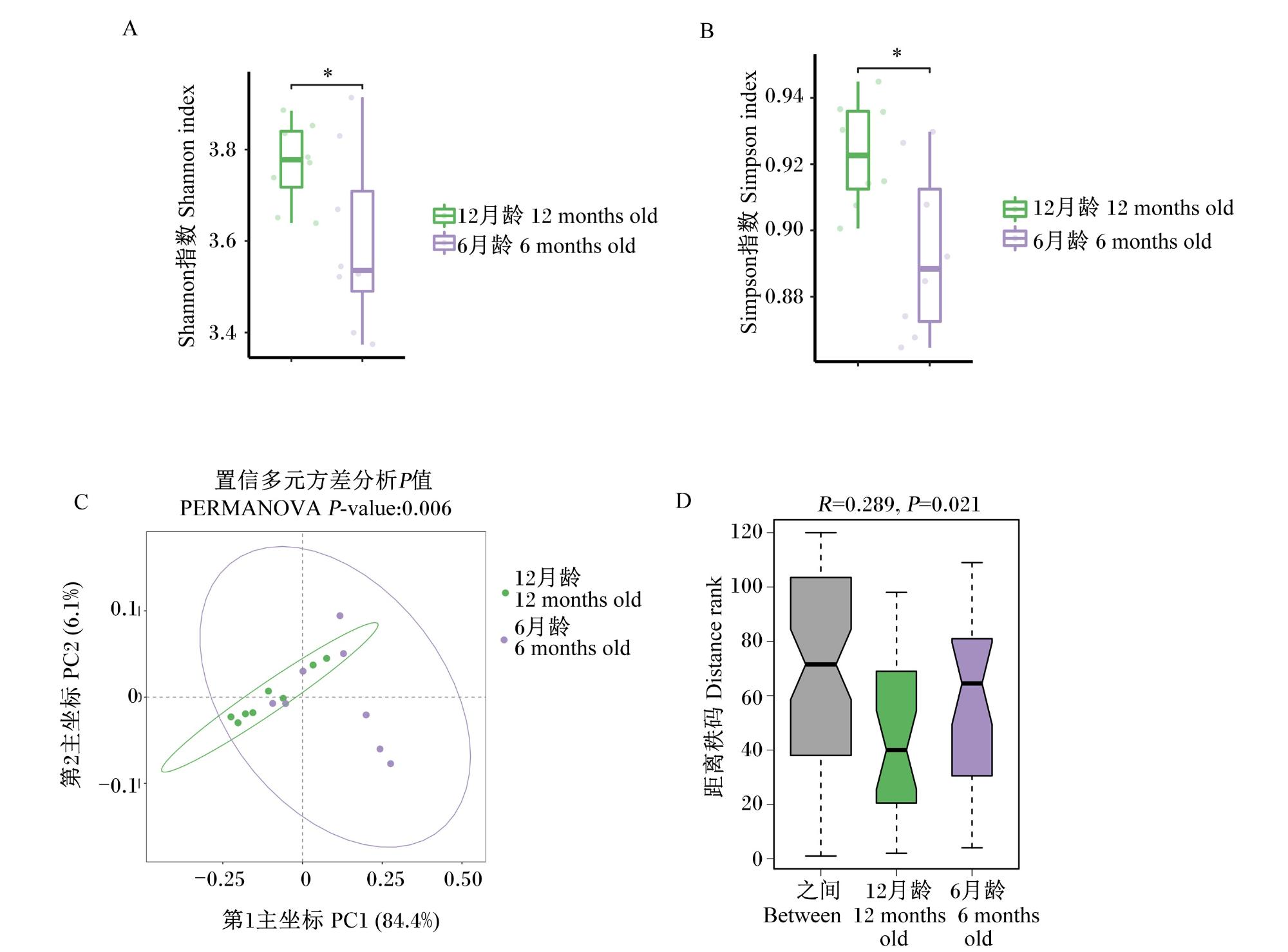
对6和12月龄杂交肉牛瘤胃的微生物进行α多样性分析(图1-A图1-B)发现,12月龄杂交肉牛的Shannon指数和Simpson指数显著高于6月龄(P<0.05)。在属水平上采用PCoA(图1-C)和Anosim(图1-D)分析杂交肉牛瘤胃微生物群落的β多样性,PCoA结果表明,6和12月龄杂交肉牛瘤胃微生物没有明显分离;Anosim结果表明,6和12月龄杂交肉牛瘤胃微生物群落间存在显著差异(R=0.289,P=0.021)。
图1 杂交肉牛瘤胃微生物多样性分析

“*”表示P<0.05。“*”indicated P<0.05.

Fig.1 Analysis of rumen microbial diversity in crossbred beef cattle

2.4 不同月龄杂交肉牛瘤胃微生物组成分析

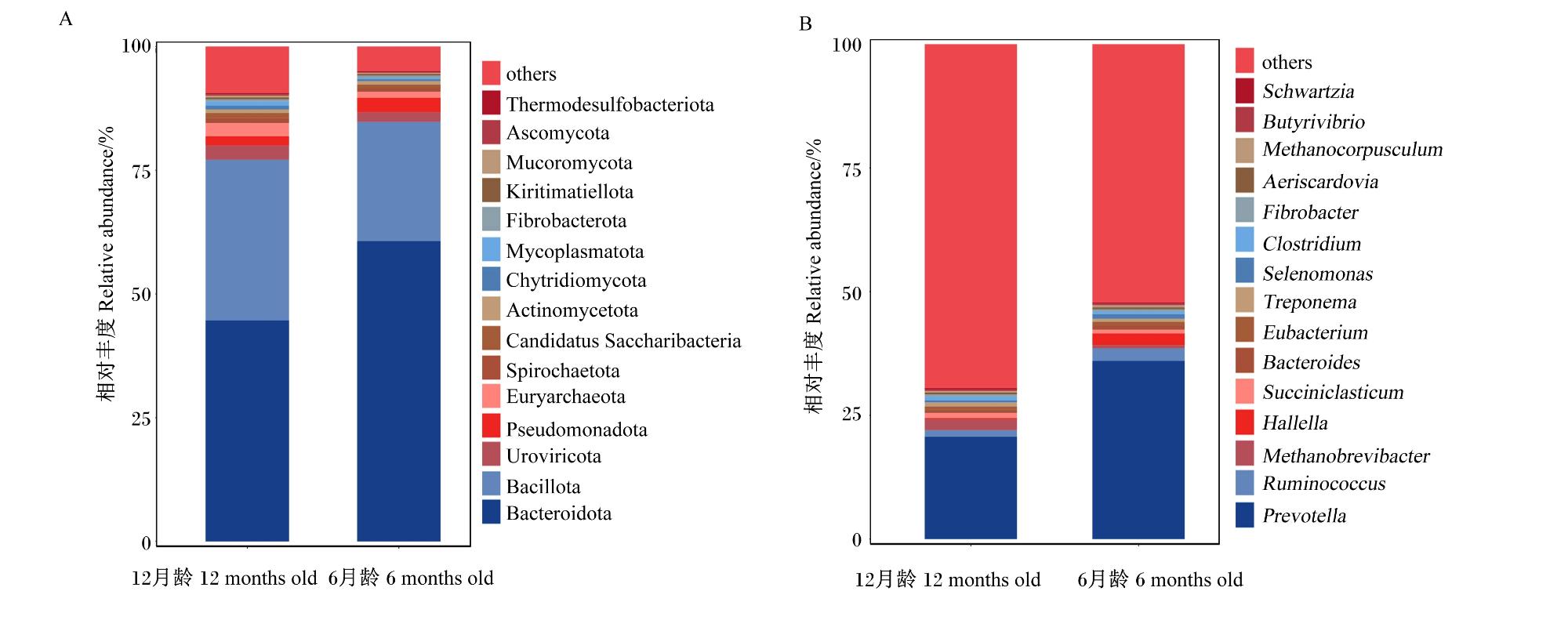
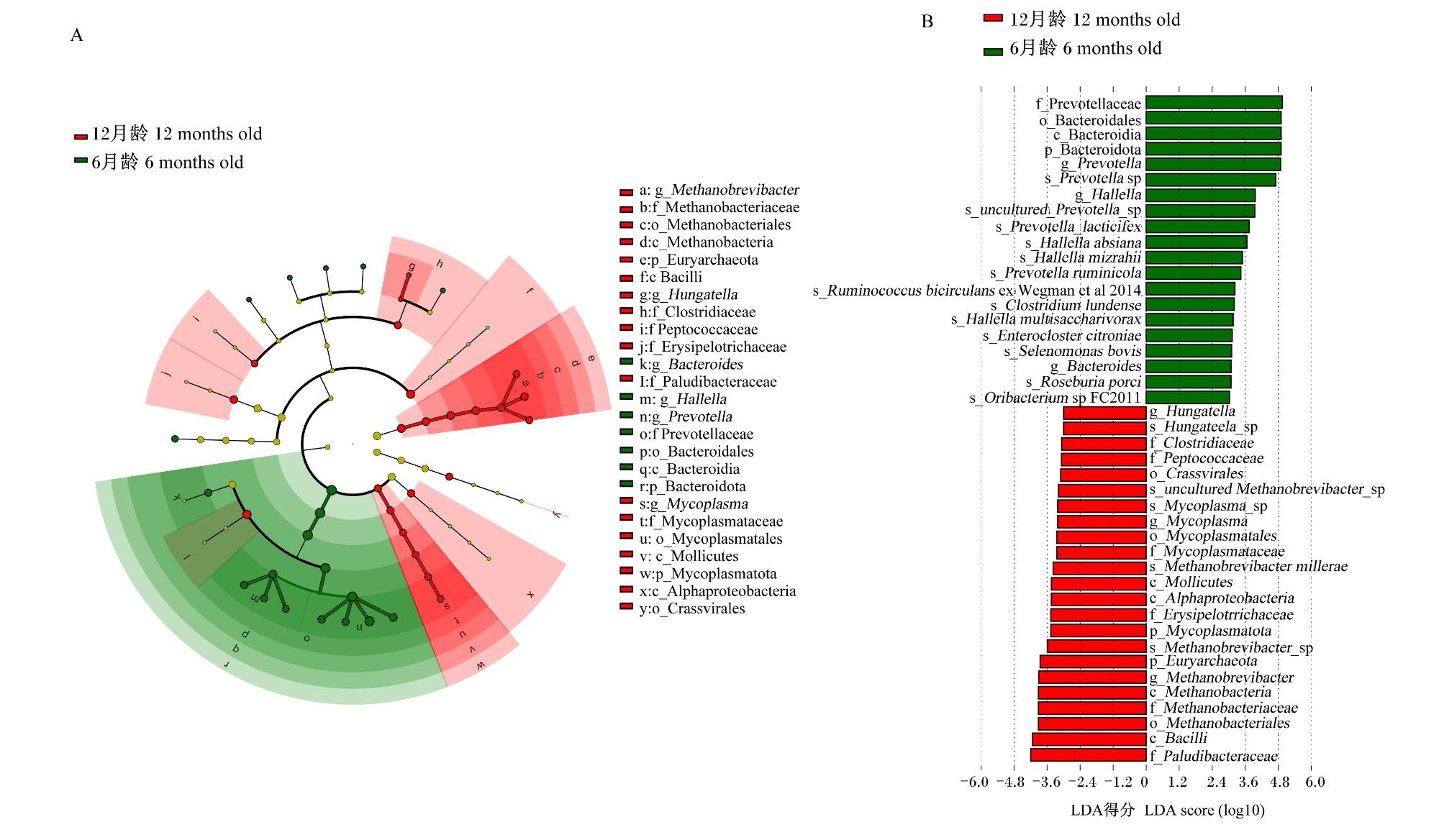
杂交肉牛瘤胃中的微生物群落分布于4个界,208个门,224个纲,470个目,1 153个科,4 698个属和27 571个种。如图2所示,选取6和12月龄杂交肉牛在门水平和属水平上前15的瘤胃微生物绘制物种相对丰度柱状图。在门水平上(图2-A),拟杆菌门(Bacteroidota)和芽孢杆菌门(Bacillota)为优势菌门。在属水平上(图2-B),普雷沃氏菌属(Prevotella)和瘤胃球菌属(Ruminococcus)为优势菌属。如图3所示,根据LEfSe分析(LDA>2.5,P<0.05)进一步揭示杂交肉牛瘤胃微生物组成的差异,发现拟杆菌门、普雷沃氏菌属、霍氏菌属(Hallella)和拟杆菌属(Bacteroides)等在6月龄显著富集(P<0.05),广古菌门(Euryarchaeota)、支原体门(Mycoplasmatota)、甲烷短杆菌属(Methanobrevibacter)、支原体属(Mycoplasma)和Hungatella等在12月龄显著富集(P<0.05)。
图2 杂交肉牛瘤胃微生物群落组成分析

A:门水平 phylum level;B:属水平 genus level
Bacteroidota:拟杆菌门;Bacillota:芽孢杆菌门;Uroviricota:尾噬菌体门;Pseudomonadota:假单胞菌门;Euryarchaeota:广古菌门;Spirochaetota:螺旋体门;Candidatus Saccharibacteria:候选糖细菌门;Actinomycetota:放线菌门;Chytridiomycota:壶菌门;Mycoplasmatota:支原体门;Fibrobacterota:纤维杆菌门;Kiritimatiellota:基里蒂马蒂菌门;Mucoromycota:毛霉菌门;Ascomycota:子囊菌门;Thermodesulfobacteriota:热脱硫杆菌门;Prevotella:普雷沃氏菌属;Ruminococcus:瘤胃球菌属;Methanobrevibacter:甲烷短杆菌属;Hallella:霍氏菌属;Succiniclasticum:解琥珀酸菌属;Bacteroides:拟杆菌属;Eubacterium:真杆菌属;Treponema:密螺旋体属;Selenomonas:月形单胞菌属;Clostridium:梭菌属;Fibrobacter:纤维杆菌属;Aeriscardovia:气斯卡多维亚菌属;Methanocorpusculum:甲烷粒菌属;Butyrivibrio:丁酸弧菌属;Schwartzia:施氏菌属;others:其他。

Fig.2 Analysis of rumen microbial community composition in crossbred beef cattle

图3 杂交肉牛瘤胃差异物种相对丰度的LEfSe分析

A:差异物种注释分支图 differential species annotation branch diagram;B:差异物种LDA评分图 LDA score plot of differential species
。 g:属 genus;f:科 family;o:目 order;c:纲 class;p:phylum 门;s:种 species;Methanobrevibacter:甲烷短杆菌属;Methanobacteriaceae:甲烷杆菌科;Methanobacteriales:甲烷杆菌目;Methanobacteria:甲烷杆菌纲;Euryarchaeota:广古菌门;Bacilli:芽孢杆菌纲;Clostridiaceae:梭菌科;Peptococcaceae:消化球菌科;Erysipelotrichaceae:丹毒丝菌科;Bacteroides:拟杆菌属;Paludibacteraceae:沼杆菌科;Hallella:霍氏菌属;Prevotella:普雷沃氏菌属;Prevotellaceae:普雷沃氏菌科;Bacteroidales:拟杆菌目;Bacteroidia:拟杆菌纲;Bacteroidota:拟杆菌门;Mycoplasma:支原体属;Mycoplasmataceae:支原体科;Mycoplasmatales:支原体目;Mollicutes:柔膜体纲;Mycoplasmatota:支原体门;Alphaproteobacteria:α-变形菌纲;Crassvirales:粗病毒目;Prevotella sp:普雷沃氏菌属未定种;uncultured Prevotella sp:未培养普雷沃氏菌未定种;Prevotella lacticifex:产乳酸普雷沃氏菌;Hallella absiana:阿布西氏霍氏菌;Hallella mizrahii:米兹拉希氏霍氏菌;Prevotella ruminicola:栖瘤胃普雷沃氏菌;Ruminococcus bicirculans ex Wegman et al 2014:双循环瘤胃球菌(源自Wegman等,2014年);Clostridium lundense:隆德梭菌;Hallella multisaccharivorax:食多糖霍氏菌;Enterocloster citroniae:柠檬肠梭菌;Selenomonas bovis:牛月形单胞菌;Roseburia porci:猪氏罗斯氏菌;Oribacterium sp FC2011:口腔杆菌属FC2011菌株;uncultured Methanobrevibacter sp:未培养甲烷短杆菌属未定种;Mycoplasma sp:支原体属未定种;Methanobrevibacter millerae:米勒氏甲烷短杆菌;Methanobrevibacter sp:甲烷短杆菌属未定种。

Fig.3 LEfSe analysis of relative abundance of differential species in rumen of crossbred beef cattle

2.5 杂交肉牛瘤胃微生物与体重、体尺的相关性分析

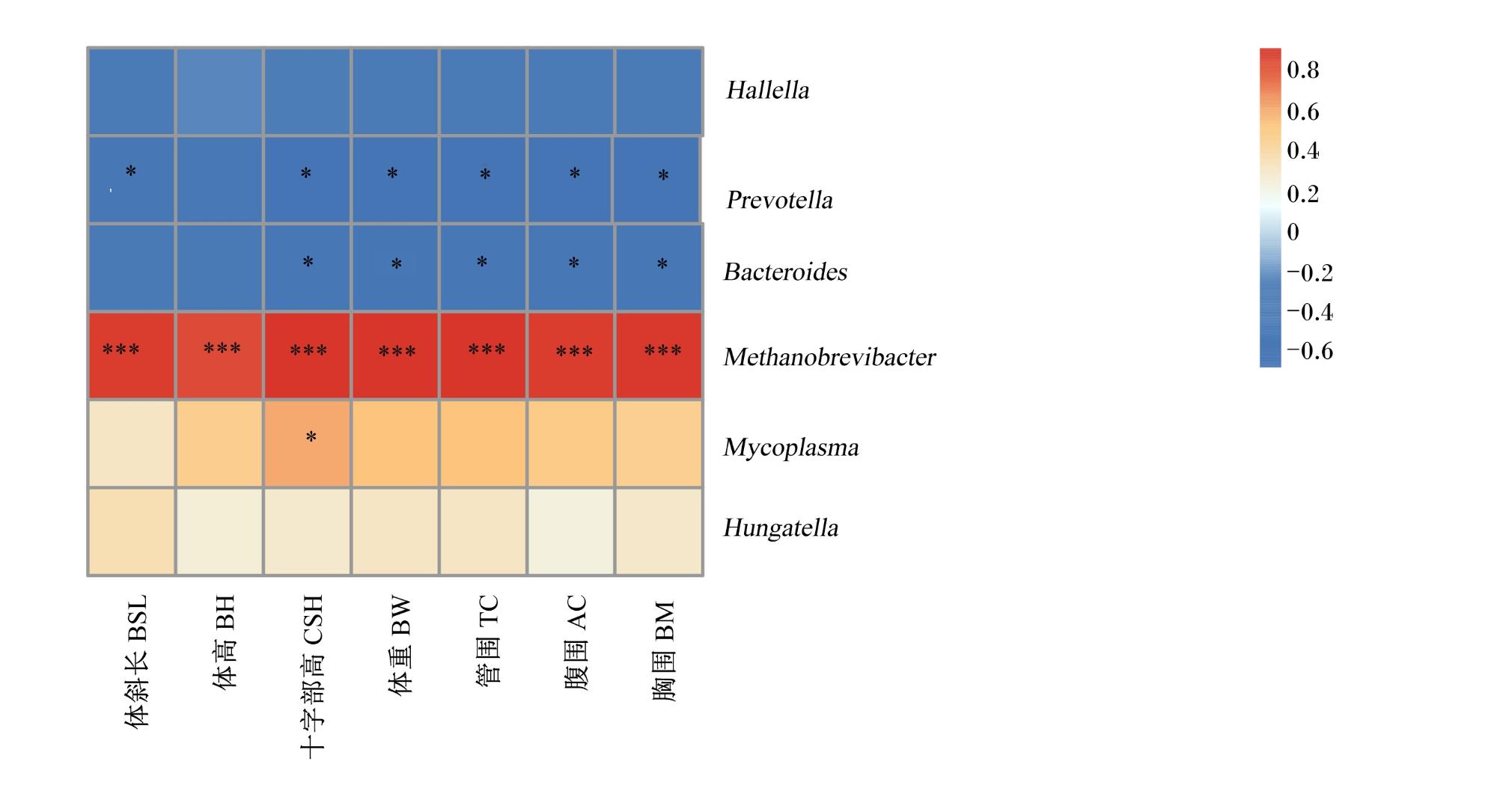
图4所示,利用Spearman相关性分析构建相关热图,分析属水平瘤胃特征微生物与体重、体尺之间的相关性。结果表明,6月龄特征微生物与体重、体尺呈负相关关系,其中普雷沃氏菌属和拟杆菌属与体重、十字部高、胸围、管围和腹围呈显著负相关(P<0.05);12月龄特征微生物与体重、体尺呈正相关关系,其中甲烷短杆菌属与体重、体斜长、体高、十字部高、胸围、腹围和管围呈极显著正相关(P<0.01),支原体属与十字部高呈显著正相关(P<0.05)。
图4 杂交肉牛瘤胃特征微生物与体重、体尺的相关性分析

红色表示正相关,蓝色表示负相关,颜色越深表示相关性越强;“*”表示P<0.05,“**”表示P<0.01,“***”表示P<0.001。Red indicated positive correlation, blue indicated negative correlation, and the deeper color indicated the stronger correlation; “*” indicated P<0.05, “**” indicated P<0.01, “***” indicated P<0.001.
Hallella:霍氏菌属;Prevotella:普雷沃氏菌属;Bacteroides:拟杆菌属;Methanobrevibacter:甲烷短杆菌属;Mycoplasma:支原体属。

Fig.4 Correlation analysis of characteristic microorganisms in the rumen of crossbred beef cattle with body weight and body measurements

2.6 不同月龄杂交肉牛瘤胃微生物功能分析

2.6.1 KEGG通路富集分析
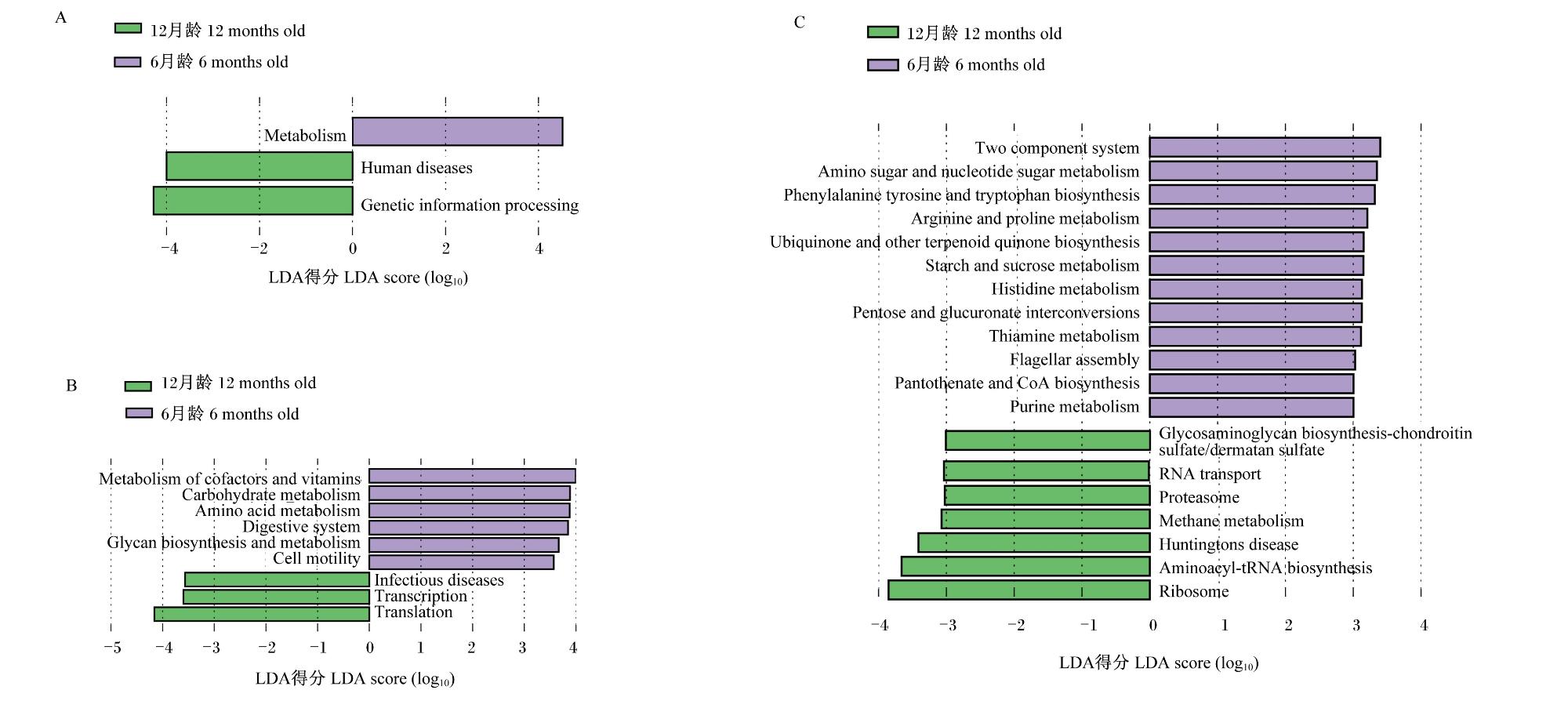
与KEGG数据库对比后发现,在1级水平上(图5-A),新陈代谢通路显著富集在6月龄中(P<0.05),遗传信息处理和人类疾病通路显著富集在12月龄中(P<0.05)。在2级水平上(图5-B),辅因子与维生素代谢、碳水化合物代谢、氨基酸代谢、消化系统、聚糖生物合成与代谢以及细胞运动通路显著富集在6月龄中(P<0.05);翻译、转录及传染病通路显著富集在12月龄中(P<0.05)。在3级水平上(图5-C),氨基糖和核苷酸糖代谢,苯丙氨酸、酪氨酸和色氨酸生物合成,精氨酸与脯氨酸代谢,泛醌及其他萜醌生物合成,淀粉和蔗糖代谢,组氨酸代谢,戊糖和葡萄糖醛酸互变,泛酸和辅酶A生物合成,硫胺素代谢及嘌呤代谢等通路显著富集在6月龄中(P<0.05);核糖体、氨酰-tRNA生物合成、甲烷代谢、蛋白酶体、RNA转运、糖胺聚糖生物合成-硫酸软骨素/硫酸皮肤素等通路显著富集在12月龄中(P<0.05)。
图5 KEGG通路LEfSe分析

A、B和C分别表示1级、2级和3级水平。A, B and C represented level 1, level 2 and level 3, respectively.
Metabolism:新陈代谢;Human diseases:人类疾病;Genetic information processing:遗传信息处理;Metabolism of cofactors and vitamins:辅因子与维生素代谢;Carbohydrate metabolism:碳水化合物代谢;Amino acid metabolism:氨基酸代谢;Digestive system:消化系统;Glycan biosynthesis and metabolism:聚糖生物合成与代谢;Cell motility:细胞运动;Infectious diseases:传染病;Transcription:转录;Translation:翻译;Two component system:双组分系统;Amino sugar and nucleotide sugar metabolism:氨基糖和核苷酸糖代谢;Phenylalanine tyrosine and tryptophan biosynthesis:苯丙氨酸、酪氨酸和色氨酸生物合成;Arginine and proline metabolism:精氨酸与脯氨酸代谢;Ubiquinone and other terpenoid quinone biosynthesis:泛醌及其他萜醌生物合成;Starch and sucrose metabolism:淀粉和蔗糖代谢;Histidine metabolism:组氨酸代谢;Pentose and glucuronate interconversions:戊糖和葡萄糖醛酸互变;Thiamine metabolism:硫胺素代谢;Flagellar assembly:鞭毛组装;Pantothenate and CoA biosynthesis:泛酸和辅酶A生物合成;Purine metabolism:嘌呤代谢;Glycosaminoglycan biosynthesis-chondroitin sulfate/dermatan sulfate:糖胺聚糖生物合成-硫酸软骨素/硫酸皮肤素;RNA transport:RNA转运;Proteasome:蛋白酶体;Methane metabolism:甲烷代谢;Huntingtons disease:亨廷顿病;Aminoacyl-tRNA biosynthesis:氨酰-tRNA生物合成;Ribosome:核糖体。

Fig.5 LEfSe analysis of KEGG pathways

2.6.2 CAZy功能注释分析

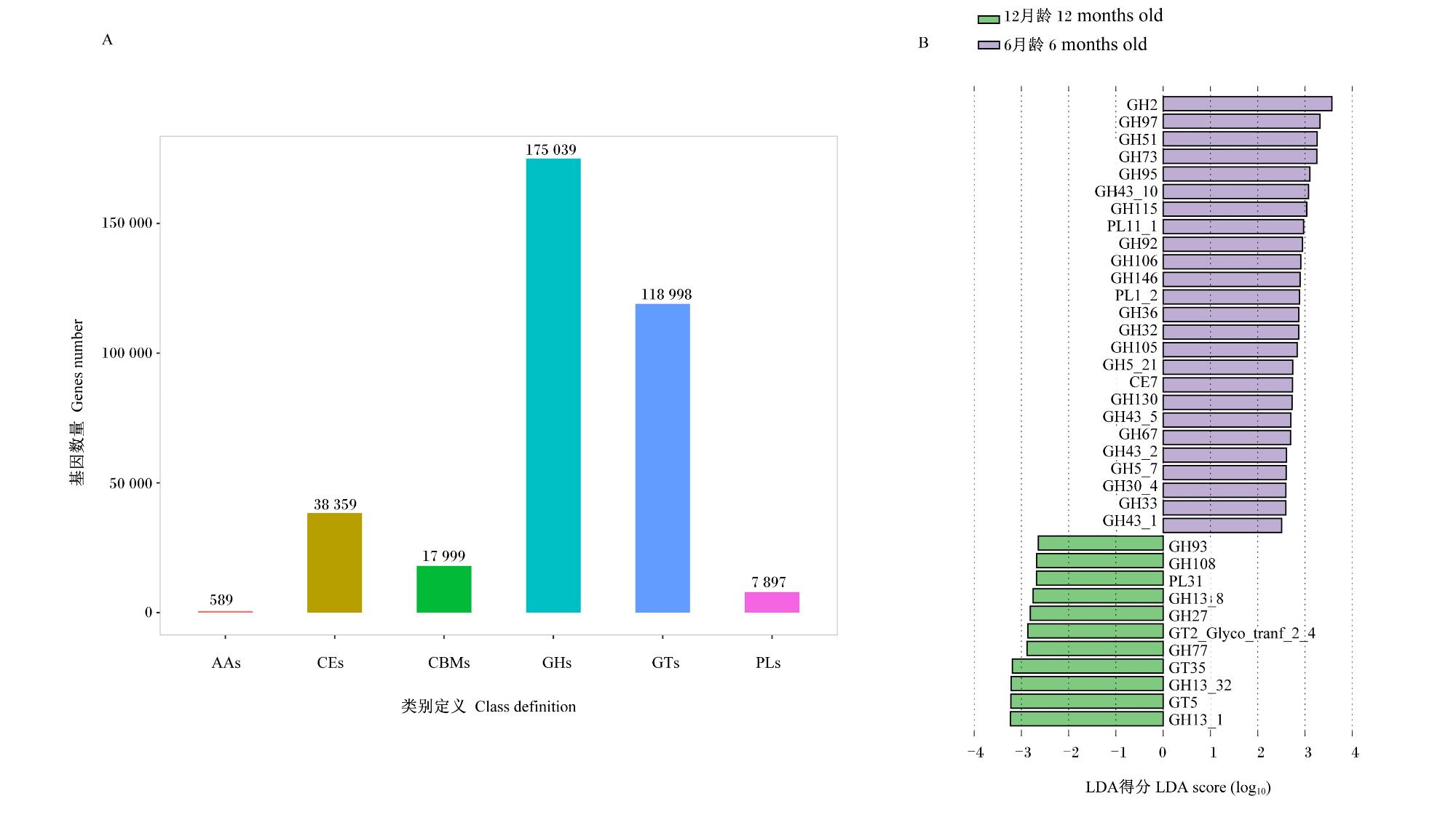
将预测基因与CAZy数据库对比后发现,共有358 881个基因注释到CAZy数据库中,其中辅助氧化还原酶(auxiliary activities,AAs)有589个、碳水化合物酯酶(carbohydrate esterases,CEs)有38 359个、碳水化合物结合模块(carbohydrate-binding modules,CBMs)有17 999个、糖苷水解酶(glycoside hydrolases,GHs)有175 039个、糖基转移酶(glycosyl transferases,GTs)有118 998个、多糖裂合酶(polysaccharide lyases,PLs)有7 897个(图6-A)。对鉴定出的443种CAZy进行LEfSe分析(图6-B)发现,GH2、GH97、GH51、GH73、PL11_1、PL1_2和CE7等25种CAZy在6月龄显著富集(P<0.05),11种CAZy在12月龄显著富集(P<0.05),分别为GH13_1、GT5、GH13_32、GT35、GH77、GT2_Glyco_tranf_2_4、GH27、GH13_8、PL31、GH108、GH93。
图6 CAZy功能注释LefSe分析

A:CAZy功能注释柱状图;B:差异CAZy的LDA评分图。A: CAZy functional annotation bar chart; B: LDA score plot of differential CAZy.

AAs:辅助氧化还原酶 auxiliary activities;CEs:碳水化合物酯酶 carbohydrate esterases;CBMs:碳水化合物结合模块 carbohydrate-binding modules;GHs:糖苷水解酶 glycoside hydrolases;GTs:糖基转移酶 glycosyl transferases;PLs:多糖裂合酶 polysaccharide lyases。

Fig.6 LefSe analysis of CAZy functional annotation

3 讨论

反刍动物的瘤胃微生物区系是一个结构复杂且功能强大的系统,在反刍动物生长发育过程中,随着年龄的增长瘤胃微生物区系逐渐发育为成熟状态,功能也更加完善,能够将饲粮中的多糖、淀粉和纤维分解为短链脂肪酸等小分子营养物质为宿主提供能量,并在宿主的生长发育过程中发挥关键作用[16-18]。因此,本研究通过宏基因组学技术对杂交肉牛不同生长发育阶段瘤胃微生物群落结构和功能差异进行探究。
反刍动物瘤胃微生物群落随着生长发育阶段进行动态演替,而不同阶段饲粮组成的改变对瘤胃微生物组成可能具有调控作用。前人研究表明,随着饲粮中精料比例上升,纤维降解菌与真菌的数量均呈下降趋势;当精料比例达到较高水平时,瘤胃内低pH环境将进一步抑制纤维降解菌的生长[19]。在本研究中,拟杆菌门和芽孢杆菌门是6和12月龄杂交肉牛瘤胃中的优势菌门,普雷沃氏菌属和瘤胃球菌属为优势菌属,这与以往的研究结果[20-22]基本一致。LEfSe分析结果显示,普雷沃氏菌属、霍氏菌属和拟杆菌属在6月龄显著富集。其中普雷沃氏菌属和拟杆菌属是多糖降解菌,可以与其他纤维素分解菌协同将纤维素降解为醋酸以及少量异丁酸、异戊酸和乳酸为宿主提供能量,还可以促进反刍动物中的碳水化合物和氮代谢[23]。霍氏菌属是一种革兰氏阴性、杆状且不形成孢子的专性厌氧菌,该菌可参与碳水化合物的降解,但是部分菌株具有病原性,参与感染及慢性炎症性疾病的发生[24]。甲烷短杆菌属、支原体属和Hungatella等在12月龄显著富集。甲烷短杆菌属是瘤胃微生物生态系统成熟的重要特征,能够利用瘤胃发酵过程中产生的氢气或甲酸将二氧化碳还原为甲烷,使得水解和发酵纤维、淀粉的微生物能够持续、高效地进行,从而保证了反刍动物从饲料中获取能量[25]。支原体属侵入呼吸道、乳腺、关节等组织,产生磷脂酶、过氧化氢和超氧化自由基等产物,会对宿主细胞产生一定的损害,还能在体外形成生物膜,增强抗干燥和耐热应激的能力[26]Hungatella主要定殖于后肠道,具有强大纤维降解潜力和产丁酸能力,它对反刍动物从饲料中最大限度地回收能量和维护后消化道健康具有重要作用[27]。在本研究中,从6~12月龄,杂交肉牛营养结构从高蛋白质转变为高碳水化合物,这一底物的改变也可能导致瘤胃微生物的丰度发生改变,这与赵烨嬋等[28]在不同生长阶段呼伦贝尔羊上的报道一致。
已有研究表明动物的表型是由微生物驱动的[29]。因此,本文通过Spearman相关性分析研究瘤胃特征微生物与体重、体尺的关系。结果表明,6月龄杂交肉牛瘤胃特征微生物与体重、体尺呈负相关关系,12月龄杂交肉牛瘤胃特征微生物与体重、体尺呈正相关关系。这可能与生长发育早期瘤胃发育不完全以及发酵效率不高有关。普雷沃氏菌属和拟杆菌属过度优势生长,可能会导致发酵模式向产生更多气体或能量利用效率较低的途径倾斜,而不是高效地合成微生物蛋白和促进生长的挥发性脂肪酸,从而表现为与体重、体尺的负相关[30]。12月龄后杂交肉牛进入育肥关键期,甲烷短杆菌的富集标志着此时瘤胃微生物区系处于稳定和成熟状态,能够更持续、高效地将饲料转化为营养物质,来支持体重、体尺的增加[31]。由此推测,随着杂交肉牛的生长发育瘤胃微生物区系逐渐变得成熟稳定。
瘤胃微生物区系的差异,将直接造成其功能的改变。KEGG通路富集分析结果表明,6月龄杂交肉牛瘤胃微生物功能显著富集于自身合成代谢和能量供应过程。6月龄处于快速生长期,氨基糖和核苷酸糖代谢、淀粉和蔗糖代谢、戊糖和葡萄糖醛酸互变通路为杂交肉牛快速生长提供了充足的葡萄糖、戊糖等能量底物和碳骨架[32]。苯丙氨酸、酪氨酸和色氨酸生物合成,精氨酸与脯氨酸代谢以及组氨酸代谢通路为机体提供大量的必需氨基酸以满足蛋白质沉积的需要[33]。泛醌及其他萜醌生物合成、泛酸和辅酶A生物合成及硫胺素代谢通路为糖类、脂类和氨基酸的氧化代谢以及能量(ATP)的高效产生提供必需的酶促反应辅助因子[34-35]。12月龄杂交肉牛微生物功能则向蛋白质精细调控转变。甲烷代谢通路的富集与甲烷短杆菌的定植相对应,标志着瘤胃微生物发酵功能发育成熟。核糖体、氨酰-tRNA生物合成及RNA转运等通路显著富集表明微生物正在进行特定功能蛋白(如维持肌肉功能的收缩蛋白、应对应激的热休克蛋白、免疫球蛋白等)的合成过程,其与蛋白酶体通路构成了一个精密的蛋白质“合成-降解”动态平衡控制体系[36]。糖胺聚糖生物合成-硫酸软骨素/硫酸皮肤素通路是肉牛肌肉结缔组织成熟和肉质形成的核心生化路径,其通过调控胶原网络结构和增强系水能力潜在影响肌内脂肪沉积[37]
CAZy的家族分类及其构成模块的一级序列注释主要用于分析、理解和比较生物体或其群落组装和分解复杂碳水化合物的能力,其中GHs负责碳水化合物糖苷键的水解;GTs负责从磷酸化糖供体中生物合成新的糖苷键;PLs可以通过β-消除机制非水解性地裂解糖苷键,产生含不饱和末端的产物;CEs负责去除单糖、寡糖和多糖中的酯基修饰,从而促进GHs对复杂多糖的作用;AAs通过氧化反应破坏结晶多糖,增强GHs的降解效率;CBMs是碳水化合物活性酶中的一个非催化结构域,能够与碳水化合物底物特异性结合增强酶的解聚效率[38-39]。在本研究中,GH2、GH97、GH51、GH73、PL11_1、PL1_2和CE7等在6月龄显著富集,主要与植物细胞壁结构性多糖的降解有关[40]。其中GH2包含β-半乳糖苷酶等,能水解乳糖及植物细胞壁中的半乳糖侧链;GH97主要为α-葡萄糖苷酶和α-半乳糖苷酶,参与淀粉和半乳甘露聚糖的初始降解;PL11_1和PL1_2均为果胶裂解酶,降解植物细胞壁中的果胶物质;CE7为乙酰酯酶,参与脱去木聚糖和果胶上的乙酰基促进主链多糖的水解。相比之下,GH13_1、GT5、GH13_32、GT35、GH77、GT2_Glyco_tranf_2_4、GH27、GH13_8、PL31、GH108、GH93等在12月龄显著富集,主要与淀粉、糖原以及更为复杂的植物多糖的降解有关[41]。其中,GH13_1、GH13_32和GH13_8为淀粉酶,能将淀粉转化为微生物可利用的糖类,后续生成挥发性脂肪酸能为宿主动物提供能量;GT5和GT35分别为糖原合成酶和糖原磷酸化酶,参与糖原的合成与分解;GH93为外切木聚糖酶,参与木聚糖降解。

4 结论

本研究利用宏基因组学分析确定了杂交肉牛不同生长发育阶段瘤胃微生物群落组成及功能,6月龄杂交肉牛的特征微生物有普雷沃氏菌属、霍氏菌属和拟杆菌属,12月龄杂交肉牛组的特征微生物有甲烷短杆菌属、支原体属和Hungatella。随着杂交肉牛的生长发育,瘤胃微生物功能也逐渐从自身合成代谢和能量供应向蛋白质精细调控转变。同时,这一研究结果也为实施杂交肉牛阶段化精准营养与管理提供了理论依据。针对6月龄杂交肉牛,饲粮应确保充足的可发酵碳水化合物、优质蛋白前体及维生素支持其旺盛的合成代谢。对于12月龄杂交肉牛,营养策略除保障能量沉积外,可能需要更多关注如何通过营养手段维持蛋白质稳态,从而保障动物健康并改善肉品质。
[1]
GENG C Y, ZHANG M, YANG L Y, et al. Correlations between circulating leptin concentrations and growth performance,carcass traits,and meat quality indexes in finishing Simmental×Luxi bulls fed high-concentrate diets[J]. Animal Science Journal, 2020, 91(1):e13426.

DOI

[2]
AN B X, XU L, XIA J W, et al. Multiple association analysis of loci and candidate genes that regulate body size at three growth stages in Simmental beef cattle[J]. BMC Genetics, 2020, 21(1):32.

DOI PMID

[3]
WEI C, LUO H P, WANG Y C, et al. Analyses of the genetic relationships between lactose,somatic cell score,and growth traits in Simmental cattle[J]. Animal, 2021, 15(1):100027.

DOI

[4]
DRUET T, AHARIZ N, CAMBISANO N, et al. Selection in action:dissecting the molecular underpinnings of the increasing muscle mass of Belgian blue cattle[J]. BMC Genomics, 2014, 15(1):796.

DOI

[5]
ZHENG Y, CHEN J J, WANG X X, et al. Metagenomic and transcriptomic analyses reveal the differences and associations between the gut microbiome and muscular genes in angus and Chinese Simmental cattle[J]. Frontiers in Microbiology, 2022, 13:815915.

DOI

[6]
WU Y, ZHAO P F, LI X R, et al. Crossbreeding Simmental with Mongolian,and Holstein cattle can improve feed efficiency and energy metabolism by upregulating COX3 and downregulating PRSS2 gene expression[J]. Frontiers in Nutrition, 2025, 12:1524242.

DOI

[7]
WANG Z, YU Y N, LI X Y, et al. Fermented soybean meal replacement in the diet of lactating Holstein dairy cows:modulated rumen fermentation and ruminal microflora[J]. Frontiers in Microbiology, 2021, 12:625857.

DOI

[8]
WU X, HUANG S, HUANG J F, et al. Identification of the potential role of the rumen microbiome in milk protein and fat synthesis in dairy cows using metagenomic sequencing[J]. Animals, 2021, 11(5):1247.

DOI

[9]
XUE M Y, SUN H Z, WU X H, et al. Multi-omics reveals that the rumen microbiome and its metabolome together with the host metabolome contribute to individualized dairy cow performance[J]. Microbiome, 2020, 8(1):64.

DOI

[10]
FURMAN O, SHENHAV L, SASSON G, et al. Stochasticity constrained by deterministic effects of diet and age drive rumen microbiome assembly dynamics[J]. Nature Communications, 2020, 11(1):1904.

DOI PMID

[11]
GUO C Y, JI S K, YAN H, et al. Dynamic change of the gastrointestinal bacterial ecology in cows from birth to adulthood[J]. MicrobiologyOpen, 2020, 9(11):e1119.

DOI PMID

[12]
AMIN N, SCHWARZKOPF S, KINOSHITA A, et al. Evolution of rumen and oral microbiota in calves is influenced by age and time of weaning[J]. Animal Microbiome, 2021, 3(1):31.

DOI PMID

[13]
YIN X J, JI S K, DUAN C H, et al. Age-related changes in the ruminal microbiota and their relationship with rumen fermentation in lambs[J]. Frontiers in Microbiology, 2021, 12:679135.

DOI

[14]
WU Y L, JIAO C, DIAO Q Y, et al. Effect of dietary and age changes on ruminal microbial diversity in Holstein calves[J]. Microorganisms, 2023, 12(1):12.

DOI

[15]
AHMAD A A, ZHANG J B, LIANG Z Y, et al. Age-dependent variations in rumen bacterial community of Mongolian cattle from weaning to adulthood[J]. BMC Microbiology, 2022, 22(1):213.

DOI PMID

[16]
PITTALUGA A M, MICCOLI F E, GUERRERO L D, et al. Effect of multispecies fungal extract supplementation on growth performance,nutrient digestibility,ruminal fermentation,and the rumen microbiome composition of beef cattle fed forage-based diets[J]. Journal of Animal Science, 2025,103:skae387.

[17]
CLEMMONS B A, VOY B H, MYER P R. Altering the gut microbiome of cattle:considerations of host-microbiome interactions for persistent microbiome manipulation[J]. Microbial Ecology, 2019, 77(2):523-536.

DOI

[18]
TARASKINA A, IGNATYEVA O, LISOVAYA D, et al. Effects of traumatic brain injury on the gut microbiota composition and serum amino acid profile in rats[J]. Cells, 2022, 11(9):1409.

DOI

[19]
徐领, 卢俊言, 陈欢, 等. 不同饲粮精粗比及菊粉和枯草芽孢杆菌添加水平对体外瘤胃发酵特性的影响[J]. 动物营养学报, 2025, 37(1):496-510.

DOI

XU L, LU J Y, CHEN H, et al. Effects of different dietary concentrate-roughage ratios and inulin and Bacillus subtilis supplemental levels on rumen fermentation characteristics in vitro[J]. Chinese Journal of Animal Nutrition, 2025, 37(1):496-510. (in Chinese)

[20]
HU C S, DING L M, JIANG C X, et al. Effects of management,dietary intake,and genotype on rumen morphology,fermentation,and microbiota,and on meat quality in yaks and cattle[J]. Frontiers in Nutrition, 2021, 8:755255.

DOI

[21]
QIU S L, LI K Y, HE X B, et al. The effects of composite alkali-stored spent Hypsizygus marmoreus substrate on carcass quality,rumen fermentation,and rumen microbial diversity in goats[J]. Animals, 2024, 14(1):166.

DOI

[22]
WANG Y J, ZHANG H, ZHU L, et al. Dynamic distribution of gut microbiota in goats at different ages and health states[J]. Frontiers in Microbiology, 2018, 9:2509.

DOI PMID

[23]
ZHOU X N, MA Y, YANG C Y, et al. Rumen and fecal microbiota characteristics of Qinchuan cattle with divergent residual feed intake[J]. Microorganisms, 2023, 11(2):358.

DOI

[24]
BAI L, PAEK J, KIM H, et al. Description and comparative genome analysis of Hallella absiana sp. nov.,isolated from pig feces[J]. Anaerobe, 2023, 81:102735.

DOI

[25]
VOLMER J G, SOO R M, EVANS P N, et al. Isolation and characterisation of novel Methanocorpusculum species indicates the genus is ancestrally host-associated[J]. BMC Biology, 2023, 21(1):59.

DOI

[26]
MAUNSELL F P, WOOLUMS A R, FRANCOZ D, et al. Mycoplasma bovis infections in cattle[J]. Journal of Veterinary Internal Medicine, 2011, 25(4):772-783.

DOI

[27]
XIE F, JIN W, SI H Z, et al. An integrated gene catalog and over 10,000 metagenome-assembled genomes from the gastrointestinal microbiome of ruminants[J]. Microbiome, 2021, 9(1):137.

DOI PMID

[28]
赵烨嬋, 欧慧敏, 谭支良, 等. 呼伦贝尔羊不同生长阶段瘤胃微生物变化与羊肉膻味相关微生物分析[J]. 动物营养学报, 2024, 36(2):1050-1062.

DOI

ZHAO Y C, OU H M, TAN Z L, et al. Microbial changes in rumen of Hulun Buir sheep at different growth stages and analysis of odor-associated microbial communities[J]. Chinese Journal of Animal Nutrition, 2024, 36(2):1050-1062. (in Chinese)

[29]
ZHANG J, SHI H T, WANG Y J, et al. Effect of dietary forage to concentrate ratios on dynamic profile changes and interactions of ruminal microbiota and metabolites in Holstein heifers[J]. Frontiers in Microbiology, 2017, 8:2206.

DOI PMID

[30]
JAMI E, WHITE B A, MIZRAHI I. Potential role of the bovine rumen microbiome in modulating milk composition and feed efficiency[J]. PLoS One, 2014, 9(1):e85423.

DOI

[31]
LI F Y, GUAN L L. Metatranscriptomic profiling reveals linkages between the active rumen microbiome and feed efficiency in beef cattle[J]. Applied and Environmental Microbiology, 2017, 83(9):e00061-17.

[32]
JIANG H, CAO H W, CHAI Z X, et al. Dynamic alterations in yak (Bos grunniens) rumen microbiome in response to seasonal variations in diet[J]. Physiological Genomics, 2022, 54(12):514-525.

DOI

[33]
WU G Y. Amino acids:metabolism,functions,and nutrition[J]. Amino Acids, 2009, 37(1):1-17.

[34]
TONG L. Structure and function of biotin-dependent carboxylases[J]. Cellular and Molecular Life Sciences, 2013, 70(5):863-891.

DOI PMID

[35]
GEBIM POLIZE G H, PERISSIN DOS SANTOS M E, MELLO CESAR A S, et al. Late gestation maternal nutrition has a stronger impact on offspring liver transcriptome than full-gestation supplementation in beef cattle[J]. Veterinary Sciences, 2025, 12(5):406.

DOI

[36]
SONTAG E M, SAMANT R S, FRYDMAN J. Mechanisms and functions of spatial protein quality control[J]. Annual Review of Biochemistry, 2017, 86:97-122.

DOI PMID

[37]
NISHIMURA T. The role of intramuscular connective tissue in meat texture[J]. Animal Science Journal, 2010, 81(1):21-27.

DOI PMID

[38]
CANTAREL B L, COUTINHO P M, RANCUREL C, et al. The carbohydrate-active enzymes database (CAZy):an expert resource for glycogenomics[J]. Nucleic Acids Research, 2009, 37(S1):D233-D238.

[39]
DRULA E, GARRON M L, DOGAN S, et al. The carbohydrate-active enzyme database:functions and literature[J]. Nucleic Acids Research, 2022, 50(D1):D571-D577.

[40]
HAN S R, JANG S M, CHI Y M, et al. Complete genome sequence of Sphingobium sp. strain PAMC28499 reveals a potential for degrading pectin with comparative genomics approach[J]. Genes & Genomics, 2020, 42(9):1087-1096.

[41]
YANG C, VAN DER MAAREL M J E C, JURAK E. A distinctive function of GH13_8 subfamily glycogen branching enzyme in Anaerococcus prevotii DSM 20548:preference to create very short branches[J]. International Journal of Biological Macromolecules, 2024, 283(Pt 3):137743.

DOI

Outlines

/