RESEARCH PAPER

Effects of Maternal Dietary Fatty Acids Balanced Oil Supplementation on Brain Development and Neuroinflammation in Suckling Piglets

  • TANG Yuhui ,
  • QIN Kun ,
  • CAI Runxue ,
  • XU Xiao ,
  • CHEN Shaokui ,
  • XIAO Kan ,
  • LIU Yulan ,
  • ZHU Huiling , *
Expand
  • Hubei Key Laboratory of Animal Nutrition and Feed Science, Wuhan Polytechnic University, Wuhan 430048, China
*associate professor, E-mail:

Received date: 2025-12-29

  Online published: 2026-08-13

Abstract

This study aimed to investigate the effects of maternal dietary fatty acids balanced oil (FABO) supplementation on brain development and neuroinflammation in suckling piglets. Twenty-four Landrace×Large White sows with similar parity and backfat thickness were randomly divided into 2 groups with 12 replicates per group 1 sow per replicate. The experiment began from day 90 of gestation and continued until day 21 of postpartum. At day 21 of postpartum, one suckling piglet from each litter was selected in a 2×2 factorial experiment with dietary treatment of sows (2% soybean oil or 2% FABO) and lipopolysaccharide (LPS) challenge of suckling piglets (injected saline or LPS). All suckling piglets were grouped by dietary treatment of sows. Six suckling piglets in each group were injected intraperitoneally with 100 μg/kg BW LPS or saline. At 4 hour post-injection of LPS, the blood was collected. All suckling piglets were anesthetized and slaughtered, and the prefrontal cortex and hippocampus samples were collected for test. The results showed as follows: 1) LPS challenge significantly decreased the contents of glucose, total cholesterol, high-density lipoprotein cholesterol and low-density lipoprotein cholesterol in plasma of suckling piglets (P<0.05); 2% FABO significantly increased the plasma glucose content of suckling piglets (P<0.05), and significantly alleviated the decrease of plasma triglyceride content induced by LPS challenge (P<0.05). 2) LPS challenge significantly increased the mRNA relative expression levels of heat shock protein 70 (HSP70), interleukin-6 (IL-6) in hippocampus and HSP70 in prefrontal cortex of suckling piglets (P<0.05); 2% FABO significantly decreased the mRNA relative expression levels of IL-6, HSP70 and cyclooxygenase-2 (COX-2) in prefrontal cortex and COX-2 in hippocampus of suckling piglets (P<0.05). 3) LPS challenge significantly decreased the mRNA relative expression levels of early growth response protein 1 (Egr1), brain-derived neurotrophic factor (BDNF) in prefrontal cortex of suckling piglets (P<0.05), and significantly increased mRNA relative expression level of nerve growth factor (NGF) in hippocampus (P<0.05); 2% FABO significantly increased the mRNA relative expression levels of NGF, BDNF, tropomyosin receptor kinase B (TrkB) and phosphatidylinositol-3 kinase (PI3K) in prefrontal cortex and hippocampus and cellular oncogene fos (c-fos) in hippocampus of suckling piglets (P<0.05). 4) LPS challenge significantly increased the mRNA relative expression level of cysteinyl aspartate proteinase-3 (Caspase-3) in prefrontal cortex and hippocampus of suckling piglets (P<0.05); 2% FABO significantly increased the mRNA relative expression level of B cell lymphoma-2 (Bcl-2) in prefrontal cortex and hippocampus of suckling piglets (P<0.05), significantly decreased the mRNA relative expression level of Caspase-3 in hippocampus (P<0.05), and significantly alleviated the increase of mRNA relative expression levels of Caspase-3 in prefrontal cortex, Bcl-2-associated X (Bax) in hippocampus and the protein relative expression of cleaved cysteinyl aspartate proteinase-3 (Cleaved Caspase-3) in prefrontal cortex and hippocampus induced by LPS challenge (P<0.05). 5) LPS challenge significantly decreased the activity of acetylcholinesterase (AChE) in hippocampus of suckling piglets (P<0.05); 2% FABO significantly increased the activity of AChE in prefrontal cortex and hippocampus of suckling piglets (P<0.05). In conclusion, the maternal dietary 2% FABO supplementation can promote the development and differentiation of brain, reduce neuroinflammatory response, and alleviate neuronal apoptosis induced by LPS in suckling piglets.

Cite this article

TANG Yuhui , QIN Kun , CAI Runxue , XU Xiao , CHEN Shaokui , XIAO Kan , LIU Yulan , ZHU Huiling . Effects of Maternal Dietary Fatty Acids Balanced Oil Supplementation on Brain Development and Neuroinflammation in Suckling Piglets[J]. Chinese Journal of Animal Nutrition, 2026 , 38(8) : 5709 -5721 . DOI: 10.12418/CJAN2026.458

母猪的繁殖性能和新生仔猪的生长性能是养猪业发展的基础。随着遗传选育和饲养管理方式的改进,母猪窝产仔数显著提高。然而,母猪繁殖性能低下、围产期仔猪死亡率高仍是制约我国养猪业发展的主要瓶颈。大量研究发现,妊娠后期及哺乳期能量供应不足是导致母猪繁殖及哺乳性能降低的主要原因[1]。母猪饲粮添加适量的脂肪酸能够促进胎儿发育,改善新生仔猪初生重和断奶前存活率[2]。脂质是动物饲粮的主要成分,也是脂肪酸的重要来源,具有提供热量、溶解营养素、调节代谢、抗菌、抗炎等多种生理功能[3]。脂质占大脑干重的50%~60%,其中约35%以多不饱和脂肪酸(PUFAs)的形式存在。长链PUFAs对新生动物的视觉、神经系统及脑部发育具有重要作用[4]。母猪饲粮n-3 PUFAs缺乏会导致哺乳仔猪脑中二十二碳六烯酸(DHA)含量降低[5]。妊娠后期充足的DHA可促进胎儿中枢神经系统的发育[6]。母猪饲粮中DHA含量与哺乳仔猪的认知能力提升呈正相关,具体表现为哺乳仔猪能更快站立、迅速定位乳头并成功吮吸初乳[7]。此外,无菌小鼠灌胃短链脂肪酸混合物(乙酸、丙酸和丁酸)可以促进脑小胶质细胞成熟[8]
脂质的营养价值取决于脂肪酸的组成。现代社会中,膳食脂肪酸组成不平衡是人类心血管疾病发生的主要原因[9]。此外,研究发现,商品猪饲粮普遍缺乏n-3 PUFAs,这可能导致妊娠母猪摄入n-6/n-3 PUFAs比例失衡,进而降低新生仔猪存活率及其后续生长性能[10]。降低妊娠母猪饲粮n-6/n-3 PUFAs比例,可以降低初乳及常乳n-6/n-3 PUFAs比例,增加哺乳仔猪组织n-3 PUFAs含量,提高断奶重、存活率及日增重[11]。饲粮中不饱和脂肪酸(UFAs)与饱和脂肪酸(SFAs)比例增加,可以提高母猪的饲料效率[12]。适量的SFAs可以提供能量,维持细胞膜的结构;同时提高饲料的氧化稳定性,延长保质期。因此,世界卫生组织建议减少SFAs和反式脂肪的摄入,同时增加有益膳食脂肪酸的摄入,如单不饱和脂肪酸(MUFAs)、PUFAs以及一定量的n-3 PUFAs,有助于预防和控制由脂肪酸失衡引起的疾病[9]。1977年联合国粮农组织和世界卫生组织在“人类营养-膳食脂肪”学术会议上首次提出了有关脂肪酸平衡的概念[13]。脂肪酸平衡是指中、短链/长链脂肪酸,UFAs/SFAs和n-6/n-3 PUFAs的平衡,然而,中、短链/长链脂肪酸的平衡未见报道。单一种类的油脂无法满足脂肪酸平衡的要求[14]。例如,豆油(SO)富含n-6 PUFAs,而缺乏n-3 PUFAs、中链脂肪酸等功能性脂肪酸[15];亚麻油富含n-3 PUFAs,椰子油富含中链脂肪酸,棕榈油富含MUFAs。因此,将多种不同类型的油脂按一定比例混合是制备脂肪酸平衡油(fatty acids balanced oil,FABO)最简单的方法之一[14,16]。关于FABO对猪生长性能及肠道健康的影响已有报道,但对哺乳仔猪脑部发育的研究报道甚少。因此,本研究将三丁酸甘油酯、椰子油、棕榈油、SO和亚麻油以适当比例混合配制FABO,探究妊娠后期及哺乳期母猪饲粮添加FABO对哺乳仔猪脑发育及神经炎症的影响。

1 材料与方法

1.1 试验设计

本试验由武汉轻工大学实验动物福利与伦理委员会审批,批准编号:WPU202304004。
选用24头胎次[(2.29±0.25)胎]、背膘厚[(17.10±2.03) mm]相近的“长白×大白”母猪,随机分为2组,每组12个重复,每个重复1头母猪。饲粮处理分别为2% SO(饲粮添加2% SO)和2% FABO(饲粮添加2% FABO)。试验从母猪妊娠第90天开始至产后第21天结束。于产后第21天,每窝选取体重相近、健康的哺乳仔猪1头,采用2×2双因素试验设计,主效应分别为母猪饲粮处理(饲粮添加2% SO或2% FABO)和哺乳仔猪脂多糖(LPS)应激处理(注射生理盐水或LPS)。所有哺乳仔猪按母猪饲粮处理分组。每组取6头哺乳仔猪腹膜注射100 μg/kg BW的LPS(大肠杆菌血清型O55:B5,有效成分>99%,购自Sigma-Aldrich公司)或等量生理盐水。LPS的注射剂量参照Zhu等[17]的研究。注射LPS或生理盐水4 h后,哺乳仔猪麻醉屠宰。
FABO是将三丁酸甘油酯、椰子油、棕榈油、SO和亚麻油按照适当比例混合制成。基础饲粮参照NRC(2012)标准配制,营养水平满足母猪需要,其组成及营养水平见表1,SO和FABO的脂肪酸组成见表2
表1 基础饲粮组成及营养水平(风干基础)

Table 1 Composition and nutrient levels of the basal diet (air-dry basis)

项目 Items 含量 Content
原料 Ingredients
玉米 Corn 52.20
麸皮 Wheat bran 9.00
小麦 Wheat 6.50
砂糖 Granulated sugar 1.00
豆粕 Soybean meal 16.50
膨化大豆 Expanded soybean 5.00
超级蒸汽鱼粉 Steam fish meal 2.00
肠膜蛋白 Intestinal mucosa protein 1.25
豆油或脂肪酸平衡油
Soybean oil or fatty acids balanced oil
2.00
石粉 Limestone 1.60
磷酸氢钙 CaHPO4 1.40
破壁酵母粉 Broken yeast powder 0.25
食盐 NaCl 0.30
预混料 Premix1) 1.00
合计 Total 100.00
营养水平 Nutrient levels2)
消化能 DE/(MJ/kg) 13.81
粗蛋白质 CP 17.00
钙 Ca 0.50
总磷 TP 0.40
赖氨酸 Lys 1.10

1)预混料每千克饲粮提供 Premix provided the following per kilogram of the diet:VA 9 000 IU,VE 120 IU,VD3 2 500 IU,VB1 3 mg,VB2 8 mg,VB12 0.03 mg,烟酸 nicotinic acid 60 mg,泛酸 pantothenic acid 25 mg,叶酸 folic acid 2.5 mg,生物素 biotin 0.3 mg,氯化胆碱 choline chloride 600 mg,Cu (CuSO4·5H2O) 30 mg,Fe (FeSO4·H2O) 80 mg,Mn (MnSO4·5H2O) 45 mg,Zn (ZnSO4·7H2O) 90 mg,Se (Na2SeO3) 0.3 mg。

2)粗蛋白质、钙、总磷为实测值,分别参考GB/T 6432—2018、GB/T 6436—2018、GB/T 6437—2018;消化能和赖氨酸为计算值,参照《中国饲料成分及营养价值表(2023年第34版)》计算。CP, Ca and TP were measured values, which referred to GB/T 6432—2018, GB/T 6436—2018 and GB/T 6437—2018, respectively; DE and Lys were calculated values, which referred to the China Feed Composition and Nutritional Value Table (34th edition, 2023)。

表2 豆油和脂肪酸平衡油的脂肪酸组成

Table 2 Fatty acid composition of SO and FABO

项目
Items
豆油
SO
脂肪酸平衡油
FABO
脂肪酸 Fatty acids/%
C4∶0 4.26
C6∶0 0.23
C8∶0 0.01 0.01
C10∶0 0.01 0.21
C12∶0 0.01 1.58
C14∶0 0.08 0.84
C15∶0 0.02 0.03
C16∶0 10.72 17.31
C16∶1 0.09 0.10
C17∶0 0.10 0.10
C18∶0 4.42 4.62
C18∶1n9c 22.05 25.08
C18∶2n6c 54.17 40.81
C18∶3n3 7.02 8.05
C20∶0 0.39 0.36
C20∶1 0.20 0.17
C21∶0 0.05 0.02
C22∶0 0.43 0.29
C22∶1n9 0.02 0.01
C23∶0 0.06 0.05
C24∶0 0.15 0.12
C24∶1 0.01
合计 Total 100.00 100.00
短链脂肪酸 SCFAs/% 4.26
饱和脂肪酸 SFAs/% 16.46 25.78
不饱和脂肪酸 UFAs/% 83.55 74.23
n-6多不饱和脂肪酸
n-6 PUFAs/%
54.17 40.81
n-3多不饱和脂肪酸
n-3 PUFAs/%
7.02 8.05
不饱和脂肪酸/饱和脂肪酸
UFAs/SFAs
5.08 2.88
n-6/n-3多不饱和脂肪酸
n-6/n-3 PUFAs
7.72 5.07

C4∶0为单独测定,不计入合计百分比。

C4∶0 was measured separately, and not included in total percentage calculation.

1.2 样品采集

哺乳仔猪腹腔注射LPS或生理盐水4 h后,前腔静脉采血,置于抗凝管中,在4 ℃条件下1 500×g离心10 min,分离血浆,-80 ℃冷冻待测。采血后,哺乳仔猪麻醉屠宰,在第1颈椎处将头与躯干分离,用电锯打开颅骨,取出大脑,从额叶前端采集皮层样本;找到杏仁核和视交叉,在杏仁核后方、视交叉外侧区采集海马体,-80 ℃冻存待测。

1.3 测定指标及测定方法

1.3.1 血浆生化指标

采用全自动生化仪(日立7100,日本)测定血浆葡萄糖(GLU)、甘油三酯(TG)、总胆固醇(TC)、高密度脂蛋白胆固醇(HDL-C)和低密度脂蛋白胆固醇(LDL-C)含量,试剂盒购自德赛诊断系统(上海)有限公司。

1.3.2 前额叶、海马体乙酰胆碱酯酶(AChE)活性

前额叶、海马体AChE活性采用南京建成生物工程研究所生产的试剂盒检测,具体检测方法参照说明书。

1.3.3 前额叶、海马体神经发育、分化、炎症和细胞凋亡相关基因mRNA相对表达量

取前额叶和海马体样品,按照RNAiso Plus裂解液说明书提取总RNA,使用NanDrop 2000分光光度计测定RNA浓度,并通过1%琼脂糖凝胶电泳检查RNA质量。使用PrimeScript® RT reagent Kit With gDNA Eraser反转录试剂盒将RNA反转录成cDNA,并于-20 ℃保存备用。根据NCBI发表的猪基因序列,利用Primer Premier6.0设计目的基因引物序列,并由武汉擎科生物科技有限公司合成,引物序列见表3。以cDNA为模板,采用由10.0 μL SYBR® Premix Ex TaqTM(2×)、0.4 μL ROX reference dyeⅡ(10×)、2.0 μL cDNA、6.8 μL RNase free dH2O、0.4 μL上游引物(10 μmol/L)、0.4 μL下游引物(10 μmol/L)组成的20 μL反应体系。使用ABI 7500 Real-time PCR仪进行扩增。反应条件:95 ℃预变性30 s;95 ℃变性5 s,60 ℃退火/延伸34 s,40个循环。以β-肌动蛋白(β-actin)为内参,采用2-ΔΔCt[18]计算前额叶和海马体神经发育、分化、炎症和细胞凋亡相关基因[白细胞介素-6(IL-6)、环氧合酶-2(COX-2)、热休克蛋白70(HSP70)、半胱氨酸天冬氨酸蛋白酶-3(Caspase-3)、B细胞淋巴瘤-2相关X蛋白(Bax)、B细胞淋巴瘤-2(Bcl-2)、神经生长因子(NGF)、细胞原癌基因fos(c-fos)、早期生长应答因子1(Egr1)、脑源性神经营养因子(BDNF)、原肌球蛋白受体激酶B(TrKB)、磷脂酰肌醇-3激酶(PI3K)]mRNA相对表达量。
表3 引物序列

Table 3 Primer sequences

基因
Genes
引物序列
Primer sequences
(5'—3')
扩增长度
Amplification
length/bp
登录号
Accession
number
白细胞介素-6
IL-6
F:CTCCAAACTGGAGGTGGCG
R:CTGAGCACCCAGTGAATGGT
114 NM_214403.1
环氧合酶-2
COX-2
F:ATGATCTACCCGCCTCACAC
R:AAAAGCAGCTCTGGGTCAAA
284 NM_214321.1
热休克蛋白70
HSP70
F:GCCCTGAATCCGCAGAATA
R:TCCCCACGGTAGGAAACG
152 NM_001123127.1
半胱氨酸天冬氨酸蛋白酶-3
Caspase-3
F:ACCCAAACTTTTCATAATTCA
R:ACCAGGTGCTGTAGAATATGC
145 NM_214131.1
B细胞淋巴瘤-2相关X蛋白
Bax
F:CTACCAAGAAGTTGAGCGAGTG
R:CCAGTTGAAGTTGCCGTCAG
158 XM_003127290.5
B细胞淋巴瘤-2
Bcl-2
F:GCAACCCATCCTGGCACCT
R:TCAAACTCATCGCCCGCCT
136 XM_021077302.1
神经生长因子
NGF
F:CAAGGAGGTGATGGTGTT
R:AATACGAGTTCCAGTGCTT
140 XM_021089997.1
细胞原癌基因fos
c-fos
F:CCAACGGTGACTGCTATC
R:CTTCTGCCAATGCTCTGA
194 NM_001123113.1
早期生长应答因子1
Egr1
F:TTCAGTATCATCTCCATCGT
R:TTAATCGTCACAGCATCATC
278 XM_003123974.6
脑源性神经营养因子
BDNF
F:CCAGGTGAGAAGAGTGATG
R:GACGATGACGACGATGTC
201 XM_005654686.3
原肌球蛋白受体激酶B
TrKB
F:AACAGCAACCAAGCAACT
R:CAGCCAACCTTCACTCAG
169 XM_021064647.1
磷脂酰肌醇-3激酶
PI3K
F:AACCTCCAGATCTACTGCGGCAAA
R:AGGAAGCGGTGGTCTATCAGCAAT
134 NM_213939
β-肌动蛋白
β-actin
F:TGCGGGACATCAAGGAGAAG
R:AGTTGAAGGTGGTCTCGTGG
216 XM_021086047.1

1.3.4 前额叶、海马体细胞凋亡关键因子剪切型半胱氨酸天冬氨酸蛋白酶-3(Cleaved Caspase-3)蛋白相对表达量

将前额叶、海马体样品加入裂解液处理后,低温匀浆,离心,取上清液采用BCA蛋白测定试剂盒测定蛋白含量。蛋白样品通过聚丙烯酰胺凝胶电泳进行分离,继而转印至聚偏二氟乙烯膜上。将膜用5%的脱脂牛奶室温封闭1.5 h,随后与抗Cleaved Caspase-3抗体4 ℃孵育过夜。过夜后室温孵育二抗2 h,Tris盐酸缓冲溶液洗膜,用Clarity MaxTM Western ECL底物显影,并使用Image J软件进行蛋白定量分析。目的蛋白相对表达量以目的蛋白与β-actin比值表示。

1.4 统计分析

数据采用SPSS 20.0软件进行双因素方差分析,模型主效应包括母猪饲粮处理、哺乳仔猪LPS应激处理及二者之间的互作效应。当互作效应显著时,采用Duncan氏法进行多重比较。所有数据均以“平均值±标准误”表示。P<0.05表示差异显著,0.05<P<0.10表示有显著趋势。

2 结果

2.1 母猪饲粮添加FABO对LPS刺激哺乳仔猪血浆生化指标的影响

表4可知,LPS刺激显著降低了哺乳仔猪血浆GLU、TC、HDL-C和LDL-C含量(P<0.05);母猪饲粮添加2% FABO显著提高了哺乳仔猪血浆GLU含量(P<0.05);母猪饲粮添加2% FABO和LPS刺激对哺乳仔猪血浆TG含量有互作效应(P<0.05),即母猪饲粮添加2% FABO可缓解LPS刺激引起的哺乳仔猪血浆TG含量的降低。
表4 母猪饲粮添加FABO对LPS刺激哺乳仔猪血浆生化指标的影响

Table 4 Effects of maternal dietary FABO supplementation on plasma biochemical indices of suckling piglets after LPS challengemmol/L

项目
Items
生理盐水 Saline 脂多糖 LPS PP-value
2%豆油
2% SO
2%脂肪酸平衡油
2% FABO
2%豆油
2% SO
2%脂肪酸平衡油
2% FABO
饲粮
Diet
脂多糖
LPS
互作
Interaction
葡萄糖 GLU 7.40±0.11 7.88±0.22 5.50±0.11 5.95±0.28 0.025 <0.001 0.938
甘油三酯 TG 0.49±0.06b 0.46±0.02b 0.34±0.05b 0.69±0.07a 0.006 0.443 0.002
总胆固醇 TC 5.17±0.34 5.18±0.34 4.11±0.21 4.74±0.30 0.296 0.021 0.305
高密度脂蛋白胆固醇
HDL-C
1.62±0.21 1.68±0.11 1.15±0.08 1.18±0.12 0.760 0.007 0.930
低密度脂蛋白胆固醇
LDL-C
2.25±0.36 1.90±0.21 1.78±0.18 1.29±0.25 0.113 0.045 0.783

同行数据肩标不同小写字母表示差异显著(P<0.05),相同或无字母表示差异不显著(P>0.05)。下表同。

In the same row, values with different small letter superscripts mean significant difference (P<0.05), while with the same or no letter superscripts mean no significant difference (P>0.05). The same as below.

2.2 母猪饲粮添加FABO对LPS刺激哺乳仔猪前额叶、海马体炎症相关基因mRNA相对表达量的影响

表5可知,LPS刺激显著提高了哺乳仔猪海马体HSP70和IL-6及前额叶HSP70的mRNA相对表达量(P<0.05);母猪饲粮添加2% FABO显著降低了前额叶IL-6、HSP70、COX-2及海马体COX-2的mRNA相对表达量(P<0.05);母猪饲粮添加2% FABO和LPS刺激对哺乳仔猪海马体IL-6的mRNA相对表达量有互作趋势(P=0.081),即母猪饲粮添加2% FABO有降低注射生理盐水哺乳仔猪海马体IL-6 mRNA相对表达量的趋势。
表5 母猪饲粮添加FABO对LPS刺激哺乳仔猪前额叶和海马体炎症相关基因mRNA相对表达量的影响

Table 5 Effects of maternal dietary FABO supplementation on mRNA relative expression levels of genes related to inflammation in prefrontal cortex and hippocampus of suckling piglets after LPS challenge

项目
Items
生理盐水 Saline 脂多糖 LPS PP-value
2%豆油
2% SO
2%脂肪酸平衡油
2% FABO
2%豆油
2% SO
2%脂肪酸平衡油
2% FABO
饲粮
Diet
脂多糖
LPS
互作
Interaction
前额叶 Prefrontal cortex
白细胞介素-6 IL-6 1.00±0.14 0.65±0.05 0.92±0.10 0.61±0.08 0.002 0.545 0.844
热休克蛋白70 HSP70 1.00±0.14 0.63±0.03 1.78±0.30 1.09±0.21 0.013 0.005 0.418
环氧合酶-2 COX-2 1.00±0.38 0.81±0.09 1.38±0.02 0.66±0.02 0.030 0.558 0.189
海马体 Hippocampus
白细胞介素-6 IL-6 1.00±0.22 0.58±0.05 1.05±0.05 1.07±0.04 0.111 0.036 0.081
热休克蛋白70 HSP70 1.00±0.30 0.97±0.20 4.70±0.60 3.60±0.29 0.158 <0.001 0.175
环氧合酶-2 COX-2 1.00±0.41 0.63±0.11 1.61±0.33 0.80±0.15 0.049 0.182 0.446

2.3 母猪饲粮添加FABO对LPS刺激哺乳仔猪前额叶、海马体神经发育相关基因mRNA的相对表达量的影响

表6可知,LPS显著降低了哺乳仔猪前额叶Egr1的mRNA相对表达量(P<0.05),显著提高了海马体NGF的mRNA相对表达量(P<0.05),且有降低海马体Egr1的mRNA相对表达量的趋势(P=0.066);母猪饲粮添加2% FABO显著提高了哺乳仔猪前额叶NGF的mRNA相对表达量(P<0.05),且有提高前额叶Egr1的mRNA相对表达量的趋势(P=0.060);母猪饲粮添加2% FABO和LPS刺激对哺乳仔猪海马体NGFc-fos的mRNA相对表达量有互作效应(P<0.05),即母猪饲粮添加2% FABO提高了LPS刺激引起的哺乳仔猪海马体NGFc-fos的mRNA相对表达量。
表6 母猪饲粮添加FABO对LPS刺激哺乳仔猪前额叶和海马体神经发育相关基因mRNA相对表达量的影响

Table 6 Effects of maternal dietary FABO supplementation on mRNA relative expression levels of genes related to neurodevelopment in prefrontal cortex and hippocampus of suckling piglets after LPS challenge

项目
Items
生理盐水 Saline 脂多糖 LPS PP-value
2%豆油
2% SO
2%脂肪酸平衡油
2% FABO
2%豆油
2% SO
2%脂肪酸平衡油
2% FABO
饲粮
Diet
脂多糖
LPS
互作
Interaction
前额叶 Prefrontal cortex
神经生长因子 NGF 1.00±0.24 1.54±0.27 0.96±0.08 1.58±0.41 0.047 0.984 0.894
细胞原癌基因fos c-fos 1.00±0.21 1.04±0.24 0.70±0.07 0.88±0.05 0.524 0.187 0.680
早期生长应答因子1 Egr1 1.00±0.34 1.84±0.34 0.70±0.13 0.85±0.09 0.060 0.018 0.182
海马体 Hippocampus
神经生长因子 NGF 1.00±0.08c 1.35±0.06b 1.05±0.03c 1.79±0.08a <0.001 0.001 0.007
细胞原癌基因fos c-fos 1.00±0.23b 1.28±0.02b 0.88±0.03b 1.90±0.19a <0.001 0.114 0.024
早期生长应答因子1 Egr1 1.00±0.41 1.43±0.24 0.81±0.07 0.62±0.21 0.645 0.066 0.242

2.4 母猪饲粮添加FABO对LPS刺激哺乳仔猪前额叶、海马体神经分化相关基因mRNA相对表达量的影响

表7可知,LPS刺激显著降低了哺乳仔猪前额叶BDNF的mRNA相对表达量(P<0.05),且有提高海马体PI3K的mRNA相对表达量的趋势(P=0.069);母猪饲粮添加2% FABO显著提高了哺乳仔猪前额叶和海马体BDNFTrkBPI3K的mRNA相对表达量(P<0.05)。
表7 母猪饲粮添加FABO对LPS刺激哺乳仔猪前额叶和海马体神经分化相关基因mRNA相对表达量的影响

Table 7 Effects of maternal dietary FABO supplementation on mRNA relative expression levels of genes related to nerve differentiation in prefrontal cortex and hippocampus of suckling piglets after LPS challenge

项目
Items
生理盐水 Saline 脂多糖 LPS PP-value
2%豆油
2% SO
2%脂肪酸平衡油
2% FABO
2%豆油
2% SO
2%脂肪酸平衡油
2% FABO
饲粮
Diet
脂多糖
LPS
互作
Interaction
前额叶 Prefrontal cortex
脑源性神经营养因子 BDNF 1.00±0.12 1.45±0.18 0.62±0.09 0.71±0.07 0.041 <0.001 0.156
原肌球蛋白受体激酶B TrkB 1.00±0.14 1.45±0.23 0.97±0.05 1.40±0.10 0.007 0.785 0.853
磷脂酰肌醇-3激酶 PI3K 1.00±0.20 1.37±0.04 0.90±0.06 1.26±0.16 0.014 0.447 0.981
海马体 Hippocampus
脑源性神经营养因子 BDNF 1.00±0.12 1.27±0.07 0.85±0.08 1.35±0.06 <0.001 0.693 0.202
原肌球蛋白受体激酶B TrkB 1.00±0.18 1.42±0.10 1.25±0.10 1.73±0.34 0.040 0.190 0.873
磷脂酰肌醇-3激酶 PI3K 1.00±0.15 1.39±0.11 1.22±0.07 1.65±0.16 0.004 0.069 0.868

2.5 母猪饲粮添加FABO对LPS刺激哺乳仔猪前额叶、海马体细胞凋亡相关因子mRNA及蛋白相对表达量的影响

表8可知,LPS刺激显著提高了哺乳仔猪前额叶和海马体Caspase-3的mRNA相对表达量(P<0.05),且有提高前额叶Bcl-2的mRNA相对表达量的趋势(P=0.085);母猪饲粮添加2% FABO显著提高了哺乳仔猪前额叶和海马体Bcl-2的mRNA相对表达量(P<0.05),显著降低了海马体Caspase-3的mRNA相对表达量(P<0.05);母猪饲粮添加2% FABO和LPS刺激对哺乳仔猪前额叶Caspase-3及海马体Bax的mRNA相对表达量存在互作效应(P<0.05),即母猪饲粮添加2% FABO缓解了LPS刺激引起的哺乳仔猪前额叶Caspase-3及海马体Bax的mRNA相对表达量的升高。
表8 母猪饲粮添加FABO对LPS刺激哺乳仔猪前额叶和海马体细胞凋亡相关基因mRNA相对表达量的影响

Table 8 Effects of maternal dietary FABO supplementation on mRNA relative expression levels of apoptosis-related genes in prefrontal cortex and hippocampus of suckling piglets after LPS challenge

项目
Items
生理盐水 Saline 脂多糖 LPS PP-value
2%豆油
2% SO
2%脂肪酸平衡油
2% FABO
2%豆油
2% SO
2%脂肪酸平衡油
2% FABO
饲粮
Diet
脂多糖
LPS
互作
Interaction
前额叶 Prefrontal cortex
半胱氨酸天冬氨酸蛋白酶-3
Caspase-3
1.00±0.09c 1.15±0.11c 2.33±0.25a 1.78±0.07b 0.190 <0.001 0.028
B细胞淋巴瘤-2相关X蛋白
Bax
1.00±0.10 1.15±0.07 1.01±0.03 0.88±0.12 0.914 0.184 0.153
B细胞淋巴瘤-2
Bcl-2
1.00±0.07 1.14±0.10 1.07±0.05 1.35±0.08 0.016 0.085 0.427
海马体 Hippocampus
半胱氨酸天冬氨酸蛋白酶-3
Caspase-3
1.00±0.16 0.85±0.14 1.71±0.14 1.09±0.22 0.031 0.010 0.176
B细胞淋巴瘤-2相关X蛋白
Bax
1.00±0.13ab 0.99±0.13ab 1.21±0.13a 0.64±0.09b 0.026 0.600 0.032
B细胞淋巴瘤-2
Bcl-2
1.00±0.10 1.17±0.07 1.00±0.06 1.24±0.06 0.011 0.603 0.667
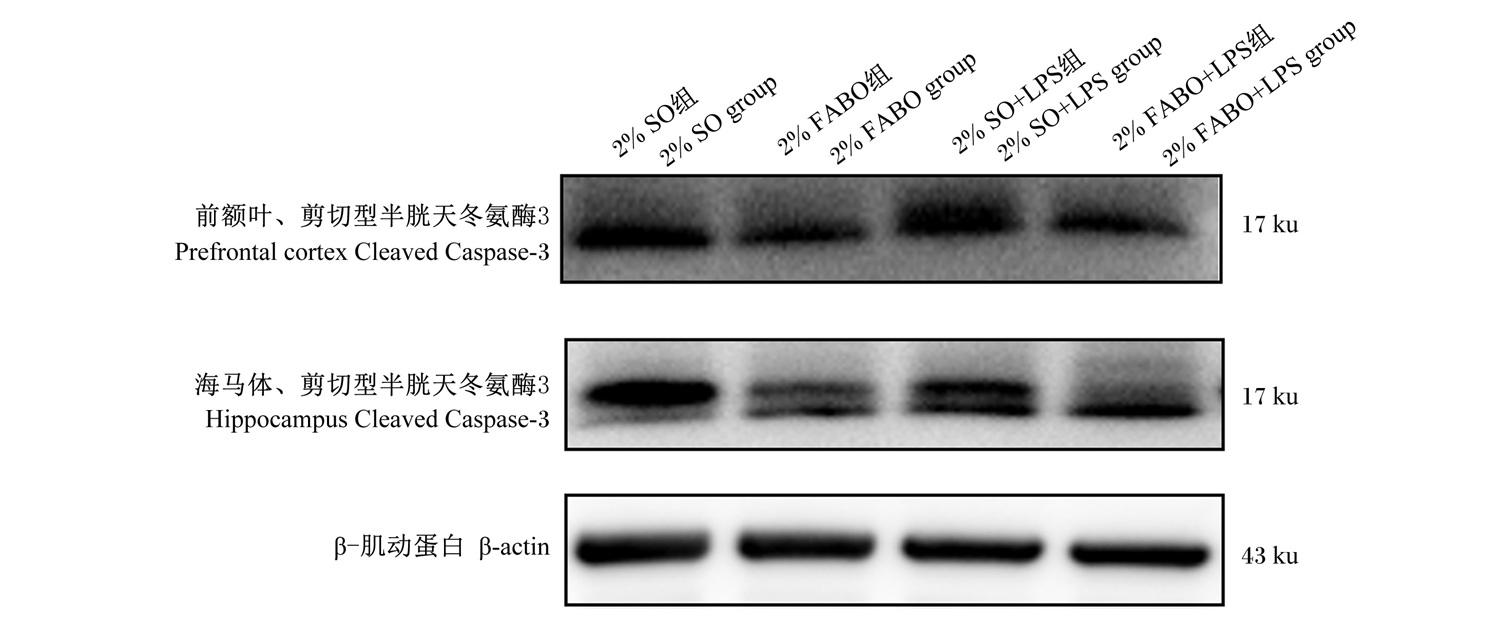
图1表9可知,母猪饲粮添加2% FABO和LPS对哺乳仔猪前额叶和海马体Cleaved Caspase-3的蛋白相对表达量存在互作效应(P<0.05),即母猪饲粮添加2% FABO缓解了LPS刺激引起的哺乳仔猪前额叶和海马体Cleaved Caspase-3蛋白相对表达量的升高。
图1 哺乳仔猪前额叶、海马体Cleaved Caspase-3代表蛋白条带

2% SO:母猪饲粮添加2%豆油,哺乳仔猪注射生理盐水;2% FABO:母猪饲粮添加2%脂肪酸平衡油,哺乳仔猪注射生理盐水;2% SO+LPS:母猪饲粮添加2%豆油,哺乳仔猪注射LPS;2% FABO+LPS:母猪饲粮添加2%脂肪酸平衡油,哺乳仔猪注射LPS。

Fig.1 Representative protein bands of Cleaved Caspase-3 in prefrontal cortex and hippocampus of sucking piglets

2% SO: sows, diet supplemented with 2% soybean oil, and suckling piglets injected with saline; 2% FABO: sows, diet supplemented with 2% fatty acid balanced oil, and suckling piglets injected with saline; 2% SO+LPS: sows, diet supplemented with 2% soybean oil, and suckling piglets injected with LPS; 2% FABO+LPS: sows, diet supplemented with 2% fatty acid balanced oil, and suckling piglets injected with LPS.

表9 母猪饲粮添加FABO对LPS刺激哺乳仔猪前额叶和海马体Cleaved Caspase-3蛋白相对表达量的影响

Table 9 Effects of maternal dietary FABO supplementation on protein relative expression level of Cleaved Caspase-3 in prefrontal cortex and hippocampus of suckling piglets after LPS challenge

项目
Items
生理盐水 Saline 脂多糖 LPS PP-value
2%豆油
2% SO
2%脂肪酸平衡油
2% FABO
2%豆油
2% SO
2%脂肪酸平衡油
2% FABO
饲粮
Diet
脂多糖
LPS
互作
Interaction
前额叶 Prefrontal cortex 1.15±0.04b 1.02±0.02c 1.29±0.06a 0.89±0.03d <0.001 0.871 0.003
海马体 Hippocampus 0.89±0.01a 0.71±0.03b 0.96±0.04a 0.60±0.02c <0.001 0.572 0.009

2.6 母猪饲粮添加FABO对LPS刺激哺乳仔猪前额叶、海马体AChE活性的影响

表10可知,LPS刺激显著降低了哺乳仔猪海马体AChE活性(P<0.05),母猪饲粮添加2% FABO显著提高了前额叶、海马体AChE活性(P<0.05)。
表10 母猪饲粮添加FABO对LPS刺激哺乳仔猪前额叶和海马体AChE活性的影响

Table 10 Effects of maternal dietary FABO supplementation on activity of AChE in prefrontal cortex and hippocampus of suckling piglets after LPS challengeU/mg prot

项目
Items
生理盐水 Saline 脂多糖 LPS PP-value
2%豆油
2% SO
2%脂肪酸平衡油
2% FABO
2%豆油
2% SO
2%脂肪酸平衡油
2% FABO
饲粮
Diet
脂多糖
LPS
互作
Interaction
前额叶 Prefrontal cortex 0.81±0.04 0.87±0.05 0.69±0.06 0.85±0.02 0.022 0.118 0.286
海马体 Hippocampus 0.55±0.05 0.61±0.02 0.44±0.03 0.55±0.03 0.027 0.020 0.445

3 讨论

3.1 母猪饲粮添加FABO对LPS刺激哺乳仔猪血浆生化指标的影响

大脑的正常功能高度依赖于持续而充足的能量供应,虽然GLU是其主要能量来源,但在应激、感染或GLU供应不足等状态下,由中、短链脂肪酸衍生而来的酮体则成为关键的替代能源[19]。本研究中,LPS刺激显著降低了哺乳仔猪血浆GLU含量,表明应激状态下大脑的GLU供应减少。与SO相比,FABO维持了血浆GLU和TG含量,这是可能是由于FABO中的中、短链脂肪酸可生成酮体,保证大脑的能量供应以减少神经元损伤。

3.2 母猪饲粮添加FABO对LPS刺激哺乳仔猪脑发育及神经炎症的影响

LPS刺激能诱发内侧前额叶皮层和海马体的神经炎症反应,导致认知功能受损和神经发育失调[20-21]。本试验中,哺乳仔猪注射LPS后出现呕吐、剧烈腹泻,部分仔猪倒地,四肢呈划水状。课题组前期研究发现,仔猪注射LPS后,血浆HSP70含量显著升高[17]。HSP70和COX-2可反映机体的炎症状态,其高表达往往显示炎症加重[22-23]。丙酸盐可以维持血脑屏障的完整性,缓解LPS刺激诱导的脑损伤[24]。人类膳食n-3/n-6 PUFA比值增加可诱导炎症和轻度抑郁[25]。n-3 PUFA已被证实可缓解LPS诱导的小鼠神经炎症并改善认知功能[26]。脑组织中高水平的n-3 PUFAs可降低炎性细胞因子IL-6和白细胞介素-1β(IL-1β)含量,缓解神经炎症[27];饲粮中的二十碳五烯酸(EPA)可抑制小胶质细胞的过度活化,减少IL-1β的产生,抑制神经炎症的发生[28]。本试验中,LPS刺激提高了哺乳仔猪海马体HSP70、IL-6及前额叶HSP70的mRNA相对表达量,母猪饲粮添加2% FABO降低了哺乳仔猪前额叶IL-6、HSP70、COX-2及海马体COX-2的mRNA相对表达量,缓解了LPS诱导的炎症。
PUFAs在胚胎后期和出生后早期神经功能发育过程中发挥关键作用[29]。作为重要的神经营养因子,NGF对神经元发育与功能维持至关重要[30]。NGF可诱导Egr1和c-fos的转录[21-22]。作为早期即刻转录调控因子,c-fos和Egr1能迅速启动细胞内级联反应,最终促进BDNF的表达[31]。BDNF通过与TrkB受体结合激活PI3K信号通路,进而促进神经发生、神经元分化和存活。研究表明,LPS诱导的促炎细胞因子会损害小鼠海马体或前额叶BDNF表达[32]。Bagheri等[33]研究发现,饲粮添加亚麻油可通过上调BDNF和胶质细胞源性神经营养因子的表达,保护小鼠脑缺血后的运动皮层区损伤。饲粮n-6/n-3 PUFAs平衡有利于维持脑花生四烯酸和DHA含量相对平衡,促进脑发育[34]。Chakraborty等[35]研究表明,饲粮n-3/n-6 PUFAs比例为7∶1时,可促进前额叶和海马体的神经发生,避免神经元的异常发育,并能缓解神经毒性。此外,研究发现,短链脂肪酸可促进BDNF的转录[36]。与这些研究结果一致,本研究发现,LPS降低了哺乳仔猪前额叶Egr1和BDNF的mRNA相对表达量,母猪饲粮添加2% FABO能显著上调哺乳仔猪前额叶或海马体NGFEgr1、c-fosBDNF信号通路相关基因的表达。BDNF信号通路的激活可有效改善神经炎症并抑制细胞凋亡[31]。LPS刺激可导致炎性细胞因子过量表达,进而启动细胞凋亡信号通路,诱导细胞异常凋亡[37]。本试验发现,LPS刺激提高了哺乳仔猪前额叶和海马体Caspase-3的mRNA相对表达量,母猪饲粮添加2% FABO显著缓解了LPS诱导的哺乳仔猪前额叶和海马体凋亡相关基因Bax的mRNA相对表达量及Cleaved Caspase-3蛋白相对表达量的增加,表明FABO可缓解LPS刺激引起的前额叶、海马体细胞的凋亡,这可能与激活BDNF相关信号通路关键因子的表达有关。这些结果说明,母猪饲粮添加FABO通过上调NGF、Egr1/c-fos及BDNF信号通路关键基因表达,进而抑制哺乳仔猪前额叶和海马体中IL-6、HSP70和COX-2的表达,缓解LPS刺激导致的神经细胞凋亡。

3.3 母猪饲粮添加FABO对LPS刺激哺乳仔猪前额叶、海马体AChE活性的影响

AChE在认知功能调控中发挥关键作用[38]。本研究发现,LPS刺激显著降低了哺乳仔猪海马体中AChE活性,母猪饲粮添加2% FABO则使哺乳仔猪前额叶和海马体的AChE活性恢复至正常水平。大量研究表明,铅和铝暴露引起的AChE活性下降与认知功能障碍密切相关[39-40]。Gupta等[40]研究证实,棕榈油可有效预防铝暴露导致的学习记忆能力衰退及AChE功能紊乱。本研究结果表明,母猪饲粮添加2% FABO可恢复LPS刺激哺乳仔猪前额叶和海马体AChE活性,进而改善哺乳仔猪的认知功能。

4 结论

母猪饲粮添加2% FABO能激活哺乳仔猪前额叶和海马体NGF、Egr1/c-fos及BDNF信号通路,提高AChE活性,降低神经炎症反应,缓解LPS刺激所导致的神经细胞凋亡。
[1]
STRATHE A V, BRUUN T S, HANSEN C F. Sows with high milk production had both a high feed intake and high body mobilization[J]. Animal, 2017, 11(11):1913-1921.

[2]
ROSERO D S, ODLE J, MENDOZA S M, et al. Impact of dietary lipids on sow milk composition and balance of essential fatty acids during lactation in prolific sows[J]. Journal of Animal Science, 2015, 93(6):2935-2947.

[3]
LIU Y L. Fatty acids,inflammation and intestinal health in pigs[J]. Journal of Animal Science and Biotechnology, 2015, 6(1):41.

[4]
ALMEIDA K C L, BOAVENTURA G T, SILVA M A G. Influence of omega-3 fatty acids from the flaxseed (Linum usitatissimum) on the brain development of newborn rats[J]. Nutricion Hospitalaria, 2011, 26(5):991-996.

[5]
INNIS S M, FRIESEN R W. Essential n-3 fatty acids in pregnant women and early visual acuity maturation in term infants[J]. The American Journal of Clinical Nutrition, 2008, 87(3):548-557.

[6]
HADLEY K B, RYAN A S, NELSON E B, et al. An assessment of dietary docosahexaenoic acid requirements for brain accretion and turnover during early childhood[J]. World Review of Nutrition and Dietetics, 2009, 99:97-104.

[7]
FRITSCHE K L, HUANG S C, CASSITY N A. Enrichment of omega-3 fatty acids in suckling pigs by maternal dietary fish oil supplementation[J]. Journal of Animal Science, 1993, 71(7):1841-1847.

[8]
SILVA Y P, BERNARDI A, FROZZA R L. The role of short-chain fatty acids from gut microbiota in gut-brain communication[J]. Frontiers in Endocrinology, 2020, 11:25.

[9]
URIHO A, YANG S J, TANG X, et al. Benefits of blended oil consumption over other sources of lipids on the cardiovascular system in obese rats[J]. Food & Function, 2019, 10(9):5290-5301.

[10]
ROOKE J A, SINCLAIR A G, EDWARDS S A, et al. The effect of feeding salmon oil to sows throughout pregnancy on pre-weaning mortality of piglets[J]. Animal Science, 2001, 73(3):489-500.

[11]
NGUYEN T X, AGAZZI A, COMI M, et al. Effects of low ω6:ω3 ratio in sow diet and seaweed supplement in piglet diet on performance,colostrum and milk fatty acid profiles,and oxidative status[J]. Animals, 2020, 10(11):2049.

[12]
BECKER S L, GREINER L L. The impact of essential fatty acid ratios and unsaturated to saturated fat ratio on growth performance of grow-finish pigs and estrus detection of gilts[J]. Translational Animal Science, 2023, 7(1):txad088.

[13]
蔡妙颜, 李冰, 袁向华. 膳食中的脂肪酸平衡[J]. 粮油食品科技, 2003, 11(2):37-39.

CAI M Y, LI B, YUAN X H. Fatty acid equilibrium in diet[J]. Science and Technology of Cereals,Oils and Foods, 2003, 11(2):37-39. (in Chinese)

[14]
BIAN X H, WANG Y, WANG S S, et al. A review of advanced methods for the quantitative analysis of single component oil in edible oil blends[J]. Foods, 2022, 11(16):2436.

[15]
IVANOV D S, LEVIĆ J D, SREDANOVIĆ S A. Fatty acid composition of various soybean products[J]. Food and Feed Research, 2010, 37(2):65-70.

[16]
RABAIL R, ALTEMIMI A B, MAERESCU C M, et al. Consumption of edible oil blended with flax,coconut,sunflower,and olive oil can significantly improve the negative health consequences of high-fat/high-cholesterol diet in Sprague Dawley rats[J]. Frontiers in Nutrition, 2024, 11:1469601.

[17]
ZHU H L, WANG H B, WANG S H, et al. Flaxseed oil attenuates intestinal damage and inflammation by regulating necroptosis and TLR4/NOD signaling pathways following lipopolysaccharide challenge in a piglet model[J]. Molecular Nutrition & Food Research, 2018, 62(9):1700814.

[18]
LIVAK K J, SCHMITTGEN T D. Analysis of relative gene expression data using real-time quantitative PCR and the 2-ΔΔCT method[J]. Methods, 2001, 25(4):402-408.

[19]
CUNNANE S C, TRUSHINA E, MORLAND C, et al. Brain energy rescue:an emerging therapeutic concept for neurodegenerative disorders of ageing[J]. Nature Reviews Drug Discovery, 2020, 19(9):609-633.

[20]
ZHAO J Y, WEI B, XIAO S, et al. Neuroinflammation induced by lipopolysaccharide causes cognitive impairment in mice[J]. Scientific Reports, 2019, 9(1):5790.

[21]
ROLLS A, SHECHTER R, LONDON A, et al. Toll-like receptors modulate adult hippocampal neurogenesis[J]. Nature Cell Biology, 2007, 9(9):1081-1088.

[22]
KINOSHITA Y, UEYAMA T, SENBA E, et al. Expression of c-fos,heat shock protein 70,neurotrophins,and cyclooxygenase-2 mRNA in response to focal cerebral ischemia/reperfusion in rats and their modification by magnesium sulfate[J]. Journal of Neurotrauma, 2001, 18(4):435-445.

[23]
CHOI S H, AID S, CHOI U, et al. Cyclooxygenases-1 and -2 differentially modulate leukocyte recruitment into the inflamed brain[J]. The Pharmacogenomics Journal, 2010, 10(5):448-457.

[24]
HOYLES L, SNELLING T, UMLAI U K, et al. Microbiome-host systems interactions:protective effects of propionate upon the blood-brain barrier[J]. Microbiome, 2018, 6(1):55.

[25]
KIECOLT-GLASER J K, BELURY M A, ANDRIDGE R, et al. Omega-3 supplementation lowers inflammation and anxiety in medical students:a randomized controlled trial[J]. Brain,Behavior,and Immunity, 2011, 25(8):1725-1734.

[26]
LIVINGSTON D B H, SWEET A, RODRIGUE A, et al. Dietary flaxseed and flaxseed oil differentially modulate aspects of the microbiota gut-brain axis following an acute lipopolysaccharide challenge in male C57Bl/6 mice[J]. Nutrients, 2023, 15(16):3542.

[27]
ORR S K, TRÉPANIER M O, BAZINET R P. N-3 polyunsaturated fatty acids in animal models with neuroinflammation[J]. Prostaglandins,Leukotrienes,and Essential Fatty Acids, 2013, 88(1):97-103.

[28]
LYNCH A M, LOANE D J, MINOGUE A M, et al. Eicosapentaenoic acid confers neuroprotection in the amyloid-beta challenged aged hippocampus[J]. Neurobiology of Aging, 2007, 28(6):845-855.

[29]
CLANDININ M T, CHAPPELL J E, LEONG S, et al. Intrauterine fatty acid accretion rates in human brain:implications for fatty acid requirements[J]. Early Human Development, 1980, 4(2):121-129.

[30]
EFTIMIADI G, SOLIGO M, MANNI L, et al. Topical delivery of nerve growth factor for treatment of ocular and brain disorders[J]. Neural Regeneration Research, 2021, 16(9):1740-1750.

[31]
EBERT D H, GREENBERG M E. Activity-dependent neuronal signalling and autism spectrum disorder[J]. Nature, 2013, 493(7432):327-337.

[32]
GUO J, LIN P, ZHAO X, et al. Etazolate abrogates the lipopolysaccharide (LPS)-induced downregulation of the cAMP/pCREB/BDNF signaling,neuroinflammatory response and depressive-like behavior in mice[J]. Neuroscience, 2014, 263:1-14.

[33]
BAGHERI A, TALEI S, HASSANZADEH N, et al. The neuroprotective effects of flaxseed oil supplementation on functional motor recovery in a model of ischemic brain stroke:upregulation of BDNF and GDNF[J]. Acta Medica Iranica, 2017, 55(12):785-792.

[34]
TOMASZEWSKI N, HE X L, SOLOMON V, et al. Effect of APOE genotype on plasma docosahexaenoic acid (DHA),eicosapentaenoic acid,arachidonic acid,and hippocampal volume in the Alzheimer’s disease cooperative study-sponsored DHA clinical trial[J]. Journal of Alzheimer’s Disease, 2020, 74(3):975-990.

[35]
CHAKRABORTY N, GAUTAM A, MUHIE S, et al. Potential roles of polyunsaturated fatty acid-enriched diets in modulating social stress-like features[J]. The Journal of Nutritional Biochemistry, 2023, 116:109309.

[36]
GE X, ZHENG M X, HU M M, et al. Butyrate ameliorates quinolinic acid-induced cognitive decline in obesity models[J]. The Journal of Clinical Investigation, 2023, 133(4):e154612.

[37]
KUO W T, SHEN L, ZUO L, et al. Inflammation-induced occludin downregulation limits epithelial apoptosis by suppressing caspase-3 expression[J]. Gastroenterology, 2019, 157(5):1323-1337.

[38]
BARALDI T, SCHÖWE N M, BALTHAZAR J, et al. Cognitive stimulation during lifetime and in the aged phase improved spatial memory,and altered neuroplasticity and cholinergic markers of mice[J]. Experimental Gerontology, 2013, 48(8):831-838.

[39]
PHYU M P, TANGPONG J. Protective effect of Thunbergia laurifolia (Linn.) on lead induced acetylcholinesterase dysfunction and cognitive impairment in mice[J]. BioMed Research International, 2013, 2013(1):186098.

[40]
GUPTA L, SOOD P K, NEHRU B, et al. Ameliorative effect of palm oil in aluminum lactate induced biochemical and histological implications in rat brain[J]. Biological Trace Element Research, 2023, 201(6):2843-2853.

Outlines

/