RESEARCH PAPER

Alleviating Effects and Mechanism of Lactobacillus plantarum Postbiotics on Salmonella-Derived Lipopolysaccharide-Induced Inflammation of Weaned Piglets

  • YE Ting ,
  • SHU Xin ,
  • HAN Meng ,
  • CHEN Liuyi ,
  • ZHANG Ruiqiang ,
  • YANG Ting ,
  • XIAO Xiao ,
  • YANG Caimei ,
  • WU Yanping , *
Expand
  • College of Animal Science and Technology · College of Veterinary Medicine, Zhejiang A & F University, Hangzhou 311300, China
*associate professor, E-mail:

Received date: 2025-11-24

  Online published: 2026-08-13

Abstract

This experiment aims to explore the this experiment aimed to explore the alleviating effects and mechanisms of Lactobacillus plantarum postbiotics on Salmonella-derived lipopolysaccharide (LPS) -induced inflammation of weaned piglets. A total of 60 healthy “Duroc×Landrace×Large White” weaned piglets at 28 days of age with an initial body weight of (7.26±0.36) kg were randomly divided into 4 groups with 15 replicates per group and 1 piglet per replicate. The four groups were control (CON) group, PB group, LPS group and PB+LPS group. Piglets in the CON and LPS groups were fed a basal diet supplemented with 0.8% MRS medium, while those in the PB and PB+LPS groups were fed a basal diet supplemented with 0.8% Lactobacillus plantarum postbiotics. After 28 days of feeding, the piglets were challenged on day 29. The LPS and PB+LPS groups received an intraperitoneal injection of Salmonella-derived LPS at a dose of 30 μg/kg BW, while the CON and PB groups received an equal volume of sterile saline. Samples were collected 4 hours later. The results showed as follows: 1) compared with the CON group, jejunum weight in the LPS group was significantly decreased (P<0.05), while no significant difference was observed in the PB+LPS group (P>0.05). 2) Compared with the CON group, jejunal and ileal villus height and villus height to crypt depth ratio (V/C) in the LPS group were significantly decreased (P<0.05), while the jejunal and ileal crypt depth were significantly increased (P<0.05). Compared with the LPS group, jejunal villus height and V/C in both jejunum and ileum in the PB+LPS group showed significantly increased (P<0.05), and the jejunal and ileal crypt depth was significantly decreased (P<0.05). 3) Compared with the CON group, the mRNA relative expression levels of zonula occludens-1 (ZO-1) and claudin-1 in the ileum of the LPS group were significantly down-regulated (P<0.05), while no significant differences were observed in the PB+LPS group (P>0.05). 4) Compared with the CON group, levels of pro-inflammatory cytokines interleukin-1β (IL-1β), tumor necrosis factor-α (TNF-α) and interleukin-6 (IL-6) in the ileum of the LPS group were significantly increased (P<0.05), while the level of anti-inflammatory cytokine interleukin-10 (IL-10) was significantly decreased (P<0.05). Compared with the LPS group, levels of IL-1β and TNF-α in the PB+LPS group showed significantly decreased (P<0.05), and level of IL-10 was significantly increased (P<0.05). 5) Compared with the CON group, the mRNA relative expression levels of apoptosis-associated speck-like protein (ASC), cysteine-aspartate protease-1 (Caspase-1), IL-1β and gasdermin D (GSDMD) in the ileum of the LPS group were significantly up-regulated (P<0.05). Compared with the LPS group, mRNA relative expression levels of ASC, Caspase-1, IL-1β and GSDMD in the PB+LPS group exhibited significantly decreased (P<0.05). 6) Compared with the CON group, the mRNA relative expression level of nuclear factor- kappa B (NF-κB) in the ileum of the LPS group was significantly up-regulated (P<0.05). Compared with the LPS group, mRNA relative expression levels of Toll-like receptor 4 (TLR4), myeloid differentiation primary response 88 (MyD88) and NF-κB in the ileum of the PB+LPS group showed significantly decreased (P<0.05). In conclusion, dietary supplementation with Lactobacillus plantarum postbiotics alleviates the inflammatory response induced by Salmonella-derived LPS in weaned piglets by maintaining intestinal barrier function, modulating inflammatory cytokines, and inhibiting the activation of the NOD-like receptor family pyrin domain containing 3 (NLRP3) inflammasome and its upstream signaling pathways.

Cite this article

YE Ting , SHU Xin , HAN Meng , CHEN Liuyi , ZHANG Ruiqiang , YANG Ting , XIAO Xiao , YANG Caimei , WU Yanping . Alleviating Effects and Mechanism of Lactobacillus plantarum Postbiotics on Salmonella-Derived Lipopolysaccharide-Induced Inflammation of Weaned Piglets[J]. Chinese Journal of Animal Nutrition, 2026 , 38(8) : 5722 -5733 . DOI: 10.12418/CJAN2026.459

益生菌制剂作为主要的抗生素替代品已被广泛应用于动物生产中,具有抗菌、免疫调节和改善肠道健康等益生功能[1]。然而,由于益生菌是活的微生物,存在饲料制粒过程中易失活、难以在低pH和胆盐环境下存活以及可能编码毒力因子和耐药基因等问题[2]。后生元是指对宿主有益的无生命微生物和/或其代谢产物的制剂[3]。近年来研究表明,后生元具有与益生菌相似甚至更优的抗菌、抗炎及免疫调节作用[4]。例如在结肠炎小鼠模型中,青春双歧杆菌后生元比其活菌菌体能发挥出更强的肠道菌群调控作用[5]
沙门氏菌是危害畜牧生产、影响畜产品品质的主要病原菌之一,可通过水平传播(环境感染)和垂直传播(如母猪到仔猪、猪到猪群等)2种方式感染整个猪群生产链[6],并且由于仔猪断奶后通常处于应激状态,生长性能下降,肠道菌群紊乱,从而增加沙门氏菌的易感性[7]。在猪生产体系中,沙门氏菌还会显著增加屠宰加工阶段胴体污染风险,进而造成食品安全隐患[8],给养猪业带来严重的经济损失。沙门氏菌感染可引起机体炎症反应,该过程主要由其表面的脂多糖(lipopolysaccharides,LPS)介导。相关研究表明,空肠和回肠是微生物作用与炎症反应的主要发生部位,也是LPS的主要攻击部位[9-10]。LPS可诱导细胞炎症及激活炎症小体,机体炎症反应可通过模式识别受体(pattern recognition receptors,PRRs),如细胞表面Toll样受体(Toll-like receptor,TLR),识别微生物的代谢产物激活[11]。在沙门氏菌感染过程中,TLR可识别沙门氏菌LPS,并通过核因子-κB(nuclear factor-kappa B,NF-κB)诱导关键基因NOD样受体家族pyrin结构域蛋白3(NOD-like receptor family pyrin domain containing 3,NLRP3)及白细胞介素-1β前体(pro-interleukin-1β,pro-IL-1β)和白细胞介素-18前体(pro-interleukin-18,pro-IL-18)的转录,随后NLRP3与凋亡相关斑点样蛋白(apoptosis-associated speck-like protein,ASC)、半胱氨酸天冬氨酸蛋白酶-1(Caspase-1)组合形成的NLRP3炎性小体,最终引发大量炎症反应,造成严重组织损伤[12]。据报道,当LPS被细胞表面的Toll样受体4(Toll-like receptor 4,TLR4)识别,触发髓样分化因子88(myeloid differentiation primary response 88,MyD88)依赖的信号,白细胞介素1受体相关激酶(IRAK)磷酸化,进而快速激活NF-κB[13]。活化的NF-κB上调NLRP3、pro-IL-1βpro-IL-18基因的转录,从而促进白细胞介素-1β(interleukin-1β,IL-1β)和肿瘤坏死因子-α(tumor necrosis factor-α,TNF-α)及白细胞介素-6(interleukin-6,IL-6)的释放和NLRP3炎症小体的激活,最终引发炎症反应[14-15]
植物乳杆菌(Lactobacillus plantarum)是一种广泛应用于畜禽生产中的益生菌。研究表明,它的后生元成分有益于改善营养摄入、免疫反应和肠道菌群平衡及促进畜禽产品的生长性能和质量[16]。本实验室前期研究发现,植物乳杆菌HJZW08菌株的后生元对沙门氏菌生长及致病性具有较强抑制效果[17-18],但其在体内作用效果及分子机制有待进一步明确。因此,本研究旨在探究植物乳杆菌后生元对断奶仔猪沙门氏菌LPS诱导的炎症反应的缓解作用,并从NLRP3炎症小体及其上游信号通路的调控角度阐明其分子机制。

1 材料与方法

1.1 试验仪器与设备

试验所用仪器与设备包括真空冷冻干燥机(LGJ-18s,上海贺帆仪器有限公司)、光学显微镜(Eclipse ci,NIKON,日本)、酶联免疫检测仪(iMark,Bio-Rad,美国)、多功能酶标仪(Multiskan FC,Thermo Fisher,美国)、凝胶电泳系统(Tanon CPS300,上海天能科技有限公司)、DNA凝胶成像系统(Tanon 2500,上海天能科技有限公司)、梯度PCR扩增仪(TC-96,杭州博日科技股份有限公司)、实时荧光定量PCR仪(CFX96,Bio-Rad,美国)。

1.2 试验材料

LPS来源于肠沙门氏菌肠炎血清型(Sigma-Aldrich,美国);MRS培养基、SS固体培养基均购于青岛海博生物技术有限公司;0.22 μm过滤器(Sigma-Aldrich,美国);焦碳酸二乙酯(DEPC)来自上海碧云天生物科技有限公司;氯仿来自杭州浩克生物科技技术公司;异丙醇来自杭州浩克生物科技技术公司;TRIzol试剂盒来自杭州浩克生物科技技术公司;荧光定量试剂盒购于杭州浩克生物科技技术公司;酶联免疫吸附测定(ELISA)试剂盒购于南京奥青生物科技有限公司;4%多聚甲醛购于上海阿拉丁生化科技股份有限公司。

1.3 试验菌株及后生元制备

植物乳杆菌HJZW08由浙江惠嘉生物科技股份有限公司提供。取出冻存于-80 ℃的植物乳杆菌,在MRS培养基中37 ℃静置培养过夜进行复苏,再以1∶50的比例进行扩培,培养48 h后得到菌液[600 nm光密度(OD600 nm)=1.650,稀释涂板测得菌数为5×10⁸ CFU/mL],8 000×g离心10 min收集上清液,再用0.22 μm过滤器过滤得无细胞培养上清(cell-free culture supernatant,CFS),分装保存于-80 ℃备用。采用真空冷冻干燥机冻干CFS,在-45~-30 ℃、真空度10 Pa条件下持续30 h冻干,经称重计算得到后生元的浓度为40 mg/mL。

1.4 试验设计

本次动物试验由浙江农林大学动物伦理委员会批准(伦理编号:ZAFUAC2022035)。
选取28日龄初始体重为(7.26±0.36) kg的“杜×长×大”健康断奶仔猪60头,随机分成4个组,每组15个重复,每个重复1头猪。4个组分别为对照(CON)组、PB组、LPS组、PB+LPS组。CON组和LPS组饲喂在基础饲粮中添加0.8% MRS培养基的试验饲粮;PB组和PB+LPS组饲喂在基础饲粮中添加0.8%植物乳杆菌后生元的试验饲粮。所用后生元添加量参考在畜禽养殖中已有研究[19]。饲喂试验饲粮28 d后,第29天进行攻毒,LPS组和PB+LPS组按30 μg/kg BW腹腔注射沙门氏菌来源的LPS,而CON组和PB组腹腔注射等体积的生理盐水,4 h后采样。

1.5 饲养管理

本次饲养试验在正大猪业(余姚)有限公司进行,每组仔猪在同一猪栏中进行饲养,每天早、中、晚各饲喂1次,自由饮水。试验期间仔猪按照猪场制定免疫程序接种疫苗,每天早、晚对各组猪舍进行打扫并消毒。
基础饲粮按照NRC(2012)仔猪营养需求标准配制,采用细小颗粒料,不含抗生素,其组成及营养水平见表1。饲粮中消化能、有效磷含量参照《中国饲料成分及营养价值表(2020年第31版)》计算,粗蛋白质、钙、氨基酸和总磷含量分别参照GB/T 6432—2018、GB/T 6436—2018、GB/T 18246—2019和GB/T 6437—2018的方法测定。
表1 基础饲粮组成及营养水平(风干基础)

Table 1 Composition and nutrient levels of basal diet (air-dry basis)%

项目 Items 含量 Content
原料 Ingredients
玉米 Corn 55.00
次粉 Wheat middling 3.50
磷脂 Phospholipid 2.00
乳清粉 Whey powder 5.00
膨化大豆 Extruded soybean 7.30
豆粕 Soybean meal 18.50
鱼粉 Fish meal 5.00
磷酸二氢钙 Ca(H2PO4)2 1.00
碳酸钙 CaCO3 1.10
食盐 NaCl 0.10
赖氨酸盐酸盐 Lys·HCl 0.34
DL-蛋氨酸 DL-Met 0.16
预混料 Premix1) 1.00
合计 Total 100.00
营养水平 Nutrient levels2)
消化能 DE/(MJ/kg) 14.17
粗蛋白质 CP 20.38
赖氨酸 Lys 1.31
蛋氨酸+半胱氨酸 Met+Cys 0.75
苏氨酸 Thr 0.82
钙 Ca 0.95
总磷 TP 0.66
有效磷 AP 0.47

1)预混料为每千克饲粮提供 The premix provided the following per kg of the diet:VB12 0.009 mg,VE 10 mg,VD3 400 IU,VB6 2 mg,VA 10 000 IU,生物素 biotin 0.3 mg,泛酸 pantothenic acid 15 mg,抗坏血酸 ascorbic acid 40 mg,叶酸 folic acid 3 mg,Zn 120 mg,Cu 130 mg,Mn 60 mg,Fe 150 mg,Se 0.25 mg,I 0.3 mg。

2)消化能和有效磷为计算值,其他营养水平为实测值。DE and AP were calculated values, while the other nutrient levels were measured values.

1.6 样品采集

在第29天攻毒结束后,每头猪均进行屠宰后开腹,取肠道食糜挤空,分别采集空肠和回肠组织,用4%多聚甲醛固定,采集回肠黏膜保存于-80 ℃备用。

1.7 指标测定与方法

1.7.1 消化器官发育指标

屠宰后开腹,取胰腺称重,取肠道食糜挤空后,测量并记录小肠各段肠道重量和长度。

1.7.2 肠道形态结构指标

用4%多聚甲醛溶液固定空肠和回肠肠段,24 h后进行乙醇脱水、石蜡包埋。切5 μm的薄片,二甲苯去除切片表面多余石蜡后进行酒精漂洗、蒸馏水漂洗,经苏木精-伊红(HE)染色后,利用光学显微镜观察空肠、回肠的组织形态结构,随机选择视野拍照,并利用Image Pro Plus 6.0图像分析软件测定肠道绒毛高度及隐窝深度,计算绒隐比。

1.7.3 肠道黏膜炎症因子水平

采用酶联免疫检测仪测定回肠黏膜中炎症因子IL-1β、TNF-α、IL-6和白细胞介素-10(IL-10)水平,操作步骤严格按照ELISA试剂盒使用说明书进行。

1.7.4 荧光定量PCR检测mRNA相对表达量

取回肠黏膜样本,利用TRIzol试剂盒提取总RNA,再按照说明书反转录为cDNA并储存于-80 ℃备用。基因信息及引物序列见表2,引物由北京擎科生物科技股份有限公司杭州分公司合成。PCR反应体系总体系10 μL:2×Universal SYBR Green Fast qPCR Mix 5 μL,正、反向引物(10 μmol/L)各0.2 μL,DEPC水3.6 μL,cDNA(50 ng/μL)1 μL。PCR反应条件:95 ℃ 3 min;95 ℃ 5 s,60 ℃ 30 s,40个循环;熔解曲线由仪器自动设置。利用实时荧光定量PCR仪,以β-肌动蛋白(β-actin)作为内参基因,对紧密连接蛋白、NLRP3炎症小体和TLR4/MyD88/NF-κB信号通路相关基因进行定量分析,并用2-ΔΔCt法计算目的基因的mRNA相对表达量。
表2 基因信息及引物序列

Table 2 Gene information and primer sequences

基因
Genes
引物序列
Primer sequences
(5'—3')
产物长度
Product length/bp
GenBank登录号
GenBank accession
number
闭锁小带蛋白-1
ZO-1
F:AGCCCGAGGCGTGTTT
R:GGTGGGAGGATGCTGTTG
147 XM_013993251
闭合蛋白
Occludin
F:GCACCCAGCAACGACAT
R:CATAGACAGAATCCGAATCAC
144 XM_005672525
封闭蛋白-1
Claudin-1
F:CATTATGCACCCAGCAACGA
R:GCACATCACGATAACGAGCA
168 XM_005672522.3
NOD样受体家族pyrin结构域蛋白3
NLRP3
F:TCCCCTGGTCTGCTGGATT
R:ACTCTTGCCGCTATCCATCTG
61 XM_047776384.1
凋亡相关斑点样蛋白
ASC
F:ACAACAAACCAGCACTGCAC
R:CCTGGTACTGCTCTTCCGTC
123 XM_003124468.5
半胱氨酸天冬氨酸蛋白酶-1
Caspase-1
F:AAGGCCCGAGCTTTGATTGA
R:ACCTGTGGAGAGTTCGAGGA
120 NM_214162.1
白细胞介素-1β
IL-1β
F:GAAAGCCCAATTCAGGGACC
R:GGCGGGTTCAGGTACTATGG
90 NM_214055.1
白细胞介素-18
IL-18
F:AGGGACATCAAGCCGTGTTT
R:CGGTCTGAGGTGCATTATCTGA
189 XM_005667327
细胞死亡调节蛋白
GSDMD
F:TGCGTGTGACTCAGAAGACC
R:CAAACAGGTCATCCCCACGA
108 NM_026960.4
Toll样受体4
TLR4
F:AGCACCTATGACGCCTTTG
R:CACCACGACAATAACCTTCC
198 NM 001293316.1
髓样分化因子88
MyD88
F:GATGGTAGCGTTGTCTCTGAT
R:GATGCTGGGGAACTCTTTCTTC
148 MK302494.1
白细胞介素1受体相关激酶
IRAK
F:CATCTGTGATGCCCTGTC
R:AACTCCAAATCCTCCCTC
200 NM_001112693.1
核因子-κB
NF-κB
F:AAAGAAGCGGGACCTGGAA
R:GGCACGGTTGTCAAAGATGG
167 NM_001048232.1:1-2880
β-肌动蛋白
β-actin
F:CTACACCGCTACCAGTTCGC
R:TAGGAGTCCTTCTGGCCCAT
179 XM_021086047.1

1.8 数据分析

试验数据经Excel 2019初步整理后,采用SPSS 26.0软件进行单因素方差分析(one-way ANOVA),若差异显著则采用Duncan氏法进行多重比较。结果以平均值±标准差表示,P<0.05表示差异显著。

2 结果与分析

2.1 植物乳杆菌后生元对沙门氏菌LPS攻毒仔猪消化器官发育的影响

表3可知,与CON组相比,LPS组空肠重量显著降低(P<0.05),而PB+LPS组空肠重量无显著差异(P>0.05);LPS组胰腺重量、十二指肠和回肠的重量与长度均有所降低,但无显著差异(P>0.05)。与LPS组相比,PB+LPS组胰腺重量有所提高,但无显著差异(P>0.05)。
表3 植物乳杆菌后生元对沙门氏菌LPS攻毒仔猪消化器官发育的影响

Table 3 Effects of Lactobacillus plantarum postbiotics on intestinal weight and organ index of piglets challenged with Salmonella derived-LPS

项目
Items
组别 Groups P
P-value
CON LPS PB PB+LPS
胰腺重量 Pancreas weight/g 35.21±2.92 27.45±1.22 30.39±1.83 32.16±1.94 0.092
十二指肠长度 Duodenum length/m 0.30±0.02 0.26±0.05 0.27±0.02 0.28±0.05 0.408
十二指肠重量 Duodenum weight/g 16.68±2.98 13.87±2.06 16.11±1.10 14.50±1.35 0.732
空肠长度 Jejunum length/m 5.19±0.27 5.00±0.17 4.88±0.14 4.77±0.15 0.460
空肠重量 Jejunum weight/g 319.06±21.62a 224.18±27.58b 308.19±16.62a 306.30±26.02a 0.034
回肠长度 Ileum length/m 7.79±0.41 7.50±0.26 7.31±0.62 7.32±0.18 0.605
回肠重量 Ileum weight/g 354.13±18.69 301.35±8.44 316.44±16.07 313.43±17.66 0.132

2.2 植物乳杆菌后生元对沙门氏菌LPS攻毒仔猪肠道形态结构的影响

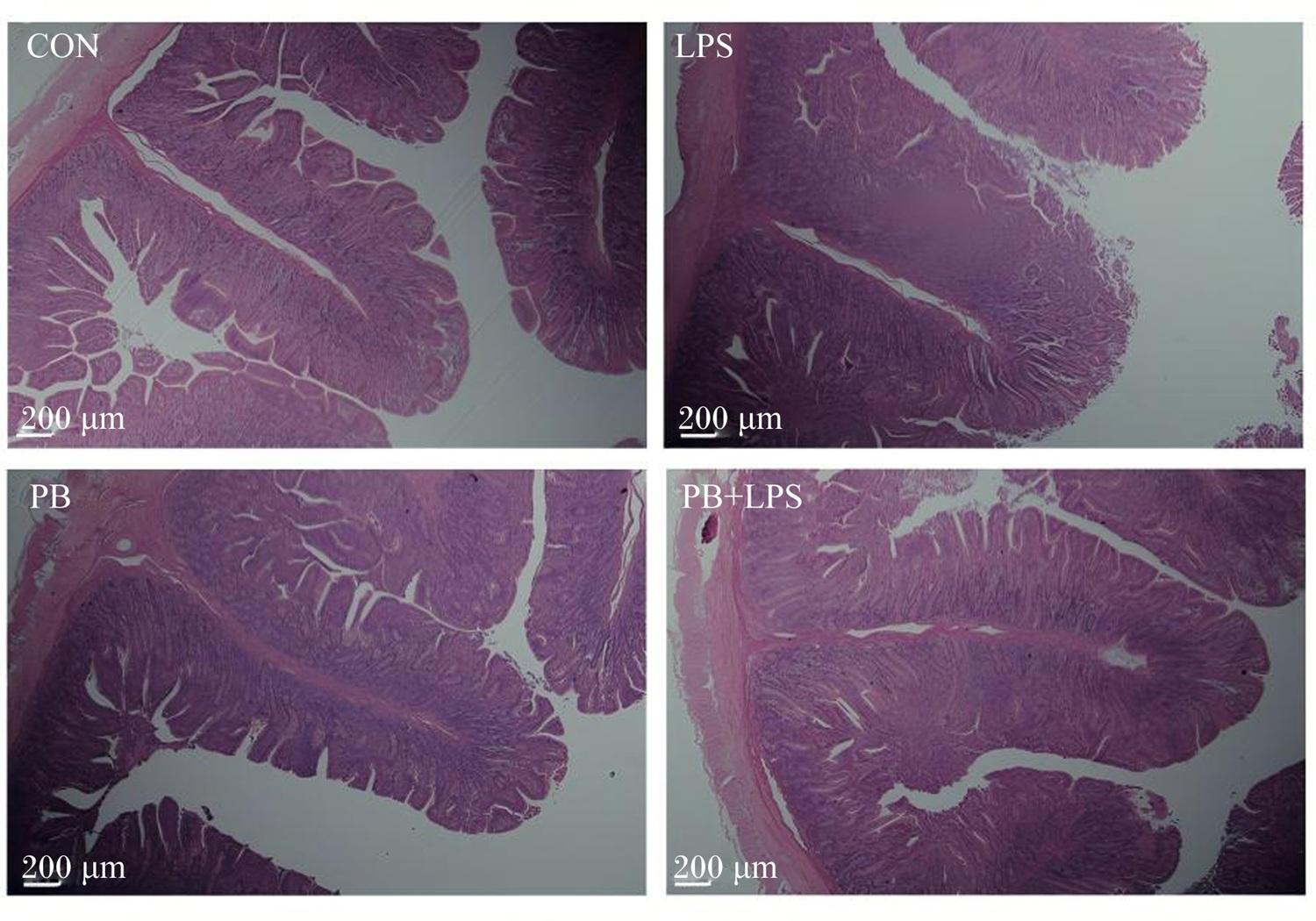
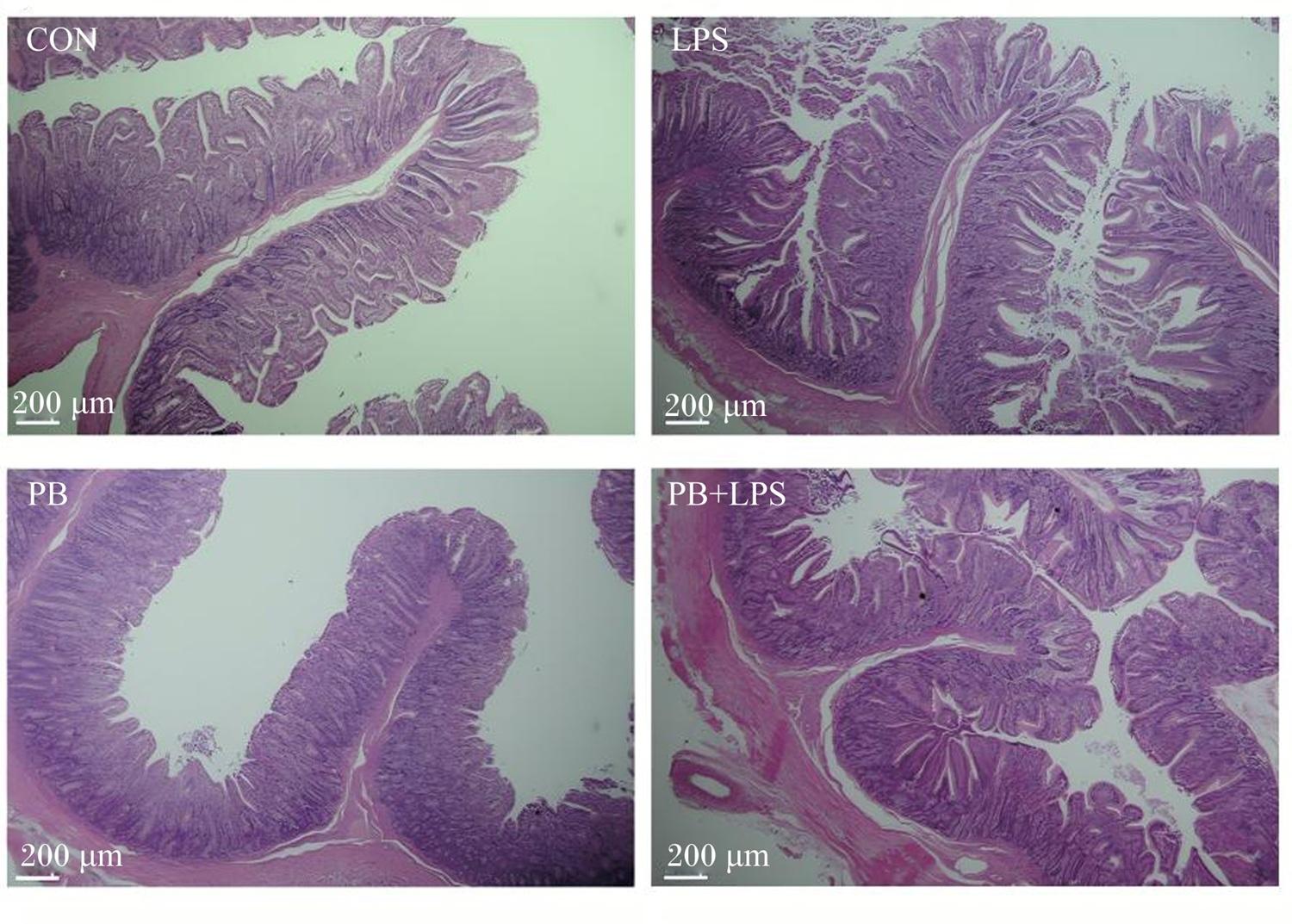
表4图1图2所示,与CON组相比,LPS组空肠和回肠肠道出现损伤,表现出明显的炎症细胞浸润、绒毛排列紊乱、结构模糊、部分绒毛脱落及溃疡形成;与CON组相比,LPS组空肠和回肠绒毛高度、绒隐比显著降低(P<0.05),空肠和回肠隐窝深度显著增加(P<0.05)。与LPS组相比,植物乳杆菌后生元预处理可缓解沙门氏菌LPS引起的肠道损伤,减轻肠道黏膜损伤,表现为炎症细胞浸润减少、绒毛排列更为规则、上皮脱落现象改善,结构更为完整;与LPS组相比,PB+LPS组空肠绒毛高度及空肠和回肠的绒隐比显著提高(P<0.05),空肠和回肠隐窝深度显著降低(P<0.05)。
表4 植物乳杆菌后生元对沙门氏菌LPS攻毒仔猪肠道形态结构的影响

Table 4 Effects of Lactobacillus plantarum postbiotics on intestinal morphology structure of piglets challenged with Salmonella derived-LPS

项目
Items
组别 Groups P
P-value
CON LPS PB PB+LPS
空肠 Jejunum
绒毛高度 Villus height/μm 458.89±76.89a 337.02±52.59c 441.91±86.24ab 425.05±82.17b <0.001
隐窝深度 Crypt depth/μm 203.58±55.13b 263.86±54.14a 205.13±54.73b 217.16±51.25b <0.001
绒隐比 V/C 2.41±0.78a 1.33±0.34c 2.28±0.72a 2.06±0.61b <0.001
回肠 Ileum
绒毛高度 Villus height/μm 395.05±93.12a 261.66±138.02b 166.54±26.55c 170.61±33.07c <0.001
隐窝深度 Crypt depth/μm 151.98±50.85b 176.32±97.23a 82.06±18.23c 72.28±22.27c <0.001
绒隐比 V/C 2.77±0.93a 1.57±0.46d 2.12±0.53c 2.53±0.79b <0.001
图1 植物乳杆菌后生元对沙门氏菌LPS攻毒仔猪空肠形态结构的影响

CON:CON组 CON group;LPS:LPS组 LPS group;PB:PB组 PB group;PB+LPS:PB+LPS组 PB+LPS group。下图同 the same as below。

Fig.1 Effects of Lactobacillus plantarum postbiotics on jejunal morphology structure of piglets challenged with Salmonella derived-LPS

图2 植物乳杆菌后生元对LPS攻毒仔猪回肠形态结构的影响

Fig.2 Effects of Lactobacillus plantarum postbiotics on ileal morphology structure of piglets challenged with Salmonella derived-LPS

2.3 植物乳杆菌后生元对沙门氏菌LPS攻毒仔猪肠道屏障相关基因表达的影响

表5所示,与CON组相比,LPS组闭锁小带蛋白-1(ZO-1)和封闭蛋白-1(Claudin-1)mRNA相对表达量显著下调(P<0.05);闭合蛋白(Occludin)mRNA相对表达量有降低的趋势,但差异不显著(P>0.05)。与LPS组相比,PB+LPS组ZO-1、OccludinClaudin-1 mRNA相对表达量均有提高的趋势,但差异不显著(P>0.05)。
表5 植物乳杆菌后生元对沙门氏菌LPS攻毒仔猪肠道屏障相关基因表达的影响

Table 5 Effects of Lactobacillus plantarum postbiotics on expression of genes related to intestinal barrier of piglets challenged with Salmonella derived-LPS

项目
Items
组别 Groups P
P-value
CON LPS PB PB+LPS
闭锁小带蛋白-1 ZO-1 1.04±0.30ab 0.51±0.23c 1.17±0.22a 0.80±0.30bc 0.002
闭合蛋白 Occludin 1.04±0.33 0.70±0.24 1.03±0.24 0.84±0.32 0.145
封闭蛋白-1 Claudin-1 1.03±0.26a 0.61±0.22b 0.92±0.18a 0.86±0.26ab 0.034

2.4 植物乳杆菌后生元对沙门氏菌LPS攻毒仔猪肠道黏膜炎症因子水平的影响

表6所示,与CON组相比,LPS组回肠促炎因子IL-1β、TNF-α和IL-6水平显著升高(P<0.05),抗炎因子IL-10水平显著降低(P<0.05)。与LPS组相比,PB+LPS组促炎因子IL-1β、TNF-α水平显著降低(P<0.05);IL-6水平有所降低,但差异不显著(P>0.05);此外,抗炎因子IL-10水平显著升高(P<0.05)。
表6 植物乳杆菌后生元对沙门氏菌LPS攻毒仔猪肠道黏膜炎症因子水平的影响

Table 6 Effects of Lactobacillus plantarum postbiotics on levels of inflammatory factors in intestinal mucosa of piglets challenged with Salmonella derived-LPS

项目
Items
组别 Groups P
P-value
CON LPS PB PB+LPS
白细胞介素-1β IL-1β/(pg/mg prot) 17.58±0.37b 25.73±0.46a 12.16±0.33c 19.09±0.21b <0.001
白细胞介素-6 IL-6/(ng/mg prot) 3.82±0.32b 4.26±0.52a 3.02±0.25b 4.12±0.19a 0.008
肿瘤坏死因子-α TNF-α/(ng/mg prot) 0.32±0.35b 0.39±0.49a 0.27±0.34b 0.35±0.25b 0.028
白细胞介素-10 IL-10/(pg/mg prot) 40.07±0.36a 32.23±0.56b 45.32±0.29a 38.87±0.23a <0.001

2.5 植物乳杆菌后生元对沙门氏菌LPS攻毒仔猪肠道NLRP3炎症小体相关基因表达的影响

表7所示,与CON组相比,LPS组回肠ASCCaspase-1、IL-1βGSDMD mRNA相对表达量显著上调(P<0.05);NLRP3和IL-18 mRNA相对表达量有所升高,但差异不显著(P>0.05)。与LPS组相比,PB+LPS组回肠ASCCaspase-1、IL-1βGSDMD mRNA相对表达量显著降低(P<0.05)。与CON组相比,LPS组NF-κB mRNA相对表达量显著上调(P<0.05);TLR4、MyD88 mRNA相对表达量有升高的趋势,IRAK mRNA相对表达量有所降低,但差异不显著(P>0.05)。与LPS组相比,PB+LPS组TLR4、MyD88、NF-κB mRNA相对表达量显著降低(P<0.05)。
表7 植物乳杆菌后生元对沙门氏菌LPS攻毒仔猪肠道NLRP3炎症小体相关基因表达的影响

Table 7 Effects of Lactobacillus plantarum postbiotics on expression of genes related to intestinal NLRP3 inflammasomes in intestine of piglets challenged with Salmonella derived-LPS

项目
Items
组别 Groups P
P-value
CON LPS PB PB+LPS
NOD样受体家族pyrin结构域蛋白3
NLRP3
1.03±0.27 1.72±0.48 0.96±0.37 1.09±0.27 0.055
凋亡相关斑点样蛋白 ASC 1.02±0.21b 1.74±0.56a 0.87±0.23b 0.97±0.26b 0.006
半胱氨酸天冬氨酸蛋白酶-1
Caspase-1
1.04±0.28b 1.97±0.43a 1.11±0.20b 1.35±0.24b <0.001
白细胞介素-1β IL-1β 1.05±0.30b 1.72±0.38a 0.91±0.36b 1.13±0.23b 0.002
白细胞介素-18 IL-18 1.04±0.29 1.48±0.60 1.05±0.50 1.22±0.57 0.407
细胞死亡调节蛋白 GSDMD 1.05±0.36b 1.62±0.41a 0.85±0.34b 1.12±0.26b 0.007
Toll样受体4 TLR4 1.09±0.48a 1.54±0.59a 0.32±0.28b 0.40±0.38b 0.005
髓样分化因子88 MyD88 1.35±0.74a 1.66±0.72a 0.48±0.42b 0.60±0.08b 0.004
白细胞介素1受体相关激酶 IRAK 0.85±0.83 0.49±0.40 0.74±0.20 0.60±0.08 0.569
核因子-κB NF-κB 1.06±0.24b 1.57±0.79a 0.58±0.38b 0.69±0.40b 0.042

3 讨论

3.1 植物乳杆菌后生元对沙门氏菌LPS攻毒仔猪消化器官发育的影响

小肠是动物机体对营养物质进行消化吸收的主要场所,分为十二指肠、空肠和回肠。食物停留时间及营养物质被消化吸收的能力受肠道长度、重量及形态等影响[20]。仔猪肠道重量及长度是反映肠道发育的重要指标,可以在一定程度上反映仔猪的肠道健康状况。相关研究发现,仔猪饲粮中添加乳酸菌培养上清可促进空肠的发育,显著增加绒毛高度[21],与此研究结果一致,本试验结果表明,沙门氏菌LPS攻毒显著降低仔猪空肠重量,而植物乳杆菌后生元预处理显著缓解这一趋势。质量较重的肠道通常具有发育较好的肌肉外层,该结构能显著增强肠道蠕动能力,进而提高对食物成分的消化效率[22]。本研究发现,沙门氏菌LPS攻毒引起的仔猪胰腺重量、十二指肠和回肠的重量与长度有降低的趋势,但差异不显著,这可能是由于不同肠段及胰腺对沙门氏菌LPS攻毒的响应存在差异,与其解剖结构、生理功能及免疫分布不同有关[23]

3.2 植物乳杆菌后生元对沙门氏菌LPS攻毒仔猪肠道形态结构的影响

肠道作为免疫器官和内分泌器官,其上皮细胞的分化对于机体应激后的免疫屏障以及肠道功能等的恢复至关重要。肠道上皮组织的绒毛与隐窝结构对营养物质的吸收具有重要作用[24]。研究表明,绒毛高度的增加和隐窝深度的减少是肠道消化和吸收功能的改善的标志[25]
边智尧等[26]研究发现,饲粮中添加嗜酸乳杆菌E可有效提高肉鸡空肠与回肠的绒毛高度和绒隐比,缓解LPS诱导后肉鸡肠道损伤。本试验结果表明,沙门氏菌LPS攻毒能造成肠道损伤,引起肠上皮细胞脱落,并显著降低空肠绒毛高度及空肠和回肠绒隐比,而植物乳杆菌后生元预处理能够有效缓解这一现象。同时,有研究证明后生元可以通过促进肠道上皮细胞的增殖和分化,改善肠道形态,提高营养物质的吸收效率[27]。以上研究说明,植物乳杆菌后生元能够有效改善感染后仔猪的肠道组织形态结构,有利于阻止沙门氏菌LPS攻毒,减少机体进一步损伤。

3.3 植物乳杆菌后生元对沙门氏菌LPS攻毒仔猪肠道屏障相关基因表达的影响

肠道屏障功能与仔猪的肠道健康和生长性能密切相关,紧密连接是肠道黏膜屏障的基本组成部分。其中,紧密连接蛋白(如ZO-1、Claudin-1和Occludin)作为肠上皮紧密连接的主要结构蛋白,主要参与调控肠道黏膜通透性,对维持肠道机械屏障具有重要意义[28]。沙门氏菌感染可严重损害肠道屏障,吴姚平等[29]研究表明,鼠伤寒沙门氏菌可通过降低肠上皮细胞中紧密连接蛋白的水平,破坏细胞间的紧密连接,进而损伤肠道屏障的结构完整性,这与本试验结果相符。本研究中,沙门氏菌LPS攻毒后紧密连接蛋白ZO-1和Claudin-1 mRNA相对表达量显著下降,添加植物乳杆菌后生元后可缓解这一现象。冯月[30]研究发现,双歧杆菌联合阿拉伯半乳聚糖可显著改善LPS诱导的ZO-1、OccludinClaudin-1基因表达下调,缓解肠道炎症,这与本试验结果一致。此外,Wang等[31]在德氏乳杆菌后生元研究中也观察到类似结果,后生元可改善沙门氏菌入侵小鼠引起的ZO-1、OccludinClaudin-1表达下调。综上所述,饲粮中添加植物乳杆菌后生元缓解了沙门氏菌LPS引起仔猪肠道紧密连接蛋白的损伤,表明植物乳杆菌后生元可通过改善肠道健康提高机体对沙门氏菌LPS攻毒的抵抗能力。

3.4 植物乳杆菌后生元对沙门氏菌LPS攻毒仔猪肠道黏膜炎症因子水平的影响

回肠作为肠道中主要负责免疫部分,其免疫应答机制与机体的免疫反应息息相关[32]。沙门氏菌LPS攻毒动物机体会引起一系列的促炎途径,并最终导致促炎因子的释放,其中典型的促炎因子如IL-1β、TNF-α、IL-6等水平的升高显示着炎症的发生[33-35];与此相反,机体中抗炎因子如IL-10水平的升高可缓解炎症反应。Chen等[36]研究显示,沙门氏菌攻毒后促炎因子IL-1β、IL-6水平在机体内迅速增加,而IL-10分泌减少,这与本研究结果一致。本研究中,LPS组促炎因子IL-1β、IL-6和TNF-α水平均显著升高,抗炎因子IL-10水平显著降低,而添加植物乳杆菌后生元可缓解这一现象。Pahumunto等[37]的试验也得到了相似结果,副干酪乳杆菌和鼠李糖乳杆菌的后生元可以抑制病原菌引起细胞促炎因子IL-1β、IL-6和TNF-α分泌,并促进抗炎因子IL-10分泌。Compare等[38]研究中同样发现,干酪乳杆菌及其后生元可缓解LPS刺激后炎症性黏膜反应,显著降低白细胞介素-1α(IL-1α)、IL-6和白细胞介素-8(IL-8)mRNA相对表达量。以上结果表明,后生元可通过提高抗炎因子水平并降低促炎因子水平来提高仔猪肠道免疫功能。

3.5 植物乳杆菌后生元对沙门氏菌LPS攻毒仔猪肠道NLRP3炎症小体相关基因表达的影响

NLRP3炎症小体作为细胞内重要的病原体传感器,在机体内免疫反应中发挥着核心作用,其组装形成可诱发GSDMD介导的细胞焦亡过程,以及诱导IL-1β和IL-18等炎症因子的释放,对宿主抵御致病菌感染至关重要[39],而其过度表达最终会引发急性炎症和组织损伤[40]。已有研究证实,沙门氏菌LPS攻毒后可激活NLRP3炎症小体[41],激活后的NLRP3通过调控ASC促使Caspase-1活化并分泌IL-1β和IL-18,导致炎症[14]。本研究通过检测回肠黏膜中NLRP3炎症小体相关基因表达发现,与LPS组相比,PB+LPS组NLRP3、ASCCaspase-1、GSDMDIL-1βIL-18 mRNA相对表达量均受到抑制,这与Guan等[17]的研究结果一致,据此推测其可能通过抑制NLRP3炎症小体通路来缓解炎症反应。
为进一步阐明后生元的抗炎作用机制,本研究对NLRP3上游关键信号通路——TLR4/MyD88/NF-κB信号通路展开了深入探究。NF-κB是炎症反应中能上调NLRP3蛋白表达的关键因子,是NLRP3激活的一级信号,对NLRP3炎症小体的活化有重要意义[42]。TLRs是细胞膜表面的识别受体,其中TLR4是TLR家族的重要成员。被LPS激活的TLR4可通过含TIR结构域的接头蛋白(TIRAP)将MyD88募集至结合位点。MyD88可使IRAK成员IRAK1、IRAK4磷酸化,并最终影响NF-κB的解离,导致NF-κB的核转录增加[43]。本研究结果显示,当沙门氏菌LPS攻毒后仔猪回肠黏膜中TLR4与MyD88 mRNA相对表达量有增加的趋势,而后生元预处理可显著下调其相对表达量,进而减少下游NLRP3基因表达,从而减少炎症因子IL-1β和TNF-α的释放,这与Chen等[13]的研究相符。此外,有研究表明鼠李糖乳杆菌可阻断LPS与TLR4的相互作用,抑制MyD88依赖的NF-κB信号通路活化,发挥抗炎作用[44],这与本试验结果相一致。综上所述,植物乳杆菌后生元可通过抑制TLR4/MyD88/NF-κB信号通路激活,并下调NLRP3炎症小体相关基因表达,从而缓解沙门氏菌LPS诱导的炎症反应。

4 结论

综上所述,饲粮中添加植物乳杆菌后生元可缓解沙门氏菌LPS诱导的断奶仔猪肠道器官损伤、增强肠道屏障功能、降低炎症反应,并可通过抑制NLRP3炎症小体及其上游信号通路来缓解沙门氏菌LPS诱导的炎症反应,从而增强断奶仔猪的肠道健康。
[1]
MARSHALL B M, LEVY S B. Food animals and antimicrobials:impacts on human health[J]. Clinical Microbiology Reviews, 2011, 24(4):718-733.

[2]
MARKOWIAK P, ŚLIŻEWSKA K. The role of probiotics,prebiotics and synbiotics in animal nutrition[J]. Gut Pathogens, 2018, 10(1):21.

[3]
SALMINEN S, COLLADO M C, ENDO A, et al. The international scientific association of probiotics and prebiotics (ISAPP) consensus statement on the definition and scope of postbiotics[J]. Nature Reviews Gastroenterology & Hepatology, 2021, 18(9):649-667.

[4]
EVANGELISTA A G, CORRÊA J A F, DOS SANTOS J V G, et al. Cell-free supernatants produced by lactic acid bacteria reduce Salmonella population in vitro[J]. Microbiology, 2021, 167(11):001102.

[5]
ZHANG T, ZHANG W Q, FENG C J, et al. Stronger gut microbiome modulatory effects by postbiotics than probiotics in a mouse colitis model[J]. NPJ Science of Food, 2022, 6(1):53.

[6]
刘怡雯, 张敏, 吴建平, 等. 猪源沙门氏菌的流行传播途径和中药防控研究进展[J]. 现代畜牧兽医, 2023(11):92-96.

LIU Y W, ZHANG M, WU J P, et al. Prevalence of Salmonella from swine and prevention and control of traditional Chinese medicine[J]. Modern Journal of Animal Husbandry and Veterinary Medicine, 2023(11):92-96. (in Chinese)

[7]
JAYARAMAN B, NYACHOTI C M. Husbandry practices and gut health outcomes in weaned piglets:a review[J]. Animal Nutrition, 2017, 3(3):205-211.

[8]
YAN S G, LIU X, LI C Y, et al. Genomic virulence genes profile analysis of Salmonella enterica isolates from animal and human in China from 2004 to 2019[J]. Microbial Pathogenesis, 2022, 173( Pt A):105808.

[9]
LI C, WANG Y P, ZHAO X Y, et al. Comparative analysis of intestinal inflammation and microbiota dysbiosis of LPS-challenged piglets between different breeds[J]. Animals, 2024, 14(5):665.

[10]
DU H H, LIANG L, LI J H, et al. Lipocalin-2 alleviates LPS-induced inflammation through alteration of macrophage properties[J]. Journal of Inflammation Research, 2021, 14:4189-4203.

[11]
刁一芮, 丁奇, 史渊源. 模式识别受体PRRs在急性肺损伤/急性呼吸窘迫综合征发病机制中的作用研究进展[J]. 中国免疫学杂志, 2022, 38(2):227-233.

DIAO Y R, DING Q, SHI Y Y. Advances in role of pattern recognition receptors PRRs in pathogenesis of acute lung injury/acute respiratory distress syndrome[J]. Chinese Journal of Immunology, 2022, 38(2):227-233. (in Chinese)

[12]
CHAUHAN D, VANDE WALLE L, LAMKANFI M. Therapeutic modulation of inflammasome pathways[J]. Immunological Reviews, 2020, 297(1):123-138.

[13]
CHEN S Y, LI Y N, CHU B X, et al. Lactobacillus johnsonii L 531 alleviates the damage caused by Salmonella typhimurium via inhibiting TLR4,NF-κB,and NLRP3 inflammasome signaling pathways[J]. Microorganisms, 2021, 9(9):1983.

[14]
HE Y, HARA H, NÚÑEZ G. Mechanism and regulation of NLRP3 inflammasome activation[J]. Trends in Biochemical Sciences, 2016, 41(12):1012-1021.

[15]
ZHANG L, SUN Y, XU W, et al. Baicalin inhibits Salmonella typhimurium-induced inflammation and mediates autophagy through TLR4/MAPK/NF-κB signalling pathway[J]. Basic & Clinical Pharmacology & Toxicology, 2021, 128(2):241-255.

[16]
DUARTE M E, DENG Z X, KIM S W. Effects of dietary Lactobacillus postbiotics and bacitracin on the modulation of mucosa-associated microbiota and pattern recognition receptors affecting immunocompetence of jejunal mucosa in pigs challenged with enterotoxigenic F18+ Escherichia coli[J]. Journal of Animal Science and Biotechnology, 2024, 15(1):139.

[17]
GUAN L Q, HU A X, MA S Y, et al. Lactiplantibacillus plantarum postbiotic protects against Salmonella infection in broilers via modulating NLRP3 inflammasome and gut microbiota[J]. Poultry Science, 2024, 103(4):103483.

[18]
WU Y P, HU A X, SHU X, et al. Lactobacillus plantarum postbiotics trigger AMPK-dependent autophagy to suppress Salmonella intracellular infection and NLRP3 inflammasome activation[J]. Journal of Cellular Physiology, 2023, 238(6):1336-1353.

[19]
HUMAM A M, LOH T C, FOO H L, et al. Supplementation of postbiotic RI 11 improves antioxidant enzyme activity,upregulated gut barrier genes,and reduced cytokine,acute phase protein,and heat shock protein 70 gene expression levels in heat-stressed broilers[J]. Poultry Science, 2021, 100(3):100908.

[20]
UNI Z, SMIRNOV A, SKLAN D. Pre- and posthatch development of goblet cells in the broiler small intestine:effect of delayed access to feed[J]. Poultry Science, 2003, 82(2):320-327.

[21]
BEDFORD A, CHEN T, HUYNH E, et al. Epidermal growth factor containing culture supernatant enhances intestine development of early-weaned pigs in vivo:potential mechanisms involved[J]. Journal of Biotechnology, 2015,196-197:9-19.

[22]
UNI Z, GEYRA A, BEN-HUR H, et al. Small intestinal development in the young chick:crypt formation and enterocyte proliferation and migration[J]. British Poultry Science, 2000, 41(5):544-551.

[23]
FENG Y Q, ZHANG M H, LIU Y, et al. Quantitative microbiome profiling reveals the developmental trajectory of the chicken gut microbiota and its connection to host metabolism[J]. iMeta, 2023, 2(2):e105.

[24]
HANNEZO E, PROST J, JOANNY J F. Instabilities of monolayered epithelia:shape and structure of villi and crypts[J]. Physical Review Letters, 2011, 107(7):078104.

[25]
杨珍珍. 白术多糖对肉鸡生长性能、血清生化指标及肠道形态结构的影响[J]. 饲料研究, 2023, 46(12):46-50.

YANG Z Z. Effect of Atractylodes macrocephala polysaccharides on growth performance,serum biochemical indicators and intestinal morphology of broilers[J]. Feed Research, 2023, 46(12):46-50. (in Chinese)

[26]
边智尧, 刘国华, 陈宝江, 等. 饲粮中添加益生菌对脂多糖诱导的免疫应激肉鸡抗氧化能力、免疫功能和肠道健康的影响[J]. 动物营养学报, 2025, 37(7):4444-4454.

BIAN Z Y, LIU G H, CHEN B J, et al. Effects of dietary probiotics supplementation on antioxidant capacity,immune function and intestinal health of broilers under immune stress induced by lipopolysaccharide[J]. Chinese Journal of Animal Nutrition, 2025, 37(7):4444-4454. (in Chinese)

[27]
HU A X, HUANG W X, SHU X, et al. Lactiplantibacillus plantarum postbiotics suppress Salmonella infection via modulating bacterial pathogenicity,autophagy and inflammasome in mice[J]. Animals, 2023, 13(20):3215.

[28]
MA T Y, ANDERSON J M, TURNER J R. Tight junctions and the intestinal barrier[M]// JOHNSONL R, GHISHANF K, KAUNITZJ D, et al.Physiology of the Gastrointestinal Tract. 5th ed. Boston: Academic Press,2012:1043-1088.

[29]
吴姚平, 武晓丽, 徐锋, 等. 鼠伤寒沙门氏菌对肠道屏障的破坏作用[J]. 南昌大学学报(理科版), 2017, 41(3):265-269.

WU Y P, WU X L, XU F, et al. Salmonella typhimurium breaks intestinal barrier of mouse[J]. Journal of Nanchang University(Natural Science), 2017, 41(3):265-269. (in Chinese)

[30]
冯月. 双歧杆菌联合阿拉伯半乳聚糖对LPS诱导的雏鸡肠道炎症保护作用研究[D]. 硕士学位论文. 沈阳: 沈阳农业大学, 2025.

FENG Y. Synergistic protection of Bifidobacterium and arabinogalactan against lipopolysaccharide-induced gut inflammation in broiler chicks[D]. Master’s Thesis. Shenyang: Shenyang Agricultural University, 2025. (in Chinese)

[31]
WANG M T, REN Y T, GUO X, et al. Postbiotics from Lactobacillus delbrueckii alleviate intestinal inflammation by promoting the expansion of intestinal stem cells in S. typhimurium-induced mice[J]. Foods, 2024, 13(6):874.

[32]
SIDIQ T, YOSHIHAMA S, DOWNS I, et al. Nod2:a critical regulator of ileal microbiota and Crohn’s disease[J]. Frontiers in Immunology, 2016, 7:367.

[33]
DINARELLO C A. A clinical perspective of IL-1β as the gatekeeper of inflammation[J]. European Journal of Immunology, 2011, 41(5):1203-1217.

[34]
ZELOVÁ H, HOŠEK J. TNF-α signalling and inflammation:interactions between old acquaintances[J]. Inflammation Research, 2013, 62(7):641-651.

[35]
TANAKA T, NARAZAKI M, KISHIMOTO T. IL-6 in inflammation,immunity,and disease[J]. Cold Spring Harbor Perspectives in Biology, 2014, 6(10):a016295.

[36]
CHEN C Y, TSEN H Y, LIN C L, et al. Oral administration of a combination of select lactic acid bacteria strains to reduce the Salmonella invasion and inflammation of broiler chicks[J]. Poultry Science, 2012, 91(9):2139-2147.

[37]
PAHUMUNTO N, TEANPAISAN R. Anti-cancer properties of potential probiotics and their cell-free supernatants for the prevention of colorectal cancer:an in vitro study[J]. Probiotics and Antimicrobial Proteins, 2023, 15(5):1137-1150.

[38]
COMPARE D, ROCCO A, COCCOLI P, et al. Lactobacillus casei DG and its postbiotic reduce the inflammatory mucosal response:an ex-vivo organ culture model of post-infectious irritable bowel syndrome[J]. BMC Gastroenterology, 2017, 17(1):53.

[39]
WANG L, HAUENSTEIN A V. The NLRP3 inflammasome:mechanism of action,role in disease and therapies[J]. Molecular Aspects of Medicine, 2020, 76:100889.

[40]
KELLEY N, JELTEMA D, DUAN Y H, et al. The NLRP3 inflammasome:an overview of mechanisms of activation and regulation[J]. International Journal of Molecular Sciences, 2019, 20(13):3328.

[41]
QU Y, MISAGHI S, NEWTON K, et al. NLRP3 recruitment by NLRC4 during Salmonella infection[J]. Journal of Experimental Medicine, 2016, 213(6):877-885.

[42]
DEJBAN P, NIKRAVANGOLSEFID N, CHAMANARA M, et al. The role of medicinal products in the treatment of inflammatory bowel diseases (IBD) through inhibition of TLR4/NF-kappaB pathway[J]. Phytotherapy Research, 2021, 35(2):835-845.

[43]
赵冠宇, 辛蕊华, 王颖, 等. 中药复方调控NLRP3炎症小体相关信号通路治疗溃疡性结肠炎研究进展[J]. 中国实验方剂学杂志, 2025, 31(17):305-314.

ZHAO G Y, XIN R H, WANG Y, et al. Traditional Chinese medicine compound formulas in treatment of ulcerative colitis by regulating NLRP3 inflammasome signaling pathway:a review[J]. Chinese Journal of Experimental Traditional Medical Formulae, 2025, 31(17):305-314. (in Chinese)

[44]
LI Y B, YANG S J, LUN J X, et al. Inhibitory effects of the Lactobacillus rhamnosus GG effector protein HM0539 on inflammatory response through the TLR4/MyD88/NF-кB axis[J]. Frontiers in Immunology, 2020, 11:551449.

Outlines

/