RESEARCH PAPER

Effects of Supplementing Novel Acid Protease in Diets with Different Crude Protein Levels on Growth Performance, Serum Indices and Intestinal Health of Broilers

  • YANG Linjie , 1, 2 ,
  • LI Yunke 1 ,
  • DU Peijie 1, 2 ,
  • LI Feiyu 1 ,
  • CAO Yunhe 1, 2 ,
  • WANG Chunlin , 1, 2, *
Expand
  • 1 National Key Laboratory of Animal Nutrition and Feeding, College of Animal Science and Technology, China Agricultural University, Beijing 100193, China
  • 2 Sanya Institute of China Agricultural University, Sanya 572025, China
*senior engineer, E-mail:

Received date: 2025-12-24

  Online published: 2026-08-13

Abstract

This study was conducted to investigate the effects of supplementing novel acid protease in diets with different crude protein (CP) levels on growth performance, serum indices and intestinal health of broilers. A 2×3 factorial experimental design was adopted, including two dietary CP levels [normal CP (NP) and low CP (LP, CP reduced by 2 percentage points relative to the NP diet] and three supplemental levels of acid protease (0, 1 and 2 g/kg). A total of 288 one-day-old male Arbor Acres broilers with an initial body weight of (48.69±0.98) g were randomly assigned to six groups, with six replicates per group and eight broilers per replicate. The trial lasted for 42 days and was divided into two phases: the early stage (1 to 21 days of age) and the late stage (22 to 42 days of age). The results showed as follows: 1) compared with the NP diet, the LP diet significantly or extremely significantly increased average daily gain (ADG), average daily feed intake (ADFI) and feed to gain ratio (F/G) in the early stage (P<0.05 or P<0.01), extremely significantly decreased ADG in the late stage and European production efficiency factor (EPEF) over the whole trial period (P<0.01), and extremely significantly increased F/G during the whole trial period (P<0.01). Compared with no acid protease supplementation, the supplementation of 1 and 2 g/kg acid protease extremely significantly decreased the late-stage F/G (P<0.01) and extremely significantly increased the overall EPEF (P<0.01). 2) Compared with the NP diet, the LP diet significantly decreased breast muscle percentage (P<0.05) and extremely significantly increased abdominal fat percentage (P<0.01). Compared with no acid protease supplementation, the supplementation of 1 g/kg acid protease significantly increased breast muscle percentage (P<0.05). 3) Compared with the NP diet, the LP diet extremely significantly increased serum triglyceride and total cholesterol contents (P<0.01) and significantly decreased serum aspartate aminotransferase activity (P<0.05). Compared with no acid protease supplementation, the supplementation of 2 g/kg acid protease signifi-cantly increased serum total antioxidant capacity (P<0.05). 4) Compared with the NP diet, the LP diet significantly increased jejunal amylase activity and dry matter apparent metabolic rate (P<0.05) and significantly or extremely significantly decreased the villus height in the jejunum and ileum (P<0.05 or P<0.01). Compared with no acid protease supplementation, the supplementation of 2 g/kg acid protease extremely significantly increased duodenal chymotrypsin activity (P<0.01) and significantly increased jejunal trypsin activity, dry matter and gross energy apparent metabolic rates, as well as ileal villus height (P<0.05). 5) When fed the NP diet, compared with no acid protease supplementation, the supplementation of 2 g/kg acid protease extremely significantly increased the cecal microbial Sobs, Chao1, and Shannon indexes of 21-day-old broilers (P<0.01). Linear discriminant analysis effect size (LEfSe) analysis showed that the NP diet group specifically enriched microbiota related to Lactobacillus; the LP diet group co-enriched microbiota related to the class Clostridia. The NP diet supplemented with 2 g/kg acid protease specifically enriched microbiota such as Lachnospiraceae and Ruminococcaceae. In conclusion, reducing dietary CP level by 2 percentage points promoted feed intake and weight gain in the early stage of broilers but was detrimental to later growth and carcass quality. However, dietary supplementation with 2 g/kg of the novel acid protease improved cecal microbiota structure, and by enhancing digestive enzyme activity, nutrient apparent metabolic rates, and intestinal morphology, effectively alleviated the growth inhibition induced by the low-protein diet in the later stage and improved feed efficiency.

Cite this article

YANG Linjie , LI Yunke , DU Peijie , LI Feiyu , CAO Yunhe , WANG Chunlin . Effects of Supplementing Novel Acid Protease in Diets with Different Crude Protein Levels on Growth Performance, Serum Indices and Intestinal Health of Broilers[J]. Chinese Journal of Animal Nutrition, 2026 , 38(8) : 5760 -5780 . DOI: 10.12418/CJAN2026.462

随着我国畜牧业的快速发展,蛋白质饲料资源紧缺问题日益凸显。据中国海关总署统计,2024年我国大豆进口量达10 503万t,同期国产大豆仅2 065万t,大豆对外依存度居高不下,严重制约了产业的可持续发展[1]。为缓解对进口大豆的依赖,农业农村部印发了《饲用豆粕减量替代三年行动方案》,明确提出推进饲用豆粕减量替代工作,逐步建立可利用饲料资源数据库、低蛋白质高品质饲料标准、高效饲料加工技术及配套政策支持体系。降低饲粮粗蛋白质(CP)水平是减少氮排放、节约饲料成本的有效途径,但CP水平过低易导致肉鸡生长性能下降、腹脂沉积增加等问题[2]。近年来,外源蛋白酶因其能提高蛋白质消化率、改善饲料利用率,已成为低蛋白质饲粮配制中的重要添加剂。研究表明,在CP水平降低1~2个百分点的饲粮中添加蛋白酶,可在一定程度上缓解低蛋白质饲粮对肉鸡生长性能的负面影响,提高养分消化率和净能利用效率[3];部分研究还提示外源蛋白酶对肉鸡肠道健康和免疫功能具有改善作用[4-6]
然而,目前关于蛋白酶在肉鸡低蛋白质饲粮中的应用研究多集中于中性或碱性蛋白酶,针对新型酸性蛋白酶的系统研究仍较少。酸性蛋白酶最适pH与肉鸡胃内环境相近,可能更有利于蛋白质的早期消化,但其在不同CP水平饲粮中的适宜添加水平,及其对肉鸡生长性能、机体健康的综合调控效应尚不明确。此外,现有研究多侧重于生长性能与养分消化率指标,关于酸性蛋白酶对肉鸡屠宰性能、血清生化指标及肠道形态健康的综合影响仍有待进一步探究。因此,本研究旨在系统评价在不同CP水平饲粮中添加不同水平新型酸性蛋白酶对肉鸡生长性能、屠宰性能、血清指标、养分表观代谢率及肠道健康的影响,以明确该蛋白酶在低蛋白质饲粮中的应用效果与适宜添加水平,为肉鸡低蛋白质高效饲粮的科学配制提供理论依据与实践参考,从而推动饲料蛋白质资源节约与畜牧业绿色可持续发展。

1 材料与方法

1.1 伦理声明

动物试验严格按照中国农业大学实验动物福利与动物实验伦理审查委员会批准方案进行,批准文号为AW50605202-1-02。

1.2 试验材料

本试验所用新型酸性蛋白酶来源于树灵芝(Ganoderma sessile)基因组中的酸性蛋白酶基因,由毕赤酵母pink4/pinkα-HC经30 L发酵罐高密度发酵培养后的上清液纯化、冻干得到。冻干后的酸性蛋白酶于-20 ℃保存,参照GB/T 23527.1—2023中的方法测得其活性为19 579.3 U/g。

1.3 试验设计

采用2×3析因设计,2个因素分别为饲粮CP水平和酸性蛋白酶添加水平,2个饲粮CP水平分别为正常CP水平(NP,1~21日龄饲粮CP水平为22%,22~42日龄饲粮CP水平为20%)和低CP水平(LP,CP水平在NP基础上降低2个百分点);3个酸性蛋白酶添加水平分别为0、1、2 g/kg(添加水平参照文献[7-8]设定)。选取288只体重为(48.69±0.98) g的1日龄雄性爱拔益加肉仔鸡,随机分为6组,每组6个重复,每个重复8只鸡。试验期42 d,分为前期(1~21日龄)和后期(22~42日龄)2个阶段。

1.4 试验饲粮与饲养管理

试验饲粮为玉米-豆粕型饲粮,参照《鸡饲养标准》(NY/T 33—2004)及《中国饲料成分及营养价值表(2024年第35版)》进行配制,其组成及营养水平见表1。饲养试验在中国农业大学西校区代谢室进行,采用封闭式3层笼养,鸡只自由采食和饮水。饲养管理按《爱拔益加肉鸡饲养管理手册2025》执行。鸡舍提前升温,试验第1天舍内温度为32 ℃,之后每周降低2~3 ℃,直至22 ℃后维持恒定,相对湿度控制在60%~70%。免疫接种按常规程序进行。
表1 试验饲粮组成及营养水平(风干基础)

Table 1 Composition and nutrient levels of experimental diets (air-dry basis)

项目
Items
1~21日龄 1 to 21 days of age 22~42日龄 22 to 42 days of age
正常CP水平饲粮
NP diet
低CP水平饲粮
LP diet
正常CP水平饲粮
NP diet
低CP水平饲粮
LP diet
原料 Ingredients
玉米 Corn 57.12 62.58 61.43 67.00
大豆油 Soybean oil 3.00 2.47 4.00 3.38
豆粕 Soybean meal 31.26 27.15 26.64 21.47
菜籽粕 Rapeseed meal 3.00 3.00 3.00 3.00
玉米蛋白粉 Corn gluten meal 1.72 0.50 1.53 1.00
石粉 Limestone 1.09 1.04 1.23 1.40
磷酸氢钙 CaHPO4 1.33 1.42 0.85 0.94
L-赖氨酸盐酸盐 L-Lys·HCl 0.25 0.37 0.19 0.33
L-苏氨酸 L-Thr 0.17 0.24 0.14 0.28
DL-蛋氨酸 DL-Met 0.20 0.23 0.12 0.15
L-异亮氨酸 L-Ile 0.05 0.13 0.06 0.15
L-缬氨酸 L-Val 0.06 0.09
植酸酶 Phytase 0.01 0.01 0.01 0.01
食盐 NaCl 0.30 0.30 0.30 0.30
预混料 Premix1) 0.50 0.50 0.50 0.50
合计 Total 100.00 100.00 100.00 100.00
营养水平 Nutrient levels2)
代谢能 ME/(MJ/kg) 12.55 12.55 12.97 12.97
粗蛋白质 CP 22.25 20.14 20.13 18.32
钙 Ca 1.02 0.99 0.89 0.87
总磷 TP 0.73 0.71 0.61 0.62
有效磷 AP 0.48 0.47 0.37 0.37
可消化赖氨酸 DLys 1.15 1.15 1.00 1.00
可消化蛋氨酸 DMet 0.50 0.50 0.40 0.40
可消化苏氨酸 DThr 0.81 0.81 0.72 0.79
可消化色氨酸 DTrp 0.24 0.22 0.22 0.19
可消化缬氨酸 DVal 0.89 0.87 0.82 0.82
可消化异亮氨酸 DIle 0.81 0.81 0.75 0.75

1)预混料为每千克饲粮提供 The premix provided the following per kg of diets:VA 11 000 IU,VD3 3 025 IU,VE 22.0 mg,VK3 2.2 mg,VB12 17.6 μg,VB2 6.6 mg,D-泛酸 D-pantothenic acid 13.2 mg,烟酸 nicotinic acid 22.0 mg,氯化胆碱 choline chloride 500.0 mg,叶酸 folic acid 0.3 mg,VB1 1.7 mg,VB6 3.3 mg,Mn (as manganese sulfate) 101.8 mg,Fe (as ferrous sulfate) 48.0 mg,Zn (as zinc sulfate) 96.6 mg,Cu (as copper sulfate) 10.0 mg,I (as potassium iodide) 0.96 mg,Se (as sodium selenite) 0.1 mg。

2)粗蛋白质(GB/T 6432—2018)、钙(GB/T 6436—2018)和总磷(GB/T 6437—2018)为实测值,其余为参照《中国饲料成分及营养价值表(2024年第35版)》所得计算值。CP (GB/T 6432—2018), Ca (GB/T 6436—2018) and TP (GB/T 6437—2018) were measured values, while the others were calculated values referred to Tables of Feed Composition and Nutritive Values in China (35th edition, 2024).

1.5 样品采集与指标测定

1.5.1 生长性能

分别于1、21、42日龄时以重复为单位对肉鸡进行称重,并于21、42日龄时统计耗料量,每天观察记录肉鸡的死亡数量;计算1~21日龄、22~42日龄及1~42日龄的平均日增重(ADG)、平均日采食量(ADFI)和料重比(F/G),并根据下方公式计算欧洲生产效益指数(EPEF):
EPEF=100×(成活率×出栏体重)/(F/G×养殖天数)。

1.5.2 屠宰性能

于42日龄时,供水、禁食12 h后,每个重复选取1只体重接近该重复平均体重的肉鸡进行屠宰,屠宰前记录活体重量,参照《家禽生产性能名词术语和度量计算方法》(NY/T 823—2020)测定屠体重、半净膛重、全净膛重、腹脂重、胸肌重,并计算屠宰率、半净膛率、全净膛率、腹脂率和胸肌率。

1.5.3 血清指标

于42日龄时,每个重复选取1只肉鸡,采用5 mL无抗凝剂真空采血管进行翅下静脉采血并制备血清。使用南京建成生物工程研究所生产的试剂盒测定血清生化和抗氧化指标。血清生化指标包括总蛋白(TP)、白蛋白(ALB)、肌酐(CREA)、尿酸(UA)、尿素(UREA)、葡萄糖(GLU)、甘油三酯(TG)、总胆固醇(TC)含量及谷草转氨酶(AST)、碱性磷酸酶(ALP)活性;血清抗氧化指标包括丙二醛(MDA)含量、总抗氧化能力(T-AOC)及总超氧化物歧化酶(T-SOD)、谷胱甘肽过氧化物酶(GSH-Px)、过氧化氢酶(CAT)活性。

1.5.4 肠道消化酶活性

1.5.3中肉鸡采血后处死,取十二指肠和空肠食糜,液氮速冻后转入-80 ℃冰箱保存。检测前按食糜质量(g)与生理盐水体积(mL)比1∶2的比例在冰上研磨混匀,然后在4 ℃、579×g条件下离心10 min,取上清液分装,于-20 ℃保存。使用南京建成生物工程研究所生产的试剂盒测定淀粉酶、糜蛋白酶、胰蛋白酶和脂肪酶活性。

1.5.5 养分表观代谢率

于35日龄时,在饲粮中添加0.3%三氧化二铬(Cr2O3)作为指示剂,搅拌均匀后进行饲喂。在39~42日龄时,每天每个重复收集约500 g排泄物样品,混匀后于冷冻干燥机中冻干,粉碎后过40目筛备用。饲粮和排泄物中干物质、粗蛋白质、总能、Cr2O3含量分别参照GB/T 6435—2014、GB/T 6432—2018、GB/T 45104—2024和GB/T 13088—2006的方法进行测定。养分表观代谢率计算公式[9]如下:

某养分表观代谢率(%)=100×[1-(饲粮中指示剂含量/排泄物中指示剂含量)×(排泄物中该养分含量/饲粮中该养分含量)]。

1.5.6 肠道形态

于42日龄时,每个重复选取1只肉鸡,屠宰后分离十二指肠、空肠和回肠组织,经生理盐水冲洗后,从各肠段前后端分别截取2 cm长的肠道组织样品,置于4%多聚甲醛固定液中,样品经脱水、石蜡包埋、切片、脱蜡处理后,进行苏木精-伊红(HE)染色。染色完成后,使用正置白光显微镜采集图像,并通过Image Pro Plus 6.0图像分析软件观察肠道形态,每个样品选取至少6根清晰、完整的肠绒毛,测定绒毛高度(VH)和隐窝深度(CD),并计算绒隐比(VH/CD)。

1.5.7 盲肠微生物

于21日龄时,每个重复选取1只体重接近该重复平均体重的健康肉鸡,屠宰后取盲肠内容物于-80 ℃冰箱保存。采用16S rRNA基因V3~V4区高通量测序技术,分析肉鸡盲肠内容物的微生物群落结构。利用FastPure Stool DNA Isolation Kit试剂盒(上海美吉生物医药科技有限公司)提取样品总DNA后,以引物338F/806R对目标区域进行PCR扩增,并在Illumina NextSeq 2000平台进行双端测序。测序完成后,在美吉生物云平台上进行生物信息学分析,包括对质控后序列进行拼接、去除嵌合体、基于97%序列相似性阈值进行操作分类单元(OTU)聚类及物种注释,并进行微生物多样性分析。在属水平上对盲肠微生物相对丰度进行组间差异分析,采用Kruskal-Wallis H检验进行多组比较,筛选组间具有显著差异(P<0.05)的菌属。利用线性判别分析效应量(LEfSe)分析进一步挖掘具有生物学意义的差异物种,以线性判别分析(LDA)得分>2.0为阈值,逐层判别门至属水平的菌群差异,筛选各组特异性富集且具备统计学差异的微生物类群,以明确各组特征菌群构成。

1.6 数据统计分析

采用SPSS 27.0软件对试验数据进行统计分析。生长性能指标以重复为统计单位,其余指标以每只鸡为统计单位,运用双因素方差分析,探究饲粮CP水平、酸性蛋白酶添加水平的主效应及其交互作用。若交互作用显著,则进行简单效应分析,以比较同一饲粮CP水平下不同酸性蛋白酶添加水平组间的差异;若交互作用不显著,则直接报告主效应结果,并采用Duncan氏法对不同酸性蛋白酶添加水平组进行多重比较。结果数据以平均值和均值标准误(SEM)表示,P<0.05为差异显著,P<0.01为差异极显著,0.05≤P<0.10为差异有显著趋势。

2 结果与分析

2.1 不同CP水平饲粮中添加新型酸性蛋白酶对肉鸡生长性能的影响

表2可知,在试验前期(1~21日龄)、后期(22~42日龄)及全期(1~42日龄),饲粮CP水平与酸性蛋白酶添加水平对肉鸡各项生长性能指标均无显著交互作用(P>0.05)。试验前期,与NP饲粮相比,LP饲粮极显著提高ADG和ADFI(P<0.01),显著提高F/G(P<0.05)。试验后期,与NP饲粮相比,LP饲粮极显著降低ADG(P<0.01),极显著提高F/G(P<0.01);与未添加酸性蛋白酶相比,添加1和2 g/kg酸性蛋白酶极显著降低F/G(P<0.01)。试验全期,与NP饲粮相比,LP饲粮显著提高ADFI(P<0.05),极显著提高F/G(P<0.01),极显著降低EPEF(P<0.01);与未添加酸性蛋白酶相比,添加1和2 g/kg酸性蛋白酶极显著降低F/G(P<0.01),极显著提高EPEF(P<0.01)。
表2 不同CP水平饲粮中添加新型酸性蛋白酶对肉鸡生长性能的影响

Table 2 Effects of supplementing novel acid protease in diets with different CP levels on growth performance of broilers

项目
Items
初始体重
IBW/g
1~21日龄 1 to 21 days of age 22~42日龄 22 to 42 days of age 1~42日龄 1 to 42 days of age
平均
日增重
ADG/
(g/d)
平均日
采食量
ADFI/
(g/d)
料重比
F/G
平均
日增重
ADG/
(g/d)
平均日
采食量
ADFI/
(g/d)
料重比
F/G
平均
日增重
ADG/
(g/d)
平均日
采食量
ADFI/
(g/d)
料重比
F/G
欧洲生产
效益指数
EPEF
饲粮粗蛋白
质水平
Dietary CP
levels
酸性蛋白酶添加水平
Acid protease supplemental
levels/(g/kg)


LP
0 48.31 37.09 46.18 1.25 75.33 134.73 1.82 51.34 86.71 1.70 324.28
1 49.08 38.76 48.36 1.25 76.41 130.31 1.64 56.14 86.70 1.60 380.93
2 49.09 37.92 46.38 1.22 78.59 124.67 1.67 52.31 83.77 1.60 370.66


NP
0 48.36 33.67 41.09 1.22 80.06 130.89 1.64 52.45 83.22 1.59 368.65
1 48.36 33.93 40.78 1.21 85.31 132.38 1.56 54.89 83.53 1.52 395.37
2 48.95 33.35 40.38 1.22 85.88 128.24 1.50 54.82 79.86 1.49 408.98
SEM 0.163 0.541 0.674 0.006 1.182 1.257 0.019 0.620 0.620 0.013 6.213
主效应 Main effect

饲粮粗蛋白质水平
Dietary CP levels
LP 48.83 37.92A 46.97A 1.24a 76.78B 129.90 1.71A 53.26 85.72a 1.64A 358.62B
NP 48.55 33.65B 40.75B 1.21b 83.75A 130.50 1.56B 54.05 82.20b 1.53B 391.00A


酸性蛋白酶添加水平
Acid protease
supplemental
levels/(g/kg)
0 48.33 35.38 43.63 1.24 77.69 132.81 1.73Aa 51.90 84.97 1.65Aa 346.47Bb
1 48.72 36.35 44.57 1.23 80.86 131.34 1.60Bb 55.51 85.11 1.56Bb 388.15Aa
2 49.02 35.63 43.38 1.22 82.23 126.45 1.58Bb 53.56 81.81 1.55Bb 389.82Aa
PP-value
饲粮粗蛋白质水平 Dietary CP level 0.407 <0.001 <0.001 0.033 0.002 0.104 <0.001 0.508 0.033 <0.001 0.002
酸性蛋白酶添加水平
Acid protease supplemental level
0.249 0.632 0.511 0.535 0.205 0.808 <0.001 0.059 0.173 <0.001 0.001
饲粮粗蛋白质水平×酸性蛋白酶添加水平
Dietary CP level×acid protease
supplemental level
0.608 0.775 0.505 0.372 0.714 0.438 0.137 0.434 0.982 0.396 0.390

同列数据肩标无字母或相同小写字母表示差异不显著(P>0.05),不同小写字母表示差异显著(P<0.05),不同大写字母表示差异极显著(P<0.01)。下表同。

In the same column, values with no letter or the same lowercase letter superscripts mean no significant difference (P>0.05), while with different lowercase letter superscripts mean significant difference (P<0.05), and with different capital letter superscripts mean extremely significant difference (P<0.01). The same as below.

2.2 不同CP水平饲粮中添加新型酸性蛋白酶对肉鸡屠宰性能的影响

表3可知,饲粮CP水平与酸性蛋白酶添加水平对肉鸡各项屠宰性能指标均无显著交互作用(P>0.05)。与NP饲粮相比,LP饲粮显著降低胸肌率(P<0.05),极显著提高腹脂率(P<0.01);与未添加酸性蛋白酶相比,添加1 g/kg酸性蛋白酶显著提高胸肌率(P<0.05),添加2 g/kg酸性蛋白酶极显著提高腹脂率(P<0.01)。
表3 不同CP水平饲粮中添加新型酸性蛋白酶对肉鸡屠宰性能的影响

Table 3 Effects of supplementing novel acid protease in diets with different CP levels on slaughter performance of broilers%

项目
Items
屠宰率
Dressing percentage
全净膛率
Eviscerated
percentage
半净膛率
Semieviscerated
percentage
胸肌率
Breast muscle
percentage
腹脂率
Abdominal fat
percentage
饲粮粗蛋白质水平
Dietary CP levels
酸性蛋白酶添加水平
Acid protease supplemental levels/(g/kg)


LP
0 92.52 73.05 86.01 27.13 1.61
1 92.97 73.25 86.33 28.64 1.81
2 93.16 71.94 84.91 27.85 2.22


NP
0 92.08 74.91 84.43 27.86 1.30
1 93.13 73.46 86.57 29.08 1.49
2 93.47 73.97 86.50 29.06 1.59
SEM 0.191 0.383 0.286 0.208 0.065
主效应 Main effect

饲粮粗蛋白质水平
Dietary CP levels
LP 92.88 72.75 85.75 27.87b 1.88A
NP 92.89 74.11 85.83 28.66a 1.46B


酸性蛋白酶添加水平
Acid protease supplemental levels/(g/kg)
0 92.30 73.98 85.22 27.49b 1.45Bb
1 93.05 73.36 86.45 28.86a 1.65ABab
2 93.31 72.96 85.71 28.45ab 1.91Aa
PP-value
饲粮粗蛋白质水平 Dietary CP level 0.978 0.081 0.886 0.039 <0.001
酸性蛋白酶添加水平 Acid protease supplemental level 0.089 0.547 0.191 0.014 0.002
饲粮粗蛋白质水平×酸性蛋白酶添加水平
Dietary CP level×acid protease supplemental level
0.694 0.564 0.071 0.687 0.273

2.3 不同CP水平饲粮中添加新型酸性蛋白酶对肉鸡血清指标的影响

表4可知,在血清生化指标方面,与NP饲粮相比,LP饲粮显著提高GLU含量(P<0.05),极显著提高TG和TC含量(P<0.01),显著降低AST活性(P<0.05);饲粮CP水平与酸性蛋白酶添加水平对CREA含量存在极显著交互作用(P<0.01),在饲喂NP饲粮时,与未添加酸性蛋白酶相比,添加1和2 g/kg酸性蛋白酶显著或极显著降低CREA含量(P<0.05或P<0.01)。
表4 不同CP水平饲粮中添加新型酸性蛋白酶对肉鸡血清生化指标的影响

Table 4 Effects of supplementing novel acid protease in diets with different CP levels on serum biochemical indices of broilers

项目
Items
总蛋白
TP/(g/L)
谷草转氨酶
AST/
(U/L)
肌酐
CREA/
(μmol/L)
葡萄糖
GLU/
(mmol/L)
甘油三酯
TG/
(mmol/L)
总胆固醇
TC/
(mmol/L)
白蛋白
ALB/
(g/L)
尿酸
UA/
(μmol/L)
尿素
UREA/
(mmol/L)
碱性
磷酸酶
ALP/(U/L)
饲粮粗蛋白质水平
Dietary CP levels
酸性蛋白酶添加水平
Acid protease supplemental
levels/(g/kg)


LP
0 26.21 531.24 1.15 13.40 0.61 2.88 11.36 252.19 1.83 1 641.77
1 26.39 479.53 1.07 13.66 0.69 3.06 11.48 272.07 1.85 1 630.67
2 24.75 496.52 0.59 13.33 0.76 3.10 10.80 247.24 1.78 2 441.47


NP
0 25.69 644.72 5.36Aa 12.19 0.56 2.70 11.27 272.36 1.89 1 678.90
1 23.80 498.44 1.73Bb 13.02 0.60 2.80 10.81 227.95 1.73 1 881.07
2 23.58 767.95 2.73ABb 12.84 0.55 2.72 10.99 226.10 1.90 1 919.67
SEM 0.410 31.216 0.319 0.157 0.022 0.044 0.170 7.788 0.020 132.124
主效应Main effect

饲粮粗蛋白质水平
Dietary CP levels
LP 25.78 502.43b 0.94 13.46a 0.68A 3.01A 11.21 257.17 1.82 1 904.63
NP 24.35 637.03a 3.27 12.69b 0.57B 2.74B 11.02 242.13 1.84 1 826.54


酸性蛋白酶添加水平
Acid protease supplemental levels/(g/kg)
0 25.95 587.98 3.26 12.80 0.58 2.79 11.31 262.28 1.86 1 660.33
1 25.09 488.98 1.40 13.34 0.64 2.93 11.14 250.01 1.79 1 755.87
2 24.16 632.23 1.66 13.09 0.65 2.91 10.89 236.67 1.84 2 180.57
PP-value
饲粮粗蛋白质水平 Dietary CP level 0.080 0.022 <0.001 0.012 0.006 0.001 0.588 0.337 0.596 0.770
酸性蛋白酶添加水平
Acid protease supplemental level
0.197 0.117 <0.001 0.334 0.267 0.283 0.626 0.409 0.327 0.250
饲粮粗蛋白质水平×酸性蛋白酶添加水平
Dietary CP level×acid protease supplemental level
0.553 0.191 0.002 0.576 0.230 0.567 0.607 0.241 0.028 0.480
表5可知,在血清抗氧化指标方面,与NP饲粮相比,LP饲粮极显著降低CAT活性(P<0.01);与未添加酸性蛋白酶相比,添加2 g/kg酸性蛋白酶显著提高T-AOC(P<0.05);饲粮CP水平与酸性蛋白酶添加对GSH-Px活性存在极显著交互作用(P<0.01),在饲喂NP饲粮时,与未添加酸性蛋白酶相比,添加2 g/kg酸性蛋白酶极显著降低GSH-Px活性(P<0.01)。
表5 不同CP水平饲粮中添加新型酸性蛋白酶对肉鸡血清抗氧化指标的影响

Table 5 Effects of supplementing novel acid protease in diets with different CP levels on serum antioxidant indices of broilers

项目
Items
丙二醛
MDA/
(nmol/mL)
过氧化氢酶
CAT/(U/mL)
总超氧化
物歧化酶
T-SOD/(U/mL)
总抗氧化能力
T-AOC/(U/mL)
谷胱甘肽
过氧化物酶
GSH-Px/(U/mL)
饲粮粗蛋白质水平
Dietary CP levels
酸性蛋白酶添加水平
Acid protease supplemental levels/(g/kg)


LP
0 6.05 6.45 96.40 8.30 138.36
1 5.10 6.53 103.94 8.99 162.49
2 5.33 6.98 99.32 9.21 160.14


NP
0 6.47 7.90 107.57 8.71 186.98Aa
1 5.39 8.21 99.07 9.32 179.60ABa
2 3.76 7.03 100.13 9.39 159.10Bb
SEM 0.449 0.192 1.354 0.129 3.674
主效应 Main effect

饲粮粗蛋白质水平
Dietary CP levels
LP 5.49 6.65B 99.89 8.83 153.66
NP 5.21 7.72A 102.26 9.14 175.23


酸性蛋白酶添加水平
Acid protease supplemental
levels/(g/kg)
0 6.26 7.17 101.98 8.50b 162.67
1 5.24 7.37 101.51 9.15ab 171.05
2 4.54 7.01 99.73 9.30a 159.62
PP-value
饲粮粗蛋白质水平 Dietary CP level 0.757 0.004 0.759 0.212 <0.001
酸性蛋白酶添加水平
Acid protease supplemental level
0.322 0.684 0.370 0.027 0.232
饲粮粗蛋白质水平×酸性蛋白酶添加水平
Dietary CP level×acid protease supplemental level
0.617 0.118 0.053 0.932 0.003

2.4 不同CP水平饲粮中添加新型酸性蛋白酶对肉鸡肠道消化酶活性的影响

表6可知,饲粮CP水平与酸性蛋白酶添加水平对各肠道消化酶活性均无显著交互作用(P>0.05)。与NP饲粮相比,LP饲粮显著提高空肠淀粉酶活性(P<0.05);与未添加酸性蛋白酶相比,添加1和2 g/kg酸性蛋白酶极显著提高十二指肠糜蛋白酶活性(P<0.01),同时添加2 g/kg酸性蛋白酶显著提高空肠胰蛋白酶活性(P<0.05)。
表6 不同CP水平饲粮中添加新型酸性蛋白酶对肉鸡肠道消化酶活性的影响

Table 6 Effects of supplementing novel acid protease in diets with different CP levels on intestinal digestive enzyme activities of broilersU/g prot

项目
Items
十二指肠 Duodenum 空肠 Jejunum
淀粉酶
Amylase
脂肪酶
Lipase
胰蛋白酶
Trypsin
糜蛋白酶
Chymotrypsin
淀粉酶
Amylase
脂肪酶
Lipase
胰蛋白酶
Trypsin
糜蛋白酶
Chymotrypsin
饲粮粗蛋白质水平
Dietary CP levels
酸性蛋白酶添加水平
Acid protease supplemental levels/(g/kg)


LP
0 3.65 5.09 2.46 22.88 4.20 6.01 2.72 34.61
1 3.92 2.58 3.05 32.15 4.01 4.74 3.59 35.24
2 3.95 2.21 3.20 39.50 3.95 10.89 3.85 38.24


NP
0 3.68 4.38 3.06 27.06 3.64 10.03 3.06 34.91
1 3.94 4.60 2.58 36.41 3.81 7.36 3.59 36.16
2 3.96 2.92 3.36 40.63 4.01 7.47 3.62 36.91
SEM 0.058 0.574 0.116 1.821 0.060 0.927 0.130 1.036
主效应 Main effect

饲粮粗蛋白质水平
Dietary CP levels
LP 3.84 3.29 2.91 31.51 4.05a 7.21 3.39 36.03
NP 3.86 3.96 3.00 34.70 3.82b 8.28 3.42 35.99


酸性蛋白酶添加水平
Acid protease supplemental levels/(g/kg)
0 3.67 4.73 2.76 24.97Bb 3.92 8.02 2.89b 34.76
1 3.93 3.59 2.81 34.28Aa 3.91 6.05 3.59ab 35.70
2 3.95 2.56 3.28 40.06Aa 3.98 9.18 3.73a 37.58
PP-value
饲粮粗蛋白质水平 Dietary CP level 0.856 0.571 0.679 0.319 0.046 0.565 0.884 0.986
酸性蛋白酶添加水平
Acid protease supplemental level
0.100 0.333 0.122 0.002 0.865 0.385 0.018 0.570
饲粮粗蛋白质水平×酸性蛋白酶添加水平
Dietary CP level×acid protease supplemental level
0.997 0.641 0.153 0.899 0.090 0.233 0.632 0.910

2.5 不同CP水平饲粮中添加新型酸性蛋白酶对肉鸡养分表观代谢率的影响

表7可知,饲粮CP水平与酸性蛋白酶添加水平对各养分表观代谢率均无显著交互作用(P>0.05)。与NP饲粮相比,LP饲粮显著提高干物质表观代谢率(P<0.05);与未添加酸性蛋白酶相比,添加2 g/kg酸性蛋白酶显著提高干物质和总能表观代谢率(P<0.05),且添加酸性蛋白酶有提高粗蛋白质表观代谢率的趋势(P=0.061)。
表7 不同CP水平饲粮中添加新型酸性蛋白酶对肉鸡养分表观代谢率的影响

Table 7 Effects of supplementing novel acid protease in diets with different CP levels on nutrient apparent metabolic rates of broilers%

项目 Items 干物质 DM 粗蛋白质 CP 总能 GE
饲粮粗蛋白质水平
Dietary CP levels
酸性蛋白酶添加水平
Acid protease supplemental levels/(g/kg)


LP
0 62.52 52.82 71.99
1 65.41 54.41 73.96
2 66.08 56.35 74.86


NP
0 60.26 51.13 70.69
1 62.15 52.89 72.58
2 63.44 56.83 73.46
SEM 0.579 0.790 0.414
主效应Main effect

饲粮粗蛋白质水平
Dietary CP levels
LP 64.67a 54.53 73.60
NP 61.95b 53.61 72.24


酸性蛋白酶添加水平
Acid protease supplemental
levels/(g/kg)
0 61.39b 51.98 71.34b
1 63.78ab 53.65 73.27ab
2 64.76a 56.59 74.16a
PP-value
饲粮粗蛋白质水平 Dietary CP level 0.012 0.557 0.077
酸性蛋白酶添加水平
Acid protease supplemental level
0.033 0.061 0.013
饲粮粗蛋白质水平×酸性蛋白酶添加水平
Dietary CP level×acid protease supplemental level
0.922 0.816 0.998

2.6 不同CP水平饲粮中添加新型酸性蛋白酶对肉鸡肠道形态的影响

表8可知,与NP饲粮相比,LP饲粮显著降低空肠绒毛高度(P<0.05),极显著降低回肠绒毛高度(P<0.01);与未添加酸性蛋白酶相比,添加2 g/kg酸性蛋白酶显著提高回肠绒毛高度(P<0.05),显著降低回肠隐窝深度(P<0.05)。此外,饲粮CP水平与酸性蛋白酶添加水平对回肠绒隐比存在显著交互作用(P<0.05),在饲喂LP饲粮时,添加2 g/kg酸性蛋白酶组的回肠绒隐比显著高于未添加酸性蛋白酶组(P<0.05),极显著高于添加1 g/kg酸性蛋白酶组(P<0.01);在饲喂NP饲粮时,添加1和2 g/kg酸性蛋白酶组回肠绒隐比均极显著高于未添加酸性蛋白酶组(P<0.01)。
表8 不同CP水平饲粮中添加新型酸性蛋白酶对肉鸡肠道形态的影响

Table 8 Effects of supplementing novel acid protease in diets with different CP levels on intestinal morphology of broilers

项目
Items
十二指肠 Duodenum 空肠 Jejunum 回肠 Ileum
绒毛高度
VH/μm
隐窝深度
CD/μm
绒隐比
VH/CD
绒毛高度
VH/μm
隐窝深度
CD/μm
绒隐比
VH/CD
绒毛高度
VH/μm
隐窝深度
CD/μm
绒隐比
VH/CD
饲粮粗蛋白质水平
Dietary CP levels
酸性蛋白酶添加水平
Acid protease supplemental
levels/(g/kg)


LP
0 1 954.59 195.33 10.06 1 558.77 166.60 9.76 883.70 133.11 6.90ABb
1 1 750.74 191.26 9.36 1 507.19 187.52 8.24 778.83 128.67 6.41Bb
2 1 861.03 200.61 9.35 1 523.18 192.00 8.28 906.30 105.86 8.94Aa


NP
0 1 806.84 195.03 9.51 1 564.15 210.87 7.59b 853.43 137.48 6.40Bb
1 1 841.49 177.39 10.40 1 672.57 197.97 8.84ab 997.75 117.62 8.66Aa
2 1 918.21 187.32 10.28 1 816.26 182.34 10.35a 1 107.53 124.33 8.78Aa
SEM 27.438 2.942 0.153 32.910 4.550 0.300 27.880 3.250 0.260
主效应Main effect

饲粮粗蛋白质水平
Dietary CP levels
LP 1 855.45 195.74 9.59 1 529.71b 182.04 8.76 856.27B 122.55 7.42
NP 1 855.51 186.58 10.06 1 684.33a 197.06 8.93 986.23A 126.48 7.94


酸性蛋白酶添加水平
Acid protease supplemental
levels/(g/kg)
0 1 880.72 195.18 9.79 1 561.46 188.74 8.68 868.56b 135.30a 6.65
1 1 796.11 184.33 9.88 1 589.88 192.74 8.54 888.29b 123.14ab 7.53
2 1 889.62 193.96 9.82 1 669.72 187.17 9.32 1 006.91a 115.10b 8.86
PP-value
饲粮粗蛋白质水平 Dietary CP level 0.999 0.122 0.110 0.014 0.087 0.768 0.009 0.510 0.172
酸性蛋白酶添加水平
Acid protease supplemental level
0.309 0.257 0.964 0.317 0.859 0.486 0.043 0.029 <0.001
饲粮粗蛋白质水平×酸性蛋白酶添加水平
Dietary CP level×acid protease supplemental level
0.165 0.560 0.060 0.157 0.045 0.014 0.064 0.141 0.011

2.7 不同CP水平饲粮中添加新型酸性蛋白酶对肉鸡盲肠微生物的影响

2.7.1 盲肠微生物多样性分析

为探究不同饲粮CP水平与酸性蛋白酶添加水平对肉鸡早期肠道微生态的影响,及其与不同阶段生长性能的潜在关联,本试验于21日龄采集盲肠内容物进行微生物多样性分析。由表9可知,饲粮CP水平与酸性蛋白酶添加水平对肉鸡盲肠微生物Sobs、Shannon、Simpson和Chao1指数存在极显著交互作用(P<0.01)。在饲喂NP饲粮时,与未添加酸性蛋白酶相比,添加1和2 g/kg酸性蛋白酶极显著提高Sobs和Chao1指数(P<0.01),同时添加2 g/kg酸性蛋白酶极显著提高Shannon指数(P<0.01),显著降低Simpson指数(P<0.05);在饲喂LP饲粮时,不同酸性蛋白酶添加水平对各α多样性指数均无显著影响(P>0.05)。
表9 不同CP水平饲粮中添加新型酸性蛋白酶对肉鸡盲肠微生物

Table 9 Effects of supplementing novel acid protease in diets with different CP levels on caecal microbial α diversity of broilers

项目
Items
Sobs指数
Sobs index
Shannon指数
Shannon index
Simpson指数
Simpson index
Chao1指数
Chao1 index
饲粮粗蛋白质水平
Dietary CP levels
酸性蛋白酶添加水平
Acid protease supplemental levels/(g/kg)


LP
0 324.17 3.40 0.09 368.12
1 284.83 3.09 0.12 331.76
2 291.83 2.76 0.15 336.85


NP
0 116.00Bb 1.32Bb 0.40a 140.27Bb
1 200.33Aa 2.03ABb 0.30ab 238.45Aa
2 300.67Aa 3.12Aa 0.13b 345.51Aa
SEM 16.411 0.154 0.026 18.301
主效应Main effect

饲粮粗蛋白质水平
Dietary CP levels
LP 300.28 3.09 0.12 345.58
NP 205.67 2.16 0.27 241.41


酸性蛋白酶添加水平
Acid protease supplemental
levels/(g/kg)
0 220.08 2.36 0.25 254.19
1 242.58 2.56 0.21 285.11
2 296.25 2.94 0.14 341.18
PP-value
饲粮粗蛋白质水平 Dietary CP level <0.001 <0.001 <0.001 <0.001
酸性蛋白酶添加水平
Acid protease supplemental level
0.038 0.073 0.091 0.039
饲粮粗蛋白质水平×酸性蛋白酶添加水平
Dietary CP level×acid protease supplemental level
0.003 <0.001 0.005 0.004
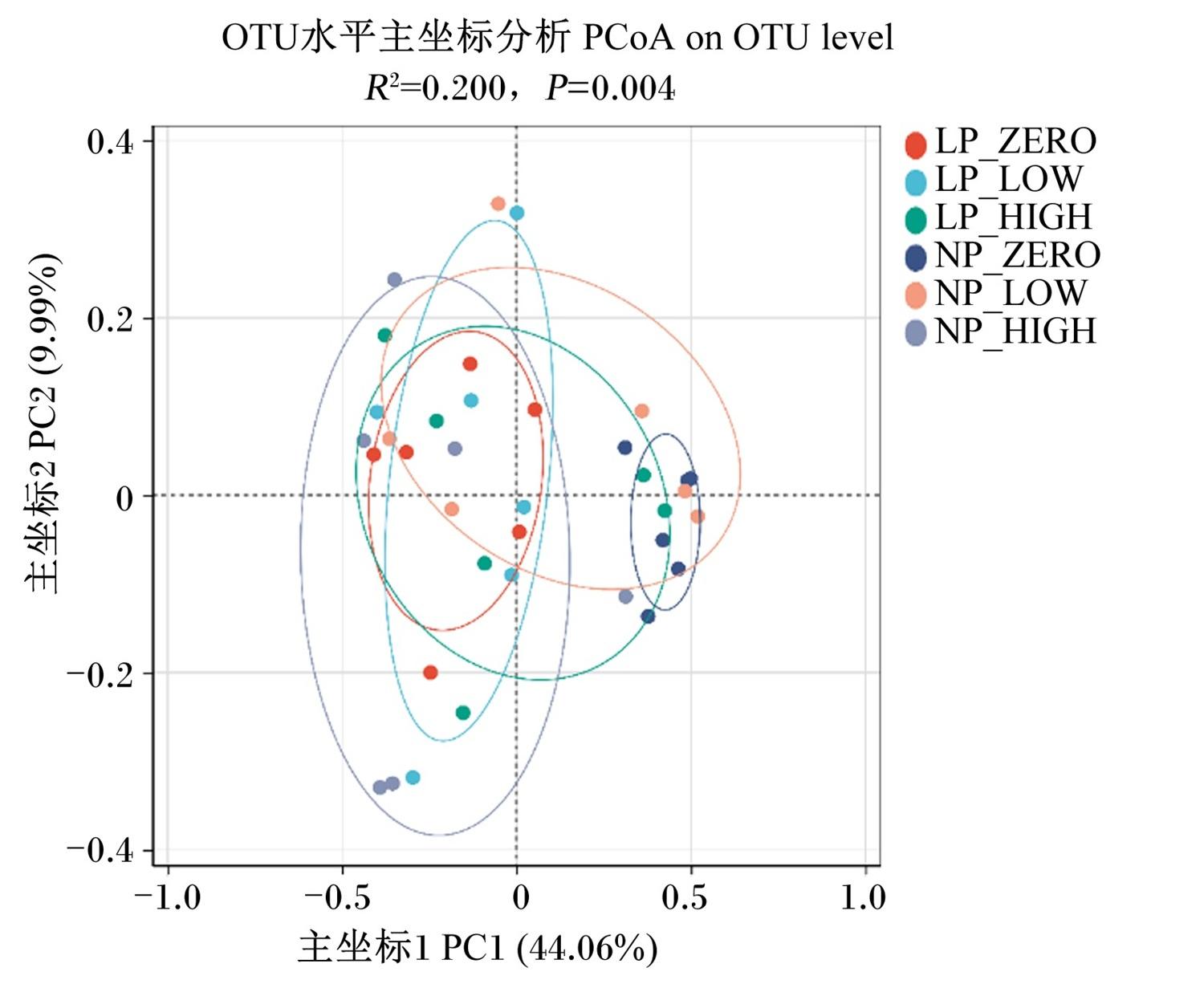
基于OTU水平的主坐标分析(PCoA)结果如图1所示,主坐标1(PC1)与主坐标2(PC2)分别解释了微生物群落总变异的44.06%和9.99%。PERMANOVA检验表明,不同组间盲肠微生物群落结构存在极显著差异(R2=0.200,P=0.004)。
图1 基于Bray-Curtis距离的主坐标分析

LP_ZERO、LP_LOW、LP_HIGH分别表示LP饲粮+0、1、2 g/kg酸性蛋白酶组,NP_ZERO、NP_LOW、NP_HIGH分别表示NP饲粮+0、1、2 g/kg酸性蛋白酶组。下图同。

Fig.1 PCoA based on Bray-Curtis distance

LP_ZERO, LP_LOW and LP_HIGH represented groups fed LP diets supplemented with 0, 1 and 2 g/kg acid protease, respectively; NP_ZERO, NP_LOW and NP_HIGH represented groups fed NP diets supplemented with 0, 1 and 2 g/kg acid protease, respectively. The same as below.

2.7.2 盲肠微生物组成及差异分析

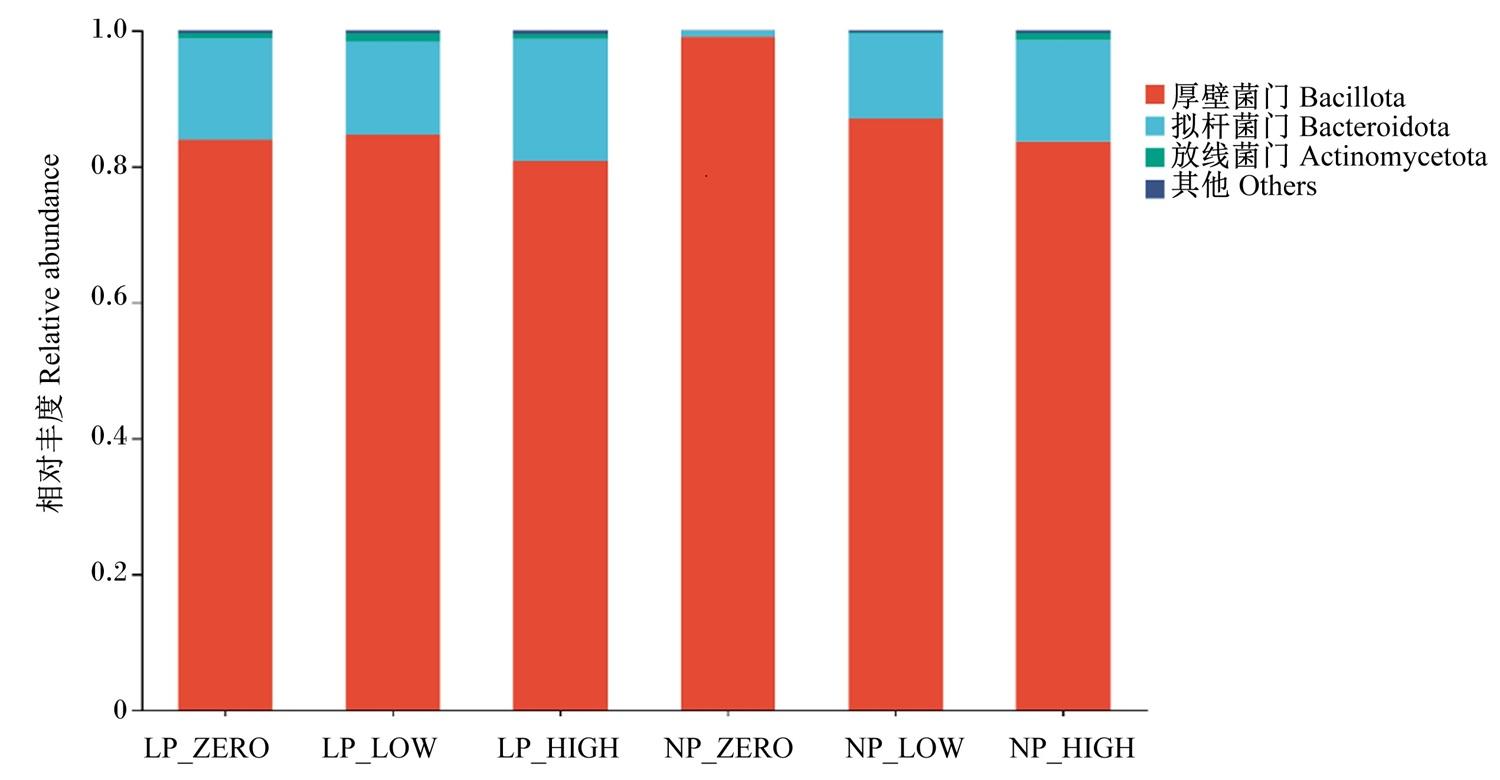
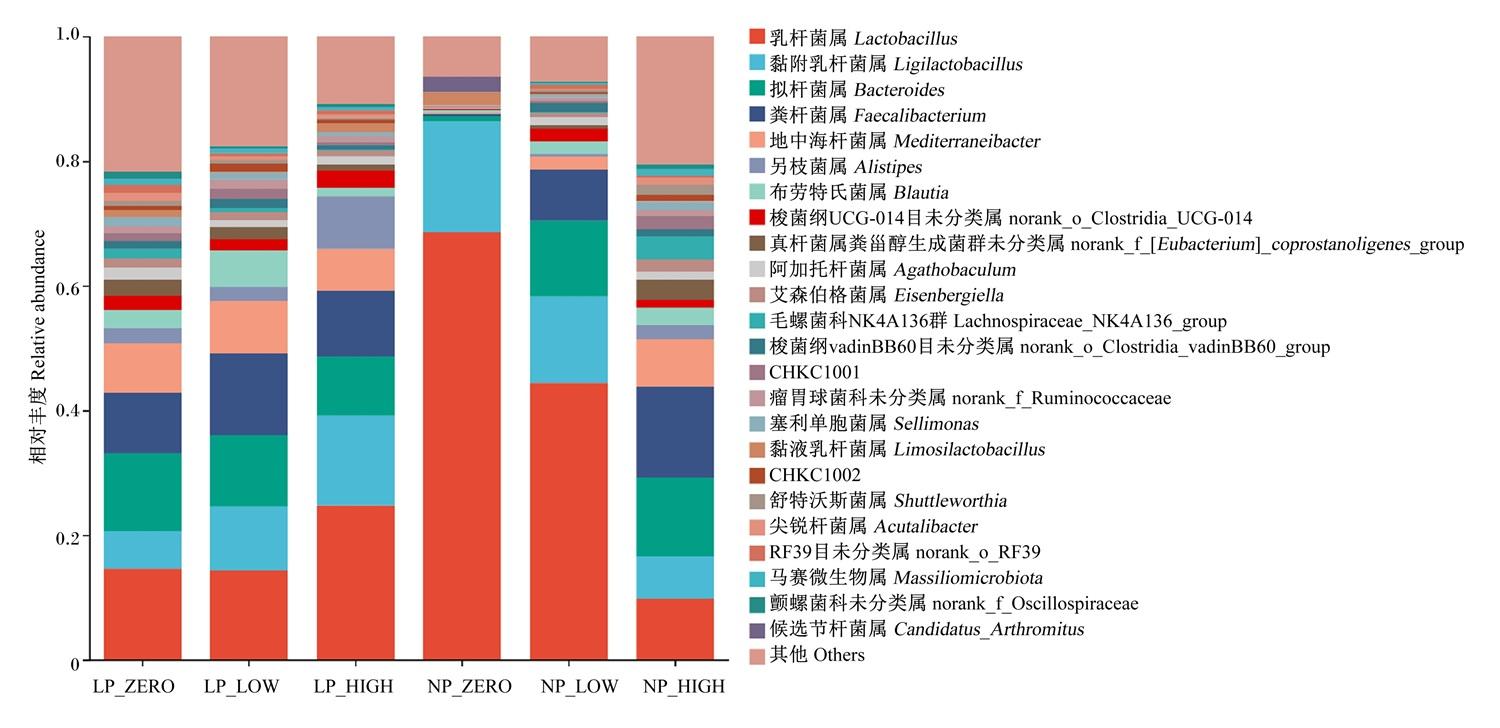
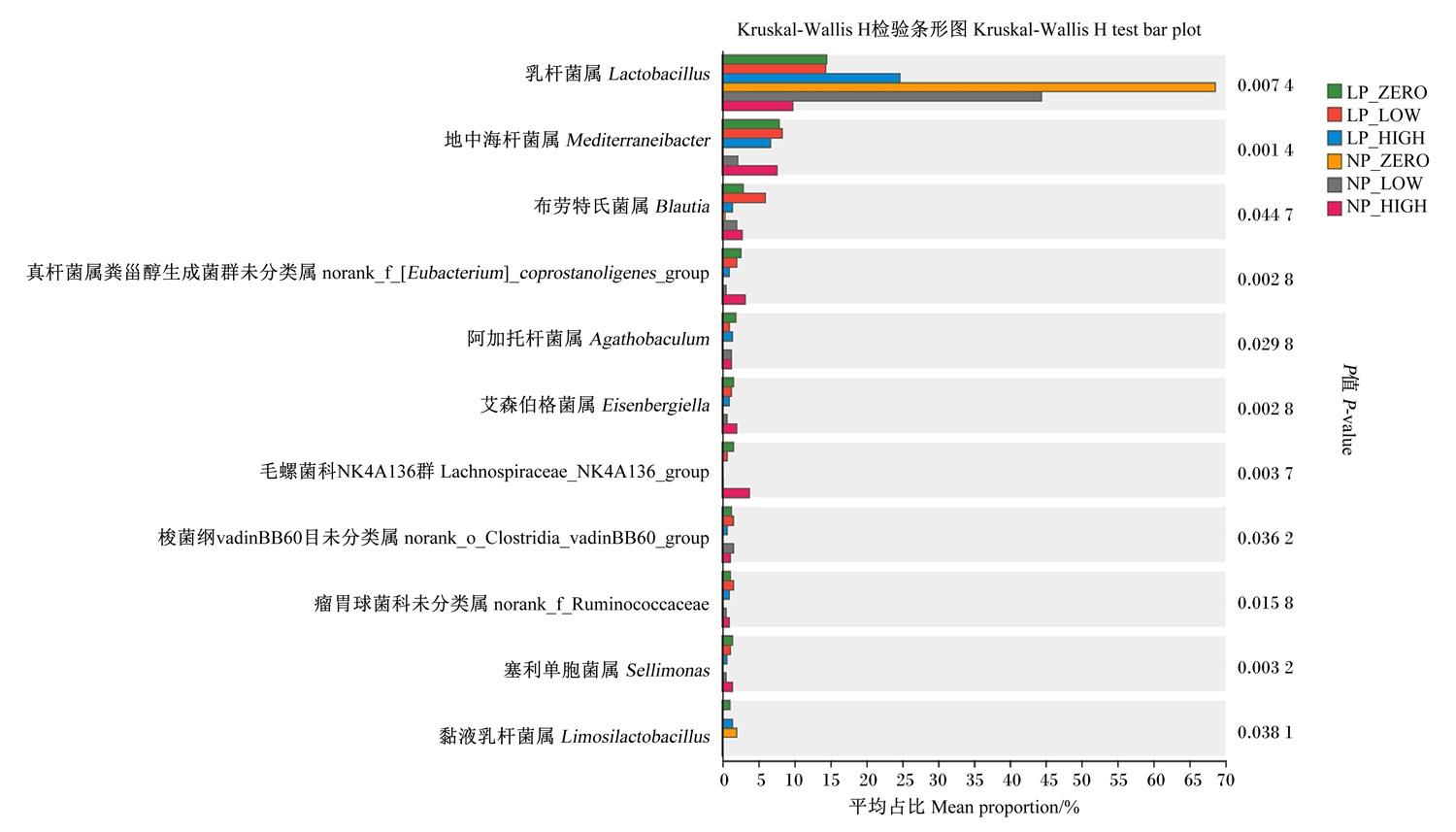
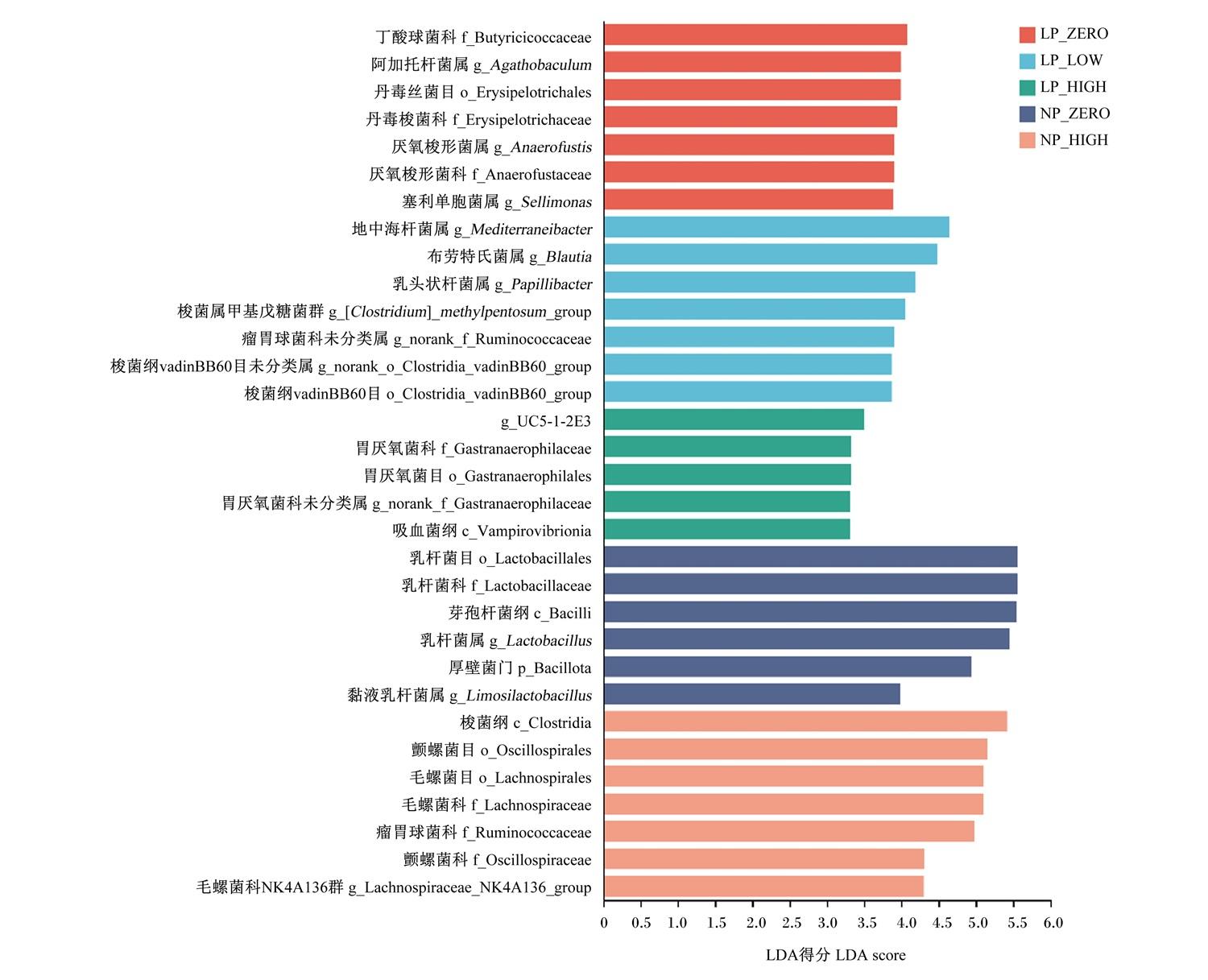
图2可知,在门水平上,肉鸡盲肠微生物的优势菌门为厚壁菌门(Bacillota,曾用名Firmicutes)和拟杆菌门(Bacteroidota),二者相对丰度合计占群落总量的90%以上。由图3可知,在属水平上,肉鸡盲肠微生物主要优势菌属包括乳杆菌属(Lactobacillus)、黏附乳杆菌属(Ligilactobacillus)、拟杆菌属(Bacteroides)、粪杆菌属(Faecalibacterium)和地中海杆菌属(Mediterraneibacter)等。Kruskal-Wallis H检验结果(图4)显示,乳杆菌属、毛螺菌科NK4A136群(Lachnospiraceae_NK4A136_group)等多个菌属的相对丰度在组间存在显著或极显著差异(P<0.05或P<0.01)。LEfSe分析结果(图5)进一步揭示了不同组别间特异性富集的标志性微生物,其中NP饲粮组特异性富集以乳杆菌属为核心的乳杆菌目(Lactobacillales)相关菌群;LP饲粮组则共同富集了以布劳特氏菌属(Blautia)、地中海杆菌属为代表的梭菌纲(Clostridia)相关菌群。在NP饲粮中添加2 g/kg酸性蛋白酶时,可特异性富集毛螺菌科(Lachnospiraceae)、瘤胃球菌科(Ruminococcaceae)等菌群。
图2 盲肠微生物门水平群落组成

Fig.2 Community composition of cecal microbiota at phylum level

图3 盲肠微生物属水平群落组成

Fig.3 Community composition of cecal microbiota at genus level

图4 盲肠微生物差异菌属分析

Fig.4 Analysis of differential bacterial genera of caecal microbiota

图5 盲肠微生物LEfSe分析

Fig.5 LEfSe analysis of cecal microbiota

3 讨论

3.1 不同CP水平饲粮中添加新型酸性蛋白酶对肉鸡生长性能和屠宰性能的影响

有研究表明,肉鸡饲粮CP水平降低1~2个百分点对ADFI、ADG和F/G无显著影响[10],但若降幅超过2个百分点,则会对肉鸡生长产生负面影响[11]。另有研究表明,在CP水平降幅2个百分点的低蛋白质饲粮中添加500 mg/kg毕赤酵母蛋白酶,可显著提升肉鸡生长性能、提高EPEF,具有节约蛋白质饲料资源的作用[12]
本试验中,在试验前期,饲喂低蛋白质饲粮极显著提高了ADG和ADFI,显著提高了F/G;在试验后期,饲喂低蛋白质饲粮极显著降低了ADG,极显著提高了F/G,且饲粮添加1和2 g/kg酸性蛋白酶极显著降低了F/G。其中,添加酸性蛋白酶改善肉鸡饲料效率的结果与前人研究一致,但低蛋白质饲粮对前期生长的促进作用与前人报道不同,这种差异可能源于本试验中低蛋白质饲粮的晶体氨基酸添加量较高,促进了前期雏鸡的采食,并提高了氮代谢效率;但随着肉鸡日龄增加,机体蛋白质沉积需求持续升高,饲粮蛋白质摄入量不足逐渐成为生长限制因素,最终造成后期生长性能下降。
屠宰性能是衡量畜禽产肉性能的主要指标,其中胸肌率与腹脂率关乎商品肉鸡的市场价值与养殖效益[2]。研究表明,饲粮CP水平改变会影响肉鸡的屠宰性能[11,13],降低饲粮CP水平会显著降低肉鸡的胸肌率[14]和显著提高腹脂率[15]。本试验中,饲喂低蛋白质饲粮显著降低了胸肌率,极显著提高了腹脂率,与前人研究结果相符。这可能是由于低蛋白质饲粮通常在保持代谢能一致的情况下降低CP水平,蛋白质比例下降使得能量占比相对提高,造成能量摄入过剩,进而促进脂肪沉积[2],最终表现为腹脂率升高、肌肉沉积受限。有研究表明,饲粮中添加蛋白酶可显著提高肉鸡胸肌率,但对其余屠宰性能指标无显著影响[12];同时在低蛋白质饲粮中添加蛋白酶能促进肉鸡对于蛋白质的吸收和促进脂肪沉积[14]。本试验结果表明,饲粮中添加1 g/kg酸性蛋白酶显著提高了肉鸡胸肌率,与上述研究相符,说明酸性蛋白酶能够改善蛋白质消化吸收效率,促进肌肉蛋白质沉积。

3.2 不同CP水平饲粮中添加新型酸性蛋白酶对肉鸡血清指标的影响

血清生化和抗氧化指标是反映动物机体健康状态、代谢强度及抗氧化能力的重要依据[16]。动物机体自身具备一定的抗氧化防御体系,但抗氧化能力存在耐受阈值,当机体遭受氧化应激且超出自身调节范围时,会引发生理损伤,进而影响肉鸡生长性能并造成养殖经济损失[17]。研究表明,饲粮CP水平会影响肉鸡血清生化指标,高蛋白质饲粮可提升肉鸡血清UA含量[18],但对血清TP、ALB含量及AST活性无显著影响[19];同时,在正常蛋白质或低蛋白质饲粮中添加蛋白酶,可显著降低肉鸡血清UA和UREA含量,改善机体蛋白质代谢[20-21]。而本试验中,饲喂低蛋白质饲粮极显著提高了血清TG和TC含量,显著降低了血清AST活性,其原因可能在于保持代谢能一致的前提下降低饲粮CP水平,使饲粮能量占比相应提高,从而增加了肉鸡的能量摄入,最终表现为血脂水平升高;AST活性降低则提示低蛋白质摄入可能减轻了肝脏蛋白质代谢负担。此外,本试验中饲粮添加酸性蛋白酶对血清UA和UREA含量无显著影响,与前人研究结果[20-21]存在差异,原因可能在于酸性蛋白酶的作用模式与前人研究中的碱性蛋白酶不同,对机体氮代谢的整体调控效应存在差异。在抗氧化指标方面,多数研究表明,饲粮中添加蛋白酶可显著提升肉鸡血清超氧化物歧化酶(SOD)、GSH-Px活性和T-AOC,降低MDA含量,增强机体抗氧化能力[22-24]。本试验中,饲粮中添加2 g/kg酸性蛋白酶显著提高了血清T-AOC,与上述研究相符。

3.3 不同CP水平饲粮中添加新型酸性蛋白酶对肉鸡肠道消化酶活性的影响

畜禽肠道消化酶活性是反映机体肠道消化功能、营养吸收能力的重要指标,对机体健康与生产性能具有重要影响。饲粮营养物质需经肠道各类消化酶分解为小分子物质后,才能被机体吸收利用。蛋白酶可将饲粮蛋白质分解为小分子肽和氨基酸,促进机体吸收,从而增强动物体质[25]。研究发现,饲粮中添加蛋白酶能显著提高肉鸭空肠胰蛋白酶[26]、淀粉酶和脂肪酶活性[27]。外源酶制剂的添加可弥补动物内源消化酶分泌的不足,进而提高肉鸡对营养物质的消化率,其作用机制可能与酶制剂降低饲粮中抗营养因子(如抗原蛋白)的负面影响有关。同时,作为饲料添加剂,蛋白酶也能增强蛋白质的水解与溶解度,从而辅助内源蛋白酶发挥消化功能[28]。本试验结果表明,与未添加酸性蛋白酶相比,添加1和2 g/kg酸性蛋白酶极显著提高十二指肠糜蛋白酶活性,同时添加2 g/kg酸性蛋白酶显著提高空肠胰蛋白酶活性,证实饲粮中添加酸性蛋白酶对肉鸡肠道消化功能具有一定改善作用。

3.4 不同CP水平饲粮中添加新型酸性蛋白酶对肉鸡养分表观代谢率和肠道形态的影响

在畜禽养殖中,饲粮养分通常无法被动物完全消化吸收。肠道作为营养物质消化吸收的主要场所,其健康状态直接影响饲料利用效率。因此,生产中常结合养分表观消化率与肠道形态指标,综合评判饲料消化效果及肠道健康状况[29]。研究表明,降低饲粮CP水平可显著提高肉鸡的干物质和粗蛋白质表观代谢率[30];此外,饲粮中添加蛋白酶可显著提高肉仔鸡对粗蛋白质、干物质、能量和氨基酸的消化率[31]。本试验结果表明,饲喂低蛋白质饲粮可显著提高干物质表观代谢率;且饲粮中添加酸性蛋白酶可提高干物质、粗蛋白质和总能表观代谢率,与上述研究结果相符。肠道形态与机体的消化吸收功能密切相关,肠道绒毛高度增加及表面积扩大可增大与食糜接触范围,增强肠道对营养物质的吸收能力[32]。一般认为,肠道绒毛高度及绒隐比越高,其吸收利用营养物质的能力越强。唐建伟等[33]研究表明,当饲粮CP水平降低2个百分点时,肉鸡空肠绒毛高度和绒隐比分别显著降低7.26%和6.10%;Laudadio等[34]研究表明,将饲粮CP水平从22.5%降至20.5%,肉鸡肠道空肠绒毛高度和绒隐比有所提高,但未达显著水平。这说明饲粮CP水平会影响肉鸡肠道绒毛形态。在蛋白酶添加方面,研究显示添加蛋白酶可使空肠绒毛长度提高3.5%,隐窝深度降低3.0%,绒隐比提升6.3%[35]。本试验结果与上述研究一致,饲喂低蛋白质饲粮显著降低了空肠和回肠绒毛高度,而饲粮中添加2 g/kg酸性蛋白酶则显著提高了回肠绒毛高度;无论在正常蛋白质还是低蛋白质饲粮条件下,添加2 g/kg酸性蛋白酶均提高了回肠绒隐比。肠道形态的改善,很可能是养分消化率提升和后期生长性能优化的结构基础。酸性蛋白酶可能通过增强蛋白质水解、减轻肠道负担、促进绒毛发育,从而与饲粮CP水平协同,共同调控养分的消化吸收效率,进而有效改善饲料转化效率,提升养殖生产经济效益。

3.5 不同CP水平饲粮中添加新型酸性蛋白酶对肉鸡肠道微生物的影响

动物肠道微生物稳态与机体健康水平和消化吸收能力密切相关,其中肠道微生物的α多样性可有效反映微生物群落的物种多样性与丰富度[36]。一般认为,较高的微生物多样性常与更稳定的群落结构和更健康的肠道功能相关[37-38]。饲粮CP水平是影响肠道菌群组成的关键因素之一。高蛋白质饲粮可能导致肠道内蛋白质代谢产物积累,进而引起菌群结构改变,丰富度与多样性下降。研究表明,降低饲粮CP水平有助于提高肉鸡盲肠微生物的多样性与丰度[39],而提高饲粮CP水平则可能降低仔猪肠道菌群的多样性[40]。本试验结果与上述结论相符,整体来看饲喂低蛋白质饲粮可改善肉鸡盲肠微生物α多样性,说明适度降低饲粮CP水平有利于塑造更为丰富和均衡的肠道菌群。
在门水平上,各组肉鸡盲肠微生物均以厚壁菌门和拟杆菌门为绝对优势菌群,二者相对丰度合计超过90%,这与多数禽类肠道微生物研究结果[41-42]一致。有研究指出,拟杆菌门作为重要的多糖降解菌,其相对丰度与宿主能量代谢效率呈正相关,与血清TG含量呈负相关[43],提示该菌群在促进能量利用与脂质代谢调节中可能发挥积极作用。通过LEfSe分析,本研究进一步筛选出了各组特征标志性菌群,其中,正常蛋白质饲粮未添加酸性蛋白酶组中乳杆菌属及其相关菌群显著富集,这可能是由于乳杆菌的生长繁殖以氨基酸、小分子肽为主要氮源[26],该组饲粮蛋白质充足,使得更多的蛋白质在小肠被分解,从而为后肠乳杆菌生长提供了有利条件。相比之下,低蛋白质饲粮未添加酸性蛋白酶组则富集了以布劳特氏菌属和地中海杆菌属为代表的梭菌纲相关菌群。布劳特氏菌是重要的短链脂肪酸(SCFAs)产生菌,有助于维持肠道健康与屏障功能[44],该结果表明,低蛋白质饲粮可能促使后肠发酵模式由蛋白质/氨基酸发酵为主转向碳水化合物发酵为主,从而促进产SCFAs菌群的增殖。值得注意的是,在正常蛋白质饲粮中添加2 g/kg酸性蛋白酶后,毛螺菌科、瘤胃球菌科菌群出现特异性富集,这2类菌群均属于厚壁菌门关键纤维降解菌群,可分解肠道复杂多糖,合成丁酸等有益SCFAs[45],这表明,酸性蛋白酶可能通过提高蛋白质在前肠的消化率,减少未消化蛋白流入后肠,间接增加可供纤维降解菌利用的底物,从而优化菌群结构与代谢功能。

4 结论

① 饲粮CP水平降低2个百分点可促进肉鸡前期(1~21日龄)采食与增重,但会导致后期(22~42日龄)生长性能下降,同时造成胸肌率降低与腹脂率升高;
② 饲粮添加2 g/kg新型酸性蛋白酶可特异性富集毛螺菌科和瘤胃球菌科等有益菌群,并且通过提高消化酶活性、改善养分表观代谢率及肠道形态,有效缓解低蛋白质饲粮引起的后期生长抑制,并改善饲料效率。
[1]
秧石航, 吴康乐, 张重阳, 等. 低蛋白质饲粮添加蛋白酶和氨基酸对蛋鸡生产性能、养分表观代谢率、免疫功能和肠道健康的影响[J]. 动物营养学报, 2025, 37(10):6729-6743.

YANG S H, WU K L, ZHANG C Y, et al. Effects of low-protein diet supplemented with protease and amino acids on performance,nutrient apparent metabolic rates,immune function and intestinal health of laying hens[J]. Chinese Journal of Animal Nutrition, 2025, 37(10):6729-6743. (in Chinese)

[2]
袁建敏, 尹达菲, 于耀, 等. 低蛋白饲粮对肉鸡生长性能、胴体品质和肠道健康影响的研究进展[J]. 饲料工业, 2025, 46(16):1-7.

YUAN J M, YIN D F, YU Y, et al. Progress of low-protein diet on growth performance,carcass quality and intestinal health of broilers[J]. Feed Industry, 2025, 46(16):1-7. (in Chinese)

[3]
刘干, 姜宁, 张爱忠. 蛋白酶的生物学意义及在肉鸡日粮中的应用研究进展[J]. 饲料博览, 2018(11):11-12,16.

LIU G, JIANG N, ZHANG A Z. Application and research progress of protease in broiler diet[J]. Feed Review, 2018(11):11-12,16. (in Chinese)

[4]
宋岳峰. 低蛋白日粮在禽类养殖中的应用与展望[J]. 家禽科学, 2025, 47(6):6-9.

SONG Y F. Application and prospect of low-protein diet in poultry breeding[J]. China Poultry Science, 2025, 47(6):6-9. (in Chinese)

[5]
邱凯, 张广民, 郑爱娟, 等. 低蛋白日粮添加新型毕赤酵母蛋白酶对肉鸡生长性能、胴体性状、机体免疫和氨基酸表观回肠消化率的影响[J]. 中国饲料, 2023(22):171-177.

QIU K, ZHANG G M, ZHENG A J, et al. Effects of the addition of novel Pichia protease to low-protein diets on growth performance,carcass traits,immunity and apparent ileal digestibility of amino acids in broilers[J]. China Feed, 2023(22):171-177. (in Chinese)

[6]
SONG X R, ANAS M A, KURNIAWATI A, et al. Effects of reduced-protein diets with protease supplementation on growth,carcass yield,intestinal morphology,organ development,nutrient digestibility,and blood biochemical of broiler chickens[J]. Translational Animal Science, 2023, 7(1):txad098.

[7]
李洪滨. 不同蛋白水平饲粮中添加不同剂量酸性蛋白酶和木聚糖复合酶对肉鸡的应用效果研究[D]. 硕士学位论文. 沈阳: 沈阳农业大学, 2023.

LI H B. Study on the effect of adding different dosages of acidprotease and xylanan complex enzyme in differentprotein levels diets on broilers[D]. Master’s Thesis. Shenyang: Shenyang Agricultural University, 2023. (in Chinese)

[8]
陈丹蝶, 王敏, 刘舸, 等. 耐高温酸性蛋白酶对豆粕抗原蛋白的降解作用及其对黄羽肉鸡生长性能和养分表观代谢率的影响[J]. 动物营养学报, 2025, 37(9):5911-5922.

CHEN D D, WANG M, LIU G, et al. Degradation effects of thermostable acid protease on soybean meal antigen protein and its effects on growth performance and apparent nutrient metabolic rates of yellow feathered chickens[J]. Chinese Journal of Animal Nutrition, 2025, 37(9):5911-5922. (in Chinese)

[9]
苏湘潭, 王科, 卢欣宇, 等. 胶红酵母培养物和枯草芽孢杆菌对黄羽肉鸡腹泻率、养分表观代谢率及粪便氨气散发量的影响[J]. 饲料研究, 2025, 48(21):49-53.

SU X T, WANG K, LU X Y, et al. Effects of Rhodotorula mucilaginosa culture and Bacillus subtilis on diarrhea rate,nutrient apparent metabolic rate,and fecal ammonia emission in yellow-feathered broilers[J]. Feed Research, 2025, 48(21):49-53. (in Chinese)

[10]
DE CESARE A, FARIA DO VALLE Ì, SALA C, et al. Effect of a low protein diet on chicken ceca microbiome and productive performances[J]. Poultry Science, 2019, 98(9):3963-3976.

[11]
LEMME A, HILLER P, KLAHSEN M, et al. Reduction of dietary protein in broiler diets not only reduces N-emissions but is also accompanied by several further benefits[J]. Journal of Applied Poultry Research, 2019, 28(4):867-880.

[12]
张静静, 郑旭, 李玥, 等. 蛋白酶对肉仔鸡生长性能、养分消化率及消化酶活性的影响[J]. 中国畜牧杂志, 2022, 58(2):167-172.

ZHANG J J, ZHENG X, LI Y, et al. Effects of protease supplementation on growth,nutrient digestibility and digestive enzymes of broilers[J]. Chinese Journal of Animal Science, 2022, 58(2):167-172. (in Chinese)

[13]
HILLIAR M, HARGREAVE G, GIRISH C K, et al. Using crystalline amino acids to supplement broiler chicken requirements in reduced protein diets[J]. Poultry Science, 2020, 99(3):1551-1563.

[14]
陈思淼, 闫晓刚, 燕磊, 等. 肉鸡低蛋白质饲粮添加外源蛋白酶对净能效率的影响[J]. 动物营养学报, 2025, 37(2):961-972.

CHEN S M, YAN X G, YAN L, et al. Effects of low-protein diet supplemented with exogenous protease on net energy efficiency of broilers[J]. Chinese Journal of Animal Nutrition, 2025, 37(2):961-972. (in Chinese)

[15]
ALLAMEH S, TOGHYANI M. Effect of dietary valine supplementation to low protein diets on performance,intestinal morphology and immune responses in broiler chickens[J]. Livestock Science, 2019, 229:137-144.

[16]
AMER S A, NASER M A F, ABDEL-WARETH A A A, et al. Effect of dietary supplementation of alpha-galactosidase on the growth performance,ileal digestibility,intestinal morphology,and biochemical parameters in broiler chickens[J]. BMC Veterinary Research, 2020, 16(1):144.

[17]
NCHO C M, GUPTA V, CHOI Y H. Effects of dietary glutamine supplementation on heat-induced oxidative stress in broiler chickens:a systematic review and Meta-analysis[J]. Antioxidants, 2023, 12(3):570.

[18]
史景松. 肉鸡能量和蛋白质需要量的研究[D]. 硕士学位论文. 杨凌: 西北农林科技大学, 2009.

SHI J S. Studies on the requirements of energy and protein in broilers[D]. Master’s Thesis. Yangling: Northwest A&F University, 2009. (in Chinese)

[19]
刘少凯, 闵育娜, 牛竹叶, 等. 日粮蛋白水平对13-18周龄略阳乌鸡生长性能、屠体性能和血清生化指标的影响[J]. 畜牧与兽医, 2014, 46(11):24-28.

LIU S K, MIN Y N, NIU Z Y, et al. Effects of dietary crude protein on growth performance,carcass characteristics and serum biochemical indexes in Lueyang black-boned chickens from thirteen to eighteen weeks of age[J]. Animal Husbandry & Veterinary Medicine, 2014, 46(11):24-28. (in Chinese)

[20]
吕毅, 李茜茜, 王鑫鑫, 等. 日粮添加蛋白酶对肉仔鸡生产性能、氮代谢及粪便氨气释放的影响[J]. 中国畜牧杂志, 2022, 58(3):123-127,132.

LV Y, LI X X, WANG X X, et al. Effects of dietary protease supplementation on performance,nitrogen metabolism and fecal ammonia release of broilers[J]. Chinese Journal of Animal Science, 2022, 58(3):123-127,132. (in Chinese)

[21]
张运锋, 李丹蕾, 占秀安. 新型饲用蛋白酶对肉鸡生产性能和消化功能的影响[J]. 中国畜牧杂志, 2022, 58(11):212-218.

ZHANG Y F, LI D L, ZHAN X A. Effects of a new protease supplementation on performance and digestive function in broilers[J]. Chinese Journal of Animal Science, 2022, 58(11):212-218. (in Chinese)

[22]
王琤韡, 瞿明仁, 蒋显仁, 等. PT125TM蛋白酶对宁都三黄鸡的影响[J]. 饲料与畜牧, 2011(6):9-16.

WANG C W, QU M R, JIANG X R, et al. Effect of PT125TM protease on Ningdu Sanhuang chickens[J]. Feed and Animal Husbandry, 2011(6):9-16. (in Chinese)

[23]
侯振平, 蒋桂韬, 吴端钦, 等. 蛋白酶对1-21日龄肉仔鸡生长性能、血清生化指标及抗氧化功能的影响[J]. 饲料工业, 2017, 38(14):17-20.

HOU Z P, JIANG G T, WU D Q, et al. Effects of protease on growth performance,serum biochemical index and antioxidant function of 1-21 d broilers[J]. Feed Industry, 2017, 38(14):17-20. (in Chinese)

[24]
周梁. 外源蛋白酶(ProAct)对肉鸡生产性能及氨基酸消化率影响的研究[D]. 硕士学位论文. 北京: 中国农业科学院, 2014.

ZHOU L. The study of a exogenous protease (ProAct) on performance and amino acids digestibility in broiler chicken[D]. Master’s Thesis. Beijing: Chinese Academy of Agricultural Sciences, 2014. (in Chinese)

[25]
FURLANI N R, DA MOTTA S A B, RAMOS B T, et al. Protease enzyme supplementation in weaning piglets fed reduced crude protein diets:effects on gut health integrity and performance response[J]. Animals, 2025, 15(14):2109.

[26]
JIANG J J, WU H, ZHU D, et al. Dietary supplementation with phytase and protease improves growth performance,serum metabolism status,and intestinal digestive enzyme activities in meat ducks[J]. Animals, 2020, 10(2):268.

[27]
闵激扬. 枯草芽孢杆菌与复合蛋白酶对肉鸡生产性能和肠道消化吸收能力的影响[D]. 硕士学位论文. 杨凌: 西北农林科技大学, 2024.

MIN J Y. The effects of Bacillus subtilis and compound protease on the production performance and intestinal digestive absorption capacity of broilers[D]. Master’s Thesis. Yangling: Northwest A&F University, 2024. (in Chinese)

[28]
FRU-NJI F, KLUENTER A M, FISCHER M, et al. A feed serine protease improves broiler performance and increases protein and energy digestibility[J]. The Journal of Poultry Science, 2011, 48(4):239-246.

[29]
陈中平. 饲粮添加酵母水解物对母猪泌乳性能的影响研究[D]. 博士学位论文. 兰州: 甘肃农业大学, 2025.

CHEN Z P. Effects of dietary hydrolyzed yeast supplementation on lactation performance in sows[D]. Ph.D.Thesis. Lanzhou: Gansu Agricultural University, 2025. (in Chinese)

[30]
马罗莹, 王金宇, 陈群, 等. 低蛋白氨基酸平衡日粮对肉仔鸡生长性能及血清生化指标的影响[J]. 饲料研究, 2022, 45(20):23-26.

MA L Y, WANG J Y, CHEN Q, et al. Effect of low-protein diet supplemented with amino acids on growth performance and serum biochemical parameters of broilers[J]. Feed Research, 2022, 45(20):23-26. (in Chinese)

[31]
ANGEL C R, SAYLOR W, VIEIRA S L, et al. Effects of a monocomponent protease on performance and protein utilization in 7- to 22-day-old broiler chickens[J]. Poultry Science, 2011, 90(10):2281-2286.

[32]
ALIAKBARPOUR H R, CHAMANI M, RAHIMI G, et al. The Bacillus subtilis and lactic acid bacteria probiotics influences intestinal mucin gene expression,histomorphology and growth performance in broilers[J]. Asian-Australasian Journal of Animal Sciences, 2012, 25(9):1285-1293.

[33]
唐建伟, 胡琳华. 不同蛋白质日粮补充蛋白酶对热应激肉鸡生长性能、肠绒毛形态及胴体性状的影响[J]. 中国饲料, 2021(14):13-16.

TANG J W, HU L H. Effects of different protein diets addition of protease on growth performance,intestinal villus morphology and carcass traits of broilers under heat stress[J]. China Feed, 2021(14):13-16. (in Chinese)

[34]
LAUDADIO V, PASSANTINO L, PERILLO A, et al. Productive performance and histological features of intestinal mucosa of broiler chickens fed different dietary protein levels[J]. Poultry Science, 2012, 91(1):265-270.

[35]
AMERAH A M, ROMERO L F, AWATI A, et al. Effect of exogenous xylanase,amylase,and protease as single or combined activities on nutrient digestibility and growth performance of broilers fed corn/soy diets[J]. Poultry Science, 2017, 96(4):807-816.

[36]
WAGNER B D, GRUNWALD G K, ZERBE G O, et al. On the use of diversity measures in longitudinal sequencing studies of microbial communities[J]. Frontiers in Microbiology, 2018, 9:1037.

[37]
LI C L, WANG J, ZHANG H J, et al. Intestinal morphologic and microbiota responses to dietary Bacillus spp. in a broiler chicken model[J]. Frontiers in Physiology, 2019, 9:1968.

[38]
ZHAO S G, ZHONG H Y, HE Y, et al. Leveraging core enzyme structures for microbiota targeted functional regulation:urease as an example[J]. iMeta, 2025, 4(3):e70032.

[39]
NIU J L, QIAO Y Y, YANG X P, et al. Protease and Bacillus coagulans supplementation in a low-protein diet improves broiler growth,promotes amino acid transport gene activity,strengthens intestinal barriers,and alters the cecal microbial composition[J]. Animals, 2025, 15(2):170.

[40]
JIN J P, ZHANG L P, JIA J L, et al. Effects of maternal low-protein diet on microbiota structure and function in the jejunum of Huzhu Bamei suckling piglets[J]. Animals, 2019, 9(10):713.

[41]
BAO C L, ZHANG W X, WANG J, et al. The effects of dietary Bacillus amyloliquefaciens TL106 supplementation,as an alternative to antibiotics,on growth performance,intestinal immunity,epithelial barrier integrity,and intestinal microbiota in broilers[J]. Animals, 2022, 12(22):3085.

[42]
WASTI S, SAH N, SINGH A K, et al. Dietary supplementation of dried plum:a novel strategy to mitigate heat stress in broiler chickens[J]. Journal of Animal Science and Biotechnology, 2021, 12(1):58.

[43]
WANG Q, SHEN Y T, LI W T, et al. Effects of dietary metabolizable energy and crude protein levels on production performance,serum biochemical indices and cecal microbiota of Taihe silky fowl during the brooding period[J]. Poultry Science, 2025, 104(12):105953.

[44]
NEIJAT M, HABTEWOLD J, SHIRLEY R B, et al. Bacillus subtilis strain DSM 29784 modulates the cecal microbiome,concentration of short-chain fatty acids,and apparent retention of dietary components in shaver white chickens during grower,developer,and laying phases[J]. Applied and Environmental Microbiology, 2019, 85(14):e00402-19.

[45]
VITAL M, KARCH A, PIEPER D H. Colonic butyrate-producing communities in humans:an overview using omics data[J]. mSystems, 2017, 2(6):e00130-17.

Outlines

/