RESEARCH PAPER

Study on Application Effects of Combined Taurine and Propylene Glycol in Dairy Cows with Subclinical Ketosis

  • TIAN Feng , 1 ,
  • SHAO Guang 2 ,
  • YU Keya 3 ,
  • JIA Xiaochen 4 ,
  • ZHANG Sixue 5 ,
  • MA Guangchang 6 ,
  • HAN Shengyu 7 ,
  • RU Caixia 8 ,
  • WANG Hongyu 9 ,
  • BAI Yunlong , 1, * ,
  • XIA Cheng , 1, * ,
  • XU Chuang 10
Expand
  • 1 Key Laboratory of Cattle Disease Prevention and Control in Northeast Cold Region, College of Animal Science and Technology, Heilongjiang Bayi Agricultural University, Daqing 163319, China
  • 2 Branch of Animal Husbandry and Veterinary Medicine, Heilongjiang Academy of Agricultural Sciences, Qiqihar 161005, China
  • 3 Agricultural Development Department, North Great Wilderness Group Heilongjiang 8510 Farm Co., Ltd., Jixi 158212, China
  • 4 Mudanjiang Agricultural Reclamation General Dairy Cattle Breeding Professional Cooperative in Heilongjiang Province, Jixi 158307, China
  • 5 Daqing Agricultural and Rural Social Service Center, Daqing 163311, China
  • 6 Beidahuang Group Heilongjiang 8511 Farm Co., Ltd., Jixi 158307, China
  • 7 Mudanjiang Agricultural Reclamation Qianmu Dairy Cattle Farm in Heilongjiang Province, Jixi 158307, China
  • 8 Xi’an Caotan Animal Husbandry Co., Ltd., Xi’an 710018, China
  • 9 Department of Animal Science and Technology, Heilongjiang Vocational College of Agricultural Economy, Mudanjiang 157041, China
  • 10 College of Veterinary Medicine, China Agricultural University, Beijing 100094, China
*BAI Yunlong, lecturer, E-mail: ;
XIA Cheng, professor, E-mail:

Received date: 2025-12-11

  Online published: 2026-08-13

Abstract

This experiment was conducted to investigate the therapeutic effects of the combination of taurine (TAU) and propylene glycol (PG) on subclinical ketosis (SCK) in dairy cows. Forty-eight SCK dairy cows [7 days postpartum, serum β-hydroxybutyric acid (BHBA) concentration≥1.20 mmol/L] were randomly assigned to 4 groups with 12 cows per group. The detailed treatments were as follows: the PC group received no drug treatment; the TAU group was given 100 g of TAU by gavage daily from days 1 to 7; the PG group was given 500 mL of PG by gavage on days 1, 3, 5 and 7; and the TPG group received a combined treatment of TAU and PG, with the same administration regimens as described above. The experiment lasted for 14 days (7 days of treatment followed by 7 days of observation). The SCK cure rate, serum biochemical indicators (including energy metabolism, liver function and oxidative stress indicators), milk performance and reproductive performance were measured in each group. The results showed that during the experimental period, the average cure rate of SCK in the four groups ranked as TPG group>PG group>TAU group>PC group. The cure rate of SCK in the TPG group was extremely significantly higher than that in the PC group (P<0.01), and that in the PG group was significantly higher than that in the PC group (P<0.05), while there was no significant difference between the TAU group and the PC group (P>0.05). For serum energy metabolism indicators, treatment regimen had an extremely significant effect on the concentrations of BHBA, glucose (GLU) and non-esterified fatty acids (NEFA) (P<0.01), and the interaction between treatment regimen and sampling time had an extremely significant effect on GLU and NEFA concentrations (P<0.01). On day 14 after treatment, the TPG group showed the lowest serum BHBA and NEFA concentrations and the highest GLU concentration among all groups. For serum liver function indicators, treatment regimen had an extremely significant effect on aspartate aminotransferase (AST) activity, total bilirubin (TBIL) and total cholesterol (TC) contents (P<0.01), and the interaction between treatment regimen and sampling time had an extremely significant effect on TC content (P<0.01). On day 14 after treatment, the TPG group exhibited the lowest AST activity, TBIL and TC contents among all groups. For serum oxidative stress indicators, treatment regimen had an extremely significant effect on superoxide dismutase (SOD) activity, total antioxidant capacity (T-AOC), glutathione peroxidase (GSH-Px) activity and malondialdehyde (MDA) content (P<0.01), and the interaction between treatment regimen and sampling time had an extremely significant effect on SOD activity, T-AOC and GSH-Px activity (P<0.01). On day 14 after treatment, the TPG group showed the highest SOD and GSH-Px activities and the lowest MDA content among all groups; its T-AOC was slightly lower than that of the PG group but higher than those of the TAU group and PC group. Compared with the PC group, the somatic cell count in the TPG group and TAU group was extremely significantly decreased (P<0.01), and milk fat rate and milk protein rate in the PG group were significantly increased (P<0.05). Although no significant differences in reproductive performance indexes were observed between each treatment group and PC group (P>0.05), all treatment groups showed numerically better values than PC group. In conclusion, the combined application of TAU and PG can effectively improve the cure rate of SCK dairy cows, alleviate negative energy balance, liver function impairment and oxidative stress, enhance milk performance, and present a trend of improving reproductive performance.

Cite this article

TIAN Feng , SHAO Guang , YU Keya , JIA Xiaochen , ZHANG Sixue , MA Guangchang , HAN Shengyu , RU Caixia , WANG Hongyu , BAI Yunlong , XIA Cheng , XU Chuang . Study on Application Effects of Combined Taurine and Propylene Glycol in Dairy Cows with Subclinical Ketosis[J]. Chinese Journal of Animal Nutrition, 2026 , 38(8) : 5940 -5953 . DOI: 10.12418/CJAN2026.476

酮病(ketosis)是一种常见的群发性代谢性疾病。奶牛分娩后,由于干物质采食量(dry matter intake,DMI)下降而泌乳量增加,易发生能量负平衡(negative energy balance,NEB),进而诱发酮病[1-2]。该病以血清酮体浓度升高为特征,主要表现为血液中β-羟丁酸(β-hydroxybutyric acid,BHBA)浓度升高[3]。根据BHBA浓度,酮病可分为临床型酮病(clinical ketosis,CK)(BHBA浓度≥2.90 mmol/L,伴有临床症状)与亚临床型酮病(subclinical ketosis,SCK)(1.20 mmol/L≤BHBA浓度<2.90 mmol/L,无临床症状)[4]。一项涵盖六大洲38项研究的系统性回顾与荟萃分析显示,全球奶牛SCK的发病率为22.7%,其中日本为17.6%,哥伦比亚为46.2%,我国为15%~30%[5-6]。随着奶牛泌乳性能的逐年提升,SCK已成为规模化牧场最常见的代谢性疾病之一[7]。患SCK的奶牛易继发脂肪肝、乳房炎、子宫炎及前胃弛缓等一系列并发症,损害生产性能,并增加牧场淘汰率。Stengärde等[8]研究发现,每例SCK的治疗费用及产奶量下降造成的经济损失可达150~300美元,给牧场带来严重的经济负担,其危害不容忽视[9]
丙二醇(propylene glycol,PG)作为一种升糖前体,可为糖异生提供充足的底物,有效缓解奶牛的NEB状态[10-11]。然而,Zhang等[12]研究发现,PG摄入过量会对奶牛的肝脏和肾脏功能造成损害,并且在治疗SCK过程中,PG可能导致乳脂率下降;其本身及其代谢产物可能经乳汁排出,是否对人类健康构成威胁尚不明确[13]。文献报道,长期使用PG可能使奶牛产生耐受性,从而降低治疗效果[9]。尽管如此,PG价格低廉且疗效确切,因此经口服给药仍是牧场治疗SCK最常用的方法之一[9,14]
牛磺酸(taurine,TAU)作为一种功能性氨基酸,可增强机体抗氧化能力,具有降低氧化应激、抑制炎症反应及抗细胞凋亡等生物学功能[15-16],已被广泛用作饲料添加剂。Bai等[17]研究发现,TAU可显著逆转抗氧化酶活性的下降,并减少脂质过氧化产物丙二醛(malondialdehyde,MDA)的积累,从而保护细胞免受热应激损伤。Liu等[18]研究发现,TAU可调控嘌呤代谢、脂质代谢及相关代谢产物,减轻牛乳腺上皮细胞的热应激损伤。Cui等[19]报道,TAU可抑制线粒体功能障碍,逆转由微塑料(microplastics,MP)暴露所致的卵母细胞成熟及胚胎发育受阻表型。此外,TAU可通过调控半胱氨酸天冬氨酸蛋白酶-3(cysteinyl aspartate specific proteinase-3,Caspase-3)等信号通路,发挥抗氧化、抗炎及抗凋亡作用,成为抵御脂多糖(lipopolysaccharide,LPS)诱导的牛子宫内膜上皮细胞损伤的天然保护剂[20]
目前,TAU在SCK奶牛中的应用效果尚不明确。因此,本研究拟通过饲喂试验,明确TAU及其与PG联用对奶牛SCK的治疗效果,评估二者联用对奶牛肝脏功能、氧化应激及能量代谢的影响,以期为兽医临床治疗奶牛SCK提供新的思路与方法。

1 材料与方法

1.1 伦理声明

本研究在黑龙江省东部某规模化牧场开展,试验方案已通过黑龙江八一农垦大学动物伦理委员会批准(审批编号为DWKJXY2024017),试验过程严格遵循该动物伦理委员会的相关要求。

1.2 主要仪器与试剂耗材

本试验所用主要仪器如下:台式低速自动平衡离心机(TDZ-WS,湖南湘仪试验室仪器开发有限公司)、高速冷冻离心机[ST 40R,赛默飞世尔科技(中国)有限公司]、冷冻离心机(H1850-R,湖南湘仪试验室仪器开发有限公司)、电子天平[ME203E/02,梅特勒-托利多仪器(上海)有限公司)、全自动生化分析仪(WC400,深圳蓝韵生物医疗科技有限公司)、酶标仪[Multiskan FC,赛默飞世尔(上海)仪器有限公司]、医用低温保存箱(DW-86L338J,青岛海尔特种电器有限公司)、冷冻冰箱(BCD-235YH,青岛海尔股份有限公司)、奶牛血酮体测试仪(TNN-Ⅱ,北京怡成生物电子技术股份有限公司)、液相色谱仪[Ultimate 3000,赛默飞世尔(上海)仪器有限公司]、质谱仪[Q Exactive,赛默飞世尔(上海)仪器有限公司]、混匀仪(BE-96,海门市其林贝尔仪器制造有限公司)、真空浓缩仪[艾本德(德国)股份公司]。
本试验所用主要试剂与药品如下:葡萄糖(GLU)测定试剂盒、天门冬氨酸氨基转移酶(AST)试剂盒、总胆红素(TBIL)测定试剂盒、白蛋白(ALB)测定试剂盒、总胆固醇(TC)测定试剂盒及总蛋白(TP)测定试剂盒均购自深圳迈瑞生物医疗国际有限公司;游离脂肪酸(NEFA)测定试剂盒(G0927W96)、丙二醛(MDA)测定试剂盒(G0109W)、超氧化物歧化酶(SOD)测定试剂盒(G0101W48)、谷胱甘肽过氧化物酶(GSH-Px)测定试剂盒(G0204w)均购自苏州格锐思生物科技有限公司;总抗氧化能力(T-AOC)检测试剂盒(A015-3-1)购自南京建成生物工程研究所有限公司;奶牛酮体试纸条(TNN-Ⅱ)购自北京怡成生物电子技术有限公司;TAU(CAS:107-35-7)购自潜江永安药业股份有限公司;PG(CAS:26264-14-2)购自美国陶氏集团。

1.3 试验设计

选择年龄[(2.96±0.10)岁]、胎次[(1.60±0.09)胎]、体况评分[(2.84±0.02)分]、泌乳量[(26.83±0.25) kg/d]及产后天数[(6.62±0.27) d]相近且组间无显著差异(P>0.05)的荷斯坦奶牛为试验动物。试验奶牛的入选依据为:在产后第6天和第7天采血,经临床检查排除其他疾病,且血清中BHBA浓度≥1.20 mmol/L。在产后第7天选定48头SCK奶牛,并随机分为4组(每组12头),分别进行如下处理:1)PC组,无任何处理;2)TAU组,第1~7天每日灌服TAU 100 g;3)PG组,第1、3、5、7天每日灌服500 mL PG;4)TPG组,第1~7天每日灌服100 g TAU,并于第1、3、5、7天每日灌服500 mL PG。试验期为14 d,前7 d为治疗期,后7 d为观察期。试验期间,所有试验奶牛均饲喂全混合日粮(TMR),自由采食、自由饮水,试验奶牛每日挤奶3次,分别在04:00、12:00、18:00进行。基础饲粮组成及营养水平见表1
表1 基础饲粮组成及营养水平(干物质基础)

Table 1 Composition and nutrient levels of the basal diet (DM basis)

项目 Items 含量 Content
原料 Ingredients
豆粕 Soybean meal 8.0
苜蓿干草 Alfalfa hay 8.0
甜菜粕 Beet pulp 2.7
玉米蛋白粉 Corn gluten meal 1.3
燕麦草 Oat hay 2.1
高水分玉米 High moisture corn 13.3
全株玉米青贮 Whole corn silage 53.1
预混料 Premix1) 1.4
碳酸氢钠 NaHCO3 0.8
碳酸氢钙 Ca(HCO3)2 0.3
脂肪粉 Fat powder 0.8
棉籽 Cottonseed 2.6
包被尿素 Coated urea 0.3
大豆皮 Soybean hulls 2.6
糖蜜 Molasses 2.7
合计 Total 100.0
营养水平 Nutrient levels2)
泌乳净能 NEL/(MJ/kg) 7.7
粗蛋白质 CP 16.9
淀粉 Starch 22.1
酸性洗涤纤维 ADF 20.8
中性洗涤纤维 NDF 32.6
钙 Ca 1.0
磷 P 0.5

1)每千克预混料含有One kilogram of premix contained the following:VA 350 000 IU,VD3 85 000 IU,VE 2 000 IU,Cu 800 mg,Zn 2 400 mg,Mn 1 200 mg,Co 10 mg,Se 24 mg,I 20 mg,Ca 148 g,P 12 g。

2)泌乳净能为计算值[21],粗蛋白质(GB/T 6432—2018)、淀粉(GB/T 20194—2018)、酸性洗涤纤维(NY/T 1459—2022)、中性洗涤纤维(GB/T 20806—2022)、钙(GB/T 6436—2018)和磷(GB/T 6437—2018)为参照对应国家标准或行业标准方法所得实测值。NEL was a calculated value[21], CP (GB/T 6432—2018), starch (GB/T 20194—2018), ADF (NY/T 1459—2022), NDF (GB/T 20806—2022), Ca (GB/T 6436—2018) and P (GB/T 6437—2018) were measured values obtained according to the corresponding Chinese national standard or industry standard methods.

1.4 试验奶牛背景信息收集

试验奶牛的背景信息通过一牧云(V5.2.1)收集。在治疗前1 d,收集每头奶牛的年龄、胎次、泌乳量、产后天数。在治疗前1天使用BCS Cowdition 1.2.2软件(拜耳德国动物保健有限公司)对奶牛现场测定体况评分(5分制)。

1.5 生产性能测定

泌乳性能:统计产奶量,并在产后第21天采集乳样,测定乳脂率、乳蛋白率、乳糖率、体细胞数、乳尿素氮含量。
繁殖性能:在产后首次同期发情-定时输精程序(于产后55~60 d实施)结束后的第30天,记录21 d怀孕率、21 d配种率及21 d受胎率;在产后第150天,记录150 d未孕比例。

1.6 血液采集与指标检测

在治疗前1天以及治疗后第1、3、5、7和14天在清晨饲喂前尾静脉采血10 mL,其中1 mL血液在现场用血酮仪检测BHBA浓度,其余9 mL血液置于一次性真空采血管中,1 800×g离心10 min后,吸取上层血清分装于1.5 mL EP管中,液氮速冻后-80 ℃保存,用于血清生化指标的检测。
使用全自动生化分析仪检测血清中能量代谢、肝功能指标,其中能量代谢指标包括GLU(氧化酶法)、NEFA(酶法)、BHBA(电化学法);肝功能指标包括AST(IFCC法)、TBIL(钒酸盐氧化法)、ALB(溴甲酚绿法)、TP(双缩脲法)、TC(氧化酶法)。使用酶标仪检测血清中氧化应激指标,包括T-AOC(FRAP法)、SOD(WST-8法)、MDA(硫代巴比妥酸法)、GSH-Px(二硫代二硝基苯甲酸法)。

1.7 SCK治愈率

SCK的治愈标准:任意2次相隔3 d的检测中,奶牛血液中BHBA浓度均小于1.00 mmol/L,判定为治愈[12]
奶牛SCK治愈率计算公式[22]如下:

SCK治愈率=(治愈奶牛头数/每组单个时间点试验奶牛总数)×100。

1.8 统计分析

采用SPSS 26软件进行数据分析。试验奶牛的SCK治愈率、其他各类疾病的占比及繁殖性能的组间差异,通过卡方检验进行分析;试验奶牛背景信息与产后第21天的泌乳性能采用单因素方差分析(one-way ANOVA),并采用Tukey法进行事后多重比较;血清生化指标采用双因素重复测量方差分析(two way repeated measures ANOVA),处理方式为组间因子,测定时间为组内因子。以P<0.05表示差异显著,P<0.01表示差异极显著。所有图形均使用GraphPad Prism 10.1.2软件绘制。

2 结果与分析

2.1 试验奶牛背景信息

试验奶牛的背景信息如表2所示,4组试验奶牛年龄、胎次、体况、泌乳量、产后天数和血液中BHBA浓度差异不显著(P>0.05)。
表2 4组试验奶牛背景信息比较

Table 2 Comparison of background information of experimental dairy cows in four groups

项目
Items
组别 Groups P
P-value
PC PG TAU TPG
年龄 Age/岁 2.95±0.51 2.84±0.77 3.03±0.58 3.00±0.79 0.906
胎次 Parity/胎 1.67±0.49 1.67±0.78 1.50±0.65 1.58±0.67 0.904
体况评分 BCS/分 2.79±0.10 2.88±0.14 2.86±0.13 2.83±0.16 0.393
泌乳量 Milk yield/(kg/d) 27.10±1.13 25.67±2.37 26.53±2.21 28.02±0.43 0.302
产后天数 Days postpartum/d 6.86±2.80 6.44±1.51 6.40±1.17 6.80±1.69 0.928
血液中BHBA浓度
Blood BHBA concentration/(mmol/L)
1.92±0.65 1.77±0.49 1.58±0.48 2.01±1.35 0.621

2.2 TAU与PG联用对奶牛SCK的治疗效果

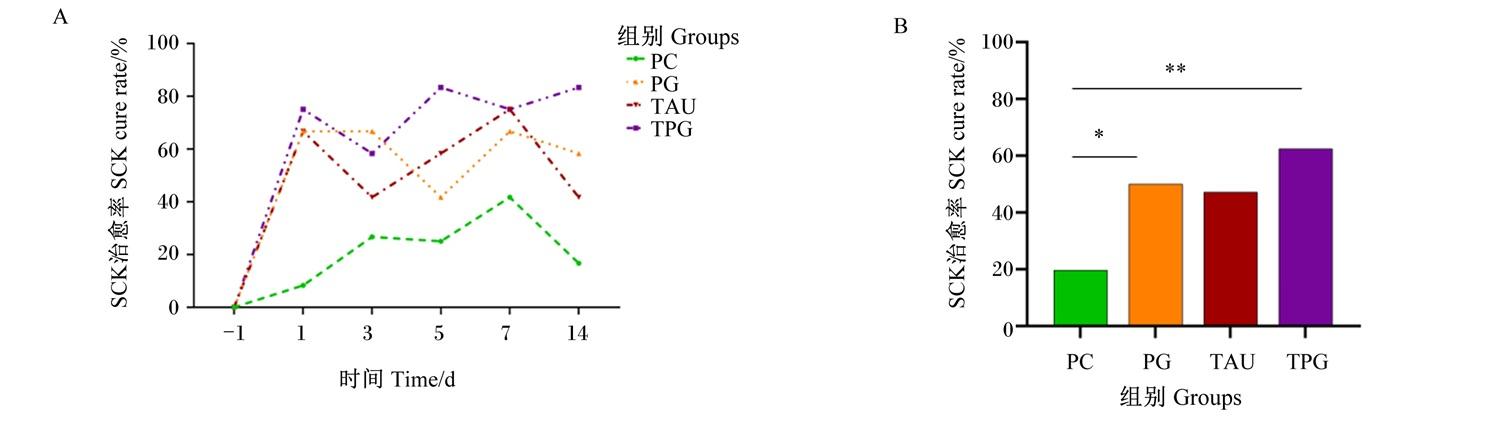
图1-A所示,从治疗前1天到治疗后第14天,4组奶牛的SCK治愈率出现不同程度的起伏,整体呈波动上升趋势。在连续治疗后第7天,4组奶牛SCK治愈率高低顺序为TAU组(75.00%)=TPG组(75.00%)>PG组(66.67%)>PC组(41.67%);在治疗后第14天,4组奶牛SCK治愈率高低顺序为TPG组(83.33%)>PG组(58.33%)>TAU组(41.67%)>PC组(16.67%)。试验期间,4组奶牛的SCK平均治愈率为TPG组>PG组>TAU组>PC组(图1-B),且TPG组极显著高于PC组(P<0.01),PG组显著高于PC组(P<0.05),TAU组与PC组无显著差异(P>0.05)。上述结果表明,TPG治疗SCK的效果最好,其次是PG,TAU的效果最差。
图1 4组试验奶牛的SCK治愈率

A:4组奶牛SCK治愈率在治疗过程中的变化;B:4组奶牛试验期内的SCK平均治愈率。“*”表示与PC组相比差异显著(P<0.05),“**”表示与PC组相比差异极显著(P<0.01)。图5图6同。

Fig.1 SCK cure rate of experimental dairy cows in four groups

A: changes in the cure rate of SCK of dairy cows in four groups over the course of treatment, B: the average cure rate of SCK of dairy cows in four groups during the trial period. “*” indicated a significant difference compared with the PC group (P<0.05), and “**” indicated an extremely significant difference compared with the PC group (P<0.01). The same as Fig.5 and Fig.6.

2.3 TAU与PG联用对奶牛其他疾病患病率的影响

表3所示,子宫炎,PC、PG、TAU组的患病率均为16.67%,TPG组未发生;腹泻,TAU组的患病率为8.33%,其余3组均未发生;真胃变位,PG组的患病率为16.67%,TPG组为8.33%,PC、TAU组均未发生;前胃弛缓,TAU、TPG组的患病率均为8.33%,PC、PG组均未发生;阴道炎,PC组的患病率为16.67%,其余3组均未发生;乳房炎,PC组的患病率为8.33%,PG组为16.67%,TAU、TPG组均未发生;蹄病,PC组的患病率为8.33%,其余3组均未发生。总的来看,在试验期间,TPG组其他疾病患病率最低;此外,患2种及以上疾病的奶牛,PC和PG组最高,各占16.67%,TPG组为8.33%,TAU组未出现患2种及以上疾病的奶牛。
表3 试验期间(产后7~21 d)4组试验奶牛其他疾病患病率

Table 3 Prevalence rates of other diseases of experimental dairy cows in four groups during trial period (7 to 21 days postpartum)

项目
Items
组别 Groups
PC PG TAU TPG
疾病类型 Disease type 子宫炎 Metritis 2(16.67) 2(16.67) 2(16.67) 0(0.00)
腹泻 Diarrhea 0(0.00) 0(0.00) 1(8.33) 0(0.00)
真胃变位 Displaced abomasum 0(0.00) 2(16.67) 0(0.00) 1(8.33)
前胃弛缓 Forestomach atony 0(0.00) 0(0.00) 1(8.33) 1(8.33)
阴道炎 Vaginitis 2(16.67) 0(0.00) 0(0.00) 0(0.00)
乳房炎 Mastitis 1(8.33) 2(16.67) 0(0.00) 0(0.00)
蹄病 Hoof disease 1(8.33) 0(0.00) 0(0.00) 0(0.00)
合计 Total 6(50.00) 6(50.00) 4(33.33) 2(16.67)
同时患病数≥2 Number of concurrent comorbidity cases≥2 2(16.67) 2(16.67) 0(0.00) 1(8.33)

表中括号外的数值代表该组患有此疾病的奶牛数(头),括号中的数值代表该组奶牛患有此疾病的患病率(%)。

The values outside the brackets in the table represented the number of cows with this disease in that group (heads), and the values inside the brackets represented the incidence (%) of this disease in that group.

表4所示,4组患病奶牛中其他各类疾病的占比无显著差异(P>0.05)。
表4 试验期间(产后7~21 d)4组患病奶牛中其他各类疾病的占比

Table 4 Proportion of other diseases among sick dairy cows in four groups during trial period (7 to 21 days postpartum)

疾病类型
Disease types
组别 Groups 合计
Total
卡方值
χ2 value
P
P-value
PC PG TAU TPG
子宫炎 Metritis 2(33.33) 2(33.33) 2(50.00) 0(0.00) 6(33.33)


21.250


0.267
腹泻 Diarrhea 0(0.00) 0(0.00) 1(25.00) 0(0.00) 1(5.56)
真胃变位 Displaced abomasum 0(0.00) 2(33.33) 0(0.00) 1(50.00) 3(16.67)
前胃弛缓 Forestomach Atony 0(0.00) 0(0.00) 1(25.00) 1(50.00) 2(11.11)
阴道炎 Vaginitis 2(33.33) 0(0.00) 0(0.00) 0(0.00) 2(11.11)
乳房炎 Mastitis 1(16.67) 2(33.33) 0(0.00) 0(0.00) 3(16.67)
蹄病 Hoof disease 1(16.67) 0(0.00) 0(0.00) 0(0.00) 1(5.56)
合计 Total 6 6 4 2 18

表中括号外的数值代表该组患有此疾病的奶牛数(头),括号中的数值代表在该组所有患病的奶牛中患有此疾病的病例数占该组总病例数的百分比(%)。

The values outside the brackets in the table represented the number of cows with this disease in that group (heads), and the values inside the brackets represented the percentage (%) of cases of this disease among all diseased cows in that group.

2.4 TAU与PG联用对奶牛血清生化指标的影响

2.4.1 TAU与PG联用对奶牛血清中能量代谢指标的影响
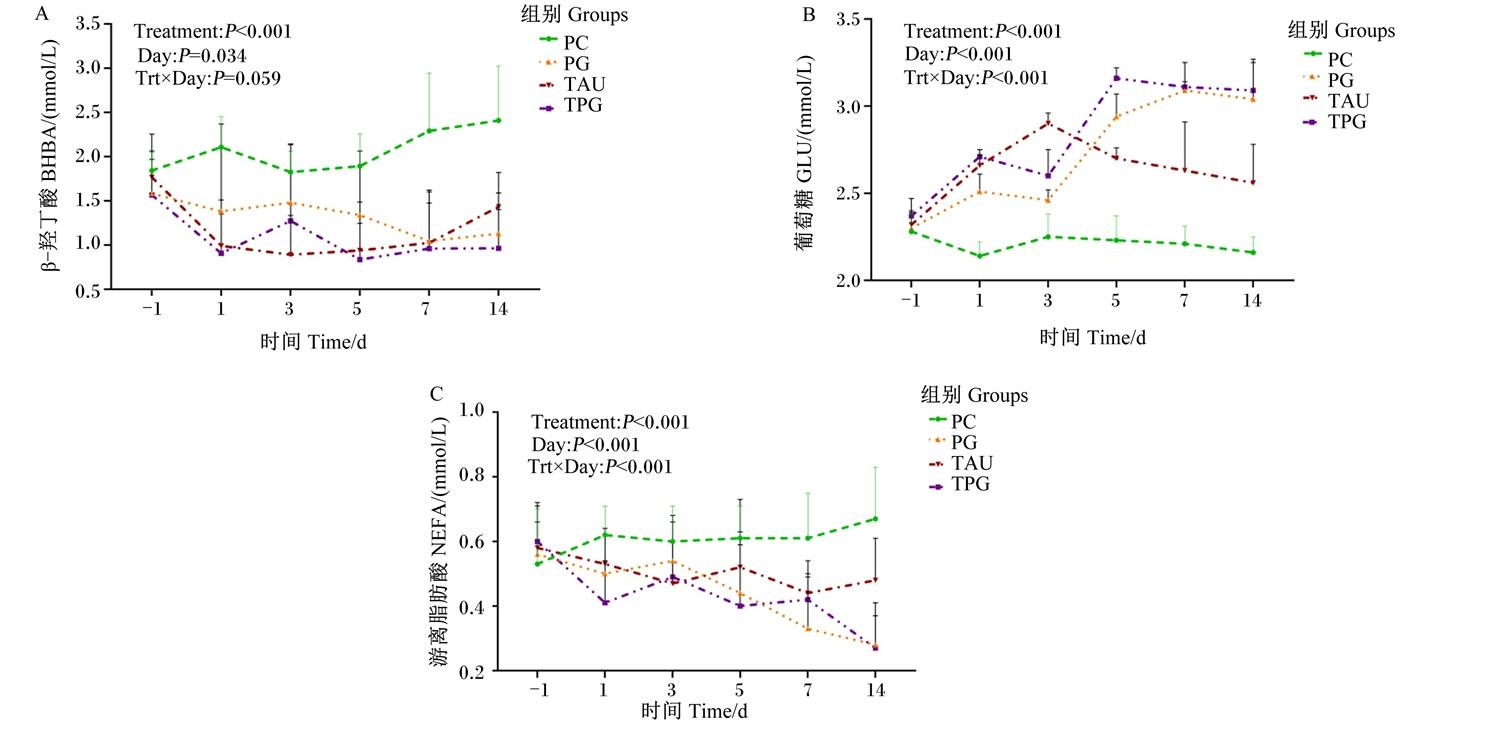
图2所示,处理方式和采样时间对奶牛血清中BHBA、GLU和NEFA浓度有显著或极显著影响(P<0.05或P<0.01);处理方式与采样时间的交互作用对奶牛血清中GLU和NEFA浓度有极显著影响(P<0.01)。从治疗后第1天开始,PC组奶牛血清中NEFA、BHBA浓度始终高于其他3组,并且,随着采样时间的延后,NEFA浓度呈现先升高、后平稳、再升高的趋势,BHBA浓度呈现先升高、后略降、再升高的趋势,在治疗后第14天都达到最高;PC组奶牛血清中GLU浓度始终低于其他3组,随着采样时间的延后呈现先下降、后升高、再缓慢下降的趋势,在治疗后第14天达最低。TPG和PG组奶牛血清中NEFA、BHBA和GLU浓度的变化趋势相似:随着采样时间的延后,二者血清中NEFA和BHBA浓度均呈现先下降、后升高、再下降的趋势,在治疗后第14天降至最低,但TPG组略低于PG组;二者血清中GLU浓度均呈现先升高、后略降低、再升高、后稍降低的趋势,在治疗后第14天达到最高,但TPG组略高于PG组。TAU组奶牛血清中BHBA浓度在治疗后第1、5与7天介于PG组与TPG组之间,NEFA浓度在治疗后第1、5、7和14天高于PG组与TPG组;TAU组奶牛血清中GLU浓度在治疗后第3天达到最高点,高于PG组与TPG组,随后降低,在治疗后第14天低于PG组与TPG组。
图2 4组试验奶牛血清中能量代谢指标的变化

Treament代表处理方式,Day代表采样时间,Trt×Day代表处理方式与采样时间的交互作用。图3图4同。

Fig.2 Changes of energy metabolism indicators in serum of experimental dairy cows in four groups

Treatment represented the treatment regimen, Day represented the sampling time, and Trt×Day represented the interaction between treatment regimen and sampling time. The same as Fig.3 and Fig.4.

2.4.2 TAU与PG联用对奶牛血清中肝功能指标的影响

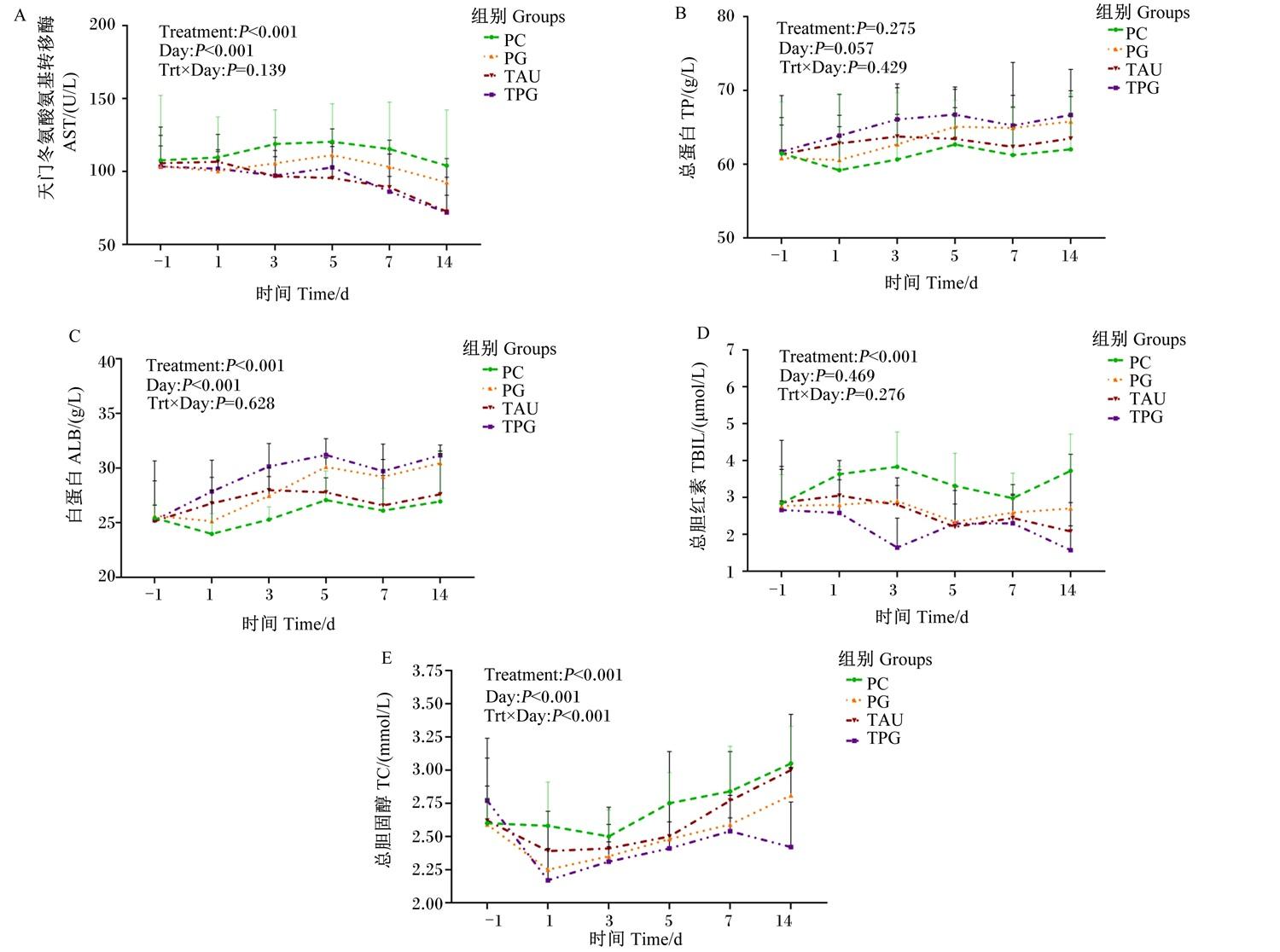
图3所示,处理方式对奶牛血清中AST活性及ALB、TC、TBIL含量有极显著影响(P<0.01);采样时间对奶牛血清中AST活性及ALB、TC含量有极显著影响(P<0.01);处理方式与采样时间的交互作用对奶牛血清中TC含量有极显著影响(P<0.01)。治疗后第7天和第14天,血清中AST活性和TBIL含量均表现为PC组>PG组>TAU组>TPG组,与第7天相比,第14天时PC组2项指标进一步升高,PG组和TAU组则略有下降,但仍高于TPG组,而TPG组则持续下降至最低水平;血清中TP、ALB含量表现为TPG组>PG组>TAU组>PC组,与第7天相比,第14天时TPG组和PG组持续升高,TAU组略有升高,PC组则进一步降低;血清中TC含量表现为PC组>TAU组>PG组>TPG组,与第7天相比,第14天时PC组继续升高,TAU组和PG组有所下降,TPG组则降至最低。
图3 4组试验奶牛血清中肝功能指标的变化

Fig.3 Changes in liver function indicators in serum of experimental dairy cows in four groups

2.4.3 TAU与PG联用对奶牛血清中氧化应激指标的影响

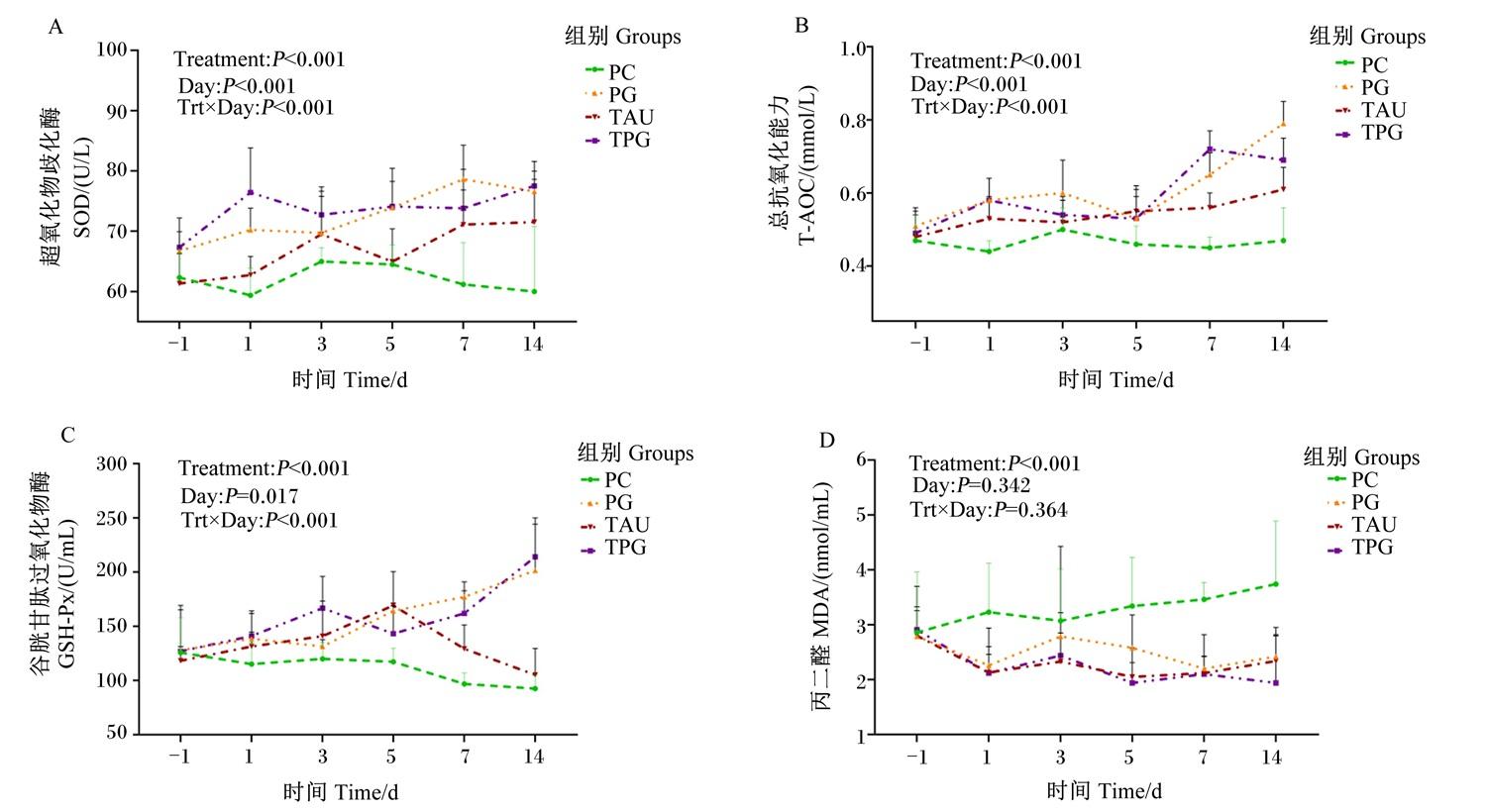
图4所示,处理方式对奶牛血清中SOD活性、T-AOC、GSH-Px活性和MDA含量均有极显著影响(P<0.01);采样时间对奶牛血清中SOD活性和T-AOC有极显著作用(P<0.01),对血清中GSH-Px活性有显著影响(P<0.05);处理方式与采样时间的交互作用对奶牛血清中SOD活性、T-AOC和GSH-Px活性有极显著影响(P<0.01)。治疗后第7天,血清中SOD、GSH-Px活性表现为PG组>TPG组>TAU组>PC组,与治疗前1天相比,PG组和TPG组明显回升,TAU组回升幅度较小,PC组则进一步降低;血清中T-AOC表现为TPG组>PG组>TAU组>PC组;血清中MDA含量表现为PC组>PG组>TAU组>TPG组。治疗后第14天,血清中SOD、GSH-Px活性排序转为TPG组>PG>组TAU组>PC组,与治疗后第7天相比,TPG组和PG组持续升高,TAU组也有所回升,PC组仍处于最低水平;血清中T-AOC排序调整为PG组>TPG组>TAU组>PC组;血清中MDA含量排序不变,PC组、PG组、TAU组均有小幅升高,而TPG组则降至最低。
图4 4组试验奶牛血清中氧化应激指标的变化

Fig.4 Changes of oxidative stress indicators in serum of experimental dairy cows in four groups

2.5 TAU与PG联用对奶牛生产性能的影响

2.5.1 TAU与PG联用对奶牛泌乳性能的影响

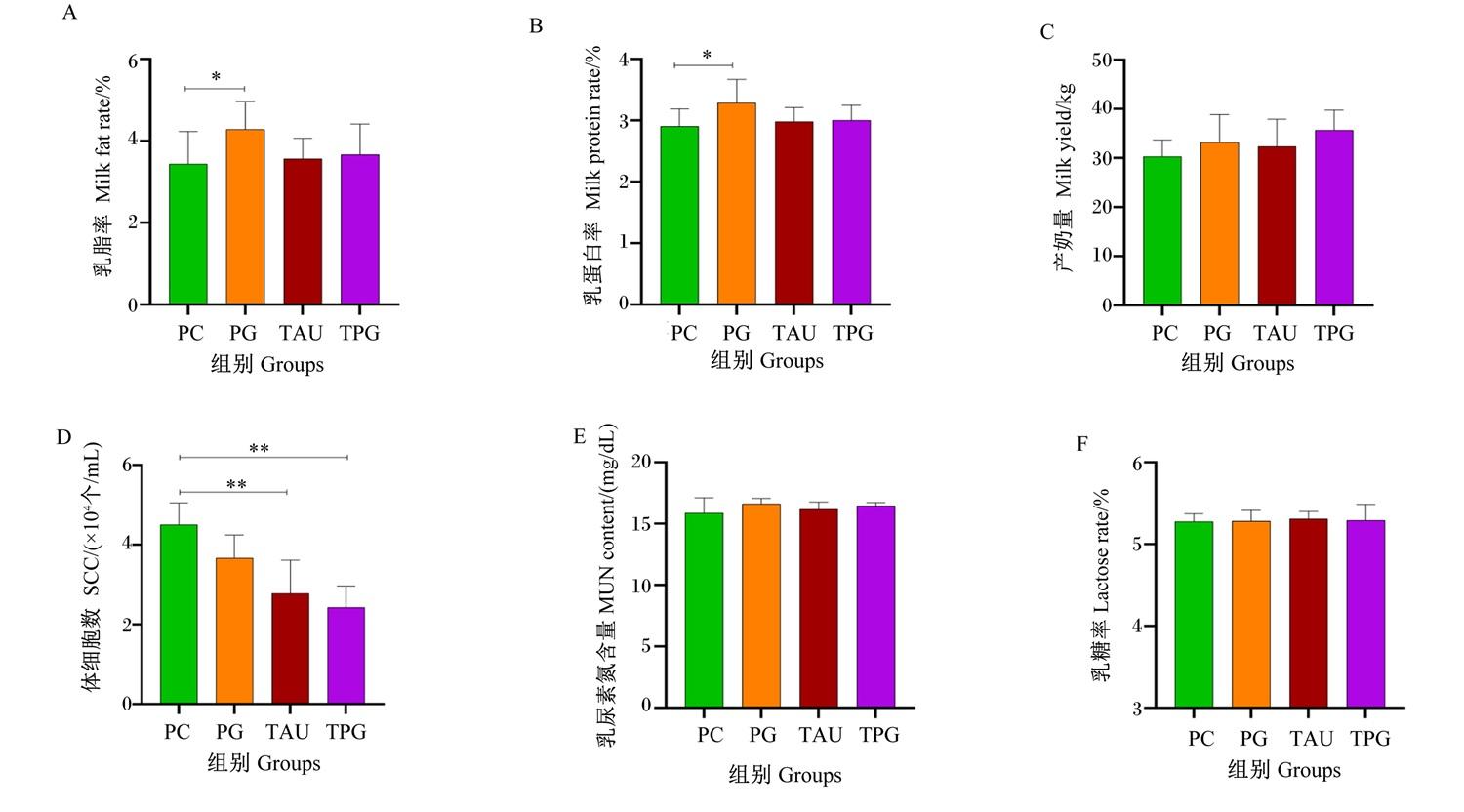
图5所示,4组奶牛乳脂率表现为PG组>TPG组>TAU组>PC组,产奶量表现为TPG组>PG组>TAU组>PC组,乳尿素氮含量表现为PG>TPG>TAU>PC组,乳蛋白率表现为PG组>TPG组>TAU组>PC组,体细胞数表现为PC组>PG组>TAU组>TPG组;与PC组相比,PG组的乳脂率、乳蛋白率显著升高(P<0.05),TAU组、TPG组的体细胞数极显著降低(P<0.01)。
图5 产后第21天4组试验奶牛的泌乳性能

Fig.5 Lactation performance of experimental dairy cows in four groups on day 21 postpartum

2.5.2 TAU与PG联用对奶牛繁殖性能的影响

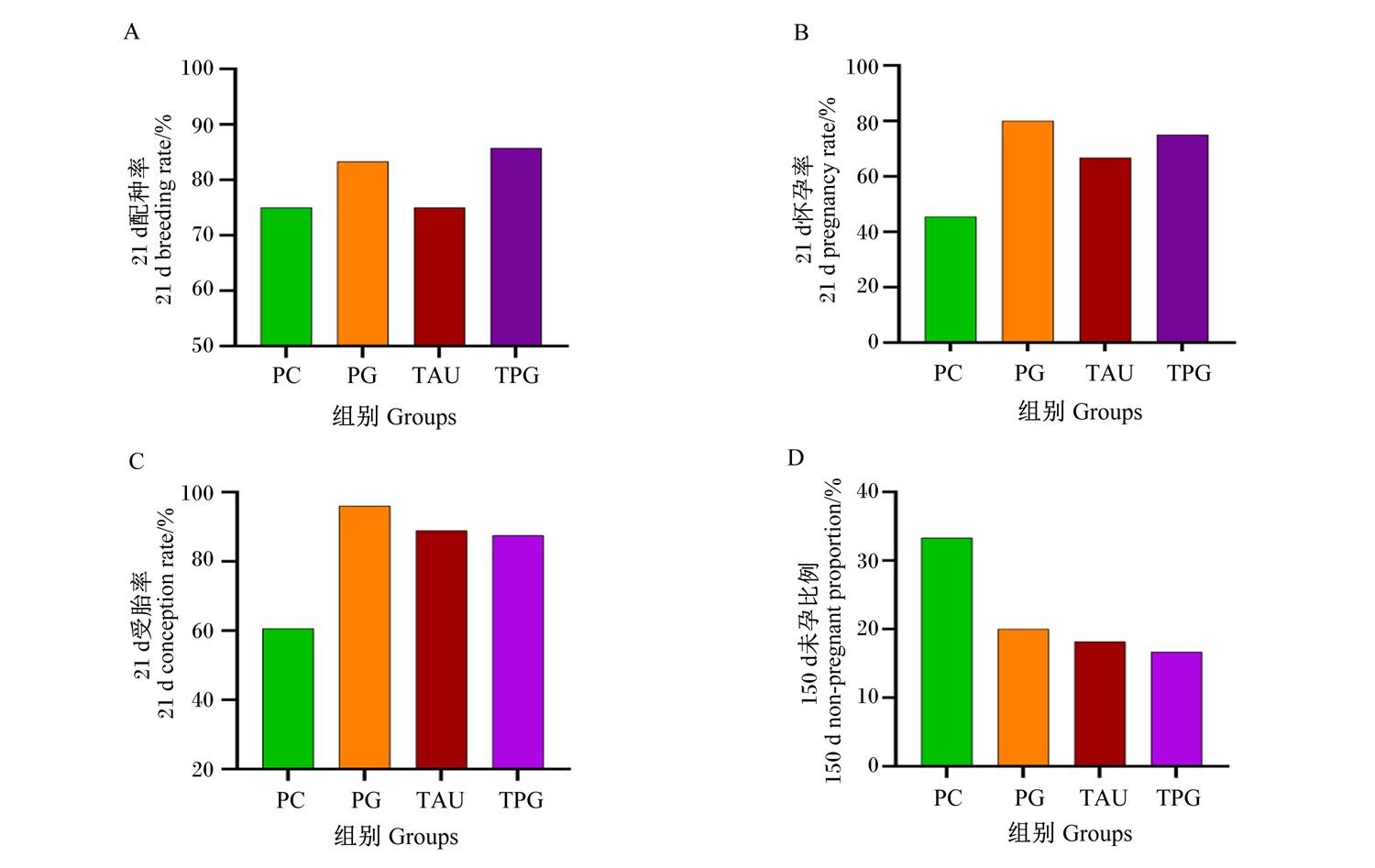
图6所示,4组奶牛21 d配种率表现为TPG组>PG组>TAU组=PC组,21 d怀孕率表现为PG组>TPG组>TAU组>PC组,21 d受胎率表现为PG组>TAU组>TPG组>PC组,150 d未孕比例表现为PC组>PG组>TAU组>TPG组;然而,PG组、TPG组、TAU组奶牛的21 d配种率、21 d怀孕率、21 d受胎率和150 d未孕比例与PC组的差异均未达显著水平(P>0.05)。
图6 4组试验奶牛的繁殖性能

Fig.6 Reproductive performance of experimental dairy cows in four groups

3 讨论

SCK的风险因素是NEB,表现为血清中BHBA、NEFA浓度升高,GLU浓度降低。本研究中,TPG组在治疗后第14天,奶牛血清中BHBA和NEFA浓度降至最低水平,GLU浓度升至最高水平;且在该时间点4组奶牛的横向对比中,TPG组上述指标同样优于其余3组,表明TAU与PG联用对奶牛能量代谢的改善。本研究中,在治疗后第7天,TPG组SCK治愈率与TAU组持平,均为75.00%,高于PG组(66.67%)和PC组(41.67%),且停药7 d后(在治疗后第14天)TPG组SCK治愈率升至83.33%,高于PG组(58.33%)和TAU组(41.67%),这表明,TAU与PG联用不仅在短期(7 d)内对酮病有明显疗效,在停药后仍可持续改善机体状态,体现出良好的治疗稳定性。在治疗后第14天,PG组血清中BHBA、NEFA浓度高于TPG组、低于TAU组与PC组,GLU浓度则低于TPG组,高于TAU组与PC组。PG作为升糖前体,通过提供糖异生底物促进肝脏GLU生
成,缓解奶牛NEB状态,从而降低酮体水平。本试验中PG在奶牛SCK中的应用结果与Zhang等[22]和Xiang等[23]的研究结果一致。TAU对肝脏的保护作用已在多项研究中得到证实。TAU可通过激活核因子E2相关因子2(Nrf2)通路,抑制氧化应激和炎症反应,减少肝细胞凋亡[24-25]。此外,TAU还能改善线粒体功能,促进脂肪酸氧化,减少脂质在肝细胞内的蓄积[26]。TAU通过抗氧化、抗炎、抗凋亡等多重机制改善机体代谢与功能,尤其是针对围产期奶牛代谢的关键器官肝脏的功能具有积极的效果[27]
本研究中,与PC组相比,TPG组血清中AST活性与TBIL、TC含量等肝脏功能相关指标降低,血清中TP和ALB含量升高,印证了TAU的这一功能,提示围产期SCK奶牛的肝脏损伤得到有效修复。吴燕[28]在热应激奶牛上也发现TAU可有效修复肝脏损伤。TAU与PG联用在降低SCK奶牛血清中BHBA和NEFA浓度、升高GLU浓度方面均优于TAU和PG单用。据文献报道,PG主要通过提供糖异生前体物质,减少脂肪动员,从而间接降低肝脏脂质沉积,但其不具备直接的抗氧化或肝损伤修复作用[14,29-30];相比之下,TAU侧重于保护肝脏和缓解氧化应激,而其快速降低血酮、升高血糖的效果相对有限[31-32]。基于此,二者联用可互为补充,弥补单药应用的不足,在促进肝糖异生、减少肝脏脂质蓄积、增强肝细胞抗氧化能力等方面发挥协同效应,从而更有效地改善围产期能量负平衡奶牛的能量供给状况。二者协同作用的具体分子机制尚需进一步研究阐明。
氧化应激是SCK的重要诱发机制之一,血清中MDA含量升高,SOD、GSH-Px活性及T-AOC下降是其典型表现[33-34]。本研究中,TPG组在治疗后第14天时血清中MDA含量降至最低,SOD、GSH-Px活性为4组最高,T-AOC略低于PG组,但高于TAU组与PC组,整体效果优于PG组和TAU组,表明TAU与PG联用在缓解氧化应激方面具有显著优势。TAU作为一种含硫氨基酸,可直接清除自由基、稳定细胞膜,并调控谷胱甘肽抗氧化系统[35]。Bai等[17]研究发现,TAU能显著提高热应激条件下牛乳腺上皮细胞中抗氧化酶活性。相比之下,PG虽不具备直接的抗氧化能力,但可通过缓解NEB、减少脂肪动员,间接降低脂质过氧化底物NEFA的释放,从而减轻机体的氧化应激负担[36-37]。TAU与PG联合应用形成了“直接清除自由基+间接减少氧化底物”的双重抗氧化机制,这也是二者联用能够改善奶牛氧化应激状态、提高SCK治愈率的关键所在。
在泌乳性能方面,与PC组相比,TPG组和TAU组乳体细胞数极显著降低,提示TAU可能通过发挥抗炎[38]和抗氧化应激作用[39]改善乳腺健康;PG组则是乳脂率和乳蛋白率显著提高,这可能与PG能改善能量供应、促进乳成分合成有关[14]。然而,Hamzaoui等[40]在奶山羊上的研究则显示,PG虽然改善了能量状态,但会降低乳脂率,与本试验结果存在差异,具体原因有待进一步研究。此外,TPG组在乳脂率、乳蛋白率方面同样表现出积极效果,虽未显著高于PC组,但其产奶量在4组中最高,这一结果提示,TAU与PG联合应用在提升SCK奶牛产奶量与优化乳成分方面具有综合优势。
研究显示,PG可通过改善奶牛NEB,降低酮病奶牛的乏情率[41],而TAU则通过发挥抗氧化、抗炎等作用间接改善动物生殖系统的健康[42]。本研究中,尽管PG组、TPG组和TAU组的21 d配种率、21 d怀孕率、21 d受胎率及150 d未孕比例与PC组相比均未达到显著差异水平,但所有接受治疗的SCK奶牛的繁殖性能均有不同程度的改善;此外,虽然TPG组的21 d受胎率略低于PG组和TAU组,但其150天未孕比例明显更低,提示PG与TAU联合应用有望为改善SCK奶牛后续繁殖性能低下问题提供有效解决方案。
综上所述,PG与TAU联用方案在提高SCK治愈率、改善代谢状态、缓解氧化损伤等方面均表现出显著优势,有效弥补了以往单独应用PG治疗SCK所导致的奶牛采食量下降及生产性能受损等不足[43],为奶牛SCK的治疗提供了新的思路与选择。

4 结论

从产后第7天开始给SCK奶牛连续7 d每日灌服100 g TAU,同时在第1、3、5、7天每日灌服500 mL PG,该PG与TAU联用方案能够有效提高SCK治愈率并改善SCK奶牛的能量代谢、肝脏功能、氧化应激状态、泌乳性能和繁殖性能。
[1]
GARZÓN-AUDOR A, OLIVER-ESPINOSA O. Incidence and risk factors for ketosis in grazing dairy cattle in the cundi-boyacencian Andean plateau,Colombia[J]. Tropical Animal Health and Production, 2019, 51(6):1481-1487.

[2]
LIM D H, MAYAKRISHNAN V, LEE H J, et al. A comparative study on milk composition of Jersey and Holstein dairy cows during the early lactation[J]. Journal of Animal Science and Technology, 2020, 62(4):565-576.

[3]
MANN S, MCART J A A. Hyperketonemia:a marker of disease,a sign of a high-producing dairy cow,or both?[J]. The Veterinary Clinics of North America:Food Animal Practice, 2023, 39(2):307-324.

[4]
宋玉锡. 亚临床酮病奶牛产后乏情的关键蛋白筛选及作用机制研究[D]. 博士学位论文. 大庆: 黑龙江八一农垦大学, 2023.

SONG Y X. Screening of key proteins and study on its action mechanism of dairy cows with postpartum anestrus caused by subclinical ketosis[D]. Ph.D.Thesis. Daqing: Heilongjiang Bayi Agricultural University, 2023. (in Chinese)

[5]
LOIKLUNG C, SUKON P, THAMRONGYOSWITTAYAKUL C. Global prevalence of subclinical ketosis in dairy cows:a systematic review and meta-analysis[J]. Research in Veterinary Science, 2022, 144:66-76.

[6]
常金水, 宋玉锡, 白云龙, 等. 我国规模化牧场奶牛酮病防治状况调查分析[J]. 中国乳业, 2023(3):64-70.

CHANG J S, SONG Y X, BAI Y L, et al. Investigation and analysis of prevention and control status of ketosis in dairy cow on large-scale pastures in China[J]. China Dairy, 2023(3):64-70. (in Chinese)

[7]
GUHA A, GUHA R, GERA S. Comparison of α1-antitrypsin,α1-acid glycoprotein,fibrinogen and NOx as indicator of subclinical mastitis in riverine buffalo (Bubalus bubalis)[J]. Asian-Australasian Journal of Animal Sciences, 2013, 26(6):788-794.

[8]
STENGÄRDE L, HULTGREN J, TRÅVÉN M, et al. Risk factors for displaced abomasum or ketosis in Swedish dairy herds[J]. Preventive Veterinary Medicine, 2012, 103(4):280-286.

[9]
GOHARY K, OVERTON M W, VON MASSOW M, et al. The cost of a case of subclinical ketosis in Canadian dairy herds[J]. The Canadian Veterinary Journal, 2016, 57(7):728-732.

[10]
GESSNER D K, KOCH C, ROMBERG F J, et al. The effect of grape seed and grape marc meal extract on milk performance and the expression of genes of endoplasmic reticulum stress and inflammation in the liver of dairy cows in early lactation[J]. Journal of Dairy Science, 2015, 98(12):8856-8868.

[11]
CASCONE G, LICITRA F, STAMILLA A, et al. Subclinical ketosis in dairy herds:impact of early diagnosis and treatment[J]. Frontiers in Veterinary Science, 2022, 9:895468.

[12]
ZHANG F, NAN X M, WANG H, et al. Effects of propylene glycol on negative energy balance of postpartum dairy cows[J]. Animals, 2020, 10(9):1526.

[13]
SLAUGHTER R J, MASON R W, BEASLEY D M G, et al. Isopropanol poisoning[J]. Clinical Toxicology, 2014, 52(5):470-478.

[14]
SONG Y X, JIANG X J, HAO Y, et al. Effectiveness of a novel propylene glycol protocol in reducing ketosis in transition dairy cows[J]. Frontiers in Veterinary Science, 2025, 12:1609300.

[15]
SINGH P, GOLLAPALLI K, MANGIOLA S, et al. Taurine deficiency as a driver of aging[J]. Science, 2023, 380(6649):eabn9257.

[16]
白慧. 热应激对奶牛乳腺上皮细胞功能的影响及牛磺酸的缓解作用[D]. 博士学位论文. 南京: 南京农业大学, 2022.

BAI H. Effects of heat stress on function of bovine mammary epithelial cells and the alleviative effects of taurine[D]. Ph.D Thesis. Nanjing: Nanjing Agricultural University, 2012. (in Chinese)

[17]
BAI H, LI T T, YU Y, et al. Cytoprotective effects of taurine on heat-induced bovine mammary epithelial cells in vitro[J]. Cells, 2021, 10(2):258.

[18]
LIU F F, LIANG L, LUO Z G, et al. Effects of taurine on metabolomics of bovine mammary epithelial cells under high temperature conditions[J]. Frontiers in Veterinary Science, 2024, 11:1393276.

[19]
CUI Z K, ZHANG J L, ZHANG J, et al. Taurine improves bovine oocyte maturation through recovering mitochondrial dysfunction and oxidative stress-induced apoptosis after microplastics exposure[J]. Journal of Dairy Science, 2025, 108(10):11682-11696.

[20]
XIAO J X, YANG M, LI K, et al. Taurine alleviates oxidative stress,inflammation,and mitochondrial apoptosis in lipopolysaccharide-induced bovine endometrial epithelial cells by activating Nrf2/HO-1 and inhibiting TLR4-MAPK/NF-κB and Caspase-3 pathways[J]. European Journal of Pharmacology, 2025, 1003:177986.

[21]
中国饲料成分及营养价值表(第35版)[J]. 中国饲料, 2024(21):182-197.

Tables of feed composition and nutritive values in China (thirty-fifth edition)[J]. China Feed, 2024(21):182-197. (in Chinese)

[22]
张瑞华. 亚临床酮病对奶牛产奶和繁殖性能的影响及其血液生化指标的变化[D]. 硕士学位论文. 南京: 南京农业大学, 2009.

ZHANG R H. The effect of subclinical ketosis on milk production and reproductive performances and changes of blood biochemical indicators in dairy cows[D]. Master’s Thesis. Nanjing: Nanjing Agricultural University, 2009. (in Chinese)

[23]
XIANG K H, LI S, TUNIYAZI M, et al. Changes in the rumen microbiota community in ketosis cows during propylene glycol treatment[J]. Food & Function, 2022, 13(13):7144-7156.

[24]
CHEN C, QI M, ZHANG W L, et al. Taurine alleviated paraquat-induced oxidative stress and gut-liver axis damage in weaned piglets by regulating the Nrf2/Keap1 and TLR4/NF-κB signaling pathways[J]. Journal of Animal Science and Biotechnology, 2025, 16(1):117.

[25]
JI X, TANG Z Q, ZHANG F, et al. Dietary taurine supplementation counteracts deoxynivalenol-induced liver injury via alleviating oxidative stress,mitochondrial dysfunction,apoptosis,and inflammation in piglets[J]. Ecotoxicology and Environmental Safety, 2023, 253:114705.

[26]
SAN J S, HU J M, PANG H P, et al. Taurine protects against the fatty liver hemorrhagic syndrome in laying hens through the regulation of mitochondrial homeostasis[J]. International Journal of Molecular Sciences, 2023, 24(12):10360.

[27]
ABDEL-MONEIM A M, AL-KAHTANI M A, EL-KERSH M A, et al. Free radical-scavenging,anti-inflammatory/anti-fibrotic and hepatoprotective actions of taurine and silymarin against CCl4 induced rat liver damage[J]. PLoS One, 2015, 10(12):e0144509.

[28]
吴燕. 牛磺酸对热应激奶牛肝损伤的保护作用及其机制研究[D]. 硕士学位论文. 武汉: 华中农业大学, 2022.

WU Y. Protective effect of taurine on liver injury in heat-stressed dairy cows and its mechanism[D]. Master’s Thesis. Wuhan: Huazhong Agricultural University, 2022. (in Chinese)

[29]
MENG L, LU F Y, ZHANG B, et al. Taming fatty liver:can taurine combat metabolic dysfunction in MASLD?[J]. Cell Communication and Signaling, 2025, 23(1):439.

[30]
TAN J, ZHAO H Y, LI L X, et al. Propylene glycol alleviates oxidative stress and enhances immunity in ketotic cows through modulating amino acid and lipid metabolism[J]. Antioxidants, 2024, 13(9):1146.

[31]
OUYANG G, WANG N, TONG J, et al. Alleviation of taurine on liver injury of type 2 diabetic rats by improving antioxidant and anti-inflammatory capacity[J]. Heliyon. 2024, 10(7):e28400.

[32]
MURAKAMI S, FUNAHASHI K, TAMAGAWA N, et al. Taurine ameliorates streptozotocin-induced diabetes by modulating hepatic glucose metabolism and oxidative stress in mice[J]. Metabolites, 2022, 12(6):524.

[33]
SONG Y X, LOOR J J, LI C Y, et al. Enhanced mitochondrial dysfunction and oxidative stress in the mammary gland of cows with clinical ketosis[J]. Journal of Dairy Science, 2021, 104(6):6909-6918.

[34]
SHEN T Y, XU F, FANG Z Y, et al. Hepatic autophagy and mitophagy status in dairy cows with subclinical and clinical ketosis[J]. Journal of Dairy Science, 2021, 104(4):4847-4857.

[35]
WANG L G, JIANG L W, CHU Y Y, et al. Dietary taurine improves growth performance and intestine health via the GSH/GSSG antioxidant system and Nrf2/ARE signaling pathway in weaned piglets[J]. Antioxidants, 2023, 12(10):1852.

[36]
PIANTONI P, ALLEN M S. Evaluation of propylene glycol and glycerol infusions as treatments for ketosis in dairy cows[J]. Journal of Dairy Science, 2015, 98(8):5429-5439.

[37]
CHIRIVI M, CORTES-BELTRAN D, GANDY J, et al. Oxylipin dynamics in dairy cows during clinical ketosis and after treatment with niacin and flunixin meglumine[J]. JDS Communications, 2025, 6(1):117-121.

[38]
吴小铃. 牛磺酸调控mTOR-焦亡途径减轻失血性休克复苏后急性肝损伤[D]. 硕士学位论文. 十堰: 湖北医药学院, 2025.

WU X L. Taurine regulates the mTOR-pyroptosis pathway to alleviate acute liver injury after hemorrhagic shock resuscitation[D]. Master’s Thesis. Shiyan: Hubei University of Medicine, 2025. (in Chinese)

[39]
陈媛圆. 过瘤胃葡萄糖和过瘤胃牛磺酸水平对牦牛肝脏免疫和糖脂代谢功能的影响[D]. 硕士学位论文. 雅安: 四川农业大学, 2025.

CHEN Y Y. Effects of rumen-protected glucose and rumen-protected taurine levels on liver immunity and glycolipid metabolismin yaks[D]. Master’s Thesis. Ya’an: Sichuan Agricultural University, 2025. (in Chinese)

[40]
HAMZAOUI S, CAJA G, SUCH X, et al. Milk production and energetic metabolism of heat-stressed dairy goats supplemented with propylene glycol[J]. Animals, 2020, 10(12):2449.

[41]
GUNER B, ERKAN A A, OZTURK B, et al. Subclinical ketosis:reproductive performance and milk yield in dairy cows receiving oral glucogenic precursors during early postpartum period[J]. Veterinary Medicine and Science, 2025, 11(5):e70563.

[42]
XIAO J X, BI C L, YANG M, et al. Taurine alleviates inflammation,oxidative stress,apoptosis,and uterus microbiota dysregulation of endometritis by inhibiting PI3K-AKT/MAPK/NF-κB pathways in mice[J]. Animals, 2025, 15(24):3619.

[43]
VAN DER DRIFT S G A, HOUWELING M, BOUMAN M, et al. Effects of a single glucocorticoid injection on propylene glycol-treated cows with clinical ketosis[J]. The Veterinary Journal, 2015, 204(2):144-149.

Outlines

/