REVIEW

Research Progress on Biosynthesis Mechanisms, Heterologous Expression Systems and Antimicrobial Mechanisms of Bacteriocins Against Pathogens in Animal Production

  • GUO Shuyan , 1, 2 ,
  • ZHANG Dongyan 2 ,
  • LIU Hui 2 ,
  • LIN Dongmei , 1, *
Expand
  • 1 College of Life Science and Food Engineering, Hebei University of Engineering, Handan 056038, China
  • 2 Institute of Animal Husbandry and Veterinary Medicine, Beijing Academy of Agriculture and Forestry Sciences, Beijing 100097, China
* professor, E-mail:

Received date: 2026-01-22

  Online published: 2026-09-12

Abstract

Bacteriocins are a class of natural antimicrobial peptides synthesized by bacteria. They possess the advantages of strong antibacterial targeting, clear mechanism of action, high biological safety, and environmental friendliness. Therefore, bacteriocins have shown promising application prospects, which can be used to inhibit intestinal pathogenic bacteria, regulate the intestinal microecology, and improve the health status of animals. However, native bacteriocin-producing strains generally suffer from low production yield, long cultivation cycles, and limitations in industrial-scale production. In addition, the biosynthesis of certain bacteriocins is highly dependent on complex post-translational modification systems, and some bacteriocins exert toxic effects on heterologous expression hosts, which collectively restricts their large-scale application. In recent years, advances in heterologous expression technologies have provided effective strategies to enhance the yield, stability, and safety of bacteriocins. Thus, this paper systematically summarizes the sources, classification, and biosynthesis mechanisms of bacteriocins, with a particular focus on recent progress in heterologous expression using Escherichia coli and yeast as expression systems. Furthermore, the antibacterial mechanisms of bacteriocins against pathogenic bacteria are elaborated, with the aim of providing a reference for the research and application of bacteriocins as antibiotic alternatives in animal production.

Cite this article

GUO Shuyan , ZHANG Dongyan , LIU Hui , LIN Dongmei . Research Progress on Biosynthesis Mechanisms, Heterologous Expression Systems and Antimicrobial Mechanisms of Bacteriocins Against Pathogens in Animal Production[J]. Chinese Journal of Animal Nutrition, 2026 , 38(9) : 6443 -6455 . DOI: 10.12418/CJAN2026.516

细菌素是细菌在代谢过程中通过核糖体合成产生的一类具有抑菌活性的多肽或前体多肽[1],在医药、微生物及食品领域备受关注。目前,研究最为深入、应用最为广泛的细菌素主要包括乳酸链球菌素(Nisin)、片球菌素(Pediocin)、乳酸菌素(Lactacin)等[2]。其中,Ⅰ类细菌素Nisin已被美国食品药品监督管理局(Food and Drug Administration,FDA)认证为“一般认为安全”(generally recognized as safe,GRAS)的代表性细菌素[3],并作为天然防腐剂广泛应用于乳制品、肉制品及水产品的保鲜[4];我国食品安全国家标准GB 2760—2024亦已将其列入允许使用的食品防腐剂名单[5]。Pediocin因其对李斯特菌的强抑制性,在肉制品保鲜和饲料防腐领域具有巨大应用潜力[6-7]。此外,Nisin、Pediocin和部分Ⅱ类细菌素可显著抑制肉、蛋和水产品中的腐败菌及致病菌,在延长货架期、改善感官品质的同时有助于减少化学防腐剂的使用[8-9]。另有研究表明,细菌素可通过抑制核因子-κB(NF-κB)、丝裂原活化蛋白激酶(MAPK)等信号通路的激活降低肠道上皮炎症损伤,促进紧密连接相关蛋白[闭锁小带蛋白1(ZO-1)、密封蛋白(claudin)、闭合蛋白(occludin)]表达,缓解肠道屏障功能障碍并促进肠黏膜修复,进而提升动物的免疫力和生长性能[10-11]。然而,目前实际应用于动物生产的商业化细菌素产品仍较少,其抗菌机制仍有待深入探究。
另外,天然细菌素在大规模生产和纯化过程中面临诸多挑战,导致生产成本较高,从而限制了其广泛应用[12]。通过异源表达系统制备细菌素,具有产量大、纯度高、功能稳定等优势,已成为突破上述瓶颈的关键技术手段。当前,工程化大肠杆菌(Escherichia coli,E. coli)[13-14]、毕赤酵母(Pichia pastoris,P. pastoris)[15]和酿酒酵母(Saccharomyces cerevisiae,S. cerevisiae)[16]等宿主已被成功用于异源表达多种细菌素。但值得注意的是,部分细菌素的成熟需要特定修饰酶(如NisB、NisC)、分泌系统(ABC转运蛋白)及免疫蛋白的共同作用,因此异源表达不仅需要表达结构基因,更需要完成完整基因簇的重构与整合,从而保证细菌素的生物活性和宿主安全性[17]。已有研究表明,不同类型的细菌素在相同试验条件下对致病菌的抑制作用存在显著差异[18],且同一细菌素基因在不同宿主菌异源表达后,抗菌活性也存在显著差异[19-20]。鉴于此,本文系统综述了细菌素的来源、分类与生物合成机制,总结了细菌素各类异源表达系统及应用效果,并系统阐述了细菌素对养殖场中常见致病菌的抗菌机制,以期为细菌素在动物生产中的科学应用提供参考。

1 细菌素的来源、分类与生物合成机制

1.1 细菌素的来源

1925年Gratia[21]在研究E.coli时首次发现了具有抑菌作用的蛋白质类物质——大肠杆菌素(Colicin),由此揭开了细菌素研究的序幕。1928年,Rogers[22]发现乳酸链球菌对保加利亚乳杆菌具有显著抑制作用,且该抑制作用并非仅由乳酸产生引起,提示该菌株可能分泌某种抑菌物质,但当时并未对该抑制物质进行明确命名。这类物质后来被统称为细菌素样抑制物质(bacteriocin-like inhibitory substances,BLIS)[23]。直到1947年,Mattick等[24]对这类物质完成分离纯化,将其命名为“Nisin”。随着研究的深入,细菌素被广泛发现于多种细菌中,其中乳酸菌(lactic acid bacteria,LAB)来源的细菌素因其来源安全、抗菌谱明确、热稳定性好且不易产生耐药性等优势,受到广泛关注[25]

1.2 细菌素的分类

LAB来源的细菌素种类繁多,在分子质量、氨基酸组成、结构特征及生物合成方式等方面存在显著差异。目前,LAB细菌素通常依据其是否经历翻译后修饰及结构特征进行分类,其中以Klaenhammer[26]提出的分类体系应用最为广泛。表1为LAB细菌素的分类、主要分子特征及抑菌特性。
表1 LAB细菌素的分类、主要分子特征及抑菌特性

Table 1 Classification, main molecular characteristics and bacteriostatic properties of LAB bacteriocins

分类
Classifications
主要分子特征
Main molecular
characteristics
代表性细菌素
Representative
bacteriocin
抑菌特性
Bacteriostatic
properties
参考文献
References
分子质量小于5 kDa,含特殊氨基酸,经翻
译后修饰成环状结构,热稳定性高
Nisin、Lacticin 481、
Lactocin S
主要作用于
革兰氏阳性菌
[27]
Ⅱa 分子质量小于10 kDa,单肽,
N端含保守序列
Pediocin PA-1 对李斯特菌具有
强抑制活性
[28]
Ⅱb 分子质量小于10 kDa,双肽,由2条
不同多肽组成,需协同作用发挥活性
Lactococcin G、
Lactococcin M、
Lactacin F
对部分革兰氏
阳性菌有效
[29]
Ⅱc 分子质量小于10 kDa,单肽,N端与C端共
价连接形成环状结构,热稳定性高
Lactococcin B 对多种革兰氏
阳性菌有效,
抑菌谱相对较广
[30]
分子质量大于30 kDa,热不稳定 Helveticin J、
Acidophilucin A
对特定革兰氏
阳性菌有效
[31]
复合型细菌素,由蛋白质及1种或
多种非蛋白质化学成分组成
Plantaricin S、
Leuconocin S
主要抑制部分革兰氏
阳性菌,作用
机制尚不明确
[32]

Nisin:乳酸链球菌素;Lacticin:乳链球菌素;Lactocin:乳杆菌素;Pediocin:片球菌素;Lactococcin:乳球菌素;Lactacin:乳酸菌素;Helveticin:瑞士乳杆菌素;Acidophilucin:嗜酸乳杆菌素;Plantaricin:植物乳杆菌素;Leuconocin:明串珠菌素。下表同 the same as below。

1.3 细菌素的生物合成机制

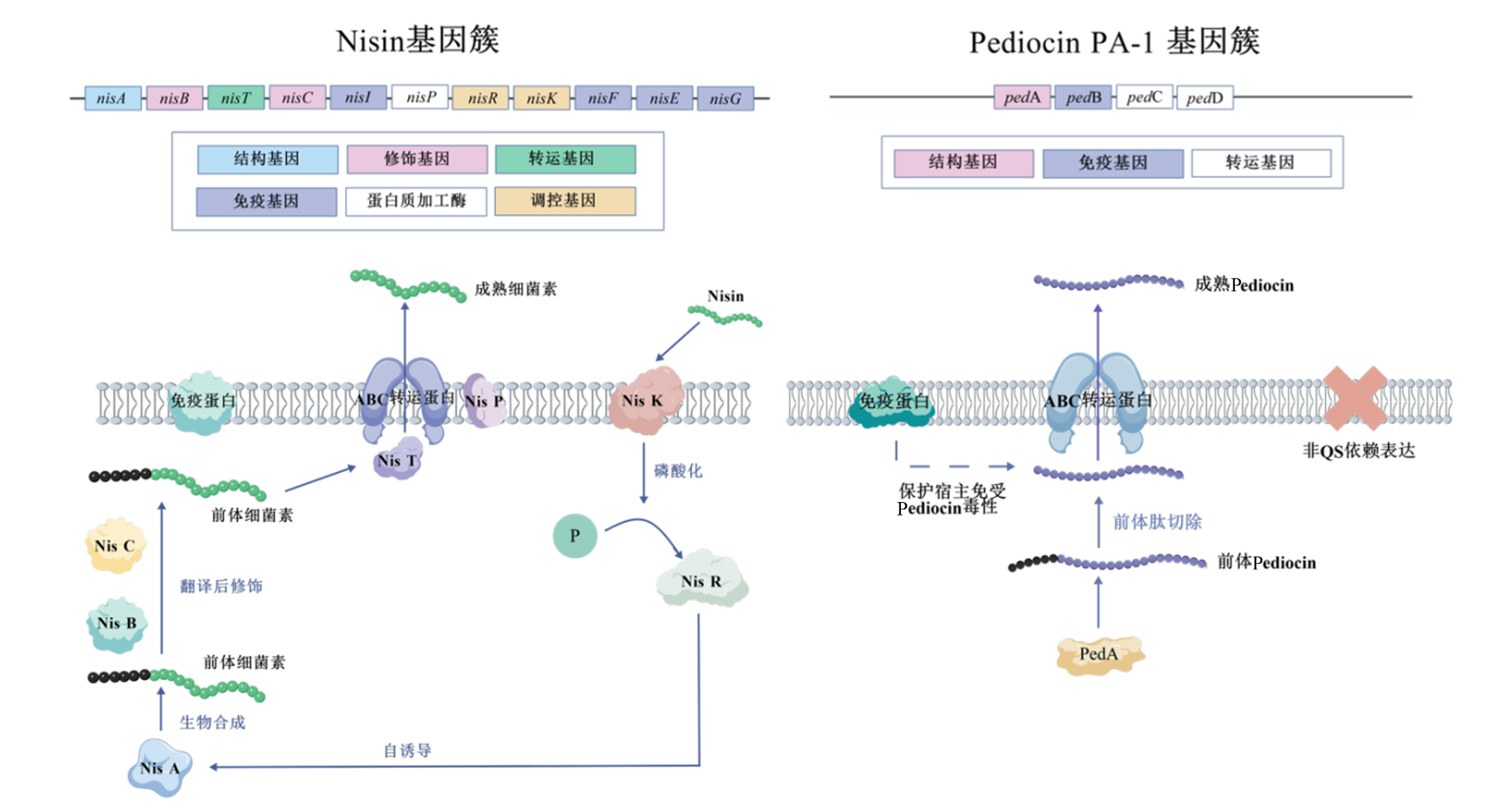
细菌素通常通过1条特定的生物合成途径产生,该过程包括前体肽的合成与特异性位点的切割加工。编码细菌素合成与分泌的相关基因通常集中在1个或2个操纵子中,定位于染色体或染色体相关的转座元件上[33-34]。其中,结构基因是操纵子的核心组成部分,负责编码含有N末端前导序列的前体细菌素;该前导序列通常为双甘氨酸型或信号肽型序列[35],可被ABC转运蛋白特异性识别,并在转运过程中被切割加工,从而促进成熟细菌素的形成与分泌,使其释放至胞外[36-37]。目前,Ⅰ类和Ⅱ类细菌素的生物合成机制已较为明确,其基因簇组成、前体肽加工方式、分泌途径以及免疫机制已得到系统阐释。Ⅰ类及Ⅱ类细菌素的生物合成与分泌机制见表2
表2 Ⅰ类及Ⅱ类细菌素的生物合成与分泌机制

Table 2 Biosynthesis and secretion mechanisms of class Ⅰ and class Ⅱ bacteriocins[38-42]

项目Items Ⅰ类Class Ⅰ Ⅱ类Class Ⅱ
代表性细菌素
Representative bacteriocins
Nisin Pediocin
基因定位与组成
Gene localization and composition
通常位于染色体;基因簇包括结构基因、修
饰基因、转运基因、调控基因和免疫基因
多位于质粒;基因簇通常包括结构
基因、转运基因及免疫基因
前体肽特征
Precursor peptide characteristics
含N端前导肽的前体肽(NisA) 含N端双甘氨酸型前导肽的
前体肽(PedA)
修饰方式
Modification approach
在胞质内经脱水酶NisB、环化酶NisC进行
翻译后修饰;胞外由丝氨酸蛋白酶NisP切除
前导肽形成成熟肽
一般不经复杂翻译后修饰;由
ABC转运蛋白在转运过程中切除前
导肽形成成熟肽
分泌机制
Secretion mechanism
由ABC转运蛋白NisT介导跨膜转运 由ABC转运蛋白PedD直接分泌至胞外
调控机制
Regulatory mechanism
受双组分系统NisK/NisR调控[群体
感应(QS)依赖型正反馈调控]
部分Ⅱb、Ⅱc类受QS调控;部分Ⅱa类
(如Pediocin PA-1)通常不依赖QS系统
免疫机制
Immunity mechanism
NisI及NisEFG介导免疫保护 PedB阻断细菌素与宿主膜结合或孔道形成
Ⅰ类细菌素的成熟通常依赖翻译后修饰酶完成,并受双组分调控系统调控[38-40];Ⅱ类细菌素合成过程相对简单,多通过ABC转运蛋白完成前导肽切除与分泌[41-42]。相比之下,Ⅲ类细菌素由于分子结构较大且类型复杂,其生物合成与抗菌机制尚未完全阐明,相关调控与分泌途径仍有待进一步研究。图1为Nisin及Pediocin PA-1的生物合成、分泌、调控及免疫机制示意图。
图1 Nisin及Pediocin PA-1的生物合成、分泌、调控及免疫机制示意图(使用BioGDP.com创建)

Fig.1 Schematic diagrams of biosynthesis, secretion, regulation and immunity mechanisms of Nisin and Pediocin PA-1[41,43](created with BioGDP.com[44])

2 细菌素的异源表达系统

2.1 E. coli异源表达系统

E. coli作为最经典的原核宿主,具有遗传背景清晰、繁殖速度快、成本低、表达量高、表达产物易纯化、稳定性好,且可通过热休克法转化等优势,被广泛应用于多种重组蛋白和多肽的表达研究[45]E. coli主要用于Ⅱ类细菌素及部分结构相对简单的抗菌肽的异源表达[46],这类细菌素通常分子质量较小,不依赖复杂的翻译后修饰过程。陈信全等[47]成功地将Ⅱ类细菌素Pediocin PA-1的基因克隆至E. coli Rosetta(DE3)中,实现融合表达与纯化;去除融合标签后获得了具有抗李斯特菌活性的成熟肽,且产物纯度达90%以上。Jiang等[48]通过His标签融合,成功表达了Ⅱb类细菌素植物乳杆菌素(Plantaricin)NC8的2个肽,获得了2.0~2.5 mg/L的PLNC8α和1.5~2.0 mg/L的PLNC8β,证实E. coli可作为该类细菌素表达与纯化的良好宿主。
然而,对于Ⅰ类细菌素羊毛硫细菌素(Lantibiotics)而言,其成熟过程依赖特定的修饰酶系统和加工酶,而E. coli本身缺乏相应的翻译后修饰能力,往往只能获得不具备完整生物活性的前体肽[49]。Cheng等[50]研究表明,NisB和NisC是实现Nisin前体肽翻译后修饰、生成具有生物活性的成熟Nisin的关键酶,缺失这2个关键酶则无法完成翻译后修饰过程。因此,在以E. coli为宿主的异源表达系统中,通常需要通过共表达修饰酶基因,或在表达后采用体外酶切等方式进行再加工,才能获得具有抑菌特性的成熟产物。此外,细菌素对宿主的毒性效应也是E. coli异源表达系统面临的重要问题,部分细菌素在表达过程中可破坏宿主细胞膜结构,导致细胞生长受抑制甚至死亡[51]E. coli异源表达系统中细菌素的种类及应用现状见表3
表3 E. coli异源表达系统中细菌素的种类及应用现状

Table 3 Types and current applications of bacteriocins produced using E.coli heterologous expression system

细菌素
Bacteriocins
类型
Types
来源菌
Source strain
宿主菌
Host strain
表达方式
Expression form
应用
Applications
参考文献
References
Pediocin PA-1 Ⅱa Pediococcus acidilactici E. coli
Rosetta (DE3)
融合表达 抗单增李斯特菌活性研究 [47]
Enterocin A Ⅱa Enterococcus faecium E. coli
BL21 (DE3)
融合表达 抗革兰氏阳性菌机制研究 [52]
Enterocin P Ⅱa Enterococcus faecium E. coli
Tuner (DE3)
可溶性表达 抗菌谱分析与功能验证 [53]
Plantaricin NC8 Ⅱb Lactobacillus plantarum E.coli
BL21 (DE3)
融合表达 抗沙门氏菌等食源性病
原菌活性研究
[48]
Plantaricin EF Ⅱb Lactobacillus plantarum E. coli
BL21 (DE3)
双肽共表达 协同抑菌作用机制 [54]
Lactococcin A Lactococcus lactis E. coli
BL21 (DE3)
融合表达 抗乳球菌菌株作用
机制与耐药性分析
[55-56]
Bacteriocin E50-52 Ⅱa Enterococcus faecium E. coli
BL21 (DE3)
重组表达 抗肠道致病菌潜力评估 [57-58]
Nisin (precursor peptide) Lactococcus lactis E. coli
BL21 (DE3)
仅表达nisA 结构与前体肽性质研究 [49,59]
Nisin (engineered
expression)
Lactococcus lactis E. coli
BL21 (DE3)
共表达nisA
nisBnisC
翻译后修饰与
机制研究
[60]

Enterocin:肠球菌素;Bacteriocin:细菌素;precursor peptide:前体肽;engineered expression system:工程化体系;Pediococcus acidilactici:乳酸片球菌;Enterococcus faecium:屎肠球菌;Lactobacillus plantarum:植物乳杆菌;Lactococcus lactis:乳酸乳球菌。下表同 the same as below。

2.2 酵母异源表达系统

S. cerevisiae异源表达系统是首个用于异源表达的真核表达系统,并且广泛应用于功能性蛋白的表达与研究。S. cerevisiae可通过分泌型表达策略实现目标蛋白的胞外分泌,从而减轻其对宿主细胞的潜在毒性;其完善的蛋白质折叠和质量控制体系有助于提高表达产物的稳定性和一致性[61],对于结构较为简单、对翻译后修饰依赖程度较低的细菌素,S. cerevisiae可实现较为稳定的功能性表达[62]。研究表明,S. cerevisiae特有的糖基化修饰方式,可能导致外源表达的细菌素发生非特异性糖基化,从而影响其分子结构和抗菌活性[63-64]。因此,利用S. cerevisiae构建细菌素表达系统时,往往需要调控信号肽、选择合适的启动子或对宿主糖基化通路进行改造等,以减少不利修饰的发生[61]
P. pastoris异源表达系统是当前细菌素异源表达研究中应用最为广泛的真核微生物体系之一,因其具有较强的外源基因表达能力和良好的工业化潜力而受到广泛关注。该系统最突出的特点在于其强启动子启动机制,尤其是醇氧化酶1(AOX1)启动子,可在甲醇诱导下实现外源基因的高水平转录表达[65]P. pastoris作为真核宿主,具有较为完善的蛋白质加工和分泌体系,通过引入合适的信号肽序列(如α-信号肽),可将目标蛋白有效分泌至胞外,从而降低其在胞内积累对宿主造成的毒性影响[66]。与S. cerevisiae相比,P. pastoris在高密度发酵和外源蛋白分泌表达方面具有显著优势;在以人粒细胞-巨噬细胞集落刺激因子为模型蛋白的对比研究中,P. pastoris分泌的目标蛋白产量(285 mg/L)显著高于S. cerevisiae(64 mg/L)[67]。通过采用多种措施,可以有效提升P. pastoris中外源蛋白的表达,包括密码子优化、筛选高拷贝整合株、选择高效启动子以及优化细胞发酵条件等[68-69]。有研究表明,经过密码子优化的基因序列可使P. pastoris中外源蛋白表达量相较原生基因序列增加2~3倍[70]。此外,P. pastoris在食品和饲料领域具有较高的生物安全性基础,其工程菌在规范条件下具备潜在的应用前景。酵母异源表达系统中细菌素的种类及应用现状见表4
表4 酵母异源表达系统中细菌素的种类及应用现状

Table 4 Types and current applications of bacteriocins produced using yeast heterologous expression system

细菌素
Bacteriocins
类型
Types
来源菌
Source strain
宿主菌
Host strain
表达方式
Expression form
应用
Applications
参考文献
References
Pediocin PA-1 Ⅱa Pediococcus acidilactici P. pastoris
X33
α-因子分泌表达 抗李斯特菌应用研究 [14]
Enterocin P Ⅱa Enterococcus faecium P. pastoris
X33
α-因子分泌表达,
pPICZαA表达载体,
甲醇诱导
抗革兰氏阳性
菌应用研究
[71]
Hybrid peptide EF 1 Ⅱb Lactobacillus plantarum P. pastoris α-因子分泌表达 异源表达与
抗菌活性验证
[72]
Enterocin L50A/L50B Ⅱa Enterococcus faecium L50 S. cerevisiae α-因子分泌表达 抗革兰氏
阳性菌活性研究
[19]
Plantaricin 423 Ⅱa Lactobacillus plantarum
423
S. cerevisiae
Y294
α-因子分泌表达 分子功能与抗菌谱研究 [73]
Hiracin JM79 Ⅱa Enterococcus hirae P. pastoris
X33
交配因子α1(MFα1)
信号肽分泌表达
异源表达与
抗菌活性验证
[74]

Hybrid peptide:杂合肽;Hiracin:海乐霉素;Enterococcus hirae:海氏肠球菌;P. pastoris:毕赤酵母 Pichia pastoris;S. cerevisiae:酿酒酵母 Saccharomyces cerevisiae

2.3 其他异源表达系统

除常见的E. coli异源表达系统和酵母异源表达系统外,可异源表达细菌素的系统还包括芽孢杆菌、昆虫细胞以及哺乳动物细胞等多种表达系统[75]。芽孢杆菌异源表达系统以枯草芽孢杆菌(Bacillus subtilis,B. subtilis)为代表,具有无内毒素污染、安全性高及分泌能力强等优势,其完善的Sec分泌途径(一般分泌途径)和Tat分泌途径(双精氨酸转运途径)可实现外源蛋白的胞外分泌表达,有利于减少外源蛋白在胞内积累和简化纯化过程[76]。然而,该系统对复杂翻译后修饰能力有限,表达Ⅰ类细菌素时通常需协同表达完整的生物合成基因簇,构建难度较高[77]。Li等[78]构建并系统优化了一套适用于B. subtilis的分泌型异源蛋白高效表达基因工具箱,旨在突破芽孢杆菌异源表达系统中蛋白酶降解和分泌效率受限等问题,结果表明,优化后的工程菌株分泌重组蛋白的产量为野生型宿主的7.5倍,且胞外蛋白稳定性显著提高。昆虫细胞异源表达系统能够完成较为复杂的蛋白质折叠及部分翻译后修饰,表达水平较高,但培养成本高、操作复杂,多用于细菌素的功能验证和机制研究[79]。哺乳动物细胞异源表达系统具备较为完善的翻译后修饰功能,可实现接近天然状态的蛋白质折叠和糖基化修饰,适用于医用抗菌肽或重组融合蛋白的研究开发,然而因生产成本高、蛋白产量低,限制了其在工业化生产中的应用[80]

3 细菌素对动物生产中致病菌的抗菌机制及其应用

3.1 对革兰氏阳性致病菌的抗菌机制

Ⅰ类细菌素以Nisin为代表,其抗菌机制已被系统阐明(图2)。研究表明,Nisin可高度特异性地结合细胞壁合成过程中的脂质Ⅱ分子[30]。一方面,这种结合阻断了肽聚糖前体向细胞壁的转运,直接抑制细胞壁生物合成;另一方面,Nisin-脂质Ⅱ复合物能够插入细胞膜并形成跨膜孔道,导致细胞膜通透性显著增加[81]。孔道的形成引发钾离子、氨基酸及ATP等关键代谢物的大量外泄,破坏细胞内渗透压平衡和能量代谢系统,最终导致细胞死亡[23,82]。Ⅱ类细菌素通常为小分子、耐热性较强的非修饰肽,其主要通过作用于细胞膜发挥抑菌作用;这类细菌素可识别革兰氏阳性菌细胞膜上的特定受体分子(如膜蛋白或脂类成分),在膜上形成孔道或破坏膜的完整性,从而导致细胞内容物流失和代谢失衡[29]
Sanca等[83]研究表明,由乳酸乳球菌产生的BLIS对革兰氏阳性病原菌具有显著抑制作用,其中对粪肠球菌的抑制作用最为突出,抑菌圈直径达7.9 mm,其次是产气荚膜梭菌,抑菌圈直径为6.9 mm。Peña等[84]从家禽屠宰场废水中分离得到的菌株可产细菌素,这些细菌素对多种革兰氏阳性菌均具有抑制作用。产气荚膜梭菌是引发肉鸡坏死性肠炎的主要病原菌,金黄色葡萄球菌和链球菌则与乳房炎、败血症等疾病密切相关;这类细菌的细胞壁主要由厚层肽聚糖构成,缺乏外膜结构,使细菌素能够直接接触并作用于其关键靶点[85]。叶碧锦[86]通过建立鸡产气荚膜梭菌体内感染模型模拟感染状态,发现在基础饲粮中添加50 g/t修饰Nisin可显著缓解产气荚膜梭菌引起的肠道病变,同时降低隐窝深度、提高十二指肠绒毛高度和绒隐比,从而改善生产性能。

3.2 对革兰氏阴性致病菌的抗菌机制

与革兰氏阳性菌相比,革兰氏阴性菌对细菌素的天然敏感性较低,其根本原因在于细胞外层存在由脂多糖(LPS)、磷脂和蛋白质组成的外膜结构;该外膜形成了有效的物理和电荷屏障,可阻止大多数细菌素分子直接到达内膜作用靶点[88]。研究表明,当革兰氏阴性菌外膜稳定性被削弱时,细菌素的抑菌活性可显著增强。例如,在低pH条件、有机酸存在或与螯合剂联合使用时,外膜中二价阳离子(如Mg2+、Ca2+)的桥联作用被破坏,LPS排列变得疏松,从而提高细菌素的穿透能力[89]。在这一过程中,细菌素可进入周质空间并进一步作用于内膜,引发膜通透性变化和能量代谢紊乱。Clifton等[90]通过X-射线反射和中子反射技术对革兰氏阴性菌外膜LPS模型进行结构解析,发现外膜中Mg2+和Ca2+介导的LPS电荷桥联是维持外膜致密排列的关键因素;去除二价阳离子后,LPS分子间的桥联作用被破坏,外膜结构显著松散,膜通透性增加,从而为外源抗菌分子穿透革兰氏阴性菌外膜提供了有利条件。此外,部分工程化改造细菌素或天然来源的阳离子抗菌肽本身具有一定的外膜亲和能力,这类细菌素可通过静电作用与LPS结合,诱导外膜结构重排甚至局部破裂[91]。一旦突破外膜屏障,其作用方式与针对革兰氏阳性菌的机制相似,主要表现为内膜去极化、离子泄漏和ATP枯竭。
图2 Ⅰ类和Ⅱ类细菌素抑制革兰氏阳性菌的机制示意图(使用BioGDP.com创建)

Lipid Ⅱ:脂质Ⅱ;Nisin-lipid Ⅱ:乳酸链球菌素-脂质Ⅱ复合体;Man-PTS:甘露糖磷酸酶转移系统 mannose phosphotransferase system。

Fig.2 Schematic diagram of antimicrobial mechanisms of class Ⅰ and class Ⅱ bacteriocins against

Gram-positive bacteria[87](created with BioGDP.com[44])

产肠毒素大肠杆菌(enterotoxigenic Escherichia coli,ETEC)是断奶仔猪腹泻的主要病原菌,可导致严重腹泻、脱水甚至死亡,在急性暴发情况下死亡率可达20%~30%[92]。Cutler等[93]研究表明,Colicin E1可降低仔猪断奶后腹泻的发生率和严重程度,同时改善仔猪的生长性能。此外,大量研究表明,Nisin与乙二胺四乙酸(EDTA)、有机酸或植物精油联合使用时,对沙门氏菌和致病性E. coli具有协同抑制效应。Field等[94]系统评估了Nisin、EDTA及肉桂醛对猪源E. coli的抑制作用,结果发现Nisin单独处理时抑菌作用有限,而与肉桂醛和EDTA联合使用时,可显著延长致病菌的生长滞后期,且处理3 h后可使致病菌的活菌数降低1 log(CFU/mL),说明三者联合使用时有显著的协同抑菌作用。

4 小结与展望

细菌素作为一类来源广泛、结构多样且生物活性显著的天然抗菌肽,在食品安全、饲料添加剂等领域具有广阔的应用前景。除高效抑菌作用外,细菌素在改善动物肠道健康及增强宿主免疫屏障等方面也展现出潜在价值。然而,当前细菌素的研究与应用仍面临诸多挑战:细菌素的抑菌特性和效果存在体内外差异;部分细菌素在体内环境中的稳定性、作用持续时间及与肠道互作机制尚未完全阐明,限制了其在动物体内的应用。未来研究应围绕以下方向深入推进:依托合成生物学与人工智能筛选技术,加快发掘抗菌谱广、活性强、安全性高的新型细菌素;通过基因编辑、结构改造与高效异源表达系统的协同优化,全面提升细菌素的产量、稳定性与体内适用性;研发靶向递送等关键技术,提高细菌素在肠道环境中的定植效率与抑菌持久性。随着多学科技术的深度融合,细菌素有望在保障畜禽健康、提升养殖效益与推动畜牧业可持续发展中发挥愈加重要的作用。
[1]
陈鹏. 细菌素在动物饲料中的替抗应用[J]. 饲料研究, 2021, 44(18):150-153.

CHEN P. Antibiotic replacement application of bacteriocins in animal feed[J]. Feed Research, 2021, 44(18):150-153. (in Chinese)

[2]
SILVA C C G, SILVA S P M, RIBEIRO S C. Application of bacteriocins and protective cultures in dairy food preservation[J]. Frontiers in Microbiology, 2018, 9:594.

DOI PMID

[3]
MAKHAL S, KANAWJIA S K, GIRI A. Effect of microGARD on keeping quality of direct acidified cottage cheese[J]. Journal of Food Science and Technology, 2015, 52(2):936-943.

DOI PMID

[4]
UCAR Y, OZOGUL Y, OZOGUL F, et al. The impact of different levels of nisin as a biopreservative agent on the chemical,sensory and microbiological quality of vacuum-packed sea bass (Dicentrarchus labrax) fillets stored at 4±2 ℃[J]. Grasas y Aceites, 2021, 72(2):e401.

DOI

[5]
中华人民共和国国家卫生健康委员会, 中国国家市场监督管理总局. 食品安全国家标准食品添加剂使用标准:GB 2760—2024[S]. 北京: 中国标准出版社, 2024.

National Health Commission of the People’s Republic of China,State Administration for Market Regulation. National food safety standard standards for uses of food additives:GB 2760—2024[S]. Beijing: Standards Press of China, 2024. (in Chinese)

[6]
FLISS O, FLISS I, BIRON E. Bioprotective strategies to control Listeria monocytogenes in food products and processing environments[J]. International Journal of Molecular Sciences, 2025, 26(21):10481.

DOI

[7]
PARADA FABIÁN J C, ÁLVAREZ CONTRERAS A K, NATIVIDAD BONIFACIO I, et al. Toward safer and sustainable food preservation:a comprehensive review of bacteriocins in the food industry[J]. Bioscience Reports, 2025, 45(4):277-302.

DOI

[8]
PÉREZ-MARTÍNEZ J C, GARCÍA-REYES L, SÁNCHEZ-DÍAZ A. Nisin as biopreservative against Listeria spp. in meat products[J]. Journal of Multidisciplinary & Health Education, 2020, 2(1):47-54.

[9]
KUMAR N, KUMAR V, WAHEED S M, et al. Efficacy of reuterin and bacteriocins nisin and pediocin in the preservation of raw milk from dairy farms[J]. Food Technology and Biotechnology, 2020, 58(4):359-369.

DOI PMID

[10]
WANG Z, DU J, MA W Y, et al. Bacteriocins attenuate Listeria monocytogenes-induced intestinal barrier dysfunction and inflammatory response[J]. Applied Microbiology and Biotechnology, 2024, 108(1):384.

DOI

[11]
DU J, WANG Z, DIAO X J, et al. Bacteriocin bifidocin A from Bifidobacterium animalis subsp. animalis BB04 alleviate Listeria monocytogenes-induced intestinal infection in vitro and in vivo[J]. Food Research International, 2025, 214:116636.

DOI

[12]
BISHT V, DAS B, HUSSAIN A, et al. Understanding of probiotic origin antimicrobial peptides:a sustainable approach ensuring food safety[J]. npj Science of Food, 2024, 8(1):67.

DOI

[13]
TSENG C C, MURNI L, HAN T W, et al. Molecular characterization and heterologous production of the bacteriocin peocin,a DNA starvation/stationary phase protection protein,from Paenibacillus ehimensis NPUST1[J]. Molecules, 2019, 24(13):2516.

DOI

[14]
THU N P A, NGHIA N H, THAO D T P, et al. Heterologous expression of pediocin PA-1 in Pichia pastoris:cloning,expression,characterization,and application in pork bologna preservation[J]. Brazilian Journal of Microbiology, 2024, 55(3):2169-2177.

DOI

[15]
NGUYEN T P A, NGUYEN T T M, NGUYEN N H, et al. Application of yeast surface display system in expression of recombinant pediocin PA-1 in Saccharomyces cerevisiae[J]. Folia Microbiologica, 2020, 65(6):955-961.

DOI

[16]
WANG Y, WANG Y, LI P L. Heterologous expression and physicochemical properties of plantaricin LPL-1[J]. Food Science, 2023, 44(20):100-106.

DOI

[17]
CHEN J Q, KUIPERS O P. Isolation and analysis of the nisin biosynthesis complex NisBTC:further insights into their cooperative action[J]. mBio, 2021, 12(5):e02585-21.

[18]
CINTAS L M, CASAUS P, FERNÁNDEZ M F, et al. Comparative antimicrobial activity of enterocin L50,pediocin PA-1,nisin A and lactocin S against spoilage and foodborne pathogenic bacteria[J]. Food Microbiology, 1998, 15(3):289-298.

DOI

[19]
BASANTA A, HERRANZ C, GUTIÉRREZ J, et al. Development of bacteriocinogenic strains of Saccharomyces cerevisiae heterologously expressing and secreting the leaderless enterocin L50 peptides L50A and L50B from Enterococcus faecium L50[J]. Applied and Environmental Microbiology, 2009, 75(8):2382-2392.

DOI

[20]
BASANTA A, GÓMEZ-SALA B, SÁNCHEZ J, et al. Use of the yeast Pichia pastoris as an expression host for secretion of enterocin L50,a leaderless two-peptide (L50A and L50B) bacteriocin from Enterococcus faecium L50[J]. Applied and Environmental Microbiology, 2010, 76(10):3314-3324.

DOI

[21]
GRATIA J P. André gratia:a forerunner in microbial and viral genetics[J]. Genetics, 2000, 156(2):471-476.

DOI

[22]
ROGERS L A. The inhibiting effect of streptococcus lactis on Lactobacillus bulgaricus[J]. Journal of Bacteriology, 1928, 16(5):321-325.

DOI

[23]
PAN G, ZHAO X L, WANG C J, et al. Antibacterial activity of bacteriocin-like inhibitory substances (BLIS) of Levilactobacillus brevis PG-11 against Salmonella typhimurium[J]. Journal of Microbiology and Biotechnology, 2025, 35:e2502011.

DOI

[24]
MATTICK A T R, HIRSCH A, BERRIDGE N J. Further observations on an inhibitory substance (nisin) from lactic Streptococci[J]. The Lancet, 1947, 250(6462):5-8.

DOI

[25]
CHEN X Y, BAI H L, MO W L, et al. Lactic acid bacteria bacteriocins:safe and effective antimicrobial agents[J]. International Journal of Molecular Sciences, 2025, 26(9):4124.

DOI

[26]
KLAENHAMMER T R. Genetics of bacteriocins produced by lactic acid bacteria[J]. FEMS Microbiology Reviews, 1993, 12(1/2/3):39-85.

DOI

[27]
PARADA J L, CARON C R, MEDEIROS A B P, et al. Bacteriocins from lactic acid bacteria:purification,properties and use as biopreservatives[J]. Brazilian Archives of Biology and Technology, 2007, 50(3):521-542.

[28]
DABOUR N, ZIHLER A, KHEADR E, et al. In vivo study on the effectiveness of pediocin PA-1 and Pediococcus acidilactici UL5 at inhibiting Listeria monocytogenes[J]. International Journal of Food Microbiology, 2009, 133(3):225-233.

DOI

[29]
BAHRAMI S, ANDISHMAND H, PILEVAR Z, et al. Innovative perspectives on bacteriocins:advances in classification,synthesis,mode of action,and food industry applications[J]. Journal of Applied Microbiology, 2024, 135(11):lxae274.

[30]
NEGASH A W, TSEHAI B A. Current applications of bacteriocin[J]. International Journal of Microbiology, 2020, 2020(1):4374891.

[31]
YAP P G, LAI Z W, TAN J S. Bacteriocins from lactic acid bacteria:purification strategies and applications in food and medical industries:a review[J]. Beni-Suef University Journal of Basic and Applied Sciences, 2022, 11(1):51.

DOI

[32]
NEWSTEAD L L, VARJONEN K, NUTTALL T, et al. Staphylococcal-produced bacteriocins and antimicrobial peptides:their potential as alternative treatments for Staphylococcus aureus infections[J]. Antibiotics, 2020, 9(2):40.

DOI

[33]
DRIDER D, FIMLAND G, HÉCHARD Y, et al. The continuing story of class Ⅱa bacteriocins[J]. Microbiology and Molecular Biology Reviews, 2006, 70(2):564-582.

DOI

[34]
WIRAWAN R E, SWANSON K M, KLEFFMANN T, et al. Uberolysin:a novel cyclic bacteriocin produced by Streptococcus uberis[J]. Microbiology, 2007, 153(5):1619-1630.

DOI

[35]
MALOY S, HUGHES K. Brenner’s encyclopedia of genetics[M]. 2nd ed. Cambridge: Academic Press, 2013.

[36]
VAN BELKUM M J, WOROBO R W, STILES M E. Double-glycine-type leader peptides direct secretion of bacteriocins by ABC transporters:colicin V secretion in Lactococcus lactis[J]. Molecular Microbiology, 1997, 23(6):1293-1301.

DOI

[37]
CHIKINDAS M, EMOND E, HAANDRIKMAN A J, et al. Heterologous processing and export of the bacteriocins pediocin PA-1 and lactococcin a in Lactococcus lactis:a study with leader exchange[J]. Probiotics and Antimicrobial Proteins, 2010, 2(2):66-76.

DOI

[38]
YE S Y, KOPONEN O, QIAO M, et al. NisP is related to nisin precursor processing and possibly to immunity in Lactococcus lactis[J]. Journal of Tongji Medical University, 1995, 15(4):193-197.

DOI

[39]
LIU J H, XIONG H, DU Y H, et al. NisI maturation and its influence on nisin resistance in Lactococcus lactis[J]. Applied and Environmental Microbiology, 2020, 86(19):e01306-20.

[40]
ARBULU S, KJOS M. Revisiting the multifaceted roles of bacteriocins:the multifaceted roles of bacteriocins[J]. Microbial Ecology, 2024, 87(1):41.

DOI

[41]
ALVAREZ-SIEIRO P, MONTALBÁN-LÓPEZ M, MU D D, et al. Bacteriocins of lactic acid bacteria:extending the family[J]. Applied Microbiology and Biotechnology, 2016, 100(7):2939-2951.

DOI

[42]
VENEMA K, KOK J, MARUGG J D, et al. Functional analysis of the pediocin operon of Pediococcus acidilactici PAC1.0:PedB is the immunity protein and PedD is the precursor processing enzyme[J]. Molecular Microbiology, 1995, 17(3):515-522.

DOI

[43]
SHARMA B R, HALAMI P M, TAMANG J P. Novel pathways in bacteriocin synthesis by lactic acid bacteria with special reference to ethnic fermented foods[J]. Food Science and Biotechnology, 2022, 31(1):1-16.

DOI PMID

[44]
JIANG S, LI H Q, ZHANG L W Y, et al. Generic diagramming platform (GDP):a comprehensive database of high-quality biomedical graphics[J]. Nucleic Acids Research, 2025, 53(D1):D1670-D1676.

[45]
ZHANG Z X, NONG F T, WANG Y Z, et al. Strategies for efficient production of recombinant proteins in Escherichia coli:alleviating the host burden and enhancing protein activity[J]. Microbial Cell Factories, 2022, 21(1):191.

DOI

[46]
MESA-PEREIRA B, O’CONNOR P M, REA M C, et al. Controlled functional expression of the bacteriocins pediocin PA-1 and bactofencin A in Escherichia coli[J]. Scientific Reports, 2017, 7(1):3069.

DOI

[47]
陈信全, 都立辉, 鞠兴荣, 等. 乳酸片球菌素PA-1在大肠杆菌中的表达与纯化[J]. 食品科学, 2016, 37(3):97-102.

DOI

CHEN X Q, DU L H, JU X R, et al. Expression and purification of pediocin PA-1 in Escherichia coli[J]. Food Science, 2016, 37(3):97-102. (in Chinese)

[48]
JIANG H, LI P, GU Q. Heterologous expression and purification of plantaricin NC8,a two-peptide bacteriocin against Salmonella spp. from Lactobacillus plantarum ZJ316[J]. Protein Expression and Purification, 2016, 127:28-34.

DOI

[49]
KARAKAS-SEN A, NARBAD A. Heterologous expression and purification of NisA,the precursor peptide of lantibiotic nisin from Lactococcus lactis[J]. Acta Biologica Hungarica, 2012, 63(2):301-310.

DOI

[50]
CHENG F, TAKALA T M, SARIS P E J. Nisin biosynthesis in vitro[J]. Journal of Molecular Microbiology and Biotechnology, 2007, 13(4):248-254.

[51]
MESA-PEREIRA B, REA M C, COTTER P D, et al. Heterologous expression of biopreservative bacteriocins with a view to low cost production[J]. Frontiers in Microbiology, 2018, 9:1654.

DOI

[52]
MERZOUG M, ZATER Z Y, MOSBAHI K, et al. Synthetic biology-based heterologous expression and purification of enterocin A:advancing antimicrobial peptide applications[J]. Molecular Nutrition & Food Research, 2026, 70(1):e70260.

[53]
GUTIÉRREZ J, CRIADO R, CITTI R, et al.Cloning, production and functional expression of enterocin P,a sec-dependent bacteriocin produced by Enterococcus faecium P13,in Escherichia coli[J]. International Journal of Food Microbiology, 2005, 103(3):239-250.

DOI

[54]
TANG X, WU S S, WANG X F, et al. Antimicrobial activity and preliminary mode of action of PlnEF expressed in Escherichia coli against Staphylococci[J]. Protein Expression and Purification, 2018, 143:28-33.

DOI

[55]
VAN BELKUM M J, ALEKSANDRZAK-PIEKARCZYK T, LAMER T, et al. Lactococcus lactis mutants resistant to lactococcin A and garvicin Q reveal missense mutations in the sugar transport domain of the mannose phosphotransferase system[J]. Microbiology Spectrum, 2023, 12(1):e03130-23.

[56]
ESQUIVEL-LÓPEZ A, ROCHA-MENDOZA D, SERRANO-MALDONADO C E, et al. Heterologous expression of bacteriocins from the metagenome mining of Cotija cheese[J]. Probiotics and Antimicrobial Proteins, 2025, 17(5):3700-3712.

DOI

[57]
PHRUTPOOM N, KHAOKHIEW T, LINN A K, et al. Efficient production and purification of bioactive E50-52-class Ⅱa peptidic bacteriocin is achieved through fusion with the catalytic domain of lysostaphin-class Ⅲ bacteriocin[J]. Biochemistry(Moscow), 2024, 89(9):1610-1618.

[58]
WANG Q, FU W J, MA Q S, et al. Production of bacteriocin E50-52 by small ubiquitin-related modifier fusion in Escherichia coli[J]. Polish Journal of Microbiology, 2013, 62(4):345-350.

DOI

[59]
VAN DER MEER J R, POLMAN J, BEERTHUYZEN M M, et al. Characterization of the Lactococcus lactis nisin a operon genes nisP,encoding a subtilisin-like serine protease involved in precursor processing,and nisR,encoding a regulatory protein involved in nisin biosynthesis[J]. Journal of Bacteriology, 1993, 175(9):2578-2588.

DOI

[60]
BARTHOLOMAE M, BAUMANN T, NICKLING J H, et al. Expanding the genetic code of Lactococcus lactis and Escherichia coli to incorporate non-canonical amino acids for production of modified lantibiotics[J]. Frontiers in Microbiology, 2018, 9:657.

DOI

[61]
ZHAO M R, MA J F, ZHANG L, et al. Engineering strategies for enhanced heterologous protein production by Saccharomyces cerevisiae[J]. Microbial Cell Factories, 2024, 23(1):32.

DOI

[62]
陈璐, 王嘉良, 梁晶丹, 等. 酿酒酵母表达和纯化功能性的铁载体合成蛋白PchE[J]. 微生物学报, 2021, 61(12):4026-4037.

CHEN L, WANG J L, LIANG J D, et al. Heterologous expression and purification of the activated siderophore synthetase PchE in Saccharomyces cerevisiae[J]. Acta Microbiologica Sinica, 2021, 61(12):4026-4037. (in Chinese)

[63]
李婉情, 张蕾. 酵母糖蛋白工程的研究进展[J]. 湖北农业科学, 2022, 61(13):173-178,184.

LI W Q, ZHANG L. Research progress of yeast glycoprotein engineering[J]. Hubei Agricultural Sciences, 2022, 61(13):173-178,184. (in Chinese)

[64]
TANG H T, WANG S H, WANG J J, et al. N-hypermannose glycosylation disruption enhances recombinant protein production by regulating secretory pathway and cell wall integrity in Saccharomyces cerevisiae[J]. Scientific Reports, 2016, 6(1):25654.

DOI

[65]
MUZAFFAR N, RAZIQ A, KHAN M W, et al. Recent developments in heterologous expression of cellulases using the Pichia pastoris expression system:a comprehensive literature review[J]. Applied Microbiology, 2025, 5(1):22.

DOI

[66]
BARRERO J J, CASLER J C, VALERO F, et al. An improved secretion signal enhances the secretion of model proteins from Pichia pastoris[J]. Microbial Cell Factories, 2018, 17(1):161.

DOI

[67]
TRAN A M, NGUYEN T T, NGUYEN C T, et al. Pichia pastoris versus Saccharomyces cerevisiae:a case study on the recombinant production of human granulocyte-macrophage colony-stimulating factor[J]. BMC Research Notes, 2017, 10(1):148.

DOI

[68]
MACAULEY-PATRICK S, FAZENDA M L, MCNEIL B, et al. Heterologous protein production using the Pichia pastoris expression system[J]. Yeast, 2005, 22(4):249-270.

DOI

[69]
YU M R, WEN S, TAN T W. Enhancing production of Yarrowia lipolytica lipase Lip2 in Pichia pastoris[J]. Engineering in Life Sciences, 2010, 10(5):458-464.

DOI

[70]
WANG J R, LI Y Y, LIU D N, et al. Codon optimization significantly improves the expression level of α-amylase gene from Bacillus licheniformis in Pichia pastoris[J]. BioMed Research International, 2015, 2015(1):248680.

[71]
GUTIÉRREZ J, CRIADO R, MARTÍN M, et al. Production of enterocin P,an antilisterial pediocin-like bacteriocin from Enterococcus faecium P13,in Pichia pastoris[J]. Antimicrobial Agents and Chemotherapy, 2005, 49(7):3004-3008.

DOI

[72]
LI Z X, CHENG Q, GUO H N, et al. Expression of hybrid peptide EF-1 in Pichia pastoris,its purification,and antimicrobial characterization[J]. Molecules, 2020, 25(23):5538.

DOI

[73]
VAN REENEN C A, CHIKINDAS M L, VAN ZYL W H, et al. Characterization and heterologous expression of a class Ⅱa bacteriocin,plantaricin 423 from Lactobacillus plantarum 423,in Saccharomyces cerevisiae[J]. International Journal of Food Microbiology, 2003, 81(1):29-40.

DOI

[74]
SÁNCHEZ J, BORRERO J, GÓMEZ-SALA B, et al. Cloning and heterologous production of hiracin JM79,a Sec-dependent bacteriocin produced by Enterococcus hirae DCH5,in lactic acid bacteria and Pichia pastoris[J]. Applied and Environmental Microbiology, 2008, 74(8):2471-2479.

DOI

[75]
CHANDER D, KOUL D, TICKOO A, et al. Advancing recombinant protein production by bacteria:strategies and challenges in heterologous systems[J]. Current Research in Biotechnology, 2025, 10:100342.

DOI

[76]
FU L L, XU Z R, LI W F, et al. Protein secretion pathways in Bacillus subtilis:implication for optimization of heterologous protein secretion[J]. Biotechnology Advances, 2007, 25(1):1-12.

DOI

[77]
SHI C Y, ZHAO H M. A plug-and-play T7 expression system for heterologous production of lanthipeptides in Bacillus subtilis[J]. ACS Synthetic Biology, 2024, 13(11):3746-3753.

DOI

[78]
LI Y, WU Y K, LIU Y F, et al. A genetic toolkit for efficient production of secretory protein in Bacillus subtilis[J]. Bioresource Technology, 2022, 363:127885.

DOI

[79]
ADENIYI A A, LUA L H L. Protein expression in the baculovirus-insect cell expression system[M]// GERRARDJ, DOMIGANL. ProteinNanotechnology. New York: Springer,2020:17-37.

[80]
蔡美娜, 王佑春. 哺乳动物细胞表达系统研究进展[J]. 中国医药生物技术, 2024, 19(3):254-259.

CAI M N, WANG Y C. Research progress in mammalian cell expression systems[J]. Chinese Medicinal Biotechnology, 2024, 19(3):254-259. (in Chinese)

[81]
WIEDEMANN I, BENZ R, SAHL H G. Lipid Ⅱ-mediated pore formation by the peptide antibiotic nisin:a black lipid membrane study[J]. Journal of Bacteriology, 2004, 186(10):3259-3261.

DOI

[82]
李冰瑶, 郑茵, 王涓, 等. 细菌素的抑菌机制及其在食品工业中应用进展[J]. 现代食品科技, 2023, 39(11):323-332.

LI B Y, ZHENG Y, WANG J, et al. Advances in antibacterial modes of action of bacteriocin and food industry applications[J]. Modern Food Science & Technology, 2023, 39(11):323-332. (in Chinese)

[83]
SANCA F M M, BLANCO I R, DIAS M, et al. Antimicrobial activity of peptides produced by Lactococcus lactis subsp. lactis on swine pathogens[J]. Animals, 2023, 13(15):2442.

DOI

[84]
PEÑA N, LAFUENTE I, SEVILLANO E, et al. Screening and genomic profiling of antimicrobial bacteria sourced from poultry slaughterhouse effluents:bacteriocin production and safety evaluation[J]. Genes, 2024, 15(12):1564.

DOI

[85]
ZHYDZETSKI A, GŁOWACKA-GRZYB Z, BUKOWSKI M, et al. Agents targeting the bacterial cell wall as tools to combat Gram-positive pathogens[J]. Molecules, 2024, 29(17):4065.

DOI

[86]
叶碧锦. 修饰乳酸链球菌素对鸡源产气荚膜梭菌的抑制作用及应用研究[D]. 硕士学位论文. 佛山: 佛山科学技术学院, 2024.

YE B J. Inhibition of modified nisin against Clostridium perfringens in chicken and its application[D]. Master’s Thesis. Foshan: Foshan University, 2024. (in Chinese)

[87]
LIANG Q P, ZHOU W, PENG S Y, et al. Current status and potential of bacteriocin-producing lactic acid bacteria applied in the food industry[J]. Current Research in Food Science, 2025, 10:100997.

DOI

[88]
MAY K L, AKIYAMA T, PARKER B G, et al. LPS O-antigen polysaccharide length impacts outer membrane permeability of enteric Gram-negative bacteria[J]. mBio, 2025, 16(12):e02518-25.

[89]
SAXENA D, MAITRA R, BORMON R, et al. Tackling the outer membrane: facilitating compound entry into Gram-negative bacterial pathogens[J]. npj Antimicrobials and Resistance, 2023, 1(1):17.

DOI

[90]
CLIFTON L A, SKODA M W A, LE BRUN A P, et al. Effect of divalent cation removal on the structure of Gram-negative bacterial outer membrane models[J]. Langmuir, 2015, 31(1):404-412.

DOI PMID

[91]
LI J G, KOH J J, LIU S P, et al. Membrane active antimicrobial peptides:translating mechanistic insights to design[J]. Frontiers in Neuroscience, 2017, 11:73.

[92]
MOHAMED R, MORRIS J F, FRANCIS B, et al. Post weaning diarrhea in pigs:risk factors and non-colistin-based control strategies[J]. Acta Veterinaria Scandinavica, 2017, 59(1):31.

DOI

[93]
CUTLER S A, LONERGAN S M, CORNICK N, et al. Dietary inclusion of colicin E1 is effective in preventing postweaning diarrhea caused by F18-positive Escherichia coli in pigs[J]. Antimicrobial Agents and Chemotherapy, 2007, 51(11):3830-3835.

DOI

[94]
FIELD D, BAGHOU I, REA M C, et al. Nisin in combination with cinnamaldehyde and EDTA to control growth of Escherichia coli strains of swine origin[J]. Antibiotics, 2017, 6(4):35.

DOI

Outlines

/