RESEARCH PAPER

Effects of Bamboo Leaf Flavonoids on Growth Performance, Meat Quality, Serum Indexes and Cecal Microbiota of Finishing Pigs

  • WANG Qi , 1, 2, 3 ,
  • LUO Qi 1 ,
  • XIAO Rong 1, 2, 3 ,
  • WANG Jing 1, 2, 3 ,
  • QIU Xiaoyu 1, 2 ,
  • ZHANG Bin 1, 2 ,
  • LONG Dingbiao , 1, 2, 3, * ,
  • ZHOU Xiaorong , 1, 2, 3, *
Expand
  • 1 Chongqing Academy of Animal Sciences, Rongchang 402460, China
  • 2 Center of Technology Innovation for Pig (Chongqing), Rongchang 402460, China
  • 3 Key Laboratory of Pig Science, Ministry of Agriculture and Rural Affairs, Chongqing Key Laboratory of Pig Science, Rongchang 402460, China
* LONG Dingbiao, professor, E-mail: ;
ZHOU Xiaorong, professor, E-mail:

Received date: 2026-01-20

  Online published: 2026-09-12

Abstract

This experiment was conducted to investigate the effects of bamboo leaf flavonoids on growth performance, meat quality, serum indexes and cecal microbiota of finishing pigs. A total of 72 Rongchang×(Landrace×Yorkshire) crossbred pigs with an average body weight of (94.00±0.92) kg were selected and randomly assigned to four groups with six replicates and three pigs per replicate. Pigs in the control group (CON group) were fed a basal diet, while those in the experimental groups were fed the basal diets supplemented with 0.05% (LBLF group), 0.10% (MBLF group), and 0.15% (HBLF group) bamboo leaf flavonoids, respectively. The trial consisted of a 3-day adaptation period and a 38-day formal feeding period. The results showed as follows: 1) dietary supplementation of bamboo leaf flavonoids had no significant effects on final body weight, average daily gain and average daily feed intake of finishing pigs (P>0.05); the feed-to-gain ratio exhibited a quadratic change of first decreased and then increased with increasing levels of bamboo leaf flavonoid supplementation (P<0.05). 2) Compared with the CON group, the intramuscular fat content of longissimus dorsi in the MBLF group was significantly increased (P<0.05), while no significant differences were observed in other meat quality indexes (P>0.05). 3) Compared with the CON group, the serum superoxide dismutase (SOD) activity was significantly increased (P<0.05), and serum malondialdehyde (MDA) content was significantly decreased in the MBLF group and HBLF group (P<0.05); the serum total antioxidant capacity (T-AOC) was significantly increased in the LBLF group (P<0.05). 4) Compared with the CON group, the relative abundance of cecal Firmicutes was significantly increased in the MBLF group and HBLF group (P<0.05), and the relative abundance of cecal Lactobacillus was significantly increased in the MBLF group (P<0.05). In conclusion, appropriate dietary supplementation of bamboo leaf flavonoids can increase intramuscular fat content in longissimus dorsi, enhance antioxidant capacity and optimize cecal microbial composition of finishing pigs. Based on comprehensive evaluation of all measured indexes, the recommended supplementation level of bamboo leaf flavonoids in finishing pig diets is 0.10%.

Cite this article

WANG Qi , LUO Qi , XIAO Rong , WANG Jing , QIU Xiaoyu , ZHANG Bin , LONG Dingbiao , ZHOU Xiaorong . Effects of Bamboo Leaf Flavonoids on Growth Performance, Meat Quality, Serum Indexes and Cecal Microbiota of Finishing Pigs[J]. Chinese Journal of Animal Nutrition, 2026 , 38(9) : 6514 -6524 . DOI: 10.12418/CJAN2026.522

我国竹子种植面积广阔,竹种数量与产量均位列全球第一,是世界竹类资源最丰富的国家。竹叶兼具药用与食用价值,应用历史悠久,是传统药食同源代表性食材之一[1]。竹叶黄酮(bamboo leaf flavonoids,BLF)是从竹叶中分离提取的黄酮类化合物,具有抗氧化、抑菌、调节脂代谢和提高免疫性能等多种生物学功能[2]。竹叶黄酮主要由荭草苷、异荭草苷、牡荆苷和异牡荆苷4种碳苷黄酮组成,与大豆异黄酮、银杏黄酮等以氧苷黄酮为主的提取物存在明显结构差异,因此竹叶黄酮具有结构稳定、亲水性强、吸收代谢慢等特点[3]。奶牛相关试验证实,饲喂竹叶提取物(主要成分为黄酮和多糖)可提高泌乳期奶牛血液免疫细胞数量和免疫球蛋白含量[4],并能提升热应激奶牛的产奶量和乳脂产量,降低牛乳体细胞数[5]。另有研究表明,饲粮中添加竹叶黄酮可显著提高断奶仔猪的日增重和饲料转化率,明显降低仔猪腹泻率[6]。家禽相关研究也表明,饲粮中添加竹叶黄酮可提高肉鸡的生长性能,改善免疫及抗氧化功能,优化肠道菌群组成[7];竹叶黄酮还可优化萧山公鸡精液品质,增强机体免疫功能和改善血小板参数[8];蛋鸡试验证实竹叶黄酮具有降低血脂的作用[9]。然而,现阶段关于竹叶黄酮在育肥猪上的系统研究仍较为匮乏。因此,本试验通过在饲粮中添加不同水平竹叶黄酮,探究其对育肥猪生长性能、胴体性状、肉品质、血清指标和盲肠菌群的影响,以期为竹叶黄酮在养猪生产中的开发和应用提供理论支撑。

1 材料与方法

1.1 试验材料

竹叶黄酮为市购产品,总黄酮含量为24%。

1.2 试验设计

动物试验程序经重庆市畜牧科学院实验动物伦理委员会批准(批准号:XKY-20240916)。选取72头平均体重为(94.00±0.92) kg的“荣昌×长大”杂交猪,随机分为4组,每组6个重复,每个重复3头猪。对照组(CON组)饲喂基础饲粮,试验组分别在基础饲粮中添加0.05%(LBLF组)、0.10%(MBLF组)和0.15%(HBLF组)竹叶黄酮,对应黄酮有效成分添加量分别为120、240和480 mg/kg。预试期3 d,正试期38 d。基础饲粮参照《猪营养需要量》(GB/T 39235—2020)进行配制,其组成及营养水平见表1。饲粮中粗蛋白质、钙和总磷含量分别参照GB/T 6432—2018、GB/T 6436—2018和GB/T 6437—2018的方法进行测定。
表1 基础饲粮组成及营养水平(风干基础)

Table 1 Composition and nutrient levels of the basal diet (air-dry basis)

项目Items 含量Content
原料Ingredients
玉米Corn 72.78
豆粕Soybean meal 13.80
小麦麸Wheat bran 11.00
大豆油Soybean oil 0.19
石粉Limestone 0.90
磷酸氢钙CaHPO4 0.50
食盐NaCl 0.30
氯化胆碱Choline chloride 0.08
植酸酶Phytase 0.02
防霉剂Mould inhibitor 0.05
抗氧化剂Antioxidant 0.02
L-赖氨酸盐酸盐L-Lys·HCl 0.09
DL-蛋氨酸DL-Met 0.04
预混料Premix1) 0.23
合计Total 100.00
营养水平Nutrient levels2)
代谢能ME/(MJ/kg) 12.91
粗蛋白质CP 13.50
钙Ca 0.50
总磷TP 0.44
有效磷AP 0.17
赖氨酸Lys 0.67
蛋氨酸Met 0.20
蛋氨酸+半胱氨酸Met+Cys 0.35
苏氨酸Thr 0.48

1)预混料为每千克饲粮提供 The premix provided the following per kg of the diet:Fe (as ferrous sulfate) 80 mg,Zn (as zinc sulfate) 81 mg,Cu (as copper sulfate) 10 mg,Mn (as manganese sulfate) 3.0 mg,Se (as sodium selenite) 0.3 mg,I (as potassium iodide) 0.3 mg,VA 9 000 IU,VD3 3 000 IU,VE 24 IU,VK3 3 mg,VB1 3 mg,VB2 7.5 mg,VB6 3.6 mg,VB12 0.036 mg,D-泛酸 D-pantothenic acid 15 mg,叶酸 folic acid 1.5 mg,D-生物素 D-biotin 0.15 mg,烟酰胺 niacinamide 30 mg。

2)粗蛋白质、钙和总磷为实测值,其余营养水平根据《中国饲料成分及营养价值表(2020年第31版)》计算得出。CP, Ca and TP were measured values, while the other nutrient levels were calculated according to Tables of Feed Composition and Nutritive Values in China (31st edition, 2020).

1.3 饲养管理

饲养试验在重庆市畜牧科学院双河基地开展。试验期间,每天清扫圈舍,并定期消毒,保持圈舍清洁、干燥和卫生。所有试验猪自由采食和饮水,每天观察并记录猪只健康情况。

1.4 测定指标及方法

1.4.1 生长性能

正试期开始和结束时对所有猪只进行空腹称重,分别记为初重和末重,准确记录各栏(重复)采食量,并据此计算平均日增重(ADG)、平均日采食量(ADFI)和料重比(F/G)。

1.4.2 胴体性状

正试期结束时,每个重复随机选取1头育肥猪进行屠宰,参照《瘦肉型猪胴体性状测定技术规范》(NY/T 825—2004)测定胴体重、屠宰率、胴体斜长、胴体直长、眼肌面积,测量肩部最厚处、最后肋结合处和腰荐结合处3点的脂肪厚度,并计算平均背膘厚:
平均背膘厚(mm)=(肩部最厚处脂肪厚度+最后肋结合处脂肪厚度+腰荐结合处脂肪厚度)/3。

1.4.3 肉品质

屠宰后采集左侧背最长肌,参照《猪肉品质测定技术规程》(NY/T 821—2019)测定宰后45 min和24 h pH(pH45 min和pH24 h)、肉色、大理石纹评分、滴水损失、蒸煮损失、剪切力及肌内脂肪含量,参照《肌肉中肌苷 肌苷酸的测定 高效液相色谱法》(T/NAIA 003—2020)测定肌苷酸含量。

1.4.4 血清生化和抗氧化指标

正试期结束时,每个重复选择1头育肥猪进行颈静脉采血,血液样品静置3 h后在4 ℃、1 095×g条件下离心10 min,取上清液分装到1.5 mL离心管中,-20 ℃保存备用。用全自动生化分析仪(DXC-700 AU,Beckman Coulter,美国)测定血清谷丙转氨酶(ALT)、谷草转氨酶(AST)、碱性磷酸酶(ALP)活性及总蛋白(TP)、白蛋白(ALB)、球蛋白(GLB)、葡萄糖(GLU)、甘油三酯(TG)、总胆固醇(TC)含量,所用试剂盒均购自北京利德曼生化股份有限公司。
采用南京建成生物工程研究所生产的试剂盒测定血清丙二醛(MDA)含量、总抗氧化能力(T-AOC)以及超氧化物歧化酶(SOD)、过氧化氢酶(CAT)和谷胱甘肽过氧化物酶(GSH-Px)活性。

1.4.5 盲肠微生物

采集1.4.2中屠宰猪只的盲肠内容物,提取微生物总DNA后,对16S rRNA基因V3~V4可变区开展PCR扩增,采用Illumina高通量测序平台进行双端测序(每个样品测序深度50 000条序列以上)。使用Trimmomatic软件过滤原始数据中的低质量序列及接头,用QIIME2(version 2020.6)中DADA2方法去除嵌合体序列,所得高质量序列按97%相似度经UPARSE聚类获得代表性序列及操作分类单元(OTU)。利用QIIME2(version 2020.6)与参考序列数据库进行比对,分析样本α多样性指数和菌群组成结构。

1.5 数据统计分析

试验数据经Excel 2019处理后,采用SPSS 18.0软件进行单因素方差分析(one-way ANOVA),并通过LSD法进行多重比较,通过正交多项式分析竹叶黄酮添加水平的线性和二次效应。试验结果以平均值和均值标准误(SEM)表示,P<0.05表示差异显著。

2 结果与分析

2.1 竹叶黄酮对育肥猪生长性能的影响

表2可知,饲粮中添加不同水平竹叶黄酮对育肥猪末重、平均日增重和平均日采食量均无显著影响(P>0.05);随着竹叶黄酮添加水平的增加,料重比呈先降低后升高的二次变化(P<0.05),MBLF组料重比最低。
表2 竹叶黄酮对育肥猪生长性能的影响

Table 2 Effects of bamboo leaf flavonoids on growth performance of finishing pigs

项目
Items
组别Groups 均值
标准误
SEM
PP-value
CON LBLF MBLF HBLF 方差分析
ANOVA
线性
Linear
二次
Quadratic
初重IBW/kg 94.67 94.20 93.50 93.71 0.918 0.980 0.705 0.881
末重FBW/kg 124.56 125.11 125.11 123.46 0.787 0.881 0.679 0.548
平均日增重ADG/kg 0.79 0.81 0.83 0.78 11.666 0.446 0.939 0.145
平均日采食量ADFI/kg 2.90 2.92 2.87 2.94 0.036 0.994 0.878 0.738
料重比F/G 3.70 3.59 3.46 3.75 0.043 0.052 0.887 0.015

同行数据肩标无字母或相同小写字母表示差异不显著(P>0.05),不同小写字母表示差异显著(P<0.05)。下表同。

In the same row, values with no letter or the same lowercase letter superscripts mean no significant difference (P>0.05), while with different lowercase letter superscripts mean significant difference (P<0.05). The same as below.

2.2 竹叶黄酮对育肥猪胴体性状的影响

表3可知,饲粮中添加不同水平竹叶黄酮对育肥猪屠宰率、胴体重、胴体直长、胴体斜长、平均背膘厚及眼肌面积均无显著影响(P>0.05)。
表3 竹叶黄酮对育肥猪胴体性状的影响

Table 3 Effects of bamboo leaf flavonoids on carcass traits of finishing pigs

项目
Items
组别Groups 均值
标准误
SEM
PP-value
CON LBLF MBLF HBLF 方差分析
ANOVA
线性
Linear
二次
Quadratic
宰前活重
Pre-slaughter weight/kg
127.58 126.58 127.17 125.17 0.818 0.767 0.393 0.773
胴体重Carcass weight/kg 91.32 89.87 90.55 89.03 0.694 0.714 0.348 0.979
屠宰率Slaughter rate/% 71.55 70.99 71.23 71.15 0.317 0.945 0.749 0.722
胴体直长
Carcass straight length/cm
102.67 101.50 104.17 102.33 0.798 0.718 0.824 0.842
胴体斜长
Carcass slanting length/cm
86.17 83.67 85.83 84.67 0.727 0.633 0.731 0.661
平均背膘厚
Average backfat thickness/mm
36.40 36.69 35.89 34.20 0.816 0.732 0.340 0.566
眼肌面积
Eye muscle area/cm2
27.94 33.23 27.90 29.52 1.000 0.197 0.947 0.349

2.3 竹叶黄酮对育肥猪肉品质的影响

表4可知,饲粮中添加不同水平竹叶黄酮对育肥猪背最长肌pH、肉色、大理石纹评分、滴水损失、蒸煮损失、剪切力和肌苷酸含量均无显著影响(P>0.05),但随着竹叶黄酮添加水平的增加,背最长肌pH24 h呈二次变化(P<0.05);与CON组相比,MBLF组背最长肌肌内脂肪含量显著提高了24.2%(P<0.05)。
表4 竹叶黄酮对育肥猪肉品质的影响

Table 4 Effects of bamboo leaf flavonoids on meat quality of finishing pigs

项目
Items
组别Groups 均值
标准误
SEM
PP-value
CON LBLF MBLF HBLF 方差分析
ANOVA
线性
Linear
二次
Quadratic
pH45 min 6.22 6.12 6.13 6.13 0.029 0.627 0.362 0.432
pH24 h 5.64 5.50 5.46 5.68 0.044 0.218 0.824 0.043
大理石纹评分Marbling score 2.20 2.33 2.67 2.08 0.112 0.279 0.987 0.117
肉色Meat color
亮度L* 40.81 41.03 41.07 41.68 0.303 0.795 0.363 0.763
红度a* 6.24 5.85 6.26 5.88 0.293 0.943 0.810 0.993
黄度b* 1.90 1.89 2.30 2.43 0.121 0.289 0.075 0.780
滴水损失Drip loss/% 2.61 2.64 2.86 2.90 0.078 0.443 0.127 0.996
蒸煮损失Cooking loss/% 12.01 14.89 12.19 12.02 0.661 0.346 0.653 0.255
剪切力Shear force/N 69.96 62.74 55.31 67.62 2.828 0.300 0.548 0.100
肌内脂肪含量IMF content/% 2.85b 2.71b 3.54a 2.41b 0.153 0.031 0.732 0.052
肌苷酸含量IMP content/(mg/g) 3.05 3.02 3.12 2.87 0.062 0.562 0.409 0.399

2.4 竹叶黄酮对育肥猪血清生化和抗氧化指标的影响

表5可知,饲粮中添加不同水平竹叶黄酮对育肥猪血清生化指标均无显著影响(P>0.05)。在血清抗氧化指标中,与CON组相比,MBLF组和HBLF组SOD活性显著提高(P<0.05),MDA含量显著降低(P<0.05);LBLF组T-AOC显著提高(P<0.05);各试验组CAT和GSH-Px活性无显著变化(P>0.05)。随着竹叶黄酮添加水平的增加,血清SOD活性和MDA含量呈线性变化(P<0.05)。
表5 竹叶黄酮对育肥猪血清生化和抗氧化指标的影响

Table 5 Effects of bamboo leaf flavonoids on serum biochemical and antioxidant indexes of finishing pigs

项目
Items
组别Groups 均值
标准误
SEM
PP-value
CON LBLF MBLF HBLF 方差分析
ANOVA
线性
Linear
二次
Quadratic
生化指标Biochemical indexes
谷丙转氨酶ALT/(U/L) 59.40 64.67 56.83 62.00 2.445 0.717 0.999 0.992
谷草转氨酶AST/(U/L) 68.40 81.00 70.00 71.00 4.313 0.772 0.953 0.549
碱性磷酸酶ALP/(U/L) 159.40 141.00 169.67 169.00 6.253 0.383 0.302 0.494
总蛋白TP/(g/L) 70.30 71.60 71.95 72.75 1.067 0.892 0.454 0.913
白蛋白ALB/(g/L) 39.97 39.80 37.67 39.83 0.804 0.730 0.738 0.493
球蛋白GLB/(g/L) 30.33 31.80 34.28 32.92 1.062 0.629 0.307 0.524
白球比A/G 1.37 1.28 1.12 1.22 0.059 0.523 0.265 0.455
总胆固醇TC/(mmol/L) 2.33 2.16 2.29 2.47 0.064 0.386 0.320 0.189
甘油三酯TG/(mmol/L) 0.45 0.48 0.45 0.52 0.025 0.741 0.479 0.665
葡萄糖GLU/(mmol/L) 4.53 4.34 4.41 5.12 0.131 0.134 0.110 0.083
抗氧化指标Antioxidant indexes
总抗氧化能力
T-AOC/(μmol/mL)
4.15b 5.72a 4.80ab 5.13ab 0.200 0.029 0.214 0.085
超氧化物歧化酶SOD/(U/mL) 55.38b 61.24ab 63.23a 66.05a 1.417 0.044 0.007 0.550
过氧化氢酶CAT/(U/mL) 6.76 8.30 7.43 7.86 0.332 0.421 0.424 0.408
丙二醛MDA/(nmol/mL) 1.18a 0.99ab 0.73c 0.85bc 0.055 0.005 0.003 0.077
谷胱甘肽过氧化物酶
GSH-Px/(U/mL)
872.73 931.76 850.27 913.28 20.505 0.526 0.833 0.963

2.5 竹叶黄酮对育肥猪盲肠菌群多样性的影响

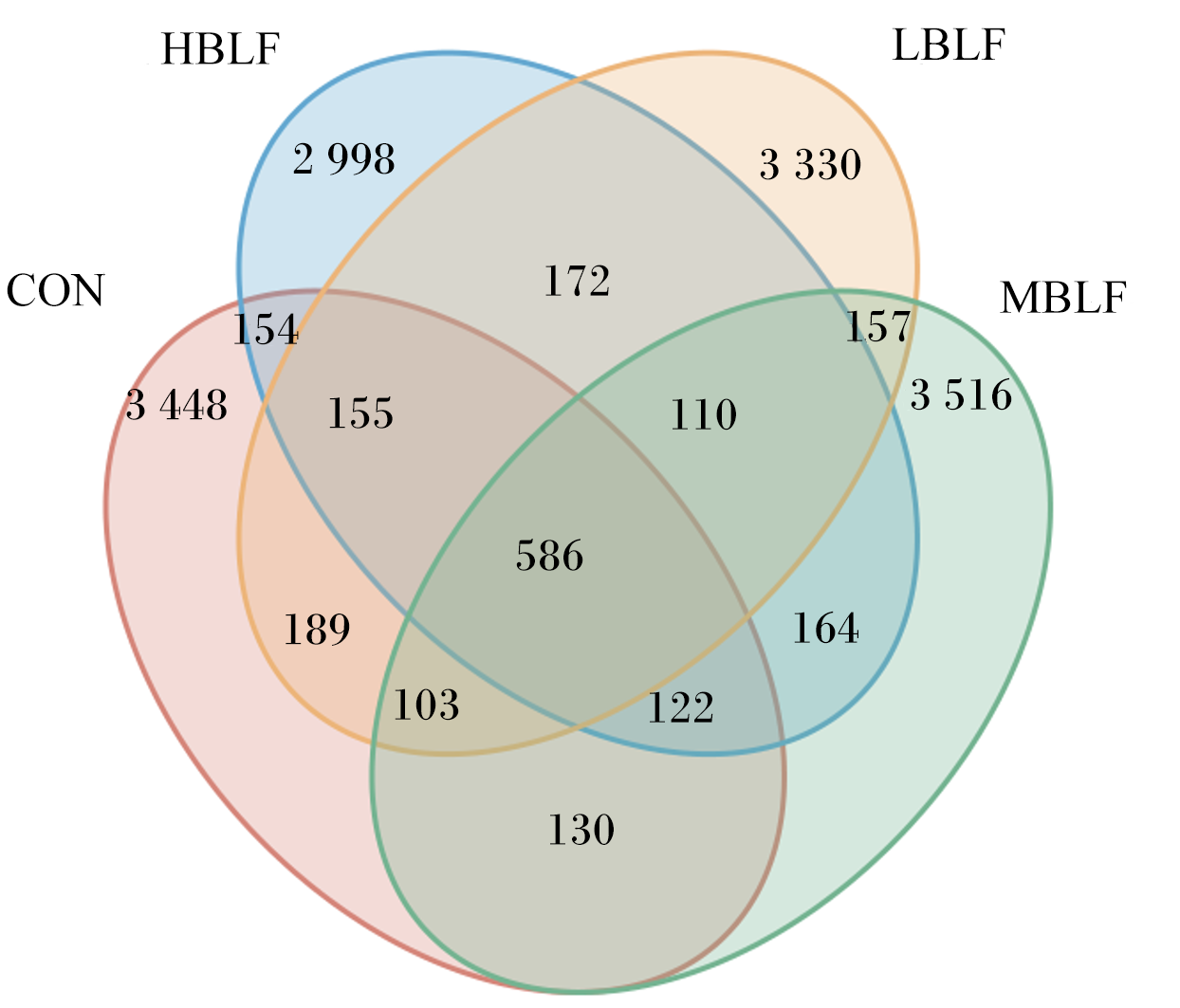
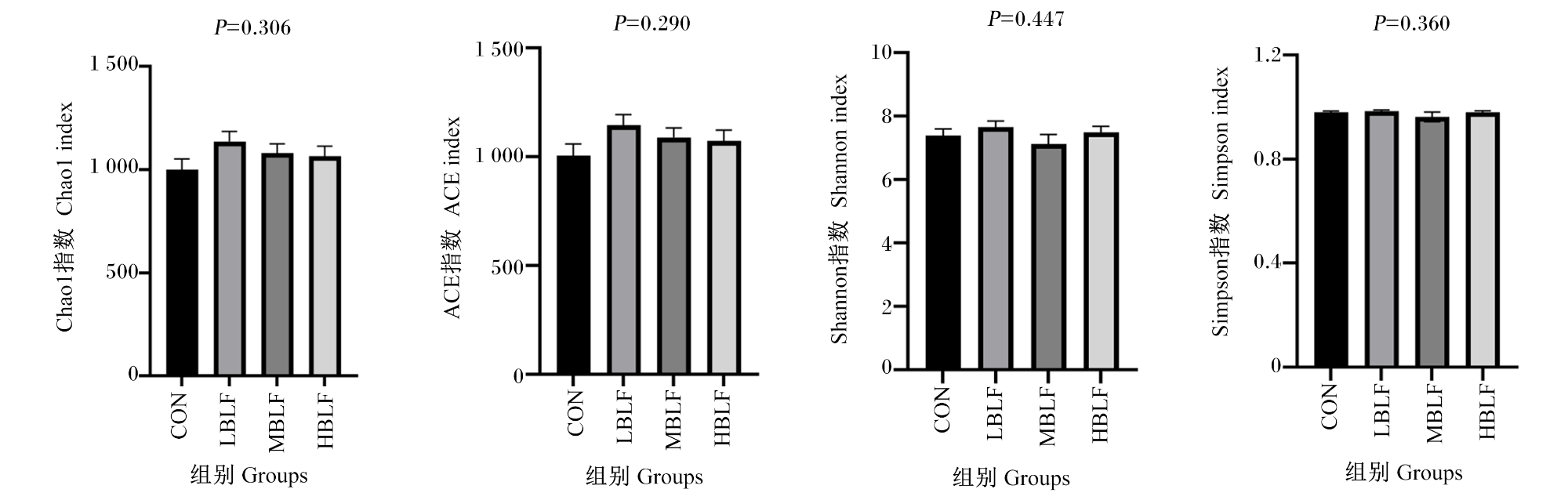
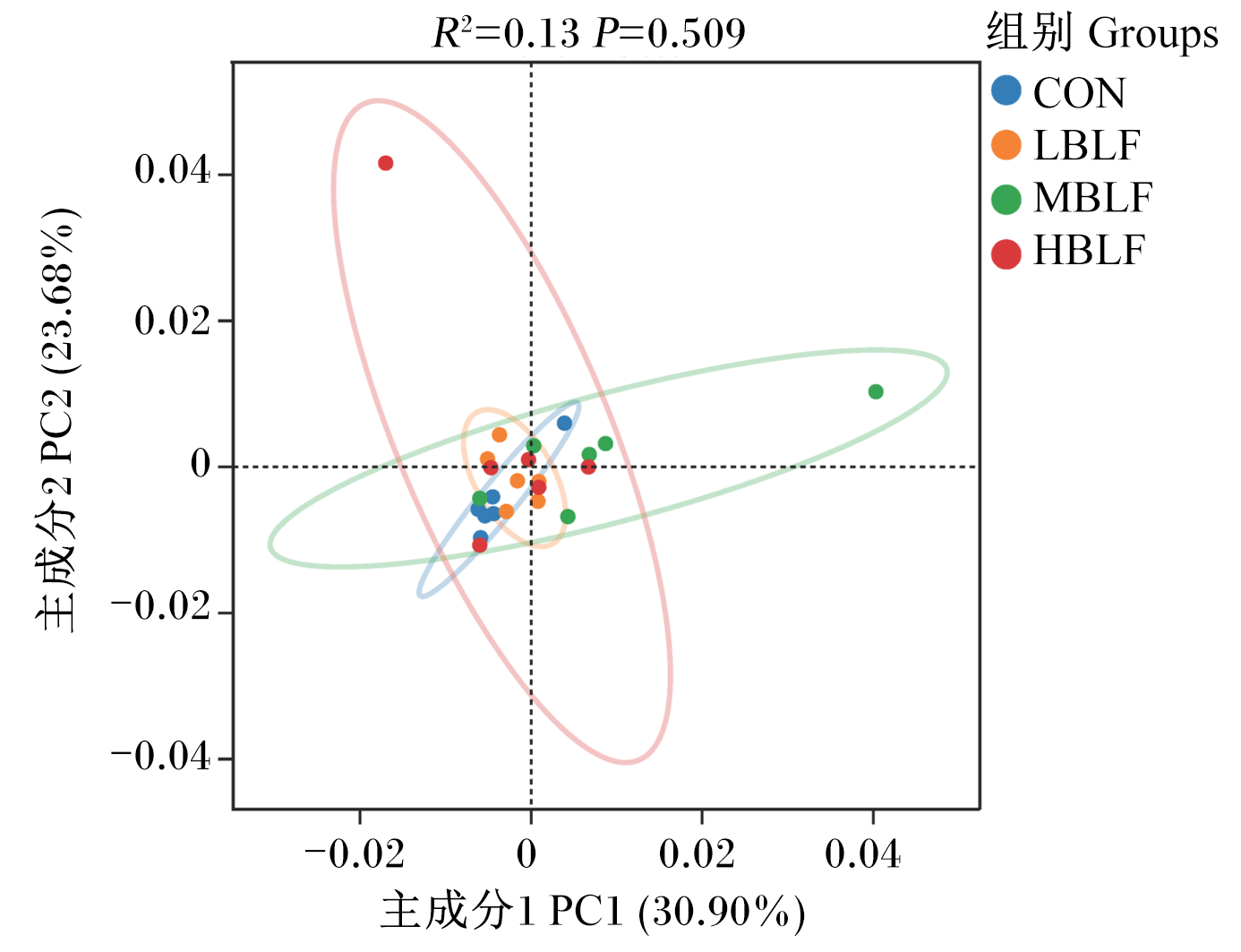
图1可知,4组育肥猪盲肠菌群共有OTU数目为586个;CON组、LBLF组、MBLF组和HBLF组特有OTU数目分别为3 448、3 330、3 516和2 998个。α多样性指数可反映微生物群落的物种丰富度、均匀度与稳定性,由图2可知,饲粮中添加不同水平竹叶黄酮对育肥猪盲肠菌群Chao1指数、ACE指数、Shannon指数及Simpson指数均无显著影响(P>0.05);但与CON组相比,LBLF组Chao1指数、ACE指数分别提升了13.8%、13.6%。β多样性用于表征不同样本间的群落物种组成差异,主成分分析结果(图3)显示,4组育肥猪盲肠菌群聚类明显,置换多元方差分析(PERMANOVA)检验结果显示组间整体菌群结构无显著差异(P>0.05);相较于LBLF组和HBLF组,MBLF组与CON组样本距离更远,说明MBLF组与CON组菌群结构组成差异更大。
图1 韦恩图

Fig.1 Venn diagram

CON:CON组 CON group;LBLF:LBLF组 LBLF group;MBLF:MBLF组 MBLF group;HBLF:HBLF组 HBLF group。下图同 the same as below。

图2 α多样性指数

Fig.2 α diversity indexes

图3 主成分分析

Fig.3 Principal component analysis

2.6 竹叶黄酮对育肥猪盲肠菌群结构的影响

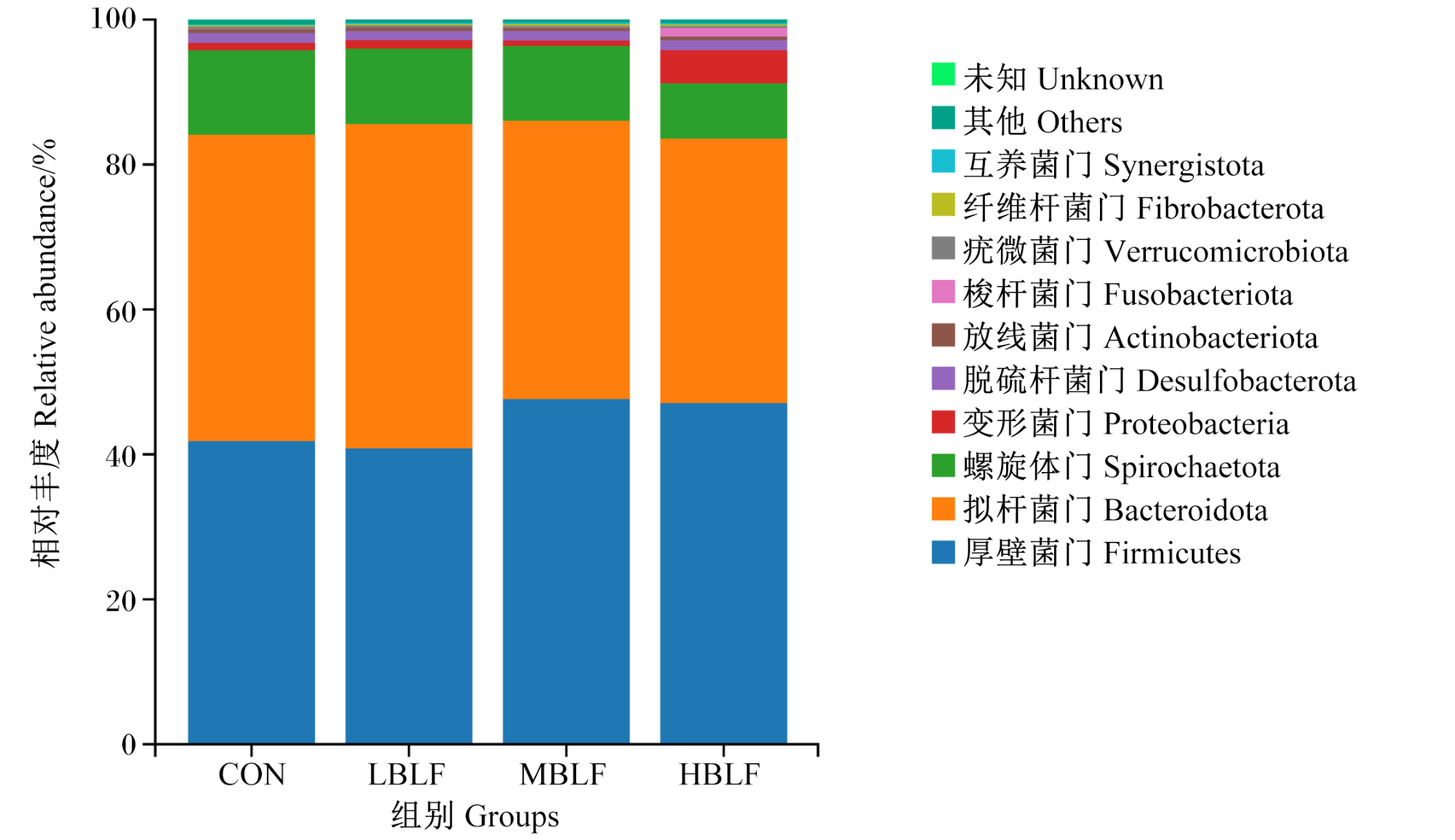
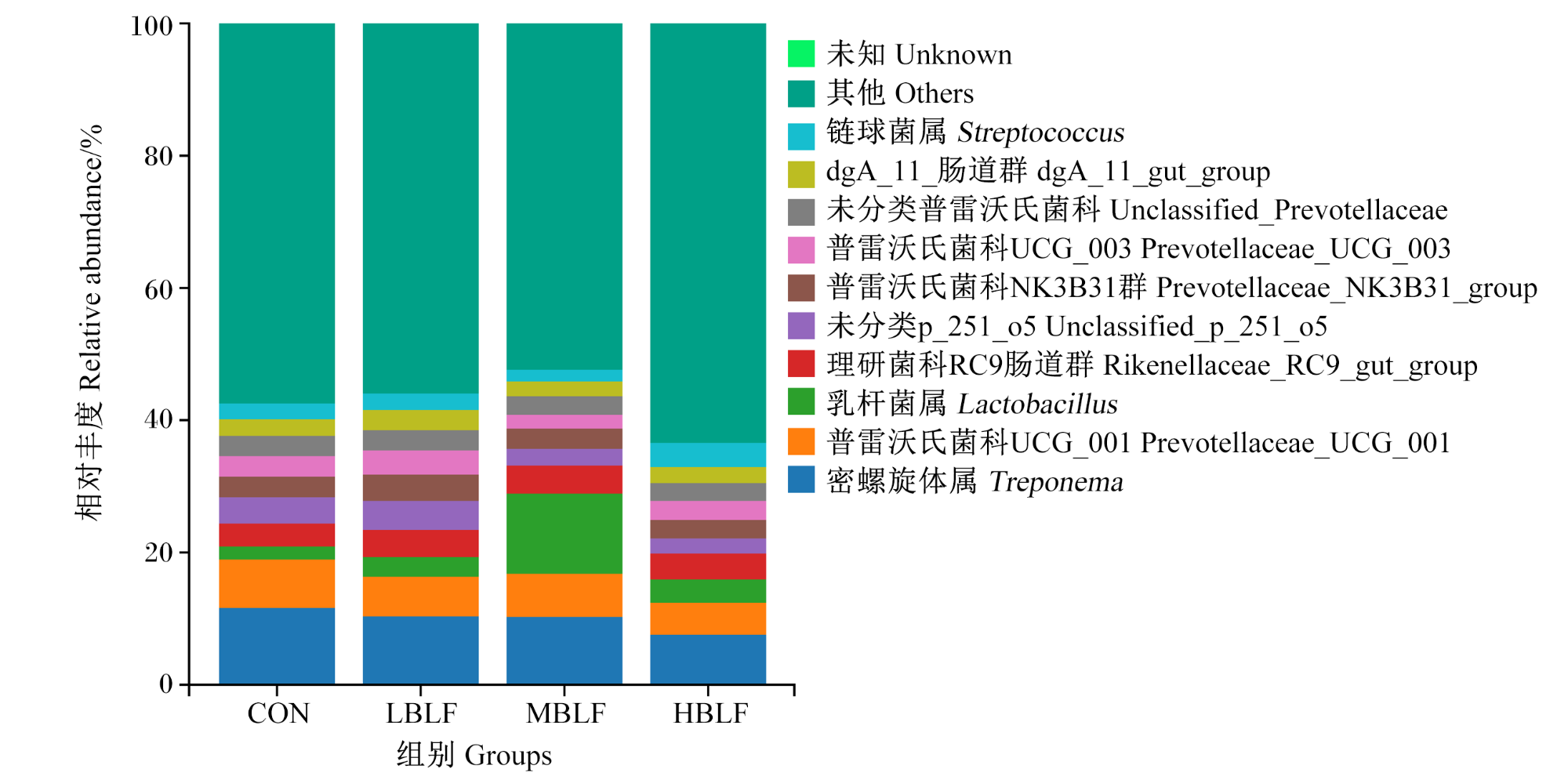
图4可知,在门水平上,4组育肥猪盲肠优势菌门为厚壁菌门(Firmicutes)、拟杆菌门(Bacteroidota)与螺旋体门(Spirochaetota)。由表6可知,与CON组相比,MBLF组和HBLF组盲肠厚壁菌门相对丰度显著提高(P<0.05);各组盲肠拟杆菌门、螺旋体门相对丰度无显著差异(P>0.05)。由图5可知,在属水平上,密螺旋体属(Treponema)、普雷沃氏菌科UCG-001(Prevotellaceae_UCG_001)、乳杆菌属(Lactobacillus)、理研菌属RC9肠道群(Rikenellaceae_RC9_gut_group)为主要菌属。由表6可知,与CON组相比,MBLF组盲肠乳杆菌属相对丰度显著提高(P<0.05);HBLF组盲肠密螺旋体属相对丰度降低,但差异不显著(P>0.05)。
图4 盲肠菌群门水平组成

Fig.4 Composition of caecal microbiota at phylum level

图5 盲肠菌群属水平组成

Fig.5 Composition of caecal microbiota at genus level

表6 竹叶黄酮对育肥猪盲肠菌群相对丰度的影响

Table 6 Effects of bamboo leaf flavonoids on relative abundance of cecal microbiota of finishing pigs

项目
Items
组别Groups 均值
标准误
SEM
PP-value
CON LBLF MBLF HBLF 方差分析
ANOVA
线性
Linear
二次
Quadratic
厚壁菌门Firmicutes 40.10b 40.47b 47.33a 46.52a 1.152 0.026 0.008 0.770
拟杆菌门Bacteroidota 42.68 44.96 38.29 37.45 1.818 0.429 0.185 0.673
螺旋体门Spirochaetota 12.20 10.59 10.32 8.16 1.286 0.767 0.315 0.918
密螺旋体属Treponema 12.12 10.52 10.27 8.08 1.290 0.767 0.315 0.945
普雷沃氏菌科UCG-001
Prevotellaceae_UCG_001
7.72 6.45 6.56 5.14 1.011 0.863 0.863 0.432
乳杆菌属Lactobacillus 1.78b 2.99b 11.68a 3.65b 1.430 0.046 0.219 0.082
理研菌科RC9肠道群
Rikenellaceae_RC9_gut_group
3.48 4.13 4.31 4.08 0.257 0.720 0.422 0.420

3 讨论

3.1 竹叶黄酮对育肥猪生长性能和胴体性状的影响

生长性能是衡量畜禽养殖经济效益的核心指标,其中料重比可直观反映动物生产效率。Wu等[7]研究报道,饲粮中添加1 000 mg/kg竹叶黄酮可显著提升肉鸡末重和平均日增重,降低料重比;另有研究证实,竹叶黄酮可改善断奶仔猪日增重,提升饲料转化率[6]。但也有研究显示竹叶黄酮对蛋鸡产蛋率、平均日采食量和料蛋比等生产性能指标无显著影响[9];此外,Yu等[10]和Zhang等[11]的研究也表明,饲喂竹叶提取物对哺乳仔猪和断奶仔猪平均日增重均无显著影响。本试验中,饲粮中添加0.05%~0.15%竹叶黄酮对育肥猪平均日增重和平均采食量均无显著影响,与前人对于蛋鸡和仔猪的研究结果基本一致。值得注意的是,与CON组相比,饲粮中添加0.10%竹叶黄酮后育肥猪料重比呈下降趋势,表明添加适宜水平竹叶黄酮可在一定程度上改善育肥猪的饲料利用率。胴体性状是衡量猪产肉性能与屠宰品质的重要标尺,核心指标包括胴体重、屠宰率、眼肌面积和背膘厚等。于倩芸等[12]研究发现,饲粮中添加1或2 g/kg竹叶提取物能提高肉鸡的屠宰率、半净膛率、全净膛率、胸肌率及腿肌率,但本试验中饲粮添加0.05%~0.15%竹叶黄酮对育肥猪胴体性状无显著影响,该结果差异可能源于试验动物品种及活性物质添加水平的不同。

3.2 竹叶黄酮对育肥猪肉品质的影响

肉品质是决定猪肉价值的重要因素,肉品质指标主要包括pH、肉色、滴水损失、剪切力和肌内脂肪含量等[13]。Shen等[14]发现,饲粮中添加1.0~5.0 g/kg竹叶提取物可显著降低肉鸡胸肌剪切力,添加3.0~4.0 g/kg竹叶提取物可显著降低胸肌滴水损失率及提高宰后45 min胸肌pH。Cao等[15]研究表明,饲粮中添加50和250 mg/kg竹叶黄酮均能显著提升肉鸡胸肌红度(a*)值和饱和度(c*)值以及腿肌系水力和c*值。本试验结果显示,饲粮中添加0.05%~0.15%竹叶黄酮对育肥猪背最长肌pH、肉色、滴水损失均无显著影响;但与CON组相比,饲粮中添加0.10%竹叶黄酮可显著提升背最长肌肌内脂肪含量。肌内脂肪含量是影响猪肉嫩度、风味与多汁性的重要指标,由此说明添加适宜水平竹叶黄酮可改善猪肉品质。

3.3 竹叶黄酮对育肥猪血清生化和抗氧化指标的影响

血清生化指标可反映动物机体代谢水平与健康状况。Shen等[16]研究发现,饲粮中添加2.0~4.0 g/kg竹叶提取物可显著降低肉仔鸡血清TG和低密度脂蛋白胆固醇含量。但本试验发现,饲粮中添加0.05%~0.15%竹叶黄酮对育肥猪各项血清生化指标均无显著影响,表明竹叶黄酮对猪健康状况无负面作用。T-AOC及SOD、GSH-Px、CAT活性和MDA含量是评估机体抗氧化能力的重要指标[17-18]。竹叶黄酮具有清除羟自由基及1,1-二苯基-2-三硝基苯肼自由基(DPPH)的能力,可缓解机体氧化损伤、提升抗氧化酶活性[19-21]。Cao等[15,22]研究发现,饲粮中添加竹叶黄酮可显著降低肉鸡血清和胸肌MDA含量,提高血清CAT活性和T-AOC,增强胸肌SOD和GSH-Px活性。Zhou等[23]及Xie等[24]的研究也表明,饲粮中添加竹叶黄酮能显著提升肉鸡血清和小肠抗氧化酶活性,改善机体抗氧化水平。Yu等[10]研究证实,竹叶提取物可显著提高哺乳仔猪小肠和肝脏抗氧化酶活性以及抗氧化相关基因表达水平。本试验中,与CON组相比,饲粮中添加0.10%和0.15%竹叶黄酮均可显著提高血清SOD活性,显著降低血清MDA含量,添加0.05%竹叶黄酮则可显著提高血清T-AOC,与前人报道基本相符,表明饲粮中添加适宜水平竹叶黄酮可以提高育肥猪的抗氧化能力。

3.4 竹叶黄酮对育肥猪盲肠菌群的影响

动物机体健康与肠道菌群的群落结构、物种丰富度及多样性水平密切相关。体外试验证明,竹叶黄酮具有一定的抑菌、抗菌活性,能够抑制多种病原菌的生长[25]。多项体内试验也证实,竹叶黄酮能提高动物肠道菌群多样性,增加肠道有益菌相对丰度。例如,Shen等[26]研究表明,饲粮中添加竹叶黄酮可缓解脂多糖诱导的老龄蛋鸡肠道损伤,显著下调盲肠迷踪菌门(Elusimicrobiota)、疣微菌门(Verrucomicrobiota)相对丰度,同时上调乳杆菌属、拟杆菌目(Bacteroidales)相对丰度;Shu等[27]研究表明,饲粮中添加竹叶黄酮可重塑肉鸡肠道菌群结构,显著提高乳杆菌属、梭菌目(Clostridiales)、瘤胃球菌属(Ruminococcus)、毛螺菌科(Lachnospiraceae)相对丰度;Wang等[28]研究表明,饲粮中添加竹叶提取物可改变伊犁马粪便微生物组成,显著提高UCG-002、NK4A214群(NK4A214_group)相对丰度,降低广古菌门(Euryarchaeota)、疣微菌门、甲烷杆菌科(Methanobacteriaceae)、甲烷短杆菌属(Methanobrevibacter)相对丰度;另有研究表明,饲喂竹叶提取物能够提高热应激奶牛瘤胃细菌丰度与群落多样性[5]。本试验中,与CON组相比,饲粮中添加0.10%竹叶黄酮显著提高了育肥猪盲肠厚壁菌门和乳杆菌属相对丰度。厚壁菌门为动物肠道优势菌门,包含梭菌属(Clostridium)、乳杆菌属、芽孢杆菌属(Bacillus)等多种有益菌属,已有研究证实,提升厚壁菌门/拟杆菌门比值有利于维护仔猪肠道健康、改善生长性能[29]。乳杆菌属具有维持肠道免疫稳态、改善营养物质消化吸收、缓解机体氧化应激等作用[30],还能够参与调控宿主脂质代谢[31]。Yang等[32]发现,罗伊氏乳杆菌(Lactobacillus reuteri)可通过支链氨基酸代谢通路,显著提高“杜长大”猪背最长肌肌内脂肪含量;Yao等[33]研究也表明,补充乳杆菌制剂可显著提高戈壁羊背最长肌肌内脂肪含量。本试验中,添加0.10%竹叶黄酮同时上调盲肠乳杆菌属相对丰度与背最长肌肌内脂肪含量,提示竹叶黄酮可能通过富集乳杆菌属等有益菌群来优化肠道微生态,进而影响机体脂质代谢,提高猪肉肌内脂肪含量。

4 结论

饲粮中添加适宜水平竹叶黄酮能改善猪肉品质,增强机体抗氧化能力,并增加盲肠乳杆菌属相对丰度。综合本试验所测各项指标结果,推荐育肥猪饲粮中竹叶黄酮的添加水平为0.10%。
[1]
王东霞, 谢静华, 袁亚, 等. 竹叶粉的食用安全性评价[J]. 中国食品卫生杂志, 2023, 35(5):717-722.

WANG D X, XIE J H, YUAN Y, et al. Food safety assessment of bamboo leaf powder[J]. Chinese Journal of Food Hygiene, 2023, 35(5):717-722. (in Chinese)

[2]
张英. 竹叶黄酮的生理与药理活性[J]. 世界竹藤通讯, 2004, 2(2):1-11.

ZHANG Y. Bamboo leave flavone physiology and pharmacological activity[J]. World Bamboo and Rattan, 2004, 2(2):1-11. (in Chinese)

[3]
CHENG Y Q, WAN S Q, YAO L N, et al. Bamboo leaf:a review of traditional medicinal property,phytochemistry,pharmacology,and purification technology[J]. Journal of Ethnopharmacology, 2023, 306:116166.

DOI

[4]
栗明月. 竹叶提取物对奶牛瘤胃发酵、血液中抗氧化酶、免疫球蛋白及炎性因子的影响[D]. 硕士学位论文. 北京: 北京农学院, 2019.

LI M Y. Effects of bamboo leaf extract on rumen fermentation,antioxidant enzymes,immunoglobulins and inflammatory factors in the blood of dairy cows[D]. Master’s Thesis. Beijing: Beijing University of Agriculture, 2019. (in Chinese)

[5]
LI Y, FANG L Y, XUE F G, et al. Effects of bamboo leaf extract on the production performance,rumen fermentation parameters,and rumen bacterial communities of heat-stressed dairy cows[J]. Animal Bioscience, 2021, 34(11):1784-1793.

DOI

[6]
张金枝, 邵庆均, 吴晓琴, 等. 竹叶黄酮对断奶仔猪生产性能的影响[J]. 中国畜牧杂志, 2003, 39(1):25-26.

ZHANG J Z, SHAO Q J, WU X Q, et al. Effect of bamboo leaf flavonoids on the production performance of weaned piglets[J]. Chinese Journal of Animal Science, 2003, 39(1):25-26. (in Chinese)

[7]
WU C, MA H, LU S W, et al. Effects of bamboo leaf flavonoids on growth performance,antioxidants,immune function,intestinal morphology,and cecal microbiota in broilers[J]. Journal of the Science of Food and Agriculture, 2024, 104(12):7656-7667.

DOI

[8]
阮振婷, 王留超, 吴志伟, 等. 竹叶黄酮对萧山鸡公鸡精液品质和血液生理生化指标的影响[J]. 中国畜牧杂志, 2022, 58(3):109-114.

RUAN Z T, WANG L C, WU Z W, et al. Effects of bamboo leaf flavonoids on the semen quality and blood physiological and biochemical indicators of Xiaoshan chicken roosters[J]. Chinese Journal of Animal Science, 2022, 58(3):109-114. (in Chinese)

[9]
张硕, 李瑞萍, 叶轩, 等. 竹叶黄酮与包膜丁酸钠对仙居鸡生产性能、蛋品质和脂质代谢的影响[J]. 动物营养学报, 2023, 35(1):260-268.

DOI

ZHANG S, LI R P, YE X, et al. Effects of bamboo leaf flavonoids and coated sodium butyrate on performance,egg quality and lipid metabolism of Xianju hens[J]. Chinese Journal of Animal Nutrition, 2023, 35(1):260-268. (in Chinese)

DOI

[10]
YU G, JI S L, YUN Y, et al. Effects of bamboo leaf extract intervention on the growth performance,antioxidant capacity,and hepatic apoptosis in suckling piglets[J]. Journal of Animal Science, 2022, 100(7):skac201.

[11]
ZHANG J, WANG J, ZHANG L, et al. The effects of bamboo leaf extract on growth performance,antioxidant traits,immune function and lipid metabolism of weaning piglets[J]. Journal of Animal and Feed Sciences, 2013, 22(3):238-246.

DOI

[12]
于倩芸, 贾喻杰, 郭梅. 竹叶提取物对白羽肉鸡生长性能、胴体性能及经济效益的影响[J]. 饲料工业, 2024, 45(24):36-41.

YU Q Y, JIA Y J, GUO M. The effects of bamboo leaf extract on growth performance,carcass performance,and economic benefits of white-feathered broilers[J]. Feed Industry, 2024, 45(24):36-41. (in Chinese)

[13]
PANDEY S, KIM S, KIM E S, et al. Exploring the multifaceted factors affecting pork meat quality[J]. Journal of Animal Science and Technology, 2024, 66(5):863-875.

DOI PMID

[14]
SHEN M M, ZHANG L L, CHEN Y N, et al. Effects of bamboo leaf extract on growth performance,meat quality,and meat oxidative stability in broiler chickens[J]. Poultry Science, 2019, 98(12):6787-6796.

DOI

[15]
CAO G T, WANG H X, YU Y, et al. Dietary bamboo leaf flavonoids improve quality and microstructure of broiler meat by changing untargeted metabolome[J]. Journal of Animal Science and Biotechnology, 2023, 14(1):52.

DOI PMID

[16]
SHEN M M, XIE Z C, JIA M H, et al. Effect of bamboo leaf extract on antioxidant status and cholesterol metabolism in broiler chickens[J]. Animals, 2019, 9(9):699.

DOI

[17]
LAURIDSEN C. From oxidative stress to inflammation:redox balance and immune system[J]. Poultry Science, 2019, 98(10):4240-4246.

DOI

[18]
TEMPLE N J. Antioxidants and disease:more questions than answers[J]. Nutrition Research, 2000, 20(3):449-459.

DOI

[19]
GONG J Y, XIA D Z, HUANG J, et al. Functional components of bamboo shavings and bamboo leaf extracts and their antioxidant activities in vitro[J]. Journal of Medicinal Food, 2015, 18(4):453-459.

DOI

[20]
YUAN J J, LI Y, MIAO J J, et al. Bamboo leaf flavonoids ameliorate cyclic heat stress-induced oxidative damage in broiler liver through activation of Keap1-Nrf2 signaling pathway[J]. Poultry Science, 2025, 104(4):104952.

DOI

[21]
YU Y, LI Z M, CAO G T, et al. Bamboo leaf flavonoids extracts alleviate oxidative stress in HepG2 cells via naturally modulating reactive oxygen species production and Nrf2-mediated antioxidant defense responses[J]. Journal of Food Science, 2019, 84(6):1609-1620.

DOI PMID

[22]
CAO G T, YU Y, WANG H X, et al. Effects of oral administration of bamboo (Dendrocalamus membranaceus) leaf flavonoids on the antioxidant capacity,caecal microbiota, and serum metabolome of Gallus gallus domesticus[J]. Frontiers in Nutrition, 2022, 9:848532.

DOI

[23]
ZHOU Q L, ALI S, SHI X Y, et al. Protective impacts of bamboo leaf flavonoids in stressed broilers induced by diquat:insight of antioxidant,immune response and intestinal barrier function[J]. Animal Nutrition, 2025, 20:158-170.

DOI

[24]
XIE Z C, YU G, YUN Y, et al. Effects of bamboo leaf extract on energy metabolism,antioxidant capacity,and biogenesis of small intestine mitochondria in broilers[J]. Journal of Animal Science, 2023,101:skac391.

[25]
舒刚. 竹叶黄酮对肉鸡的生物效应及作用机理研究[D]. 博士学位论文. 雅安: 四川农业大学, 2015.

SHU G. Study on the biological effect and mechanism of bamboo leaf flavonoid in broilers[D]. Ph.D.Thesis. Ya’an: Sichuan Agricultural University, 2015. (in Chinese)

[26]
SHEN X Y, HUANG W C, ZHAN S N, et al. Bamboo leaf flavonoids counteract lipopolysaccharide-induced gut dysfunction in aging laying hens through microbiota and metabolic reprogramming[J]. Poultry Science, 2026, 105(2):106328.

DOI

[27]
SHU G, KONG F L, XU D, et al. Bamboo leaf flavone changed the community of cecum microbiota and improved the immune function in broilers[J]. Scientific Reports, 2020, 10(1):12324.

DOI PMID

[28]
WANG C K, WANG J W, MA B Q, et al. Effect of supplemental bamboo leaf extract on milk production,composition,biochemical indices,and fecal microbiota diversity in grazing Yili mares[J]. Life, 2025, 15(12):1928.

DOI

[29]
HAN G G, LEE J Y, JIN G D, et al. Evaluating the association between body weight and the intestinal microbiota of weaned piglets via 16S rRNA sequencing[J]. Applied Microbiology and Biotechnology, 2017, 101(14):5903-5911.

DOI PMID

[30]
SHAHALI A, SOLTANI R, AKBARI V. Probiotic Lactobacillus and the potential risk of spreading antibiotic resistance:a systematic review[J]. Research in Pharmaceutical Sciences, 2023, 18(5):468-477.

DOI

[31]
CUI X Y, YUAN Q W, LONG J L, et al. Recent advances in gut microbiota-mediated regulation of fat deposition and metabolic disorders[J]. Microbiome Research Reports, 2025, 4(3):31.

DOI

[32]
YANG M, XIE Q, WANG J, et al. Ningxiang pig-derived Lactobacillus reuteri modulates host intramuscular fat deposition via branched-chain amino acid metabolism[J]. Microbiome, 2025, 13(1):32.

DOI

[33]
YAO D, SU R, ZHANG Y, et al. Impact of dietary Lactobacillus supplementation on intramuscular fat deposition and meat quality of Sunit sheep[J]. Journal of Food Biochemistry, 2022, 46(8):e14207.

Outlines

/