RESEARCH PAPER

Effects of Dietary Supplementation with Wheatgrass-Rice Hull Meal-Corn Stover Fermented Feed on Carcass Traits, Meat Quality, Serum Antioxidant Indices and Fecal Microbiota of Finishing Pigs

  • WANG Rong , 1 ,
  • YIN Zhangzheng 1 ,
  • WANG Yongxing 1 ,
  • LI Qiuyan , 2, * ,
  • HUANG Qi 3 ,
  • WU Shusong 1, *
Expand
  • 1 Yuelushan Laboratory, College of Animal Science and Technology, Hunan Agricultural University, Changsha 410128, China
  • 2 College of Biological Sciences, China Agricultural University, Beijing 100083, China
  • 3 Hunan International Rice City Academy of Agricultural Technology, Changsha 410129, China
* LI Qiuyan, associate professor, E-mail: liqiuyan-yuan@163.com; WU Shusong, professor, E-mail:

Received date: 2026-01-21

  Online published: 2026-09-12

Abstract

This experiment was conducted to investigate effects of dietary supplementation with different proportions of wheatgrass-rice hull meal-corn stover fermented feed (WFF) on carcass traits, meat quality, serum antioxidant indices and fecal microbiota of finishing pigs. Fifteen 110-day-old “Duroc × Landrace × Yorkshire” ternary crossbred finishing pigs with an initial body weight of (58.67±3.39) kg were selected and randomly assigned to 3 groups with 5 replicates per group and 1 pig per replicate. The control (CON) group was fed a basal diet, while the other two groups were fed experimental diets supplemented with 10% (10% RG group) and 20% WFF (20% RG group), respectively. The pre-trial period lasted 7 days, and the formal trial period lasted 70 days. The results showed as follows: 1) compared with the CON group, the growth performance of the 10% RG group and the 20% RG group showed no significant differences (P>0.05). 2) Compared with the CON group, the lean meat rate, water-holding capacity of the longissimus dorsi muscle, and 45-min redness ( ${\mathit{a}}_{45\mathit{ }\mathit{m}\mathit{i}\mathit{n}}^{\mathit{*}}$) value of the 10% RG group and the 20% RG group were significantly or extremely significantly increased (P<0.05 or P<0.01). 3) On day 21, the serum catalase (CAT) activity of the 10% RG group was significantly higher than that of the CON group and the 20% RG group (P<0.05). 4) Diversity analysis showed that the ACE index and Sobs index of fecal microbiota in the 10% RG group were significantly higher than those in the CON group and the 20% RG group (P<0.05), while the overall microbial community structure of the 20% RG group was extremely significantly different from that of the CON group (P<0.01). Differential analysis of fecal microbiota revealed that the dominant phyla in all groups were Bacillota, Bacteroidota and Spirochaetota. Compared with the CON group, the relative abundances of genera such as Clostridium and Marvinbryantia in feces of the 10% RG group and the 20% RG group were significantly increased (P<0.05). In conclusion, dietary supplementation with 10% WFF has no negative effects on growth performance of finishing pigs, and can effectively increase lean meat rate, improve meat quality, and enhance gut microbiota richness, showing good application potential.

Cite this article

WANG Rong , YIN Zhangzheng , WANG Yongxing , LI Qiuyan , HUANG Qi , WU Shusong . Effects of Dietary Supplementation with Wheatgrass-Rice Hull Meal-Corn Stover Fermented Feed on Carcass Traits, Meat Quality, Serum Antioxidant Indices and Fecal Microbiota of Finishing Pigs[J]. Chinese Journal of Animal Nutrition, 2026 , 38(9) : 6565 -6576 . DOI: 10.12418/CJAN2026.526

畜牧业蓬勃发展带动饲料需求激增,与之相对的是饲料资源短缺问题日趋显著,而农副产品利用率处于较低水平,这些问题已成为制约行业可持续发展的关键因素。因此,开发利用成本低廉、来源广泛的非常规饲料资源,探索其在改善动物健康、提升产品品质方面的应用潜力,具有重要现实意义[1]
禾本科小麦属植物小麦的嫩茎叶,通常被称为小麦草,其营养价值丰富,富含蛋白质、氨基酸、矿物质、维生素、活性酶及叶绿素等成分[2]。近年来,凭借种植简便、营养全面、生长周期短的优势,被广泛应用于人体保健食品及动物饲料领域[3]。发酵作为一种经济高效的饲料改性技术,可有效改善非常规饲料适口性差、营养价值低及营养成分易损失等问题[4],进而提升动物的生长性能[5]。郭惠敏等[6]研究表明,发酵麦麸对育肥猪肠道菌群具有调控效应,可显著提升肠道有益菌群相对丰度,降低有害菌群相对丰度。Zhu等[7]研究发现,育肥后期用苜蓿发酵饲料替代部分饲粮,可改善育肥猪血清生化及抗氧化指标、优化盲肠菌群,促进整体健康。
然而,现有发酵饲料多以麦麸、苜蓿、菜籽粕等为原料,虽各有优势,但针对小麦草这一高营养、易种植的非常规原料,经复合菌剂发酵制成的发酵饲料研究较少。该饲料兼具小麦草的营养优势与发酵工艺的改性价值,可丰富发酵饲料原料种类,且目前关于其在育肥猪饲粮中的应用效果、适宜添加比例均缺乏系统性评估。因此,本试验旨在以“杜×长×大”三元杂交育肥猪为试验对象,探讨饲粮添加10%和20%小麦草-统糠-玉米秸秆发酵饲料(WFF)对猪的胴体性状、肉品质、血清抗氧化指标及粪便菌群的影响,旨在综合评价WFF在育肥猪生产中的应用效果,为WFF在育肥猪养殖中的规模化应用提供借鉴。

1 材料与方法

1.1 试验材料

本试验所用WFF以新鲜小麦嫩茎叶、玉米粉为主要原料,搭配统糠、玉米秸秆等其他原料,接种复合菌剂(乳酸菌≥1.0×10⁸ CFU/g、枯草芽孢杆菌≥1.0×108 CFU/g、酿酒酵母≥5.0×107 CFU/g),经28~32 ℃固态发酵15 d制成。WFF组成及营养水平见表1
表1 小麦草-统糠-玉米秸秆发酵饲料组成及营养水平(风干基础)

Table 1 Composition and nutrient levels of WFF (air-dry basis)

项目Items 含量Content
原料Ingredients
小麦草Wheatgrass 30.00
玉米粉Corn flour 38.00
菜籽粕Rapeseed meal 12.00
统糠Rice hull meal 12.99
玉米秸秆Corn stover 5.00
碳酸钙CaCO3 1.50
硫酸铵(NH4)2SO4 0.50
复合菌剂Compound microbial agent 0.01
合计Total 100.00
营养水平Nutrient levels
总能GE/(MJ/kg) 16.25
粗蛋白质CP 17.83
粗脂肪EE 14.32
粗纤维CF 22.11

营养水平均为实测值。

Nutrient levels were measured values.

1.2 试验设计及饲粮

动物试验经湖南农业大学动物管理与使用委员会审查批准(批准号:20250619)。
选取15头初始体重为(58.67±3.39) kg的110日龄“杜×长×大”三元杂交育肥猪,随机分为3组,每组设5个重复,每个重复1头猪。对照(CON)组饲喂基础饲粮,其他2组分别饲喂添加10%(10% RG组)、20% WFF(20% RG组)的试验饲粮。预试期7 d,正试期70 d。基础饲粮参照NRC(2012)猪营养需要标准配制,各组饲粮组成及营养水平见表2
表2 饲粮组成及营养水平(风干基础)

Table 2 Composition and nutrient levels of diets (air-dry basis)

项目
Items
组别Groups
CON 10% RG 20% RG
原料Ingredients
东北玉米Northeast corn 69.13 67.37 59.46
豆粕(43%粗蛋白质) Soybean meal (43% CP) 18.60 17.20 16.00
麸皮Wheat bran 3.60 1.60
豆油Soybean oil 0.58
米糠(粗脂肪≥15%) Rice bran (EE≥15%) 5.00
小麦草-统糠-玉米秸秆发酵饲料WFF 10.00 20.00
细石粉Fine limestone 1.20 1.20 1.20
磷酸氢钙CaHPO4 0.50 0.50 0.50
L-赖氨酸L-Lys (70%) 0.67 0.77 0.83
预混料Premix (0.10%)1) 0.50 0.50 0.50
食盐NaCl 0.42 0.42 0.42
蛋氨酸Met (99%) 0.10 0.10 0.10
苏氨酸Thr (98%) 0.15 0.16 0.17
氯化胆碱Choline chloride (50%) 0.05 0.05 0.05
耐高温植酸酶Thermostable phytase 0.01 0.01 0.01
防霉剂Mold inhibitor 0.05 0.10 0.15
抗氧化剂Antioxidant 0.02 0.02 0.03
合计Total 100.00 100.00 100.00
营养水平Nutrient levels2)
总能GE/(MJ/kg) 18.27 18.16 18.03
消化能DE/(MJ/kg) 13.48 13.65 13.51
粗蛋白质CP 15.27 15.45 16.06
粗灰分Ash 4.86 4.88 5.49
钙Ca 0.66 0.68 0.74
总磷TP 0.41 0.40 0.46
赖氨酸Lys 1.06 1.03 1.00
蛋氨酸Met 0.33 0.30 0.29
苏氨酸Thr 0.63 0.59 0.57

1)预混料为每千克饲粮提供 The premix provided the following per kg of diets:VA 9 000 IU,VE 28 IU,VD3 2 800 IU,VK3 2.5 mg,VB1 2.2 mg,VB2 6.8 mg,VB6 4.2 mg,VB12 0.025 mg,D-泛酸 D-pantothenic acid 13 mg,Cu (as basic copper chloride) 9 mg,Zn (as zinc oxide) 100 mg,Fe (as ferrous sulfate) 100 mg,I (as potassium iodide) 0.3 mg,Se (as sodium selenite) 0.3 mg。

2)消化能、氨基酸为计算值,根据《中国饲料成分及营养价值表(2020年第31版)》计算,其余为实测值。DE and amino acids were calculated values according to the Tables of Feed Composition and Nutritive Values in China (31st edition, 2020), while the others were measured values.

1.3 饲养管理

饲养试验于2025年7月13日至2025年9月29日在湖南农业大学动物科学实验中心进行,试验猪饲养于恒温恒湿试验舍,采用单笼饲养,环境条件均一。试验猪自由采食和饮水,每天分别于08:00和16:00进行饲喂。持续监测并记录猪群健康状况与采食动态,猪舍环境参数维持稳定,温度18~25 ℃,相对湿度60%~70%。

1.4 样品采集及测定指标

1.4.1 WFF和饲粮营养成分

WFF和饲粮中总能(GE)、粗蛋白质(CP)含量分别参照GB/T 45104—2024、GB/T 6432—2018的方法进行测定,WFF中粗脂肪(EE)、粗纤维(CF)含量分别参照GB/T 6433—2006、GB/T 6434—2022的方法进行测定,饲粮中钙(Ca)、总磷(TP)、粗灰分(Ash)含量分别参照GB/T 6436—2018、GB/T 6437—2018、GB/T 6438—2007的方法进行测定。

1.4.2 生长性能

正试期第1天和第70天,经12 h空腹后对所有育肥猪称重,分别获得初始体重(IBW)和终末体重(FBW)。试验期间每天记录每头猪的给料量与余料量,同时持续观察并记录其食欲及精神状态以评估健康情况。根据称重及采食量数据,计算平均日增重(ADG)、平均日采食量(ADFI)以及料重比(F/G)。

1.4.3 胴体性状及肉品质

正试期第70天,经12 h空腹后对所有育肥猪进行屠宰,操作过程严格按照国家标准《畜禽屠宰操作规程 生猪》(GB/T 17236—2019)执行,屠宰率、瘦肉率、肥肉率、皮率、胴体直长、胴体斜长及平均背膘厚等胴体性状指标均参照《瘦肉型猪胴体性状测定技术规范》(NY/T 825—2004)的方法进行测定与计算;取背最长肌测定蒸煮损失、系水力、滴水损失、剪切力、45 min和24 h的pH与肉色等肉品质相关指标,测定方法参照《猪肉品质测定技术规程》(NY/T 821—2019)。

1.4.4 血清抗氧化指标

正试期第21天和第42天,经12 h空腹后对所有育肥猪进行前腔静脉采血10 mL,采血管在室温条件下静置30 min,在4 ℃条件下以1 095×g离心15 min,获取上层血清分装至2 mL无菌冻存管,放-20 ℃冰箱保存备用。血清抗氧化指标包括总超氧化物歧化酶(T-SOD)、过氧化氢酶(CAT)、谷胱甘肽过氧化物酶(GPX)活性和丙二醛(MDA)含量及总抗氧化能力(T-AOC),所有指标均使用来自武汉赛维尔生物科技有限公司的检测试剂盒测定,严格遵循试剂盒说明书的要求操作。

1.4.5 粪便菌群

正试期第70天,采集所有育肥猪的新鲜粪便,立即装入50 mL的无菌离心管中,置于干冰中低温运输至实验室。取粪便样品分装于2 mL无菌冻存管,委托上海美吉生物医药科技有限公司完成16S rRNA基因高通量测序。采用Omega Soil DNA提取试剂盒(Omega Bio-Tek,美国)提取粪便总DNA并完成PCR扩增,经DNA质检、Illumina文库构建及平台测序后,对原始序列进行质控、过滤和双端拼接获得优化数据,降噪后得到扩增子序列变体(ASVs)代表序列及丰度信息。粪便菌群的多样性、物种组成及组间差异分析均通过美吉生物云平台完成。

1.5 数据处理及分析

试验数据使用Excel 2019记录整理,采用SPSS 26.0统计软件进行单因素方差分析(one-way ANOVA),并结合Duncan氏法进行组间多重比较。结果数据以“平均值±标准差”表示,P<0.01表示差异极显著,P<0.05表示差异显著,0.05≤P<0.10表示差异有显著的趋势。

2 结果与分析

2.1 WFF对育肥猪生长性能的影响

表3可知,各组间IBW、FBW、ADG、ADFI及F/G均无显著差异(P>0.05)。
表3 小麦草-统糠-玉米秸秆发酵饲料对育肥猪生长性能的影响

Table 3 Effects of WFF on growth performance of finishing pigs

项目
Items
组别Groups P
P-value
CON 10% RG 20% RG
初始体重IBW/kg 60.20±1.86 57.60±5.07 58.20±3.05 0.505
终末体重FBW/kg 115.54±6.83 118.06±7.64 115.38±6.55 0.799
平均日增重ADG/(kg/d) 0.72±0.09 0.81±0.12 0.81±0.13 0.455
平均日采食量ADFI/(kg/d) 2.66±0.05 2.53±0.25 2.51±0.10 0.278
料重比F/G 3.31±0.52 2.89±0.26 3.37±0.29 0.170

同行数据肩标无字母或相同小写字母表示差异不显著(P>0.05),不同小写字母表示差异显著(P<0.05),不同大写字母表示差异极显著(P<0.01)。下表同。

In the same row, values with no letter or the same small letter superscripts mean no significant difference (P>0.05), while with different small letter superscripts mean significant difference (P<0.05), and with different capital letter superscripts mean extremely significant difference (P<0.01). The same as below.

2.2 WFF对育肥猪胴体性状的影响

表4可知,与CON组相比,10% RG组、20% RG组瘦肉率显著提高(P<0.05)。各组间屠宰率、肥肉率、皮率、胴体直长、胴体斜长及平均背膘厚均无显著差异(P>0.05)。
表4 小麦草-统糠-玉米秸秆发酵饲料对育肥猪胴体性状的影响

Table 4 Effects of WFF on carcass traits of finishing pigs

项目
Items
组别Groups P
P-value
CON 10% RG 20% RG
屠宰率Slaughter rate/% 78.56±1.51 77.13±2.81 77.06±0.89 0.406
瘦肉率Lean meat rate/% 56.74±2.83b 60.46±1.41a 60.24±1.60a 0.041
肥肉率Fat rate/% 21.42±3.96 18.50±4.78 18.29±1.47 0.354
皮率Skin rate/% 7.77±0.50 8.03±0.84 8.34±0.53 0.397
胴体直长Carcass straight length/cm 102.16±5.25 106.20±5.26 103.24±2.79 0.383
胴体斜长Carcass diagonal length/cm 92.86±5.02 96.50±3.64 93.82±2.80 0.348
平均背膘厚Average back fat thickness/cm 2.42±0.42 2.44±0.50 2.26±0.33 0.766

2.3 WFF对育肥猪肉品质的影响

表5可知,与CON组相比,10% RG组、20% RG组背最长肌系水力极显著提高(P<0.01);10% RG组、20% RG组背最长肌45 min红度( ${\mathit{a}}_{45\mathit{ }\mathit{m}\mathit{i}\mathit{n}}^{\mathit{*}}$)值显著提高(P<0.05)。各组间其他肉品质指标如蒸煮损失、滴水损失、剪切力、pH45 min等均无显著差异(P>0.05)。
表5 小麦草-统糠-玉米秸秆发酵饲料对育肥猪肉品质的影响

Table 5 Effects of WFF on meat quality of finishing pigs

项目
Items
组别Groups P
P-value
CON 10% RG 20% RG
蒸煮损失Cooking loss/% 26.52±2.94 30.14±1.93 26.09±2.63 0.082
系水力Water-holding capacity/% 5.22±0.70Bb 7.03±0.75Aa 6.31±0.18Aa 0.005
滴水损失Drip loss/% 4.91±1.96 3.95±0.76 3.99±1.51 0.536
剪切力Shear force/N 86.58±22.40 88.00±20.67 68.17±10.24 0.211
pH45 min 6.86±0.24 6.64±0.26 6.73±0.21 0.371
pH24 h 5.56±0.03 5.55±0.04 5.51±0.06 0.153
肉色Meat color
45 min亮度 ${\mathit{L}}_{45\mathit{ }\mathit{m}\mathit{i}\mathit{n}}^{\mathit{*}}$ 38.37±0.94 38.17±0.75 38.83±1.34 0.601
45 min红度 ${\mathit{a}}_{45\mathit{ }\mathit{m}\mathit{i}\mathit{n}}^{\mathit{*}}$ 1.81±0.74b 4.35±1.28a 4.44±1.50a 0.016
45 min黄度 ${\mathit{b}}_{45\mathit{ }\mathit{m}\mathit{i}\mathit{n}}^{\mathit{*}}$ 3.58±1.26 3.86±1.55 2.90±1.16 0.520
24 h亮度 ${\mathit{L}}_{24\mathit{ }\mathit{h}}^{\mathit{*}}$ 48.68±2.30 48.87±2.39 47.42±3.19 0.653
24 h红度 ${\mathit{a}}_{24\mathit{ }\mathit{h}}^{\mathit{*}}$ -0.07±1.13 0.06±1.48 -0.94±1.92 0.596
24 h黄度 ${\mathit{b}}_{24\mathit{ }\mathit{h}}^{\mathit{*}}$ 9.14±0.72 10.23±0.68 9.58±1.74 0.476

2.4 WFF对育肥猪血清抗氧化指标的影响

表6可知,第21天,10% RG组血清CAT活性显著高于CON组和20% RG组(P<0.05);与CON组相比,10% RG组、20% RG组血清GPX活性有下降的趋势(0.05≤P<0.10);各组间血清T-AOC、T-SOD活性及MDA含量均无显著差异(P>0.05)。第42天,各组间血清抗氧化指标均无显著差异(P>0.05)。
表6 小麦草-统糠-玉米秸秆发酵饲料对育肥猪血清抗氧化指标的影响

Table 6 Effects of WFF on serum antioxidant indices of finishing pigs

项目
Items
组别Groups P
P-value
CON 10% RG 20% RG
第21天Day 21
总抗氧化能力T-AOC/(mmol/mL) 0.39±0.05 0.35±0.05 0.36±0.02 0.292
总超氧化物歧化酶T-SOD/(U/mL) 88.30±28.36 93.14±24.68 103.93±15.29 0.573
丙二醛MDA/(mmol/mL) 2.63±0.65 3.75±1.64 3.00±0.78 0.301
谷胱甘肽过氧化物酶GPX/(U/mL) 642.28±96.43 539.56±39.23 484.69±92.65 0.069
过氧化氢酶CAT/(U/mL) 41.48±15.77b 87.05±46.41a 42.38±5.73b 0.042
第42天Day 42
总抗氧化能力T-AOC/(mmol/mL) 0.37±0.05 0.37±0.05 0.34±0.02 0.538
总超氧化物歧化酶T-SOD/(U/mL) 113.88±15.33 137.75±20.63 126.03±16.65 0.145
丙二醛MDA/(mmol/mL) 2.76±0.99 3.15±0.75 2.49±0.72 0.475
谷胱甘肽过氧化物酶GPX/(U/mL) 550.69±45.28 481.71±74.62 520.24±36.91 0.193
过氧化氢酶CAT/(U/mL) 62.50±30.81 50.54±25.28 59.71±29.99 0.793

2.5 WFF对育肥猪粪便菌群的影响

2.5.1 α和β多样性分析

表7可知,粪便样品α多样性分析显示,10% RG组粪便菌群ACE指数、Sobs指数显著高于CON组、20% RG组(P<0.05);10% RG组粪便菌群Chao指数有高于其他组的趋势(0.05≤P<0.10);各组间粪便菌群Shannon指数、Simpson指数无显著差异(P>0.05)。
表7 育肥猪粪便菌群α多样性分析

Table 7 Alpha diversity analysis of fecal microbiota in finishing pigs

项目
Items
组别Groups P
P-value
CON 10% RG 20% RG
ACE指数ACE index 702.18±46.26b 792.29±28.30a 728.38±28.30b 0.012
Chao指数Chao index 727.40±61.58 799.52±32.50 725.85±25.80 0.050
Shannon指数Shannon index 4.13±0.71 4.57±0.21 4.37±0.38 0.381
Simpson指数Simpson index 0.05±0.03 0.04±0.01 0.06±0.04 0.526
Sobs指数Sobs index 640.75±46.64b 723.25±26.06a 666.40±35.44b 0.012
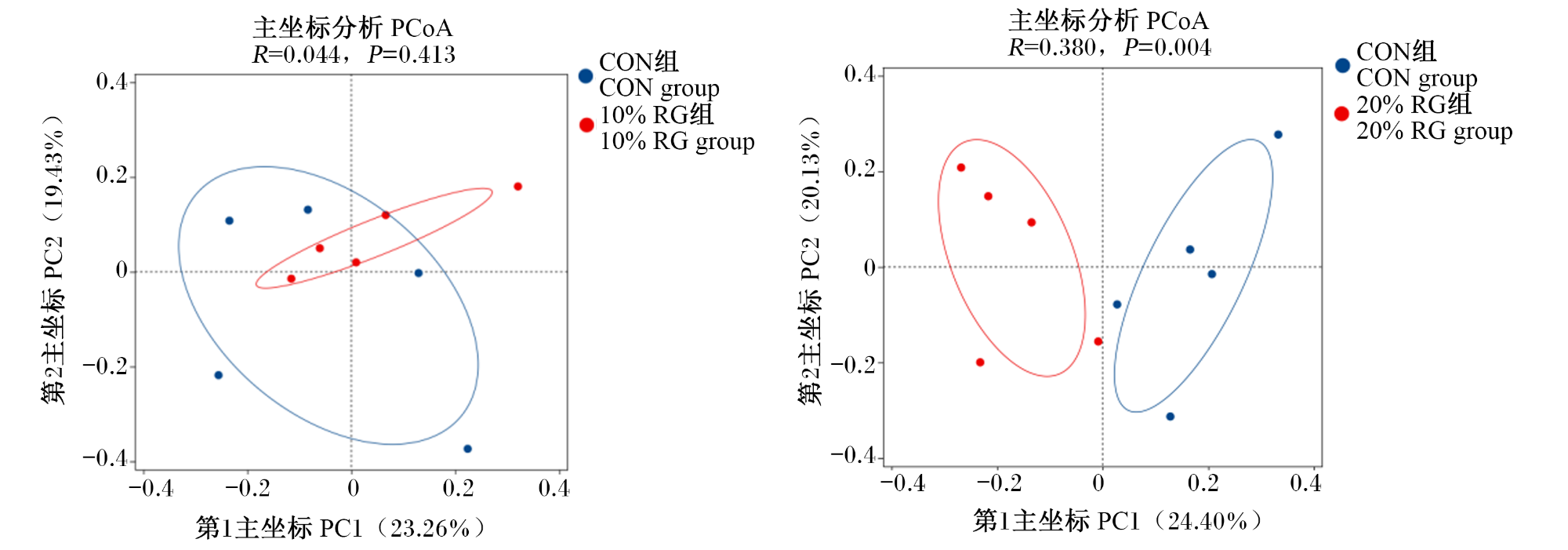
图1可知,粪便样品β多样性分析显示,CON组与10% RG组样本聚类重叠,第1主坐标(PC1)和第2主坐标(PC2)分别解释了粪便菌群差异的23.26%和19.43%;相似性分析(ANOSIM)分析结果显示P=0.413,表明2组间菌群整体结构无显著差异(P>0.05)。CON组与20% RG组样本明显分离,PC1和PC2分别解释了粪便菌群差异的24.40%和20.13%;ANOSIM分析结果显示P=0.004,表明2组间菌群整体结构存在极显著差异(P<0.01)。
图1 育肥猪粪便菌群β多样性分析

Fig.1 Beta diversity analysis of fecal microbiota in finishing pigs (n=5)

2.5.2 门水平与属水平菌群差异性分析

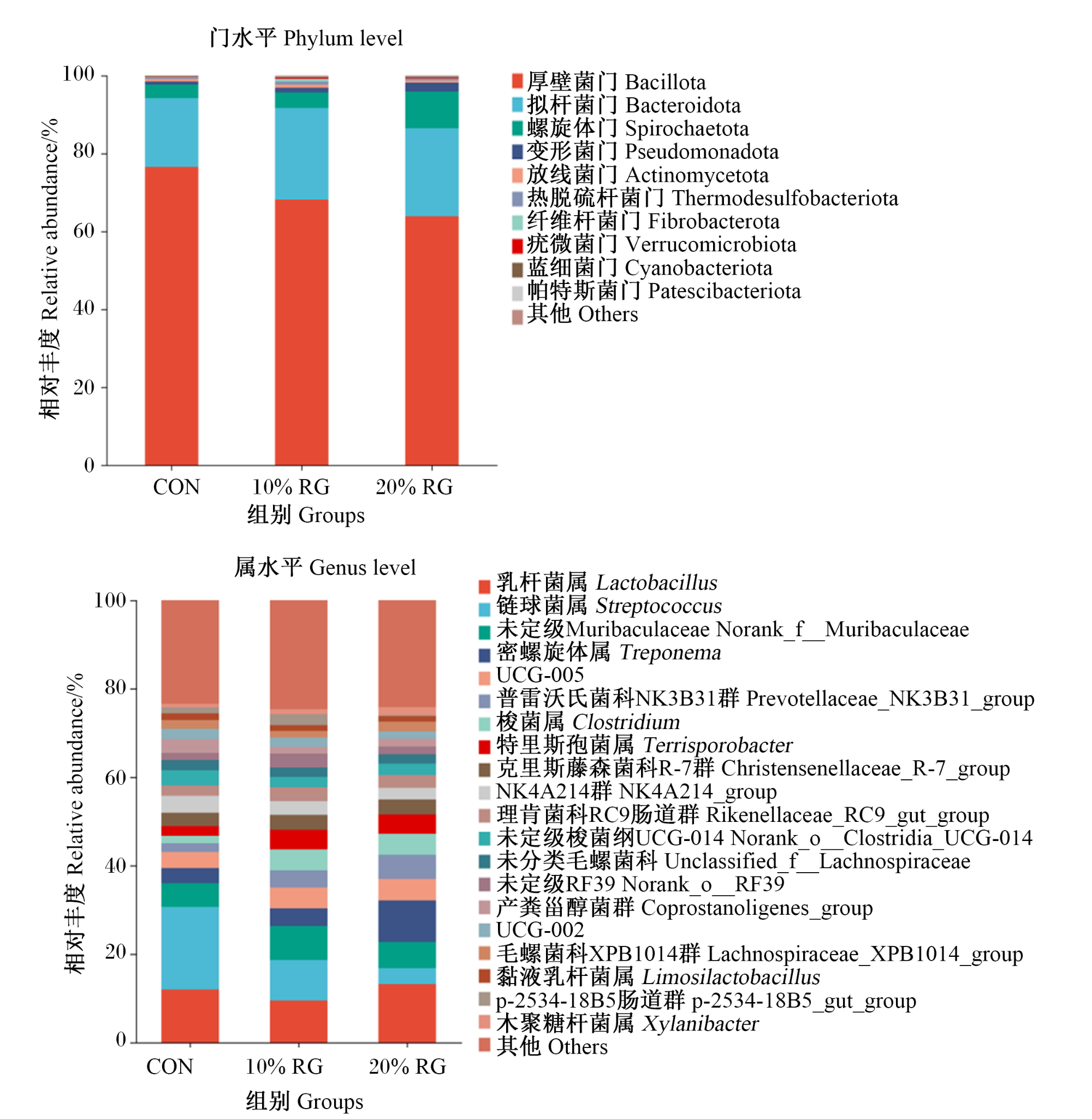
图2可知,在门水平上,各组粪便中厚壁菌门(Bacillota,曾用名Firmicutes)、拟杆菌门(Bacteroidota)、螺旋体门(Spirochaetota)均为优势菌门;在属水平上,各组粪便中优势菌属主要有乳杆菌属(Lactobacillus)、密螺旋体属(Treponema)、链球菌属(Streptococcus)、未定级Muribaculaceae(norank_Muribaculaceae)、UCG-005和普雷沃氏菌科NK3B31群(Prevotellaceae_NK3B31_group)等。
图2 育肥猪粪便菌群在门水平与属水平的组成分析

Fig.2 Analysis of fecal microbiota composition of finishing pigs at phylum and genus levels (n=5)

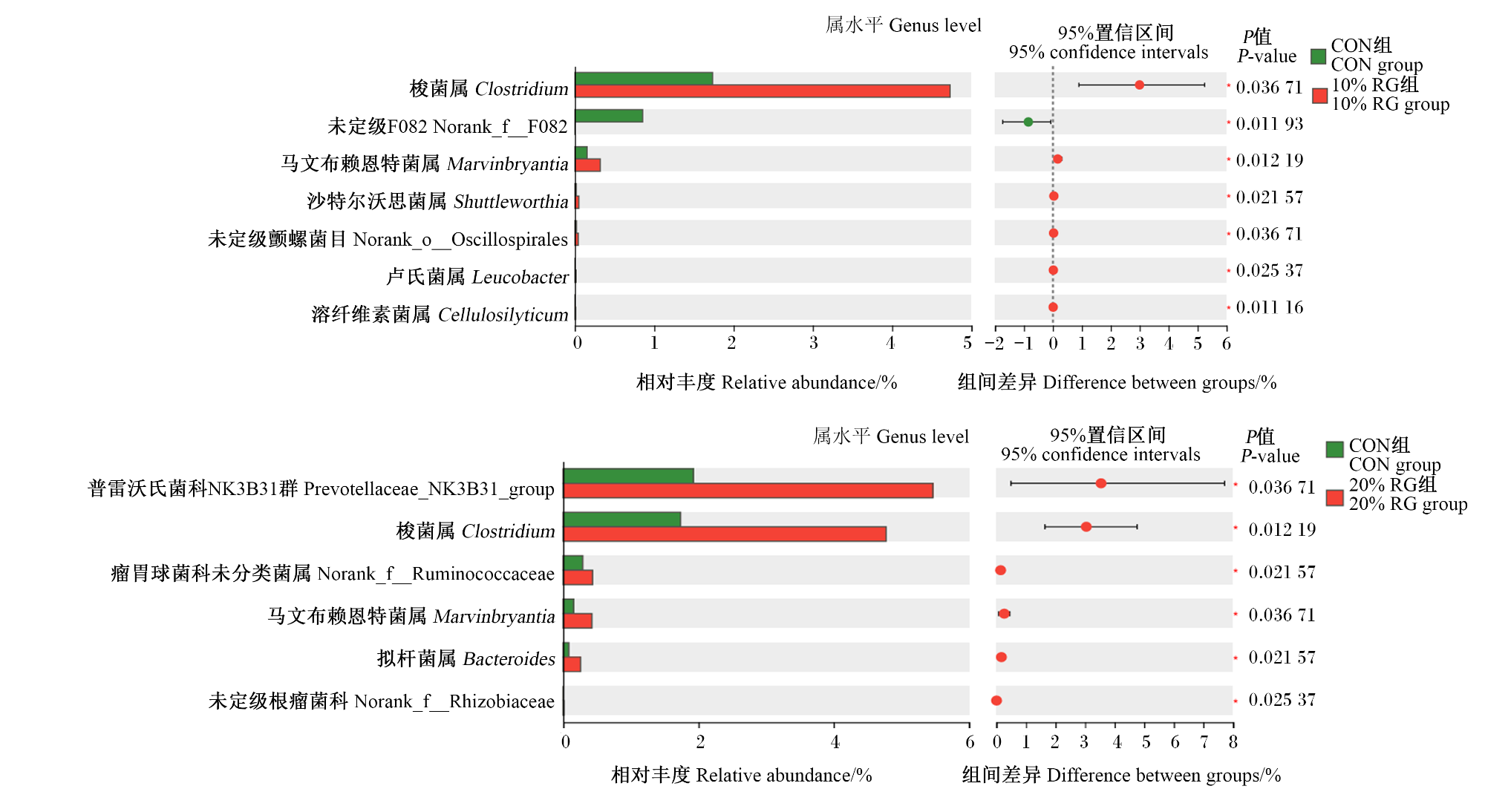
图3可知,通过粪便菌群在属水平的差异性分析,与CON组相比,10% RG组粪便中梭菌属(Clostridium)、马文布赖恩特菌属(Marvinbryantia)、沙特尔沃思菌属(Shuttleworthia)、未定级颤螺菌目(norank_o_Oscillospirales)、卢氏菌属(Leucobacter)、溶纤维素菌属(Cellulosilyticum)相对丰度显著升高(P<0.05),而未定级F082(norank_f__F082)相对丰度显著降低(P<0.05);20% RG组粪便中普雷沃氏菌科NK3B31群、梭菌属、瘤胃球菌科未分类菌属(norank_f__Ruminococcaceae)、马文布赖恩特菌属、拟杆菌属(Bacteroides)、未定级根瘤菌科(norank_f__Rhizobiaceae)相对丰度均显著升高(P<0.05)。
图3 育肥猪粪便菌群在属水平的差异性分析

Fig.3 Differential analysis of fecal microbiota of finishing pigs at genus level (n=5)

3 讨论

3.1 WFF对育肥猪生长性能的影响

生长性能是评估育肥猪饲料应用效果的核心指标[8],主要受饲粮营养、粗纤维含量及加工方式等影响,其稳定性直接关系到养殖经济效益。张俊峰等[9]在育肥猪饲粮中添加发酵菜籽粕或发酵白酒糟,发现适量添加发酵饲料可维持正常生长性能;Ji等[10]亦证实,以发酵秸秆替代部分玉米饲喂育肥猪,在适宜比例下对生长性能无显著负面影响。在本研究中,各组间FBW、ADG、ADFI及F/G均无显著差异,这与上述研究报道结果一致,说明饲粮添加10%和20% WFF对育肥猪生长性能未产生不良影响。

3.2 WFF对育肥猪胴体性状的影响

胴体性状是育肥猪养殖的核心经济指标,其中瘦肉率直接决定猪肉产品的市场竞争力与养殖效益[11];其调控机制与饲粮组成、肠道微生态代谢等多种因素密切相关。关于肠道菌群与育肥猪瘦肉率的关联,已有研究揭示了潜在调控路径:育肥猪肠道内优势菌门是拟杆菌门与厚壁菌门[12];拟杆菌门代谢生成的丙酸、乙酸等短链脂肪酸(SCFAs)可通过调节脂质代谢影响脂肪沉积[13],这为发酵饲料改善胴体性状提供了理论支撑。雷丽莉等[14]证实,育肥猪饲粮中添加发酵饲料可显著提高瘦肉率,与本研究结果一致。在本研究中,10% RG组和20% RG组瘦肉率均显著高于CON组。由此推测,WFF可能通过调节肠道内拟杆菌门等优势菌门的相对丰度及代谢活性,减少机体脂肪沉积,最终实现瘦肉率的提升。

3.3 WFF对育肥猪肉品质的影响

系水力是影响肉品多汁性、嫩度和加工产率的关键指标[15];肉色是决定消费者视觉接受程度的重要因素,这2项指标直接影响猪肉产品的市场价值,因此改善系水力和肉色具有重要的经济意义。从调控机制来看,氧化应激是影响这2项指标的关键因素:氧化应激会导致肌原纤维蛋白变性、细胞膜完整性破坏,一方面引发肌肉水分流失,另一方面造成肌红蛋白氧化,最终导致肉品质下降[16]。已有研究证实,提高机体抗氧化能力可延缓胴体肌肉中肌红蛋白的氧化进程,增强肉色稳定性[17];抑制机体蛋白质氧化可减少肌肉水分流失,提升系水力[18]。已有发酵饲料相关研究证实,饲喂发酵混合饲料可提高肉色的红度值,并改善大理石花纹评分[19],表明发酵饲料具有改善肉品质的应用潜力。在本研究中,10% RG组、20% RG组背最长肌系水力极显著高于CON组,且45 min红度值显著高于CON组。这可能与机体抗氧化系统平衡的改善存在内在联系,抗氧化能力增强可减少蛋白质氧化损伤,进而降低肌肉水分流失。

3.4 WFF对育肥猪血清抗氧化指标的影响

自由基是机体代谢的正常产物,但其过量产生与积累是导致氧化应激、衰老及多种疾病的关键因素[20]。因此,机体清除自由基的能力——T-AOC,是常被用作评价机体健康状况的重要指标[21]。GPX、超氧化物歧化酶(SOD)和CAT是机体抗氧化防御系统的核心酶类,其主要功能在于清除过量的自由基与活性氧,防止脂质过氧化等氧化损伤[22]。田朝阳等[23]在育肥猪饲粮中添加发酵棉籽粕的研究发现,该处理对育肥猪的血清T-AOC、CAT、SOD活性及MDA含量均无显著影响,但会降低血清GPX活性;其原因推测与发酵棉籽粕中抗营养因子棉酚有关,棉酚作为一种具有空间阻碍效应的化合物,兼具促氧化与一定浓度下的抗氧化特性,可能会促进机体氧化应激反应[24]。上述研究结果与本研究相符,在本研究中,第21天,各组间血清T-SOD活性、MDA含量及T-AOC均无显著差异;而10% RG组、20% RG组血清GPX活性有低于CON组的趋势,该结果可能与WFF中粗纤维特性有关,已有研究发现饲喂高纤维饲粮会显著降低血清GPX活性[25]。值得注意的是,第21天10% RG组血清CAT活性显著高于CON组,这一变化推测是机体抗氧化系统的代偿性调节。该现象在动物试验中已有相关佐证:罗德生等[26]研究发现,当动物体内血液GPX活性出现明显下降时,CAT活性会较基础水平显著升高,以此维持机体抗氧化防御功能的相对稳定。本研究中,第42天,各组间血清抗氧化指标均无显著差异,表明随着试验周期延长,育肥猪机体逐渐适应饲粮添加的WFF,抗氧化系统的代偿性调节逐渐减弱,整体氧化还原状态恢复稳定。

3.5 WFF对育肥猪粪便菌群的影响

粪便菌群的结构与功能受饲粮成分调控[27],发酵饲料可通过改变肠道营养底物,针对性调节菌群结构,进而影响动物生长与产品品质。本研究从菌群多样性、组成及丰度差异维度,分析WFF的调控作用,为揭示其改善胴体性状、肉品质等的微生态机制提供依据。

3.5.1 α和β多样性

菌群α多样性反映群落内物种的丰富度与均匀度,是评价肠道微生态稳定性的核心指标[28];β多样性则体现不同样本间菌群结构的差异程度[29]。关于发酵饲料对粪便菌群α多样性的影响,张朋等[30]研究表明,菌酶协同发酵饲料可提高粪便菌群的物种多样性。本研究中,10% RG组粪便菌群ACE指数和Sobs指数均显著高于CON组。这2个指数是评估肠道菌群物种丰富度的常用α多样性指标[31],二者显著提高表明饲粮添加10% WFF可有效增加肠道菌群丰富度。菌群丰富度提升可能有利于饲粮粗纤维降解、SCFAs合成等代谢过程,为瘦肉沉积提供微生态基础[32]
通过主坐标分析(PCoA)发现,20% RG组与CON组粪便样本菌群结构存在显著差异,而10% RG组与CON组菌群结构无显著差异。该结果表明,饲粮添加10% WFF对肠道菌群的调节作用较为平稳,在提升物种丰富度的同时,保持了菌群核心结构的稳定。而饲粮添加WFF增加到20%后,因WFF本身较高的粗纤维含量(22.11%),饲粮总纤维负荷明显增加。这种强烈的膳食刺激作为关键环境因子,驱动肠道菌群朝更专一于纤维降解的方向进行生态重构,最终导致群落结构的显著偏移[33]

3.5.2 门水平与属水平菌群差异性

从菌群整体组成来看,本试验各组粪便菌群在门水平上均以厚壁菌门、拟杆菌门为优势菌门,与猪肠道菌群的普遍特征相符[34]。与CON组相比,10% RG组、20% RG组拟杆菌门相对丰度有所提升。拟杆菌门是降解复杂碳水化合物的关键功能菌门,其相对丰度的变化提示WFF可能定向富集了纤维代谢相关的微生物类群。
在属水平差异物种的进一步分析发现,10% RG组、20% RG组均显著富集了以梭菌属、马文布赖恩特菌属为代表的纤维降解相关菌属。这些菌群可生成丙酸、乙酸、丁酸等SCFAs[35];而SCFAs作为关键信号分子,又可调控宿主能量代谢与脂肪沉积[36];为胴体瘦肉率与肉色的红度值改善提供了代谢基础。但20% RG组虽富集纤维降解菌,却未提升菌群丰富度,且导致菌群结构偏移,推测与过高纤维负荷破坏微生态平衡有关。
综上所述,饲粮添加10% WFF是最优选择,有利于构建物种丰富、结构稳定且富含高效纤维降解的肠道微生态系统。该优化菌群通过提高SCFAs产量,提升饲粮营养利用率、改善肠道健康,并调控脂肪沉积与蛋白质合成,在保持生长性能稳定的同时提高瘦肉率。鉴于本研究受试验场地及条件限制,样本量较小,研究结果仅为初步评估,未来仍需开展更大规模的生产试验来进一步验证其效果。

4 结论

综上所述,在本试验条件下,饲粮添加10%或20% WFF可在不影响育肥猪生长性能的基础上,有效提高胴体瘦肉率并改善肉品质。同时,10%添加比例能够提高肠道菌群丰富度,并富集纤维降解相关功能菌群,表现出较好的综合应用潜力。
[1]
王雨, 夏庆祥, 张雪丽, 等. 非常规饲料原料的应用进展[J]. 中南农业科技, 2025, 46(6):228-232.

WANG Y, XIA Q X, ZHANG X L, et al. Application progress of unconventional feed raw materials[J]. South-Central Agricultural Science and Technology, 2025, 46(6):228-232. (in Chinese)

[2]
薛雨琛, 郭益红, 韩超, 等. 无土栽培小麦草生长条件分析[J]. 现代园艺, 2018(17):26-27.

XUE Y C, GUO Y H, HAN C, et al. Analysis on growth conditions of hydroponic wheatgrass[J]. Xiandai Horticulture, 2018(17):26-27. (in Chinese)

[3]
姚文英, 崔龙, 蒋超, 等. 无人植物工厂小麦草生产技术初探[J]. 新疆农垦科技, 2024, 47(4):17-18,22.

YAO W Y, CUI L, JIANG C, et al. Preliminary study on wheatgrass production technology in unmanned plant factory[J]. Xinjiang Farm Research of Science and Technology, 2024, 47(4):17-18,22. (in Chinese)

[4]
SUN H X, JIANG Z P, CHEN Z M, et al. Effects of fermented unconventional protein feed on pig production in China[J]. Frontiers in Veterinary Science, 2024, 11:1446233.

DOI

[5]
HAN G Q, LIU S, ZHAO C X, et al. Effects of fermented liquid feed on growth performance,meat quality,and intestinal microbiota of Yuedong black pigs[J]. Animals, 2025, 15(18):2657.

DOI

[6]
郭惠敏, 李辉. 发酵麦麸对育肥猪生产性能、肠道菌群及免疫功能的影响[J]. 中国饲料, 2023(16):65-68.

GUO H M, LI H. Effects of fermented wheat bran on production performance,intestinal flora and immune function of fattening pigs[J]. China Feed, 2023(16):65-68. (in Chinese)

[7]
ZHU Y F, LEI X Y, ZHANG X Y, et al. Effects of alfalfa fermented feed on growth performance,meat quality,and fecal microflora of Taoyuan black pigs[J]. Frontiers in Veterinary Science, 2025, 12:1689943.

DOI

[8]
ZHANG A R, YANG Y Y, LI Y, et al. Effects of wheat-based fermented liquid feed on growth performance,nutrient digestibility,gut microbiota,intestinal morphology,and barrier function in grower-finisher pigs[J]. Journal of Animal Science, 2024,102:skae229.

[9]
张俊峰, 冷来福, 齐仁立, 等. 低蛋白质饲粮中添加发酵饲料对生长猪生长性能、血清指标和经济效益的影响[J]. 动物营养学报, 2025, 37(1):261-270.

DOI

ZHANG J F, LENG L F, QI R L, et al. Effects of adding fermented feeds to low-protein diets on growth performance,serum indices and economic benefits of growing pigs[J]. Chinese Journal of Animal Nutrition, 2025, 37(1):261-270. (in Chinese)

[10]
JI X G, TONG W F, SUN X X, et al. Dietary effects of different proportions of fermented straw as a corn replacement on the growth performance and intestinal health of finishing pigs[J]. Animals, 2025, 15(3):459.

DOI

[11]
王楚端, 王立贤, 张庆才. 用生物经济学方法研究猪生产性状的经济权重[J]. 中国农业大学学报, 2002, 7(5):95-100.

WANG C D, WANG L X, ZHANG Q C. Economic weight of production traits for swine with bio-economic model[J]. Journal of China Agricultural University, 2002, 7(5):95-100. (in Chinese)

[12]
WANG D, CHEN G S, SONG L L, et al. Effects of dietary protein levels on Bamei pig intestinal colony compositional traits[J]. BioMed Research International, 2020, 2020(1):2610431.

DOI

[13]
YIN J, LI Y Y, HAN H, et al. Melatonin reprogramming of gut microbiota improves lipid dysmetabolism in high-fat diet-fed mice[J]. Journal of Pineal Research, 2018, 65(4):e12524.

DOI

[14]
雷丽莉, 张淑芳, 章岳军, 等. 全混合食叶草发酵饲粮对育肥猪生长性能、血液指标及胴体性状的影响[J]. 动物营养学报, 2023, 35(2):813-822.

DOI

LEI L L, ZHANG S F, ZHANG Y J, et al. Effects of total mixed protein grass fermented diet on growth performance,blood indexes and carcass traits of finishing pigs[J]. Chinese Journal of Animal Nutrition, 2023, 35(2):813-822. (in Chinese)

[15]
MIR N A, RAFIQ A, KUMAR F, et al. Determinants of broiler chicken meat quality and factors affecting them:a review[J]. Journal of Food Science and Technology, 2017, 54(10):2997-3009.

DOI

[16]
LI C Y, ZHAO W J, QU Y N, et al. Proteomic insights into DEM-induced oxidative stress:glycolytic and antioxidant synergy in beef colour stability[J]. Food Chemistry, 2025, 494:146202.

DOI

[17]
CUNHA L C M, MONTEIRO M L G, LORENZO J M, et al. Natural antioxidants in processing and storage stability of sheep and goat meat products[J]. Food Research International, 2018, 111:379-390.

DOI PMID

[18]
HUANG Y, HUANG Z Q, JIA G, et al. L-theanine reduces muscle drip loss by regulating oxidative stress-mediated glycolysis disturbance and cytoskeletal protein degradation[J]. Food Bioscience, 2025, 72:107424.

DOI

[19]
LIU S Q, DU M, TU Y A, et al. Fermented mixed feed alters growth performance,carcass traits,meat quality and muscle fatty acid and amino acid profiles in finishing pigs[J]. Animal Nutrition, 2023, 12:87-95.

DOI

[20]
YANG J Y, LUO J Y, TIAN X T, et al. Progress in understanding oxidative stress,aging,and aging-related diseases[J]. Antioxidants, 2024, 13(4):394.

DOI

[21]
LUO J Q, WU X, CHEN D W, et al. Dietary ferulic acid supplementation enhances antioxidant capacity and alleviates hepatocyte pyroptosis in diquat challenged piglets[J]. Journal of Animal Science and Biotechnology, 2024, 15(1):134.

DOI PMID

[22]
ZENGIN H. The effects of feeding and starvation on antioxidant defence,fatty acid composition and lipid peroxidation in reared Oncorhynchus mykiss fry[J]. Scientific Reports, 2021, 11(1):16716.

DOI

[23]
田朝阳, 刘世龙, 田敏, 等. 低蛋白质饲粮中添加发酵棉籽粕和发酵干酒糟及其可溶物对育肥猪生长性能、抗氧化功能和肉品质的影响[J]. 动物营养学报, 2025, 37(2):879-892.

DOI

TIAN C Y, LIU S L, TIAN M, et al. Effects of low-protein diets supplemented with fermented cottonseed meal and fermented dried distiller’s grains with solubles on growth performance,antioxidant function and meat quality of finishing pigs[J]. Chinese Journal of Animal Nutrition, 2025, 37(2):879-892. (in Chinese)

[24]
KOVACIC P. Mechanism of drug and toxic actions of gossypol:focus on reactive oxygen species and electron transfer[J]. Current Medicinal Chemistry, 2003, 10(24):2711-2718.

DOI

[25]
LI S F, WANG H R, LI B Y, et al. Multi-omics analysis reveals the negative effects of high-concentrate diets on the colonic epithelium of Dumont lambs[J]. Animals, 2025, 15(5):749.

DOI

[26]
罗德生, 化长林, 王新广, 等. 低硒动物血中几种抗氧化酶活性变化的实验观察[J]. 中国公共卫生学报, 1996, 15(1):52-54.

LUO D S, HUA C L, WANG X G, et al. Changes of antioxidative activities in blood of low-seleuium animals[J]. Public Health of China, 1996, 15(1):52-54. (in Chinese)

[27]
YOSHIKAWA S, ITAYA K, HOSHINA R, et al. Thermophile-fermented feed modulates the gut microbiota related to lactate metabolism in pigs[J]. Journal of Applied Microbiology, 2024, 135(10):lxae254.

[28]
SONG J H, PARK S S, KIM I H, et al. Differential growth enhancement followed by notable microbiota modulation in growing-finishing pigs by Bacillus subtilis strains ps4060,ps4100,and a 50:50 strain mixture[J]. PLoS One, 2024, 19(9):e0306014.

DOI

[29]
MOOYOTTU S, MUYYARIKKANDY M S, YOUSEFI F, et al. Fecal microbiota transplantation modulates jejunal host-microbiota interface in weanling piglets[J]. Microbiome, 2025, 13(1):45.

DOI PMID

[30]
张朋, 姚有莉, 王永奔, 等. 不同发酵模式发酵菜籽粕对育肥猪生长性能、血清免疫指标、激素水平及粪便微生物的影响[J]. 动物营养学报, 2025, 37(3):1660-1672.

DOI

ZHANG P, YAO Y L, WANG Y B, et al. Effects of different fermentation modes of rapeseed meal on growth performance,serum immunity indexes,hormone levels and fecal microorganisms of fattening pigs[J]. Chinese Journal of Animal Nutrition, 2025, 37(3):1660-1672. (in Chinese)

DOI

[31]
ZHANG W J, CHENG W L, LI J H, et al. New aspects characterizing non-obese NAFLD by the analysis of the intestinal flora and metabolites using a mouse model[J]. mSystems, 2024, 9(3):e0102723.

DOI

[32]
LUO Z B, HAN S Z, YIN X J, et al. Fecal transplant from myostatin deletion pigs positively impacts the gut-muscle axis[J]. eLife, 2023, 12:e81858.

DOI

[33]
ZHANG X L, ZHONG R Z, WU J, et al. Dietary selection of distinct gastrointestinal microorganisms drives fiber utilization dynamics in goats[J]. Microbiome, 2025, 13(1):118.

DOI

[34]
周浩, 刘闯, 韩锦仪, 等. 不同品种猪肠道菌群结构差异比较分析[J]. 家畜生态学报, 2025, 46(6):55-62.

ZHOU H, LIU C, HAN J Y, et al. Comparative analysis of intestinal microbiota of different breeds of pigs[J]. Acta Ecologiae Animalis Domastici, 2025, 46(6):55-62. (in Chinese)

[35]
SIMONELLI N, ABRAHAM A G, MEDRANO M. Stimulation of microbial butyrate synthesis through prebiotics[J]. Food Bioscience, 2024, 62:105329.

DOI

[36]
LIU H Y, LU H D, WANG Y X, et al. Unlocking the power of short-chain fatty acids in ameliorating intestinal mucosal immunity:a new porcine nutritional approach[J]. Frontiers in Cellular and Infection Microbiology, 2024, 14:1449030.

DOI

Outlines

/