RESEARCH PAPER

Effects of Wood Fiber on Intestinal Health and Cecal Microbiota of Laying Hens during Later Laying Period

  • CAI Bin , 1 ,
  • DU Xiaohui 1 ,
  • WANG Yonggang 2 ,
  • CHEN Shiyi 2 ,
  • SHAO Dongyue 3 ,
  • WANG Yang 3 ,
  • WU Zhengkun 3 ,
  • SHU Gang , 3, *
Expand
  • 1 College of Animal Science and Technology, Sichuan Agricultural University, Chengdu 611130, China
  • 2 Fujian Bestar Bio-Technology Co., Ltd., Quanzhou 362599, China
  • 3 College of Veterinary Medicine, Sichuan Agricultural University, Chengdu 611130, China
* associate professor, E-mail:

Received date: 2026-01-30

  Online published: 2026-09-12

Abstract

This study aimed to investigate the effects of wood fiber on intestinal health and cecal microbiota of laying hens during later laying period. A total of 768 healthy laying hens at 69 weeks of age with similar body weight [(1.90±0.50) kg] were randomly divided into 4 groups with 6 replicates per group and 32 hens per replicate. The control group (CON group) was fed a basal diet, and the low, medium and high dose groups were fed the basal diets supplemented with 4 (D group), 6 (Z group), and 10 g/kg (G group) wood fiber, respectively. The pre-experimental period lasted for 1 week, and the experimental period lasted for 8 weeks. The results showed as follows: 1) compared with the CON group, the laying rate during all stages of D and G groups was significantly increased (P<0.05), the feed to egg ratio during all stages of D, Z and G groups was significantly decreased (P<0.05), and the average egg weight during all stages (except 74 to 75 weeks of age) of D group was significantly increased (P<0.05); the fecal score during 70 to 77 weeks of age of D, Z and G groups was significantly decreased (P<0.05). 2) Compared with the CON group, the jejunal index of D, Z and G groups was significantly increased (P<0.05), and the ileal index of D group was significantly increased (P<0.05). 3) Compared with the CON group, the jejunal superoxide dismutase (SOD), glutathione peroxidase (GSH-Px) activities and total antioxidant capacity (T-AOC) of Z and G groups were significantly increased (P<0.05), and the ileal SOD, GSH-Px activities and T-AOC of D and Z groups were significantly increased (P<0.05). 4) Compared with the CON group, the jejunal crypt depth of D, Z and G groups was significantly increased (P<0.05). 5) Compared with the CON group, the ileal α-amylase (AMS) activity of D and G groups was significantly increased (P<0.05), and the mRNA relative expression levels of lipase (LPS) and trypsin (TPS) in ileum of D and Z groups were significantly increased (P<0.05). 6) Compared with the CON group, the relative abundances of Bacteroidetes and Bacteroides in cecum of D group were significantly increased (P<0.05). In conclusion, dietary wood fiber supplementation can improve the intestinal structure, enhance the antioxidant capacity and digestive enzyme activities, improve the cecal microbiota composition, promote the intestinal health, thereby increasing the laying rate and average egg weight while reducing the feed to egg ratio of laying hens during later laying period. Under the experimental conditions, dietary supplemented with 4 g/kg wood fiber has the optimal effect.

Cite this article

CAI Bin , DU Xiaohui , WANG Yonggang , CHEN Shiyi , SHAO Dongyue , WANG Yang , WU Zhengkun , SHU Gang . Effects of Wood Fiber on Intestinal Health and Cecal Microbiota of Laying Hens during Later Laying Period[J]. Chinese Journal of Animal Nutrition, 2026 , 38(9) : 6699 -6714 . DOI: 10.12418/CJAN2026.536

在集约化家禽养殖模式下,产蛋高峰期母鸡因代谢亢进及持续氧化应激作用,导致其肠道屏障功能随周龄增长显著衰退[1]。这一退化过程引发肠道通透性增加,促使病原体及内毒素易位,诱发局部感染甚至系统性炎症反应[2];最终表现为产蛋率下降、生产周期缩短,并造成严重经济损失。因此,产蛋后期蛋鸡的生产潜力在很大程度上取决于肠道健康,其中完整的肠道屏障尤为重要。已有研究表明,饲粮纤维在促进猪肠道健康方面起着至关重要的作用,因为它增强了上皮屏障的功能,同时通过调节肠道菌群和短链脂肪酸(SCFAs)的产生来维持宿主的肠道稳态[3]。尽管木纤维(尤其是可发酵型纤维)在家禽及猪生产中展现出改善肠道健康等多重应用潜力,但传统观念曾长期将其简单归类为抗营养因子。例如,Graham等[4]在猪上的研究表明,随着饲粮纤维水平增高,猪对淀粉、粗蛋白质、粗脂肪和矿物质的回肠表观消化率降低。这一现象主要源于物理稀释效应与消化道食糜流速加快,并非纤维本身具有毒性。现代动物营养学研究已彻底重塑了这一认知,证实适量且特定类型的纤维不仅是非营养性填充物,更是改善肠道健康、调控微生物群落结构以及缓解肠道紊乱的关键功能性成分[5]。因此,将纤维笼统视为抗营养因子的认知已明显滞后,当前行业更应强调依据纤维来源、溶解性及动物生理阶段进行精准配伍与科学应用。
在家禽规模化饲养实践中,普遍采用低纤维、高能量和高蛋白质水平的复合型饲粮,可有效提高家禽养殖的生产效益[6]。然而,高营养水平的饲粮配方可能加重家禽消化系统的代谢负担,长期饲喂可能影响其生理机能和健康状况。近年来研究发现,饲粮中添加适量木纤维能促进动物肌胃发育,增强消化酶活性,刺激胆汁酸分泌,进而有利于营养吸收,促进肠道健康[7-8]。木纤维中的不溶性纤维经水合作用膨胀后,可增加食糜与肠道黏膜的接触面积,从而提升营养物质的吸收效率,因此,不溶性纤维被认为是木纤维中发挥有益功能的主要因素[9]。Makivic等[10]研究表明,在饲粮中添加0.6%木质纤维素可显著提高肉鸡采食量和生长性能,具体表现为平均日采食量和体重均有所提升。Tejeda等[11]研究表明,在饲粮中添加大豆壳能促进肉鸡消化道器官发育,添加8%大豆壳时,可显著提升十二指肠绒毛高度,改善肠道形态结构;添加4%大豆壳时,可显著提升空肠绒毛高度。Guzmán等[12]研究发现,饲粮中添加纤维可以增加5和10周龄雏鸡的肌胃相对重量。Pourazadi等[13]在饲粮中添加葵花籽壳,可降低肉鸡盲肠大肠杆菌数量,并且可降低血液甘油三酯含量。在规模化养殖场中,蛋鸡肠道健康问题较为常见,对蛋鸡养殖业的健康发展产生了不良影响。目前,评定木纤维对产蛋后期蛋鸡肠道健康和盲肠菌群的报道较少,限制了其在饲料添加剂中的应用。因此,本试验旨在研究木纤维对产蛋后期蛋鸡肠道健康和盲肠菌群的影响,探究其对肠道功能的调控作用,以期为蛋鸡养殖中木纤维的科学应用提供数据参考。

1 材料与方法

1.1 试验材料

木纤维为天然云杉木通过机械加工将木材分解、提取、精制的纤维素产品,其主要由纤维素、半纤维素及木质素等不溶性膳食纤维构成,粗纤维含量为63.2%,粗灰分含量为0.33%。

1.2 试验动物与试验设计

所有试验程序和动物保护方案经过四川农业大学实验动物伦理与福利委员会审核并批准,伦理审查编号为No.20250664。选取768只体重[(1.90±0.50) kg]相近、健康状况良好的69周龄京粉6号蛋鸡,采用完全随机分组法分为4组,每组6个重复,每个重复32只鸡。对照组(CON组)饲喂基础饲粮,低、中、高剂量组分别在基础饲粮中添加4(D组)、6(Z组)和10 g/kg(G组)木纤维。预试期1周,正试期8周。基础饲粮参照国家标准《产蛋鸡和肉鸡配合饲料》(GB/T 5916—2020)配制,满足产蛋鸡营养需求,其组成及营养水平见表1
表1 基础饲粮组成及营养水平(风干基础)

Table 1 Composition and nutrient levels of the basal diet (air-dry basis)

原料Ingredients 含量Content 营养水平Nutrient levels2) 含量Content
玉米Corn 55.00 代谢能ME/(MJ/kg) 11.79
豆粕Soybean meal 15.00 粗蛋白质CP 16.93
麸皮Bran 12.00 粗纤维CF 2.02
大豆油Soybean oil 2.00 粗灰分Ash 11.82
石粒Stone particles 7.50 钙Ca 3.49
石粉Limestone 5.00 有效磷AP 0.53
食盐NaCl 0.50 蛋氨酸Met 0.49
预混料Premix1) 3.00 赖氨酸Lys 0.81
合计Total 100.00 蛋氨酸+胱氨酸Met+Cys 0.51

1)每千克预混料包含 One kg premix contained the following:VA 200 000 IU,VD3 100 000 IU,VE 500 IU,VK3 60 mg,VB2 100 mg,VB6 70 mg,烟酰胺 niacinamide 700 mg,泛酸 pantothenic acid 300 mg,生物素 biotin 2 mg,叶酸 folic acid 20 mg,Cu (as copper sulfate) 500 mg,Fe (as ferrous sulfate) 13 000 mg,Mn (as manganese sulfate) 500 mg,Zn (as zinc sulfate) 2 400 mg。

2)代谢能、有效磷和氨基酸为计算值计算值,其余为实测值。ME, AP and amino acids were calculated values, while the others were measured values.

1.3 饲养管理

饲养试验采用环境可控的3层A型笼,温度为(22±1) ℃,相对湿度为(60±5)%,负压通风,每日光照16 h,每笼饲喂4只鸡。预试期用于适应试验环境,保证采食量稳定。试验前对鸡舍进行彻底消毒,并通过单因素方差分析确认各组采食量、产蛋率和体重均无显著差异(P>0.05),并检查其健康状况。正式试验期间自由采食和饮水,每天喂料3次,添加量以料槽内略有剩余为准。饲养管理按照常规方法进行。每日以重复为单位,记录死亡淘汰鸡数量,观察记录蛋鸡精神状态和粪便形态。

1.4 样品采集与指标测定

1.4.1 饲粮营养水平

饲粮粗蛋白质、粗纤维、粗灰分和钙含量分别参照GB/T 6432—2018、GB/T 6434—2022、GB/T 6438—2007和GB/T 6436—2018的方法进行测定,代谢能、有效磷和氨基酸含量参照《中国饲料成分及营养价值表(2022年第33版)》进行计算。

1.4.2 生产性能和粪便评分

试验期间,每天09:00以重复为单位记录产蛋数、蛋重,计算各组每周的产蛋率、料蛋比、平均蛋重;每周记录蛋鸡平均体重,并参照Biswas等[14]的粪便评分方法对粪便进行评分,粪便评分采用4分制,粪便评分标准见表2,评分越低代表蛋鸡腹泻程度越低。各阶段产蛋率、料蛋比、平均蛋重计算公式如下:
产蛋率(%)=(阶段产蛋总数/蛋鸡只数)×100;
料蛋比=阶段产蛋总重/阶段饲料消耗量;
平均蛋重(g)=阶段产蛋总重/阶段产蛋总数。
表2 粪便评分标准

Table 2 Fecal scoring criteria

项目Items 评分标准Scoring criteria
1分1 point 正常的干粪便,呈圆锥形
2分2 point 轻微疏松粪便,一些呈圆锥形,无游离水
3分3 point 疏松粪便,有少量呈圆锥形,一些游离水
4分4 point 粪便极其疏松,无圆锥形粪便,大量游离水

1.4.3 器官指数和肠道长度

试验结束后,从每个重复中随机选取1只体重相近的试验鸡,采用颈椎脱臼处死后,打开腹腔,采集相关器官并称重,测量各肠道长度,脏器指数计算公式如下:
器官指数(%)=(器官重量/活体重)×100。

1.4.4 肠道抗氧化指标测定

试验鸡处死后,及时取出十二指肠、空肠、回肠,置于-80 ℃冰箱保存备用。采集的样本经过高压灭菌的生理盐水多次清洗后,再用清洁的滤纸吸去水分,随后精确地称量十二指肠、空肠、回肠,并按照重量(g)与体积(mL)比例为1∶9加入9倍体积的0.9%生理盐水。将混合物放入组织研磨机中,在-20 ℃和60 Hz的条件下研磨100 s,制备成10%的组织匀浆。取上述匀浆液400 μL 4 ℃,1 000×g离心10 min,取上清液进行测定。严格按照试剂盒(南京建成生物工程研究所)说明书操作,使用全自动生化分析仪(HITACHI3100,日本日立公司),测定超氧化物歧化酶(SOD)、谷胱甘肽过氧化物酶(GSH-Px)活性和丙二醛(MDA)含量及总抗氧化能力(T-AOC)。

1.4.5 肠道形态和回肠消化酶活性

取部分十二指肠、空肠、回肠肠段,置于4%多聚甲醛固定液中用于组织形态学分析;刮取回肠黏膜放入液氮中,随后转入-80 ℃保存冻存,以备检测回肠消化酶活性。
取出4%多聚甲醛固定液中的十二指肠、空肠、回肠组织,制成石蜡切片,经苏木精-伊红(HE)染色和封片等程序后在显微镜下进行观察,每张切片选取5根肠绒毛进行绒毛高度和隐窝深度的测量,并计算绒毛高度与隐窝深度的比值(绒隐比)。取出-80 ℃保存的回肠黏膜,采用全自动生化分析仪及相应的试剂盒(南京建成生物工程研究所)测定回肠α-淀粉酶(AMS)、脂肪酶(LPS)和胰蛋白酶(TPS)活性。

1.4.6 盲肠菌群

各组随机选取6只试验鸡,经颈静脉放血处死后解剖,使用无菌剪刀剪断盲肠,将盲肠食糜使用液氮速冻,然后转入-80 ℃冰箱保存。将冻存的盲肠食糜样品送至南京集思慧远生物科技有限公司,采用16S RNA高通量测序进行盲肠菌群的测定。采用VSEARCH工具剔除嵌合体序列,获得Effective Tags用于后续分析。运用DADA2算法在97%相似度阈值下对Effective Tags进行去噪及操作分类单元(OTU)聚类。选取各OTU代表性序列,基于Greengenes 13_8数据库,采用RDP分类器(置信阈值≥80%)完成门和属水平的物种注释。

1.4.7 回肠消化酶相关基因表达

利用Trizol Reagent提取回肠组织总RNA。采用反转录试剂盒(BL699A,四川博尔瑞生物科技有限公司)将提取的总RNA转录为cDNA。以合成的cDNA为模板,参照试剂盒操作指南,使用ABI Q5实时荧光定量PCR系统(Thermo Fisher Scientific,美国)进行扩增,选用SYBR Green为荧光染料,反应体系10 μL:Stormstar SybrGreen qPCR Master Mix 5 μL,上、下游引物(10 μmol/L)各1 μL,cDNA模板1 μL,无酶去离子水2 μL,PCR反应条件见表3。以β-肌动蛋白(β-actin)作为内参基因,检测消化酶基因(AMSLPSTPS)和营养代谢相关基因[脂肪酸转运蛋白4(FATP4)、乙酰辅酶A羧化酶(ACC)]的表达,引物序列见表4,采用2-ΔΔCt法计算各目的基因的mRNA相对表达水平。
表3 PCR反应条件

Table 3 PCR reaction conditions

项目
Items
温度
Temperature/℃
时间
Time
循环次数
Number of cycles

预变性Pre-denaturation
52 2 min
1
95 10 min

循环反应Cyclic reaction
95 15 s
40
60 1 min


熔解曲线Melting curve
95 15 s
60 1 min
95 15 s
表4 引物序列

Table 4 Primer sequence

基因
Genes
GenBank登录号
GenBank accession number
引物序列
Primer sequence (5'—3')
产物长度
Product size/bp
β-肌动蛋白
β-actin
NM_205518.1 F:AACACCCACACCCCTGTGAT
R:TGAGTCAAGCGCCAAAAGAA
116
α-淀粉酶
AMS
NM_001001473.2 F:AAGTGGAATGGAGAGAAGATG
R:CCAGAAAGTAAGAATGGAAGC
147
脂肪酶
LPS
XM_015288675.2 F:CCCTGCCCAACCTTATTT
R:GCATTTCCACTCCTCCGT
176
胰蛋白酶
TPS
XM_025143180.1 F:AGCGAGCAGACCATTAGTTC
R:AGGAGAGTACAGGGGCATTC
253
脂肪酸转运蛋白4
FATP4
XM_046929199.1 F:ATACCTCTGGCACTACGGGAAT
R:CATACATCACATCATCGGGTCT
117
乙酰辅酶A羧化酶
ACC
NM_205505 F:TTGTGGCACAGAAGAGGGAA
R:GTTGGCACATGGAATGGCAG
161

1.5 数据统计与分析

试验数据经Excel 2019完成初步整理后,采用SPSS 30.0统计软件进行单因素方差分析,并结合Duncan氏法进行多重比较检验,数据采用“平均值±标准差”表示,P<0.05时判定为差异显著。相关统计图表使用GraphPad Prism 9软件绘制完成。

2 结果

2.1 饲粮中添加木纤维对70~77周龄蛋鸡生产性能的影响

表5可知,70~71周龄,与CON组相比,D、Z和G组的产蛋率均显著增加(P<0.05),且G组的产蛋率显著高于D和Z组(P<0.05);D、Z和G组的料蛋比均显著降低(P<0.05),且D和G组的料蛋比显著低于Z组(P<0.05);D、Z和G组的平均蛋重均显著增加(P<0.05),且D组的平均蛋重显著高于Z和G组(P<0.05)。72~73周龄,与CON组相比,D、Z和G组的产蛋率均显著增加(P<0.05),且G组的产蛋率显著高于D和Z组(P<0.05);D、Z和G组的料蛋比均显著降低(P<0.05),且D组的料蛋比显著低于Z和G组(P<0.05);D组的平均蛋重均显著增加(P<0.05)。74~75周龄,与CON组相比,D、Z和G组的产蛋率均显著增加(P<0.05),且G组的产蛋率显著高于D和Z组(P<0.05);D、Z和G组的料蛋比均显著降低(P<0.05),且D组的料蛋比显著低于Z和G组(P<0.05);G组的平均蛋重均显著降低(P<0.05)。76~77周龄,与CON组相比,D和G组的产蛋率均显著增加(P<0.05);D、Z和G组的料蛋比均显著降低(P<0.05),且D组的料蛋比显著低于Z和G组(P<0.05);D组的平均蛋重均显著增加(P<0.05)。
表5 饲粮中添加木纤维对70~77周龄蛋鸡生产性能的影响

Table 5 Effects of dietary wood fiber supplementation on performance of laying hens aged from 70 to 77 weeks

项目
Items
组别Groups P
P-value
CON D Z G
产蛋率Laying rate/%
70~71周龄70 to 71 weeks of age 89.92±0.95c 91.26±0.78b 91.56±0.78b 92.56±0.34a 0.001
72~73周龄72 to 73 weeks of age 89.36±1.23c 91.19±0.65b 90.93±0.63b 91.88±0.54a 0.001
74~75周龄74 to 75 weeks of age 88.73±1.36c 90.60±0.62b 90.16±0.75b 91.34±0.80a 0.010
76~77周龄76 to 77 weeks of age 87.08±1.60b 88.82±1.71a 88.20±1.17ab 89.05±1.77a 0.033
料蛋比Feed to egg ratio
70~71周龄70 to 71 weeks of age 2.13±0.03a 2.04±0.02c 2.07±0.02b 2.04±0.02c 0.010
72~73周龄72 to 73 weeks of age 2.13±0.03a 2.03±0.03c 2.07±0.02b 2.06±0.02b 0.001
74~75周龄74 to 75 weeks of age 2.15±0.04a 2.02±0.02c 2.10±0.02b 2.08±0.03b 0.001
76~77周龄76 to 77 weeks of age 2.26±0.11a 2.09±0.05c 2.17±0.04b 2.16±0.06b 0.010
平均蛋重Average egg weight/g
70~71周龄70 to 71 weeks of age 57.56±0.34c 59.36±0.56a 58.21±0.39b 58.18±0.28b 0.001
72~73周龄72 to 73 weeks of age 58.52±0.78b 59.85±0.71a 58.52±0.57b 58.19±0.27b 0.010
74~75周龄74 to 75 weeks of age 58.13±0.35ab 60.27±0.56a 58.33±0.27b 57.99±0.56c 0.001
76~77周龄76 to 77 weeks of age 57.96±0.97b 59.67±0.72a 58.29±0.73b 58.21±0.77b 0.010

同行数据肩标不同小写字母表示差异显著(P<0.05),相同或无字母表示差异不显著(P>0.05)。下表同。

In the same row, values with different small letter superscripts mean significant difference (P<0.05), while with the same or no letter superscripts mean no significant difference (P>0.05). The same as below.

2.2 饲粮中添加木纤维对70~77周龄蛋鸡粪便评分和体重的影响

表6可知,与CON组相比,D、Z和G组的72周龄粪便评分显著降低(P<0.05),Z和G组的75周龄粪便评分显著降低(P<0.05),D、Z和G组的70~77周龄粪便评分显著降低(P<0.05)。
表6 饲粮中添加木纤维对70~77周龄蛋鸡粪便评分的影响

Table 6 Effects of dietary wood fiber supplementation on fecal scores of laying hens aged from 70 to 77 weeks 分

项目
Items
组别Groups P
P-value
CON D Z G
70周龄70 weeks of age 3.50±0.55 3.17±0.41 3.00±0.63 2.84±0.75 0.285
71周龄71 weeks of age 3.50±0.55 3.33±0.52 3.17±0.41 3.98±2.66 0.774
72周龄72 weeks of age 3.67±0.52a 3.00±0.63b 3.00±0.00b 2.83±0.41b 0.023
73周龄73 weeks of age 3.33±0.52 3.00±0.63 2.83±0.41 2.67±0.52 0.186
74周龄74 weeks of age 3.33±0.52 2.67±0.52 2.67±0.52 2.83±0.41 0.091
75周龄75 weeks of age 3.33±0.52a 2.83±0.41ab 2.67±0.52b 2.50±0.55b 0.049
76周龄76 weeks of age 3.33±0.52 2.67±0.52 2.67±0.52 2.67±0.52 0.089
77周龄77 weeks of age 3.33±0.52 2.67±0.52 2.50±0.55 2.67±0.52 0.056
70~77周龄70 to 77 weeks of age 3.42±0.13a 2.92±0.25b 2.81±0.23b 3.00±0.57b 0.010
表7可知,与CON组相比,D、Z和G组的平均体重均无显著差异(P>0.05)。
表7 饲粮中添加木纤维对70~77周龄蛋鸡平均体重的影响

Table 7 Effects of dietary wood fiber supplementation on average body weights of laying hens aged from 70 to 77 weeks kg

项目
Items
组别Groups P
P-value
CON D Z G
70周龄70 weeks of age 1.93±0.06 1.94±0.03 1.92±0.07 1.89±0.07 0.648
71周龄71 weeks of age 1.95±0.05 1.94±0.03 1.93±0.08 1.93±0.03 0.964
72周龄72 weeks of age 1.94±0.05 1.96±0.03 1.93±0.06 1.95±0.04 0.836
73周龄73 weeks of age 1.99±0.08 2.07±0.03 2.01±0.14 1.98±0.03 0.497
74周龄74 weeks of age 2.00±0.07 2.05±0.06 2.08±0.17 2.00±0.05 0.654
75周龄75 weeks of age 2.03±0.07 2.08±0.04 1.97±0.03 2.02±0.04 0.056
76周龄76 weeks of age 2.05±0.06 2.01±0.02 1.98±0.02 2.67±0.52 0.118
77周龄77 weeks of age 1.95±0.03 2.00±0.05 1.99±0.04 1.99±0.01 0.327
70~77周龄70 to 77 weeks of age 1.98±0.07 2.01±0.06 1.98±0.09 1.98±0.06 0.316

2.3 饲粮中添加木纤维对蛋鸡消化器官指数和肠道长度的影响

表8可知,与CON组相比,D、Z和G组的空肠指数显著增加(P<0.05),D组的回肠指数显著增加(P<0.05),D、Z和G组的腺胃指数、肌胃指数、十二指肠指数、回肠长度、十二指肠长度和空肠长度均无显著差异(P>0.05)。
表8 饲粮中添加木纤维对蛋鸡器官指数和肠道长度的影响

Table 8 Effects of dietary wood fiber supplementation on organ indexes and intestinal lengths of laying hens

项目
Items
组别Groups P
P-value
CON D Z G
器官指数Organ indexes/%
腺胃Glandular stomach 0.47±0.04 0.46±0.04 0.50±0.08 0.49±0.10 0.113
肌胃Gizzard 1.64±0.42 1.62±0.42 1.60±0.27 1.58±0.23 0.992
十二指肠Duodenum 0.62±0.09 0.65±0.08 0.62±0.10 0.61±0.07 0.796
空肠Jejunum 1.03±0.14b 1.46±0.13a 1.45±0.13a 1.31±0.29a 0.003
回肠Ileum 1.09±0.24b 1.61±0.19a 1.30±0.15b 1.15±0.19b 0.003
肠道长度Intestinal lengths/cm
回肠Ileum 53.42±10.38 55.37±3.28 53.22±3.30 57.40±2.79 0.635
十二指肠Duodenum 27.63±1.45 27.65±1.90 26.45±1.54 27.38±1.60 0.839
空肠Jejunum 52.05±8.10 54.50±2.35 56.25±4.55 56.25±0.50 0.497

2.4 饲粮中添加木纤维对蛋鸡肠道抗氧化指标的影响

表9可知,与CON组相比,Z和G组的空肠SOD活性及T-AOC显著增加(P<0.05),D、Z和G组的空肠GSH-Px活性显著增加(P<0.05),D、Z和G组的空肠MDA活性均无显著差异(P>0.05)。与CON组相比,D、Z、G组的回肠MDA含量显著增加(P<0.05),D和Z组的回肠SOD、GSH-Px活性及T-AOC显著增加(P<0.05)。与CON组相比,D、Z和G组的十二指肠SOD、GSH-Px活性和MDA含量及T-AOC均无显著差异(P>0.05)。
表9 饲粮中添加木纤维对蛋鸡肠道抗氧化指标的影响

Table 9 Effects of dietary wood fiber supplementation on intestinal antioxidant indices of laying hens

项目
Items
组别Groups P
P-value
CON D Z G
空肠Jejunum
总抗氧化能力T-AOC/(U/mg) 0.34±0.10b 0.38±0.05ab 0.54±0.17a 0.47±0.11a 0.033
谷胱甘肽过氧化物酶GSH-Px/(U/mg) 154.80±47.03c 172.90±22.86b 248.18±76.82a 217.33±51.86a 0.033
超氧化物歧化酶SOD/(U/mg) 19.12±5.81b 21.36±2.82ab 30.66±9.49a 26.85±6.41a 0.033
丙二醛MDA/(nmol/mg) 5.45±1.30 4.79±0.63 5.16±1.11 5.37±0.89 0.725
回肠Ileum
总抗氧化能力T-AOC/(U/mg) 0.21±0.02b 0.32±0.07a 0.33±0.09a 0.24±0.03b 0.001
谷胱甘肽过氧化物酶GSH-Px/(U/mg) 94.94±10.02b 135.37±21.20a 150.65±39.21a 110.64±11.42b 0.010
超氧化物歧化酶SOD/(U/mg) 11.73±1.24b 18.13±4.16a 18.61±4.84a 13.38±1.45b 0.010
丙二醛MDA/(nmol/mg) 2.63±0.28b 3.75±0.59a 3.62±0.51a 3.02±0.36a 0.010
十二指肠Duodenum
总抗氧化能力T-AOC/(U/mg) 0.25±0.03 0.24±0.01 0.25±0.02 0.25±0.01 0.618
谷胱甘肽过氧化物酶GSH-Px/(U/mg) 116.62±11.55 111.03±4.67 115.05±8.69 116.05±4.62 0.618
超氧化物歧化酶SOD/(U/mg) 14.41±1.43 13.72±0.58 14.21±1.07 14.34±0.57 0.618
丙二醛MDA/(nmol/mg) 3.23±0.32 3.08±0.13 3.19±0.24 3.21±0.13 0.618

2.5 饲粮中添加木纤维对蛋鸡肠道形态的影响

表10可知,与CON组相比,D、Z和G组的空肠隐窝深度显著增加(P<0.05),空肠绒毛高度和绒隐比均无显著差异(P>0.05);D、Z和G组的十二指肠和回肠绒毛高度、隐窝深度和绒隐比均无显著差异(P>0.05)。
表10 饲粮中添加木纤维对蛋鸡肠道形态的影响

Table 10 Effects of dietary wood fiber supplementation on intestinal morphology of laying hens

项目
Items
组别Groups P
P-value
CON D Z G
十二指肠Duodenum
绒毛高度Villi heigh/μm 1 414.84±18.82 1 326.68±37.15 1 352.52±182.33 1 360.05±41.00 0.724
隐窝深度Crypt depth/μm 95.50±2.35 96.12±1.89 98.70±9.50 106.36±7.84 0.215
绒隐比V/C 13.70±0.75 14.87±0.27 13.89±3.02 12.85±1.09 0.561
空肠Jejunum
绒毛高度Villi heigh/μm 803.34±5.44 786.33±13.07 783.99±28.42 814.70±7.80 0.145
隐窝深度Crypt depth/μm 70.53±4.65b 80.45±0.86a 78.08±6.12a 82.25±0.83a 0.027
绒隐比V/C 10.49±0.71 9.91±0.30 9.91±0.69 10.10±0.15 0.394
回肠Ileum
绒毛高度Villi heigh/μm 678.70±4.51 669.24±8.07 679.60±1.25 671.91±2.51 0.077
隐窝深度Crypt depth/μm 76.37±3.18 73.23±3.16 71.63±1.82 72.98±1.33 0.126
绒隐比V/C 8.69±0.49 8.72±0.51 8.64±0.56 8.41±0.38 0.790

2.6 饲粮中添加木纤维对蛋鸡回肠消化酶活性和相关基因表达的影响

表11可知,与CON组相比,D和G组的回肠AMS活性显著增加(P<0.05),D、Z和G组的回肠TPS和LPS活性均无显著差异(P>0.05)。
表11 饲粮中添加木纤维对蛋鸡回肠消化酶活性的影响

Table 11 Effects of dietary wood fiber supplementation on ileal digestive enzyme activities of laying hens

项目
Items
组别Groups P
P-value
CON D Z G
α-淀粉酶
AMS/(U/mg prot)
4.69±0.40b 5.78±0.32a 5.12±0.58ab 5.41±1.04a 0.042
胰蛋白酶
TPS/(U/mg prot)
2 562.41±239.82 2 674.63±844.03 2 936.48±1 109.62 2 468.89±250.94 0.733
脂肪酶
LPS/(U/g prot)
10.62±4.18 10.69±1.14 8.19±8.00 7.89±4.07 0.862
表12可知,与CON组相比,G组的回肠FATP4 mRNA相对表达水平显著增加(P<0.05),Z组的回肠ACC mRNA相对表达水平显著增加(P<0.05),D、Z和G组的回肠LPS mRNA相对表达水平显著增加(P<0.05),D和Z组的回肠TPS mRNA相对表达水平显著增加(P<0.05)。此外,G组的回肠AMS mRNA相对表达水平显著高于CON、D和Z组(P<0.05)。
表12 饲粮中添加木纤维对蛋鸡回肠消化酶相关基因表达的影响

Table 12 Effects of dietary wood fiber supplementation on expression of ileal digestive enzyme-related genes of laying hens

项目
Items
组别Groups P
P-value
CON D Z G
脂肪酸转运蛋白4 FATP4 1.00±0.03b 0.74±0.13b 1.05±0.70b 3.15±0.38a 0.017
乙酰辅酶A羧化酶ACC 1.01±0.14b 0.61±0.11c 2.56±0.20a 1.35±0.48b 0.010
α-淀粉酶AMS 1.02±0.22b 0.73±0.05b 0.70±0.13b 2.26±0.45a 0.001
脂肪酶LPS 1.01±0.13c 1.68±0.15b 1.25±0.10b 5.74±0.08a 0.001
胰蛋白酶TPS 1.02±0.23b 2.83±0.94a 2.25±0.53a 1.79±0.36b 0.027

2.7 饲粮中添加木纤维对蛋鸡盲肠菌群的影响

2.7.1 OTU聚类分析

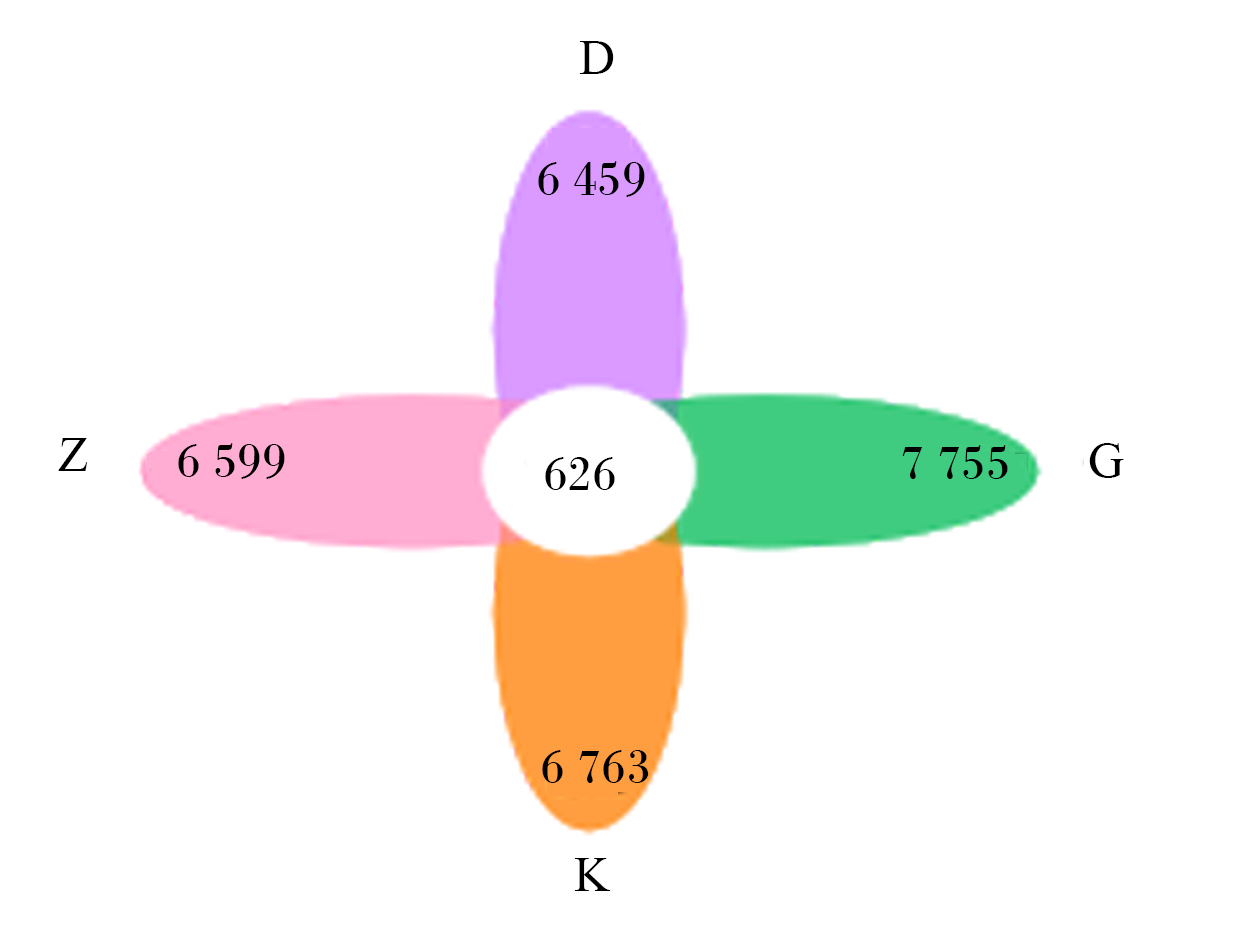
图1所示,4个组共有的OTU数量为626个;与CON组相比,G组的OTU数量明显增加,而D和Z组的OTU数量无明显变化,菌群结构较稳定。
图1 蛋鸡盲肠菌群韦恩图

Fig.1 Venn diagram of cecal microbiota of laying hens

K:CON组 CON group;D:D组 D group;Z:Z组 Z group;G:G组 G group。下图同 the same as below。

2.7.2 饲粮中添加木纤维对蛋鸡盲肠菌群Alpha多样性的影响

表13可知,与CON组相比,D、Z和G组的盲肠菌群Chao1指数显著增加(P<0.05),D、Z和G组的盲肠菌群Observed_OTUs指数、Shannon指数和Simpson指数均无显著差异(P>0.05)。
表13 饲粮中添加木纤维对蛋鸡盲肠菌群Alpha多样性的影响

Table 13 Effects of dietary wood fiber supplementation on cecal microbiota Alpha diversity of laying hens

项目
Items
组别Groups P
P-value
CON D Z G
Observed_OTUs指数
Observed_OTUs index
1 607.83±180.71 1 557.00±249.33 1 538.00±96.73 1 785.83±266.00 0.216
Shannon指数Shannon index 8.17±0.29 8.17±0.39 8.23±0.12 8.53±0.21 0.142
Simpson指数Simpson index 0.99±0.00 0.99±0.00 0.99±0.00 0.99±0.00 0.317
Chao1指数Chao1 index 1 516.57±54.56c 1 612.99±262.39b 1 656.69±172.03b 1 897.08±231.61a 0.030

2.7.3 饲粮中添加木纤维对蛋鸡盲肠菌群Beta多样性的影响

本研究采用主坐标分析(principal co-ordinates analysis,PCoA)方法,基于Bray-Curtis距离、加权UniFrac距离和非加权UniFrac距离进行Beta多样性评估。如图2所示,Beta多样性指数热图显示,D、Z和G组之间Beta多样性指数较低,证实其物种组成具有高度相似性。
图2 Beta多样性指数热图

矩阵中的数值表示样品间的相异性指数,该指数与微生物群落差异程度呈负相关。每个单元格内自上而下依次为Bray-Curtis距离、非加权UniFrac距离和加权UniFrac距离的定量结果。

Fig.2 Heat map of Beta diversity index

Values in the matrix represent the dissimilarity index between samples, which is negatively correlated with microbial community degree of deviation. Within each cell, the quantitative results are presented from top to bottom as Bray-Curtis distance, unweighted UniFrac distance and weighted UniFrac distance.

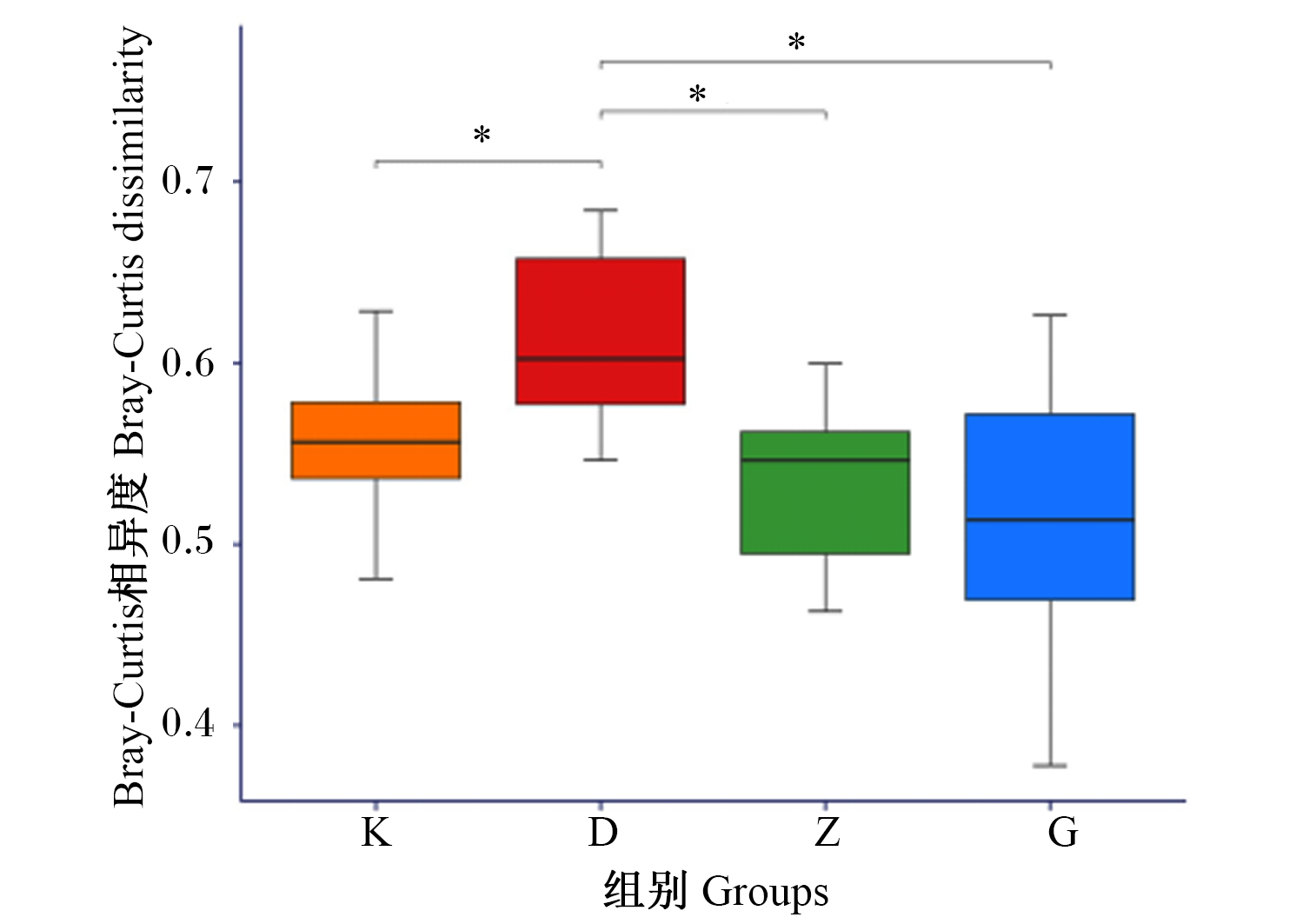
图3所示,Beta多样性组间差异分析箱形图显示,与CON组相比,D组的Beta多样性指数显著增加(P<0.05);此外,D组的Beta多样性指数显著高于Z和G组(P<0.05)。
图3 Beta多样性指数组间差异分析箱形图

*代表差异显著(P<0.05)。

Fig.3 Box plot of intergroup differences analysis in Beta diversity index

* indicated significant difference (P<0.05).

2.7.4 饲粮中添加木纤维对蛋鸡盲肠菌群结构组成的影响

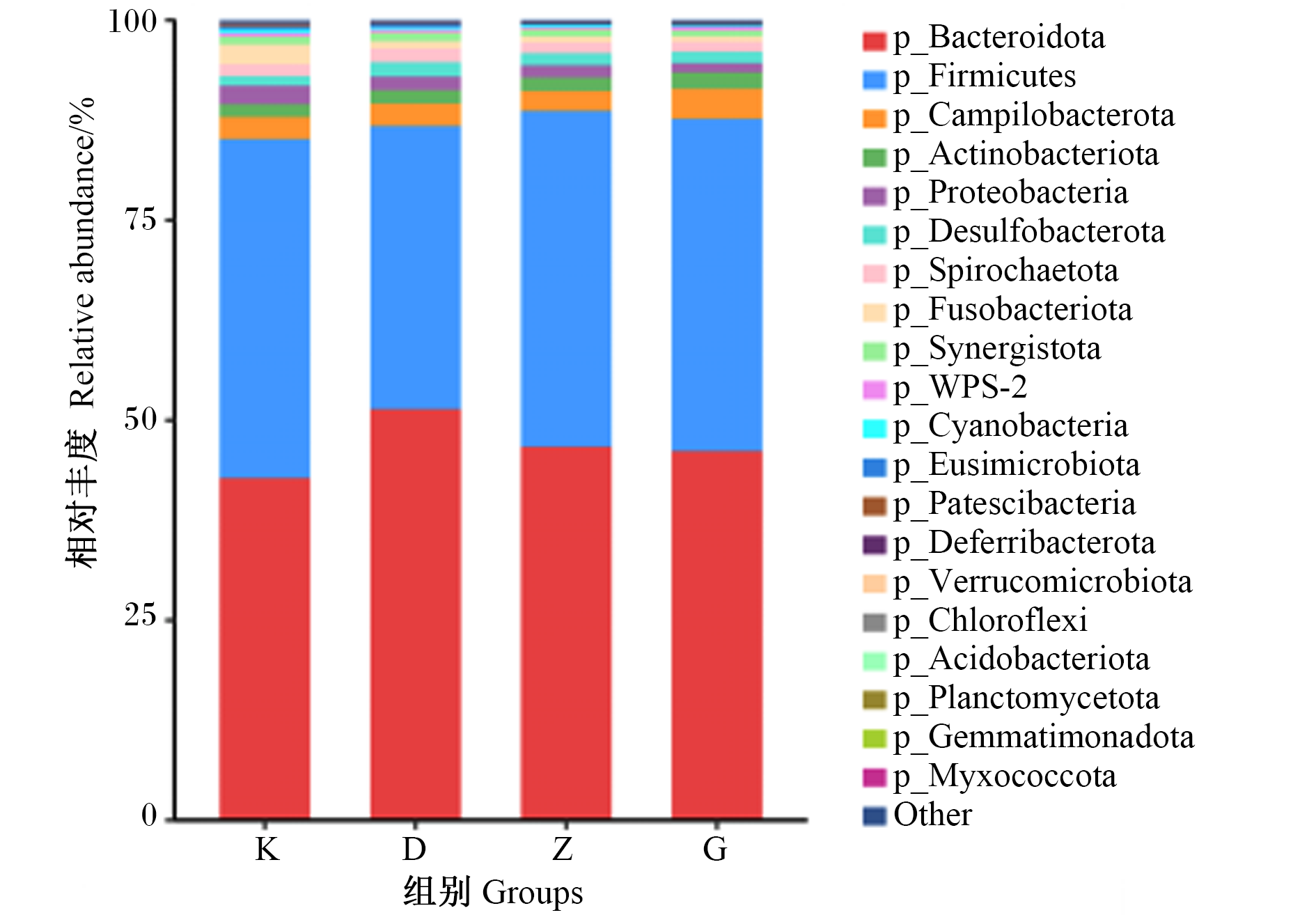
图4所示,在门水平上,各组均以拟杆菌门(Bacteroidota)和厚壁菌门(Firmicutes)为主要盲肠优势菌群。由表14可知,与CON组相比,D组的盲肠拟杆菌门相对丰度显著增加(P<0.05),D、Z和G组的盲肠厚壁菌门和弯曲杆菌门(Campilobacterota)相对丰度均无显著差异(P>0.05)。
图4 门水平上的盲肠菌群组成柱状图

p_Bacteroidota:拟杆菌门;p_Firmicutes:厚壁菌门;p_Campilobacterota:弯曲杆菌门;p_Actinobacteriota:放线菌门;p_Proteobacteria:变形菌门;p_Desulfobacterota:脱硫杆菌门;p_Spirochaetota:螺旋体菌门;p_Fusobacteriota:梭杆菌门;p_Synergistota:互养菌门;p_WPS-2:WPS-2菌门;p_Cyanobacteria:蓝藻菌门;p_Eusimicrobiota:真微生物菌门;p_Patescibacteria:候选菌辐射门;p_Deferribacterota:脱铁杆菌门;p_Verrucomicrobiota:疣微菌门;p_Chloroflexi:绿弯菌门;p_Acidobacteriota:酸杆菌门;p_Planctomycetota:浮霉菌门;p_Gemmatimonadota:芽单胞菌门;p_Myxococcota:黏液球菌门;Other:其他。

Fig.4 Bar chart of cecal microbiota composition at phylum level

表14 优势盲肠菌群门水平相对丰度

Table 14 Relative abundances of dominant cecal microbiota at phylum level

项目
Items
组别Groups P
P-value
CON D Z G
拟杆菌门Bacteroidota 42.77±3.72b 51.38±2.84a 46.70±3.09ab 46.15±1.84ab 0.010
厚壁菌门Firmicutes 42.37±3.84 38.03±4.73 41.99±3.10 43.86±1.23 0.068
弯曲杆菌门Campilobacterota 2.77±1.47 1.94±1.21 2.47±1.83 1.14±0.76 0.278
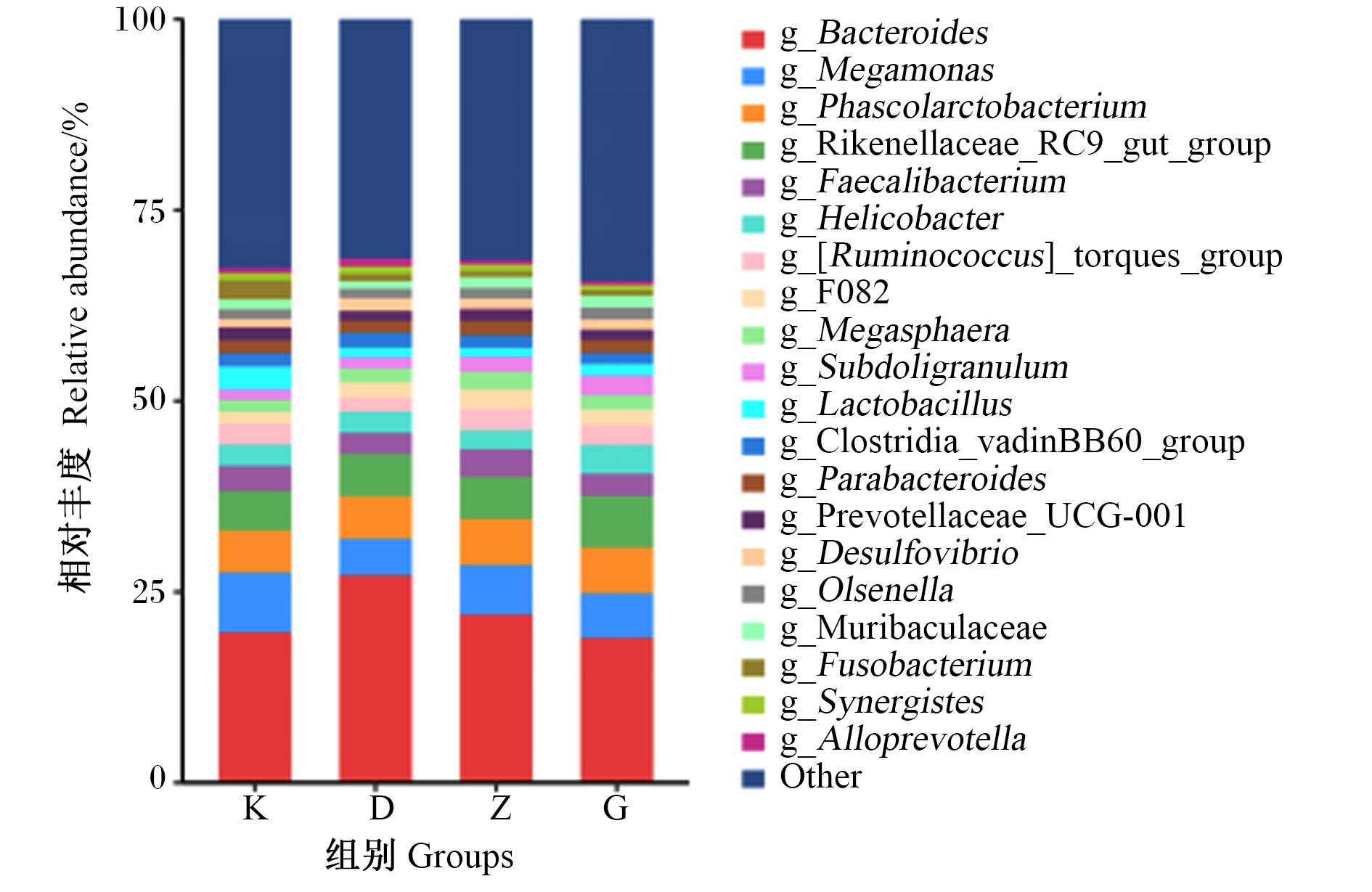
图5所示,在属水平上,各组均以拟杆菌属(Bacteroides)、巨单胞菌属(Megamonas)、理研菌科RC9肠道群(Rikenellaceae_RC9_gut_group)和考拉杆菌属(Phascolarctobacterium)为主要盲肠优势菌群。由表15可知,与CON组相比,D和Z组的盲肠拟杆菌属相对丰度显著增加(P<0.05),D、Z和G组的巨单胞菌属、理研菌科RC9肠道群和考拉杆菌属相对丰度均无显著差异(P>0.05)。
图5 属水平上的盲肠菌群组成柱状图

g_Bacteroides:拟杆菌属;g_Megamonas:巨单胞菌属;g_Phascolarctobacterium:考拉杆菌属;g_Rikenellaceae_RC9_gut_group:理研菌科RC9肠道群;g_Faecalibacterium:粪杆菌属;g_Helicobacter:螺杆菌属;g_[Ruminococcus]_torques_group:瘤胃球菌属torques群;g_F082:F082菌属;g_Megasphaera:巨球形菌属;g_Subdoligranulum:罕见小球菌属;g_Lactobacillus:乳杆菌属;g_Clostridia_vadinBB60_group:梭菌纲vadinBB60群;g_Parabacteroides:副拟杆菌属;g_Prevotellaceae_UCG-001:普雷沃氏菌科UCG-001;g_Desulfovibrio:脱硫弧菌属;g_Olsenella:奥尔森菌属;g_Muribaculaceae:鼠杆菌科(属级);g_Fusobacterium:梭杆菌属;g_Synergistes:互养菌属;g_Alloprevotella:拟普雷沃氏菌属;Other:其他。

Fig.5 Bar chart of cecal microbiota composition at genus level

表15 优势盲肠菌群属水平相对丰度

Table 15 Relative abundances of dominant cecal microbiota at genus level

项目
Items
组别Groups P
P-value
CON D Z G
拟杆菌属Bacteroides 19.72±4.86c 27.18±4.89a 22.05±2.88b 18.97±1.99c 0.001
巨单胞菌属Megamonas 7.83±4.85 4.81±3.65 6.50±4.17 5.86±3.35 0.632
理研菌科RC9肠道群
Rikenellaceae_RC9_gut_group
5.17±1.78 5.56±2.17 5.88±0.33 6.78±1.10 0.346
考拉杆菌属Phascolarctobacterium 5.03±1.17 5.55±1.76 6.02±2.16 6.36±0.65 0.577

3 讨论

3.1 饲粮中添加木纤维对蛋鸡生产性能、粪便评分和肠道形态结构的影响

禽类营养物质的同化作用与其消化道发育呈正相关,所有消化吸收过程均在消化系统内完成[15]。肠道屏障作为消化系统的重要防御结构,对维护肠道稳态具有核心作用[16]。其生理功能主要体现在选择性隔离肠道内的病原微生物、潜在致敏原及其他毒性物质,从而有效保障机体内环境稳定。本试验中,与CON组相比,D、Z和G组的空肠指数和隐窝深度均显著增加,这可能是因为饲粮中的粗纤维对动物消化系统具有多重生理效应。这些不可溶性木纤维能够通过机械刺激作用促进肠道的节律性收缩运动,同时诱导胃肠壁肌肉组织的适应性增厚。这种结构功能的双重改善最终提升了整个消化系统的运作效率,促进了营养物质吸收。这也可以解释在本试验中,适量木纤维添加有利于提升产蛋率和平均蛋重,以及降低料蛋比和粪便评分。Abdollahi等[17]用甜菜渣(SBP)作为纤维来源,发现饲喂含6% SBP饲粮的母鸡回肠重量更高。有研究显示,粗粒的不溶性纤维(燕麦壳、稻壳)可增加肌胃重量,降低肌胃pH,增加营养物质利用率[18]。但在本研究中,虽然木纤维对蛋鸡小肠长度一定促进趋势,但是没有产生显著影响,这也与前人的论点“不溶性纤维对小肠长度的影响有限”[19]一致。这表明饲粮中添加适量的木纤维对蛋鸡肠道形态结构与营养物质吸收有一定促进作用。

3.2 饲粮中添加木纤维对蛋鸡肠道抗氧化指标的影响

肠道绒毛是营养物质消化和吸收的主要场所,其高度的增加可以扩大吸收面积。绒毛尖端的抗氧化酶活性较高,而隐窝区域的抗氧化酶活性相对较低,这种分布有助于保护绒毛细胞免受氧化损伤[20]。本试验中,木纤维对肠道抗氧化能力产生了复杂影响,在增强蛋鸡空肠、回肠SOD、GSH-Px活性的同时,也观察到了回肠MDA含量与SOD、GSH-Px活性同步升高。这种看似矛盾的现象可能并非单纯的氧化损伤,而是反映了肠道对纤维的适应性重塑。空肠隐窝深度显著增加提示上皮细胞更新加快,MDA作为该过程的副产物会随之升高,其含量的升高可能是细胞更替增强的直接结果,因为有研究表明绒隐比的变化与肠道的抗氧化能力相关[21],较高的绒隐比可能意味着肠道细胞更新较快,从而有助于维持肠道的抗氧化平衡。此外,抗氧化能力提升可能与盲肠菌群代谢产物(如SCFAs)有关,有研究表明,肠道菌群对宿主的物质代谢、肥胖和免疫功能等均有影响[22];并且SCFAs通常具有提供动物所需的部分能量并促进营养物质的吸收、调节脂类代谢、调控肠道内的pH、抑制肠道炎症和调节免疫应答等生理功能,不仅可以影响肠道抗氧化能力,还解释了肠道器官指数提升的原因。

3.3 饲粮中添加木纤维对蛋鸡肠道消化酶活性影响

家禽营养物质的消化吸收过程高度依赖其肠道分泌的多种消化酶。这些由肠黏膜分泌的酶类(包括AMS、LPS及具有关键激活功能的肠激酶)通过协同作用完成三大营养物质的代谢转化[23]。其中,肠激酶通过催化TPS原转化为活性TPS,启动蛋白质的分解级联反应。所有消化酶共同将大分子营养物质降解为可吸收的小分子形式,显著提升碳水化合物、蛋白质和脂肪的生物利用率。本试验发现,饲粮中添加木纤维可以提高蛋鸡回肠AMS活性,这与Yokhana等[24]发现木纤维可以提高蛋鸡TPS活性和消化器官重量的研究结果有所不同,可能是因为其所测定部位为腺胃,而本试验所测部位为小肠,不同部位消化酶活性有所差异。

3.4 饲粮中添加木纤维对蛋鸡空肠消化酶相关基因表达的影响

Jiménez-Moreno等[25]研究发现,3%的木质纤维素可以一定程度上促进脂肪消化吸收。研究表明,在肉鸡饲粮中添加1%木质纤维素时,虽然对全消化道脂肪消化率未产生显著影响,但能明显提升回肠的脂肪消化效率[26]。FATP4和ACC分别负责脂肪酸的摄取和调节脂肪酸的合成与吸收,二者协同作用于脂质代谢过程,维持肠道黏膜的脂质稳态和功能,并间接影响消化酶活性[27]。本试验中,与CON组相比,G组的回肠FATP4 mRNA相对表达水平显著增加,Z组的回肠ACC mRNA相对表达水平显著增加。这表明适量的木纤维添加对营养物质的消化吸收以及肠道稳态的维持有重要作用。

3.5 饲粮中添加木纤维对蛋鸡盲肠菌群的影响

家禽消化道内定植着复杂的微生物群落,这些共生菌群通过以下机制促进宿主健康:增强饲料营养物质的分解代谢效率、调控生长发育相关代谢通路、调节免疫系统功能、维持肠道微生态平衡并构建生物屏障抵御病原微生物入侵[28]。Alpha多样性用于表征微生物群落的物种组成情况,主要包括丰富度和多样性2个维度。在具体评估指标方面,Chao1指数主要用于反映物种丰富程度,而Shannon指数和Simpson指数则更侧重于评估物种多样性水平[29]。本试验发现,与CON组相比,D、Z和G组的盲肠菌群Chao1指数显著增加,并且根据Beta多样性指数分析,各组间分离程度不明显,物种类型相似,表明木纤维提高了盲肠菌群的多样性。肠道微生物群落中,厚壁菌门与拟杆菌门的比值(F/B比值)是评估菌群稳态的核心生物指标,其变化与多种病理状态密切相关,作为肠道两大优势菌群,二者的相对丰度反映微生物生态平衡状态[30]。F/B比值升高通常表征能量代谢增强,而降低则可能提示炎症或屏障功能障碍,比如炎症性肠病的菌群特征为拟杆菌门相对丰度增加和厚壁菌门相对丰度减少,导致F/B比值下降,这种变化与肠道屏障完整性破坏和慢性炎症微环境形成相关[31]
理研菌科RC9肠道群可以降解可溶性多糖和不溶性纤维素,并且该菌属与丁酸代谢和胆汁酸代谢有关[32]。拟杆菌属主要参与类固醇、多糖和胆汁酸的代谢,可以提升宿主机体多糖的吸收能力和蛋白质合成能力,从而提升宿主对营养的吸收利用能力[33]。厚壁菌门和拟杆菌门是家禽主要的肠道菌门,它们与肠道中SCFAs的代谢有关,可以产生丁酸盐和B族维生素[34],对于动物脂肪沉积也有益处[35]。在本研究中,各组在门水平上的优势菌群有拟杆菌门、厚壁菌门,与CON组相比,D组的盲肠拟杆菌门相对丰度显著增加;各组在属水平上的优势菌群有拟杆菌属、巨单胞菌属、理研菌科RC9肠道群、考拉杆菌属,与CON组相比,D和Z组的盲肠拟杆菌属相对丰度显著增加。综上所述,木纤维的添加改变了蛋鸡盲肠菌群组成,具体表现为拟杆菌门及其下属拟杆菌属的相对丰度增加。这种变化可能与木纤维在盲肠内的微生物发酵过程有关,其降解产物主要包括乙酸、丙酸和丁酸等SCFAs[36],木纤维经微生物发酵生成的SCFAs通过酸化肠道环境与盐酸协同抑制病原体,同时为共生菌提供代谢底物,从而动态调节菌群结构与功能,维持宿主-微生物互作平衡[37]
本试验证明了因为木纤维的添加,促进了盲肠菌群发酵产生SCFAs,导致FATP4和ACC这2个与脂肪酸摄取和吸收基因的表达增加;并且因为木纤维的添加维护了蛋鸡肠道屏障。考虑到蛋鸡随着年龄增长,其生殖机能衰退[38],代谢减缓、营养需求减少,过剩营养易转化为腹部脂肪,并且过多能量转化为脂肪会加重肝脏负担易引发病变,增加死亡率;需调整饲粮营养水平,以适应需求变化、提高利用率、降低饲料成本[39]。从促进营养物质吸收,以及提升盲肠拟杆菌门和拟杆菌属相对丰度的角度来分析,低剂量的木纤维添对盲肠发酵以及脂肪酸相关基因表达的提升都有积极作用,在一定程度上可以促进产蛋后期蛋鸡的营养物质吸收,从而提升产蛋率和平均蛋重,降低料蛋比,提高饲料利用率。

4 结论

饲粮中添加适量的木纤维有利于提高蛋鸡产蛋率和平均蛋重,降低料蛋比和粪便评分,促进胃肠道发育和肠道黏膜消化酶分泌,一定程度上缓解肠道氧化应激,改善盲肠菌群组成,提高营养物质利用率,从而促进蛋鸡肠道健康。在本试验条件下,饲粮中添加4 g/kg木纤维时效果最佳。
[1]
XIE T, BAI S P, ZHANG K Y, et al. Effects of Lonicera confusa and Astragali radix extracts supplementation on egg production performance,egg quality,sensory evaluation,and antioxidative parameters of laying hens during the late laying period[J]. Poultry Science, 2019, 98(10):4838-4847.

DOI

[2]
WANG W W, WANG J, ZHANG H J, et al. Effects of Clostridium butyricum on production performance and intestinal absorption function of laying hens in the late phase of production[J]. Animal Feed Science and Technology, 2020, 264:114476.

DOI

[3]
YANG P, ZHAO J B. Variations on gut health and energy metabolism in pigs and humans by intake of different dietary fibers[J]. Food Science & Nutrition, 2021, 9(8):4639-4654.

DOI

[4]
GRAHAM H, HESSELMAN K, ÅMAN P. The influence of wheat bran and sugar-beet pulp on the digestibility of dietary components in a cereal-based pig diet[J]. The Journal of Nutrition, 1986, 116(2):242-251.

DOI

[5]
SINGH A K, KIM W K. Effects of dietary fiber on nutrients utilization and gut health of poultry: a review of challenges and opportunities[J]. Animals (Basel), 2021, 11(1):181-181.

[6]
JHA R, MISHRA P. Dietary fiber in poultry nutrition and their effects on nutrient utilization,performance,gut health,and on the environment:a review[J]. Journal of Animal Science and Biotechnology, 2021, 12(1):51.

DOI

[7]
SVIHUS B. The gizzard:function,influence of diet structure and effects on nutrient availability[J]. World’s Poultry Science Journal, 2011, 67(2):207-224.

DOI

[8]
JHA R, FOUHSE J M, TIWARI U P, et al. Dietary fiber and intestinal health of monogastric animals[J]. Frontiers in Veterinary Science, 2019, 6:48.

DOI PMID

[9]
MURAI A, KITAHARA K, TERADA H, et al. Ingestion of paddy rice increases intestinal mucin secretion and goblet cell number and prevents dextran sodium sulfate-induced intestinal barrier defect in chickens[J]. Poultry Science, 2018, 97(10):3577-3586.

DOI PMID

[10]
MAKIVIC L, GLISIC M, BOSKOVIC M, et al. Performances,ileal and cecal microbial populations and histological characteristics in broilers fed diets supplemented with lignocellulose[J]. Kafkas Universitesi Veteriner Fakultesi Dergisi, 2019, 25(1):83-91.

[11]
TEJEDA O J, KIM W K. The effects of cellulose and soybean hulls as sources of dietary fiber on the growth performance,organ growth,gut histomorphology,and nutrient digestibility of broiler chickens[J]. Poultry Science, 2020, 99(12):6828-6836.

DOI

[12]
GUZMÁN P, SALDAÑA B, KIMIAEITALAB M V, et al. Inclusion of fiber in diets for brown-egg laying pullets:effects on growth performance and digestive tract traits from hatching to 17 weeks of age[J]. Poultry Science, 2015, 94(11):2722-2733.

DOI

[13]
POURAZADI Z, SALARI S, TABANDEH M R, et al. Insoluble fibre and enzyme supplementation in mash or pellets diets on growth performance,apparent ileal digestibility and intestinal morphology of broiler chickens fed barley containing diets[J]. Veterinary Medicine and Science, 2024, 10(2):e1399.

DOI

[14]
BISWAS S, CHO S B, KIM I H. An evaluation of gallic acid supplementation to corn-soybean-gluten meal-based diet in broilers[J]. Poultry Science, 2023, 102(7):102738.

DOI

[15]
廖凯威, 孙中华, 徐杰, 等. 蛋鸡日粮中添加不同剂量酵母膳食纤维对生产性能、蛋品质和免疫指标的影响[J]. 中国饲料, 2024(13):201-204.

LIAO K W, SUN Z H, XU J, et al. Effects of dietary fiber supplementation with different doses of yeast on production performance,egg quality and immune indexes of laying hens[J]. China Feed, 2024(13):201-204. (in Chinese)

[16]
MARTEL J, CHANG S H, KO Y F, et al. Gut barrier disruption and chronic disease[J]. Trends in Endocrinology and Metabolism, 2022, 33(4):247-265.

DOI PMID

[17]
ABDOLLAHI A, KARIMI A, SADEGHI A A, et al. The effects of the fiber source and xylanase supplementation on production,egg quality,digestibility,and intestinal morphology in the aged laying hen[J]. Poultry Science, 2021, 100(3):100936.

DOI

[18]
ABDOLLAHI M R, ZAEFARIAN F, HUNT H, et al. Wheat particle size,insoluble fibre sources and whole wheat feeding influence gizzard musculature and nutrient utilisation to different extents in broiler chickens[J]. Journal of Animal Physiology and Animal Nutrition, 2019, 103(1):146-161.

DOI

[19]
JIMÉNEZ-MORENO E, GONZÁLEZ-ALVARADO J M, DE COCA-SINOVA A, et al. Insoluble fiber sources in mash or pellets diets for young broilers.2.Effects on gastrointestinal tract development and nutrient digestibility[J]. Poultry Science, 2019, 98(6):2531-2547.

DOI

[20]
KUZMINA I V, TOLPYGO S M, KOTOV A V, et al. Intestinal digestion in poultry compared to other animal species with a diverse diet[J]. Frontiers in Physiology, 2024, 15:1358524.

DOI

[21]
邹立军, 熊霞, 王小城, 等. 肠道隐窝-绒毛轴上皮细胞更新及调控机制研究进展[J]. 中国科学(生命科学), 2017, 47(2):190-200.

ZOU L J, XIONG X, WANG X C, et al. Current advances in renewal mechanisms of intestinal epithelial cells along the crypt-villus axis[J]. Scientia Sinica Vitae, 2017, 47(2):190-200. (in Chinese)

DOI

[22]
XIAO Y P, XIANG Y, ZHOU W D, et al. Microbial community mapping in intestinal tract of broiler chicken[J]. Poultry Science, 2017, 96(5):1387-1393.

DOI PMID

[23]
TAN J, MCKENZIE C, POTAMITIS M, et al. Chapter three-the role of short-chain fatty acids in health and disease[M]// ALTF W. Advancesin immunology. Amsterdam: Academic Press,2014:91-119.

[24]
YOKHANA J S, PARKINSON G, FRANKEL T L. Effect of insoluble fiber supplementation applied at different ages on digestive organ weight and digestive enzymes of layer-strain poultry[J]. Poultry Science, 2016, 95(3):550-559.

DOI PMID

[25]
JIMÉNEZ-MORENO E, GONZÁLEZ-ALVARADO J M, GONZÁLEZ-SÁNCHEZ D, et al. Effects of type and particle size of dietary fiber on growth performance and digestive traits of broilers from 1 to 21 days of age[J]. Poultry Science, 2010, 89(10):2197-2212.

DOI

[26]
BOGUSŁAWSKA-TRYK M, PIOTROWSKA A, SZYMECZKO R, et al. Effect of dietary lignocellulose on ileal and total tract digestibility of fat and fatty acids in broiler chickens[J]. Journal of Animal Physiology and Animal Nutrition, 2016, 100(6):1050-1057.

DOI

[27]
LI H L, HERRMANN T, SEEBLE J, et al. Role of fatty acid transport protein 4 in metabolic tissues:insights into obesity and fatty liver disease[J]. Bioscience Reports, 2022, 42(6):BSR20211854.

[28]
STANLEY D, HUGHES R J, MOORE R J. Microbiota of the chicken gastrointestinal tract:influence on health,productivity and disease[J]. Applied Microbiology and Biotechnology, 2014, 98(10):4301-4310.

DOI

[29]
GRICE E A, KONG H H, CONLAN S, et al. Topographical and temporal diversity of the human skin microbiome[J]. Science, 2009, 324(5931):1190-1192.

DOI PMID

[30]
HUANG K C, CHUANG P Y, YANG T Y, et al. Diabetic rats induced using a high-fat diet and low-dose streptozotocin treatment exhibit gut microbiota dysbiosis and osteoporotic bone pathologies[J]. Nutrients, 2024, 16(8):1220.

DOI

[31]
YIN Y, YANG T Z, TIAN Z Y, et al. Progress in the investigation of the firmicutes/bacteroidetes ratio as a potential pathogenic factor in ulcerative colitis[J/OL]. Journal of Medical Microbiology, 2025,doi:10.1099/jmm.0.001966.

[32]
简宗辉, 徐焘杰, 孙帅, 等. 肠道微生物影响单胃动物免疫的分子机理研究进展[J]. 畜牧与兽医, 2022, 54(1):129-136.

JIAN Z H, XU T J, SUN S, et al. Progress in research on the molecular mechanism of intestinal microorganism affecting immunity of monogastric animals[J]. Animal Husbandry & Veterinary Medicine, 2022, 54(1):129-136. (in Chinese)

[33]
DU R L, BEI H K, JIA L H, et al. Danggui buxue tang restores antibiotic-induced metabolic disorders by remodeling the gut microbiota[J]. Journal of Ethnopharmacology, 2020, 259:112953.

DOI

[34]
HUGENHOLTZ F, RITARI J, NYLUND L, et al. Feasibility of metatranscriptome analysis from infant gut microbiota:adaptation to solid foods results in increased activity of firmicutes at six months[J]. International Journal of Microbiology, 2017, 2017(1):9547063.

[35]
农斯伟, 沈水宝, 韦晓芳, 等. 丁酸梭菌和枯草芽孢杆菌对广西黎村黄鸡生长性能、肠道形态及盲肠微生物区系的影响[J]. 饲料工业, 2021, 42(3):19-24.

NONG S W, SHEN S B, WEI X F, et al. Effects of Clostridium butyricum and Bacillus subtilis on the growth performance,intestinal morphology and cecal microflora of Guangxi Licun yellow chickens[J]. Feed Industry, 2021, 42(3):19-24. (in Chinese)

[36]
白雅绮. 日粮可溶性纤维与益生菌对育肥猪生长性能、氮排放及肠道菌群的影响[D]. 硕士学位论文. 绵阳: 西南科技大学, 2020.

BAI Y Q. Effects of dietary soluble fiber and probiotics on growth performance,nitrogen emissions and intestinal microflora of finishing pigs[D]. Master’s Thesis. Mianyang: Southwest University of Science and Technology, 2020. (in Chinese)

[37]
PANDIT R J, HINSU A T, PATEL N V, et al. Microbial diversity and community composition of caecal microbiota in commercial and indigenous Indian chickens determined using 16S rDNA amplicon sequencing[J]. Microbiome, 2018, 6(1):115.

DOI PMID

[38]
LIU H K, LONG D W, BACON W L. Preovulatory luteinizing hormone surge interval in old and young laying turkey hens early in the egg production period[J]. Poultry Science, 2001, 80(9):1364-1370.

PMID

[39]
姜礼文. 排卵诱导氧化应激对蛋鸡卵巢机能的影响[D]. 硕士学位论文. 北京: 中国农业科学院, 2013.

JIANG L W. Influence of oxidative stress induced by repeated ovulation on ovary functions of laying hens[D]. Master’s Thesis. Beijing: Chinese Academy of Agricultural Sciences, 2013. (in Chinese)

Outlines

/