RESEARCH PAPER

Effects of Heat Stress on Growth Performance, Digestive Performance, Serum Biochemical Indices, Rumen Fermentation Parameters and Microbial Community Structure of Fattening Lambs

  • LI Jianjie , 1 ,
  • WANG Chao 1 ,
  • YANG Haitong 1 ,
  • LIU Yuqing 1 ,
  • LUO Yu 2 ,
  • GUO Lei 3 ,
  • YANG Wei 3 ,
  • GAO Yuhong , 1, ** ,
  • ZHANG Huiwen , 2, **
Expand
  • 1 College of Animal Science and Technology, Hebei Agricultural University, Baoding 071001, China
  • 2 Chengde Veterinary Drug Administration Station, Chengde 067000, China
  • 3 Agriculture and Rural Bureau of Shuangqiao District in Chengde City, Chengde 067000, China
** GAO Yuhong, professor, E-mail: ;
ZHANG Huiwen, professor, E-mail:

* Contributed equally

Received date: 2026-01-09

  Online published: 2026-09-12

Abstract

This experiment was conducted using environmentally controlled chambers to investigate the changes in growth performance, digestive performance, serum biochemical indices, rumen fermentation parameters and microbial community structure of fattening lambs under heat stress, and to analyze the correlations among these indicators. Twelve fattening male lambs (small-tailed Han sheep×Dorper sheep) with an average body weight of (22.4±2.6) kg were randomly allocated to two environmentally controlled chambers, with six lambs per chamber and each lamb housed in a single pen. The control chamber was maintained under non-heat-stress conditions (control group) at 21.5 ℃ and 60% relative humidity, with a temperature-humidity index (THI) of 67.91. The heat-stress chamber was maintained under heat-stress conditions (heat-stress group) at 33.50 ℃ and 60% relative humidity, with a THI of 84.75. After a 14-day feeding period, growth performance, nutrient apparent digestibility, rumen volatile fatty acid (VFA) concentrations, and the diversity and composition of rumen fungal, protozoal and archaeal communities were determined. The results showed as follows: 1) the average daily gain (ADG) and average daily feed intake (ADFI) of lambs in the heat-stress group were extremely significantly decreased compared with the control group (P<0.01), whereas the feed-to-gain ratio (F/G) was significantly increased (P<0.05). 2) The apparent digestibility of dry matter (DM), crude protein (CP), ether extract (EE), acid detergent fiber (ADF) and neutral detergent fiber (NDF) in the heat-stress group was significantly or extremely significantly decreased compared with the control group (P<0.05), with the ADF apparent digestibility being only 52.91% of that in the control group. 3) Serum cortisol (COR) content in the heat-stress group was increased by 35.99% compared with the control group (P<0.01), whereas serum triiodothyronine (T3), blood urea nitrogen (BUN) and glucose (GLU) contents were extremely significantly decreased compared with the control group (P<0.01). 4) Rumen total volatile fatty acid (TVFA) concentration in the heat-stress group was extremely significantly increased compared with the control group (P<0.01), and the concentrations of acetate and propionate were increased by 27.26% (P<0.01) and 38.46% (P<0.05), respectively. 5) Regarding rumen microbial community structure, no significant differences were observed in the α diversity of rumen fungal, protozoal and archaeal communities between the two groups (P>0.05). The relative abundance of Entodinium in the heat-stress group was significantly higher than that in the control group (P<0.05), and the relative abundance of Entodinium showed significant negative correlations with serum T3, BUN and COR (P<0.05). In conclusion, heat stress adversely affects the growth performance and digestive performance of fattening lambs and induces alterations in rumen fermentation parameters. Although it does not significantly affect the α diversity of rumen fungal, archaeal, and protozoal communities, it can significantly increase the relative abundance of Entodinium.

Cite this article

LI Jianjie , WANG Chao , YANG Haitong , LIU Yuqing , LUO Yu , GUO Lei , YANG Wei , GAO Yuhong , ZHANG Huiwen . Effects of Heat Stress on Growth Performance, Digestive Performance, Serum Biochemical Indices, Rumen Fermentation Parameters and Microbial Community Structure of Fattening Lambs[J]. Chinese Journal of Animal Nutrition, 2026 , 38(9) : 6836 -6852 . DOI: 10.12418/CJAN2026.547

随着全球气候持续变暖,热应激对畜牧业的威胁日益严峻,近年来给养殖场(户)造成的经济损失已引起广泛关注。在热应激环境下,家畜因散热机制受阻而出现体内蓄热、体温升高[1],进而导致采食量下降、生长受阻和代谢紊乱;同时,高温高湿会加剧畜舍环境恶化[2-3],间接影响家畜健康。目前,关于反刍家畜热应激的研究报道多侧重于奶牛,而在羊上的相关研究相对滞后,且当前羊产业正处于由放牧模式向舍饲、半舍饲模式转型的阶段。近年来,作者团队对河北省不同区域羊场热应激发生程度的调研发现,北部燕山山区虽气候较为凉爽,但夏季羊舍温湿度指数(THI)仍高于72,而中南部地区已达80以上[4],表明华北地区肉羊夏季面临普遍的热应激风险,其中中南部地区已达重度水平。已有研究表明,热应激会破坏瘤胃细菌群落的结构和功能,导致厚壁菌门和普雷沃氏菌属的相对丰度降低[5-6]。Silpa等[7]和张瑜[8]研究也发现,遭受热应激的羊瘤胃中拟杆菌门和变形菌门的相对丰度降低。除细菌外,瘤胃中的真菌、原生动物和古菌等群落对动物的消化、代谢和免疫也发挥着重要作用[5]。真菌可产生纤维素降解酶,具有较强的纤维降解能力[9-10];原生动物参与多种代谢过程,可分解宿主自身无法消化的难降解碳水化合物[11];古菌在微生物发酵中有助于还原辅助因子的再氧化,具有维持纤维降解的功能[12]。尽管已有研究探讨了热应激与瘤胃微生态的关系,但相关报道多集中于细菌群落,热应激对育肥羔羊瘤胃中真菌、原生动物和古菌群落结构与功能的影响仍缺乏系统性解析。基于此,本研究采用环控舱探究热应激条件下育肥羔羊生长性能、养分表观消化率、血清生化指标以及瘤胃发酵参数与真菌、原生动物和古菌群落结构的变化,并分析各指标间的相关性,以期为生产实践中缓解羊热应激提供理论依据。

1 材料与方法

1.1 试验设计

本研究的动物试验方案已获得河北农业大学实验动物管理与伦理委员会的批准(伦理编号:2026006)。选择12只健康且体重接近的育肥公羔[小尾寒羊×杜泊羊,体重(22.4±2.6) kg],随机分配到2间同相对湿度不同温度的环控舱中(对照舱和热应激舱),每间舱设置6个独立羊栏(1.2 m×1.0 m),每栏饲养1只羔羊。根据课题组之前的研究成果[3],将对照舱为无热应激环境(对照组),设定环境温度为21.5 ℃,相对湿度为60%,THI为67.91[THI计算公式:THI=(1.8×环境温度+32)-(0.55-0.005 5×相对湿度)×(1.8×环境温度-26)[13]];热应激舱为热应激环境(热应激组),设定环境温度为33.5 ℃、相对湿度为60%,THI为84.75,其他条件与对照舱保持一致。试验周期为14 d。

1.2 饲养管理

环控舱均采用日光灯(150 lx,白光)照明,每日07:00打开,21:00关闭。试验前对环控舱进行全面消毒,通风2 d后,将育肥羔羊转入环控舱中,正式试验前羔羊预饲1周。整个试验期所有羔羊采用全混合颗粒料饲喂,每天给料3次(06:00、12:00和18:00),自由采食,剩料率控制在2%~5%。全混合颗粒料参照《肉羊饲养标准》(NY/T 816—2021)的营养需要并结合生产实践配制,其组成及营养水平见表1
表1 全混合颗粒料组成及营养水平(风干基础)

Table 1 Composition and nutrient levels of the pelleted total mixed ration (air-dry basis)

项目Items 含量Content
原料Ingredients
磨碎玉米Ground corn 33.20
棉籽粕Cottonseed meal 8.00
豆粕Soybean meal 20.00
花生秧Peanut vine 17.50
燕麦Oats 19.00
小苏打NaHCO3 0.70
食盐NaCl 0.80
维生素预混料Vitamin premix1) 0.20
矿物质预混料Mineral premix2) 0.60
合计Total 100.00
营养水平Nutrient levels3)
代谢能ME/(MJ/kg) 11.79
干物质DM 90.41
粗蛋白质CP 14.35
粗脂肪EE 1.97
中性洗涤纤维NDF 27.56
酸性洗涤纤维ADF 20.14
钙Ca 0.65
磷P 0.32

1)维生素预混料为每千克全混合颗粒料提供 The vitamin premix provides the following per kg of the pelleted total mixed ration:VA 2 300 IU,VD 1 750 IU,VE 15 IU,VB1 3.5 mg。

2)矿物质预混料为每千克全混合颗粒料提供 The mineral premix provides the following per kg of the pelleted total mixed ration:I (as potassium iodide) 0.6 mg,Fe (as ferrous sulfate) 72 mg,Cu (as copper sulfate)3.6 mg,Mn (as manganese sulfate) 45 mg,Zn (as zinc sulfate) 20 mg,Se 0.15 mg,Co 0.18 mg。

3)代谢能参照《肉羊饲养标准》(NY/T 816—2021)计算,其余为实测值。ME is calculated according to the Nutrient Requirements of Meat-Type Sheep and Goat (NY/T 816—2021), while the others are measured values.

1.3 样品采集

试验结束前3 d,按照GB/T 20195—2024中的方法采集粪便和饲粮样品,将采集的新鲜粪便和饲粮样品存放于-20 ℃冰箱中,以备测干物质(DM)、粗蛋白质(CP)、粗脂肪(EE)、酸性洗涤纤维(ADF)、中性洗涤纤维(NDF)、钙(Ca)、磷(P)和盐酸不溶灰分(AIA)含量。试验结束当日,每只羊空腹采血10 mL,离心制备血清,-20 ℃冰箱中保存待测血清生化指标。试验结束当日,利用瘤胃液采样管从口腔进入瘤胃,采集每只羔羊的瘤胃液(30 mL),分装成2份,一份用于测定挥发性脂肪酸(VFA)浓度,另一份用于测定真菌、原生动物和古菌群落结构。

1.4 测定指标与方法

1.4.1 生长性能

在试验开始和结束时对羔羊逐只进行空腹称重,计算平均日增重(ADG);另外,通过每日称量羔羊的给料量和剩料量,计算平均日采食量(ADFI),并根据ADFI和ADG计算羔羊的料重比(F/G),即F/G=ADFI/ADG。

1.4.2 养分表观消化率

DM、CP、EE、Ca、P、NDF、ADF和AIA含量分别参照GB/T 6435—2014、GB/T 24318—2009、GB/T 6433—2025、GB/T 6436—2018、GB/T 6437—2018、GB/T 20806—2022、NY/T 1459—2022和GB/T 23742—2009方法进行测定。各养分的表观消化率均采用内源指示剂法进行测定,以AIA为内源指示剂,计算各养分的表观消化率,计算公式如下:
某养分表观消化率(%)=100-(粪样中该养分含量/粪样中AIA含量)×(饲粮样中AIA含量/饲粮样中该养分含量)×100。

1.4.3 血清生化指标

血清三碘甲腺原氨酸(T3)、甲状腺素(T4)、皮质醇(COR)和生长激素(GH)含量使用放射免疫γ计数器(DFM-96,北京莱博泰瑞科技发展有限公司)进行检测,血清葡萄糖(GLU)、尿素氮(BUN)、总蛋白(TP)、白蛋白(ALB)和球蛋白(GLB)含量使用半自动生化分析仪(GF-D200,北京莱博泰瑞科技发展有限公司)进行检测,上述指标测定所用的试剂盒均为南京建成生物工程研究所的产品,测定时按照试剂盒说明进行操作。

1.4.4 瘤胃VFA浓度

将待测瘤胃液样品以3 920×g离心10 min后,取上清液。用含2-乙基丁酸的25%偏磷酸溶液作为内标,将上清液和内标液混合,在冰水浴静置30 min,离心,使用GC-7890A气相色谱仪(Agilent Technologies,美国)测定乙酸、丙酸、丁酸、异丁酸、戊酸、异戊酸浓度,并计算乙丙比和总挥发性脂肪酸浓度。

1.4.5 瘤胃微生物群落结构

首先提取瘤胃液样品的基因组DNA,采用NanoDrop 2000超微量分光光度计(Thermo Fisher Scientific,美国)对提取的DNA质量和浓度进行检测,随后进行PCR扩增。真菌ITS1区域的扩增引物序列:正向引物,5'-CTTGGTCATTTAGAGGAAGTAA-3';反向引物,5'-TGCGTTCTTCATCGATGC-3';原生动物18S rRNA基因V4区域(573~951 bp)的扩增引物序列:正向引物,5'-CGCGGTAATTCCAGCTCCA-3';反向引物,5'-TTGGYRAATGCTTTCGC-3';古菌16S rRNA基因V3~V4区域(344~806 bp)的扩增引物序列:正向引物,5'-ACGGGGYGCAGCAGGCGCGA-3';反向引物,5'-GGACTACVSGGGTATCTAAT-3'。使用建库试剂盒(New England Biolabs,美国)构建文库,并利用Illumina MiSeq平台(Illumina,美国)进行PE250/PE300双端测序。对所得的Fastq原始数据,采用Trimmomatic(v0.36)进行序列质控,借助Pear(v0.9.6)剔除含N碱基的无效序列;随后利用Flash(v1.20)与Pear软件,基于双端reads的overlap区进行序列拼接,获得Fasta序列,最后采用UCHIME方法去除Fasta序列中的嵌合体。此外,利用QIIME2软件和R语言对所有样本进行α多样性和β多样性分析,以评价各组微生物群落结构差异,其中α多样性通过Chao1、Shannon、Simpson和Observed_species指数进行评价,β多样性基于主成分分析(PCA)进行可视化展示。

1.5 数据处理与分析

试验数据利用SPSS 27.0和R 4.4.2软件进行分析。其中,组间差异通过独立样本t检验进行判断;生长性能与血清生化指标、瘤胃发酵参数、瘤胃微生物间的相关性采用Spearman秩相关法进行分析,并通过Mantel检验进行验证;采用LEfSe方法筛选差异微生物,筛选标准为Kruskal-Wallis检验P<0.05、Wilcoxon检验P<0.05,且线性判别分析(LDA)得分>2。数据统计显著性的判定标准:P<0.05,差异显著;P<0.01,差异极显著。

2 结果与分析

2.1 育肥羔羊在热应激条件下生长性能的变化

表2可知,与对照组比较,热应激组的ADG与ADFI均极显著降低(P<0.01),F/G则显著增加(P<0.05),说明热应激条件下育肥羔羊的生长性能受到了负面影响。
表2 育肥羔羊在热应激条件下生长性能的变化

Table 2 Changes in growth performance of fattening lambs under heat stress

项目
Items
对照组
Control group
热应激组
Heat-stress group
均值标准误
SEM
P
P-value
初始体重IBW/kg 22.37 22.40 0.489 0.963
终末体重FBW/kg 26.42a 24.47b 0.485 0.018
平均日增重ADG/g 288.08A 148.16B 8.649 <0.001
平均日采食量ADFI/g 1 907.10A 1 374.00B 92.123 0.004
料重比F/G 6.62b 9.27a 0.632 0.017

同行数据肩标不同小写字母表示组间差异显著(P<0.05),不同大写字母表示组间差异极显著(P<0.01)。下表同。

Values within a row with the different small letter superscripts mean significant difference between groups (P<0.05), and those with different capital letter superscripts mean extremely significant difference between groups (P<0.01). The same as below.

2.2 育肥羔羊在热应激条件下养分表观消化率的变化

表3可知,热应激组的ADF和NDF表观消化率极显著低于对照组(P<0.01),分别为对照组的52.91%和86.77%;与对照组相比,热应激组的EE、DM和CP表观消化率显著降低(P<0.05),分别为对照组的64.29%、90.24%和86.46%。
表3 育肥羔羊在热应激条件下养分表观消化率的变化

Table 3 Changes in nutrient apparent digestibility of fattening lambs under heat stress

项目
Items
对照组
Control group
热应激组
Heat-stress group
均值标准误
SEM
P
P-value
干物质DM 74.68a 67.39b 1.345 0.019
粗蛋白质CP 82.28a 71.14b 1.895 0.014
粗脂肪EE 41.11a 26.43b 3.657 0.047
中性洗涤纤维NDF 70.15A 60.87B 1.470 0.002
酸性洗涤纤维ADF 63.82A 33.77B 2.345 <0.001
钙Ca 24.95 15.67 2.618 0.066
磷P 78.46 75.69 0.981 0.117

2.3 育肥羔羊在热应激条件下血清生化指标的变化

表4可知,热应激组血清COR含量极显著高于对照组(P<0.01),较对照组提高了35.99%,而血清T3、BUN和GLU含量均极显著低于对照组(P<0.01);同时,与对照组相比,热应激组血清GH、TP和GLB含量显著降低(P<0.05)。
表4 育肥羔羊在热应激条件下血清生化指标的变化

Table 4 Changes in serum biochemical indices of fattening lambs under heat stress

项目
Items
对照组
Control group
热应激组
Heat-stress group
均值标准误
SEM
P
P-value
三碘甲状腺原氨酸T3/(ng/mL) 33.83A 28.14B 0.890 0.004
甲状腺素T4/(ng/mL) 1 082.33 1 010.85 24.050 0.080
皮质醇COR/(ng/mL) 19.23B 26.15A 0.928 0.002
生长激素GH/(ng/mL) 1.26a 0.71b 0.087 0.011
葡萄糖GLU/(mmol/L) 3.30A 1.86B 0.248 0.007
尿素氮BUN/(mmol/L) 9.58A 7.13B 0.233 <0.001
总蛋白TP/(g/L) 67.59a 63.98b 0.931 0.033
白蛋白ALB/(g/L) 41.29 39.51 0.601 0.081
球蛋白GLB/(g/L) 27.57a 22.18b 1.130 0.015

2.4 育肥羔羊在热应激条件下瘤胃VFA浓度的变化

表5可知,与对照组相比,热应激组瘤胃中乙酸和总挥发性脂肪酸浓度极显著增加(P<0.01),丙酸和异戊酸浓度显著增加(P<0.05),但乙丙比未产生显著变化(P>0.05)。
表5 育肥羔羊在热应激条件下瘤胃挥发性脂肪酸浓度的变化

Table 5 Changes of rumen volatile fatty acid concentrations of fattening lambs under heat stress

项目
Items
对照组
Control group
热应激组
Heat-stress group
均值标准误
SEM
P
P-value
乙酸Acetate/(mmol/L) 45.93B 58.45A 1.396 0.003
丙酸Propionate/(mmol/L) 20.41b 28.26a 1.342 0.015
丁酸Butyrate/(mmol/L) 9.12 14.46 1.484 0.064
异丁酸Isobutyrate/(mmol/L) 0.75 1.66 0.314 0.109
戊酸Valerate/(mmol/L) 0.92 2.04 0.468 0.166
异戊酸Isovalerate/(mmol/L) 0.86b 2.76a 0.470 0.046
乙丙比A/P ratio 1.13 1.04 0.051 0.286
总挥发性脂肪酸TVFA/(mmol/L) 77.99B 107.62A 3.966 0.006

2.5 育肥羔羊在热应激条件下瘤胃真菌群落结构的变化

2.5.1 真菌群落多样性
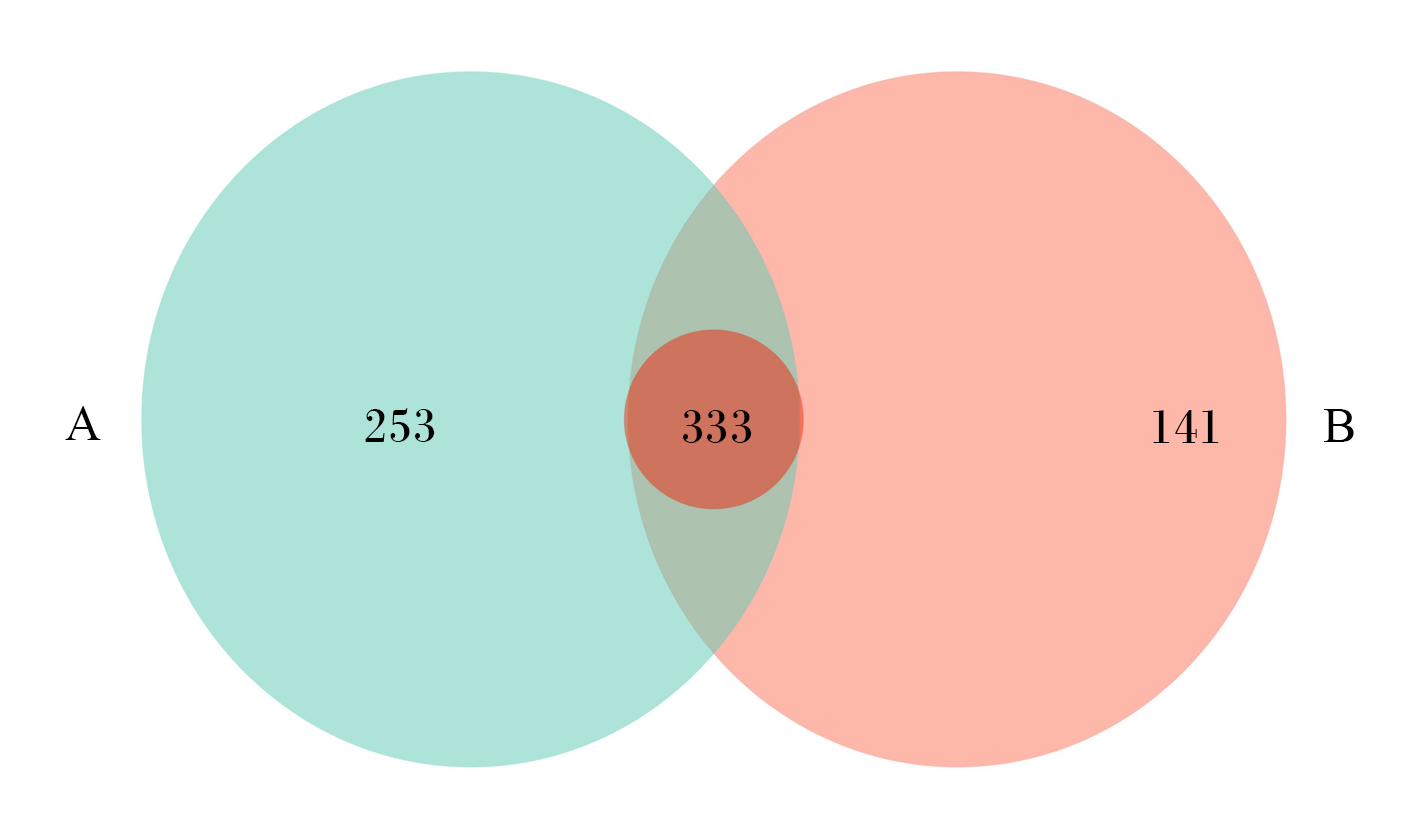
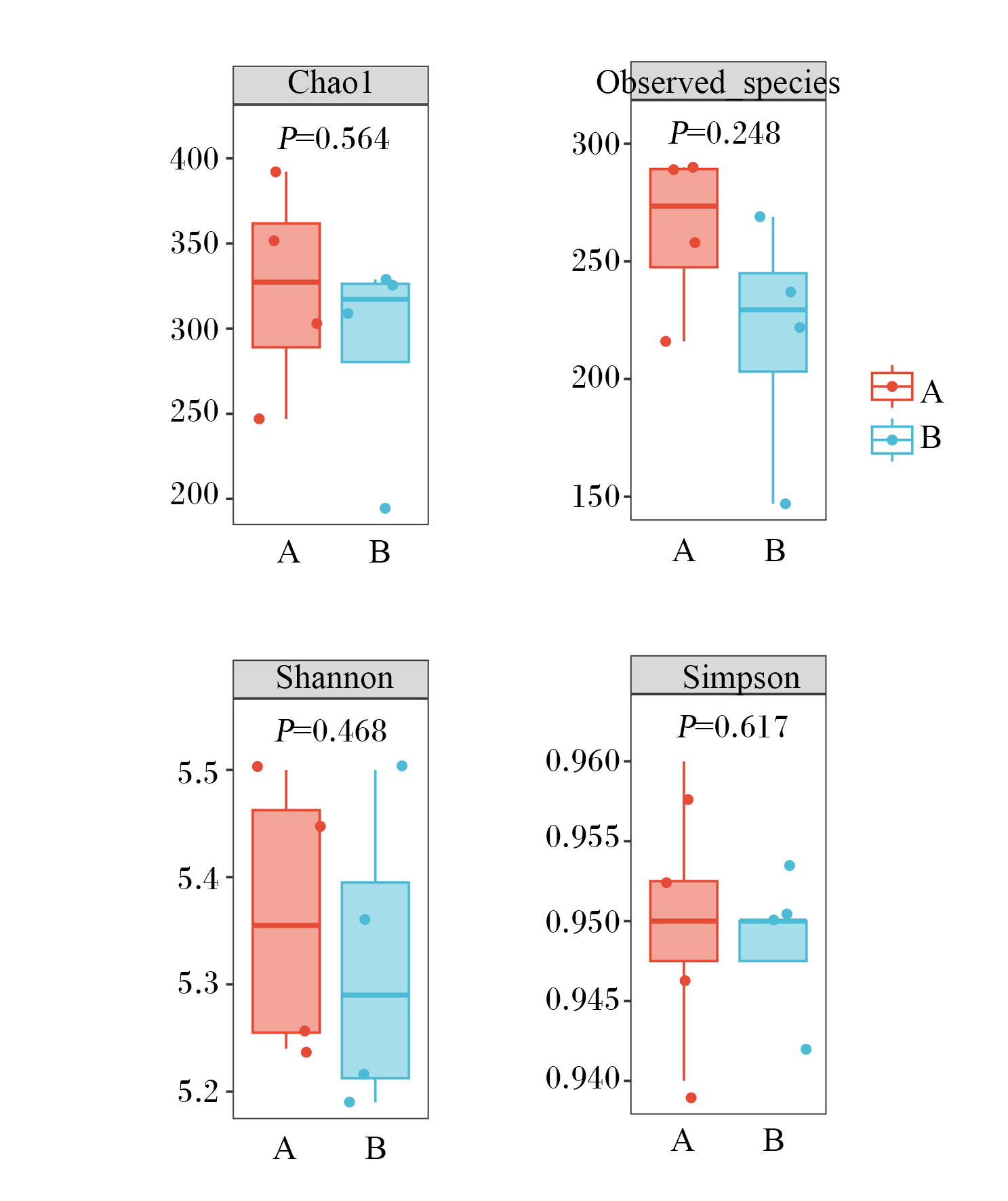
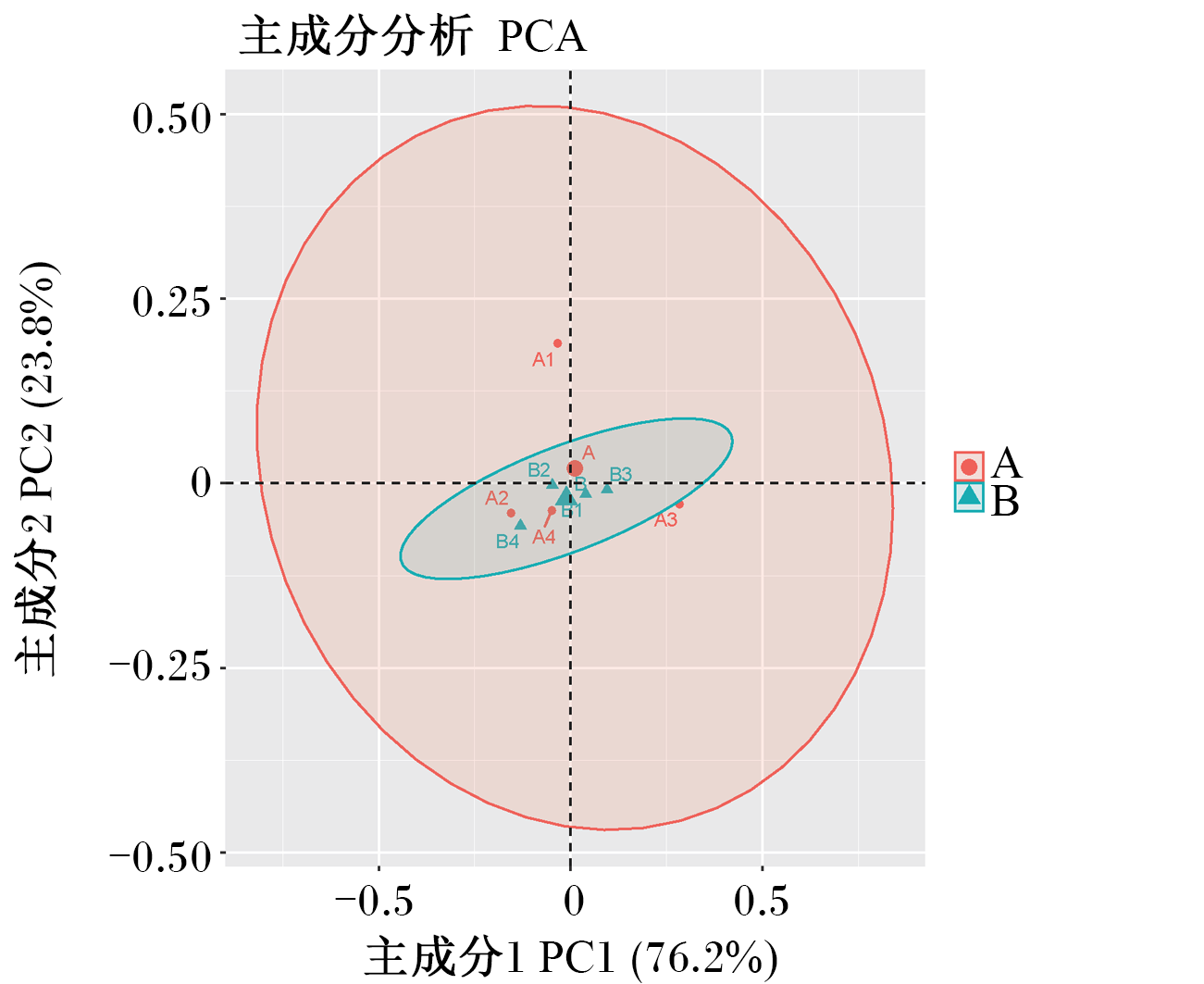
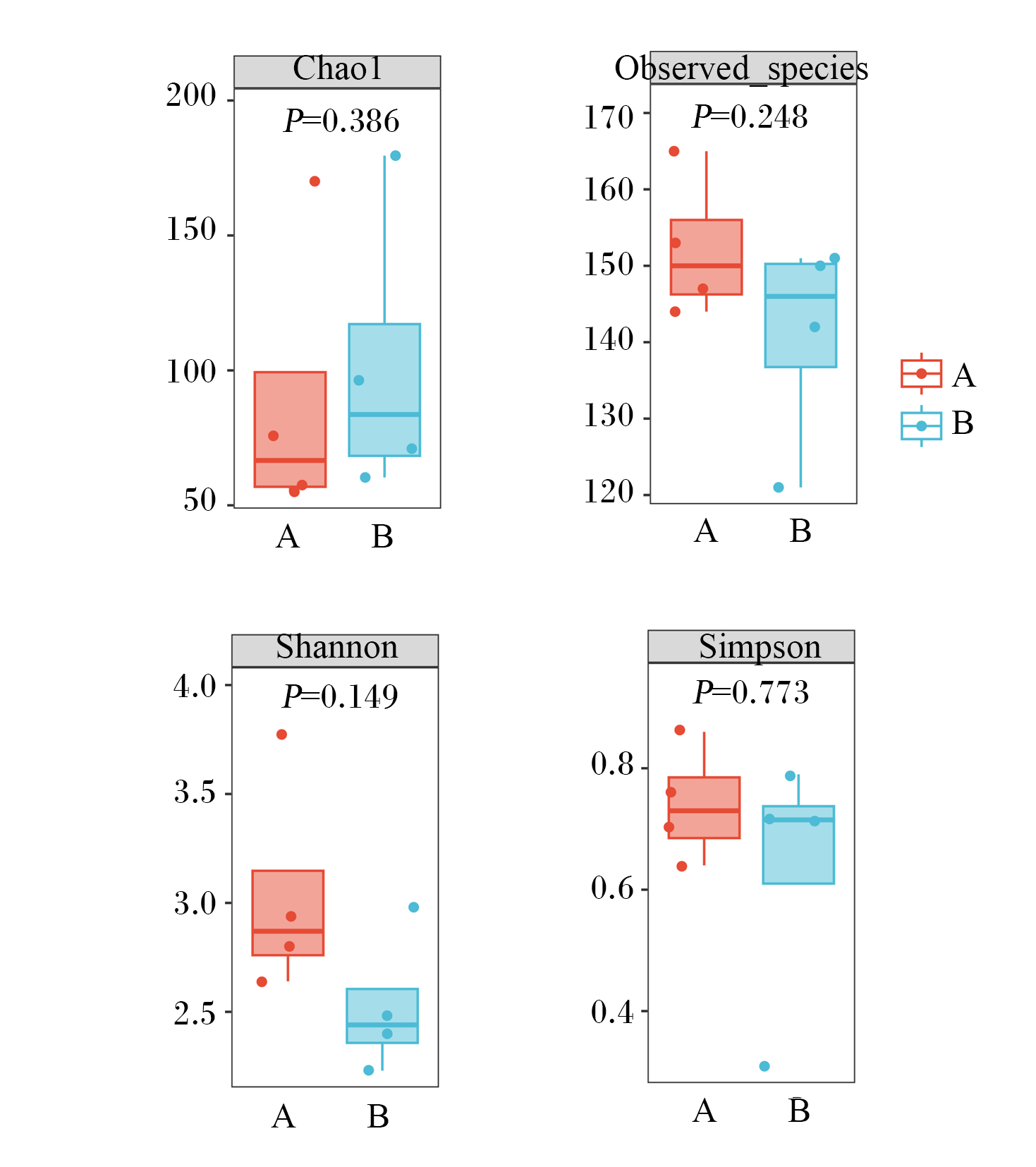
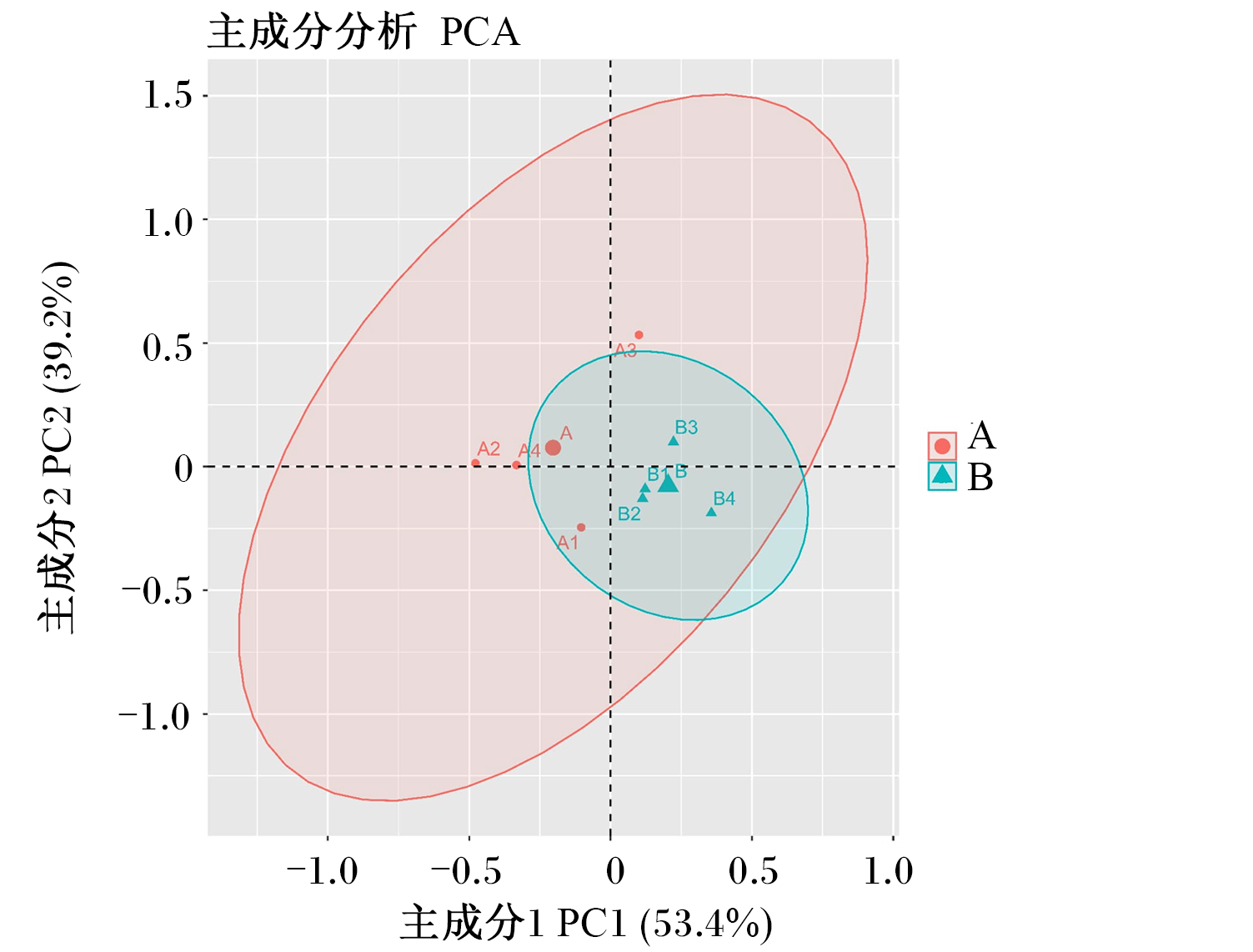
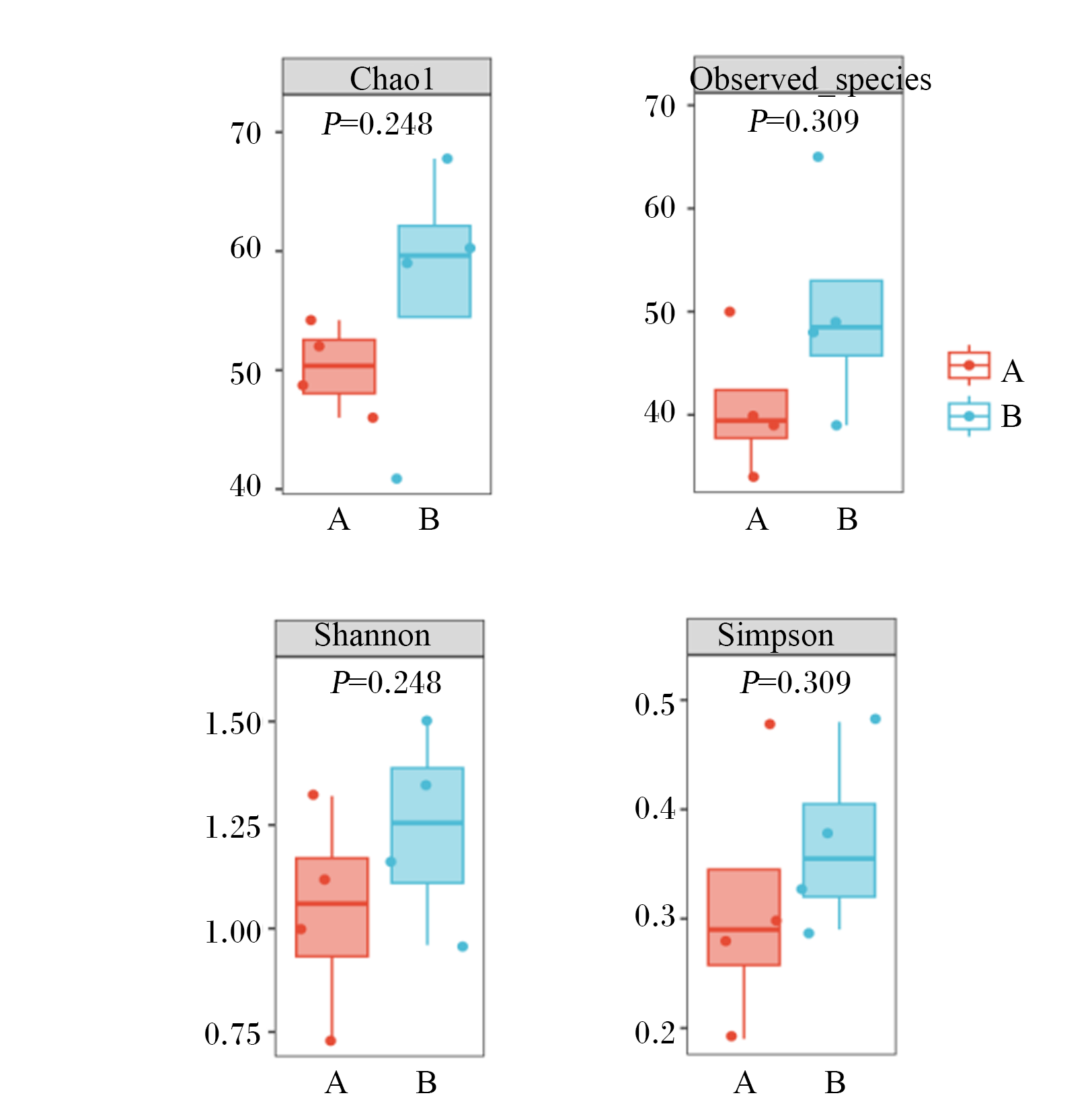
通过对真菌群落的操作分类单元(OTU)进行分析发现,2组共产生727个OTU,其中共有的OTU为333个,热应激组和对照组各自独有的OTU分别为141和253个(图1)。α多样性分析(图2)显示,2组真菌群落的Chao1、Observed_species、Shannon和Simpson指数均无显著差异(P>0.05)。β多样性主成分分析图(图3)显示,2组样本聚集在一起,且组间存在一定重叠,表明2组真菌群落结构差异较小。
图1 基于OTU的瘤胃真菌群落韦恩图

A为对照组,B为热应激组。下图同。

Fig.1 Venn diagram of rumen fungal community based on OUT

A is the control group, and B is the heat stress group. The same as below.

图2 热应激条件下育肥羔羊瘤胃真菌群落α多样性指数的变化

Fig.2 Changes in α diversity indices of rumen fungal community of fattening lambs under heat stress

Chao1:Chao1指数 Chao1 index;Observed_species:Observed_species指数Observed_species index;Shannon:Shannon指数 Shannon index;Simpson:Simpson指数 Simpson index。图7图12同 the same as Fig.7 and Fig.12

图3 热应激条件下育肥羔羊瘤胃真菌群落β多样性的变化

Fig.3 Changes in β diversity of rumen fungal community of fattening lambs under heat stress

2.5.2 真菌群落组成

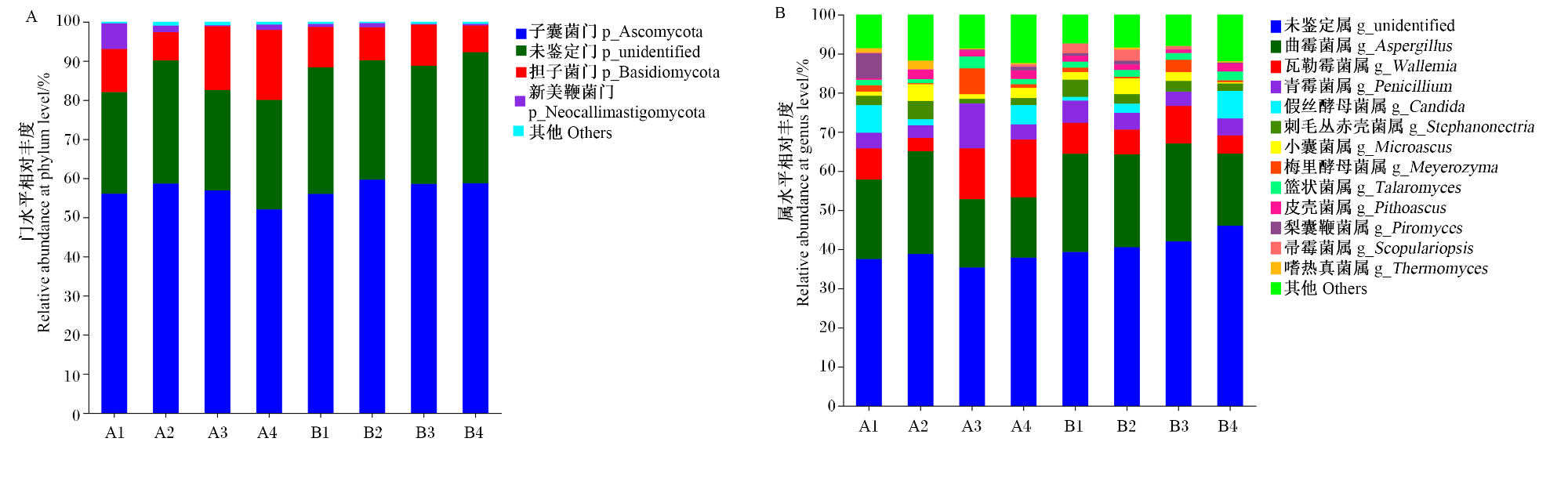
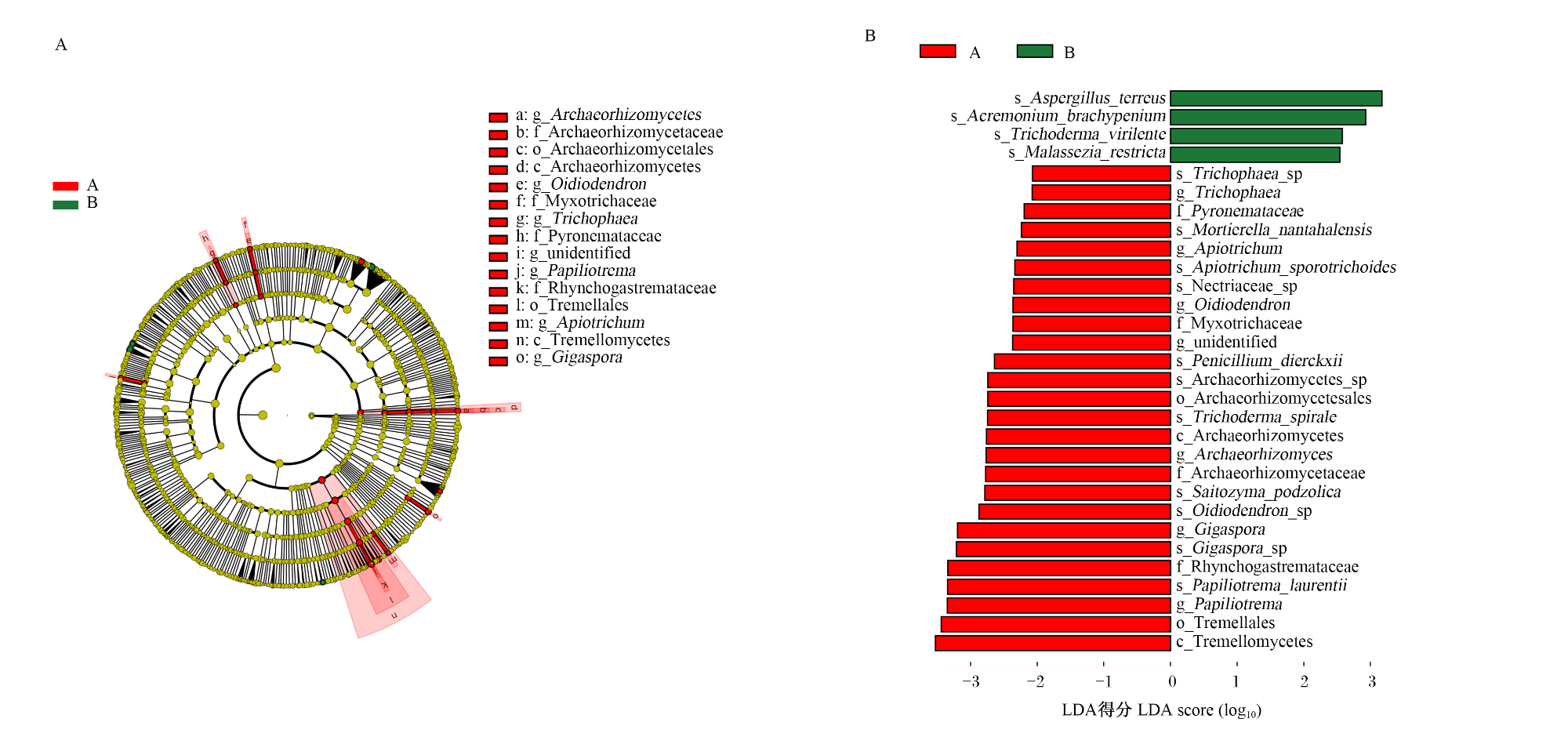
图4-A表6可知,在门水平上,2组瘤胃真菌群落的优势菌门均为子囊菌门(Ascomycota),其相对丰度在50%以上;热应激组除了未鉴定门的相对丰度显著高于对照组(P<0.05)外,其他真菌菌门的相对丰度与对照组相比均未表现出显著差异(P>0.05),但热应激组担子菌门(Basidiomycota)的相对丰度仅为对照组的68.81%。图4-B表6可知,在属水平上,2组瘤胃真菌群落中除未鉴定属外的优势菌属为曲霉菌属(Aspergillus),热应激组未鉴定属的相对丰度(41.96%)显著高于对照组(37.36%)(P<0.05),其他真菌菌属的相对丰度在2组间均未表现出显著差异(P>0.05)。LEfSe分析结果(图5)表明,2组的真菌群落结构存在显著差异。对照组在多个分类层级存在大量富集的真菌类群,核心特征类群包括古根霉纲(Archaeorhizomycetes)全分类层级类群、银耳纲(Tremellomycetes)全分类层级类群以及火丝菌科(Pyronemataceae)、毛盘菌属(Trichophaea)、Apiotrichum等多个类群,而热应激组仅土曲霉(Aspergillus terreus)、短枝顶孢霉(Acremonium brachypenium)、绿木霉(Trichoderma virilente)、限制性马拉色菌(Malassezia restricta)4个种水平类群显著富集,是热应激组瘤胃真菌的核心生物标志物。
图4 热应激条件下育肥羔羊瘤胃真菌群落在门(A)和属水平(B)上相对丰度的变化

Fig.4 Changes in relative abundance of rumen fungal community at phylum (A) and genus levels (B) of fattening lambs under heat stress

表6 热应激条件下育肥羔羊瘤胃真菌群落中优势真菌门和属的相对丰度

Table 6 Relative abundances of dominant fungal phyla and genera in rumen fungal community of fattening lambs under heat stress

项目
Items
对照组
Control group
热应激组
Heat-stress group
均值标准误
SEM
P
P-value
优势真菌门Dominant fungal phyla
子囊菌门Ascomycota 55.89 58.21 0.011 0.197
担子菌门Basidiomycota 13.11 9.02 0.018 0.165
新美鞭菌门Neocallimastigomycota 2.46 0.59 0.010 0.235
未鉴定门Unidentified 27.78b 32.66a 0.011 0.046
优势真菌属Dominant fungal genera
曲霉菌属Aspergillus 19.85 23.07 0.020 0.397
瓦勒霉菌属Wallemia 9.80 7.12 0.020 0.372
青霉菌属Penicillium 5.64 4.49 0.014 0.584
假丝酵母菌属Candida 3.40 2.60 0.016 0.896
刺毛丛赤壳菌属Stephanonectria 2.51 2.87 0.007 0.732
小囊菌属Microascus 2.28 2.13 0.008 0.718
梅里酵母菌属Meyerozyma 2.35 1.29 0.011 0.157
篮状菌属Talaromyces 1.70 1.82 0.003 0.533
皮壳菌属Pithoascus 1.66 1.44 0.004 0.805
梨囊鞭菌属Piromyces 1.87 0.49 0.011 0.693
帚霉菌属Scopulariopsis 0.25 1.55 0.005 0.389
嗜热真菌属Thermomyces 0.96 0.22 0.003 0.111
未鉴定属Unidentified 37.36b 41.96a 0.012 0.046
图5 瘤胃真菌群落LEfSe进化分支图(A)和LDA得分分布柱状图(B)

s_Aspergillus_terreus:土曲霉;s_Acremonium_brachypenium:短枝顶孢霉;s_Trichoderma_virilente:绿木霉;s_Malassezia_restricta:限制性马拉色菌;s_Trichophaea_sp:毛盘菌属某未定种;g_Trichophaea:毛盘菌属;f_Pyronemataceae:火丝菌科;s_Mortierella_nantahalensis:南塔哈尔被孢霉;s_Nectriaceae_sp:丛赤壳科未定种;g_Oidiodendron:卵孢霉属;f_Myxotrichaceae:黏毛菌科;g_unidentified:未鉴定属;s_Penicillium_dierckxii:迪尔克氏青霉;s_Archaeorhizomycetes_sp:古根霉纲未定种;o_Archaeorhizomycetesales:古根霉目;s_Trichoderma_spirale:螺旋木霉;c_Archaeorhizomycetes:古根霉纲;g_Archaeorhizomyces:古根霉属;f_Archaeorhizomycetaceae:古根霉科;s_Saitozyma_podzolica:灰褐斋藤酵母;s_Oidiodendron_sp:卵孢霉属未定种;g_Gigaspora:巨孢囊霉属;s_Gigaspora_sp:巨孢囊霉属未定种;f_Rhynchogastremataceae:喙胃菌科;s_Papiliotrema_laurentii:劳伦乳突酵母菌;g_Papiliotrema:乳突酵母菌属;o_Tremellales:银耳目;c_Tremellomycetes:银耳纲。

Fig.5 LEfSe evolutionary cladogram (A) and LDA score distribution bar plot (B) of rumen fungal community

2.6 育肥羔羊在热应激条件下瘤胃原生动物群落结构的变化

2.6.1 原生动物群落多样性
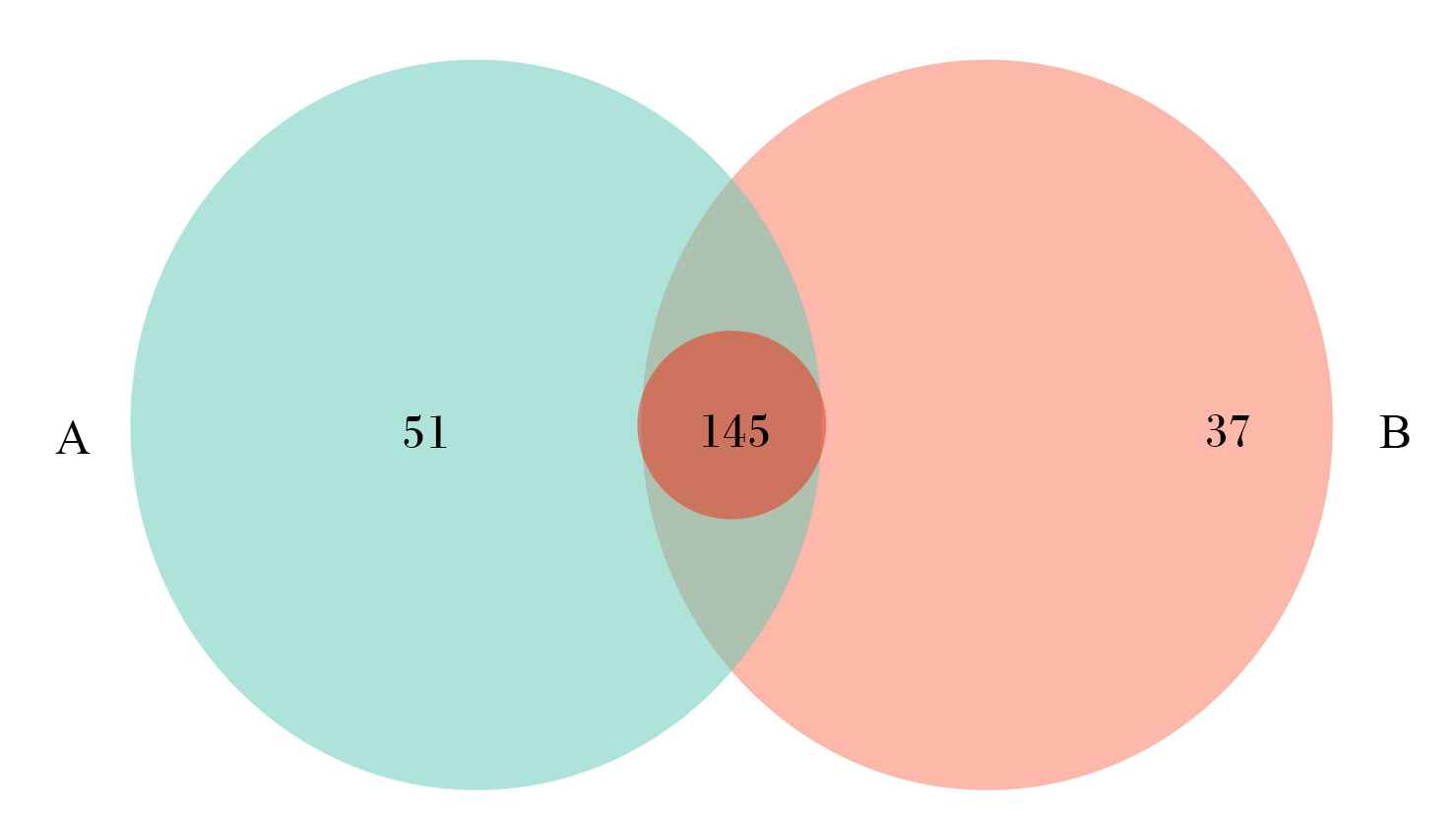
通过对原生动物群落的OTU进行分析发现,热应激降低了育肥羔羊瘤胃原生动物群落的数量,2组共有的OTU为145个,热应激组和对照组各自独有的OTU分别为37和51个(图6)。α多样性分析(图7)显示,2组的Chao1、Observed_species、Shannon和Simpson指数均无显著差异(P>0.05)。β多样性主成分分析(图8)显示,2组样本之间有重叠,组内原生动物群落结构差异较小。
图6 基于OTU的瘤胃原生动物群落韦恩图

Fig.6 Venn diagram of rumen protozoa community based on OTU

图7 热应激条件下育肥羔羊瘤胃原生动物群落α多样性指数的变化

Fig.7 Changes in α diversity indices of rumen protozoa community of fattening lambs under heat stress

图8 热应激条件下育肥羔羊瘤胃原生动物群落β多样性的变化

Fig.8 Changes in β diversity of rumen protozoa community of fattening lambs under heat stress

2.6.2 原生动物群落组成

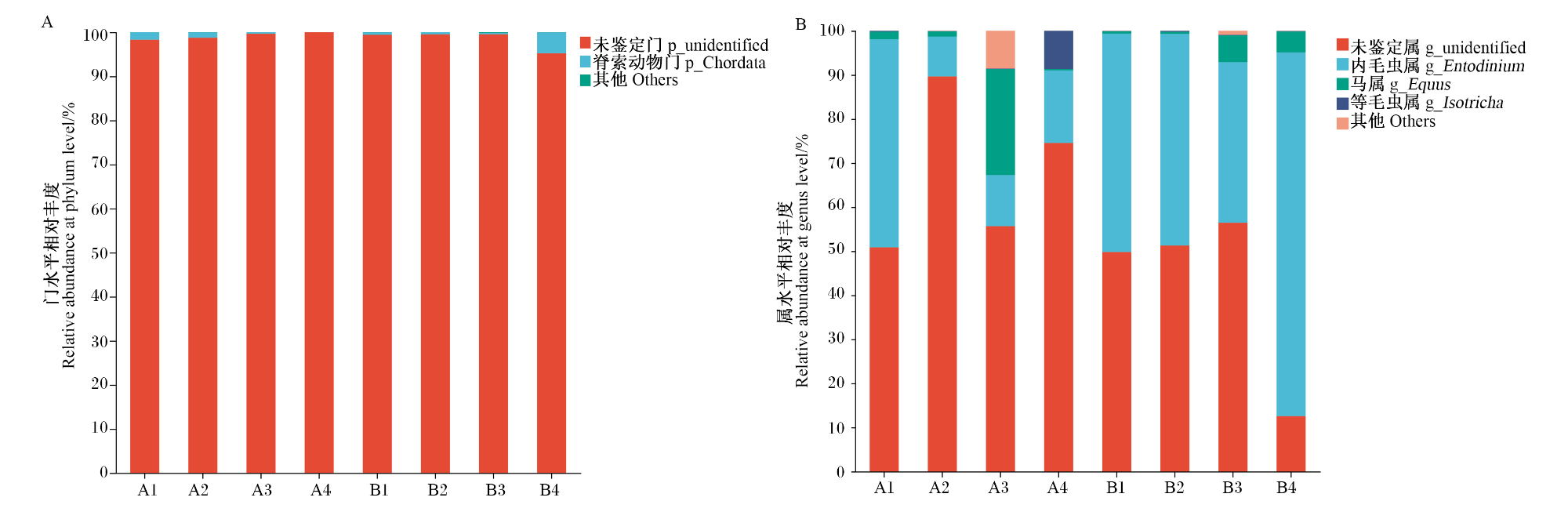
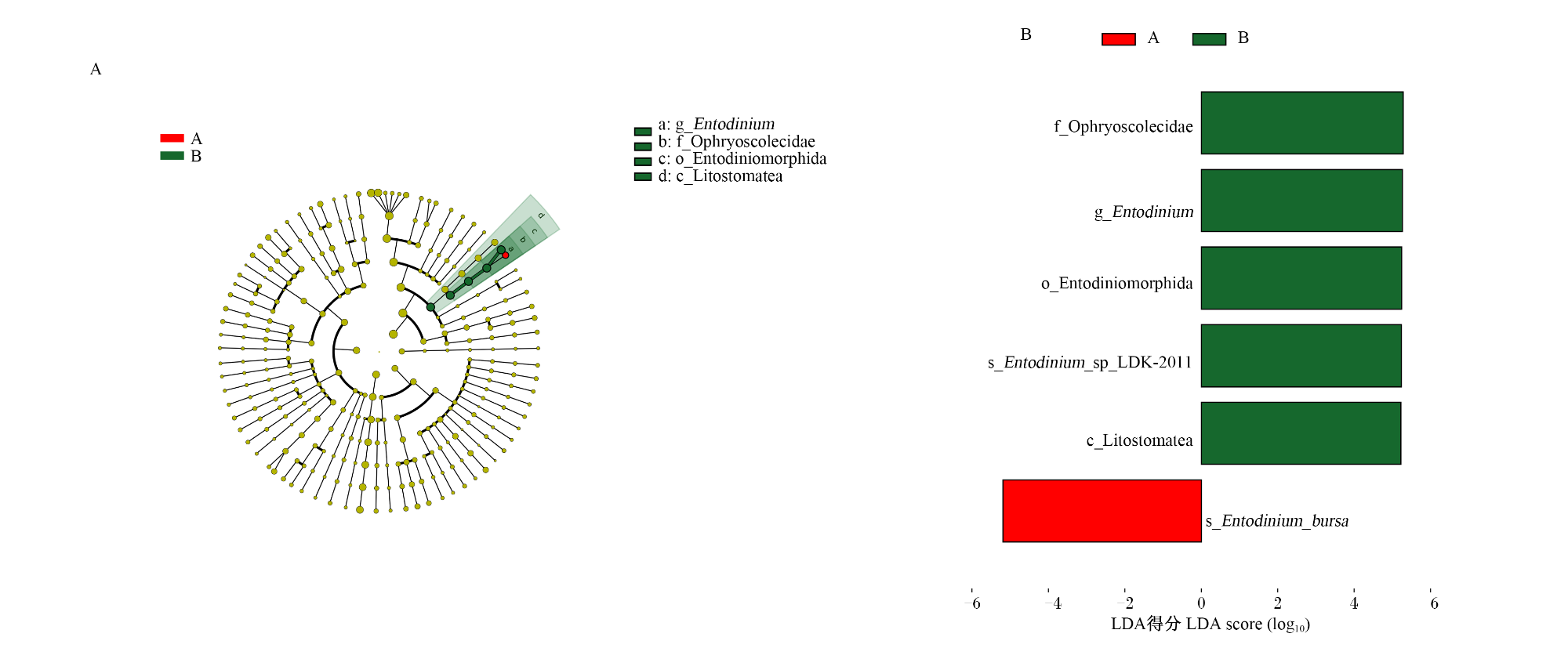
图9-A表7可知,在门水平上,2组瘤胃原生动物群落中未鉴定门的相对丰度均占绝对优势(>99%),且2组间差异不显著(P>0.05)。由图9-B表7可知,在属水平上,对照组中未鉴定属的相对丰度最高,为67.68%,而热应激组中内毛虫属(Entodinium)的相对丰度最高,达到54.15%,且显著高于对照组(P<0.05),是对照组的2.6倍。LEfSe分析结果(图10)表明,2组的原虫群落结构存在显著差异。对照组仅囊状内毛虫(Entodinium bursa)显著富集,而热应激组的核心特征类群为叶口纲(Litostomatea)、内毛目(Entodiniomorphida)、头毛科(Ophryoscolecidae)、Entodinium和内毛虫属未定种LDK-2011(Entodinium sp. LDK-2011)。
图9 热应激条件下育肥羔羊瘤胃原生动物群落在门(A)和属水平(B)上相对丰度的变化

Fig.9 Changes in relative abundance of rumen protozoa community at phylum (A) and genus levels (B) of fattening lambs under heat stress

表7 热应激条件下育肥羔羊瘤胃原生动物群落中优势原生动物门和属的相对丰度

Table 7 Relative abundances of dominant protozoan phyla and genera in rumen protozoa community of fattening lambs under heat stress

项目
Items
对照组
Control
热应激组
Heat-stress group
均值标准误
SEM
P
P-value
优势原生动物门Dominant protozoan phyla
脊索动物门Chordata 6.82 2.94 0.042 0.538
未鉴定门Unidentified 89.08 96.58 0.071 0.481
优势原生动物属Dominant protozoan genera
内毛虫属Entodinium 21.08b 54.15a 0.094 0.047
未鉴定属Unidentified 67.68 42.52 0.095 0.111
马属Equus 6.82 2.95 0.042 0.538
等毛虫属Isotricha 2.25 0.14 0.015 0.365
图10 瘤胃原生动物群落LEfSe进化分支图(A)和LDA得分分布柱状图(B)

f_Ophryoscolecidae:头毛虫科;g_Entodinium:内毛虫属;o_Entodiniomorphida:内毛虫目;s_Entodinium_sp_LDK-2011:内毛虫属未定种LDK-2011;c_Litostomatea:叶口纲;s_Entodinium_bursa:囊状内毛虫。

Fig.10 LEfSe evolutionary cladogram (A) and LDA score distribution bar plot (B) of rumen protozoa community

2.7 育肥羔羊在热应激条件下瘤胃古菌群落结构的变化

2.7.1 古菌群落多样性
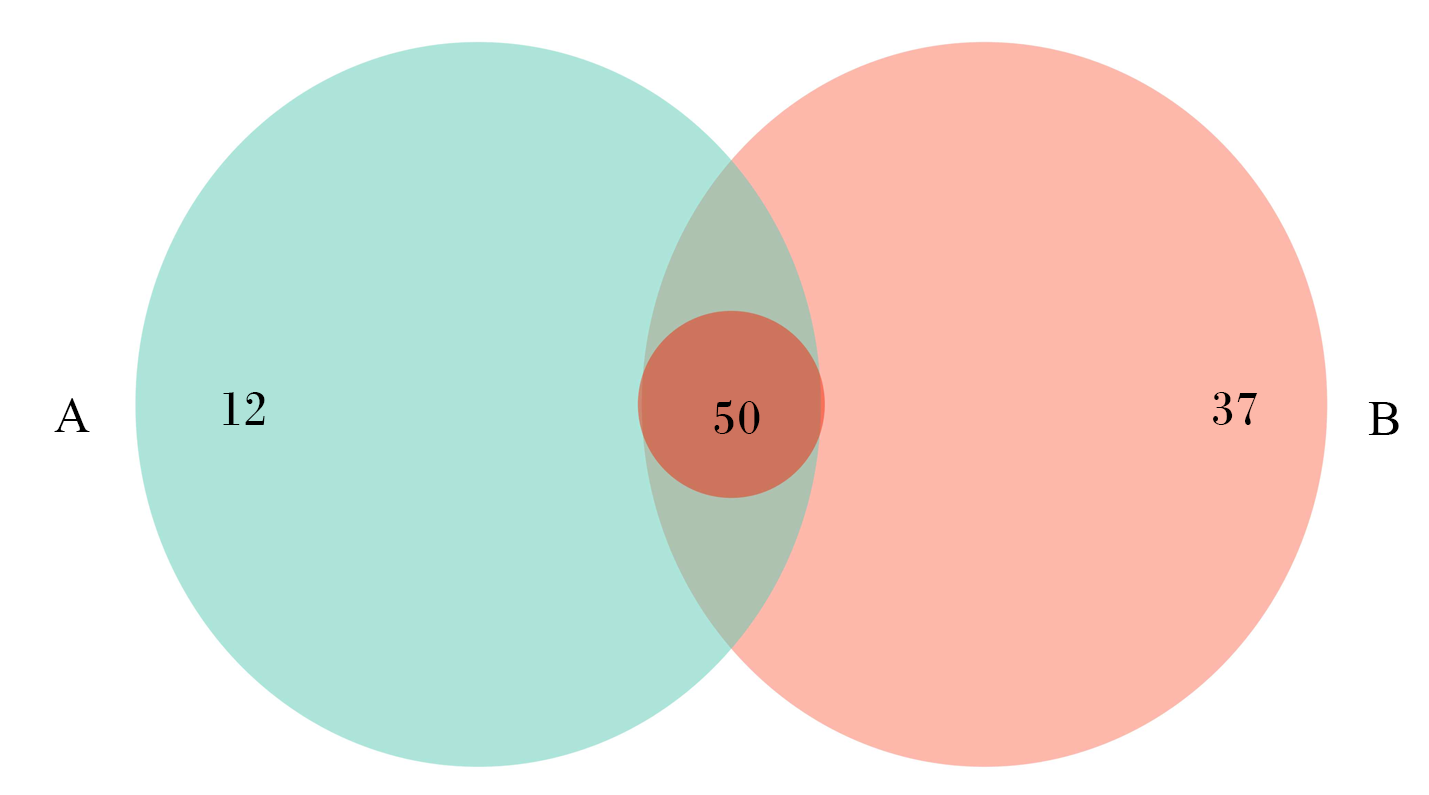
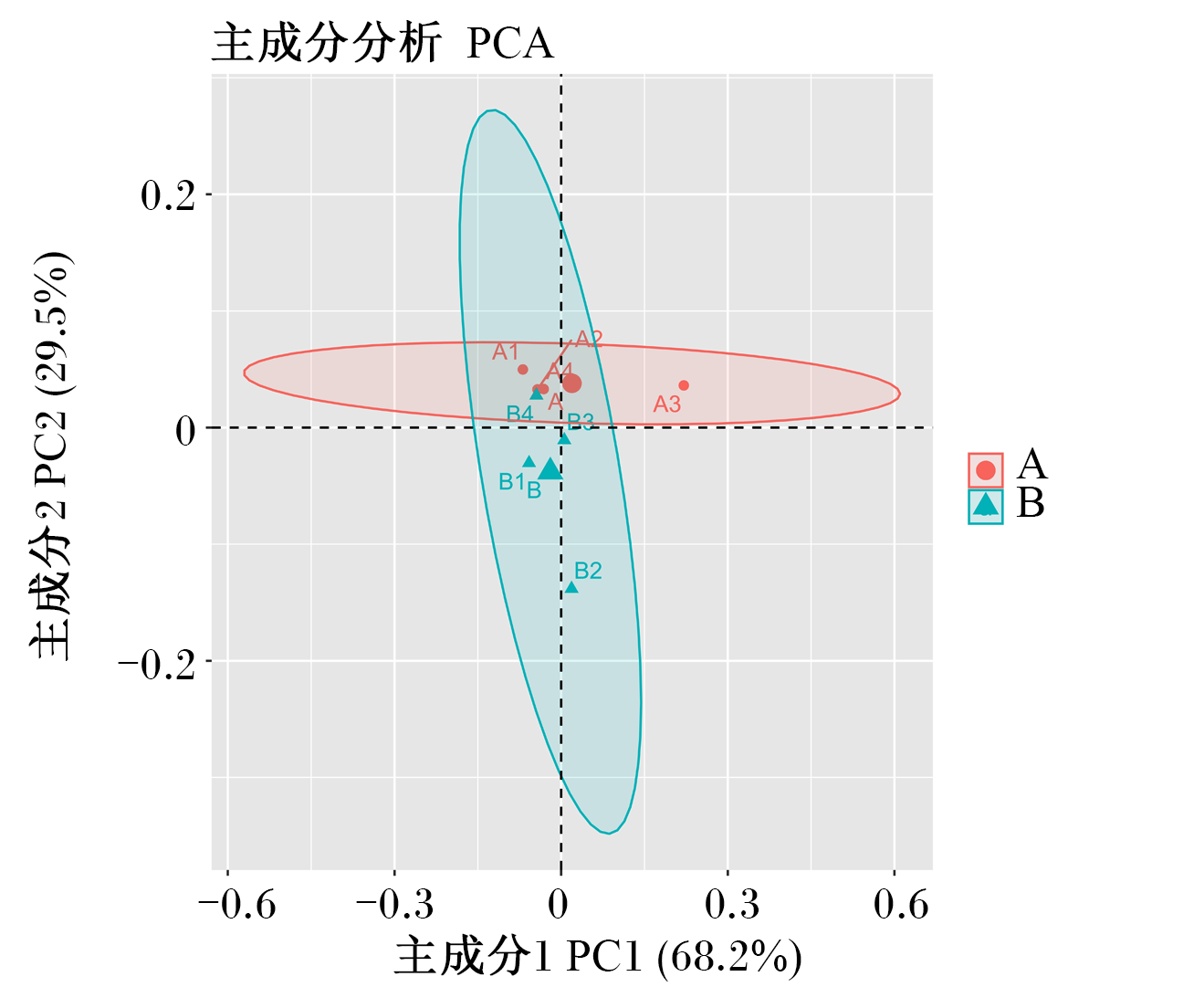
通过对古菌群落的OTU进行分析发现,热应激改变了育肥羔羊瘤胃古菌群落结构,热应激组和对照组各独有37个和12个OTU,热应激组独有的OTU数目是对照组的3.1倍(图11)。α多样性分析(图12)显示,2组的Chao1、Observed-species、Shannon和Simpson指数均未表现出显著差异(P>0.05)。β多样性主成分分析(图13)显示,2组样本聚集在一起,组内古菌群落结构差异较小。
图11 基于OTU的瘤胃古菌群落韦恩图

Fig.11 Venn diagram of rumen archaeal community based on OTU

图12 热应激条件下育肥羔羊瘤胃古菌群落α多样性指数的变化

Fig.12 Changes in α diversity indices of rumen archaeal community of fattening lambs under heat stress

图13 热应激条件下育肥羔羊瘤胃古菌群落β多样性的变化

Fig.13 Changes in β diversity of rumen archaeal community of fattening lambs under heat stress

2.7.2 古菌群落组成

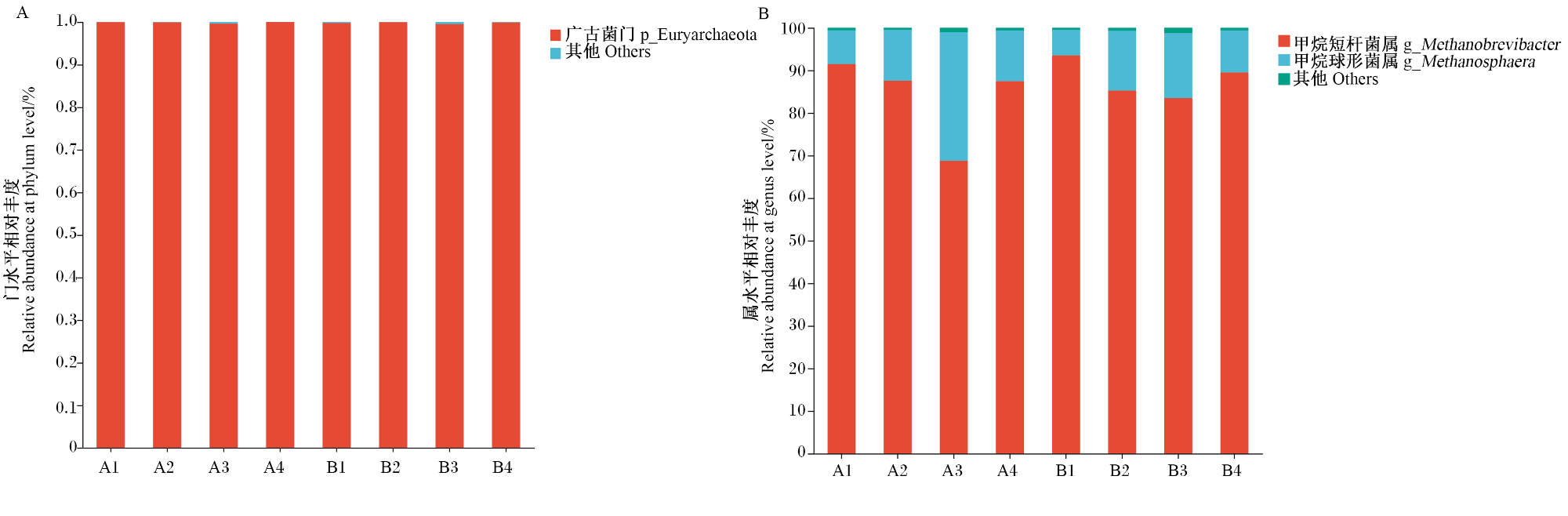
图14-A表8可知,在门水平上,瘤胃古菌群落中广古菌门(Euryarchaeota)的相对丰度占绝对优势(>99%),2组间无显著差异(P>0.05)。由图14-B表8可知,在属水平上,虽然甲烷短杆菌属(Methanobrevibacter)和甲烷球形菌属(Methanosphaera)的相对丰度在2组间未表现出显著差异(P>0.05),但热应激组Methanobrevibacter的相对丰度较对照组提高了5.55%,Methanosphaera的相对丰度较对照组降低了27.08%。
图14 热应激条件下育肥羔羊瘤胃古菌群落在门(A)和属水平(B)上相对丰度的变化

Fig.14 Changes in relative abundance of rumen archaeal community at phylum (A) and genus levels (B) of fattening lambs under heat stress

表8 热应激条件下育肥羔羊瘤胃古菌群落中优势古菌门和属的相对丰度

Table 8 Relative abundances of rumen archaeal community in fattening lambs under heat stress

项目
Items
对照组
Control group
热应激组
Heat-stress group
均值标准误
SEM
P
P-value
优势古菌门Dominant archaeal phyla
广古菌门Euryarchaeota 99.87 99.79 0.094 0.549
奇古菌门Thaumarchaeota 0.06 0.05 0.001 0.888
优势古菌属Dominant archaeal genera
甲烷短杆菌属Methanobrevibacter 83.81 87.93 0.039 0.488
甲烷球形菌属Methanosphaera 15.47 11.28 0.038 0.468

2.8 育肥羔羊生长性能与血清生化指标、瘤胃发酵参数、瘤胃微生物的相关性

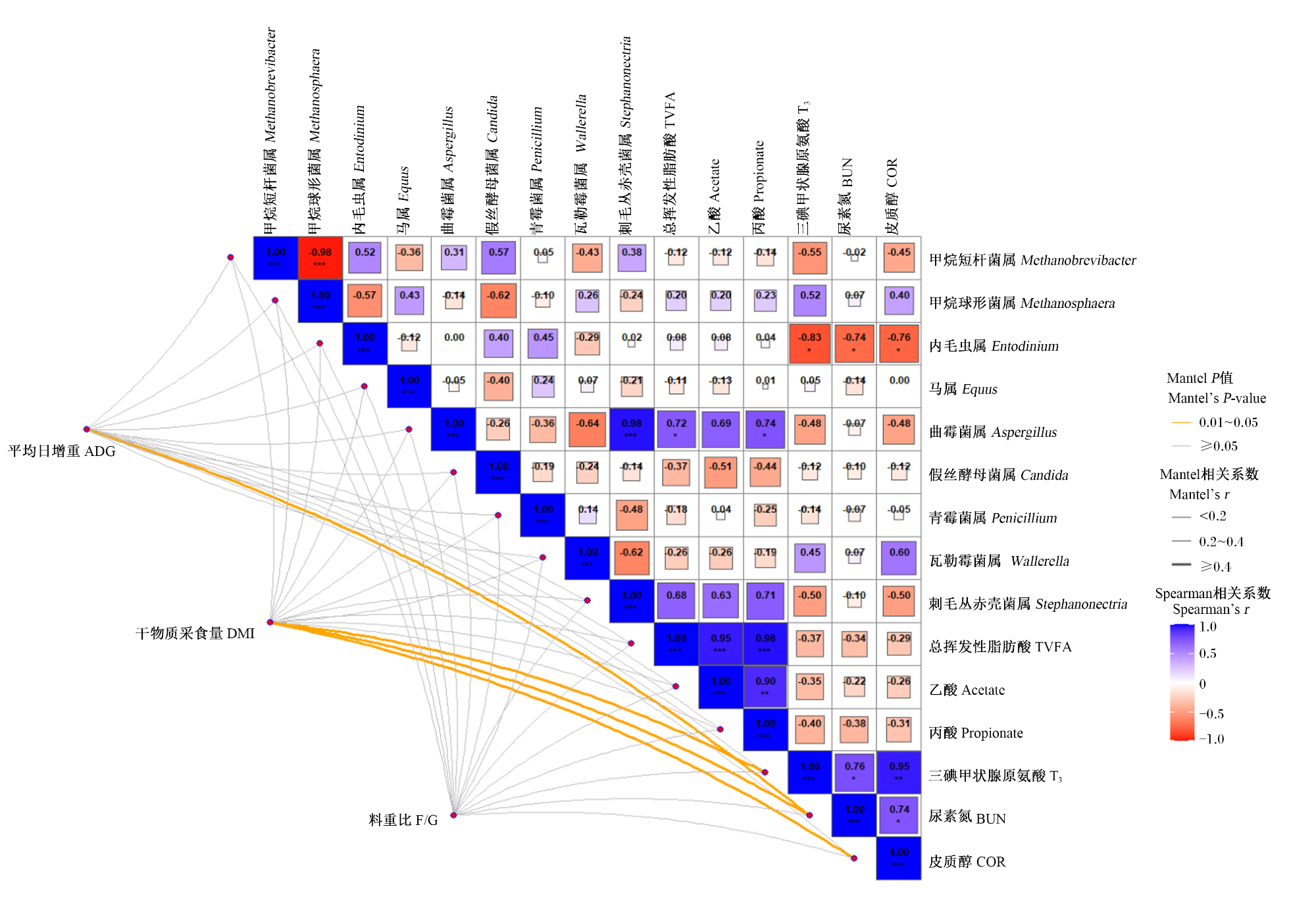
育肥羔羊生长性能与血清生化指标、瘤胃发酵参数、瘤胃微生物的相关性分析结果如图15所示。ADG与血清BUN含量呈显著正相关(P<0.05),DMI与血清T3、BUN和COR含量呈显著正相关(P<0.05)。另外,Entodinium相对丰度与血清T3、BUN和COR含量呈显著负相关(P<0.05),Methanobrevibacter相对丰度与Methanosphaera相对丰度表现出极显著负相关关系(P<0.001)。
图15 育肥羔羊生长性能与血清生化指标、瘤胃发酵参数、瘤胃微生物的相关性

蓝色越深代表正相关越强,橙色越深代表负相关越强,*表示显著相关(P<0.05),**表示高度显著相关(P<0.01),***表示极显著相关(P<0.001)。橙黄色线表示ADG、DMI或F/G与该指标显著相关(P<0.05),灰色线表示ADG、DMI或F/G与该指标无显著相关(P>0.05)。

Fig.15 Correlation of growth performance with serum biochemical indices, rumen fermentation parameters and rumen microbiota of fattening lambs

Darker blue indicates stronger positive correlation, while darker orange indicates stronger negative correlation; *, ** and *** represent significant (P<0.05), highly significant (P<0.01) and extremely significant (P<0.001) correlation, respectively. Orange-yellow lines indicate that ADG, DMI or F/G is significantly correlated with this parameter (P<0.05), whereas gray lines indicate no significant correlation (P>0.05).

3 讨论

3.1 热应激对育肥羔羊生长性能和消化性能的影响

本研究中,热应激极显著降低了育肥羔羊的ADG。Nascimento等[14]认为,热应激条件下动物通过减少采食量、增加饮水量来降低代谢产热。刘玉强等[15]和Marai等[16]的研究也指出,热应激可影响下丘脑的食欲中枢,导致采食量下降,同时引起蛋白质和能量代谢紊乱,降低饲料利用率。本研究中,热应激显著或极显著影响了NDF、ADF和CP表观消化率,较对照组分别降低了13.23%、47.09%和13.54%,这与Marai等[17]的研究结果基本一致,其原因在于热应激触发机体散热反应(如皮肤血管扩张、血流量增加等),间接导致胃肠道血液供应不足[18],从而降低消化吸收能力,减少营养摄入量[19-20],这解释了热应激导致家畜消化性能下降的原因。然而,本研究中热应激对P表观消化率未产生显著影响,该结果与Moseley等[21]报道基本一致。这可能是由于P在消化道内主要以离子形式被溶解吸收,其消化过程对微生物发酵的依赖性极低,且受热应激引起的肠道酶活性变化及内源磷损失干扰也相对较小。

3.2 热应激对育肥羔羊血清生化指标的影响

血清生化指标是反映机体内环境稳态的重要参数,也是评估动物整体健康状态的有效依据[22]。研究表明,热应激会破坏动物内环境的稳态[23]。本研究中,Mantel检验结果显示,DMI与血清T3、BUN和COR含量均呈显著正相关关系。热应激状态下,家畜采食量和养分消化率下降,营养物质摄入不足,机体为满足能量需求而加速GLU的分解供能,导致血清GLU含量降低。本研究中,热应激组羔羊血清GLU含量极显著低于对照组,仅为对照组的56.36%。研究表明,血清COR含量升高是热应激的特异性反应[24]。热应激激活下丘脑-垂体-肾上腺轴,促使COR释放增加,促进肌肉蛋白质分解、释放氨基酸以供能,同时抑制蛋白质合成。已有研究报道,热应激条件下肉牛血液中COR含量显著增加[25],本研究结果与此一致。血清T4和T3是维持机体基础代谢率的重要激素,并参与体温调节[26]。本试验中,热应激组血清T3含量较对照组极显著降低,这可能与热应激直接抑制甲状腺活性有关,也可能因采食量减少以避免额外体增热所致[27],这与已有研究报道的热应激下试验动物血清T3含量降低的结果[28-30]相符。此外,热应激会抑制蛋白质合成[31]。本研究中,反映机体体液免疫能力的3个重要指标血清TP、ALB和GLB含量,在热应激下均有不同程度降低,与殷炜琦等[32]的研究结果一致。当热应激引起的蛋白质分解代谢超过合成代谢时,羔羊进入负氮平衡状态,表现为血清BUN含量下降。本研究还发现,ADG与血清BUN含量呈显著正相关关系,表明血清BUN含量可间接反映羔羊的生长性能,进一步揭示了热应激通过干扰氮代谢而抑制羔羊生长的内在机制。

3.3 热应激对育肥羔羊瘤胃发酵参数与微生物群落结构的影响

瘤胃具有多样化的微生物生态系统[33],细菌、真菌、原生动物和古菌是其微生态系统的重要组成部分[34]。研究表明,瘤胃微生物易受环境因素影响[35],且对养分的消化、吸收与代谢具有联动效应。瘤胃中碳水化合物发酵的主要终产物VFA可为反刍动物提供70%~80%的能量,是衡量瘤胃消化功能的重要指标[36]。本研究中,热应激改变了育肥羔羊瘤胃中总挥发性脂肪酸浓度,较对照组增加了1.4倍,且乙酸、丙酸浓度显著或极显著升高。本课题组前期的相关研究结果表明,对照组羔羊瘤胃细菌群落中的优势菌门为厚壁菌门和拟杆菌门,而热应激组改变了细菌群落结构,仅拟杆菌门为优势菌门,其门下的普雷沃氏菌属相对丰度较对照组提高了3.3倍,成为绝对主导菌属,同时厚壁菌门相对丰度降低[6]。一般而言,厚壁菌门是瘤胃中降解纤维物质的核心类群,其相对丰度下降在某种程度上解释了热应激条件下NDF和ADF表观消化率降低的原因。另外,热应激下NDF和ADF表观消化率下降,说明了未被充分分解的纤维物质在瘤胃内滞留时间延长,一方面降低了瘤胃整体发酵效率,另一方面使得瘤胃内可发酵非结构性碳水化合物(淀粉、可溶性糖等)的相对比例上升,发酵环境更偏向于淀粉利用型菌群的增殖,从促进了瘤胃中能高效利用淀粉的Entodinium和普雷沃氏菌属增殖。内纤毛虫的代谢有利于丙酸的生成[37],因此本试验中热应激组瘤胃中丙酸浓度表现出显著升高。另外,本研究的LEfSe分析结果表明,热应激影响了育肥羔羊瘤胃原生动物群落结构,热应激组显著富集的Entodinium是瘤胃内高效利用淀粉与可溶性碳水化合物的优势原虫,其相对丰度升高是热应激条件下羔羊采食量下降、瘤胃发酵底物向可溶性碳水化合物倾斜引发的适应性演替,与本试验中瘤胃VFA组成的变化基本一致,而无热应激的对照组羔羊显著富集的Entodinium bursa兼具纤维降解与淀粉利用的功能,其丰度优势表明了对照组羔羊具有稳定的瘤胃纤维消化能力。李宗军[38]研究发现,Entodinium可以发酵淀粉产生乙酸和丁酸,这直接解释了本研究中热应激下瘤胃中乙酸和丁酸浓度增加的结果。另有研究报道,内纤毛虫能提高氮的利用效率,降低氮经肝脏转化形成BUN[39-40]。但是,内纤毛虫种群产生的瘤胃氮代谢优势可能被机体整体上的净蛋白质分解代谢所掩盖,最终表现为血清BUN含量降低与TP含量下降并存的现象,这也揭示了热应激下机体氮代谢的复杂性。此外,多数原生动物对酸性环境敏感,瘤胃中总挥发性脂肪酸浓度升高往往导致pH降低[41],使瘤胃原生动物的生长受到抑制[42]。本研究中,热应激条件下羔羊瘤胃原生动物群落的多样性降低,热应激组OTU数目仅为对照组的72.55%。然而,本研究所鉴定的原生动物分类中存在部分未能确定的属,有待后续深入研究。
本研究对热应激条件下羔羊瘤胃真菌群落的多样性和相对丰度进行了检测,结果表明,热应激对优势真菌菌门Ascomycota的相对丰度无显著影响,这可能与其能产生子囊孢子、抗逆性较强有关[43];而具有纤维分解功能的Basidiomycota的相对丰度则呈降低趋势,这在一定程度上解释了热应激条件下ADF与NDF表观消化率下降的原因。LEfSe分析结果显示,无热应激羔羊瘤胃中富集了大量Archaeorhizomycetes、Tremellomycetes等与纤维降解相关的微生物类群,这些类群是瘤胃中纤维物质降解的核心功能群,能够通过菌丝穿透植物细胞壁的致密结构,为纤维分解菌提供降解位点,是决定反刍动物NDF和ADF消化率的关键类群,其丰度优势直接反映了对照组羔羊较高的纤维消化效率。而热应激羔羊瘤胃中仅Aspergillus terreusTrichoderma virilente等少数耐胁迫腐生真菌显著富集,但此类类群不具备核心纤维降解功能,表明热应激抑制了羔羊瘤胃真菌的纤维降解功能。
此外,本研究中瘤胃古菌群落中相对丰度最高的为Methanobrevibacter,其次为Methanosphaera。研究表明,Methanobrevibacter与甲烷生成密切相关[44]。热应激条件下,瘤胃中乙酸浓度升高有利于Methanobrevibacter的生长[45]。本研究中,热应激组Methanobrevibacter相对丰度增加,而Methanosphaera相对丰度下降。Mantel检验结果显示,Methanobrevibacter相对丰度与Methanosphaera相对丰度呈显著负相关,表明产甲烷古菌群落内部存在对瘤胃环境变化的竞争性适应。Methanobrevibacter能够直接、高效地利用瘤胃中的氢气(H2)和二氧化碳(CO2),而Methanosphaera不能利用CO2,必须依赖甲醇作为碳源,同时需要H2作为电子供体。Methanobrevibacter凭借其利用丰富底物(H2、CO2)的高效能力,在争夺H2的竞争中占据绝对优势,从而压制了依赖特定底物的Methanosphaera的生态位[46-47]。瘤胃古菌群落结构的变化可直接影响瘤胃内氢分压与发酵格局,进而改变能量利用效率并反映在宿主生长性能上,同时也暗示瘤胃微生物群落结构变化可能是导致热应激羔羊养分表观消化率降低的重要内在原因。本试验中,热应激下瘤胃Methanobrevibacter相对丰度的升高,在一定程度上验证了王小林等[48]关于热应激引起甲烷产量增加的研究结果。甲烷产量的增加意味着饲粮中能量未被机体充分吸收,从而导致饲料利用率下降[49]。然而,本研究对瘤胃古菌群落的LEfSe分析未筛选出热应激组显著富集的差异类群(LDA得分>2),表明热应激未对育肥羔羊瘤胃古菌群落结构产生显著的重塑作用。

4 结论

热应激对育肥羔羊的生长性能(ADG和ADFI)和养分表观消化率(CP、NDF、ADF和EE表观消化率)均产生了负面影响,并干扰了机体的养分代谢,表现为血清COR含量极显著升高、GLU含量极显著降低;同时,热应激条件下瘤胃液中总挥发性脂肪酸、乙酸浓度极显著增加,丙酸浓度显著增加。从瘤胃微生物群落结构来看,虽然热应激对育肥羔羊瘤胃真菌、古菌和原虫群落的α多样性均未产生显著影响,但可使Entodinium相对丰度显著升高,且Entodinium相对丰度与血清T3、BUN和COR含量均呈显著负相关。
[1]
ZIMBLEMAN R B, RHOADS R P, RHOADS M L, et al. Are-evaluation of the impact of temperature humidity index (THI) and black globe humidity index (BGHI) on milk production in high producing dairy cows[C]// Proceedings of the 24th Southwest Nutrition and Management Conference.[S.l.]:[s.n.], 2009:158-169.

[2]
王哲奇. 温热环境对绵羊增重性能及生理指标影响的研究[D]. 博士学位论文. 呼和浩特: 内蒙古农业大学, 2020.

WANG Z Q. Study on effects of thermal environment on weight gain performance and physiological indexes of sheep[D]. Ph.D.Thesis. Hohhot: Inner Mongolia Agricultural University, 2020. (in Chinese)

[3]
赵寿培, 冯曼, 刘乾亥, 等. 基于断奶羔羊生理和生长性能的热应激发生阈值预测[J]. 农业工程学报, 2023, 39(23):212-219.

ZHAO S P, FENG M, LIU Q H, et al. The threshold of occurrence of heat stress in weaned lambs based on physiological and growth performance[J]. Transactions of the Chinese Society of Agricultural Engineering, 2023, 39(23):212-219. (in Chinese)

[4]
赵娟娟, 冯曼, 孙新胜, 等. 河北省舍饲绵羊的热应激评价及温湿参数与羊生理指标的相关性研究[J]. 畜牧兽医学报, 2020, 51(6):1342-1353.

DOI

ZHAO J J, FENG M, SUN X S, et al. Evaluation of heat stress of housed sheep and correlation between temperature-humidity parameter and physiological parameter of sheep in Hebei Province[J]. Acta Veterinaria et Zootechnica Sinica, 2020, 51(6):1342-1353. (in Chinese)

[5]
WANG Z C, GUO M L, LIANG Y, et al. Breed-specific responses and ruminal microbiome shifts in dairy cows under heat stress[J]. Animals, 2025, 15(6):817.

DOI

[6]
刘爱瑜, 王超, 吴占军, 等. 热应激对断奶绵羔羊生长性能、抗氧化性能和瘤胃菌群的影响[J]. 草业学报, 2023, 32(4):173-182.

DOI

LIU A Y, WANG C, WU Z J, et al. Impact of heat stress on growth rate,serum antioxidant properties,and rumen flora in weaned lambs[J]. Acta prataculturae Sinica, 2023, 32(4):173-182. (in Chinese)

[7]
SILPA M V, SEJIAN V, DEVARAJ C, et al. Impact of heat stress on rumen fermentation patterns and microbiota diversity and its association with thermotolerance in indigenous goats[J]. Fermentation, 2025, 11(8):450.

DOI

[8]
张瑜. 热应激对湖羊生长性能、肉品质及瘤胃微生物的影响[D]. 硕士学位论文. 南宁: 广西大学, 2022.

ZHANG Y. The effect of heat stress on the growth performance,meat quality and rumen microorganism in Hu sheep[D]. Master’s Thesis. Nanning: Guangxi University, 2022. (in Chinese)

[9]
HAGEN L H, BROOKE C G, SHAW C A, et al. Proteome specialization of anaerobic fungi during ruminal degradation of recalcitrant plant fiber[J]. The ISME Journal, 2021, 15(2):421-434.

DOI

[10]
COX M S, DEBLOIS C L, SUEN G. Assessing the response of ruminal bacterial and fungal microbiota to whole-rumen contents exchange in dairy cows[J]. Frontiers in Microbiology, 2021, 12:665776.

DOI

[11]
HACKMANN T J, SEN A, FIRKINS J L. Culture techniques for ciliate protozoa from the rumen:recent advances and persistent challenges[J]. Anaerobe, 2024, 87:102865.

DOI

[12]
LI Y, LEAHY S C, JEYANATHAN J, et al. The complete genome sequence of the methanogenic archaeon ISO4-H5 provides insights into the methylotrophic lifestyle of a ruminal representative of the Methanomassiliicoccales[J]. Standards in Genomic Sciences, 2016, 11(1):59.

DOI PMID

[13]
HILL D L, WALL E. Dairy cattle in a temperate climate:the effects of weather on milk yield and composition depend on management[J]. Animal, 2015, 9(1):138-149.

DOI

[14]
NASCIMENTO B M, PARKER GADDIS K L, KOLTES J E, et al. Impact of heat stress on dry matter intake and residual feed intake in mid-lactation dairy cows[J]. Journal of Dairy Science, 2025, 108(7):7345-7353.

DOI PMID

[15]
刘玉强, 杨镇玮, 赵智锋, 等. 热应激对肉牛生产影响的研究进展[J]. 中国草食动物科学, 2020, 40(5):61-64.

LIU Y Q, YANG Z W, ZHAO Z F, et al. Progress on effect of heat stress on beef cattle production[J]. China Herbivore Science, 2020, 40(5):61-64. (in Chinese)

[16]
MARAI I F M, EL-DARAWANY A, FADIEL A, et al. Physiological traits as affected by heat stress in sheep-a review[J]. Small Ruminant Research, 2007, 71(1/2/3):1-12.

DOI

[17]
MARAI I F M, SHALABY T H, BAHGAT L B. Fattening of lambs on concentrates mixture diet alone without roughages or with addition of natural clay under sub-tropical conditions of Egypt.2.Physiological reactions[C]// International Conference on Animal,Poultry,Rabbit Production and Health, Cairo,1997:2-4.

[18]
马燕芬, 杜瑞平, 高民. 热应激对奶山羊生产性能及瘤胃上皮细胞形态结构的影响[J]. 中国农业科学, 2013, 46(21):4486-4495.

DOI

MA Y F, DU R P, GAO M. Effect of heat stress on dairy goat performance and rumen epithelial cell morphology[J]. Scientia Agricultura Sinica, 2013, 46(21):4486-4495. (in Chinese)

[19]
RHOADS R P, BAUMGARD L H, SUAGEE J K, et al. Nutritional interventions to alleviate the negative consequences of heat stress[J]. Advances in Nutrition, 2013, 4(3):267-276.

DOI PMID

[20]
WHEELOCK J B, RHOADS R P, VANBAALE M J, et al. Effects of heat stress on energetic metabolism in lactating Holstein cows[J]. Journal of Dairy Science, 2010, 93(2):644-655.

DOI PMID

[21]
MOSELEY P L. Heat shock proteins and heat adaptation of the whole organism[J]. Journal of Applied Physiology, 1997, 83(5):1413-1417.

DOI PMID

[22]
余昌萌, 余瑶, 吴登虎, 等. 重庆动物园大熊猫血液生理生化指标的测定及分析[J]. 野生动物学报, 2019, 40(1):33-42.

YU C M, YU Y, WU D H, et al. Determination and analysis of blood physiological and biochemical indexes of giant pandas in Chongqing zoo[J]. Chinese Journal of Wildlife, 2019, 40(1):33-42. (in Chinese)

[23]
刘嘉莉, 窦金焕, 胡丽蓉, 等. 热应激对奶牛生理和免疫功能的影响及其机理[J]. 中国畜牧兽医, 2018, 45(1):263-270.

DOI

LIU J L, DOU J H, HU L R, et al. Effects and mechanism of heat stress on physiological and immune system in dariy cows[J]. China Animal Husbandry & Veterinary Medicine, 2018, 45(1):263-270. (in Chinese)

[24]
彭孝坤, 胡建宏, 张恩平. 热应激对肉牛和肉羊生理生化指标及外周血miRNA表达水平的影响[J]. 家畜生态学报, 2018, 39(3):1-7.

PENG X K, HU J H, ZHANG E P. Effects of heat stress on physiological and biochemical indexes and expression levels of miRNA in peripheral blood of beef cattle,sheep and goats[J]. Acta Ecologae Animalis Domastici, 2018, 39(3):1-7. (in Chinese)

[25]
宋小珍, 付戴波, 瞿明仁, 等. 热应激对肉牛血清内分泌激素含量、抗氧化酶活性及生理生化指标的影响[J]. 动物营养学报, 2012, 24(12):2485-2490.

DOI

SONG X Z, FU D B, QU M R, et al. Effects of heat stress on endocrine hormone content,antioxidant enzyme activity and physiological and serum biochemical indices of beef cattle[J]. Chinese Journal of Animal Nutrition, 2012, 24(12):2485-2490. (in Chinese)

[26]
ALEENA J, PRAGNA P, ARCHANA P R, et al. Significance of metabolic response in livestock for adapting to heat stress challenges[J]. Asian Journal of Animal Sciences, 2016, 10(4/5):224-234.

DOI

[27]
RATHWA S D, VASAVA A A, PATHAN M M, et al. Effect of season on physiological,biochemical,hormonal,and oxidative stress parameters of indigenous sheep[J]. Veterinary World, 2017, 10(6):650-654.

DOI

[28]
HUANG Y Y, CAI H Y, HAN Y S, et al. Mechanisms of heat stress on neuroendocrine and organ damage and nutritional measures of prevention and treatment in poultry[J]. Biology, 2024, 13(11):926.

DOI

[29]
SAMMES S L, GAUGHAN J B, CONNELL S O, et al. Effects of a calcareous marine algae on dry matter intake,water intake,rumen temperature,rumen pH and average daily gain of grain-fed steers during a heat wave[J]. Journal of Animal Science, 2024, 102(S3):299-300.

[30]
IRSHAD I U, SHARMA A K. Understanding the regulation of protein synthesis under stress conditions[J]. Biophysical Journal, 2024, 123(20):3627-3639.

DOI PMID

[31]
PONTIGGIA A, MÜNGER A, AMMER S, et al. Short-term physiological responses to moderate heat stress in grazing dairy cows in temperate climate[J]. Animal, 2023, 17(3):100718.

DOI

[32]
殷炜琦, 雷铭凯, 李熊, 等. 热应激对杜湖杂交公羔生理指标、血清生化指标、抗氧化功能和瘤胃发酵参数的影响[J]. 家畜生态学报, 2024, 45(9):27-33.

YIN W Q, LEI M K, LI X, et al. Effects of heat stress on physiological indexes,serum biochemical,antioxidant functions and rumen fermentation parameters of Doper×Hu crossbred rams[J]. Acta Ecologae Animalis Domastici, 2024, 45(9):27-33. (in Chinese)

[33]
MYER P R, SMITH T P L, WELLS J E, et al. Rumen microbiome from steers differing in feed efficiency[J]. PLoS One, 2015, 10(6):e0129174.

DOI

[34]
SALLES M S V, ZANETTI M A, SALLES F A, et al. Changes in ruminal fermentation and mineral serum level in animals kept in high temperature environments[J]. Revista Brasileira de Zootecnia, 2010, 39(4):883-890.

DOI

[35]
SHANKS O C, KELTY C A, ARCHIBEQUE S, et al. Community structures of fecal bacteria in cattle from different animal feeding operations[J]. Applied and Environmental Microbiology, 2011, 77(9):2992-3001.

DOI PMID

[36]
翁秀秀. 饲喂不同日粮奶牛瘤胃发酵和VFA吸收特性及其相关基因表达的研究[D]. 博士学位论文. 兰州: 甘肃农业大学, 2013.

WENG X X. The study on rumen fermentation,volatile fatty acid absorption characteristics and gene expression in dairy cows receiving different types of diets[D]. Ph.D.Thesis. Lanzhou: Gansu Agricultural University, 2013. (in Chinese)

[37]
LI Q S, WANG R, MA Z Y, et al. Dietary selection of metabolically distinct microorganisms drives hydrogen metabolism in ruminants[J]. The ISME Journal, 2022, 16(11):2535-2546.

DOI

[38]
李宗军. 瘤胃丙酸发酵的增强策略及其对碳水化合物代谢的动态影响[D]. 博士学位论文. 杨凌: 西北农林科技大学, 2018.

LI Z J. The ruminal manipulation strategies for enhancing propionate fermentation and their dynamic effects on carbohydrate metabolism[D]. Ph.D.Thesis. Yangling: Northwest A&F University, 2018. (in Chinese)

[39]
ZHONG C L, LONG R J, STEWART G S. The role of rumen epithelial urea transport proteins in urea nitrogen salvage:a review[J]. Animal Nutrition, 2022, 9:304-313.

DOI

[40]
PARK T. Ruminal ciliates as modulators of the rumen microbiome[J]. Animal Bioscience, 2024, 37(2):385-395.

DOI

[41]
殷正艳, 张永翠, 徐云政, 等. 饲粮精粗比对沂蒙黑山羊生长性能、养分表观消化率及瘤胃发酵参数的影响[J]. 饲料研究, 2025, 48(12):12-16.

YIN Z Y, ZHANG Y C, XU Y Z, et al. Effects of dietary concentrate to forage ratio on growth performance,nutrient apparent digestibility,and rumen fermentation parameters in Yimeng black goats[J]. Feed Research, 2025, 48(12):12-16. (in Chinese)

[42]
LI Z J, WANG X N, ZHANG Y, et al. Genomic insights into the phylogeny and biomass-degrading enzymes of rumen ciliates[J]. The ISME Journal, 2022, 16(12):2775-2787.

DOI

[43]
张仲卿. 混合真菌发酵秸秆及其对绵羊养分消化和瘤胃发酵的影响[D]. 硕士学位论文. 大庆: 黑龙江八一农垦大学, 2019.

ZHANG Z Q. Mixed fungal fermented straw andits effects on nutrient digestion andrumen fermentation of sheep[D]. Master’s Thesis. Daqing: Heilongjiang Bayi Agricultural University, 2019. (in Chinese)

[44]
LIU Y C, WHITMAN W B. Metabolic,phylogenetic,and ecological diversity of the methanogenic archaea[J]. Annals of the New York Academy of Sciences, 2008, 1125:171-189.

DOI

[45]
ANGELA R M, JEAN P J, JOHN N. Methane production by ruminants:its contribution to global warming[J]. Animal Research, 2000, 49(3):231-253.

[46]
BHARATHI M, CHELLAPANDI P. Intergenomic evolution and metabolic cross-talk between rumen and thermophilic autotrophic methanogenic archaea[J]. Molecular Phylogenetics and Evolution, 2017, 107:293-304.

DOI PMID

[47]
MAND T D, METCALF W W. Energy conservation and hydrogenase function in methanogenic archaea,in particular the genus methanosarcina[J]. Microbiology and Molecular Biology Reviews, 2019, 83(4):e0002019.

DOI

[48]
王小林, 张丹凤, 卜登攀, 等. 热应激对干奶期奶牛甲烷排放量的影响[J]. 中国畜牧兽医, 2012, 39(7):234-237.

WANG X L, ZHANG D F, BU D P, et al. The effect of heat stress on methane emissions in dry period cows[J]. China Animal Husbandry & Veterinary Medicine, 2012, 39(7):234-237. (in Chinese)

[49]
谭翠. 茶皂素调控肉牛瘤胃微生物菌群结构及甲烷生成的研究[D]. 博士学位论文. 雅安: 四川农业大学, 2016.

TAN C. Effects of tea seed saponin on the community composition of microorganism and methanogenesis in rumen of beef cattle[D]. Ph.D.Thesis. Ya’an: Sichuan Agricultural University, 2016. (in Chinese)

Outlines

/