RESEARCH PAPER

Effects of Catalase Supplementation in Oxidized Fish Oil Diets on Growth Performance, Immune Function and Hypoxia Stress Resistance of Macrobrachium nipponense

  • SUN Yuxin ,
  • GAO Junjie ,
  • LI Shanshan ,
  • ZHANG Yixiang ,
  • CAO Fang ,
  • ZHOU Junbo ,
  • ZHAO Hanqu ,
  • DING Zhili , **
Expand
  • Key Laboratory of Aquatic Animal Genetic Breeding and Nutrition of Chinese Academy of Fishery Sciences, Zhejiang Provincial Key Laboratory of Aquatic Resources Conservation and Development, Huzhou University, Huzhou 313000, China
** professor, E-mail:

* Contributed equally

Received date: 2026-01-22

  Online published: 2026-09-12

Abstract

This experiment was conducted to investigate the effects of catalase (CAT) supplementation in oxidized fish oil diets on growth performance, immunity function and hypoxia stress resistance of Macrobrachium nipponense. A total of 900 healthy juvenile prawns with an initial body weight of (0.100 0±0.001 4) g were randomly assigned to 6 groups with 3 replicates per group and 50 prawns per replicate. A 3×2 two-factor experimental design was adopted, including three oxidation levels of fish oil [fresh (F), moderately oxidized (M) and highly oxidized (H)] and two CAT supplemental levels (0 and 250 U/kg). Six isonitrogenous and isolipidic experimental diets (F, M, H, F+CAT, M+CAT, H+CAT) were formulated to feed six groups of prawns for an 8-week feeding trial. The results showed as follows: 1) compared with F and M groups, the survival rate and mRNA relative expression level of superoxide dismutase (SOD) in hepatopancreas were significantly decreased in H group (P<0.05), while the malondialdehyde (MDA) content, polyphenol oxidase (PPO) activity and mRNA relative expression level of thioredoxin reductase (TrxR) in hepatopancreas were significantly increased (P<0.05). Compared with F group, the hydrogen peroxide (H2O2) content, total nitric oxide synthase (T-NOS) activity and mRNA relative expression level of heat shock protein 70 (Hsp70) in hepatopancreas were significantly increased in H group (P<0.05), whereas the mRNA relative expression level of CAT in hepatopancreas was significantly decreased (P<0.05). 2) Compared with H group, the survival rate and mRNA relative expression levels of SOD and CAT in hepatopancreas were significantly increased in H+CAT group (P<0.05), while the contents of H2O2 and MDA, activities of T-NOS and PPO and mRNA relative expression level of TrxR in hepatopancreas were significantly decreased (P<0.05). 3) The acute hypoxia-reoxygenation test showed that at 12 h of hypoxia stress, the mRNA relative expression level of SOD in hepatopancreas in M group was significantly lower than that in F group (P<0.05), and the mRNA relative expression level of Hsp70 in hepatopancreas in M and H groups was significantly higher than that in F group (P<0.05). At 24 h of hypoxia stress and 12 h post-reoxygenation, the MDA content in hepatopancreas in M and H groups were significantly higher than that in group F (P<0.05). At 12 h and 24 h post-reoxygenation, the MDA content in hepatopancreas in F+CAT, M+CAT and H+CAT groups was significantly lower than that in F, M and H groups, respectively (P<0.05). In conclusion, highly oxidized fish oil reduces the survival rate of Macrobrachium nipponense, disturbs the expression of antioxidant- and immunity-related genes as well as enzyme activities, and induces oxidative stress damage. Dietary supplementation with 250 U/kg CAT could alleviate the negative effects of highly oxidized fish oil by improving antioxidant capacity and immune function, and enhance hypoxia stress resistance of Macrobrachium nipponense.

Cite this article

SUN Yuxin , GAO Junjie , LI Shanshan , ZHANG Yixiang , CAO Fang , ZHOU Junbo , ZHAO Hanqu , DING Zhili . Effects of Catalase Supplementation in Oxidized Fish Oil Diets on Growth Performance, Immune Function and Hypoxia Stress Resistance of Macrobrachium nipponense[J]. Chinese Journal of Animal Nutrition, 2026 , 38(9) : 6898 -6912 . DOI: 10.12418/CJAN2026.551

脂质是水生动物不可或缺的营养素,除作为重要的供能与储能物质[1]外,其还参与激素合成[2]与代谢调节[3]等多种生理过程,并为机体提供必需脂肪酸[4]。其中,n-3多不饱和脂肪酸(n-3 PUFA,如二十碳五烯酸、二十二碳六烯酸)对水生动物的生长、繁殖、免疫及产品品质均具有显著影响[5-6]。鱼油因其富含n-3 PUFA而成为水产饲料中的优质脂肪源[7]。然而,n-3 PUFA具有高度不饱和性,在饲料挤压加工的高温环境、包装不当或长期储存过程中,极易受光、热及微量元素催化而发生氧化变质[8-9]。鱼油氧化不仅会产生酸败异味、降低饲料适口性,还会生成醛、酮、酸等具有生物毒性的次级代谢产物[10]。这些产物被动物摄入后,会直接破坏肠道黏膜,引发机体氧化应激,导致肝胰腺受损、免疫力下降,进而显著抑制生长性能,甚至引发高死亡率[11-12]。大量研究证实,摄食氧化鱼油会显著抑制多种甲壳动物的生长与健康,例如:导致斑节对虾(Penaeus monodon)增重率降低及肝胰腺细胞异常[8];降低中国对虾(Penaeus chinensis)增重率和成活率[11];降低罗氏沼虾(Macrobrachium rosenbergii)幼虾体重和抗氧化性能[13];降低日本对虾(Penaeus japonicus)幼虾成活率和总长度[14];降低中华绒螯蟹(Eriocheir sinensis)幼蟹生长性能和抗氧化性能[15]。因此,氧化鱼油诱发的氧化应激与脂质过氧化是制约甲壳动物健康养殖的关键风险因素之一。
目前,针对氧化鱼油危害的防控主要依赖于在饲料中添加天然抗氧化剂(如维生素E、辅酶Q10等)或合成抗氧化剂[15-17]。上述添加剂虽可在一定程度上延缓油脂氧化,但存在生物利用率差异、高温加工环境稳定性差及应对复杂环境胁迫时防护效果有限等问题[18]。近年来,利用生物酶制剂增强机体自身抗氧化防御机制已成为研究热点。过氧化氢酶(CAT)作为生物抗氧化系统的核心酶之一,能高效、特异性地将有害的过氧化氢(H2O2)分解为水和氧气,从而阻断脂质过氧化连锁反应,保护细胞免受氧化损伤[19]。研究表明,CAT在维持细胞氧化稳态、机体免疫保护[20]及脂肪生成[21]中发挥着重要作用。当水产动物遭受外界环境胁迫时,为抵御刺激会产生呼吸爆发,导致活性氧(ROS)累积,进而引发机体损伤[22],而CAT正是清除ROS中间产物H2O2的关键功能酶。禽类相关研究表明,CAT可以提高黄羽肉鸡的抗氧化性能、保护肠道屏障,缓解敌草快[23]或硫酸葡聚糖[24]诱导的氧化应激损伤。现有研究已证实CAT能够提高水生动物的抗氧化和免疫能力[25],但关于饲料中添加CAT能否缓解水产养殖中常见劣质饲料及环境胁迫所带来的危害,相关研究仍不充分。
日本沼虾(Macrobrachium nipponense)俗称青虾、河虾,广泛分布于东南亚淡水水域,经济价值突出,是我国重要的甲壳类养殖品种。鱼油是日本沼虾饲料中常用脂肪源[26],已有研究指出,氧化鱼油会诱导日本沼虾产生氧化应激,导致其生长性能下降[27]。本实验室前期研究也发现,饲料中添加CAT可提高日本沼虾的生长性能及抗氧化能力[25],但CAT能否缓解氧化鱼油对日本沼虾的应激损伤尚不明确。因此,本研究通过配制添加不同氧化程度鱼油及不同水平CAT的饲料,系统探究CAT对摄食氧化鱼油饲料日本沼虾生长性能、抗氧化能力、免疫应答及低氧胁迫耐受性的影响,以期为水产饲料中抗氧化剂的合理应用提供理论依据。

1 材料与方法

1.1 试验材料

试验所用CAT(活性600 U/g)为市购产品,生产菌种为特异青霉,菌种保藏编号为ACCC30443。不同氧化程度鱼油制备流程:取新鲜鱼油(过氧化值2.14 meq/kg)置于50 ℃恒温水浴,持续通入空气进行氧化,分别制得中度(过氧化值56.63 meq/kg)和高度氧化鱼油(过氧化值111.92 meq/kg);鱼油过氧化值参照LS/T 6106—2012的方法检测。

1.2 试验饲料

采用3×2双因素试验设计,设置3种氧化程度鱼油[新鲜(F)、中度氧化(M)、高度氧化(H)]与2个CAT添加水平(0和250 U/kg),共配制6种等氮等脂的试验饲料,分别记为F、M、H、F+CAT、M+CAT、H+CAT。试验饲料组成及营养水平见表1。所有固体原料经粉碎后过80目筛,按配方逐级混匀,加入鱼油和水完全混合。使用F-26双螺杆挤出机(华南理工大学化学工程研究所)经1.5 mm模孔制粒,风干后于-20 ℃冰箱保存备用。
表1 试验饲料组成及营养水平(风干基础)

Table 1 Composition and nutrient levels of experimental diets (air-dry basis)

项目
Items
饲料Diets
F M H F+CAT M+CAT H+CAT
原料Ingredients
鱼粉Fish meal 24.00 24.00 24.00 24.000 0 24.000 0 24.000 0
酪蛋白Casein 20.00 20.00 20.00 20.000 0 20.000 0 20.000 0
明胶Gelatin 4.00 4.00 4.00 4.000 0 4.000 0 4.000 0
玉米淀粉Corn starch 25.00 25.00 25.00 25.000 0 25.000 0 25.000 0
新鲜鱼油Fresh fish oil 6.00 6.000 0
中度氧化鱼油Moderately oxidized fish oil 6.00 6.000 0
高度氧化鱼油Highly oxidized fish oil 6.00 6.000 0
过氧化氢酶CAT 0.041 7 0.041 7 0.041 7
大豆卵磷脂Soybean lecithin 0.50 0.50 0.50 0.500 0 0.500 0 0.500 0
胆固醇Cholesterol 0.50 0.50 0.50 0.500 0 0.500 0 0.500 0
氯化胆碱Choline chloride 0.50 0.50 0.50 0.500 0 0.500 0 0.500 0
维生素预混料Vitamin premix1) 2.00 2.00 2.00 2.000 0 2.000 0 2.000 0
矿物质预混料Mineral premix2) 3.00 3.00 3.00 3.000 0 3.000 0 3.000 0
诱食剂Attractant3) 3.00 3.00 3.00 3.000 0 3.000 0 3.000 0
纤维素Cellulose 9.50 9.50 9.50 9.458 3 9.458 3 9.458 3
羧甲基纤维素钠
Carboxymethylcellulose sodium
2.00 2.00 2.00 2.000 0 2.000 0 2.000 0
合计Total 100.00 100.00 100.00 100.000 0 100.000 0 100.000 0
营养水平Nutrient levels4)
水分Moisture 9.73 9.18 9.92 9.56 9.79 9.77
粗蛋白质CP 41.85 40.84 41.00 40.61 41.22 40.13
粗脂肪EE 8.25 8.65 8.62 8.87 8.08 8.31
粗灰分Ash 7.11 7.25 7.37 7.37 7.21 7.49

1)每千克维生素预混料含有 One kg of the vitamin premix contained the following:VA 4 200 000 IU,VC 57.5 g,VE 20 g,VD3 1 200 000 IU,VK3 1.8 g,VB1 6 g,VB2 2.63 g,VB6 1 g,VB12 0.15 g,烟酸 nicotinic acid 5 g,对氨基苯甲酸 p-aminobenzoic acid 5 g,叶酸 folic acid 0.19 g,肌醇 inositol 60 g,生物素 biotin 0.75 g,泛酸钙 calcium pantothenate 5 g,α-纤维素 α-cellulose 821.427 5 g。

3)诱食剂由20%丙氨酸、20%甘氨酸、20%谷氨酸和40%甜菜碱组成。The attractant was composed of 20% alanine, 20% glycine, 20% glutamic acid and 40% betaine.

4)实测值 measured values。

2)每千克矿物质预混料含有 One kg of the mineral premix contained the following:KCl 28 g,MgSO4·7H2O 100 g,NaH2PO4 215 g,KH2PO4 100 g,Ca(H2PO4)2·H2O 265 g,CaCO3 105 g,C6H10CaO6·5H2O 165 g,FeC6H5O7·5H2O 12 g,ZnSO4·7H2O 4.76 g,MnSO4·H2O 1.07 g,AlCl3·6H2O 0.15 g,CuCl2·2H2O 0.24 g,CoCl2·6H2O 1.4 g,KI 0.23 g,α-纤维素 α-cellulose 2.15 g。

1.3 试验动物及饲养管理

本试验所用日本沼虾幼虾购自浙江省湖州市某农业公司,所有试验操作均经湖州师范学院实验动物伦理委员会批准(批准号:202303-07)。试验开始前,以对照组饲料(饲料F)饲喂试验幼虾1周,使其适应试验条件。试验开始时,选取初始体重为(0.100 0±0.001 4) g的健康幼虾900尾,随机分为6组(F、M、H、F+CAT、M+CAT、H+CAT组),每组3个重复,每个重复50尾,以重复为单位饲养于18个白水槽(体积300 L)中。每日饱食投喂2次,投喂量约为体重的6%,养殖8周。为减少自相残杀,在每个白水槽中放置尼龙渔网和蓝白PVC管作为人工庇护所。在试验期间,监测水质参数,在自然光周期下保持温度25~28 ℃,溶解氧浓度>6.5 mg/L,氨氮浓度<0.10 mg/L,每个水槽每天更换1/3的水。

1.4 样品采集

饲养试验结束后,将试验虾禁食24 h,随后统计各白水槽中虾的数量并称重,以确定其生长性能;每个白水槽取12只虾置于冰盘之上,小心取出完整的肝胰腺并快速放入标记的艾彭多夫管中,置于-80 ℃超低温冰箱保存,用于测定丙二醛(MDA)、H2O2、一氧化氮(NO)含量和总一氧化氮合酶(T-NOS)、多酚氧化酶(PPO)活性以及超氧化物歧化酶(SOD)、CAT、硫氧还蛋白(Trx)、硫氧还蛋白还原酶(TrxR)、热休克蛋白70(Hsp70)mRNA相对表达量。

1.5 急性低氧-复氧试验

对试验虾计数并称重后,从每组中随机选取60尾虾用于急性低氧-复氧试验。将每组的60尾虾随机分配到3个白水桶(70 L)中,每桶(重复)20尾,使用对照组饲料正常饲喂2 d。急性低氧-复氧试验参照Zhou等[28]的方法进行搭设、操作及预试验。每个白水桶内放置2个气泡石,分别通入空气和氮气,通过调节阀精准控制气泡石气体流速。正常饲喂2 d后,用保鲜膜覆盖白水桶桶口,开启氮气阀门并关闭空气阀门,使水中溶解氧浓度降至2 mg/L(低氧浓度参照前人研究[29]设定),该过程耗时50 min。持续低氧胁迫24 h后,关闭氮气、通入空气并移除保鲜膜,使水体溶解氧浓度回升至6.5 mg/L以上,完成复氧处理。分别于低氧胁迫12、24 h及复氧12、24 h采集肝胰腺样品,样品处理与保存方式同1.4,用于测定MDA含量及SODHsp70 mRNA相对表达量。

1.6 测定指标和方法

1.6.1 饲料营养成分

饲料水分、粗蛋白质、粗脂肪和粗灰分含量均参照AOAC(2005)的方法测定。其中,水分含量采用105 ℃烘干失重法测定,粗蛋白质含量采用杜马斯燃烧定氮法测定,粗脂肪含量采用索氏抽提法测定,粗灰分含量采用550 ℃马弗炉灼烧法测定。

1.6.2 生长性能

生长性能相关指标计算公式如下:
存活率(%)=100×终末尾数/初始尾数;
增重率(%)=100×(终末体重-初始体重)/初始体重;
特定生长率(%/d)=100×(ln终末体重-ln初始体重)/养殖天数。

1.6.3 肝胰腺抗氧化及免疫指标

用0.86%(w/v)预冷生理盐水(pH 7.0)均质化肝胰腺样品,使用匀浆机振荡匀浆(60 Hz,20 s)后,于4 ℃、1 500×g离心20 min,收集上清液待测。采用南京建成生物工程研究所提供的试剂盒测定MDA、H2O2、NO含量及T-NOS、PPO活性。使用Multiskan酶标仪读取吸光度值,并根据试剂盒说明书进行含量或活性计算。

1.6.4 肝胰腺基因表达测定

采用TRIzol试剂法提取肝胰腺组织总RNA,并采用琼脂糖凝胶电泳法检测RNA的浓度与质量,260和280 nm波长处吸光度值比值(A260/A280)在1.7~2.1范围内视为RNA质量合格,可用于后续试验。将合格RNA用逆转录试剂盒(TaKaRa,日本)逆转录为cDNA,并进行实时荧光定量PCR(qRT-PCR)。qRT-PCR反应条件:95 ℃预变性10 min;95 ℃变性10 s,58 ℃退火30 s,72 ℃延伸32 s,共40个循环。以β-肌动蛋白(β-actin)为内参基因,采用2-△△Ct法计算目的基因的mRNA相对表达量。所用引物由生工生物工程(上海)股份有限公司合成,扩增效率为85%~105%,各基因标准曲线的相关系数均大于0.98。引物序列见表2
表2 引物序列

Table 2 Primer sequences

基因
Genes
引物序列
Primer sequences (5'—3')
登录号
Accession number
产物长度
Product length/bp
β-肌动蛋白β-actin F:TCCGTAAGGACCTGTATGCC
R:TCGGGAGGTGCGATGATTTT
AY651918.2 136
超氧化物歧化酶SOD F:GGTGACAGAGCAGTTGTAGG
R:AATTTCCTTAGTCGTGGGGG
JX045662 154
过氧化氢酶CAT F:TCCTTATCGCTCTCGTGCTA
R:GTCGAGCAAGTGAAAGTGGA
KC485002 150
硫氧还蛋白Trx F:GGTGTGGTCCATGTAAGCTT
R:ATAAGCCGGTTGACAAATGC
KY465768 229
硫氧还蛋白还原酶TrxR F:AACTCCTACTGCCCGTTTTG
R:CACCACCAAGATGTTCACCA
KY465769 181
热休克蛋白70 Hsp70 F:GGTCTCAATGTGCTCCGTAT
R:ATGTGTGTCACCAGCAGTAG
KC460343 186

1.7 数据分析

数据经Excel 2019整理后,使用SPSS 20.0软件进行统计分析,并用GraphPad Prism 8.0软件绘制图表。采用双因素方差分析检验鱼油氧化程度与CAT添加水平的主效应及交互效应;采用单因素方差分析比较同一CAT添加水平下不同鱼油氧化程度组间的差异,采用独立样本t检验比较同一鱼油氧化程度下不同CAT添加水平组间的差异。结果以“平均值±标准差”表示,P<0.05为差异显著。

2 结果与分析

2.1 氧化鱼油饲料中添加CAT对日本沼虾生长性能的影响

表3可知,鱼油氧化程度与CAT添加水平对存活率存在显著交互效应(P<0.05)。未添加CAT时,H组存活率显著低于F和M组(P<0.05);添加CAT后,H+CAT组存活率较H组显著提高(P<0.05)。鱼油氧化程度和CAT添加水平对增重率具有显著影响(P<0.05)。添加CAT后,F+CAT组增重率较F组显著提高(P<0.05)。鱼油氧化程度和CAT添加水平及二者交互效应对终末体重和特定生长率均无显著影响(P>0.05)。
表3 氧化鱼油饲料中添加CAT对日本沼虾生长性能的影响

Table 3 Effects of CAT supplementation in oxidized fish oil diets on growth performance of Macrobrachium nipponense

项目
Items
组别Groups PP-value
F M H F+CAT M+CAT H+CAT FO CAT FO×CAT
终末体重FBW/g 0.77
±0.10
0.73
±0.06
0.75
±0.08
0.83
±0.19
0.74
±0.05
0.80
±0.06
0.383 0.299 0.883
存活率SR/% 79.44
±0.96b
78.33
±1.67b
63.30
±1.67a
86.67
±7.64B
73.89
±4.19A
70.00
±1.67A*
<0.001 0.102 0.033
增重率WGR/% 633.30
±62.15
581.07
±27.56
586.15
±83.84
827.90
±64.75B*
640.36
±31.65A
632.57
±23.45A
0.003 0.002 0.064
特定生长率SGR/(%/d) 1.98
±0.06
1.96
±0.04
1.97
±0.05
2.01
±0.11
1.96
±0.03
2.00
±0.04
0.463 0.292 0.858

FO表示鱼油氧化程度主效应,CAT表示CAT添加水平主效应,FO×CAT表示二者交互效应。同行数据肩标不同小写字母表示未添加CAT时不同鱼油氧化程度组间差异显著(P<0.05),不同大写字母表示添加CAT时不同鱼油氧化程度组间差异显著(P<0.05)。*表示同一鱼油氧化程度下,添加CAT组与未添加CAT组间差异显著(P<0.05)。下表同。

FO represented the main effect of fish oil oxidation degree, CAT represented the main effect of CAT supplementation level, and FO×CAT represented their interaction effect. In the same row, values with different lowercase superscripts indicated significant differences among fish oil oxidation degree groups without CAT supplementation (P<0.05); values with different uppercase superscripts indicated significant differences among fish oil oxidation degree groups with CAT supplementation (P<0.05). * indicated a significant difference between the CAT-supplemented group and the non-supplemented group under the same fish oil oxidation degree (P<0.05). The same as below.

2.2 氧化鱼油饲料中添加CAT对日本沼虾抗氧化能力的影响

表4可知,鱼油氧化程度与CAT添加水平对肝胰腺MDA和H2O2含量存在显著交互效应(P<0.05)。未添加CAT时,肝胰腺MDA和H2O2含量随鱼油氧化程度升高呈上升趋势,其中H组MDA含量显著高于F和M组(P<0.05),H2O2含量显著高于F组(P<0.05);添加CAT后,随着鱼油氧化程度升高,肝胰腺MDA含量显著上升(P<0.05),H2O2含量显著下降(P<0.05)。在相同鱼油氧化程度下,与未添加CAT相比,添加CAT后各组肝胰腺MDA含量显著降低(P<0.05);而肝胰腺H2O2含量在F+CAT组显著高于F组(P<0.05),在M+CAT、H+CAT组分别显著低于M、H组(P<0.05)。
表4 氧化鱼油饲料中添加CAT对日本沼虾肝胰腺抗氧化指标的影响

Table 4 Effects of CAT supplementation in oxidized fish oil diets on antioxidant indices in hepatopancreas of Macrobrachium nipponense

项目
Items
组别Groups PP-value
F M H F+CAT M+CAT H+CAT FO CAT FO×CAT
丙二醛
MDA/(nmol/mg prot)
64.41
±1.09a
66.86
±3.23a
96.74
±2.99b
52.97
±2.63A*
57.77
±1.10B*
67.03
±0.99C*
<0.001 <0.001 <0.001
过氧化氢
H2O2/(mmol/g prot)
47.68
±9.23a
60.02
±3.80ab
69.01
±7.37b
64.67
±1.04C*
51.81
±6.30B*
23.58
±1.05A*
0.004 <0.001 <0.001
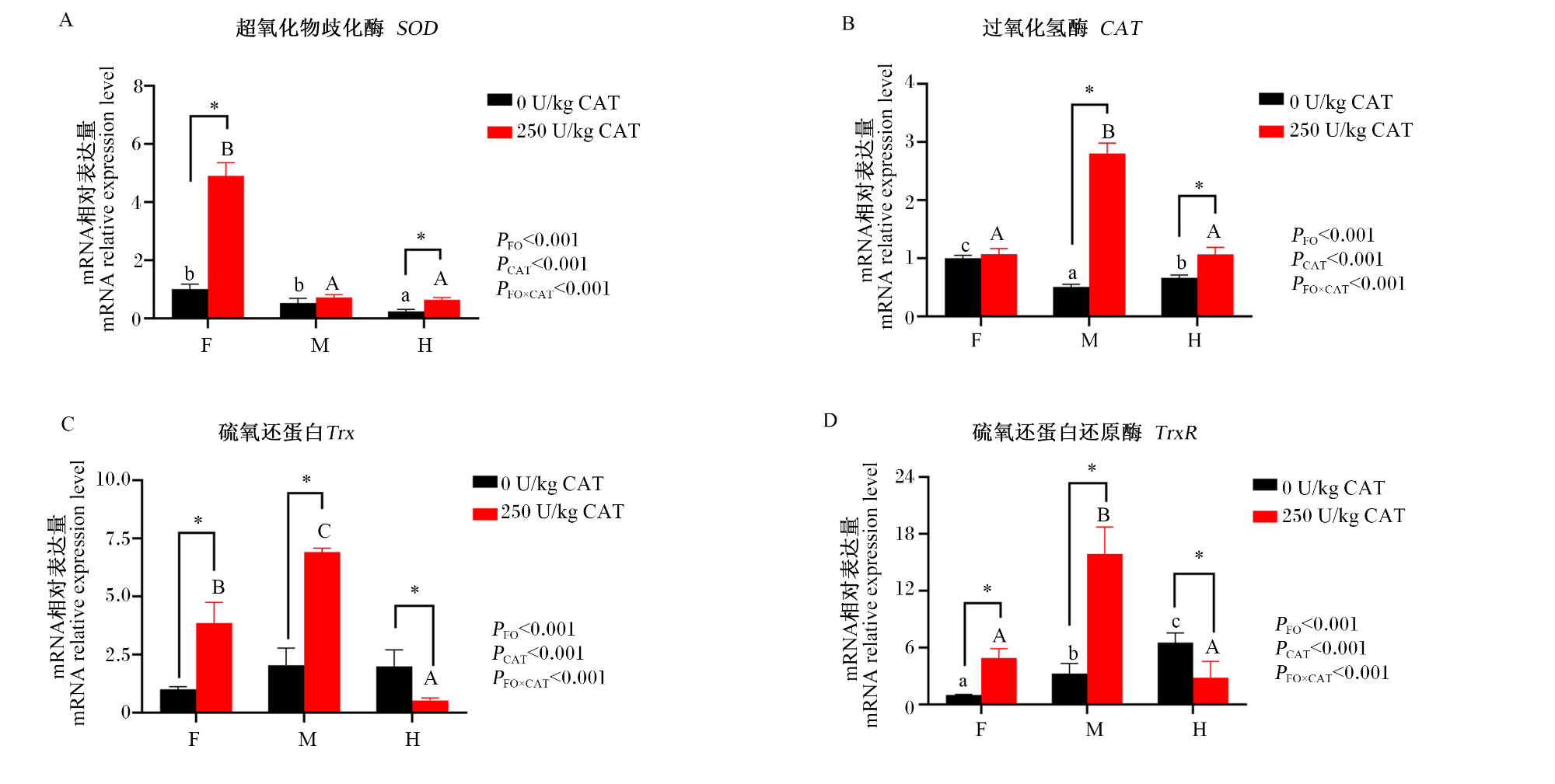
图1可知,鱼油氧化程度与CAT添加水平对肝胰腺SODCATTrxTrxR mRNA相对表达量存在显著交互效应(P<0.05)。未添加CAT时,H组肝胰腺SOD及M和H组肝胰腺CAT mRNA相对表达量显著低于F组(P<0.05),且M组CAT mRNA相对表达量显著低于H组(P<0.05);添加CAT后,F+CAT、H+CAT组肝胰腺SOD mRNA相对表达量分别较F、H组显著提高(P<0.05),M+CAT、H+CAT组肝胰腺CAT mRNA相对表达量分别较M、H组显著提高(P<0.05)。未添加CAT时,肝胰腺TrxR mRNA相对表达量随鱼油氧化程度升高显著上升(P<0.05);添加CAT后,肝胰腺TrxTrxR mRNA相对表达量在H+CAT组显著低于H组(P<0.05),在F+CAT、M+CAT组分别显著高于F、M组(P<0.05),且TrxTrxR mRNA相对表达量均以M+CAT组最高,显著高于F+CAT和H+CAT组(P<0.05)。
图1 氧化鱼油饲料中添加CAT对日本沼虾肝胰腺抗氧化相关基因表达的影响

F:新鲜鱼油,M:中度氧化鱼油,H:高度氧化鱼油。PFOPCATPFO×CAT分别表示鱼油氧化程度、CAT添加水平主效应及二者的交互效应。数据柱形标注不同小写字母表示未添加CAT时不同鱼油氧化程度组间差异显著(P<0.05),不同大写字母表示添加CAT时不同鱼油氧化程度组间差异显著(P<0.05)。*表示同一鱼油氧化程度下,添加CAT组与未添加CAT组间差异显著(P<0.05)。下图同。

Fig.1 Effects of CAT supplementation in oxidized fish oil diets on antioxidant-related genes expression in hepatopancreas of Macrobrachium nipponense

F: fresh fish oil; M: moderately oxidized fish oil; H: highly oxidized fish oil. PFO, PCAT and PFO×CAT represented the main effects of oxidized fish oil degree, CAT supplementation level and their interaction effect, respectively. Columns marked with different lowercase superscripts indicated significant differences among fish oil oxidation degree groups without CAT supplementation (P<0.05); while different uppercase letters denoted significant differences among fish oil oxidation groups with CAT supplementation (P<0.05). * indicated a significant difference between the CAT-supplemented group and the non-supplemented group under the same fish oil oxidation degree (P<0.05). The same as below.

2.3 氧化鱼油饲料中添加CAT对日本沼虾免疫功能的影响

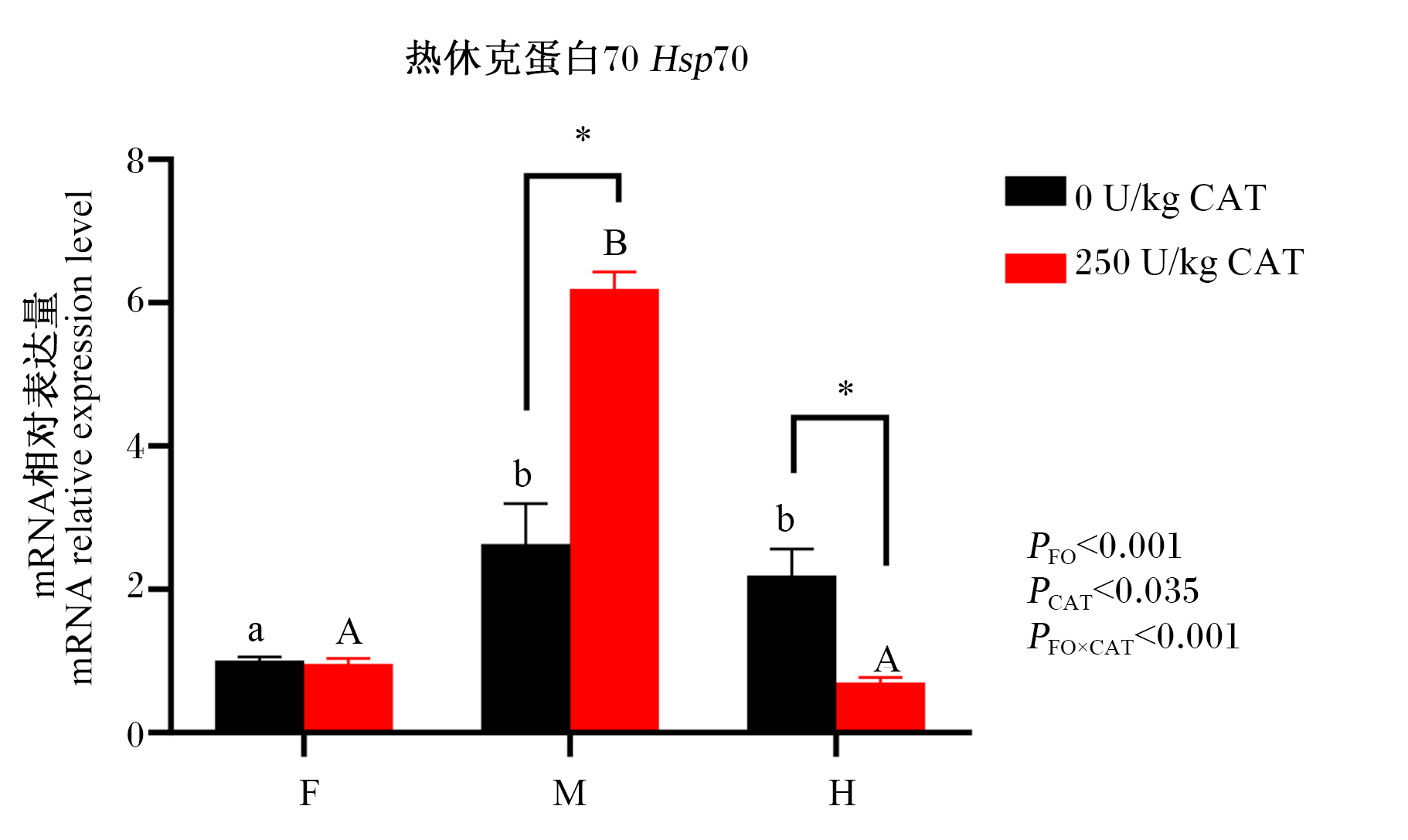
表5图2可知,鱼油氧化程度与CAT添加水平对肝胰腺NO含量和T-NOS、PPO活性及Hsp70 mRNA相对表达量存在显著交互效应(P<0.05)。未添加CAT时,肝胰腺T-NOS和PPO活性均随鱼油氧化程度升高呈上升趋势,其中H组T-NOS活性显著高于F组(P<0.05),PPO活性显著高于F和M组(P<0.05);添加CAT后,M+CAT、H+CAT组肝胰腺T-NOS活性分别较M、H组显著降低(P<0.05),H+CAT组肝胰腺PPO活性较H组显著降低(P<0.05),而F+CAT组肝胰腺T-NOS和PPO活性较F组显著提高(P<0.05)。F+CAT组肝胰腺NO含量显著高于M+CAT组(P<0.05)。
表5 氧化鱼油饲料中添加CAT对日本沼虾肝胰腺免疫指标的影响

Table 5 Effects of CAT supplementation in oxidized fish oil diets on immune indices in hepatopancreas of Macrobrachium nipponense

项目
Items
组别Groups PP-value
F M H F+CAT M+CAT H+CAT FO CAT FO×CAT
一氧化氮
NO/(μmol/g prot)
13.15
±0.08
13.90
±2.18
13.60
±0.96
16.00
±2.52B
8.19
±1.32A
10.48
±0.81AB
0.044 0.068 0.020
总一氧化氮合酶
T-NOS/(U/mg prot)
0.77
±0.02a
0.88
±0.03b
1.40
±0.09b
1.19
±0.05C*
0.46
±0.03A*
0.55
±0.03B*
<0.001 <0.001 <0.001
多酚氧化酶
PPO/(U/mg prot)
13.32
±1.40a
14.79
±0.51a
23.73
±2.68b
31.23
±5.91B*
8.17
±0.19A
5.20
±0.56A*
<0.001 0.065 <0.001
图2 氧化鱼油饲料中添加CAT对日本沼虾肝胰腺Hsp70 mRNA相对表达量的影响

Fig.2 Effects of CAT supplementation in oxidized fish oil diets on Hsp70 mRNA relative expression level in hepatopancreas of Macrobrachium nipponense

图2可知,未添加CAT时,M和H组肝胰腺Hsp70 mRNA相对表达量显著高于F组(P<0.05);添加CAT后,M+CAT组肝胰腺Hsp70 mRNA相对表达量较M组进一步显著提高(P<0.05),H+CAT组肝胰腺Hsp70 mRNA相对表达量则较H组显著降低(P<0.05)。

2.4 氧化鱼油饲料中添加CAT对日本沼虾抗低氧胁迫能力的影响

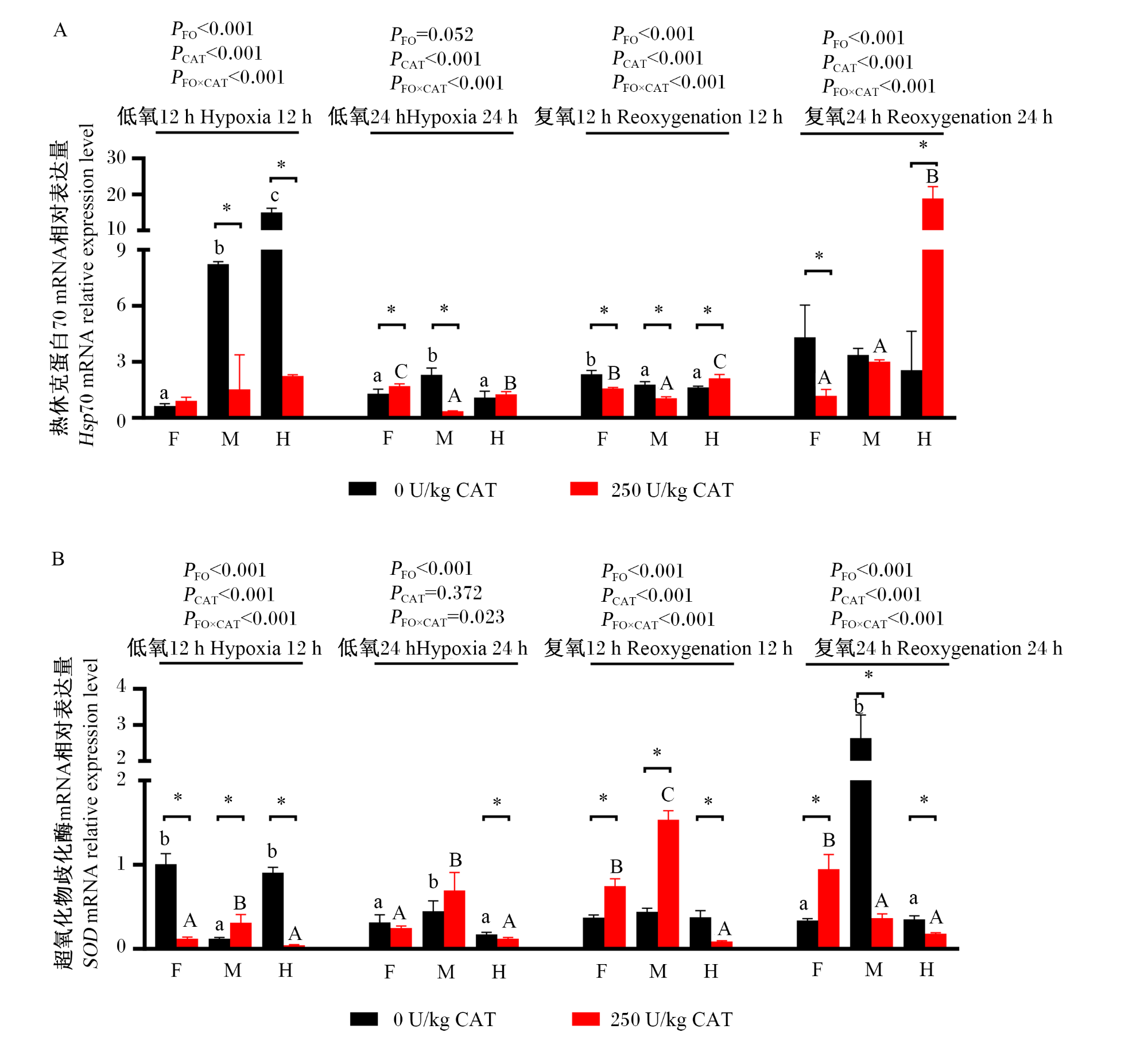
表6图3可知,鱼油氧化程度与CAT添加水平对低氧12、24 h及复氧12、24 h的肝胰腺Hsp70和SOD mRNA相对表达量及MDA含量均存在显著交互效应(P<0.05)。
表6 氧化鱼油饲料中添加CAT对低氧胁迫后日本沼虾肝胰腺MDA含量的影响

Table 6 Effects of CAT supplementation in oxidized fish oil diets on MDA content in hepatopancreas of Macrobrachium nipponense after hypoxic stress

项目
Items
组别Groups PP-value
F M H F+CAT M+CAT H+CAT FO CAT FO×CAT
低氧12 h
Hypoxia 12 h
76.10
±1.68b
74.96
±1.26b
54.20
±0.33a
54.74
±0.47A*
73.14
±1.18C
63.87
±1.46B*
<0.001 <0.001 <0.001
低氧24 h
Hypoxia 24 h
38.84
±0.51a
64.03
±1.15b
88.67
±1.63c
42.42
±0.57A*
70.43
±0.55C*
61.84
±0.46B*
<0.001 <0.001 <0.001
复氧12 h
Reoxygenation 12 h
72.97
±2.21a
79.77
±0.89b
83.39
±1.18c
65.65
±1.10B*
69.09
±0.93C*
53.73
±0.44A*
<0.001 <0.001 <0.001
复氧24 h
Reoxygenation 24 h
104.30
±1.08c
85.26
±1.14b
52.49
±1.20a
48.88
±0.48C*
46.82
±0.60B*
36.44
±0.94A*
<0.001 <0.001 <0.001
图3 氧化鱼油饲料中添加CAT对低氧胁迫后日本沼虾肝胰腺Hsp70和SOD mRNA相对表达量的影响

Fig.3 Effects of CAT supplementation in oxidized fish oil diets on Hsp70 and SOD mRNA relative expression levels in hepatopancreas of Macrobrachium nipponense after hypoxic stress

低氧胁迫12 h后,未添加CAT时,肝胰腺Hsp70 mRNA相对表达量随鱼油氧化程度升高显著上升(P<0.05),肝胰腺SOD mRNA相对表达量在M组显著低于F和H组(P<0.05),肝胰腺MDA含量在H组显著低于F和M组(P<0.05)。添加CAT后,肝胰腺Hsp70 mRNA相对表达量在M+CAT、H+CAT组分别显著低于M、H组(P<0.05);SOD mRNA相对表达量在F+CAT、M+CAT组分别显著低于F、M组(P<0.05),在H+CAT组显著高于H组(P<0.05);MDA含量在F+CAT组显著低于F组(P<0.05),在H+CAT组显著高于H组(P<0.05)。
低氧胁迫24 h后,未添加CAT时,肝胰腺MDA含量随鱼油氧化程度升高显著上升(P<0.05),M组肝胰腺Hsp70和SOD mRNA相对表达量显著高于F和H组(P<0.05)。添加CAT后,M+CAT组肝胰腺Hsp70 mRNA相对表达量降至最低,显著低于F+CAT和H+CAT组(P<0.05),而MDA含量及SOD mRNA相对表达量显著高于F+CAT和H+CAT组(P<0.05);F+CAT组肝胰腺Hsp70 mRNA相对表达量及MDA含量较F组显著提高(P<0.05);M+CAT组肝胰腺Hsp70 mRNA相对表达量较M组显著降低(P<0.05),MDA含量较M组显著提高(P<0.05);H+CAT组肝胰腺MDA含量及SOD mRNA相对表达量较H组显著降低(P<0.05)。
复氧12 h后,未添加CAT时,肝胰腺MDA含量随鱼油氧化程度升高显著上升(P<0.05),M和H组肝胰腺Hsp70 mRNA相对表达量显著低于F组(P<0.05)。添加CAT后,肝胰腺Hsp70 mRNA相对表达量在F+CAT、M+CAT组分别显著低于F、M组(P<0.05),在H+CAT组显著高于H组(P<0.05);SOD mRNA相对表达量则呈现相反变化趋势;MDA含量在F+CAT、M+CAT、H+CAT组分别显著低于F、M、H组(P<0.05)。
复氧24 h后,未添加CAT时,肝胰腺MDA含量随鱼油氧化程度升高显著下降(P<0.05),M组肝胰腺SOD mRNA相对表达量显著高于F和H组(P<0.05)。添加CAT后,肝胰腺SOD mRNA相对表达量在F+CAT组显著高于F组(P<0.05),在M+CAT、H+CAT组分别显著低于M、H组(P<0.05);MDA含量在F+CAT、M+CAT、H+CAT组分别显著低于F、M、H组(P<0.05);肝胰腺Hsp70、SOD mRNA相对表达量分别以H+CAT、F+CAT组最高,MDA含量以H+CAT组最低。

3 讨论

3.1 氧化鱼油饲料中添加CAT对日本沼虾生长性能的影响

日本沼虾属杂食性动物,会出现同类残食现象,尤以刚蜕皮的嫩虾为攻击对象;养殖后期虾体规格增大,互残现象进一步加剧。本试验虽在养殖槽内放置了人工庇护所,但仍无法完全避免互残发生。此外,氧化鱼油会对日本沼虾幼虾产生较强氧化胁迫,直接损伤机体组织功能,已有研究证实氧化鱼油会显著降低甲壳动物存活率[30]。在上述双重压力下,本试验中日本沼虾的存活率处于相对较低水平,但与常规甲壳动物营养试验[31-32]的存活率接近,表明该结果在同类研究中具有可比性。本研究结果表明,高度氧化鱼油显著降低了日本沼虾的存活率,这与在斑节对虾[10]和中华绒螯蟹[15]中的研究结果一致。可能是因为鱼油氧化产生的MDA等次级产物具有强烈的亲脂性,能直接渗透并破坏机体肝胰腺细胞膜的脂质双分子层,导致细胞结构完整性受损[9],从而降低了存活率。本研究进一步发现,在添加250 U/kg CAT后,摄食高度氧化鱼油饲料日本沼虾的存活率显著提高,说明适宜水平外源CAT可有效缓解高度氧化鱼油带来的生存胁迫,这可能与CAT阻断脂质过氧化连锁反应、减轻细胞氧化损伤的作用[19,22]有关。同时,在新鲜鱼油饲料中添加CAT主要表现为促生长效应,能有效提高日本沼虾的增重率。本实验室前期研究[25]指出,饲料添加外源CAT可上调日本沼虾肠道有益菌丰度,推测CAT通过优化肠道菌群结构、提升营养物质吸收效率实现促生长效果。综上所述,氧化鱼油主要降低日本沼虾成活率,而外源CAT可凭借自身抗氧化作用在一定程度上缓解氧化鱼油引起的生长性能损害。

3.2 氧化鱼油饲料中添加CAT对日本沼虾抗氧化能力的影响

MDA是多不饱和脂肪酸脂质过氧化反应的终末产物,其含量是衡量细胞氧化损伤与脂质过氧化水平的可靠标志物[26]。SOD可防止活细胞中超氧自由基引发氧化应激[33],是机体抗氧化能力重要评价指标之一。本研究结果表明,摄食高度氧化鱼油饲料会导致日本沼虾肝胰腺MDA和H2O2含量显著升高,同时显著下调肝胰腺SODCAT的表达,表明高度氧化鱼油已诱发机体产生明显的氧化应激及脂质过氧化损伤。这一现象与在罗氏沼虾[34]中的研究结果相似,进一步证实氧化鱼油会破坏水产动物的抗氧化防御体系。本研究发现,饲料中添加250 U/kg CAT可有效逆转高度氧化鱼油引发的负面效应,不仅肝胰腺中MDA和H2O2的积累明显减少,SODCAT等抗氧化关键基因的表达也显著上调,说明外源CAT能够有效增强机体的抗氧化能力,从而缓解氧化鱼油所诱导的氧化损伤。该作用机制与在黄羽肉鸡[23]和断奶仔猪[35]中观察到的CAT的抗氧化效果相吻合。值得注意的是,本研究观察到在新鲜鱼油饲料中添加CAT反而显著升高了肝胰腺中H2O2含量,推测该结果与机体抗氧化酶的级联协同效应相关,添加CAT可提升SOD活性,加速超氧阴离子的歧化分解,进而导致中间产物H2O2暂时性累积[36]。此外,Di Marzo等[37]认为H2O2是调控细胞生长与代谢的关键信号分子。本试验中,F+CAT组肝胰腺H2O2含量的适度升高与该组增重率显著提升的结果相互印证,提示外源CAT可能通过优化机体氧化还原信号通量,诱导幼虾的生理代偿与生长加速,这一现象符合氧化应激理论中的毒性兴奋效应[38]
Trx系统的核心功能在于维持细胞内的氧化还原平衡,保护细胞免受氧化应激损伤[39-40]。本研究发现,氧化鱼油胁迫显著上调了肝胰腺TrxR的表达,这可能是机体在氧化应激状态下的一种代偿性响应。而添加CAT后,摄食中度氧化鱼油饲料日本沼虾肝胰腺TrxTrxR的表达上调,摄食高度氧化鱼油组中二者表达则下调,这说明CAT的干预能够调节Trx系统的应激反应,使其在适度胁迫下增强抗氧化信号,而在重度胁迫下避免过度激活,从而维持氧化还原稳态[41-42]。这一调控模式与维生素E在中华绒螯蟹[15]中对Trx系统的影响相似。综上所述,饲料中添加适量CAT可通过上调日本沼虾肝胰腺的抗氧化酶基因的表达和调节Trx系统,缓解氧化鱼油诱导的氧化应激,减轻脂质过氧化对机体的损伤。

3.3 氧化鱼油饲料中添加CAT对日本沼虾免疫功能的影响

甲壳动物缺乏特异性免疫系统,主要依赖非特异性免疫机制抵御外界病原入侵[43]。其中,酚氧化酶原激活系统是甲壳动物免疫防御的核心环节,PPO作为该系统的关键酶,其活性变化可反映机体免疫状态[44]。此外,NO及其合成酶T-NOS在免疫应答中亦具有重要作用[45],Hsp70则在机体应对胁迫时发挥保护与修复功能[46]。本研究结果表明,氧化鱼油提升了日本沼虾肝胰腺PPO和T-NOS活性及Hsp70的表达,表明氧化鱼油会诱发幼虾产生免疫应激[47]。饲料添加250 U/kg CAT后,摄食高度氧化鱼油饲料日本沼虾肝胰腺PPO和T-NOS活性及Hsp70的表达均显著下降,摄食中度氧化鱼油饲料日本沼虾肝胰腺T-NOS活性也显著降低。上述结果与部分研究中使用维生素E等抗氧化剂可提升PPO活性[15]的结论有所不同,推测可能与CAT的强效抗氧化作用有关:CAT可直接清除H2O2等活性氧,缓解机体氧化胁迫,进而减少免疫系统过度激活[48]。值得注意的是,同一鱼油氧化程度下,CAT添加与否不会显著改变肝胰腺NO含量,说明CAT并未干扰NO的基础代谢,但其对T-NOS活性的调控作用提示CAT可能通过调节免疫相关酶活性,减轻氧化鱼油引起的免疫过度激活[25]。本研究结果还表明,氧化鱼油可显著诱导肝胰腺Hsp70表达上调,而CAT的添加在中度氧化鱼油条件下进一步上调了该基因的表达,在高度氧化鱼油条件下则显著下调其表达。这一差异可能与氧化胁迫程度有关:适度胁迫下CAT通过上调Hsp70表达增强了机体的应激保护能力,而在高度氧化胁迫下,CAT则通过缓解氧化损伤降低了Hsp70的表达需求[49]。综上所述,氧化鱼油可激活日本沼虾的免疫防御系统,而外源添加CAT则通过缓解氧化应激,调节免疫相关酶活性和基因表达,在一定程度上恢复了机体的免疫稳态,表现出对氧化鱼油所致免疫紊乱的缓解作用。

3.4 氧化鱼油饲料中添加CAT对日本沼虾抗低氧胁迫能力的影响

本研究结果表明,在低氧胁迫12 h阶段,未添加CAT组中肝胰腺Hsp70的表达随鱼油氧化程度升高显著上调。该现象提示氧化鱼油与低氧胁迫存在协同效应,二者共同加剧机体氧化应激[50-51]。有研究表明CAT与水生动物缺氧应激有关,CAT活性受抑会导致复氧过程中的氧化还原失衡[52]。本研究中,添加CAT后摄食氧化鱼油饲料日本沼虾肝胰腺Hsp70的表达显著下调,其表达水平与新鲜鱼油组无显著差异,说明CAT通过清除H2O2[48],从源头上减轻了氧化应激信号对细胞的冲击。与此同时,高度氧化鱼油组添加CAT后,肝胰腺SOD的表达反而降低,且MDA含量上升。这一看似矛盾的结果可能表明,胁迫初期CAT虽然缓解了部分H2O2毒性,但持续低氧环境可能扰乱了抗氧化系统的协同调控机制。有研究指出,缺氧对水生动物的生理和免疫反应有重大影响,持续低氧几小时就会导致死亡[53]
本研究结果表明,在低氧胁迫24 h阶段,无论是否添加CAT,氧化鱼油组肝胰腺MDA含量均较新鲜鱼油组显著升高。MDA作为脂质过氧化损伤标志物,其含量可因生物或非生物胁迫发生变化[54],上述结果表明持续低氧已对机体造成了严重的氧化损伤,脂质过氧化产物大量积累。本研究结果还表明,添加CAT显著下调了摄食高度氧化鱼油饲料日本沼虾肝胰腺SOD的表达。SOD是抗氧化防御系统的第1道防线,负责将超氧阴离子转化为H2O2[55]。CAT在此阶段的主要作用可能体现在清除了部分H2O2[48],减轻了抗氧化系统负担,导致SOD的表达反馈性下调。
研究表明,复氧并非简单的生理恢复过程,反而会诱发再氧合损伤,即大量氧气瞬间涌入导致ROS爆发性产生[56]。本研究中,在复氧12 h阶段,添加CAT后各氧化鱼油组肝胰腺MDA含量均较未添加CAT时急剧下降,这是CAT发挥保护效应的直接证据。在ROS爆发期,CAT可高效清除关键中间产物H2O2,阻断芬顿反应生成高活性羟基自由基,从而抑制脂质过氧化进程,保护细胞膜结构[57]。此外,CAT的添加使摄食中度氧化鱼油饲料日本沼虾肝胰腺Hsp70的表达下调、SOD的表达上调,而在摄食高度氧化鱼油饲料日本沼虾中调控趋势完全相反。这种分化反映了虾体在不同氧化损伤基础上面临复氧时的复杂调控网络。摄食中度氧化鱼油饲料时可能因损伤较轻,在CAT的保护下能更有序地启动抗氧化防御;而摄食高度氧化鱼油饲料时可能因基础损伤过重,修复机制更为复杂和紊乱。
本研究结果表明,在复氧24 h阶段,在同一鱼油氧化程度下,添加CAT后肝胰腺MDA含量均显著低于未添加CAT时,表明在整个胁迫-恢复周期中,CAT对减轻组织氧化损伤具有持续且显著的效果。Hsp70在氧化鱼油组中依然维持较高表达,可能说明即使到了恢复末期,由氧化鱼油和低氧-复氧造成的细胞损伤仍未完全修复,机体仍需依赖Hsp70维持蛋白质稳态以实现细胞保护[49]。值得注意的是,本研究观察到H+CAT组在复氧24 h时肝胰腺Hsp70的表达较H组出现显著大幅上调。可能是因为在缺乏CAT保护的H组中,严重的细胞损伤抑制了机体合成应激蛋白的能力;而添加CAT通过前期对生物膜结构的保护,维持了机体核心的代谢活力,从而在复氧后期蛋白质修复阶段调动更多生理储备产生Hsp70,以进行变性蛋白的折叠与清除[49,52]
综上所述,在低氧-复氧过程中,添加CAT后肝胰腺SOD的表达普遍下调,MDA含量整体降低,这可能是因为CAT有效承担了清除H2O2的重任,减轻了整体抗氧化系统负担,因此SOD的表达需求相应降低,机体氧化还原状态趋于稳定。同时,CAT通过调控Hsp70和SOD的表达,有效减轻了低氧-复氧与氧化鱼油共同诱导的氧化损伤,提升了日本沼虾在复杂胁迫环境下的生理适应能力。

4 结论

高度氧化鱼油会降低日本沼虾存活率,扰乱机体抗氧化与免疫相关基因表达及酶活性,诱发氧化应激损伤;饲料中添加250 U/kg CAT可通过改善虾体抗氧化能力和免疫功能,缓解高度氧化鱼油带来的负面作用,并增强其抗低氧胁迫能力。
[1]
WEIL C, LEFÈVRE F, BUGEON J. Characteristics and metabolism of different adipose tissues in fish[J]. Reviews in Fish Biology and Fisheries, 2013, 23(2):157-173.

DOI

[2]
JIANG Z Z, XU C, WU S, et al. Optimal arachidonic acid supplementation enhances ovarian development and reproductive performance in female redclaw crayfish (Cherax quadricarinatus)[J]. Aquaculture, 2025, 602:742358.

DOI

[3]
WU J P, LI J Y, DU H, et al. Transcriptome and lipidomics profiling of F2 generation female Chinese sturgeon (Acipenser sinensis) in response to different arachidonic acid diets[J]. Aquaculture Reports, 2022, 23:101020.

DOI

[4]
XU S D, WANG S Q, ZHANG L, et al. Effects of replacement of dietary fish oil with soybean oil on growth performance and tissue fatty acid composition in marine herbivorous teleost Siganus canaliculatus[J]. Aquaculture Research, 2012, 43(9):1276-1286.

DOI

[5]
GLENCROSS B D, BACHIS E, BETANCOR M B, et al. Omega-3 futures in aquaculture:exploring the supply and demands for long-chain omega-3 essential fatty acids by aquaculture species[J]. Reviews in Fisheries Science & Aquaculture, 2025, 33(2):167-216.

[6]
WANG X, DONG Y Z, HUANG Y Y, et al. Docosahexaenoic acid-enriched diet improves the flesh quality of freshwater fish (Megalobrama amblycephala):evaluation based on nutritional value,texture and flavor[J]. Food Chemistry, 2024, 460(Pt 1):140518.

DOI

[7]
ALHAZZAA R, NICHOLS P D, CARTER C G. Sustainable alternatives to dietary fish oil in tropical fish aquaculture[J]. Reviews in Aquaculture, 2019, 11(4):1195-1218.

DOI

[8]
LAOHABANJONG R, TANTIKITTI C, BENJAKUL S, et al. Lipid oxidation in fish meal stored under different conditions on growth,feed efficiency and hepatopancreatic cells of black tiger shrimp (Penaeus monodon)[J]. Aquaculture, 2009, 286(3/4):283-289.

DOI

[9]
姚仕彬, 叶元土, 李洁, 等. 鱼油在氧化过程中氧化指标及其脂肪酸组成的变化[J]. 饲料研究, 2012(6):74-76.

YAO S B, YE Y T, LI J, et al. Changes in oxidation indicators and fatty acid composition of fish oil during oxidation process[J]. Feed Research, 2012(6):74-76. (in Chinese)

[10]
MOURENTE G, DIÍAZ-SALVAGO E, BELL J G, et al. Increased activities of hepatic antioxidant defence enzymes in juvenile gilthead sea bream (Sparus aurata L.) fed dietary oxidised oil:attenuation by dietary vitamin E[J]. Aquaculture, 2002, 214(1/2/3/4):343-361.

DOI

[11]
梁萌青, 徐明起, 姚健, 等. 酸败油脂和黄曲霉毒素对中国对虾(Penaeus chinensis)生长的影响[J]. 中国水产科学, 1996, 3(4):49-53.

LIANG M Q, XU M Q, YAO J, et al. The effect of acided oil and aflatoxin on the prawns (Penaeus chinensis) growth[J]. Journal of Fishery Sciences of China, 1996, 3(4):49-53. (in Chinese)

[12]
YIN P, XIE S W, HUO Y J, et al. Effects of dietary oxidized fish oil on growth performance,antioxidant defense system, apoptosis and mitochondrial function of juvenile largemouth bass (Micropterus salmoides)[J]. Aquaculture, 2019, 500:347-358.

DOI

[13]
单凡. 维生素E对日粮脂肪诱导罗氏沼虾氧化应激的调控作用研究[D]. 硕士学位论文. 南京: 南京农业大学, 2019.

SHAN F. Regulation of vitamin E on dietary lipid induced oxidative stress in giant freshwater prawn (Macrobrachium rosenbergii)[D]. Master’s Thesis. Nanjing: Nanjing Agricultural University, 2019. (in Chinese)

[14]
KOSHIO S, TESHIMA S, KANAZAWA A. Effects of dietary oxidized oil for Penaeus japonicus[J]. Fisheries Science, 1994, 60(3):283-288.

DOI

[15]
王立改. 维生素E对中华绒螯蟹饲料脂肪利用的保护作用研究[D]. 博士学位论文. 上海: 华东师范大学, 2014.

WANG L G.Study on the protection effect of vitamin E on the dietary lipid of Chinese mitten crab Eriocheir sinensis[D]. Ph.D.Thesis. Shanghai: East China Normal University, 2014. (in Chinese)

[16]
ZHONG Y, LALL S P, SHAHIDI F. Effects of oxidized dietary oil and vitamin E supplementation on lipid profile and oxidation of muscle and liver of juvenile Atlantic cod (Gadus morhua)[J]. Journal of Agricultural and Food Chemistry, 2007, 55(15):6379-6386.

PMID

[17]
彭士明. 黑鲷(Acanthopagrus schlegeli)脂类与维生素E的营养生理研究[D]. 博士学位论文. 上海: 华东师范大学, 2008.

PENG S M. Nutritional physiology of lipid and vitamin E in black seabream,Acanthopagrus schlegeli[D]. Ph.D.Thesis. Shanghai: East China Normal University, 2008. (in Chinese)

[18]
LEWIS-MCCREA L M, LALL S P. Effects of moderately oxidized dietary lipid and the role of vitamin E on the development of skeletal abnormalities in juvenile Atlantic halibut (Hippoglossus hippoglossus)[J]. Aquaculture, 2007, 262(1):142-155.

DOI

[19]
朱安南, 刘欢, 孟勇, 等. 过氧化氢酶的功能及在畜禽中的研究进展[J]. 饲料研究, 2022, 45(10):143-145.

ZHU A N, LIU H, MENG Y, et al. Research progress on function of catalase and its application in livestock and poultry production[J]. Feed Research, 2022, 45(10):143-145. (in Chinese)

[20]
GAYASHANI SANDAMALIKA W M, KWON H, LIM C, et al. The possible role of catalase in innate immunity and diminution of cellular oxidative stress:insights into its molecular characteristics,antioxidant activity,DNA protection,and transcriptional regulation in response to immune stimuli in yellowtail clownfish (Amphiprion clarkii)[J]. Fish & Shellfish Immunology, 2021, 113:106-117.

[21]
NITTA Y, MURAOKA-HIRAYAMA S, SAKURAI K. Catalase is required for peroxisome maintenance during adipogenesis[J]. Biochimica et Biophysica Acta:Molecular and Cell Biology of Lipids, 2020, 1865(8):158726.

[22]
于德玲, 王昌留. 过氧化氢酶的研究进展[J]. 中国组织化学与细胞化学杂志, 2016, 25(2):189-194.

YU D L, WANG C L. Progresses in the research of catalase[J]. Chinese Journal of Histochemistry and Cytochemistry, 2016, 25(2):189-194. (in Chinese)

[23]
唐明红. 过氧化氢酶对Diquat诱导黄羽肉鸡氧化应激的影响及其作用机制研究[D]. 博士学位论文. 长沙: 湖南农业大学, 2022.

TANG M H. Effects of catalase supplementation in diet on oxidative stress and its mechanism in yellow broilers[D]. Ph.D.Thesis. Changsha: Hunan Agricultural University, 2022. (in Chinese)

[24]
王旭溟. 过氧化氢酶和美洛昔康缓解DSS诱导的黄羽肉鸡肠道损伤和菌群失调[D]. 硕士学位论文. 武汉: 华中农业大学, 2022.

WANG X M. Effect of catalase and meloxicam on DSS-induced yellow-feather chickens intestinal injuries and dysbacteriosis[D]. Master’s Thesis. Wuhan: Huazhong Agricultural University, 2022. (in Chinese)

[25]
李姗姗, 王俊保, 简永慧, 等. 饲料中添加过氧化氢酶对日本沼虾生长性能、抗氧化能力、免疫性能和肠道菌群结构的影响[J]. 动物营养学报, 2024, 36(1):464-477.

DOI

LI S S, WANG J B, JIAN Y H, et al. Effects of adding catalase in diets on growth performance,antioxidant activity,immune performance and intestinal flora structure of Macrobrachium nipponense[J]. Chinese Journal of Animal Nutrition, 2024, 36(1):464-477. (in Chinese)

[26]
JIAN Y H, SONG J X, CHEN Z Y, et al. Positive effects of a mixture of fish oil and soybean oil as a dietary lipid source on the ovarian development and health of female giant river prawn,Macrobrachium rosenbergii broodstock[J]. Aquaculture Reports, 2024, 39:102407.

DOI

[27]
LIU X, SUN C X, ZHOU Q L, et al. Ferulic acid relieves the oxidative stress induced by oxidized fish oil in oriental river prawn (Macrobrachium nipponense) with an emphasis on lipid metabolism and gut microbiota[J]. Antioxidants, 2024, 13(12):1463.

DOI

[28]
ZHOU D S, WANG C L, ZHENG J X, et al. Dietary thiamine modulates carbohydrate metabolism,antioxidant status,and alleviates hypoxia stress in oriental river prawn Macrobrachium nipponense (De Haan)[J]. Fish & Shellfish Immunology, 2022, 131:42-53.

[29]
SUN S M, WU Y, JAKOVLIĆ I, et al. Identification of neuropeptides from eyestalk transcriptome profiling analysis of female oriental river prawn (Macrobrachium nipponense) under hypoxia and reoxygenation conditions[J]. Comparative Biochemistry and Physiology Part B:Biochemistry and Molecular Biology, 2020, 241:110392.

DOI

[30]
WANG L G, LI E C, QIN J G, et al. Effect of oxidized fish oil and α-tocopherol on growth,antioxidation status,serum immune enzyme activity and resistance to Aeromonas hydrophila challenge of Chinese mitten crab Eriocheir sinensis[J]. Aquaculture Nutrition, 2015, 21(4):414-424.

DOI

[31]
LIU S B, LI X Y, WANG X D, et al. Molting,tissue calcium phosphorus deposition and immunity of juvenile Chinese mitten crab (Eriocheir sinensis) fed different levels of calcium and vitamin D3[J]. Aquaculture, 2022, 554:738124.

DOI

[32]
YANG C, LIU B, PAN L K, et al. Impact of soybean bioactive peptides on growth,lipid metabolism,antioxidant ability,molecular responses,and gut microbiota of oriental river prawn (Macrobrachium nipponense) fed with a low-fishmeal diet[J]. Biology, 2025, 14(1):11.

DOI

[33]
YAO C L, WANG A L, WANG W N, et al. Purification and partial characterization of Mn superoxide dismutase from muscle tissue of the shrimp Macrobrachium nipponense[J]. Aquaculture, 2004, 241(1/2/3/4):621-631.

DOI

[34]
GAO Q, LIU B, SHAN F, et al. Effects of oxidized fish oil on digestive enzyme activity and antioxidant system in Macrobrachium rosenbergii post-larvae[J]. Aquaculture Reports, 2022, 23:101062.

DOI

[35]
CHEN J L, LI F C, YANG W R, et al. Supplementation with exogenous catalase from Penicillium notatum in the diet ameliorates lipopolysaccharide-induced intestinal oxidative damage through affecting intestinal antioxidant capacity and microbiota in weaned pigs[J]. Microbiology Spectrum, 2021, 9(3):e00654-21.

[36]
JOMOVA K, ALOMAR S Y, ALWASEL S H, et al. Several lines of antioxidant defense against oxidative stress:antioxidant enzymes,nanomaterials with multiple enzyme-mimicking activities,and low-molecular-weight antioxidants[J]. Archives of Toxicology, 2024, 98(5):1323-1367.

DOI

[37]
DI MARZO N, CHISCI E, GIOVANNONI R. The role of hydrogen peroxide in redox-dependent signaling:homeostatic and pathological responses in mammalian cells[J]. Cells, 2018, 7(10):156.

DOI

[38]
COSTANTINI D. Oxidative stress and hormesis in evolutionary ecology and physiology:a marriage between mechanistic and evolutionary approaches[M]. Heidelberg:Springer, 2014.

[39]
王瑞钰, 彭琳茜, 薛倩, 等. 硫氧还蛋白系统与高血压的研究进展[J]. 心血管病学进展, 2020, 41(10):1036-1039.

WANG R Y, PENG L Q, XUE Q, et al. Thioredoxin system in hypertension[J]. Advances in Cardiovascular Diseases, 2020, 41(10):1036-1039. (in Chinese)

[40]
徐兴农. 硫氧还蛋白系统与肿瘤的治疗[J]. 世界最新医学信息文摘, 2021, 21(98):573-574.

XU X N. Thioredoxin system and tumor therapy[J]. World Latest Medicine Information, 2021, 21(98):573-574. (in Chinese)

[41]
张文翔, 王建平. 过氧化氢酶对肉鸡生产性能、抗氧化能力、盲肠微生物及代谢物的影响[J]. 中国畜牧兽医, 2024, 51(3):1086-1093.

DOI

ZHANG W X, WANG J P. Effect of catalase on the production performance,antioxidant capacity,cecal microbe and metabolites in broilers[J]. China Animal Husbandry & Veterinary Medicine, 2024, 51(3):1086-1093. (in Chinese)

[42]
严伯涵, 何照, 范俊凤, 等. 假结核耶尔森氏菌硫氧还蛋白系统相关基因参与抗氧化胁迫的机制[J]. 微生物学通报, 2025, 52(5):2331-2343.

YAN B H, HE Z, FAN J F, et al. Role of the thioredoxin system in response to oxidative stress in Yersinia pseudotuberculosis[J]. Microbiology China, 2025, 52(5):2331-2343. (in Chinese)

[43]
LEE M H, SHIAU S Y. Vitamin E requirements of juvenile grass shrimp,Penaeus monodon,and effects on non-specific immune responses[J]. Fish & Shellfish Immunology, 2004, 16(4):475-485.

[44]
王文锋, 马建敏, 杨洪, 等. 日本沼虾酚氧化酶原基因cDNA的全长克隆及表达分析[J]. 解剖学报, 2012, 43(6):744-750.

DOI

WANG W F, MA J M, YANG H, et al. cDNA cloning and characterisation of prophenoloxidase from Macrobrachium nipponense[J]. Acta Anatomica Sinica, 2012, 43(6):744-750. (in Chinese)

[45]
卢秀红, 邓祝新, 黄维义, 等. 一氧化氮在免疫效应机制中的作用及其细胞因子的调控[J]. 河南畜牧兽医, 2009, 30(12):10-12.

LU X H, DENG Z X, HUANG W Y, et al. Role of nitric oxide in immune effector mechanisms and its cytokine regulation[J]. Henan Journal of Animal Husbandry and Veterinary Medicine, 2009, 30(12):10-12. (in Chinese)

[46]
沈骅, 王晓蓉, 张景飞. 应用应激蛋白HSP70作为生物标志物研究锌、铜及其联合毒性对鲫鱼肝脏的影响[J]. 环境科学学报, 2004, 24(5):895-899.

SHEN H, WANG X R, ZHANG J F. Application of the stress protein (HSP70) as the biomarker in studying zinc and copper,and the joint toxicity to fish liver[J]. Acta Scientiae Circumstantiae, 2004, 24(5):895-899. (in Chinese)

[47]
YANG S P, LIU H L, WANG C G, et al. Effect of oxidized fish oil on growth performance and oxidative stress of Litopenaeus vannamei[J]. Aquaculture Nutrition, 2015, 21(1):121-127.

DOI

[48]
REGOLI F, GIULIANI M E. Oxidative pathways of chemical toxicity and oxidative stress biomarkers in marine organisms[J]. Marine Environment Research, 2014, 93:106-117.

DOI

[49]
MULTHOFF G. Heat shock protein 70 (Hsp70):membrane location,export and immunological relevance[J]. Methods, 2007, 43(3):229-237.

DOI

[50]
DEBEVEC T, MILLET G P, PIALOUX V. Hypoxia-induced oxidative stress modulation with physical activity[J]. Frontiers in Physiology, 2017, 8:84.

DOI PMID

[51]
GAO J, KOSHIO S, ISHIKAWA M, et al. Effects of dietary oxidized fish oil with vitamin E supplementation on growth performance and reduction of lipid peroxidation in tissues and blood of red sea bream Pagrus major[J]. Aquaculture, 2012,356-357:73-79.

[52]
WELKER A F, CARDOSO L A, et al. Role of catalase on the hypoxia/reoxygenation stress in the hypoxia-tolerant Nile tilapia[J]. American Journal of Physiology:Regulatory,Integrative and Comparative Physiology, 2012, 302(9):R1111-R1118.

[53]
ABDEL-TAWWAB M, MONIER M N, HOSEINIFAR S H, et al. Fish response to hypoxia stress:growth,physiological,and immunological biomarkers[J]. Fish Physiology and Biochemistry, 2019, 45(3):997-1013.

DOI

[54]
DAVEY M W, STALS E, PANIS B, et al. High-throughput determination of malondialdehyde in plant tissues[J]. Analytical Biochemistry, 2005, 347(2):201-207.

DOI PMID

[55]
MCCORD J M, FRIDOVICH I. Superoxide dismutase. An enzymic function for erythrocuprein (hemocuprein)[J]. The Journal of Biological Chemistry, 1969, 244(22):6049-6055.

DOI

[56]
LI C Y, JACKSON R M. Reactive species mechanisms of cellular hypoxia-reoxygenation injury[J]. American Journal of Physiology:Cell Physiology, 2002, 282(2):C227-C241.

[57]
SEPASI T H, MOOSAVI-MOVAHEDI A A. Catalase and its mysteries[J]. Progress in Biophysics and Molecular Biology, 2018, 140:5-12.

DOI

Outlines

/