RESEARCH PAPER

Effects of Solid-State Fermentation with Bacillus amyloliquefaciens on Nutritional Value and in Vitro Fermentation Characteristics of Whole Cottonseed

  • LI Guangyang , 1 ,
  • WANG Zhisheng , 1, * ,
  • HU Rui 1 ,
  • ZOU Huawei 1 ,
  • JIANG Yahui 1 ,
  • DAI Qindan 1 ,
  • LIANG Xiurong 1 ,
  • ZHANG Qiqi 1 ,
  • WANG Yanyang 1 ,
  • PENG Quanhui 1 ,
  • ZHOU Zhenyong 2 ,
  • ZHANG Yang 2 ,
  • ZHU Bingshan 3
Expand
  • 1 Sichuan Provincial Key Laboratory of Cattle Low Carbon Farming and Safe Production in Universities, Meat Cattle Low Carbon Farming Innovation Team, Institute of Animal Nutrition, Sichuan Agricultural University, Chengdu 611130, China
  • 2 Institute of Animal Husbandry, Xinjiang Academy of Animal Husbandry, Urumqi 830000, China
  • 3 Xinjiang Daolang Sunshine Agriculture and Animal Husbandry Technology Co., Ltd., Kashgar 844000, China
* professor, E-mail:

Received date: 2023-03-24

  Online published: 2023-09-13

Abstract

This experiment aimed to study the effects of solid-state fermentation with Bacillus amyloliquefaciens on the nutritional value and in vitro fermentation characteristics of whole cottonseed. Taking crude protein (CP) content as the index, the single-factor test and L9(34) orthogonal test design were used to optimize the fermentation temperature, fermentation time, material to water ratio and inoculation amount, and the change of nutritional value before and after fermentation of whole cottonseed was compared. In vitro fermentation test was carried out on the unfermented whole cottonseed (control group) and fermented whole cottonseed (fermentation group, whole cottonseed was fermented under the screened optimal conditions) by in vitro gas production method to determine gas production, gas production parameters and fermentation parameters. The results showed as follows: 1) the optimal fermentation conditions of whole cottonseed by solid-state fermentation with Bacillus amyloliquefaciens were fermentation temperature 42 ℃, fermentation time 6 d, inoculation amount 20% (volume:mass) and material to water ratio 1:0.6. 2) After fermentation under optimal conditions, the contents of crude protein and true protein increased significantly (P<0.05), and the crude fiber content decreased from 24.96% to 22.95% (P<0.05); the contents of essential amino acids and total amino acids increased significantly (P<0.05), which increased by 14.72% and 7.23%, respectively; the contents of free gossypol and deoxynivalenol were significantly reduced (P<0.05); the activities of amylase, cellulase, neutral protease, acid protease and alkaline protease were significantly increased (P<0.05). 3) At 48 h of fermentation, the concentrations of acetate, butyrate and total volatile fatty acids (TVFA) of the fermentation group were significantly higher than those of the control group (P<0.05). The results indicate that the solid fermentation with Bacillus amyloliquefaciens can significantly improve the nutritional value of whole cottonseed, and promote in vitro rumen fermentation.

Cite this article

LI Guangyang , WANG Zhisheng , HU Rui , ZOU Huawei , JIANG Yahui , DAI Qindan , LIANG Xiurong , ZHANG Qiqi , WANG Yanyang , PENG Quanhui , ZHOU Zhenyong , ZHANG Yang , ZHU Bingshan . Effects of Solid-State Fermentation with Bacillus amyloliquefaciens on Nutritional Value and in Vitro Fermentation Characteristics of Whole Cottonseed[J]. Chinese Journal of Animal Nutrition, 2023 , 35(9) : 6100 -6110 . DOI: 10.12418/CJAN2023.559

随着我国畜牧养殖产业快速发展,优质蛋白质饲料原料的匮乏成为我国饲料行业面临的主要问题。此外,随着玉米、豆粕减量替代计划推出,传统玉米-豆粕型饲粮结构逐步发生变化,多元化饲料配方将成为我国畜牧养殖业的常态。因此,开发新的饲料原料和充分利用现有饲料原料是行业发展的重要目标。
我国是产棉大国,棉花加工副产物全棉籽(whole cottonseed,WCS)产量丰富。全棉籽既能提供能量和蛋白质,又能提供有效纤维,是极具潜力的反刍动物饲料原料[1]。但由于存在游离棉酚等抗营养因子、蛋白质品质不高、消化利用率低等问题,使得全棉籽的饲料化利用存在一定限制[2-3]。微生物固态发酵是改善饲料原料品质的有效手段[4]。Sun等[5]通过固态发酵棉籽粕、代秦丹等[6]通过固态发酵酒糟发现,发酵后棉籽粕和酒糟营养价值得到显著改善。因此,本试验以解淀粉芽孢杆菌(Bacillus amyloliquefaciens)作为发酵菌种,固态发酵全棉籽,结合单因素试验和正交试验筛选出全棉籽适宜的发酵条件,评估发酵效果和营养价值,以期为全棉籽的饲料资源化高效利用提供试验数据和理论依据。

1 材料与方法

1.1 试验材料

发酵菌种:解淀粉芽孢杆菌T11(Bacillus amyloliquefaciens T11)为四川农业大学动物营养研究所草食动物营养研究室筛选保藏的菌株,保藏号为CCTCC M 20211450,保藏地为中国典型培养物保藏中心(湖北武汉)。
发酵底物:全棉籽、玉米面和麦麸按8:1:1比例混匀作为发酵底物。全棉籽采自新疆喀什,粗蛋白质含量为25.56%;玉米面和麦麸采自四川农业大学动物营养研究所教学科研基地,粗蛋白质含量分别为7.61%和15.66%。称取20 g发酵底物,装入250 mL三角瓶中,按照设定的试验条件进行固态发酵。

1.2 种子液的制备

将保藏的解淀粉芽孢杆菌T11菌液接种到鉴别培养基上培养48 h,挑取1接种环的菌株接种到装有50 mL LB培养基的250 mL三角瓶中,于39 ℃、180 r/min条件下振荡培养16 h,作为种子液[6]。此菌液浓度下进行平板计数,测得其浓度约为2.03×10⁷ CFU/mL。

1.3 试验设计

1.3.1 单因素试验

采用单因素试验设计对发酵因素初步优化,发酵因素分别为发酵温度(30、33、36、39和42 ℃;此时固定发酵时间4 d,接种量20%,料水比1:0.8)、发酵时间(2、3、4、5和6 d;此时固定发酵温度39 ℃,接种量20%,料水比1:0.8)、接种量(10%、15%、20%、25%和30%,体积质量比,即v/m;此时固定发酵温度39 ℃,发酵时间5 d,料水比1:0.8)、料水比(1:0.4、1:0.6、1:0.8、1:1.0和1:1.2;此时固定发酵温度39℃,发酵时间5 d,接种量25%),每个处理3个重复。发酵结束后测定粗蛋白质含量。

1.3.2 正交试验

采用正交试验进一步对发酵温度(A)、发酵时间(B)、接种量(C)、料水比(D)进行4因素3水平条件优化,每个处理3个重复。发酵结束后测定粗蛋白质含量。根据极差分析和方差分析得到最优发酵条件。

1.3.3 体外发酵试验

晨饲前2 h采集3头体况良好的黄牛瘤胃液,混匀后过滤到充满二氧化碳(CO2)且预热至39 ℃的密封保温瓶中,并立即运回实验室。黄牛饲养于四川农业大学动物营养研究所试验基地。
参照Menke等[7]方法配制人工瘤胃液并进行体外发酵。设置对照组(以未发酵全棉籽为底物)和发酵组(以发酵全棉籽为底物,该发酵全棉籽是由正交试验得到的适宜条件经解淀粉芽孢杆菌固态发酵获得),并设未添加任何底物的空白对照,用于矫正累积产气量。在发酵3、6、9、12、24、48 h时记录产气量;在发酵12、24、48 h时收集发酵液,测定pH后,分装发酵液用于发酵参数的测定。

1.4 指标测定与计算

干物质(DM)、粗灰分(Ash)、粗纤维(CF)、中性洗涤纤维(NDF)、酸性洗涤纤维(ADF)、粗蛋白质(CP)含量分别按照GB/T 6435—2014、GB/T 6438—2007、GB/T 6434—2006、GB/T 20806—2006、NY/T 1459—2022、GB/T 6432—2018中方法测定;样品经硫酸铜沉淀法预处理后参照文献[8]的方法测定真蛋白质(TP)含量;氨基酸含量的测定参照GB/T 18246—2019;游离棉酚含量的测定参照GB/T 13086—2020;黄曲霉毒素B1、玉米赤霉烯酮含量的测定参照NY/T 2071—2011,脱氧雪腐镰刀菌烯醇含量的测定参照GB/T 30956—2014;淀粉酶和纤维素酶活性采用试剂盒(南京建成生物工程研究所)测定;蛋白酶活性参照SB/T 10317—1999中的福林法测定。利用扫描电镜(HITACHI Regulus 8100)进行表面结构观察。
采用雷磁25型pH计测定发酵液pH。采用碱性次氯酸钠-苯酚分光光度法[9]进行氨态氮(NH3-N)浓度测定。使用差速离心法[10]提取微生物蛋白(MCP)沉淀,稀释后使用BCA蛋白定量测试盒(南京建成生物工程研究所)测定MCP浓度。采用气相色谱仪(CP-3800)测定乙酸、丙酸和丁酸浓度,计算乙酸/丙酸的值,总挥发性脂肪酸(TVFA)浓度为乙酸、丙酸和丁酸浓度之和。
产气量的计算公式[11]为:
GPt=200×(Vt-V0)/W
式中:GPt为样品在t时刻的产气量(mL/mg);Vt为样品发酵t小时后发酵管刻度读数;V0为样品在开始发酵时空白发酵管刻度读数;W为样品干物质重量(mg)。
对产气量进行非线性拟合,计算公式[12]为:
GPt=a+b×(1-e-ct)。
式中:GPtt时刻的产气量(mL/mg);a为快速发酵部分产气量(mL/mg);b为慢速发酵部分产气量;c为慢速发酵部分的产气速率(%/h);a+b为潜在产气量(mL/mg);t为发酵时间(h)。

1.5 数据统计与分析

试验数据经Excel 2019整理后,采用SPSS 27.0对单因素试验结果进行单因素方差分析(one-way ANOVA),并使用Duncan氏法进行多重比较,并以粗蛋白质含量增加率作为效应指标进行二次回归统计分析;对正交试验结果进行极差和方差分析;对发酵前后全棉籽的营养成分含量和体外瘤胃发酵参数进行独立样本t检验。结果均用平均值±标准误表示,P<0.05表示差异显著。

2 结果与分析

2.1 不同发酵条件下解淀粉芽孢杆菌固态发酵对全棉籽粗蛋白质含量的影响

2.1.1 单因素试验结果
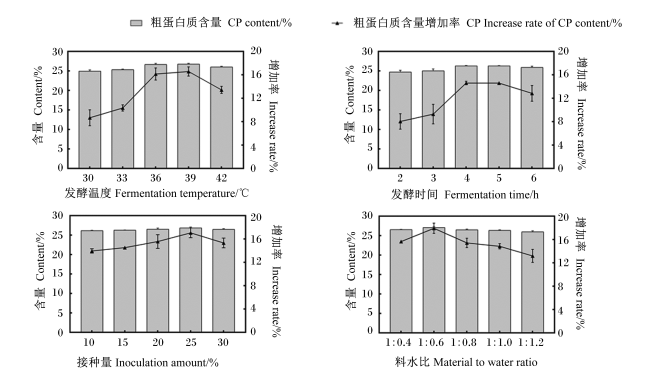
解淀粉芽孢杆菌固态发酵全棉籽单因素试验结果如图1所示。随着发酵温度的升高,粗蛋白质含量先上升后下降,当发酵温度为36和39 ℃时,粗蛋白质含量接近且显著高于其余发酵温度时(P<0.05)。随着发酵时间的增加,粗蛋白质含量先升高后趋于稳定,发酵4 d及以后时粗蛋白质含量显著高于其余发酵时间时(P<0.05)。随着接种量的增加,粗蛋白质含量先升高后下降,当接种量为25%时,粗蛋白质含量显著高于其余接种量(P<0.05)。随着料水比的降低,粗蛋白质含量先上升后下降,当料水比为1:0.6时,粗蛋白质含量最高且显著高于其余料水比时(P<0.05)。根据单因素试验的回归分析(表1),可以确定当发酵温度为38.24 ℃,发酵时间为5.03 d,接种量为24.17%,含水量为36.50%(料水比1:0.6)时,粗蛋白质含量最高。根据单因素试验结果,确定正交试验选取的4个因素的3个水平分别为:发酵温度,36、39、42 ℃;发酵时间,4、5、6 d;接种量,20%、25%、30%;料水比,1:0.4、1:0.6、1:0.8。
图1 解淀粉芽孢杆菌固态发酵全棉籽单因素试验结果

Fig.1 Single-factor test results of whole cottonseed solid-state fermentation with Bacillus amyloliquefaciens

表1 解淀粉芽孢杆菌固态发酵全棉籽单因素试验结果的回归分析

Table 1 Regression analysis of single factor test result of whole cottonseed by solid-state fermentation with Bacillus amyloliquefaciens

因素
Factors
回归方程
Regression equation
R2 P
P-value
最适值
Optimal value
发酵温度 Fermentation temperature/℃ Y=-0.119X2+9.101X-158.092 0.760 <0.001 38.24
发酵时间 Fermentation time/d Y=-0.687X2+6.91X-3.351 0.885 <0.001 5.03
接种量 Inoculation amount/% Y=-0.012X2+0.58X+9.024 0.458 0.010 24.17
含水量 Water content/% Y=-0.014X2+1.022X-2.115 0.679 <0.001 36.50

为方便回归分析,将料水比换算成含水量计算,Y指粗蛋白质含量。

The material to water ratio is converted into water content for ease of regression analysis, and Y refers to CP content.

2.1.2 正交试验结果

由极差分析(表2)的R值和方差分析(表3)的F值可知,影响解淀粉芽孢杆菌固体发酵全棉籽的因素先后顺序为发酵时间、料水比、发酵温度和接种量。方差分析结果表明发酵温度、发酵时间、接种量及料水比均显著影响粗蛋白质含量增加率(P<0.05)。根据极差分析(表2)的K值可得最佳发酵组合为:发酵温度42 ℃,发酵时间6 d,接种量20%,料水比1:0.6。
表2 解淀粉芽孢杆菌固态发酵全棉籽正交试验结果的极差分析

Table 2 Range analysis of orthogonal test result of whole cottonseed by solid-state fermentation with Bacillus amyloliquefaciens

试验号
Experimental
No.
因素 Factors 粗蛋白质
含量增加率
Increment
rate of CP
content/%
发酵温度
Fermentation
temperature/℃
发酵时间
Fermentation
time/d
接种量
Inoculation
amount/%
料水比
Material to
water ratio
1 36 4 20 1:0.4 12.18
2 36 5 25 1:0.6 17.64
3 36 6 30 1:0.8 17.74
4 39 4 25 1:0.8 9.34
5 39 5 30 1:0.4 9.56
6 39 6 20 1:0.6 20.10
7 42 4 30 1:0.6 16.37
8 42 5 20 1:0.8 15.35
9 42 6 25 1:0.4 18.62
K1 15.854 12.629 15.877 13.452
K2 13.000 14.183 15.201 18.037
K3 16.780 18.823 14.556 14.145
R 3.779 6.194 1.321 4.584
表3 解淀粉芽孢杆菌固态发酵全棉籽正交试验结果的方差分析

Table 3 Variance analysis of orthogonal test result of whole cottonseed by solid-state fermentation with Bacillus amyloliquefaciens

方差来源
Source of variance
Ⅲ型平方和
Ⅲ square sum
自由度
df
均方
Mean square
F
F-value
显著性
Significance
发酵温度 Fermentation temperature 69.941 2 34.971 32.217 *
发酵时间 Fermentation time 186.999 2 93.450 86.092 *
接种量 Inoculation amount 7.829 2 3.914 3.606 *
料水比 Material to water ratio 109.937 2 54.969 50.641 *
误差 Error 19.538 18 1.085
总计 Total 5 265.965 27

“*”表示差异显著(P<0.05)。

“*” indicates significant difference (P<0.05).

2.2 适宜条件下解淀粉芽孢杆菌固态发酵全棉籽后营养价值的变化

2.2.1 发酵前后常规营养成分含量的变化

表4可知,在正交试验得出的适宜条件下对全棉籽进行发酵,与发酵前相比,全棉籽发酵后粗蛋白质含量从21.35%提高到25.73%(P<0.05),真蛋白质含量从20.24%提高到22.50%(P<0.05),中性洗涤纤维含量变化不显著(P>0.05),酸性洗涤纤维含量从28.37%降低到27.80%(P<0.05),粗纤维含量从24.96%降低到22.95%(P<0.05),粗灰分含量从4.01%提高到5.27%(P<0.05)。
表4 解淀粉芽孢杆菌固态发酵全棉籽前后常规营养成分含量对比(干物质基础)

Table 4 Comparison of common nutritional component contents of whole cottonseed before and after solid-state fermentation with Bacillus amyloliquefaciens (DM basis)%

项目 Items 发酵前 Before fermentation 发酵后 After fermentation
粗蛋白质 CP 21.35±0.13b 25.73±0.15a
真蛋白质 TP 20.24±0.09b 22.50±0.15a
中性洗涤纤维 NDF 40.10±0.07 39.62±0.25
酸性洗涤纤维 ADF 28.37±0.05a 27.80±0.05b
粗纤维 CF 24.96±0.05a 22.95±0.02b
粗灰分 Ash 4.01±0.02b 5.27±0.01a

2.2.2 发酵前后氨基酸含量的变化

表5可知,与发酵前相比,全棉籽发酵后谷氨酸、甘氨酸、半胱氨酸、酪氨酸、精氨酸含量没有显著变化(P>0.05),脯氨酸含量显著降低(P<0.05),其他氨基酸含量均显著提高(P<0.05);此外,必需氨基酸含量从5.98%提高到6.86%(P<0.05),提高了14.72%;总氨基酸含量从20.20%提高到21.66%(P<0.05),提高了7.23%。
表5 解淀粉芽孢杆菌固态发酵全棉籽前后氨基酸含量对比(干物质基础)

Table 5 Comparison of amino acid contents of whole cottonseed before and after solid-state fermentation with Bacillus amyloliquefaciens (DM basis)%

项目 Items 发酵前 Before fermentation 发酵后 After fermentation
天冬氨酸 Asp 1.99±0.01b 2.23±0.04a
苏氨酸 Thr 0.72±0.01b 0.89±0.03a
丝氨酸Ser 0.93±0.01b 1.09±0.03a
谷氨酸 Glu 4.57±0.02 4.64±0.08
甘氨酸 Gly 0.92±0.00 0.91±0.01
丙氨酸 Ala 0.90±0.00b 1.02±0.02a
半胱氨酸 Cys 0.27±0.01 0.29±0.01
缬氨酸 Val 0.95±0.01b 1.10±0.02a
蛋氨酸 Met 0.21±0.01b 0.27±0.01a
异亮氨酸 Ile 0.67±0.00b 0.80±0.01a
亮氨酸 Leu 1.30±0.01b 1.44±0.01a
酪氨酸 Tyr 0.66±0.01 0.69±0.01
苯丙氨酸 Phe 1.18±0.01b 1.35±0.02a
赖氨酸 Lys 0.95±0.01b 1.01±0.01a
组氨酸 His 0.62±0.00b 0.68±0.02a
精氨酸 Arg 2.47±0.01 2.42±0.03
脯氨酸 Pro 0.86±0.01a 0.83±0.01b
必需氨基酸 EAA 5.98±0.03b 6.86±0.11a
总氨基酸 TAA 20.20±0.10b 21.66±0.33a

2.2.3 发酵前后游离棉酚和霉菌毒素含量的变化

表6可知,与发酵前相比,全棉籽发酵后游离棉酚含量从3 316.60 mg/kg降低到1 444.40 mg/kg(P<0.05),降低了56.45%;玉米赤霉烯酮含量没有显著变化(P>0.05),脱氧雪腐镰刀菌烯醇含量从0.13 mg/kg降低到0.10 mg/kg(P<0.05)。全棉籽在发酵前和发酵后均未检出黄曲霉毒素B1
表6 解淀粉芽孢杆菌固态发酵全棉籽前后游离棉酚和霉菌毒素含量对比(干物质基础)

Table 6 Comparison of free gossypol and mycotoxin contents of whole cottonseed before and after solid-state fermentation with Bacillus amyloliquefaciens (DM basis)

项目 Items 发酵前 Before fermentation 发酵后 After fermentation
游离棉酚 FG/(mg/kg) 3 316.60±36.49a 1 444.40±27.26b
玉米赤霉烯酮 ZEN/(μg/kg) 10.59±0.10 11.21±0.41
脱氧雪腐镰刀菌烯醇 DON/(mg/kg) 0.13±0.00a 0.10±0.00b
黄曲霉毒素B1 AFB1/(μg/kg) ND ND

ND表示未检出。

ND means not detected.

2.2.4 发酵前后酶活性的变化

表7可知,与发酵前相比,全棉籽发酵后淀粉酶活性由0.00 U/g达到34.67 U/g(P<0.05),纤维素酶活性由251.12 U/g提高到364.13 U/g(P<0.05),中性蛋白酶、酸性蛋白酶和碱性蛋白酶活性显著提高(P<0.05),分别提高了171.66%、100.58%和129.11%。
表7 解淀粉芽孢杆菌固态发酵全棉籽前后酶活性对比

Table 7 Comparison of enzyme activities before and after solid-state fermentation of whole cottonseed with Bacillus amyloliquefaciensU/g

项目 Items 发酵前 Before fermentation 发酵后 After fermentation
淀粉酶 Amylase 0.00±0.00b 34.67±0.27a
纤维素酶 Cellulase 251.12±27.37b 364.13±33.22a
中性蛋白酶 Neutral protease 168.70±7.21b 458.29±20.82a
酸性蛋白酶 Acid proteinase 236.04±12.55b 473.44±21.34a
碱性蛋白酶 Alkaline protease 178.34±16.64b 408.60±11.04a

2.2.5 发酵前后超微结构的变化

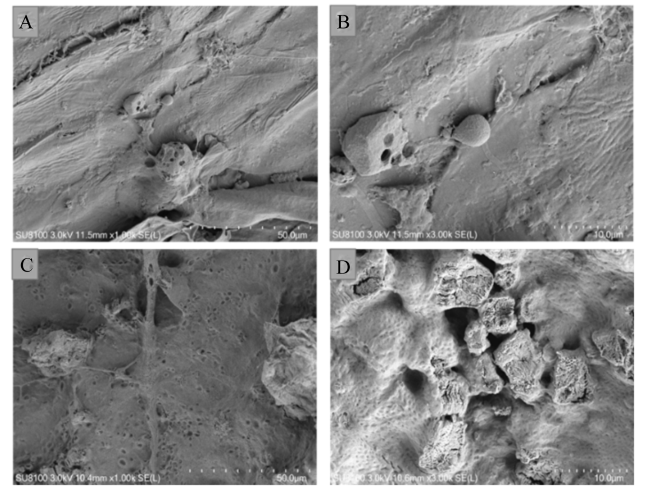
由扫描电镜图(图2)可知,发酵前的全棉籽的结构较完整,表面光滑;发酵后的全棉籽表面不平整,有很多不规则孔洞,纤维结构被破坏,结构较松散。
图2 解淀粉芽孢杆菌固态发酵全棉籽前后扫描电镜图对比

A、B为发酵前的全棉籽,C、D为发酵后的全棉籽。A和C的放大倍数为1 000倍,B和D的放大倍数为3 000倍。

Fig.2 Comparison of SEM photographs of whole cottonseed before and after solid-state fermentation with Bacillus amyloliquefaciens

A and B are the whole cottonseed before fermentation, C and D are the whole cottonseed after fermentation. The magnification of A and C is 1 000 times, and the magnification of B and D is 3 000 times.

2.3 解淀粉芽孢杆菌固态发酵全棉籽对体外发酵特性的影响

2.3.1 解淀粉芽孢杆菌固态发酵全棉籽对体外发酵产气量和产气参数的影响
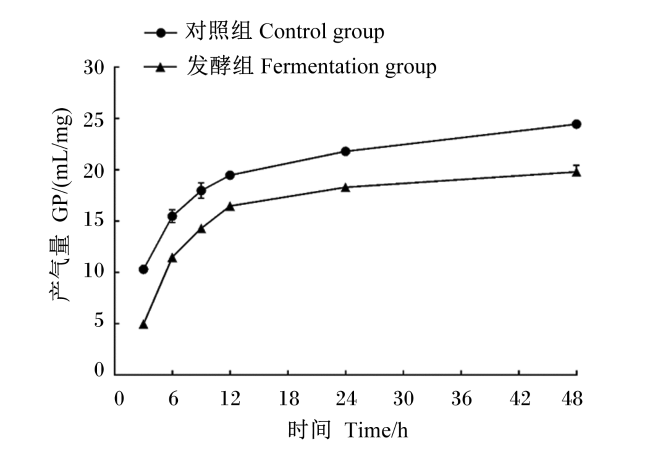
图3可知,随体外发酵时间的延长,对照组和发酵组的产气量均呈增加趋势。由表8可知,发酵不同时间(12、24和48 h)时对照组的产气量均显著高于发酵组(P<0.05);对照组的快速发酵部分产气量和潜在产气量显著高于发酵组(P<0.05),慢速发酵部分产气量和产气速率显著低于发酵组(P<0.05)。
图3 解淀粉芽孢杆菌固态发酵全棉籽体外发酵产气量动态变化

Fig.3 Dynamic variation of in vitro fermentation GP of whole cottonseed by solid-state fermentation with Bacillus amyloliquefaciens

表8 解淀粉芽孢杆菌固态发酵全棉籽对体外发酵产气量和产气参数的影响

Table 8 Effects of whole-cottonseed by solid-state fermentation with Bacillus amyloliquefaciens on in vitro GP and gas production parameters

项目 Items 对照组 Control group 发酵组 Fermentation group
产气量
GP/(mL/mg)
12 h 19.48±0.17a 16.48±0.16b
24 h 21.81±0.16a 17.65±0.18b
48 h 24.47±0.16a 19.81±0.31b
产气参数
Gas production
parameters
快速发酵部分产气量
Rapidly fermentation fraction GP (a)/(mL/mg)
4.91±0.66a -5.30±0.77b
慢速发酵部分产气量
Slowly fermentation fraction GP (b)/(mL/mg)
19.23±0.52b 24.33±0.43a
潜在产气量 Potential GP (a+b)/(mL/mg) 24.15±0.50a 19.03±0.35b
产气速率 Gas production rate
(c)/(%/h)
0.13±0.01b 0.19±0.01a

2.3.2 解淀粉芽孢杆菌固态发酵全棉籽对体外发酵参数的影响

表9可知,对照组与发酵组的pH无显著差异(P>0.05);发酵组体外发酵24和48 h时NH3-N浓度显著高于对照组(P<0.05),体外发酵12 h时NH3-N浓度与对照组无显著差异(P>0.05);发酵组体外发酵12 h时MCP浓度显著高于对照组(P<0.05),体外发酵24和48 h时MCP浓度与对照组无显著差异(P>0.05);发酵组体外发酵12、24和48 h时TVFA、乙酸浓度显著高于对照组(P<0.05),体外发酵24和48 h时丁酸浓度显著高于对照组(P<0.05);体外发酵12、24和48 h时,发酵组与对照组的丙酸浓度和乙酸/丙酸的值没有显著差异(P>0.05)。
表9 解淀粉芽孢杆菌固态发酵全棉籽对体外发酵参数的影响

Table 9 Effects of whole-cottonseed by solid-state fermentation with Bacillus amyloliquefaciens on in vitro fermentation parameters

项目
Items
对照组 Control group 发酵组 Fermentation group
12 h 24 h 48 h 12 h 24 h 48 h
pH 6.68±0.03 6.78±0.03 6.78±0.03 6.70±0.03 6.78±0.03 6.73±0.03
氨态氮 NH3-N/(mg/dL) 32.63±0.58 34.81±0.56b 40.80±0.66b 32.38±0.63 42.65±0.32a 48.96±0.40a
微生物蛋白 MCP/(mg/mL) 1.31±0.03b 1.50±0.06 1.63±0.03 1.57±0.02a 1.61±0.04 1.65±0.03
总挥发性脂肪酸
TVFA/(mmol/L)
55.45±0.64b 63.83±0.49b 68.27±1.18b 63.90±0.71a 70.19±0.35a 75.43±0.35a
乙酸 Acetate/(mmol/L) 35.41±0.40b 41.25±0.57b 44.29±0.88b 41.96±0.51a 45.91±0.76a 49.02±0.36a
丙酸 Propionate/(mmol/L) 13.54±0.51 15.49±0.32 16.15±0.35 15.67±1.02 16.63±0.38 17.62±0.50
丁酸 Butyrate/(mmol/L) 6.51±0.04 7.09±0.03b 7.84±0.11b 6.27±0.17 7.66±0.14a 8.79±0.09a
乙酸/丙酸 Acetate/propionate 2.63±0.10 2.67±0.08 2.74±0.03 2.72±0.22 2.77±0.11 2.79±0.10

同一时间点,对照组和发酵组数据肩标无字母表示差异不显著(P>0.05),肩标不同小写字母表示差异显著(P<0.05)。

At the same time, values of control group and fermentation group with no letter superscripts mean no significant difference (P>0.05), while with different small letter superscripts mean significant difference (P<0.05).

3 讨论

3.1 解淀粉芽孢杆菌固态发酵全棉籽条件优化

发酵温度、发酵时间、料水比和接种量是影响发酵效果的主要因素[13]。本试验中,发酵时间和料水比对发酵效果影响较大,其次是发酵温度和接种量。发酵时间通过影响菌株的数量和产酶量间接影响发酵效果。料水比即含水量直接影响菌株的生存环境和活性,进而影响产酶效果[14]
刘倚帆等[15]在发酵全棉籽时将含水量控制在30%,与本试验中所得最适料水比相差不大。微生物的生长会因为过高或过低的温度受到限制,菌株生长的适宜温度决定了固态发酵工艺的温度。Gao等[16]筛选的芽孢杆菌发酵豆粕的最适温度为40 ℃,与本研究的得出的最适发酵温度相近。接种量的大小直接决定发酵质量,过低导致产酶活力受限,易被杂菌污染;过高导致微生物过度繁殖使发酵效果不佳。韦涛等[17]利用纳豆芽孢杆菌发酵小米糠的研究结果表明,随着接种量的增加,发酵效果先升高后降低,与本试验中接种量对全棉籽粗蛋白质含量的影响结果一致。

3.2 解淀粉芽孢杆菌固态发酵全棉籽的效果

微生物固态发酵是改善饲料原料营养价值的有效途径。夏新成等[18]利用酵母和霉菌复合发酵棉籽粕,使其粗蛋白质含量提高了17.72%。本试验中,全棉籽经解淀粉芽孢杆菌固态发酵后粗蛋白质含量提高了20.52%,这可能是发酵过程中微生物合成MCP,同时消耗碳水化合物,造成部分干物质损失,从而提高了粗蛋白质含量。此外,微生物将非蛋白氮转化为真蛋白氮,使全棉籽的真蛋白质含量提高,与李英英等[19]的研究结果一致。发酵后全棉籽的纤维含量降低,这与Sun等[5]研究结果一致,可能是微生物产生纤维素酶,起到降解纤维作用。同时,扫描电镜结果表明发酵后全棉籽的结构疏松多孔,更有利于动物消化吸收。发酵后,全棉籽的粗灰分含量升高了31.42%,这是因为微生物利用了底物中的有机物,间接导致粗灰分含量上升,与Chi等[20]发酵豆粕所得结果一致。王晓玲等[21]利用混菌发酵棉籽粕,发酵后总氨基酸和必需氨基酸含量分别增加了22.20%和28.40%。本试验中,发酵后全棉籽的必需氨基酸和总氨基酸含量分别提高了14.72%和7.23%,但增幅与王晓玲等[21]的研究结果存在差距。这可能是因为发酵底物不同,且单菌发酵效果不及混菌发酵;此外,微生物利用氨基酸存在偏好,直接影响发酵后的氨基酸含量变化[4]
微生物发酵会产生多种酶类,不同微生物的产酶特性不同。和小黑[22]研究发现,枯草芽孢杆菌发酵棉籽粕产物中含有丰富的淀粉酶和蛋白酶。本试验中,发酵后全棉籽的淀粉酶活性达到34.67 U/g,发酵过程中可将淀粉降解为单糖等供微生物生长繁殖,合成MCP;纤维素酶活性提高了45.00%,说明发酵破坏底物纤维结构,使粗纤维含量显著降低;中性蛋白酶、酸性蛋白酶和碱性蛋白酶活性均显著提高,使不易被消化吸收的大分子蛋白质降解为易被利用的小分子多肽类物质,使植物蛋白转化为更优质的MCP。
固态发酵能有效降低饲料中抗营养因子的含量。张文举等[23]用热带假丝酵母、黑曲霉以及复合菌固态发酵棉籽粕,使得游离棉酚含量显著下降,与本试验结果一致。Nagalakshmi等[24]认为发酵过程中游离棉酚与微生物分泌的氨基酸或者活性蛋白质中的游离氨基酸结合,形成结合棉酚;或者微生物能够分泌可降解棉酚的酶类,从而达到脱毒效果。霉菌毒素是霉菌在生长繁殖过程中产生的次级代谢产物,通过影响动物的各种生理特性发挥毒性,含量超标会导致家畜的生产性能下降,甚至发生中毒。万里等[25]通过复合益生菌发酵饲料,使得黄曲霉毒素B1、玉米赤霉烯酮和脱氧雪腐镰刀菌烯醇含量显著降低。《饲料卫生标准》(GB 13078—2017)对黄曲霉毒素B1、玉米赤霉烯酮和脱氧雪腐镰刀菌烯醇给出的限量分别是30.00 μg/kg、1 000 μg/kg和5.00 mg/kg。本试验中,发酵后全棉籽中脱氧雪腐镰刀菌烯醇含量降低了23.08%,与前人研究一致,玉米赤霉烯酮含量虽没有显著变化,但远低于《饲料卫生标准》的限量。

3.3 体外产气法评定发酵全棉籽的瘤胃发酵特性

产气参数反映瘤胃微生物对饲料中不同成分的发酵效果[26]。本试验中,发酵组的慢速发酵部分产气量和产气速率高于对照组,说明发酵后的全棉籽可一定程度提高瘤胃微生物的发酵能力,增强对非可溶性成分的消化。NH3-N浓度可以用来评定瘤胃微生物降解蛋白质与合成MCP的动态平衡情况。瘤胃液NH3-N浓度与饲料粗蛋白质含量呈正相关关系[27]。本试验中,发酵组的底物粗蛋白质含量高于对照组,所以发酵组的NH3-N浓度显著高于对照组。MCP作为反刍动物最主要的氮源,能够提供所需蛋白质的40%~80%,其浓度高低与微生物对NH3-N的利用效率有关。本试验中,体外发酵12 h时,发酵组MCP浓度显著高于对照组,可能是因为在发酵前期,底物碳水化合物含量较高,发酵组粗蛋白质含量更高,碳氮协同释放,转换效率更高,合成更多的MCP,这与Nocek等[28]的研究结果相同。挥发性脂肪酸是饲料中碳水化合物经瘤胃微生物发酵后的主要产物,是反刍动物生长和生产的主要能量来源[29]。体外发酵24和48 h时,发酵组的乙酸、丁酸和TVFA浓度均高于对照组,可能因为对照组结构性碳水化合物含量高,纤维降解菌不能充分利用,而发酵全棉籽非结构性碳水化合物含量较高,可消化养分增加,因此产生更多的挥发性脂肪酸[6]

4 结论

① 解淀粉芽孢杆菌固态发酵全棉籽的适宜条件为:发酵温度42 ℃,发酵时间6 d,接种量20%,料水比1:0.6。
② 全棉籽经解淀粉芽孢杆菌固态发酵后,粗蛋白质含量由21.35%提高到25.73%,粗纤维含量由24.96%降低到22.95%,必需氨基酸含量由5.98%提高到6.86%,游离棉酚含量由3 316.60 mg/kg降低到1 444.40 mg/kg,霉菌毒素含量降低,淀粉酶、纤维素酶和蛋白酶活性增加,营养价值得到有效改善。
③ 发酵全棉籽可提高体外发酵乙酸、丁酸和TVFA浓度,促进体外瘤胃发酵。
[1]
BERTRAND J A, SUDDUTH T Q, CONDON A, et al. Nutrient content of whole cottonseed[J]. Journal of Dairy Science, 2005, 88(4):1470-1477.

PMID

[2]
KHATTAB R, GOLDBERG E, LIN L, et al. Quantitative analysis and free-radical-scavenging activity of chlorophyll,phytic acid,and condensed tannins in canola[J]. Food Chemistry, 2010, 122(4):1266-1272.

DOI

[3]
AIDER M, BARBANA C. Canola proteins:composition,extraction,functional properties,bioactivity,applications as a food ingredient and allergenicity—a practical and critical review[J]. Trends in Food Science&Technology, 2011, 22(1):21-39.

[4]
吴逸飞, 孙宏, 李园成, 等. 微生物固态发酵对饲料营养特性的影响[J]. 浙江农业学报, 2016, 28(12):2014-2020.

DOI

WU Y F, SUN H, LI Y C, et al. Effects of microbial solid-state fermentation on nutritional value of feeds[J]. Acta Agriculturae Zhejiangensis, 2016, 28(12):2014-2020. (in Chinese)

[5]
SUN H, TANG J W, YAO X H, et al. Improvement of the nutritional quality of cottonseed meal by Bacillus subtilis and the addition of papain[J]. International Journal of Agriculture&Biology, 2012, 14(4):563-568.

[6]
代秦丹, 黎光杨, 汪成, 等. 一株纤维降解菌的鉴定及其对酒糟固态发酵效果的研究[J]. 中国农业大学学报, 2022, 27(3):119-132.

DAI Q D, LI G Y, WANG C, et al. Identification of one fiber degrading bacterium and its effect on solid fermentation of distillers’ grains[J]. Journal of China Agricultural University, 2022, 27(3):119-132. (in Chinese)

[7]
MENKE K H, RAAB L, SALEWSKI A, et al. The estimation of the digestibility and metabolizable energy content of ruminant feedingstuffs from the gas production when they are incubated with rumen liquor in vitro[J]. The Journal of Agricultural Science, 1979, 93(1):217-222.

DOI

[8]
王俊锋. 饲料中真蛋白质含量的测定方法[J]. 广东饲料, 2004, 13(6):37-38.

WANG J F. The method to determine the real protein in feed[J]. Guangdong Feed, 2004, 13(6):37-38. (in Chinese)

[9]
BRODERICK G A, KANG J H. Automated simultaneous determination of ammonia and total amino acids in ruminal fluid and in vitro media[J]. Journal of Dairy Science, 1980, 63(1):64-75.

DOI

[10]
王晓光. 饲草型全混日粮饲用价值评价研究[D].博士学位论文. 呼和浩特: 内蒙古农业大学, 2011.

WANG X G. Study on feeding evaluationg of forage-type total mixed rations[D].Ph.D.Thesis Hohhot: Inner Mongolia Agricultural University, 2011. (in Chinese)

[11]
彭点懿. 不同品质粗饲料组合对体外发酵参数、夏季奶牛生产性能及血液生化指标的影响[D].硕士学位论文. 雅安: 四川农业大学, 2010.

PENG D Y. Effect of different quality roughage combinating on rumen in vitro fermentation parameters,production performance and biochemical parameters of dairy cows in summer[D].Master’s Thesis. Ya’an: Sichuan Agricultural University, 2010. (in Chinese)

[12]
ØRSKOV E R, MCDONALD I. The estimation of protein degradability in the rumen from incubation measurements weighted according to rate of passage[J]. The Journal of Agricultural Science, 1979, 92(2):499-503.

DOI

[13]
RUQAYYAH T I D, JAMAL P, ALAM M Z, et al. Application of response surface methodology for protein enrichment of cassava peel as animal feed by the white-rot fungus Panus tigrinus M609RQY[J]. Food Hydrocolloids, 2014, 42(Part 2):298-303.

DOI

[14]
BHATTACHARYA S S, GARLAPATI V K, BANERJEE R. Optimization of laccase production using response surface methodology coupled with differential evolution[J]. New Biotechnology, 2011, 28(1):31-39.

DOI PMID

[15]
刘倚帆, 王星凌, 岳寿松, 等. 复合微生物固态发酵整粒棉籽的研究[J]. 饲料工业, 2016, 37(20):50-54.

LIU Y F, WANG X L, YUE S S, et al. Solid-state fermentation of whole cottonseed with mixed culture of microorganisms[J]. Feed Industry, 2016, 37(20):50-54. (in Chinese)

[16]
GAO S, PAN L Q, ZHANG M Z, et al. Screening of bacterial strains from the gut of pacific white shrimp (Litopenaeus vannamei) and their efficiencies in improving the fermentation of soybean meal[J]. FEMS Microbiology Letters, 2020, 367(2):fnaa017.

DOI

[17]
韦涛, 周启静, 陆兆新, 等. 纳豆芽孢杆菌固态发酵小米糠产抗氧化肽工艺优化[J]. 食品科学, 2017, 38(10):66-73.

DOI

WEI T, ZHOU Q J, LU Z X, et al. Optimization of solid state fermentation conditions for production of antioxidant peptides from millet bran by bacillus natto[J]. Food Science, 2017, 38(10):66-73. (in Chinese)

DOI

[18]
夏新成, 李贵强, 滕安国, 等. 复合发酵棉籽粕菌种筛选、鉴定及其发酵工艺参数优化研究[J]. 中国粮油学报, 2010, 25(1):91-98.

XIA X C, LI G Q, TENG A G, et al. Mixed culture solid fermentation for detoxification of cottonseed meal[J]. Journal of the Chinese Cereals and Oils Association, 2010, 25(1):91-98. (in Chinese)

[19]
李英英, 丁立人, 朱平华, 等. 复合菌株固态发酵对大豆皮营养价值的影响[J]. 动物营养学报, 2022, 34(6):4041-4049.

DOI

LI Y Y, DING L R, ZHU P H, et al. Effects of solid-state fermentation with compound strains on nutritional value of soybean hulls[J]. Chinese Journal of Animal Nutrition, 2022, 34(6):4041-4049. (in Chinese)

DOI

[20]
CHI C H, CHO S J. Improvement of bioactivity of soybean meal by solid-state fermentation with Bacillus amyloliquefaciens versus Lactobacillus spp. and Saccharomyces cerevisiae[J]. LWT-Food Science and Technology, 2016, 68:619-625.

DOI

[21]
王晓玲, 刘倩, 韩伟, 等. 棉酚脱除菌株的筛选及棉粕混菌固态发酵研究[J]. 粮油食品科技, 2016, 24(1):81-85.

WANG X L, LIU Q, HAN W, et al. Screening of gossypol-removing strain and the fermentation of cottonseed meal with mixed culture[J]. Science and Technology of Cereals,Oils and Foods, 2016, 24(1):81-85. (in Chinese)

[22]
和小黑. 棉粕源枯草芽孢杆菌发酵饲料消化酶活性的研究[D].硕士学位论文. 石河子: 石河子大学, 2014.

HE X H. A study on digestive enzymes activity of Bacillus subtilis fermented feed from cottonseed meal[D].Master’s Thesis. Shihezi: Shihezi University, 2014. (in Chinese)

[23]
张文举, 许梓荣, 孙建义, 等. 假丝酵母ZD-3与黑曲霉ZD-8复合固体发酵对棉籽饼脱毒及营养价值的影响研究[J]. 中国粮油学报, 2006, 21(6):129-135.

ZHANG W J, XU Z R, SUN J Y, et al. Effect of solid substrate fermentation with mixed cultured C. tropicalis ZD-3 and A. niger ZD-8 on nutritional value and detoxification of cottonseed meal[J]. Journal of the Chinese Cereals and Oils Association, 2006, 21(6):129-135. (in Chinese)

[24]
NAGALAKSHMI D, SASTRY V R B, PAWDE A. Rumen fermentation patterns and nutrient digestion in lambs fed cottonseed meal supplemental diets[J]. Animal Feed Science and Technology, 2003, 103(1/4):1-14.

DOI

[25]
万里, 吴国芳, 王磊, 等. 复合益生菌发酵饲料发酵条件优化及品质鉴定[J]. 动物营养学报, 2022, 34(5):3358-3375.

DOI

WAN L, WU G F, WANG L, et al. Fermentation condition optimization and quality evaluation of feed fermented by compound probiotics[J]. Chinese Journal of Animal Nutrition, 2022, 34(5):3358-3375. (in Chinese)

DOI

[26]
李金辉, 陈佳欣, 王里彦, 等. 棉籽粕替代豆粕对瘤胃体外发酵参数的影响[J]. 中国畜牧杂志, 2022, 58(9):228-233.

LI J H, CHEN J X, WANG L Y, et al. Effect of cotton meal replacing soybean meal on rumen fermentation in vitro[J]. Chinese Journal of Animal Science, 2022, 58(9):228-233. (in Chinese)

[27]
KLJAK K, PINO F, HEINRICHS A J. Effect of forage to concentrate ratio with Sorghum silage as a source of forage on rumen fermentation,N balance,and purine derivative excretion in limit-fed dairy heifers[J]. Journal of Dairy Science, 2017, 100(1):213-223.

DOI

[28]
NOCEK J E, RUSSELL J B. Protein and energy as an integrated system.Relationship of ruminal protein and carbohydrate availability to microbial synthesis and milk production[J]. Journal of Dairy Science, 1988, 71(8):2070-2107.

DOI

[29]
LYU Z, SHAO N N, AKINYEMI T, et al. Methanogenesis[J]. Current Biology, 2018, 28(13):R727-R732.

DOI

Outlines

/