RESEARCH PAPER

Effects of Fermented Citrus Pomace on Nutrient Apparent Digestibility, Serum Biochemical Indices, Cecal Microbial Number and Odor Substance Emission of Qingyuan Partridge Chickens from 90 to 120 Days of Age

  • YANG Pan , 1 ,
  • TANG Yantian 1 ,
  • LI Zhenming 1 ,
  • MA Xianyong 1 ,
  • LUO Zhihui 2 ,
  • HUANG Weiwen 3 ,
  • YU Miao , 1, *
Expand
  • 1 Guangdong Engineering Technology Research Center of Animal Meat Quality and Safety Control and Evaluation, Guangdong Key Laboratory of Animal Breeding and Nutrition, State Key Laboratory of Swine and Poultry Breeding Industry, Key Laboratory of Animal Nutrition and Feed in South China, Ministry of Agriculture and Rural Affairs, Institute of Animal Science, Guangdong Academy of Agricultural Sciences, Guangzhou 510640, China
  • 2 Huangmang Ecological Agriculture Farm, Longping Town, Lianzhou City, Qingyuan 513400, China
  • 3 Xufeng Farming and Animal Husbandry Co., Ltd., Kaiping City, Jiangmen 529300, China
* associated professor, E-mail:

Received date: 2023-12-07

  Online published: 2024-05-15

Abstract

This experiment was conducted to study the effects of dietary fermented citrus pomace on nutrient apparent digestibility, serum biochemical indices, cecal microbial number and odor substance emission of Qingyuan partridge chickens. A total of 540 healthy 90-day-old Qingyuan partridge hens with similar body weight were randomly divided into 3 groups with 6 replicates per group and 30 hens per replicate. Chickens in the control group were fed a basal diet, and those in the experimental groups were fed the basal diet supplemented with 10% citrus pomace (citrus pomace group) and 10% fermented citrus pomace (fermented citrus pomace group), respectively. The experiment lasted for 30 days. The results showed as follows: 1) compared with the control group, the crude protein apparent digestibility in fermented citrus pomace group had a tendency to be increased (0.05<P<0.10). 2) Compared with the control group, the contents of uric acid and total cholesterol and glutamic oxalacetic transaminase activity in serum of Qingyuan partridge chickens in fermented citrus pomace group were significantly decreased (P<0.05), and the glucose content in serum was significantly increased (P<0.05). 3) Compared with the control group, the Bifidobacterium number in cecum of Qingyuan partridge chickens in citrus pomace group and fermented citrus pomace group was significantly increased (P<0.05); the Lactobacillus number in cecum in fermented citrus pomace group was significantly increased (P<0.05), and the numbers of Escherichia coli and Clostridium cluster Ⅳ in cecum were significantly decreased (P<0.05). Compared with the control group or citrus pomace group, the contents of acetic acid, propionic acid, butyric acid, lactic acid and total short-chain fatty acid in cecum of Qingyuan partridge chickens in fermented citrus pomace group were significantly increased (P<0.05). 4) Compared with the control group, the contents of p-cresol, indole, skatole and ammonia nitrogen in cecum of Qingyuan partridge chickens in fermented citrus pomace group were significantly decreased (P<0.05). In conclusion, dietary fermented citrus pomace can improve the crude protein apparent digestibility, increase the numbers of beneficial bacteria in cecum, reduce the numbers of harmful bacteria in cecum, and maintain body health by reducing the content of odor substances and increasing the organic acid contents in cecum, and the effect is better than that of dietary citrus pomace.

Cite this article

YANG Pan , TANG Yantian , LI Zhenming , MA Xianyong , LUO Zhihui , HUANG Weiwen , YU Miao . Effects of Fermented Citrus Pomace on Nutrient Apparent Digestibility, Serum Biochemical Indices, Cecal Microbial Number and Odor Substance Emission of Qingyuan Partridge Chickens from 90 to 120 Days of Age[J]. Chinese Journal of Animal Nutrition, 2024 , 36(5) : 2958 -2969 . DOI: 10.12418/CJAN2024.254

柑橘是我国华南地区栽培面积最广的水果,也是我国农业农村经济的支柱产业。据国家统计局数据,2022年我国柑橘的产量为6 003.89万t[1];到2025年,全国柑橘种植面积将稳定在4 300万亩(1亩≈666.7 m2)[2]。柑橘除鲜用之外,大约30%用于深加工,加工过程中会产生大量的果渣,由橘皮、橘籽、橘络和部分橘肉组成[3]。鲜果渣由于水分和糖类物质含量高,容易腐烂变质,不便于贮运;人工干燥不仅成本较高,而且易导致养分损失;此外,鲜果渣纤维含量高、有效能低,致使其饲料化应用受阻。习近平总书记曾在中央农村工作会议指出:“树立大农业观、大食物观,向耕地草原森林海洋、向植物动物微生物要热量、要蛋白,全方位多途径开发食物资源。”鲜柑橘渣富含碳水化合物、维生素、矿物质以及黄酮、多酚、色素类营养活性物质[4];将鲜柑橘渣通过微生物的作用进行发酵处理可以提高柑橘渣的适口性,同时可将部分抗营养因子转化生成一些发酵产物,改善柑橘渣的饲用价值[5]。将柑橘渣饲料化利用不仅有助于缓解我国饲料资源短缺的问题,而且可以从根本上解决柑橘渣废弃所引发的环境污染,有助于推动“藏粮于技”战略的落实落地。
全面协调推进华南地区乡村振兴是现代化农业强国建设的重要组成部分,而清远麻鸡是华南地区实施乡村振兴战略、助推“三农”工作的重要抓手。由于全球供应链的变化,导致全球饲料原料供需偏紧,这阻碍了产业的可持续发展。充分挖掘利用地方特色饲料原料资源,优化调整饲粮配方结构,构建具有华南地区特色的多元化饲粮配方体系,降低常规饲料原料占比,保障饲料粮供需平衡,稳定粮食安全大局,正是树立习近平总书记提出“大食物观”的出发点和落脚点[6]。因此,本试验结合清远麻鸡的消化生理特点以及考虑到饲料资源开发利用的合理性,重点研究发酵柑橘渣对清远麻鸡营养物质表观消化率、血清生化指标以及盲肠微生物数量和臭气物质排放的影响,为发酵柑橘渣作为清远麻鸡的饲料原料资源提供参考。

1 材料与方法

1.1 试验材料

本试验所用的柑橘渣为市售,发酵柑橘渣底物为80%柑橘渣和20%麸皮,发酵所用微生物包括黑曲霉(Aspergillus niger)、葡萄牙棒状杆菌(Corynebacterium portuguese)和地衣芽孢杆菌(Bacillus licheniformis)。将各菌种与发酵底物混匀,在30 ℃条件下发酵7 d。发酵柑橘渣中粗蛋白质(crude protein,CP)含量为6.70%,粗脂肪(ether extract,EE)含量为3.45%,钙(Ca)含量为0.59%,总磷(total phosphorus,TP)含量为0.14%。

1.2 试验设计和饲粮

本试验在广东省农业科学院清远麻鸡饲养场进行。试验选取90日龄、体重相近且健康的清远麻鸡母鸡540只,随机分为3个组,每组6个重复,每个重复30只。对照组饲喂基础饲粮,试验组饲喂在基础饲粮中分别添加10%柑橘渣(柑橘渣组)和10%发酵柑橘渣(发酵柑橘渣组)的饲粮。饲粮为参照《黄羽肉鸡营养需要量》(NY/T 3645—2020)[7]配制的颗粒料,其组成及营养水平见表1。各组间饲粮营养水平保持一致。试验期30 d,期间试验鸡自由采食和饮水。
表1 饲粮组成及营养水平(干物质基础)

Table 1 Composition and nutrient levels of diets (DM basis) %

项目
Items
对照组
Control group
柑橘渣组
Citrus pomace group
发酵柑橘渣组
Fermented citrus pomace group
原料Ingredients
玉米Corn 70.40 60.29 60.29
豆粕Soybean meal 16.75 15.90 15.90
麦麸Wheat bran 6.00 6.00 6.00
大豆油Soybean oil 3.00 3.80 3.80
L-赖氨酸盐酸盐L-Lys·HCl 0.19 0.25 0.25
DL-蛋氨酸DL-Met 0.13 0.18 0.18
苏氨酸Thr 0.10 0.10 0.10
磷酸氢钙CaHPO4 1.60 1.65 1.65
石粉Limestone 0.53 0.53 0.53
氯化钠NaCl 0.30 0.30 0.30
柑橘渣Citrus pomace 10.00
发酵柑橘渣Fermented citrus pomace 10.00
预混料Premix1) 1.00 1.00 1.00
合计Total 100.00 100.00 100.00
营养水平Nutrient levels2)
粗蛋白质CP 16.48 16.53 16.60
粗脂肪EE 6.47 7.18 7.35
钙Ca 0.69 0.75 0.76
总磷TP 0.67 0.67 0.68
代谢能ME/(MJ/kg) 14.17 14.01 14.66

1)预混料为每千克饲粮提供 The premix provided the following per kg of diets:VA 8 000 IU,VD 500 IU,VE 30 mg,VB1 1 mg,VB2 8 mg,VB6 2.8 mg,VB12 0.015 mg,VK3 2 mg,D-泛酸 D-pantothenic acid 10 mg,叶酸 folic acid 0.9 mg,烟酸 nicotinic acid 30 mg,生物素 biotin 0.1 mg,Zn 75 mg,Fe 80 mg,Mn 55 mg,I 0.5 mg,Cu 7 mg,Se 0.15 mg。

2)营养水平为实测值。Nutrient levels were measured values。

1.3 饲养管理和样品采集

在试验开始前对鸡舍的卫生进行彻底清扫,打扫干净后进行消毒处理,完毕空置1周后开始启用。试验过程中记录试验动物每日的采食量,并监测鸡群生长和健康状态,在饲养过程中管理和环境参数保持一致,饲养管理参考《黄羽肉鸡饲养管理技术规程》(NY/T 1871—2020)[8]执行。
饲养试验结束时,每组每个重复选取2只体重接近平均体重的试验鸡,转入代谢笼,开展代谢试验,收集3 d的粪样,挑出粪样中的羽毛等其他异物后将样品置于-20 ℃的冰箱保存,将3 d的粪样用10%盐酸固氮后混匀、烘干及称重,用于常规养分及能量的测定。
试验结束前1天提前8 h断料,每组每个重复随机选取2只体重接近平均体重的试验鸡进行翅静脉采血,静置处理30 min后,在4 ℃、3 000 r/min下离心收集血清,于-20 ℃冻存备用。试验鸡采血后进行屠宰取盲肠,并用冻存管收集其内容物保存于-80 ℃冰箱。

1.4 测定指标及方法

1.4.1 营养物质表观消化率测定

饲粮和粪便中水分、CP和EE含量分别参照GB/T 6435—2014[9]、GB/T 6432—2018[10]和GB/T 6433—2006[11]的方法进行测定;Ca和TP含量分别按照GB/T 6436—2018[12]和GB/T 6437—2018[13]的方法进行测定;总能(gross energy,GE)使用全自动氧弹量热仪(Parr 6400,Parr Instrument Company,美国)进行测定。营养物质表观消化率计算公式如下:
某营养物质表观消化率(%)=100×
(饲粮中该营养物质含量-粪便中该营养物质
含量)/饲粮中该营养物质含量。

1.4.2 血清生化指标测定

采用全自动血液生化分析仪(SELECTRA-XL,Vital Scientific,荷兰)测定血清总蛋白、白蛋白、球蛋白、尿素、尿酸、葡萄糖、甘油三酯、总胆固醇、高密度脂蛋白胆固醇(HDL-C)和低密度脂蛋白胆固醇(LDL-C)含量以及谷丙转氨酶(ALT)和谷草转氨酶(AST)活性。

1.4.3 盲肠乳酸和短链脂肪酸(short-chain fatty acid,SCFA)含量测定

盲肠内容物中乳酸含量采用酶标仪(Varioskan LUX,Thermo Fisher Scientific,美国)进行测定,测定试剂盒购于南京建成生物工程研究所;盲肠内容物中SCFA含量参照Yu等[14]的方法进行测定。

1.4.4 盲肠臭气物质含量测定

盲肠内容物中氨态氮含量参照宋敏等[15]的比色法进行测定;盲肠内容物中酚和吲哚类物质含量参照Yu等[16]的方法,通过标准曲线进行计算得出。

1.4.5 盲肠微生物数量测定

采用DNA提取试剂盒(Qiagen,德国)提取盲肠内容物总DNA,具体操作步骤参照试剂盒说明书进行。提取的DNA采用核酸蛋白检测仪(Nanodrop 1100,Thermo Fisher Scientific,美国)检测其浓度和质量,样品检验合格的标准为:吸光度(OD)260/280值在1.80~2.00,OD260/230值在2.00左右。采用实时荧光定量PCR仪(CFX Connect,Bio-Rad,美国)对盲肠内容物中主要微生物的16S rRNA基因拷贝数进行定量分析,每个样品3个重复。

1.5 数据统计分析

试验数据先用Excel 2019进行初步整理后,采用SAS JMP软件中的单因素方差分析(one-way ANOVA)模块进行分析,并使用Tukey检验对差异显著的结果进行多重比较。结果以“平均值±标准差”表示,P<0.05表示差异显著,0.05<P<0.10表示差异有显著趋势。采用GraphPad Prism 8.0软件对盲肠内容物有差异的微生物进行绘图。

2 结果与分析

2.1 饲粮中添加发酵柑橘渣对清远麻鸡营养物质表观消化率的影响

表2可知,与对照组和柑橘渣组相比,发酵柑橘渣组干物质(dry matter,DM)、CP、EE、有机物(organic matter,OM)和GE表观消化率均无显著差异(P>0.05),CP表观消化率有提高的趋势(0.05<P<0.10)。与对照组相比,柑橘渣组GE表观消化率显著降低(P<0.05)。
表2 饲粮中添加发酵柑橘渣对清远麻鸡营养物质表观消化率的影响

Table 2 Effects of dietary fermented citrus pomace on nutrient apparent digestibility of Qingyuan partridge chickens %

项目
Items
对照组
Control group
柑橘渣组
Citrus pomace group
发酵柑橘渣组
Fermented citrus
pomace group
P
P-value
总能GE 85.81±1.34a 80.80±1.56b 84.45±0.91ab 0.044
干物质DM 82.19±1.56 77.19±1.85 81.96±1.02 0.059
粗蛋白质CP 54.06±3.33 52.10±4.66 63.73±2.30 0.076
粗脂肪EE 81.62±4.73 74.31±3.88 79.31±3.92 0.466
有机物OM 54.28±5.10 56.77±3.81 46.23±2.28 0.202

同行数据肩标无字母或相同小写字母表示差异不显著(P>0.05),不同小写字母表示差异显著(P<0.05)。下表同。

In the same row, values with no letter or the same small letter superscripts mean no significant difference (P>0.05), while with different small letter superscripts mean significant difference (P<0.05). The same as below.

2.2 饲粮中添加发酵柑橘渣对清远麻鸡血清生化指标的影响

表3可知,与对照组相比,发酵柑橘渣组清远麻鸡血清尿酸和总胆固醇含量以及谷草转氨酶活性显著降低(P<0.05),血清葡萄糖含量显著提高(P<0.05)。与对照组和柑橘渣组相比,发酵柑橘渣组清远麻鸡血清总蛋白、白蛋白、球蛋白、尿素、甘油三酯、高密度脂蛋白胆固醇和低密度脂蛋白胆固醇含量以及谷丙转氨酶活性均无显著差异(P>0.05)。
表3 饲粮中添加发酵柑橘渣对清远麻鸡血清生化指标的影响

Table 3 Effects of dietary fermented citrus pomace on serum biochemical indices of Qingyuan partridge chickens

项目
Items
对照组
Control group
柑橘渣组
Citrus pomace group
发酵柑橘渣组
Fermented citrus
pomace group
P
P-value
总蛋白Total protein/(g/L) 46.94±2.37 48.16±2.40 51.68±1.56 0.298
白蛋白Albumin/(g/L) 22.23±1.49 23.79±1.12 24.93±1.00 0.319
球蛋白Globulin/(g/L) 24.71±2.71 24.37±1.92 26.75±1.48 0.694
尿素Urea/(mmol/L) 0.89±0.02 0.83±0.07 0.88±0.04 0.700
尿酸Uric acid/(μmol/L) 139.07±3.98a 118.03±8.53ab 103.32±8.89b 0.013
葡萄糖Glucose/(mmol/L) 12.69±0.39b 13.45±0.28ab 14.00±0.29a 0.038
甘油三酯Triglyceride/(mmol/L) 3.04±1.17 2.76±0.98 2.54±0.94 0.947
总胆固醇Total cholesterol/(mmol/L) 2.96±0.20a 2.34±0.16ab 2.26±0.15b 0.038
高密度脂蛋白胆固醇HDL-C/(mmol/L) 2.03±0.10 1.85±0.26 1.78±0.19 0.669
低密度脂蛋白胆固醇LDL-C/(mmol/L) 0.94±0.22 0.99±0.14 0.95±0.15 0.973
谷丙转氨酶ALT/(U/L) 3.20±0.45 2.74±0.49 1.74±0.43 0.102
谷草转氨酶AST/(U/L) 199.72±5.42a 181.21±13.56ab 159.20±6.25b 0.023

2.3 饲粮中添加发酵柑橘渣对清远麻鸡盲肠微生物数量和有机酸含量的影响

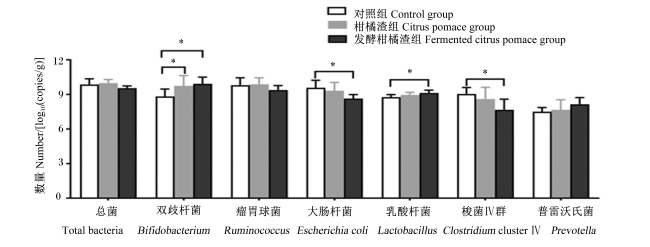
图1所示,各组间清远麻鸡盲肠总菌数量无显著差异(P>0.05)。与对照组相比,柑橘渣组和发酵柑橘渣组盲肠双歧杆菌(Bifidobacterium)数量显著增加(P<0.05),而柑橘渣组和发酵柑橘渣组之间盲肠双歧杆菌数量无显著差异(P>0.05);发酵柑橘渣组盲肠乳酸杆菌(Lactobacillus)数量显著增加(P<0.05),盲肠大肠杆菌(Escherichia coli)和梭菌Ⅳ群(Clostridium cluster Ⅳ)数量显著减少(P<0.05)。此外,各组间盲肠瘤胃球菌(Ruminococcus)和普雷沃氏菌(Prevotella)数量无显著差异(P>0.05)。
图1 饲粮中添加发酵柑橘渣对清远麻鸡盲肠微生物数量的影响

*表示差异显著(P<0.05)。

Fig.1 Effects of dietary fermented citrus pomace on microorganism number in cecum of Qingyuan partridge chickens

* mean significant difference (P<0.05).

表4可知,与对照组或柑橘渣组相比,发酵柑橘渣组清远麻鸡盲肠乙酸、丙酸、丁酸、乳酸和总短链脂肪酸含量显著提高(P<0.05),盲肠戊酸含量有提高趋势(0.05<P<0.10);与对照组相比,柑橘渣组盲肠上述有机酸含量无显著差异(P>0.05)。同时,各组间盲肠异丁酸、异戊酸和总支链氨基酸含量均无显著差异(P>0.05)。
表4 饲粮中添加发酵柑橘渣对清远麻鸡盲肠乳酸和SCFA含量的影响

Table 4 Effects of dietary fermented citrus pomace on contents of lactic acid and SCFA in cecum of Qingyuan partridge chickens μmol/g

项目
Items
对照组
Control group
柑橘渣组
Citrus pomace group
发酵柑橘渣组
Fermented citrus
pomace group
P
P-value
乙酸Acetate 43.87±2.41b 41.60±4.58b 57.18±2.57a 0.010
丙酸Propionate 9.27±0.90ab 6.61±0.77b 11.30±1.41a 0.023
丁酸Butyrate 4.93±0.90ab 3.83±0.95b 7.66±1.10a 0.041
异丁酸Isobutyrate 1.47±0.07 1.36±0.08 1.57±0.09 0.225
戊酸Valerate 1.38±0.03 1.25±0.06 1.53±0.12 0.077
异戊酸Isovalerate 1.52±0.11 1.40±0.08 1.32±0.03 0.229
总支链脂肪酸Total BCFA 3.00±0.13 2.76±0.14 2.89±0.07 0.393
总短链脂肪酸Total SCFA 62.47±3.46b 56.05±5.75b 80.57±4.55a 0.013
乳酸Lactic acid 2.35±0.08b 2.36±0.05b 2.95±0.11a 0.025

2.4 饲粮中添加发酵柑橘渣对清远麻鸡盲肠臭气物质含量的影响

表5可知,与对照组或柑橘渣组相比,发酵柑橘渣组清远麻鸡盲肠对甲酚、吲哚、粪臭素和氨态氮含量显著降低(P<0.05);与对照组相比,柑橘渣组盲肠对甲酚、吲哚、粪臭素和氨态氮含量均无显著差异(P>0.05)。此外,各组间盲肠苯酚含量无显著差异(P>0.05)。
表5 饲粮中添加发酵柑橘渣对清远麻鸡盲肠臭气物质含量的影响

Table 5 Effects of dietary fermented citrus pomace on contents of odor substances in cecum of Qingyuan partridge chickens

项目
Items
对照组
Control group
柑橘渣组
Citrus pomace group
发酵柑橘渣组
Fermented citrus
pomace group
P
P-value
酚和吲哚类Phenols and indoles/(μg/g)
苯酚Phenol 3.55±0.37 3.20±0.61 3.06±0.19 0.707
对甲酚p-cresol 5.55±0.42a 5.33±0.33a 3.19±0.58b 0.004
吲哚Indole 1.45±0.10a 1.32±0.11ab 1.06±0.07b 0.034
粪臭素Skatole 1.61±0.08a 1.46±0.10ab 1.18±0.10b 0.018
氨态氮NH3-N/(mg/g) 2.85±0.18a 2.65±0.15a 2.25±0.11b 0.045

3 讨论

3.1 饲粮中添加发酵柑橘渣对清远麻鸡营养物质表观消化率的影响

随着我国柑橘加工生产规模的不断增大,产生的柑橘渣日益增多。柑橘渣作为地缘性的资源,含有多种提高动物免疫力的功能成分,利用微生物靶向代谢菌酶协同耦合联产饲料技术能够提高柑橘渣蛋白质含量,改善动物适口性,提高免疫活性物质含量,且饲喂后对动物生产没有负面影响,同时可提高机体抗病能力[17]。柑橘渣经过微生物发酵后能够提高其CP含量,降低粗纤维含量,减少其中的大分子物质,提高其营养价值,因此发酵柑橘渣具有作为饲料原料被饲料资源化利用的潜力。有研究表明,将柑橘渣进行发酵处理后,可提高其可溶性碳水化合物、有机酸和多酚类物质的含量,有利于提高柑橘渣的饲用价值[18]。此外,Ahmad等[19]研究发现,在饲粮中添加柑橘皮提取物显著提高了鹌鹑的免疫功能,增强了其抗病能力。本团队前期试验发现,肉鸡的肠道形态结构可以通过饲粮中添加柑橘提取物进行调节,并且通过上调氨基酸和小分子肽转运蛋白基因的表达,提高氨基酸和小分子肽的吸收与利用[20]。本试验中,饲粮中添加发酵柑橘渣提高了清远麻鸡对CP的表观消化率,说明发酵柑橘渣促进了肉鸡对蛋白质的消化吸收。

3.2 饲粮中添加发酵柑橘渣对清远麻鸡血清生化指标的影响

血清生化指标不仅可以用来衡量动物的健康状态,还可以反映出动物机体的整体代谢情况。血清中的总蛋白、白蛋白、球蛋白和尿酸含量可以反映动物机体肾脏和肝脏的功能状况。血清总蛋白含量的提高反映动物机体的消化吸收能力的提高,可用来表明机体的蛋白质累积和新陈代谢的状态[21]。B淋巴细胞转化为浆细胞后能够分泌产生球蛋白,且球蛋白会随着抗体水平的提高而增加,与白蛋白共同维持血液渗透压和酸碱平衡[22]。本试验结果表明,饲粮中添加发酵柑橘渣显著降低了清远麻鸡血清尿酸含量,并且饲粮中添加柑橘渣和发酵柑橘渣能够提高血清总蛋白、白蛋白和球蛋白含量,其中发酵柑橘渣组含量较高,表明发酵柑橘渣的添加在一定程度上加强了肉鸡的新陈代谢。
血清甘油三酯含量可反映脂肪组织发育和脂肪沉积的能力,低密度脂蛋白可将肝脏合成的胆固醇转运到肝外组织,而高密度脂蛋白则把胆固醇转回到肝脏并生成其他物质排出体外,从而使机体胆固醇保持稳态[23]。在本研究中,饲粮中添加发酵柑橘渣显著降低了清远麻鸡血清总胆固醇含量,同时血清甘油三酯含量也有所降低;饲粮中添加发酵柑橘渣还显著降低了血清谷草转氨酶活性,对血清谷丙转氨酶活性无显著影响;饲粮中添加发酵柑橘渣提高了血清葡萄糖含量,有利于其正常生长发育。此外,与对照组和柑橘渣组相比,饲粮中添加发酵柑橘渣对清远麻鸡血清尿素含量无显著影响。

3.3 饲粮中添加发酵柑橘渣对清远麻鸡盲肠微生物数量和有机酸含量的影响

动物肠道微生物群对于维持宿主正常的肠道生理和健康发挥着十分重要的作用。肠道微生物的组成受饲粮养分和组成比例的影响,如饲粮纤维对其生长代谢有促进作用,有助于改善肠道健康。在本研究中,采用实时荧光定量PCR进一步研究了饲粮中添加柑橘渣对清远麻鸡盲肠微生物数量的影响,结果表明,饲粮中添加发酵柑橘渣显著影响了盲肠微生物组成,表现为增加了对机体代谢和免疫相关的有益菌(双歧杆菌和乳酸杆菌)的数量,而减少了致病菌(大肠杆菌)的数量。双歧杆菌和乳酸杆菌是存在于宿主肠道内的有益微生物,不仅能与病原菌竞争与肠上皮的结合位点以及提供生长所需的营养物质来防止病原体的感染和定殖,而且可以产生一些抗菌因子,如细菌素和乳酸,从而促进肠道健康和维护其功能的完善[24]。对甲酚和吲哚类物质是梭菌Ⅳ群的主要代谢产物[25],本研究发现,饲粮中添加发酵柑橘渣显著减少了清远麻鸡盲肠梭菌Ⅳ群的数量,这与降低其对应代谢产物——对甲酚和吲哚含量的结果相一致,表明发酵柑橘渣可维持肠道内环境的稳态。因此,本试验中,盲肠产乳酸细菌和产SCFA细菌数量的增加,以及潜在致病菌数量的降低,表明清远麻鸡饲粮中添加发酵柑橘渣维系了肠道菌群的稳态并对肠道健康具有益生作用。
据报道,动物采食发酵柑橘渣抑制了其后肠道有害菌的生长,可能是因为其含有的类黄酮物质[26]。王帅[27]研究发现,饲粮中添加8%发酵柑橘渣有效减少了断奶仔猪盲肠和空肠中大肠杆菌的数量,并显著增加了断奶仔猪肠道乳酸杆菌的数量,且可能是由于发酵柑橘渣中的功能性成分所导致的,其中包括类黄酮化合物、香精油和膳食纤维,这些成分能够对肠道内微生物群落的结构和数量进行靶向调控。李春荣[28]研究发现,在育肥猪饲粮中添加15%和30%的发酵柑橘渣改善了育肥猪肠道微生态环境,试验组中乳杆菌属的丰度虽然较照组无显著差异,但是相比较于对照组提高38.94%~62.50%,并解释这可能是由于柑橘渣发酵后富含大量的乳酸菌,从而导致盲肠乳杆菌属丰度提高。此外,发酵饲料中的益生菌可以在肠道进行定植,从而在黏膜上形成生物屏障,这样一方面可以减少病原微生物的侵染,另一方面也可以通过分泌抗菌物质抑制病原菌的生长,这可能是造成本试验中有害菌数量减少的原因之一。有研究发现,柑橘中含有的活性物质可影响肠道微生物的组成和丰富度[29]。柑橘类水果中含有的柑橘类黄酮具有调节肠道微生物区系的功能[30]。本研究团队在前期试验中发现,柑橘渣经过复合菌发酵后,提高了终产物中总黄酮和有机酸的含量[31]。因此,本试验将柑橘渣进行发酵处理后,可能进一步释放了柑橘中的类黄酮物质,同时提高了微生物代谢小分子物质含量,协同对肠道菌群产生了益生调节作用。
SCFA包含了乙酸、丙酸、丁酸、戊酸和异戊酸等。通常,动物的SCFA有2方面的来源:一是直接通过外源获取,二是通过后肠微生物的发酵产生,且后者也是动物体获取SCFA的主要方式。肠道中的SCFA不仅可以被吸收代谢,提供部分能量,还可以参与机体中营养物质的代谢,调节机体健康[32]。本研究发现,饲粮中添加发酵柑橘渣能够提高清远麻鸡盲肠乙酸、丙酸、丁酸和乳酸含量。上述结果一方面可能是因为发酵柑橘渣中富含有机酸,饲喂清远麻鸡后提高了动物肠道的乙酸、丙酸、丁酸和乳酸的含量;另一方面,作为碳水化合物和蛋白质发酵过程中的主要代谢产物,SCFA的产生与肠道微生物群的丰度和结构有关。SCFA能够为肠道菌群提供能量,提供肠道中酸性的内环境;同时,SCFA可以抑制有害菌生长,并促进有益菌的增殖。有研究报道,丙酸具有抑制沙门氏菌和大肠杆菌生长的作用[33];丁酸可以促进有益菌乳酸杆菌和双歧杆菌的黏附,降低大肠杆菌的黏附[34];乙酸和丁酸可以增强黏蛋白2的表达,维持肠道屏障的免疫功能[35]。本研究中,盲肠乙酸、丙酸和丁酸含量的升高与微生物数量增加的结果是一致的。此外,饲喂发酵柑橘渣后盲肠丁酸含量的提高可能与产丁酸菌的丰度提高密切相关。最近的一项研究表明,饲粮中添加柑橘副产物发酵饲料增强了青脚麻鸡的肠道形态和屏障功能,并通过调节肠道炎症因子和微生物组成来促进其生长[36]。因此,这表明发酵柑橘渣可能通过提高SCFA的产量以及提高有益菌丰度,从而增强肠道屏障功能。
发酵柑橘渣富含膳食纤维,饲粮纤维是肠道微生物群落的重要营养来源,可促进微生物菌落的生长;饲粮纤维具有增加有益菌、抑制有害菌的作用[37]。膳食纤维中的可溶性纤维在后肠快速发酵后会产生SCFA,能够降低肠道pH,有利于有益菌如乳酸杆菌的生长,同时抑制大肠杆菌的繁殖[38]。相比之下,不溶性纤维主要通过加速肠道食糜的流通速度,阻止大肠杆菌在肠道的附着。此外,不溶性纤维还具有吸附作用,能够吸附肠道中的有害代谢产物,从而创造出有利于益生菌生长的健康肠道环境,减少有害菌的数量[39]。因此,本试验中,发酵柑橘渣调控清远麻鸡盲肠微生物稳态可能是通过黄酮类或膳食纤维而起作用,但其具体作用成分以及作用机制还需要进一步研究确认。

3.4 饲粮中添加发酵柑橘渣对清远麻鸡盲肠氨态氮、酚和吲哚类物质含量的影响

本试验中,饲喂经发酵处理的柑橘渣显著降低了清远麻鸡盲肠对甲酚含量,提示微生物发酵过程降低了对酪氨酸的分解代谢。粪臭素是色氨酸的代谢产物,大部分经粪便或尿液排出体外,没有被代谢的粪臭素会沉积在肌肉和脂肪组织中,影响猪机体健康与猪肉品质[40]。本研究结果表明,饲粮中添加发酵柑橘渣显著降低了清远麻鸡盲肠吲哚和粪臭素含量,表明饲粮中添加发酵柑橘渣可以有效提高机体健康,并可能改善肉品质,这与之前的研究结果[41]相一致。酚和吲哚类物质在高含量下具有潜在的遗传毒性、诱变性和致癌性,对肠道健康产生不良影响[42-43]。因此,本试验中,清远麻鸡盲肠对甲酚和吲哚含量的降低进一步表明饲粮中添加发酵柑橘渣有利于维系清远麻鸡的肠道健康。肠道中氨态氮的代谢受到微生物群落的影响,动物排放的氨主要是微生物通过水解尿素和氨基酸脱氨代谢的结果[44]。在本试验中,饲粮中添加发酵柑橘渣显著降低了清远麻鸡盲肠氨态氮含量,这可能是由于发酵柑橘渣通过调节产氨或氨利用细菌的丰度,从而减少了清远麻鸡盲肠中氨的产生。这表明饲粮中添加发酵柑橘渣可以提高机体对氮素的利用率,有效减少氮素损失的挥发,降低对环境的污染,达到清洁生产的目的;同时也表明,饲粮中添加发酵柑橘渣可能改善了鸡粪肥料的质量,这对于农业生产中减少氮素损失,提高肥料利用率具有积极的意义。

4 结论

① 饲粮中添加发酵柑橘渣可以提高清远麻鸡对CP的表观消化率。
② 饲粮中添加发酵柑橘渣可以降低清远麻鸡血清尿酸和总胆固醇含量以及谷草转氨酶活性,提高血清葡萄糖含量。
③ 饲粮中添加发酵柑橘渣可以提高清远麻鸡盲肠有益菌数量,并减少有害菌数量,同时提高盲肠SCFA含量,并降低盲肠臭气物质含量。
④ 发酵柑橘渣的饲喂效果优于柑橘渣。
[1]
国家统计局. 数据[EB/OL].[2023-10-03].https://www.stats.gov.cn/sj/.

National Bureau of Statistics. Data[EB/OL].[2023-10-03].https://www.stats.gov.cn/sj/. in Chinese).

[2]
中华人民共和国农业农村部. 农业农村部印发《“十四五”全国种植业发展规划》[R/OL].(2022-03-08)[2023-10-03].http://www.northnews.cn/p/2075987.html.

Ministry of Agriculture and Rural Affairs of the People’s Republic of China. The ministry of agriculture and rural affairs has issued the “14th five year plan for the development of national crop industry”[R/OL].(2022-03-08)[2023-10-03].http://www.northnews.cn/p/2075987.html. in Chinese)

[3]
FAO. Citrus fruit fresh and processed statistical bulletin 2020[R/OL].[2023-10-03].https://www.fao.org/3/cb6492en/cb6492en.pdf.

[4]
李春荣, 李小宇, 宋代军. 柑橘渣的营养特点及其在畜禽生产中的应用[J]. 动物营养学报, 2022, 34(3):1464-1475.

DOI

LI C R, LI X Y, SONG D J. Nutritional characteristics of citrus pulp and its application in livestock and poultry production[J]. Chinese Journal of Animal Nutrition, 2022, 34(3):1464-1475. (in Chinese)

[5]
田志梅, 马现永, 鲁慧杰, 等. 果渣营养价值及其发酵饲料在畜禽养殖中的应用[J]. 中国畜牧兽医, 2019, 46(10):2955-2963.

DOI

TIAN Z M, MA X Y, LU H J, et al. Nutrient value of fruit pomace and the application of its fermented feed in livestock breeding[J]. China Animal Husbandry & Veterinary Medicine, 2019, 46(10):2955-2963. (in Chinese)

[6]
学而时习工作室. 习近平总书记谈“大食物观”[EB/OL].[2023-10-05].http://www.qstheory.cn/zhuanqu/2023-03/20/c_1129442759.htm.

XUEERSHIXI Studio. Xi Jinping talks about “big food concept”[EB/OL].[2023-12-03].http://www.qstheory.cn/zhuanqu/2023-03/20/c_1129442759.htm. in Chinese)

[7]
中华人民共和国农业农村部. 黄羽肉鸡营养需要量:NY/T 3645—2020[S]. 北京: 中国农业出版社, 2020.

Ministry of Agriculture and Rural Affairs of the People’s Republic of China. Nutritional requirements of yellow-feather broiler chickens:NY/T 3645—2020[S]. Beijing: China Agriculture Press, 2020. (in Chinese)

[8]
中华人民共和国农业农村部. 黄羽肉鸡饲养管理技术规程:NY/T 1871—2020[S]. 北京: 中国农业出版社, 2010.

Ministry of Agriculture and Rural Affairs of the People’s Republic of China. Feeding management regulations of yellow-feather chickens:NY/T 1871—2020[S]. Beijing: China Agriculture Press, 2010. (in Chinese)

[9]
中华人民共和国国家质量监督检验检疫总局, 中国国家标准化管理委员会. 饲料中水分的测定:GB/T 6435—2014[S]. 北京: 中国标准出版社, 2015.

General Administration of Quality Supervision,Inspection and Quarantine of the People’s Republic of China, Standardization Administration of the People’s Republic of China, Determination of moisture in feedstuffs:GB/T 6435—2014[S]. Beijing: Standards Press of China, 2015. (in Chinese)

[10]
国家市场监督管理总局, 中国国家标准化管理委员会. 饲料中粗蛋白的测定凯氏定氮法:GB/T 6432—2018[S]. 北京: 中国标准出版社, 2018.

State Administration for Market Regulation, Standardization Administration of the People’s Republic of China. Determination of crude protein in feeds-Kjeldahl method:GB/T 6432—2018[S]. Beijing: Standards Press of China, 2018. (in Chinese)

[11]
中华人民共和国国家质量监督检验检疫总局, 中国国家标准化管理委员会. 饲料中粗脂肪的测定方法:GB/T 6433—2006[S]. 北京: 中国标准出版社, 2006.

General Administration of Quality Supervision,Inspection and Quarantine of the People’s Republic of China, Standardization Administration of the People’s Republic of China. Determinaiion of crude fat in feeds:GB/T 6433—2006[S]. Beijing: Standards Press of China, 2006. (in Chinese)

[12]
国家市场监督管理总局, 中国国家标准化管理委员会. 饲料中钙的测定:GB/T 6436—2018[S]. 北京: 中国标准出版社, 2018.

State Administration for Market Regulation, Standardization Administration of the People’s Republic of China. Determination of calcium in feeds:GB/T 6436—2018[S]. Beijing: Standards Press of China, 2018. (in Chinese)

[13]
国家市场监督管理总局, 中国国家标准化管理委员会. 饲料中总磷的测定分光光度法:GB/T 6437—2018[S]. 北京: 中国标准出版社, 2018.

State Administration for Market Regulation, Standardization Administration of the People’s Republic of China. Determination of phosphorus in feeds-spectrophotometry:GB/T 6437—2018[S]. Beijing: Standards Press of China, 2018. (in Chinese)

[14]
YU M, ZHANG C J, YANG Y X, et al. Long-term effects of early antibiotic intervention on blood parameters,apparent nutrient digestibility,and fecal microbial fermentation profile in pigs with different dietary protein levels[J]. Journal of Animal Science and Biotechnology, 2018, 9(1):175-186.

[15]
宋敏, 王超普, 崔艺燕, 等. 桑叶提取物对断奶仔猪粪便中主要微生物数量和臭气物质生成的影响[J]. 动物营养学报, 2023, 35(2):823-833.

DOI

SONG M, WANG C P, CUI Y Y, et al. Effects of mulberry leaf extract on number of main microbes and production of odorous substances in feces of weaned piglets[J][J]. Chinese Journal of Animal Nutrition, 2023, 35(2):823-833. (in Chinese)

DOI

[16]
YU M, LI Z M, CHEN W D, et al. Hermetia illucens larvae as a potential dietary protein source altered the microbiota and modulated mucosal immune status in the colon of finishing pigs[J]. Journal of Animal Science and Biotechnology, 2019, 10(1):50.

[17]
SEIDAVI A, ZAKER-ESTEGHAMATI H, SALEM A Z M. A review on practical applications of Citrus sinensis by-products and waste in poultry feeding[J]. Agroforestry Systems, 2020, 94(4):1581-1589.

[18]
HU X, ZENG J R, SHEN F, et al. Citrus pomace fermentation with autochthonous probiotics improves its nutrient composition and antioxidant activities[J]. LWT, 2022, 157:113076.

[19]
AHMAD F, SULTAN A, KHAN S, et al. Effect of citrus peeling (Citrus sinensis) on production performance,humoral immunity,nutrients,and energy utilization of broiler quails[J]. Poultry Science, 2024, 103(1):103207.

[20]
YU M, LI Z M, WANG G, et al. Dietary supplementation with citrus extract alters the plasma parameters,circulating amino acid profiles and gene expression of small intestinal nutrient transporters in Chinese yellow-feathered broilers[J]. Journal of the Science of Food and Agriculture, 2020, 100(14):5126-5135.

[21]
OMAR A E, AL-KHALAIFAH H S, ISMAIL T A, et al. Performance,serum biochemical and immunological parameters,and digestive enzyme and intestinal barrier-related gene expression of broiler chickens fed fermented fava bean by-products as a substitute for conventional feed[J]. Frontiers in Veterinary Science, 2021, 8:696841.

[22]
AKKAYA M, KWAK K, PIERCE S K. B cell memory:building two walls of protection against pathogens[J]. Nature Reviews.Immunology, 2020, 20(4):229-238.

[23]
REGAR M N, TULUNG B, LONDOK J J M R, et al. Blood lipid profile of broiler chicken as affected by a combination of feed restriction and different crude fiber sources[J]. In IOP Conference Series:Earth and Environmental Science, 2019, 387(1):012053.

[24]
PITTAYANON R, LAU J T, LEONTIADIS G I, et al. Differences in gut microbiota in patients with vs without inflammatory bowel diseases:a systematic review[J]. Gastroenterology, 2020, 158(4):930-946.e1.

[25]
KRAUTKRAMER K A, FAN J, BÄCKHED F. Gut microbial metabolites as multi-kingdom intermediates[J]. Nature Reviews.Microbiology, 2021, 19(2):77-94.

[26]
GAO J X, YANG Z, ZHAO C Q, et al. A comprehensive review on natural phenolic compounds as alternatives to in-feed antibiotics[J]. Science China Life Sciences, 2023, 66(7):1518-1534.

[27]
王帅. 发酵柑橘渣对仔猪生长和肠道发育的影响[D].硕士学位论文. 重庆: 西南大学, 2014.

WANG S. Effects of the fermented citrus pulp on growth and development of gastrointestinal tract in weaned piglets[D].Master’s Thesis. Chongqing: Southwest University, 2014. (in Chinese)

[28]
李春荣. 发酵柑橘渣对生长育肥猪生产性能、抗氧化能力、免疫力和肉质的影响[D].硕士学位论文. 重庆: 西南大学, 2022.

LI C R. Effects of fermented citrus pulp on production performance,antioxidant capacity,immunity and meat quality of growing-finishing pigs[D].Master’s Thesis. Chongqing: Southwest University, 2022. (in Chinese)

[29]
STEVENS Y, VAN RYMENANT W, GROOTAERT C, et al. The intestinal fate of citrus flavanones and their effects on gastrointestinal health[J]. Nutrients, 2019, 11(7):1464.

[30]
PEI R S, LIU X C, BOLLING B. Flavonoids and gut health[J]. Current Opinion in Biotechnology, 2020, 61:153-159.

DOI PMID

[31]
崔艺燕, 王超普, 邓盾, 等. 不同菌种有氧发酵对柑橘渣营养价值的影响[J]. 动物营养学报, 2022, 34(3):2030-2040.

DOI

CUI Y Y, WANG C P, DENG D, et al. Effects of aerobic fermentation with different strains on nutritional value of citrus pomace[J]. Chinese Journal of Animal Nutrition, 2022, 34(3):2030-2040. (in Chinese)

[32]
钟颂石, 刘亚力, 黄兴国, 等. 短链脂肪酸对宿主肠道免疫的调控机制及其在畜禽生产中的研究进展[J]. 动物营养学报, 2022, 34(5):2820-2830.

DOI

ZHONG S S, LIU Y L, HUANG X G, et al. Research progress in regulation mechanism of short chain fatty acids on host intestinal immunity and its application in livestock and poultry production[J]. Chinese Journal of Animal Nutrition, 2022, 34(5):2820-2830. (in Chinese)

[33]
RANAEI V, PILEVAR Z, KHANEGHAH A M, et al. Propionic acid:method of production,current state and perspectives[J]. Food Technology and Biotechnology, 2020, 58(2):115-127.

[34]
梁开阳, 孙志洪, 谭支良, 等. 丁酸介导下肠道菌群与宿主免疫互作机制的研究进展[J]. 畜牧兽医学报, 2021, 52(10):2710-2720.

LIANG K Y, SUN Z H, TAN Z L, et al. Crosstalk mechanism between intestinal microbes and host immunity mediated by microbial metabolites-butyrate[J]. Acta Veterinaria et Zootechnica Sinica, 2021, 52(10):2710-2720. (in Chinese)

[35]
LIU H, WANG J, HE T, et al. Butyrate:a double-edged sword for health?[J]. Advances in Nutrition, 2018, 9(1):21-29.

[36]
ZHOU X H, ZHANG H D, LI S Y, et al. Effects of different levels of citri sarcodactylis fructus by-products fermented feed on growth performance,serum biochemical,and intestinal health of cyan-shank partridge birds[J]. Scientific Reports, 2023, 13(1):20130.

[37]
HAN X B, MA Y, DING S J, et al. Regulation of dietary fiber on intestinal microorganisms and its effects on animal health[J]. Animal Nutrition, 2023, 14:356-369.

DOI PMID

[38]
张玲, 李华, 赵瑶, 等. 短期饲喂两种类型纤维对生长猪后肠菌群结构和主要代谢产物的影响[J]. 四川农业大学学报, 2019, 37(1):70-77.

ZHANG L, LI H, ZHAO Y, et al. The short-term feeding of two different dietary fibers affects the microbial community and main metabolites in the hindgut of growing pigs[J]. Journal of Sichuan Agricultural University, 2019, 37(1):70-77. (in Chinese)

[39]
WILLIAMS B A, MIKKELSEN D, FLANAGAN B M, et al. “Dietary fibre”:moving beyond the “soluble/insoluble” classification for monogastric nutrition,with an emphasis on humans and pigs[J]. Journal of Animal Science and Biotechnology, 2019, 10:45.

[40]
MA Q, MENG N, LI Y J, et al.Occurrence,impacts, and microbial transformation of 3-methylindole (skatole):a critical review[J]. Journal of Hazardous Materials, 2021, 416:126181.

[41]
AL-SAGHEER A A, ABDEL MONEM U M, SAYED-AHMED E E, et al. Navel orange peel hydroethanolic extract as a phytogenic feed supplement: impacts on growth,feed intake,nutrient digestibility,and serum metabolites of heat stressed growing rabbits[J]. Animal Biotechnology, 2023, 34(4):1083-1094.

[42]
YE X W, LI H Y, ANJUM K, et al. Dual role of indoles derived from intestinal microbiota on human health[J]. Frontiers in Immunology, 2022, 13:903526.

[43]
TOFT P B, VANSLETTE A M, TROŠT K, et al. Microbial metabolite p-cresol inhibits gut hormone expression and regulates small intestinal transit in mice[J]. Frontiers in Endocrinology, 2023, 14:1200391.

[44]
唐延天, 邓盾, 李贞明, 等. 畜禽规模化养殖场臭气减排调控技术研究进展[J]. 广东农业科学, 2020, 47(4):106-113.

TANG Y T, DENG D, LI Z M, et al. Deodorization technology of livestock and poultry scale farms[J]. Guangdong Agricultural Sciences, 2020, 47(4):106-113. (in Chinese)

Outlines

/