RESEARCH PAPER

Effects of Formic Acid on Nutrition and Fermentation Quality, Aerobic Stability and in Vitro Rumen Fermentation Characteristics of Whole Plant Forage Mulberry Silage

  • KANG Yajie , 1 ,
  • SHEN Yao 1 ,
  • XUE Fuguang 2 ,
  • HU Xiuzhen 1 ,
  • NAN Xuemei 1 ,
  • TANG Xiangfang 1 ,
  • XIONG Benhai , 1, *
Expand
  • 1 State Key Laboratory of Animal Nutrition and Feeding, Institute of Animal Science, Chinese Academy of Agricultural Sciences, Beijing 100193, China
  • 2 State Key Laboratory of Animal Health and Safety in Nanchang, College of Animal Science and Technology, Jiangxi Agricultural University, Nanchang 330045, China
*professor, E-mail:

Received date: 2024-02-28

  Online published: 2024-08-12

Abstract

The purpose of this study was to explore the effects of formic acid on the nutrition and fermentation quality, aerobic stability and in vitro rumen fermentation characteristics of whole plant forage mulberry silage, and to provide more scientific and effective theoretical support for the development and utilization of whole plant forage mulberry. The experiment was divided into 5 groups, and the 5 groups were supplemented with 0 (control group, CK group), 2 (FA2 group), 4 (FA4 group), 6 (FA6 group) and 8 mL/kg (FA8 group) formic acid in the forage mulberry, respectively, each group contained 4 replicates, and silage for 90 days. The samples were collected on the days 0 (intraday), 3, 6, 9 and 12 of aerobic exposure to determine the silage quality and aerobic stability, to select the optimal formic acid supplemental level. Subsequently, the effects of formic acid addition on rumen fermentation of dairy cows was further explored, the forage mulberry was divided into 3 groups: the forage mulberry silage raw material group (M group), the silage forage mulberry group not supplemented with formic acid (CK group) and the silage forage mulberry group with screened optimal supplemental level of formic acid (FA2 group), each t contained 3 replicates, and the in vivo degradation test and in vitro fermentation test were carried out for 48 h. The results showed as follows: 1) during the aerobic exposure period, the dry matter (DM) content of FA4 group was always the highest, and significantly higher than that of CK and FA6 groups on days 0, 3, 6 and 12 of aerobic exposure (P<0.05); the contents of neutral detergent fiber (NDF) and acid detergent fiber (ADF) of FA2 and FA4 groups were significantly lower than those of CK and FA8 group on day 9 of aerobic exposure (P<0.05). 2) On day 0 of aerobic exposure, the pH, ammonia nitrogen (NH3-N) and acetic acid (AA) contents of FA2, FA4, FA6 and FA8 groups were significantly lower than those of the CK group (P<0.05). With the extension of aerobic exposure time, the pH of the FA2 group was stable and always the lowest. 3) During the aerobic exposure period, the feed temperature of the FA2 group was always lower than that of the CK group and the ambient temperature. Therefore, the suitable formic acid supplemental level was 2 mL/kg. 4) The dry matter digestibility (DMD) of the FA2 group was significantly higher than that of the CK group (P<0.05), the propionic acid and valeric acid contents were significantly lower than that of the CK group (P<0.05), and the pH, acetic acid content and acetic acid/propionic acid were significantly lower than that of the M group (P<0.05). In conclusion, the addition of 2 mL/kg formic acid can improve the nutrition and fermentation quality, aerobic stability and in vitro rumen fermentation function of forage mulberry silage.

Cite this article

KANG Yajie , SHEN Yao , XUE Fuguang , HU Xiuzhen , NAN Xuemei , TANG Xiangfang , XIONG Benhai . Effects of Formic Acid on Nutrition and Fermentation Quality, Aerobic Stability and in Vitro Rumen Fermentation Characteristics of Whole Plant Forage Mulberry Silage[J]. Chinese Journal of Animal Nutrition, 2024 , 36(8) : 5170 -5180 . DOI: 10.12418/CJAN2024.440

饲料桑(forage mulberry)又称蛋白桑,属荨麻目、桑科、桑属,是一种粗蛋白质(CP)含量高、功能活性物质丰富、适应性强且产量高的木本植物[1]。饲料桑CP含量高达15%~28%,与苜蓿干草相当[2]。与传统落叶乔木蚕桑相比,饲料桑属于落叶灌木,全株均可用作动物饲料,能有效避免桑树资源浪费[3-4]。因此,在饲粮中添加饲料桑为反刍动物生产提供了替代传统蛋白质成分的可行方案[5]
先前研究发现,饲料桑单独青贮时品质表现并不理想,主要因其缓冲能值较高、本身附着乳酸菌数量不足及产酸能力较弱,青贮后大肠杆菌成为主要优势菌属[6]。此外,青贮饲料在饲喂或管理不善而暴露于空气中时,容易发生好氧变质[7]。不良微生物将利用乳酸(lactic acid,LA)或残留的可溶性碳水化合物进行代谢和繁殖,导致青贮饲料营养物质损失或腐败,从而降低饲料质量,影响动物的健康和生产[7]。因此,有必要采取一些措施提高饲料桑作为青贮饲料时的发酵品质及其有氧稳定性。Desta等[8]研究发现,有机酸在青贮过程中可将碳水化合物转化为可发酵的单糖,这为乳酸菌发酵提供额外底物,从而促进乳酸菌数量的增加,成为一种可参考使用的改善青贮品质的方法。
甲酸属于有机酸,是一种发酵抑制剂,具有显著抗菌功能[9]。对低青贮能力饲料添加适宜水平甲酸,可迅速降低青贮饲料pH,抑制植物酶活性,在青贮早期限制大肠杆菌、梭状芽胞杆菌等不良微生物与乳酸菌竞争发酵底物,从而改善青贮效果[10]。Lorenz等[11]研究发现,青贮红豆草时添加8 mL/kg甲酸可有效降低其氨态氮(ammonia nitrogen,NH3-N)含量,减少牧草中蛋白质降解,改善青贮品质。然而,不同甲酸添加水平对青贮饲料发酵影响不同。Zhao等[12]研究发现,添加0.2%甲酸可促进水稻秸秆青贮饲料中乳酸菌发酵,添加0.6%甲酸则抑制了其青贮过程中所有微生物发酵,不同甲酸添加水平均可抑制不良微生物活动,减少发酵损失,提高饲料青贮品质。此外,多项研究表明,甲酸可显著改善小麦、高粱和玉米等青贮饲料发酵品质及其有氧稳定性,有效提高反刍动物对饲料的摄入与消化[13-15]。目前,鲜有研究报道甲酸对饲料桑青贮品质的影响。因此,本研究旨在评价甲酸对饲料桑青贮营养和发酵品质、有氧稳定性及体外瘤胃发酵特性的影响,以期为全株饲料桑的应用提供理论依据和技术支持。

1 材料与方法

1.1 试验原料

饲料桑采自山东省冠县恒祥牧业责任有限公司饲料桑基地,于2022年9月28日在饲料桑株高140 cm时进行全株收割,留茬高度为10~15 cm,人工刈割后利用饲草粉碎机切短至2~3 cm。将切碎的全株饲料桑平铺于地面,并喷洒等量不同浓度甲酸稀释液。甲酸(分析纯,>99%)购于上海阿拉丁生化科技股份有限公司。全株饲料桑青贮原料营养成分含量见表1
表1 全株饲料桑青贮原料营养成分含量

Table 1 Nutrient contents of whole plant forage mulberry silage raw materials

项目Items 含量Content
干物质DM/% 39.26
粗蛋白质CP/%DM 21.81
中性洗涤纤维NDF/%DM 48.90
酸性洗涤纤维ADF/%DM 27.21
粗脂肪EE/%DM 4.43
粗灰分Ash/%DM 8.71

实测值 Measured values。

1.2 试验设计

根据甲酸添加水平不同,分为5组,各组分别在饲料桑中添加0(对照组,CK组)、2(FA2组)、4(FA4组)、6(FA6组)、8 mL/kg(FA8组)甲酸。甲酸以鲜重(fresh weight,FW)为基础进行添加,将相应添加水平甲酸用蒸馏水混制为20 mL/kg,对照组添加20 mL/kg蒸馏水。将相应添加水平甲酸稀释液喷施于各组样品上,充分混合均匀,每组设置4个重复,每袋1 kg样品,立即装入带排气阀的聚乙烯袋中(35 cm×50 cm,青岛绿生生物科技有限公司),使用封口机抽空空气密封,于室温下青贮90 d后开包。开包后第0(当天)、3、6、9、12天将青贮饲料桑充分混匀后采用四分法进行取样,测定其营养成分、发酵品质和有氧稳定性,以确定适宜甲酸添加水平。为进一步探究甲酸对瘤胃发酵的影响,将饲料桑青贮原料组(M组)、未添加甲酸青贮饲料桑组(CK组)和经筛选出最优甲酸添加水平青贮饲料桑组(FA2组)3组风干样品进行48 h体内降解试验和体外发酵试验,每组3个重复。

1.3 指标测定

1.3.1 营养成分

在青贮90 d后开封,分别于有氧暴露第0、3、6、9、12天取样,每袋取200 g青贮样品,于烘箱105 ℃杀青30 min,再于65 ℃烘干72 h直至恒重,准确称量,参考GB/T 6435—2014的方法测定干物质(DM)含量,用微型粉碎机研磨通过1 mm筛网,密封保存备用。CP含量参考GB/T 6432—2018的方法,利用凯氏定氮仪测定;中性洗涤纤维(NDF)和酸性洗涤纤维(ADF)含量分别参考GB/T 20806—2022和NY/T 1459—2007的方法,利用纤维分析仪测定;粗灰分(Ash)含量参考GB/T 6438—2007的方法,利用马弗炉550 ℃焚烧测定;粗脂肪(EE)含量参考GB/T 6433—2006的方法,采用索氏提取法测定。

1.3.2 发酵品质

青贮90 d后,分别于有氧暴露第0、3、6、9、12天取样,每袋取20 g青贮样品,与180 mL蒸馏水混合均匀,置于4 ℃冰箱保存24 h,用4层纱布过滤。pH使用便携式pH计测定,NH3-N含量采用苯酚-次氯酸盐反应法测定,挥发性脂肪酸(VFA)含量利用Agilent 7890B高效气相色谱系统测定,LA含量使用乳酸试剂盒(A019-2,南京建成生物工程研究所)测定[16]

1.3.3 有氧稳定性

青贮90 d后,将青贮样品放入2 L聚乙烯无菌桶(上直径149.5 mm,下直径135 mm,桶深103 mm)中,为保证空气自由进入的同时减少原料污染和水分流失,用2层纱布覆盖桶口[5,17]。在青贮饲料中心位置插入多通道温度记录仪(EX4000,北京广鉴重安科技有限公司)探头,同时于环境中放置4个探头,每2 min测定1次青贮饲料中心温度和环境温度,记录青贮开包至青贮饲料中心温度高于环境温度2 ℃的时间[13]

1.3.4 体内降解试验

选用3头体重相近、健康状况良好且安装了永久性瘤胃瘘管的荷斯坦奶牛作为试验动物,按照中国农业科学院北京畜牧兽医研究所昌平试验基地日常管理方式饲养,并经中国农业科学院伦理委员会批准(审批号:IAS2023-136)。准确称取5 g风干样品放入已预先称重的尼龙袋中,用尼龙绳将袋口紧密绑好。晨饲前将尼龙袋投入奶牛瘤胃中,投入48 h后取出,立即放入冰水以终止微生物发酵。用清水冲洗尼龙袋,直至冲洗液清澈。将尼龙袋放入65 ℃烘箱烘干72 h,直至恒重,称取尼龙袋及其中残渣的重量,测定干物质消化率(dry matter digestibility,DMD)。

1.3.5 体外发酵试验

体外发酵试验选用3头体重相近、健康状况良好且安装了永久性瘤胃瘘管的荷斯坦奶牛作为瘤胃液供体。晨饲前2 h收集奶牛瘤胃液后用4层无菌纱布过滤,将瘤胃液和缓冲液按体积1∶2充分混合。参考Liu等[18]方法在试验前配制好缓冲液,混匀后置于39 ℃恒温水浴锅加热备用。将准确称取的0.5 g底物和75 mL瘤胃缓冲液加入120 mL厌氧发酵瓶中,期间持续通入二氧化碳(CO2),确保瓶内厌氧环境。随后用橡胶塞和铝制盖密封发酵瓶,将其与气囊相连,放入39 ℃恒温培养箱中发酵48 h,抽真空收集气体读取产气量(GP),然后放入冰水终止发酵,立即测定pH,收集样品用于后续测定瘤胃体外干物质降解率(in vitro dry matter digestibility,IVDMD)及VFA、NH3-N和甲烷(CH4)含量。使用气相色谱仪测定CH4和VFA[包括总挥发性脂肪酸(TVFA)、乙酸(acetic acid,AA)、丙酸(propionic acid,PA)、丁酸(butyric acid,BA)、异戊酸(isovaleric acid,IA)和戊酸(valeric acid,VA)]含量,采用苯酚-次氯酸钠比色法测定NH3-N含量。

1.4 数据统计分析

使用Excel 2019对数据进行初步整理,采用SPSS 27.0软件进行单因素方差分析,并进行Duncan氏多重比较。试验结果以平均值±标准差表示,P<0.05表示差异显著。采用SPSS 27.0软件进行一般线性模型单变量方差分析有氧暴露时间与甲酸添加水平之间的交互效应,当P<0.05表示交互效应存在显著差异。使用Graphpad Prism 9.5绘制图形。

2 结果与分析

2.1 甲酸对青贮饲料桑有氧暴露期间营养成分含量的影响

表2可知,有氧暴露时间和甲酸添加水平对青贮饲料桑各项营养成分含量均有显著影响(P<0.05),但两者的交互作用对青贮饲料桑各项营养成分含量无显著影响(P>0.05)。青贮90 d后,FA4组DM含量最高;随有氧暴露时间延长,各组DM含量均有所下降,其中FA4组DM含量始终最高,与FA2组差异不显著(P>0.05),但第0、3、6、12天显著高于CK和FA6组(P<0.05)。青贮90 d后,FA组CP含量高于对照组,各组之间CP含量差异不显著(P>0.05),其中FA2组CP含量最高。青贮90 d后,与对照组相比,其他各组NDF、ADF含量不同程度下降,但差异不显著(P>0.05);有氧暴露后,各组NDF、ADF含量整体呈上升趋势,FA2、FA4组有氧暴露第9天NDF和ADF含量显著低于CK和FA8组(P<0.05)。青贮90 d后,CK组Ash含量显著高于其他各组(P<0.05);随有氧暴露时间延长,各组Ash含量均呈上升趋势,FA2、FA4组Ash含量始终低于其他各组。
表2 甲酸对青贮饲料桑有氧暴露期间营养成分含量的影响

Table 2 Effects of formic acid on nutrient contents of silage forage mulberry during aerobic exposure

项目
Items
干物质
DM/%
粗蛋白质
CP/%DM
中性洗涤纤维
NDF/%DM
酸性洗涤纤维
ADF/%DM
粗脂肪
EE/%DM
粗灰分
Ash/%DM
有氧暴露时间
Aerobic exposure time/d
组别
Groups
0 CK 35.98±0.66ABa 21.86±0.10 48.84±0.36b 32.26±1.94b 4.96±0.29 8.17±0.20Ac
FA2 35.99±0.29AB 22.15±0.41 44.81±0.39d 30.63±1.67c 5.32±0.27 7.69±0.10Bc
FA4 36.72±0.48Aa 22.02±0.04 45.82±0.68b 29.52±6.15b 5.24±0.30 7.82±0.25Bc
FA6 35.57±0.45B 21.93±0.05 47.45±0.86c 31.42±0.56b 5.19±0.12 7.85±0.09Bd
FA8 36.29±0.63ABa 21.97±0.08 47.48±6.23b 30.83±1.84c 5.15±0.39 7.89±0.15Bd
3 CK 35.34±0.89ABab 21.80±0.21 49.76±1.54b 35.89±0.37Aa 4.82±0.30 9.00±0.18Ab
FA2 35.52±0.19AB 21.94±0.11 45.13±0.65d 32.62±0.85Bb 5.18±0.26 8.40±0.17Db
FA4 36.17±0.30Aab 21.94±0.16 46.26±4.79b 33.53±2.02Bab 5.10±0.20 8.46±0.14CDb
FA6 35.22±0.54A 21.92±0.18 48.42±5.11bc 34.10±2.24ABa 4.97±0.25 8.66±0.10BCc
FA8 35.75±0.39ABab 21.83±0.07 48.44±2.04b 33.75±0.70ABb 5.00±0.18 8.82±0.16ABc
6 CK 34.99±0.81Bab 21.76±0.04 53.44±2.93Aa 36.28±1.62a 4.93±0.29 9.08±0.24Ab
FA2 35.49±0.26AB 21.87±0.14 49.71±0.56ABc 35.17±1.46a 5.19±0.21 8.78±0.34ABab
FA4 36.03±0.40Aab 21.81±0.15 48.74±4.28Bab 35.25±3.09a 5.10±0.09 8.39±0.51Bb
FA6 34.93±0.38B 21.85±0.15 52.04±1.62ABab 34.49±1.90a 4.98±0.20 9.13±0.14Ab
FA8 35.20±0.28Bb 21.79±0.07 54.11±2.60Aa 35.85±0.87a 5.04±0.27 9.15±0.09Ab
9 CK 34.95±0.47ab 21.72±0.08 54.02±2.80Aa 36.62±1.34Aa 4.87±0.32 9.41±0.42ab
FA2 35.18±0.99 21.85±0.11 51.07±0.19Bb 35.06±0.49Ba 5.10±0.06 8.85±0.57ab
FA4 36.00±0.50b 21.82±0.16 51.51±1.65Ba 35.21±0.72Ba 4.99±0.28 9.04±0.16a
FA6 34.93±0.13 21.83±0.14 53.11±0.41ABa 35.62±0.58ABa 5.02±0.27 9.27±0.22ab
FA8 35.00±0.36c 21.72±0.02 54.82±0.12Aa 36.53±0.62Aa 4.83±0.26 9.32±0.09ab
12 CK 34.86±0.36Bb 21.63±0.41 55.51±2.04a 37.10±2.58a 4.79±0.14 9.60±0.16Aa
FA2 35.24±0.44AB 21.79±0.15 52.25±1.32a 35.25±0.66a 5.11±0.28 9.01±0.17Ba
FA4 35.87±0.49Ab 21.71±0.08 53.37±3.01a 35.25±1.08a 4.82±0.13 9.01±0.12Ba
FA6 34.91±0.26B 21.79±0.12 53.76±3.10a 35.75±0.87a 4.95±0.27 9.42±0.19Aa
FA8 34.73±0.54Bc 21.69±0.05 55.12±0.69a 36.54±1.73a 4.83±0.33 9.53±0.25Aa
PP-value
有氧暴露时间Aerobic exposure time <0.001 0.014 <0.001 <0.001 0.015 <0.001
甲酸添加水平Formic acid supplemental level <0.001 <0.001 <0.001 0.015 0.006 <0.001
有氧暴露时间×甲酸添加水平
Aerobic exposure time×formic acid supplemental level
0.970 0.997 0.998 0.996 0.839 0.435

同列数据肩标不同大写字母表示同一指标相同有氧暴露时间不同甲酸添加水平之间差异显著(P<0.05),肩标不同小写字母表示同一指标相同甲酸添加水平不同有氧暴露时间之间差异显著(P<0.05)。表3同。

In the same column, values with different capital letter superscripts mean significant difference in different formic acid supplemental levels of the same aerobic exposure time for the same index (P<0.05), and with different lowercase letters mean significant difference in same formic acid supplemental level and different aerobic exposure times for the same index (P<0.05). The same as Table 3.

2.2 甲酸对青贮饲料桑有氧暴露期间发酵品质的影响

表3可知,有氧暴露时间和甲酸添加水平对青贮饲料桑各项发酵品质指标均有显著影响(P<0.05),且两者的交互作用对青贮饲料桑各项发酵品质指标也均有显著影响(P<0.05)。随有氧暴露时间延长,CK和FA4组pH呈先降低后升高趋势,FA2组pH始终最低且变化幅度较小;FA8组pH在有氧暴露第3、6、9、12天显著高于FA2、FA4组(P<0.05),在有氧暴露第9天显著高于CK组(P<0.05)。随有氧暴露时间延长,各组NH3-N含量呈升高趋势;不同有氧暴露时间点,随甲酸添加水平升高,各组NH3-N含量呈下降趋势,其中CK组NH3-N含量始终显著高于其他各组(P<0.05)。青贮90 d后,随甲酸添加水平升高,各组LA含量呈下降趋势,CK、FA2组LA含量始终显著高于其他各组(P<0.05);随有氧暴露时间延长,各组LA含量呈先升高后降低趋势,在有氧暴露第9天时LA含量达到峰值。除FA4、FA6组AA含量在有氧暴露期间呈下降趋势外,各组AA含量呈先升高后降低趋势,FA8组AA含量始终显著低于其他各组(P<0.05)。有氧暴露期间,各组均未检测到PA和BA含量。
表3 甲酸对青贮饲料桑有氧暴露期间发酵品质的影响

Table 3 Effects of formic acid on fermented quality of silage forage mulberry during aerobic exposure

项目
Items
pH 氨态氮
NH3-N/(g/kg)
乳酸
LA/%DM
乙酸
AA/%DM
有氧暴露时间
Aerobic exposure time/d
组别
Groups


0
CK 4.22±0.03Aab 97.93±1.36Ac 3.22±0.11Ab 1.80±0.32Ab
FA2 4.05±0.01Bb 93.63±1.14Bc 3.20±0.13Ab 1.36±0.02Bab
FA4 4.08±0.04B 81.46±2.73Dc 1.86±0.46Bc 0.70±0.17Ca
FA6 4.07±0.04Ba 86.50±0.55Cb 0.82±0.38Cc 0.51±0.08Ca
FA8 4.08±0.10Bb 81.11±3.59Dc 0.37±0.04Db 0.09±0.05Dbc


3
CK 4.20±0.03Aab 290.28±9.77Ab 3.45±0.28Ab 2.17±0.09Aa
FA2 4.07±0.01Ba 258.57±12.89Bb 3.30±0.09Ab 1.33±0.18Bb
FA4 4.07±0.02B 235.23±3.19Bb 1.76±0.20Bc 0.69±0.14Ca
FA6 4.19±0.02Ab 218.23±48.34Ba 1.39±0.07Cb 0.41±0.07Da
FA8 4.20±0.12Aa 218.08±33.7Bb 0.51±0.30Db 0.17±0.07Eab


6
CK 4.19±0.02Cb 293.45±6.68Ab 3.34±0.95Ab 2.11±0.25Aa
FA2 4.06±0.01Db 264.53±10.71Bb 3.27±0.09Ab 1.58±0.09Ba
FA4 4.07±0.01D 240.88±14.07Cb 2.09±0.19Bbc 0.67±0.02Ca
FA6 4.24±0.03Ba 238.74±2.24Ca 1.38±0.14Cb 0.28±0.07Cb
FA8 4.28±0.02Aa 232.35±4.37Cab 0.69±0.06Db 0.19±0.03Da


9
CK 4.20±0.03Bab 300.34±3.96Ab 4.83±0.30Aa 2.43±0.05Aa
FA2 4.06±0.01Cb 266.55±8.20Bb 4.55±0.22Aa 1.58±0.16Ba
FA4 4.07±0.02C 258.60±11.98BCa 3.31±0.68Ba 0.65±0.13Ca
FA6 4.23±0.03Ba 244.26±19.68CDa 2.44±0.60Ca 0.26±0.01Db
FA8 4.29±0.03Aa 239.63±6.83Dab 1.44±0.42Da 0.08±0.10Ebc


12
CK 4.23±0.02ABa 367.27±13.59Aa 4.81±0.14Aa 2.17±0.12Aa
FA2 4.05±0.00Cb 314.84±12.93Ba 4.42±0.33Aa 1.36±0.20Bab
FA4 4.08±0.02C 265.93±17.20Ca 2.68±0.52Bab 0.37±0.09Cb
FA6 4.22±0.01Bab 253.62±8.92Ca 1.67±0.31Cb 0.29±0.11Cb
FA8 4.28±0.06Aa 255.29±4.66Ca 0.61±0.49Db 0.04±0.05Dc
PP-value
有氧暴露时间Aerobic exposure time <0.001 <0.001 <0.001 0.002
甲酸添加水平Formic acid supplemental level <0.001 <0.001 <0.001 <0.001
有氧暴露时间×甲酸添加水平
Aerobic exposure time×formic acid supplemental level
<0.001 <0.001 0.019 <0.001

2.3 甲酸对青贮饲料桑有氧暴露期间有氧稳定性的影响

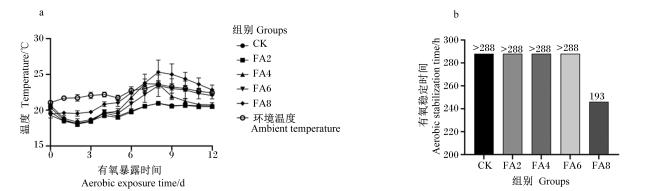
图1可知,有氧暴露第0天,FA组温度低于CK组和环境温度,随有氧暴露时间延长,CK、FA2组温度变化幅度不大,且FA2组温度始终最低。CK、FA2、FA4、FA6组青贮饲料有氧稳定时间均高于288 h,FA8组青贮饲料在有氧暴露193 h后变质。
图1 甲酸对青贮饲料桑有氧稳定性的影响

Fig.1 Effects of formic acid on aerobic stability of silage forage mulberry

2.4 甲酸对青贮饲料桑体外瘤胃发酵特性的影响

表4可知,M组DMD显著高于CK、FA2组(P<0.05),且FA2组DMD显著高于CK组(P<0.05)。3组之间IVDMD及BA、TVFA、NH3-N、GP、CH4含量无显著差异(P>0.05)。M组pH、AA/PA显著高于CK、FA2组(P<0.05)。M组AA含量显著高于FA2组(P<0.05)。CK组PA含量显著高于M、FA2组(P<0.05),FA2组PA含量显著高于M组(P<0.05)。CK组IA含量显著高于M组(P<0.05)。M组VA含量显著高于CK、FA2组(P<0.05),CK组显著高于FA2组(P<0.05)。
表4 甲酸对青贮饲料桑体外瘤胃发酵特性的影响

Table 4 Effects of formic acid on rumen fermentation characteristics of silage forage mulberry in vitro

项目
Items
组别Groups P
P-value
M CK FA2
干物质降解率DMD/% 80.22±0.46a 72.55±2.31c 76.78±0.73b 0.002
体外干物质降解率IVDMD/% 77.27±2.47 73.38±1.46 78.50±7.23 0.402
pH 6.65±0.02a 6.60±0.01b 6.58±0.03b 0.017
乙酸AA/(mmol/L) 43.84±1.18a 42.97±0.27ab 41.36±0.95b 0.036
丙酸PA/(mmol/L) 28.91±0.83c 32.75±0.12a 31.39±0.35b <0.001
乙酸/丙酸AA/PA 1.52±0.01a 1.31±0.01b 1.32±0.02b <0.001
丁酸BA/(mmol/L) 23.36±0.71 23.47±0.40 22.67±0.31 0.187
异戊酸IA/(mmol/L) 7.90±0.21b 8.53±0.33a 8.09±0.07ab 0.038
正戊酸VA/(mmol/L) 4.17±0.09a 3.96±0.07b 3.66±0.09c 0.001
总挥发性脂肪酸TVFA/(mmol/L) 108.19±3.01 111.68±1.04 106.72±2.30 0.087
氨态氮NH3-N/(mg/dL) 62.88±3.29 54.19±5.61 60.70±4.95 0.142
产气量GP/mL 122.33±2.08 118.33±4.04 115.00±11.31 0.526
甲烷CH4/mL 20.60±5.58 20.37±2.37 17.11±5.44 0.621

同行数据肩标不同小写字母表示差异显著(P<0.05),相同或无字母表示差异不显著(P>0.05)。

In the same row, values with different small letter superscripts mean significant difference (P<0.05), while with the same or no letter superscripts mean no significant difference (P>0.05).

3 讨论

3.1 甲酸对青贮饲料桑有氧暴露期间营养成分含量的影响

青贮饲料DM含量与其在青贮及有氧暴露期间发酵底物的损失程度密切相关[19]。饲料营养成分损失程度越高,其DM含量越低。饲料桑青贮90 d后,FA2、FA4、FA8组青贮饲料DM含量高于CK组,与Desta等[8]的研究结果一致,可能源于甲酸抑制了青贮饲料中植物细胞间的呼吸作用和有害微生物对青贮营养物质的代谢。有氧暴露后,饲料中好氧微生物重新活动,各组DM含量随之下降,但FA4组DM含量在各组中始终最高,表明4 mL/kg甲酸可有效减少饲料桑青贮DM损失。研究发现,甲酸可以抑制植物蛋白酶和好氧微生物活性,降低蛋白质水解程度[15],这可能是各甲酸添加组CP含量高于CK组的原因。甲酸添加水平升高而CP含量降低,可能是甲酸没能有效抑制的大肠杆菌等微生物在消耗营养物质,这与Zhao等[12]的研究结果一致。NDF和ADF是评估青贮饲料营养成分的核心指标,对反刍动物的采食量和消化率具有显著影响,其含量越低,表明青贮饲料品质越优良[20-21]。本研究表明,不同有氧暴露时间点,FA2、FA4组NDF和ADF含量相对较低,这与Jiang等[9]的研究结果一致,可能是因为甲酸抑制了植物酶活性,减少了细胞壁的降解,表明适宜甲酸添加水平才有利于饲料桑青贮纤维降解。本研究发现,青贮后各组CP和EE含量升高,这与邹诗雨等[22]的研究结果一致。这可能是因为青贮过程中发酵微生物繁殖,消耗饲料中水分和营养物质,使各组中CP和EE含量相对升高。饲粮中适宜Ash含量对满足家畜的矿物质需求至关重要[23]。本研究发现,青贮饲料中添加甲酸后,其Ash含量有所降低。这可能是由于部分酸根离子与饲料中无机盐反应,生成了分子质量较小的新盐类物质[24]。这种反应可能改变了饲料中矿物质的形态与分布,从而影响了Ash含量。研究发现,青贮饲料开包接触氧气后,其CP和EE等有机物将被好氧微生物所降解,这可能是饲料桑青贮有氧暴露后各组DM、CP和EE含量相对下降,NDF、ADF和Ash含量相对升高的原因,与刘逸超等[25]研究发现的发酵抑制剂对羊草青贮在有氧暴露后各营养成分含量变化的结果一致。

3.2 甲酸对青贮饲料桑有氧暴露期间发酵品质的影响

pH是评价青贮饲料发酵品质的关键指标,一般认为pH在3.8~4.2时青贮饲料达到良好的青贮品质[26]。本研究中,青贮饲料桑90 d开包时,CK组pH为4.22,未达到良好青贮饲料品质要求。相比之下,添加甲酸组青贮饲料桑pH均小于4.2,表明其青贮品质良好。有氧暴露期间FA4组pH相对稳定,但FA2组pH始终最低。有氧暴露第3天开始,FA6、FA8组pH逐渐升高到4.2以上,青贮饲料品质降低,这可能源于饲料接触空气后进行二次发酵,分解有机物与LA,产生大量的水和CO2,酸性环境遭到破坏[25]。有机酸含量也是影响青贮饲料发酵品质的关键指标,其中LA含量越高,饲料青贮品质越高。本试验中,饲料桑添加甲酸青贮后,乳酸菌等产酸微生物受到抑制,FA组LA、AA含量随甲酸添加水平升高而下降,与Tyrolová等[27]基于玉米青贮的研究结果一致。有氧暴露后,青贮饲料中甲酸挥发或代谢,部分被抑制的乳酸菌重新开始活动,利用青贮期间保存的碳水化合物产生LA,这可能是有氧暴露初期各组LA含量上升,部分组pH降低或稳定的原因之一[28]。Zhang等[29]研究发现,羊草青贮有氧暴露8 d后,对照组与甲酸组LA含量降低,可能源于LA被酵母菌等微生物所代谢,这与本研究有氧暴露后期各组LA含量下降结果相吻合。CK、FA2、FA8组AA含量也呈先升高后降低趋势,该过程可能是产生的LA转化为AA和CO2的原因[30]。Daniel等[31]研究发现,AA有助于提高青贮饲料暴露在空气后的有氧稳定性,这与本研究中FA8组AA含量最低且有氧稳定性最差结果一致。NH3-N的产生主要源自植物细胞呼吸和微生物代谢过程,是评估青贮饲料中蛋白质降解程度的核心指标[32]。NH3-N含量越高,表示蛋白质分解越剧烈,表明青贮饲料品质越差。本研究发现,随着甲酸添加水平的升高,各组NH3-N含量逐渐下降,说明添加甲酸能够降低NH3-N含量,改善蛋白质降解程度,提高饲料青贮品质,这与Yuan等[33]的研究结果一致。有氧暴露后,各组NH3-N含量急剧上升,可能源于好氧微生物接触空气后活动增强,蛋白质降解程度加深[34]

3.3 甲酸对青贮饲料桑体外瘤胃发酵特性的影响

DMD和IVDMD反映饲料在反刍动物瘤胃内消化程度,是评价青贮饲用价值的关键指标[21,35]。发酵底物的降解率越高,表明其饲用价值越高。未经青贮处理的新鲜牧草可保留较多原始营养成分,更易被反刍动物吸收利用,这可能是尼龙袋试验中M组DMD比CK、FA2组高的原因[36]。冯启贤等[37]研究发现,添加6 mL/kg甲酸可以促进青贮饲料在瘤胃内消化,这与本研究中FA2组DMD和IVDMD高于CK组一致。瘤胃pH是反映反刍动物瘤胃健康状况的指标之一,能显著影响瘤胃微生物菌群活动。各组瘤胃液pH均在瘤胃正常发酵范围(5.8~7.0)内,不会诱发反刍动物瘤胃酸中毒[26]。CK、FA2组瘤胃液pH显著低于M组,这可能与饲料桑青贮后呈酸性有关,这与宫斌等[38]的研究结果一致。瘤胃中碳水化合物发酵产生的VFA是反刍动物的重要能量来源,提供动物新陈代谢所需能量的70%以上[39]。VFA对反刍动物生存至关重要,主要包括AA、PA和BA等有机酸。其中,AA、PA分别是乳脂和葡萄糖合成的重要前体物质。AA/PA反映瘤胃发酵类型,PA发酵在提高饲料转化率方面发挥关键作用,能为反刍动物增重提供能量[26]。Cui等[26]研究发现,发酵底物中粗纤维含量降低,AA含量下降,PA含量增加,AA/PA降低,CH4产量会减少,能提高反刍动物能量利用效率,这与本研究结果一致。CK、FA2组AA/PA显著低于M组,表明饲料桑经青贮处理可改变瘤胃发酵模式。然而,CK、FA2组之间AA/PA差异不显著,说明添加甲酸不影响饲料桑青贮奶牛瘤胃发酵模式。瘤胃NH3-N是瘤胃微生物利用饲料中含氮物质合成菌体蛋白的主要原料[38]。各组之间NH3-N含量无显著差异,表明不同处理不影响瘤胃微生物合成速率和内源性含氮物质周转率。

4 结论

与CK组相比,添加甲酸对饲料桑青贮营养和发酵品质、有氧稳定性及体外瘤胃发酵效果均有改善作用。综合评定各项指标,当甲酸添加水平为2 mL/kg时,饲料桑青贮品质与有氧稳定性达到最佳状态,同时对奶牛瘤胃DM降解也产生积极影响。
[1]
HAO J Y, WAN Y, YAO X H, et al. Effect of different planting areas on the chemical compositions and hypoglycemic and antioxidant activities of mulberry leaf extracts in Southern China[J]. PLoS One, 2018, 13(6):e0198072.

[2]
WANG B, LUO H L. Effects of mulberry leaf silage on antioxidant and immunomodulatory activity and rumen bacterial community of lambs[J]. BMC Microbiology, 2021, 21(1):250.

DOI PMID

[3]
LIU Y Y, LI Y H, XIAO Y, et al. Mulberry leaf powder regulates antioxidative capacity and lipid metabolism in finishing pigs[J]. Animal Nutrition, 2021, 7(2):421-429.

DOI PMID

[4]
TRABI E B, YUAN X J, LI J F, et al. Effect of glucose and lactic acid bacteria on the fermentation quality,chemical compositions and in vitro digestibility of mulberry (Morus alba) leaf silage[J]. Pakistan Journal of Zoology, 2017, 49(6):2271-2277.

[5]
FERRERO F, TABACCO E, PIANO S, et al. Temperature during conservation in laboratory silos affects fermentation profile and aerobic stability of corn silage treated with Lactobacillus buchneri,Lactobacillus hilgardii,and their combination[J]. Journal of Dairy Science, 2021, 104(2):1696-1713.

[6]
张颖超, 尹守亮, 王一炜, 等. 木本饲料青贮研究进展[J]. 生物技术通报, 2021, 37(9):48-57.

DOI

ZHANG Y C, YIN S L, WANG Y W, et al. Research progress in woody forage silage[J]. Biotechnology Bulletin, 2021, 37(9):48-57. (in Chinese)

[7]
WILKINSON J M, DAVIES D R. The aerobic stability of silage:key findings and recent developments[J]. Grass and Forage Science, 2013, 68(1):1-19.

[8]
DESTA S T, YUAN X J, LI J F, et al. Ensiling characteristics,structural and nonstructural carbohydrate composition and enzymatic digestibility of Napier grass ensiled with additives[J]. Bioresource Technology, 2016,221:447-454.

[9]
JIANG F G, CHENG H J, LIU D, et al. Treatment of whole-plant corn silage with lactic acid bacteria and organic acid enhances quality by elevating acid content,reducing pH,and inhibiting undesirable microorganisms[J]. Frontiers in Microbiology, 2020,11:593088.

[10]
MUCK R E, NADEAU E M G, MCALLISTER T A, et al. Silage review:recent advances and future uses of silage additives[J]. Journal of Dairy Science, 2018, 101(5):3980-4000.

[11]
LORENZ M M, UDÉN P. Influence of formic acid and dry matter on protein degradation in the tanniniferous legume sainfoin[J]. Animal Feed Science and Technology, 2011, 164(3/4):217-224.

[12]
ZHAO J, WANG S R, DONG Z H, et al. Effect of storage time and the level of formic acid on fermentation characteristics,epiphytic microflora,carbohydrate components and in vitro digestibility of rice straw silage[J]. Animal Bioscience, 2021, 34(6):1038-1048.

[13]
KUNG L Jr, RANJIT N K. The effect of Lactobacillus buchneri and other additives on the fermentation and aerobic stability of barley silage[J]. Journal of Dairy Science, 2001, 84(5):1149-1155.

[14]
SALAWU M B, WARREN E H, ADESOGAN A T. Fermentation characteristics,aerobic stability and ruminal degradation of ensiled pea/wheat bi-crop forages treated with two microbial inoculants,formic acid or quebracho tannins[J]. Journal of the Science of Food and Agriculture, 2001, 81(13):1263-1268.

[15]
WEI S N, LI Y F, JEONG E C, et al. Effects of formic acid and lactic acid bacteria inoculant on main summer crop silages in Korea[J]. Journal of Animal Science and Technology, 2021, 63(1):91-103.

DOI PMID

[16]
彭丽娟, 李孟伟, 杨承剑, 等. 甘蔗尾青贮发酵剂的研制及其对青贮发酵品质的影响[J]. 饲料研究, 2020, 43(7):94-98.

PENG L J, LI M W, YANG C J, et al. Preparation of sugarcane tail silage fermentation agent and its effect on the quality of silage fermentation[J]. Feed Research, 2020, 43(7):94-98. (in Chinese)

[17]
ZHANG H, WU J, ZHAO X, et al. Improving aerobic stability and methane production of maize stover silage with lactic acid bacteria inoculants:focus on pentose-fermentation[J]. Industrial crops and products, 2023,201:116861.

[18]
LIU Z H, WANG K, NAN X M, et al. Effects of combined addition of 3-nitrooxypropanol and vitamin B12 on methane and propionate production in dairy cows by in vitro-simulated fermentation[J]. Journal of Dairy Science, 2023, 106(1):219-232.

[19]
DONG L F, ZHANG H S, GAO Y H, et al. Dynamic profiles of fermentation characteristics and bacterial community composition of Broussonetia papyrifera ensiled with perennial ryegrass[J]. Bioresource Technology, 2020,310:123396.

[20]
GAO X, HOU M J, FU X Y, et al. Effect of replacing corn straw by sweet sorghum silage or whole plant corn silage in sheep diets on rumen fermentation and bacterial flora[J]. Animal, 2023, 17(8):100906.

[21]
何晓琳, 王胜男, 肖艺梅, 等. 收获时间与留茬高度对桂青贮7号青贮玉米体外消化特性的影响[J]. 动物营养学报, 2024, 36(2):1315-1330.

DOI

HE X L, WANG S N, XIAO Y M, et al. Effects of harvest time and stubble height on in vitro digestive characteristics of Gui silage No.7 silage maize[J]. Chinese Journal of Animal Nutrition, 2024, 36(2):1315-1330. (in Chinese)

[22]
邹诗雨, 陈东, 唐启源, 等. 青贮时间对再生稻头季全株青贮品质和体外瘤胃发酵特性的影响[J]. 动物营养学报, 2020, 32(7):3282-3290.

DOI

ZOU S Y, CHEN D, TANG Q Y, et al. Effects of silage time on quality and in vitro rumen fermentation characteristics of first season ratoon rice whole silage[J]. Chinese Journal of Animal Nutrition, 2020, 32(7):3282-3290. (in Chinese)

[23]
张林鑫, 吴仙, 李莉娜, 等. 8种青饲料营养成分及其饲用价值的研究[J]. 中国畜禽种业, 2023, 19(5):66-71.

ZHANG L X, WU X, LI L N, et al. Study on nutritional components and feeding value of 8 kinds of green feed[J]. The Chinese Livestock and Poultry Breeding, 2023, 19(5):66-71. (in Chinese)

[24]
华世旋, 陈艳萍, 黑银川, 等. 不同添加剂对杂交构树青贮饲料营养成分和发酵品质、能量及体外消化率的影响[J]. 现代畜牧科技, 2023(6):42-45.

HUA S X, CHEN Y P, HEI Y C, et al. Effects of different additives on the nutrients,fermentation quality,energy and in vitro digestibility of Broussonetia papyrifera silage[J]. Modern Animal Husbandry Science & Technology, 2023(6):42-45. (in Chinese)

[25]
刘逸超, 孙鹏波, 张佳伟, 等. 发酵抑制剂对羊草青贮品质和有氧稳定性的影响[J]. 草地学报, 2023, 31(8):2564-2570.

DOI

LIU Y C, SUN P B, ZHANG J W, et al. Effect of fermentation inhibitors on quality and aerobic stability of Leymus chinensis silage[J]. Acta Agrestia Sinica, 2023, 31(8):2564-2570. (in Chinese)

[26]
CUI Y L, LIU H, GAO Z M, et al. Whole-plant corn silage improves rumen fermentation and growth performance of beef cattle by altering rumen microbiota[J]. Applied Microbiology and Biotechnology, 2022, 106(11):4187-4198.

[27]
TYROLOVÁ Y, BARTOÑ L, LOUČKA R. Effects of biological and chemical additives on fermentation progress in maize silage[J]. Czech Journal of Animal Science, 2017, 62(7):306-312.

[28]
BRITT D G, HUBER J T, ROGERS A L. Fungal growth and acid production during fermentation and refermentation of organic acid treated corn silages[J]. Journal of Dairy Science, 1975, 58(4):532-539.

PMID

[29]
ZHANG Q, YU Z, NA R S. Effects of different additives on fermentation quality and aerobic stability of Leymus chinensis silage[J]. Grass and Forage Science, 2018, 73(2):413-419.

[30]
ROMERO J J, ZHAO Y, BALSECA-PAREDES M A, et al. Laboratory silo type and inoculation effects on nutritional composition,fermentation,and bacterial and fungal communities of oat silage[J]. Journal of Dairy Science, 2017, 100(3):1812-1828.

[31]
DANIEL J L P, CHECOLLI M, ZWIELEHNER J, et al. The effects of Lactobacillus kefiri and L. brevis on the fermentation and aerobic stability of sugarcane silage[J]. Animal Feed Science and Technology, 2015,205:69-74.

[32]
LI X J, TIAN J P, ZHANG Q, et al. Effects of mixing red clover with alfalfa at different ratios on dynamics of proteolysis and protease activities during ensiling[J]. Journal of Dairy Science, 2018, 101(10):8954-8964.

DOI PMID

[33]
YUAN X J, WEN A Y, DESTA S T, et al. Effects of four short-chain fatty acids or salts on the dynamics of nitrogen transformations and intrinsic protease activity of alfalfa silage[J]. Journal of the Science of Food and Agriculture, 2017, 97(9):2759-2766.

DOI PMID

[34]
周燚, 张娟, 刘一佳, 等. 丙酸对杂交狼尾草青贮品质及微生物区系的影响[J]. 动物营养学报, 2023, 35(8):5404-5417.

DOI

ZHOU Y, ZHANG J, LIU Y J, et al. Effects of propionic acid on silage quality and microbial community of hybrid Pennisetum silage[J]. Chinese Journal of Animal Nutrition, 2023, 35(8):5404-5417. (in Chinese)

DOI

[35]
户林其, 郭伟婷, 赵晓静, 等. 体外产气法评定不同留茬高度对全株玉米青贮体外发酵指标的影响[J]. 饲料研究, 2022, 45(4):61-66.

HU L Q, GUO W T, ZHAO X J, et al. Effect of different stubble heights on in vitro fermentation indexes of whole maize silage by in vitro gas production method[J]. Feed Research, 2022, 45(4):61-66. (in Chinese)

[36]
ZHAO J, DONG Z H, LI J F, et al. Ensiling as pretreatment of rice straw:the effect of hemicellulase and Lactobacillus plantarum on hemicellulose degradation and cellulose conversion[J]. Bioresource Technology, 2018,266:158-165.

[37]
冯启贤, 张磊, 李妍, 等. 甲酸处理对苜蓿青贮品质及瘤胃降解率的影响[J]. 草地学报, 2023, 31(4):1264-1272.

DOI

FENG Q X, ZHANG L, LI Y, et al. Effects of formic acid treatment on the quality and rumen degradation rate of alfalfa silage[J]. Acta Agrestia Sinica, 2023, 31(4):1264-1272. (in Chinese)

[38]
宫斌, 檀论, 侯坤, 等. 杂交构树青贮对奶公牛生长性能、营养物质表观消化率和瘤胃发酵参数的影响[J]. 动物营养学报, 2023, 35(6):3771-3779.

DOI

GONG B, TAN L, HOU K, et al. Effects of hybrid Broussonetia papyrifera silage on growth performance,nutrient apparent digestibility and rumen fermentation parameters of fattening dairy bulls[J]. Chinese Journal of Animal Nutrition, 2023, 35(6):3771-3779. (in Chinese)

DOI

[39]
LUO Y, PFISTER P, LEISINGER T, et al. The genome of archaeal prophage PsiM100 encodes the lytic enzyme responsible for autolysis of Methanothermobacter wolfeii[J]. Journal of Bacteriology, 2001, 183(19):5788-5792.

Outlines

/