RESEARCH PAPER

Effects of Replacing Algal Powder with Fermented Algal Powder on Growth Performance, Intestinal Digestive Enzyme Activities, Antioxidant Indexes and Microbial Diversity of Apostichopus japonicus

  • LI Lu ,
  • LIU Jingxi ,
  • LI Baoshan ,
  • WANG Fuchen ,
  • WANG Chengqiang ,
  • LI Peiyu ,
  • HAO Tiantian ,
  • WANG Xiaoyan ,
  • WANG Jiying , *
Expand
  • Yantai Key Laboratory of Quality and Safety Control and Deep Processing of Marine Food, Shandong Key Laboratory of Marine Ecological Restoration, Aquatic Animal Nutrition and Feed R&D Innovation Demonstration Platform, Shandong Marine Fishery Feed Engineering Technology Research Center, Shandong Marine Resource and Environment Research Institute, Yantai 264006, China
*professor, E-mail:

Received date: 2024-03-29

  Online published: 2024-10-14

Abstract

This study aimed to investigate the effects of replacing algal powder with fermented algal powder on growth performance, intestinal digestive enzyme activities, antioxidant indexes and microbial diversity of Apostichopus japonicus. A total of 480 healthy Apostichopus japonicus with average weight of (68.10±1.45) g were randomly divided into 4 groups with 3 replicates per group and 40 sea cucumber per replicate. Apostichopus japonicus in control group were fed a basal diet, and those in three replacement groups were cultured with fermenting algae powder instead of 10%, 20% and 30% algae powder of the basal diet, respectively. The culture cycle was 40 days. After the end of culture experiment, samples were taken to analyze growth performance, body composition, intestinal digestive enzyme activities, antioxidant indexes and microbial diversity. The results showed that with the increase of the replacement amount of fermented algae powder, the weight gain rate, specific growth rate and body crude protein content of Apostichopus japonicus firstly increased and then decreased, and reached the highest when the replacement amount was 10%, which was significantly higher than that in the control group (P<0.05). The body crude lipid content of Apostichopus japonicus in all replacement groups was significantly lower than that in the control group (P<0.05), and the body crude ash content of Apostichopus japonicus in 10% and 20% replacement groups was significantly lower than that in the control group (P<0.05). Intestinal amylase activity increased firstly and then decreased with the increase of the replacement amount of fermented algae powder, and reached the highest when the replacement amount was 10%, which was significantly higher than that of the control group and 30% replacement group (P<0.05). The activity of intestinal protease increased after the replacement of fermented algal powder, but there was no significant differences among groups (P>0.05). Intestinal total antioxidant capacity (T-AOC) increased and then leveled off, the highest in the 10% replacement group and significantly higher than that of control group (P<0.05). Intestinal catalase (CAT) activity increased after the replacement of fermented algal powder, but there was no significant difference compared with the control group (P>0.05). The intestinal villus height showed a trend of increasing and then decreasing, and the 10% replacement group reached the highest, which was significantly higher than that of other groups (P<0.05). The replacement of 10% algae powder by fermented algae powder increased the Ace index, Chao index and Sobs index of intestinal flora, and Firmicutes, Proteobacteria and Cyanobacteria became the dominant bacteria. In conclusion, an appropriate amount (10%) of fermented algal powder can improve the intestinal digestive function and antioxidant ability by enriching intestinal microbial diversity, and then promote the growth and protein deposition of Apostichopus japonicus.

Cite this article

LI Lu , LIU Jingxi , LI Baoshan , WANG Fuchen , WANG Chengqiang , LI Peiyu , HAO Tiantian , WANG Xiaoyan , WANG Jiying . Effects of Replacing Algal Powder with Fermented Algal Powder on Growth Performance, Intestinal Digestive Enzyme Activities, Antioxidant Indexes and Microbial Diversity of Apostichopus japonicus[J]. Chinese Journal of Animal Nutrition, 2024 , 36(10) : 6620 -6630 . DOI: 10.12418/CJAN2024.563

刺参(Apostichopus japonicus),又名仿刺参,是我国传统的名贵海珍品,富含蛋白质和多糖等营养物质,并含有铁、钙等人体必需微量元素,具有很高的食用价值和药用价值。随着人们生活水平的提高,对刺参等名贵海珍品的需求也逐渐增加,加快了刺参养殖产业的发展。藻粉是刺参饲料的主要成分,然而刺参对藻粉利用率不高的问题较为突出,如何提高饲料中藻粉的利用率进而降低养殖成本实现高效绿色养殖,成为海参养殖产业亟待解决的问题。
生物发酵技术可通过生化反应将饲料原料进行预消化,得到一些小分子营养物质[1],并适当消除发酵底物中的抗营养因子,从而有效提高养殖动物对饲料的利用率[2-4]。同时,发酵饲料内益生菌可定植于养殖动物肠道和水环境,丰富肠道菌群及水体物种多样性,有利于生态健康养殖。较为常见的生物发酵手段是对水产动物饲料原料进行发酵,目的是将饲料原料中的大分子蛋白质分解为小肽,同时丰富肠道菌群多样性,使其更好地被机体吸收利用,使饲料原料发挥出最大的营养价值,从而降低养殖成本,实现高效生态养殖。目前有关发酵饲料原料的研究多集中于豆粕等植物蛋白质原料[5-6]和农副产物(如家禽肉粉、虾头废弃物和羽毛粉),多项研究证明发酵饲料原料的替代可有效提高饲料利用率、促进消化并提高抗氧化能力[7-9]。对刺参发酵饲料的研究大多是对发酵全价饲料进行探索,对发酵藻粉的研究相对较少[10]。作为刺参饲料的主要蛋白质源,探究发酵藻粉对刺参的影响在高效健康养殖领域具有重要意义。因此,本试验通过对刺参饲料原料——藻粉进行生物发酵,并用其部分替代饲料中的未发酵藻粉,采用近海自然水域筏式吊笼养殖模式,探究发酵藻粉对近海养殖刺参生长性能以及肠道消化能力、抗氧化能力及微生物多样性的影响,以期提高刺身对藻粉的消化利用,为刺参的高效生态养殖提供参考。

1 材料与方法

1.1 试验设计

本试验所用饲料原料均来自山东升索饲料科技有限公司,所用藻粉为鼠尾藻、马尾藻和海带混合制成的商用藻粉。所用发酵菌种有酿酒酵母菌、枯草芽孢杆菌及植物乳杆菌,其中植物乳杆菌(1×10¹⁰ CFU/g)购自青岛根源生物集团,枯草芽孢杆菌、酿酒酵母菌(2×1010 CFU/g)购自青岛蔚蓝生物股份有限公司。使用复合菌剂(酿酒酵母菌∶枯草芽孢杆菌∶植物乳杆菌=1∶1∶1)在35 ℃下发酵藻粉3 d,将发酵藻粉烘干粉碎,过200目筛后备用。藻粉与发酵藻粉的粗蛋白质和酸溶蛋白含量见表1。配制4种试验饲料,分别以0(D0)、10%(D1)、20%(D2)及30%(D3)的发酵藻粉替代基础饲料中的藻粉,试验饲料组成及营养水平见表2。将所有饲料原料粉碎过200目标准筛,按配方中比例称重后逐级混匀,与适量新鲜蒸馏水混合,挤压成厚度为2 mm的片状饲料后室温风干,储存于-20 ℃冰箱备用。
表1 藻粉与发酵藻粉的粗蛋白质和酸溶蛋白含量(干物质基础)

Table 1 Crude protein and acid soluble protein contents of algal powder and fermented algal powder (DM basis)%

项目
Items
藻粉
Algal powder
发酵藻粉
Fermented algal powder
粗蛋白质 Crude protein 19.54 17.84
酸溶蛋白 Acid soluble protein 5.95 10.09
表2 试验饲料组成及营养水平(干物质基础)

Table 2 Composition and nutrient levels of experimental diets (DM basis)%

项目
Items
饲料 Diets
D0 D1 D2 D3
原料 Ingredients
鱼粉 Fish meal 7.00 7.00 7.00 7.00
豆粕 Soybean meal 4.00 4.00 4.00 4.00
藻粉 Algal powder 33.00 29.60 26.20 23.00
发酵藻粉 Fermented algal powder 3.40 6.80 10.00
α-淀粉 α-starch 5.90 5.90 5.90 5.90
维生素预混料 Vitamin premix1) 1.00 1.00 1.00 1.00
矿物质预混料 Mineral premix2) 1.00 1.00 1.00 1.00
抗氧化剂 Antioxidant 0.10 0.10 0.10 0.10
海泥 Sea mud 48.00 48.00 48.00 48.00
合计 Total 100.00 100.00 100.00 100.00
营养水平 Nutrient levels3)
粗蛋白质 Crude protein 14.95 14.89 14.87 14.90
粗脂肪 Crude lipid 0.30 0.28 0.29 0.28
粗灰分 Crude ash 55.04 54.97 54.88 55.19

1)维生素预混料为每千克饲料提供 Vitamin premix provided the following per kg of diets:VA 7 500.00 IU,VD 1 500.00 IU,VE 60.00 mg,VK3 18.00 mg,VB1 12.00 mg,VB2 12.00 mg,VB12 0.10 mg,泛酸 pantothenic acid 48.00 mg,烟酰胺 nicotinamide 90.00 mg,叶酸 folic acid 3.70 mg,D-生物素 D-biotin 0.20 mg,吡哆醇 pyridoxine 60.00 mg,VC 310.00 mg。

2)矿物质预混料为每千克饲料提供 Mineral premix provided the following per kg of diets:Zn 35.00 mg,Mn 21.00 mg,Cu 8.30 mg,Fe 23.00 mg,Co 1.20 mg,I 1.00 mg,Se 0.30 mg。

3)营养水平均为实测值。Nutrient levels were measured values.

1.2 饲养管理及样品采集

养殖试验开展于烟台市芝罘岛东口码头,采用近海自然水域筏式吊笼养殖模式,所用刺参均为当地养殖。挑选状态健康、均重为(68.10±1.45) g的刺参480头,随机分为4组,即D0(对照)、D1、D2、D3组,对应投喂4种试验饲料,每组3个重复,每个重复的40头参放置于1个吊笼内,将吊笼挂至近海水域木筏上进行养殖。养殖环境随海湾自然海水环境而变,养殖水温在17~20 ℃。养殖周期为40 d,每隔1 d定时饱食投喂1次,投喂量为2.5 g/头,取样前24 h停止投喂。养殖试验结束时,对刺参进行称重并记录,然后每个吊笼随机选取1头刺参(每组3头),用于检测体常规营养成分含量;每个吊笼随机选取2头刺参(每组6头),无菌条件下解剖取肠道组织及肠道内容物,冻存于-80 ℃用于检测肠道组织消化酶活性、抗氧化指标及肠道菌群;每个吊笼再随机选取1头刺参(每组3头),解剖取肠道组织,使用波恩氏液固定,用于组织形态学观察及肠道绒毛高度测量。

1.3 指标测定

1.3.1 生长性能指标的计算

养殖试验开始前及结束后对刺参进行称重,分别记录为初始体重及终末体重,用于计算增重率和特定生长率。

增重率(%)=100×(终末体重-初始体重)/初始体重;

特定生长率(SGR,%/d)=100×(ln终末体重-ln初始体重)/试验天数。

1.3.2 常规营养成分的检测

将全参烘干磨碎后取全参粉末检测常规营养成分含量。试验饲料和全参中粗蛋白质含量使用凯氏定氮法(GB/T 6432—2018)测定,粗脂肪含量使用索氏抽提法(石油醚为溶剂,GB/T 6433—2006)测定,粗灰分含量使用高温灼烧法(GB/T 6438—2007)测定。藻粉、发酵藻粉中酸溶蛋白含量参照《饲料原料中酸溶蛋白的测定》(NY/T 3801—2020)进行测定,粗蛋白质含量使用凯氏定氮法(GB/T 6432—2018)测定。

1.3.3 肠道消化酶活性、抗氧化指标及肠道绒毛高度的检测

使用南京建成生物工程研究所生产的试剂盒检测肠道组织淀粉酶、蛋白酶活性以及总抗氧化能力(T-AOC)、过氧化氢酶(CAT)活性。
肠道组织经脱水、包埋、切片等操作后,进行苏木精-伊红(HE)染色,在10倍物镜下观察肠道组织状态,测量肠道绒毛高度。

1.3.4 肠道菌群的检测

利用细菌通用引物338F(5'-ACTCCTACGGGAGGCAGCAG-3')和806R(5'-GGACTACHVGGGTWTCTAAT-3')对细菌的16S rDNA进行PCR扩增,送至上海美吉生物医药科技有限公司进行高通量测序,在美吉生物云平台对测序所得数据进行生物信息学分析。测序过程中生成的原始fastq文件在QIIME1.7平台使用先前建立的标准[11-12]进行分析。通过使用UPARSE(7.1)以97%的相似性阈值聚类对reads进行去噪并生成操作分类单元(OTU)[13]。使用Mothur v.1.30.1运行获得维恩图和alpha多样性指数[14]。采用Kruskal-Wallis秩和检验检测菌群类群间的差异特征,并用线性判别分析(LDA)量化有显著差异特征的效应量。

1.4 数据统计与分析

采用SPSS 17.0软件进行单样本t检验检测数据分布的正态性,若数据服从正态分布,对数据进行单因素方差分析,若检测到显著性则采用Duncan氏法进行组间差异性的多重比较。结果以“平均值±标准误”表示,P<0.05表示差异显著。

2 结果与分析

2.1 发酵藻粉替代藻粉对刺参生长性能及体成分的影响

发酵藻粉替代藻粉对刺参生长性能及体成分的影响见表3。随着发酵藻粉替代量的增加,刺参的增重率与特定生长率均呈现先升高后降低的趋势,均在D1组达到最高,显著高于D0组(P<0.05),且较D0组均提高了近1倍,其他2个替代组与D0组相比无显著差异(P>0.05),说明发酵藻粉替代10%藻粉可以有效促进刺参生长;随着发酵藻粉替代量的增加,全参粗蛋白质含量呈现先升高后降低的趋势,在D1组达到最高,D1组和D2组显著高于D0组与D3组(P<0.05),而D3组则低于D0组(P>0.05),可见发酵藻粉替代量过高会降低全参粗蛋白质含量;与D0组相比,D1组、D2组和D3组全参粗脂肪含量均显著降低(P<0.05),且以D1组最低,但D1组、D2组、D3组之间无显著差异(P>0.05),说明发酵藻粉替代藻粉会降低全参的粗脂肪含量;D1组、D2组的全参粗灰分含量均显著低于D0组(P<0.05),D3组与D0组无显著差异(P>0.05)。
表3 发酵藻粉替代藻粉对刺参生长性能及体成分的影响

Table 3 Effects of replacing algal powder with fermented algal powder on growth performance and body composition of Apostichopus japonicus

项目
Items
组别 Groups
D0 D1 D2 D3
生长性能指标 Growth performance indexes
初始体重 IBW/g 68.09±0.23 68.15±0.18 68.16±0.29 67.95±0.39
终末体重 FBW/g 71.70±1.79 75.09±0.84 73.31±0.78 72.71±0.16
增重率 WGR/% 5.28±2.28a 10.16±1.05b 7.56±0.69ab 7.01±0.39ab
特定生长率 SGR/(%/d) 0.13±0.05a 0.24±0.02b 0.18±0.02ab 0.17±0.01ab
体成分(干物质基础) Body composition (DM basis)/%
粗蛋白质 Crude protein 55.71±0.08a 56.88±0.28b 56.81±0.02b 55.50±0.30a
粗脂肪 Crude lipid 4.53±0.39b 2.48±0.42a 2.78±0.20a 2.85±0.26a
粗灰分 Crude ash 26.96±0.27c 25.46±0.09a 26.08±0.06ab 26.42±0.30bc

同行数据肩标不同字母表示差异显著(P<0.05)。下表同。

In the same row, values with different letter superscripts represented significant difference (P<0.05). The same as below.

2.2 发酵藻粉替代藻粉对刺参肠道消化酶活性和抗氧化指标的影响

发酵藻粉替代藻粉对刺参肠道消化酶活性和抗氧化指标的影响见表4。肠道蛋白酶活性随着发酵藻粉替代量的增加呈现先升高后降低至平稳的趋势,在D1组达到最高值,但各组之间无显著差异(P>0.05);肠道淀粉酶活性随着发酵藻粉替代量的增加呈现先升高后降低的趋势,在D1组达到最高,并显著高于D0组和D3组(P<0.05)。肠道CAT活性随着发酵藻粉替代量的增加呈现先升高后降低的趋势,D1组和D2组高于D0组和D3组,但各组之间无显著差异(P>0.05);肠道T-AOC在D1组最高,显著高于D0组(P<0.05),其他各组之间无显著差异(P>0.05)。
表4 发酵藻粉替代藻粉对刺参肠道消化酶活性和抗氧化指标的影响

Table 4 Effects of replacing algal powder with fermented algal powder on intestinal digestive enzyme activities and antioxidant indexes of Apostichopus japonicus

项目
Items
组别 Groups
D0 D1 D2 D3
蛋白酶 Protease/(U/g) 0.95±0.19 1.25±0.53 1.12±0.32 1.14±0.57
淀粉酶 Amylase/(U/mg) 0.28±0.01a 0.46±0.04b 0.36±0.03ab 0.30±0.02a
过氧化氢酶 CAT/(U/mg) 0.79±0.11 1.25±0.16 1.25±0.18 1.18±0.15
总抗氧化能力 T-AOC/(U/mg) 0.04±0.02a 0.17±0.05b 0.09±0.01ab 0.16±0.02ab

2.3 发酵藻粉替代藻粉对刺参肠道绒毛高度及菌群的影响

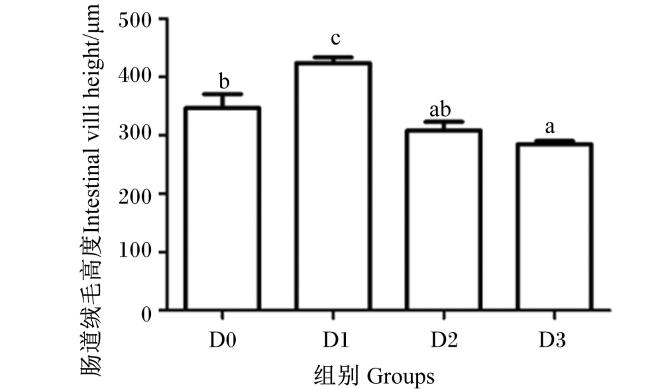
发酵藻粉替代藻粉对刺参肠道结构的影响见图1。与D0组相比,D1组肠道绒毛高度显著升高(P<0.05),D3组肠道绒毛高度显著降低(P<0.05),D2组则无显著变化(P>0.05);此外,D1组肠道绒毛高度显著高于D2组和D3组(P<0.05)。
图1 发酵藻粉替代藻粉对刺参肠道绒毛高度的影响

数据柱标注不同字母表示差异显著(P<0.05)。下图同。

Fig.1 Effects of replacing algal powder with fermented algal powder on intestinal villi height of Apostichopus japonicus

Data columns with different letters represented significant difference (P<0.05). The same as below.

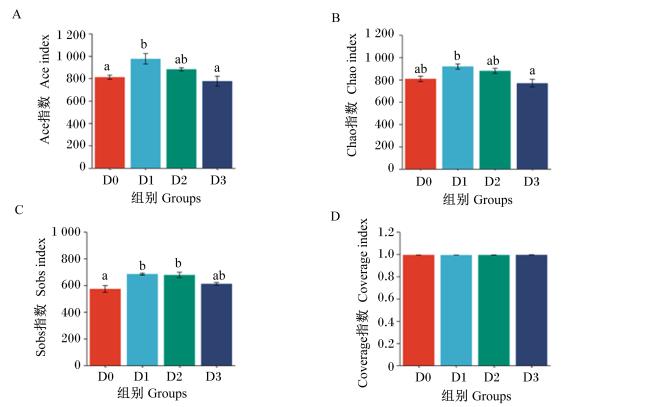
发酵藻粉替代藻粉对刺参肠道菌群多样性的影响见图2。与D0组和D3组相比,D1组的Ace指数显著升高(P<0.05)(图2-A),其他组之间无显著差异(P>0.05)。与D3组相比,D1组的Chao指数显著升高(P<0.05)(图2-B),其他组之间无显著差异(P>0.05)。与D0组相比,D1组和D2组的Sobs指数显著升高(P<0.05),其他组之间无显著差异(P>0.05)(图2-C)。各组的Coverage指数均大于0.99,各组之间无显著差异(P>0.05)(图2-D)。
图2 发酵藻粉替代藻粉对刺参肠道菌群多样性的影响

Fig.2 Effects of replacing algal powder with fermented algal powder on intestinal microbial diversity of Apostichopus japonicus

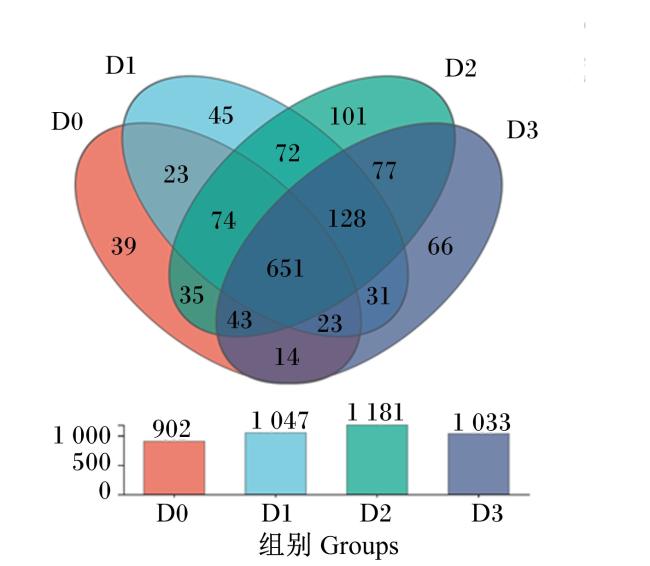
图3可知,在D0组、D1组、D2组和D3组中分别鉴定出了902、1 047、1 181和1 033个核心OTU,其中独特核心OTU的数量分别为39、45、101和66个,D1组、D2组和D3组共有OTU数量为128个。
图3 基于OTU的维恩图

Fig.3 Venn diagram based on OTU

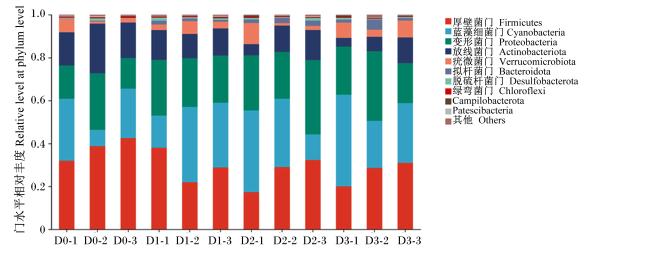
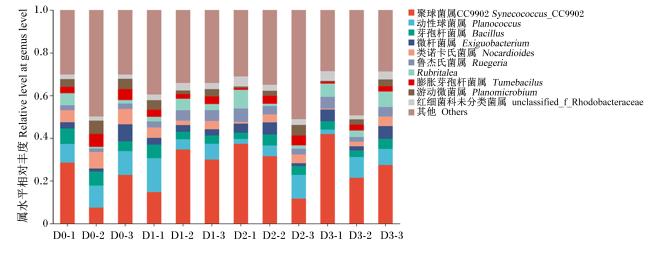
刺参肠道菌群在门和属水平上的组成情况分别见图4图5。在门水平上,D0组的主要优势菌为厚壁菌门(Firmicutes)和变形菌门(Proteobacteria),从D0组到D1组,变形菌门的相对丰度略微降低,蓝藻细菌门(Cyanobacteria)的相对丰度由19.68%升高至26.78%。随着发酵藻粉替代量的逐渐升高,在D1组、D2组和D3组厚壁菌门(相对丰度依次为29.54%、26.18%和24.49%)、变形菌门(相对丰度依次为23.56%、27.41%和24.50%)和蓝藻细菌门(相对丰度依次为26.78%、27.28%和30.84%)逐渐成为优势菌。在属水平上,D0组的主要优势菌为聚球菌属_CC9902(Synechococcus_CC9902)和动性球菌属(Planococcus),且聚球菌属_CC9902的相对丰度随着发酵藻粉添加量的增加逐渐上升,成为D1组、D2组和D3组(相对丰度依次为26.47%、26.86%和30.26%)的优势菌。
图4 刺参肠道菌群在门水平上的组成

D0-1、D0-2、D0-3为D0组的3个样本,D1-1、D1-2、D1-3为D1组的3个样本,D2-1、D2-2、D2-3为D2组的3个样本,D3-1、D3-2、D3-3为D3组的3个样本。下图同。

Fig.4 Composition of intestinal microbial flora of Apostichopus japonicus at phylum level

D0-1, D0-2, D0-3 were three samples of D0 group, D1-1, D1-2, D1-3 were three samples of D1 group, D2-1, D2-2, D2-3 were three samples of D2 group, and D3-1, D3-2, D3-3 were three samples of D3 group. The same as below.

图5 刺参肠道菌群在属水平上的组成

Fig.5 Composition of intestinal microbial flora of Apostichopus japonicus at genus level

3 讨论

本研究发现,发酵藻粉替代适量的普通藻粉可显著提高刺参的增重率和特定生长率,有效提高刺参的生长性能,并能提高刺参的粗蛋白质含量,降低粗灰分和粗脂肪含量,优化刺参的蛋白质沉积及营养价值。对配合饲料原料进行发酵的研究在水产动物中已有涉足。研究显示,使用益生菌发酵羽毛粉替代鱼粉,可有效提高尼罗罗非鱼[9]、虹鳟[15]和非洲鲶[16]的生长性能、饲料利用率和肠道消化水平,从而提高养殖鱼种的品质。在锦鲤饲料中使用发酵南极磷虾粉替代未发酵南极磷虾粉进行投喂试验,结果显示,适量发酵南极磷虾粉可以有效提高锦鲤的终末体重、增重率和特定生长率等生长指标,并可改善锦鲤体色,提高经济价值[17]。使用发酵葵花籽粕替代鱼粉可以提高罗非鱼的增重、特定生长率和摄食量[18]。结合生化指标和肠道健康结果推测,适量发酵藻粉的替代对生长性能的优化可能是由有益菌刺激肠道消化吸收引起的。综合上述结果得到初步结论,发酵蛋白质源可以有效提高养殖动物的生长性能,并能优化养殖动物的品质。
本试验结果显示,适量发酵藻粉(10%)可优化肠道抗氧化功能。刺参肠道T-AOC和CAT活性随着发酵藻粉替代量的增加呈现先升高后降低的趋势,在发酵藻粉替代量为10%时达到最高,说明发酵藻粉替代10%藻粉可有效提高刺参的肠道抗氧化能力。王凤军等[19]使用发酵饲料投喂刺参后发现,较投喂未发酵饲料组而言,投喂发酵饲料组刺参存活率显著升高,体腔液中非特异性免疫相关酶活性显著升高,即饲料经发酵后可以提高刺参的非特异性免疫功能。出现该现象的原因推测与藻粉发酵时对大分子营养物质的预消化有关。普通饲料中大分子营养物质通过肠道消化吸收进入机体内,一些机体较难吸收的物质和抗营养因子会刺激肠道发生各种应激反应,相关生化指标出现负面改变,进而影响机体的抗氧化能力[20]。而生物发酵可将大分子营养物质预消化为小分子,同时消除抗营养因子,提高营养物质吸收率,缓解肠道出现抗氧化及应激现象,进而提高机体的非特异性免疫能力[21]。与此同时,肠道微生物中的一些优势菌种(如厚壁菌门)也可促进机体消化吸收相关营养物质,从而提高机体抗氧化能力[22]。在其他物种的研究中也得到了类似的结论。在虹鳟的研究中发现,使用添加益生菌发酵的饲料饲喂虹鳟可以降低虹鳟的应激,增强血清和黏液中抗氧化和免疫防御成分的作用[23]。使用发酵豆粕部分替代凡纳滨对虾饲料中的鱼粉可以提高肝胰腺中抗氧化酶活性,上调免疫相关基因的相对表达量[24]。研究发现,在牙鲆幼鱼饲料中添加发酵金枪鱼副产物可以提高牙鲆幼鱼血清中超氧化物歧化酶等抗氧化相关酶的活性及非特异性免疫性能[25]
丰富肠道菌群的多样性可以提高肠道消化能力,优化肠道结构,加快代谢,促进生长。本研究中,发酵藻粉替代10%藻粉后刺参肠道菌群的Ace指数和Sobs指数显著升高,说明肠道菌群的丰富度较高,发酵藻粉提高了肠道菌群多样性,改变了刺参肠道菌群结构。Lu等[26]在罗非鱼饲料中添加发酵豆粕后发现,Simpson指数、Shannon指数和Chao等多样性指数显著升高,提高了罗非鱼肠道菌群的丰富度。He等[27]在大口黑鲈饲料中使用发酵豆粕替代鱼粉后发现,肠道菌群Chao、Shannon和Sobs指数有效提高,即发酵饲料可以增加肠道微生物多样性;与此同时,各发酵组OTU数量也增加,说明发酵豆粕丰富的肠道菌群的多样性。在其他相关研究中也得到类似结论。在大口黑鲈幼鱼饲料中使用发酵豆粕替代鱼粉可以有效提高肠道OTU数量[28]。使用益生菌发酵饲料饲喂刺参后,各试验组较对照组而言肠道菌群多样性和丰富度均明显提高,OTU数量也出现升高状态[29]。采用益生菌发酵饲料饲喂草金鱼可以有效提高肠道Shannon指数、Ace指数和Sobs指数,并可提高肠道OTU数量[30]
发酵藻粉的添加增加了肠道有益菌的多样性,在改善肠道结构的同时提高了肠道的抗氧化功能,从而促进刺参生长。本研究中,门水平下,相比对照组而言,各替代组蓝藻细菌门的相对丰度有所提高,致使厚壁菌门、变形菌门和蓝藻细菌门共同作为优势菌存在。厚壁菌门相对丰度较高暗示了养殖生物对营养物质吸收的能力较强,可促进益生菌增殖[29,31],还可产生多种碳水化合物修饰酶,提高不可消化的多糖等营养物质的利用率。这也与肠道绒毛高度升高及消化酶活性增强的结果相对应,最终提高刺参的粗蛋白质含量。Jasim等[23]在虹鳟饲料中添加益生菌发酵后进行饲喂,发现肠道内蛋白酶和淀粉酶活性显著升高,即发酵饲料可提高机体的消化功能。在斑马鱼的研究中发现,向饲料中添加发酵麦麸多糖会提高肠道厚壁菌门的相对丰度,有利于提高代谢,维持机体健康[22]。结合其他物种方面的研究可发现,发酵藻粉会通过调节肠道菌群多样性,增加厚壁菌门等有益菌的相对丰度,从而提高肠道消化酶活性,进一步提高营养物质的消化吸收,从而优化刺参品质。研究证明,以革兰氏阴性菌为主的变形菌门含有多种致病菌[29],其相对丰度增加会对水生动物造成潜在风险。本研究中,发酵藻粉替代藻粉后变形菌门的相对丰度无明显增加,说明发酵藻粉不会刺激肠道产生致病菌。蓝藻细菌可在一定程度上改善水质[32],而蓝藻细菌门相对丰度的增加可能会带给我们一个信号——投喂发酵饲料或许对养殖水环境具备一定程度的正面影响。在其他研究中也得到过类似结论。对饲料进行发酵后饲喂刺参苗种,结果发现养殖水体氨氮和亚硝酸盐浓度显著低于未发酵饲料组[19]。以发酵植物蛋白质源替代饲料中的鱼粉后饲喂凡纳滨对虾,发现水体中氨氮和亚硝酸盐浓度显著降低,即发酵饲料可有效优化养殖水体水质[33]。在属水平上,各替代组优势菌为蓝藻细菌门下的聚球菌属_CC9902,与门水平结果对应;同时,在本研究中当替代量过高时,刺参的生长性能出现一定程度的下降现象,结合肠道菌群结果发现,当替代量为20%和30%时厚壁菌门相对丰度有所降低,推测发酵藻粉的大量添加导致外源微生物摄入过多,造成肠道菌群紊乱,与此同时,藻粉发酵过程会产酸[34],过量添加并长期摄入可能会引起肠道轻微的酸碱失衡,导致肠道负担加重,吸收能量的能力减弱,从而出现生长性能下降现象。然而,当饲料中未进行发酵藻粉替代时(即对照组)却发现厚壁菌门的相对丰度有所升高,同时伴随物种多样性和蓝藻细菌门相对丰度的降低,推测该组生长性能的劣势是由水环境和肠道菌群多样性共同介导的。
总而言之,发酵藻粉替代藻粉后可通过提高肠道消化酶活性、改善肠道绒毛高度及丰富肠道菌群多样性,进而从促进消化、提高代谢及改善抗氧化能力3个方面来优化刺参的生长。

4 结论

在饲料中以发酵藻粉适量(10%)替代藻粉可促进刺参生长,提高机体抗氧化能力及消化能力。适量的发酵藻粉可通过提高肠道绒毛高度、丰富肠道菌群多样性、改善肠道抗氧化能力及消化能力,从而提高刺参对营养物质的利用率,促进刺参生长。
[1]
邹志恒, 宋琼莉, 韦启鹏, 等. 发酵饲料在养猪生产中的应用与研究进展[J]. 中国动物保健, 2009(3):66-68.

ZOU Z H, SONG Q L, WEI Q P, et al. Application and research progress of fermented feed in pig production[J]. China Animal Health, 2009(3):66-68. (in Chinese)

[2]
丁丽, 周维仁, 章世元, 等. 复合微生态制剂对异育银鲫生长及表观消化率的影响[J]. 江苏农业科学, 2010(2):248-250.

DING L, ZHOU W R, ZHANG S Y, et al. Effects of compound microecological agents on growth and apparent digestibility of Carassius auratus[J]. Jiangsu Agricultural Sciences, 2010(2):248-250. (in Chinese)

[3]
黄世金, 俸祥仁, 周勇. 复合微生物发酵饲料在罗非鱼养殖中的应用研究[J]. 南方农业学报, 2011, 42(8):1003-1006.

HUANG S J, FENG X R, ZHOU Y. Application of compound microbial fermented feeds on tilapia breeding[J]. Journal of Southern Agriculture, 2011, 42(8):1003-1006. (in Chinese)

[4]
赵莹, 王君锐, 刘佳佳, 等. 益生菌发酵饲料在动物生产中的应用[J]. 中国饲料, 2022(11):6-12.

ZHAO Y, WANG J R, LIU J J, et al. Application of probiotics fermented feed in animal production[J]. China Feed, 2022(11):6-12. (in Chinese)

[5]
SHIU Y L, HSIEH S L, GUEI W C, et al. Using Bacillus subtilis E20-fermented soybean meal as replacement for fish meal in the diet of orange-spotted grouper (Epinephelus coioides,Hamilton)[J]. Aquaculture Research, 2015, 46(6):1403-1416.

[6]
SHIU Y L, WONG S L, GUEI W C, et al. Increase in the plant protein ratio in the diet of white shrimp, Litopenaeus vannamei (Boone),using Bacillus subtilis E20-fermented soybean meal as a replacement[J]. Aquaculture Research, 2015, 46(2):382-394.

[7]
DAWOOD M A O, MAGOUZ F I, MANSOUR M, et al. Evaluation of yeast fermented poultry by-product meal in Nile tilapia (Oreochromis niloticus) feed:effects on growth performance,digestive enzymes activity,innate immunity,and antioxidant capacity[J]. Frontiers in Veterinary Science, 2020,6:516.

[8]
XIMENES J C M, HISSA D C, RIBEIRO L H, et al. Sustainable recovery of protein-rich liquor from shrimp farming waste by lactic acid fermentation for application in tilapia feed[J]. Brazilian Journal of Microbiology, 2019, 50(1):195-203.

DOI PMID

[9]
ARUNLERTAREE C, MOOLTHONGNOI C. The use of fermented feather meal for replacement fish meal in the diet of Oreochromis niloticus[J]. Environment and Natural Resources Journal, 2008, 6(1):13-24.

[10]
姜燕, 廖梅杰, 王印庚, 等. 原料灭菌处理对刺参饲料发酵效果的影响及发酵饲料在幼参保苗期的规模化应用效果评价[J]. 饲料工业, 2017, 38(16):30-36.

JIANG Y, LIAO M J, WANG Y G, et al. The influences of feedstuff sterilization on fermentation and application effect of fermented feed for juvenile sea cucumber (Apostichopus japonicus) in large scale[J]. Feed Industry, 2017, 38(16):30-36. (in Chinese)

[11]
CAPORASO J G, KUCZYNSKI J, STOMBAUGH J, et al. QIIME allows analysis of high-throughput community sequencing data[J]. Nature Methods, 2010, 7(5):335-336.

DOI PMID

[12]
SCHNORR S L, CANDELA M, RAMPELLI S, et al. Gut microbiome of the Hadza hunter-gatherers[J]. Nature Communications, 2014,5:3654.

[13]
LING Z X, LI Z L, LIU X, et al. Altered fecal microbiota composition associated with food allergy in infants[J]. Applied and Environmental Microbiology, 2014, 80(8):2546-2554.

DOI PMID

[14]
ZHOU S S, XU J, ZHU H, et al. Gut microbiota-involved mechanisms in enhancing systemic exposure of ginsenosides by coexisting polysaccharides in ginseng decoction[J]. Scientific Reports, 2016,6:22474.

[15]
CHOI D G, HE M, FANG H, et al. Replacement of fish meal with two fermented soybean meals in diets for rainbow trout (Oncorhynchus mykiss)[J]. Aquaculture Nutrition, 2020, 26(1):37-46.

[16]
KARI Z A, KABIRR M A, MAT K, et al. The possibility of replacing fish meal with fermented soy pulp on the growth performance,blood biochemistry,liver,and intestinal morphology of African catfish (Clarias gariepinus)[J]. Aquaculture Reports, 2021,21:100815.

[17]
付豪, 宋红梅, 牟希东, 等. 发酵南极磷虾粉替代鱼粉对锦鲤生长、体色及血清生化指标的影响[J]. 渔业科学进展, 2023, 44(5):80-89.

FU H, SONG H M, MU X D, et al. Effects of fish meal replacement with fermented Antarctic Krill meal on growth performance,body color and serum biochemical indexes of koi carp (Cyprinus carpio L.)[J]. Progress in Fishery Sciences, 2023, 44(5):80-89. (in Chinese)

[18]
SOLTAN M A H M S, ABDELLA M S. Yeast fermented sunflower meal as a replacer for fish meal in diets of the Nile tilapia,Oreochromis niloticus[J]. Egyptian Journal of Aquatic Biology and Fisheries, 2015,19:65-72.

[19]
王凤军, 廖梅杰, 王印庚, 等. 投喂发酵饲料对刺参能量收支、生长、酶活性及其养殖水质的影响[J]. 渔业科学进展, 2021, 42(3):147-154.

WANG F J, LIAO M J, WANG Y G, et al. Effect of fermented feed on the energy budget, growth, and enzyme activities of sea cucumber seedlings and its influence on the water quality in the culture system[J]. Progress in Fishery Sciences, 2021, 42(3):147-154. (in Chinese)

[20]
万淑阳, 周泽湘, 方刘, 等. 微生物发酵饵料的研究现状及在虾类生产中的应用[J]. 饲料研究, 2023, 46(7):142-147.

WAN S Y, ZHOU Z X, FANG L, et al. Research situation of microbial fermentation feed and its application in shrimp production[J]. Feed Research, 2023, 46(7):142-147. (in Chinese)

[21]
WANG J P. Classification,action mechanism and passivation methods of dietary antinutritional factors[J]. Current Fisheries, 2022, 47(05):72-73,75.

[22]
CHEN Q Y, WANG Y, YIN N, et al. Polysaccharides from fermented wheat bran enhanced the growth performance of zebrafish (Danio rerio) through improving gut microflora and antioxidant status[J]. Aquaculture Reports, 2022,25:101188.

[23]
JASIM S A, HAFSAN H, SALEEM H D, et al. The synergistic effects of the probiotic (Lactobacillus fermentum) and cinnamon, Cinnamomum sp. powder on growth performance, intestinal microbiota, immunity, antioxidant defence and resistance to Yersinia ruckeri infection in the rainbow trout (Oncorhynchus mykiss) under high rearing density[J]. Aquaculture Research, 2022, 53(17):5957-5970.

[24]
刘韬, 黄旭雄, 苏美英, 等. 发酵豆粕替代鱼粉对凡纳滨对虾生长、免疫相关酶及免疫相关基因表达的影响[J]. 水产学报, 2018, 42(9):1417-1427.

LIU T, HUANG X X, SU M Y, et al. Effects of fermented soybean meal replacing fish meal on the growth performance, immune-related enzymes and gene expression of Litopenaeus vannamei[J]. Journal of Fisheries of China, 2018, 42(9):1417-1427. (in Chinese)

[25]
AYA F A, MONIRUZZAMAN M, PAGADOR G S, et al. Evaluation of dietary fermented tuna by-product meal as partial replacement for unprocessed tuna by-product meal in fishmeal-based diets for juvenile olive flounder Paralichthys olivaceus[J]. Fish Physiology and Biochemistry, 2022, 48(6):1507-1519.

[26]
LI L, SONG J J, PENG C Y, et al. Co-occurrence network of microbes linking growth and immunity parameters with the gut microbiota in Nile tilapia (Oreochromis niloticus) after feeding with fermented soybean meal[J]. Aquaculture Reports, 2022,26:101280.

[27]
HE M, LI X, POOLSAWAT L, et al. Effects of fish meal replaced by fermented soybean meal on growth performance,intestinal histology and microbiota of largemouth bass (Micropterus salmoides)[J]. Aquaculture Nutrition, 2020, 26(4):1058-1071.

[28]
黄河, 田鑫鑫, 黄旭雄, 等. 发酵豆粕替代鱼粉对大口黑鲈幼鱼生长、脂质代谢、血清非特异性免疫及肠道菌群的影响[J]. 水生生物学报, 2022, 46(4):466-477.

HUANG H, TIAN X X, HUANG X X, et al. Fermented soybean meal instead of fish meal on growth, lipid metabolism,serum non-sprcific immunity and intestinal flora of juvenile largemouth bass[J]. Acta Hydrobiological Sinica, 2022, 46(4):466-477.

[29]
杨燕云, 蒋鲁杰, 朱晓振, 等. 菊芋全粉益生元发酵饲料对仿刺参生长性能、非特异性免疫及肠道微生物的影响[J]. 饲料工业, 2022, 43(10):57-64.

YANG Y Y, JIANG L J, ZHU X Z, et al. Effects of Jerusalem artichoke powder prebiotics fermented feed on the growth performance,non-specific immunity and intestinal microflora of Apostichopus japonicus[J]. Feed Industry, 2022, 43(10):57-64. (in Chinese)

[30]
葛玲瑞, 安建国, 刘科均, 等. 酵母菌和芽孢杆菌发酵饲料对草金鱼体色、消化及肠道菌群组成的影响[J]. 饲料研究, 2021, 44(9):66-70.

GE L R, AN J G, LIU K J, et al. Effect of yeast and bacillus fermentation feed on body color,digestion and intestinal flora composition of grass goldfish (Carassius auratus red var)[J]. Feed Research, 2021, 44(9):66-70. (in Chinese)

[31]
朱昊俊, 强俊, 徐钢春, 等. 哈尼梯田稻-渔共作模式下杂交黄颡鱼肠道微生物研究[J]. 水生生物学报, 2021(6):1232-1242.

ZHU H J, QIANG J, XU G C, et al. Microbial community structure of hybrid yellow catfish in rice-fish co-culture system in Hani terrace[J]. Acta Hydrobiological Sinica, 2021(6):1232-1242. (in Chinese)

[32]
王颖, 宋明, 张锦华, 等. 微生态制剂对草鱼生产性能和肠道菌群的影响[J]. 水产科学, 2020, 39(1):12-21.

WANG Y, SONG M, ZHANG J H, et al. Effects of probiotics level on growth performance and intestinal flora in grass carp Ctenopharyngodon idellus[J]. Fisheries Science, 2020, 39(1):12-21. (in Chinese)

[33]
HAMIDOGHLI A, WON S, FARRIS N W, et al. Solid state fermented plant protein sources as fish meal replacers in whiteleg shrimp Litopaeneus vannamei[J]. Animal Feed Science and Technology, 2020,264:114474.

[34]
GAROFALO C, NORICI A, MOLLOO L, et al. Fermentation of microalgal biomass for innovative food production[J]. Microorganisms, 2069,10:2069.

Outlines

/