RESEARCH PAPER

Effects of Dietary Stevia Chlorogenic Acid on Growth Performance, Meat Quality, Immune Function and Antioxidant Capacity of Finishing Pigs

  • TANG Jiaxi ,
  • QIU Yueqin * ,
  • YE Guohao ,
  • YE Xiufeng ,
  • LIU Shilong ,
  • WANG Li ,
  • GAO Kaiguo ,
  • JIANG Zongyong ,
  • YANG Xuefen , **
Expand
  • Guangdong Provincial Key Laboratory of Animal Breeding and Nutrition, Key Laboratory of Animal Nutrition and Feed Science in South China, Ministry of Agriculture and Rural Affairs, State Key Laboratory of Swine and Poultry Breeding Industry, Institute of Animal Science, Guangdong Academy of Agricultural Sciences, Guangzhou 510640, China
** professor, E-mail:

* Contributed equally

Received date: 2024-07-15

  Online published: 2025-01-10

Abstract

This study was conducted to investigate the effects of supplementation of stevia chlorogenic acid (SCA) in unconventional diet on growth performance, meat quality, immune function and antioxidant capacity of finishing pigs. A total of 48 healthy finishing pigs (Duroc×Landrace×Large White) with an initial body weight of (95.5±3.90) kg were selected and randomly divided into 2 groups with 6 replicates per group and 6 pigs (half male and half female) per replicate. The pigs in the control group were fed an unconventional basal diet, and the other pigs in SCA group were fed the basal diet supplemented with 200 mg/kg SCA. The trail lasted for 31 days. The results showed as follows: 1) dietary SCA had a tendency to increase the average daily gain (ADG) (P=0.063) and decrease the ratio of feed to gain (F/G) (P=0.093) of finishing pigs. 2) Compared with the control group, the pre-slaughter weight (P=0.055) and loin-eye area (P=0.089) in SCA group tended to be increased, and the back-fat thickness tended to be decreased (P=0.057). 3) Compared with the control group, the yellowness value at 24 h in longissimus dorsi in SCA group was significantly decreased (P<0.05), the yellowness value at 48 h tended to be decreased (P=0.062), and the marbling score was significantly increased (P<0.05). 4) Compared with the control group, the serum immunoglobulin M (IgM) content in SCA group tended to be increased (P=0.065), and the serum immunoglobulin G (IgG) content was significantly increased (P<0.05). 5) Compared with control group, the serum malonaldehyde (MDA) content in SCA group was extremely significantly decreased (P<0.01), the activities of serum catalase (CAT), liver glutathione peroxidase (GSH-Px) and total superoxide dismutase (T-SOD) in longissimus dorsi were significantly increased (P<0.05), and the activities of serum T-SOD (P=0.061) and GSH-Px (P=0.072) as well as liver T-SOD (P=0.087) tended to be increased. 6) Analysis of the correlation between growth performance and carcass traits with serum immune indices and antioxidant capacity showed that the serum IgG content was significantly positively correlated with ADG (P<0.05), and significantly negatively correlated with F/G (P<0.05); the serum MDA content was extremely significantly negatively correlated with ADG (P<0.01), significantly positively correlated with F/G (P<0.05), and significantly negatively correlated with pre-slaughter weight and loin-eye area (P<0.05); the liver GSH-Px activity was significantly positively correlated with pre-slaughter weight (P<0.05). Analysis of the correlation between muscle quality and antioxidant capacity showed that the serum MDA content was extremely significantly positively correlated with 24 h yellowness value in muscle (P<0.01), significantly positively correlated with 24 h yellowness value (P<0.05), and significantly negatively correlated with marbling score (P<0.05); the serum T-SOD activity was significantly positively correlated with marbling score (P<0.05); the serum CAT activity was extremely significantly negatively correlated with 24 h yellowness value (P<0.01). In conclusion, the results in this study suggest that the unconventional diet supplemented with 200 mg/kg SCA has a tendency to improve growth performance and immune function of finishing pigs, and can significantly enhance antioxidant capacity, increase muscle marbling score and improve meat color.

Cite this article

TANG Jiaxi , QIU Yueqin , YE Guohao , YE Xiufeng , LIU Shilong , WANG Li , GAO Kaiguo , JIANG Zongyong , YANG Xuefen . Effects of Dietary Stevia Chlorogenic Acid on Growth Performance, Meat Quality, Immune Function and Antioxidant Capacity of Finishing Pigs[J]. Chinese Journal of Animal Nutrition, 2025 , 37(1) : 250 -260 . DOI: 10.12418/CJAN2025.022

近年来,饲料原料价格上涨导致我国饲料行业和畜牧业发展受限。为了降低成本和综合利用资源,采用非常规饲料原料已成为现代畜禽养殖的发展趋势。然而,非常规饲粮由于营养成分不平衡,且含有多种抗营养因子和真菌毒素,可能会引起动物机体炎症和氧化应激损伤,对生长性能和肉品质等造成负面影响[1-3]。段渴慧[4]研究表明,饲粮中添加6%~10%非常规饲料(由棉籽粕、菜籽粕、血粉、羽毛粉和干酒糟及其可溶物组成)会降低育肥猪生长性能和免疫功能,同时也会降低猪肉香味、口感和嫩度等感官评价指标。高芳芳[5]研究结果显示,当文冠果粕全部替代豆粕时,肉鸡血清抗氧化酶活性会显著降低。
甜叶菊别名甜菊、糖菊等,是菊科泽兰属宿根性草本植物,在我国种植面积大、资源丰富[6-7]。甜叶菊富含的甜菊糖苷是一种天然甜味剂,已成为世界第三大甜味剂[8]。甜叶菊绿原酸(stevia chlorogenic acid,SCA)类化合物则是甜叶菊提取甜菊糖苷之后的副产物,包含绿原酸、异绿原酸A、异绿原酸B、异绿原酸C、新绿原酸以及隐绿原酸等成分,具有抗氧化和免疫调节等作用[9]。Liu等[10]在饲粮中添加甜叶菊渣提取物(绿原酸及其类似物含量大于40%)饲喂断奶仔猪发现,其改善了仔猪肠道菌群结构,降低了腹泻率,提高了抗氧化能力,促进了仔猪健康。卓春柳[11]研究表明,SCA能缓解大肠杆菌O78引起的蛋雏鸡机体氧化应激反应,改善肠道屏障功能,从而增强机体免疫力,减少蛋雏鸡死亡。SCA应用于断奶仔猪和蛋雏鸡生产对机体免疫和抗氧化方面均有积极效果,但SCA在非常规饲粮中对育肥猪生长性能、肉品质、免疫功能和抗氧化能力的研究鲜有报道。因此,本试验探讨了SCA在非常规饲粮中对育肥猪生长性能、肉品质、免疫功能和抗氧化能力的影响,旨在优化育肥猪饲粮配制,促进生猪产业绿色发展,同时实现甜叶菊资源的综合利用。

1 材料与方法

1.1 试验材料

SCA呈深褐色,总绿原酸类化合物含量大于44.41%,其中异绿原酸A含量为13.51%、异绿原酸B含量为2.47%、异绿原酸C含量为7.95%、绿原酸含量为15.00%、新绿原酸含量为2.09%、隐绿原酸含量为3.39%。

1.2 试验设计

本研究中采用的所有动物试验方案均符合中国动物福利指南,并经广东省农业科学院动物科学研究所(水产研究所)实验动物伦理委员会批准,动物试验伦理批准编号为2024011。
试验选取遗传背景相同、体重为(95.50±3.90) kg的健康“杜×长×大”三元杂交育肥猪48头,随机分为2个组,每组6个重复,每个重复4头猪(公母各占1/2)。对照组饲喂非常规基础饲粮,SCA组在基础饲粮中添加200 mg/kg SCA。试验期31 d。饲粮参考NRC(2012)标准配制,其组成及营养水平见表1
表1 饲粮组成及营养水平(风干基础)

Table 1 Composition and nutrient levels of diets (air-dry basis) %

项目
Items
含量Content
对照组
Control group
SCA组
SCA group
原料Ingredients
玉米Corn 9.97 9.97
高粱Broomcorn 15.00 15.00
碎米Second head 36.00 36.00
豆粕Soybean meal 5.50 5.50
菜籽粕Rapeseed meal 5.00 5.00
麦麸Wheat bran 24.00 24.00
赖氨酸Lys 0.40 0.40
苏氨酸Thr 0.12 0.12
蛋氨酸Met 0.06 0.06
缬氨酸Val 0.02 0.02
食盐NaCl 0.45 0.45
石粉Limestone 1.40 1.40
磷酸氢钙CaHPO4 0.55 0.55
次粉Wheat middling 0.53 0.51
甜叶菊绿原酸SCA 0.02
预混料Premix1) 1.00 1.00
合计Total 100.00 100.00
营养水平Nutrient levels2)
代谢能ME/(MJ/kg) 12.55 12.55
粗蛋白质CP 13.73 13.99
粗脂肪EE 3.91 3.72
粗纤维CF 3.56 3.53
钙Ca 0.77 0.71
总磷TP 0.96 1.00

1)预混料为每千克饲粮提供 The premix provided the following per kg of diets:VA 8 000 IU,VD3 1 000 IU,VE 30 mg,VK3 2 mg,VB1 2 mg,VB2 6 mg,VB6 4 mg,VB12 20 μg,烟酸 nicotinic acid 25 mg,泛酸钙 calcium pantothenate 10 mg,叶酸 folic acid 1 mg,生物素 biotin 0.25 mg,Fe (FeSO4·H2O) 120 mg,Cu (CuSO4·5H2O) 10 mg,Zn (ZnSO4·H2O) 120 mg,Mn (MnSO4·H2O) 35 mg,Se (Na2SeO3) 0.2 mg,I (CaI2O6) 0.25 mg。

2)代谢能为计算值[根据NRC(2012)计算得出],粗蛋白质(GB/T 6432—2018)、粗脂肪(GB/T 6433—2006)、粗纤维(GB/T 6434—2006)、钙(GB/T 6436—2018)和总磷(GB/T 6437—2018)为实测值。ME was a calculated value according to NRC (2012), while CP (GB/T 6432—2018), EE (GB/T 6433—2006), CF (GB/T 6434—2006), Ca (GB/T 6436—2018) and TP (GB/T 6437—2018) were measured values.

1.3 饲养管理

饲养试验在广东省农业科学院白云试验基地开展。试验期间所有猪自由采食和饮水,每日根据前1日采食情况调整投料量。试验用猪舍为半敞开式建筑,舍内自然通风。栏舍每天冲洗,定期消毒,保持圈舍清洁、干燥和卫生。试验期间每天观察并记录试验猪的健康情况。

1.4 样品采集及指标测定

1.4.1 生长性能

分别于试验开始和结束当天08:00对试验猪进行空腹称重,记录每个重复试验猪的饲粮消耗量,计算全程试验猪的平均日采食量(ADFI)、平均日增重(ADG)和料重比(F/G)。

1.4.2 胴体性状

在试验结束停饲12 h后,每个重复随机选取1头育肥猪,每组6头,共24头用于屠宰试验。按照常规屠宰方法进行胴体分割,并测量胴体重、屠宰率、眼肌面积和背膘厚,测量方法参照《瘦肉型猪胴体性状测定技术规范》(NY/T 825—2004)进行。

1.4.3 肌肉品质

参照《猪肉品质测定技术规程》(NY/T 821—2019)测定背最长肌肉色(45 min、24 h和48 h)、pH(45 min、24 h和48 h)、滴水损失(24 h和48 h)、剪切力和大理石纹评分。

1.4.4 血清免疫指标

试验结束时,每个重复选取1头育肥猪用抗凝管进行前腔静脉采血,1 006.2×g离心10 min,分离血清,置于-20 ℃保存。采用酶联免疫吸附试验(ELISA)法在酶标仪(SYNERGY H1,BioTek公司,美国)上测定血清免疫球蛋白A(IgA)、免疫球蛋白M(IgM)和免疫球蛋白G(IgG)含量,采用生化自动分析工作站(SELECTRA ProXL,VITAL公司,荷兰)测定血清总蛋白(TP)、白蛋白(ALB)、球蛋白(GLB)含量以及白球比(A/G)。

1.4.5 抗氧化能力

试验猪屠宰后分别取0.5 g肝脏和肌肉以及回肠样品于冻存管中,置于液氮保存。采用南京建成生物工程研究所生产的试剂盒测定总超氧化物歧化酶(T-SOD)、过氧化氢酶(CAT)、谷胱甘肽过氧化物酶(GSH-Px)活性以及丙二醛(MDA)含量,测定步骤按照试剂盒说明书进行。

1.5 数据统计分析

采用SPSS 26.0软件对数据进行分析,结果用“平均值±标准误”形式表示;采用独立样本t检验分析组间差异显著性,P<0.01表示差异极显著,P<0.05表示差异显著,0.05≤P<0.10表示差异有显著趋势,然后对P<0.10的指标进行Pearson相关性分析。

2 结果

2.1 SCA对育肥猪生长性能的影响

表2可知,2组之间育肥猪末重和ADFI均无显著差异(P>0.05);但与对照组相比,SCA组ADG有提高趋势(P=0.063),F/G有降低趋势(P=0.093)。
表2 SCA对育肥猪生长性能的影响

Table 2 Effects of SCA on growth performance of finishing pigs

项目Items 对照组Control group SCA组SCA group PP-value
始重Initial weight/kg 94.63±2.26 95.38±1.62 0.793
末重Final weight/kg 127.25±1.79 131.79±2.03 0.124
平均日增重ADG/kg 1.05±0.04 1.18±0.04 0.063
平均日采食量ADFI/kg 3.79±0.02 3.83±0.04 0.466
料重比F/G 3.63±0.15 3.28±0.12 0.093

同行数据肩标无字母或相同小写字母表示差异不显著(P>0.05),不同小写字母表示差异显著(P<0.05),不同大写字母表示差异极显著(P<0.01)。下表同。

In the same row, values with no letter or the same letter superscripts mean no significant difference (P>0.05), while with different small letter superscripts mean significant difference (P<0.05), and with different capital letter superscripts mean extremely significant difference (P<0.01). The same as below.

2.2 SCA对育肥猪胴体性状的影响

表3可知,2组之间育肥猪胴体重和屠宰率均无显著差异(P>0.05);但与对照组相比,SCA组宰前重(P=0.055)和眼肌面积(P=0.089)有提高趋势,背膘厚有降低趋势(P=0.057)。
表3 SCA对育肥猪胴体性状的影响

Table 3 Effects of SCA on carcass traits of finishing pigs

项目Items 对照组Control group SCA组SCA group PP-value
宰前重Pre-slaughter weight/kg 127.83±1.74 132.33±1.12 0.055
胴体重Carcass weight/kg 93.40±0.88 95.07±1.56 0.374
屠宰率Dressing percentage/% 73.09±0.48 71.86±1.24 0.376
眼肌面积Loin-eye area/cm2 58.25±1.98 65.18±3.10 0.089
背膘厚Back-fat thickness/mm 27.79±0.96 24.88±0.97 0.057

2.3 SCA对育肥猪肌肉品质的影响

表4可知,2组之间育肥猪背最长肌45 min肉色、pH(45 min、24 h和48 h)、滴水损失(24和48 h)和剪切力均无显著差异(P>0.05)。与对照组相比,SCA组育肥猪背最长肌24 h黄度值显著降低(P<0.05),48 h黄度值有降低趋势(P=0.062),大理石纹评分显著提高(P<0.05)。
表4 SCA对育肥猪肌肉品质的影响

Table 4 Effects of SCA on muscle quality of finishing pigs

项目Items 对照组Control group SCA组SCA group PP-value
肉色Meat color
45 min亮度 L 45 m i n * 46.65±0.58 46.60±0.70 0.961
45 min红度 a 45 m i n * 16.57±0.16 16.19±0.49 0.477
45 min黄度 b 45 m i n * 2.25±0.20 1.79±0.26 0.201
24 h亮度 L 24   h * 56.58±0.51 55.13±0.73 0.136
24 h红度 a 24   h * 16.17±0.22 16.16±0.39 0.986
24 h黄度 b 24   h * 2.27±0.12a 1.73±0.15b 0.019
48 h亮度 L 48   h * 58.09±0.45 57.15±0.83 0.344
48 h红度 a 48   h * 16.85±0.23 17.12±0.37 0.547
48 h黄度 b 48   h * 2.75±0.20 2.18±0.18 0.062
pH
pH45 min 6.50±0.04 6.49±0.05 0.817
pH24 h 5.48±0.02 5.46±0.02 0.716
pH48 h 5.45±0.03 5.48±0.03 0.525
滴水损失Drip loss/%
24 h 2.28±0.37 2.98±0.11 0.120
48 h 3.69±0.28 3.58±0.16 0.741
剪切力Shear force/N 62.63±2.88 58.82±2.26 0.325
大理石纹评分Marbling score 2.06±0.12b 2.75±0.19a 0.012

2.4 SCA对育肥猪血清免疫指标的影响

表5可知,与对照组相比,SCA组育肥猪血清IgM含量有提高趋势(P=0.065),血清IgG含量显著提高(P<0.05),而血清总蛋白、白蛋白、球蛋白和IgA含量以及白球比均无显著差异(P>0.05)。
表5 SCA对育肥猪血清免疫指标的影响

Table 5 Effects of SCA on serum immune indices of finishing pigs

项目Items 对照组Control group SCA组SCA group PP-value
总蛋白TP/(g/L) 65.96±1.27 64.73±0.82 0.433
白蛋白ALB/(g/L) 31.98±0.48 31.41±0.66 0.497
球蛋白GLO/(g/L) 33.98±0.92 33.33±0.55 0.558
白球比A/G 0.94±0.02 0.94±0.03 0.962
免疫球蛋白A IgA/(μg/mL) 26.43±1.14 28.00±0.97 0.318
免疫球蛋白M IgM/(μg/mL) 37.61±0.36 41.64±1.91 0.065
免疫球蛋白G IgG/(μg/mL) 419.54±8.92b 445.69±7.14a 0.045

2.5 SCA对育肥猪抗氧化能力的影响

表6可知,与对照组相比,SCA组育肥猪血清MDA含量极显著降低(P<0.01),血清CAT活性显著提高(P<0.05),血清T-SOD(P=0.061)和GSH-Px(P=0.072)活性均有提高的趋势。
表6 SCA对育肥猪血清抗氧化指标的影响

Table 6 Effects of SCA on serum antioxidant indices of finishing pigs

项目Items 对照组Control group SCA组SCA group PP-value
丙二醛MDA/(nmol/mL) 4.54±0.09A 3.96±0.14B 0.007
总超氧化物歧化酶T-SOD/(U/mL) 162.79±3.50 178.55±6.58 0.061
过氧化氢酶CAT/(U/mL) 11.62±1.64b 16.46±0.76a 0.023
谷胱甘肽过氧化物酶GSH-Px/(U/mL) 959.09±38.91 1 104.55±60.97 0.072
表7可知,与对照组相比,SCA组育肥猪肝脏GSH-Px活性显著提高(P<0.05),肝脏T-SOD活性有提高趋势(P=0.087),而肝脏MDA含量和CAT活性无显著差异(P>0.05)。
表7 SCA对育肥猪肝脏抗氧化指标的影响

Table 7 Effects of SCA on liver antioxidant indices of finishing pigs

项目Items 对照组Control group SCA组SCA group PP-value
丙二醛MDA/(nmol/mg prot) 0.34±0.01 0.27±0.04 0.146
总超氧化物歧化酶T-SOD/(U/mg prot) 374.69±7.51 399.99±11.02 0.087
过氧化氢酶CAT/(U/mg prot) 17.02±1.37 18.72±0.87 0.319
谷胱甘肽过氧化物酶GSH-Px/(U/mg prot) 130.59±2.43a 140.69±2.26b 0.012
表8可知,与对照组相比,SCA组育肥猪背最长肌T-SOD活性显著提高(P<0.05),而背最长肌MDA含量和CAT、GSH-Px活性均无显著差异(P>0.05)。
表8 SCA对育肥猪肌肉抗氧化指标的影响

Table 8 Effects of SCA on muscle antioxidant indices of finishing pigs

项目Items 对照组Control group SCA组SCA group PP-value
丙二醛MDA/(nmol/mg prot) 0.11±0.00 0.10±0.00 0.323
总超氧化物歧化酶T-SOD/(U/mg prot) 46.47±1.87b 51.96±1.31a 0.036
过氧化氢酶CAT/(U/mg prot) 1.31±0.08 1.30±0.05 0.961
谷胱甘肽过氧化物酶GSH-Px/(U/mg prot) 7.43±0.82 10.29±2.38 0.283
表9可知,2组之间育肥猪回肠MDA含量和T-SOD、CAT、GSH-Px活性均无显著差异(P>0.05)。
表9 SCA对育肥猪回肠抗氧化指标的影响

Table 9 Effects of SCA on ileal antioxidant indices of finishing pigs

项目Items 对照组Control group SCA组SCA group PP-value
丙二醛MDA/(nmol/mg prot) 0.31±0.04 0.37±0.05 0.364
总超氧化物歧化酶T-SOD/(U/mg prot) 100.45±5.14 103.17±5.80 0.733
过氧化氢酶CAT/(U/mg prot) 5.62±0.39 6.63±0.60 0.188
谷胱甘肽过氧化物酶GSH-Px/(U/mg prot) 19.31±2.43 24.30±3.35 0.256

2.6 育肥猪生长性能、胴体性状与血清免疫指标、抗氧化能力的相关性分析

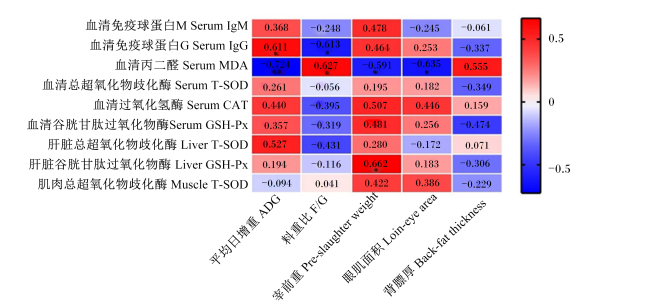
图1可知,育肥猪血清IgG含量与ADG呈显著正相关(P<0.05),与F/G呈显著负相关(P<0.05);血清MDA含量与ADG呈极显著负相关(P<0.01),与F/G呈显著正相关(P<0.05),与宰前重和眼肌面积均呈显著负相关(P<0.05);肝脏GSH-Px活性与宰前重呈显著正相关(P<0.05)。
图1 育肥猪生长性能、胴体性状与血清免疫指标、抗氧化能力的相关性分析

*表示显著相关(P<0.05),**表示极显著相关(P<0.01)。图2同。

Fig.1 Correlation between growth performance and carcass traits with serum immune indices and antioxidant capacity of finishing pigs

* indicated significant correlation (P<0.05), and ** indicated extremely significant correlation (P<0.01). The same as Fig.2.

2.7 育肥猪肌肉品质与抗氧化能力的相关性分析

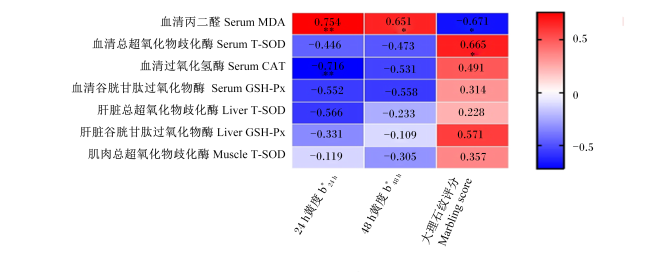
图2可知,育肥猪血清MDA含量与肌肉24 h黄度值呈极显著正相关(P<0.01),与48 h黄度值呈显著正相关(P<0.05),与大理石纹评分呈显著负相关(P<0.05);血清T-SOD活性与大理石纹评分呈显著正相关(P<0.05);血清CAT活性与24 h黄度值呈极显著负相关(P<0.01)。
图2 育肥猪肌肉品质与抗氧化能力的相关性分析

Fig.2 Correlation analysis between muscle quality and antioxidant capacity of finishing pigs

3 讨论

3.1 SCA对育肥猪生长性能、胴体性状和肌肉品质的影响

非常规饲粮在节约饲料原料成本、解决国内粮食安全问题方面颇具潜力,但也存在适口性差、某些营养成分不稳定以及饲料原料营养数据不全或不准确等问题,可能会对育肥猪生长性能造成不利影响[12-13]。据报道,在饲粮中添加绿原酸能改善育肥猪生长性能[14-16]。周昊等[14]研究发现,饲粮添加800 mg/kg绿原酸(纯度为50%)可显著提高育肥猪ADG和末重,降低F/G。Li等[15]研究发现,饲粮添加1 000 mg/kg杜仲提取物(绿原酸含量为82.8%)能改善育肥猪ADFI、ADG以及肉的氧化状态。于生兰等[16]研究发现,饲粮添加500和1 000 mg/kg金银花提取物(绿原酸含量大于90%)可不同程度提高育肥猪生长性能。张珊等[17]研究表明,在饲粮中添加100 mg/kg SCA(绿原酸含量为13.7%,总绿原酸类化合物含量大于43.3%)即可改善产蛋后期蛋鸡生产性能。此外,研究表明,在改善机体抗菌、抗炎以及抗氧化等生理活性方面,异绿原酸效果均优于绿原酸[18]。而对比甜叶菊、杜仲和金银花中绿原酸类化合物具体成分发现,甜叶菊中的异绿原酸含量明显更高[19]。本试验结果显示,在非常规饲粮中添加200 mg/kg SCA(绿原酸含量为15.00%,总绿原酸类化合物含量大于44.41%)即可一定程度上提高育肥猪ADG,降低F/G,这可能与SCA中异绿原酸占比更大有关[18-19]
胴体性状是衡量猪产肉性能的指标,包括胴体重、屠宰率、眼肌面积和背膘厚等。研究表明,饲粮添加400 mg/kg绿原酸(纯度>98%)能显著提高育肥猪无脂瘦肉率,降低背膘厚和体脂率[20]。邢月腾[21]研究发现,饲粮添加100 mg/kg金银花绿原酸(纯度为95%)能一定程度上降低宁乡猪的平均背膘厚,并且对屠宰率、胴体长度和眼肌面积等胴体性状指标没有影响。本研究表明,在非常规饲粮中添加200 mg/kg SCA(总绿原酸类化合物含量大于44.41%)有提高育肥猪眼肌面积和降低背膘厚的趋势,这与邢月腾[21]的研究结果相似,表明200 mg/kg SCA能在一定程度上调节育肥猪的脂肪沉积。
猪肌肉品质指标包括肉色、pH、滴水损失、剪切力和大理石纹评分等,其中肉色和大理石纹评分是消费者判断猪肉鲜嫩程度的重要指标,很大程度上影响着消费者购买欲望。肌肉的红度值和黄度值均与肌红蛋白的氧化还原状态及转化为高铁肌红蛋白的程度密切相关[22],大理石纹评分则与肌内脂肪沉积显著相关[23]。关于绿原酸对育肥猪生长性能和肉品质影响的报道较多,但研究结果并不一致。本研究结果表明,在非常规饲粮中添加200 mg/kg SCA能降低育肥猪背最长肌黄度值和提高大理石纹评分。Wang等[24]研究发现,金银花绿原酸能降低育肥猪肌肉的黄度值,改善肌纤维特性,这与本研究的结果相似。有研究发现,饲粮添加金银花绿原酸会显著提高宁乡猪肌肉的亮度和黄度值,而显著降低红度值,这可能是由于瘦肉型猪(杜×长×大)与宁乡猪肌肉中单不饱和脂肪酸含量不同所致[21]。综上所述,在非常规饲粮中添加200 mg/kg SCA能在一定程度上提高育肥猪生长性能,并显著降低育肥猪背最长肌黄度值,提高大理石纹评分,这可能与SCA富含抗氧化能力较强的异绿原酸有关。

3.2 SCA对育肥猪免疫功能和抗氧化能力的影响

血清免疫指标在一定程度上反映了动物的生理、代谢和免疫状态。免疫球蛋白是机体体液免疫的重要组分,在机体防御病原体中起关键作用,其中,IgG是血清中发现的主要免疫球蛋白,分布最广、含量最多;其次是IgM,它是接触抗原首先发生反应的第一抗体[25-26]。卓春柳等[27]研究表明,SCA可提高大肠杆菌O78感染蛋雏鸡血清中抗炎因子IgA和IgM含量,降低血清中促炎因子白细胞介素(IL)-2、IL-6和肿瘤坏死因子-α(TNF-α)含量,降低回肠促炎细胞因子IL-1βIL-2和TNF-α的基因表达水平。吴丽飞等[28]研究发现,甜叶菊异绿原酸盐(异绿原酸含量>50%)添加量为200 mg/kg时,能显著降低产蛋初期蛋鸡血清TNF-α、干扰素-γ(IFN-γ)、IL-6和IL-8含量,提高血清IL-10、IgM和IgG含量。本试验结果显示,在非常规饲粮中添加200 mg/kg SCA(总绿原酸类化合物含量>44.41%)可以提高育肥猪血清中IgM和IgG含量,与上述研究结果一致,表明SCA具有良好的免疫调节功能。
抗氧化作用是SCA的重要生理功能之一。赵磊等[29]研究表明,甜叶菊废渣提取物中绿原酸、隐绿原酸、咖啡酸、异绿原酸A、异绿原酸B、异绿原酸C、槲皮苷和槲皮素均具有较强的抗氧化能力。Liu等[10]研究发现,饲粮添加200 mg/kg甜叶菊废渣提取物(绿原酸及其类似物含量大>40%)能显著提高第42天断奶仔猪血清T-SOD和GSH-Px活性,降低血清MDA含量。熊云霞等[30]研究同样发现,甜叶菊废渣提取物能提高断奶仔猪抗氧化酶活性。本试验中,在非常规饲粮中添加200 mg/kg SCA显著提高了育肥猪血清、肝脏和背最长肌的抗氧化能力,其机制可能与SCA中的绿原酸分子和异绿原酸分子结构中的酚羟基和咖啡酰基能够清除羟自由基、二苯代苦味酰基(DDPH)自由基和2,2’-联氮-二(3-乙基-苯并噻唑-6-磺酸)二铵盐(ABTS)阳离子自由基[29,31],以及激活蛋白激酶B(Akt)/核因子E2相关因子2(Nrf2)/血红素加氧酶-1(HO-1)通路上调抗氧化基因表达[32]等因素有关。

3.3 相关性分析

相关性分析是一种用于判断2个或多个变量之间关联程度的统计学方法,Pearson相关系数是衡量2个随机变量之间的线性关系强度的指标。本研究发现,育肥猪血清IgG含量与ADG呈显著正相关,与F/G呈显著负相关;血清MDA含量与ADG呈极显著负相关,与F/G呈显著正相关,与宰前重和眼肌面积均呈显著负相关;肝脏GSH-Px活性与宰前重呈显著正相关。此外,育肥猪血清MDA含量与肌肉24 h黄度值呈极显著正相关,与24 h黄度值呈显著正相关,与大理石纹评分呈显著负相关;血清T-SOD活性与大理石纹评分呈显著正相关;血清CAT活性与24 h黄度值呈极显著负相关。上述结果表明,SCA可能通过降低育肥猪脂质过氧化物含量,提高抗氧化酶活性和体液免疫水平,从而提高其生长性能和胴体性状;SCA中的绿原酸和异绿原酸可能通过提高育肥猪抗氧化能力,调节肌肉脂肪代谢,从而增加肌肉脂肪沉积[33],延缓肌红蛋白氧化[34],提高猪肉大理石纹评分,改善肉色。

4 结论

饲粮添加200 mg/kg SCA有改善育肥猪生长性能和免疫功能的趋势,并且能显著增强机体抗氧化能力,提高肌肉大理石纹评分,改善肉色。
[1]
唐辉, 谢正军, 李瑞, 等. 菜籽饼粕的营养价值、抗营养因子及其在猪饲粮中的应用[J]. 动物营养学报, 2024, 36(7):4103-4115.

DOI

TANG H, XIE Z J, LI R, et al. Nutritional value and anti-nutritional factors of rapeseed cake meal and its application in swine feeding[J]. Chinese Journal of Animal Nutrition, 2024, 36(7):4103-4115. (in Chinese)

DOI

[2]
赵晓芳, 刘惠芳. 抗营养因子及其钝化方法[J]. 四川畜牧兽医, 2002, 29(增刊):77-79.

ZHAO X F, LIU H F. Antinutritional factors and their deactivation[J]. Sichuan Animal & Veterinary Sciences, 2002, 29(Suppl.):77-79. (in Chinese)

[3]
赵金标, 周行健, 李佳, 等. 非常规饲料原料营养价值及其在生猪高效养殖中的应用策略[J]. 中国猪业, 2022, 17(2):17-23.

ZHAO J B, ZHOU H J, LI J, et al. Efficient applications of unconventional feed ingredients in swine production[J]. China Swine Industry, 2022, 17(2):17-23. (in Chinese)

[4]
段渴慧. 大量使用非常规饲料对育肥猪生产性能的影响[D]. 硕士学位论文. 延吉: 延边大学, 2007.

DUAN K H. Effect on using plenty of unconventionality feedstuff on production capability of fatten pigs[D]. Master’s Thesis. Yanji: Yanbian University, 2007. (in Chinese)

[5]
高芳芳. 两种非常规饲料原料对猪、鸡氧化还原状态和脂代谢的影响[D]. 硕士学位论文. 南京: 南京农业大学, 2020.

GAO F F. Effects of two unconventional feed materials on redox status and lipid metabolism of pigs and chickens[D]. Master’s Thesis. Nanjing: Nanjing Agricultural University, 2020. (in Chinese)

[6]
PETELIUK V, RYBCHUK L, BAYLIAK M, et al. Natural sweetener Stevia rebaudiana:functionalities,health benefits and potential risks[J]. EXCLI Journal, 2021,20:1412-1430.

[7]
鲍玉龙, 柳春燕, 邵太丽, 等. 甜叶菊化学成分和药理作用的研究进展及其质量标志物(Q-Marker)预测[J]. 中草药, 2024, 55(3):1014-1025.

BAO Y L, LIU C Y, SHAO T L, et al. Research progress on chemical composition and pharmacological effects of Stevia rebaudiana and its quality marker prediction analysis[J]. Chinese Traditional and Herbal Drugs, 2024, 55(3):1014-1025. (in Chinese)

[8]
PURI M, SHARMA D, TIWARI A K. Downstream processing of stevioside and its potential applications[J]. Biotechnology Advances, 2011, 29(6):781-791.

DOI PMID

[9]
徐美利, 李云聪, 徐亚超, 等. 不同产地甜叶菊绿原酸类成分含量分析及质量评价[J]. 中国食品添加剂, 2021, 32(4):6-11.

XU M L, LI Y C, XU Y C, et al. Analysis and quality evaluation of chlorogenic acids in stevia from different habitats[J]. China Food Additives, 2021, 32(4):6-11. (in Chinese)

[10]
LIU S, XIONG Y X, CAO S T, et al. Dietary stevia residue extract supplementation improves antioxidant capacity and intestinal microbial composition of weaned piglets[J]. Antioxidants, 2022, 11(10):2016.

[11]
卓春柳. 甜叶菊绿原酸增强蛋雏鸡免疫功能研究[D]. 硕士学位论文. 邯郸: 河北工程大学, 2021.

ZHUO C L. Study on stevia chlorogenic acid enhances immune function of layer[D]. Master’s Thesis. Handan: Hebei University of Engineering, 2021. (in Chinese)

[12]
赵金波, 黄合特, 刘盈序, 等. 非常规饲料资源在畜禽饲料粮减量化营养调控的优化利用[J]. 中国饲料, 2023(15):123-129.

ZHAO J B, HUANG H T, LIU Y X, et al. Optimal utilization of unconventional feeding resources in reducing nutritional regulation of feed grain for livestock and poultry[J]. China Feed, 2023(15):123-129. (in Chinese)

[13]
马新燕, 李剑豪, 黄琳, 等. 我国非常规饲料原料在养猪生产中应用[J]. 广东畜牧兽医科技, 2019, 44(2):13-20.

MA X Y, LI J H, HUANG L, et al. Application of unconventional feed ingredients in pig production in China[J]. Guangdong Journal of Animal and Veterinary Science, 2019, 44(2):13-20. (in Chinese)

[14]
周昊, 况丹. 绿原酸对育肥猪生长性能、血清生化及免疫指标的影响[J]. 中国饲料, 2023(16):25-28.

ZHOU H, KUANG D. Effects of chlorogenic acid on growth performance,serum biochemical indexes and immune function of finishing pigs[J]. China Feed, 2023(16):25-28. (in Chinese)

[15]
LI H G, ZHAO J S, DENG W, et al. Effects of chlorogenic acid-enriched extract from Eucommia ulmoides oliver leaf on growth performance and quality and oxidative status of meat in finishing pigs fed diets containing fresh or oxidized corn oil[J]. Journal of Animal Physiology and Animal Nutrition, 2020, 104(4):1116-1125.

[16]
于生兰, 罗军, 陈晓兰, 等. 日粮添加金银花提取物对育肥猪生长性能、血清生化及养分消化率的影响[J]. 中国饲料, 2022(18):39-42.

YU S L, LUO J, CHEN X L, et al. Effects of honeysuckle extract on growth performance,serum biochemistry and nutrient digestibility of finishing pigs[J]. China Feed, 2022(18):39-42. (in Chinese)

[17]
张珊, 肖蕴祺, 陈傲, 等. 甜叶菊绿原酸对产蛋后期蛋鸡生产性能、蛋品质、血浆生化指标和肠道组织形态的影响[J]. 动物营养学报, 2024, 36(2):946-955.

DOI

ZHANG S, XIAO Y Q, CHEN A, et al. Effects of stevia chlorogenic acid on performance,egg quality,plasma biochemical indexes and intestinal morphology of laying hens during late laying period[J]. Chinese Journal of Animal Nutrition, 2024, 36(2):946-955. (in Chinese)

DOI

[18]
宋丹萍, 张珊, 宋志刚, 等. 绿原酸及其异构体功能比较、结构修饰及在动物上应用的研究进展[J]. 中国畜牧杂志, 2023, 59(1):10-19.

SONG D P, ZHANG S, SONG Z G, et al. Research progress on the structural and functional comparison,structural modification of chlorogenic acid and its isomers and application in animals[J]. Chinese Journal of Animal Science, 2023, 59(1):10-19. (in Chinese)

[19]
李云聪, 牛志平, 徐美利, 等. 甜叶菊与其他植物中绿原酸类成分对比分析[J]. 中国食品添加剂, 2021, 32(1):1-6.

LI Y C, NIU Z P, XU M L, et al. Comparative analysis of chlorogenic acids in stevia and other plants[J]. China Food Additives, 2021, 32(1):1-6. (in Chinese)

[20]
WANG W L, LI F N, DUAN Y H, et al. Effects of dietary chlorogenic acid supplementation derived from Lonicera macranthoides hand-mazz on growth performance,free amino acid profile,and muscle protein synthesis in a finishing pig model[J]. Oxidative Medicine and Cellular Longevity, 2022,2022:6316611.

[21]
邢月腾. 绿原酸对宁乡猪肉质和脂肪代谢的影响[D]. 博士学位论文. 长沙: 湖南农业大学, 2020.

XING Y T. Effects of chlorogenic acid on meat quality and lipid metabolism of Ningxiang pigs[D]. Ph.D. Thesis. Changsha: Hunan Agricultural University, 2020. (in Chinese)

[22]
GAGAOUA M, SUMAN S P, PURSLOW P P, et al. The color of fresh pork:consumers expectations,underlying farm-to-fork factors,myoglobin chemistry and contribution of proteomics to decipher the biochemical mechanisms[J]. Meat Science, 2023,206:109340.

[23]
陈银基, 周光宏, 邹晓葵, 等. 肉牛胴体背最长肌脂肪酸组成与大理石花纹等级相关性研究[J]. 中国农业科学, 2007, 40(12):2853-2860.

CHEN Y J, ZHOU G H, ZOU X K, et al. Research on relationship between beef marbling standard and fatty acid composition of longissimus dorsi[J]. Scientia Agricultura Sinica, 2007, 40(12):2853-2860. (in Chinese)

[24]
WANG W L, WEN C Y, GUO Q P, et al. Dietary supplementation with chlorogenic acid derived from Lonicera macranthoides hand-mazz improves meat quality and muscle fiber characteristics of finishing pigs via enhancement of antioxidant capacity[J]. Frontiers in Physiology, 2021,12:650084.

[25]
BALAN P, SIK-HAN K, MOUGHAN P J. Impact of oral immunoglobulins on animal health-a review[J]. Animal Science Journal, 2019, 90(9):1099-1110.

DOI PMID

[26]
DAHMER P L, DEROUCHEY J M, GEBHARDT J T, et al. Summary of methodology used in enterotoxigenic Escherichia coli (ETEC) challenge experiments in weanling pigs and quantitative assessment of observed variability[J]. Translational Animal Science, 2023, 7(1):txad083.

[27]
卓春柳, 王方方, 钟翠红, 等. 甜叶菊绿原酸增强大肠杆菌感染蛋雏鸡免疫力研究[J]. 畜牧兽医学报, 2021, 52(8):2200-2212.

DOI

ZHUO C L, WANG F F, ZHONG C H, et al. Effects of stevia chlorogenic acid on enhancing the immunity of E.coli O78-infected layers[J]. Acta Veterinaria et Zootechnica Sinica, 2021, 52(8):2200-2212. (in Chinese)

[28]
吴丽飞, 史自强, 赵鹏宇, 等. 甜叶菊异绿原酸盐对产蛋初期蛋鸡产蛋性能、血液免疫指标及脂质代谢指标的影响[J]. 饲料工业, 2023, 44(2):25-29.

WU L F, SHI Z Q, ZHAO P Y, et al. Effects of stevia isochlorogenic salt on laying performance,blood immune index and lipid metabolism index at the early stage of lying for laying hens[J]. Feed Industry, 2023, 44(2):25-29. (in Chinese)

[29]
赵磊, 潘飞, 林文轩, 等. 甜叶菊废渣提取物的主要成分分析及其抗氧化作用[J]. 食品科学, 2021, 42(2):247-254.

ZHAO L, PAN F, LIN W X, et al. Main components of stevia residue extract and their antioxidant activities[J]. Food Science, 2021, 42(2):247-254. (in Chinese)

DOI

[30]
熊云霞, 刘帅, 肖昊, 等. 饲粮添加甜叶菊废渣提取物对断奶仔猪生长性能及内脏组织病理的影响[J]. 动物营养学报, 2023, 35(10):6289-6300.

DOI

XIONG Y X, LIU S, XIAO H, et al. Effects of dietary stevia residue extract supplementation on growth performance and visceral histopathology of weaned piglets[J]. Chinese Journal of Animal Nutrition, 2023, 35(10):6289-6300. (in Chinese)

DOI

[31]
王智勇, 刘秀斌, 徐美利, 等. 甜叶菊总异绿原酸抗氧化、抑菌及防霉功能评价[J]. 饲料研究, 2021, 44(3):101-105.

WANG Z Y, LIU X B, XU M L, et al. Evaluation of anti-bacterial,anti-oxidant and anti-mildew functions of stevia total isochlorogenic acid[J]. Feed Research, 2021, 44(3):101-105. (in Chinese)

[32]
ZHAO L, YANG H Q, XU M L, et al. Stevia residue extract ameliorates oxidative stress in D-galactose-induced aging mice via Akt/Nrf2/HO-1 pathway[J]. Journal of Functional Foods, 2019,52:587-595.

[33]
台瑞青. 迷迭香酸对育肥猪抗氧化水平与脂肪代谢的影响[D]. 硕士学位论文. 杨凌: 西北农林科技大学, 2022.

TAI R Q. Effects of rosmarinic acid on antioxidant levels and fat metabolism in finishing pigs[D]. Master’s Thesis. Yangling: Northwest A&F University, 2022. (in Chinese)

[34]
廖嘉龙, 万波扬, 尹靖东, 等. 抗氧化剂在调控猪肉品质中的应用研究进展[J]. 动物营养学报, 2024, 36(4):2079-2090.

DOI

LIAO J L, WAN B Y, YIN J D, et al. Research progress on application of antioxidants in regulation of meat quality of pigs[J]. Chinese Journal of Animal Nutrition, 2024, 36(4):2079-2090. (in Chinese)

DOI

Outlines

/