REVIEW

Research Advance on Effects of Feeding Methods on Fatty Acid Composition and Volatile Flavor Compounds in Yak Meat

  • WANG Li , 1 ,
  • WEI Jian 2 ,
  • WU Bin 1 ,
  • WANG Yutao , 1, *
Expand
  • 1 Key Laboratory of Biological Resources and Ecology of Pamirs Plateau in Xinjiang Uygur Autonomous Region,College of Life and Geography Sciences, Kashi University, Kashi 844000, China
  • 2 Shihezi University, Shihezi 832003, China
* professor, E-mail:

Received date: 2024-05-22

  Online published: 2025-01-10

Abstract

Fatty acid composition and volatile flavor compounds are the key indicators of yak meat quality. Feeding methods(diet composition) have great effects on the fatty acid composition in yak meat; however, the difference of fatty acid composition in yak meat is the main direct factor affecting the species, composition and contents of volatile flavor compounds. In this paper, the effects of fatty acids in yak meat on the formation of volatile flavor compounds and the effects of feeding methods on fatty acid composition and volatile flavor compounds in yak meat were summarized and analyzed. This review provides reference for the quality regulation, improvement and the high-quality utilization of yak meat.

Cite this article

WANG Li , WEI Jian , WU Bin , WANG Yutao . Research Advance on Effects of Feeding Methods on Fatty Acid Composition and Volatile Flavor Compounds in Yak Meat[J]. Chinese Journal of Animal Nutrition, 2025 , 37(1) : 87 -100 . DOI: 10.12418/CJAN2025.008

牦牛(Bos grunniens)是分布在海拔3 000 m以上的青藏高原及其毗邻高山、亚高山地区的特有优势畜种,其对生产区域的经济价值、生态价值和社会价值不可替代[1-2]。近年来,消费者对高品质牛肉的需求正在以每年20%的速度增长,牦牛肉作为“优质绿色肉食品”,市场需求力度逐年增大,2018—2022年,牦牛胴体产量年均增长2.4%,牦牛肉单体产值年均增长15.6%,年产值高达约467亿元,产业发展潜力巨大[3-8]。终年全放牧无补饲是牦牛的传统养殖方式,但由于高山草原高寒、缺氧、干燥、冷季长、暖季短,加上冷季饲草营养匮乏且短缺,这使牦牛体重损失高达25%,导致牦牛生长发育缓慢、生长周期长、产量低,常年供应受限,肉品质不稳定,同时打破了草畜平衡,严重阻碍草原生态环境的可持续发展[9-11]。不过,通过牦牛生长发育规律和现代养殖实践发现,对牦牛进行季节性适度补饲或舍饲饲养,可防止牦牛体重下降,提高出栏率和商品率,改善肉质,是缓解草场生态压力的有效措施。
由于高寒草地冷暖两季牧草数量和质量上的差异,目前对牦牛进行补饲或舍饲喂养的研究主要集中在冷季[11-14]。但有学者认为,在冷季对牦牛进行补饲或舍饲饲养,存在投入高、养殖利润低、生长潜力得不到充分发挥及食品安全风险等弊端,而暖季气温适宜,牦牛补偿生长能力较强,草场牧草质量优、功能性次生代谢物和不饱和脂肪酸含量丰富,多重优势叠加可有效快速提升牦牛生长性能和肉品质[15-18]。随着高原牦牛养殖产业的迅速发展,无论冷季或暖季对牦牛进行补饲或舍饲饲养,采用“传统放牧+阶段营养调控高效育肥饲养”的饲养方式是现阶段提高牦牛生产效益,平衡草场生态功能,提升牦牛肉质标准化和竞争力,实现高原牦牛产业提质增效的必由之路。
脂肪酸组成和挥发性风味物质分别是评价牦牛肉营养品质及食用加工品质的关键指标。相关研究表明,挥发性风味物质产生在很大程度上依赖于脂肪酸组成,脂肪酸组成差异是产生不同挥发性风味物质的主要直接因素,通过饲养方式对牦牛进行营养调控,可改变牦牛肉脂肪酸组成,进而由脂肪酸直接影响或决定牦牛肉的挥发性风味物质[19-22]。近年来,针对不同饲养方式对牦牛肉脂肪酸组成和挥发性风味物质的影响研究较多,为探索牦牛营养阶段性改变对肌肉脂肪酸组成及挥发性风味物质的调控效应提供了有力支撑。因此,本文以牦牛营养阶段改变对肌肉脂肪酸组成及挥发性风味物质的调控效应为关注视角,就牦牛肉脂肪酸对挥发性风味物质形成的作用及饲养方式对牦牛肌肉脂肪酸组成和挥发性风味物质的影响进行综述,以期为牦牛肉在品质调控提升和高质化利用方面的研究提供参考。

1 牦牛肉脂肪酸对挥发性风味物质形成的作用
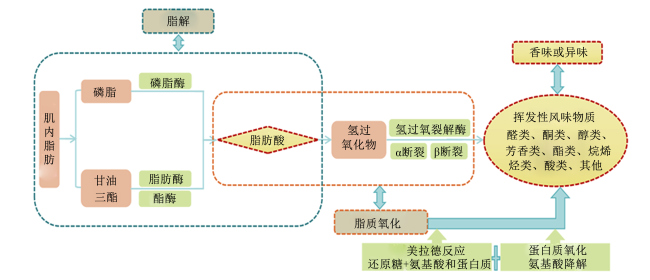
肌内脂肪酸主要由磷脂和甘油三酯在内源磷脂酶、脂肪酶和酯酶作用下降解产生,是机体不可或缺的营养物质和重要能源物质[23-24]。脂肪酸按饱和度可分为饱和脂肪酸(saturated fatty acid,SFA)和不饱和脂肪酸(unsaturated fatty acid,USFA),同时根据不饱和双键的个数又可将USFA分为单不饱和脂肪酸(monounsaturated fatty acid,MUFA)和多不饱和脂肪酸(polyunsaturated fatty acid,PUFA)。SFA较稳定,而MUFA和PUFA因具有不饱和双键,极易发生氢化、氧化等反应,且因反刍动物瘤胃微生物具有氢化作用,所以通常牦牛肉中SFA>MUFA>PUFA(相对含量)[12-13,21,25-26]。挥发性风味物质是肉制品最直观重要的质量特征之一,影响肉制品的整体可接受性和加工特性。脂肪酸作为特征挥发性风味物质生物合成的关键直接前体物质,对挥发性风味物质的释放可用气相色谱-质谱、电子鼻技术及脂质组学等技术进行检测分析[27-29]。研究发现,牦牛肉的主体挥发性风味物质为醛类、酮类和醇类等物质,是其具有独特风味的关键[20-21,30]。脂肪酸,特别是USFA经过脂质氧化形成多种氢过氧化物,然后在氢裂解酶的作用下打破氢过氧化物的碳碳键,产生醛、酮、醇等大量具有独特风味的挥发性风味物质,同时脂质氧化与美拉德反应及蛋白质氧化、氨基酸降解产物的相互关联也是影响牦牛肉风味形成的有效途径[31-34]。牦牛肉脂肪酸对挥发性风味物质形成的作用见图1
图1 牦牛肉脂肪酸对挥发性风味物质形成的作用

Fig.1 Effects of fatty acids in yak meat on formation of volatile flavor compounds

2 饲养方式对牦牛肉脂肪酸组成的影响

牦牛肉中的PUFA特别是n-3 PUFA含量较高,脂肪酸质量优于其他牛肉[26,35-36]。饲养方式对牦牛肌肉脂肪酸组成有较显著影响。刘奕轩等[12]在冷季对青海高原牦牛进行全混合日粮(精料为玉米、豆粕、小麦麸和菜籽粕等,粗料为燕麦干草、苜蓿干草和青稞酒糟,精粗比为3:7)短期(120 d)舍饲育肥,相较于天然放牧,舍饲育肥对牦牛背最长肌中SFA无显著影响,但可使MUFA相对含量显著提高36%,其中对油酸(C18:1,oleic acid,OA)含量的提升作用最明显;与放牧组相比,舍饲育肥组背最长肌PUFA相对含量显著降低43%,背最长肌亚油酸(C18:2,linoleic acid,LA)、α-亚麻酸(C18:3,α-linolenic acid,ALA)和二十碳五烯酸(C18:5,eicosapentaenoic acid,EPA)相对含量均显著降低,n-6 PUFA/n-3 PUFA值从4.18降为3.34,PUFA/SFA值从0.48降为0.26,其中n-6 PUFA/n-3 PUFA值<4.0,符合世界卫生组织推荐比值,但PUFA/SFA值<0.4,低于推荐比值[37-39]。杨媛丽[19]和谭子璇等[20]分别在暖季用不同比例的玉米、豆粕、麦麸、菜籽粕和燕麦干草等对青海高原牦牛和金川牦牛进行全混合日粮舍饲育肥(100~120 d),牦牛背最长肌中MUFA和PUFA相对含量变化与刘奕轩等[12]的研究结果相似,但SFA相对含量和n-6 PUFA/n-3 PUFA值(>4.0)显著提高。方雷[17]研究发现,暖季自然放牧组(自由放牧)和放牧补料组(自由放牧+每头每天补饲玉米、小麦麸、菜籽粕、苜蓿颗粒、燕麦干草及玉米秸秆等充饥料2 kg)西藏斯布牦牛肉中的n-3 PUFA和ALA相对含量显著高于舍饲育肥145 d的舍饲组(全天自由采食充饥料)和舍词补料组(全天自由采食充饥料+每头每天补充小麦麸、玉米、棉籽粕、豆粕及大豆皮等混合精料2 kg),n-6 PUFA/n-3 PUFA值更符合人体健康需求。Xiong等[21]在研究饲养方式对青海高原牦牛肉脂肪酸的影响时也得到了相似结果。除牦牛品种、年龄等因素外,牦牛饲养方式的不同本质是饲粮组成的不同,舍饲组肌肉SFA和MUFA相对含量增加,可能是舍饲饲粮提高了牦牛肌内脂肪含量,而PUFA相对含量降低,可能是由于舍饲饲粮中PUFA和植物源性抗氧化剂等活性成分不如高原牧草丰富所致;此外,舍饲使n-6 PUFA/n-3 PUFA值发生变化,可能与舍饲饲粮中谷物饲料具有更多的n-6脂肪酸,而牧草中ALA含量较高,ALA是n-3脂肪酸的母体有关[40-44]
综上可知,从脂肪酸营养价值的角度来看,自然放牧的牦牛肉对消费者来说更健康。Cao等[26]和刘奕轩等[12]提出,通过舍饲育肥牺牲的一些丰富、健康的脂肪酸,可用牦牛肉食用与加工品质的提升来弥补。而Hao等[45]发现,在冷季向青海高原牦牛饲粮(由玉米、豆粕、小麦麸、菜籽粕和燕麦青贮等组成)中添加富含PUFA且经过熟化技术处理的油菜籽(120 d),可将牦牛背最长肌SFA相对含量显著降低3.77%,MUFA、PUFA、n-3 PUFA和n-6 PUFA相对含量分别显著提高1.6%、5.4%、3.04%和1.33%,PUFA/SFA值从0.37显著提高到0.55(>0.4),n-6 PUFA/n-3 PUFA值从4.78极显著降低到2.76(<4.0)。郝力壮[16]在暖季通过向放牧牦牛补饲含有熟化油菜籽的精料(由玉米、小麦麸和双低菜籽粕等组成),也得到了相似的结果。左子珍等[30]在麦洼牦牛基础饲粮(由玉米、大豆、豆粕、菜籽粕、玉米胚芽粉、豆壳和玉米秸秆青贮料等组成)中添加5 g/d过瘤胃蛋氨酸,舍饲80 d后可提高半腱肌中PUFA含量。陈光吉[46]研究发现,净能为4.48 MJ/kg的饲粮可显著提高暖季舍饲麦洼牦牛背最长肌中MUFA和PUFA含量。谢昕廷等[47]研究发现,将饲粮(由玉米、裸大麦、酒糟和苜蓿等混合而成)精粗比调为5:5时冷季舍饲麦洼牦牛背最长肌的脂肪酸质量更优。Wood等[25]、Yang等[48]和Huang等[49]指出,可通过对饲粮的营养调控影响瘤胃微生物区系,降低瘤胃微生物的氢化作用,进而改变肌肉中脂肪酸组成。
因此,可通过改变牦牛饲养方式及饲粮有效处理技术和科学合理营养调控的方法,在冷季或暖季对放牧牦牛补饲或舍饲富含PUFA和植物抗氧化剂以及瘤胃不饱和脂肪酸生物氢化程度较低的饲粮,同时在饲粮中加入微生态制剂调节瘤胃微生物的多样性,从而有针对性地改变肌肉中各脂肪酸的组成和稳定性,提高对人体健康更有益的脂肪酸含量,以满足消费者的需求,提升牦牛肉的品质和价值。

3 饲养方式对牦牛肉挥发性风味物质的影响

3.1 饲养方式对牦牛肉挥发性风味物质种类的影响

表1可知,Xiong等[50]研究的2岁龄青海高原舍饲牦牛背最长肌中挥发性风味物质较放牧牦牛少10种,饲养方式对醛类和烷、烯烃类的共有成分影响较大。谭子璇等[20]研究发现,放牧金川牦牛肉中挥发性风味物质较舍饲育肥牛也更多,2组共有成分较放牧组少12种,舍饲育肥对芳香类和烷、烯烃类物质的影响最大。但杨媛丽[19]研究发现,舍饲育肥对青海高原牦牛背最长肌中挥发性风味物质丰度有提升作用。在舍饲麦洼牦牛基础饲粮中添加10 g/d以上过瘤胃蛋氨酸,可影响半腱肌中挥发性风味物质种类和烷、烯烃类成分[30]。这说明饲养方式对牦牛肌肉挥发性风味物质种类影响较显著,且烷、烯烃类物质可能是最易受饲养方式影响的成分。
表1 饲养方式对牦牛肉挥发性风味物质种类的影响

Table 1 Effects of feeding methods on species of volatile flavor compounds in yak meat

牦牛品种
Yak
breeds
饲养方式
Feeding
methods
挥发性风
味物质种类
Species of volatile
flavor compounds
醛类
Aldehydes
酮类
Ketones
醇类
Alcohols
酯类
Esters
酸类
Acids
芳香类
Aromatics
烷、
烯烃类
Alkanes,
olefins
含氮含硫及
杂环类
Nitrogenous, sulfur-
contained and
heterocyclics
参考文献
References
青海高原牦牛
Qinghai Plateau yak
放牧 49 12 6 10 4 4 4 7 2 [50]
舍饲 39 11 6 8 3 3 3 3 2
共有 36 8 6 8 3 3 3 3 2
金川牦牛
Jinchuan yak
放牧 34 9 5 7 2 1 2 5 3 [20]
舍饲 27 8 4 8 2 1 0 1 3
共有 22 6 4 6 2 0 0 1 3
青海高原牦牛
Qinghai Plateau yak
放牧 26 9 3 5 1 0 7 1 0 [19]
舍饲 30 9 4 4 1 2 8 2 0
共有 24 8 3 4 1 0 7 1 0
麦洼牦牛
Maiwa yak
舍饲 32 8 5 7 2 1 0 5 4 [30]
舍饲+5 g/d过瘤胃蛋氨酸 32 9 4 6 2 2 0 5 4
舍饲+10 g/d过瘤胃蛋氨酸 34 8 3 8 2 1 0 8 4
舍饲+15 g/d过瘤胃蛋氨酸 31 9 4 6 2 2 0 4 4
共有 27 8 3 6 1 1 0 4 4

表中“共有”表示放牧组和舍饲组均含有的挥发性风味物质种类。

In the table, “common” indicated the species of volatile flavor compounds contained in both grazing group and feedlot group.

谭子璇等[20]、Xiong等[50]和Van Ba等[51]认为,放牧组牦牛肌肉中USFA含量较舍饲组高,USFA易被氧化,可以产生数百种挥发性风味物质,包括烷、烯烃类、醛类、醇类、酮类、酯类和杂环化合物等,因此放牧组挥发性风味化合物物质种类较舍饲组多。杨媛丽[19]的研究结果同样发现,放牧组牦牛肉中USFA相对含量较舍饲组显著高3.94%,但舍饲组牦牛肉中却含有更多的挥发性风味成分。Descalzo等[52]也发现,舍饲阿根廷牛肉中同样具有较低含量的USFA,但挥发性风味物质丰度却更好。挥发性风味物质的产生是一系列复杂连锁反应,影响因素较多,除了脂肪酸组成和脂质氧化途径外,可能其他物质和反应途径对挥发性风味物质种类也有较大影响,具体机制还需要进一步通过大量试验补充验证。
此外,杨媛丽[19]和Xiong等[50]的研究对象均是2~3岁的青海高原公牦牛,但2组放养牦牛背最长肌中挥发性风味物质差异较大,且2组舍饲育肥牦牛因舍饲混合饲粮组成成分不同,差异更大。金川牦牛背最长肌中挥发性风味物质与上述2个研究的差异可能与牦牛品种、年龄及摄食差别均有关。由此可见,牦牛摄食牧草或饲粮营养水平是影响肌肉挥发性风味物质的显著重要因素。饲养方式对牦牛肉挥发性风味物质的影响见表2
表2 饲养方式对牦牛肉挥发性风味物质的影响

Table 2 Effects of feeding methods on volatile flavor compounds in yak meat

物质类别
Compound
classes
物质名称
Compound names
青海高原牦牛(2~3岁龄)
Qinghai Plateau yak
(2 to 3 years of age)[19]
青海高原牦牛(2岁龄)
Qinghai Plateau yak
(2 years of age)[50]
金川牦牛(4岁龄)
Jinchuan yak
(4 years of age)[20]
舍饲
Feedlot (180 d)
放牧
Grazing
舍饲
Feedlot (180 d)
放牧
Grazing
舍饲
Feedlot (100 d)
放牧
Grazing
醛类
Aldehydes
乙醛 2.92±0.11 2.91±0.29 3.20±1.86 1.90±0.44
2-甲基丁醛 1.49±0.14
3-甲基丁醛 1.68±0.12 1.23±0.67
己醛 2.26±0.14** 1.91±0.15 14.96±7.45 15.30±5.37
庚醛 2.06±0.08 2.31±0.30 2.51±1.21 2.26±0.81
辛醛 0.02±0.01* 0.25±0.07 2.10±0.09 1.83±0.33 1.81±0.70 1.41±0.64
壬醛 0.57±0.09* 0.08±0.002 17.39±0.84** 12.59±0.89
2-辛烯醛 0.04±0.01* 0.36±0.27
癸醛 0.14±0.03* 0.55±0.03 0.29±0.02** 0.18±0.03
2-糠醛 0.26±0.09 0.29±0.13
苯甲醛 0.42±0.08* 0.76±0.09 0.22±0.02* 0.31±0.07 4.39±1.68 5.83±1.34
2-壬烯醛 0.06±0.02 1.27±0.06 1.33±0.28
2-癸烯醛 2.16±0.16
2-十一烯醛 1.61±0.18
3-乙基苯甲醛 0.51±0.04 0.76±0.07
4-乙基苯甲醛 0.05±0.01 0.11±0.03
十四醛 1.52±0.06 1.77±1.79
十六醛 3.34±0.10 3.10±0.48 4.58±5.04 3.02±1.02
十八醛 1.63±0.13 1.16±0.36
对异丙基苯甲醛 0.06±0.01 0.07±0.01
酮类
Ketones
丙酮 1.56±0.08* 1.40±0.10 1.50±1.45 1.61±0.26
2-丁酮 0.61±0.05 0.57±0.06 0.70±0.30 0.46±0.14
3-羟基-2-丁酮 7.31±0.61** 10.80±0.92 5.96±4.46* 21.69±10.16
3-戊酮 1.30±0.19* 0.73±0.20
2-庚酮 1.03±0.11** 1.53±0.08 1.11±0.33* 0.59±0.26
6-甲基-5-庚烯-2-酮 0.67±0.05 0.73±0.16 0.83±0.36
2-辛酮 0.07±0.01
2-壬酮 0.04±0.01* 0.07±0.01
苯乙酮 0.47±0.07* 0.19±0.07 2.27±0.15** 3.93±0.42
醇类
Alcohols
乙醇 1.44±0.14** 0.83±0.10 2.06±1.46 1.10±0.11
3-甲基-1-丁醇 1.78±0.06
1-戊醇 4.57±0.14** 2.66±0.13 4.99±1.29* 1.17±0.57
1-戊烯-3-醇 0.70±0.03
3-甲基-1-丁醇 1.50±1.04
3-甲基-2-丁烯-1-醇 0.58±0.08** 0.76±0.06
1-己醇 0.41±0.14 2.43±0.15** 2.09±0.15 2.09±0.34 2.76±2.50
1-辛烯-3-醇 0.08±0.02* 0.39±0.07 13.40±0.57** 7.83±1.51 17.87±6.17* 6.54±2.87
反式-2-辛烯-1-醇 2.29±1.19* 0.95±0.45
1-庚醇 0.29±0.01* 0.59±0.01 1.82±0.16** 2.78±0.11 2.16±0.16
2-乙基己醇 0.07±0.002* 0.56±0.03 2.49±0.17** 2.10±0.17 1.68±1.17 1.47±0.26
正辛醇 0.66±0.08* 1.27±0.08 1.43±0.14** 2.19±0.22
2-十六烷醇 0.14±0.03
酯类
Esters
γ-丁内酯 0.10±0.03* 0.22±0.08
癸酸乙酯 5.20±0.28** 2.33±0.15
N-癸基乙酸酯 0.10±0.02
醋酸乙烯酯 1.46±0.14** 3.04±0.29 1.58±0.68* 4.70±1.01
己酸乙烯酯 0.73±0.06 0.75±0.09 9.65±1.35* 4.73±0.61
烷、烯烃类
Alkanes, olefins
十八烷 0.51±0.04
2,2,4,4,6,8,8-七甲基壬烷 2.44±0.25 2.60±0.40
2,2,4,6,6-五甲基-庚烷 1.86±1.31
十三烷 0.05±0.01** 0.10±0.03
2,2,4,4-四甲基聚烷 0.59±0.22
2-丙烯基环丁烯 0.70±0.08
癸烷 - 0.27±0.05
戊基环丙烷 2.78±0.14** 1.53±0.18 3.24±0.56* 1.52±0.49
(+)-柠檬烯 0.54±0.03 0.81±0.08
苯乙烯 0.32±0.08 0.43±0.09 0.60±0.09 1.59±0.70
酸类
Acids
乙酸 0.44±0.01 2.75±0.16 2.21±0.21
丁酸 1.40±0.15 1.41±0.19
4-羟基丁酸 0.49±0.10 0.72±0.31
腺苷-5'-磷酸 3.06±2.08
己酸 1.78±0.16** 2.40±0.29
苯甲酸 0.05±0.01
芳香类
Aromatics
甲苯 0.55±0.01 0.51±0.04 0.90±0.08 0.79±0.08
间二甲苯 0.29±0.02* 0.71±0.15 0.55±0.09** 1.16±0.21
1,2-二甲苯 1.02±0.08 0.92±0.13
1,2,4-三甲基苯 0.09±0.01* 0.50±0.13
4-异丙烯基甲苯 0.03±0.01* 0.23±0.02
苯甲腈 0.11±0.02
苯酚 0.30±0.14 0.52±0.12
4-烯丙基苯酚 0.05±0.01* 0.17±0.21
0.31±0.04* 0.88±0.11 1.16±0.20 0.81±0.29 0.74±0.22
含氮含硫及杂环类
Nitrogenous, sulfur-
contained and
heterocyclics
2-乙基呋喃 0.82±0.07** 0.56±0.08 0.69±0.34 0.45±0.15
2-戊基呋喃 1.56±0.13 1.69±0.10 2.34±0.85* 1.04±0.28
丙氨酰甘氨酸二肽 4.79±2.47 4.08±1.60

上述参考文献研究的牦牛部位均为背最长肌,参考文献[19]中挥发性风味物质含量的单位是ng/g,参考文献[50]和[20]中挥发性风味物质是相对含量(%)。“*”表示差异显著(P<0.05),“**”表示差异极显著(P<0.01)。“-”表示未检出。

The yak parts studied in the above references were all longissimus dorsi muscle, the unit of volatile flavor compound content in reference [19] was ng/g, and the volatile flavor compound contents in references [50] and [20] were relative contents (%). “*” mean significant difference (P<0.05), and “**” mean extremely significant difference (P<0.01). “-” indicated not detected.

3.2 饲养方式对牦牛肉主体挥发性风味物质的影响

3.2.1 醛类物质

醛类感官阈值低,转化率高,是牛肉最重要的主体挥发性风味组分,多数能赋予牛肉甜香味和水果味[53]。庚醛、辛醛、壬醛和癸醛主要是OA的氧化产物,己醛、2-辛烯醛和苯甲醛分别主要由LA、ALA和EPA脂质氧化产生[54-55]。壬醛是2岁龄青海高原舍饲与放牧牦牛肉中相对含量最高的醛类物质,舍饲组己醛、壬醛和癸醛相对含量较放牧组分别极显著提高了15%、28%和38%,苯甲醛相对含量显著降低了29%,这可能是舍饲组OA脂质含量高于放牧组,而LA和EPA脂质含量低于放牧组引起的[50]。2~3岁龄青海高原牦牛经过180 d舍饲育肥后,肌肉醛类总相对含量及辛醛、2-辛烯醛、癸醛和苯甲醛含量均显著降低,而壬醛含量显著提高了86%,醛类总相对含量的降低可能与PUFA含量降低有关,2-辛烯醛、苯甲醛和壬醛含量的变化,与舍饲组肌肉中EPA、ALA相对含量显著降低、OA相对含量显著升高相对应,而辛醛和癸醛可能还受其他因素影响[19]。舍饲与放牧金川牦牛肌肉中共有的6种醛类化合物相对含量均无显著差异,2组己醛相对含量均较高,分别为14.96%和15.30%,放牧组稍高于舍饲组,可能与放牧牦牛肌肉中LA相对含量显著高于舍饲牦牛有关[20]。己醛和2-辛烯醛有青草味,苯甲醛有苦杏仁味,庚醛和辛醛有油脂味,壬醛有柑橘味和油脂味,癸醛有橙子味和肥皂味[56-58]。舍饲喂养可能会使牦牛肌肉中令人不愉快的气味减少,脂肪味和香甜果味增强。

3.2.2 酮类物质

酮类物质主要是美拉德反应和脂质氧化的产物,大多具有果香和奶油香味,对肉制品风味起重要作用[59-60]。2~3岁龄青海高原牦牛肉中共检测出4种酮类物质,舍饲组酮类总相对含量较放牧组提高了65%,其中3-戊酮和苯乙酮相对含量分别显著提高了44%和60%,2-壬酮相对含量显著降低了43%[19]。金川牦牛肉中检测出了5种酮类物质,但与2~3岁龄青海牦牛肉的酮类物质完全不同,舍饲组2-庚酮相对含量较放牧组显著提高了47%,但3-羟基-2-丁酮相对含量显著降低了73%[20]。2岁龄青海高原牦牛肉中共有6种酮类物质,4种物质在金川牦牛肉中也有检出,但与2~3岁龄青海高原牦牛肉相同的酮类仅有苯乙酮,舍饲使3-羟基-2-丁酮、2-庚酮和苯乙酮相对含量极显著降低了32%以上,而使丙酮相对含量显著提高了10%[50]。3-羟基-2-丁酮具有奶香味,是金川牦牛肉与2岁龄青海高原牦牛肉共有且相对含量均最高的酮类物质,舍饲喂养可使上述2种牦牛肌肉中的3-羟基-2-丁酮相对含量均显著或极显著降低,由此可推断,舍饲喂养可能会对牦牛肉的奶香味有减弱作用[61-62]

3.2.3 醇类物质

醇类是脂质氧化的主要衍生物,是牦牛肉中较丰富的挥发性化合物之一,对风味有影响的可能是一些含量较高的醇或不饱和醇[63-64]。1-辛烯-3-醇具有强蘑菇香气,对肉类风味贡献较大,与LA和EPA氧化降解有关[63,65]。2~3岁龄青海高原牦牛舍饲育肥组肌肉中LA、EPA和1-辛烯-3-醇含量均较放牧组分别显著降低了38%、83%和79%[19]。1-辛烯-3-醇是2岁龄青海高原牦牛和金川牦牛肌肉中最丰富的醇类物质,牦牛舍饲育肥后,1-辛烯-3-醇相对含量较放牧组分别显著提高了63%和42%,但LA和EPA相对含量却显著降低[20,50]。Lorenz等[66]对西门塔尔牛进行舍饲育肥时,也得到了相似结论。不过,具体调控机制可能需要更进一步通过试验补充验证。

3.2.4 其他

碳原子数小于10的芳香类物质主要来自于脂肪酸脂质氧化途径,2岁龄青海高原牦牛和金川牦牛肉中芳香类物质较少[20,50];而2~3岁龄青海高原牦牛肉中芳香类物质相对含量仅低于醛类,但与酸类、烷烯烃类似,阈值较大,含量较低,对主成分的贡献率不高,对牦牛肉总体风味影响不大,舍饲育肥能显著降低间二甲苯、1,2,4-三甲基苯、4-异丙烯基甲苯、4-烯丙基苯酚和萘的相对含量,肉中甲苯类芳香物质与涂料味有关,可能通过舍饲育肥会在一定程度上减少2~3岁龄青海高原牦牛肉中的涂料气味[19,67]。酯类物质可由醇类与羧酸类的酯化反应或不饱和醛的氧化反应或羟基脂肪酸的酯化反应生成,一般与微生物有关,牦牛肉中N-己酸乙烯酯、乙酸乙烯酯、癸酸乙酯和γ-丁内酯受舍饲育肥影响较大[19-20,50,66,68]。舍饲育肥将2岁龄青海高原牦牛肉中2-乙基呋喃相对含量提高了32%,将金川牦牛肉中2-戊基呋喃相对含量提高了2.25倍,呋喃由肉中糖类、氨基酸、LA、ALA等成分在加热等过程中发生的美拉德反应或脂质氧化反应产生,与LA、ALA等USFA在加热过程的自动氧化密切相关,且生成呋喃的量随脂肪酸氧化程度提高而增加,而2岁龄青海高原牦牛和金川牦牛舍饲育肥组肌肉中LA和ALA相对含量较放牧组低,因此,2-乙基呋喃和2-戊基呋喃相对含量的提高可能是由舍饲育肥牦牛肉中其他成分的增加或美拉德反应引起的[20,50,69-70]
综上所述,饲养方式对牦牛肉挥发性风味物质种类及醛类、酮类和醇类等物质有显著影响,通过舍饲育肥喂养可能会使牦牛肉中令人不愉快的气味减少,增强脂肪香味和果香味等令人愉悦的气味,但相关研究结果因牦牛品种、年龄、饲粮组成等不同差异较大,肉中挥发性风味物质生成是受众多因素影响的一系列复杂连锁反应,且关于饲养方式调控牦牛肉挥发性风味物质的相关研究较其他肉品质少,更多影响效应还需要更进一步通过大量试验补充和验证。

4 小结与展望

牦牛肉脂肪酸组成和挥发性风味物质是至关重要的肉质指标,饲养方式对牦牛肉脂肪酸组成和挥发性风味物质影响较大。牦牛肉脂肪酸组成差异是影响挥发性风味物质种类及醛类、酮类和醇类等风味物质释放的主要直接因素。通过改变牦牛饲养方式(饲粮组成)及饲粮有效处理技术和科学合理营养调控的方法,可有针对性地提高对人体健康更有益的PUFA含量和稳定性,增强牦牛肉中令人愉悦的气味,提升牦牛肉品质和价值,满足消费者需求。目前,通过饲养方式调控提升牦牛肉品质的相关研究较多,但关于饲养方式对牦牛肉挥发性风味物质影响的研究其他肉品质少,更多调控影响效应还需要更进一步通过大量试验补充和验证。且随着牦牛舍饲比例和范围逐年提高扩大,牦牛“生态、科学、标准、安全、绿色”养殖愈发重要,因此,因地制宜制定高效科学舍饲饲养标准的工作已迫在眉睫。
[1]
WIENER G. The yak,an essential element of the high altitude regions of central Asia[J]. Études Mongoles et Sibériennes,Centrasiatiques et Tibétaines, 2013, 43(43/44):1-12.

[2]
WANG Q, ZHAO X, REN Y R, et al. Effects of high pressure treatment and temperature on lipid oxidation and fatty acid composition of yak (Poephagus grunniens) body fat[J]. Meat Science, 2013, 94(4):489-494.

DOI PMID

[3]
曹兵海, 李俊雅, 王之盛, 等. 2018年肉牛牦牛产业技术发展报告[J]. 中国畜牧杂志, 2019, 55(3):133-137.

CAO B H, LI J Y, WANG Z S, et al. 2018 beef cattle and yak industry technology development report[J]. Chinese Journal of Animal Science,2019, 55(3):133-137. (in Chinese)

[4]
曹兵海, 李俊雅, 王之盛, 等. 2019年度肉牛牦牛产业技术发展报告[J]. 中国畜牧杂志, 2020, 56(3):173-178.

CAO B H, LI J Y, WANG Z S, et al. 2019 beef cattle and yak industry technology development report[J]. Chinese Journal of Animal Science,2020, 56(3):173-178. (in Chinese)

[5]
曹兵海, 张越杰, 李俊雅, 等. 2020年度肉牛牦牛产业技术发展报告[J]. 中国畜牧杂志, 2021, 57(3):240-245.

CAO B H, ZHANG Y J, LI J Y, et al. 2020 beef cattle and yak industry technology development report[J]. Chinese Journal of Animal Science,2021, 57(3):240-245. (in Chinese)

[6]
曹兵海, 张越杰, 李俊雅, 等. 2021年肉牛牦牛产业技术发展报告[J]. 中国畜牧杂志, 2022, 58(3):245-250.

CAO B H, ZHANG Y J, LI J Y, et al. 2021 beef cattle and yak industry technology development report[J]. Chinese Journal of Animal Science,2022, 58(3):245-250. (in Chinese)

[7]
曹兵海, 李俊雅, 王之盛, 等. 2022年度肉牛牦牛产业技术发展报告[J]. 中国畜牧杂志, 2023, 59(3):330-335.

CAO B H, LI J Y, WANG Z S, et al. 2022 beef cattle and yak industry technology development report[J]. Chinese Journal of Animal Science,2023, 59(3):330-335. (in Chinese)

[8]
曹兵海, 曹建民, 李俊雅, 等. 2023年度肉牛牦牛产业与技术发展报告[J]. 中国畜牧杂志, 2024, 60(3):335-338.

CAO B H, CAO J M, LI J Y, et al. 2023 beef cattle and yak industry technology development report[J]. Chinese Journal of Animal Science,2024, 60(3):335-338. (in Chinese)

[9]
OR-RASHID M M, ODONGO N E, SUBEDI B, et al. Fatty acid composition of yak (Bos grunniens) cheese including conjugated linoleic acid and trans-18:1 fatty acids[J]. Journal of Agricultural and Food Chemistry, 2008, 56(5):1654-1660.

[10]
WEN W T, LUO X L, XIA B X, et al. Post-mortem oxidative stability of three yak (Bos grunniens) muscles as influenced by animal age[J]. Meat Science, 2015,105:121-125.

[11]
XUE B, ZHAO X Q, ZHANG Y S. Seasonal changes in weight and body composition of yak grazing on alpine-meadow grassland in the Qinghai-Tibetan plateau of China[J]. Journal of Animal Science, 2005, 83(8):1908-1913.

[12]
刘奕轩, 熊琳, 梁春年, 等. 冷季不同饲养模式对牦牛肉品质的影响[J]. 畜牧兽医学报, 2021, 52(6):1640-1651.

DOI

LIU Y X, XIONG L, LIANG C N, et al. Effects of different feeding systems on meat quality of yak in cold season[J]. Acta Veterinaria et Zootechnica Sinica, 2021, 52(6):1640-1651. (in Chinese)

DOI

[13]
姚喜喜, 王伟, 徐成体, 等. 放牧与舍饲对大通牦牛生长性能、瘤胃发酵参数、屠宰性能及肉品质的影响[J]. 动物营养学报, 2022, 34(6):3768-3776.

DOI

YAO X X, WANG W, XU C T, et al. Effects of grazing and barn feeding on growth performance,rumen fermentation parameters,slaughter performance and meat quality of Datong yaks (Bos grunniens)[J]. Chinese Journal of Animal Nutrition, 2022, 34(6):3768-3776. (in Chinese)

[14]
张振祥, 曹铨, 丁路明, 等. 冷季不同饲养管理模式对牦牛生长、脂肪沉积及养殖效益的影响[J]. 草地学报, 2024, 32(1):305-313.

DOI

ZHANG Z X, CAO Q, DING L M, et al. Effects of different models for feeding and management on the growth,fat deposition,and breeding benefits of yak during the cold season[J]. Acta Agrestia Sinica, 2024, 32(1):305-313. (in Chinese)

[15]
XIONG L, PEI J, BAO P J, et al. The effect of the feeding system on fat deposition in yak subcutaneous fat[J]. International Journal of Molecular Sciences, 2023, 24(8):7381.

[16]
郝力壮. 牦牛暖季补饲对改善肉品质的作用及机理研究[D]. 博士学位论文. 兰州: 兰州大学, 2019.

HAO L Z. Effect of supplementary feeding in warm season on meat quality of yaks and underlying mechanisms[D]. Ph.D.Thesis. Lanzhou: Lanzhou University, 2019. (in Chinese)

[17]
方雷. 饲养方式对夏季牦牛生长性能、屠宰性能、牛肉品质和瘤胃细菌多样性的影响[D]. 博士学位论文. 北京: 中国农业大学, 2015.

FANG L. Effects of feeding patterns in summer on yaks’ growth performance,carcass traits,meat quality and rumen bacteria diversity[D]. Ph.D.Thesis. Beijing: China Agricultural University, 2015. (in Chinese)

[18]
孙鹏飞. 青海高原生长期牦牛暖季补饲生长潜力评价[D]. 硕士学位论文. 西宁: 青海大学, 2015.

SUN P F. Evaluation of growing yaks’growth potential on Qinghai plateau by warm season supplementation[D]. Master’s Thesis. Xining: Qinghai University, 2015. (in Chinese)

[19]
杨媛丽. 不同育肥时间对牦牛肉品质及肌肉代谢物的影响比较研究[D]. 硕士学位论文. 北京: 中国农业科学院, 2020.

YANG Y L. Comparative study on the effects of breeding time on the quality of yak beef and muscle metabolites[D]. Master’s Thesis. Beijing: Chinese Academy of Agricultural Sciences, 2020. (in Chinese)

[20]
谭子璇, 柏雪, 罗璠, 等. 不同饲养方式对牦牛瘤胃微生物区系及肌肉品质的影响[J]. 食品科学, 2020, 41(15):79-87.

TAN Z X, BAI X, LUO F, et al. Effects of different feeding systems on rumen microflora and muscle quality of yaks[J]. Food Science, 2020, 41(15):79-87. (in Chinese)

DOI

[21]
XIONG L, PEI J, WANG X D, et al. Lipidomics and transcriptome reveal the effects of feeding systems on fatty acids in yak’s meat[J]. Foods, 2022, 11(17):2582.

[22]
MORRISSEY P A, KERRY J P, GALVIN K. Lipid oxidation in muscle foods[J]. ACS Symposium Series, 2002,836:188-200.

[23]
张凯华, 臧明伍, 王守伟, 等. 磷脂分子调控畜禽肉品质研究进展[J]. 食品科学, 2024, 45(8):303-311.

ZHANG K H, ZANG M W, WANG S W, et al. Research advances in regulatory effect of phospholipids on meat quality[J]. Food Science, 2024, 45(8):303-311. (in Chinese)

DOI

[24]
王英, 黄旭辉, 李冬梅, 等. 磷脂氧化降解机制及调控技术研究进展[J]. 食品科学, 2024, 45(12):349-357.

WANG Y, HUANG X H, LI D M, et al. Research progress on the mechanism and regulation techniques for phospholipid oxidative degradation[J]. Food Science, 2024, 45(12):349-357. (in Chinese)

DOI

[25]
WOOD J D, RICHARDSON R I, NUTE G R, et al. Effects of fatty acids on meat quality:a review[J]. Meat Science, 2004, 66(1):21-32.

[26]
CAO X K, CHENG J, HUANG Y Z, et al. Growth performance and meat quality evaluations in three-way cross cattle developed for the Tibetan plateau and their molecular understanding by integrative omics analysis[J]. Journal of Agricultural and Food Chemistry, 2019, 67(1):541-550.

[27]
MAUGHAN C, TANSAWAT R, CORNFORTH D, et al. Development of a beef flavor lexicon and its application to compare the flavor profile and consumer acceptance of rib steaks from grass- or grain-fed cattle[J]. Meat Science, 2012, 90(1):116-121.

DOI PMID

[28]
XU L, LIU C Y, LI S B, et al. Association of lipidome evolution with the corresponding volatile characteristics of postmortem lamb during chilled storage[J]. Food Research International, 2023,169:112916.

[29]
FU Y H, CAO S Y, YANG L, et al. Flavor formation based on lipid in meat and meat products:a review[J]. Journal of Food Biochemistry, 2022, 46(12):e14439.

[30]
左子珍, 王海波, 柴志欣, 等. 过瘤胃蛋氨酸对牦牛半腱肌肉品质、挥发性风味物质及脂肪酸组成的影响[J]. 畜牧兽医学报, 2024, 55(3):1102-1114.

DOI

ZUO Z Z, WANG H B, CHAI Z X, et al. Effects of rumen-protected methionine on meat quality,volatile flavor compounds and fatty acid composition of yak semitendinosus[J]. Acta Veterinaria et Zootechnica Sinica, 2024, 55(3):1102-1114. (in Chinese)

[31]
ZHANG Z Q, ZANG M W, ZHANG K H, et al. Effects of phospholipids and reheating treatment on volatile compounds in phospholipid-xylose-cysteine reaction systems[J]. Food Research International, 2021,139:109918.

[32]
XU L R, YU X Z, LI M J. Monitoring oxidative stability and changes in key volatile compounds in edible oils during ambient storage through HS-SPME/GC-MS[J]. International Journal of Food Properties, 2017, 20(Suppl.3):S2926-S2938.

[33]
刁小琴, 王莹, 贾瑞鑫, 等. 动物性脂肪对肉品风味影响机制研究进展[J]. 肉类研究, 2022, 36(3):45-51.

DIAO X Q, WANG Y, JIA R X, et al. Progress in understanding the mechanism of the influence of animal fat on meat flavor[J]. Meat Research, 2022, 36(3):45-51. (in Chinese)

[34]
WANG T Z, ZHEN D W, TAN J, et al. Characterization of initial reaction intermediates in heated model systems of glucose,glutathione,and aliphatic aldehydes[J]. Food Chemistry, 2020,305:125482.

[35]
刘亚娜, 郎玉苗, 包高良, 等. 甘南牦牛肉与中国西门塔尔牛肉营养特性对比分析[J]. 食品工业科技, 2016, 37(15):360-364.

LIU Y N, LANG Y M, BAO G L, et al. Comparison and analysis of nutrition characteristics for Gannan yak meat and Chinese Simmental meat[J]. Science and Technology of Food Industry, 2016, 37(15):360-364. (in Chinese)

[36]
侯丽, 柴沙驼, 刘书杰, 等. 青海牦牛肉与秦川牛肉氨基酸和脂肪酸的比较研究[J]. 肉类研究, 2013, 27(3):30-36.

HOU L, CHAI S T, LIU S J, et al. Comparative studies on beef amino acid composition and fatty acid composition of Qinghai yak and Qinchuan cattle[J]. Meat Research, 2013, 27(3):30-36. (in Chinese)

[37]
JACOBSEN C, BRUNI LET M. Healthy polyunsaturated fatty acids (PUFAs) for food enrichment[M]// OTTAWAY P B.Food fortification and supplementation:technological,safety and regulatory aspects. Boca Raton: CRC Press,2008:60-87.

[38]
MCNEILL S H, HARRIS K B, FIELD T G, et al. The evolution of lean beef:identifying lean beef in today’s U.S. marketplace[J]. Meat Science, 2012, 90(1):1-8.

[39]
World Health Organization. Diet,nutrition and the prevention of chronic diseases:report of a joint WHO/FAO expert consultation:916[R]. Geneva: World Health Organization, 2003.

[40]
RAES K, BALCAEN A, DIRINCK P, et al. Meat quality,fatty acid composition and flavour analysis in Belgian retail beef[J]. Meat Science, 2003, 65(4):1237-1246.

[41]
MAO Z X, FU H, NAN Z B, et al. Fatty acid content of common vetch (Vicia sativa L.) in different regions of Northwest China[J]. Biochemical Systematics and Ecology, 2012,44:347-351.

[42]
王莉, 魏健, 李静, 等. 中国牦牛种质资源及牦牛肉品质调控研究进展[J]. 甘肃农业大学学报, 2023, 58(2):1-8.

WANG L, WEI J, LI J, et al. Research progress on yak germplasm resources and meat quality control in China[J]. Journal of Gansu Agricultural University, 2023, 58(2):1-8. (in Chinese)

[43]
RASHEED A, ALI H, GUL B, et al. Stage-specific changes in hydrogen peroxide,membrane damage and antioxidant defense of a xerohalophyte fodder grass panicum antidotale under increasing salinity[J]. South African Journal of Botany, 2022, 151(Part A):1025-1034.

[44]
YANG X, BIN L, YUCHAO L, et al. Bulk and fatty acid-specific stable isotope analysis coupled with multivariate modeling for differentiating free-range grass-fed and captive grain-fed yak meat[J]. Journal of Food Composition and Analysis, 2023,123:105536.

[45]
HAO L Z, XIANG Y, DEGEN A, et al. Adding heat-treated rapeseed to the diet of yak improves growth performance and tenderness and nutritional quality of the meat[J]. Animal Science Journal, 2019, 90(9):1177-1184.

DOI PMID

[46]
陈光吉. 发酵酒糟、日粮NDF和能量水平对舍饲育肥牦牛生产性能、瘤胃发酵和胴体品质的影响[D]. 硕士学位论文. 成都: 西南民族大学, 2016.

CHEN G J. Effects of fermented distiller’s grains,neutral detergent fiber and energy content on performance,ruminal fermentation and carcass quality of housing-feeding yaks[D]. Master’s Thesis. Chengdu: Southwest University for Nationalities, 2016. (in Chinese)

[47]
谢昕廷, 彭忠利, 高彦华, 等. 日粮类型及精粗比对舍饲育肥牦牛肉氨基酸和脂肪酸含量的影响[J]. 食品工业科技, 2019, 40(12):18-25.

XIE X T, PENG Z L, GAO Y H, et al. Effects of diet type and concentrate-to-forage ration of diet feed on contents of amino acid and fatty acid of house-feeding yak meat[J]. Science and Technology of Food Industry, 2019, 40(12):18-25. (in Chinese)

[48]
YANG X G, FAN X N, JIANG H, et al. Simulated seasonal diets alter yak rumen microbiota structure and metabolic function[J]. Frontiers in Microbiology, 2022,13:1006285.

[49]
HUANG C, GE F, YAO X X, et al. Microbiome and metabolomics reveal the effects of different feeding systems on the growth and ruminal development of yaks[J]. Frontiers in Microbiology, 2021,12:682989.

[50]
XIONG L, PEI J, WANG X D, et al. Effect of lipids in yak muscle under different feeding systems on meat quality based on untargeted lipidomics[J]. Animals, 2022, 12(20):2814.

[51]
VAN BA H, RYU K S, LAN N T K, et al. Influence of particular breed on meat quality parameters,sensory characteristics,and volatile components[J]. Food Science and Biotechnology, 2013, 22(3):651-658.

[52]
DESCALZO A M, INSANI E M, BIOLATTO A, et al. Influence of pasture or grain-based diets supplemented with vitamin E on antioxidant/oxidative balance of Argentine beef[J]. Meat Science, 2005, 70(1):35-44.

DOI PMID

[53]
BA H V, PARK K, DASHMAA D, et al. Effect of muscle type and vacuum chiller aging period on the chemical compositions,meat quality,sensory attributes and volatile compounds of Korean native cattle beef[J]. Animal Science Journal, 2014, 85(2):164-173.

[54]
LI H Q, XI B, YANG X L, et al. Evaluation of change in quality indices and volatile flavor components in raw milk during refrigerated storage[J]. LWT, 2022,165:113674.

[55]
HOWE P E, BARBELLA N G. The flavor of meat and meat products[J]. Journal of Food Science, 1937, 2(3):197-202.

[56]
GUO X, LU S L, WANG Y Q, et al. Correlations among flavor compounds,lipid oxidation indices,and endogenous enzyme activity during the processing of Xinjiang dry-cured mutton hams[J]. Journal of Food Processing and Preservation, 2019, 43(11):e14199.

[57]
AL-DALALI S, LI C, XU B C. Evaluation of the effect of marination in different seasoning recipes on the flavor profile of roasted beef meat via chemical and sensory analysis[J]. Journal of Food Biochemistry, 2022, 46(6):e13962.

[58]
BELDARRAIN L R, MORÁN L, SENTANDREU M Á, et al. Effect of ageing time on the volatile compounds from cooked horse meat[J]. Meat Science, 2022,184:108692.

[59]
HUANG Q, DONG K, WANG Q, et al. Changes in volatile flavor of yak meat during oxidation based on multi-omics[J]. Food Chemistry, 2022,371:131103.

[60]
AL-DALALI S, LI C, XU B C. Effect of frozen storage on the lipid oxidation,protein oxidation,and flavor profile of marinated raw beef meat[J]. Food Chemistry, 2021,376:131881.

[61]
HAN G, ZHANG L, LI Q X, et al. Impacts of different altitudes and natural drying times on lipolysis,lipid oxidation and flavour profile of traditional Tibetan yak jerky[J]. Meat Science, 2020,162:108030.

[62]
李永鹏, 余群力. 宰后成熟过程对牦牛肉中挥发性风味化合物的影响[J]. 食品科学, 2011, 32(5):1-5.

DOI

LI Y P, YU Q L. Effect of postmortem aging process on volatile flavor components in yak meat[J]. Food Science, 2011, 32(5):1-5. (in Chinese)

[63]
POPOVA T. Effect of the rearing system on the fatty acid composition and oxidative stability of the M. longissimus lumborum and M. semimembranosus in lambs[J]. Small Ruminant Research, 2007, 71(1/2/3):150-157.

[64]
MA Q L, HAMID N, BEKHIT A E D, et al. Evaluation of pre-rigor injection of beef with proteases on cooked meat volatile profile after 1 day and 21 days post-mortem storage[J]. Meat Science, 2012, 92(4):430-439.

DOI PMID

[65]
ZHANG Q, WAN C, WANG C Z, et al. Evaluation of the non-aldehyde volatile compounds formed during deep-fat frying process[J]. Food Chemistry, 2018,243:151-161.

[66]
LORENZ S, BUETTNER A, ENDER K, et al. Influence of keeping system on the fatty acid composition in the longissimus muscle of bulls and odorants formed after pressure-cooking[J]. European Food Research and Technology, 2002, 214(2):112-118.

[67]
INSAUSTI K, BERIAIN M J, GORRAIZ C, et al. Volatile compounds of raw beef from 5 local Spanish cattle breeds stored under modified atmosphere[J]. Journal of Food Science, 2002, 67(4):1580-1589.

[68]
SPANIER A M, SHAHIDI F, PARLIMENT T H, et al. Food flavors and chemistry:advances of the new millennium[M]. Cambridge: The Royal Society of Chemistry, 2001.

[69]
LIU S X, ZHANG Y W, ZHOU G H, et al. Lipolytic degradation,water and flavor properties of low sodium dry cured beef[J]. International Journal of Food Properties, 2019, 22(1):1322-1339.

[70]
BECALSKI A, SEAMAN S. Furan precursors in food:a model study and development of a simple headspace method for determination of furan[J]. Journal of AOAC International, 2005, 88(1):102-106.

Outlines

/