RESEARCH PAPER

Effects of Additives and Corn Varieties on Quality and in Vitro Digestibility of Whole Corn Silage

  • CHEN Xue ,
  • WANG Yifan ,
  • JI Fangcai ,
  • ZHANG Hongrui ,
  • WANG Lei ,
  • BAO Jinze ,
  • ZHUO Xingliang ,
  • JIA Tingting ,
  • YU Zhu , *
Expand
  • College of Grassland and Technology, China Agricultural University, Beijing 100194, China
*professor, E-mail:

Received date: 2024-07-24

  Online published: 2025-02-16

Abstract

The aim of this study was to investigate the effects of additives and corn varieties on the quality and in vitro digestibility of whole corn silage. The whole corn of Jingke 968, Gaoyou 958 and Luxingnuo were used as raw materials. Lactobacillus brucei (LB), sodium benzoate (SB) and SB+LB were used as additives. The specific treatment was as follows: 1) no additive (CK) and equal amount of distilled water was added; 2) adding LB, the additive amount was 1×10⁶ CFU/g FM; 3) adding SB, the additive amount was 0.2% FM; 4) adding LB+SB, the added amount of LB was 1×10⁶ CFU/g FM, and the added amount of SB was 0.2% FM. The fermentation quality, nutrient composition and in vitro digestibility of whole corn silage were determined and the correlation analysis was carried out. The results showed that the pH, ammonia nitrogen/total nitrogen, butyric acid, neutral detergent fiber, acid detergent fiber and starch quality of the three varieties of whole corn silage belong to “first class”. The lactic acid content in Jingke 968 and Gaoyou 958 after adding LB was significantly higher than SB (P<0.05). The acetic acid content in the silage of 3 varieties of whole corn treated with LB and SB+LB was significantly higher than that of CK and SB (P<0.05). Acid detergent fiber content of Jingke 968 and Gaoyou 958 was decreased significantly after adding LB. The in vitro dry matter digestibility content of Gaoyou 958 was the highest after LB supplementation (P<0.05). In vitro dry matter digestibility had the highest value after adding LB, followed by SB+LB. Correlation analysis showed that in vitro dry matter digestibility was significantly negatively correlated with neutral detergent fiber and acid detergent fiber contents, and in vitro neutral detergent fiber digestibility was significantly positively correlated with lactic acid and acetic acid contents. The results of comprehensive evaluation show that Gaoyou 958 variety with LB has the best silage effect.

Cite this article

CHEN Xue , WANG Yifan , JI Fangcai , ZHANG Hongrui , WANG Lei , BAO Jinze , ZHUO Xingliang , JIA Tingting , YU Zhu . Effects of Additives and Corn Varieties on Quality and in Vitro Digestibility of Whole Corn Silage[J]. Chinese Journal of Animal Nutrition, 2025 , 37(2) : 1152 -1161 . DOI: 10.12418/CJAN2025.100

在奶牛的生产过程中,粗饲料可为动物提供必需的营养物质,通常占饲粮的30%~70%[1]。为了保持粗饲料的品质,在奶牛养殖中普遍采用青贮饲料[2]。青贮是一种保证新鲜牧草品质的有效方法,具有贮存时间长、适口性好、营养价值高等特点。玉米是家畜能量饲料的主要来源,含有丰富的水溶性碳水化合物,可作为主要的青贮原料[3],蜡熟期收获的青贮玉米可以调制为优质的青贮饲料[4-5]
在青贮过程中添加剂的选择是影响青贮饲料品质的关键因素,使用微生物或者化学添加剂都可以有效提高青贮饲料质量。乳杆菌群中的少数菌种在青贮饲料生产中表现良好,包括布氏乳杆菌(Lentilactobacillus buchneri,LB)和不常见的克氏乳杆菌(Lactobacillus gasseri)、短乳杆菌(Lactobacillus brevis)、希尔加迪乳杆菌(Lentilactobacillus hilgardii)和副乳杆菌(Paralactobacillus leisner)[6]。LB具有较高的耐酸性和抗菌活性[7]。有研究表明,LB添加量越多,青贮饲料的品质越好[6,8]。化学添加剂可以电离产生酸和盐离子,具有酸性和抗菌性能[9]。有机酸的未解离分子可以穿过质膜,释放质子使细胞质酸化,从而阻止酵母和霉菌的生长[10]。近年来,苯甲酸钠(SB)主要作为一种微生物生长调节剂应用于青贮生产[11],它可以抑制有害细菌和真菌的生长,从而提高青贮饲料的发酵品质和有氧稳定性[6,12]。然而由于种植地区和环境的不同,添加剂和品种对全株玉米青贮的影响也不尽相同,且研究多集中在单一品种和添加剂,关于多品种和添加剂在通辽地区青贮玉米中的关注较少。因此,本试验旨在探究不同玉米品种和添加剂对青贮玉米发酵特性、营养成分和体外消化率的影响以及相关性分析,以期提高全株玉米青贮品质,为青贮玉米品种筛选和添加剂产品优化提供理论依据。

1 材料与方法

1.1 材料准备

试验所用青贮玉米取自内蒙古通辽市科尔沁左翼中旗国家现代农业产业园区,有京科968(JK)、高油958(GY)、鲁星糯(LXN)3个玉米品种。收获后进行青贮调制,添加剂处理有:1)无添加剂(CK),添加等量蒸馏水;2)添加LB,添加量为1×10⁶ CFU/g FM,由中国农业大学牧草生产与加工利用实验室提供;3)添加SB,添加量为0.2% FM;4)添加LB+SB,其中LB添加量为1×10⁶ CFU/g FM,SB添加量为0.2% FM。

1.2 青贮调制方法

青贮玉米于2021年9月20日(蜡熟期)在内蒙古通辽市科尔沁左翼中旗(123°32'E,4°32'N)收获,当地气温1~14 ℃。玉米收获后粉碎切短至2~3 cm,施用添加剂后装入3 L的青贮桶中,青贮密度为750 kg/m3,共3品种×4添加剂处理×3重复=36个样品,室温发酵200 d。

1.3 全株玉米青贮饲料质量分级

采样团体标准《青贮饲料全株玉米 T/CAAA 005—2018》[13]对全株玉米青贮饲料质量分级进行评定,该标准以pH、氨态氮/总氮、乙酸(AA)、丁酸(BA)、中性洗涤纤维(NDF)和淀粉含量为评定指标,各指标含量不同分配的分数不同。全株玉米青贮饲料的质量分级见表1
表1 全株玉米青贮饲料的质量分级

Table 1 Quality classification of whole corn silage

项目
Items
等级Grades
一级Level one 二级Level two 三级Level three 四级Level four
pH ≤4.2 4.2~4.4 4.4~4.6 4.6~4.8
氨态氮/总氮NH3-N/TN/% ≤10 10~20 20~25 25~30
乙酸Acetic acid/% ≤15 15~20 20~30 30~40
丁酸Butyric acid/% 0 ≤5 5~10 >10
中性洗涤纤维Neutral detergent fiber/% ≤48 48~53 53~58 58~63
酸性洗涤纤维Acid detergent fiber/% ≤27 27~30 30~33 33~36
淀粉Starch/% ≥28 23~28 18~23 13~18

乙酸、丁酸含量以占总酸的质量比表示;中性洗涤纤维、酸性洗涤纤维、淀粉含量以占干物质的质量比表示。

The contents of acetic acid and butyric acid are expressed by the mass ratio of total acid; the contents of neutral detergent fiber, acid detergent fiber and starch are expressed by the mass ratio of dry matter.

开罐后取样品20 g,倒入180 mL蒸馏水,于4 ℃冰箱浸提24 h后过滤,测定浸提液pH,分装入2 mL离心管于-20 ℃条件保存测定发酵品质。采用高效液相色谱法(HPLC)分别测定乳酸(LA)、AA、丙酸(PA)和BA含量[14];苯酚次氯酸钠比色法测定氨态氮含量[14],结果以氨态氮/总氮表示,其中,总氮=粗蛋白质/6.25。

1.4 营养成分

全株玉米原料和青贮料烘干粉碎,过40目筛,于65 ℃烘箱中烘干48 h,测定干物质(DM)含量(GB/T 6435—2014);采用硫酸-蒽酮比色法[15]测定可溶性碳水化合物(WSC)含量;采用AOAC(2023)中的方法测定粗蛋白质(CP,方法976.05)、淀粉(ST,方法920.40)、NDF和酸性洗涤纤维(ADF)含量(方法973.18)。

1.5 体外消化率

采用Tilley等[16]的方法测定体外消化率。取晨饲前3头荷斯坦奶牛(北京中地畜牧科技有限公司)的瘤胃液放入保温瓶,于实验室用4层纱布过滤,将缓冲液(pH 6.80)与瘤胃液按体积比4∶1混合均匀,制成培养液,放入样品,通入CO2,立即盖紧瓶盖,39 ℃恒温振荡(100 r/min),测定培养48 h后的体外干物质消化率(IVDMD)和体外中性洗涤纤维消化率(IVNDFD)。

1.6 统计分析

采用SPSS22.0统计软件对试验数据进行方差分析,并采用Duncan氏法进行多重比较,P<0.05表示差异显著。采用Pearson法分析全株玉米发酵品质和营养成分的相关性。

2 结果与分析

2.1 不同品种全株玉米原料营养成分比较

表2可知,高油958的ST含量显著高于京科968和鲁星糯(P<0.05)。鲁星糯NDF含量显著低于京科968(P<0.05),与高油958差异不显著(P>0.05);鲁星糯ADF含量显著高于高油958(P<0.05),与京科968差异不显著(P>0.05)。
表2 不同品种全株玉米原料特性

Table 2 Raw material characteristics of different varieties of whole corn

项目
Items
京科968
Jingke 968
高油958
Gaoyou 958
鲁星糯
Luxingnuo
干物质Dry matter/% 36.32b 35.61b 41.11a
中性洗涤纤维Neutral detergent fiber/% DM 41.86a 37.64b 38.97b
酸性洗涤纤维Acid detergent fiber/% DM 23.82a 20.31b 23.25a
淀粉Starch/% DM 30.83c 35.49a 32.32b

同行数据肩标不同小写字母表示差异显著(P<0.05)。

In the same row, values with different small letter superscripts mean significant differences (P<0.05).

2.2 不同玉米品种和添加剂的全株玉米青贮质量分级

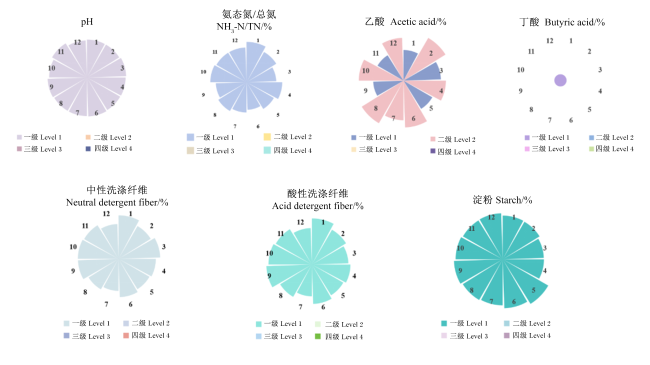
图1可知,3个品种的全株玉米青贮pH、NH3-N/TN、BA、NDF、ADF和ST品质都属于“一级”,表明全株玉米青贮质量优良;各玉米品种AA含量在“一级”到“二级”,其中京科968和鲁星糯在CK和NAB处理下属于“一级”,AA产生较少,在使用LB后AA含量增加,为“二级”。
图1 不同玉米品种和添加剂的全株玉米青贮质量分级

1:京科968无添加剂 Jingke 968 without additives;2:京科968添加LB Jingke 968 with LB;3:京科968添加SB Jingke 968 JK with SB;4:京科968添加SB+LB Jingke 968 with SB+LB;5:高油958无添加剂 Gaoyou 958 without additives;6:高油958添加LB Gaoyou 958 with LB;7:高油958添加SB Gaoyou 958 with SB;8:高油958添加SB+LB Gaoyou 958 with SB+LB;9:鲁星糯无添加剂 Luxinnuo without additives;10:鲁星糯添加LB Luxinnuo with LB;11:鲁星糯添加SB Luxinnuo with SB;12:鲁星糯添加SB+LB Luxinnuo with SB+LB。

Fig.1 Whole corn silage quality grading of different corn varieties and additives

2.3 不同玉米品种和添加剂对全株玉米青贮发酵品质的影响

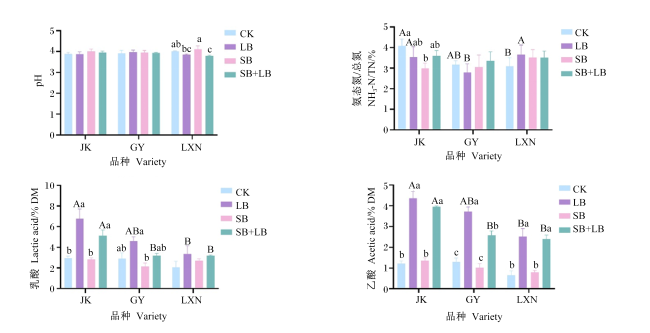
图2可知,本试验所有全株玉米青贮pH都在4.2以下。全株玉米青贮在同一添加剂不同品种之间,经CK处理的京科968 NH3-N/TN含量显著高于鲁星糯(P<0.05);经LB处理的高油958 NH3-N/TN含量显著低于京科968和鲁星糯(P<0.05),经LB处理的3个玉米品种的LA和AA含量排序是京科968>高油958>鲁星糯;经SB+LB处理的京科968 LA和AA含量显著高于高油958和鲁星糯(P<0.05)。在同一品种不同添加剂之间,京科968品种经SB处理的NH3-N/TN含量最低,京科968经LB和SB+LB处理的LA和AA含量显著高于CK和SB处理(P<0.05);高油958经LB处理的LA和AA含量显著高于SB处理(P<0.05);鲁星糯经LB和SB+LB处理的AA含量显著高于CK和SB处理(P<0.05)。
图2 不同玉米品种和添加剂的全株玉米青贮的发酵品质

JK:京科968 Jingke 968;GY:高油958 Gaoyou 958;LXN:鲁星糯 Luxinnuo;CK:无添加剂 no additives;LB:布氏乳杆菌 Lentilactobacillus buchneri;SB:苯甲酸钠 sodium benzoate;SB+LB:苯甲酸钠+布氏乳杆菌 sodium benzoate+Lentilactobacillus buchneri。下图同 the same as below。

不同大写字母表示玉米品种间差异显著(P<0.05),不同小写字母表示添加剂间差异显著(P<0.05)。图3图4同。Different uppercase letters indicate significant difference between corn varieties (P<0.05), and different lowercase letters indicate significant difference between additives (P<0.05). The same as Fig.3 and Fig.4.

Fig.2 Fermentation quality of whole corn silage under different corn varieties and additives

2.4 不同玉米品种和添加剂对全株玉米青贮营养成分的影响

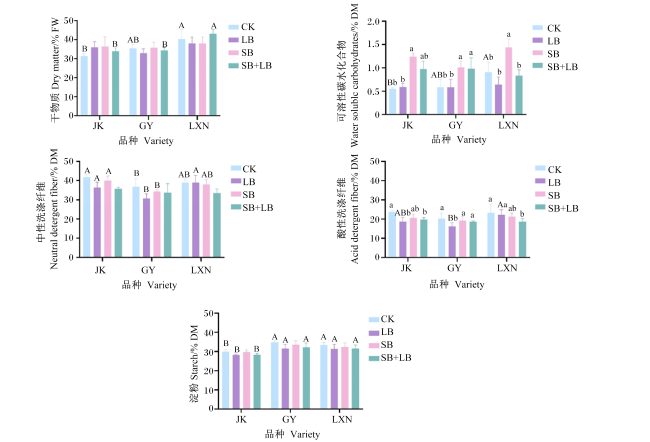
图3可知,添加剂对3个品种全株玉米青贮的DM、NDF和ST含量无显著影响(P>0.05)。在同一添加剂不同品种之间,经CK处理的鲁星糯DM、WSC和ST含量显著高于京科968(P<0.05);经LB处理的鲁星糯NDF和ADF含量显著高于高油958(P<0.05),经LB处理的鲁星糯和高油958 ST含量显著高于京科968(P<0.05);经SB处理的京科968 NDF含量显著高于高油958(P<0.05)。在同一品种中不同添加剂之间,京科968经SB处理的WSC含量显著高于CK、LB、SB+LB处理(P<0.05),京科968经CK处理的ADF含量显著高于LB和SB+LB处理(P<0.05);高油958经SB和SB+LB处理的WSC含量显著高于CK和LB处理(P<0.05),高油958经LB处理的ADF含量显著低于CK、SB和SB+LB处理(P<0.05);鲁星糯经SB处理的WSC含量显著高于CK、LB和SB+LB处理(P<0.05);鲁星糯经SB+LB处理的ADF含量显著低于CK和LB处理(P<0.05)。
图3 不同玉米品种和添加剂的全株玉米青贮的营养成分

Fig.3 Nutrient composition of whole corn silage under different varieties and additives

2.5 不同玉米品种和添加剂对全株玉米青贮体外消化率的影响

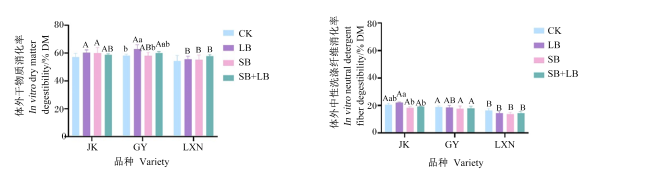
图4可知,添加剂对京科968和鲁星糯的IVDMD无显著影响(P>0.05),对高油958和鲁星糯的IVNDFD影响不显著(P>0.05)。全株玉米青贮在同一添加剂不同品种之间,经CK处理的3个品种IVNDFD大小的排序是京科968>高油958>鲁星糯,差异显著(P<0.05);经LB和SB处理的京科968的IVDMD和IVNDFD显著高于鲁星糯(P<0.05)。在同一品种不同添加剂之间,京科968经LB处理的IVNDFD最高,显著高于SB和SB+LB处理(P<0.05);高油958经LB处理的IVDMD最高,显著高于CK和SB处理(P<0.05)。
图4 不同玉米品种和添加剂的全株玉米青贮体外消化率

Fig.4 In vitro digestibility of whole corn silage under different corn varieties and additives

2.6 全株玉米青贮品质和营养成分的相关性热图

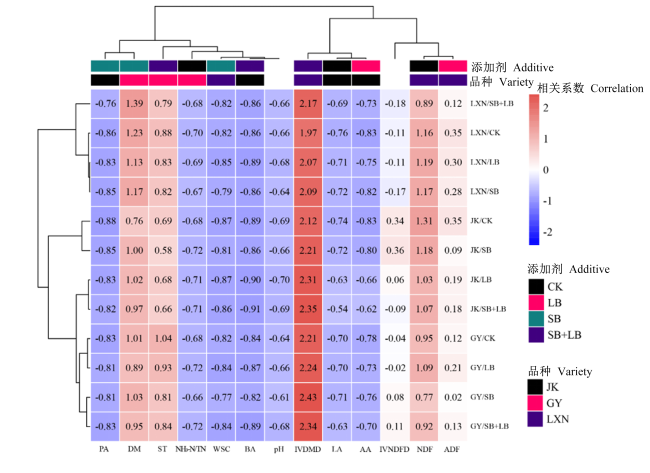
采用Hiplot软件对3个玉米品种和4个添加剂的全株玉米青贮品质进行相关性热图分析,结果如图5所示。不同品种的全株玉米青贮在营养成分和发酵品质方面存在差异。左边树状图对玉米品种和添加剂进行聚类分析可得,相同品种全株玉米可以归为一类。鲁星糯的4个添加剂处理聚为第3类,鲁星糯的LB和SB处理聚为第1类,高油958的4个添加剂处理聚为第2类,京科968的LB和SB+LB处理聚为第1类。
图5 玉米品种和添加剂对全株玉米发酵品质、营养成分和体外消化率的相关性热图分析

PA:丙酸 propionic acid;DM:干物质 dry matter;ST:淀粉 starch;NH3-N/TN:氨态氮/总氮 ammonia nitrogen/total nitrogen;WSC:可溶性碳水化合物 water soluble carbohydrates;BA:丁酸 butyric acid;IVDMD:体外干物质消化率 in vitro dry matter digestibility;LA:乳酸 lactic acid;AA:乙酸 acetic acid;IVNDFD:体外中性洗涤纤维消化率 in vitro neutral detergent fiber;NDF:中性洗涤纤维 neutral detergent fiber;ADF:酸性洗涤纤维 acid detergent fiber。

红色为正相关,蓝色为负相关。Red means positive correlation, blue means negative correlation.

Fig.5 Correlation heat map analysis of additives and varieties on fermentation quality, nutrient composition and in vitro digestibility of whole corn silage

位于热图主体上方的树状图对青贮品质和体外消化率进行聚类,结果发现,LA、AA、PA、BA、WSC、AN含量与TVDMD、ST、DM、NDF含量呈负相关。由图5可知,添加剂中,CK处理可以影响青贮后NH3-N/TN(-0.66~-0.72)、LA(-0.54~-0.76)和NDF含量(0.77~1.31),LB处理影响青贮后AA(-0.62~-0.82)和ADF含量(0.02~0.35),SB处理影响青贮后PA(-0.76~-0.88)、WSC(-0.77~-0.87)和DM含量(0.76~1.39),SB+LB处理影响青贮后BA(-0.82~-0.91)含量、IVDMD(1.97~2.43)和ST含量(0.58~1.04);京科968主要影响青贮后BA(-0.82~-0.91)、LA(-0.54~-0.76)、ADF(0.02~0.35)和DM含量(0.76~1.39),高油958主要影响青贮后WSC含量(-0.77~-0.87)、NH3-N/TN(-0.66~-0.72)、AA(-0.62~-0.82)和ST含量(0.58~1.04),鲁星糯主要影响青贮后PA(-0.76~-0.88)含量、IVDMD(1.97~2.43)和NDF含量(0.77~1.31)。

3 讨论

3.1 玉米品种和添加剂对全株玉米发酵特性的影响

添加LB的青贮饲料需要更长的保存期(从45到90 d)才能有效,这是使用大多数商业化的LB菌株作为青贮添加剂的一个关键方面[17]。LB可将LA转化为AA和1,2-丙二醇[18]。AA具有抗真菌特性,可以抑制酵母等不良微生物的繁殖[6]。本研究3个品种全株玉米青贮经LB和SB+LB处理的AA含量显著高于CK和SB处理。Driehuis等[19]研究表明,单独使用LB或与同型发酵乳酸菌组合使用LB作为添加剂青贮后发现,与对照相比,AA含量增加,可能是由于全株玉米青贮中的木质纤维素被微生物降解为戊糖导致[20],这与Kristensen等[21]的研究结果一致。
pH是衡量青贮饲料发酵品质和有机酸产生的主要指标之一,本研究中全株玉米青贮发酵200 d后pH稳定在3.79~4.12,使用LB处理后各玉米品种的pH都接近CK处理。添加剂和玉米品种的pH没有显著差异,乳酸和乙酸积累后pH会降低。据报道,微生物添加剂会增加或不影响青贮饲料的pH[8,22]。Ferrero等[23]研究表明,单丙氨酸和单丁二酰甘油混合物对全株玉米青贮发酵品质的影响时发现,发酵100和240 d的pH在添加LB(NCIMB 40788)后高于使用化学添加剂(单丙氨酸和单丁二酰甘油混合物),这可能是因为该研究的全株玉米青贮饲料DM含量高(DM>40%)、低水分活度和不适合乳酸菌生存的环境使LB活性无效。

3.2 玉米品种和添加剂对全株玉米ST和WSC的影响

本研究中,各玉米品种经LB和SB+LB处理后全株玉米青贮的ST含量低于CK和SB处理,但处理之间无显著差异。这说明化学添加剂对微生物有抑制作用,一定程度上阻碍了微生物对ST的利用;另外,青贮玉米收获时一般在1/2到2/3乳线期,获得的DM含量高,ST比例高,水分活度和WSC含量较低,乳酸菌发酵困难[24]。Nair等[25]的研究表明,将希尔加迪乳杆菌(Lactobacillus hilgardii)和LB组成的异发酵乳酸菌混合物添加到全株玉米青贮饲料中,研究结果显示,在对照组(23.1% DM)和添加微生物的处理组(24.3% DM)之间,全株玉米青贮的ST含量差异并不显著,也就是说微生物添加剂对全株玉米青贮ST含量影响较小。
WSC含量对于青贮至关重要,为乳酸菌提供足够的发酵底物[26]。本研究中,3个品种的全株玉米青贮在使用化学添加剂后WSC含量增加,可能的原因是SB主要以未离解酸的形式起作用,它们的抗菌活性受到微生物发酵产生的环境影响[27],而抗菌活性的增加也减少了微生物对WSC的消耗。经过LB处理的全株玉米青贮的WSC含量变化不大,而Wang等[28]研究表明,在乳酸菌和艾蒿处理玉米青贮饲料中微生物群落和发酵品质的变化时发现,在青贮60 d时,添加乳酸菌全株玉米青贮的WSC含量比对照组显著降低,与本研究结果不一致,可能是因为本研究中原料收获于蜡熟期,水分和WSC含量较低,使得乳酸菌活性较低。

3.3 不同玉米品种和添加剂对全株玉米青贮纤维和体外消化率的影响

纤维含量是评价青贮饲料的一个重要指标,饲料中高含量的粗纤维会降低动物的采食量和DM消化率,甚至会降低生产性能[29]。本研究中,京科968和高油958全株玉米青贮的NDF和ADF含量经LB处理后低于CK和SB处理,这可能是青贮过程中产生的有机酸水解可消化细胞壁部分的结果[30]。Rossi等[30]研究表明,使用LB的青贮玉米NDF和ADF含量都低于无添加剂的对照组,与本研究结果一致。
青贮添加剂中使用的乳酸菌可以在瘤胃液中存活,与瘤胃微生物相互作用,改变瘤胃发酵,增强瘤胃功能,并在小肠中提供益生菌[31]。LB可以在青贮饲料中产生阿魏酸酯酶,这有可能提高纤维的消化率[31]。本研究中3个全株玉米品种在添加LB青贮200 d后的IVDMD和IVNDFD升高,各玉米品种IVNDFD在添加LB后最高,其次是SB+LB,这表明了在玉米青贮饲料微生物添加剂会强化发酵,进一步水解细胞壁成分并结合到瘤胃微生物中[32-33]。Wagali等[34]研究表明,添加微生物菌剂后全株玉米青贮的IVNDFD显著增加,与本研究结果一致。

4 结论

综上所述,在生产实践中,建议选择高油958作为通辽地区全株青贮玉米的适宜种植品种,并配合LB作为添加剂使全株玉米青贮品质得到进一步提升。
[1]
NRC. Nutrient requirements of dairy cattle[S]. 7rd ed. Washington,D.C.: National Research Council, 2001.

[2]
MA J, FAN X, MA Z, et al. Silage additives improve fermentation quality,aerobic stability and rumen degradation in mixed silage composed of amaranth and corn straw[J]. Frontiers in Plant Science, 2023, 14:1189747.

[3]
LI J, WEN X, YANG J, et al. Effects of maize varieties on biomass yield and silage quality of maize-soybean intercropping in the Qinghai-Tibet plateau[J]. Fermentation, 2022, 8(10):542.

[4]
ZHANG X L, WANG Q, ZHAO Y L, et al. Effects of nitrogen fertilization rate and harvest time on summer maize grain yield and its quality[J]. Journal of Applied Ecology, 2010, 21(10):2565-2572.

[5]
WANG Y, WANG C, ZHOU W, et al. Effects of wilting and Lactobacillus plantarum addition on the fermentation quality and microbial community of Moringa oleifera leaf silage[J]. Frontiers in Microbiology, 2018, 9:1817.

[6]
MUCK R E, NADEAU E M G, MCALLISTER T A, et al. Silage review:recent advances and future uses of silage additives[J]. Journal of Dairy Science, 2018, 101(5):3980-4000.

[7]
ROMERO J J, ZHAO Y, BALSECA-PAREDES M A, et al. Laboratory silo type and inoculation effects on nutritional composition,fermentation,and bacterial and fungal communities of oat silage[J]. Journal of Dairy Science, 2017, 100(3):1812-1828.

[8]
KUNG Jr L, SHAVER R D, GRANT R J, et al. Silage review:interpretation of chemical,microbial,and organoleptic components of silages[J]. Journal of Dairy Science, 2018, 101(5):4020-4033.

[9]
WEN A Y, YUAN X J, WANG J, et al. Effects of four short-chain fatty acids or salts on dynamics of fermentation and microbial characteristics of alfalfa silage[J]. Animal Feed Science and Technology, 2017, 223:141-148.

[10]
KLEINSCHMIT D H, SCHMIDT R J, KUNG L J. The effects of various antifungal additives on the fermentation and aerobic stability of corn silage[J]. Journal of Dairy Science, 2005, 88(6):2130-2139.

PMID

[11]
ZHANG Y, LIU Y, MENG Q, et al. A mixture of potassium sorbate and sodium benzoate improved fermentation quality of whole-plant corn silage by shifting bacterial communities[J]. Journal of Applied Microbiology, 2020, 128(5):1312-1323.

DOI PMID

[12]
DAI T, DONG D, WANG S R, et al. The effectiveness of chemical additives on fermentation profiles,aerobic stability and in vitro ruminal digestibility of total mixed ration ensiled with Napier grass and wet distillers’grains in southeast China[J]. Italian Journal of Animal Science, 2022, 21(1):979-989.

[13]
中国畜牧协会. 青贮饲料全株玉米:T/CAAA 005—2018[S]. 北京: 中国农业科学技术出版社, 2018.

China Animal Agriculture Association. Silage Whole Plant Corn:T/CAAA 005—2018[S]. Beijing: China Agricultal Science and Technology Press, 2018. (in Chinese)

[14]
BRODERICK G A, KANG J H. Automated simultaneous determination of ammonia and total amino acids in ruminal fluid and in vitro media[J]. Journal of Dairy Science, 1980, 63(1):64-75.

[15]
张丽英. 饲料分析及饲料质量检测技术[M]. 2版. 北京: 中国农业大学出版社, 2003 ZHANG L Y.

Feed analysis and feed quality testingtechnology[M]. 2nd ed. Beijing: China Agricultural University Press, 2003. (in Chinese)

[16]
TILLEY J A, TERRY R C. A two-stage technique for the in vitro digestion of forage crops[J]. Journal of the British Grassland Society, 1963, 18(2):104-111.

[17]
FERRERO F, PIANO S, TABACCO E, et al. Effects of conservation period and Lactobacillus hilgardii inoculum on the fermentation profile and aerobic stability of whole corn and sorghum silages[J]. Journal of the Science of Food and Agriculture, 2019, 99(5):2530-2540.

[18]
BASSO F C, ADESOGAN A T, LARA E C, et al. Effects of feeding corn silage inoculated with microbial additives on the ruminal fermentation,microbial protein yield,and growth performance of lambs[J]. Journal of Animal Science, 2014, 92(12):5640-5650.

[19]
DRIEHUIS F, OUDE E S J, VAN WIKSELAAR P G. Fermentation characteristics and aerobic stability of grass silage inoculated with Lactobacillus buchneri,with or without homofermentative lactic acid bacteria[J]. Grass Forage Science, 2001, 56(4):330-343.

[20]
KOHLER B, DIEPOLDER M, OSTERTAG J, et al. Dry matter losses of grass,lucerne and maize silages in bunker silos[J]. Journal of the Science of Food and Agriculture, 2013, 22(1):145-150.

[21]
KRISTENSEN N B, SLOTH K H, HØJBERG O, et al. Effects of microbial inoculants on corn silage fermentation,microbial contents,aerobic stability,and milk production under field conditions[J]. Journal of Dairy Science, 2010, 93(8):3764-3774.

[22]
LARA E C, BASSO F C, DE ASSIS F B, et al. Changes in the nutritive value and aerobic stability of corn silages inoculated with Bacillus subtilis alone or combined with Lactobacillus plantarum[J]. Animal Reproduction Science, 2016, 56:1867-1874.

[23]
FERRERO F, TABACCO E, BORREANI G. Effects of a mixture of monopropionine and monobutyrin on the fermentation quality and aerobic stability of whole crop maize silage[J]. Animal Feed Science and Technology, 2019, 258:114319.

[24]
COMINO L, TABACCO E, RIGHI F, et al. Effects of an inoculant containing a Lactobacillus buchneri that produces ferulate-esterase on fermentation products,aerobic stability,and fibre digestibility of maize silage harvested at different stages of maturity[J]. Animal Feed Science and Technology, 2014, 198:94-106.

[25]
NAIR J, HUAXIN N, ANDRADA E, et al. Effects of inoculation of corn silage with Lactobacillus hilgardii and Lactobacillus buchneri on silage quality,aerobic stability,nutrient digestibility,and growth performance of growing beef cattle[J]. Journal of Animal Science, 2020, 98(10):skaa267.

[26]
FERRERO F, TABACCO E, BORREANI G. Lentilactobacillus hilgardii inoculum,dry matter contents at harvest and length of conservation affect fermentation characteristics and aerobic stability of corn silage[J]. Frontiers in Microbiology, 2021, 12:675563.

[27]
KUNG L J, SMITH M L, BENJAMIM DA SILVA E, et al. An evaluation of the effectiveness of a chemical additive based on sodium benzoate,potassium sorbate,and sodium nitrite on the fermentation and aerobic stability of corn silage[J]. Journal of Dairy Science, 2018, 101(7):5949-5960.

[28]
WANG W W, TAN Z F, GU L B, et al. Variation of microbial community and fermentation quality in corn silage treated with Lactic acid bacteria and Artemisia argyi during aerobic exposure[J]. Toxins, 2022, 14(5):349.

[29]
LARSEN S U, HJORT-GREGERSEN K, VAZIFEHKHORAN A H, et al. Co-ensiling of straw with sugar beet leaves increases the methane yield from straw[J]. Bioresource Technology, 2017, 245(Pt A):106-115.

DOI PMID

[30]
ROSSI L G, ANDRADE M E B, RABELO C H S, et al. Flint corn silage management:influence of maturity stage, inoculation with Lentilactobacillus buchneri,and storage time on fermentation pattern,aerobic stability,and nutritional characteristics[J]. Frontiers in Microbiology, 2023, 14:1223717.

[31]
WEINBERG Z G, SHATZ O, CHEN Y, et al. Effect of lactic acid bacteria inoculants on in vitro digestibility of wheat and corn silages[J]. Journal of Dairy Science, 2007, 90(10):4754-4762.

[32]
NSEREKO V L, SMILEY B K, RUTHERFORD W M, et al. Influence of inoculating forage with Lactic acid bacterial strains that produce ferulate esterase on ensilage and ruminal degradation of fiber[J]. Animal Feed Science and Technology, 2008, 145(1/2/3/4):122-135.

[33]
DEMIREL M, YILMAZ I, DENIZ S, et al. Effect of addition of urea or urea plus molasses to different corn silages harvested at dough stage on silage quality and digestible dry matter yield[J]. Journal of Applied Animal Research, 2003, 24(1):7-16.

[34]
WAGALI P, PELECH I, SABASTIAN C, et al. The effect of microbial inoculum and urea supplements on nutritive value,amino acids profile,aerobic stability and digestibility of wheat and corn silages[J]. Animals, 2023, 13(13):2197.

Outlines

/