RESEARCH PAPER

Effects of Different Fermentation Time and Additives on Fermentation Quality and Microbial Diversity of High Moisture Corn Cobs

  • WEI Yao , 1, 2 ,
  • BIAN Binbin 1, 2 ,
  • FENG Yinyuan 1, 2 ,
  • LI Jiayu 1, 2 ,
  • GUO Xu 1, 2 ,
  • LI Yanbing , 1, 2, *
Expand
  • 1 College of Animal Science and Technology, Heilongjiang Bayi Agricultural and Reclamation University, Daqing 163319, China
  • 2 Key Laboratory of Efficient Utilization of Feed Resources and Nutritional Regulation in Cold Regions of Heilongjiang Province, Daqing 163319, China
*associate professor, E-mail:

Received date: 2024-07-24

  Online published: 2025-03-13

Abstract

The aim of this experiment was to investigate the effects of different fermentation time and additives on nutrients, fermentation quality and microbial diversity of high moisture corn cobs. The experiment was designed with two factors, and three groups were set up according to different additives, namely control group (no additives, CK group), Lactobacillus brucei group (Lactobacillus brucei supplemental level was 1×10⁵ CFU/g, NK group) and 0.5% sodium propionate group (sodium propionate supplemental level was 5 g/kg, SP group). Each group was repeated three times. The relevant indexes of high water corn cobs were analyzed on the 7th and 60th day of fermentation, respectively. The results showed as follows: 1) additives had a significant effect on dry matter content (P<0.05), fermentation time had a significant effect on crude ash content (P<0.05), and the interaction between the two had a very significant effect on calcium content (P<0.01). On the 7th day of fermentation, the dry matter content of SP group was significantly lower than that of CK group (P<0.05). 2) Lactic acid content was significantly higher in the NK group than in the other two groups (P<0.05) at the 7th day of fermentation; in aerobic stabilization, pH was significantly higher in the CON group than the NK group (P<0.05), while there was no significant change in the SP group (P>0.05). 3) At the phylum level, compared with the CK group, the relative abundance of Firmicutes in the SP group at 7 days and 60 days of fermentation showed an increasing trend. At the genus level, compared with the CK group, the relative abundance of Lactobacillus in the SP group showed an increasing trend on the 7th day of fermentation, and the relative abundance of adverse microorganisms showed a decreasing trend. 4)Correlation analysis showed that the relative abundance of Lactobacillus was positively correlated with crude protein and acid detergent fiber contents (P<0.05), and propionic acid content was negatively correlated with the relative abundance of Clostridium and Peptoclostridium (P<0.05). In conclusion, the addition of 0.5% sodium propionate improves the fermentation quality of high-moisture corn cobs, reduces the loss of nutrients, and increases the relative abundance of beneficial bacteria as well as aerobic stability.

Cite this article

WEI Yao , BIAN Binbin , FENG Yinyuan , LI Jiayu , GUO Xu , LI Yanbing . Effects of Different Fermentation Time and Additives on Fermentation Quality and Microbial Diversity of High Moisture Corn Cobs[J]. Chinese Journal of Animal Nutrition, 2025 , 37(3) : 2045 -2057 . DOI: 10.12418/CJAN2025.173

玉米作为世界范围内的主要饲料作物,长期以来在畜牧业中得到广泛应用[1]。玉米穗包括玉米籽粒、玉米芯2部分,利用其制作青贮,可减少烘干、存贮等费用[2]。近年来,黑龙江地区汛期时降水天数总体呈增加趋势[3],引发的洪涝灾害使大面积农田被淹没,导致大量玉米在乳熟期时被洪水浸泡,而水分是玉米贮藏过程中一个具有挑战性的因素[4],并且高水分玉米穗(HMEC)的营养价值易受好氧变质的限制[5],若饲料处理不当会导致严重的资源浪费。因此,寻找合适的贮藏方法至关重要。
青贮饲料中使用添加剂能够改善青贮饲料发酵并有利于饲料的保存[6],添加剂种类繁多,在实际生产应用中主要分为同源发酵乳酸菌、专性异质发酵乳酸菌、乳酸菌混合接种剂、化学添加剂和酶制剂[7]。布氏乳杆菌是专性异质发酵乳酸菌,接种异型乳酸菌制剂对发酵中微生物菌群多样性及丰度有较大影响[8]。Gallo等[9]评估了接种不同青贮密度的布氏乳杆菌的影响,发现接种可以提高发酵质量,同时降低伏马菌素B2和罗克福汀C的含量。对于高水分玉米,接种布氏乳杆菌可有效抑制酵母生长,并降低青贮饲料和空气胁迫条件下肠杆菌科的相对丰度[10]。Muck等[7]研究发现,含有同源或兼性异质发酵的细菌接种剂利用糖发酵生成乳酸来快速降低青贮饲料pH。但是,布氏乳杆菌在发酵初始阶段与植物乳杆菌相比,pH的降低效果较差,这可能导致在发酵的好氧阶段有害细菌的生长[1]
有机酸(盐)属于化学添加剂,可以调节饲料发酵过程中微生物群落的结构变化,抑制不良微生物的生长与繁殖,提高发酵饲料的有氧稳定性,降低饲料中的营养损失[11]。醋酸盐、丙酸盐和丁酸盐是短链脂肪酸中代谢物最丰富的,其中丁酸盐的研究最为广泛,已被证明对维持宿主健康很重要[12]。近年来,丙酸盐也引起了更多的关注。在所有短链脂肪酸中,丙酸具有最大的抗真菌特性。Ogunade等[13]研究发现,丙酸处理组丙酸浓度提高,其未解离形式可有效减少酵母菌和霉菌的生长。Sun等[14]研究表明,在高比例豆粕饲粮中补充0.5%或1.0%丙酸钠(NaP)可减少豆粕对肠黏膜屏障的损害。Dai等[15]研究发现,0.5%丙酸钠能够改善发酵全混合日粮(TMR)的发酵质量、好氧稳定性和体外瘤胃消化率。
本试验以高水分玉米穗为原料,旨在探讨添加布氏乳杆菌与0.5%丙酸钠对不同发酵时间的高水分玉米穗发酵品质和微生物多样性的影响,为高水分玉米穗的贮藏提供理论支持和试验数据。

1 材料与方法

1.1 试验材料

玉米穗收集于黑龙江省大庆市,原料的营养水平与微生物数量见表1
表1 高水分玉米穗原料营养水平与微生物数量

Table 1 Nutrient levels and microbial populations of high moisture corn cobs

项目
Item
干物质
DM/% FM
pH 乳酸菌
LAB/[lg(CFU/g)]
酵母菌
Yeast/[lg(CFU/g)]
大肠杆菌
ENB/[lg(CFU/g)]
含量Content 51.72 5.28 5.30 5.30 5.90

1.2 试验设计

试验采用双因素设计,按照添加剂设置3个组,分别为对照组(无添加剂,CK组)、布氏乳杆菌组(布氏乳杆菌添加量为1×10⁵ CFU/g,NK组)与0.5%丙酸钠组(丙酸钠添加量为5 g/kg,SP组),每组3次重复,将不同添加剂分别均匀地喷洒在经切短至1~2 cm的玉米穗中,各组样品分别装入真空包装袋中,每袋约300 g,真空密封,室温条件下在发酵第7天与第60天开袋分析不同发酵时间与添加剂对高水分玉米穗发酵品质及微生物多样性的影响。

1.3 测定指标及方法

1.3.1 常规营养成分分析

玉米穗干物质(DM)含量采用GB/T 6435—2014[16]方法测定;粗蛋白质(CP)含量采用GB/T 6432—2018[17]方法测定;粗灰分(Ash)含量采用GB/T 6438—2007[18]方法测定;采用范氏洗涤纤维法[19]分别检测中性洗涤纤维(NDF)与酸性洗涤纤维(ADF)含量;粗脂肪(EE)含量采用GB/T 6433—2006方法[20]测定;氨态氮(NH3-N)含量采用苯酚-次氯酸盐法[21]测定;钙和磷含量分别按照GB/T 6436—2018[22]和GB/T 6437—2018[23]方法测定。

1.3.2 发酵品质测定

pH使用酸度计进行测定;有机酸含量采用高效液相色谱法[24]测定;可溶性碳水化合物(WSC)含量采用蒽酮-硫酸比色法[25]测定。采用平板计数法对乳酸菌、酵母菌与大肠杆菌进行计数。

1.3.3 微生物多样性分析

采用CTAB方法提取各样本的总基因组DNA,使用细菌16S rRNA基因V3~V4区引物对获得DNA模板进行序列扩增。采用Illumina Nova Seq测序平台对混合样品基于16S rRNA基因高通量测序。PCR扩增采用全式金公司的Pfu高保真DNA聚合酶进行,将PCR扩增回收产物进行荧光定量,对发酵高水分玉米穗的微生物组成与丰度进行分析。

1.4 数据统计与分析

采用Excel 2019对数据进行初步处理,采用SPSS 27.0软件进行两因素方差分析,采用Duncan氏法进行多重比较检验,结果用平均值和均值标准误(SEM)表示,以P<0.05为差异显著判断标准,P<0.01为差异极显著判断标准。

2 结果与分析

2.1 不同发酵时间与添加剂对高水分玉米穗营养品质的影响

表2可知,添加剂对DM含量有显著影响(P<0.05),对Ash及Ca含量有极显著影响(P<0.01);发酵时间对Ash和NDF含量有显著影响(P<0.05),对Ca和NH3-N含量有极显著影响(P<0.01);二者的交互作用对Ash含量有显著影响(P<0.05),对Ca含量有极显著作用(P<0.01)。
表2 不同发酵时间与添加剂对高水分玉米穗营养品质的影响

Table 2 Effects of different fermentation time and additives on nutritional quality of high moisture corn cobs

项目
Items
时间
Time/d
组别Groups SEM PP-value
CK NK SP 时间
Time
添加剂
Additive
时间×添加剂
Time×additive
干物质
DM/% FM
7 54.71a 54.01ab 52.39b 0.792
0.279

0.018

0.657
60 55.15 54.07 53.52 0.861
粗蛋白质
CP/% DM
7 8.55 8.22 6.99 2.334
0.410

0.653

0.953
60 7.08 7.40 6.36 1.537
粗灰分
Ash/% DM
7 0.61Bb 0.49Bb 1.09a 0.078
0.041

<0.001

0.018
60 0.81Aab 0.71Ab 0.99a 0.074
粗脂肪
EE/% DM
7 0.13 0.36A 0.12 0.194
0.233

0.407

0.377
60 0.10 0.10B 0.11 0.006
中性洗涤纤维
NDF/% DM
7 24.39A 25.98 21.34 5.144
0.019

0.602

0.653
60 16.44B 18.96 18.22 1.862
酸性洗涤纤维
ADF/% DM
7 5.50 4.63 4.34 1.020
0.108

0.901

0.389
60 3.52 4.10 4.09 0.793

Ca/% DM
7 0.18B 0.24B 0.24B 0.038
<0.001

<0.001

<0.001
60 0.26Ab 0.55Ab 1.23Aa 0.172

P/% DM
7 0.04a 0.02b 0.02Bb 0.006
0.963

0.824

0.095
60 0.01 0.02 0.04A 0.021
氨态氮
NH3-N/(g/kg DM)
7 6.95B 7.58B 7.68B 1.274
<0.001

0.570

0.242
60 13.65A 13.41A 11.75A 0.793
可溶性碳水化合物
WSC/(g/kg DM)
7 50.57 67.45 50.10 17.419
0.322

0.287

0.930
60 39.47 55.86 45.81 12.293

同列数据肩标不同大写字母表示相同添加剂不同发酵时间之间差异显著(P<0.05),同行数据肩标不同小写字母表示相同发酵时间在不同添加剂之间差异显著(P<0.05),同行或同列数据肩标无字母表示差异不显著(P>0.05)。下表同。

Different uppercase letters in the superscripts of data within the same column indicate significant difference between different fermentation time with the same additive (P<0.05), and different lowercase letters in the superscripts of data within the same row indicate significant difference between different additives at the same fermentation time (P<0.05), while no letter superscripts on data in the same row or column indicate no significant difference (P>0.05). The same as below.

在发酵第7天不同添加剂作用下,CK组的DM含量显著高于SP组(P<0.05);SP组的Ash含量显著高于其他2组(P<0.05);CK组的P含量显著高于其余2组(P<0.05)。在发酵第60天不同添加剂作用下,SP组的Ash含量显著高于NK组(P<0.05);SP组的Ca含量显著高于其余2组(P<0.05)。
在添加剂相同不同发酵天数时,发酵第60天CK组与NK组的Ash含量显著高于第7天(P<0.05),发酵第7天CK组的NDF含量显著高于第60天(P<0.05),发酵第60天CK组、NK组及SP组的Ca、NH3-N含量显著高于第7天(P<0.05),发酵第60天SP组P含量显著高于第7天(P<0.05)。

2.2 不同发酵时间与添加剂对高水分玉米穗发酵品质的影响

表3可知,发酵时间对酵母菌和丁二酸含量有极显著影响(P<0.01),对丙酸含量和大肠杆菌数量有显著影响(P<0.05);添加剂对酵母菌和丁酸含量有极显著影响(P<0.01),对乳酸含量有显著影响(P<0.05);二者的交互作用对丁酸含量有极显著影响(P<0.01),对其他发酵品质指标均无显著影响(P>0.05)。
表3 不同发酵时间与添加剂对高水分玉米穗发酵品质的影响

Table 3 Effects of different fermentation time and additives on fermentation quality of high moisture corn cobs

项目
Items
时间
Time/d
组别Groups SEM PP-value
CK NK SP 时间
Time
添加剂
Additive
时间×添加剂
Time×additive
pH 7 4.70b 4.78b 5.27a 0.106 0.836 0.170 0.395
60 4.73 4.98 4.94 0.370
乳酸菌
LAB/[lg(CFU/g)]
7 8.39ab 8.18b 8.75a 0.181 0.362 0.715 0.184
60 8.45 9.26 8.46 0.703
酵母菌
Yeast/[lg(CFU/g)]
7 8.44b 8.03Bc 8.74Ba 0.088 <0.001 <0.001 0.357
60 8.73b 8.62Ab 9.30Aa 0.198
大肠杆菌
ENB/[lg(CFU/g)]
7 6.25 5.82B 6.49 1.774 <0.001 0.038 0.686
60 7.03 6.84A 7.24 3.322
乳酸
LA/(g/kg DM)
7 3.04b 9.03a 2.45b 2.011 0.183 0.042 0.298
60 2.51 4.15 2.31 2.493
乙酸
AA/(g/kg DM)
7 1.16 4.30 0.41 2.292 0.812 0.099 0.697
60 0.71 2.99 1.37 1.342
丙酸
PA/(g/kg DM)
7 - - 0.69 0.162 0.019 0.133 0.558
60 - - 2.85 1.323
丁酸
BA/(g/kg DM)
7 0.14b 1.22Aa - 0.194 0.802 0.003 <0.001
60 0.27 0.39B 0.62 0.213
1,2-丙二醇
1,2-PA/(g/kg DM)
7 0.05 0.36 0.31 0.141 0.442 0.342 0.736
60 0.26 0.33 0.43 0.265
2,3-丁二醇
2,3-BD/(g/kg DM)
7 - - - - 0.183 0.579 0.579
60 - 0.09 0.06 0.088
丁二酸
SA/(g/kg DM)
7 - - - - 0.002 0.576 0.576
60 0.18 0.09 0.14 0.087
异丁酸
Iso-butyric acid/(g/kg DM)
7 0.02 - - 0.020 0.337 0.397 0.397
60 - - - -
乙醇
ETOH/(g/kg DM)
7 2.50 3.03 2.32 1.507 0.833 0.744 0.544
60 3.49 1.63 2.16 1.488

-为未检测到 - was not detected。

在发酵第7天不同添加剂作用下,SP组的pH、酵母菌数量显著高于其他2组(P<0.05),SP组的乳酸菌数量显著高于NK组(P<0.05);NK组的乳酸与丁酸数量显著高于其他2组(P<0.05)。在发酵第60天不同添加剂作用下,SP组的酵母菌数量显著高于CK组与NK组(P<0.05),其他发酵品质指标均无显著差异(P>0.05)。
在相同添加剂不同发酵天数下,发酵第60天NK组与SP组酵母菌数量显著高于第7天(P<0.05);发酵第60天NK组与SP组大肠杆菌数量显著高于第7天(P<0.05);发酵第7天NK组的丁酸数量显著高于第60天(P<0.05)。

2.3 高水分玉米穗发酵有氧稳定性

表4可知,在有氧稳定第0天时pH无显著变化(P>0.05),在有氧稳定第7天时,CK组与NK组pH均显著高于第0天(P<0.05)。发酵时间对pH变化有极显著影响(P<0.01),添加剂对各组pH无显著影响(P>0.05),二者对pH无显著交互作用(P>0.05)。
表4 高水分玉米穗发酵60 d后的7 d有氧稳定性

Table 4 High moisture corn cobs 7-day aerobic stability after fermentation 60 days

项目
Item
时间
Time/d
组别Groups SEM PP-value
CK NK SP 时间
Time
添加剂
Additive
时间×添加剂
Time×additive
pH 0 4.73B 4.98B 4.94 0.369 0.001 0.184 0.123
7 6.58A 6.57A 5.27 0.623

2.4 不同发酵时间与添加剂对高水分玉米穗微生物多样性的影响

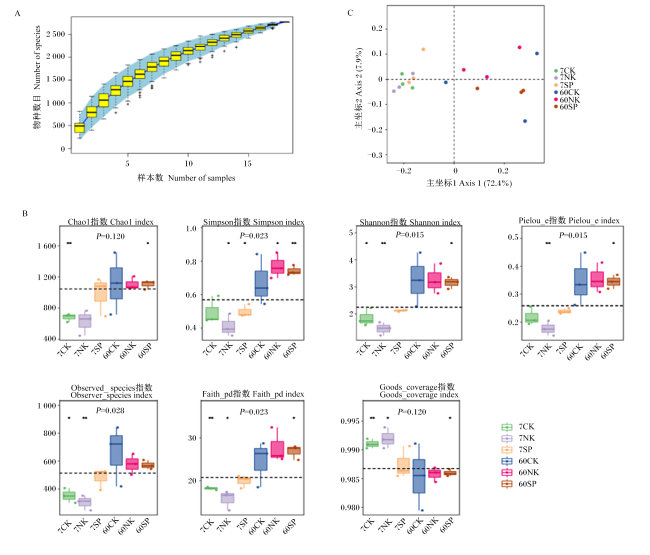
为探讨不同添加剂对发酵玉米穗微生物的影响,对发酵第7天与第60天后的微生物进行了检测。随着抽取样品增加,物种累积曲线逐渐趋于饱和,说明测序数据充分合理(图1-A)。7CK组的Chao1指数显著低于其他组(P<0.05)。7NK组的Simpson、Shannon、Pielou_e、Faith_pd以及Observed_species指数均显著低于其他组(P<0.05)(图1-B)。采用主坐标分析(PCoA)比较了发酵玉米穗微生物β-多样性的差异(图1-C)。β-多样性第1主成分中在发酵第7天各组与第60天各组之间距离明显,表明发酵时间对微生物多样性有影响,在第2主成分上发酵第7天SP组与7CK组有明显的距离,说明添加0.5%的丙酸钠进行玉米穗发酵有利于微生物多样性。
图1 Specaccum物种累积曲线图(A)、微生物α-多样性指数(B)、微生物weighted UniFrac的主坐标分析(PCoA)(C)

7CK、7NK、7SP、60CK、60NK、60SP分别表示发酵第7天CK、NK、SP组和发酵第60天CK、NK、SP组。下图同。7CK, 7 NK, 7SP, 60CK, 60NK, 60SP represent CK, NK, SP groups on the 7th day of fermentation and CK, NK, SP groups on the 60th day of fermentation, respectively. The same as below.

图B中,*为P<0.05,**为P<0.01。In Fig. B, * indicates P<0.05, ** indicates P<0.01.

Fig.1 Specaccum species accumulation curve (A), microbial α-diversity index (B), principal coordinate analysis of microbial weighted UniFrac (PCoA) (C)

2.5 高水分玉米穗发酵的微生物组成

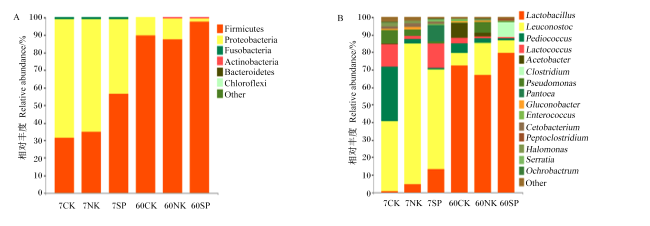
不同添加剂下,高水分玉米穗在发酵第7天和第60天后在门水平与属水平上的微生物结构见图2。在门水平上,厚壁菌门(Firmicutes)与变形菌门(Proteobacteria)在各组中相对丰度最高,随着时间的变化,厚壁菌门相对丰度呈增加趋势,变形菌门相对丰度呈减少趋势。与其他2组相比,SP的添加增加了厚壁菌门的相对丰度,并降低了变形菌门的相对丰度。在属水平上,玉米穗发酵第7天时,CK组的菌群主要包括明串珠菌属(Leuconostoc,39.81%)、片球菌属(Pediococcus,30.84%)、乳酸乳球菌属(Lactococcus,13.46%)和假单胞菌属(Pseudomonas,7.70%)以及少量醋酸杆菌属(Cetobacterium,1.26%)、乳杆菌属(Lactobacillus,0.88%)以及葡萄糖杆菌属(Gluconobacter,0.23%)等。NK与SP的添加增加了乳杆菌属与明串珠菌属的相对丰度,降低了片球菌属与假单胞菌属的相对丰度。随着发酵时间的变化,各组微生物多样性也发生了较大的变化,在发酵第60天时,乳杆菌属成为各组最主要的优势菌属,SP组相对丰度最高(79.60%),与发酵第7天各组相比,明串珠菌属相对丰度均呈降低趋势。
图2 不同发酵时间与添加剂对高水分玉米穗发酵在门水平(A)与属水平(B)上微生物结构的影响

Firmicutes: 厚壁菌门; Proteobacteria: 变形菌门; Fusobacteria: 梭杆菌门; Actinobacteria: 放线菌门; Bacteroidetes: 拟杆菌门; Chloroflexi: 绿弯菌门; Other: 其他; Lactobacillus: 乳杆菌属; Leuconostoc: 明串珠菌属;Pediococcus: 片球菌属; Lactococcus: 乳酸乳球菌; Acetobacter: 醋酸杆菌属; Clostridium: 梭状芽孢杆菌属; Pseudomonas: 假单胞菌属; Pantoea: 泛菌属; Gluconobacter: 葡萄糖杆菌属; Enterococcus: 肠球菌属; Cetobacterium: 醋酸杆菌属; Peptoclostridium: 艰难梭菌属; Halomonas: 盐单胞菌属; Serratia: 沙雷氏菌属; Ochrobactrum: 苍白杆菌属。

Fig.2 Effects of different fermentation time and additives on microbial structure of high moisture corn cobs fermentation at phylum level (A) and genus level (B)

2.6 化学成分与属水平上的微生物的相关性

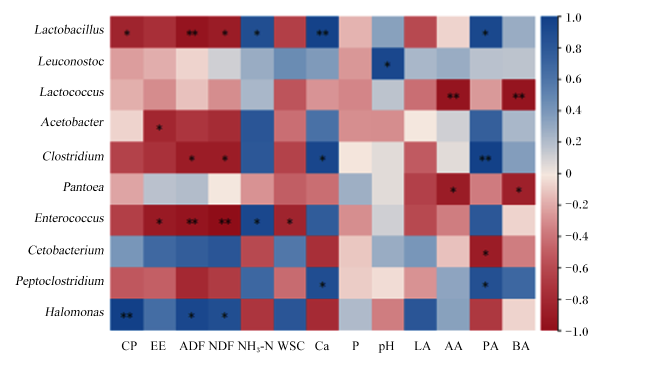
图3可知,发酵玉米穗的营养及发酵品质对微生物有显著影响。CP含量与乳杆菌属的相对丰度呈显著正相关(P<0.05),与盐单胞菌属(Halomonas)的相对丰度呈极显著负相关(P<0.01)。EE含量与醋酸杆菌属(Acetobacter)和肠球菌属(Enterococcous)的相对丰度呈显著正相关(P<0.05)。ADF与NDF含量对乳杆菌属的相对丰度(P<0.05)、梭状芽孢杆菌属(Clostridium)(P<0.05)与肠球菌属(P<0.01)的相对丰度呈显著或极显著正相关,与盐单胞菌属的相对丰度呈显著负相关(P<0.05)。NH3-N含量与乳杆菌属与肠球菌属的相对丰度呈显著负相关(P<0.05)。Ca和PA含量与乳杆菌属、梭状芽孢杆菌属和艰难梭菌属(Peptoclostridium)的相对丰度呈显著负相关(P<0.05)。AA和BA含量与乳酸乳球菌属(P<0.01)和泛菌属(Pantoea)(P<0.05)的相对丰度呈显著或极显著正相关。pH与明串珠菌的相对丰度呈显著负相关(P<0.05)。
图3 化学成分与属水平上的微生物的相关性分析

Lactobacillus: 乳杆菌属; Leuconostoc: 串珠菌属; Lactococcus: 乳酸乳球菌属; Acetobacter: 醋酸杆菌属; Clostridium: 梭状芽孢杆菌属; Pantoea: 泛菌属; Enterococcus: 肠球菌属; Cetobacterium: 醋酸杆菌属; Peptoclostridium: 艰难梭菌属; Halomonas: 盐单胞菌属; CP:粗蛋白质 crude protein; EE:粗脂肪;ADF:酸性洗涤纤维 acid detergent fiber;NDF:中性洗涤纤维 neutral detergent fiber;NH3-N:氨态氮 ammoniacal nitrogen;WSC:可溶性碳水化合物 water soluble carbohydrates;Ca:钙 calcium;P:磷 phosphorus;LA:乳酸 lactic acid;AA:乙酸 acetic acid;PA:丙酸 propionic acid;BA:丁酸 butyric acid。

值大于0表示存在负相关(蓝色),低于0的值表示存在正相关(红色);*表示显著相关(P<0.05),**表示极显著相关(P<0.01)。A value greater than 0 indicates a negative correlation (blue), a value lower than 0 indicates a positive correlation (red); * indicates significant correlation (P<0.05), and ** indicates significant correlation (P<0.01).

Fig.3 Correlation analysis between chemical component and microorganisms at genus level

3 讨论

3.1 不同发酵时间与添加剂对高水分玉米穗营养品质的影响

DM、WSC与CP是影响饲料发酵品质的关键因素,可直观反映发酵玉米穗营养水平的变化情况[26]。发酵饲料中DM的损失源于细胞的呼吸作用及微生物发酵[27]。而WSC是可供乳酸发酵的底物,有较低的缓冲能值[28],有利于饲料发酵。本试验添加剂组与CK组DM含量相似,可能是由于LA主导了各组微生物的发酵,导致DM损失减少[29],使各组之间差异不明显。随着发酵时间的延长,第60天的WSC含量降低,可能由于WSC转化成为微生物发酵的底物。田瑞霞等[30]在青贮研究中发现,在青贮初期时由于细胞呼吸以及酶解反应导致WSC含量降低,与本研究结果一致。本试验中加入各添加剂后CP含量无明显变化,前人研究表明,添加剂对发酵饲料CP含量无显著影响[31],证实了本研究中CK组和各添加剂组的CP含量基本相同。这可能是因为提前收割的玉米穗在发酵中缺乏足够的发酵底物,不能迅速降低pH和提高有机酸含量,导致蛋白酶活性受到抑制[32]
NDF和ADF是评估动物消化率的关键参数。本研究发酵后期NDF含量呈降低趋势,但与发酵第7天的CK组相比,第60天的NDF含量显著降低,2个添加剂组间均无显著变化,说明添加剂对降低NDF含量无显著影响,可能是因为玉米穗中更容易被微生物代谢利用的是非结构性的碳水化合物,而WSC含量较高对木质纤维成分的酶解反应可能也产生一定的抑制作用[33]。本试验中的ADF含量虽无明显变化但自身含量较低,有利于提高饲草的消化率。Khota等[34]研究发现,在高粱青贮过程中加入添加剂,NDF与ADF含量并未显著下降。

3.2 不同发酵时间与添加剂对高水分玉米穗发酵品质的影响

发酵饲料的发酵品质主要由pH与乳酸、乙酸等有机酸决定,饲料在较低pH下仍能保持稳定状态,品质优良的发酵饲料的pH一般在4.2以下,由于对有限营养物质的竞争,乳酸菌数量随着有害细菌数量的减少而增加,导致大量乳酸的产生,pH迅速下降,混合青贮饲料的发酵质量得到改善[35]。本试验中各组pH之间均无显著变化,在发酵第7天时,SP组pH达到了5.27,但NK组的pH与CK组无显著差异,并且NK组的乳酸含量显著高于其他2组。这可能是由于青贮时样品之间的空气难以完全耗尽,难以达到完全厌氧的环境,使各种生物酶活性降低,导致青贮发酵进程缓慢,无法达到酸性环境并很好地抑制各种有害菌的生长繁殖[36],另外还可能是由于加入NK后有利于抑制好氧菌的生长,使乳酸含量显著增加,导致pH无显著变化。丙酸和丁酸是衡量饲料发酵品质的重要标志[37]。丙酸对真菌繁殖能够起到抑制作用,减少真菌对青贮饲料营养物质的消耗[38]。丁酸由有害微生物生成并对青贮饲料中的氨基酸进行分解,进而导致青贮饲料营养损失[39]。本研究中,在发酵第7天时仅SP组检测出微量的丙酸,随着发酵时间的变化,各组丙酸含量均有所增加,对玉米穗的发酵起到了积极作用,能够抑制真菌繁殖减少对营养物质的损耗。SP组在发酵第7天时未检测出丁酸,说明添加0.5%的丙酸钠能够降低丁酸含量,有效抑制梭菌发酵[40],在发酵第60天时有微量丁酸生成,可能因为随着玉米穗发酵时间的延长,致使饲料发生二次发酵,酵母菌和好氧性细菌快速增殖,引起了发酵饲料变质[41]

3.3 玉米穗发酵7 d有氧稳定性分析

发酵饲料有氧稳定性是指发酵饲料在贮存与饲喂期间,pH与温度没有发生变化,仍然具有保持新鲜、气味酸香的能力[42]。本研究中,CK组与NK组在7 d有氧后pH显著上升,而SP组pH无显著变化,说明添加SP后有助于提高玉米穗的有氧稳定性。这可能是因为丙酸盐转化为丙酸分子后,对引起青贮饲料有氧腐败的酵母菌和霉菌生长均有抑制作用,丙酸是一种有效的抗真菌剂[43]。与Kung等[44]研究结果相似。

3.4 不同发酵时间与添加剂对高水分玉米穗微生物多样性的影响

微生物的群落结构、物种多样性和功能是影响青贮饲料发酵的关键因素[45]。本试验中随着样品测序深度逐渐加深,物种累积曲线逐渐趋于平滑,证明测序结果合理,能够反映出全部的细菌多样性[46]。在玉米穗发酵试验中,Chao1与Observrd-species指数结果表明,随着发酵时间的变化以及添加剂的加入各组的微生物丰富度均有所升高。不同添加剂与不同发酵时间的Simpson和Shannon指数表明物种多样性有所增加,这可能是由于相对较高的pH有利于微生物多样化[47],有研究证实了pH较高,微生物α多样性可能会增加[48-49],与本试验结果一致。但NK组低于CK组,说明加入乳酸菌添加剂后青贮中复杂的微生物群落会逐渐被优势乳酸菌取代[50]
在门水平上,发酵第7天各组优势菌门为厚壁菌门与变形菌门,SP的添加明显增加了厚壁菌门的相对丰度。本试验结果与Liu等[51]的试验结果一致。造成这一现象的原因可能是丙酸钠转化成丙酸分子发挥了较好的抗菌作用,其有效成分丙酸对变形菌门等好气型菌起到了较好的抑制作用[52]。Lv等[53]研究发现,一些对添加剂敏感的微生物群落变化可能与优势细菌的生理特性及适应添加剂处理引起的环境变化有关。丙酸钙可以直接影响细菌生理学,间接影响微生物群落。随着发酵时间的延长,变形菌门的相对丰度逐渐降低,而厚壁菌门成为优势菌门,可能是因为厚壁菌门在厌氧青贮条件下将糖发酵成酸并抑制变形菌,导致其相对丰度降低[54-55]。Wang等[55]在辣木叶青贮饲料中也证明了类似的结果。
部分研究发现,片球菌属与乳杆菌属等在饲料发酵过程中起到了主导作用[56]。这2种菌属在发酵中、后期对酸性环境的耐受能力与乳杆菌属相比较弱,一般被认为是饲料发酵中的早期定植菌属[57]。本试验属水平的微生物丰度分析表明,玉米穗发酵第7天时,CK组的优势菌群主要包括明串珠菌属、片球菌属和假单胞菌属。在分别添加NK与SP后,乳杆菌属与明串珠菌属的相对丰度增加,片球菌属与假单胞菌属的相对丰度降低。有研究表明,添加剂的使用改变了发酵质量以及微生物群落多样性。具体而言,青贮饲料添加剂的使用可减少不良微生物[Caproiciproducens和假单孢菌属(Pseudomonas)]的增殖,并增加了所需微生物的丰度[58]。随着发酵时间的变化,各组微生物多样性也发生了较大的变化,在发酵第60天时,乳杆菌属成为各组最主要的优势菌属,与发酵第7天相比,明串珠菌属相对丰度显著降低。这可能是因为片球菌属在青贮初期与乳酸积累以及快速酸化联系紧密,为乳杆菌属生长、繁殖创造有利的生境条件[59]。Wang等[55]研究发现,添加剂对微生物群落的影响随发酵时间的变化而变化,能够改变发酵过程,通过加速发酵使乳酸菌属占主导地位,有益于青贮饲料发酵,与本研究结果一致。

3.5 发酵高水分玉米穗属水平的微生物与发酵品质的相关性聚类热图分析

研究表明,微生物群落与发酵参数之间存在相互作用[60]。本试验的Spearman相关热图显示了各发酵参数与微生物群落的相关性。乳杆菌属相对丰度与乳酸含量呈正相关,与pH呈负相关。这证明了乳杆菌属细菌耐酸性较强,对青贮pH降低起到了重要作用[61],并能快速酸化,对抑制有害细菌的生物活性和保存饲料营养物质起着关键作用[51]。明串珠菌属与pH呈显著负相关,与Mu等[62]的研究结果一致,这主要是由于明串珠菌属等乳酸菌代谢产生的乳酸可以迅速降低发酵饲料pH。

4 结论

本研究结果表明,添加0.5%丙酸钠提高了高水分玉米穗的发酵品质,降低了营养成分的损失,提高了有益菌的相对丰度以及有氧稳定性。
[1]
LI J, LI Z, SHANG S L, et al. Effect of additives and moisture on the fermentation quality and bacterial community of high moisture ear corn[J]. Frontiers in Microbiology, 2023, 14:1251946.

[2]
宫玉霞, 李红梅, 张红霞, 等. 浅谈玉米果穗青贮技术[J]. 中国牛业科学, 2019, 45(2):60-61.

GONG Y X, LI H M, ZHANG H X, et al. Talking about corn ear silage technology[J]. China Cattle Science, 2019, 45(2):60-61. (in Chinese)

[3]
高玲, 王蕾. 黑龙江汛期降水日变化特征分析及对农业的影响[J]. 农业灾害研究, 2024, 14(3):169-171.

GAO L, WANG L. Characterization of daily changes in precipitation during the flood season in Heilongjiang and its impact on agriculture[J]. Journal of Agricultural Catastropholog, 2024, 14(3):169-171. (in Chinese)

[4]
SHANG S L, LI Z, LI J J, et al. Effects of high moisture ear corn on production performance,milk fatty acid composition,serum antioxidant status,and immunity in primiparous dairy cows[J]. Animal Bioscience, 2024, 37(7):1204-1212.

[5]
ALLI I, FAIRBAIRN R, BAKER B E, et al. Effects of anhydrous ammonia on fermentation of chopped,high-moisture ear corn[J]. Journal of Dairy Science, 1983, 66(11):2343-2348.

[6]
ASANO K, ISHIKAWA T, ARAIE A, et al. Improving quality of common reed (Phragmites communis Trin.) silage with additives[J]. Asian-Australasian Journal of Animal Sciences, 2018, 31(11):1747-1755.

[7]
MUCK R E, NADEAU E M G, MCALLISTER T A, et al. Silage review:recent advances and future uses of silage additives[J]. Journal of Dairy Science, 2018, 101(5):3980-4000.

[8]
辛亚芬, 陈晨, 曾泰儒, 等. 青贮添加剂对微生物多样性影响的研究进展[J]. 生物技术通报, 2021, 37(9):24-30.

DOI

XIN Y F, CHEN C, ZENG T R, et al. Research progress in the effects of additives to silage on microbial diversity[J]. Biotechnology Bulletin, 2021, 37(9):24-30. (in Chinese)

[9]
GALLO A, BERNARDES T F, COPANI G, et al. Effect of inoculation with Lactobacillus buchneri LB1819 and Lactococcus lactis O224 on fermentation and mycotoxin production in maize silage compacted at different densities[J]. Animal Feed Science and Technology, 2018, 246:36-45.

[10]
BENJAMIM DA SILVA É, POLUKIS S A, SMITH M L, et al. The use of Lentilactobacillus buchneri PJB1 and Lactiplantibacillus plantarum MTD1 on the ensiling of whole-plant corn silage,snaplage, and high-moisture corn[J]. Journal of Dairy Science, 2024, 107(2):883-901.

[11]
YUAN X J, WEN A Y, DESTA S T, et al. Effects of sodium diacetate on the fermentation profile,chemical composition and aerobic stability of alfalfa silage[J]. Asian-Australasian Journal of Animal Sciences, 2017, 30(6):804-810.

[12]
MORRISON D J, PRESTON T. Formation of short chain fatty acids by the gut microbiota and their impact on human metabolism[J]. Gut Microbes, 2016, 7(3):189-200.

DOI PMID

[13]
OGUNADE I M, JIANG Y, PECH CERVANTES A A, et al. Bacterial diversity and composition of alfalfa silage as analyzed by illumina MiSeq sequencing:effects of Escherichia coli O157:H7 and silage additives[J]. Journal of Dairy Science, 2018, 101(3):2048-2059.

[14]
SUN H Y, ZHANG J J, WANG W T, et al. The effects of sodium propionate supplementation in the diet with high soybean meal on growth performance,intestinal health,and immune resistance to bacterial infection in turbot (Scophthalmus maximus L.)[J]. Aquaculture Nutrition, 2022, 2022:8952755.

[15]
DAI T T, DONG D, WANG S R, et al. Assessment of organic acid salts on fermentation quality,aerobic stability,and in vitro rumen digestibility of total mixed ration silage[J]. Tropical Animal Health and Production, 2022, 54(5):261.

[16]
中华人民共和国国家质量监督检验检疫总局, 中国国家标准化管理委员会. 饲料中水分的测定:GB/T 6435—2014[S]. 北京: 中国标准出版社, 2014.

General Administration of Quality Supervision,Inspection and Quarantine of the People’s Republic of China, Standardization Administration of the People’s Republic of China. Determination of moisture in feedstuffs:GB/T 6435—2014[S]. Beijing: Standards Press of China, 2014. (in Chinese)

[17]
国家市场监督管理总局, 中国国家标准化管理委员会. 饲料中粗蛋白的测定凯氏定氮法:GB/T 6432—2018[S]. 北京: 中国标准出版社, 2018.

General Administration of Quality Supervision,Inspection and Quarantine of the People’s Republic of China, Standardization Administration of the People’s Republic of China. Determination of crude protein in feeds-Kjeldahl method:GB/T 6432—2018[S]. Beijing: Standards Press of China, 2018. (in Chinese)

[18]
中华人民共和国国家质量监督检验检疫总局, 中国国家标准化管理委员会. 饲料中粗灰分的测定方法:GB/T 6438—2007[S]. 北京: 中国标准出版社, 2007.

General Administration of Quality Supervision,Inspection and Quarantine of the People’s Republic of China, Standardization Administration of the People’s Republic of China. Animal feeding stuffs-determination of crude ash:GB/T 6438—2007[S]. Beijing: Standards Press of China, 2007. (in Chinese)

[19]
VAN SOEST P J, ROBERTSON J B, LEWIS B A. Methods for dietary fiber,neutral detergent fiber,and nonstarch polysaccharides in relation to animal nutrition[J]. Journal of Dairy Science, 1991, 74(10):3583-3597.

[20]
中华人民共和国国家质量监督检验检疫总局, 中国国家标准化管理委员会. 饲料中粗脂肪的测定方法:GB/T 6433—2006[S]. 北京: 中国标准出版社, 2006.

General Administration of Quality Supervision,Inspection and Quarantine of the People’s Republic of China, Standardization Administration of the People’s Republic of China. Determination of crude fat in feed:GB/T 6433—2006[S]. Beijing: Standards Press of China, 2006. (in Chinese)

[21]
ZONG Y Q, ZHOU K, DUAN X H, et al. Effects of whole-plant corn and hairy vetch(Vicia villosa Roth)mixture on silage quality and microbial communities[J]. Animal Bioscience, 2023, 36(12):1842-1852.

[22]
国家市场监督管理总局, 中国国家标准化管理委员会. 饲料中钙的测定:GB/T 6436—2018[S]. 北京: 中国标准出版社, 2018.

State Administration for Market Regulation, Standardization Administration of the People’s Republic of China. Determination of calcium in feeds:GB/T 6436—2018[S]. Beijing: Standards Press of China, 2018. (in Chinese)

[23]
国家市场监督管理总局, 中国国家标准化管理委员会. 饲料中总磷的测定分光光度法:GB/T 6437—2018[S]. 北京: 中国标准出版社, 2018.

State Administration for Market Regulation, Standardization Administration of the People’s Republic of China. Determination of phosphorus in feeds-spectrophotometry:GB/T 6437—2018[S]. Beijing: Standards Press of China, 2018. (in Chinese)

[24]
MUCK R E. DICKERSON J T. Storage temperature effects on proteolysis in alfalfa silage[J]. Transactions of the ASABE, 1988, 31:1005-1009.

[25]
OWENS V N, ALBRECHT K A, MUCK R E, et al. Protein degradation and fermentation characteristics of red clover and alfalfa silage harvested with varying levels of total nonstructural carbohydrates[J]. Crop Science, 1999, 39(6):1873-1880.

[26]
任海伟, 黎金莲, 南亭植, 等. 异常毕赤酵母和纤维素酶对甜高粱青贮质量及微生物多样性的影响[J]. 动物营养学报, 2023, 35(6):4011-4027.

DOI

REN H W, LI J L, NAN T Z, et al. Effects of pichia anomala and cellulase on ensiling quality and microbial diversity of sweet sorghum silages[J]. Chinese Journal of Animal Nutrition, 2023, 35(6):4011-4027. (in Chinese)

[27]
KAEWPILA C, GUNUN P, KESORN P, et al. Author correction:improving ensiling characteristics by adding lactic acid bacteria modifies in vitro digestibility and methane production of forage-sorghum mixture silage[J]. Scientific Reports, 2021, 11(1):8049.

[28]
LI J, SHEN Y X, CAI Y M. Improvement of fermentation quality of rice straw silage by application of a bacterial inoculants and glucose[J]. Journal of Animal Science, 2010, 23(7):901-906.

[29]
MUCK R E. Microbiologia da silagem e seu controle com aditivos[J]. Revista Brasileira de Zootecnia, 2010, 39:183-191.

[30]
田瑞霞, 安渊, 王光文, 等. 紫花苜蓿青贮过程中pH值和营养物质变化规律[J]. 草业学报, 2005, 14(3):82-86.

TIAN R X, AN Y, WANG G W, et al. Effect of silaging temperature on the pH and nutrition of Medicago sativa silage[J]. Acta Prataculturae Sinica, 2005, 14(3):82-86. (in Chinese)

[31]
MUCK R E. Factors influencing silage quality and their implications for management[J]. Journal of Dairy Science, 1988, 71(11):2992-3002.

[32]
SOUSA D O, HANSEN H H, NUSSIO L G, et al. Effects of wilting and ensiling with or without additive on protein quality and fermentation of a lucerne-white clover mixture[J]. Animal Feed Science and Technology, 2019, 258:114301.

[33]
JIN L, CHEVAUX E, MCALLISTER T, et al. Impact of Pediococcus pentosaceus and Pichia anomala in combination with chitinase on the preservation of high-moisture alfalfa hay[J]. Grass and Forage Science, 2018, 73(3):610-621.

[34]
KHOTA W, PHOLSEN S, HIGGS D, et al. Fermentation quality and in vitro methane production of sorghum silage prepared with cellulase and lactic acid bacteria[J]. Asian-Australasian Journal of Animal Sciences, 2017, 30(11):1568-1574.

[35]
YANG M, WANG F D, XU W, et al. Effects of the fermentation quality and microbial community of waxy maize mixed with fodder soybean silage[J]. Frontiers in Microbiology, 2024, 15:1405018.

[36]
赵牧其尔, 王志军, 包健, 等. 不同青贮添加剂对饲用谷子青贮品质的影响[J]. 草地学报, 2022, 30(4):1021-1026.

DOI

ZHAO M Q E, WANG Z J, BAO J, et al. Effect of different silage additives on the silage quality of forage millet[J]. Acta Agrestia Sinica, 2022, 30(4):1021-1026. (in Chinese)

[37]
SHARIF S, HANIF N Q, GHAZANFAR S, et al. Dominance of Bacillus sp. alter microbiological and nutritional quality and improve aerobic stability of the corn silage[J]. Rendiconti Lincei-Scienze Fisiche e Naturali, 2023, 34(1):283-293.

[38]
尉小强, 罗仕伟, 哈志刚, 等. 添加乳酸菌和有机酸制剂对全株玉米青贮品质、微生物数量和有氧稳定性的影响[J]. 草学, 2018(增刊1):63-68.

WEI X Q, LUO S W, HA Z G, et al. The effect on fermentation quality,microbe quantity and aerobic stability of whole-plant corn by adding lactic acid bacteria and organic acid preparations[J]. Journal of Grassland and Forage Science, 2018(Suppl.1):63-68. (in Chinese)

[39]
张相伦, 张正, 李俊玲, 等. 混合比例、菌剂和压实密度对玉米秸秆和花生秧混合青贮发酵品质和营养价值的影响[J]. 动物营养学报, 2024, 36(4):2633-2647.

DOI

ZHANG X L, ZHANG Z, LI J L, et al. Effects of mixing ratio,microbial preparation and packing density on fermentation quality and nutritional value of mixed silage of corn straw and peanut vine[J]. Chinese Journal of Animal Nutrition, 2024, 36(4):2633-2647. (in Chinese)

[40]
JIA T T, YUN Y, YU Z. Propionic acid and sodium benzoate affected biogenic amine formation,microbial community,and quality of oat silage[J]. Frontiers in Microbiology, 2021, 12:750920.

[41]
刘立山, 郎侠, 周瑞, 等. 降雨和风干对玉米秸秆青贮品质的影响[J]. 中国草地学报, 2019, 41(2):22-29.

LIU L S, LANG X, ZHOU R, et al. Effects of rainfall and air drying on the quality of corn straw silage[J]. Chinese Journal of Grassland, 2019, 41(2):22-29. (in Chinese)

[42]
YUAN X, WEN A, DONG Z Q, et al. Effects of formic acid and potassium diformate on the fermentation quality,chemical composition and aerobic stability of alfalfa silage[J]. Grass and Forage Science, 2017, 72(4):833-839.

[43]
袁仕改, 陈超, 张明均, 等. 添加剂对温湿生境青贮玉米发酵品质及有氧稳定性的影响1[J]. 草地学报, 2018, 26(4):942-947.

DOI

YUAN S G, CHEN C, ZHANG M J, et al. Effects of additives on the fermentation quality and aerobic stability of silage corn under warm and wet climate[J]. Acta Agrestia Sinica, 2018, 26(4):942-947. (in Chinese)

[44]
KUNG L Jr, ROBINSON J R, RANJIT N K, et al. Microbial populations,fermentation end-products,and aerobic stability of corn silage treated with ammonia or a propionic acid-based preservative[J]. Journal of Dairy Science, 2000, 83(7):1479-1486.

[45]
BESHARATI M, KARIMI M, TAGHIZADEH A, et al. Improve quality of alfalfa silage ensiled with orange pulp and bacterial additive[J]. Kahramanmaraş Sütçü Īmam Üniversitesi Tarim ve Doga Dergisi, 2020, 23(6):1669-1677.

[46]
KEMP P F, ALLER J Y. Bacterial diversity in aquatic and other environments:what 16S rDNA libraries can tell us[J]. FEMS Microbiology Ecology, 2004, 47(2):161-177.

[47]
DONG Z H, LI X B, DI F, et al. Effects of additives on the fermentation quality and bacterial community of silage prepared from fresh-cut whole-plant quinoa (Chenopodium quinoa Willd.)[J]. Italian Journal of Animal Science, 2022, 21(1):1558-1568.

[48]
CHEN L Y, QU H, BAI S Q, et al. Effect of wet sea buckthorn pomace utilized as an additive on silage fermentation profile and bacterial community composition of alfalfa[J]. Bioresource Technology, 2020, 314:123773.

[49]
HU W, SCHMIDT R J, MCDONELL E E, et al. The effect of Lactobacillus buchneri 40788 or Lactobacillus plantarum MTD-1 on the fermentation and aerobic stability of corn silages ensiled at two dry matter contents[J]. Journal of Dairy Science, 2009, 92(8):3907-3914.

[50]
常春, 卢强, 孙林, 等. 盐胁迫对苜蓿营养品质及附着微生物群落的影响[J]. 动物营养学报, 2023, 35(1):439-449.

DOI

CHANG C, LU Q, SUN L, et al. Effects of salt stress on nutritional quality and attached microbial community of alfalfa[J]. Chinese Journal of Animal Nutrition, 2023, 35(1):439-449. (in Chinese)

DOI

[51]
LIU B Y, HUAN H L, GU H R, et al. Dynamics of a microbial community during ensiling and upon aerobic exposure in lactic acid bacteria inoculation-treated and untreated barley silages[J]. Bioresource Technology, 2019, 273:212-219.

DOI PMID

[52]
王青兰, 谢展, 张志飞. 有机酸盐在青贮发酵中的应用研究进展[J]. 草学, 2020(6):13-18,29.

WANG Q L, XIE Z, ZHANG Z F. Research progress on the application of organic acid salts in silage fermentation[J]. Journal of Grassland and Forage Science, 2020(6):13-18,29. (in Chinese)

[53]
LV J Y, FANG X P, FENG G Z, et al. Effects of sodium formate and calcium propionate additives on the fermentation quality and microbial community of wet brewers grains after short-term storage[J]. Animals, 2020, 10(9):1608.

[54]
XIN Y F, CHEN C, ZHONG Y H, et al. Effect of storage time on the silage quality and microbial community of mixed maize and faba bean in the Qinghai-Tibet plateau[J]. Frontiers in Microbiology, 2023, 13:1090401.

[55]
WANG Y, HE L W, XING Y Q, et al. Dynamics of bacterial community and fermentation quality during ensiling of wilted and unwilted Moringa oleifera leaf silage with or without lactic acid bacterial inoculants[J]. mSphere, 2019, 4(4):e00341-19.

[56]
詹发强, 包慧芳, 崔卫东, 王炜. 玉米青贮过程中乳酸菌动态变化[J]. 微生物学通报, 2010, 37(6):834-838.

ZHAN F Q, BAO H F, CUI W D, et al. Dynamic changes of lactic acid bacteria during a 15-day ensilage of corn[J]. Microbiology China, 2010, 37(6):834-838. (in Chinese).

[57]
MUCK R E. Recent advances in silage microbiology[J]. Agricultural and Food Science, 2013, 22(1):3-15.

[58]
XU D H, LI M Y, WANG Y H, et al. Study on the effect of additives on microbial diversity,predicted functional profiles,and fermentation quality of Broussonetia papyrifera and Pennisetum sinese mixed ensilage in the Karst region[J]. Letters in Applied Microbiology, 2023, 76(4):ovad039.

[59]
CAI Y, BENNO Y, OGAWA M, et al. Influence of Lactobacillus spp. from an inoculant and of Weissella and Leuconostoc spp. from forage crops on silage fermentation[J]. Applied and Environmental Microbiology, 1998, 64(8):2982-2987.

[60]
MCALLISTER T A, DUNIÈRE L, DROUIN P, et al. Silage review:using molecular approaches to define the microbial ecology of silage[J]. Journal of Dairy Science, 2018, 101(5):4060-4074.

[61]
YUAN X, DONG Z, LI J, et al. Microbial community dynamics and their contributions to organic acid production during the early stage of the ensiling of Napier grass(Pennisetum purpureum)[J]. Grass and Forage Science, 2020, 75(1):37-44.

[62]
MU L, XIE Z, HU L X, et al. Cellulase interacts with Lactobacillus plantarum to affect chemical composition,bacterial communities,and aerobic stability in mixed silage of high-moisture amaranth and rice straw[J]. Bioresource Technology, 2020, 315:123772.

Outlines

/