REVIEW

Research Progress on Nutritional Value of Sorghum and Its Application in Pig Production

  • ZHANG Jianjian ,
  • WANG Li ,
  • YANG Xuefen ,
  • LI Ping , *
Expand
  • Lingnan Modern Agricultural Science and Technology Guangdong Laboratory Maoming Branch, Guangdong Key Laboratory of Animal Breeding and Nutrition, Key Laboratory of Animal Nutrition and Feed in South China, Ministry of Agriculture and Rural Affairs, State Key Laboratory of Swine and Poultry Breeding Industry, Institute of Animal Science, Guangdong Academy of Agricultural Sciences, Guangzhou 510640, China
* associate professor, E-mail:

Received date: 2025-06-19

  Online published: 2026-01-13

Abstract

As one of the energy-feed raw materials, the content of crude protein and amino acid of sorghum is slightly higher than that of corn, and the effective energy value is similar to that of corn. When the price of corn is high, using part of sorghum instead of corn can effectively reduce the feed cost and alleviate the shortage of energy-feed raw materials. However, sorghum was not widely used in pigs because of its anti-nutritional factors, especially in the piglet stage. Therefore, this paper mainly reviewed the differences in nutritional components of different types of sorghum, the available energy and amino acid digestibility of pigs and their applications in pig production.

Cite this article

ZHANG Jianjian , WANG Li , YANG Xuefen , LI Ping . Research Progress on Nutritional Value of Sorghum and Its Application in Pig Production[J]. Chinese Journal of Animal Nutrition, 2026 , 38(1) : 19 -35 . DOI: 10.12418/CJAN2026.002

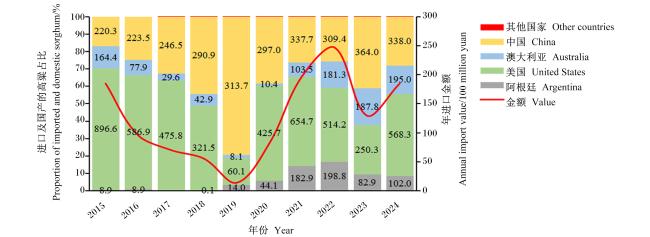
高粱原产于非洲,是一种禾本科高粱属的草本植物,主要由外皮、胚乳和胚芽3部分组成[1]。高粱作为全球第五大谷物,超过5亿人以高粱作为主要粮食作物[2]。我国高粱种植区主要以内蒙古、黑龙江、吉林、辽宁、贵州等地为主,种植面积占全国的80%以上,其中内蒙古为我国高粱产量的第一产区,约占全国的23.37%(国家统计局2022年)。同时,我国又是高粱进口国,2024年1月到12月底,高粱进口量为865.58万t,进口额达184.28亿元,较2023年增长42.94%,其中以美国、澳大利亚和阿根廷为主(国家统计局2024年)。2015—2024年我国国产及进口高粱数量如图1所示。在美国、澳大利亚、墨西哥和南美洲等地,高粱是主要的动物饲料原料,其中,饲用高粱是美国的第三大谷物类作物(美国农业部2023年)[3]。我国经过杂交改良育成的新品种高粱使其在饲料作物总产量中的比重由4%增加至12%[4]。近年来,由于饲料资源的短缺,开发利用玉米的替代饲料原料越发迫切,而高粱作为玉米替代品的一种,性价比优越,在我国饲料及养殖业的重视程度逐渐升高。但由于高粱品种繁多、种植环境以及加工处理等因素不同,使其营养价值存在较大差异。因此,本文主要就高粱的营养成分、猪有效能(available energy,AE)和氨基酸消化率及其在猪生产中的应用研究进行综述,为其高效利用提供参考。
图1 2015—2024年我国国产及进口高粱情况

图中数据单位为:万t;数据来自于国家统计局和海关统计数据;2024年我国高粱产量来自于卓创资讯预测数据;其他国家主要包含缅甸、尼日利亚和乌拉圭。The data unit in the figure is: 10 000 t; data from the National Bureau of Statistics and General Administration of Customs of the People’s Republic of China; China’s sorghum production in 2024 came from the forecast data of Zhuochuang Information; other countries include Myanmar, Nigeria and Uruguay.

Fig.1 Domestic and imported sorghum in China from 2015 to 2024

1 高粱的营养成分

1.1 高粱的常规营养成分

高粱的营养成分与其品种、种植环境及加工方式等因素有关,各高粱间的成分含量有一定的差异。我国饲用高粱质量标准(NY/T 115—2021)[5]表1所示,饲料原料高粱以单宁含量(0.3%)为主要分类标准,以容重定级,其余粗蛋白质(CP)、杂质、不完善粒、水分、粗纤维(CF)和粗灰分(Ash)作为限定指标,但我国《猪营养需要量》(GB/T 39235—2020)[6]中单宁含量以0.5%和1.0%分类,因此我国对于低单宁、中单宁和高单宁饲用高粱的分级标准还未形成统一标准。随着单宁含量的增加,粗脂肪(EE)含量有升高的趋势,CF含量逐渐降低。高粱的化学成分与玉米相近[7-8],干物质(DM)含量为89%~90%,CP含量为7.23%~13.45%,Ash含量为1.23%~2.91%,CF含量为1.20%~2.71%,无氮浸出物含量为71.7%~72.3%,总膳食纤维中主要是纤维素和阿拉伯木聚糖[1,9]。高粱中磷的含量与玉米接近,但67%~72%磷与植酸结合(玉米约为59%),因此磷的标准全肠道消化率相对较低,但通过添加植酸酶能提高磷的利用率[5,10]。不同单宁含量高粱的常规营养成分如表2所示。
表1 饲用高粱质量标准

Table 1 Quality standards of feed material sorghum

项目Items 指标Indexes
类型Type Ⅰ型 Ⅱ型
单宁Tannin/% ≤0.3 >0.3
等级Grade 一级 二级 一级 二级
容重Test weight/(g/L) ≥740 ≥700 ≥740 ≥700
粗蛋白质CP/% ≥8.0
杂质Foreign material/% ≤1.0
不完善粒Imperfect kernel/% ≤3.0
水分Moisture/% ≤14.0
粗纤维CF/% ≤3.0
粗灰分Ash/% ≤3.0

各项指标含量除单宁、容重、水分、杂质和不完善粒以原样为基础计算外,其他均以88%干物质为基础计算。

The contents of each index were calculated on the basis of 88% dry matter except tannin, test weight, moisture, foreign material and imperfect kernel.

表2 高粱的常规营养成分(干物质基础)

Table 2 Proximate nutrient components of sorghum (DM basis)

序号
No.
项目
Items
粗蛋白质
CP/%
粗脂肪
EE/%
粗纤维
CF/%
粗灰分
Ash/%
单宁
Tannin/%
淀粉
Starch/%
直链淀粉/
总淀粉
Amylose/total
starch
总能
GE/
(kcal/kg)
参考文献
References
1 单宁<0.5% 8.17~13.45 0.78~3.55 1.44~2.71 1.51~2.35 0~0.45 62.93~83.37 15.05~20.70 4 364~4 438 [11-13]
2 0.5%≤单宁<1.0% 8.18~12.91 1.19~3.54 1.20~2.59 1.38~2.15 0.59~0.98 62.01~74.83 - 4 357~4 577 [11-12]
3 单宁≥1.0% 7.23~13.41 1.39~4.74 1.30~2.11 1.23~2.91 1.01~1.61 61.25~85.38 13.43~23.47 4 383~4 530 [11-14]
4 高粱(NRC,2012) 10.47 3.83 2.39 1.84 - 78.39 - 4 343 [15]
5 单宁<0.5%(中国,2020) 10.54 2.20 3.87 1.76 0.08 72.85 - 4 410 [6]
6 0.5%≤单宁<1.0%(中国,2020) 10.42 2.79 3.92 1.71 0.84 70.41 - 4 438 [6]
7 单宁≥1.0%(中国,2020) 10.92 2.71 4.18 2.15 1.29 67.60 - 4 453 [6]
8 高粱(INRA) 10.87 3.35 2.77 1.62 - 74.10 - 4 504 [16]
9 高粱(CVB) 9.98 3.21 2.64 1.72 - 71.67 - - [17]
10 低单宁(巴西) 10.05 3.85 3.32 1.58 - 76.46 - 4 579 [18]
11 高单宁(巴西) 10.44 2.74 3.24 2.17 - 66.12 - 4 494 [18]
12 高粱,研磨(NASEM,2021) 12.5 4.09 - 2.5 - 72.6 - - [19]
13 蒸汽压片(NASEM,2021) 12.5 4.09 - 2.5 - 72.6 - - [19]
最大值Maximum value 13.45 4.74 2.71 2.91 1.61 85.38 23.47 4 577
最小值Minimum value 7.23 0.78 1.20 1.23 0.02 61.25 13.43 4 357
平均值Average value 10.21 2.80 1.78 1.88 0.93 71.41 18.71 4 314

数据根据参考文献中高粱的实际含量值换算成百分比;“-”表示参考文献中无该成分数据。下表同。

The actual content of sorghum was converted into percentage according to the reference; “-” indicated that there was no data of this component in the reference. The same as below.

1.2 高粱的氨基酸组成

不同饲料原料数据库中高粱、玉米和小麦的氨基酸含量如表3所示,虽然高粱的CP含量与玉米相近,但其赖氨酸(Lys)、精氨酸(Arg)、组氨酸(His)和蛋氨酸(Met)等必需氨基酸含量低于玉米和小麦,而脯氨酸(Pro)、亮氨酸(Leu)、丙氨酸(Ala)和谷氨酸(Glu)等氨基酸含量高于玉米和小麦[15]。有报道称,高粱中的Lys是最具限制性的氨基酸[20],但是,近年来随着高Lys高粱等品种的不断选育,此情况未来有望得到改善。
表3 玉米、小麦和各饲料原料数据库中高粱的氨基酸含量(干物质基础)

Table 3 Amino acid contents of sorghum in databases of corn, wheat and various feed raw materials (DM basis) %

项目
Items
NRC(2012)[15] 《猪营养需要》Nutrient requirement of swine[6] CVB[17] INRA[16] NASEM(2021)[19]
玉米
Corn
小麦
Wheat
高粱
Sorghum
单宁<0.5%
Tannin<0.5%
0.5%≤单宁<1.0%
0.5%≤Tannin<1.0%
单宁≥1.0%
Tannin≥1.0%
高粱
Sorghum
高粱
Sorghum
高粱、蒸汽压片
Sorghum,
steam-flaked
赖氨酸Lys 0.28 0.41~0.44 0.22 0.25 0.25 0.26 0.24 0.25 0.28
蛋氨酸Met 0.20 0.25 0.18 0.15 0.16 0.18 0.18 0.17 0.21
苏氨酸Thr 0.31 0.41~0.45 0.34 0.34 0.34 0.36 0.33 0.36 0.39
色氨酸Trp 0.07 0.16~0.19 0.08 0.08 0.08 0.08 0.11 0.12 0.13
缬氨酸Val 0.43 0.54~0.65 0.51 0.61 0.63 0.63 0.49 0.59 0.57
异亮氨酸Ile 0.31 0.39~0.53 0.40 0.50 0.55 0.55 0.40 0.46 0.46
亮氨酸Leu 1.07 0.79~1.03 1.35 1.51 1.62 1.62 1.30 1.48 1.51
精氨酸Arg 0.41 0.60~0.68 0.40 0.35 0.36 0.36 0.40 0.44 0.47
组氨酸His 0.27 0.32~0.38 0.23 0.23 0.24 0.24 0.24 0.24 0.28
苯丙氨酸Phe 0.44 0.60~0.72 0.54 0.65 0.60 0.63 0.53 0.58 0.61
丙氨酸Ala 0.67 0.49~0.53 0.94 0.98 0.96 1.05 0.88 1.01 -
天冬氨酸Asp 0.60 0.67~0.80 0.67 0.72 0.70 0.76 0.70 0.21 -
半胱氨酸Cys 0.21 0.35~0.37 0.20 0.32 0.24 0.16 0.18 0.21 0.22
谷氨酸Glu 1.66 3.38~4.38 2.06 2.58 2.51 2.75 1.98 2.28 -
甘氨酸Gly 0.35 0.57~0.64 0.35 0.35 0.34 0.35 0.33 0.34 -
脯氨酸Pro 0.79 1.20~1.53 0.83 0.82 0.76 0.84 0.80 0.92 -
丝氨酸Ser 0.43 0.51~0.68 0.44 0.44 0.41 0.46 0.46 0.50 -
酪氨酸Tyr 0.29 0.41~0.35 0.36 0.33 0.34 0.40 0.39 0.44 -

1.3 高粱中的淀粉特性

高粱淀粉的颗粒形状一般为球形(粉质胚乳颗粒)或多面体形(角质胚乳颗粒),表面有延伸到内部的凹痕和小孔,这种结构会降低淀粉酶的酶解作用[21]。不同品种高粱的淀粉含量为65.29%~72.72%,其直链淀粉、支链淀粉分别占总淀粉的0.18%~28.21%和99.82%~71.79%,快消化淀粉、慢消化淀粉和抗性淀粉分别占总淀粉的12.0%~21.5%、61.7%~68.5%和0~65.7%[22-25],表明不同品种高粱的淀粉含量和特性差别较大,这与遗传基因、生长环境等因素有关。除此之外,淀粉颗粒的形态以及酶抑制剂(单宁)等也会对淀粉酶产生影响[26]。因此,可以通过降解淀粉分子、破坏淀粉与蛋白质的结合、改变淀粉颗粒的物理结构以及消除酶抑制剂等方法,防止二硫键与蛋白质的结合,增加α-淀粉酶对淀粉的水解[27]

1.4 高粱中的脂肪和脂肪酸

脂肪酸是评价肉品质的重要指标,分为饱和脂肪酸和不饱和脂肪酸[28]。如果胴体中饱和脂肪酸比例较高,脂肪硬度增大,在加工过程中易成型且耐储存;反之,若不饱和脂肪酸比例较大,则肉易发生氧化且不易加工成型,合格率降低[29]。祁瑜婷[30]选取32个不同品种的高粱进行研究,测得EE含量为2.00%~3.18%,亚油酸、油酸、棕榈酸和亚麻酸等不饱和脂肪酸(占总脂肪酸的83%~88%)含量较高,分别占总不饱和脂肪酸的45.6%~51.1%、32.2%~42.0%、12.4%~16.0%和1.4%~2.8%。相对于玉米饲粮,饲喂高粱饲粮时育肥猪背最长肌中的饱和脂肪酸含量提升21.7%,脂肪硬度增大[31]。因此,与玉米相比,高粱对于改善猪肉品质具有一定的优势。

2 高粱的抗营养因子

2.1 高粱的单宁含量

单宁是影响高粱饲用价值的主要抗营养因子,根据化学性质分为水解单宁和缩合单宁,单宁主要通过影响饲料的适口性、与营养物质结合以及抑制消化酶等方式影响猪的采食量和养分利用率,进而对高粱的饲用价值产生影响[32-33]。据报道,单宁能够与饲料中的蛋白质和猪体内的内源酶形成配合物,使饲料中的蛋白质难以水解,导致淀粉和蛋白质的消化率降低,内源性蛋白质(酶和黏蛋白)的损失增加[34-36];相关研究发现,苏氨酸(Thr)消化率降低的原因是单宁刺激黏蛋白增多导致,Arg消化率降低的原因是CP与单宁之间结合导致,Lys消化率降低的原因是单宁引起球状蛋白(白蛋白和球蛋白)结合沉淀所致[8,37]。Jondreville等[38]研究发现,与其他谷物(玉米、小麦、黑麦和黑小麦)相比,饲喂高粱饲粮的猪内源性蛋白质损失更高。采用不同的加工方法,如粉碎、挤压膨化和添加酶制剂等,可以降低单宁的不利影响,提高高粱的利用价值[39-40]

2.2 高粱的醇溶蛋白

高粱蛋白质根据溶解度可分为白蛋白(水溶性蛋白)、球蛋白(盐溶性蛋白)、醇溶蛋白和谷蛋白(稀碱溶性蛋白),其中,醇溶蛋白是高粱中主要的蛋白质组分[41-43]。Osborne[41]方法仅可提取26%~40%的高粱总蛋白质。高粱醇溶蛋白主要分布于胚乳,约占总蛋白质的55%,主要由Leu(15.6%)、Pro(10.4%)、Glu(31.3%)组成,缺少Lys(0.4%)、Met等必需氨基酸[8,43]。高粱籽粒中的醇溶蛋白谱决定了蛋白体的组成、密度、大小、数量、形状和结构,直接影响CP的消化率[44-46]。高粱醇溶蛋白根据结构分为α-醇溶蛋白(70%~80%)、β-醇溶蛋白(7%~8%)、γ-醇溶蛋白(9%~12%)和δ-醇溶蛋白(小于1%)[47]。与β-醇溶蛋白相比,α-醇溶蛋白中Glu、Ala和天冬氨酸(Asp)含量较高,而γ-醇溶蛋白中缬氨酸(Val)和His含量较高[48]。α-醇溶蛋白易于消化,但被β-醇溶蛋白和γ-醇溶蛋白包裹,β-醇溶蛋白和γ-醇溶蛋白不易被消化,形成较多的二硫键,从而降低了蛋白质的消化率[46]。高粱醇溶蛋白分子间存在交联较多的共价键,导致高粱蛋白质中氨基酸不平衡且利用率较低,严重限制了在猪饲粮中的应用[49]。例如Gómez Soto等[50]证实,饲喂高粱饲粮的猪回肠食糜中存在醇溶蛋白,并表明部分醇溶蛋白未被消化。但如果采用合适的加工方法,如挤压膨化等,可降低醇溶蛋白的含量,提高高粱籽粒氨基酸的利用率。因为在加热过程中,促进了醇溶蛋白在β-折叠中的重排,降低了醇溶蛋白对蛋白质水解的敏感性[45]

3 高粱的猪AE及预测方程

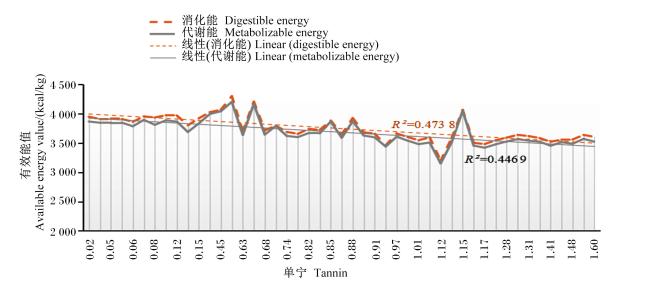
AE是指饲料中能被动物机体消化吸收的能量,反映了饲料能量的营养价值,一般包括消化能(DE)、代谢能(ME)和净能(NE)[51]。随着单宁含量的增加,DE和ME有降低的趋势,各数据库中的DE和ME也存在一定的差异,差异原因很多且不确定,既可能与高粱本身有关(如品种、产地、种植条件、质量等级等),也可能与具体试验细节有关(如试验动物的品种品系、体重、生理阶段、试验方法、检测、人为操作等)。另外,NRC(2012)数据库中的DE和ME值最高,原因可能是美国近年来对于高粱的品种选育方面研究较为深入,培育出低单宁饲用高粱品种,而研究表明高粱单宁含量与其猪AE值呈显著负相关,这也可能是一个重要原因[12]。高粱的GE、DE和ME与小麦和玉米相近[52]。Feng等[11]通过生长猪消化代谢试验研究发现,不同品种不同产地高粱的DE和ME存在较大的差异,其中DE的范围为2 826~3 794 kcal/kg,ME的范围为2 785~3 709 kcal/kg。随着单宁含量的增加,高粱的AE值呈线性下降趋势。然而大多数AE数据以生长猪的模型进行建立,仔猪方面的数据比较有限,原因可能是仔猪胃肠道发育尚未健全,对高粱中的一些抗营养因子抵抗机制不够完善,所以在配制仔猪饲粮时使用高粱较少,但如果使用生长猪数据配制仔猪饲粮,则可能会高估其AE值[53]。Zhang等[54]研究34.6 kg体重的生长猪饲喂小麦(小麦占饲粮的96.9%)、高粱(高粱占饲粮的96.9%)2种谷物时AE值的差异,结果显示,小麦和高粱的DE分别为3 822(16.0 MJ/kg)和3 918 kcal/kg(16.4 MJ/kg)(DM基础),ME分别为3 727(15.6 MJ/kg)和3 870 kcal/kg(16.2 MJ/kg)(DM基础)。Bolarinwa等[55]通过直接法和间接法测定32 kg生长猪高粱的DE和ME,结果发现,直接法(高粱占饲粮的96.9%)和间接法(高粱分别占饲粮的0、30%、60%)得到的DE分别为4 097、4 014、3 968和3 965 kcal/kg(DM基础),ME分别为4 042、3 930、3 891和3 864 kcal/kg(DM质基础),单一高粱饲粮的DE、ME和氮校正代谢能(MEn)分别为3 951、3 896和3 827 kcal/kg(DM基础),发现直接法和间接法得到的AE值差异较小(14~63 kcal/kg)。Lowell等[56]比较了体重为40 kg的生长阉猪和252 kg的妊娠母猪,以直接法(高粱占饲粮的97.2%)测定高粱的AE值,结果发现,妊娠母猪的DE(3 829 kcal/kg,16.02 MJ/kg)和ME(3 757 kcal/kg,15.72 MJ/kg)(DM基础)均高于40 kg生长阉猪DE(3 702 kcal/kg,15.49 MJ/kg)和ME(3 544 kcal/kg,14.83 MJ/kg)(DM基础),妊娠母猪的能量消化率高于生长猪,这可能与体重阶段、生长日龄以及饲喂水平的差异有关。Xie等[57]比较了不同阶段的猪(13.3、31.6、56.7和111 kg),采用直接法(高粱占饲粮的97.34%)测定高粱的AE值并探究体重对高粱消化率的影响,研究结果显示,4个不同体重阶段的DE分别为3 440(14.4 MJ/kg)、3 464(14.5 MJ/kg)、3 536(14.8 MJ/kg)和3 512 kcal/kg(14.7 MJ/kg)(DM基础),ME分别为3 392(14.2 MJ/kg)、3 416(14.3 MJ/kg)、3 488(14.6 MJ/kg)和3 464 kcal/kg(14.5 MJ/kg)(DM基础),高粱的ME随体重增加有升高的趋势但差异不显著。另外,有研究显示,高粱籽粒中单宁含量每增加1%,DE和ME值降低200 kcal/kg以上,但单宁含量低于1%时,高粱的营养价值与玉米相近[1,58]。 高粱的猪AE值及预测方程分别如表4表5所示;不同单宁含量的高粱 AE 值如图2所示。
表4 高粱的猪有效能值(干物质基础)

Table 4 Available energy value of sorghum for pigs (DM basis)

序号 项目
Items
体重
Body
weight/kg
粗蛋白质
CP/%
单宁
Tannin/%
消化能
DE/
(kcal/kg)
代谢能
ME/
(kcal/kg)
净能
NE/
(kcal/kg)
参考文献
References
1 单宁<0.5% 18.5~70 7.21~15.59 0.02~0.45 3 800~4 025 3 687~3 993 - [7,11-12,59]
2 0.5%≤单宁<1.0% 36.8~70 7.68~12.91 0.59~0.98 3 459~4 297 3 438~4 200 - [11-12]
3 单宁≥1.0% 36.7~70 6.39~13.41 1.01~1.81 3 196~4 063 3 150~4 049 - [11-12,39]
4 单宁<0.5%
(中国,2020)
生长猪 10.54 - 3 934 3 855 3 042 [6]
5 单宁<0.5%
(中国,2020)
母猪 10.54 - 4 005 3 889 3 068 [6]
6 0.5≤单宁<1.0%
(中国,2020)
生长猪 10.42 - 3 687 3 624 2 859 [6]
7 0.5≤单宁<1.0%
(中国,2020)
母猪 10.42 - 3 753 3 644 2 875 [6]
8 单宁≥1.0%
(中国,2020)
生长猪 10.92 - 3 569 3 498 2 761 [6]
9 单宁≥1.0%
(中国,2020)
母猪 10.92 - 3 632 3 528 2 783 [6]
10 高粱(CVB) - 9.98 - - - 3 070 [17]
11 高粱(INRA) 生长猪 10.87 - 3 923 3 841 3 039 [16]
12 高粱(INRA) 母猪 10.87 - 4 006 3 896 3 067 [16]
13 高粱(NRC,2012) - 10.47 - 4 023 3 951 3 110 [15]
14 高单宁(巴西) 生长猪 10.05 - 3 587 3 474 2 715 [18]
15 高单宁(巴西) 母猪 10.05 - 3 766 3 609 2 814 [18]
16 低单宁(巴西) 生长猪 10.44 - 3 915 3 855 3 048 [18]
17 低单宁(巴西) 母猪 10.44 - 4 023 3 937 3 108 [18]

除特殊说明外,试验动物均为去势公猪。下表同。

Unless otherwise specified, all test animals were castrated boars. The same as below.

表5 高粱的猪有效能值及标准回肠末端氨基酸消化率预测方程(干物质基础)

Table 5 Prediction equations of sorghum available energy value and standardized ileal amino acid digestibility for pigs (DM basis)

项目
Items
预测方程
Prediction equation
回归系数
R2
相对标准差
Relative standard
deviation
P
P-value
参考文献
References
有效能Available energy/(kcal/kg)
25~50 kg[(36.8±3.5) kg] DE=3 944-294×Tannin
DE=4 034-272×Tannin-23.66×ADF
DE=3 959-256×Tannin-44.48×ADF+14.80×CP
DE=6 974-236×Tannin-43.27×ADF+24.96×CP-0.71×GE
ME=3 869-287×Tannin
ME=3 973-262×Tannin-27.24×ADF
0.930
0.940
0.950
0.960
0.930
0.940
-
-
-
-
-
-
<0.010
<0.010
<0.010
<0.010
<0.010
<0.010
[58]
50~75 kg[(70.0±1.8) kg] DE=4 074.916-936.361×Tannin
DE=6 267.945-1 271.154×Tannin-1 109.720×Ash
ME=4 028.100-913.803×Tannin
ME=6 068.658-1 225.319×Tannin-1 032.567×Ash
ME=58.297+0.974×DE
0.426
0.803
0.426
0.769
0.994
-
-
-
-
-
0.041
<0.010
0.041
<0.010
<0.010
[11]
标准回肠末端氨基酸消化率Standardized ileal amino acid digestibility/%
25~50 kg[(41.3±1.2) kg] SIDCP=87.778-4.246×EE
SIDCP=107.151-345.496×Trp
SIDCP=93.404-21.026×Tannin
SIDCP=42.922-4.011×EE+151.774×Met
SIDLys=95.138-29.386×Tannin
SIDLys=51.237+13.770×CF
SIDLys=90.078-7.213×EE
SIDLys=-29.134+14.275×CF+1.389×Starch
SIDLys=129.947-670.760×Trp
SIDMet=-126.333+2.491×DM
SIDMet=111.347-232.298×Trp
SIDThr=40.923+19.600×Ash
SIDThr=55.187+3.851×ADF
SIDTrp=76.645+2.155×ADF
SIDTrp=95.676-10.824×Tannin
0.431
0.528
0.593
0.696
0.477
0.497
0.513
0.749
0.821
0.416
0.647
0.517
0.609
0.456
0.523
4.41
4.02
3.73
3.44
6.58
6.46
6.35
4.88
3.86
2.72
2.11
3.44
3.10
2.36
2.21
0.039
0.017
<0.010
0.015
0.027
0.023
0.020
<0.010
<0.010
0.044
<0.010
0.019
<0.010
0.032
0.018
[11]

表中体重均为初始体重 The weights in the table were all the initial weights。

Tannin:单宁;DE:消化能 digestible energy;ME:代谢能 metabolizable energy;GE:总能gross energy;ADF:酸性洗涤纤维 acid detergent fiber;CP:粗蛋白质 crude protein;Ash:粗灰分 crude ash;EE:粗脂肪 ether extract;CF:粗纤维 crude fibre;SID:标准回肠末端消化率 standardized ileal digestibility;Trp:色氨酸 tryptophan;Met:蛋氨酸 methionine;Thr:苏氨酸 threonine;Lys:赖氨酸 lysine。

图2 不同单宁含量高粱的猪有效能值

Fig.2 Available energy value of sorghum with different tannin contents for pigs[7,11,39,59-60]

4 高粱的猪氨基酸消化率

氨基酸的消化率与原料的种类有关,在进行饲粮配制时一般采用标准回肠末端氨基酸消化率(SID),这也是当前猪饲粮配制首选的氨基酸营养体系[61-62]。如Duodu等[46]所述,高粱蛋白质消化率较低的原因是由于一系列外源因素(谷物结构、多酚类物质、植酸盐和细胞壁成分)和内源因素(二硫交联键、醇溶蛋白疏水性和蛋白质二级结构)造成的。与玉米和小麦相比,高粱中纤维与蛋白质的结合更为紧密,这也可能是造成高粱氨基酸的SID低于小麦和玉米的原因之一[63-64]。不同类型高粱的猪SID值的差异较大,如Lys的SID值在46.1%~90.6%,其中,我国高粱挤压与未挤压相比,挤压之后各氨基酸消化率均有显著提升,相较于未挤压,美国高粱氨基酸消化率高于我国高粱,但美国膨化与未膨化相比,氨基酸消化率提高的比率低于我国,可能与美国高粱单宁含量较低,挤压处理提升潜力有限有关,另外,我国高粱与美国高粱有一定差异,除高粱之间的营养成分不同外,也可能与试验过程中造成的差异相关。仔猪大多数氨基酸的SID值低于生长猪,但也受高粱品种、猪的体重阶段以及抗营养因子含量的影响[65]。也有研究显示,高粱中单宁含量对氨基酸消化率有负面影响,但可能只有当单宁含量大于1%才会对氨基酸的SID产生显著的不利影响[8]。Mariscal-Landín等[14]研究高粱在断奶仔猪和生长猪中氨基酸的表观回肠末端氨基酸消化率(AID),发现仔猪CP和氨基酸的AID随饲粮中高粱含量的增加(15%~61%)呈线性降低,除Lys和胱氨酸(Cys)外,生长猪氨基酸的AID和CP的消化率比仔猪分别高15.1%~67.9%和57.2%。Reis De Souza等[34]研究醇溶蛋白(42.5%和57.0%)含量不同的高粱对蛋白质、氨基酸消化率的影响,结果显示,与42.5%醇溶蛋白相比,57.0%醇溶蛋白对Glu、His、Ala、Asp和Val的AID分别降低4.8%、6.1%、4.5%、12.3%和5.0%,醇溶蛋白与单宁互作使Glu和Lys的AID分别降低6.7%和18.3%。高单宁饲粮中氨基酸的AID降低可能是由于单宁对消化酶(如胰蛋白酶、脂肪酶、淀粉酶)活性的抑制作用和内源性蛋白质分泌的增加[48,65]。此外,内源性蛋白质富含Glu、Asp、Arg、Thr,高单宁高粱含有较高含量的中性洗涤纤维(15.24%),这可能也是导致内源性蛋白质损失增加的原因之一[34,66-67]。综上所述,当高粱中的单宁和醇溶蛋白含量升高时,对高粱中CP和氨基酸的消化利用具有抑制作用,生长猪的AID和SID降低。高粱的猪标准回肠末端氨基酸消化率见表6
表6 高粱的猪标准回肠末端氨基酸消化率

Table 6 Standardized ileal amino acid digestibility of sorghum for pigs %

序号
No.
项目
Items
体重
Body
weight/kg
赖氨酸
Lys
蛋氨酸
Met
苏氨酸
Thr
色氨酸
Trp
缬氨酸
Val
异亮
氨酸
Ile
亮氨酸
Leu
精氨酸
Arg
组氨酸
His
苯丙
氨酸
Phe
丙氨酸
Ala
天冬
氨酸
Asp
半胱
氨酸
Cys
谷氨酸
Glu
甘氨酸
Gly
脯氨酸
Pro
丝氨酸
Ser
酪氨酸
Tyr
参考文献
References
1 单宁
<0.5%
8.8~
60.0
46.1~
82.2
71.1~
95.4
54.4~
80.8
70.5~
90.5
68.7~
90.9
46.5~
90.6
78.5~
96
73.7~
87
66.6~
84.0
72.7~
91.1
73.7~
83.7
70.1~
90.1
56.3~
79.1
75.9~
92.4
43.4~
81.4
53.8~
88.3
73.3~
85.8
66.9~
78.9
[7-8,11
59-65,67-68]
2 0.5%≤单宁
<1.0%
41.3~
60.0
66.1~
90.6
77.5~
95.3
70.3~
85.1
84.2~
92.4
77.9~
93.1
76.9~
95.7
80.3~
97.0
74.2~
86.9
70.8~
90.9
79.4~
95.2
75.6~
86.3
77.4~
92.7
63.0~
94.0
80.3~
95.6
60.8~
83.8
63.0~
81.3
77.9~
93.6
69.4~
91.8
[8,11]
3 单宁≥1.0% 27.6~
60.0
56.2~
82.3
75.7~
92.7
66.4~
78.5
85.0~
85.2
72.4~
90.5
42.5~
92.9
79.3~
95.4
65.4~
83.4
60.5~
91.5
76.2~
93.4
74.4~
84.3
73.0~
93.1
54.1~
84.1
78.6~
95.8
43.7~
85.1
17.5~
82.5
75.8~
85.9
64.2~
86.3
[8,11
68]
4 中国未挤
压高粱
22.3
±2.8
54.8 78.3 67.1 72.3 71.7 73.7 79.9 76.5 68.7 78.5 75.9 72.4 69.3 79.3 64.5 - 74.9 71.6 [54]
5 中国挤
压高粱
83.1 88.3 86.3 88.7 85.7 87.6 89.4 91.6 85.6 88.4 86.6 85.5 83.6 89.6 75.2 - 88.2 85.1 [54]
6 美国
未挤压
高粱
14.2±
0.9(母猪)
68.6 82.5 74.4 77.3 78.9 79.2 83.6 85.4 76.6 83.3 82.6 79.0 76.9 83.6 86.7 130.4 81.4 - [39]
7 美国挤
压高粱
77.6 85.1 77.5 77.7 80.7 82.0 85.1 89.8 76.2 84.7 85.0 82.6 75.6 86.4 88.7 143.5 84.4 - [39]
8 墨西哥低
单宁低醇
溶蛋白
25.0±
0.6
72.9 86.0 84.7 - 82.7 83.1 85.1 63.3 74.7 81.1 78.0 87.6 54.7 84.7 11.2 -121.4 84.4 75.2 [34]
9 墨西哥低
单宁高醇
溶蛋白
75.4 83.3 75.9 - 77.3 76.8 84.2 65.2 69.0 76.6 73.4 77.5 55.8 80.7 5.1 -59.3 79.1 70.8 [34]
10 墨西哥高
单宁低醇
溶蛋白
85.1 89.2 88.0 - 83.0 82.4 86.6 70.8 77.7 79.9 77.6 89.9 62.7 84.0 10.7 -85.4 85.5 75.9 [34]
11 墨西哥高
单宁高醇
溶蛋白
63.2 80.1 72.6 - 76.9 77.6 82.8 57.7 66.0 77.9 73.9 75.2 47.8 81.4 5.5 -95.4 78.0 70.1 [34]
12 单宁<0.5%
(中国,2020)
- 67 79 76 74 94 41 96 81 74 95 86 64 63 85 67 74 81 69 [6]
13 0.5%≤单宁
<1.0%
(中国,2020)
- 62 79 76 74 96 45 96 70 66 99 92 62 59 84 67 74 80 70 [6]
14 单宁≥1.0%
(中国,2020)
- 48 79 71 74 92 33 96 52 57 78 73 59 63 82 67 74 76 66 [6]
15 高粱(CVB) - 80 89 86 86 87 88 89 86 83 89 85 84 86 93 82 93 91 90 [17]
16 高粱(INRA) - 74 85 76 79 81 83 86 82 78 85 81 82 77 86 66 50 81 85 [16]
17 高粱
(NRC,2012)
- 74 79 75 74 77 78 83 80 74 83 79 79 67 81 67 74 81 75 [15]

5 高粱在猪饲粮中的应用

5.1 饲用高粱对猪生长性能及营养物质消化率的影响

与玉米和小麦等其他能量饲料原料相似,低单宁高粱可以部分或全部替代玉米,对断奶仔猪或生长育肥猪的生长性能不会产生影响或影响较小[69]。尚秀国等[70]研究无单宁高粱对育肥猪生长性能的影响,结果发现,无单宁高粱全部替代玉米后,对猪的平均日采食量、平均日增重和料重比等生长性能没有产生负面影响,说明使用高粱替代玉米饲粮在猪生产中是可行的。宋献艺等[71]分别使用30%、65%和100%的高粱替代玉米,研究发现高粱替代65%和100%的玉米后,猪体内的抗氧化酶活性分别显著提高了32.4%和38.7%,说明高粱替代玉米后对育肥猪血清抗氧化能力具有一定的改善作用。张凯等[31]研究发现,高粱替代30%、65%和100%玉米后,猪的背膘厚度分别显著提高3.0%、5.2%和4.3%,100%替代后,背最长肌中油酸、反式油酸、花生酸和花生四烯酸含量分别显著提高15.3%、39.6%、56.8%和52.4%,65%替代后,背最长肌中油酸、花生酸、二十碳三烯酸和花生四烯酸含量分别显著提高37.9%、77.15%、72.2%和53.2%,说明高粱替代部分玉米后对于改善肉品质具有显著的作用。高粱替代玉米对猪生长性能的影响如表7所示。
表7 高粱替代玉米对猪生长性能的影响

Table 7 Effects of sorghum substitution for corn on growth performance of pigs

体重阶段
Body weight of stage/kg
玉米∶高粱
Corn∶sorghum/%
平均日采食量
ADFI/(g/d)
平均日增重
ADG/(g/d)
料重比
F/G
参考文献
References
7~11 0~40∶20~66 457~1 210 295~648 1.52~1.86 [7,59,72-73]
11~25 0~72.2∶0~73 1 424~2 462 640~803 1.87~3.07 [65,74-75]
25~50 0~58.69∶0~80 1 420~2 770 710~840 1.97~3.42 [31,71,76-79]
50~75 0~62∶0~83 2 010~2 670 573~950 2.78~3.77 [70,80-81]

5.2 提升高粱在猪饲粮中饲用价值的方法

高粱通过适宜的加工处理可改善其在猪饲粮中的应用效果。Owsley等[82]研究了高粱粒度由1 262 mm降低到471 mm对30 kg生长猪的影响,发现DM、淀粉、CP和GE的回肠表观消化率分别显著提高了12.2%、16.0%、9.9%和12.6%。王勇生等[83]采用替代法测定了过20、40和60目筛的高粱对体重为32.5 kg猪的DE,发现过60目筛的高粱比过20目筛高粱的DE提高了12.42%。Wang等[84]研究了调质温度(65~85 ℃)对高粱饲粮营养物质消化率和肠道菌群的影响,发现调质温度从75 ℃提高到80 ℃,猪肠道和粪便中有益菌(双歧杆菌和乳杆菌)数量增加3.0%~23.0%,致病菌(大肠杆菌)数量降低1.3%~8.2%,平均日增重、CP和淀粉的回肠表观消化率在75 ℃时最高,分别为988 g/d、87.95%和92.26%。Trindade Neto等[40]研究多糖酶和植酸酶对以玉米或大麦高粱为基础饲粮的生长猪营养物质消化率和回肠消化特性的影响,结果发现,多碳水化合物酶制剂可以显著提高高粱DM的消化率。因此,在饲粮中应用高粱时应考虑合理的粉碎粒度和调制温度、添加酶制剂或选择合适的加工方式,这些措施将有助于提高营养物质消化率,改善生长性能,然而,关于如何提升高粱饲用价值还有待进一步探究,例如对于单宁酶应用于高单宁高粱中目前还鲜见相关报道。
综上所述,当单宁、醇溶蛋白等抗营养因子含量较低时,高粱DE、ME及氨基酸等营养物质消化率与玉米相近,高粱替代玉米对猪的生长性能没有显著影响;反之,当高粱中抗营养因子含量较高时,营养物质的消化率降低,但通过添加酶制剂、粉碎及挤压膨化等适当的处理工艺,则会大幅度降低或消除其不利影响,提高营养物质的消化率,可以部分(5%~30%)或全部替代玉米,具有较高的饲用价值。

6 小结

高粱作为重要的能量饲料原料之一,对于替代玉米具有极大的潜力,但由于含有单宁、醇溶蛋白等抗营养因子,降低了饲料中营养物质的消化利用,限制了高粱在猪饲粮中的应用。目前我国主产高粱主要应用于酿造行业,而饲用高粱主要依赖从美国、澳大利亚等进口,我国主推饲用高粱品种较少(如辽杂52),且应用于饲料中的数量仍处于较低水平,因此饲用高粱品种选育工作仍需加强。随着品种选育以及添加酶制剂、粉碎、挤压膨化等技术的发展,将会提高高粱在猪饲粮中的应用。目前高粱在猪营养方面的研究还有很大潜力,尤其在仔猪上的研究和应用较少,未来需要进一步对不同阶段猪开展不同高粱AE值和氨基酸消化率的研究,这对于完善猪饲料原料数据库、精准营养、玉米减量替代及降低猪生产成本具有重要意义。
[1]
ETUK E, IFEDUBA A V, OKATA U E, et al. Nutrient composition and feeding value of sorghum for livestock and poultry[J]. Journal of Animal Science Advances, 2012, 2(6):510-524.

[2]
佚名. 中澳两国科学家对高粱进行全基因组测序分析[J]. 福建农业, 2013(11):34.

ANON. Whole genome sequencing analysis of sorghum by Chinese and Australian scientists[J]. Fujian Agriculture, 2013(11):34. (in Chinese)

[3]
U.S.Department of Agriculture. Home[EB/OL],(2024-12-06)[2025-06-19]. https://www.ers.usda.gov/.

[4]
李锋涛. 高粱饲喂动物应用效果研究[J]. 广东饲料, 2008, 17(8):37-38.

LI F T. Research on the effects of feeding grain sorghum to animals[J]. Guangdong Feed, 2008, 17(8):37-38. (in Chinese)

[5]
中华人民共和国农业农村部. 饲料原料高粱:NY/T 115—2021[S]. 北京: 中国标准出版社, 2021.

Ministry of Agriculture and Rural Affairs of the People’s Republic of China. Feed material sorghum:NY/T 115—2021[S]. Beijing: Standards Press of China, 2021. (in Chinese)

[6]
中华人民共和国国家市场监督管理总局, 中国国家标准化管理委员会. 猪营养需要量:GB/T 39235—2020[S]. 北京: 中国标准出版社, 2020.

State Administration for Market Regulation of the People’s Republic of China,National Standardization Administration of China. Nutrient requirements of swine: GB/T 39235—2020[S]. Beijing: Standards Press of China, 2020. (in Chinese)

[7]
PAN L, SHANG Q H, WU Y, et al. Concentration of digestible and metabolizable energy,standardized ileal digestibility,and growth performance of pigs fed diets containing sorghum produced in the United States or corn produced in China[J]. Journal of Animal Science, 2017, 95(11):4880-4892.

DOI

[8]
MARISCAL-LANDÍN G, AVELLANEDA J H, REIS DE SOUZA T C, et al. Effect of tannins in sorghum on amino acid ileal digestibility and on trypsin (E.C.2.4.21.4) and chymotrypsin (E.C.2.4.21.1) activity of growing pigs[J]. Animal Feed Science and Technology, 2004, 117(3/4):245-264.

DOI

[9]
JAWORSKI N W, LÆRKE H N, BACH KNUDSEN K E, et al. Carbohydrate composition and in vitro digestibility of dry matter and nonstarch polysaccharides in corn,sorghum,and wheat and coproducts from these grains[J]. Journal of Animal Science, 2015, 93(3):1103-1113.

DOI

[10]
CERVANTES M, GÓMEZ R, FIERRO S, et al. Ileal digestibility of amino acids,phosphorus,phytate and energy in pigs fed sorghum-based diets supplemented with phytase and Pancreatin[J]. Journal of Animal Physiology and Animal Nutrition, 2011, 95(2):179-186.

DOI

[11]
FENG G Y, LI R, JIANG X J, et al. Prediction of available energy and amino acid digestibility of Chinese sorghum fed to growing-finishing pigs[J]. Journal of Animal Science, 2023, 101:skad262.

[12]
潘龙. 高粱的猪有效能预测方程及高效应用的研究[D]. 博士学位论文. 北京: 中国农业大学, 2018.

PAN L. Prediction equations for the available energy and efficient application of sorghum grain fed to pigs[D]. Ph.D.Thesis. Beijing: China Agricultural University, 2018. (in Chinese)

[13]
田晓红, 谭斌, 谭洪卓, 等. 我国主产区高梁的理化性质分析[J]. 粮食与饲料工业, 2009(4):10-13.

TIAN X H, TAN B, TAN H Z, et al. Analysis of physicochemical properties of sorghums in our main producing area[J]. Cereal & Feed Industry, 2009(4):10-13. (in Chinese)

[14]
MARISCAL-LANDÍN G, REIS DE SOUZA T C, AVALOS M A. Ileal amino acids digestibility of sorghum in weaned piglets and growing pigs[J]. Animal, 2010, 4(8):1341-1348.

DOI

[15]
NRC. Nutrient requirements of swine[S].11th ed. Washington,D.C.: the National Academies Press, 2012.

[16]
SAUVANT D, PEREZ J M, TRAN G. Tables of composition and nutritional value of feed materials:pig, poultry, sheep, goats, rabbits, horses, fish[M]. Wageningen: Wageningen Academic Publishers, 2004.

[17]
TABLE C F. Chemical composition and nutritional value of feedstuffs[M]. Wageningen: Wageningen Livestock Research, 2021.

[18]
ROSTAGNO H S, ALBINO L F T, HANNAS M I, et al. Brazilian tables for poultry and swine[M]. Viçosa: Federal University of Viçosa-Department of Animal Science, 2017.

[19]
National Academies of Sciences,Engineering,and Medicine. Nutrient requirements of dairy cattle[S]. 8th ed. Washington,D.C.: the National Academies Press, 2021.

[20]
卢庆善. 高粱学[M]. 北京: 中国农业出版社, 1999.

LU Q S. Sorghum science[M]. Beijing: China Agriculture Press, 1999. (in Chinese)

[21]
AI Y F, MEDIC J, JIANG H X, et al. Starch characterization and ethanol production of sorghum[J]. Journal of Agricultural and Food Chemistry, 2011, 59(13):7385-7392.

DOI PMID

[22]
CHEN B R, WANG C Y, WANG P, et al. Genome-wide association study for starch content and constitution in sorghum (Sorghum bicolor (L.) Moench)[J]. Journal of Integrative Agriculture, 2019, 18(11):2446-2456.

DOI

[23]
SANG Y J, BEAN S, SEIB P A, et al. Structure and functional properties of sorghum starches differing in amylose content[J]. Journal of Agricultural and Food Chemistry, 2008, 56(15):6680-6685.

DOI PMID

[24]
张若辰. 高粱中抗性淀粉的研究[D]. 硕士学位论文. 济南: 齐鲁工业大学, 2014.

ZHANG R C. Study on resistant starch in sorghum[D]. Master’s Thesis. Ji’nan: Qilu University of Technology, 2014. (in Chinese)

[25]
TEIXEIRA N D C, QUEIROZ V A V, ROCHA M C, et al. Resistant starch content among several sorghum (Sorghum bicolor) genotypes and the effect of heat treatment on resistant starch retention in two genotypes[J]. Food Chemistry, 2016, 197(Pt A):291-296.

DOI PMID

[26]
HIBBERD C A, WAGNER D G, SCHEMM R L, et al. Digestibility characteristics of isolated starch from sorghum and corn grain[J]. Journal of Animal Science, 1982, 55(6):1490-1497.

DOI

[27]
EZEOGU L I, DUODU K G, TAYLOR J R N. Effects of endosperm texture and cooking conditions on the in vitro starch digestibility of sorghum and maize flours[J]. Journal of Cereal Science, 2005, 42(1):33-44.

DOI

[28]
何洋. 日粮脂肪酸饱和度对育肥猪生产性能、肉质性能和DGAT2基因的影响[D]. 硕士学位论文. 沈阳: 沈阳农业大学, 2019.

HE Y. Effect of dietary fatty acid saturation on performance,meat quality and DGAT2 gene in finishing pigs[D]. Ph.D.Thesis. Shenyang: Shenyang Agricultural University, 2019. (in Chinese)

[29]
袁保京, 王若瑾, 姜洁凌, 等. 高粱的营养价值及其在猪、鸡饲料与养殖生产中的应用研究进展[J]. 中国畜牧杂志, 2014, 50(18):70-75.

YUAN B J, WANG R J, JIANG J L, et al. Nutritional values of sorghum and its pratical application in animal and feed production[J]. Chinese Journal of Animal Science, 2014, 50(18):70-75. (in Chinese)

[30]
祁瑜婷. 高粱淀粉制备及其功效评价研究[D]. 硕士学位论文. 济南: 山东大学, 2018.

QI Y T. Preparation and efficacy evaluation of sorghum starch[D]. Master’s Thesis. Ji’nan: Shandong University, 2018. (in Chinese)

[31]
张凯, 杜丽英, 张伯池, 等. 高粱替代不同水平玉米对育肥猪生长性能、胴体性状及肉品质的影响[J]. 动物营养学报, 2019, 31(7):3058-3066.

ZHANG K, DU L Y, ZHANG B C, et al. Effects of replacing different levels of corn with sorghum on growth performance,carcass traits and meat quality of finishing pigs[J]. Chinese Journal of Animal Nutrition, 2019, 31(7):3058-3066. (in Chinese)

[32]
朱安南, 刘欢, 孟勇, 等. 高粱的营养特性及其在畜禽生产中的应用[J]. 中国饲料, 2023,(5):147-151,162.

ZHU A N, LIU H, MENG Y, et al. Reserch progress on nutritional characteristics of sorghum and its application in livestock and poultry production[J]. China Feed, 2023,(5):147-151,162. (in Chinese)

[33]
唐青松, 徐娥, 熊海涛, 等. 缩合单宁对断奶仔猪生长性能和腹泻的影响[J]. 饲料工业, 2020, 41(21):37-41.

TANG Q S, XU E, XIONG H T, et al. Effects of condensed tannin on growth performance and diarrhea of weaned piglets[J]. Feed Industry, 2020, 41(21):37-41. (in Chinese)

[34]
REIS DE SOUZA T C, ÁVILA ÁRRES I E, RAMÁREZ RODRÍGUEZ E, et al. Effects of kafirins and tannins concentrations in sorghum on the ileal digestibility of amino acids and starch, and on the glucose and plasma urea nitrogen levels in growing pigs[J]. Livestock Science, 2019, 227:29-36.

DOI

[35]
BHAT T K, KANNAN A, SINGH B, et al. Value addition of feed and fodder by alleviating the antinutritional effects of tannins[J]. Agricultural Research, 2013, 2(3):189-206.

DOI

[36]
RASHWAN A K, YONES H A, KARIM N, et al. Potential processing technologies for developing sorghum-based food products:an update and comprehensive review[J]. Trends in Food Science & Technology, 2021, 110:168-182.

[37]
CHARLTON A J, BAXTER N J, KHAN M L, et al. Polyphenol/peptide binding and precipitation[J]. Journal of Agricultural and Food Chemistry, 2002, 50(6):1593-1601.

DOI PMID

[38]
JONDREVILLE C, VAN DEN BROECKE J, GÂTEL F, et al. Ileal digestibility of amino acids and estimates of endogenous amino acid losses in pigs fed wheat,triticale,rye,barley,maize and sorghum[J]. Animal Research, 2001, 50(2):119-134.

[39]
RODRIGUEZ D A, LEE S A, JONES C K, et al. Digestibility of amino acids,fiber,and energy by growing pigs,and concentrations of digestible and metabolizable energy in yellow dent corn,hard red winter wheat,and sorghum may be influenced by extrusion[J]. Animal Feed Science and Technology, 2020, 268:114602.

[40]
TRINDADE NETO M A, GALLARDO VELA C, DADALT J C. Amino acid digestibility and energy use by weaned piglets fed yellow corn,sorghum and an exogenous enzymes combination[J]. Livestock Science, 2020, 240:104126.

[41]
OSBORNE T B. The vegetable proteins[M].New York: New York: Longmans,Green,and Co, 1909.

[42]
LANDRY J, MOUREAUX T. Heterogeneity of corn seed glutelin:selective extraction and amino acid composition of the 3 isolated fractions[J]. Bulletin de La Societe de Chimie Biologique, 1970, 52(10):1021-1037.

[43]
YOUSSEF A M. Extractability, fractionation and nutritional value of low and high tannin sorghum proteins[J]. Food Chemistry, 1998, 63(3):325-329.

DOI

[44]
BALDERRAMA-PÉREZ V A, GÓMEZ-SOTO J G, REIS DE SOUZA T C, et al. Is the kafirin profile capable of modulating the ileal digestibility of amino acids in a soybean meal-sorghum diet fed to pigs?[J]. Animal Nutrition, 2019, 5(2):124-129.

DOI

[45]
GROOTBOOM A W, MKHONZA N L, MBAMBO Z, et al. Co-suppression of synthesis of major α-kafirin sub-class together with γ-kafirin-1 and γ-kafirin-2 required for substantially improved protein digestibility in transgenic sorghum[J]. Plant Cell Reports, 2014, 33(3):521-537.

DOI PMID

[46]
DUODU K G, TAYLOR J R N, BELTON P S, et al. Factors affecting sorghum protein digestibility[J]. Journal of Cereal Science, 2003, 38(2):117-131.

DOI

[47]
蔡晓, 李忍, 姜鹏, 等. 高粱醇溶蛋白结构与功能活性的研究进展[J]. 中国粮油学报, 2021, 36(5):192-202.

CAI X, LI R, JIANG P, et al. Research progress on structure and functional activity of sorghum kafirin[J]. Journal of the Chinese Cereals and Oils Association, 2021, 36(5):192-202. (in Chinese)

[48]
SELLE P H, CADOGAN D J, LI X, et al. Implications of sorghum in broiler chicken nutrition[J]. Animal Feed Science and Technology, 2010, 156(3/4):57-74.

DOI

[49]
WONG J H, LAU T, CAI N, et al. Digestibility of protein and starch from sorghum (Sorghum bicolor)is linked to biochemical and structural features of grain endosperm[J]. Journal of Cereal Science, 2009, 49:73-82.

DOI

[50]
GÓMEZ SOTO J G, SOUZA T T C R, LANDIN G M, et al. Gastrointestinal morphophysiology and presence of kafirins in ileal digesta in growing pigs fed sorghum-based diets[J]. Journal of Applied Animal Research, 2018, 46(1):618-625.

DOI

[51]
张帅, 刘岭, 王凤来, 等. 猪饲料原料营养价值与动态营养需要量模型化研究进展[J]. 动物营养学报, 2020, 32(10):4525-4539.

DOI

ZHANG S, LIU L, WANG F L, et al. Research progress on modeling of nutrient values and dynamic nutrient requirements of pig feed ingredients[J]. Chinese Journal of Animal Nutrition, 2020, 32(10):4525-4539. (in Chinese)

[52]
CERVANTES-PAHM S K, LIU Y H, STEIN H H. Comparative digestibility of energy and nutrients and fermentability of dietary fiber in eight cereal grains fed to pigs[J]. Journal of the Science of Food and Agriculture, 2014, 94(5):841-849.

DOI

[53]
PLUSKE J R, KERTON D J, CRANWELL P D, et al. Age, sex, and weight at weaning influence organ weight and gastrointestinal development of weanling pigs[J]. Australian Journal of Agricultural Research, 2003, 54:515-527.

DOI

[54]
ZHANG G, ZHANG G, ZHAO J B, et al. Effect of extrusion on available energy and amino acid digestibility of barley, wheat, sorghum, and broken rice in growing pigs[J]. Animal Bioscience, 2024, 37(6):1085-1095.

DOI

[55]
BOLARINWA O A, ADEOLA O. Regression and direct methods do not give different estimates of digestible and metabolizable energy values of barley, sorghum, and wheat for pigs[J]. Journal of Animal Science, 2016, 94(2):610-618.

DOI PMID

[56]
LOWELL J E, LIU Y H, STEIN H H. Comparative digestibility of energy and nutrients in diets fed to sows and growing pigs[J]. Archives of Animal Nutrition, 2015, 69(2):79-97.

DOI PMID

[57]
XIE F, PAN L, LI Z C, et al. Digestibility of energy in four cereal grains fed to barrows at four body weights[J]. Animal Feed Science and Technology, 2017, 232:215-221.

DOI

[58]
PAN L, LI P, MA X K, et al. Tannin is a key factor in the determination and prediction of energy content in sorghum grains fed to growing pigs[J]. Journal of Animal Science, 2016, 94(7):2879-2889.

DOI PMID

[59]
THOMAS L L, ESPINOSA C D, GOODBAND R D, et al. Nutritional evaluation of different varieties of sorghum and the effects on nursery pig growth performance[J]. Journal of Animal Science, 2020, 98(5):skaa120.

[60]
PAN L, AN D. Nitrogen utilization is lower for sorghum-based diets compared with corn-based diets in pigs[J]. Livestock Science, 2020, 237:104066.

[61]
RANJHAN S K. Animal nutrition in the tropics[M]. 5th ed. New Delhi: S.Chand (G/L) & Company Ltd., 2001.

[62]
李全丰. 中国玉米猪有效营养成分预测方程的构建[D]. 博士学位论文. 北京: 中国农业大学, 2014.

LI Q F. Establish prediction modeling on available nutrients with Chinese corn for pigs[D]. Ph.D.Thesis. Beijing: China Agricultural University, 2014. (in Chinese)

[63]
BACH KNUDSEN K E, MUNCK L. Dietary fibre contents and compositions of sorghum and sorghum-based foods[J]. Journal of Cereal Science, 1985, 3(2):153-164.

DOI

[64]
PEDERSEN C, BOERSMA M G, STEIN H H. Energy and nutrient digestibility in NutriDense corn and other cereal grains fed to growing pigs[J]. Journal of Animal Science, 2007, 85(10):2473-2483.

DOI PMID

[65]
CHEN H Y, ZHANG S H, PARK I, et al. Impacts of energy feeds and supplemental protease on growth performance, nutrient digestibility, and gut health of pigs from 18 to 45 kg body weight[J]. Animal Nutrition, 2017, 3(4):359-365.

DOI

[66]
STEIN H H, TROTTIER N L, BELLAVER C, et al. The effect of feeding level and physiological status on total flow and amino acid composition of endogenous protein at the distal ileum in swine[J]. Journal of Animal Science, 1999, 77(5):1180-1187.

PMID

[67]
REIS DE SOUZA T C, BARREYRO A A, MARISCAL-LANDÍN G. Estimation of endogenous protein and amino acid ileal losses in weaned piglets by regression analysis using diets with graded levels of casein[J]. Journal of Animal Science and Biotechnology, 2013, 4(1):36.

DOI PMID

[68]
PAN L, LI W, GU X M, et al. Comparative ileal digestibility of gross energy and amino acids in low and high tannin sorghum fed to growing pigs[J]. Animal Feed Science and Technology, 2022, 292:115419.

[69]
PAN L, AN D, ZHU W. Low-tannin sorghum grain could be used as an alternative to corn in diet for nursery pigs[J]. Journal of Animal Physiology and Animal Nutrition, 2021, 105(5):890-897.

DOI

[70]
尚秀国, 朱晓萍, 郭维先. 无单宁高粱替代玉米对肥育猪生产性能的影响[J]. 中国畜牧杂志, 2004, 40(7):49-50.

SHANG X G, ZHU X P, GUO W X. Effect of replacing corn with tannin free sorghum on performance of finishing pigs[J]. Chinese Journal of Animal Science, 2004, 40(7):49-50. (in Chinese)

[71]
宋献艺, 杜丽英, 贾丽军, 等. 高粱替代玉米对育肥猪生长性能、血液生化指标、抗氧化性能和免疫力的影响[J]. 中国畜牧杂志, 2019, 55(11):116-120.

SONG X Y, DU L Y, JIA L J, et al. Effect of sorghum replacing corn on growth performance, serum biochemical parameters, antioxidant trait and immune function of finishing pigs[J]. Chinese Journal of Animal Science, 2019, 55(11):116-120. (in Chinese)

[72]
PAN L, AN D, ZHU W Y. Sorghum as a dietary substitute for corn reduces the activities of digestive enzymes and antioxidant enzymes in pigs[J]. Animal Feed Science and Technology, 2021, 273:114831.

[73]
FIALHO E, RODRIGUES P, LIMA J, et al. Performance and nutrient digestibility of low tannin sorghum fed to pigs from 10 to 30 kg[J]. Journal of Animal Science, 2004, 82:22.

[74]
顾晓明. 高粱和玉米营养素在猪肠道中释放差异的比较研究[D]. 硕士学位论文. 南京: 南京农业大学, 2022.

GU X M. Comparative research on difference of nutrient release between sorghum and corn in intestinal tract of pigs[D]. Master’s Thesis. Nanjing: Nanjing Agricultural University, 2022. (in Chinese)

[75]
陈静, 单柳跃, 戴劲. 高粱-豆粕型日粮添加复合蛋白酶对仔猪生长性能、养分利用率及粪中细菌组分的影响[J]. 中国饲料, 2018(6):71-76.

CHEN J, SHAN L Y, DAI J. Effects of supplementation of compound proteases on growth performance, nutrient utilization and fecal bacteria in pigs fed with sorghum-soybean meal basal diets[J]. China Feed, 2018(6):71-76. (in Chinese)

[76]
罗佳捷, 肖淑华, 张彬, 等. 高粱和小麦替代玉米对生长猪生产性能的影响[J]. 饲料博览, 2015(1):5-8.

LUO J J, XIAO S H, ZHANG B, et al. Effects of sorghum and wheat replacing with corn on growth performance of growing pig[J]. Feed Review, 2015(1):5-8. (in Chinese)

[77]
李思思, 朱晓彤, 黎育颖, 等. 不同高粱水平低粗蛋白质饲粮对生长猪生长性能、肉品质和血清氨基酸浓度的影响[J]. 动物营养学报, 2018, 30(8):2969-2978.

LI S S, ZHU X T, LI Y Y, et al. Effects of low crude protein diets with different sorghum levels on growth performance, meat quality and serum amino acid concentrations of growing pigs[J]. Chinese Journal of Animal Nutrition, 2018, 30(8):2969-2978. (in Chinese)

[78]
李思思, 方俊, 李铁军. 不同高粱水平饲粮补充蛋白酶对生长猪的影响[J]. 湖南农业科学, 2018(4):70-74.

LI S S, FANG J, LI T J, et al. Effect of different sorghum level of diet supplemented with protease on growing pig[J]. Hunan Agricultural Sciences, 2018(4):70-74. (in Chinese)

[79]
袁敏, 杨文凯, 袁庆刚, 等. 育肥猪饲粮中添加高粱对饲料加工特性、生长性能以及胴体性状的影响[J]. 粮食与饲料工业, 2020(5):43-47, 52.

YUAN M, YANG W K, YUAN Q G, et al. Effects of sorghum supplementation on feed processing characteristics, growth performance and carcass traits in finishing pigs[J]. Cereal & Feed Industry, 2020(5):43-47,52. (in Chinese)

[80]
BENZ J M, TOKACH M D, DRITZ S S, et al. Effects of increasing choice white grease in corn- and sorghum-based diets on growth performance, carcass characteristics, and fat quality characteristics of finishing pigs[J]. Journal of Animal Science, 2011, 89(3):773-782.

DOI PMID

[81]
唐一波, 赖家宏, 吴细波. 高粱日粮中添加复合酶制剂对育肥猪生产性能的影响[J]. 四川畜牧兽医, 2017, 44(3):39-41.

TANG Y B, LAI J H, WU X B, et al. Effect of sorghum diet supplemented multi-enzyme additive on production performance of growing-finishing pigs[J]. Sichuan Animal & Veterinary Sciences, 2017, 44(3):39-41. (in Chinese)

[82]
OWSLEY W F, KNABE D A, TANKSLEY T D J. Effect of sorghum particle size on digestibility of nutrients at the terminal ileum and over the total digestive tract of growing-finishing pigs[J]. Journal of Animal Science, 1981, 52(3):557-566.

DOI PMID

[83]
王勇生, 李洁, 雷恒. 不同粉碎粒径高粱猪消化能与消化率的比较研究[J]. 粮食与饲料工业, 2020(2):30-33.

WANG Y S, LI J, LEI H. Comparison the digestible energy and digestibility of different particle size of sorghum grain fed to growing pigs[J]. Cereal & Feed Industry, 2020(2):30-33. (in Chinese)

[84]
WANG T X, HUANG Y K, YAO W L, et al. Effect of conditioning temperature on pelleting characteristics, nutrient digestibility and gut microbiota of sorghum-based diets for growing pigs[J]. Animal Feed Science and Technology, 2019, 254:114227.

Outlines

/