REVIEW

Research Progress on Sources of Mutton Odor Substances, Influencing Factors and Odor Reduction Methods

  • LIU Lili , 1 ,
  • YUAN Weiwei 1 ,
  • PU Xuanxuan 1, 2 ,
  • GUO Xuefeng , 1, 2, *
Expand
  • 1 College of Animal Science and Technology, Tarim University, Alar 843300, China
  • 2 Key Laboratory of Livestock and Grass Resources Utilization Around Tarim, Ministry of Agriculture and Rural Affairs (Co-Built by Ministry and Province), Alar 843300, China
* professor, E-mail:

Received date: 2025-06-18

  Online published: 2026-01-13

Abstract

With the upgrading of consumption and the optimization of dietary structure, mutton has gradually become an important choice for healthy eating due to its high-protein and low-fat nutritional characteristics. However, the characteristic odor of mutton has become a key factor restricting the growth of its consumption. 4-alkyl branched-chain fatty acids, 3-methylindole and 4-methylphenol are the main components of the mutton odor, and their formation mechanism is closely related to rumen microbial metabolism and lipid oxidation processes, etc. This article systematically reviews the sources of compounds with odor characteristics, elaborates on their influences on the mutton odor from the perspectives of genetic factors, feeding methods and diets, as well as gender and months of age, and analyzes the effective ways to reduce the mutton odor from the perspectives of breed hybridization, nutritional regulation and mutton processing, aiming to provide reference basis for improving the quality of mutton and promoting the high-quality development of the industry.

Cite this article

LIU Lili , YUAN Weiwei , PU Xuanxuan , GUO Xuefeng . Research Progress on Sources of Mutton Odor Substances, Influencing Factors and Odor Reduction Methods[J]. Chinese Journal of Animal Nutrition, 2026 , 38(1) : 77 -87 . DOI: 10.12418/CJAN2026.007

随着经济的持续增长,社会需求得到驱动性升级,城乡居民饮食模式正经历从“吃饱”向“吃好”的转变。动物性蛋白质是其中一个具有代表性的例证,据报道,与2018年相比,2050年我国人均动物源性食品消费量预计增长58.5%[1]。羊肉蛋白质含量高达24%,脂肪含量仅为3%~8%,且富含不饱和脂肪酸、功能性氨基酸、维生素以及钙、铁、锌和硒等矿物质元素,为高密度营养肉类,具有助元阳、补精血、疗肺虚和益劳损等功效[2]。然而,我国2023年底羊只存栏量虽有32 233万只,但年人均消费量仅有4.07 kg[3],远落后于猪肉、牛肉和禽肉消费量。造成该差距的主要原因是羊肉特殊的风味被大众排斥,使得羊肉的销量及开发受到限制[4-5]。我国普遍采用“膻味”描述羊肉的特殊风味,国外学者则描述为“动物味”“粪臭味”“樟脑味”“腐败味”“谷仓味”及“金属味”等。膻味影响因素和控制途径复杂,难以去除。本文将系统综述致膻挥发性物质的来源,阐述遗传因素、饲养方式和饲粮以及性别和月龄等对羊肉膻味的影响,并从品种杂交、营养调控及羊肉加工处理等角度分析有效降低羊肉膻味的方式,以期为提高羊肉品质和降低膻味的研究提供参考依据。

1 羊肉膻味物质组成及来源

致膻相关物质的合成,其核心在于机体对脂肪的代谢利用水平,以及脂肪酸及其前体物在脂肪组织中的沉积水平。大量研究表明,4-烷基支链脂肪酸(4-alkyl branched-chain fatty acids,BCFAs)、3-甲基吲哚、4-甲基苯酚及硬脂酸等对羊肉膻味的形成具有重要影响作用。

1.1 BCFAs

BCFAs主要包括4-甲基辛酸(4-methyloctanoic acid,MOA)、4-乙基辛酸(4-ethyloctanoic acid,EOA)和4-甲基壬酸(4-methylnonanoic acid,MNA),三者是造成羊肉膻味的主要原因[4,6-8]。其中,顺式MOA气味特征为膻味和类似山羊的气味,反式MOA气味特征为膻味、山羊气味和霉臭味;顺式EOA具有山羊气味和新鲜的山羊奶酪味,反式EOA气味特征类似;顺式MNA有羊肉膻味和类山羊气味,反式MNA有较弱的汗味[9]。BCFAs中MOA含量最高,约为EOA的2倍、MNA的10倍[10]。BCFAs种类对羊肉膻味的贡献有所差异,早在1975年,Wong等[10]报道了挥发性支链脂肪酸对羊肉组织中膻味的主要贡献量;韩卫杰[9]研究发现,MOA对羊肉膻味起主要作用,MNA则起辅助作用。对3种膻味脂肪酸进行相关性分析发现,MOA与EOA间的相关性最高,与MNA的相关性次之,EOA与MNA的相关性最低,这可能与MOA和EOA合成所需前体物质相同有关[11-13]。另外,膻味并非由单一物质组成,MOA、EOA及MNA可通过叠加作用对羊肉膻味造成影响,它们之间可通过相互作用使羊肉膻味加剧[5-6]
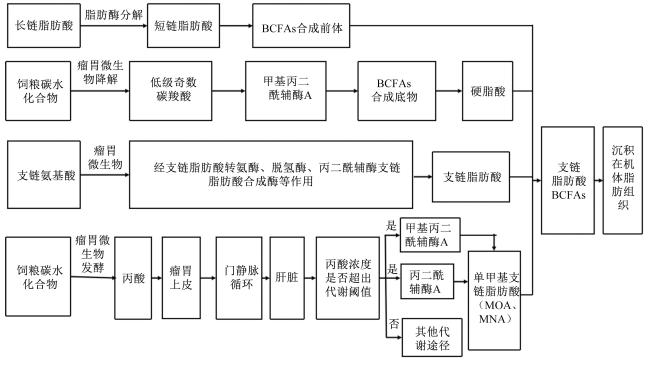
BCFAs可从以下几个途径进行合成:1)瘤胃代谢产物的从头合成。瘤胃微生物对饲粮中的碳水化合物进行发酵,会生成支链脂肪酸合成的重要前体物质丙酸,丙酸经瘤胃上皮、门静脉循环到达肝脏,丙酸含量超出动物肝脏代谢阈值时,未代谢部分会转化为丙二酰辅酶A和甲基丙二酰辅酶A[14]。它们经从头合成反应,可形成单甲基支链脂肪酸(如MOA和MNA)[15-16]。在脂肪酸的从头合成过程中,因脂肪酸合成酶和乙酰辅酶A羧化酶的底物混杂特性也可产生支链脂肪酸[5]。乙基支链脂肪酸则可能是以丁酸为前体物,以乙基丙二酰辅酶A为引物所合成的,具体途径尚不明确[17]。支链脂肪酸的合成过程与甲基/乙基丙二酰辅酶A脱羧酶的关联性较为显著,若抑制该酶的活性,则有助于提高支链脂肪酸的合成量[15]。2)瘤胃微生物转化。瘤胃微生物与支链脂肪酸的形成密切相关,它能够借助支链氨基酸构建含支链的碳骨架结构,用于支链脂肪酸的合成,如缬氨酸(支链氨基酸)在瘤胃微生物的作用下,经支链氨基酸转氨酶、脱氢酶和丙二酰辅酶支链脂肪酸合成酶等作用,生成支链脂肪酸,最终沉积在机体脂肪组织中[18-19];瘤胃微生物对饲粮中的碳水化合物(植烷酸)进行降解,生成低级奇数碳羧酸后,可进一步转化为甲基丙二酰辅酶A,从而为BCFAs的合成提供底物基础[20]。3)脂肪组织分解。羊体内的脂肪酶可促进长链脂肪酸分解为短链脂肪酸,进而为BCFAs的合成提供前提条件[5]。BCFAs合成途径见图1
图1 BCFAs合成示意图

BCFAs:4-烷基支链脂肪酸 4-alkyl branched-chain fatty acids;MOA:4-甲基辛酸 4-methyloctanoic acid;MNA:4-甲基壬酸 4-methylnonanoic acid。

Fig.1 Schematic diagram of BCFAs synthesis[14-16,18-20]

1.2 3-甲基吲哚和4-甲基苯酚

反刍动物以牧草、青绿豆科植物和其他阔叶植物为食时,会产生一种独特的肉味,称为“田园风味”,该风味主要由含硫化合物、酚类化合物和吲哚类化合物等成分相互混杂,综合作用形成,其中3-甲基吲哚和4-甲基苯酚是“田园风味”的主要贡献者[21]。作为羊肉膻味的关键特征化合物,3-甲基吲哚和4-甲基苯酚可通过协同作用,增强羊肉异味的感知强度。
3-甲基吲哚具有粪臭味,其含量与放牧模式密切相关[21]。早在1997年,Young等[22]研究发现来源于牧区养殖的羊肉在煮熟过程中,其上方漂浮的空气中含有高含量的3-甲基吲哚。3-甲基吲哚是L-色氨酸的代谢产物,肉羊采食含有L-色氨酸的草料、精料后,在瘤胃微生物的作用下,L-色氨酸经转氨酶、脱氢酶及2次脱羧后形成3-甲基吲哚,部分会通过尿液排出体外,剩余部分则通过肝脏代谢、血液循环等途径,在脂肪组织中沉积,进而对羊肉风味造成不利影响(图2)[5,23-26]。舍饲羔羊肾周脂肪里的3-甲基吲哚含量显著低于放牧羔羊[21],这主要与采食差异相关。放牧条件下,牧草中易发酵碳水化合物含量较少,其蛋白质在瘤胃内容易降解,降解产物含有大量L-色氨酸和酪氨酸[21],其中大部分L-色氨酸则在瘤胃细菌和原虫的作用下生成3-甲基吲哚[27],因此3-甲基吲哚是放牧绵羊肉中的主要特征风味物质之一。
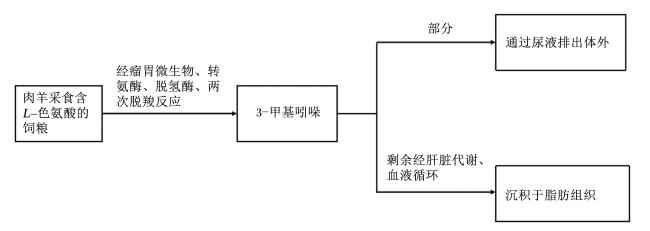
图2 3-甲基吲哚合成示意图

Fig.2 Schematic diagram of 3-methyl indole synthesis[5,23-26]

4-甲基苯酚具有强烈的酚类气味,饲粮、放牧条件及肉的pH与4-甲基苯酚的形成密切相关[9]。研究表明,4-甲基苯酚在放牧条件下有2种来源:1)肉羊采食草料和精料后,其中的蛋白质经瘤胃发酵生成酪氨酸,酪氨酸再经转氨酶作用及2次脱羧反应,生成4-甲基苯酚,后经血液循环沉积于脂肪[5,28](图3);2)当肉羊采食饲粮后,饲粮中的香豆酸酯及其他植物酚类物质在瘤胃内降解,形成4-甲基苯酚[29]。随着放牧时间的延长,4-甲基苯酚含量呈现上升趋势,与此同时,肉质pH最终呈现下降趋势[30]。当羊肉加工成熟肉,4-甲基苯酚会使熟羊肉的气味增加,从而影响羊肉的整体风味[31]
图3 4-甲基苯酚合成示意图

Fig.3 Schematic diagram of 4-methylphenol synthesis[5,28]

1.3 硬脂酸

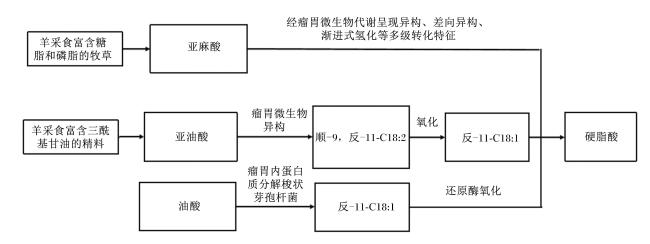
硬脂酸与BCFAs、3-甲基吲哚和4-甲基苯酚,均为影响羊肉膻味的重要成分。硬脂酸作为羊肉脂肪酸中的重要组分,其氧化产物(如醛类、酮类)会产生刺激性气味,直接影响羊肉膻味的感官特征。硬脂酸作为致膻成分之一,其含量与羊肉膻味呈显著正相关[32];李维红等[33]研究发现,随着肉羊日龄的增长,其体内脂硬脂酸含量显著升高,进而认为羊肉膻味的产生与硬脂酸这一重要脂肪酸密切相关。由于脂肪酸组成主要受瘤胃内脂质降解和生物氢化程度的调控,因此硬脂酸的合成会受到饲粮组成及瘤胃微生物的影响[34]。研究发现,亚麻酸、亚油酸及油酸可通过不同生化途径合成硬脂酸,与硬脂酸合成密切相关[35]。放牧条件下,牧草富含糖脂和磷脂,羊只采食后,机体以亚麻酸为主要脂肪酸。亚麻酸经瘤胃微生物代谢呈现异构、差向异构、渐进式氢化等多级转化特征,最终形成硬脂酸。精料中三酰基甘油含量丰富时,机体内以亚油酸为主要脂肪酸,在瘤胃微生物的异构作用下,亚油酸先转化为顺-9,反-11-C18∶2,随后进一步氢化为反-11-C18∶1,最终合成硬脂酸[36-37]。此外,油酸在瘤胃内蛋白质分解梭状芽孢杆菌的作用下会异构化为反-11-C18∶1,再经还原酶氢化生成硬脂酸[38](图4)。亚麻酸在机体内生成硬脂酸的效率较亚油酸和油酸有所升高,因此与精料饲喂相比,放牧条件下羊只体内脂肪组织亚麻酸和硬脂酸含量较高[39]
图4 硬脂酸合成示意图

Fig.4 Schematic diagram of stearic acid synthesis[36-38]

2 羊肉膻味物质合成的主要影响因素

2.1 遗传因素

品种受遗传基因调控,基因差异会影响机体内脂肪酸代谢过程,这是决定羊肉膻味强度的主要因素之一[40]。韩卫杰[9]研究发现,品种对肉羊膻味脂肪酸的含量产生一定影响,其含量从高到低顺序分别为小尾寒羊、滩羊、同羊。达马拉肥尾羊尾部脂肪中的甲基支链脂肪酸含量高于杜泊羊和美利奴羊[41]。在相同饲喂模式下,小尾寒羊脂肪组织中的EOA含量显著高于澳寒羊[42]。膻味物质的合成与遗传力也有关,Tajet等[43]研究发现,3-甲基吲哚在机体中沉积水平的遗传力估计值为0.19~0.54。脂肪酸的组成与沉积量会受遗传因素作用,进而对羊肉的膻味强度造成影响。Deighton等[44]研究发现,持续向绵羊瘤胃注入3-甲基吲哚,可减少内源性3-甲基吲哚的产生,且新西兰绵羊群体3-甲基吲哚在肝脏的沉积存在显著差异,这可能跟收集到的肝脏组织中3-甲基吲哚相关基因表达量有所差异相关,进而导致3-甲基吲哚在肝脏的沉积中出现差异。

2.2 饲养方式和饲粮

相比遗传因素,饲粮因素和饲养体系通常对羊肉膻味的影响更为直接[32]。随着生活水平的提高,肉羊集约化养殖成为必然趋势,这也在一定程度上加剧羊肉膻味。与放牧相比,舍饲情况下肉羊摄入谷物类等浓缩饲料的比例显著升高,瘤胃发酵产生的丙酸含量较高,为脂肪组织合成甲基支链脂肪酸提供了更多的前体物质,最终导致羊肉膻味的增加[21]。研究表明,饲喂颗粒料的羔羊比放牧羔羊膻味更重[45];而在黑麦草草场放牧的羔羊,其膻味显著低于饲喂浓缩料的同类羔羊[46],放牧羔羊皮下脂肪中MOA含量极显著低于舍饲羔羊[21]。另外,Young等[21]研究表明,当羔羊饲粮中谷物添加量提升时,肌肉脂肪和体脂中BCFAs沉积量会显著增加。相较于舍饲养殖模式,放牧饲养的羊只脂肪含量更低,其背最长肌还原糖和硫胺素含量更高;同时,肌肉中的饱和脂肪酸和单不饱和脂肪酸含量则处于较低水平[47]。综上可知,与舍饲相比,放牧羔羊肉品质及风味更佳。
饲粮是影响膻味物质形成的重要因素之一。Watkins等[6]指出,采食牧草的肉羊比饲喂精料的肉羊膻味低。放牧过程中补饲玉米,可显著提高皮下脂肪中MOA和MNA含量,加剧羊肉膻味[21-22]。此外,当饲粮经碾压、研磨后,会导致羊肉脂肪组织中的亚麻酸和支链脂肪酸含量随之升高,加剧羊肉膻味[48-49]。上述现象主要与饲粮中可溶性碳水化合物含量的升高导致瘤胃内丙酸含量的升高有关,丙酸含量升高为膻味脂肪酸的形成提供了更多的前体物质。芸薹属植物如油菜和羽衣甘蓝富含硫葡萄糖甙,当地居民发现其作为家畜饲料时,羊肉中类似于膻味的不良风味显著增加,这主要与硫葡萄糖甙在羊体内降解为硫氰酸酯、异硫氰酸酯及腈等具有刺激性气味的代谢物有关,这些物质可通过血液代谢沉积在畜产品中,从而影响羊肉风味[50-51]。豆科和菊芭属植物富含酚类代谢物,可在瘤胃环境中干扰微生物对脂质的代谢,抑制脂肪酸氧化酶活性,进而有效降低羊肉膻味强度。因此,饲粮中豆科植物比例适中或加入从豆科和菊芭属植物中提取的缩合单宁(多酚类化合物)可有效降低羊肉膻味。

2.3 性别和月龄

性别和月龄是影响羊肉膻味的重要因素。随着月龄的增加,公羊肉比母羊肉、阉羊肉的膻味更重,母羊肉与阉羊肉膻味则无显著差异[52]。Gkarane等[53]通过定量描述分析结合感官评价发现,公羊肉膻味的得分高于阉羊肉;Young等[11]研究发现,公羊肉的3-甲基吲哚、甲基支链脂肪酸和吲哚含量高于母羊肉和阉羊肉;Krvavica等[54]研究表明,母羊肉的肌内脂肪含量高于公羊肉;孙瑞璐等[55]研究表明,公羔肉较母羔肉含有更多提供汗味和膻味的物质。综上所述,公羊肉膻味较重,这主要与其机体内睾酮活性升高,通过蛋白质代谢和脂质代谢等途径驱动膻味加强,导致其膻味得分高于阉羊肉。除性别外,月龄是影响羊肉膻味程度的另一主要因素。随着月龄的增加,羊体内脂肪的沉积量不断增加,其中不饱和脂肪酸易发生氧化,进而生成更多的膻味物质。欧慧敏等[56]研究发现,呼伦贝尔羊脂肪组织中MOA、MNA和EOA含量随月龄的增加而显著升高。Garza等[57]研究发现,5月龄羔羊肉肉质、肌内脂肪含量及风味显著低于12月龄羔羊肉。

3 降膻方式

近年来,羊肉膻味调控策略呈现多维度发展趋势,主要集中于品种杂交[58-59]、营养调控[51,60-67]及羊肉加工处理[5,68-72]等,具体降膻措施见表1。例如:将波尔山羊和关中奶山羊杂交,研究发现波尔山羊与关中奶山羊的后代肌肉嫩度、颜色都有明显改善,且膻味得到降低[58];在饲粮中添加沙葱醇提物能够调控机体脂肪酸及氨基酸代谢通路,进而调控BCFAs的合成,改善羊肉膻味[51,62-66];羊肉进行烤制时,丰富的肉脂经氧化散发出香气,膻味得到改善[69-71]。此外,添加吸附剂也可降低羊肉膻味[73],但与品种杂交、营养调控、烤制等方法相比,添加吸附剂会影响食品安全,影响羊肉品质[5]
表1 羊肉降膻方式对比

Table 1 Comparison of mutton odor reduction methods

降膻方式
Methods to reduce odor
处理
Treatment
结果分析
Results analysis
参考文献
References
品种杂交
Breed hybridization
波尔山羊与关中奶山羊杂交 后代肌肉嫩度、颜色改善,膻味降低 丁武[58]
美利奴羊与法国伊尔羊和新西兰
某一品种羊杂交
4-烷基支链脂肪酸(BCFAs)
含量显著下降,膻味降低
Kaffarnik等[59]
营养调控
Nutritional regulation
补充适量硫元素 饲喂含硫牧草的滩羊羔羊
膻味最低,肉质最好
王琤 [60]
薛永伟[61]
沙葱提取物 羊肉挥发性物质含量降低,调控机体
脂肪酸及氨基酸代谢通路,从而调控
BCFAs合成
刘旺景等[51,62-63]
敖长金等[64]
Liu等[65]、包志碧[66]
碱蓬 羊肉膻味降低,羊肉品质提升 席继锋等[67]
羊肉加工处理
Mutton processing
高温处理与真空急骤蒸发协同作用 羊肉膻味减轻 杨东松等[5]
漂洗法:水温40 ℃、pH 8.2、
肉水比1∶7、漂洗5次
膻味显著降低 顾仁勇等[68]
烤制 有效降低羊肉膻味 Jia等[69]、彭海川等[70]
李子豪[71]
蒸煮时添加食盐、香料,控制时间 膻味显著降低 刘佳琳等[72]
吸附剂Adsorbent 膻味降低 Wang等[73]

4 小结

羊肉膻味物质的形成是一个复杂的过程,涉及瘤胃代谢产物的从头合成、瘤胃微生物转化以及脂肪组织分解等多种途径,受到遗传因素、饲养方式和饲粮以及性别和月龄等多种因素的影响,可通过品种杂交、营养调控及羊肉加工处理等来达到降低羊肉膻味的目的。未来的研究可结合代谢组学、宏基因组学和转录组学等方法进一步探究羊肉膻味物质的形成机制,结合现代生物技术,如基因编辑、微生物组学等,从遗传和微生物层面探索调控羊肉膻味的新途径,为羊肉产业的发展提供新的思路和方法,从而开发出更加高效、安全、环保的降膻技术,实现羊肉品质的全面提升,满足消费者对高品质羊肉的需求。
[1]
WANG R, BAI Z H, CHANG J F, et al. China’s low-emission pathways toward climate-neutral livestock production for animal-derived foods[J]. The Innovation, 2022, 3(2):100220.

DOI

[2]
费雨婕, 许芳瑞, 廖锐, 等. 羊肉及其制品特征挥发性风味物质的研究进展[J]. 食品研究与开发, 2023, 44(24):201-207.

FEI Y J, XU F R, LIAO R, et al. Research progress on characteristic volatile flavor compounds of mutton and its products[J]. Food Research and Development, 2023, 44(24):201-207. (in Chinese)

[3]
李军, 金海. 2022年我国肉羊产业发展概况、未来趋势及建议[J]. 中国畜牧杂志, 2023, 59(3):294-299.

LI J, JIN H. 2022 China’s meat sheep industry development overview,future trends and suggestions[J]. Chinese Journal of Animal Science, 2023, 59(3):294-299. (in Chinese)

[4]
赵烨嬋, 欧慧敏, 谭支良, 等. 呼伦贝尔羊不同生长阶段瘤胃微生物变化与羊肉膻味相关微生物分析[J]. 动物营养学报, 2024, 36(2):1050-1062.

DOI

ZHAO Y C, OU H M, TAN Z L, et al. Microbial changes in rumen of Hulun Buir sheep at different growth stages and analysis of odor-associated microbial communities[J]. Chinese Journal of Animal Nutrition, 2024, 36(2):1050-1062. (in Chinese)

[5]
杨东松, 高爽, 袁红, 等. 羊肉中呈膻物质的形成机制及降膻方式的研究进展[J]. 食品科学, 2024, 45(8):331-341.

YANG D S, GAO S, YUAN H, et al. Formation mechanisms of odor substances in mutton and deodorization methods:a review[J]. Food Science, 2024, 45(8):331-341. (in Chinese)

DOI

[6]
WATKINS P J, JABOREK J R, TENG F, et al. Branched chain fatty acids in the flavour of sheep and goat milk and meat:a review[J]. Small Ruminant Research, 2021, 200:106398.

[7]
TENG F, REIS M G, BROADHURST M, et al. Factors affecting levels of volatile 4-alkyl branched-chain fatty acids in sheep milk from 2 contrasting farming systems in New Zealand[J]. Journal of Dairy Science, 2020, 103(3):2419-2433.

DOI PMID

[8]
TENG F, REIS M G, YANG L, et al. Structural characteristics of triacylglycerols contribute to the distinct in vitro gastric digestibility of sheep and cow milk fat prior to and after homogenisation[J]. Food Research International, 2020, 130:108911.

[9]
韩卫杰. 绵羊脂肪组织中致膻物质及其形成机理的初步研究[D]. 博士学位论文. 杨凌: 西北农林科技大学, 2010.

HAN W J. Study on caused mutton odor material and their formation mechanism from sheep adipose tissue[D]. Ph.D. Thesis. Yangling: Northwest A&F University, 2010. (in Chinese)

[10]
WONG E, JONHSON C B, NIXON L N. The contribution of 4-methyloctanoic (hircinoic) acid to mutton and goat meat flavour[J]. New Zealand Journal of Agricultural Research, 1975, 18(3):261-266.

DOI

[11]
YOUNG O A, LANE G A, PODMORE C, et al. Changes in composition and quality characteristics of ovine meat and fat from castrates and rams aged to 2 years[J]. New Zealand Journal of Agricultural Research, 2006, 49(4):419-430.

DOI

[12]
WATKINS P J, ROSE G, SALVATORE L, et al. Age and nutrition influence the concentrations of three branched chain fatty acids in sheep fat from Australian abattoirs[J]. Meat Science, 2010, 86(3):594-599.

DOI PMID

[13]
SALVATORE L, ALLEN D, BUTLER K L, et al. Factors affecting the concentration of short branched-chain fatty acids in sheep fat[J]. Australian Journal of Experimental Agriculture, 2007, 47(10):1201-1207.

DOI

[14]
VAHMANI P, PONNAMPALAM E N, KRAFT J, et al. Bioactivity and health effects of ruminant meat lipids.Invited review[J]. Meat Science, 2020, 165:108114.

[15]
DEWULF J P, GERIN I, RIDER M H, et al. The synthesis of branched-chain fatty acids is limited by enzymatic decarboxylation of ethyl- and methylmalonyl-CoA[J]. Biochemical Journal, 2019, 476(16):2427-2447.

DOI PMID

[16]
ZHAO Y B, ZHANG Y M, KHAS E, et al. Transcriptome analysis reveals candidate genes of the synthesis of branched-chain fatty acids related to mutton flavor in the lamb liver using Allium mongolicum Regel extract[J]. Journal of Animal Science, 2022, 100(9):skac256.

[17]
KAFFARNIK S, HEID C, KAYADEMIR Y, et al. High enantiomeric excess of the flavor relevant 4-alkyl-branched fatty acids in milk fat and subcutaneous adipose tissue of sheep and goat[J]. Journal of Agricultural and Food Chemistry, 2015, 63(2):469-475.

DOI PMID

[18]
KANEDA T. Iso- and anteiso-fatty acids in bacteria:biosynthesis,function,and taxonomic significance[J]. Microbiological Reviews, 1991, 55(2):288-302.

DOI

[19]
VLAEMINCK B, FIEVEZ V, CABRITA A R J, et al. Factors affecting odd- and branched-chain fatty acids in milk:a review[J]. Animal Feed Science and Technology, 2006, 131(3/4):389-417.

DOI

[20]
SUN L L, LIU L, BRENNA J T, et al. Odd-and branched-chain fatty acids in milk fat from Holstein dairy cows are influenced by physiological factors[J]. Animal, 2022, 16(6):100545.

DOI

[21]
YOUNG O A, LANE G A, PRIOLO A, et al. Pastoral and species flavour in lambs raised on pasture,lucerne or maize[J]. Journal of the Science of Food and Agriculture, 2003, 83(2):93-104.

[22]
YOUNG O A, BERDAGUÉ J L, VIALLON C, et al. Fat-borne volatiles and sheepmeat odour[J]. Meat Science, 1997, 45(2):183-200.

PMID

[23]
WESOLY R, WEILER U. Nutritional influences on skatole formation and skatole metabolism in the pig[J]. Animals, 2012, 2(2):221-242.

DOI PMID

[24]
GUNAWAN A, LISTYARINI K, FURQON A, et al. Transcriptome signature of liver tissue with divergent mutton odour and flavour using RNA deep sequencing[J]. Gene, 2018, 676:86-94.

DOI PMID

[25]
SEONI E, BATTACONE G, SILACCI P, et al. Effect of condensed tannins from birdsfoot trefoil and dietary protein level on growth performance,carcass composition and meat quality of ram lambs[J]. Small Ruminant Research, 2018, 169:118-126.

DOI

[26]
MA Q, MENG N, LI Y J, et al. Occurrence,impacts,and microbial transformation of 3-methylindole (skatole):a critical review[J]. Journal of Hazardous Materials, 2021, 416:126181.

[27]
刘旺景, 敖长金. 羊膻味物质的合成机理及影响因素研究进展[J]. 动物营养学报, 2019, 31(12):5412-5421.

DOI

LIU W J, AO C J. Research advances in synthesis mechanism and influencing factors of characteristic flavor substances[J]. Chinese Journal of Animal Nutrition, 2019, 31(12):5412-5421. (in Chinese)

[28]
DEL BIANCO S, NATALELLO A, LUCIANO G, et al. Influence of dietary cardoon meal on volatile compounds and flavour in lamb meat[J]. Meat Science, 2020, 163:108086.

[29]
SCHREURS N M, FRASER K, LANE G A, et al. Effects of different forages on phenol and methylphenol formation in the rumen of sheep[J]. Proceedings of the New Zealand Society of Animal Production, 2003, 63:40-44.

[30]
VASTA V, PRIOLO A. Ruminant fat volatiles as affected by diet.A review[J]. Meat Science, 2006, 73(2):218-228.

DOI

[31]
WATKINS P J, FRANK D. Heptadecanoic acid as an indicator of BCFA content in sheep fat[J]. Meat Science, 2019, 151:33-35.

DOI PMID

[32]
SAÑUDO C, ENSER M E, CAMPO M M, et al. Fatty acid composition and sensory characteristics of lamb carcasses from Britain and Spain[J]. Meat Science, 2000, 54(4):339-346.

PMID

[33]
李维红, 吴建平, 王欣荣. 靖远滩羊体脂脂肪酸与肉品质关系的研究[J]. 中国草食动物, 2005, 25(1):54-55,48.

LI W H, WU J P, WANG X R. Study on short chain and C18 fatty acids in Tan sheep meat and its influence on meat flavor[J]. China Herbivore Science, 2005, 25(1):54-55,48. (in Chinese)

[34]
SHINGFIELD K J, BONNET M, SCOLLAN N D. Recent developments in altering the fatty acid composition of ruminant-derived foods[J]. Animal, 2013, 7(S1):132-162.

DOI

[35]
ZHANG C, ZHANG H, LIU M, et al. Effect of breed on the volatile compound precursors and odor profile attributes of lamb meat[J]. Foods, 2020, 9(9):1178.

DOI

[36]
JENKINS T C, WALLACE R J, MOATE P J, et al. Board-invited review:recent advances in biohydrogenation of unsaturated fatty acids within the rumen microbial ecosystem[J]. Journal of Animal Science, 2008, 86(2):397-412.

DOI

[37]
NUERNBERG K, NUERNBERG G, ENDER K, et al. Effect of grass vs. concentrate feeding on the fatty acid profile of different fat depots in lambs[J]. European Journal of Lipid Science and Technology, 2005, 107(10):737-745.

DOI

[38]
MCKAIN N, SHINGFIELD K J, WALLACE R J. Metabolism of conjugated linoleic acids and 18:1 fatty acids by ruminal bacteria:products and mechanisms[J]. Microbiology, 2010, 156(Pt 2):579-588.

DOI

[39]
要铎. 饲养方式对苏尼特羊脂肪分布与脂肪酸组成的影响及其机理研究[D]. 博士学位论文. 呼和浩特: 内蒙古农业大学, 2021:48-58.

YAO D. Impact of feeding regimens on fat distribution and fatty acids profile of Sunit sheep and its underlying mechanism[D]. Ph.D. Thesis. Hohhot: Inner Mongolia Agricultural University, 2021:48-58. (in Chinese)

[40]
张志超, 段子渊, 张新华, 等. 羊肉肉质风味研究进展[J]. 肉类研究, 2018, 32(10):61-65.

ZHANG Z C, DUAN Z Y, ZHANG X H, et al. Recent progress in research on mutton quality and flavor[J]. Meat Research, 2018, 32(10):61-65. (in Chinese)

[41]
ALVES S P, BESSA R J B, QUARESMA M A G, et al. Does the fat tailed Damara ovine breed have a distinct lipid metabolism leading to a high concentration of branched chain fatty acids in tissues?[J]. PLoS One, 2013, 8(10):e77313.

DOI

[42]
张志超, 王小琪, 包琦, 等. 澳洲白羊与小尾寒羊杂交F1代背最长肌肉品质与皮下脂肪组织膻味物质分析[J]. 食品工业科技, 2021, 42(14):272-277.

ZHANG Z C, WANG X Q, BAO Q, et al. Analysis of the longissimus dorsi meat quality and the content of mutton flavor substances of F1 hybrid sheep between Australian white sheep and native small-tail Han sheep[J]. Science and Technology of Food Industry, 2021, 42(14):272-277. (in Chinese)

[43]
TAJET H, ANDRESEN Ø, MEUWISSEN T. Estimation of genetic parameters of boar taint;skatole and androstenone and their correlations with sexual maturation[J]. Acta Veterinaria Scandinavica, 2006, 48(S1):S9.

[44]
DEIGHTON M H, PACHECO D, TAVENDALE M H, et al. Increased hepatic skatole exposure via rumen infusion increases skatole concentration in peripheral circulation and inter-muscular fat in sheep[J]. Proceedings of the New Zealand Society of Animal Production, 2006, 66:295-299.

[45]
PRIOLO A, MICOL D, AGABRIEL J, et al. Effect of grass or concentrate feeding systems on lamb carcass and meat quality[J]. Meat Science, 2002, 62(2):179-185.

PMID

[46]
AUROUSSEAU B, BAUCHART D, CALICHON E, et al. Effect of grass or concentrate feeding systems and rate of growth on triglyceride and phospholipid and their fatty acids in the M.longissimus thoracis of lambs[J]. Meat Science, 2004, 66(3):531-541.

DOI

[47]
罗玉龙. 放牧与舍饲条件下苏尼特羊肉风味差异及形成机制研究[D]. 博士学位论文. 呼和浩特: 内蒙古农业大学, 2019.

LUO Y L. Difference of meat flavor in Sunit lamb (concentrated vs grazing) and primary formation mechanism[D]. Ph.D. Thesis. Hohhot: Inner Mongolia Agricultural University, 2019. (in Chinese)

[48]
DUNCAN W R, ORSKOV E R, GARTON G A. Effect of different dietary cerals on the occurence of branched-chain fatty acids in lamb fats[J]. The Proceedings of the Nutrition Society, 1974, 33(3):81A-82A.

[49]
BRAND T S, VAN DER MERWE D A, HOFFMAN L C, et al. The effect of dietary energy content on quality characteristics of Boer goat meat[J]. Meat Science, 2018, 139:74-81.

DOI PMID

[50]
TRIPATHI M K, MISHRA A S. Glucosinolates in animal nutrition:a review[J]. Animal Feed Science and Technology, 2007, 132(1/2):1-27.

DOI

[51]
刘旺景. 沙葱提取物对肉羊体脂4-烷基支链脂肪酸代谢的影响及其机理研究[D]. 博士学位论文. 呼和浩特: 内蒙古农业大学, 2020.

LIU W J. Effects of Allium mongolicum Regel extracts on metabolism of 4-alkyl branched-chain fatty acids of body fat and its mechanism in lambs[D]. Ph.D. Thesis. Hohhot: Inner Mongolia Agricultural University, 2020. (in Chinese)

[52]
薛丽娜, 周胜花. 羊肉膻味物质的影响因素及候选基因研究进展[J]. 山西农业科学, 2020, 48(8):1347-1350.

XUE L N, ZHOU S H. Research progress on influence factors and candidate genes of characteristic flavors substances[J]. Journal of Shanxi Agricultural Sciences, 2020, 48(8):1347-1350. (in Chinese)

[53]
GKARANE V, ALLEN P, GRAVADOR R S, et al. Effect of castration and age at slaughter on sensory perception of lamb meat[J]. Small Ruminant Research, 2017, 157:65-74.

DOI

[54]
KRVAVICA M, DUGUM J, TOPALOVIĆ M D, et al. Changes in proximate chemical and mineral compositions of different sex categories of mutton during the dry-curing process[J]. Animals, 2021, 11(11):3019.

DOI

[55]
孙瑞璐, 刘天月, 罗海玲, 等. 兴安多羔羊肉营养成分与风味物质研究[J]. 农业机械学报, 2022, 53(10):386-395.

SUN R L, LIU T Y, LUO H L, et al. Investigation on nutrition and flavor of Xingan lamb meat[J]. Transactions of the Chinese Society for Agricultural Machinery, 2022, 53(10):386-395. (in Chinese)

[56]
欧慧敏, 张小丽, 钟荣珍, 等. 不同生长阶段呼伦贝尔羊3种脂肪组织中膻味脂肪酸含量的变化规律研究[J]. 动物营养学报, 2022, 34(11):7220-7227.

DOI

OU H M, ZHANG X L, ZHONG R Z, et al. Change law of odor fatty acid contents in three adipose tissues of Hulun Buir sheep at different growth stages[J]. Chinese Journal of Animal Nutrition, 2022, 34(11):7220-7227. (in Chinese)

[57]
GARZA H, JABOREK J R, ZERBY H N, et al. The effects of age,sex,and hot carcass weight on cooked lamb flavor and off-flavor in four muscle cuts[J]. Translational Animal Science, 2021, 5(3):txab083.

[58]
丁武. 波尔山羊与关中奶山羊杂交后代产肉性能及羊肉品质研究[D]. 博士学位论文. 杨凌: 西北农林科技大学, 2005.

DING W. The studies on the meat production and quality properties of barstart crossed Boer and Guanzhong goats[D]. Ph.D. Thesis. Yangling: Northwest A&F University, 2005. (in Chinese)

[59]
KAFFARNIK S, PREUB S, VETTER W. Direct determination of flavor relevant and further branched-chain fatty acids from sheep subcutaneous adipose tissue by gas chromatography with mass spectrometry[J]. Journal of Chromatography A, 2014, 1350:92-101.

DOI PMID

[60]
王琤 , 陈秋玲, 王仁华. 硫在羊生产中的研究应用进展[J]. 粮食与饲料工业, 2025(6):48-50.

WANG C W, CHEN Q L, WANG R H. Research and application progress of sulfur in sheep production[J]. Cereal & Feed Industry, 2025, 2025(6):48-50. (in Chinese)

[61]
薛永伟. 含硫牧草对盐池滩羊膻味的影响研究[J]. 现代畜牧科技, 2025, 53(1):51-53.

XUE Y W. Research on the influence of sulfur-containing forage on the ram odor of Yanchi Tan sheep[J]. Modern Animal Husbandry Science & Technology, 2025, 53(1):51-53. (in Chinese)

[62]
刘旺景, 唐德富, 敖长金. 沙葱及其提取物对舍饲肉羊肾周脂肪膻味物质代谢组特征的影响[J]. 畜牧兽医学报, 2022, 53(9):3029-3041.

DOI

LIU W J, TANG D F, AO C J. Effect of Allium mongolicum Regel and its extract on the metabolomic characteristics of perirenal adipose tissue typical odor and flavor substances in captive meat sheep[J]. Acta Veterinaria et Zootechnica Sinica, 2022, 53(9):3029-3041. (in Chinese)

[63]
刘旺景, 李书仪, 唐德富, 等. 日粮添加沙葱及其提取物对羊肉膻味脂肪酸沉积及贮藏期肉品质的影响[J]. 食品科学, 2022, 43(11):49-56.

LIU W J, LI S Y, TANG D F, et al. Influence of dietary incorporation of Allium mongolicum Regel or its extracts on flavor and odor fatty acid deposition and lamb meat quality during storage[J]. Food Science, 2022, 43(11):49-56. (in Chinese)

[64]
敖长金, 赵亚波, 白晨, 等. 沙葱及其提取物对羊肉膻味的调控作用研究进展[J]. 动物营养学报, 2022, 34(10):6371-6378.

DOI

AO C J, ZHAO Y B, BAI C, et al. Research progress on regulation of Allium mongolicum Regel and its extracts on mutton flavour[J]. Chinese Journal of Animal Nutrition, 2022, 34(10):6371-6378. (in Chinese)

[65]
LIU W J, DING H, KHAS E, et al. Effects of flavonoids from Allium mongolicum Regel as a dietary additive on meat quality and composition of fatty acids related to flavor in lambs[J]. Canadian Journal of Animal Science, 2018, 99(1):15-23.

DOI

[66]
包志碧. 沙葱及其提取物对羊肉品质和风味物质组成的影响[D]. 硕士学位论文. 呼和浩特: 内蒙古农业大学, 2019.

BAO Z B. Effects of Allium mongolicum Regel and its extracts on the meat quality and flavor components in mutton sheep[D]. Master’s Thesis. Hohhot: Inner Mongolia Agricultural University, 2019. (in Chinese)

[67]
席继锋, 丑武江. 饲喂碱蓬对羊肉品质的影响[J]. 黑龙江畜牧兽医, 2016(18):180-182,298-299.

XI J F, CHOU W J. Effect of Suaeda salsa feeding on mutton quality[J]. Heilongjiang Animal Science and Veterinary Medicine, 2016(18):180-182,298-299. (in Chinese)

[68]
顾仁勇, 银永忠, 傅伟昌. 羊肉的漂洗脱膻及风味羊肉丝的研制[J]. 食品工业科技, 2008, 29(3):213-215.

GU R Y, YIN Y Z, FU W C. Preparation of flavor mutton silk and de-odoring of mutton with wash[J]. Science and Technology of Food Industry, 2008, 29(3):213-215. (in Chinese)

[69]
JIA W, ZHANG R, LIU L, et al. Proteomics analysis to investigate the impact of diversified thermal processing on meat tenderness in Hengshan goat meat[J]. Meat Science, 2022, 183:108655.

[70]
彭海川, 张鹏程, 钱琴, 等. 发酵菌种对鱼露中挥发性风味物质的影响[J]. 中国调味品, 2023, 48(7):68-72.

PENG H C, ZHANG P C, QIAN Q, et al. Effects of fermentation strains on volatile flavor substances in fish sauce[J]. China Condiment, 2023, 48(7):68-72. (in Chinese)

[71]
李子豪. 烤羊肉加工新工艺及其综合保藏技术研究[D]. 硕士学位论文. 成都: 成都大学, 2024.

LI Z H. Studies on the new processing technology and comprehensive preservation of roasted lamb[D]. Master’s Thesis. Chengdu: Chengdu University, 2024. (in Chinese)

[72]
刘佳琳, 恩和哲布, 任璐, 等. 基于电子舌及GC-MS评价预制手扒羊肉品质及风味特征[J]. 食品与发酵工业, 2025, 51(15):340-347.

DOI

LIU J L, EN H Z B, REN L, et al. Evaluation of quality and flavour characteristics of pre-prepared hand-steamed mutton based on electronic tongue combined with GC-MS[J]. Food and Fermentation Industries, 2025, 51(15):340-347. (in Chinese)

DOI

[73]
WANG C, WANG C N, GAO F, et al. Effects of polymerized whey protein on goaty flavor and texture properties of fermented goat milk in comparison with β-cyclodextrin[J]. Journal of Dairy Research, 2018, 85(4):465-471.

DOI PMID

Outlines

/