RESEARCH PAPER

Effects of Dietary Supplementation with Different Levels of Lysozyme on Growth Performance, Immune Function, Antioxidant Capacity, Intestinal Short-Chain Fatty Acids Contents and Microbial Flora of Yellow-Feathered Broilers

  • WANG Tao , 1 ,
  • XU Haocheng 1, * ,
  • LI Hui 2 ,
  • YANG Caimei 2 ,
  • CHEN Liuyi 1 ,
  • XIAO Xiao , 1, **
Expand
  • 1 College of Animal Science and Technology·College of Veterinary Medicine, Zhejiang A&F University, Hangzhou 311300, China
  • 2 Zhejiang Huijia Biotechnology Co., Ltd., Huzhou 313306, China
**lecturer, E-mail:

*Contributed equally

Received date: 2025-08-08

  Online published: 2026-03-16

Abstract

This experiment was conducted to investigate the effects of dietary supplementation with different levels of lysozyme on growth performance, immune function, antioxidant capacity, intestinal short-chain fatty acids contents and microbial flora of yellow-feathered broilers. A total of 450 healthy 1-day-old yellow-feathered broilers with an initial average body weight of approximately 31.7 g were randomly divided into 3 groups with 10 replicates per group and 15 broilers per replicate. Broilers in the control group (CON group) were fed a basal diet, while those in the experimental groups were fed the basal diets supplemented with 250 (LZ250 group) and 500 mg/kg (LZ500 group) lysozyme (enzyme activity: 100 000 U/g), respectively. The experimental period lasted for 56 days. The results showed as follows: 1) compared with the CON group, the feed-to-gain ratio in the LZ500 group was significantly decreased (P<0.05). 2) Compared with the CON group, the serum contents of immunoglobulin A (IgA), immunoglobulin M (IgM) and immunoglobulin Y (IgY) in the LZ250 and LZ500 groups were significantly increased (P<0.05), and the serum content of tumor necrosis factor-α (TNF-α) was significantly decreased (P<0.05); the serum contents of interleukin-1β (IL-1β) and interleukin-6 (IL-6) in the LZ500 group were significantly decreased (P<0.05), while the serum content of interleukin-10 (IL-10) was significantly increased (P<0.05). 3) Compared with the CON group, the serum glutathione peroxidase (GPx) activity in the LZ250 and LZ500 groups was significantly increased (P<0.05), and the serum malondialdehyde (MDA) content was significantly decreased (P<0.05); the serum superoxide dismutase (SOD) activity in the LZ500 group was significantly increased (P<0.05). 4) Compared with the CON group, the cecal contents of propionic acid, butyric acid and isobutyric acid in the LZ500 group were significantly increased (P<0.05). 5) Compared with the CON group, the relative abundance of Streptococcus in cecum of the LZ250 and LZ500 groups was significantly increased (P<0.05), while the relative abundance of Butyricimonas in cecum was significantly decreased (P<0.05); the relative abundance of Turicibacter in cecum of the LZ500 group was significantly increased (P<0.05). In conclusion, dietary supplementation with 500 mg/kg lysozyme can significantly improve the growth performance, immune function and antioxidant capacity of yellow-feathered broilers, increase the contents of SCFAs in cecum, and alter the cecal microbial composition.

Cite this article

WANG Tao , XU Haocheng , LI Hui , YANG Caimei , CHEN Liuyi , XIAO Xiao . Effects of Dietary Supplementation with Different Levels of Lysozyme on Growth Performance, Immune Function, Antioxidant Capacity, Intestinal Short-Chain Fatty Acids Contents and Microbial Flora of Yellow-Feathered Broilers[J]. Chinese Journal of Animal Nutrition, 2026 , 38(3) : 1900 -1910 . DOI: 10.12418/CJAN2026.153

黄羽肉鸡在我国肉鸡养殖产业中占据重要地位,其肉质鲜美、风味独特,深受消费者喜爱。在养殖过程中,提升黄羽肉鸡的生长性能、增强其免疫功能以及维持良好的肠道健康,对提高养殖效益和保障产品质量至关重要[1]。溶菌酶(lysozyme,LZ)是一类天然的酶类物质,具有抗菌、抗炎、抗氧化等多种生物活性,近年来在畜牧养殖领域受到广泛关注[2]。作为分布广泛的生物活性分子,溶菌酶天然存在于人体分泌液、动植物外泌物以及微生物胞内环境中。例如,鸡蛋清中溶菌酶含量丰富,是研究其结构与功能的基本模型。此外,该酶还存在于其他禽类蛋白、哺乳动物乳汁以及部分植物和微生物中。除核心抗菌作用外,溶菌酶还具有抗病毒、免疫调节和抗肿瘤等多种药理作用[3]。溶菌酶的抗菌机制在于选择性水解肽聚糖层中N-乙酰胞壁酸(NAM)与N-乙酰葡糖胺(NAG)之间的β-1,4-糖苷键,该反应可瓦解细胞壁结构稳定性,导致细菌渗透压调节功能丧失,进而引发裂解性死亡[4]。此外,溶菌酶的阳离子性质也赋予其抗菌能力,该特性使其能够靶向结合带负电荷的细菌细胞膜,诱导形成跨膜离子通道,造成胞内物质渗漏,进而引发细菌死亡[5]。有研究表明,在断奶仔猪饲粮中添加溶菌酶可显著改善其生长性能以及胃肠道健康[6];在小鼠饲粮中添加溶菌酶能够减少肠道有害菌定植数量,促进有益菌增殖[7];在小鼠结肠炎期间补充溶菌酶能减轻肠道炎症反应,改善肠道健康[8]。然而,目前关于溶菌酶在肉鸡养殖中应用效果的研究仍较为有限。本研究以黄羽肉鸡为试验动物,旨在探究饲粮中添加溶菌酶对其生长性能、免疫功能及抗氧化能力的影响,并分析对其肠道短链脂肪酸(SCFAs)含量及微生物区系的调节作用,以期为溶菌酶在肉鸡养殖中的应用提供理论依据。

1 材料与方法

1.1 试验设计与饲粮

动物试验由浙江农林大学动物科技学院·动物医学院实验室管理及伦理委员会批准,批准号为ZAFUAC202484。
选取初始体重约为31.7 g的健康1日龄黄羽肉鸡450只,随机分为3组,每组10个重复,每个重复15只。对照组(CON组)饲喂基础饲粮,试验组分别饲喂在基础饲粮中添加250(LZ250组)和500 mg/kg(LZ500组)溶菌酶(酶活性为100 000 U/g)的试验饲粮。试验期56 d。基础饲粮参照《黄羽肉鸡营养需要量》(NY/T 3645—2020)配制,其组成及营养水平见表1。饲粮中粗蛋白质含量采用凯氏定氮法(GB/T 6432—2018)进行测定,钙含量采用原子吸收分光光度法(GB/T 6436—2018)进行测定,总磷含量采用分光光度法(GB/T 6437—2018)进行测定,氨基酸含量采用高效液相色谱法(GB/T 18246—2019)进行测定,代谢能参考《中国饲料成分及营养价值表(2017年第28版)》计算得出。
表1 基础饲粮组成及营养水平(风干基础)

Table 1 Composition and nutrient levels of the basal diet (air-dry basis)

项目 Items 含量 Content
原料 Ingredients
玉米 Corn 54.40
玉米蛋白粉 Corn protein meal 2.00
豆粕 Soybean meal 23.60
膨化大豆 Extruded soybean 5.00
大米干酒糟及其可溶物 Rice DDGS 5.00
大豆油 Soybean oil 2.20
发酵豆粕 Fermented soybean meal 2.50
石粉 Limestone 1.30
预混料 Premix1) 4.00
合计 Total 100.00
营养水平 Nutrient levels2)
代谢能 ME/(MJ/kg) 12.48
粗蛋白质 CP 20.40
赖氨酸 Lys 1.18
蛋氨酸 Met 0.55
蛋氨酸+半胱氨酸 Met+Cys 0.90
色氨酸 Trp 0.22
苏氨酸 Thr 0.88
钙 Ca 0.86
总磷 TP 0.59

1)预混料为每千克饲粮提供 The premix provided the following per kg of the diet:VA 1 500 IU,VB1 1.5 mg,VB2 3.5 mg,VB6 3 mg,VB12 0.01 mg,VD3 200 IU,VE 10 IU,VK 35 mg,泛酸 pantothenic acid 10 mg,烟酸 nicotinic acid 30 mg,生物素 biotin 0.15 mg,氯化胆碱 choline chloride 1 000 mg,Mn 60 mg,Fe 80 mg,Zn 40 mg,Cu 8 mg,Se 0.15 mg,I 0.18 mg。

2)代谢能为计算值,粗蛋白质、钙、总磷和氨基酸为实测值。ME was a calculated value, while CP, Ca, TP and amino acids were measured values.

1.2 饲养管理

动物试验在浙江惠嘉生物科技有限公司(湖州)进行。试验期间,采用单层笼养模式,光照周期设定为每日16 h光照与8 h黑暗,鸡舍内的温度、相对湿度等环境参数控制及常规免疫程序均参照标准养殖规程执行。肉鸡自由采食和饮水,每日定时巡查鸡群健康状况。

1.3 样品采集与处理

养殖试验结束后,试验鸡禁食12 h(自由饮水)。从每个重复选取1只体重接近该重复平均体重的试验鸡(每组10只),使用普通采血管经颈动脉采集血液样本,室温静置至析出血清后,于4 ℃、3 000×g条件下离心15 min,收集上清液,分装后于-20 ℃冰箱中保存,用于血清免疫及抗氧化指标的测定。屠宰后完整摘取法氏囊、脾脏及胸腺,称重后计算免疫器官指数[免疫器官指数(g/kg)=免疫器官鲜重(g)/宰前活重(kg)];收集盲肠内容物,分装至2支无菌冻存管中,液氮速冻后转移至-80 ℃超低温冰箱中保存,用于SCFAs含量的测定及肠道微生物分析。

1.4 测定指标与方法

1.4.1 生长性能

以重复为单位记录试验开始及结束时的肉鸡体重,记录每周每重复的饲粮消耗量及死亡个体数。基于上述数据,计算试验鸡的平均日增重(ADG)、平均日采食量(ADFI)以及料重比(F/G)。

1.4.2 血清免疫和抗氧化指标

血清免疫指标:采用购自杭州金恒诺生物科技有限公司的酶联免疫吸附试验(ELISA)试剂盒测定免疫球蛋白A(IgA)、免疫球蛋白M(IgM)、免疫球蛋白Y(IgY)、白细胞介素-6(IL-6)、白细胞介素-1β(IL-1β)、白细胞介素-10(IL-10)和肿瘤坏死因子-α(TNF-α)含量,具体操作严格按照试剂盒说明书执行。
血清抗氧化指标:采用购自武汉吉利德生物科技有限公司的试剂盒测定谷胱甘肽过氧化物酶(GPx)、超氧化物歧化酶(SOD)活性和丙二醛(MDA)含量及总抗氧化能力(T-AOC),具体操作严格按照试剂盒说明书执行。

1.4.3 盲肠内容物SCFAs含量

参照Xiao等[9]的方法,使用Agilent 7890B气相色谱仪(Agilent Technologies,美国)测定盲肠内容物中乙酸、丙酸、丁酸、异丁酸、戊酸和异戊酸含量。

1.4.4 16S rRNA测序分析盲肠微生物区系

采用磁珠法土壤/粪便基因组DNA提取试剂盒(Thermo Fisher Scientific,美国)对盲肠内容物中的总基因组DNA进行分离纯化,随后检测其浓度与纯度。采用T100热循环PCR仪(Bio-Rad,美国)以引物338F(5'-ACTCCTACGGGAGGCAGAG-3')和806R(5'-GGACTACHVGGGTWTCT AAT-3')对细菌16S rRNA基因V3~V4高变区进行扩增。PCR产物经2%琼脂糖凝胶电泳分离后回收,利用试剂盒纯化,并使用Qubit 4.0试剂盒(Thermo Fisher Scientific,美国)进行定量。测序所得原始序列使用Fastp(v0.19.6)进行质量过滤,并用FLASH(v1.2.11)进行合并;利用QIIME2平台,采用基于SILVA 16S rRNA基因数据库构建的RDP朴素贝叶斯共识分类器,对扩增子序列变体(ASV)进行物种分类注释,注释置信度阈值设为70%。采用Mothur(v1.30.2)进行α多样性分析;基于Bray-Curtis距离算法,采用QIIME(v1.9.1)进行β多样性分析,并通过非度量多维尺度(NMDS)分析进行结果可视化;采用tax_summary工具及R语言(v3.3.1)相关程序包完成微生物群落组成分析;采用STAMP(v2.1.3)分析各组微生物组成差异。

1.5 数据统计与分析

试验数据经Excel 2019初步整理后,采用SPSS 27.0软件进行单因素方差分析(one-way ANOVA),并使用Duncan氏法进行组间多重比较;使用GraphPad Prism 8.01软件绘图。结果以平均值±标准误(mean±SE)表示,P<0.05表示差异显著。

2 结果与分析

2.1 饲粮中添加不同水平溶菌酶对黄羽肉鸡生长性能的影响

表2可知,与CON组相比,LZ250组与LZ500组末重、ADG和ADFI均无显著变化(P>0.05),LZ500组F/G显著降低(P<0.05)。
表2 饲粮中添加不同水平溶菌酶对黄羽肉鸡生长性能的影响

Table 2 Effects of dietary supplementation with different levels of lysozyme on growth performance of yellow-feathered broilers

项目
Items
组别 Groups P
P-value
CON LZ250 LZ500
末重 FBW/g 1 996.55±94.03 2 002.80±23.75 1 982.14±25.09 0.485
平均日增重 ADG/g 33.80±0.37 35.19±0.42 34.82±0.45 0.066
平均日采食量 ADFI/g 75.91±1.71 76.24±1.28 73.26±0.79 0.234
料重比 F/G 2.24±0.04a 2.17±0.03ab 2.11±0.03b 0.016

同行数据肩标无字母或相同小写字母表示差异不显著(P>0.05),不同小写字母表示差异显著(P<0.05)。下表同。

In the same row, values with no letter or the same small letter superscripts mean no significant difference (P>0.05), while with different small letter superscripts mean significant difference (P<0.05). The same as below.

2.2 饲粮中添加不同水平溶菌酶对黄羽肉鸡免疫器官指数的影响

表3可知,与CON组相比,饲粮中添加250和500 mg/kg溶菌酶对脾脏指数、胸腺指数和法氏囊指数均无显著影响(P>0.05)。
表3 饲粮中添加不同水平溶菌酶对黄羽肉鸡免疫器官指数的影响

Table 3 Effects of dietary supplementation with different levels of lysozyme on immune organ indexes of yellow-feathered broilers

项目
Items
组别 Groups P
P-value
CON LZ250 LZ500
胸腺指数 Thymus index 2.53±0.28 1.95±0.32 1.89±0.26 0.278
脾脏指数 Spleen index 1.54±0.90 1.52±0.77 1.56±0.10 0.960
法氏囊指数 Bursa of Fabricius index 1.51±0.88 1.44±0.07 1.74±0.14 0.054

2.3 饲粮中添加不同水平溶菌酶对黄羽肉鸡血清免疫指标的影响

表4可知,与CON组相比,LZ250组和LZ500组血清IgA、IgM和IgY含量显著提高(P<0.05);LZ500组血清IL-1β和IL-6含量显著降低(P<0.05),血清IL-10含量显著提高(P<0.05);LZ250组和LZ500组血清TNF-α含量显著降低(P<0.05)。
表4 饲粮中添加不同水平溶菌酶对黄羽肉鸡血清免疫指标的影响

Table 4 Effects of dietary supplementation with different levels of lysozyme on serum immune indexes of yellow-feathered broilers

项目
Items
组别 Groups P
P-value
CON LZ250 LZ500
免疫球蛋白A IgA/(ng/mL) 4.82±0.49b 14.27±1.26a 19.89±2.48a <0.001
免疫球蛋白M IgM/(ng/mL) 1.52±0.10b 3.54±0.30a 4.20±0.40a <0.001
免疫球蛋白Y IgY/(ng/mL) 1.19±0.50b 2.45±0.21a 2.37±0.21a <0.001
白细胞介素-1β IL-1β/(pg/mL) 117.56±7.18a 104.01±8.65a 67.87±11.54b 0.005
白细胞介素-6 IL-6/(pg/mL) 39.97±1.92a 34.02±2.98a 24.11±2.75b 0.002
肿瘤坏死因子-α TNF-α/(pg/mL) 192.59±8.77a 153.28±9.71b 127.09±5.44b <0.001
白细胞介素-10 IL-10/(pg/mL) 8.95±0.83b 10.18±0.75ab 11.84±0.30a 0.026

2.4 饲粮中添加不同水平溶菌酶对黄羽肉鸡血清抗氧化指标的影响

表5可知,与CON组相比,LZ250组和LZ500组血清GPx活性显著提高(P<0.05),血清MDA含量显著降低(P<0.05);LZ500组血清SOD活性显著提高(P<0.05);LZ250组和LZ500组血清T-AOC无显著变化(P>0.05)。
表5 饲粮中添加不同水平溶菌酶对黄羽肉鸡血清抗氧化指标的影响

Table 5 Effects of dietary supplementation with different levels of lysozyme on serum antioxidant indexes of yellow-feathered broilers

项目
Items
组别 Groups P
P-value
CON LZ250 LZ500
谷胱甘肽过氧化物酶 GPx/(U/mL) 0.93±0.16b 1.44±0.11a 1.66±0.12a 0.005
总抗氧化能力 T-AOC/(U/mL) 0.15±0.01 0.28±0.05 0.30±0.07 0.123
超氧化物歧化酶 SOD/(U/L) 727.31±69.79b 1 036.73±124.65ab 1 297.81±116.42a 0.006
丙二醛 MDA/(nmol/mL) 36.30±6.68a 12.35±2.33b 10.31±0.98b <0.001

2.5 饲粮中添加不同水平溶菌酶对黄羽肉鸡盲肠SCFAs含量的影响

表6可知,与CON组相比,LZ500组盲肠丙酸、丁酸和异丁酸含量显著提高(P<0.05),LZ250组和LZ500组盲肠乙酸、戊酸和异戊酸含量均无显著变化(P>0.05)。
表6 饲粮中添加不同水平溶菌酶对黄羽肉鸡盲肠SCFAs含量的影响

Table 6 Effects of dietary supplementation with different levels of lysozyme on cecal SCFAs contents of yellow-feathered broilers

项目
Items
组别 Groups P
P-value
CON LZ250 LZ500
乙酸 Acetic acid 2 701.12±259.17 2 935.24±176.27 3 144.27±159.68 0.259
丙酸 Propionic acid 461.48±49.27b 520.11±50.78ab 665.49±68.42a 0.018
丁酸 Butyric acid 1 010.81±132.37b 1 379.36±112.05ab 1 459.85±128.96a 0.040
异丁酸 Isobutyric acid 45.75±8.60b 75.42±22.27ab 76.49±5.97a 0.042
戊酸 Valeric acid 79.28±10.86 84.74±13.07 75.96±8.37 0.861
异戊酸 Isovaleric acid 37.15±6.57 47.32±9.16 43.78±3.67 0.323

2.6 饲粮中添加不同水平溶菌酶对黄羽肉鸡盲肠微生物区系的影响

2.6.1 盲肠微生物多样性分析
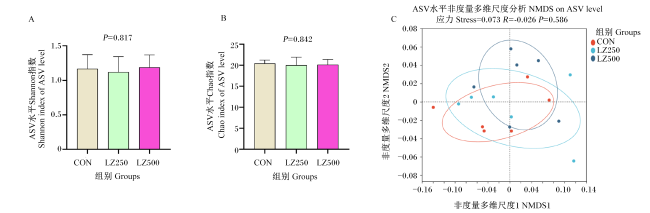
本研究通过测定Shannon指数与Chao指数,分别评估了盲肠微生物群落的多样性与丰富度(α多样性),结果表明,饲粮中添加250和500 mg/kg溶菌酶对盲肠微生物Shannon指数(图1-A)和Chao指数(图1-B)均无显著影响(P>0.05)。基于Bray-Curtis距离构建的NMDS分析结果表明,饲粮中添加250和500 mg/kg溶菌酶对盲肠微生物β多样性也无显著影响(应力=0.073,P=0.586,图1-C)。
图1 盲肠微生物多样性分析

Fig.1 Cecal microbial diversity analysis

2.6.2 盲肠微生物组成及差异分析

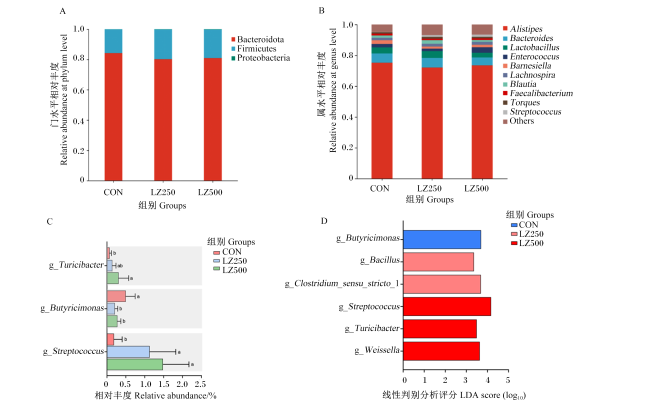
门和属水平盲肠微生物组成分析结果表明,3组盲肠微生物中优势菌门均为拟杆菌门(Bacteroidota)和厚壁菌门(Firmicutes)(图2-A),其中拟杆菌门相对丰度最高,厚壁菌门次之。在门水平上,3组之间未发现存在显著差异的微生物。属水平上相对丰度排名前10的微生物如图2-B所示,包括另枝杆菌属(Alistipes)、拟杆菌属(Bacteroides)、乳杆菌属(Lactobacillus)、肠球菌属(Enterococcus)、巴恩斯氏菌属(Barnesiella)、毛螺菌属(Lachnospira)、布劳特氏菌属(Blautia)、粪杆菌属(Faecalibacterium)、扭链菌属(Torques)和链球菌属(Streptococcus),且另枝杆菌属在3组盲肠微生物中均为优势菌属。此外,差异分析结果(图2-C)表明,与CON组相比,LZ250组和LZ500组盲肠微生物中链球菌属相对丰度显著提高(P<0.05),丁酸单胞菌属(Butyricimonas)相对丰度显著降低(P<0.05);LZ500组盲肠苏黎世杆菌属(Turicibacter)相对丰度显著提高(P<0.05)。以线性判别分析评分(LDA score)>3为阈值,对属水平微生物进行线性判别分析效应大小(LEfSe)分析(图2-D),结果表明,CON组盲肠微生物中富集丁酸单胞菌属,LZ250组盲肠微生物中富集狭义梭菌属-1(Clostridium_sensu_stricto_1)和芽孢杆菌属(Bacillus),而LZ500组盲肠微生物中富集链球菌属、魏斯氏菌属(Weissella)和苏黎世杆菌属。
图2 盲肠微生物组成及差异分析

A:门水平盲肠微生物组成;B:属水平盲肠微生物组成;C:属水平差异微生物分析;D:线性判别分析效应大小(LEfSe)分析。数据柱形标注不同字母表示差异显著(P<0.05)。A: cecal microbial composition at phylum level; B: cecal microbial composition at genus level; C: analysis of differential microorganisms at genus level; D: linear discriminant analysis effect size (LEfSe) analysis. Value columns with different letters mean significant difference (P<0.05).

Bacteroidota:拟杆菌门;Firmicutes:厚壁菌门;Proteobacteria:变形菌门;Alistipes:另枝杆菌属;Bacteroides:拟杆菌属;Lactobacillus:乳杆菌属;Enterococcus:肠球菌属;Barnesiella:巴恩斯氏菌属;Lachnospira:毛螺菌属;Blautia:布劳特氏菌属;Faecalibacterium:粪杆菌属;Torques:扭链菌属;Streptococcus:链球菌属;Others:其他;Turicibacter:苏黎世杆菌属;Butyricimonas:丁酸单胞菌属;Bacillus:芽孢杆菌属;Clostridium_sensu_stricto_1:狭义梭菌属-1;Weissella:魏斯氏菌属。

Fig.2 Cecal microbial composition and differences analysis

3 讨论

3.1 饲粮中添加不同水平溶菌酶对黄羽肉鸡生长性能的影响

Gong等[10]研究表明,饲粮中添加100 mg/kg溶菌酶可在一定程度上改善肉鸡的肠道健康,但对ADG和ADFI无显著影响。本研究结果与之相符,即饲粮中添加250和500 mg/kg溶菌酶对黄羽肉鸡的ADG和ADFI未产生显著影响。与此同时,本研究发现,饲粮中添加500 mg/kg溶菌酶可显著降低F/G,表明在肉鸡饲养过程中添加溶菌酶能有效改善饲料利用率。Liu等[11]也报道了在黄羽肉鸡饲粮中添加40 mg/kg溶菌酶可显著改善其F/G,与本研究结果一致。

3.2 饲粮中添加不同水平溶菌酶对黄羽肉鸡免疫功能的影响

作为机体免疫系统的核心组分,免疫器官的发育水平与动物免疫功能呈正相关[12]。相关研究表明,溶菌酶等添加剂可对黄羽肉鸡免疫器官指数产生一定调节作用。例如,在黄羽肉鸡饲粮中添加13.3 g/kg溶菌酶,可能通过增强机体的免疫应答,刺激免疫器官的发育,从而使免疫器官指数有所上升[13]。但本研究结果显示,饲粮中添加250和500 mg/kg溶菌酶对黄羽肉鸡免疫器官指数并无显著影响,该差异可能与溶菌酶添加剂量及试验周期不同有关。
血清免疫球蛋白(如IgA、IgM、IgY等)和细胞因子(白细胞介素、肿瘤坏死因子等)在机体免疫防御中发挥着关键作用[14]。相关研究证实,饲粮中添加90 mg/kg溶菌酶可使肉鸡表现出更强的免疫调节效应,具体体现为细胞免疫(巨噬细胞调理活性与吞噬指数提升)、局部免疫(IgA含量增加)及体液免疫(新城疫与高致病性禽流感H5N1血凝抑制滴度升高)反应的增强[15]。本研究结果与之相符,饲粮中添加250和500 mg/kg溶菌酶显著提高了黄羽肉鸡血清IgA、IgM和IgY含量,这一结果间接反映出机体免疫活性的增强。在细胞因子方面,溶菌酶可通过调节促炎与抗炎因子的平衡来维持机体免疫稳态[16]。有研究报道,在饲粮中分别添加20、60和180 mg/kg溶菌酶后,肉鸡肠道黏膜中抗炎因子IL-10含量均显著升高,促炎因子IL-1β含量降低[17]。本研究结果表明,饲粮中添加250和500 mg/kg溶菌酶均显著降低了黄羽肉鸡血清中促炎因子TNF-α含量;且添加量为500 mg/kg时血清促炎因子IL-1β和IL-6含量亦显著下降,血清IL-10含量显著提高。这与前人研究结果一致,表明溶菌酶通过降低促炎因子含量以减轻机体炎症反应,增强肉鸡免疫功能。

3.3 饲粮中添加不同水平溶菌酶对黄羽肉鸡抗氧化能力的影响

血清抗氧化因子是机体抗氧化防御系统的关键组成部分,在维持体内氧化还原平衡中发挥着至关重要的作用。其中,T-AOC能综合反映抗氧化酶活性及体内非酶类抗氧化物质的含量[18];GPx作为一类重要的抗氧化酶,能有效清除体内产生的过量活性氧,减少机体过氧化反应[19]。而MDA作为脂质过氧化的终末代谢产物,是评价氧化损伤程度的关键生物标志物,其含量直接反映脂质过氧化水平及氧化应激状态[20-21]。本研究结果表明,饲粮中添加250和500 mg/kg溶菌酶能显著提高肉鸡血清GPx活性,并显著降低血清MDA含量;此外,添加500 mg/kg溶菌酶还能显著提高血清SOD活性。有研究报道,饲粮中添加150 mg/kg溶菌酶能显著提高热应激肉鸡血清SOD活性,提高其抗氧化能力[22]。在断奶仔猪饲粮中添加0.1%溶菌酶可以显著提高其血清SOD和GPx活性,同时降低血清MDA含量[23],该结果与本研究发现一致。综上可知,饲粮中添加溶菌酶能够提高血清T-AOC及SOD、GPx活性,减少MDA积累,从而整体增强机体的抗氧化能力。

3.4 饲粮中添加不同水平溶菌酶对黄羽肉鸡盲肠SCFAs含量及微生物区系的影响

肠道微生物通过发酵作用产生的SCFAs,以乙酸、丙酸及丁酸为典型代表,可通过介导肠上皮细胞健康与机体代谢调控发挥关键生理功能[21,24]。在盲肠微环境中,SCFAs能与共生菌群协同作用,通过促进肠黏膜形态发育、调控局部免疫稳态,实现肠道健康维护与肉鸡生长性能的协同优化[25]。已有研究证实,饲粮中添加40、100和200 mg/kg溶菌酶可通过调控肠道微生物群落结构、促进有益菌增殖,进而影响黄羽肉鸡盲肠中SCFAs含量[26]。本研究结果表明,饲粮中添加500 mg/kg溶菌酶可显著提高黄羽肉鸡盲肠丙酸、丁酸及异丁酸含量,与前人研究结果相符。
本研究结果表明,饲粮中添加250和500 mg/kg溶菌酶能显著提高黄羽肉鸡盲肠链球菌属相对丰度并降低丁酸单胞菌属相对丰度;添加500 mg/kg溶菌酶还能显著提高盲肠苏黎世杆菌属相对丰度。相关研究显示,饲粮中添加800 mg/kg异亮氨酸可降低肉鸡盲肠丁酸单胞菌属相对丰度[27]。丁酸单胞菌能够代谢膳食中的葡萄糖并转化为丁酸盐,该物质是肠道上皮细胞的关键能量底物,通常情况下能促进细胞新陈代谢,甚至还能通过抑制有害微生物的增殖来维持肠道微生态平衡与健康[28]。但本试验中溶菌酶对丁酸单胞菌的调控并未削弱肠道丁酸供给,推测溶菌酶可能通过其抗菌特性重塑了盲肠微生物的竞争格局。这种重构有利于链球菌属和苏黎世杆菌属等微生物的增殖,后者可能在溶菌酶存在的环境下,为肉鸡提供了更优的代谢产物组合,从而在整体上促进了肠道健康。这也表明单一菌属丰度的下降,不等于其有益功能(如产生丁酸)的缺失。另有研究发现,苏黎世杆菌在肠道微生态平衡维护中具有重要作用,正常情况下其与乳酸菌及双歧杆菌等肠道微生物相互协作,共同维持肠道微生态稳定[29]。当畜禽肠道遭受有害菌[如大肠杆菌(Escherichia coli)、沙门氏菌(Salmonella)]侵袭时,苏黎世杆菌能够通过竞争营养物质、占据黏附位点等方式,抑制有害菌的生长和定植,从而降低肠道疾病发生率[29]。关于链球菌的报道也指出,常见链球菌如唾液链球菌(Streptococcus salivarius)和乳链球菌(Streptococcus lactis)常定植于畜禽肠道[30],可发酵碳水化合物产生乳酸,降低肠道pH,促进钙、磷等矿物质吸收。在肉鸡肠道中,这类链球菌还能分解饲粮中的非淀粉多糖,提高饲料转化率,尤其在高纤维饲粮中作用更为明显[31]。在仔猪肠道中,粪链球菌(Streptococcus faecalis,现归入肠球菌属,但传统分类中属链球菌属)能分泌细菌素[32],抑制病原性大肠杆菌的生长,减少腹泻发生[33]。肠道微生物分析结果还显示,饲粮中添加250和500 mg/kg溶菌酶后黄羽肉鸡盲肠微生物富集狭义梭菌属-1、芽孢杆菌属、链球菌属、魏斯氏菌属和苏黎世杆菌属。Zhou等[34]的研究中也发现狭义梭菌属-1在肉鸡肠道中富集,该菌属是与SCFAs生成密切相关的一类生物标志物细菌。芽孢杆菌属、魏斯氏菌属和苏黎世杆菌属也被报道在畜禽肠道中有利于乳酸菌、双歧杆菌等有益厌氧菌生长,并能抑制大肠杆菌等需氧有害菌繁殖[35-37]。以上结果表明,饲粮中添加溶菌酶可促进有益菌在肉鸡肠道内的定植,有助于维护肠道微生态平衡与健康。
然而,目前溶菌酶在黄羽肉鸡养殖中的应用仍存在诸多亟待解决的问题。例如不同来源和剂型的溶菌酶活性差异及其对黄羽肉鸡作用效果的影响,以及溶菌酶与其他饲料添加剂之间的协同作用机制等。未来研究可围绕上述方向深入探索,以期为溶菌酶在黄羽肉鸡健康养殖中的规范化应用提供更充分的理论依据和实践指导。

4 结论

本试验条件下,饲粮中添加500 mg/kg溶菌酶能够显著降低黄羽肉鸡的F/G,改善其生长性能;显著提高血清免疫球蛋白(IgA、IgY、IgM)及抗炎因子IL-10含量,同时降低血清促炎因子IL-1β、IL-6和TNF-α含量,有效增强机体免疫功能;还可显著提升血清GPx和SOD活性,降低MDA含量,提高机体抗氧化能力。此外,饲粮中添加500 mg/kg溶菌酶还显著提高了盲肠中苏黎世杆菌属和链球菌属相对丰度,改变了肠道微生物组成,并增加了盲肠中丙酸、丁酸和异丁酸等SCFAs含量。
[1]
ZHANG S, ZHONG G, SHAO D, et al. Dietary supplementation with Bacillus subtilis promotes growth performance of broilers by altering the dominant microbial community[J]. Poultry Science, 2021, 100(3):100935.

DOI

[2]
WINDISCH W, SCHEDLE K, PLITZNER C, et al. Use of phytogenic products as feed additives for swine and poultry[J]. Journal of Animal Science, 2008, 86(S14):E140-E148.

[3]
BLAKE C C F, KOENIG D F, MAIR G A, et al. Structure of hen egg-white lysozyme:a three-dimensional Fourier synthesis at 2 Å resolution[J]. Nature, 1965, 206(4986):757-761.

DOI

[4]
OLIVER W T, WELLS J E, MAXWELL C V. Lysozyme as an alternative to antibiotics improves performance in nursery pigs during an indirect immune challenge[J]. Journal of Animal Science, 2014, 92(11):4927-4934.

DOI PMID

[5]
MASSCHALCK B, MICHIELS C W. Antimicrobial properties of lysozyme in relation to foodborne vegetative bacteria[J]. Critical Reviews in Microbiology, 2003, 29(3):191-214.

PMID

[6]
OLIVER W T, WELLS J E. Lysozyme as an alternative to antibiotics improves growth performance and small intestinal morphology in nursery pigs[J]. Journal of Animal Science, 2013, 91(7):3129-3136.

DOI PMID

[7]
DAN L, LIU S, SHANG S Z, et al. Expression of recombinant human lysozyme in bacterial artificial chromosome transgenic mice promotes the growth of Bifidobacterium and inhibits the growth of Salmonella in the intestine[J]. Journal of Biotechnology, 2018,272/273:33-39.

[8]
LARSEN I S, JENSEN B A H, BONAZZI E, et al. Fungal lysozyme leverages the gut microbiota to curb DSS-induced colitis[J]. Gut Microbes, 2021, 13(1):1988836.

DOI

[9]
XIAO X, CUI T T, QIN S K, et al. Beneficial effects of Lactobacillus plantarum on growth performance,immune status,antioxidant function and intestinal microbiota in broilers[J]. Poultry Science, 2024, 103(12):104280.

DOI

[10]
GONG M, ANDERSON D, RATHGEBER B, et al. The effect of dietary lysozyme with EDTA on growth performance and intestinal microbiota of broiler chickens in each period of the growth cycle[J]. Journal of Applied Poultry Research, 2017, 26(1):1-8.

DOI

[11]
LIU D, GUO Y M, WANG Z, et al. Exogenous lysozyme influences Clostridium perfringens colonization and intestinal barrier function in broiler chickens[J]. Avian Pathology, 2010, 39(1):17-24.

DOI

[12]
ANDERSON G, JENKINSON E J. Thymus organ cultures and T-cell receptor repertoire development[J]. Immunology, 2000, 100(4):405-410.

DOI

[13]
RUAN D, FOUAD A M, FAN Q L, et al. Dietary L-arginine supplementation enhances growth performance,intestinal antioxidative capacity,immunity and modulates gut microbiota in yellow-feathered chickens[J]. Poultry Science, 2020, 99(12):6935-6945.

DOI

[14]
LEE L, SAMARDZIC K, WALLACH M, et al. Immunoglobulin Y for potential diagnostic and therapeutic applications in infectious diseases[J]. Frontiers in Immunology, 2021, 12:696003.

DOI

[15]
ABDEL-LATIF M A, EL-HAMID H S A, EMAM M, et al. Dietary lysozyme and avilamycin modulate gut health,immunity,and growth rate in broilers[J]. BMC Veterinary Research, 2024, 20(1):28.

DOI

[16]
RYMUSZKA A, STUDNICKA M, SIWICKI A K, et al. The immunomodulatory effects of the dimer of lysozyme (KLP-602) in carp (Cyprinus carpio L.) -in vivo study[J]. Ecotoxicology and Environmental Safety, 2005, 61(1):121-127.

DOI

[17]
TIAN X F, CAO H, YAN J T, et al. Effect of dietary supplementation with recombinant human lysozyme on growth performance,antioxidative characteristics,and intestinal health in broiler chickens[J]. Journal of Animal Science, 2024,102:skae121.

[18]
ATTIA Y A, HASSAN R A, TAG EL-DIN A E, et al. Effect of ascorbic acid or increasing metabolizable energy level with or without supplementation of some essential amino acids on productive and physiological traits of slow-growing chicks exposed to chronic heat stress[J]. Journal of Animal Physiology and Animal Nutrition, 2011, 95(6):744-755.

DOI PMID

[19]
ZHOU M J, ZENG D, NI X Q, et al. Effects of Bacillus licheniformis on the growth performance and expression of lipid metabolism-related genes in broiler chickens challenged with Clostridium perfringens-induced necrotic enteritis[J]. Lipids in Health and Disease, 2016, 15(1):48.

DOI

[20]
GHIMIRE S, SUBEDI K, ZHANG X W, et al. Efficacy of Bacillus subtilis probiotic in preventing necrotic enteritis in broilers:a systematic review and Meta-analysis[J]. Avian Pathology, 2024, 53(6):451-466.

DOI

[21]
秦宋柯, 崔振川, 李慧, 等. 地衣芽孢杆菌对黄羽肉鸡生长性能、免疫和抗氧化功能以及肠道菌群的影响[J]. 动物营养学报, 2023, 35(2):865-873.

DOI

QIN S K, CUI Z C, LI H, et al. Effects of Bacillus licheniformis on growth performance,immune and antioxidant functions and intestinal microbiota of yellow-feathered broilers[J]. Chinese Journal of Animal Nutrition, 2023, 35(2):865-873. (in Chinese)

[22]
ELBAZ A M, RAMADAN G S, ATEYA A, et al. Lysozyme and Bacillus subtilis improve growth performance,nutrient utilization,physiological stress indices,intestinal integrity,and gene expression of heat-stressed broilers[J]. Scientific Reports, 2025, 15(1):39574.

DOI

[23]
WU Y Y, CHENG B, JI L X, et al. Dietary lysozyme improves growth performance and intestinal barrier function of weaned piglets[J]. Animal Nutrition, 2023, 14:249-258.

DOI PMID

[24]
DEN BESTEN G, VAN EUNEN K, GROEN A K, et al. The role of short-chain fatty acids in the interplay between diet,gut microbiota,and host energy metabolism[J]. Journal of Lipid Research, 2013, 54(9):2325-2340.

DOI

[25]
YANG C M, ZHANG L L, CAO G T, et al. Effects of dietary supplementation with essential oils and organic acids on the growth performance,immune system,fecal volatile fatty acids,and microflora community in weaned piglets[J]. Journal of Animal Science, 2019, 97(1):133-143.

[26]
XIA Y, KONG J, ZHANG G B, et al. Effects of dietary supplementation with lysozyme on the structure and function of the cecal microbiota in broiler chickens[J]. PLoS One, 2019, 14(6):e0216748.

DOI

[27]
LIU H C, SUN J L, JIANG S Z, et al. Effects of dietary isoleucine supplementation on the production performance,health status and cecal microbiota of Arbor Acre broiler chickens[J]. Microorganisms, 2023, 11(2):236.

DOI

[28]
YANG S, HU T, LIU H, et al. Akebia saponin D ameliorates metabolic syndrome (MetS) via remodeling gut microbiota and attenuating intestinal barrier injury[J]. Biomedicine & Pharmacotherapy, 2021, 138:111441.

DOI

[29]
ZHANG Y Y, LIU Y S, LI J L, et al. Dietary resistant starch modifies the composition and function of caecal microbiota of broilers[J]. Journal of the Science of Food and Agriculture, 2020, 100(3):1274-1284.

DOI PMID

[30]
KOKWE N H, TSHABUSE F, SWALAHA F M. In vitro characterization and safety assessment of Streptococcus salivarius,Levilactobacillus brevis and Pediococcus pentosaceus isolated from the small intestine of broiler breeders[J]. Microorganisms, 2025, 13(6):1231.

DOI

[31]
ZHENG L L, ZHANG L, TAN F, et al. Prevention and control of chicken coccidiosis construction of recombinant Lactococcus lactis expressing chicken IL-4 and IL-2 fusion protein and its immune synergistic effect on chicken coccidia live vaccine[J]. Poultry Science, 2023, 102(4):102530.

DOI

[32]
WANG K L, CHEN G Y, CAO G T, et al. Effects of Clostridium butyricum and Enterococcus faecalis on growth performance,intestinal structure,and inflammation in lipopolysaccharide-challenged weaned piglets[J]. Journal of Animal Science, 2019, 97(10):4140-4151.

DOI

[33]
LIU C Q, ZHU Q, CHANG J, et al. Effects of Lactobacillus casei and Enterococcus faecalis on growth performance,immune function and gut microbiota of suckling piglets[J]. Archives of Animal Nutrition, 2017, 71(2):120-133.

DOI

[34]
ZHOU Q Q, LAN F R, LI X C, et al. The spatial and temporal characterization of gut microbiota in broilers[J]. Frontiers in Veterinary Science, 2021, 8:712226.

DOI

[35]
ABUDABOS A M, ALHOURI H A A, ALHIDARY I A, et al. Ameliorative effect of Bacillus subtilis,Saccharomyces boulardii,oregano,and calcium montmorillonite on growth,intestinal histology,and blood metabolites on Salmonella-infected broiler chicken[J]. Environmental Science and Pollution Research, 2019, 26(16):16274-16278.

DOI

[36]
YUAN J J, LI Y, SUN S A, et al. Response of growth performance and cecum microbial community to cyclic heat stress in broilers[J]. Tropical Animal Health and Production, 2023, 56(1):9.

DOI PMID

[37]
LIU Y L, WANG Y B, WANG C H, et al. Alterations in hepatic transcriptome and cecum microbiota underlying potential ways to prevent early fatty liver in laying hens[J]. Poultry Science, 2023, 102(5):102593.

DOI

Outlines

/