RESEARCH PAPER

Optimization of Solid-State Fermentation Process for Mulberry Leaf Powder and Its Degradation Effect on Anti-Nutritional Factors

  • DUAN Linna , 1 ,
  • GAO Yanhang 1 ,
  • ZI Shaoping 1 ,
  • ZHANG Degen 1 ,
  • CHEN Shiyu 1 ,
  • BAO Guoying 1 ,
  • LIN Qiuye 2 ,
  • CAO Zhenhui , 1, 3, ** ,
  • XU Le , 1, 3, **
Expand
  • 1 College of Animal Science and Technology, Yunnan Agricultural University, Kunming 650201, China
  • 2 School of Ethnic Medicine, Yunnan Minzu University, Kunming 650504, China
  • 3 Yunnan Key Laboratory of Animal Nutrition and Feed Science, Kunming 650201, China
**CAO Zhenhui, professor, E-mail: ;
XU Le, lecturer, E-mail:

*Contributed equally

Received date: 2025-09-24

  Online published: 2026-04-14

Abstract

This experiment aimed to optimize the solid-state fermentation process of mulberry leaf powder, investigate the changes in nutritional components and the degradation effect of anti-nutritional factors before and after fermentation, so as to provide the theoretical basis and technical support for the efficient utilization of mulberry leaf powder. In this study, the aerobic fermentation was first carried out using Aspergillus niger as the functional strain, followed by anaerobic fermentation with Lactobacillus plantarum and Saccharomyces cerevisiae. The optimal two-stage solid-state fermentation process was investigated through single-factor and orthogonal experiments, the changes in contents of nutritional components and anti-nutritional factors before and after fermentation were analyzed. The results showed that the optimal fermentation parameters for Aspergillus niger were time of 5 d, temperature of 37 ℃ and inoculation amount of 2×10⁵ CFU/g. The optimal fermentation parameters for Lactobacillus plantarum and Saccharomyces cerevisiae were time of 48 h, temperature of 35 ℃ and inoculation amount of 1×10⁷ CFU/g. After two-stage solid-state fermentation under the optimal process, the contents of crude protein, calcium, total phosphorus and total phenols in mulberry leaf powder were significantly increased (P<0.05 or P<0.01), while the contents of crude fiber, phytic acid and tannins were significantly decreased (P<0.05 or P<0.01). In terms of hygienic indicators, the Escherichia coli, Salmonella and Shigella were not detected in the fermented mulberry leaf powder, and the viable count of Lactobacillus reached 2.73×10⁹ CFU/g. In conclusion, two-stage solid-state fermentation with Aspergillus niger, Lactobacillus plantarum and Saccharomyces cerevisiae can effectively improve the feed value of mulberry leaf powder, providing a theoretical foundation for its application in the feed industry.

Cite this article

DUAN Linna , GAO Yanhang , ZI Shaoping , ZHANG Degen , CHEN Shiyu , BAO Guoying , LIN Qiuye , CAO Zhenhui , XU Le . Optimization of Solid-State Fermentation Process for Mulberry Leaf Powder and Its Degradation Effect on Anti-Nutritional Factors[J]. Chinese Journal of Animal Nutrition, 2026 , 38(4) : 3148 -3160 . DOI: 10.12418/CJAN2026.252

玉米-豆粕型饲料是我国常用饲料类型,随着畜牧业的快速发展,国内粮食供应已无法满足行业需求。据统计,2023年我国玉米、大豆进口量分别达2 712万和9 861万t,对外依存度居高不下[1]。鉴于此,充分利用我国丰富的非常规饲料资源,不仅可有效降低饲料成本、提高养殖效益,更是减少饲料原料进口依赖的战略性举措[2]。云南省作为我国气候类型最为多样的省份,境内温度适宜、光照充足的自然条件为桑树提供了优越的生长环境,仅2021年全省桑园种植面积就达138.6万亩(1亩≈666.67 m2)[3-4]。桑叶作为桑树主产物,粗蛋白质含量较高(27.63%~37.36%),且富含维生素、植物甾醇和多糖等生物活性物质[5-6]。因此,将其作为非常规饲料开发,将有助于缓解我国因缺乏优质饲料原料而导致的“人畜争粮”现象,对推动畜牧业和饲料业的可持续发展具有重要意义。
然而,桑叶中含量较高的粗纤维(9.90%~13.85%)会刺激畜禽肠道蠕动,缩短食物消化时间,并吸附消化酶和胆汁盐,降低饲料利用率[5,7]。此外,桑叶中的植酸和单宁等抗营养因子会通过螯合矿物质离子抑制消化酶活性及与蛋白质结合形成不溶性复合物,进一步降低畜禽的消化吸收功能[8]。上述因素共同限制了桑叶在饲料行业中的推广应用。固态发酵技术是一种在低水分固态基质中利用微生物进行生物转化的过程,被广泛用于改善饲料原料营养价值及降解抗营养因子,在饲料与养殖领域具有重要应用价值[9-10]。现有研究表明,常规营养成分的改善及抗营养因子的降解主要依赖于产酶丰富的黑曲霉(Aspergillus niger)或芽孢杆菌主导的好氧发酵过程[11]。然而,现有桑叶固态发酵工艺主要采用乳酸菌厌氧发酵,该工艺虽能使终产物中富含具有益生特性的乳酸菌,但由于其酶系单一,对桑叶的营养价值改善有限[12]。因此,为充分提高桑叶的可利用性并赋予其益生特性,本研究拟先采用黑曲霉对桑叶进行有氧发酵,在此基础上利用植物乳杆菌(Lactobacillus plantarum)和酿酒酵母(Saccharomyces cerevisiae)进行厌氧发酵,通过单因素和正交试验设计探究最优二段发酵工艺,并比较发酵前后桑叶粉营养指标、消化酶活性、感官品质及饲用安全性,为非常规饲料桑叶的开发和利用提供参考依据。

1 材料与方法

1.1 试验材料

发酵用桑叶采集自云南省陆良县板桥镇,选取市售玉米面作为发酵碳源,上述原料粉碎过40目筛后备用。黑曲霉由上海交通大学惠赠,植物乳杆菌和酿酒酵母均为本课题组保藏。

1.2 主要试剂与仪器

MRS肉汤琼脂培养基、沙氏葡萄糖琼脂(Sabouraud dextrose agar,SDA)培养基、马铃薯葡萄糖水(potato dextrose broth,PDB)培养基、伊红美蓝琼脂(eosin methylene blue,EMB)培养基均购于广东环凯生物科技有限公司,胆硫乳琼脂(deoxycholate hydrogen sulfide lactose agar,DHL)培养基、沙门氏菌显色培养基(干粉)均购于青岛海博生物技术有限公司。
立式高压蒸汽灭菌器(LDZF-50L)购于上海申安医疗器械厂,凯氏定氮仪(UDK-159)购于意大利VELP公司,紫外可见分光光度计(UV-5100)购于上海元析仪器有限公司,台式高速离心机(TG16B)购于金坛市科析仪器有限公司。

1.3 试验方法

1.3.1 种子液制备

取黑曲霉菌株接种至SDA液体培养基中,37 ℃、100 r/min振荡培养36 h进行活化,将菌丝涂布于SDA固体培养基表面,经无菌水冲洗收集孢子,制得黑曲霉种子液;取植物乳杆菌接种至MRS液体培养基中,37 ℃静置培养8 h,制得植物乳杆菌种子液;取酿酒酵母接种至PDB液体培养基中,37 ℃、100 r/min振荡培养12 h进行活化,制得酿酒酵母种子液。

1.3.2 黑曲霉固态发酵桑叶粉工艺优化

1.3.2.1 单因素试验

按桑叶粉与玉米粉质量比9∶1、料液比1∶1.9配制20 g发酵体系,混匀后121 ℃的条件下高压蒸汽灭菌20 min。随后进行单因素试验,以粗蛋白质含量和纤维素酶活性为指标,设定发酵条件为温度37 ℃、接菌量1×10⁶ CFU/g,探究不同时间(2、3、4、5、6 d)对体系的影响;设定发酵条件为时间4 d、接菌量1×10⁶ CFU/g,探究不同温度(33、35、37、39、41 ℃)对体系的影响;设定发酵条件为时间4 d、温度37 ℃,探究不同接菌量(4×10⁴、2×10⁵、1×10⁶、5×10⁶、2.5×10⁷ CFU/g)对体系的影响[13]。将发酵底物置于发酵罐中,罐口用透气性封口膜覆盖,每隔24 h对发酵底物进行搅拌,确保氧气分布均匀,满足黑曲霉的好氧生长需求。

1.3.2.2 正交试验及验证

经单因素试验后,采用三因素三水平(L933)正交试验优化黑曲霉发酵工艺,以发酵时间(4、5、6 d)、发酵温度(35、37、39 ℃)、黑曲霉接菌量(2×10⁵、1×10⁶、5×10⁶ CFU/g)为因素,每个因素设置3个水平,共9组试验,每组3次重复[13]。将正交试验极差分析中的最优发酵组合与正交试验粗蛋白质含量和纤维素酶活性最高值进行对比,验证优化方案的可行性。

1.3.3 植物乳杆菌和酿酒酵母固态发酵桑叶粉工艺优化

1.3.3.1 单因素试验

在黑曲霉固态发酵桑叶粉最优工艺的基础上,采用植物乳杆菌和酿酒酵母1∶1的接种比例进行二段混菌固态发酵。以发酵产物中植物乳杆菌活菌数为指标,设定发酵条件为温度37 ℃、总接菌量1×10⁶ CFU/g,探究不同时间(24、36、48、60、72 h)对体系的影响;设定发酵条件为时间48 h、总接菌量1×10⁶ CFU/g,探究不同温度(33、35、37、39、41 ℃)对体系的影响;设定发酵条件为温度37 ℃、发酵时间48 h,探究不同总接菌量(1×10⁴、1×10⁵、1×10⁶、1×10⁷、1×10⁸ CFU/g)对体系的影响[13]。将发酵底物置于发酵罐中并严格密封,为植物乳杆菌和酿酒酵母混菌发酵创造厌氧环境。

1.3.3.2 正交试验及验证

经单因素试验后,采用三因素三水平(L933)正交试验优化植物乳杆菌和酿酒酵母发酵工艺,以发酵时间(36、48、60 h)、发酵温度(33、35、37 ℃)、总接菌量(1×10⁵、1×10⁶、1×10⁷ CFU/g)为因素,每个因素设置3个水平,共9组试验,每组3次重复[13]。将正交试验极差分析中的最优发酵组合与正交试验植物乳杆菌活菌数最高值进行对比,验证优化方案的可行性。

1.4 检测指标和方法

1.4.1 桑叶粉发酵前后的理化指标与功能活性成分测定

固态发酵后所得样品于65 ℃烘干至恒重,粉碎过40目筛后参照相应国家标准或文献方法进行理化指标与功能活性成分测定。桑叶粉发酵前后各指标测定标准或方法如下:水分(GB/T 6435—2014)、粗蛋白质(GB/T 6432—2018)、粗纤维(GB/T 6434—2006)、粗脂肪(GB/T 6433—2006)、粗灰分(GB/T 6438—2007)、钙(GB/T 6436—2018)、总磷(GB/T 6437—2018)、植酸(GB 5009.153—2016)、单宁(GB/T 27985—2011)、蛋白酶(GB/T 2815—2012)、纤维素酶(GB/T 23881—2009)、淀粉酶(GB/T 24401—2009)、脂肪酶(参照Margesin等[14]的方法)、总酚(参照Zhang等[15]的方法)、总黄酮(参照Jia等[16]的方法)。

1.4.2 发酵桑叶粉的感官评定与微生物卫生安全指标测定

基于德国农业协会(DLG)的评价体系[17],对发酵桑叶粉的感官品质进行综合评定。发酵桑叶粉中微生物卫生指标参照国标进行测定:大肠杆菌(GB/T 18869—2019)、沙门氏菌(GB/T 13091—2018)、志贺氏菌(GB 4789.5—2012)。

1.5 数据统计与分析

采用SPSS 25.0软件进行数据分析,2组数据间差异性比较采用t检验;多组数据间差异性比较采用单因素方差分析,并用Duncan氏法进行显著性检验。P<0.05为差异显著,P<0.01为差异极显著,P>0.05为差异不显著。

2 结果与分析

2.1 黑曲霉固态发酵桑叶粉单因素试验

2.1.1 发酵时间
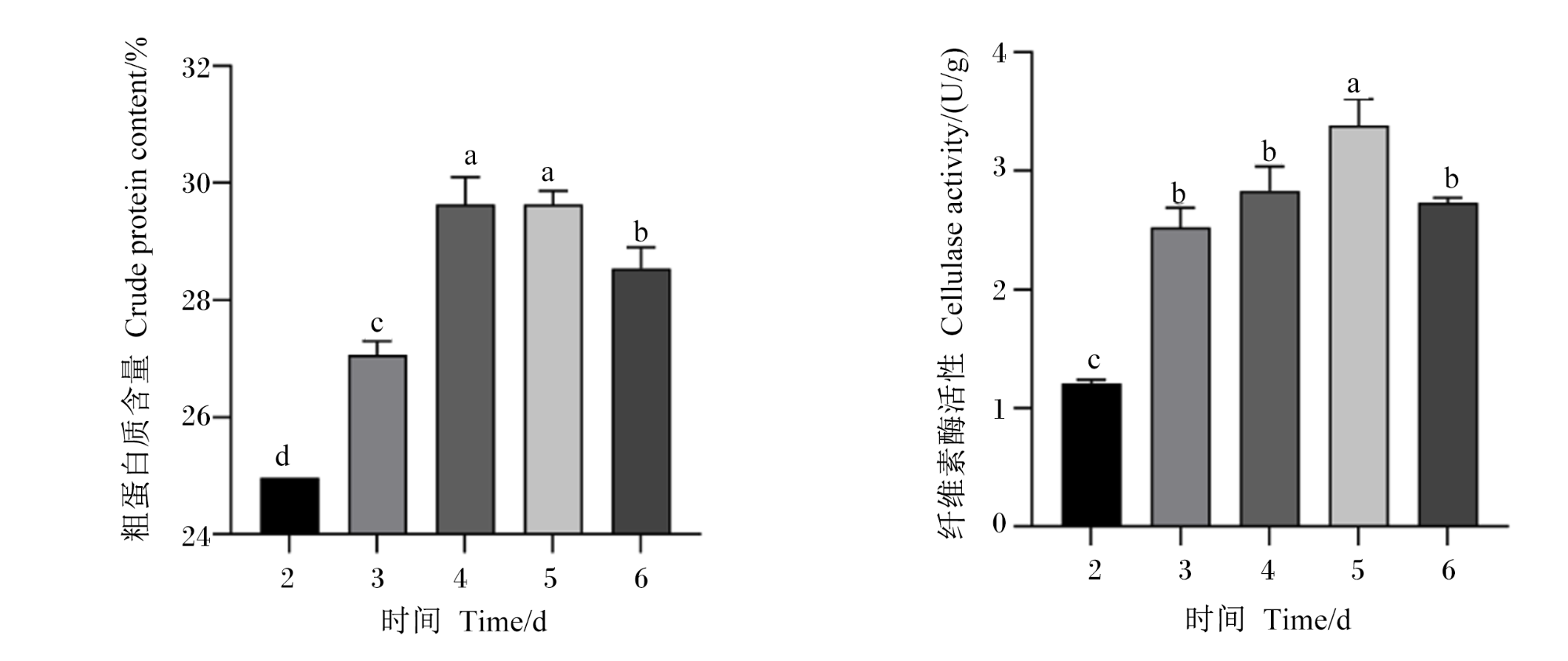
图1可知,当发酵条件为温度37 ℃、黑曲霉接菌量1×10⁶ CFU/g时,粗蛋白质含量和纤维素酶活性随时间变化均呈先升后降的趋势,粗蛋白质含量(29.63%)和纤维素酶活性(3.38 U/g)在发酵5 d时均达到峰值。
图1 不同发酵时间对桑叶粉粗蛋白质含量和纤维素酶活性的影响

数据柱标相同小写字母表示差异不显著(P>0.05),不同小写字母表示差异显著(P<0.05)。下图同。

Fig.1 Effects of different fermentation time on crude protein content and cellulase activity in mulberry leaf powder

Value columns with the same small letter mean no significant difference (P>0.05), while with different small letters mean significant difference (P<0.05). The same as below.

2.1.2 发酵温度

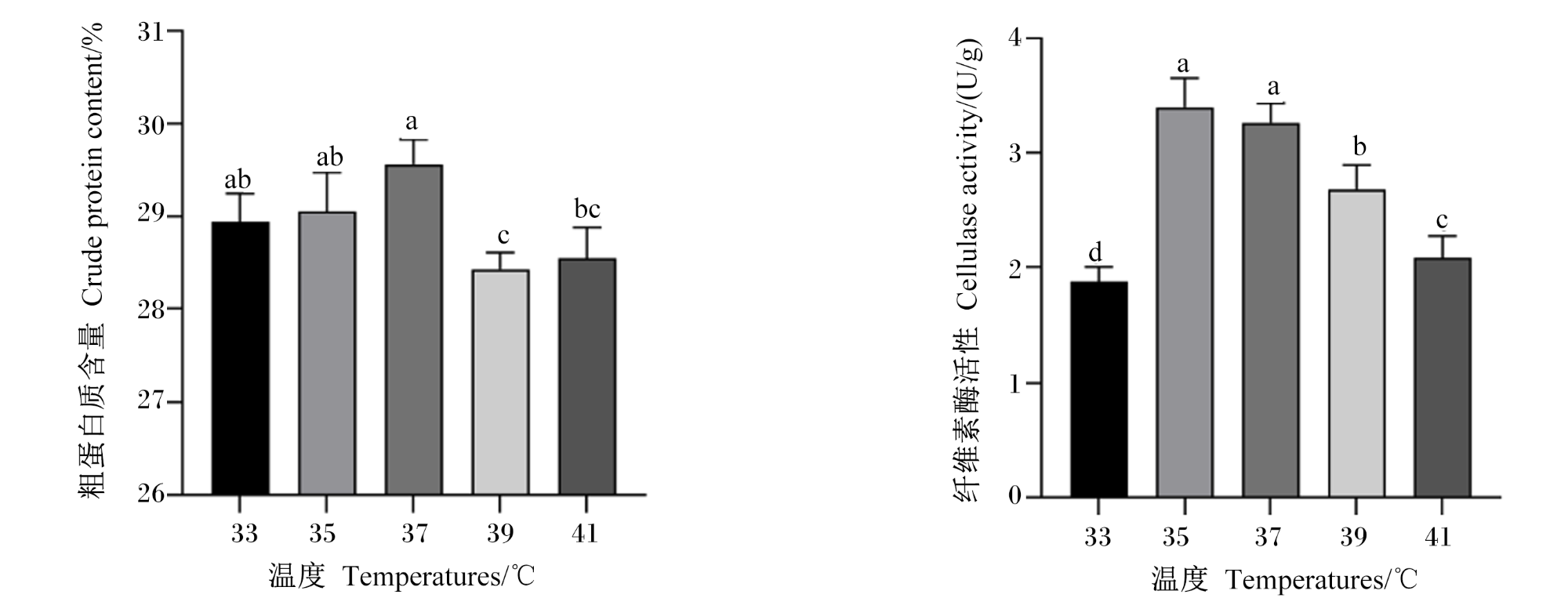
图2可知,当发酵条件为时间4 d、黑曲霉接菌量1×10⁶ CFU/g时,粗蛋白质含量和纤维素酶活性随温度变化均呈先升后降的趋势,粗蛋白质含量(29.56%)和纤维素酶活性(3.40 U/g)分别在发酵温度37和35 ℃时达到峰值。
图2 不同发酵温度对桑叶粉粗蛋白质含量和纤维素酶活性的影响

Fig.2 Effects of different fermentation temperatures on crude protein content and cellulase activity in mulberry leaf powder

2.1.3 接菌量

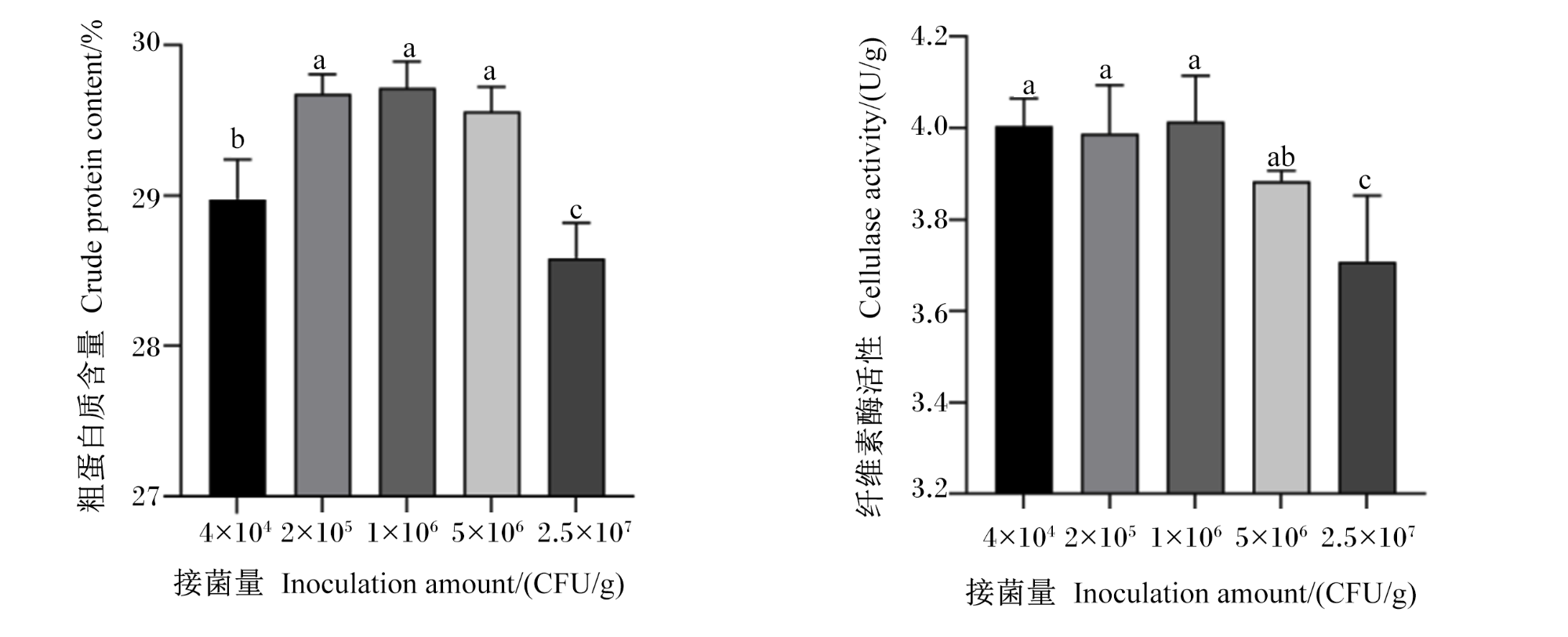
图3可知,当发酵条件为温度37 ℃,时间4 d时,粗蛋白质含量和纤维素酶活性随接菌量变化均呈先升后降的趋势,粗蛋白质含量(29.71%)和纤维素酶活性(4.01 U/g)在接菌量为1×106 CFU/g时达到峰值。
图3 不同接菌量对桑叶粉粗蛋白质含量和纤维素酶活性的影响

Fig.3 Effects of different inoculum amounts on crude protein content and cellulase activity in mulberry leaf powder

2.2 黑曲霉固态发酵桑叶粉正交试验

2.2.1 正交试验极差分析

黑曲霉发酵桑叶粉过程中的影响因素发酵时间、发酵温度、接种量分别用A、B、C表示。由表1中的极差可知,各因素对发酵产物粗蛋白质含量、纤维素酶活性、综合评分影响程度分别为:A>B>C、B>A>C、B>A>C。由K值可知,各因素对粗蛋白质含量、纤维素酶活性、综合评分的最优组合均为A2B2C1(5 d,37 ℃,2×105 CFU/g)。表1中粗蛋白质含量、纤维素酶活性、综合评分最高组合为A2B2C3(5 d,37 ℃,5×106 CFU/g)。
表1 黑曲霉固态发酵桑叶粉正交试验极差分析

Table 1 Orthogonal test range analysis of solid-state fermentation for mulberry leaf powder by Aspergillus niger

项目
Items
发酵时间
Fermentation
time
(A)
发酵温度
Fermentation
temperature
(B)
接种量
Inoculation
amount
(C)
粗蛋白质含量
CP content/%
纤维素
酶活性
Cellulase
Activity/(U/g)
综合评分
Overall
score
组别Groups 1 1 1 1 29.71 3.912 1.31
2 1 2 2 29.79 4.069 1.49
3 1 3 3 28.19 3.475 0.28
4 2 1 2 30.37 3.843 1.51
5 2 2 3 30.68 4.223 1.99
6 2 3 1 30.18 3.637 1.24
7 3 1 3 28.92 3.183 0.30
8 3 2 1 30.37 4.019 1.68
9 3 3 2 29.75 3.561 1.00
粗蛋白质
CP
K1 29.23 29.67 30.09
K2 30.41 30.28 29.97
K3 29.68 29.37 29.26
极差R 1.18 0.91 0.82
纤维素酶活性
Cellulase
activity
K1 3.82 3.65 3.86
K2 3.90 4.10 3.82
K3 3.59 3.56 3.63
极差R 0.31 0.55 0.23
综合评分
Overall score
K1 1.03 1.04 1.41
K2 1.58 1.72 1.33
K3 0.99 0.84 0.86
极差R 0.59 0.89 0.55

2.2.2 验证试验

表1中的K值和极差可知,黑曲霉发酵桑叶粉的最优条件为时间5 d,温度37 ℃,接菌量2×10⁵ CFU/g,即组合A2B2C1,该组合非预设的正交试验组。经验证,用该组合对桑叶粉进行发酵,粗蛋白质含量达30.82%,纤维素酶活性达4.31 U/g,均优于正交表中任一组合的相应最高值。上述结果表明,组合A2B2C1(5 d,37 ℃,2×105 CFU/g)为黑曲霉有氧发酵阶段的最佳工艺组合。

2.3 混菌固态发酵桑叶粉单因素试验

2.3.1 发酵时间

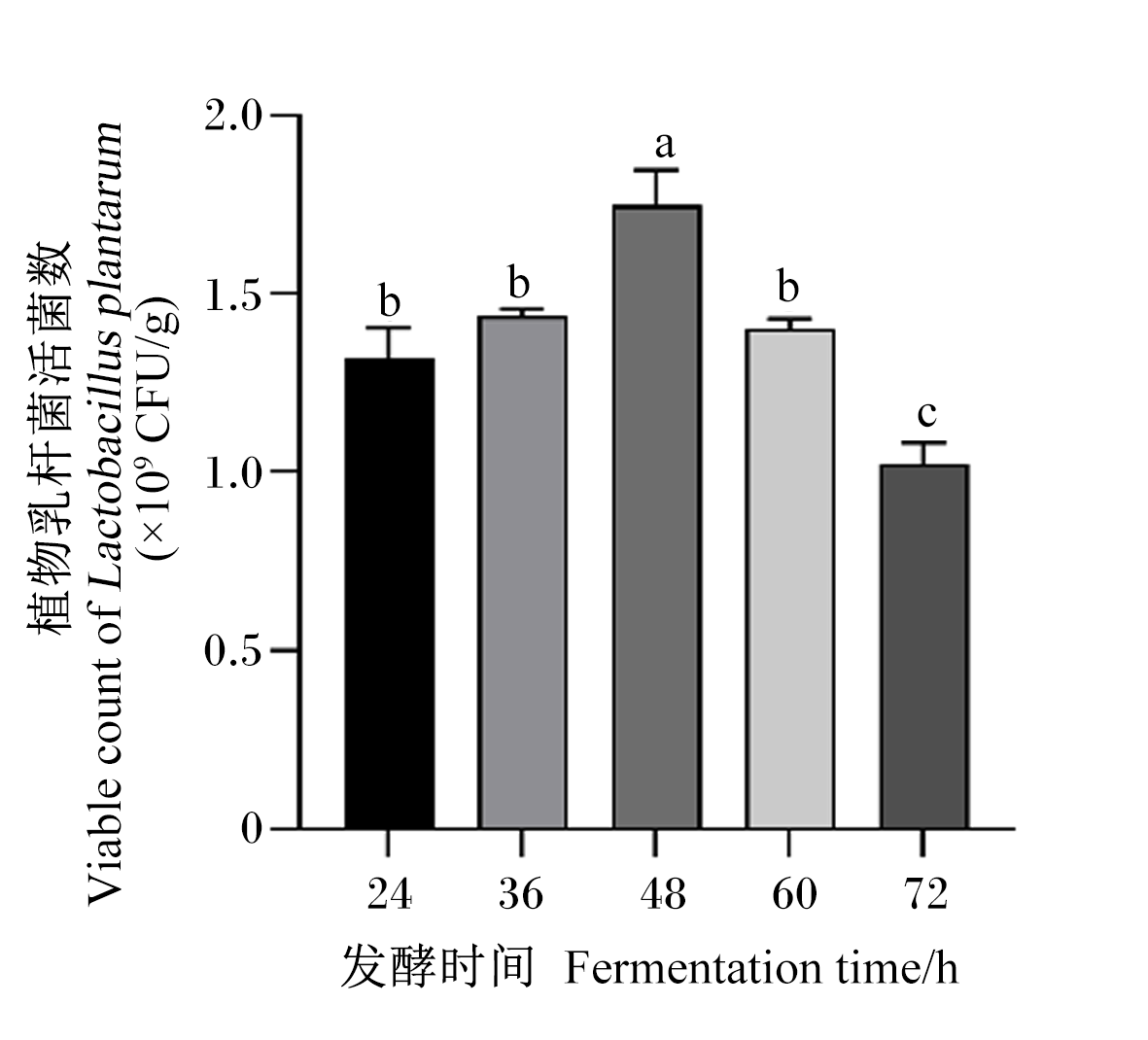
图4可知,当发酵条件为温度37 ℃、总接菌量1×10⁶ CFU/g时,植物乳杆菌活菌数随时间变化呈先升后降的趋势,在发酵时间48 h时达到峰值(1.75×10⁹ CFU/g)。
图4 不同发酵时间对混菌发酵植物乳杆菌活菌数的影响

Fig.4 Effects of different fermentation time on viable count of Lactobacillus plantarum in mixed-culture fermentation

2.3.2 发酵温度

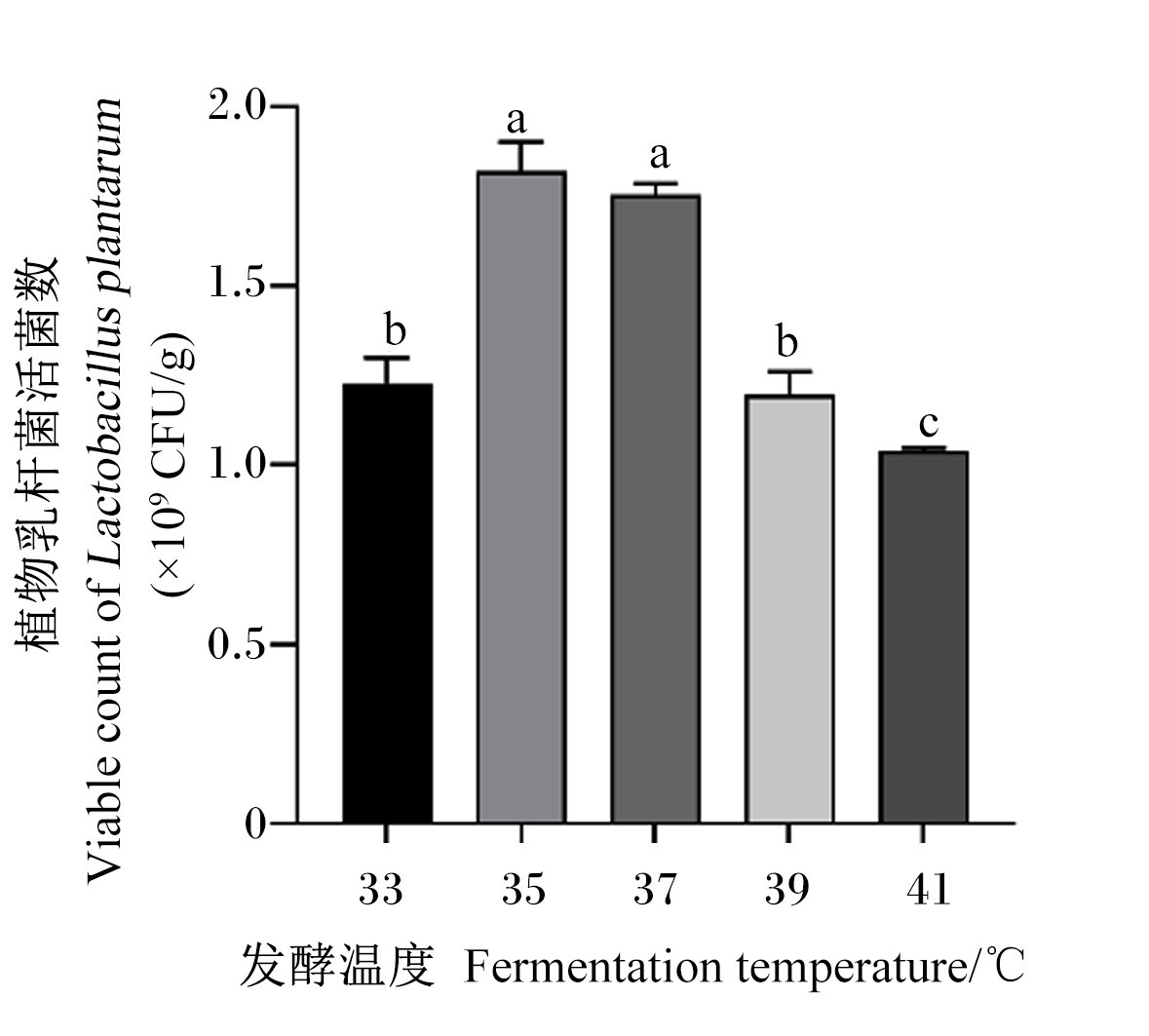
图5可知,当发酵条件为时间48 h、总接菌量1×10⁶ CFU/g时,植物乳杆菌活菌数随温度变化呈先升后降的趋势,在发酵温度35 ℃时达到峰值(1.82×10⁹ CFU/g)。
图5 不同发酵温度对混菌发酵植物乳杆菌活菌数的影响

Fig.5 Effects of different fermentation temperatures on viable count of Lactobacillus plantarum in mixed-culture fermentation

2.3.3 总接菌量

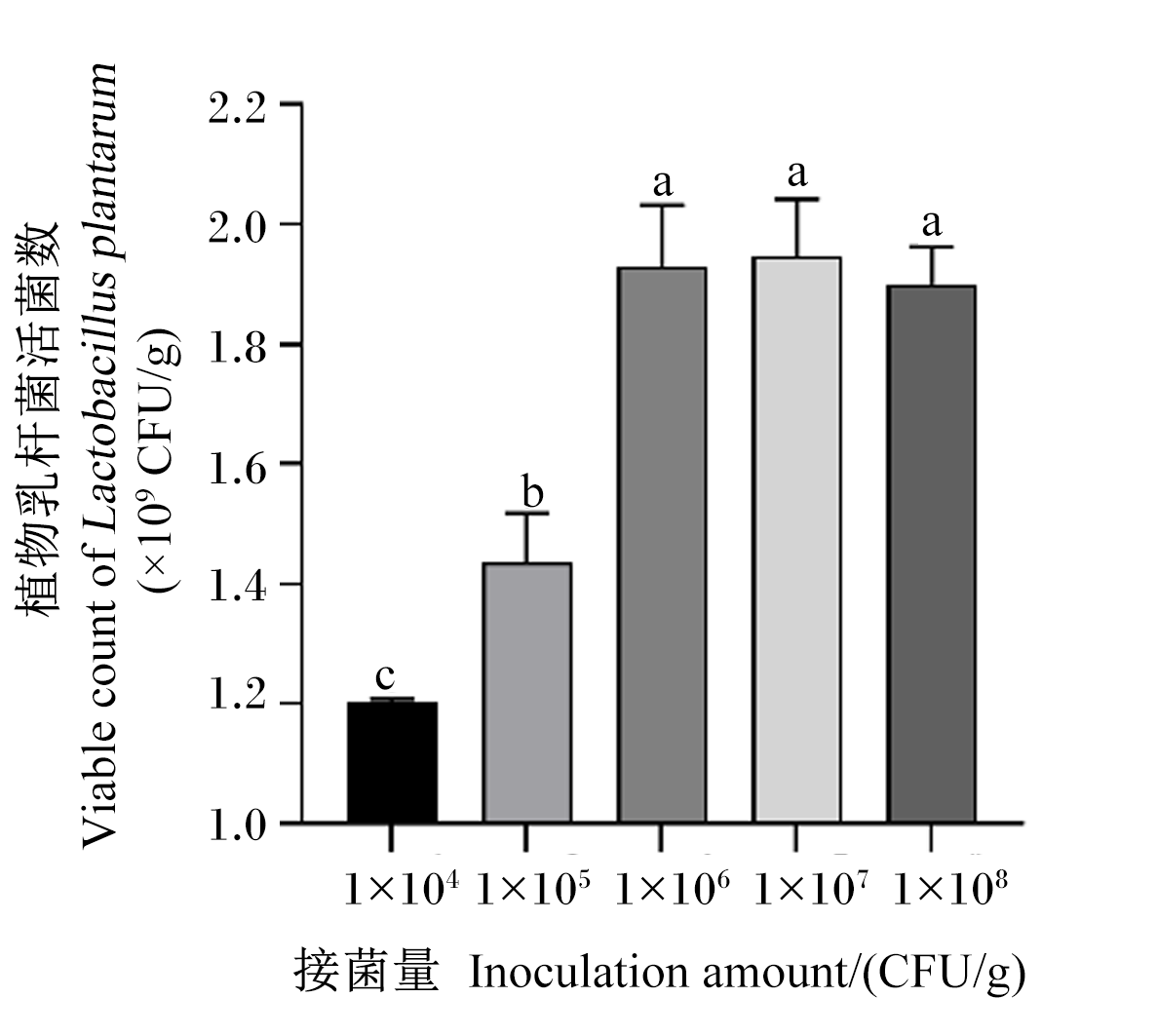
图6可知,当发酵条件为时间48 h、温度37 ℃时,植物乳杆菌活菌数随总接菌量变化呈先升后趋于平缓的趋势,在总接菌量1×10⁷ CFU/g达到峰值(1.95×109 CFU/g)。
图6 不同接菌量对混菌发酵植物乳杆菌活菌数的影响

Fig.6 Effects of different inoculum amounts on viable count of Lactobacillus plantarum in mixed-culture fermentation

2.4 混菌固态发酵桑叶粉正交试验

2.4.1 正交试验极差分析

混菌发酵桑叶粉过程中的影响因素发酵时间、发酵温度、接种量分别用A、B、C表示。由表2中的极差可知,各因素对植物乳杆菌活菌数影响程度为:C>A>B。由K值可知,各因素对植物乳杆菌活菌数的最优组合为A1B1C3(36 h,33 ℃,1×107 CFU/g)。
表2 混菌固态发酵桑叶粉正交试验极差分析

Table 2 Orthogonal test range analysis of solid-state fermentation for mulberry leaf powder by mixed bacteria

项目
Items
发酵时间
Fermentation
time (A)
发酵温度
Fermentation
temperature (B)
接种量
Inoculation
amount (C)
植物乳杆菌活菌数
Viable count of
Lactobacillus plantarum
(×109 CFU/g)
组别Groups
1 1 1 1 2.36
2 1 2 2 2.09
3 1 3 3 2.30
4 2 1 2 2.17
5 2 2 3 2.78
6 2 3 1 1.63
7 3 1 3 2.17
8 3 2 1 1.41
9 3 3 2 1.58
K1 2.25 2.23 1.80
K2 2.19 2.09 1.94
K3 1.72 1.84 2.42
极差R 0.53 0.40 0.61

2.4.2 验证试验

表2中的K值和极差综合可知,混菌发酵桑叶粉的最优条件为时间36 h、温度33 ℃、总接菌量1×10⁷ CFU/g,即组合A1B1C3,该组合非预设的正交试验组。经验证,用该组合对桑叶粉进行发酵,植物乳杆菌活菌数可达2.53×109 CFU/g。根据表2数据分析可知,组合A2B2C3的植物乳杆菌活菌数可高达2.78×109 CFU/g。上述结果表明,A2B2C3(48 h,35 ℃,1×107 CFU/g)为混菌厌氧发酵阶段的最佳工艺组合。

2.5 桑叶粉发酵前后营养成分含量变化

表3可知,与发酵前相比,发酵后粗蛋白质、粗灰分、钙和总磷含量极显著增加(P<0.05),粗蛋白质含量增加了51.97%,粗灰分含量增加了39.98%,钙含量增加了21.43%,总磷含量增加了54.69%;粗纤维、粗脂肪含量极显著降低(P<0.05),粗纤维含量降低了56.12%,粗脂肪含量降低了14.95%。
表3 主要营养成分含量变化(干物质基础)

Table 3 Changes in contents of main nutrients (DM basis) %

项目
Items
粗蛋白质
CP
粗纤维
CF
粗脂肪
EE
粗灰分
Ash

Ca
总磷
TP
发酵前
Before fermentation
20.78±1.41B 10.21±0.04A 5.15±0.05A 11.48±0.09B 2.80±0.10B 0.64±0.01B
发酵后
After fermentation
31.58±0.13A 4.48±0.30B 4.38±0.21B 16.07±0.13A 3.40±0.20A 0.99±0.03A
提升比例
Increase rate/%
51.97% -56.12% -14.95% 39.98% 21.43% 54.69%

同列数据肩标不同小写字母表示差异显著(P<0.05),不同大写字母表示差异极显著(P<0.01),无字母表示差异不显著(P>0.05)。表4同。

In the same column, values with different small letter superscripts mean significant difference (P<0.05), and with different capital letter superscripts mean significant difference (P<0.01), while with no letter superscripts mean no significant difference (P>0.05). The same as Table 4.

2.6 桑叶粉发酵前后抗营养因子及生物活性物质含量变化

表4可知,与发酵前相比,发酵后植酸和单宁含量显著或极显著降低(P<0.05或P<0.01),植酸降低了12.95%,单宁降低了19.84%;总酚含量显著增加了20.86%(P<0.05);总黄酮含量降低了5.52%,但差异不显著(P>0.05)。
表4 抗营养因子及生物活性物质变化

Table 4 Changes in contents of antinutritional factors and bioactive substances mg/g

项目
Items
植酸
Phytic acid
单宁
Tannin
总酚
Total phenolic content
总黄酮
Total flavonoid content
发酵前
Before fermentation
2.78±0.11a 7.56±0.03A 5.56±0.08B 5.07±0.04
发酵后
After fermentation
2.42±0.09b 6.06±0.09B 6.72±0.17A 4.79±0.27
提升比例
Increase rate/%
-12.95 -19.84 20.86 -5.52

2.7 桑叶粉发酵前后消化酶活性变化

表5可知,桑叶粉经固态发酵后产生了消化酶,发酵后蛋白酶活性为12.71U/g,纤维素酶活性为3.67 U/g,脂肪酶活性为1.14 U/g,淀粉酶活性为27.08 U/g。
表5 消化酶活性变化

Table 5 Changes in activities of digestive enzyme U/g

项目
Items
蛋白酶
Protease
纤维素酶
Cellulase
脂肪酶
Lipase
淀粉酶
Amylase
发酵前Before fermentation - - - -
发酵后After fermentation 12.71±1.93 3.67±0.13 1.14±0.04 27.08±0.14

“-”表示未检出。下表同。

“-” indicated not detected. The same as below.

2.8 发酵桑叶粉的感官品质与微生物卫生指标

发酵桑叶粉的香气明显,烘干色泽为淡褐色,感官综合得分16分,可达优良级别。由表6可知,发酵桑叶粉中乳酸杆菌富集量可达2.73×10⁹ CFU/g,且未检测到致病菌,表明饲料符合卫生安全标准。
表6 发酵桑叶粉的微生物卫生指标

Table 6 Microbial health indicators of fermented mulberry leaf powder

项目
Item
大肠杆菌
Escherichia coli
沙门氏菌
Salmonella
志贺氏菌
Shigella
乳酸杆菌
Lactobacillus/(CFU/g)
检出值Detection value - - - 2.73×10⁹

3 讨论

3.1 固态发酵菌种的选择

固态发酵过程中发酵菌种的选择是影响发酵效果与产物质量的关键因素[18]。黑曲霉、植物乳杆菌和酿酒酵母是美国食品和药品管理局(FDA)认证的安全菌株[19-21],已被列入我国《饲料添加剂品种目录》。黑曲霉具有丰富的胞外水解酶系统,可充分改善发酵底物营养结构并降解抗营养因子[22];酿酒酵母可产生大量菌体蛋白和酯类等芳香物质,是提高饲料消化利用率与适口性的重要菌株[23-24];植物乳杆菌可快速酸化饲料,延长饲料保存时间,其还可通过改善畜禽肠道菌群结构、强化肠道屏障及降低炎症水平促进机体健康[25]。本研究发现,通过黑曲霉、植物乳杆菌和酿酒酵母多菌种协同发酵桑叶粉,可显著提升桑叶粉的营养品质和饲用价值。

3.2 桑叶粉固态发酵工艺参数的优化

固态发酵过程中接种量过低会导致微生物生长缓慢或延滞期延长,降低发酵效率;接种量过高会导致营养物质消耗过快而抑制代谢产物合成[26-27]。本研究发现,黑曲霉固态发酵桑叶粉的最适接种量为2×10⁵ CFU/g,植物乳杆菌和酿酒酵母的最适混菌接种量为1×107 CFU/g。孙静等[28]通过优化坚强芽孢杆菌发酵豆粕的工艺条件,确定其最适接种量为3.84×106 CFU/g。在该条件下,豆粕的粗蛋白质和必需氨基酸含量均有所增加。由此可知,最优接种量对调控固态发酵过程与产物合成具有积极影响。此外,黑曲霉发酵过程中发酵时间不足会导致菌体生长及代谢不充分;发酵时间过长会增加杂菌污染风险,并导致基质营养物质过度消耗[29]。而植物乳杆菌和酿酒酵母混菌发酵时,发酵时长不足会限制其对底物的转化效率;发酵时间过长会导致菌体提前进入衰亡期,活菌数下降。本研究发现,黑曲霉的最佳发酵时间为5 d,植物乳杆菌和酿酒酵母的最佳发酵时间为48 h。因此,根据不同微生物的生理特性精确控制发酵时间,对优化固态发酵过程具有重要意义。
发酵温度和料液比通过调节微生物生长和代谢相关酶系的活性影响发酵效果[30-31]。黑曲霉的最适生长温度为35~37 ℃[32]。本研究发现,黑曲霉有氧发酵桑叶粉的最适温度为37 ℃,在此条件下,黑曲霉生长和代谢活动旺盛,能够合成并分泌多种胞外酶,从而降解桑叶粉中的抗营养因子,改善发酵产物的品质。桑叶是高蛋白质非常规饲料原料,黑曲霉产生的蛋白酶能水解蛋白质,提高蛋白质利用率。这与Shi等[33]的研究结果一致,其在34 ℃条件下利用黑曲霉固态发酵菜籽粕,粗蛋白质和氨基酸含量显著提高,同时抗营养因子含量降低,进一步验证了黑曲霉在适宜发酵温度下提升蛋白质饲料品质的有效性。在此基础上,植物乳杆菌和酿酒酵母混菌厌氧发酵最适温度为35 ℃。该温度下,植物乳杆菌通过发酵碳水化合物产生大量乳酸,抑制杂菌及腐败菌的生长;而酵母细胞凭借其耐酸特性,能够在酸性环境中保持代谢活性,从而改善发酵风味并提高蛋白质含量[34],这体现了多菌种发酵过程中温度对微生物互作与代谢调控的关键作用。此外,桑叶粉中富含膳食纤维和亲水物质,其在低水分条件下难以充分溶胀,有机质溶解度较低,限制了菌体对基质的渗透与利用[35]。本研究前期已对固态发酵体系最适料液比进行探究,发现1∶1.9的料液比可显著提高桑叶粉发酵产物中粗蛋白质含量和纤维素酶活性。因此,本研究后续试验选用1∶1.9的料液比为固定参数对桑叶粉进行固态发酵。该方法与赫丁轩等[36]采用1∶0.7料液比固态发酵猫爪草的低水分工艺有所区别,反映出不同物料对最优水分需求的差异,也进一步体现了基于基质特性优化发酵参数的重要性。

3.3 发酵前后桑叶粉营养物质含量变化

营养物质组成的改变是评价发酵效果的重要指标[37]。本研究发现,最优工艺发酵后,桑叶粉中粗蛋白质、粗灰分、钙和总磷含量分别提高了51.97%、39.98%、21.43%和54.69%,粗纤维含量降低了56.12%,变化趋势与Shi等[38]研究结果一致。蛋白质是动物生长、组织修复等生命活动所必需的营养物质,其含量提高对畜禽生产性能具有积极影响[39];桑叶粉中具有较高粗纤维含量,过量摄入粗纤维易降低畜禽能量与蛋白质吸收效率[40],发酵后其粗纤维含量大幅下降,表明营养结构得到显著改善。在发酵过程中,黑曲霉会产生大量的纤维素酶,将纤维素分解为还原糖[41]。而植物乳杆菌和酿酒酵母利用黑曲霉生成的葡萄糖等糖类作为碳源,通过厌氧发酵合成菌体蛋白[42-43]。其还可利用游离的氮源促进菌体蛋白合成,提高饲料粗蛋白质含量[32,44]。发酵后体系中粗蛋白质、粗灰分、钙和总磷含量升高的原因可能是发酵过程中黑曲霉优先分解利用粗纤维等碳源物质,导致发酵底物总量减少,使上述营养成分相对占比提高。营养成分相对富集的现象与菌体代谢合成效应共同作用,在混菌体系中表现得更为显著。周浩宇等[44]采用枯草芽孢杆菌、黑曲霉和产朊假丝酵母对油茶籽粕进行固态发酵,发现混菌发酵对抗营养因子的降解效果优于单菌发酵,同时可降低粗纤维含量,提高粗蛋白质含量。综上所述,混菌发酵在提升饲料营养价值方面具有显著效果。

3.4 发酵前后桑叶粉抗营养因子含量、生物活性物质和消化酶活性变化

桑叶中的植酸可与钙和磷等矿物元素形成不溶性螯合物,抑制淀粉酶、胃蛋白酶和胰蛋白酶等消化酶活性,降低畜禽对营养物质消化吸收能力;单宁具有苦涩味,易降低饲料适口性,还可与蛋白质、多糖等大分子形成不溶性复合物,显著影响饲料利用效率[45-46]。本研究中,桑叶粉固态发酵后植酸和单宁含量显著下降,总酚含量显著提高。鄂晓迪等[47]利用黑曲霉、酿酒酵母和乳酸菌混菌发酵辣木茎叶粉,发现植酸和单宁抗营养因子显著降低,本研究结果与其一致。发酵后桑叶粉植酸和单宁含量的下降可能与黑曲霉和植物乳杆菌有关。现有研究发现,上述菌株可分泌植酸酶,将植酸逐步水解为肌醇和磷酸,并释放被其螯合的钙、铁、锌等矿物质[48-49]。黑曲霉还可分泌单宁酶,其能够水解单宁酯键形成果酸苷,并在β-葡萄糖苷酶的作用下,断裂果酸苷糖苷键形成没食子酸,最终形成鞣花酸单体[50]
多酚类物质具有较强抗氧化活性,可有效清除畜禽体内氧化自由基,减轻氧化损伤,其含量增加对桑叶益生功能的提高具有重要意义[51]。本研究中,桑叶粉固态发酵后总酚含量增加了20.86%,与Feitosa等[52]研究结果一致。该现象可能与黑曲霉分泌的纤维素酶、果胶酶、蛋白酶等胞外酶有关。上述酶能够破坏并分解桑叶细胞壁结构,释放嵌合在其中的酚类物质[53]。此外,黑曲霉还可分泌蛋白酶和淀粉酶等多种消化酶[54]。在本研究最优工艺条件下,产物中纤维素酶、蛋白酶、脂肪酶和淀粉酶活性分别达3.67、12.71、1.14和27.08 U/g,同时乳酸杆菌得到富集,总数达2.73×109 CFU/g。上述消化酶有助于提高畜禽对饲料的消化利用率,而富集的乳酸杆菌则可在肠道中竞争性抑制病原菌的定植,并通过产生乙酸促进宿主肠道上皮细胞的生长[55-56]

4 结论

桑叶粉经黑曲霉有氧发酵的最优条件为:发酵时间5 d,发酵温度37 ℃,接种量2×10⁵ CFU/g。在此基础上进行的植物乳杆菌和酿酒酵母混菌厌氧发酵的最优条件为:发酵时间48 h,发酵温度35 ℃,总接种量1×10⁷ CFU/g。该固态发酵工艺可显著提高桑叶粉中粗蛋白质和总酚含量,并有效降解粗纤维、植酸和单宁等抗营养因子含量。发酵后的桑叶粉有明显的香味,颜色呈淡褐色,感官品质得到明显改善;同时,未检出致病菌,且乳酸杆菌数量显著富集。
[1]
国家统计局. 中国统计年鉴2024[M]. 北京: 中国统计出版社, 2024.

National Bureau of Statistics of China. China statistical yearbook 2024[M]. Beijing: China Statistics Press, 2024. (in Chinese)

[2]
印遇龙, 杨哲. 非常规饲料的开发与高效利用[J]. 饲料工业, 2025, 46(1):2-10.

YIN Y L, YANG Z. Development and efficient utilization of unconventional feed[J]. Feed Industry, 2025, 46(1):2-10. (in Chinese)

[3]
李平平, 储一宁, 杜伟, 等. 云南蚕区33份桑树种质资源的桑叶和桑枝总黄酮含量测定[J]. 蚕业科学, 2014, 40(1):85-90.

LI P P, CHU Y N, DU W, et al. Determination of total flavonoids contents in leaves and branches of 33 mulberry germplasm resources in Yunnan sericultural area[J]. Acta Sericologica Sinica, 2014, 40(1):85-90. (in Chinese)

[4]
云南省农业农村厅. 2021年度云南省蚕桑产业发展报告[R]. 昆明: 云南省农业农村厅, 2022:44-54.

Department of Agriculture and Rural Affairs of Yunnan Province. Annual development report on sericulture industry of Yunnan Province in 2021[R]. Kunming: Department of Agriculture and Rural Affairs of Yunnan Province, 2022:44-54. (in Chinese)

[5]
HAO J Y, WAN Y, YAO X H, et al. Effect of different planting areas on the chemical compositions and hypoglycemic and antioxidant activities of mulberry leaf extracts in southern China[J]. PLoS One, 2018, 13(6):e0198072.

DOI

[6]
FATIMA M, DAR M A, DHANAVADE M J, et al. Biosynthesis and pharmacological activities of the bioactive compounds of white mulberry (Morus alba):current paradigms and future challenges[J]. Biology, 2024, 13(7):506.

DOI

[7]
CAPUANO E. The behavior of dietary fiber in the gastrointestinal tract determines its physiological effect[J]. Critical Reviews in Food Science and Nutrition, 2017, 57(16):3543-3564.

DOI PMID

[8]
PATHAW N, DEVI K S, SAPAM R, et al. A comparative review on the anti-nutritional factors of herbal tea concoctions and their reduction strategies[J]. Frontiers in Nutrition, 2022, 9:988964.

DOI

[9]
KUMAR V, AHLUWALIA V, SARAN S, et al. Recent developments on solid-state fermentation for production of microbial secondary metabolites:challenges and solutions[J]. Bioresource Technology, 2021, 323:124566.

DOI

[10]
TEREFE Z K, OMWAMBA M N, NDUKO J M. Effect of solid state fermentation on proximate composition,antinutritional factors and in vitro protein digestibility of maize flour[J]. Food Science & Nutrition, 2021, 9(11):6343-6352.

DOI

[11]
钟国防, 田鑫鑫, 谢春元, 等. 芽孢杆菌有氧发酵豆粕替代鱼粉对大口黑鲈幼鱼生长性能、血清生化指标及肠组织结构的影响[J]. 渔业科学进展, 2021, 42(5):139-148.

ZHONG G F, TIAN X X, XIE C Y, et al. Effects of replacing fish meal with Bacillus aerobically fermented soybean meal on the growth performance,serum biochemical indices and intestinal histology of largemouth bass (Micropterus salmoides)[J]. Progress in Fishery Sciences, 2021, 42(5):139-148. (in Chinese)

[12]
CHENG Q M, LI M Y, FAN X Y, et al. Effects of epiphytic and exogenous lactic acid bacteria on fermentation quality and microbial community compositions of paper mulberry silage[J]. Frontiers in Microbiology, 2022, 13:973500.

DOI

[13]
高彦航. 桑叶粉固态发酵工艺优化及抗营养因子降解效果研究[D]. 硕士学位论文. 昆明: 云南农业大学, 2024.

GAO Y H. Solid fermentation process optimization on mulberry leaf powder and the effect of degradation anti-nutrition factors[D]. Master’s Thesis. Kunming: Yunnan Agricultural University, 2024. (in Chinese)

[14]
MARGESIN R, FELLER G, HÄMMERLE M, et al. A colorimetric method for the determination of lipase activity in soil[J]. Biotechnology Letters, 2002, 24(1):27-33.

DOI

[15]
ZHANG L, TU Z C, YUAN T, et al. Antioxidants and α-glucosidase inhibitors from Ipomoea batatas leaves identified by bioassay-guided approach and structure-activity relationships[J]. Food Chemistry, 2016, 208:61-67.

DOI

[16]
JIA Z S, TANG M C, WU J M. The determination of flavonoid contents in mulberry and their scavenging effects on superoxide radicals[J]. Food Chemistry, 1999, 64(4):555-559.

DOI

[17]
郭旭生, 丁武蓉, 玉柱. 青贮饲料发酵品质评定体系及其新进展[J]. 中国草地学报, 2008, 30(4):100-106.

GUO X S, DING W R, YU Z. The evaluation system of fermentation quality of ensiled forage and its improvement[J]. Chinese Journal of Grassland, 2008, 30(4):100-106. (in Chinese)

[18]
FENG X Y, NG K, AJLOUNI S, et al. Effect of solid-state fermentation on plant-sourced proteins:a review[J]. Food Reviews International, 2024, 40(9):2580-2617.

DOI

[19]
ISMAEL M, GU Y X, CUI Y L, et al. Probiotic of Lactiplantibacillus plantarum NWAFU-BIO-BS29 isolated from Chinese traditional fermented milk and its potential therapeutic applications based on gut microbiota regulation[J]. Foods, 2022, 11(23):3766.

DOI

[20]
MANEIRA C, CHAMAS A, LACKNER G. Engineering Saccharomyces cerevisiae for medical applications[J]. Microbial Cell Factories, 2025, 24(1):12.

DOI

[21]
SCHUSTER E, DUNN-COLEMAN N, FRISVAD J C, et al. On the safety of Aspergillus niger-a review[J]. Applied Microbiology and Biotechnology, 2002, 59(4/5):426-435.

DOI

[22]
PEL H J, DE WINDE J H, ARCHER D B, et al. Genome sequencing and analysis of the versatile cell factory Aspergillus niger CBS 513.88[J]. Nature Biotechnology, 2007, 25(2):221-231.

DOI

[23]
DILEEP N, PRADHAN C, PETER N, et al. Nutritive value of guar and copra meal after fermentation with yeast Saccharomyces cerevisiae in the diet of Nile tilapia,Oreochromis niloticus[J]. Tropical Animal Health and Production, 2021, 53(4):416.

DOI

[24]
SUOMALAINEN H, LEHTONEN M. The production of aroma compounds by yeast[J]. Journal of the Institute of Brewing, 1979, 85(3):149-156.

DOI

[25]
YANG N, MA T, XIE Y, et al. Lactiplantibacillus plantarum P 9 for chronic diarrhea in young adults:a large double-blind,randomized,placebo-controlled trial[J]. Nature Communications, 2024, 15(1):6823.

DOI

[26]
RUSLAN N F, AHMAD N, ABAS A, et al. Sustainable bioethanol production by solid-state fermentation:a systematic review[J]. Environmental Science and Pollution Research, 2025, 32(22):13140-13158.

DOI

[27]
GOU J Y, GUO Y X, LIU H, et al. Process optimization of vanillin production by conversion of ferulic acid by Bacillus megaterium[J]. Journal of the Science of Food and Agriculture, 2022, 102(13):6047-6061.

DOI

[28]
孙静, 宋晓玲, 黄健. 豆粕的坚强芽孢杆菌(Bacillus firmus)发酵工艺优化及其营养成分分析[J]. 渔业科学进展, 2017, 38(3):163-171.

SUN J, SONG X L, HUANG J. Optimization of fermentation conditions and analysis of the nutrition components of soybean meal fermented with Bacillus firmus[J]. Progress in Fishery Sciences, 2017, 38(3):163-171. (in Chinese)

[29]
LI J H, SHI L, XU S Y, et al. Optimal fermentation time for Nigrospora-fermented tea rich in bostrycin[J]. Journal of the Science of Food and Agriculture, 2021, 101(6):2483-2490.

DOI

[30]
丁梁斌, 路光明, 汤敏, 等. 黄精药渣固态发酵生产蛋白质饲料工艺条件优化[J]. 饲料工业, 2025, 46(5):125-133.

DING L B, LU G M, TANG M, et al. Technological conditiongs optimization of protein feed production from Polygonum residues by solid state fermentation[J]. Feed Industry, 2025, 46(5):125-133. (in Chinese)

[31]
LI C, MA L T, WANG L F, et al. Optimization of solid-state fermentation conditions of Quercus liaotungensis by Bacillus subtilis[J]. Fermentation, 2023, 9(1):75.

DOI

[32]
COSTA C P, GONÇALVES SILVA D, RUDNITSKAYA A, et al. Shedding light on Aspergillus niger volatile exometabolome[J]. Scientific Reports, 2016, 6(1):27441.

DOI

[33]
SHI C Y, HE J, YU J, et al. Physicochemical properties analysis and secretome of Aspergillus niger in fermented rapeseed meal[J]. PLoS One, 2016, 11(4):e0153230.

DOI

[34]
PORRO D, BRAMBILLA L, RANZI B M, et al. Development of metabolically engineered Saccharomyces cerevisiae cells for the production of lactic acid[J]. Biotechnology Progress, 1995, 11(3):294-298.

DOI

[35]
AFZAL F, KHALID W, ASIF M N, et al. Role of mulberry leaves in human nutrition:a review[J]. Acta Scientific Nutritional Health, 2021, 5(3):43-50.

[36]
赫丁轩, 吕雪艳, 熊柏惠, 等. 猫爪草固态发酵工艺优化及抗氧化活性研究[J]. 中国酿造, 2024, 43(8):262-268.

DOI

HE D X, LV X Y, XIONG B H, et al. Optimization of solid-state fermentation process for Ranunculus ternatus Thunb. and its antioxidant activity[J]. China Brewing, 2024, 43(8):262-268. (in Chinese)

[37]
MORALES E M, DOMINGOS R N, ANGELIS D F. Improvement of protein bioavailability by solid-state fermentation of babassu mesocarp flour and cassava leaves[J]. Waste and Biomass Valorization, 2018, 9(4):581-590.

DOI

[38]
SHI H H, YANG E D, LI Y, et al. Effect of solid-state fermentation on nutritional quality of leaf flour of the drumstick tree (Moringa oleifera Lam.)[J]. Frontiers in Bioengineering and Biotechnology, 2021, 9:626628.

DOI

[39]
WANG H L, ZHANG G P, YANG S C, et al. Deep fertilization enhances crude protein content in forage maize by modulating key enzymes of protein synthesis across plant organs in semi-arid regions of China[J]. Biology, 2025, 14(5):535.

DOI

[40]
DONG W X, ZHANG G, LI Z C, et al. Effects of different crude protein and dietary fiber levels on the comparative energy and nutrient utilization in sows and growing pigs[J]. Animals, 2020, 10(3):495.

DOI

[41]
ALI N, TING Z, LI H L, et al. Heterogeneous expression and functional characterization of cellulose-degrading enzymes from Aspergillus niger for enzymatic hydrolysis of alkali pretreated bamboo biomass[J]. Molecular Biotechnology, 2015, 57(9):859-867.

DOI

[42]
BADOTTI F, DÁRIO M G, ALVES S L Jr, et al. Switching the mode of sucrose utilization by Saccharomyces cerevisiae[J]. Microbial Cell Factories, 2008, 7(1):4.

DOI

[43]
REYES-BASTIDAS M, REYES-FERNÁNDEZ E Z, LÓPEZ-CERVANTES J, et al. Physicochemical,nutritional and antioxidant properties of tempeh flour from common bean (Phaseolus vulgaris L.)[J]. Food Science and Technology International, 2010, 16(5):427-434.

DOI

[44]
周浩宇, 黄凤洪, 钮琰星, 等. 发酵法与化学法改良油茶籽粕品质效果的比较[J]. 中国油脂, 2010, 35(9):40-43.

ZHOU H Y, HUANG F H, NIU Y X, et al. Comparison of bio-fermentation and chemical method in the improvement of the quality of oil-tea camellia seed meal[J]. China Oils and Fats, 2010, 35(9):40-43. (in Chinese)

[45]
SINGH M, KRIKORIAN A D. Inhibition of trypsin activity in vitro by phytate[J]. Journal of Agricultural and Food Chemistry, 1982, 30(4):799-800.

DOI

[46]
ZHAO W R, ZHENG M Z, LI X, et al. Fruit astringency:mechanisms,technologies,and future directions[J]. Horticulturae, 2025, 11(6):699.

DOI

[47]
鄂晓迪, 李家明, 张玉鹏, 等. 多菌联合发酵对辣木发酵品质和活性物质的影响[J]. 中国饲料, 2022(7):131-135.

E X D, LI J M, ZHANG Y P, et al. Effects of multi-bacteria co-fermentation on fermentation quality and active substances of Moringa oleifera[J]. China Feed, 2022(7):131-135. (in Chinese)

[48]
LEI X G, PORRES J M. Phytase enzymology,applications,and biotechnology[J]. Biotechnology Letters, 2003, 25(21):1787-1794.

DOI

[49]
SUMENGEN M, DINCER S, KAYA A. Production and characterization of phytase from Lactobacillus plantarum[J]. Food Biotechnology, 2013, 27(2):105-118.

DOI

[50]
SHI B, HE Q, YAO K, et al. Production of ellagic acid from degradation of valonea tannins by Aspergillus niger and Candida utilis[J]. Journal of Chemical Technology & Biotechnology, 2005, 80(10):1154-1159.

DOI

[51]
XIAO Y X, HUANG R, WANG N, et al. Ellagic acid alleviates oxidative stress by mediating Nrf2 signaling pathways and protects against paraquat-induced intestinal injury in piglets[J]. Antioxidants, 2022, 11(2):252.

DOI

[52]
FEITOSA P R B, SANTOS T R J, GUALBERTO N C, et al. Solid-state fermentation with Aspergillus niger for the bio-enrichment of bioactive compounds in Moringa oleifera (moringa) leaves[J]. Biocatalysis and Agricultural Biotechnology, 2020, 27:101709.

DOI

[53]
DULF F V, VODNAR D C, SOCACIU C. Effects of solid-state fermentation with two filamentous fungi on the total phenolic contents,flavonoids,antioxidant activities and lipid fractions of plum fruit (Prunus domestica L.) by-products[J]. Food Chemistry, 2016, 209:27-36.

DOI

[54]
OXENBØLL K. Aspergillus enzymes and industrial uses[M]// POWELL K A,RENWICK A,PEBERDY J F.The genus Aspergillus.Boston:Springer,1994:147-154.

[55]
ASHAOLU T J, GREFF B, VARGA L. Action and immunomodulatory mechanisms,formulations,and safety concerns of probiotics[J]. Bioscience of Microbiota,Food and Health, 2025, 44(1):4-15.

DOI

[56]
FONSECA H C, DE SOUSA MELO D, RAMOS C L, et al. Probiotic properties of Lactobacilli and their ability to inhibit the adhesion of enteropathogenic bacteria to Caco-2 and HT-29 cells[J]. Probiotics and Antimicrobial Proteins, 2021, 13(1):102-112.

DOI

Outlines

/