REVIEW

Regulatory Effects of Genetic and Nutritional Synergies on Meat Quality in Yellow Feathered Broilers

  • MA Manting ,
  • LIN Xiajing ,
  • WANG Yibing ,
  • JIANG Shouqun , *
Expand
  • Guangdong Key Laboratory of Animal Breeding and Nutrition, Key Laboratory of Animal Nutrition and Feed Science in South China, Ministry of Agriculture and Rural Affairs, State Key Laboratory of Swine and Poultry Breeding Industry, Institute of Animal Science, Guangdong Academy of Agricultural Sciences, Guangzhou 510640, China
* professor, E-mail:

Received date: 2025-11-17

  Online published: 2026-06-13

Abstract

Meat quality is a complex, multidimensional trait closely related to genetic background, nutritional regulation, and other factors. This article reviewed the main evaluation indicators of meat quality in yellow-feathered broilers and summarized the regulatory mechanisms of genetic factors on meat quality from the perspectives of intramuscular fat (IMF) content and muscle fiber type. On this basis, it analyzed the genetic interactions between nutrients and meat quality at the nutrigenomics level, identified the key links through which nutrients influence meat quality formation by regulating specific genetic elements, and aimed to integrate existing research findings to provide a reference for the practice of “precision nutritional regulation of meat quality” in yellow-feathered broilers.

Cite this article

MA Manting , LIN Xiajing , WANG Yibing , JIANG Shouqun . Regulatory Effects of Genetic and Nutritional Synergies on Meat Quality in Yellow Feathered Broilers[J]. Chinese Journal of Animal Nutrition, 2026 , 38(6) : 3962 -3974 . DOI: 10.12418/CJAN2026.315

黄羽肉鸡具有高蛋白质、低脂肪等特点,且以肉质细嫩、风味独特等特质深受消费者喜爱,其在华南市场占有率超过90%,并占全国肉鸡市场约1/4。鸡肉品质是一个广泛的概念,涵盖了物理指标、化学指标和感官指标等多种评定指标[1]。遗传因素与营养条件共同构成调控黄羽肉鸡肉质性状的核心要素。本文将重点剖析影响黄羽肉鸡肉品质的主要遗传因素,以及遗传与营养协作调控对肉质性状的影响。通过提供全面的参考资料和科学见解,为我国黄羽肉鸡肉品质定向改良提供参考依据。

1 黄羽肉鸡肉品质主要评价指标

肉品质评价主要包括物理评价和化学成分评价2类。反映肉品质的物理指标通常涵盖肉色、pH、嫩度、肌纤维类型等,这些表观物理指标不仅直观的反映肉品质,还与肉品质的化学指标存在紧密的内在关联。其中,肌内脂肪(intramuscular fat,IMF)含量是影响肉品物理特性的核心化学指标,较高的IMF含量可有效提升肉品的嫩度与多汁性。肌纤维是骨骼肌的基本组成单位,主要分为慢肌纤维和快肌纤维2种类型。不同类型的肌纤维具有差异化的能量代谢途径,直接影响肌苷酸、游离氨基酸等风味前体物质的合成与累积。此外,慢肌纤维含量较高的肌肉具有更高的嫩度。因此,针对黄羽肉鸡肉品质的物理性状和化学成分指标开展定向改良研究,能够加速黄羽肉鸡优质个体的筛选与繁育,促进优质黄羽肉鸡的产业化生产进程。

1.1 肌纤维类型

在家禽骨骼肌组织中,肌纤维类型可基于肌球蛋白重链亚型划分为慢速氧化型(Ⅰ型)、快速氧化型(Ⅱa型)、快速酵解型(Ⅱb型)与中间型(Ⅱx型)4种[2]。肌纤维类型组成是影响畜禽肉品质的关键内在因素,其与肉的嫩度、系水力和IMF含量等肉品质指标紧密相关[3]。在家禽肌肉组织中,慢肌纤维含量较高的肌肉,表现为更鲜艳的红色,并具有较低的剪切力和更高的IMF含量[3]。与之相反,快肌纤维依赖厌氧糖酵解,具有乳酸脱氢酶和磷果糖激酶等高活性酶,导致ATP快速生成,同时也促进乳酸积累和死后酸化[4]。这些酶类影响并调控肉色、pH和屠宰后嫩度[5]。此外,有研究显示,肉鸭肌纤维直径与嫩度之间存在负相关关系,肌纤维直径越小、密度越高,肌肉的剪切力越低[6]

1.2 IMF

脂肪作为肉类风味形成的核心影响因子,其含量与组分构成直接影响肌肉口感特性及风味特征。对于家禽而言,脂肪组织主要划分为腹部脂肪、皮下脂肪与IMF 3类,不同类型的脂肪功能差异显著[7]。IMF被定义为在肌肉内部和肌纤维之间沉积的脂肪,主要分布于肌纤维束之间和肌纤维束内的肌纤维间隙中。研究发现,IMF可以改善肉的风味、多汁性和嫩度,还可以作为风味化合物的助溶剂[8-9]。研究显示,当IMF含量适度增加时,羊肉的多汁特性会得到显著提升,风味层次也将进一步增强[10]。与其他类型的脂肪相比,IMF中磷脂类物质的占比更高,并且这类磷脂中含有较为丰富的软脂酸、硬脂酸、油酸及亚油酸等脂肪酸成分[5]。部分特定种类脂肪酸对鸡肉感官品质的调控效应已得到明确验证。例如,花生四烯酸含量较高的鸡肉具有更优的风味和嫩度[11-12]

1.3 主要的风味前体物质

鸡肉风味是滋味与香气的协同体现,依赖于生鸡肉中天然存在的“味觉活性前体物质”。此类拥有味道或触觉特征的水溶性物质,主要包含游离氨基酸、味觉活性肽、风味核苷酸、还原糖与硫胺素等成分。
游离氨基酸及其代谢衍生物不仅直接调控家禽肉在烹饪过程中的风味物质,还对肉的营养价值具有关键影响[13-14]。在新鲜鸡肉组织中,丙氨酸与谷氨酸为含量最丰富的游离氨基酸,二者合计占到总游离氨基酸的24%,其次为甘氨酸与丝氨酸[15]。依据游离氨基酸的风味特征,可将其划分为4个主要类别:鲜味类(如谷氨酸、天冬氨酸)、甜味类(如丙氨酸、甘氨酸)、苦味类(如亮氨酸、异亮氨酸),以及无味类(如半胱氨酸、酪氨酸)。核苷酸是肉类中具有代表性的鲜味单体成分,主要包括肌苷单磷酸、鸟苷单磷酸等。其中,肌苷单磷酸作为一类应用广泛的增味物质,能够有效改善肉类产品的适口性[16]。肉类中核苷酸对鲜味的贡献,很大程度上依赖于与其他鲜味化合物的相互作用。当5'-肌苷单磷酸与谷氨酸或天冬氨酸结合时,会产生协同增强效应,放大鲜味的感知[17]。味觉活性肽是调控肉类风味的重要因子,通过增强或改善肉类的特定风味发挥作用,如提升肉的鲜味或降低肉中的腥味、苦涩等不良风味,对肉品风味起到重要调控作用。研究发现,鸡肉中确定的12种风味肽中,有8种呈现鲜味特征[18]。寡肽[如精氨酰-缬氨酸(Arg-Val)、丝氨酸-天冬氨酸(Ser-Asn)]是一种关键的鲜味化合物,能与鲜味受体相结合,从而提高鲜味感知,是影响鲑鱼鲜味的关键来源[19]。肉类中的可溶性糖以葡萄糖、核糖、果糖等形式存在,其生成与畜禽屠宰后的肌肉代谢紧密相关。其中,核糖被认为是鸡肉中最重要的风味前体物质,可通过与含硫氨基酸反应,提升鸡肉的香气[20]。此外,鸡肉中硫胺素的分解产物2-甲基-3-呋喃硫醇,更是赋予鸡肉特征性气味的重要芳香化合物[21]

2 参与调控黄羽肉鸡肉品质和风味的关键遗传基础

在黄羽肉鸡产业化发展进程中,肉的嫩度、多汁性与风味特征已成为决定产品市场竞争力的关键因素,而遗传因子作为调控这些肉品质表型形成的关键因素,其作用具有不可替代性。遗传因子可通过调控IMF的合成及快、慢肌纤维类型的组成比例,直接影响肉品的嫩度与多汁性;此外,通过调控肌苷酸、游离氨基酸等风味前体物质的合成通路与积累量,进一步塑造肉品的独特风味轮廓。因此,深入挖掘并解析调控肉品质指标的关键基因,有助于定向改良黄羽肉鸡的肉质性状。

2.1 黄羽肉鸡中IMF沉积的主要遗传调控机制

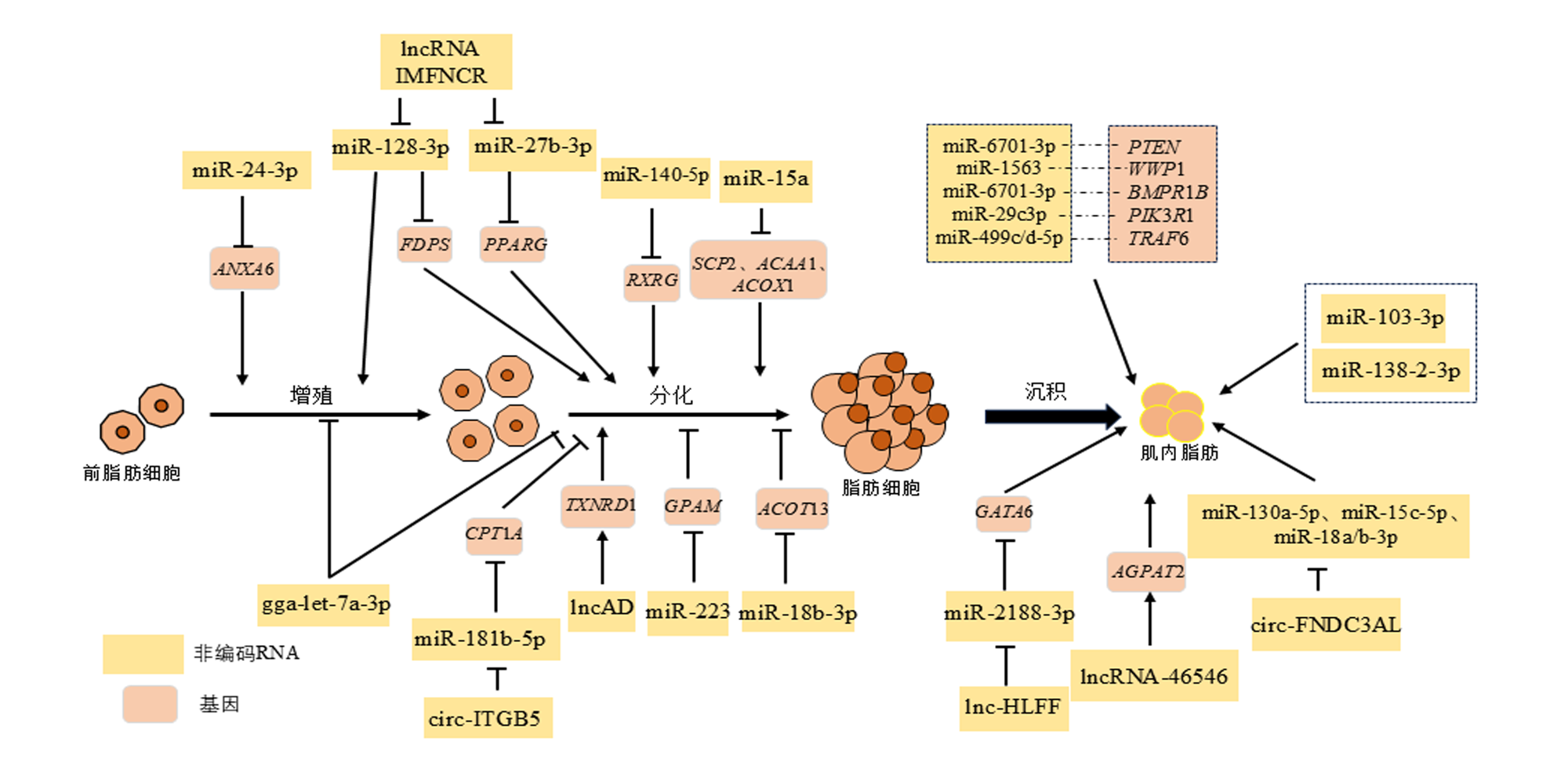
IMF含量是决定家禽肉品质的重要数量性状,其沉积过程受多种信号通路与调控因子的协同调控。其中,转录调控是最常见的基因表达控制的方式。目前已明确,过氧化物酶体增殖物激活受体(peroxisome proliferator-activated receptors,PPARs)家族、Kruppel样因子(Kruppel-like factors,KLFs)家族、CCAAT增强子结合蛋白(CCAAT/enhancer-binding proteins,C/EBPs)家族、叉头框O(forkhead box O,FoxO)家族以及信号转导与转录激活因子(signal transducers and activators of transcription,STATs)等转录因子,在家禽脂肪生成中发挥关键调控作用[22-24]。除转录因子外,非编码RNA(ncRNA)能够通过“分子海绵”“信号分子”等作用模式,在转录后水平对脂肪代谢相关基因的表达进行调控,是IMF沉积调控网络中不可或缺的重要补充(图1)。已鉴定出miR-15a、miR-24-3p、miR-128-3p、miR-140-5p、miR-18b-3p、miR-223和let-7a-3p等多个微小RNA(miRNA)可通过靶向不同的脂肪代谢相关基因,参与调控肌内前脂肪细胞增殖、分化或脂质合成的进程,共同构成IMF沉积的miRNA调控网络[25-30]。同时,在家禽IMF沉积调控中多个长链非编码RNA(lncRNA)的功能已被明确:例如,lncRNA IMFNCR能够借助内源竞争RNA(ceRNA)机制,作为miR-128-3p与miR-27b-3p的“分子海绵”,通过减弱这2种miRNA对过氧化物酶体增殖物激活受体γ(peroxisome proliferator-activated receptor gamma,PPARG)基因表达的抑制效应,最终推动肌内前脂肪细胞的分化进程[31]。另有研究表明,lncRNA ZFP36L2-AS可通过发挥RNA结合蛋白的调控功能,增强乙酰辅酶A羧化酶α(acetyl-CoA carboxylase α,ACACA)的去磷酸化水平并维持丙酮酸羧化酶(pyruvate carboxylase,PC)的结构稳定性,在介导骨骼肌代谢稳态的同时,加快IMF的沉积速率[32]。除lncRNA外,环状RNA(circRNA)如circARMH1、circLCLAT1、circFNDC3AL及circCLEC19A等也被发现具有IMF调控潜力,这些circRNA可通过靶向PPARs信号通路或脂肪酸代谢相关miRNA,间接调控脂肪生成过程[33]
图1 黄羽肉鸡IMF沉积中的ncRNA主要调控网络

ANXA6:膜联蛋白A6 annexin A6;FDPS:法尼基焦磷酸合酶 farnesyl diphosphate synthase;PPARG:过氧化物酶体增殖物激活受体γ peroxisome proliferator-activated receptor gamma;RXRG:类视黄醇X受体γ retinoid X receptor gamma;SCP2:固醇载体蛋白2 sterol carrier protein 2;ACAA1:乙酰辅酶A酰基转移酶1 acetyl-CoA acyltransferase 1;ACOX1:酰基辅酶A氧化酶1 acyl-CoA oxidase 1;PTEN:磷酸酶及张力蛋白同源物 phosphatase and tensin homolog;WWP1:含WW结构域E3泛素连接酶1 WW domain containing E3 ubiquitin protein ligase 1;BMPR1B:骨形态发生蛋白受体1B bone morphogenetic protein receptor 1B;PIK3R1:磷脂酰肌醇3-激酶调节亚基1 phosphoinositide-3-kinase regulatory subunit 1;TRAF6:肿瘤坏死因子受体相关因子6 TNF receptor associated factor 6;CPT1A:肉碱棕榈酰转移酶1A carnitine palmitoyltransferase 1A;TXNRD1:硫氧还蛋白还原酶1 thioredoxin reductase 1;GPAM:线粒体甘油三磷酸酰基转移酶 glycerol-3-phosphate acyltransferase mitochondrial;ACOT13:酰基辅酶A硫酯酶13 acyl-CoA thioesterase 13;GATA6:GATA结合蛋白6A GATA binding protein 6;AGPAT2:1-酰基甘油-3-磷酸O-酰基转移酶2 1-acylglycerol-3-phosphate O-acyltransferase 2。

Fig.1 Core regulatory networks of ncRNA in IMF deposition of yellow-feathered broilers

2.2 黄羽肉鸡中参与肌纤维发育的主要遗传调控机制

遗传调控在骨骼肌肌纤维发育过程中扮演着不可或缺的角色,其分子调控机制极为复杂,涉及多条关键信号通路的,包括腺苷酸活化蛋白激酶(adenosine monophosphate-activated protein kinase,AMPK)信号通路、Ca2+/钙调神经磷酸酶(calcineurin,CaN)信号通路、Ca2+/钙调蛋白依赖性蛋白激酶(calcium/calmodulin-dependent protein kinase,CaMK)信号通路和PPARs信号通路等。除上述通路外,骨骼肌肌纤维发育还受多种转录因子及ncRNA的调控。Zhu等[34]通过实时荧光定量PCR鉴定筛选出胰岛素样生长因子1(insulin-like growth factor 1,IGF1)、肌抑素样蛋白1(musculoskeletal tumor necrosis factor 1,MUSTN1)、丙酮酸脱氢酶激酶4(pyruvate dehydrogenase kinase 4,PDK4)作为家禽骨骼肌肌纤维发育的主要候选基因。此外,更多研究证实,过氧化物酶体增殖物激活受体γ辅激活因子1α(peroxisome proliferator-activated receptor γ coactivator 1α, PPARGC1A)、Toll样受体2(Toll-like receptor 2,TLR2)、Toll样受体4(Toll-like receptor 4,TLR4)、胰岛素样生长因子结合蛋白3(insulin-like growth factor binding protein 3,IGFBP3)等基因也参与调控肌纤维发育过程[35-39]
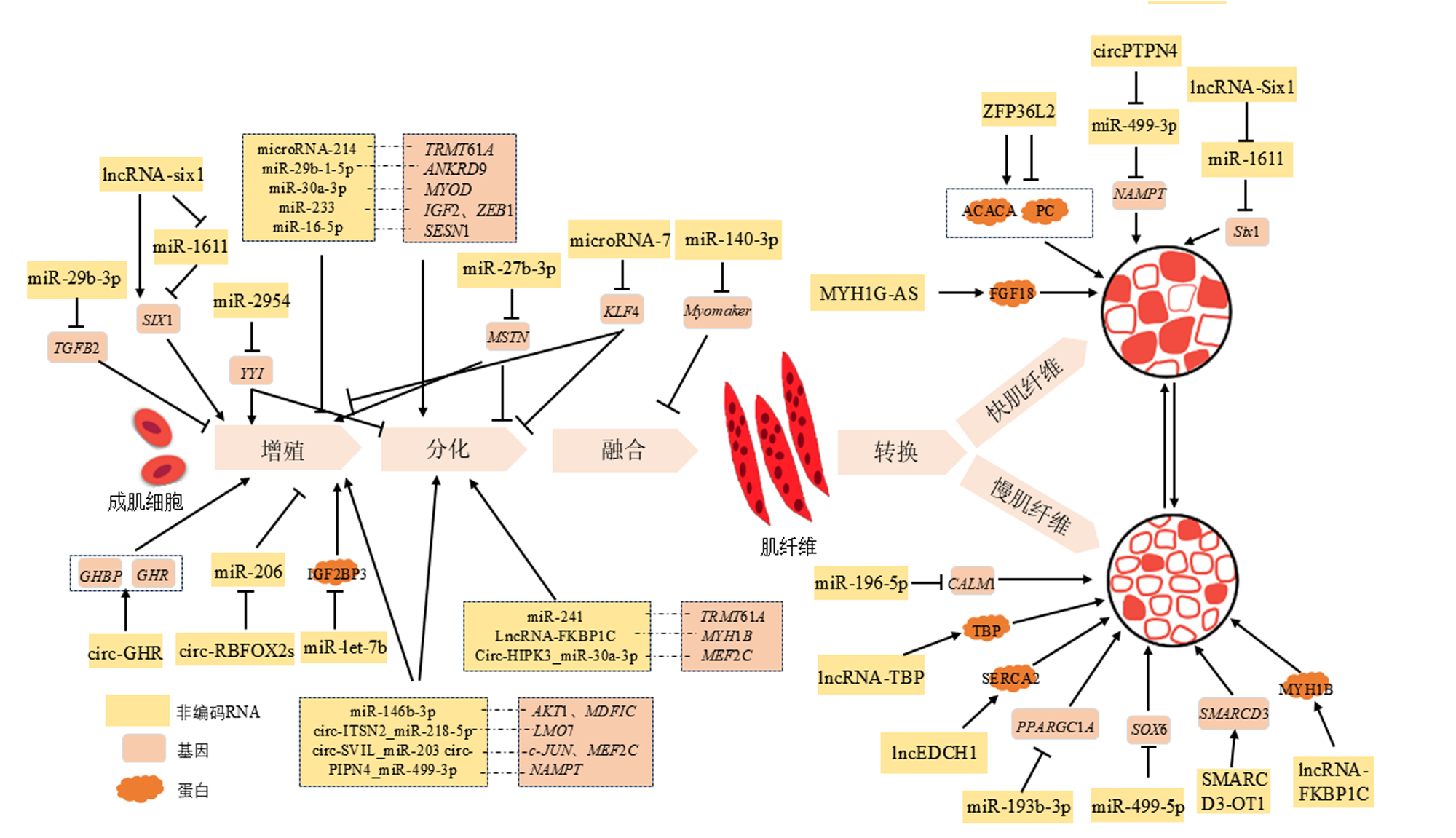
同时,ncRNA可以通过靶向肌纤维发育相关基因或信号通路,影响肌纤维的类型转化与肌肉代谢特性(图2)。例如,miRNA可通过直接靶向肌纤维发育相关基因,调控快肌与慢肌纤维的平衡[37,40]。此外,已鉴定出lncEDCH1、lncRNA ZFP36L2-AS、lncRNA MYH1G-AS及lncRNA-FKBP1C等关键lncRNA,它们可通过直接结合肌纤维发育相关蛋白(如转录因子和代谢酶等),影响蛋白活性或核定位,进而调控肌纤维的分化与肌肉代谢特性。例如,lncRNA ZFP36L2-AS可通过调节脂质代谢酶活性,间接参与氧化型肌纤维的形成[32,41-43]。circPTPN4已被证明诱导慢肌纤维向快肌表型转化,激活快肌纤维表型[44]
图2 黄羽肉鸡肌纤维发育过程中的ncRNA主要调控网络

TGFB2:转化生长因子β2 transforming growth factor beta 2;SIX1:SIX同源框1 SIX homeobox 1;YY1:YY1转录因子 YY1 transcription factor;MSTN:肌抑素 myostatin;KLF4:Krüppel样因子4 Krüppel-like factor 4;Myomaker:肌细胞生成因子myoblast determination protein;NAMPT:烟酰胺磷酸核糖转移酶 nicotinamide phosphoribosyl transferase;GHBP:生长激素结合蛋白 growth hormone binding protein;GHR:生长激素受体 growth hormone receptor;TRMT61A:tRNA甲基转移酶61A tRNA methyltransferase 61A;ANKRD9:锚蛋白重复域9 ankyrin repeat domain 9;MYOD:肌分化因子1 myogenic differentiation 1;IGF2:胰岛素样生长因子2 insulin-like growth factor 2;ZEB1:锌指E盒结合同源框1 zinc finger E-box binding homeobox 1;SESN1:应激诱导蛋白1 sestrin 1;MYH1B:肌球蛋白重链1B myosin heavy chain 1B;MEF2C:肌细胞增强因子2C myocyte enhancer factor 2C;AKT1:丝氨酸/苏氨酸蛋白激酶1 AKT serine/threonine kinase 1;MDF1C:肌分化因子1C myogenic differentiation factor 1C;LM07:LIM结构域蛋白7 LIM domain containing 7;CALM1:钙调蛋白1 calmodulin 1;PPARGC1A:过氧化物酶体增殖物激活受体γ共激活因子1α PPARG coactivator 1 alpha;SOX6:SRY-box转录因子6 SRY-box transcription factor 6;SMARCD3:染色质调节亚基D3 SWI/SNF related matrix associated actin dependent regulator of chromatin subfamily D member 3;ACACA:乙酰辅酶A羧化酶α acetyl-CoA carboxylase alpha;PC:丙酮酸羧化酶 pyruvate carboxylase;FGF18:成纤维细胞生长因子18 fibroblast growth factor 18;IGF2BP3: 胰岛素样生长因子2结合蛋白3 IGF2 mRNA binding protein 3;TBP:TATA盒结合蛋白 TATA-box binding protein;SERCA2:肌浆/内质网钙ATP酶2 sarcoplasmic/endoplasmic reticulum calcium ATPase 2;MYH1B:肌球蛋白重链1B myosin heavy chain 1B。

Fig.2 Core regulatory networks of ncRNA during myofiber development in yellow-feathered broilers

2.3 黄羽肉鸡中参与风味物质合成的主要遗传调控机制

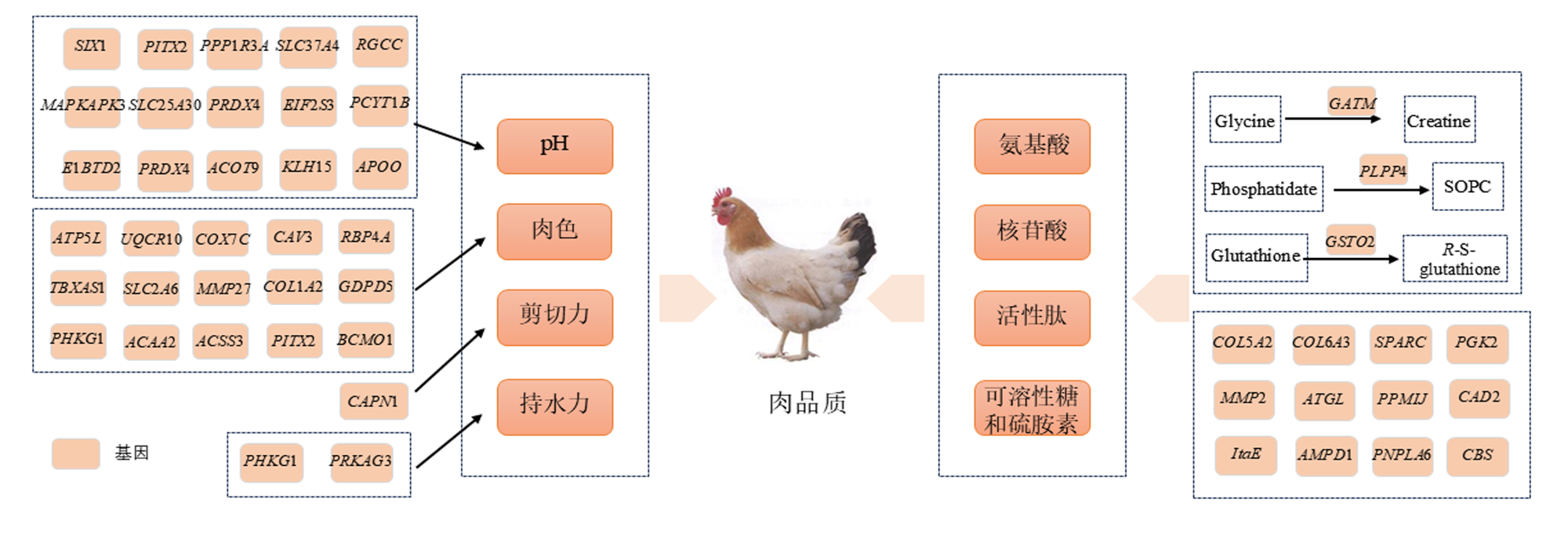
遗传因素可对肉色、系水力、pH、嫩度及风味物质等多个核心性状产生重要影响(图3)。已有多个研究明确了肌肉品质性状的关键调控基因及其作用机制。鸡肉肉色主要由肌红蛋白含量、氧化状态及血红素代谢决定,其遗传调控涉及糖酵解、脂肪酸代谢、蛋白质代谢及血红素代谢等多个相关通路[45-47]。宰后鸡肉pH的下降速率与最终pH,直接影响肌肉的保水性和嫩度。研究已确定,酰基辅酶A硫酯酶9(acyl-CoA thioesterase 9,ACOT9)、载脂蛋白O(apolipoprotein O,APOO)和小窝蛋白3(caveolin 3,CAV3)等基因可通过调控糖酵解关键酶活性、细胞能量代谢或离子转运,影响家禽宰后肌肉pH下降过程及最终pH[48]。系水力对肉品质有着至关重要的影响,研究表明,影响肌肉系水力的候选基因主要是与细胞膜通透性相关的基因,包括三磷酸腺苷结合盒转运蛋白A1(ATP-binding cassette transporter A1,ABCA1)、Ⅵ型胶原蛋白α1链(collagen type Ⅵ α1 chain,COL6A1)等[49]。此外,肌肉嫩度主要取决于肌原纤维蛋白降解程度,其中钙蛋白酶1(calpain 1,CAPN1)与钙蛋白酶抑制蛋白(calpastatin,CAST)构成的钙蛋白酶系统是调控肌原纤维蛋白降解的核心通路[50-51]
图3 黄羽肉鸡肌肉品质和风味物质的主要遗传调控网络

SIX1:SIX同源框1 SIX homeobox 1;PITX2:配对样同源域转录因子2 paired-like homeodomain transcription factor 2;PPP1R3A:蛋白磷酸1调节亚基3A protein phosphatase 1 regulatory subunit 3A;SLC37A4:溶质载体家族37成员4 solute carrier family 37 member 4;RGCC:细胞周期调节蛋白 regulator of cell cycle;MAPKAPK3:丝裂原活化蛋白激酶激活蛋白激酶3 MAPK-activated protein kinase 3;SLC25A30:溶质载体家族25成员30 solute carrier family 25 member 30;PRDX4:过氧化物还原酶4 peroxiredoxin 4;EIF2S3:真核翻译起始因子2亚基γ eukaryotic translation initiation factor 2 subunit gamma;PCYT1B:磷酸胞苷酰转移酶1B phosphate cytidylyltransferase 1B;EIBTD2:含BTB结构域蛋白2 BTB domain containing 2;ACOT9:酰基辅酶A硫酯酶9 acyl-CoA thioesterase 9;KLH15:Kelch样家族成员15 Kelch-like family member 15;APOO:载脂蛋白O apolipoprotein O;ATP5L:ATP合成酶亚基g ATP synthase subunit g;UQCR10:泛醇-细胞色素c还原酶亚基10 ubiquinol-cytochrome c reductase subunit 10;COX7C:细胞色素c氧化酶亚基7C cytochrome c oxidase subunit 7C;CAV3:小窝蛋白3 caveolin 3;RBP4A:视黄醇结合蛋白4a retinol binding protein 4a;TBXAS1:血栓烷A合成酶1 thromboxane A synthase 1;SLC2A6:溶质载体家族2成员6 solute carrier family 2 member 6;MMP27:基质金属肽酶27 matrix metallopeptidase 27;COL1A2:Ⅰ型胶原α2链 collagen type Ⅰ alpha 2 chain;GDPD5:甘油磷酸二酯酶5 glycerophosphodiester phosphodiesterase 5;PHKG1:磷酸化酶激酶调节亚基1 phosphorylase kinase regulatory subunit gamma 1;ACAA2:乙酰辅酶A酰基转移酶2 acetyl-CoA acyltransferase 2;ACSS3:短链酰基辅酶A合成酶家族成员3 acyl-CoA synthetase short-chain family member 3;BCMO1:β-胡萝卜素加氧酶1 beta-carotene oxygenase 1;CAPN1:钙蛋白酶1 calpain 1;PRKAG3:AMP激活蛋白激酶非催化亚基γ3 AMP-activated protein kinase non-catalytic subunit gamma 3;GATM:甘氨酸脒基转移酶 glycine amidinotransferase;PLPP4:磷脂磷酸酶4 phospholipid phosphatase 4;GSTO2:谷胱甘肽S-转移酶ω2 glutathione S-transferase omega 2;COL5A2:Ⅴ型胶原α2链 collagen type Ⅴ alpha 2 chain;COL6A3:Ⅵ型胶原α3链 collagen type Ⅵ alpha 3 chain;SPARC:富含半胱氨酸的酸性分泌蛋白 secreted protein acidic and rich in cysteine;PGK2:磷酸甘油酸激酶2 phosphoglycerate kinase 2;MMP2:基质金属肽酶2 matrix metallopeptidase 2;ATGL:脂肪甘油三酯脂肪酶 adipose triglyceride lipase;PPM1J:镁锰依赖性蛋白磷酸酶1J protein phosphatase Mg2+ Mn2+ dependent 1J;CAD2:钙黏蛋白2 cadherin 2;ItaE:异构酶AE isomerase AE;AMPD1:腺苷单磷酸脱氨酶1 adenosine monophosphate deaminase 1;PNPLA6:帕塔汀样磷脂酶结构域蛋白6 Patatin-like phospholipase domain containing 6;CBS:胱硫醚β合酶 cystathionine beta-synthase;Glycine:甘氨酸;Creatine:肌酸;Phosphatidate:磷脂酸;Glutathione:谷胱甘肽;R-S-glutathione:S-取代型谷胱甘肽。

Fig.3 Core genetic regulatory networks of muscle quality and flavor substances in yellow feathered broilers

风味前体物质是鸡肉特征风味形成的核心基础,其含量和组成比例直接决定肌肉风味品质。Gai等[52]通过加权基因共表达网络分析(weighted gene co-expression network analysis,WGCNA)鉴定了与氨基酸代谢相关的基因,推测胱硫醚β-合成酶(cystathionine β-synthase,CBS)、甘氨酸脒基转移酶(glycine amidinotransferase,GATM)、谷氨酸脱羧酶2(glutamate decarboxylase 2,GAD2)、整合素αE(integrin αE,ItaE)是肌肉发育过程中参与氨基酸衍生风味形成的关键基因。通过试验已证实,磷酸甘油酸激酶2(phosphoglycerate kinase 2,PGK2)、蛋白磷酸酶镁锰依赖性1J(protein phosphatase Mg2+/Mn2+ dependent 1J,PPM1J)基因可通过介导肌肉组织中蛋白质磷酸化过程,调控风味前体物质的生成与转化,进而影响肉鸡肌肉风味[53-54]

3 参与调控黄羽肉鸡肉品质的主要营养-遗传协作因素

肉品质是一类复杂的多维度性状,其形成与遗传基础、营养调控等因素密切相关。营养素通过调控转录因子活性、RNA加工及表观遗传修饰等途径,影响肉质相关基因的时空表达,最终影响鸡肉肉质表型(表1)。
表1 营养素调控遗传物质的表达及其对肉品质的影响

Table 1 Effects of nutrient regulation on genetic material expression and their impacts on meat quality

项目
Items
添加量
Addition
效果
Effects
作用途径
Pathways of action
调控基因
Regulated genes
参考文献
References
代谢能
Metabolizable energy
3 180 kcal/kg
(约13.30 MJ/kg)
改善IMF含量和
肌肉嫩度
FABP3、APO3 [55]
蛋白质
Protein
13.5% 促进IMF沉积 FXR-SHP-SREBP1
和PPARG通路
FASNC/EBPβ
CD36
[56]
精氨酸
Arginine
肉鸡推荐
量的70%
改善IMF和
腹部脂肪含量
FASNLPL [57]
肌苷酸
Inosinic acid
0.5% 改善腹脂率、
肌肉肉色和pH
GPAT
ADSL
[58]
益生元(低聚半乳糖或低聚木糖) Prebiotic (galacto-oligosaccharides or xylo-oligosaccharides) 1% 改善磷脂和氨基酸组分 PNPADA [59]
硒代蛋氨酸+枯草芽孢杆菌
Selenomethionine+Bacillus subtilis
0.3 mg/kg+
109 CFU/kg
改善IMF含量及肌肉
系水力、嫩度、
肉色和pH
Myf5、FMMyoGMyoD
IGF1、CAPN2、CAPN3、
SMSLC27A1、FAT
FABP4、H-FABPFASN
ACACA
[60]
维生素E
Vitamin E
100 IU/kg 促进IMF沉积 AGE-RAGE、
MAPK和FoxO
信号通路
ASB2、CETPPDK4、
CYR61、AGTR1、
UCP3和HPGD
[61]
维生素D3
Vitamin D3
3 750 IU/kg 改善IMF和
腹部脂肪含量
脂肪酸生物合成和
代谢途径
LPLFATP1 [62]
芦丁
Rutin
200 mg/kg 改善IMF和肌肉
脂肪酸含量
AMPK/PPARG
信号通路
AMPKαPPARG
FADS1、ACACA
FASNELOVL7
[63]
发酵柑橘渣
Fermented citrus pomace
10% 改善IMF含量、
肌肉pH和肉色
SREBP1和FASN [64]
新鲜玉米提取物
Fresh corn extract
0.6% 促进IMF沉积 鞘脂代谢途径 SPHK1、CERS1、
CERS6、GLB1L
SGMS2、UGT8
UGCG
[65]
山药多糖
Chinese yam polysaccharide
250 mg/kg 抑制IMF沉积 Wnt/β-连环蛋白和
PPARG信号通路
Wnt1、PPARG
C/EBPα
[47]
干燥的印楝叶提取物
Dried neem leaf extract
2.0% 改善脂质过
氧化和系水力
SOD1、MnSOD
GPX7和CAT
[66]
姜黄素
Curcumin
1 000 mg/kg 改善腹部脂肪含量 ACCFASNSREBP1c
ACLYPPARαCPT1
[67]
甘草多糖
Glycyrrhiza polysaccharide
900 mg/kg 改善肌肉肉色、pH、
蒸煮损失和滴定损失
LPLPPARGFABP3、
CASTCAPN2
[68]
果糖
Fructose
10% 促进IMF沉积 DNL途径 ChREBP [69]

IMF:肌内脂肪 intramuscular fat;FXR:法尼醇X受体 farnesoid X receptor;SHP:小异二聚体伴侣 small heterodimer partner;SREBP1:固醇调节元件结合蛋白1 sterol regulatory element-binding protein 1;PPARG:过氧化物酶体增殖物激活受体γ peroxisome proliferator-activated receptor gamma;AGE:晚期糖基化终末产物 advanced glycation end products;RAGE:晚期糖基化终末产物受体 receptor for advanced glycation end products;MAPK:丝裂原活化蛋白激酶 mitogen-activated protein kinase;FoxO:叉头框O forkhead box O;AMPK:腺苷酸活化蛋白激酶 adenosine monophosphate-activated protein kinase;DNL:从头脂肪合成 de novo lipogenesis;FABP3:脂肪酸结合蛋白3 fatty acid-binding protein 3;APO3:载脂蛋白3 apolipoprotein 3;FASN:脂肪酸合酶 fatty acid synthase;C/EBPβ:CCAAT/增强子结合蛋白β CCAAT/enhancer-binding protein beta;CD36:分化簇36 cluster of differentiation 36;LPL:脂蛋白脂酶 lipoprotein lipase;GPAT:甘油-3-磷酸酰基转移酶 glycerol-3-phosphate acyltransferase;ADSL:腺苷酸琥珀酸裂解酶 adenylosuccinate lyase;PNP:嘌呤核苷磷酸化酶 purine nucleoside phosphorylase;ADA:腺苷脱氨酶 adenosine deaminase;Myf5:生肌因子5 myogenic factor 5;FM:快速肌球蛋白重链 fast myosin heavy chain;MyoG:肌细胞生成素 myogenin;MyoD:生肌决定因子 myogenic differentiation;IGF1:胰岛素样生长因子1 insulin-like growth factor 1;CAPN2:钙蛋白酶2 calpain 2;CAPN3:钙蛋白酶3 calpain 3;SM:慢肌球蛋白重链 slow myosin heavy chain;SLC27A1:溶质载体家族27成员1 solute carrier family 27 member 1;FAT:脂肪酸转运蛋白 fatty acid translocase;FABP4:脂肪酸结合蛋白4 fatty acid-binding protein 4;H-FABP:心脏型脂肪酸结合蛋白 heart-type fatty acid-binding protein;ACACA:乙酰辅酶A羧化酶α acetyl-CoA carboxylase alpha;ASB2:含锚蛋白重复序列和SOCS盒蛋白2 ankyrin repeat and SOCS box-containing protein 2;CETP:胆固醇酯转移蛋白 cholesteryl ester transfer protein;PDK4:丙酮酸脱氢酶激酶4 pyruvate dehydrogenase kinase 4;CYR61:富含半胱氨酸的血管生成诱导因子61 cysteine-rich angiogenic inducer 61;AGTR1:血管紧张素Ⅱ受体1型 angiotensin Ⅱ receptor type 1;UCP3:解偶联蛋白3 uncoupling protein 3;HPGD:15-羟基前列腺素脱氢酶 15-hydroxyprostaglandin dehydrogenase;FATP1:脂肪酸转运蛋白1 fatty acid transport protein 1;AMPKα:5'-腺苷酸活化蛋白激酶α亚基 5'-adenosine monophosphate-activated protein kinase α;PPARG:过氧化物酶体增殖物激活受体γ peroxisome proliferator-activated receptor gamma;FADS1:脂肪酸去饱和酶1 fatty acid desaturase 1;ELOVL7:脂肪酸延长酶7 elongation of very long chain fatty acids protein 7;SREBP1:固醇调节元件结合蛋白1 sterol regulatory element-binding protein 1;SPHK1:鞘氨醇激酶1 sphingosine kinase 1;CERS1:神经酰胺合酶1 ceramide synthase 1;CERS6:神经酰胺合酶6 ceramide synthase 6;GLB1L:半乳糖苷酶β1样蛋白 galactosidase beta 1 like;SGMS2:鞘磷脂合酶2 sphingomyelin synthase 2;UGT8:UDP-糖基转移酶8 UDP-glycosyltransferase 8;UGCG:UDP-葡萄糖神经酰胺葡糖基转移酶 UDP-glucose ceramide glucosyltransferase;Wnt1:无翅型MMTV整合位点家族成员1 wingless-type MMTV integration site family member 1;C/EBPα:CCAAT/增强子结合蛋白α CCAAT/enhancer-binding protein alpha;SOD1:超氧化物歧化酶1 superoxide dismutase 1;MnSOD:锰超氧化物歧化酶 manganese superoxide dismutase;GPX7:谷胱甘肽过氧化物酶7 glutathione peroxidase 7;CAT:过氧化氢酶 catalase;ACC:乙酰辅酶A羧化酶 acetyl-CoA carboxylase;SREBP1c:固醇调节元件结合蛋白1c sterol regulatory element-binding protein 1c;ACLY:ATP柠檬酸裂解酶 ATP-citrate lyase;PPARα:过氧化物酶体增殖物激活受体α peroxisome proliferator-activated receptor alpha;CPT1:肉碱棕榈酰转移酶1 carnitine palmitoyltransferase 1;CAST:钙蛋白酶抑制蛋白 calpastatin;ChREBP:碳水化合物反应元件结合蛋白 carbohydrate-responsive element-binding protein。

饲粮代谢能水平对肉鸡肌肉成分具有显著调控作用,当黄羽肉鸡饲粮中代谢能水平达到3 180 kcal/kg(约13.30 MJ/kg)时,鸡肉的品质和风味达到最佳,这种改变可能与高能量饲粮上调脂肪酸结合蛋白3(fatty acid binding protein 3,FABP3)和载脂蛋白B(apolipoprotein B,APOB)的表达,促进IMF沉积相关[55]。有研究发现,IMF和鸡肉肉质受到低蛋白质饲粮的影响,低蛋白质饲粮显著上调肝脏中脂质代谢相关基因的表达,这些基因包括脂肪酸合酶(fatty acid synthase,FASN)、CCAAT/增强子结合蛋白β(CCAAT/enhancer binding protein β,C/EBPβ)和分化簇36(cluster of differentiation 36,CD36)[56]。适量的精氨酸补充剂可以上调肌肉中与脂肪合成相关基因(如FASNLPL)的表达,增加胸肌的重量和IMF的含量,同时降低肉鸡的腹部脂肪沉积和血浆中胆固醇和甘油三酯含量[57]。此外,周博等[58]研究表明,额外添加肌苷酸可以有效改善肉鸡的腹脂率、肉色和pH等指标,这一功能可能与调控甘油-3-磷酸酰基转移酶(glycerol-3-phosphate acyltransferase,GPAT)和腺苷琥珀酸裂解酶(adenylosuccinate lyase,ADSL)的表达相关。
饲粮中补充益生元可诱导脂肪分解和脂肪细胞因子信号通路相关基因参与调控脂肪酸积累过程,改变与风味相关的代谢物的含量[59]。此外,Yang等[60]研究发现,补充硒代蛋氨酸和枯草芽孢杆菌后,促进了IGF1、FASNACACA等基因的表达,进而缓解了热应激对肉鸡IMF含量、系水力、嫩度、肉色和pH的不利影响。研究表明,饲粮中补充100 IU/kg维生素E可以调节线粒蛋白激活的激酶和FoxO信号通路,改善肉鸡IMF沉积[61]。而另一项研究发现,饲粮中补充3 750 IU/kg维生素D3时,可以促进脂肪相关基因的表达,从而显著增加IMF含量[62]
植物提取物对鸡肉肉品质的影响也得到了证实。据报道,补充芦丁可促进清远麻鸡胸肌中IMF沉积,并调控AMPK/PPARG信号通路和相关基因的表达,如5'-腺苷酸活化蛋白激酶α亚基(5'-adenosine monophosphate-activated protein kinase α,AMPKα)、PPARGACACAFASN[63]。添加10%发酵柑橘渣可以上调固醇调节元件结合蛋白1(sterol regulatory element-binding protein 1,SREBP1)和FASN的表达,促进脂质合成,从而提高清远麻鸡的IMF含量[64]。利用转录组学和代谢组学分析发现,饲粮中添加0.6%新鲜玉米提取物后,可调控鞘氨醇激酶1(sphingosine kinase1,SPHK1)、神经酰胺合酶1(ceramide synthase 1,CERS1)等基因的表达,参与肉鸡IMF形成的调节[65]。另有研究发现,添加山药多糖[48]、干燥的印楝叶提取物[66]、姜黄素[67]均有助于改善鸡肉品质。此外,甘草多糖[68]、果糖[69]也被证实通过各种信号通路调节鸡肉品质。
上述这些研究从营养调控基因组学的角度确立了营养素与肉品质调节之间的遗传关联,为整合遗传和营养协作以提高黄羽肉鸡的肉品质提供了参考。

4 小结

关于禽肉质量的定义存在差异,其不仅取决于肉品的内在性状(如嫩度、风味、系水力)与外在性状(如肉色),还与消费者的主观偏好(如口感需求、健康诉求)密切相关。在家禽肉品质形成过程中,肌纤维特性、IMF及风味物质含量是决定肉品质的关键内在因素,已有大量研究证实上述指标与嫩度、多汁性、风味等核心肉品质性状存在明确关联。目前,已鉴定出大量调控鸡肉品质的关键分子,包括影响肌纤维发育、IMF沉积及风味物质含量的候选基因、转录因子、ncRNA及表观遗传修饰因子,这些发现为优质黄羽肉鸡的遗传育种提供了坚实的理论依据与分子标记。同时,营养干预与遗传调控的协作机制也逐步明确,特定营养素通过影响关键基因、蛋白质、ncRNA和表观遗传修饰,最终影响黄羽肉鸡的肉品质。营养基因组学研究进一步揭示了营养素(蛋白质、氨基酸、维生素、植物化学物质等)与鸡肉品质之间的遗传关联,为黄羽肉鸡的“精准营养调控肉品质”提供了科学支撑。
然而,尽管鸡肉品质调控研究已取得显著进展,但通过“营养-遗传”协同作用调控肉鸡肌肉风味物质形成的机制仍未明确,是当前研究的核心短板。基于此,未来的研究应聚焦于鸡肉风味物质的形成机制,特别是通过了解其遗传基础,深入探究遗传与营养之间的协同作用机制;并整合多组学技术(如代谢组学、基因组学、转录组学和蛋白质组学相结合)来阐明肉品质调控的机制,以实施精准的营养调控措施。
[1]
巨晓军, 刘一帆, 章明, 等. 鸡肉品质性状评价指标与方法研究进展[J]. 中国家禽, 2019, 41(2):44-48.

JU X J, LIU Y F, ZHANG M, et al. Research progress on evaluation indices and methods of chicken meat quality[J]. China Poultry, 2019, 41(2):44-48. (in Chinese)

[2]
孙玲利, 卢慧芳, 张磊, 等. 家禽肌纤维类型分化机制研究进展[J]. 中国家禽, 2015, 37(8):46-49.

SUN L L, LU H F, ZHANG L, et al. Research progress of type differentiation mechanism of muscle fiber in poultry[J]. China Poultry, 2015, 37(8):46-49. (in Chinese)

[3]
WENG K Q, HUO W R, LI Y, et al. Fiber characteristics and meat quality of different muscular tissues from slow- and fast-growing broilers[J]. Poultry Science, 2022, 101(1):101537.

DOI

[4]
GLANCY B, KANE D A, KAVAZIS A N, et al. Mitochondrial lactate metabolism:history and implications for exercise and disease[J]. The Journal of Physiology, 2021, 599(3):863-888.

DOI

[5]
KIM Y H B, MA D Y, SETYABRATA D, et al. Understanding postmortem biochemical processes and post-harvest aging factors to develop novel smart-aging strategies[J]. Meat Science, 2018, 144:74-90.

DOI PMID

[6]
HUO W R, WENG K Q, GU T T, et al. Effect of muscle fiber characteristics on meat quality in fast- and slow-growing ducks[J]. Poultry Science, 2021, 100(8):101264.

DOI

[7]
LI J J, LI Z Q, RAN J S, et al. LC/MS-based lipidomics to characterize breed-specific and tissue-specific lipid composition of chicken meat and abdominal fat[J]. LWT, 2022, 163:113611.

DOI

[8]
HOCQUETTE J F, GONDRET F, BAÉZA E, et al. Intramuscular fat content in meat-producing animals:development,genetic and nutritional control,and identification of putative markers[J]. Animal, 2010, 4(2):303-319.

DOI

[9]
KHAN M I, JO C, TARIQ M R. Meat flavor precursors and factors influencing flavor precursors—a systematic review[J]. Meat Science, 2015, 110:278-284.

DOI

[10]
袁倩, 王宇, 苏琳, 等. 饲养方式对苏尼特羊肌内脂肪沉积途径AMPK-ACC-CPT1通路和肉品品质的影响[J]. 食品科学, 2019, 40(1):31-36.

DOI

YUAN Q, WANG Y, SU L, et al. Effects of different feeding systems on intramuscular fat deposition pathway AMPK-ACC-CPT1 and meat quality in Sunit lamb[J]. Food Science, 2019, 40(1):31-36. (in Chinese)

DOI

[11]
JEON H J, CHOE J H, JUNG Y, et al. Comparison of the chemical composition,textural characteristics,and sensory properties of north and south Korean native chickens and commercial broilers[J]. Korean Journal for Food Science of Animal Resources, 2010, 30(2):171-178.

DOI

[12]
KIYOHARA R, YAMAGUCHI S, RIKIMARU K, et al. Supplemental arachidonic acid-enriched oil improves the taste of thigh meat of Hinai-jidori chickens[J]. Poultry Science, 2011, 90(8):1817-1822.

DOI PMID

[13]
QI J, DU C, YAO X N, et al. Enrichment of taste and aroma compounds in braised soup during repeated stewing of chicken meat[J]. LWT, 2022, 168:113926.

DOI

[14]
SHIN D J, JUNG Y, KIM D, et al. Identification and comparison of aroma and taste-related compounds from breast meat of three breeds of Korean native chickens[J]. Poultry Science, 2024, 103(3):103462.

DOI

[15]
XIAO Z C, LUO Y T, WANG G Y, et al. 1H-NMR-based water-soluble low molecular weight compound characterization and fatty acid composition of boiled Wuding chicken during processing[J]. Journal Science of Food and Agriculture, 2019, 99(1):429-435.

DOI

[16]
DASHDORJ D, AMNA T, HWANG I. Influence of specific taste-active components on meat flavor as affected by intrinsic and extrinsic factors:an overview[J]. European Food Research and Technology, 2015, 241(2):157-171.

DOI

[17]
CHAUDHARI N, PEREIRA E, ROPER S D. Taste receptors for umami:the case for multiple receptors[J]. The American Journal of Clinical Nutrition, 2009, 90(3):738S-742S.

DOI

[18]
KONG Y, YANG X, DING Q, et al. Comparison of non-volatile umami components in chicken soup and chicken enzymatic hydrolysate[J]. Food Research International, 2017, 102:559-566.

DOI PMID

[19]
DONG M, ZHANG Z C, WANG H P, et al. Discrimination and evaluation of commercial salmons by low-molecule-weight compounds:oligopeptides and phosphatides[J]. Food Chemistry, 2024, 455:139777.

DOI

[20]
MEINERT L, SCHÄFER A, BJERGEGAARD C, et al. Comparison of glucose,glucose 6-phosphate,ribose,and mannose as flavour precursors in pork;the effect of monosaccharide addition on flavour generation[J]. Meat Science, 2009, 81(3):419-425.

DOI

[21]
FAN M D, XIAO Q F, XIE J C, et al. Aroma compounds in chicken broths of Beijing Youji and commercial broilers[J]. Journal of Agricultural and Food Chemistry, 2018, 66(39):10242-10251.

DOI

[22]
LIU L, LIU X J, CUI H X, et al. Transcriptional insights into key genes and pathways controlling muscle lipid metabolism in broiler chickens[J]. BMC Genomics, 2019, 20(1):863.

DOI PMID

[23]
FU R Q, LIU R R, ZHAO G P, et al. Expression profiles of key transcription factors involved in lipid metabolism in Beijing-You chickens[J]. Gene, 2014, 537(1):120-125.

DOI

[24]
WANG W J, LI Y D, LI Z W, et al. Polymorphisms of KLF3 gene coding region and identification of their functionality for abdominal fat in chickens[J]. Veterinary Medicine and Science, 2021, 7(3):792-799.

DOI

[25]
LI G X, FU S Y, CHEN Y, et al. MicroRNA-15a regulates the differentiation of intramuscular preadipocytes by targeting ACAA1,ACOX1 and SCP2 in chickens[J]. International Journal of Molecular Sciences, 2019, 20(16):4063.

DOI

[26]
LIN Z Z, TANG Y, LI Z Q, et al. miR-24-3p dominates the proliferation and differentiation of chicken intramuscular preadipocytes by blocking ANXA6 expression[J]. Genes, 2022, 13(4):635.

DOI

[27]
ZHU S P, ZHANG B B, ZHU T Q, et al. miR-128-3p inhibits intramuscular adipocytes differentiation in chickens by downregulating FDPS[J]. BMC Genomics, 2023, 24(1):540.

DOI

[28]
ZHANG M, LI D H, LI F, et al. Integrated analysis of miRNA and genes associated with meat quality reveals that Gga-MiR-140-5p affects intramuscular fat deposition in chickens[J]. Cellular Physiology and Biochemistry, 2018, 46(6):2421-2433.

DOI PMID

[29]
SUN G R, LI F, MA X F, et al. gga-miRNA-18b-3p inhibits intramuscular adipocytes differentiation in chicken by targeting the ACOT13 gene[J]. Cells, 2019, 8(6):556.

DOI

[30]
REN P, CHEN M, LIU Q, et al. Gga-let-7a-3p inhibits the proliferation and differentiation of chicken intramuscular preadipocytes[J]. British Poultry Science, 2024, 65(1):34-43.

DOI

[31]
ZHANG M, LI F, SUN J W, et al. LncRNA IMFNCR promotes intramuscular adipocyte differentiation by sponging miR-128-3p and miR-27b-3p[J]. Frontiers in Genetics, 2019, 10:42.

DOI PMID

[32]
CAI B L, MA M T, ZHANG J, et al. Long noncoding RNA ZFP36L2-AS functions as a metabolic modulator to regulate muscle development[J]. Cell Death & Disease, 2022, 13(4):389.

[33]
ZHANG M, HAN Y, ZHAI Y H, et al. Integrative analysis of circRNAs,miRNAs,and mRNAs profiles to reveal ceRNAs networks in chicken intramuscular and abdominal adipogenesis[J]. BMC Genomics, 2020, 21(1):594.

DOI

[34]
ZHU M T, WANG M Y, SHAO Y Y, et al. Characterization of muscle development and gene expression in early embryos of chicken,quail,and their hybrids[J]. Gene, 2021, 768:145319.

DOI

[35]
YU M L, WANG H, XU Y L, et al. Insulin-like growth factor-1 (IGF-1) promotes myoblast proliferation and skeletal muscle growth of embryonic chickens via the PI3K/Akt signalling pathway[J]. Cell Biology International, 2015, 39(8):910-922.

DOI PMID

[36]
LI Z H, CAI B L, ABDALLA B A, et al. LncIRS1 controls muscle atrophy via sponging miR-15 family to activate IGF1-PI3K/AKT pathway[J]. Journal of Cachexia,Sarcopenia and Muscle, 2019, 10(2):391-410.

DOI

[37]
MA M T, CAI B L, KONG S F, et al. PPARGC1A is a moderator of skeletal muscle development regulated by miR-193b-3p[J]. International Journal of Molecular Sciences, 2022, 23(17):9575.

DOI

[38]
BOONLAOS A, UDDIN M J, TEMYORD K, et al. Muscle fiber characteristics and expression level of troponin T3,Toll-like receptor 2,and Toll-like receptor 4 genes in chicken meat with white striping[J]. Veterinary World, 2023, 16(7):1415-1420.

[39]
GUO X, ZHANG H, WANG H, et al. Identification of key modules and hub genes involved in regulating the color of chicken breast meat using WGCNA[J]. Animals, 2023, 13(14):2356.

DOI

[40]
LIU Y F, ZHANG M, SHAN Y J, et al. miRNA-mRNA network regulation in the skeletal muscle fiber phenotype of chickens revealed by integrated analysis of miRNAome and transcriptome[J]. Scientific Reports, 2020, 10(1):10619.

DOI PMID

[41]
YU J A, WANG Z J, YANG X, et al. LncRNA-FKBP1C regulates muscle fiber type switching by affecting the stability of MYH1B[J]. Cell Death Discovery, 2021, 7(1):73.

DOI

[42]
CAI B L, MA M T, ZHANG J, et al. LncEDCH1 improves mitochondrial function to reduce muscle atrophy by interacting with SERCA2[J]. Molecular Therapy Nucleic Acids, 2022, 27:319-334.

DOI

[43]
CAI B L, MA M T, YUAN R S, et al. MYH1G-AS is a chromatin-associated lncRNA that regulates skeletal muscle development in chicken[J]. Cellular & Molecular Biology Letters, 2024, 29(1):9.

[44]
CAI B L, MA M T, ZHOU Z, et al. circPTPN4 regulates myogenesis via the miR-499-3p/NAMPT axis[J]. Journal of Animal Science and Biotechnology, 2022, 13(1):2.

DOI PMID

[45]
XIONG X W, LIU X X, ZHU X N, et al. A mutation in PHKG1 causes high drip loss and low meat quality in Chinese Ningdu yellow chickens[J]. Poultry Science, 2022, 101(1):101556.

DOI

[46]
姜宏正, 杨德智, 马中华, 等. 儋州鸡胸肌肉色性状全基因组关联分析[J]. 中国畜牧杂志, 2022, 58(6):117-122.

JIANG H Z, YANG D Z, MA Z H, et al. Genome-wide association study of meat color traits in Danzhou chickens[J]. Chinese Journal of Animal Science, 2022, 58(6):117-122. (in Chinese)

[47]
HUANG R Q, DENG X Q, WU J W, et al. Genetic and metabolic factors influencing skin yellowness in yellow-feathered broilers[J]. Poultry Science, 2025, 104(1):104534.

DOI

[48]
BIHAN-DUVAL E L, HENNEQUET-ANTIER C, BERRI C, et al. Identification of genomic regions and candidate genes for chicken meat ultimate pH by combined detection of selection signatures and QTL[J]. BMC Genomics, 2018, 19(1):294.

DOI

[49]
ZHANG M, YAN F B, LI F, et al. Genome-wide DNA methylation profiles reveal novel candidate genes associated with meat quality at different age stages in hens[J]. Scientific Reports, 2017, 7:45564.

DOI PMID

[50]
SHU J T, ZHANG M, SHAN Y J, et al. Analysis of the genetic effects of CAPN1 gene polymorphisms on chicken meat tenderness[J]. Genetics and Molecular Research, 2015, 14(1):1393-1403.

DOI

[51]
ZHOU Y G, XIONG Y, YANG C W, et al. Experimental verification of CAPN1 and CAST gene polymorphisms in different generations of Da-heng broilers[J]. BioMed Research International, 2017, 2017(1):7968450.

[52]
GAI K, GE Y, LIU D P, et al. Identification of key genes affecting flavor formation in Beijing-You chicken meat by transcriptome and metabolome analyses[J]. Foods, 2023, 12(5):1025.

DOI

[53]
MA M T, YANG X, KONG S F, et al. Phosphoproteomic reveals that phosphoglycerate kinase 2 suppresses hypoxanthine accumulation in broiler[J]. Food Frontiers, 2025, 6(2):789-800.

DOI

[54]
MA M T, YANG X, ZHANG Y N, et al. PPM1J regulates meat quality feature and glycerophospholipids composition in broiler by modulating protein dephosphorylation[J]. NPJ Science Food, 2024, 8(1):89.

DOI

[55]
CUI X Y, EL-SENOUSEY H K, GOU Z Y, et al. Evaluation of dietary metabolizable energy concentrations on meat quality and lipid metabolism-related gene expression in yellow-feathered chickens[J]. Journal Animal Physiology and Animal Nutrition, 2023, 107(1):275-285.

DOI

[56]
YUAN X, FANG X S, LI Y X, et al. Effects of dietary protein level on liver lipid deposition,bile acid profile and gut microbiota composition of growing pullets[J]. Poultry Science, 2024, 103(11):104183.

DOI

[57]
CASTRO F L S, SU S, CHOI H, et al. L-arginine supplementation enhances growth performance,lean muscle,and bone density but not fat in broiler chickens[J]. Poultry Science, 2019, 98(4):1716-1722.

DOI

[58]
周博, 闫俊书, 吴乐, 等. 种鸡及子代肉仔鸡饲粮添加外源肌苷酸对子代肉仔鸡生长性能、肉品质及相关基因表达的影响[J]. 动物营养学报, 2019, 31(2):638-651.

ZHOU B, YAN J S, WU L, et al. Effects of adding exogenous inosinic acid in diets of breeding hens and offspring broilers on growth performance,meat quality and related gene expression of offspring broilers[J]. Chinese Journal of Animal Nutrition, 2019, 31(2):638-651. (in Chinese)

[59]
YANG C W, QIU M H, ZHANG Z R, et al. Galacto-oligosaccharides and xylo-oligosaccharides affect meat flavor by altering the cecal microbiome,metabolome,and transcriptome of chickens[J]. Poultry Science, 2022, 101(11):102122.

DOI

[60]
YANG W G, XUE J J, ZHANG S, et al. Enhancing skeletal muscle fiber characteristics,intramuscular fat deposition,and fatty acid composition in broilers under heat stress through combined selenomethionine and Bacillus subtilis supplementation in the diet[J]. Journal of Animal Science, 2024, 102:skae267.

DOI

[61]
ZHANG M, LIN W M, WU Q, et al. Effects of dietary vitamin E on intramuscular fat deposition and transcriptome profile of the pectoral muscle of broilers[J]. Journal of Poultry Science, 2023, 60(1):2023006.

[62]
LI J W, LI X M, TIAN J M, et al. Effects of supplementation with vitamin D3 on growth performance,lipid metabolism and cecal microbiota in broiler chickens[J]. Frontiers in Veterinary Science, 2025, 12:1542637.

DOI

[63]
LI Y F, MEI H D, LIU Y C, et al. Dietary supplementation with rutin alters meat quality,fatty acid profile,antioxidant capacity,and expression levels of genes associated with lipid metabolism in breast muscle of Qingyuan partridge chickens[J]. Foods, 2023, 12(12):2302.

DOI

[64]
LIU Y C, TANG Y T, MEI H D, et al. Feeding citrus pomace fermented with combined probiotics improves growth performance,meat quality,fatty acid profile,and antioxidant capacity in yellow-feathered broilers[J]. Frontiers in Veterinary Science, 2024, 11:1469947.

DOI

[65]
TIAN J L, WU Y X, ZHAO W, et al. Transcriptomic and metabolomic-based revelation of the effect of fresh corn extract on meat quality of Jingyuan chicken[J]. Poultry Science, 2025, 104(2):104814.

DOI

[66]
NAKAMURA K, SHISHIDO M, SHIMAMOTO S, et al. Effects of supplementation with dried neem leaf extract on lipid peroxidation and antioxidant enzyme mRNA expression in the pectoralis major muscle of broiler chickens[J]. The Journal of Poultry Science, 2022, 59(1):75-80.

DOI

[67]
XIE Z L, SHEN G Z, WANG Y, et al. Curcumin supplementation regulates lipid metabolism in broiler chickens[J]. Poultry Science, 2019, 98(1):422-429.

DOI PMID

[68]
杨又兵, 钱凯凤, 卢小宁, 等. 甘草多糖对鸡肉品质及其相关候选基因表达的影响[J]. 江苏农业科学, 2024, 52(9):219-225.

YANG Y B, QIAN K F, LU X N, et al. Effects of licorice polysaccharides on chicken meat quality and related candidate gene expression[J]. Jiangsu Agricultural Sciences, 2024, 52(9):219-225. (in Chinese)

[69]
WANG P, XIAO H H, WU T, et al. Activation of skeletal carbohydrate-response element binding protein (ChREBP)-mediated de novo lipogenesis increases intramuscular fat content in chickens[J]. Animal Nutrition, 2024, 18:107-118.

DOI

Outlines

/